Formerly a knuckle-head, now an earnest Christian, who is married to his best friend, the father of three, an evangelist of the Gospel, a Star Wars fan, and tries to be an all around nice guy.
In the Hebrew Bible, the verb zākar (“to remember,” “to memorialize,” “to recite”) appears 222 times in 213 verses, used at least once in every book. It finds its most use in the Psalms, appearing 52 times, then Isaiah (24), Ezekiel (21), followed by Jeremiah (16), and Deuteronomy (15). By contrast, the noun zēker (remembrance, memorial) appears 23 times. It appears memory is an important part of a life that reflects on faith and one’s dependence on God.
In the New Testament, several Greek words are translated with “memory” (mnēmē) or a “remembrance” (anamnēsis), “to remember” or “to remind” (mimnéskō). Each of these words has its shade of meaning, but all speak to things that are brought to the foreground of our thoughts after some time has elapsed. Again, in the New Testament, we see that memory serves a significant function.
If you would like to trace these words down throughout Scripture, I recommend an accessible study guide such as Vine’s Complete Expository Dictionary of Old and New Testament Words or Stephen D. Renn’s Expository Dictionary of Bible Words. It will profit your soul to see the range our “memory” is taken by the faithful.
Another profitable way to appreciate the brain is a study of that part of the brain called the hippocampus. It is said to be the place associated with both memory and emotion and the intricate interweaving of both. For example, you go to an event and meet new people. Who would you remember, usually the ones you found interesting or funny (“Memory, Learning, and Emotion: the Hippocampus,” psycheducation.org). I find it particularly ingenious that the place that stores our memories is also the place that attaches emotions to our memories. It is only my opinion, but I believe that makes the hippocampus one of the most important places in the brain.
I want to open my hippocampus and share two stories with you that mean a lot to me. I hope they encourage you. God bless.
Story 1: The Cadbury Creme Eggs of Reconciliation
I grew up with that silly commercial of the white chubby bunny rabbit clucking like a chicken, which then moves aside to reveal the “very unusual” basket with Cadbury Creme Eggs. It is a silly commercial full of nostalgia and a silly candy that is clearly a sugar coma waiting to happen.
Many years ago, my friend Andy changed the way I see this white and yellow creme-filled chocolate egg. Sometimes friendships have moments that test the ties which bind them together, and as I recall, we had one of those times. Then it happened; Andy gave me a Cadbury Creme Egg.
At first, it was just a curious gift. Then I learned that for him it was a symbol of reconciliation. It was a gesture of peace; a demonstration of the renewal of our friendship. I was overwhelmed by that gesture. Even today, it still touches me. That’s right, a Cadbury Creme Egg reminds me of compassion, love, and reconciliation.
So the next time you are having a significant break of friendship, love, or something that belongs to both emotions, let me encourage you to find a gesture to share that will truly speak to them about love, renewal, friendship, and the promise that “with compassion and love, dignity and respect, forgiveness and closure… let’s move forward renewed together.”
Story 2: The Warmest “Frozen” Chocolate Bunny
There is a right way to eat a chocolate bunny. I know this. I have a method. I start by breaking off the ears and then breaking off the tail. Lastly, I work my way through its chocolate torso. There is nothing OCD about it (so I tell myself).
Mom always used to send me a chocolate bunny for Easter, even when I was away at college in Henderson, Tennessee. A few thousand miles was not going to deter her from sending a chocolate gesture of her warmest affection.
This one year, I received a rather large postal package that contained some notes of love and Easter treats; this included a “chocolate bunny.” I unsheathed the bunny from its box and went to break off its ears, but this time it was an impossible task. For you see, my friends, the bunny was plastic.
Over the course of a phone call, I thanked her for the plastic bunny. She responded, “what plastic bunny !? I didn’t send you a plastic bunny! I bought you a chocolate bunny and even placed it in the freezer to prepare it for shipping.” Every time the freezer was opened for any length of time, she yelled, “close that door!”
It became a running gag between us. All her intention (the freezer, the wrapping, the shipping, etc.) to make sure her “baby” knew mom loved him hilariously colored by the frozen plastic bunny. I still possess this gesture of maternal love. Its capacity to bring a smile and a chuckle is a reminder of her love.
The Power of the Divine Gesture of Love
Sometimes we take simple gestures of kindness for granted. A cup of coffee, a stick of gum, a handshake or a pat on the back, a prayer, a text, a hug; even an invite to eat. They go a long way.
What then may we say about God’s great act of love? One of the most famous notions of God’s love is found in the Gospel of John. In the pen of the narrator, we read:
For God so loved the world, that he gave his only Son, that whoever believes in him should not perish but have eternal life. For God did not send his Son into the world to condemn the world, but in order that the world might be saved through him. Whoever believes in him is not condemned, but whoever does not believe is condemned already, because he has not believed in the name of the only Son of God. ( John 3:16–18 ESV)
The Apostle John reminds us of three profound ones found in the words of Jesus: (1) “This is my commandment, that you love one another as I have loved you,” (2) “Greater love has no one than this, that someone lays down his life for his friends,” and (3) “You are my friends if you do what I command you” (John 15:12–14).
Let us remember these three lasting demonstrations of love. First, there are gestures of love we extend toward each other. Second, Jesus’ death shows His devotion to his “friends,” which His disciples are to follow. Lastly, there is the obedience we offer to Jesus as a gesture of love. What gestures of love and reconciliation are you handing out to others in your service to God? The opportunity to improve your service is closer than you think.
[Chapter submission for the 84th Annual Freed-Hardeman University Lectureship (2020), Henderson, Tennessee. This is part of the “Anticipating the Future: My Story is His Story” Series. Our Place in His Story: Remembering the Past, Anticipating the Future (Link to book). Listen to the audio lecture as delivered clicking here.]
Everyone has a past. Every conversion to Christ has a past from which it starts and a future to which it clings. Early in Paul’s letter to the Thessalonians he wrote of their decisive change from paganism to the faith and hope that is found in Christ, noting, “how you turned to God from idols to serve the living and true God, and to wait for his Son from heaven, whom he raised from the dead, Jesus who delivers us from the wrath to come” (1 Thess 1:9–10). [All Scripture references are from the English Standard Version unless otherwise stated.] This is the basic grammar of the Christian life: a conversion to serve God awaiting future deliverance at the return of Jesus. Between these two bookends (the past and future) the Christian experiences grace which is greater than our all past associations.
The Past is Worthless
In his autobiographical moments, Paul affirmed that the grace he experienced as a Christian—and apostle—surpassed any value attached to his past Jewish heritage. For example, in Philippians 3, Paul weighs the value of his life outside of Christ against what he finds “in Christ.” His past and present reads much like a “pros” (present) and “cons” (past) list. His past was filled with Israelite hubris and Jewish accolades (3:5–6). Richard Peace well observes,
not only was he blessed by birth with impeccable religious credentials, but as the result of his own accomplishments he had risen to the pinnacle of first-century Jewish spirituality. (31).
Richard Peace, Conversion in the New Testament (1999)
On paper, he was truly a “Hebrew of Hebrews” and it showed. Paul had been a blameless Benjamite Pharisee who zealously persecuted the church. Yet, at the time, his “zeal for God” was “not according to knowledge” (Rom 10:2). On the other side of the ledger, the “gain” (kérdos) this activity afforded him —Jewish “street cred”—amounted to being “loss” (Phil 3:7, 8) and “rubbish”[1] (3:8). Real “gain” is found in Paul’s slogan, “to live is Christ, and to die is gain [kérdos]” (Phil 1:21). Why? Paul had attained a full and realized relationship with Jesus Christ (3:8–16) manifested in the Lord’s “grace” (1:2, 7; 4:23). This is what every Christian shares in, grace that is greater than one’s past associations.
1 Timothy 1:12–14
Lost in Speculation (1 Tim 1:3–7)
Another important autobiographical statement by Paul is found in 1 Timothy 1:12–14.[2] Contextually, it comes off the heals of his reminder to Timothy that he was charged to address the dangers of “certain ones” (tís) bringing into the church religious “speculations” (ekzétesis) which emerge from teaching other doctrine(s) (hetero + didaskaleín) and indulging in myths and genealogies (1:3–4). Paul’s stress for doctrinal purity is well established. In Galatians 1:6, for example, Paul is opposed to any desertion to a “different gospel” (héteron euangélion). In Ephesus, the “end game” of those teaching other doctrines was simply “the inquiry” into the theoretical which subverts the actual carrying out of the plan of God (oikonomía; Knight 75) empowered by faith. The economy of God’s plan is not empowered by theory but by a Christian whose love is saturated by their pure heart, good conscience, and sincere personal faith (1:5). A Christian, distracted by “overthinking,” untouched by the work of God in their life will never be able to truly carry out their call to share the gospel of Jesus (1:6–7).
Healthy Teaching Restrains Evil (1 Tim 1:8–11)
There is no sin in exploring the contours of the faith nor engaging in deep religious and theological conversations, but this must never hinder teaching the law of God with its concrete condemnation of sin in all of its forms. Paul mentions thirteen types of “lawless” ones (1:9–10) for whom the law properly applies (nomímōs, 1:8). Paul affirms it is the primary purpose of the law “to restrain evil doing” (Guthrie 74) and this is why those that teach other doctrine(s) (1:3) fail in their endeavor to be “teachers of the law” (nomodidáskaloi, 1:7). Their speculations only offer that which is “contrary” (antíkeimai), and different (héteros),[3] to what is “healthy teaching” as concretely found and expressed in the law (1:10). This is the source of the convicting component of the gospel message, for through it God convicts humanity of sin but he does not leave sinners in their judgment. He incorporates them into the economy of his plan. This may be restated as, “no matter who you are, no matter where you have been, no matter what you have done, there is a place for you in the kingdom of God” (Payes). This key principle is the foundation for Paul’s own autobiographical thanksgiving in the next verses (1:12–14).
Thankful for the Grace of Jesus (1 Tim 1:12–14)
Paul frequently uses the Greek word chárin (grace, thanks, gift, favor, etc.) in his letters (100 times). In fact, he opens and closes all of his letters with chárin. This segment of 1 Timothy likewise opens (1:12) and closes (1:14) with this word, but with two different emphases—gratitude and favor (MM 684). Paul’s gratitude to his Lord Christ Jesus recognizes not only the enabling power (endunamóō) he receives from the Lord, but also the confidence placed on Paul to serve in his ministry (diakonía). Participating in the economy of God’s saving plan gave the apostle the experience of an overflowing “grace” (chárin). Paul never forgot his past, grace does not delete the past. It is clear that Paul’s past as “a blasphemer, persecutor, and insolent opponent” served as a motivation for his gratitude and zeal (Petrillo 18). His example demonstrates that God’s grace and mercy provides the means to cross the bridge from condemnation (1:8–10) to arrive at the healing place which creates the pure heart, good conscience, and a sincere faith (1:5) within the “foremost” sinner (1:15).
Paul’s “unbelief” (apistía) was met with the Lord’s compassion (eleéō), his “sins” and lawless behavior was met with the embrace of “the faith and love that are in Christ Jesus” (1:14). When Paul was brought into the “in Christ” relationship mercy was shown to him, he did not have to earn it. In his case, however, his rebellion was in ignorance while zealous for God (cf. Rom 10:2); nevertheless, he was in sin, and he acknowledged that God initiated a relationship with him out of compassion. Luke records this divine extension of mercy and Paul’s response (Acts 9:1–19; 22:16). On paper, Paul should stand condemned, but God does the overflowing abundant thing by empowering him to be an example to every believer after him (1 Tim 1:16).
Grace Greater than the Past
If one is not careful there is no greater enemy than the past. The powerful functions of the brain to store and to recall memories, decisions, mistakes, sins, and to imprint on them feelings anew can leave a person in an emotionally dangerous depressive cycle. If ever there was a divine commentary to how the human conscience lives in agony face to face with the evil done in the body it is David and his penitential prayer in Psalm 51. It is felt in the imperatives of the first two verses: have mercy, blot out, wash me, cleanse me. David makes these petitions trusting in God’s “steadfast love” (chesed) and “abundant mercy” (rōb + rahamim). Grief over moral failure is real, it hurts, and it lingers; however, the Lord provides the healing presence of his Spirit to find “a clean heart” and a renewed “right spirit” (10–11). It will require working through grief and regret, and to take these weaknesses that will always be there, and allow God to supply the power of his overflowing grace to take such weaknesses and turn them into strengths (2 Cor 12:9–10). There are some Christians who will never let go, they will hold grudges, but God’s grace is greater than past moral failures and greater than the self-righteous critics.
The reason grace is so powerful is that God turns human expectations on their heads and forces his people to reorient themselves to accommodate how the grace of God is rolled out. The Scottish wordsmith theologian, William Barclay (1907–1978), wrote about “the essential grace” in his volume The Mind of Paul. There are a few points to appreciate. First, “grace always moves in the realm of winsomeness, of loveliness, of attractiveness, of beauty and of charm” (154). Second, “grace has always in it the idea of a gift which is completely free and entirely undeserved” (155). For Barclay, grace always has an esthetic value, it can be appreciated for its beauty and attractiveness, and it also can be exchanged without quid pro quo. Third, God’s grace is inexhaustible as well as “undeserved generosity” (161–62). Indeed, Barclay affirms:
Grace is not a thing of narrow limitations, it is not a thing measured out in painstakingly accurate quantities with just enough and no more, as an ingredient might be in a recipe for some concoction; in grace there is a certain infinity; a certain complete adequacy; a certain inexhaustibility and illimitableness. No demand that can ever be made on it can exhaust it or strain its capacity and its power. (Barclay 163)
William Barclay, The Mind of Paul (1958)
It enabled Paul to embrace and celebrate the Christian experience of grace in all of its surpassing capacity (2 Cor 9:8, 14; Rom 5:20; Eph 1:7, 2:7).
Grace empowers the child of God to move forward, it is not a crutch to revert back into lawlessness. There is no cheap grace with God. Grace is rich and deep, but it is not an excuse to continue in sin (Rom 6:1–2). The connection between immersion and grace is firmly established with the Christian’s identification with Jesus’ resurrection, for the risen Christian emerges to serve God in grace (6:3–14). The past is not ignored, but the legal metaphor[4] based on the Roman slave trade is employed to paint the transition in ownership explains how Christians went from servants of sin to become “servants of righteousness” and experiencing the grace of God (Rom 6:15–23). Grace enables the Christian to serve God unimpeded.
A Personal Aside
It is easy to get lost in the academic side of this study, but grace is not a sterile observable entity. Grace is an environment of generosity designed to rehabilitate those made in the image of God through the gospel (2 Cor 5:17). Over twenty years ago, I was on a street corner in the Mission District of San Francisco. I was a drug dealer and user. I abused alcohol. I was sexually immoral. I was in a gang. I was violent. I was a criminal. I contributed to the urban system of violence and fear. I was a sinner. But by the grace of God, I had the opportunity to read about Jesus in a Bible I found under my bed. The beauty of his grace was attractive. I desired it and wanted to share it with others. I traded in my old life for a life in Christ and was immersed for the forgiveness of my sins (Acts 2:38).
I never expected to be a preacher—I never expected to live past 18 years old. Today I am more than twice that age, and by the grace of God I preach the gospel and share it with my community in Bakersfield, CA. I’ve had some serious growing pains in the course of my Christian life. Some will only see me for my mistakes. Others have spurred me along because they too know that the grace of God is greater than our past associations and failures. Let us all ever be so minded.
Endnotes
The word skúbalon is translated variously as “dung” (KJV, NET, CSB), “rubbish” (ESV, NABRE, NASB95, NKJV, NRSV), “refuse” (ASV, RSV), or “garbage” (CEV, NIV2011). Some think this word is either a swear/crude word (i.e, the s-word) or the closest thing to it. It certainly is a word that may literally mean “dung” (Sir 27:4) so in this sense it is construed as a vulgar word (TDNT 7:446; Wallace); however, the available lexical data does not support its use as an invective curse word (Manning). According to Friedrich Lang’s research, skúbalon is found to be an apt religious and philosophical analog for human “corruptibility” and “worthlessness” (TDNT 7:445). This appears to be clearly Paul’s point as he intensifies from “loss” to skúbalon; as in, his past is “all worthless trash” (ERV). It would have provided some shock value but not because it was a curse word.
While some scholars argue that certain internal and contextual factors surrounding 1 Timothy—along with 2 Timothy and Titus—are not in keeping with the traditional view that Paul is its author (Dibelius and Conzelmann 1–5), they are however far from definitive (Knight 21–52) and do not make Pauline authorship impossible (Guthrie 58). The present study presupposes Pauline authorship for the thirteen letters traditionally associated to him.
The ASV reads, “if there be any other thing [héteros] contrary to the sound doctrine” (1:10), which more clearly keeps at the forefront Paul’s use of héteros than the rendering of the ESV, “whatever else [héteros].”
For further reading on the legal metaphor in Romans 6 see, Francis Lyall, “Legal Metaphors in the Epistles,” TynB 32 (1981):81–95.
Works Cited
Barclay, William. The Mind of Paul. 1958. Repr., New York: Harper & Row, 1975.
Dibelius, Martin, and Hans Conzelmann. The Pastoral Epistles. Translated by Philip Buttolph and Adela Yarbro. Herm. Edited by Helmut Koester, et al. Philadelphia: Fortress, 1972.
Guthrie, Donald. The Pastoral Epistles: An Introduction and Commentary. 2d edition. TNTC. Vol. 14. Edited by Leon Morris. 1990. Repr., Downers Grove: IVP Academic, 2009.
Knight, George W., III. The Pastoral Epistles. NIGTC. Edited by I. Howard Marshall and W. Ward Gasque. 1992. Repr., Grand Rapids: Eerdmans, 2013.
Lang, Friedrich. “skúbalon.” Theological Dictionary of the New Testament. Vol. 7. Edited by Gerhard Kittel and Gerhard Friedrich. Translated by Geoffrey W. Bromiley. Grand Rapids: Eerdmans, 1964.
Lyall, Francis. “Legal Metaphors in the Epistles.” TynB 32 (1981): 81–95.
N. T. Wright, Scripture and the Authority of God: How to Read the Bible Today (New York: HarperCollins, 2005), pb, 210 pages.
In his volume, Scripture and the Authority of God: How to Read the Bible Today, the former Bishop of Durham (2003–2010) and Anglican scholar, Nicholas Thomas Wright (1948–), argues in close quarters (200 pages) that the “authority of God” is mediated in the scriptures and this authority is properly accessed today when the church takes the biblical narrative seriously—Jesus redeems, renews, and completes the human story—as the rubric by which it engages today’s meaningful questions in face of God’s victory revealed in the gospel.
Book Summary
Wright argues that God is the only authority that can be spoken of concretely and that the authority of God manifested in the world is a necessary reality in way of sin’s corruption of creation in the fall. This assertion of divine authority is realized by the concept of rulership and kingdom. The written word, properly understood as the scriptures (i.e., the Bible), is not authoritative in a moralistic sense as being a scrapbook of good ideas, but instead communicates God’s authority in a narratival sense. For Wright, the flow of this story is played out in five acts (creation, the fall, Israel, Jesus, and the church) revealing the way in which God plans to heal and renew his image-bearers and the creation itself through the work and person of Jesus Christ. The scriptures, therefore, mediate God’s authority in the same way as revealed in the work of prophets as they spoke and proclaimed his word. Today, that same authoritative word is mediated properly to the church—the Bible reading community—when this overall message is narratively understood, contextually appreciated, and Christologically applied.
The overall purpose of the book is to provide a remedy to the “bible wars” in which the question and place of the scripture’s authority have lost their fixed placement in the “culture wars.” The church has always been a “Bible reading” entity and its history reflects this point; however, the church interacts with culture as well as the Bible and must constantly apply afresh its narrative to the church’s ever-changing setting and questions. The areas of contemporary tensions (culture, politics, philosophy, theology, and ethics) the church faces “interlock” with how the Bible-reading church applies the scriptures.[1] The most important resource which sets the scriptures apart as a unique source of Christian guidance is that the Bible is “the authority of God.” This is, as Wright describes a “shorthand” to help densely pack into a phrase that the narrative of the scriptures has an effect upon its readers because it carries a transcendent narrative that reveals the only true authority—God—as one who has created, and is now confronting the fall of his creation by the manifestation of his kingdom through Jesus Christ.
In this significant sense, the Bible reveals that in the kingdom (the kingship), in Jesus, God is confronting a fallen world in order to redeem, renew, and complete it in him. To do so God not only enlists his image-bearers (humans), but must also in the process redeem, renew, and complete them to be those who embrace the kingship of God. Authority, according to Wright, is not static nor flat but must be understood within the conflict of the biblical narrative. The authority of God includes the scriptures, but the scriptures do not exhaust God’s authority. In other words, “the authority of God” resides in the scriptures because it is the form God has chosen to mediate his kingship authority to his bible reading image-bearers, who will be redeemed, renewed, and completed in Jesus Christ. The narrative of scripture as alluded to above, unfolds in five stages, beginning with the good creation, the fall of humanity, the call of Israel, the incarnation of Jesus Christ, and the full consumption of God’s plan in the church. God’s authority in scripture only makes sense within that narrative.
Wright conceives of a theological foundation for his approach to the authority of scripture. This approach brings his main purposes and overarching points into focus. Much of what Wright sees in the broader church culture are significant influences and forces on the academic study of scripture that undermine its authority and accessibility to the church—the intended Bible reading community—and therefore his proposal. Wright spends a major part of his proposal engaging and providing clarifications based on his extensive body of research (which he self-references) to highlight the lingering benefits and problems from the Enlightenment (i.e., Age of Reason), and the influence of the Reformation. Negatively, the development of scientific tools of historical research birthed a movement of pure rationalism, and with it an accompanying skepticism of the divine (or tendency toward deism). This has created a polarization within the theological academy which is still felt to this day represented in his catalog of various “misreadings.”[2] Wright argues that good historical criticism and the Bible can co-exist without the loss of the scripture’s supernatural authority. It is not only possible but necessary for the church to contextually understand the Bible’s story.
Meanwhile, the celebrated Reformation period has likewise contributed to contemporary problems in Bible reading. In particular, Wright culls out the mantra of the Reformation—sola scriptura—and contextualizes it. The slogan was not intended to eviscerate any appreciation for the history of how the historic church had responded to the authority of the scriptures. Wright affirms the Reformer’s “insistence that scripture contains all things necessary to salvation… was part of their protest against the Roman insistence on belief in dogmas like transubstantiation as necessary articles of faith.”[3] The slogan was to affirm a limit, namely, that “nothing beyond scripture” could be taught as an article of salvation.[4] The need to stress this speaks to the “muddled” understanding of the “protest” theology behind the slogan. Furthermore, Wright goes on to underscore a common misunderstanding of another term reaffirmed in the Reformation period, being on insisting on the “literal” sense of scripture. This phrase does not pursue “the sense of the letter” but instead it means “the sense that the first writers intended.”[5] For Wright, this is crucial because it underscores the importance of historical criticism in understanding the text, and it discards a misunderstanding of a hermeneutical principle.
A Brief Evaluation
Wright argues that the question regarding the “authority of scripture” is not a flat discussion, and must take into account more than a book citation by observing how a text of scripture fits within his five-act biblical narrative, and how the trajectory of the “new creation” frames an important narratival hermeneutical context to understand the relevance and application of these texts.
Simply because there may be a “proof text” of an idea found in the Bible does not provide sufficient warrant that the notion is provided positive authority for the practicing Christian today. More is required. This is certainly an important point which Wright demonstrates in the two case studies that Sunday is not the new Sabbath and that the Sabbath ultimately speaks to the coming divine-human co-habitation,[6] and on how to establish the proper basis for male-female monogamy in the face of considerable evidence that the Old Testament tolerated polygamy.[7] What is extremely helpful in Wright’s model is how it grounds the textual and the application of the text in the renewing story of the gospel, and in this way provides God’s authority mediated through these scriptures.
If there is any drawback to Wright’s argument it may be found in his writing style. Granted, it is refreshingly straightforward, but the inclusion of caveats and parenthetical notations can detract from the argumentation. It is not so much of a drawback in Wright’s argument, but the writing style of a very aware scholar seeking to maintain in every statement an accurate reflection of the substance of his thesis. More significantly, Wright does not spend any time working through 2 Timothy 3:16-17, being by his own admission, “the famous passage about scripture.”[8] His only observation is that the passage is not about the nature of scripture but an encouragement to study the scriptures. Certainly, Paul’s focus the usefulness of “all scripture” to make its students “proficient, equipped for every good work” (3:17 NRSV).[9] Nevertheless, “all scripture” is both “useful” (ōphélimos) and “inspired by God” (theópneustos) which are both adjectival statements in the same clause about scripture in general, and are affirmations of their origin (theópneustos) and purpose in particular (ōphélimos). The explanation for this lack of attention is probably because the work presupposes the Bible as God’s mediated authority on the one hand, and that Wright is focused on how to appropriate this authority.
Finding Application
The thesis of Wright’s work has proven to find an immediate application in my life. First, the emphasis on the renewing work in Christ as the “end game” of the theological trajectory has an immediate and personal application in how I process scripture. Second, recognizing that scripture still mediates God’s authority has invigorated my confidence in the theological process.
First, Wright’s work has significantly challenged how I apply the same principle behind the transformative “renewing” of my mind principle of Romans 12:2 to the trajectory of the gospel narrative. As Paul says, “So if anyone is in Christ, there is a new creation: everything old has passed away; see, everything has become new!” (2 Cor 5:17). It has certainly made me more aware of the need to ground my conclusions to what Christ is renewing in the world. The narrative framework looks at the promises of God as “speech acts” wherein he heals not only me, but the world around me.
Second, even in the wake of its historical, occasional, culturally bound essence which requires reason and the Spirit to evaluate my experience(s) and church traditions, God’s authority is still mediated in the scriptures. This has re-invigorated my confidence in the theological process. Wright’s survey of biblical interpretation and authority was extremely helpful in providing better clarity of how authority and scripture have been connected over the centuries.[10] Wright also called attention to the importance of private and communal study, not just in the academic context but also in the congregational setting. Since our insights are limited, it is worthwhile to gain insight from what others see in their in-depth study of God’s word.
Conclusion
What Wright accomplishes in Scripture and the Authority of God is to chart an important course that affirms that “the authority of God” is mediated in the scriptures, and this authority is properly accessed and applied when the redeeming, renewing, and completing work of Jesus Christ is applied to understanding the narrative of scripture as the church answers its call today.
Endnotes
Wright, Scripture and the Authority of God, 4–18.
107–14.
72.
72.
73–74.
143–73.
176–95.
97.
New Revised Standard Version of the Holy Bible.
Wright, Scripture and the Authority of God, 61–81.
For wisdom is better than rubies; And all the things that may be desired are not to be compared unto it.
Proverbs 8:11 (American Standard Version)
Every culture has its wise one. Every “hero’s journey” has its wizard or Jedi. These iconic figures in culture and fiction manifest the human need for guidance by those who have deeper insight and knowledge which affect our relationship with ourselves, our families, our society and our God.
Contrary to the notion that wisdom can only be gained through the school of hard knocks (trial and error) or some “inner voice,” the Bible speaks quite often that wisdom and insight are attainable by listening to the voice of God. For this reason, wisdom is said to be “better than rubies; And all the things that may be desired are not to be compared unto it” (Proverbs 8:11).[1]
The willingness to submit to Divine wisdom is the essential ingredient to a spiritual life and a right relationship with God. God has given wisdom instruction to the world through his people (Deuteronomy 4:5–6) to gain wisdom through meditation of it and to practice it (Proverbs 1:2–6). And, Divine wisdom must always be our daily companion —especially, when thinking about Jesus “the wisdom of God” (1 Corinthians 1:25). We will explore these ideas presently.
A Starting Place
In the Old Testament, the Hebrew word hokmah —often translated “wisdom”— is found 149 times. Practical knowledge, coupled with godly fear of the will of God and the willingness to arrange one’s world on this basis is the dominant way in which biblical wisdom is portrayed, especially in the book of Proverbs.
While no single verse may indeed capture the entire thrust of a biblical topic, the tension found in Proverbs 1:7 provides a helpful theological mapping, observe:
“The fear of Jehovah is the beginning of knowledge; But the foolish despise wisdom and instruction.”
These two lines of opposite thoughts are sewn together at the seam by inspired design in order to display that “wisdom and instruction” are accepted through personal submission to “Jehovah.” True “knowledge” does not emerge from the short-sighted, the arrogant, nor the spiritual loner who comes to their own realization or epiphanies.
Knowledge, wisdom, and instruction are the instruments through which God takes those who are humble and willing to learn the reframing power of the “fear of Jehovah” (9:10). In other words, the Bible is talking about what we may call today as spiritual formation, reframing life and its choices by the insight gained by wisdom (Proverbs 4:7) and acquiring the discipline to chose wisdom over folly, insight over forgetfulness, life over death. Here inlays the value and power of biblical wisdom, it is the wisdom that comes from above (James 3:17).
The Importance of Wisdom
The arrangement found in most Old Testament Bibles today places five poetic and wisdom books together. They are poetic in genre and style but offer the wisdom of God toward specific areas of godly living. Let us briefly look at Job, Psalms, Proverbs, Ecclesiastes, and the Song of Solomon to appreciate their value.
Job. In 42 chapters, the book challenges a common notion that people only suffer due to their own failings and sins. In this life, sin does not always have immediate consequences of suffering; righteous living is no absolute protection from harm. The good do suffer, the unjust often thrive, but God will judge in the end. While injustice may never feel resolved from our vantage point, we must learn to trust in God’s grace and sovereign will.
Psalms. In 150 psalms, a host of prayers and praises are given to God. They demonstrate a complete spectrum of human emotion and devotion given to God. There is a place to come to the Lord in praise or confusion, in pain or joy, in anger or celebration. Prayer and praise are far more dynamic than “conventional wisdom” often suggests to us. The articulation of our heart and soul to God in prayer and praise is one of the greatest expressions of wisdom.
Proverbs. The training of spiritual leadership is the goal of the 31 chapters of Proverbs. In chapters 1-9, a father is providing a series of speeches to his son encouraging him to seek after wisdom like a devoted woman, while avoiding the seductive intrigue of folly portrayed as an adulterous woman. “Case studies” of wisdom versus folly are then laid out in a series of two-line wisdom collections (10:1, 22:17, 25:1, 30:1, 31:1).
Ecclesiastes. The twelve chapters provided by “the Preacher” (1:1) are framed much like an introspective journal as “the son of David” seeks to find meaning in this life “under heaven” (1:12-18). He pursued various forms of pleasure and materialism and walked away seeing these things are nothing more than an elusive mirage, “vanity” (hevel). In the end, he comes to understand that his relationship with God is the only things that make life “under the sun” complete (ch. 12).
Song of Solomon. In one of the most unique contributions in all of scripture, the Song highlights the wisdom and elevates the beauty of romantic, marital sexual intimacy. Although some Jewish and Christian circles have viewed this allegorically for the intimate love of God for his people, the book itself reinforces the unashamed pure intimacy that should exist within the “one flesh” of marriage (Genesis 2:18–25). The Song reinforces the wisdom saying, “drink waters out of thine own cistern” (Proverbs 5:15).
Wisdom is one of the most pervasive concepts used in Scripture for spiritual growth and development. While there may be segments found throughout the biblical canon, these core volumes provide various theaters of life in which wisdom is needed: the marital relationship, the workplace, the battles of everyday choices, the realm of worship and prayer, and our appreciation of justice and grace.
Don’t Leave Home Without Wisdom
In Proverbs 1:7 and 9:10 the first major section of the book (chapters 1–9) opens and concludes with the importance and value of wisdom, as it reflects the “deep-seated reverence and awe” that a person should have as an emerging wise person.[2] Like bookends, the section opens and closes with the reminder that wisdom apart from the “fear of Jehovah” is self-defeating; therefore, treat Divine wisdom like jewelry and take it everywhere with you (1:9; 3:21–22; 4:9).
Wisdom is valuable in many ways, observe: as a proclaimer warning against catastrophe (1:20), as precious treasures (2:4) to spend one’s energies to pursue, find and store up (2:7; 3:3); or, as a security detail (2:7–8), a caretaker (2:10–12), a life-extender like the “tree of life” (3:2, 18; 4:13), provides security and peace (3:23–25), as the wisdom and instruction of mother and father (6:13).
What is clear is that Proverbs offers wisdom for everyday living —emphasis on the “living” part of the phrase. We are invited to:
Trust in Jehovah with all thy heart, And lean not upon thine own understanding: In all thy ways acknowledge him, And he will direct thy paths.
Proverbs 3:5-6
Yet, if we do not understand that reframing our vision to see that everyday choices are spiritual choices it may prove difficult “trust in Jehovah.”
Ultimately, we need to understand that Jesus is the Wisdom (sophia) of God (1 Corinthians 1:24). The Old Testament provides considerable information about the importance of the word of God. This principle becomes clearer in the New Testament when Jesus is declared to be the Word who becomes flesh in the person of Jesus of Nazareth (John 1:1–3, 14). It becomes clear that the word of wisdom is from God (Luke 11:49), is the word which God gives as instruction and teaching, and is the word by which all things are created, and this Word is Jesus Christ.
The value which we should place on wisdom, then, is the same value we should place on Jesus Christ (and vice versa), who according to Paul is not only “the power of God” but also “the wisdom of God” (1 Corinthians 1:24).
Final Thoughts
Wisdom is important for all aspects of life. Biblical wisdom is intertwined with a moral discipline that requires God-fearing souls to reject wickedness and uphold righteousness, to trust His plan over our own. Families, churches, and the world need more people seeking the wisdom of Jesus Christ. It may often look foolish but it will be wiser than the wisdom of men (1 Corinthians 1:25).
Endnotes
Unless otherwise noted all quotations are taken from the American Standard Version of The Holy Bible.
Kenneth T. Aitken, Proverbs (Louisville, KY: Westminster John Knox, 1986), 14-15.
This article was originally published in The Glendale Gleaner (Newbern, TN: Glendale church of Christ). It is slightly expanded here.
Many phrases summarize Paul’s letter to Rome such as justification, righteousness, gospel, or God’s sovereignty. Another important phrase found in Romans is “obedience of faith” and bookends the letter at its beginning (1:5) and at its close (16:26). This is the desired result (“to bring about”) of the Father’s work of salvation in Jesus Christ.
Those seeking to enjoy the redemptive blessings of God’s righteousness and salvation are called to respond with a faith in God that is obedient to his call and his word (Rom 1:16–17). Paul’s quotation of Habakkuk 2:4, “The righteous shall live by faith” (1:17), further establishes his point. This is the nature of biblical faith and when sharing the gospel it is imperative to remember that faith is not biblical if it is not obedient. This has significant implications to the Christian’s efforts to share the victory message of the gospel with their neighbors.
The Shape of Faith
Words are the patterns by which people think. It is key, therefore, to clear the air on a common misconception. For some, faith resembles a blind leap into the dark. It is a gut feeling devoid of reason. Taken in this way, the only relationship between faith and reason is that they are on opposite poles that never touch. Furthermore, faith in God, the Bible as the word of God, or in the death, burial, resurrection, and ascension are purely a feeling. It is pure fideism. Biblical faith is a response to evidence (Heb 11:1).
Biblical faith is both relational and responsive. Paul explains that the gospel of God is supported by a series of lines of evidence. The gospel was promised prophetically in the Old Testament (1:2) and centered on the Davidic lineage of Jesus (1:3) whose claim to being the Son of God is established by the resurrection from the dead (1:4). On this basis, the apostles are commissioned to share the gospel designed to induce an obedient faith from the world and the church (1:5–6). Faith relates to the worthiness of the evidence of the gospel message that God acted in the world through Jesus and his cross (2 Cor 5:18), and responds with actions that reflect that trust in God and the gospel.
Living by Faith
In Romans 1:16-17, Paul explains that faith is not only a first response to the gospel but also frames the lifestyle of the Christian. It is not an exaggeration to say that the Roman letter hangs on his quotation of Habakkuk 2:4, “The righteous shall live by faith.” Paul evokes the contrast God makes in his response to a frustrated Habakkuk. The wicked live faithless and so digress into immorality (Hab 1:12–2:5). By contrast, the righteous organize their life by what faith in God requires (2:4). Two things are affirmed here: (1) faith is anchored in God’s actions and word, and (2) faith reshapes one’s priorities and actions. Let us explore these two points a bit further.
First, when sharing the gospel it is imperative to anchor a person’s faith in God and his word. Biblical faith in God does not emerge without believing God exists and acts in history (Acts 14:15–17, 17:24–31), the Bible provides divine truth (Eph 3:4–5), and has sent his son as demonstration of his love (Rom 5:6–8). Indeed, this “obedience of faith” is reflected in the Genesis story of Abraham. Paul, by the Spirit, picks up on this in Romans 3–4, when he parallels the justifying faith of Abraham with the faith of the person who comes to obey God and walks before him in faith (3:21–26).
Indeed, “Abraham believed God” (Rom 4:3; Gen 15:6). Abraham was “fully convinced” that God was “able to do what he promised” (Rom 4:21). Until a person has a conviction in God and his word, saving faith has no fertile soil to blossom from (Rom 10:6–13; Mark 16:15–16).
Second, faith reshapes one’s priorities and actions. The words of Habakkuk are quoted two other times in the New Testament (Gal 3:11; Heb 10:37–38). In each passage, there is an emphasis that biblical faith — saving faith — reshapes the Christian’s priorities. In Galatians, Paul argues that faith provides access to the gift of the Spirit. In Hebrews, the writer affirms that because of faith the converted believer can endure hardships because their priorities have changed. It is written,
“And without faith it is impossible to please him, for whoever would draw near to God must believe that he exists and that he rewards those who seek him” (Heb 11:6).
Personal faith is nurtured through the study of the scriptures and leads gospel obedience (Rom 6:17–18; 1 Thess 2:13). As Jesus affirmed,
“It is written in the Prophets, ‘And they will all be taught by God.’ Everyone who has heard and learned from the Father comes to me” (John 6:45).
Concluding Thoughts
In order to show the difference between “agreement” and “faith,” evangelist Windell Fikes learned to asked: (1) “Do you believe what the Bible says?,” (2) “Do you want to do what the Bible says?,” and (3) “Do you want to do what the Bible says right now?” In other words, biblical faith is expressed in obedience to God’s word.
Jesus would say,
“Why do you call me ‘Lord, Lord,’ and not do what I tell you?” (Luke 6:46).
Jovan preaches for the Highland congregation in Bakersfield, CA.
This article originally appeared in The Carolina Messenger. To subscribe for FREE click here.
In Jonah 4:2 the prophet appeals to the Hebrew noun חֶסֶד (hesed) as a Divine character trait reflected in relational actions. This term is one of the most profound words in the Hebrew Bible, but this profundity is complicated by the fact no single translation really captures its meaning. For this reason, deClaissé-Walford, Jacobson and Tanner opted to transliterate the term throughout their commentary on the Psalms:
Traditionally, a wide range of English terms have been employed in the attempt to capture the meaning of hesed: “mercy,” “loving-kindness,” “steadfast love,” “faithfulness,” “covenantal love,” “loving faithfulness,” and the like. We find that none of these words or phrases satisfactorily express the range and depth of hesed.[1]
The present word study, then, seeks to provide sufficient contours for the word’s usage in the Hebrew Bible and then suggest Jonah’s usage is not only a matter of subversion but also an acknowledgment that the LORD is a God of “benevolent love” (Exod 34:6–7).
Hesed Throughout the Hebrew Bible
There is no agreement of how many instances of hesed there are in the Hebrew Bible. In ascending order, based on BHS4 Kohlenberger and Swanson index the noun 244 times.[2] Stoebe and Zobel list 245 instances; yet, Gordon counts 246.[3] In their popular grammar, Practico and Van Pelt supply a 249 wordcount; meanwhile, Koehler, Baumgartner, and Stamm, and therefore Holladay, calculate about 250 instances.[4] This apparent statistics fluctuation for the frequency of hesed is probably due, at least, to variants in the critical Hebrew texts upon which their analyses were based.
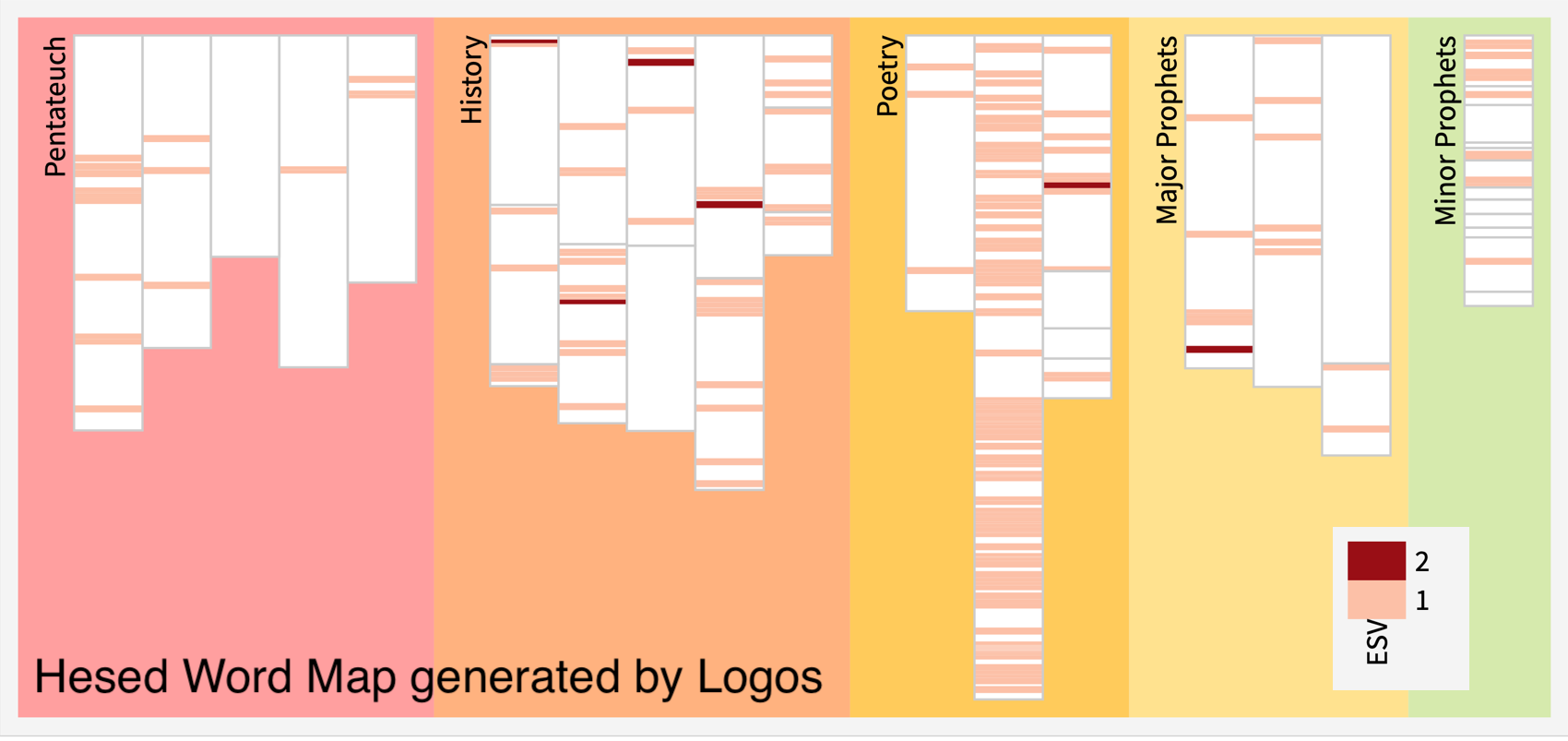
Hesed is widely distributed across all biblical literary categories of the Hebrew Bible, which is arranged differently than the Christian Bible (see word map below). It is found in the Torah 20 times, in the Prophets (Nevi’im) 53 times, and the Writings (Ketuvim) 172[3] times.[5] The twelve books where hesed does not appear, however, are Leviticus, 2 Kings, Ezekiel, seven of the twelve minor prophets (Amos, Obadiah, Nahum, Habakkuk, Zephaniah, Haggai, and Malachi), Song of Solomon and Ecclesiastes.
Hesed appears in the first book and the last book of the Hebrew Bible; from the rescuing of Lot in Genesis 19:19 to the faithful deeds of Josiah’s reformation in 2 Chronicles 35:26:
you have shown me great kindness [hesed] in saving my life. (NRSV)[6]
the rest of the acts of Josiah and his faithful [hesed] deeds in accordance with what is written in the law of the Lord. (NRSV)
The last reference reflected in the Protestant arrangement of the Bible (see word map below) closes with the prophetic oracle of Zechariah 7:9-10:
Thus says the Lord of hosts: Render true judgments, show kindness [hesed] and mercy to one another; do not oppress the widow, the orphan, the alien, or the poor; and do not devise evil in your hearts against one another. (NRSV)
Word Map: The Hesed (חֶסֶד) word map is based on the English Standard Version generated by Logos Bible software. The pink horizontal lines represent single and double instances.
The books which have ten or more references of hesed are Proverbs (10 times), Genesis (11 times), 1–2 Chronicles (15 times), 1–2 Samuel (16 times), and the Psalms (127[8] times). The majority of these books reflect the relational nature of hesed in the human realm. In Proverbs the end goal of wisdom is to teach practical relational hesed (31:26, 21:21), it is not a false front but the foundation of one’s reputation by its presence in their life (20:6, 28).
In Genesis, “kindness” is requested in prayer to God by Abraham’s servant to find a wife for Isaac (Gen 24:12, 14, 27). Then, Laban and Bethuel act in hesed (“kindness”) by cosigning their approval of Rebekah’s consent to be given as wife to Isaac.
1–2 Chronicles and 1–2 Samuel show that hesed expressed in reciprocal social acts. Saul reciprocates and excuses the Kenites from his assault on the Amalekites because they has shown hesed to Israel in ages past (1 Sam 15:6). Hushai’s “love” (loyalty?) for David is questioned during his infiltration of Absolam’s forces (2 Sam 16:17). The hesed shared between David and Jonathan is a story of deep loyalty and mutual reciprocity (1 Sam 20:8, 14–15). The Divine hesed is evidenced as well (2 Sam 15:20). Nathan enshrined the Davidic lineage and kingdom on behalf of God,
“my love will never be taken away from him” (2 Sam 7:15 NIV; 1 Chr 17:13, 2 Chr 1:8, 6:42; Psa 18:25[26]).
The Psalms contain close to half of all uses of the noun hesed (127[8] times); but it does not appear in 55% (83 psalms) of the 150 psalms. In brief, there are 23 instances in Book I (1-41), 16 instances in Book II (42–72), 14 and 13 times in Book III (73–89) and IV (90–106) respectively. In Book V (107–150), however, the frequency count skyrockets to 60 instances. Psalm 136 alone celebrates the Divine hesed in each of its twenty-six verses. It is in the Psalms that “both God and human worshipers describe God’s hesed as everlasting.”[7] Indeed,
While the term is used of both humans and God, in the Psalter it is above all a theological term that describes God’s essential character as well as God’s characteristic ways of acting—especially God’s characteristic ways of acting in electing, delivering, and sustaining the people of Israel. Hesed is both who the Lord is and what the Lord does. Hesed is an ancient term that defined for Israel who its God is.[8]
The saturation of hesed in the Psalms suggests that God’s people should always be mindful in prayer and worship of its content, its deeds, and the God who so relates to his people (Psa 36:5, 7, 10).
As pertains to the present study, it should be noted that the noun hesed only features twice in Jonah.Jonah is only one of four minor prophets where the term is employed (Hosea, Joel, and Micah). The first instance is in Jonah’s prayer of lament while in the “great fish” wherein he affirms that pagan idolators will miss out on “the grace [hasdam] that could be theirs” (2:8[9] NIV). The other instance is in 4:2 where Jonah laments what he knows about the LORD, who is “abounding in love” (NIV, warabhesed) and willing to change his mind about bringing judgment on the penitent people of Nineveh.
Semantic Range and Related Hebrew Words
As Silzer and Finley remind, “[w]ords normally have more than one meaning. The specific meaning of the word depends on its context.”[9] It is not sufficient, then, to rely on English translations (archaic or contemporary), nor to force lexical glosses to determine the meaning of a word.[10]
Brown, Driver, and Briggs groups hesedwith its verbal (hasad 2 times) and adjectival (hasid 32 times) forms, along with a few proper names, such asBen-Hesed (“son of Hesed” 1 Kgs 4:10) and Hasadiah (“Yah is Hesed” 1 Chr 3:20).[11] Lastly, is the unclean hasidah (6 times) often translated “stork” or “heron.” The root connection is believed to be due to their fond, “kind and affectionate” nature with their young.[12] This is a feature that is never appealed to in the Hebrew Bible.
The semantic range of hesed extends to the secular and the religious. In each, hesed manifests in concrete actions of goodwill, loyalty, and communal love whether in or outside of the covenant.[13] Divergent views emerge here with polarizing understandings over the meaning of hesed. Nelson Glueck saw in hesed a hardline covenantal legal obligation, H. J. Stoebe and others countered that hesedwas a free relational demonstration of loyal love.[14]
In the secular sense hesed speaks to certain “ethical norms of human intercourse” where mutuality exists that focuses on “the closest of human bonds.”[15] For example, Ruth exhibits this sense (1:8, 2:20, 3:10). Naomi blesses her daughters-in-law reciprocally, “May the Lord deal kindly [hesed] with you, as you have dealt with the dead and with me” (NRSV).
Religiously, the Divine demonstration of hesed does not function very differently than from the secular.[16] Exodus 34:1–7 provide a clear liturgical formula which demonstrates that Israel’s God abounds “in steadfast love and faithfulness” (34:6 NRSV; Psa 86:15, 89:14, Num 14:18).
The Lord passed before him, and proclaimed, “The Lord, the Lord, God merciful and gracious, slow to anger, and abounding in steadfast love [hesed] and faithfulness, keeping steadfast love [hesed] for the thousandth generation, forgiving iniquity and transgression and sin, yet by no means clearing the guilty, but visiting the iniquity of the parents upon the children and the children’s children, to the third and the fourth generation.” (Exod 34:6-7 NRSV)
This divine expression stresses the LORD’s multi-generational hesed and faithfulness. Moses now knows (33:13) that the LORD relates to his people through his benevolent and enduring nature. The words are quoted and echoed throughout the Hebrew Bible which suggests that they became formulaic or institutionalized to extoll the attributes of the God of Israel (Num 14:18, Jer 32:18, Joel 2:13, Nah 1:3, Psa 86:15, 103:8, 111:4, 112:4, 116:5, 145:8, Neh 9:17, 31, 2 Chron. 30:9)[17]
There are several words that appear frequently with hesed. They provide some dynamic appreciation for its usage in the Hebrew Bible.[18]Hesed may be done (‘asah) in concrete choices (Ruth 1:8). The LORD God keeps (shamar) and abounds (rab) in hesed (Deut 7:9, Neh 9:17). It is often associated with various nouns of “mercy” as in Psa 103:4 where the psalmist speaks of being crowned by God with hesed and rahamim(mercy). Likewise, hesed appears together with ’emet (faithfulness) probably as a hendiadys such as in Exod 34:6 and Psa 86:15.[19]
Hesed in Jonah 4:2
He prayed to the Lord and said, “O Lord! Is not this what I said while I was still in my own country? That is why I fled to Tarshish at the beginning; for I knew that you are a gracious God and merciful, slow to anger, and abounding in steadfast love [hesed], and ready to relent from punishing. And now, O Lord, please take my life from me, for it is better for me to die than to live.” (Jonah 4:2–3 NRSV)
This survey of hesed in the Hebrew Bible should help to determine the possible range of meaning for how Jonah 4:2 should be understood. Words have meaning only in context. With the above range in mind, the context appears to reflect Jonah’s usage of the formulaic hesedlanguage of Exodus 34:6–7. Instead of celebrating his God with these words, Jonah is subversively using this language to express his frustration with the LORD’s restraint against the city of Nineveh.
Jonah is using God’s own words against him. For this reason, it appears the meaning for Hebrew word hesedfound in Jonah 4:2 should be understood as “benevolent love.” Jonah knows how LORD acts out in concrete acts of hesed, these being grace, mercy, “slow to anger,” and relenting from judgment. Since there is no evidence that the LORD is in covenant with Nineveh, this supports the supposition that divine hesed may be expressed in free relational demonstrations of benevolent love. God relates to repentance with the reciprocal response of grace, mercy, patience/forbearance, relenting from judgment.
Jonah 2:8[9] further supports this view. It reveals that the prophet desires for judgment those who do not enjoy a covenant relationship with the LORD. It appears that for Jonah, idolatry is the “deal-breaker” for having a relationship with the LORD based on hesed. Yet, the irony fails to make any headway with the nationalistic prophet, since he rejected his prophetic call on the basis that he knew what the LORD would do should Nineveh repent. Both he and pagans have rejected God. Jonah is not only selfish with his relationship with his faithful God (“save me from the fish!”) but is resentful that God is “sharing the love” with foreigners (“you saved them from judgment!”).
Jonah wants his curse to come true, that those who “cling to worthless idols forfeit the grace [hesed] that could be theirs” (2:8[9] NIV). It is this forfeiture of Divine hesedwhich Jonah still desires for Nineveh, reflected in his willingness to proclaim that the city “will be overturned” (3:4) and his bitterness that it was not (4:1–11). Jonah knew that God would choose relationship over punishment. The LORD said as much (4:11). Humans, unfortunately, seem to choose punishment over relationship. Jonah shows as much.
This focused study on hesed and Jonah 4:2 brings to mind that the caricature of the bloodthirsty wrathful God of the Old Testament is just that an exaggerated cartoon (cf. Jas 2:13). As Baer and Gordon powerfully remind:
The insight that, while both anger and love are appropriate divine responses, the latter outlasts the former, is an important one for biblical theology. Wrath is a true word, a right word, sometimes an inevitable word, such passages seem to say. But God would not have it be his last word. That honor is reserved for his unfailing love (hesed).[20]
The burden of Jonah was to provide concrete witness to the people of Nineveh that God seeks to extend and establish benevolent love with all nations. As one who has experienced Divine benevolent love, Jonah should have been moved to be a spokesman for Divine benevolent love. In this he struggled and failed; nevertheless, God succeeded even if for a brief time (cf. Nahum 1:1?).
Conclusion
The meaning for Hebrew word hesedfound in Jonah 4:2 should be understood as “benevolent love.” The formulaic language of Exodus 34:6–7 is surely the theological and context for Jonah’s use of hesed. In Exodus as in Jonah 4:11, the LORD shows that he has the concern to establish and maintain a communal relationship with Israel. The benevolent concerns of preserving others and acting on the basis of moral uprightness anchor the LORD’s demands of repentance. Jonah knew if Nineveh took seriously the burden of his message, his God would become their God. They would collectively experience Divine benevolent love.
A final thought should be emphasized. Even though there are many excellent translations in the English language their primary function is simply to provide a reading text. Some significant and complex words, like hesed, merit the focused investigation which a word study provides. As developed above, hesed stresses relationships, community, loyalty and the ethical demands of love, responsibility, care, and obligation words which no single translation can do justice. Word studies reveal facets and these usages are combined into a framework. This framework provides the contours for understanding what a word means within its context, for usage determines meaning.
Endnotes
Rolf A. Jacobson, “Text, Title, and Interpretation,” in The Book of Psalms, NICOT, eds. E. J. Young, R. K. Harrison, and Robert L. Hubbard (Grand Rapids, MI: Eerdmans, 2014), 7–8.
John R. Kohlenberger III. and James A. Swanson, The Hebrew-English Concordance to the Old Testament (Grand Rapids, MI: Zondervan, 1998), v, 559.
H. J. Stoebe, “hesed kindness,” TLOT 2:449; H.-J. Zobel, “hesed,” TDOT 5:45; Robert P. Gordon, “hesed,” NIDOTTE 2:211.
Gray D. Practico and Miles V. Van Pelt, Basics of Biblical Hebrew, 2d ed. (Grand Rapids, MI: Zondervan, 2007), 105; Koehler, Baumgartner, and Stamm, “hesed,” HALOT 1:336; William L. Holladay, A Concise Hebrew and Aramaic Lexicon of the Old Testament (1971; repr., Grand Rapids, MI: Eerdmans, 2000), 111.
The Torah includes Genesis-Deuteronomy; the Nevi’im includes Joshua-2 Kings, Isaiah, Jeremiah and Ezekiel, and the Minor Prophets; and the Ketuvim includes Psalms, Proverbs, Job, Song of Solomon, Ruth, Lamentation, Ecclesiastes, Esther, Daniel, Ezra-Nehemiah, and 1–2 Chronicles.
The two English translations the Holy Bible used in this paper are the New Revised Standard Version (Nashville, TN: Nelson, 1989) and the New International Version (Nashville, TN: HarperCollins, 2011) cited as NRSV and NIV respectively.
David A. Baer and Robert P. Gordon, “hesed,” IDOTTE 2:212–17.
Jacobson, “Text, Title, and Interpretation,” 8.
Peter James Silzer and Thomas John Finley, How Biblical Languages Work: A Student’s Guide to Learning Hebrew and Greek (Grand Rapids, MI: Kregel Publications, 2004), 164.
Douglas Stuart, Old Testament Exegesis: A Handbook for Students and Pastors, 4th ed. (Louisville, KY: Westminster John Knox, 2009), 182–83.
BDB 338–39.
BDB 339; HALOT 1:336; TLOT 2:449.
IDOTTE 2:212–17; HALOT 1:336–37; TDOT 5:46–64.
R. Laird Harris, “hesed,” TWOT 1:305–06.
TDOT 5:47–48.
TDOT 5:54–55.
Nahum M. Sarna, Exodus, JPS Torah Commentary, ed. Nahum M. Sarna (Philadelphia, PA: Jewish Publication Society, 1991), 216.
HALOT 1:337.
TWOT 1:307.
IDOTTE 2:214.
Bibliography
Baer, David A., and Robert P. Gordon. “חסד.” Pages 211–18 in vol. 2 of New International Dictionary of Old Testament Theology and Exegesis. Grand Rapids, MI: Zondervan, 2012.
Brown, Francis, S. R. Driver, and Charles A. Briggs. A Hebrew and English Lexicon of the Old Testament. Oxford: Clarendon Press, 1907.
Ford, David. “Keeping up Biblical Languages while in the Ministry.” Foundations 14 (1985): 41–44.
Gordon, Robert P. “חסד.” Pages 211–18 in vol. 2 of New International Dictionary of Old Testament Theology and Exegesis. Edited by Willem A. VanGemeren. Grand Rapids, MI: Zondervan, 1997.
Harris, R. Laird. “חסד (hsd).” Pages 305–07 in vol. 1 of Theological Wordbook of the Old Testament. Edited by R. Laird Harris, Gleason L. Archer, Jr., and Bruce K. Waltke. Chicago, IL: Moody Press, 1980.
Holladay, William L. A Concise Hebrew and Aramaic Lexicon of the Old Testament. 1971. Repr., Grand Rapids, MI: Eerdmans, 2000.
Jacobson, Rolf A. “Text, Title, and Interpretation.” Pages 2–9 in The Book of Psalms. NICOT. Edited by E. J. Young, R. K. Harrison, and Robert L. Hubbard. Grand Rapids, MI: Eerdmans, 2014.
Koehler, Ludwig, Walter Baumgartner, and Johann J. Stamm. The Hebrew and Aramaic Lexicon of the Old Testament. Translated and edited under the supervision of Mervyn E. J. Richardson. 5 vols. New York: Brill, 1994–1999.
Kohlenberger, John R., III., and James A. Swanson. The Hebrew-English Concordance to the Old Testament. Grand Rapids, MI: Zondervan, 1998.
Practico, Gray D., and Miles V. Van Pelt. Basics of Biblical Hebrew. 2d edition. Grand Rapids, MI: Zondervan, 2007.
Sarna, Nahum M. Exodus. JPS Torah Commentary. Edited by Nahum M. Sarna. Philadelphia, PA: Jewish Publication Society, 1991.
Silzer, Peter James, and Thomas John Finley. How Biblical Languages Work: A Student’s Guide to Learning Hebrew and Greek. Grand Rapids, MI: Kregel Publications, 2004.
Stoebe, H. J. “חֶסֶד, hesed kindness.” Pages 449–64 in vol. 2 of Theological Lexicon of the Old Testament. Edited by Ernst Jenni and Claus Westermann. Translated by Mark E. Biddle. 3 vols. Peabody, MA: Hendrickson, 1997.
Stuart, Douglas. Old Testament Exegesis: A Handbook for Students and Pastors. 4th edition. Louisville, KY: Westminster John Knox, 2009.
Wegner, Paul D. Using Old Testament Hebrew in Preaching: A Guide for Students and Pastors. Grand Rapids, MI: Kregel Publications, 2009.
Zobel, H.-J. “(חֶסֶד, hesed).” Pages 44–64 in vol. 5 of Theological Dictionary of the Old Testament. Edited by G. Johannes Botterweck and Helmer Ringgren. Translated by David E. Green. Grand Rapids, MI: Eerdmans, 1977.
In 2 Timothy, Paul encourages the evangelist Timothy to trust in “[a]ll scripture” as the “useful” source for transformative instruction which empowers God’s people to accomplish “every good work” (3:16–17 NRSV).[1] There is a reason to believe this reference to “scripture” is primarily an allusion to the Hebrew Bible.[2] Study of the Hebrew language, then, would be a necessary acquisition for the minister. The benefits of studying biblical Hebrew are vast and significant, ranging from practical to technical. The insights gained from the study of Hebrew allow the minister to provide biblical clarity for the benefit of their audience.
The Benefits of Studying Biblical Hebrew
There are several benefits of studying Hebrew but only a selected few will be set forward for consideration. The ultimate benefit and goal for any minister of the Hebrew Bible are “to learn to exegete the Hebrew text accurately in order to preach authoritative, relevant sermons.”[3] Studying biblical Hebrew improves the proficiency to preach and teach what amounts to two-thirds of the biblical canon, a literary world that is often a difficult foreign terrain for most people.[4]
Further, a knowledge of biblical Hebrew also liberates ministers from being dependent on commentaries, and other secondary literature, and helps avoid making arguments exclusively from scholarly consensus.[5] Instead, proficient knowledge of Hebrew will allow the minister to provide fresh and original messages that guide the church based on deep personal wrestling with the original languages.[6]
For the minister, there are several benefits from a technical (professional) vantage point. The minister ought to know their subject matter in deeper ways than the average Bible reader.[7] Silzer and Finley point out that much of the exegetical task is to understand how language works to convey meaning, in other words, semantics.[8] A steady daily program of working through biblical Hebrew, along with the right tools (lexicons, grammar, and other aids) will increase exposure and proficiency in how the language functions.[9]
Ideally, such would help mitigate against linguistic fallacies such as root, the figure of speech confusion, and totality transfer which reflect ignorance of how languages work.[10] Furthermore, the exegetical process helps the minister sort through technical questions which have no homiletic value but are required by the exegetical task. “The meaning of a sentence is not always obvious from the meaning of the individual words.”[11] This process to let context determine the meaning of words and phrases whether literal or figurative, ambiguous or clear ought to encourage humility (Jas 4:10), a much-needed “benefit” to the craft of preaching and teaching.[12]
The Task of Ministers to Clarify the Biblical Text
The insights gained from the study of Hebrew allow the minister to be in a better position to clarify the biblical text using languages and images their audience understands. This task emerges from various needs.
First, ministers are often asked to answer questions about translations and teachings.[13] The question “which translation is correct?” may seem a daunting one but it is actually an opportunity to help the person take their first steps into a larger world of Bible study. The minister must help to provide guidance and clarity in this sensitive but crucial area of Bible knowledge that all translations are interpretive aids to understand the original language of the text.[14] Finally, a minister who has adequate proficiency in biblical Hebrew will have the ability to address questions concerning the accuracy of certain proposed teachings or the need to correct inaccurate teachings.
Second, ministers must know when to bring out relevant insights from the text that English translations do not highlight but are quite helpful to see another level of depth to the pericope.[15] Wegner, for example, points to the phrase tōhu wābōhu which appears in the Hebrew Bible twice (Jer 4:23 and Gen 1:2).[16] It seems the prophet Jeremiah is using this unique phrase from Genesis (“a formless void” NRSV) to affirm that due to the sins of Israel, the earth is once again “waste and void” (NRSV). This intertextual insight would most likely have gone unnoticed without work in the Hebrew text.
Finally, and perhaps most significantly is the clarity that comes from a fresh and relevant application of the Hebrew text to the contemporary life of the congregation. Exegesis always has the singular aim “to produce a deeper understanding of biblical truth,”[17] the sermon for the contemporary setting must be shaped by these “freshly pressed” insights.
Conclusion
A knowledge of biblical Hebrew certainly provides practical and technical benefits for the minister who maintains a steady program to improve their proficiency in the language. Likewise, the insights gained from the study of Hebrew allow the minister to provide clarity when preaching and teaching.
This will often include addressing questions regarding translations, and teachings, or providing fresh insight from the Hebrew text hidden by an English text; and finally, by aligning the message to the contours of the exegetical work in the original language.
Endnotes
All Scripture references are taken from the New Revised Standard Version unless otherwise noted.
Paul D. Wegner, Using Old Testament Hebrew in Preaching: A Guide for Students and Pastors (Grand Rapids, MI: Kregel Publications, 2009), 17.
Wegner, Using Old Testament Hebrew, 13.
Wegner, Using Old Testament Hebrew, 13–14; Peter James Silzer and Thomas John Finley, How Biblical Languages Work: A Student’s Guide to Learning Hebrew and Greek (Grand Rapids, MI: Kregel Publications, 2004), 161.
Wegner, Using Old Testament Hebrew, 15–16; David Ford, “Keeping up Biblical Languages while in the Ministry,” Foundations 14 (1985), 42; Douglas Stuart, Old Testament Exegesis: A Handbook for Students and Pastors, 4th ed. (Louisville, KY: Westminster John Knox, 2009), 181.
Ford, “Keeping up Biblical Languages,” 42, 44; Wegner, Using Old Testament Hebrew, 15–17.
Wegner, Using Old Testament Hebrew, 17.
Silzer and Finley, How Biblical Languages Work, 160.
Wegner, Using Old Testament Hebrew, 20–22.
Silzer and Finley, How Biblical Languages Work, 162, 165; Stuart, Old Testament Exegesis, 182–83.
Silzer and Finley, How Biblical Languages Work, 176.
Silzer and Finley, How Biblical Languages Work, 180.
Wegner, Using Old Testament Hebrew, 16.
Wegner, Using Old Testament Hebrew, 15.
Ford, “Keeping up Biblical Languages,” 42.
Wegner, Using Old Testament Hebrew, 15.
Ford, “Keeping up Biblical Languages,” 43.
Bibliography
Ford, David. “Keeping up Biblical Languages while in the Ministry.” Foundations 14 (1985): 41–44.
Silzer, Peter James, and Thomas John Finley. How Biblical Languages Work: A Student’s Guide to Learning Hebrew and Greek. Grand Rapids, Mich: Kregel Publications, 2004.
Stuart, Douglas. Old Testament Exegesis: A Handbook for Students and Pastors. 4th edition. Louisville, Kent: Westminster John Knox, 2009.
Wegner, Paul D. Using Old Testament Hebrew in Preaching: A Guide for Students and Pastors. Grand Rapids, Mich: Kregel Publications, 2009.






 biblicalfaith.online