Third John: Fellowship and Truth

Preface

To be clear, this is not really a commentary on 3 John. It is a study which at times ranges from the devotional to an exploration of a few technical details. In fact, the present material originally appeared in a serialized format and has been sewn together here in the hopes that it be helpful to anyone studying through “3 John.” This little letter, along with 2 John, is a perfect specimen of what many recovered 1st Century letters look like in form. But it is always astonishing to me how God employed 1st Century communications technology (i.e., the letter) to be the vehicle of His prophets. Today in our ethereal world, I hope we have learned how to employ our communication technology as a vehicle to share the words of His holy prophets.

I hope the following exploration into 3 John will be of use and of illumination to all those who wish to ruminate over Johannine literature. I wish to thank the Livingston church of Christ for their indulgence as I shared these studies with them first. They are a fellowship of God’s children whom I “love in truth” because they  “walk in the truth.”

Introduction

The New Testament letter of 3 John is arguably the smallest document in the canon associated with the apostle’s letters (1 John, 2 John), his Gospel account (John), and the final document of the New Testament, the Revelation.

We offer a study of this brief note to Gaius, a church leader under fire for his commitment to evangelism. The major theme has been admirably summarized as follows:

The basic message of the epistle is that a congregation of the Lord’s people is to support faithful missionaries in their proclamation of the gospel, and that anyone who prevents such support and who otherwise disrupts the orderly and faithful conduct of the congregation’s work by attempting to exercise tyrannical control is a troublemaker who should be rebuked and set down.[1]

John H. Parker in The Biblical Messages of the Books of the New Testament

Aside from this explicit controversy, not much else is known about the key personalities involved (e.g. Gaius, Demetrius, and Diotrephes) outside of 3 John.[2]

Yet the letter showcases the power of faithful saints supporting full-time evangelism:

The same sort of Christians are needed in the church today. Such disciples are not necessarily those who are going out to teach and preach the Word or to establish churches in difficult areas of the world. Instead, they include the people who are supporting such workers—supporting them financially, supporting them emotionally, and supporting them personally.[3]

Luke T. Johnson, The Writings of the New Testament: An Interpretation

The Greeting (v.1)

The elder to the beloved Gaius, whom I love in truth. 

(Unless otherwise noted the translation text is the English Standard Version of The Holy Bible [Wheaton, IL: Crossway, 2001])

First, it is important to observe, that “letters in the ancient world had their appropriate form, just as they do today.”[4] Though there were considerable alterations in the format, the following is a basic form of an ancient letter:

A [Sender] to B [Receiver]

Greetings

Thanksgiving and wishes for good health

Body of Letter

Farewell

Second, notice that a letter was sent by “the elder”; hence, 3 John is explicitly anonymous. Yet, Gaius knew who “the elder” was, and ancient testimony attributes this letter to the Apostle John. In fact, it has been suggested that John’s use of the term “the elder” is a reference to his unique situation as being both an elder and the last surviving apostle; hence, he is “‘the elder’ par excellence.”[5]

Third, what may be surmised from the context of the letter about Gaius is that he is definitely a leader in the church, and perhaps is a house-church leader. That he is loved “in truth” and “walks in truth” may either hint at doctrinal discord in his church setting or may refer to the spiritual division on receiving the emissaries of “the elder.”[6]

But what we do know is that Gaius is regarded in high esteem for his appropriate conduct during this controversial time. Furthermore, the use of an emphatic form for “I” in Greek (ego), suggests an inference that someone, or some “ones”, did not appreciate Gaius in the same way.[7]

The Prayer and Blessing (vv.2-4)

Beloved, I pray that all may go well with you and that you may be in good health, as it goes well with your soul. For I rejoiced greatly when the brothers came and testified to your truth, as indeed you are walking in the truth. I have no greater joy than to hear that my children are walking in the truth.

First, part of the greeting naturally flows into a blessing to fall upon the reader; much like, in modern times we find a parallel in: “How are you? I hope well.” But here we find a wonderful Christian thought, “I pray […] that you may be in good health, as it goes well with your soul.” This was a well-known conventional prayer for wellbeing, but John adapts it to stress his desire for Gaius’ health to match his well-developed spiritual fortitude.[8]

Second, John rejoices “greatly” as a result of the testimony made on behalf of Gaius’ “truth.” The term “for” makes a clear connection between verses 2 and 3,[9] transitioning from a hint to a clear example of Gaius’ spiritual fortitude. In other words, it is a fact that he is “walking in truth.”

This is clearly a heartfelt expression of the “stand for truth” that Gaius is currently making. It implies of course that some in the church context of Gaius are not “walking in truth.” This is a practice that began in the past and is extended to the time of the writing of this letter.[10]

This is quite a commentary on the quality of character evidenced in Gaius – a church leader of strength and fidelity to truth. Quite clearly, then, we see why John rejoiced so greatly.

Third, we must observe that the apostle describes Gaius as his child (Grk. to ema tekna). John calls Gaius “my child” (literally, pl. children) employing an emphatic form of the possessive case of ego, which means “I,”[11] which supposes that Gaius is not the spiritual child of another. This is a statement of a spiritual union bound in truth.

Edmond Hiebert observes that “my children” may be understood in two senses: (a) his specific converts; or, (b) those under his spiritual care. We agree with his remarks however that “in either view… [John] regarded and treasured them as his own.[12]

In Praise of Hospitality (vv.5-6)

Beloved, it is a faithful thing you do in all your efforts for these brothers, strangers as they are, who testified to your love before the church. You will do well to send them on their journey in a manner worthy of God.

First, Gaius evidently works with Christian strangers, and some who had been blessed by their association with Gaius had reported back to John (cf. vs. 3). As will be shown below, these are missionaries that have been blessed by Gaius’ faithful efforts (cf. vv. 7-8).

As a result, recipients of his generosity have given reports of his love before John’s congregation – and perhaps beyond. The term “church” could suggest the variety of congregations, including John’s, where testimony on behalf of Gaius has been made.

Second, Gaius had established a reputation for being hospitable to missionaries (v. 6). As Everett Ferguson writes:

The traveling teachers had reported to the church what he had done. The Elder [John] assures him he has been doing the right thing (v. 5) and wants him to continue on a regular basis.[13]

As will be seen later in the letter, activity like this was the focus of censorship by Diotrephes – the “missions” killer (vs. 10). F. F. Bruce observes, “the ministry of traveling teachers […], was a well-known feature of church life in Western Asia at the end of the first and beginning of the second century.”[14]

Third, when John encourages Gaius to “send them [the missionaries] on their journey,” he employs a term of unique significance in the New Testament. The Greek term for “send them on their way” is propempsas, meaning:

[T]o assist someone [here, the itinerant preachers] in making a journey, send on one’s way with food, money, by arranging for companions, by means of travel, etc.[15]

Bauer, et al., A Greek-English Lexicon of the New Testament and Other Early Christian Literature (2000)

There is no shortage of evidence to suggest that it is a technical term in the New Testament, meaning to provide missionaries with the appropriate means of support for their work and travels (cf. Acts 15:3; Rom 15:24; 1 Cor 16:6, 11; 2 Cor 1:16; Tit 3:13).

The Obligation to Missions (vv. 7-8)

For they have gone out for the sake of the name, accepting nothing from the Gentiles. Therefore we ought to support people like these, that we may be fellow workers for the truth. 

First, it is important to stress that these individuals are already on the road “for the sake of the name.” There is a deliberate decision that is in view for they have “gone out” for the sake of the only name that can be exalted (Phil 2:9) –that of Jesus.[16] This is their motivation for missions; especially, since “the name” would summarize “the saving message which the missionaries proclaimed.”[17]

One of their policies, says the Elder, is that “these itinerant evangelists would not (as a matter of policy) seek their support from unbelievers and did not (as a matter of fact) receive their support from them.”[18]

John Stott demonstrates the distinction this truly was for the early church:

Christian missionaries were not like many wandering non-Christian teachers of those days […], who made a living out of their vagrancy … a Christian congregation supporting its minister is one thing; missionaries begging money from unbelievers is another.[19]

John R. W. Stott, The Letters of John (2002)

There is an example of how the early church had become so abused by would-be missionaries, that an early catechetical document, known as the Didache, made excessive rules for hosting traveling teachers:

Let every apostle who comes to you be welcomed as if he were the Lord. But he is not to stay for more than one day, unless there is need, in which case he may stay another. But if he says three days, he is a false prophet. And when the apostle leaves, he is to take nothing except bread until he finds his next night’s lodging. But if he asks for money, he is a false prophet. (Did 11:4-6)[20]

As will be seen below, John has already sent a document to “the church” but it has been rejected, as have his apostolic authority, the traveling missionaries, and those who would – like Gaius – assist these honorable individuals (9-10).

Second, the church was under an obligation to support these individuals in order to be a part of their work. The longevity and amount are not the issues, what is at stake is the responsibility of a congregation to provide care for the missionaries and assist them on their way.

As Everett Ferguson observes:

For a household to receive missionaries, provide for them, and then to send them forward with provisions for the next stage of their journey was the regular method in early Christianity for supporting missionary work.[21]

Everett Ferguson, The Letters of John (1984)

And as mentioned above, this hospitality had received considerable abuse.

One of the safeguards against abuse was a letter of recommendation (cf. 2 Cor. 3.1-3). “In order to assist travelers in securing aid while exercising some control,” explains Abraham Malherbe:

[A] special type of letter, in which the writer recommended the bearer to friends or associates, had been developed. Some Christians also wrote such letters (e.g., Acts 18:27; Rom. 16:1-2), and some churches evidently demanded them of travelers.[22]

Abraham J. Malherbe in The New Interpreter’s Bible, ed. Leander E. Keck (1995)

The letter was to authenticate that these were honorable missionaries (including Demetrius cf. v.12), needing assistance as they traveled the world preaching the gospel.

Third, the obligation, as Hiebert observes, “involves more than giving them a personal welcome by lodging them; it also involves supplying their needs so they can continue their ministry.”[23]

Because of their lack of resources (cf. “taking nothing”), “believers therefore have the moral obligation to ‘undertake’ for them.”[24] The term opheilomen (cf. opheilo) carries the meaning of an obligation – whether financial, social, or moral;[25] particularly here, there are strong spiritual and moral responsibilities in view (evangelistic efforts of destitute missionaries).

We would also reflect upon the way this divides the labor of worldwide evangelism. As David Smith observes, “If we cannot preach the Gospel ourselves, we may help others to do it.”[26]

Fourth, the end result of assisting those who have dedicated themselves to being traveling teachers is that we may become “fellow workers for the truth.” There may be a generic flavor to this phrase, addressing the overall effects of involvement in supporting worldwide evangelism. Much like Adam Clarke observes, the assistance was designed to “encourage the persecuted, and contribute to the spread and maintenance of the Gospel.”[27]

Several students believe it is difficult to understand definitively the meaning of how we are “fellow-workers” in relation to the truth;[28] however, we believe the overall judgment on how to understand this partnership is expressed in the following words:

The Christian missionaries co-operate with the truth by proclaiming it; we co-operate with it by entertaining them. The Christian missionary enterprise is, therefore, not undertaken by evangelists only, but also by those who entertain and support them.[29]

Stott, The Letters of John

The activity of hosting and providing needed supplies for future travels “was a concrete expression of fellowship”.[30]

As those who welcome and support those who preach false doctrines become partakers with them (2 John 9), so those who receive and maintain those who preach the truth become fellow-workers for the truth.[31]

Guy N. Woods, A Commentary on the New Testament Epistles of Peter, John, and Jude (1973)

This concrete expression of Christian solidarity demonstrated by Gaius prepares the reader for the adverse behavior demonstrated by Diotrephes in the next few verses (vv. 9-10).

Interference of Sin (vv. 9-10)

I have written something to the church, but Diotrephes, who likes to put himself first, does not acknowledge our authority. So if I come, I will bring up what he is doing, talking wicked nonsense against us. And not content with that, he refuses to welcome the brothers, and also stops those who want to and puts them out of the church. 

First, though some students find that John regards his previous letter (not 2 John) of little importance, we find the reasoning upon which this perception is based to be quite weak. It is argued that since John wrote, “I have written something” (egrapsa ti), he did not view his letter as relatively important.[32]

However, there are serious problems with this interpretation, specifically because Diotrephes rejected John’s authority inherent in the letter he wrote. Such an audacious rejection of apostolic communication would hardly be something to rebuke Diotrephes about if the letter was of little importance.

We believe, along with other students, that egrapsa ti describes as “a brief letter of commendation” such that would have accompanied the traveling preachers mentioned earlier (v. 3):[33]

It apparently was a brief letter, now lost, requesting assistance for the missionaries being sent out by John. If so, it is not improbable that Diotrephes suppressed the letter.[34]

D. Edmond Hiebert, “Studies in 3 John Part 2 (of 3 Parts): An Exposition of 3 John 5-10,” Bibliotheca Sacra 144 (1987)

Stott does not stop at suppression. He suggests that Diotrephes destroyed the letter and poses this as the reason why John’s brief letter is now lost (cf. Jer 36).[35]

Finally, the letter can hardly be regarded as unimportant since what John desired to occur is set at odds against the strong contrasting “but” (Grk. alla), which emphasizes the rejection by Diotrephes.[36]

Diotrephes did not just suppress a mere letter; it was an apostolic request for the support of traveling missionaries who had no other means of gaining resources (“accepting nothing from the Gentiles” v.7) for the work they set out to do “for the sake of the name.” Consequently, Diotrephes “did not acknowledge” John’s authority.

Second, there has been tremendous ink spilled to discuss the troublesome New Testament nuisance known as Diotrephes. We will consider a few lines of thought regarding this gentleman we view as an excommunicating missions-killer.

(a) It is rather obvious that he, as a gentile, had a religiously pagan upbringing. This is understood from the meaning of his name (dio + trephes), “nourished by Zeus.”[37] Perhaps this hints at the pagan background where much of his character was probably formed.

Zeus was the god-of-gods, and he was regarded as the provider who nourished both family and community life (rain, dew, good gifts, etc.), being himself the patron of the home.

As one classical scholar describes, Zeus was:

[T]he avenger of perjury, the keeper of boundaries and of property, the defender of the laws of hospitality and the rights of the suppliant.[38]

Oskar Seyffert in Dictionary of Classical Antiquities (1966)

Besides the obvious possessor of the lightning bolts and the gatherer of the clouds, it was thought that all meteorological phenomenons were the work of Zeus.

I find a hint of irony in this correspondence, due to the fact that during the early ministry of Jesus, the sons of Zebedee (James and John) were given the “nickname” of the “sons of thunder” (Mark 3:17; Matt 4:21). During an episode in the Lord’s ministry, they wished to avenge mistreatment by raining fire from heaven (Luke 9:51-56).

Now, the aged John –known more for love than vengeance (cf. 1 John) – must address a man who acts more like the thunder god, than the son of God.

(b) Diotrephes “likes to put himself first” (RSV, NRSV, ESV). Other translations render this one word in Greek (philoproteuon) more to the point: “who loveth to have the preeminence” (KJV, ASV); “who loves to be first” (NASBU, NET); “who loves to be in charge” (ISV); “He always wants to be number one” (Plain English NT); “who loves to have first place” (FHV); “who wants to be first in everything” (Phillips).

What these translations suggest about Diotrephes, along with his spiritually criminal behavior also recorded in verse 10, is that “it was not just an ambition on his part but liking of the power he had.”[39]

And with his power, he made a unilateral decision to reject the apostle John’s authoritative request for support to be given to the traveling missionaries (vs. 5).[40]

One could investigate deeply and speculate why Diotrephes was so antiauthoritarian when it came to the apostle’s letter; however, we must not assume another position for which John – the inspired author – sets forth for us:

To John the motives governing the conduct of Diotrephes were neither theological, nor social, nor ecclesiastical, but moral. The root of the problem was sin.[41]

Stott, The Letters of John

This sin was his craving for prominence and dominance (philoproteuon) – a word carrying both desires: “to be first” and “to order others.”[42] The range of this disposition is seen in four ways:[43]

  1. Ambition to hold prominence.
  2. Refusal to submit to those of greater authority (e.g. apostle John).
  3. Slanders and oppresses those undermining his “perceived” right to prominence.
  4. Removes those of dissenting opinions from positions of influence.

(c) Everett Ferguson calls attention to three clauses that describe Diotrephes actions toward the missionaries: he refuses, hinders, and expels.[44] He kills evangelistic fervor at every level.

Third, “the elder” forewarns Gaius regarding his own arrival to the area and promises to bring Diotrephes to justice. As Wayne Jackson observes, “The apostle is unwilling simply to ‘let bygones be bygones.’”[45]

In an era where rebukes for sinful behavior are looked down upon, the church would do well to soak up the apostolic backbone demonstrated here. Indeed, “the past actions of Diotrephes could not be explained away.”[46]

In Diotrephes, we see a person in leadership with such degenerative respect for apostolic leadership and authority. He is characterized by such a vile personality that can be only viewed as a person who “was nourished by a very poisonous, aggressive passion to be in charge.”[47]

Imitate Good Behavior (v.11)

Beloved, do not imitate evil but imitate good. Whoever does good is from God; whoever does evil has not seen God.

This is the last of four times that the apostle calls Gaius “beloved” (agapete, cf. v. 1, 2, and 5). It is no small matter that John appeals to Gaius in this fashion; the term refers to one of compelling worth and one who is dearly loved.[48]

While there is no hint that John and Gaius know each other personally (and we not excluding the possibility), at the very least Gaius has gained such high esteem with the apostle due to his longstanding history of helping traveling missionaries (v. 3, 4, 5-6).

Although the letter is brief Gaius is described in at least eight other ways emphasizing his faithfulness and support of the truth, by the financial and material support of those who preach and teach the gospel.

(1) John loves Gaius “in truth” (v. 1). Combining a few ideas and passages in this letter, “in truth” is an idiom for a framework of thinking centered on the Gospel truth and its proclamation.

This is the Christian worldview in mind; in other words, the “fundamental way of looking at things” as a Christian (cf. Col. 3.1-3).[49] Christianity for Gaius – as it ought to be for us – is not for mere “social fraternity” but for “redemptive” outreach.[50]

(2) John prays that Gaius’s health resembles his robust spiritual health (v. 2). One is immediately compelled to wonder what would our physical health appear like should it be replaced by our true spiritual status.

Indeed, God knows our failures; yet, it is also true that God knows our hearts despite our failures.

For Gaius, such a benediction was a mark of faithfulness to God in the face of certain church politics applying negative pressure upon those who desire to support evangelists.

(3) A report had been given to John regarding Gaius having the truth, and living a life consistent with that truth (v. 3). This is emphasized again in verse 4.

Consistently, Gaius is the living embodiment of faithfulness to the gospel in that he was involved with sending evangelists, seeking those who would hear the gospel, and saving lost souls with this message of redemption.

The fact that “walks” in truth is a statement that this is a lifestyle, not a “past time.” Christianity did not exist solely within the confines of worship and times of fellowship; instead, evangelism was the air that he breathed, and his conduct reflected it.[51]

(4) Because Gaius lives within the framework of Gospel truth evidenced by his support of evangelists, John calls him his “child” (v. 4). This is certainly a mark of solidarity.

Despite their distance, this statement reflects their united fellowship seen in the comforting knowledge of faithful Christians “continuing steadfastly in faith and good works.”[52]

(5) Gaius is one who does faithful deeds which is supporting traveling evangelists by providing hospitality out of his home and through his material blessings which he sacrifices in order to send these heralds with the appropriate things needed to get to the next stage of their evangelistic labors (vv. 5-6).

(6) The “beloved” (agapete) is also one who expresses “love” (agape, v. 6) through these evangelistic and hospitable deeds (v 5). Because of his love shown to others (here, the evangelists), John has made a special place for Gaius in his heart.

(7) For the above reasons, Gaius implicitly is qualified as “a fellow worker for the truth” (v. 8). Gaius understands the moral imperative to support the gospel (= the truth) by “sending” the traveling evangelists.

This should elevate the relationship of “giving” with its connection to supporting evangelism in the church. We must understand that without “supporters” and “givers,” evangelism would die. “Without missions there would be no church, for the church is the result of missions.”[53]

It is not enough for us to know that supporting evangelism is important and essential, there must be follow-through to actually “put aside something” proportionate to our prosperity (1 Cor 16:2).

(8) Finally, Gaius is even dearer to John because he has not done these deeds in isolation; instead, Gaius has done this in the face of a local dominating church leader named Diotrephes.

Understanding that John knows all of these things as he wrote this letter, one can only imagine the kind of trust, love, admiration, and appreciation for Gaius which had budded within John’s heart.

Mimic Good Behavior, Not Evil

It is an important transition to which we find the words, “do not imitate evil, but imitate good.” The reality is that Gaius is already doing good, for he is living in “truth.”

Perhaps John is cautioning Gaius to be mindful of responding to Diotrephes’s tactics with the same measure of carnality.

The force of the verb is that of an earnest plea, or that of a command (imperative). In either case, John is imposing his apostolic presence to compel Gaius to stop mimicking (“do not imitate”) evil (kakos),[54] which suggests that perhaps he had given in to the carnality of the combat instigated by Diotrephes.

Consequently, John had to impose on Gaius to repent (though the word is not there) and to continue his honorable work of supporting evangelists. Here we learn the lesson that when “church problems” affect evangelism we must repent so that peace may return to the congregation. Wise leadership will shield its congregation from needless battles of words with ungodly individuals, for peace is better than a war of words.

We must imitate good, and that means we must submit our passions to God (cf. Jas 1:19-20; Rom 12:9-21; 1 Cor 11:1). In this light, the apostle desires to pull Gaius away from the distractions which come from in-fighting to refocus himself so that he may support Demetrius, who was probably the letter courier (v. 12). And like Demetrius, Gaius must reflect the truth through commendable behavior.

In order to hammer this point down, an important contrast is struck. It is in many ways, “a moral test.”[55] The test is a simple one: is your lifestyle described as continuing and practicing good or evil?[56]

If your life is consistently soured by evil, worthless, base, even criminal behavior – like Diotrephes – then you have not seen God; essentially saying, you are not in fellowship with God for you do not know him (1 John 3:4-6).

A Christian cannot be consistently immoral and think they are well-pleasing to the Lord. Consequently, Gaius is called upon to be found behaving as he ought to, as a faithful benefactor in the kingdom of God. Only then can it be said that he is “from God”.

It has been well observed:

Gaius was a man of influence and he had shown a Christian spirit in all things; yet John knew that Satan is no respector of persons and it would be a great blow to the church if Satan could cause this loyal church member to behave in a n unchristian manner.[57]

Oliver B. Greene, The Epistles of John (1966)

Could this be the apostle’s loving way to bring Gaius back from the cliff of carnality, a moment where the heat of battle was changing Gaius into the very thing he had sworn to defend the church from? Possibly. Nevertheless, the lesson is ours.

A Recommendation (v. 12)

It has been said that without influence one cannot lead. John wrote his letter 3 John – the briefest document in the New Testament – to encourage Gaius in his own time of need. To influence him to do the right thing.

There is evidence within the letter suggesting that there was a concern that Gaius needed the advice of verse 11, calling upon him to imitate (Grk. mimeomai) good, civil, non-detrimental behavior.

Such strong appeals reflect that Gaius may have come to the edge in his own crisis. Missions killer, Diotrephes, and his own evil, criminal, and detrimental methods may levy their toll upon Gaius, and now he may feel compelled to enter the fray of church politics with a war of words.

John implores Gaius to maintain; despite the conflict, be a child of God – be a “doer of good” (= supporter of evangelism). In this connection, the apostle introduces Demetrius, who most likely bore the letter to Gaius, and places a stamp of approval upon him.

Demetrius has received a good testimony from everyone, and from the truth itself. We also add our testimony, and you know that our testimony is true. 

It is not altogether clear who Demetrius is, and what exactly is his relationship with John, Gaius, and Diotrephes. In the light of any concrete evidence, there are a number of reasonable connections to consider.

In the New Testament, the proper name Demetrius is found in this letter (12) and in Acts with reference to an Ephesian silversmith (19:24, 38). The two are most likely different individuals.[58]

Some have observed that Demas is a shortened form of Demetrius, and may very well be a repentant detractor from among Paul’s co-laborers (2 Tim 4:10). The latter case is not probable (see below). The name, however, is quite common in the inscriptions.[59]

Demetrius in this sense is a mystery to us; however, he is a Christian known to John and Gaius, but we are blessed by his notice in this letter due to his example of faithfulness.

John sets forth Demetrius’ faithfulness by appealing to three witnesses. (1) The church bears witness of his faithfulness, (2) the “truth” as understood in this letter as that of good Christian conduct expressed in the support of evangelistic pursuits, and (3) John and his group go on record on behalf of Demetrius.

“The threefold witness to Demetrius should stir our desire to emulate his character”: the universal testimony, a good testimony from the truth itself, and a good testimony from John and his circle.[60]

(1) Universal testimony

The text begins, “Regarding Demetrius, it has been witnessed by all …”[61]; or, “Demetrius has witness borne to him by all.”[62] Unlike Diotrephes, and much like Gaius, Demetrius’ good reputation precedes him.

Demetrius has a well-known, geographically dispersed reputation within the church of faithfulness. Furthermore, this is not a new development for John uses the Greek perfect indicative which denotes a present state of affairs resulting from a past action.[63] In other words, Demetrius’ character was of good report in the past and continues to be in the present (hence, not Demas).

Consistent character is a wonderful blessing to the church! Too many times there are those who are more like shooting stars, bright shining spectacles which fade away as quickly as they emerged. The church needs steady hands, devoted hearts, and ready feet.

Demetrius was of great influence in the work of the church, and it can be seen why he would pose such a great contrast to Diotrephes (11).

(2) Good testimony from the truth itself

The second testimony which John appeals to is that which comes from truth. In fact, he compounds it with the testimony that “everyone” else makes regarding Demetrius.

Gaius lived in truth, walked in truth, and testimony of his support of evangelists had reached John (vv. 3, 6). In the same vein, then, it seems that Demetrius is so commended. Here we may learn something about Demetrius’ role in the church.

Some suggest that Demetrius is a traveling evangelist bearing this letter from John, which sets forth the principle that support for such noblemen ought to be provided (7-8). Demetrius is one such nobleman who have left for the sake of the name, needing support; in this way the truth of Christian thinking commends him.

Others observe that Demetrius may in fact be a member and leader of the local congregation (house church?), who is known to John, Gaius, and Diotrephes. He may very well have reported to John what had been going on at “home.”

Now on return, John sends a brief note designed to commend Demetrius for his faithfulness to the church there, acknowledging Gaius’ faithfulness as well, and to denounce Diotrephes from afar with the hope to address him in person.

In either case, Gaius and Demetrius have everything in common spiritually. They share the same “Christian way” of thinking which places the Gospel and missionary imperative as the backdrop for all of their actions. Would that we could capture the spirit of evangelism demonstrated by these first-century Christians.

(3) Good testimony from John and his circle

This third commendation comes more specifically from the apostolic circle. The apostle makes it abundantly clear that Demetrius is known and commended by an authoritative source.

John anticipates that Gaius knows the value of his apostolic testimony. Here we find why John appeals to Gaius to imitate good (11), instead of imitating evil behavior as expressed by mission killers.

Verse 12 suggests three criteria of commendable church leadership. Leaders in the church must reflect Christian character and behavior, perspective governed by a Christian worldview that is evangelistic at its core, and behave consistently with apostolic authority.

Missions and Prudence

As a footnote to the last point above, we must add that those who have left for the sake of the name are commendable for the reasons listed above. These traits are the result of training and development.

Can we imagine that John would send just “anyone”? Hardly. The most important work in the world to go into all the world should not be carried out by novices (Matt. 28.19-20). They were prepared before they left and well-supplied to do the work.

A Face to Face Visit (vv. 13-14)

I had much to write to you, but I would rather not write with pen and ink. I hope to see you soon, and we will talk face to face. 

In John’s closing remarks, he makes it abundantly clear that this brief letter is only the beginning. The letter is to encourage Gaius to continue his support of evangelism, to denounce Diotrephes’ hostile church leadership, and commend to the local church the conduct of Demetrius.

As John sums up his letter, he reemphasizes to Gaius that there is much which cannot be solved with “pen and ink” (cf. 2 John 12).

In fact, John points to a wealth of matters to which he had a desire to write about when he began to write,[64] but under the present circumstances wisdom pressed him to refrain from a “war of words”.

This is a personal point to which John makes abundantly clear of his “present unwillingness to go on writing the other things ‘with pen and ink.’”[65] The apostle shows that church problems are not solved with ongoing writing, particularly when it can be solved with a personal visit (v. 10).

The phrase “ink and pen” (melanos and kalamos), similar to another phrase the apostle uses in 2 John 12 “paper and ink” (kartos and melanos), reflect the common tools for written communications. John literally says, with “black” and “reed-pen.”[66] Calling attention to these tools of communications – writing technologies – acknowledges the limitations of such to do the work to which leaders must avail themselves.

Church leadership is not for cowards who can hide behind the defenses of ink and pen leveling charges at a distance. The need to confront sin, or deal with matters of more delicate and personal nature is better resolved “face to face” (v. 14).

Consequently, the many things which “the elder” had the initial impulse to write to Gaius will not be developed in text form. Perhaps this is one of the greatest lessons gleaned from this letter – when to silence the pen.

One can only ponder over the kind of treatise the document would have been; it doubtless would have called into question Diotrephes’ conduct and the crisis he instigated. Nevertheless, John wanted quality time with Gaius so we should not assume all the matters at hand were negative in nature.

After all, John held “hope” in his heart to be with his “fellow worker” (v. 8) very soon. There was a planned visit in John’s itinerary to arrive on the scene with Gaius, Diotrephes, the church, and perhaps even Demetrius. His words are not threats but promises to rectify the situation.

He looks forward to a time when they can speak intimately “face to face” (lit. “mouth to mouth”). Unimpeded by the limitations of ink, pen, and paper, the “vividness” of thought and timbre would set the tone for the work to be done at the local level for which John traveled to help resolve.[67]

The Farewell (v. 15)

Peace be to you. The friends greet you. Greet the friends, each by name. 

Thus ends the briefest letter in the entire New Testament and the entire Bible. A common benediction is offered towards Gaius to the intent that “all felicity attend you. Those that are good and happy themselves wish others so too.”[68]

Even in the face of church dysfunction, John shows how much we must keep our perspective cool and collective; instead of being taken by the heat which pervades those so entangled in bitter words of disagreement. Instead, he wishes for peace.

And why not, they are mutual “friends” after all. The idea of “friendship” appears to be the equivalent phrase of “brethren,”[69] which is the more commonplace term for fellow Christians.

Still, it is quite possible and likely that since this is a personal letter in every aspect – from John to Gaius – the idea of “friendship” here is that which reflects the bonds of their fellowship.[70] They may have brethren in faith, but they were fraternal at heart.

Faith was the environment their relationships developed into friendships. It is true that not all Christians form tight bonds with every other Christian; however, those relationships which materialize into tender overtures of mutual affection as friends find a unique bond this side of heaven.

Zane C. Hodges writes:

The use of the term ‘friends’ twice in these closing statements is perhaps one final reminder to Gaius that Christians in every place are or should be a network of friends who are ready to help one another whenever a need arises.[71]

Zane C. Hodges in The Bible Knowledge Commentary New Testament (1983)

The readiness with which Christians must arm themselves to be a ready help to their fellow brethren is a tremendous theme within this letter.

While trouble is the main cause of the need for brotherhood reliance in 3 John, trouble should not be the only reason we rely upon each other. We must realize that we are an extension of each other.

One of the critical problems in this letter is the abuse of leadership, Diotrephes assumed a place of prominence and imposed his will on others, and gave no respect to the true authority in the form of the apostle.

We must absorb what Jesus says, “whoever would be great among you must be your servant” (Matt 20:26).

Endnotes

  1. John H. Parker, “The Living Message of Third John,” in The Living Messages of the Books of the New Testament, eds. Garland Elkins and Thomas B. Warren (Jonesboro, AR: National Christian Press, 1976), 315.
  2. Coy Roper, 2010, “3 John – Encore #2: Are You a Help or a Hindrance?”, BibleCourses.com (Searcy, AR: Truth for Today), 3.
  3. Luke T. Johnson, The Writings of the New Testament: An Interpretation, rev. ed., rev. Todd C. Penner (Minneapolis, MI: Fortress Press, 1999), 562.
  4. Roy B. Ward, “How to Study the New Testament” in The World of the New Testament, ed. Abraham J. Malherbe (1967; repr. Abilene, TX: Abilene Christian University Press, 1984), 170.
  5. John R. W. Stott, The Letters of John (1988; repr. Grand Rapids, MI: Eerdmans, 2002), 44.
  6. Johnson, The Writings of the New Testament, 362-63.
  7. J. Gresham Machen, New Testament Greek for Beginners (1923; repr. Unicoi, TN: Trinity Foundation, 2000), 48-49.
  8. Frederick F. Bruce, The Epistles of John (Grand Rapids, MI: Eerdmans, 1979), 147.
  9. D. Edmond Hiebert, “Studies in 3 John Part 1: An Exposition of 3 John 1-4,” BSac 144 (1987): 62.
  10. Daniel B. Wallace, The Basics of New Testament Syntax: An Intermediate Greek Grammar (Grand Rapids, MI: Zondervan, 2000), 222-23.
  11. Machen, New Testament Greek, 46.
  12. Hiebert, “Studies in 3 John Part 1,” 65; emphasis added.
  13. Everett Ferguson, The Letters of John (Abilene, TX: Biblical Research, 1984), 99.
  14. Bruce, The Letters of John, 149.
  15. Walter Bauer, Frederick W. Danker, William F. Arndt, and F. Wilbur Gingrich, A Greek-English Lexicon of the New Testament and Other Early Christian Literature, 3rd ed. (Chicago, IL: University of Chicago Press, 2000), BDAG 873.
  16. Stott, The Letters of John, 226.
  17. D. Edmond Hiebert, “Studies in 3 John Part 2 (of 3 Parts): An Exposition of 3 John 5-10,” BSac 144 (1987): 199.
  18. Stott, The Letters of John, 226.
  19. Stott, The Letters of John, 226-27.
  20. Michael W. Holmes, ed., The Apostolic Fathers: Greek Texts and English Translations, rev. ed. (Grand Rapids, MI: Baker, 1999).
  21. Ferguson, The Letters of John, 99.
  22. Abraham J. Malherbe, “The Cultural Context of the New Testament: The Greco-Roman World,” in The New Interpreter’s Bible, ed. Leander E. Keck (Nashville, TN: Abingdon, 1995), NIB 8:13.
  23. Hiebert, “An Exposition of 3 John 5-10,″ 200.
  24. Hiebert, “An Exposition of 3 John 5-10,″ 200.
  25. BDAG 743.
  26. David Smith, “The Epistles of John,” in The Expositor’s Greek Testament, ed. W. Robertson Nicoll (New York, NY: Doran, 1901), 5:207.
  27. Adam Clarke, Clarke’s Commentary (Nashville, TN: Abingdon, n.d.), 6:942.
  28. Hiebert,“An Exposition of 3 John 5-10,″ 201-02; Stott, The Letters of John, 227-28; Marvin R. Vincent, Word Studies in the New Testament (repr. Peabody, Mass.: Hendrickson, n.d.), 2:402-03.
  29. Stott, The Letters of John, 228.
  30. Ferguson, The Letters of John, 99.
  31. Guy N. Woods, A Commentary on the New Testament Epistles of Peter, John, and Jude (Nashville, TN: Gospel Advocate, 1973), 362.
  32. Vincent, Word Studies in the New Testament, 2:403; Charles C. Ryrie, “I, II, III John,” in The Wycliffe Bible Commentary, eds. Charles F. Pfeiffer and Everett F. Harrison (Chicago, IL: Moody Press, 1962), 1484.
  33. Smith, “The Epistles of John,” 5:207; R. W. Orr, “The Letters of John” in The International Bible Commentary, rev. ed., ed. Frederick F. Bruce (Grand Rapids, MI: Zondervan, 1986), 1588; Vincent, Word Studies in the New Testament, 2:403; Albert Barnes, 1949, James, Peter, John, and Jude, Notes on the New Testament, rev. ed., ed. Robert Frew (Grand Rapids, MI: Baker, 1949), 374.
  34. Hiebert, “Studies in 3 John Part 2,” 203.
  35. Stott, The Letters of John, 228-29.
  36. Hiebert, “Studies in 3 John Part 2,” 203.
  37. “Diotrephes,” in Zondervan’s Pictorial Bible Dictionary, ed. Merrill C. Tenney (Grand Rapids, MI: Zondervan, 1964), ZPBD 217; Hiebert,“Studies in 3 John Part 2,” 203.
  38. Oskar Seyffert, 1966, Dictionary of Classical Antiquities, rev. ed., rev. and eds. Henry Nettleship and J.E. Sandys (N.p.: World Publishing, 1966), 704.
  39. Ferguson, The Letters of John, 100.
  40. cf. Jason Jackson, “Fellow Workers for the Truth,” ChristianCourier.com, where Jackson asks the following series of questions: “Why would Diotrephes reject a legitimate request by known brothers for the spreading of the gospel? Maybe the more appropriate question is this: Why was Diotrephes making unilateral decisions?” (par. 7). Could it be that Diotrephes did not have a heart of evangelism, local or abroad? It may very well be, but the issue is most likely that of heart and self-interest of Diotrephes manifesting in the rejection of apostolic authority.
  41. Stott, The Letters of John, 230.
  42. Johannes P. Louw and Eugene A. Nida, Greek-English Lexicon of the New Testament Based on Semantic Domains, 2d ed. (New York, NY: United Bible Society, 1989), L&N 25.110.
  43. William E. Vine, The Collected Writings of W.E. Vine (Nashville, TN: Nelson, 1996), 3:412.
  44. Ferguson, The Letters of John, 100.
  45. Wayne Jackson, Notes From the Margin of My Bible (Stockton, CA.: Courier Publications, 1993), 2:172
  46. J. Jackson, “Fellow Workers for the Truth,” par. 15.
  47. Lloyd J. Ogilvie qtd. in Hiebert, “Studies in 3 John Part 2,” 204.
  48. BDAG 7.
  49. Paul G. Hiebert, 1985, Anthropological Insights for Missionaries (1985; repr. Grand Rapids, MI: Baker Academic, 2008), 21.
  50. Gailyn Van Rheenen and Bob Waldron, The Status of Missions: A Nationwide Survey of Churches of Christ (Abilene, TX: Abilene Christian University Press, 2002), 1-2.
  51. BDAG 803.
  52. Woods, A Commentary on the New Testament Epistles of Peter, John, and Jude, 360.
  53. Van Rheenen and Waldron, The Status of Missions, 13. In fact, they go on to say, “Wherever churches exist, missionaries have overcome immense obstacles to teach unbelievers the Gospel, edify new Christians to live Christ-like lives, work together as a body of Christ, and train preachers and elders for Christian ministry” (13).
  54. J. Gresham Machen, New Testament Greek for Beginners , 180. Machen writes, “the present imperative refers to it [i.e the action] as continuing or as being repeated.” The text literally reads, “stop mimicking the evil, instead [mimic] the good” (my translation), which would be a reference to the two opposites of Diotrephes and Demetrius – hence, the warning would suggest, “Do not imitate Diotrephes, but imitate Demetrius” (Smith, “The Epistles of John,” 208). If the rebuke and command are to make sense, it appears then we must see the good Gaius as one who has allowed the carnality of Diotrephe to get the better of him, and John is trying to bring peace back into the church setting.
  55. Stott, The Letters of John, 232.
  56. The words “do good” (agathopoieo) and “do evil” (kakopoieo) are common antitheses regarding causing harm (being criminal/evil doer) v. not causing harm (being good citizen/benign) in the New Testament, that they appear together four times across four different authors: 1 Peter 3:17, Mark 3:4 = Luke 6:9, and here 3 John 11 (BDAG 3, 501).
  57. Oliver B. Greene, The Epistles of John (Greenville, SC: The Gospel Hour, 1966), 256-57.
  58. Ronald F. Youngblood, ed., Nelson’s New Illustrated Bible Dictionary (Nashville, TN: Nelson, 1989), 346.
  59. James Hope Moulton and George Milligan, The Vocabulary of the Greek Testament Illustrated from the Papyri and Other Non-Literary Sources (London: Hodder and Stoughton, 1914-1929), MM 144.
  60. F. B. Meyer, Through the Bible by Day: A Devotional Commentary (1914; repr. Franklin, TN: e-Sword, 2000-2012), comments on 3 John 1:1-14.
  61. My translation.
  62. John Nelson Darby, New Testament Translation (1884; repr. Franklin, Tenn.; e-Sword, 2000-2012).
  63. Machen, New Testament Greek for Beginners, 187.
  64. D. Edmond Hiebert, “Studies in 3 John Part 3 (of 3 Parts): An Exposition of 3 John 11-14,” Bibliotheca Sacra 144 (July-Sept. 1987): 300.
  65. Hiebert, 1987, “Studies in 3 John Part 3,” 301.
  66. Barclay M. Newman, Jr., A Concise Greek-English Dictionary of the New Testament (Stuttgart: German Bible Society, 1993), 112, 91.
  67. Hiebert, “Studies in 3 John Part 3,” 302.
  68. Matthew Henry, Matthew Henry’s Commentary on the Whole Bible (n.d.; repr. Franklin, TN: e-Sword, 2000-2012), comments on 3 John 12-14.
  69. Craig S. Keener, “Friendship” in Dictionary of New Testament Background, eds. Craig A. Evans and Stanley E. Porter (Downers Grove, IL: InterVarsity Press, 2000), DNTB 387.
  70. Hiebert, “Studies in 3 John Part 3,” 303.
  71. Zane C. Hodges, “3 John,” in The Bible Knowledge Commentary New Testament, eds. John F. Walvoord and Roy B. Zuck (Wheaton, IL: Victor, 1983), 914-15.

Lessons Learned from Demas

Demas. His name is on a list of names posted on the pages of the New Testament as one of the most notorious of Christian apostates. There are only three references to his name and his contribution to Paul’s ministry (Col 4:14, Philm 24) and his later detraction from it (2 Tim 4:9–10).

From these limited Scriptural references what can be possibly learned from this Christian man? Apparently much. This is the goal of this particular piece, to consider the lesson of Demas who at some point was counted among Paul’s “fellow workers” but then deserted Paul at a most crucial point in his ministry.

The Man in Question

In all fairness, there is next to nothing explicitly known about Demas, so we are forced in many ways to stretch out as much as possible (within fair limits) from what we do know about him.

Demas was a common enough name to be found in documents found among the ancient papyri of the New Testament era and beyond. The name is found in the company of several Jewish names. His name is a shortened form either Demetrius (cf. Acts 19:24, 3 John 12), Demarchus, or Demaratos.[1]

He could either be a Greek convert or a convert from among the Greek speaking Jews like Timothy (Acts 16:1). The last time we read of him he is journey bound to Thessalonica (2 Tim 4:10), which could point to his origins. Paul and Silas established a congregation in that city made up Jews and Greeks (cf. Acts 17:1–9).

Ultimately, we are left with reasonable speculation as to his origins. At some point, Demas comes in contact with the Gospel and with Paul. His reputation for service is of such caliber that he joins Paul’s mission to the Gentiles (2 Tim 4:17, Acts 9:15–16, Gal 2:6–10).

All this being said, we must ask a puzzling question, “What went wrong?” Here is a gentleman that labored alongside the Apostle Paul during some of the most epic moments of his ministry only to defect at the last. It’s baffling, if not disconcerting.

Background

Perhaps a little background is in order. The New Testament reflects that Paul experienced two significant imprisonments in Rome. The first imprisonment lasted two years and dates roughly to about A.D. 61–62, the second traditionally dates around A.D. 64.

The letters of Philippians, Ephesians and Colossians, and Philemon were dispatched during the first imprisonment as he waited for his hearing before Caesar (cf. Acts 28), from which he was subsequently released (Phil 1:25–26, Rom 15:24).

Demas was there with Paul when the Apostle was awaiting trial. He stands alongside noteworthy men such as Tychicus, Onesimus, Mark, Jesus (Justus), Epaphras, and Luke (Col 4:10–17, Philm 23–44). Those arduous years in Rome were filled with much turmoil as well as victories.

No wonder he was labeled as a “fellow worker” (Philm 24). This word reflects the fact that Demas was no slouch. He was every bit as critical as those listed above. He helped in doing his part in the division of labor. Such is the meaning of the phrase “fellow worker” (Grk. synergos).[2] But just a few years later, his heart desired no part of this work.

Upon release, Paul was ready to set in motion the things necessary to go West in Spain as he wrote to Christians in Rome (Rom 15:24). Also, Paul addresses some matters with Timothy in Ephesus (1 Timothy), and Titus in Crete (Titus).

All things seem to be progressing. At some point, however, Paul is arrested again. This time it is for keeps. The city of Rome suffered a week long fire that catastrophically destroyed the center of the empire in A.D. 64. The Great Fire of Rome is said to have “deprived numerous families of their homes and caused widespread discontent.”[3]

It is widely accepted that the fire was created by Caesar Nero (A.D. 54–68), and that he blamed the Christians for this crime (Tacitus [ca. 60-120], Annals 15.44).[4] According to tradition, Paul and Peter were both caught up in the persecution which followed; both were arrested and executed under Nero.[5] In fact, early tradition says their executions happened around the same time, the fourteenth year of Nero (A.D. 67–68).[6]

Paul has the trial of his life before him and he needs “the books and the parchments” (4:13). He also needed heaven bound Christians; yet, Paul was aware that this time his outcome did not look good (4:6). Yet, he trusted in the Lord.

“Demas… has Deserted Me”

This brings us to 2 Timothy 4:10. In Paul’s final letter he laments Demas as an unfortunate casualty: 

“Demas, in love with this present world, has deserted me and gone to Thessalonica.” (4:10 ESV) 

It is quite possible that the fierceness of the persecution and atmosphere in Rome played a factor in Demas’s desert towards Thessalonica. For this reason, he asks Timothy to leave Ephesus and come to Rome in a hurry (4:9). Ironically, Timothy would sail out of the Aegean Sea, waters shared with Thessalonica.

Paul is quite clear that Demas is a “deserter.”[7] That the desertion had already happened by the time the letter is obvious. Paul felt the sting of being left behind in his bonds by one who had been so trusted an ally in Christ. Demas forsook, abandoned, and deserted Paul while he was in a dire situation. This requires little exposition, Demas left Paul abandoned in his bonds and set his course to Thessalonica.

The real curious aspect of this text is the phrase, “in love with this present world” (or “having loved the present age”). The usual word translated “world” (kosmos) which suggests the material world and universe is not used here by the Apostle; instead, Paul employs a term which means “a very long time,” like the term “eternity” (Jude 25, John 6:51, 58). It may also mean the created world (Heb 1:2; 11:3), but this use is very limited; or, as is the case here, “a segment of time” as in an “age, an epoch.”[8]

There is a moral quality to this phrase. In 1 Corinthians 3:18b, Paul writes, “If anyone among you thinks that he is wise in this age.” There is a way one is wise in the things “which people in this world think” or “think are right.”[9] Again, in Mark 4.19 we read, “the cares of the world and the deceitfulness of riches and the desires for other things enter in and choke the word, and it proves unfruitful.” It is not that much different, then, to have a “high esteem” for the present world/age with all its “cares” and “wisdom.”[10]

Demas’s interest and concern (“being in love” or “having loved”) with this present age was materialized, then, in his desertion of Paul. In fact, it would be reasonable to understand “being in love with this world/age” as defining the nature of the desertion. Demas forsook Paul “in that he held a high appraisal of this present world” over the faithfulness of God and the promises of the Gospel. It is quite clear that the vigor of faith that he had early on was now replaced by a desire to be satisfied by what the world offers. So, he departed from Paul.

What Can We Learn?

There are some painful lessons to observe from Demas. But they call upon us to be vigilant of our motives for being followers of Christ. Briefly, here are some lessons:

  • Difficult times reveal the quality of one’s conversion. Moments don’t define the quality of our conversion, they reveal it.
  • Great Christians can fall. Demas was a guy that no one perhaps would have suspected to abandon his brethren in hard times.
  • What we care about can be dangerous. Demas had become so concerned with what the world valued that it became more alluring than his witness to the world with the Gospel.
  • What matters most to you will always be revealed. Demas was unable to stay focused on the temporary nature of this life; his love of this world outweighed his love for the next life.

Demas reminds us of how fragile faith can be. More specifically, Demas gives us a spiritual “wake up” call. It is time to pick up!

Sources

  1. James H. Moulton and George Milligan, The Vocabulary of the Greek Testament Illustrated from the Papyri and Other Non-Literary Sources (London: Hodder and Stoughton, 1914-1929), 144. William Smith, A Dictionary of the Bible, rev. ed., eds. F. N. Peloubet and M. A. Peloubet (Chicago, IL: Winston Co., 1884), 142. Smith defines Demas as “governor of the people” which is not as enlightening as we would like. B. H. Throckmorton, Jr., “Demas” in The Interpreter’s Dictionary of the Bible, edited by George A. Buttrick (Nashville, TN: Abingdon, 1962), IDB 1:815.
  2. The term means, “a fellow-worker”, the verb form means “I work along with, I co-operate with” (Alexander Souter, A Pocket Lexicon to the Greek New Testament [Oxford: Clarendon Press, 1917], 248). See also Joseph H. Thayer, A Greek-English Lexicon of the New Testament (New York, NY: American Book Co., 1886), 603-04.
  3. Michael Grant, The Roman Emperors: A Biographical Guide to the Rulers of Imperial Rome 31 B.C. – A.D. 476 (1985; repr. New York, NY: Barnes & Noble, 1997), 38.
  4. See Wayne Jackson, “Nero Caesar and the Christian Faith,” ChristianCourier.com.
  5. Harvey E. Dana, The New Testament World, 3rd ed. (Nashville, TN: Broadman Press, 1937), 176.
  6. E. E. Ellis, “Pastoral Letters” in Dictionary of Paul and His Letters, eds. Gerald F. Hawthorne, et al. (Downers Grove, IL: InterVarsity Press, 1993), 662.
  7. “engkataleipo” Walter Bauer, et al., A Greek-English Lexicon of the New Testament and Other Early Christian Literature, 2nd ed. (Chicago, IL: University of Chicago Press, 1979), BAGD 215; Moulton and Milligan, The Vocabulary of the Greek Testament, 179; Henry G. Liddell and Robert Scott, An Intermediate Greek-English Lexicon (Oxford: Clarendon Press, 1889). This is in keeping with the classical meaning, “to leave in the lurch.”
  8. BAGD, 27-28. Liddell and Scott, Intermediate Greek-English Lexicon.
  9. Johannes P. Louw and Eugene Albert Nida, Greek-English Lexicon of the New Testament: Based on Semantic Domains, 2d ed. (New York: United Bible Societies, 1996), 41:38.
  10. BAGD 4-5. Agapao, “of the love for things; denoting high esteem for or satisfaction with something.”

In the Beginning was the Word (John 1:1)

It is a staggering idea to contemplate God choosing self-sacrifice in order to create the opportunity for reconciliation between Himself and his rebellious creation. In fact, Paul would word the matter in the following way: “God was reconciling the world to himself, not counting their trespasses against them” (2 Cor 5:19). The agent through whom this is accomplished is Jesus Christ in His death so that we (humanity – “us”) may potentially experience the reconciliation of God (2 Cor 5:14-21).

The Gospel of John provides a fuller detail as to how God was reconciling the world to himself. The record of John is, however, unlike Matthew’s Gospel which begins with the Hebrew genealogical table which emphasizes the Lord’s lineage from David and Abraham (Matt 1:1-17). It is unlike Mark’s abrupt mention of “the beginning” of the gospel, which is marked by Jesus’ ministry inaugurated by the baptism by John (Mark 1:1-14).

It is even unlike Luke’s historically grounded retelling, beginning from Jesus’ birth announcements to the unfolding of the universal gospel call as seen in Luke’s second volume Acts (Luke 1:1-4; Acts 1:1-9). John begins the narration of his Gospel Account from the very beginning. In this way John stands upon unique footing.

Jesus the Eternal Word

photo-1.jpg

Although not being distinct in its message and general outline, John’s Gospel Account is a maverick of sorts, focusing upon the cosmic drama mentioned above which grounds the gospel message. To provide his readers the needed perspective in order to appreciate all that proceeds, John pens the first line of his account with the following words:

In the beginning was the Word, and the Word was with God, and the Word was God. He was in the beginning with God. All things were made through him, and without him was not any thing made that was made. (John 1:1–3 ESV)[1]

This eternal “Word” is explicitly identified as the Father’s son – Jesus – who indeed “became flesh and dwelt among us” (1:14). John further affirms, “and we have seen his glory, glory as of the only Son from the Father, full of grace and truth” (1:14; As an important side note stands the fact that the term “Father” is used approximately 107 times as the name for “God” in John’s Gospel).

This is a profound truth regarding Jesus’ nature and ought to inform our understanding of the Gospel message as well. Let us consider a few ideas from John 1:1, as expressed in three clauses: (a) “In the beginning was the Word,” (b) “the Word was with God,” and (c) “the Word was God.” The rich language of the first verse of John’s Gospel conveys the divine nature of “the Word” (Grk. logos), who in fact is the pre-incarnate Jesus (i.e. before he put on his human identity).

Many times the “beginnings” of Jesus of Nazareth are only considered from the standpoint of his birth and baptism; however, the implications of John 1:1 demonstrate that His beginnings are from eternity (Micah 5.2). As Jack Cottrell succinctly writes:

Each of these clauses affirms the divine nature of the Logos. The first asserts his eternity, since he was already there when everything else had its beginning (see vv. 2-3). The second asserts his eternal coordination with God. He is distinguished from God, yet placed alongside God. The third clause declares his identity or equality with God.[2]

In order to truly appreciate the gospel proclamation, it is a vital matter to understand that Jesus had an existence before he walked the rocky soil of Palestine in the 1st Century A.D. In fact, Jesus was/is an eternal divine being, namely God.

For this reason, the Gospel of John continuously makes reference to Jesus’ divine nature (5:16-17, 25-27, 6:41, 8:58), Jesus’ claims to divine authority and commission (2:16, 4:34), plus the difficulty held by those who heard Jesus make these claims (5:18, 6:42), and the rejection experienced because of this inability to accept both the human nature of Jesus and his claims to “God-hood” (2:16, 8:59). Nevertheless, it is clear from the very beginning of the Gospel of John, that his inspired Apostles believed and taught that Jesus was/is an eternal being who predates time and our universe, and has entered into His creation (John 1:2-3, 17:5).

Is Jesus “a god”?

It is a tragedy that there are groups which claim allegiance to Jesus and yet they deny the biblical doctrine of the eternal deity of Christ. One such group, the Jehovah Witnesses, offer the translation for John 1:1 in the following way:

In [the] beginning the Word was, and the Word was the God, and the Word was a god. (brackets original)[3]

In the footnote to this passage, they refer to Appendix 6A which sets forth their justification for the translation “the Word was a god.”

The essential thrust of the argument is, according to them, a grammatical one. It is here, however, that the theological bias of the Watchtower New World Translation is evident. They argue that in New Testament Greek (koine) a noun with the article “points to an identity, a personality”, but a predicate noun without the article “preceding the verb points to a quality about someone.”[4] Accordingly, it is argued that “it does not identify him [Jesus] as one and the same as God himself.”

The Watchtower followers are determined to maintain the “oneness” of God as is traditionally understood as monotheism (Deut 6:4-5); however, they affirm the “oneness” of Jehovah at the expense of robbing Jesus of His eternal divine nature – His “God-hood.” They go so far as to affirm that the Word (Jesus) is a creation of God: “The Word’s preeminent position among God’s creatures as the Firstborn, the one through whom God created all things.”[5] This is but a primer of their teaching on Jesus.

While an exhaustive response cannot be given here, the following two responses are enlisted which demonstrate the weakness – even blasphemy – of the Watchtower “reasoning”. First, the “no-article-a-god” argument based upon grammar is faulty at best, if not theologically biased at worst. As Frank Pack writes, when John writes “the Word was God” he is expressing “the quality or nature” of the Word/Logos.[6] John was not affirming that Jesus is the same person as the Father (“the Word was with God”), but that the Word was distinct in person, and yet shares the same Divine nature (Grk. theos; cf. John 20:28; Phil 2:5-8).

Second, the Gospel of John explicitly sets the “Word” as the agent through which “all things were made” (1:3). In fact, the Watchtower’s New World Translation words the last clause of verse 3 this way: “and apart from him not even one thing came into existence.” It ought to go without saying that Jesus did not self-create himself. Moreover, John expands our understanding of the creation story and is purposeful in echoing Genesis 1:1, “In the beginning, God created the heavens and the earth” (ESV). It is God (Heb. ’elohim) who said, “Let us make man in our image, after our likeness” (Gen 1:26). Denying John’s placement of Jesus in eternity and at the beginning is a tragic failure to accept basic bible teaching.

Conclusion

John 1:1 is a powerful passage serving as a gateway to understanding Jesus and the gospel story. The Eternal Divine Agent of creation (John 1:1-3) put upon himself the nature of “flesh” (1:14) and became “the Lamb of God, who takes away the sin of the world!” (1:30). May we, unlike those who deny the Lord’s deity, respond to Jesus as Thomas did and herald Him as our Lord and our God (John 20:28).

Sources

  1. Unless otherwise noted the translation employed is the English Standard Version (ESV) of the The Holy Bible (Wheaton, IL: Crossway, 2001).
  2. Jack Cottrell, The Faith Once for All (Joplin, MO: College Press, 2002), 236.
  3. (NWT) New World Translation of the Holy Scriptures with References, rev. ed. (Brooklyn, NY: Watchtower Bible and Tract Society of New York, 1984). Recently, the 2013 revision of the Watchtower’s New World Translation still maintains the following rendition of verse 1: In the beginning was the Word, and the Word was with God, and the Word was a god.” The editors have removed the brackets; however, the online edition the footnote (*) on “was a god” reads: “Or ‘was divine.'” This is not a shift in their Christology, but it is a better translation than “a god”; furthermore, it is a step in the right direction by deriving understanding of Jesus based upon the language of the text first.
  4. “Appendix 6A,” NWT, 1579. The pages for these notes have been reproduced here for those wishing to see the actual Watchtower source.
  5. Aid to Bible Understanding, 919.
  6. Frank Pack, Gospel of John 1:29; cf. Dana and Mantey, Manual Grammar of the Greek New Testament, 139-40

This is a reformatted and slightly expanded version of the article which originally published in The Glendale Gleaner (Newbern, TN: Glendale church of Christ).


Who is Claudius Lysias?

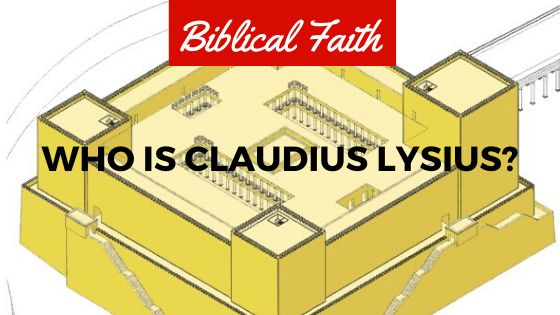
Reconstruction of Fort Antonia by Ehud Netzer in Biblical Archaeology Review 35.1 (Jan.-Feb. 2009).

Claudius Lysias, the Tribune

Claudius Lysias is called “the tribune” (χιλίαρχος, chilíarchos) 16 times within Acts 21-24 (21:31-33, 37; 22:24, 26-29; 23:10, 15, 17, 19, 22; 24:22); 17 times if Claudius Lysias is also included in among the “military tribunes” in the “audience hall” when Herod Agrippa II and Bernice come to hear Paul (Acts 25:23). However, such speculation is uncertain, especially considering a minimum of two years from when Claudius Lysias sent Paul to the Procurator Marcus Antonius Felix in c. AD 57/58 Acts 23:26-35, to within the first few months of the new Procurator Porcius Festus who rules from AD 60-62 (Acts 24:27-25:1-22).

The Greek term chilíarchos is said to be used to translate the Roman tribunus militum (following Polybius), and also for the phrase tribuni militares consulari potestate (Plutarch). The responsibilities of a chilíarchos were as a “commander of a thousand men”.[1] Essentially, Claudius Lysias is “a high ranking military officer in charge” of anywhere from 600 to 1,000 men,[2] and this appears to be the case for it is said that his command was over a “cohort” (σπειρα, speira) in Jerusalem which is “the tenth part of a Roman legion having about 600 men” (Acts 21:31).[3]

Tribune of a Jerusalem Cohort

Claudius Lysias’s complete description as found in the New Testament book of the Acts of the Apostles is “the tribune of the cohort” in Jerusalem, which resided in nearby “barracks” (Acts 21:34, 37; 22:24, 23:10, 16, 32). It takes six cohorts to make up a legion, and each legion had six tribunes with a thousand men (“soldiers and centurions” Acts 21:32) under his command if the cohort was full; consequently, Claudius Lysias was a part of a larger military force.

The exact numbers in his cohort may never be known, however, he had sufficient men to spare two centurions, two hundred soldiers, seventy horsemen, and two hundred spearmen to accompany Paul to Caesarea Acts 23:23-24. Furthermore, when the security detail arrives before Antipatris (Acts 23:31), Claudius Lysias allows for the seventy horsemen to go on with him and Paul to Caesarea, the headquarters of the Procurator Felix (Acts 23:32-35).

The “barracks” referenced in the book of Acts (21:34, 37; 22:24; 23:10, 16, 32), in connection to Claudius Lysias and his cohort are references to the Tower of Antonia, which Herod the Great rebuilt from a previous structure and named it after Marc Antony.[4] The Antonia was added on to the northwest side of the Temple facilities, “from which stairs descend into the outer court of the temple” (Acts 21:32, 35, 22:30).[5] For this reason, the Roman Tribune could hear the commotion caused by the confusing riot over Paul’s presence in the Temple and respond with speed (Acts 21:27-32).

Claudius Lysias in the New Testament

The military tribune Claudius Lysias enters the New Testament narrative when he protects Paul of Tarsus from a hostile Jewish mob on the outside of the Temple grounds in Jerusalem (Acts 21:30-32). The Acts text does not explicitly state why the tribune arrests Paul aside from asking “who he was and what he had done” (Acts 21:33); consequently, it appears Paul is detained for investigation as reflected later in Paul’s interrogation in the Antonian barracks because he was a cause of instigation among the Jews (Acts 22:23-24).

Claudius Lysias is aware of Jewish anarchistic movements, for when Paul speaking in Greek asks permission to speak to the shouting Jewish mob, the tribune appears shocked that he speaks Greek (Acts 21:37). Paul, as a controversial Greek-speaking Hebrew, evidently met some of the criteria for Lysias to conclude he was a Jewish revolutionist. Consequently, it appears that Lysias suspects him of being “the Egyptian” who “stirred up a revolt and led the four thousand men of the Assassins [σικαρίων] out into the wilderness” (Acts 21:38).

This individual operated around A.D. 53, and this revolution amounted to amassing these four thousand men, positioning themselves upon the Mount of Olives outside Jerusalem, and anticipating the walls of Jerusalem to collapse at his command. The Romans attacked this band of men, and the Egyptian lost six hundred men, and fled into the wilderness where he disappears awaiting “further revelation.” Evidently, “the Egyptian” was still on the run, wanted by the Roman military and the tribune was going to see if Paul was this anarchist.[6]

Paul was able to persuade Lysias that he was not an agitator, and provides him with his provincial citizenship as being from Tarsus, in the province of Cilicia (Acts 21:39). This was not an “obscure city” and either this suggests his citizenship could be authenticated, or Paul distinguished himself from the obscure Egyptian. In either case, Paul’s point is clear, he is not the Egyptian; the tribune accepts Paul’s case, and grants Paul an opportunity to speak to the Jews on the steps of the Temple facilities adjoined to the Antonian fortress (Acts 22:39-40).

The Jews did not respond peaceably to Paul’s speech, and Claudius Lysias decides to take Paul into the “barracks” of Antonia and “examine” him through the process of binding him to flog him (Acts 22:22-24). On receiving a report that Paul was a Roman citizen and then making a personal inquiry, Claudius is afraid of having violated the rights of a Roman by having him bound (see “Roman Citizenship” below). Claudius desires to arrive at the truth concerning the Jewish case against Paul and commands the Sanhedrin to assemble. Dissension among the Sanhedrin towards Paul arises again and causes Claudius Lysias to order his men to take Paul to the safety of the Antonian barracks (Acts 22:30-23:10).

Upon learning of a plot to kill Paul, Claudius Lysias summoned a military convoy to leave for Caesarea Maritima. In compliance with Roman law, he also sent a statement of the case to the procurator Antonius Felix. The letter reads:

Claudius Lysias, to his Excellency the governor Felix, greetings.

This man was seized by the Jews and was about to be killed by them when I came upon them with the soldiers and rescued him, having learned that he was a Roman citizen. And desiring to know the charge for which they were accusing him, I brought him down to their council. I found that he was being accused about questions of their law, but charged with nothing deserving death or imprisonment. 

And when it was disclosed to me that there would be a plot against the man, I sent him to you at once, ordering his accusers also to state before you what they have against him. (Acts 23:26-30, English Standard Version)

The letter format is consistent with the general format in the Graeco-Roman world, of “author” to “recipient” with a “greeting” with the subsequent content of the reason for the letter.[7] This letter, however, was not altogether factual. It is an interesting “specimen” of Roman military correspondence (Acts 23:26-30).

Although acknowledging Paul’s innocence, Claudius Lysias gave the impression that he had rescued Paul because of having learned that the apostle was a Roman, whereas in reality, he had violated Paul’s citizenship rights by having him bound and even ordering that he be examined under scourgings. As to the disciple Luke’s knowledge of the letter’s contents, it may be that the letter itself was read at the time Paul’s case was heard.

Roman Citizenship

In Acts 22:23-29, a discussion between Paul and Claudius emerges on the topic of Roman citizenship. Part of Claudius’ investigation procedure to find out more information was to stretch out the detained for whips and flog them.

Before his flogging begins, Paul questions the centurion given this detail, “Is it lawful for you to flog a man who is a Roman citizen and uncondemned?” (Acts 22:25). Roman citizenship had a number of privileges, as John Polhill writes:

A Roman citizen was subject to Roman law and thus was protected from such things as being beaten without a trial, from cruel punishments like crucifixion, and from unlawful imprisonment, rights which did not belong to an ordinary provincial (peregrinus). Citizens had the right of appeal. Only a Roman citizen could legally marry another Roman citizen. Citizens were exempted from certain taxes. Beyond this, there was the considerable factor of honor and deference such a status afforded.[8]

It was such a valued honor, that some people risked the death penalty given for falsely claiming citizenship.[9] Interestingly, one could hold dual citizenship, as Paul was not only a citizen of the city of Rome but was also a citizen of the city of Tarsus from the province of Cilicia (Acts 21.39; 23.34).

Roman citizenship was conferred in a number of ways. The basic ones are as follows:

(1) The most common way was being born of two Roman citizens.

This is the claim Paul makes when asked how he obtained his citizenship (“I am a citizen by birth” Acts 22:28), which implies that both of Paul’s parents were Jewish Roman citizens (cf. #4).

(2) One could obtain citizenship as a reward for military service.

Regularly, military veterans were given citizenship upon discharge. This was the surest way to get it, taking 20 to 25 years depending on the level of ranking.

(3) Imperial conference, though heard of, was not entirely common.

Nevertheless, the emperor could confer citizenship, either on individuals or on whole communities, as in the establishment of a new colony. Often the result of doing some loyal service to Rome. Also, many times through these services, one gained an audience with the Emperor through expensive gifts to members of the inner Imperial court.

This may have been how the Tribune Claudius Lysias gained his citizenship (Acts 22:27-28). In fact, the tribune’s name provides evidence to assume the plausibility that Emperor Claudius (A.D. 41 – A.D. 54) conferred upon Lysias citizenship since those granted this honor would bear the name (the nomen) of the family or patron which conferred it; hence, Lysias gained the name of his patron Claudius. It has been noted that the emperor was quite “promiscuous” in his conference of citizenship.[10]

(4) Roman citizenship was also conferred through the emancipation of a slave from the house of a Roman citizen.

Some have suggested that Paul’s ancestors may have been freedmen from among the thousands of Jews whom Pompey took as slaves in 63 B.C.[11]

Endnotes

  1. H. G. Liddell, An Intermediate Greek-English Lexicon: Abridged from Liddel and Scott’s Greek-English Lexicon (1888; repr.; Oak Harbor, Wash.: Logos Research Systems, 1996), 888.
  2. Barclay Newman, Jr., A Concise Greek-English Dictionary of the New Testament, revised ed. (Stuttgart: Deutsche Bibelgesellschaft, 2010), 200.
  3. Newman, A Concise Greek-English Dictionary, 167.
  4. Josephus, Antiquities 15.293; 15.409.
  5. George A. Smith, et al., “Jerusalem,” Encyclopaedia Biblica, eds. T. K. Cheyne and J. Southerland Black (London: A & C Black, 1901), 1:2429.
  6. Robert M. Grant, The Sword and the Cross (New York, NY: Macmillan, 1955), 49.
  7. T. C. Mitchell, Biblical Archaeology: Documents from the British Museum (New York, NY: University of Cambridge, 1988), 89.
  8. John B. Polhill, “Political Background of the New Testament,” Foundations for Biblical Interpretation, eds. David S. Dockery, et al. (Nashville, TN: Broadman & Holman, 1994), 531-32.
  9. Abraham J. Malherbe, “Life in the Graeco-Roman World,” The World of the New Testament, ed. Abraham J. Malherbe (1967; repr., Abilene, Tex.: Abilene Christian University Press, 1984), 9.
  10. Polhill, “Political Background of the New Testament,” 532.
  11. John B. Polhill, “Political Background of the New Testament,” 532; Richard R. Losch, The Uttermost Part of the Earth: A Guide to Places in the Bible (Grand Rapids, MI: Eerdmans, 2005), 176-77.

This originally appeared as a fully edited submission to Wikipedia.org. I have posted this here in case it is revised or rewritten.


Church: A Preliminary Survey

With so many “churches” in the religious world, people interested in visiting one are often sidelined by the inevitable question, “which church should I go to?” After all, there are as many “churches” as there are potential opinions on what a church should be like. But where should a person begin as they search for a church, should they simply jump out on a whim? Hardly.

Searching for a church should be a reverent endeavor, especially since in the New Testament the “church” is said to have been “purchased” by the very blood of Jesus Christ (Acts 20.28). Consequently, if the church was that important to Jesus and the Father, those seeking to “go to church” should realize this spiritual venture should not be taken lightly.

Where then might a person find the necessary perspective from which to begin this search? The relevant information is found in the New Testament documents, the documents which record the formative forces which began the church in the first place; moreover, the New Testament provides ample information about how people became members of the blood-bought church of Jesus, along with important church organizational references.

This piece is a primer, in a sense, on the nature of the church. There are many ways that this topic can be addressed. But, nevertheless, below are some relevant points to glean from the New Testament on the topic of the church of Christ (Rom. 16.16).

The New Testament Documents

In the New Testament, from the beginning to end, the thought and actual fact that the saved existed as a collective known as the “church” or body of Christ is clearly self-evident (Matt 16:18 and Eph 1:22, 23, 4:4; Acts 2:47). Consider a sample of the New Testament documents.

There are four accounts of the ministry of Jesus, they are called Gospels. The term “church” is found only in the Gospel of Matthew, particularly in chapters 16 and 18. In chapter 16, Jesus speaks of building His church – “my church” (16:18). He explains that death (Grk. hades – not hell, contra KJV) will be incapable of deterring his plans to bring His church into reality.[1] In chapter 18, verses 15-17 describe the disciplinarian process regarding a Christian brother living in sin, and hence, needing private correction. The final stage is to bring the sin to the public forum by telling it to the church, with the intention that it can act as a loving measure of leverage to pressure the brother to quit the sinful practice. Thus, in Matthew Jesus speaks of his church in two ways: (1) that it will be built (Matt 16:18), and (2) as the ultimate forum for maintaining moral purity among God’s people (Matt 18:15-17).

The Acts of the Apostles is the inspired historical account of the church – albeit a history with a theological focus. It is most definitely a primary source for the church, and therefore a logical document to examine in order to find the biblical church. To save space, consider what we find in only the first half of Acts (Acts 1-12). We find it was “the church”[2] that had become fearful after the Divine retribution against Ananias and Sapphira was administered by the Lord (Acts 5:11); the object of Saul of Tarsus’ brutal obsession was “the church” anywhere it assembled (Acts 8:1, 3; cf. Gal 1:13); it was “the church” at large in Samaria and Judea that enjoyed peace when the persecuting Saul became the believing Paul (Acts 9.31).

We find Barnabas and Paul (Saul) laboring in “the church,” particularly in Antioch of Syria,[3] and labeling the disciples (i.e. the individual members of the church) Christians (Acts 11:22, 26); several members of “the church” suffered persecution under the hand of King Herod (Acts 12:1, 5); “the church” in Antioch of Pisidia had prophets and inspired teachers, and sent Paul and Barnabas out to accomplish their first missionary call (Acts 13:1ff.); Paul and Barnabas had appointed elders in every “church” they established on their missionary labors (Acts 14:23), and upon their return to Antioch they recounted they travel to “the church” (Acts 14:27).

The largest sub-category of the New Testament documents is The Letter (also commonly styled, “epistle”) – 21 letters to be exact.[4] They are further divided by the prophets which God employed to pen them: Paul (13 letters), John (3), Peter (2), James (1), Jude (1), and the unknown author of the Letter to the Hebrews. This is a vast amount of literature to scan, but we can reflect on the following citations of “the church” among the letters and observe that “the church” is the redeemed body of Jesus believers. It goes without saying – at least it should be by students – that the New Testament Letters assume their audience is the redeemed body of Jesus disciples.

Ancient letter writing etiquette had the author’s name first and then the recipient’s name; thus, we read, “from me… to you.” When Paul wrote his letters, he often addressed the recipients with the nomenclature “saints” (cf. Rom 1:7; 1 Cor 1:2; 2 Cor 1:1; Eph 1:1; Phil 1:1; Col 1:2). The term “saint” is the general description of all members of “the church” in the respect that they have been sanctified in baptism, and this sanctification continues in obedience shown by a holy life (Matt 26:28; Acts 2:38; 1 Cor 6:11-13; 1 John 1:6-7). The “saints” are members of the church viewed from the perspective of consecration. In fact, many times the letters begin like this: to the church with the saints.

Some appear to use Jewish terminology, like James and Peter, to describe the people of God. The letter of James is written to “the twelve tribes in the Dispersion” (1:1); meanwhile, the audience for the Letters of Peter (if to the same audience) is depicted in the following way: “To those who are elect exiles of the dispersion” (1 Pet 1:1). However, in Peter’s second letter, he speaks of his audience as “those who have obtained a faith of equal standing with ours by the righteousness of our God and Savior Jesus Christ” (2 Pet 1:1). It seems like the language applies the covenant aspect that biblical Israel had with God, and here it is applied in a new way to demonstrate that Peter’s audience is the new covenant people of God (Jer 31:31; Heb 8:13). These are members of the biblical church.

The Letter of Jude addresses his recipients with the nomenclature “called” and “beloved” (vs. 1). Their calling seems from the simple fact that they received their invitation (a clearer meaning of the term, kleitos translated “called”) to share the “common salvation”. Moreover, they received access to the love of God actuated in the redemption of their soul accomplished through Jesus Christ, thus, they are the beloved of God. What Jude emphasized that their identity was related to their Divine relationship through obedience to the Gospel. For our purposes, we are to understand that these “saints” and “beloved” ones are members of the New Testament church.

The First Letter of John, much like Hebrews, does not begin in the traditional letter format. Some describe them as tractates or some larger form of literary work sent as a letter. Nevertheless, John assumes a relationship – a fellowship between the apostolic circle, God, and themselves – that is based on obedient living and faithful confession of sin as they strive to live a disciplined life (1 John 1:1-10). They already are in this relationship, they are saved. Again, in Hebrews 2:1-4, the evidence is provided regarding the recipients. They are encouraged to remain vigilant, not neglecting their salvation which was shown to have a supernatural origin. Likewise, these recipients are members of the biblical church.

The last document in the New Testament is the Apocalypse, the Book of Revelation. The document opens up with these words: “John to the seven churches that are in Asia” (Rev 1:4). In the doxology, it is Jesus “who loves us and has freed us from our sins by his blood, and made us a kingdom, priests to his God and Father” (Rev 1:5-6). The audience, the churches, share salvation and the love of God, are part of a kingdom, and share involvement in the priesthood of God. The message of Revelation is the victory over the enemies of God as it is revealed in the inability of these satanic forces to prevent the faithful saints from entering the New Jerusalem, wherein lies the tree of life (Rev. 22.14). The brief but spiritually dense letters sent to the churches of Asia in Revelation 2 and 3 show among other things, the audience intended for the prophecies embedded into the fabric of this symbolic book. They assume that the recipients are already Christians, members of the church.

The picture should be clear that the New Testament is a collection of 27 books which speak to or about the church of Jesus Christ. Consequently, anyone looking for a church should reverently approach the prospect with the New Testament as the guiding source for determining what the church that God established should look like and be like.

The Church: A Brief Word Analysis

We may survey some of the information from the New Testament regarding the “church” and the redeemed which make up the “church”, but what does “church” mean? The term “church” is the most common, though unclear, translation for the New Testament Greek term ekklesia. Often times, “church” is thought of as solely “the building” in which a person congregates with others to worship God; however, ekklesia does not refer to a building – hence, “church” is an unclear translation if not misleading altogether. But the term is so commonplace that it need not be shelved; after all, even modern dictionaries have various nuances for the word “church.”

The English word “church” has a peculiar history that demands some attention. Hugo McCord (1911-2004) – professor, translator, and preacher – briefly summarizes the history of the word:

Historically, the English word “church” comes from the Middle English “cherche” or “chirche,” which is from the Anglo-Saxon “circe” or “cyrce,” which is from the German “Kirche,” which is from the Greek kuriakos, meaning “belonging to the Lord.” Webster says that the Greek word doma, “house,” has to be added to kuriakos to make the word “church,” that is, a “church” is “the Lord’s house.”[5]

McCord further observes that only twice does kuriakos – “the Lord’s” – appear in the New Testament (“the Lord’s supper” 1 Cor. 11.20; “the Lord’s day” Rev. 1.10), but in neither case is the phrase “the Lord’s house” ever employed.[6]

Basically, the etymology of the word translated “church” (ekklesia) derives itself from the adjoining of two words, ek and kaleo (ek-kaleo “call out”), into one verb originally “used for the summons to an army to assemble.” As a noun, ekklesia, denoted “the popular assembly of the full citizens of the polis, or Greek city state” (cf. Acts 19:32, 41).[7] This is, in a nutshell, the Greek background of the word beneath our religious word “church.”

Its existence in the Old Testament is due to the Greek translation of the Hebrew Scriptures. In the Septuagint (abbreviated LXX), ekklesia appears about one hundred times and is frequently employed to translate the Hebrew term qahal.[8] It is not so much the frequency to translate qahal which is intriguing; instead, it is the regularity of the context when ekklesia is employed which should attract contemplation. O’Brien writes:

Of particular significance are those instances of ekklesia (rendering qahal) which denote the congregation of Israel when it assembled to hear the Word of God on Mt. Sinai, or later on Mt. Zion where all Israel was required to assemble three times a year.[9]

Interestingly, the Hebrew writer similarly speaks of the redeemed in Hebrews 12:22-24. Thus, a raw translation of ekklesia may suggest the meaning to be, “the called out ones.”[10] In the biblical tradition, however, it seems better to emphasize that it carries the spiritual depiction of an assembly of God’s people prepared to hear and be led by His word in the covenantal sense.

Stephen, the first Christian martyr, recounts how Israel was an ekklesia during the forty years of wandering in the wilderness due to their rebellion and lack of faith (Acts 7:38). And it was during this time that they were taught how to depend upon the Lord. The beautiful and yet tragic relationship between the faithful God and his unbelieving nation is set forth clearly in Psalm 78 (cf. Hos 11:1-9). The Lord’s goal was to “shepherd” and “guide” them with his powerful word and through the demonstration of his presence.

With regards to the Lord’s church which Jesus promised to “build,” it is important that we consider these thoughts in our understanding of the kind of church Jesus was thinking of; as a consequence, it should guide our assessment of how “church” should behave. Individuals gathered together to hear and abide in his teaching, so that in it, they may be shepherded and guided (1 Tim 4:13). Meanwhile, leadership in the church (i.e. elders/shepherds) is to be “able to teach” and “manage” his household, and use these skills as he executes his God’s appointed office (Acts 20:28, 1 Tim 3:1-5). When the church considers this relationship and responsibility and embraces its challenge, we will be taking strong steps to finding a congregation of the Lord – a church of Christ.

Conclusion

We find in the New Testament a consciousness the early Christians held regarding the church. Jesus was to build his church, and after his death, the church began in Jerusalem and spread throughout the Roman world through Judea, Samaria, and to the furthermost extents of known Roman world (Acts 1.8ff). As the church expanded, the apostles and other inspired authors wrote to Christians regarding the ministry of Jesus and concerning Christian living.

Through these documents, important information is related to the nature of the church. Anyone searching for a “church” to attend should not settle for any church but should study the New Testament reverently identifying the nature of the church revealed in its pages.

When examining the English word “church” we find that we are not talking about a building, but instead, the emphasis should be placed upon an assembly of people. These individuals are assembled to hear the word of God, and make those Divine words translate into everyday action – everyday living. Only until we hear and practice the Word will we become the church (ekklesia) of Christ.

Endnotes

  1. The King James Version (a.k.a. the A.V.) is quite misleading here, for the Greek text reads pulai hadou – literally, “the gates of hades.” The Analytical-Literal Translation of the New Testament (ALT) has the following descriptive rendering of the passage,”[the] gates of the realm of the dead [Gr., hades] will not prevail against it” (ATL Matt. 16.18).
  2. Again we disagree with the A.V./KJV-Byzantine tradition in Acts 2.47, where the word “church” (ekklesia) is part of a variant reading of the text. Instead, we agree with others who find that the ending better reads epi to auto, a phrase often used to refer to the “Christian body” in a collective sense (Acts 1.15; 2.1, 47; 1 Cor 11.20; 14.23; Bruce Metzger, A Textual Commentary on the Greek New Testament, 2d ed. [Germany: Deutsche Bibelgesellschaft, 2001], 264-65).
  3. Antioch of Syria is not to be confused with the Antioch of Pisidia in Asia Minor. BiblePlaces.com has good images of both Antioch of Syria (link) and of Pisidia (Link).
  4. Technically, there are a few more letters in the New Testament record, but each is embedded in other books. For example, the book of Acts has two letters (a) 15.22-29, and (b) 23.23-30; and, the book of Revelation has seven letters to the church of Asia (Rev. 1-3).
  5. Hugo McCord, The Everlasting Gospel: Plus Genesis, Psalms, and Proverbs, 4th ed. (Henderson, TN: Freed-Hardeman University, 2000), 696. This edition is known also as FHV4.
  6. McCord, The Everlasting Gospel, 696.
  7. Peter T. O’Brien, “Church,” DPHL, 123.
  8. O’Brien, “Church,” 124; TDNT 3:527; BDAG, 303.
  9. O’Brien, “Church,” 124.
  10. Etymologically, ekklesia does suggest that individuals were “called out” from their lifestyles by the Gospel (2 Thess 2:14). There is obviously a separation that occurs (2 Cor 6:17, 1 John 2:15-17). These etymological considerations corroborate with New Testament teaching on the church. However, the word has a richer heritage as is seen in its Old Testament use of the Greek language. These aspects must be appreciated in balance with each other.

Suggested Reading

  1. Wayne Jackson, “The Origin of Christianity,” ChristianCourier.com.
  2. Wayne Jackson, “The Restoration of First-Century Christianity,” ChristianCourier.com.

Obtainable Spiritual Goals (2): Study of the Scriptures

There is no debate over the need to be people of the Scriptures. There is ample biblical data to demonstrate this clear teaching. We are providing practical suggestions for the inclusion of devotional time with the Word of God. This is then an attempt at providing some missing links in the chain between fact and practice. Let us incorporate time with Scripture into our daily routine.

The Bible

Centuries ago, a prophet by the name of Hosea[1] lamented over the Hebrew people and their ignorance of God’s word. He said that their calamity was a direct result of their lack of God-revealed-knowledge (Hos 4:1-7:16). To refrain from a study of the Bible is tantamount to a rejection of God, and also may incur rejection of providential protection (cf. Hos. 4:6).

Hosea speaks on behalf of the Creator in the following way:

My people are destroyed for lack of knowledge; because you have rejected knowledge, I reject you from being a priest to me. And since you have forgotten the law of your God, I also will forget your children. (Hos 4:6)

As Jesus would later quote, the Lord desired Israel’s steadfast love, reflected in their possession and application of the knowledge of God (Hos 6:6; cf. Matt 9:13, 12:7). Instead, the Lord received religious deviance (i.e. idolatry, covenantal infractions, etc.) grounded in ignorance and the rejection of God’s word.

As a result, God’s warnings of wrath went unheeded, and the Northern Kingdom (Israel and Ephraim) was conquered in 722 B.C. by Assyria, and the Southern Kingdom (Judah) was overcome and their citizenry harvested three times.[2]

  • 606 B.C.: Nebuchadnezzar conquered Jehoiakim and took the upper class of Judah and the spoils of war (2 Chron 36:6-7).
  • 597 B.C.: Nebuchadnezzar came again and completed the plunder begun a decade prior to this invasion (2 Kings 24:14-16).
  • 586 B.C.: Babylonians burned Jerusalem and leveled the walls, and finalized any deportation desires it had.

Both Israel and Judah suffered at their own hands because they did not commit themselves to the teaching of God. Hosea spoke of this calamity in his prophetic utterances found in Hosea 5:5-7:

The pride of Israel testifies to his face; Israel and Ephraim shall stumble in his guilt; Judah also shall stumble with them. With their flocks and herds they shall go to seek the Lord, but they will not find him; he has withdrawn from them. They have dealt faithlessly with the Lord; for they have borne alien children. Now the new moon shall devour them with their fields.

The lesson here is obvious: there is no substitute for actually opening a biblical book in order to read and to study it, in order to apply the message God embedded within its pages.

Let us, therefore, make time to add Bible reading to our daily schedule. And here are some practical places to introduce Bible reading:

  • Wake up a little earlier (Or, go to bed a little later) to make time for a 5-10 minute reading or study. You would be amazed how much can be accomplished by a consistent dose – however small.
  • If you are a commuter (bus, train, taxi, carpool, etc.) and can read while in motion, try squeezing a paragraph in. Make a photocopy of a page or two out of the Bible, and slip it in your paperwork. Then when you are done reading it, you can give it away or discard it somehow (trash, recycle at office, etc.).
  • Flash cards can be great tools at learning wonderful statements in the Bible. A list could be generated of significant passages, then every night before bed one or two verses can be copied down onto a card or two. The next day, the cards are available to commit to your memory. The book of Proverbs lends itself quite well to this type of learning project.
  • Above all else, make Bible reading time a family project of Divine learning. God required this of physical Israel:

Hear, O Israel: The Lord our God, the Lord is one. You shall love the Lord your God with all your heart and with all your soul and with all your might. And these words that I command you today shall be on your heart. You shall teach them diligently to your children, and shall talk of them when you sit in your house, and when you walk by the way, and when you lie down, and when you rise. You shall bind them as a sign on your hand, and they shall be as frontlets between your eyes. You shall write them on the doorposts of your house and on your gates. (Deut 6:4-9)

To be sure, there are other ways to incorporate Bible reading into a person’s schedule and routine, but these are provided to get your “thinking caps” charged up.

Audio

When the apostle Paul wrote to Timothy regarding this young evangelist’s ministry, Paul was specific that Timothy should do several things. He told Timothy,  “devote yourself to the public reading of Scripture, to exhortation, to teaching […] Keep a close watch on yourself and on the teaching. Persist in this, for by so doing you will save both yourself and your hearers” (1 Tim 4:13, 16).

In as much as we are accustomed to reading the Bible to ourselves, there is much emphasis in Scripture about public settings where the Bible is read aloud. Moses read the Law to all of Israel (Exod 24:3). Ezra read the Law to all of Israel (Neh 8:1-8). Josiah’s reformation was predicated upon the public reading of the Law (2 Kings 22-23). And the Jerusalem church acknowledged that “Moses” (= the Law) was proclaimed since time immemorial (Acts 15:21).

Sometimes a difference is made between “listening” and “hearing,” and one might even suggest that a person can “listen” but never quite listen to the message of a conversation. Likewise, a person can “hear” someone speaking to them and be found in the same predicament – they did not really hear the content of the message.

Jesus faced a similar problem. In the Gospel accounts, Jesus would often say, “He who has ears to hear, let him hear” (Matt 11:14; cf. Mark 4:9 and Luke 8:8, Mark 4:23, Luke 14:35).[3] Such admonitions stem from an old plea from God through the prophet Moses in Deuteronomy 29:4:

And Moses summoned all Israel and said to them: “You have seen all that the LORD did before your eyes in the land of Egypt, to Pharaoh and to all his servants and to all his land, the great trials that your eyes saw, the signs, and those great wonders. But to this day the LORD has not given you a heart to understand or eyes to see or ears to hear. (Deut 29:2-4)

Moses’ words echo throughout the entire biblical tradition, for both testaments embrace the notion of using our ears and eyes to hear and see with spiritual clarity.[4] We must give attention to the “living and abiding voice” of the Scriptures.[5]

How can we incorporate the listening of Scripture into our routine? Fortunately, technology is our ally; really, it is more – it is our servant ready to perform for our Spiritual needs. There are Bibles on tape, cd, mp3, DVD, online, podcasts, and whatever else the future provides as the new “techy” way to provide audio content.

Some audio Bibles are available free online, some are relatively inexpensive to acquire, and others are accentuated with marketing strategies using popular actors, singers, or other types of celebrity voices in dramatized versions of the audio Bible.

There are so many types of Bible in multiple versions that finding the one that we like the most should be our biggest problem, not listening of the Bible. The problem is not access, it is a habit – it is the failure to make it a routine to listen to the Bible.

So here are some practical suggestions.

  • Purchase an audio Bible. That is pretty basic. Go to an online store or a local bookstore – Christian or otherwise – and bring home an audio Bible that you can use in the car, on your iPod or mp3 player, one that you can play on your desktop or laptop. The point is: to take the first step into a larger world.
  • Find a time slot you are going to set aside to listen to the Bible. Select maybe a half an hour every other night dedicated to listening to a book or several books of the Bible (especially those small ones!). We find time to watch our favorite TV show so we can know how the story unfolds (“how will Monk get out of this one?”), we ought to find the same fervor to hear the Bible (“what can we learn from God’s care of Esther and Mordecai?”).
  • The iPod should be God’s pod.[6]Surely, we can make room for God in our iPod or mp3 player – be it an “8 gigger” or “120 gigger.” GB should not only stand for gigabite, but also for God’s bite. It may sound korny, but we know this is an important perspective to embrace. Any portable media player can be a source of spiritual enrichment. For example, at the doctor’s office while you are “waiting for those results”, at the Department of Motor Vehicles when you need the patience of Job, or just when you are experiencing a time of deep emotional turmoil. Why turn to The Killers, or Kanye West, when we can turn to the “I Am”.
  • Make your car an “Ethiopian Eunuch mobile.” In Acts 8:26-40, we find the story of Phillip and the Ethiopian Eunuch. It is a story of providence and salvation, but what appeals to our study from this narrative is that the eunuch was leaving Jerusalem to commute over 1,000 miles to Gaza in his chariot. The text reads that he “was returning, seated in his chariot, and he was reading the prophet Isaiah” (Acts 8:28). We can turn off our typical (habitual?) morning wake-up show for some Scripture time.

Again, these suggestions are just to get your creative juices flowing. Find the time, however brief, to include God and His word in your everyday lifestyle – it will literally change your world.

Sources

  1. Hosea’s ministry is probably fixed between 760-710 B.C., as can be derived from Hosea 1.1 and the list of Hebrew Kings serving as historical benchmarks (Kings of Judah: Uzziah (Azariah), Jotham, Ahaz, and Hezekiah; and Jeroboam II in Israel); Andrew E. Hill, Baker’s Handbook of Bible Lists (Grand Rapids, MI: Baker, 1981), 78-80; Norman L. Geisler, A Popular Survey of the Old Testament (Grand Rapids, MI: Zondervan, 1977), 240.
  2. Henry H. Halley, Halley’s Bible Handbook, 24th ed. (Grand Rapids, MI: Zondervan, 1965), 210.
  3. The last sure place in the New Testament where such an appeal is made to ears that hear is in Romans 11:8 in a quotation of Isaiah 29:10 and coupled with the oldest biblical reference in Deuteronomy 29:4.
  4. It is worth noting that such references are mostly found in the prophetic admonitions where spiritual sensitivity is valued at a high premium; such as Isaiah (30:21), Jeremiah (25:4), Ezekiel (3:10, 12:2, 40:4, 44:5), and Zechariah (7:11).
  5. This reference comes from available fragments of the writings of an early non-inspired Christian named Papias (middle second century AD, cf. Fragments of Papias 3:4; online as ch. 1). He longed to hear from eyewitness auditors of the apostolic circle, those whose memory still rang with apostolic sermons and teaching. He preferred these encounters over the study of books. The longing Papias demonstrates should resonate with our spiritual fervor to hear the Scriptures aloud.
  6. Bible.org offers a free Bible podcast of their New English Translation of the Holy Bible on iTunes. I have enjoyed the translation in hard copy form and am really enjoying it in audio format on iTunes. If possible, download iTunes and check it out (click).

Jon Meacham, the Bible, and His “Problematic Source”

It has been a few years since Mel Gibson’s movie, “The Passion of the Christ,” was all that the world could talk about. It was a situation bound to receive controversial media coverage – it just comes with the territory of religion in the media. A case in point was the February 16 issue of Newsweek published in anticipation of Gibson’s film. About a week before this publication hit the stands, Jon Meacham’s cover story entitled, “Who Killed Jesus?,” was published online on MSNBC.com in four internet pages – then later archived on Newsweek.com.

Meacham’s article feigned an attempt to evaluate Gibson’s new movie, and instead, assaulted the biblical text. He openly affirms, “the Bible is the product of human authors.” He further argues that these authors were producing religious propaganda for Christianity, and like any other literary work the Bible is plagued with historical inaccuracies. Concerning the Bible Meacham writes:

The Bible can be a problematic source. Though countless believers take it as the immutable word of God, Scripture is not always a faithful record of historical events; the Bible is the product of human authors who were writing in particular times and places with particular points to make and visions to advance.[1]

Jon Meacham, “Who Killed Jesus?,” Newsweek (2004)

This is just one quote from a number of similar statements found throughout the article. The editor of Newsweek couches his statement with liberal theological overtones. In other words, Scripture is regarded as human produced literature designed only to give morals, void of any direct involvement of God. We shall see that the problematic source is not the Bible, it is Meacham’s theological presumptions.

The Media’s Treatment of the Bible

Meacham’s view of the Bible articulates three ways the Bible is often misrepresented in mainstream American media: (1) the Bible is of sole human origin, (2) the Scriptures are unreliable historical records, and (3) the biblical sources are legendary that need specious sources to embellish the narrative to provide the “true story.” With a national circulation over 3 million plus, there is no doubt that the church, our neighbors (religious or otherwise) and our youth are influenced by this.

How shall we respond? Bible believers need to be able to affirm the following response. Although these erroneous views of the Bible are widespread, the Bible (i.e. Scripture) is beyond that of human production and consequently trustworthy, because the internal evidence of predictive prophecy, the uncanny historical accuracy, and the marvelous unity of the 66 books is of supernatural origin and guidance.

Predictive Prophecy

Predictive prophecy is one of the most powerful lines of evidence that the Bible is beyond that of human production. The specific foretelling of future events serves as an accurate brief definition. Moreover, there are at least three criteria: (1) it must be given separated by a significant amount of time, (2) there are specific details (not generalities) and, (3) 100% fulfillment must follow (not 95% etc.). As an example, observe the prophecy of the rise and fall of four world powers of antiquity given in Daniel 2 and its relationship to the establishment of the church in the first century.

The image of Nebuchadnezzar’s dream (Dan. 2:1-24) was a picture of 4 sequential kingdoms: Babylonia (605-539 B.C), Persia (539-331 B.C.), Hellenistic (331-63 B.C.), and Roman (63 B.C-A.D. 476).[2] Daniel living in the 6th century B.C. predicted the fall of Babylon and the rise of these world empires. Furthermore, in Daniel 2:44-45 the prophecy was declared that during the reign of Imperial Rome, the God of heaven would establish His kingdom for all time.

While Rome was in power Jesus was born, lived, ministered, died, and resurrected (Gal 4:4). He declared that he was going to establish His church (Matt 16:18), which in this context means His kingdom (Matt. 16:19-20; Mark 9:1). This kingdom-church would come after the Holy Spirit had come upon the 12 Apostles (Acts 1:4-8), which arrived on the day of Pentecost (Acts 2). The prophecy was fulfilled as precisely as it was given centuries in advance.[3]

Precise Historical Accuracy

Historical accuracy is another line of reasoning which demonstrates that the Bible is beyond that of human production. The book of Acts is a powerful example. Luke wrote the book of Acts, which is a chronicle of the labors of Peter and Paul as the gospel goes from Jerusalem to the entire world.

The accuracy of Acts is such that no human could have been so accurate, except for the guidance of the Holy Spirit; observe:

This companion of Paul was a careful and meticulous historian. For instance, in Acts he mentions thirty-two countries, fifty-four cities, and nine Mediterranean islands. He also mentions ninety-five persons in Acts, sixty-two of which are not named elsewhere in the New Testament. He is thoroughly familiar with the geographical and political conditions of his day. And this is really amazing since the political/territorial situation was in a constant state of flux and flow in Luke’s time.[4]

Wayne Jackson, Biblical Studies in the Light of Archaeology (1982)

Accessibility to libraries was minimal due to how few or exclusive they were, and even if they had reference works, “the events Luke was trying to chronicle had taken place – at least at the beginning – in what the people of that day would have said were remote areas of the world.”[5]

There has yet to be the historical accuracy of the magnitude of Acts and the Bible recovered from antiquity to the present.

Unity of the Scriptures

A third line of argumentation is the unparalleled unity of the Scriptures. For instance, Jeremiah 25:1 and Daniel 1:1 are among a variety of passages appealed to for the claim that the Bible is not a harmonious work. Here is the argument. Jeremiah 25:1 and Daniel 1:1 refer to the same event in antiquity, the invasion of Judah by Nebuchadnezzar.

In the third year of the reign of Jehoiakim king of Judah, Nebuchadnezzar king of Babylon came to Jerusalem and besieged it. (Daniel 1:1 ESV)
The word that came to Jeremiah concerning all the people of Judah, in the fourth year of Jehoiakim the son of Josiah, king of Judah (that was the first year of Nebuchadnezzar king of Babylon)... (Jer 25:1 ESV)

However, the date of the event mentioned appears upon face value discrepant for Jeremiah says the event happened in the 4th year of Jehoiakim’s reign while Daniel says the timeframe was during the 3rd year of Jehoiakim’s rule (see “System” chart[6]).

SYSTEM1ST Sovereign2ND Sovereign3RD
Sovereign
4TH Sovereign
BabylonianYear of Ascension1st Year of Reign2nd Year of Reign3rd Year of Reign
Palestinian1st Year of Reign2nd Year of Reign3rd Year of Reign4th Year of Reign

If the two accounts cannot be harmonized then this is a historical mistake, underscoring a purely human enterprise. The answer to this riddle, however, lies in the distinct systems of dating regnal years used by Daniel and Jeremiah. Bruce K. Waltke writes:

In Babylonia the year in which the king ascended the throne was designated specifically as “the year of accession to the kingdom,” and this was followed by the first, second, and subsequent years of rule. In Palestine, on the other hand, there was no accession year as such, so that the length of rule was computed differently, with the year of accession being regarded as the first year of the king’s reign.[7]

Bruce K. Waltke, “The Date of the Book of Daniel,” Bibliotheca Sacra (1976)

Therefore, Daniel living in Babylonia used that system, while Jeremiah employed the Palestinian method. The unity spans cross-cultural methods of communication, how wonderful! The remarkable unity is so strong that even difficult passages backfire on the critic.

As so often happens, the supposed discrepancies become evidence against the critics of the Bible.

Conclusion

The Bible is not a problematic source; however, that does not mean that it has no range of complexity. The Bible is “a faithful record of historical events,” and its principles are grounded upon historical reality (e.g. creation, the Exodus, the resurrection of Jesus, etc.). The Bible comes together like pieces of a jig-saw puzzle. It is due to overwhelming evidence like this that we affirm that the Bible is beyond human production. The “problematic source” is Meacham’s liberal perspective – it is not the Bible!

Sources

  1. Jon Meacham, “Who Killed Jesus?,” Newsweek.com (Accessed: 16 Feb. 2004), par. 6.
  2. Robert T. Boyd, World’s Bible Handbook (Nashville, TN: Nelson, 1996), 309.
  3. Jason Jackson, “How Can the Church be the Fulfillment of Daniel 2:44?,” ChristianCourier.com (Accessed: 28 Sept. 2005).
  4. Wayne Jackson, Biblical Studies in the Light of Archaeology (Montgomery, AL: Apologetics Press, 1982), 46.
  5. James M. Boice, Acts: An Expositional Commentary (Grand Rapids, MI: Baker, 1997), 14.
  6. Jovan Payes, “Ascertaining the Date of Daniel: A First Look,” BiblicalFaith.wordpress.com. This particular line of reasoning is important evidence supporting the unity of Scriptures against baseless accusations of intertextual (book to book) problems. We are not suggesting there are not difficult passages that take more depth to study, but we are asserting that this “problem” passage is an eloquent statement of intertextual unity.
  7. Bruce K. Waltke, “The Date of the Book of Daniel,” BSac 133 (1976): 326.