Lessons Learned from Demas

Demas. His name is on a list of names posted on the pages of the New Testament as one of the most notorious of Christian apostates. There are only three references to his name and his contribution to Paul’s ministry (Col 4:14, Philm 24) and his later detraction from it (2 Tim 4:9–10).

From these limited Scriptural references what can be possibly learned from this Christian man? Apparently much. This is the goal of this particular piece, to consider the lesson of Demas who at some point was counted among Paul’s “fellow workers” but then deserted Paul at a most crucial point in his ministry.

The Man in Question

In all fairness, there is next to nothing explicitly known about Demas, so we are forced in many ways to stretch out as much as possible (within fair limits) from what we do know about him.

Demas was a common enough name to be found in documents found among the ancient papyri of the New Testament era and beyond. The name is found in the company of several Jewish names. His name is a shortened form either Demetrius (cf. Acts 19:24, 3 John 12), Demarchus, or Demaratos.[1]

He could either be a Greek convert or a convert from among the Greek speaking Jews like Timothy (Acts 16:1). The last time we read of him he is journey bound to Thessalonica (2 Tim 4:10), which could point to his origins. Paul and Silas established a congregation in that city made up Jews and Greeks (cf. Acts 17:1–9).

Ultimately, we are left with reasonable speculation as to his origins. At some point, Demas comes in contact with the Gospel and with Paul. His reputation for service is of such caliber that he joins Paul’s mission to the Gentiles (2 Tim 4:17, Acts 9:15–16, Gal 2:6–10).

All this being said, we must ask a puzzling question, “What went wrong?” Here is a gentleman that labored alongside the Apostle Paul during some of the most epic moments of his ministry only to defect at the last. It’s baffling, if not disconcerting.

Background

Perhaps a little background is in order. The New Testament reflects that Paul experienced two significant imprisonments in Rome. The first imprisonment lasted two years and dates roughly to about A.D. 61–62, the second traditionally dates around A.D. 64.

The letters of Philippians, Ephesians and Colossians, and Philemon were dispatched during the first imprisonment as he waited for his hearing before Caesar (cf. Acts 28), from which he was subsequently released (Phil 1:25–26, Rom 15:24).

Demas was there with Paul when the Apostle was awaiting trial. He stands alongside noteworthy men such as Tychicus, Onesimus, Mark, Jesus (Justus), Epaphras, and Luke (Col 4:10–17, Philm 23–44). Those arduous years in Rome were filled with much turmoil as well as victories.

No wonder he was labeled as a “fellow worker” (Philm 24). This word reflects the fact that Demas was no slouch. He was every bit as critical as those listed above. He helped in doing his part in the division of labor. Such is the meaning of the phrase “fellow worker” (Grk. synergos).[2] But just a few years later, his heart desired no part of this work.

Upon release, Paul was ready to set in motion the things necessary to go West in Spain as he wrote to Christians in Rome (Rom 15:24). Also, Paul addresses some matters with Timothy in Ephesus (1 Timothy), and Titus in Crete (Titus).

All things seem to be progressing. At some point, however, Paul is arrested again. This time it is for keeps. The city of Rome suffered a week long fire that catastrophically destroyed the center of the empire in A.D. 64. The Great Fire of Rome is said to have “deprived numerous families of their homes and caused widespread discontent.”[3]

It is widely accepted that the fire was created by Caesar Nero (A.D. 54–68), and that he blamed the Christians for this crime (Tacitus [ca. 60-120], Annals 15.44).[4] According to tradition, Paul and Peter were both caught up in the persecution which followed; both were arrested and executed under Nero.[5] In fact, early tradition says their executions happened around the same time, the fourteenth year of Nero (A.D. 67–68).[6]

Paul has the trial of his life before him and he needs “the books and the parchments” (4:13). He also needed heaven bound Christians; yet, Paul was aware that this time his outcome did not look good (4:6). Yet, he trusted in the Lord.

“Demas… has Deserted Me”

This brings us to 2 Timothy 4:10. In Paul’s final letter he laments Demas as an unfortunate casualty: 

“Demas, in love with this present world, has deserted me and gone to Thessalonica.” (4:10 ESV) 

It is quite possible that the fierceness of the persecution and atmosphere in Rome played a factor in Demas’s desert towards Thessalonica. For this reason, he asks Timothy to leave Ephesus and come to Rome in a hurry (4:9). Ironically, Timothy would sail out of the Aegean Sea, waters shared with Thessalonica.

Paul is quite clear that Demas is a “deserter.”[7] That the desertion had already happened by the time the letter is obvious. Paul felt the sting of being left behind in his bonds by one who had been so trusted an ally in Christ. Demas forsook, abandoned, and deserted Paul while he was in a dire situation. This requires little exposition, Demas left Paul abandoned in his bonds and set his course to Thessalonica.

The real curious aspect of this text is the phrase, “in love with this present world” (or “having loved the present age”). The usual word translated “world” (kosmos) which suggests the material world and universe is not used here by the Apostle; instead, Paul employs a term which means “a very long time,” like the term “eternity” (Jude 25, John 6:51, 58). It may also mean the created world (Heb 1:2; 11:3), but this use is very limited; or, as is the case here, “a segment of time” as in an “age, an epoch.”[8]

There is a moral quality to this phrase. In 1 Corinthians 3:18b, Paul writes, “If anyone among you thinks that he is wise in this age.” There is a way one is wise in the things “which people in this world think” or “think are right.”[9] Again, in Mark 4.19 we read, “the cares of the world and the deceitfulness of riches and the desires for other things enter in and choke the word, and it proves unfruitful.” It is not that much different, then, to have a “high esteem” for the present world/age with all its “cares” and “wisdom.”[10]

Demas’s interest and concern (“being in love” or “having loved”) with this present age was materialized, then, in his desertion of Paul. In fact, it would be reasonable to understand “being in love with this world/age” as defining the nature of the desertion. Demas forsook Paul “in that he held a high appraisal of this present world” over the faithfulness of God and the promises of the Gospel. It is quite clear that the vigor of faith that he had early on was now replaced by a desire to be satisfied by what the world offers. So, he departed from Paul.

What Can We Learn?

There are some painful lessons to observe from Demas. But they call upon us to be vigilant of our motives for being followers of Christ. Briefly, here are some lessons:

  • Difficult times reveal the quality of one’s conversion. Moments don’t define the quality of our conversion, they reveal it.
  • Great Christians can fall. Demas was a guy that no one perhaps would have suspected to abandon his brethren in hard times.
  • What we care about can be dangerous. Demas had become so concerned with what the world valued that it became more alluring than his witness to the world with the Gospel.
  • What matters most to you will always be revealed. Demas was unable to stay focused on the temporary nature of this life; his love of this world outweighed his love for the next life.

Demas reminds us of how fragile faith can be. More specifically, Demas gives us a spiritual “wake up” call. It is time to pick up!

Sources

  1. James H. Moulton and George Milligan, The Vocabulary of the Greek Testament Illustrated from the Papyri and Other Non-Literary Sources (London: Hodder and Stoughton, 1914-1929), 144. William Smith, A Dictionary of the Bible, rev. ed., eds. F. N. Peloubet and M. A. Peloubet (Chicago, IL: Winston Co., 1884), 142. Smith defines Demas as “governor of the people” which is not as enlightening as we would like. B. H. Throckmorton, Jr., “Demas” in The Interpreter’s Dictionary of the Bible, edited by George A. Buttrick (Nashville, TN: Abingdon, 1962), IDB 1:815.
  2. The term means, “a fellow-worker”, the verb form means “I work along with, I co-operate with” (Alexander Souter, A Pocket Lexicon to the Greek New Testament [Oxford: Clarendon Press, 1917], 248). See also Joseph H. Thayer, A Greek-English Lexicon of the New Testament (New York, NY: American Book Co., 1886), 603-04.
  3. Michael Grant, The Roman Emperors: A Biographical Guide to the Rulers of Imperial Rome 31 B.C. – A.D. 476 (1985; repr. New York, NY: Barnes & Noble, 1997), 38.
  4. See Wayne Jackson, “Nero Caesar and the Christian Faith,” ChristianCourier.com.
  5. Harvey E. Dana, The New Testament World, 3rd ed. (Nashville, TN: Broadman Press, 1937), 176.
  6. E. E. Ellis, “Pastoral Letters” in Dictionary of Paul and His Letters, eds. Gerald F. Hawthorne, et al. (Downers Grove, IL: InterVarsity Press, 1993), 662.
  7. “engkataleipo” Walter Bauer, et al., A Greek-English Lexicon of the New Testament and Other Early Christian Literature, 2nd ed. (Chicago, IL: University of Chicago Press, 1979), BAGD 215; Moulton and Milligan, The Vocabulary of the Greek Testament, 179; Henry G. Liddell and Robert Scott, An Intermediate Greek-English Lexicon (Oxford: Clarendon Press, 1889). This is in keeping with the classical meaning, “to leave in the lurch.”
  8. BAGD, 27-28. Liddell and Scott, Intermediate Greek-English Lexicon.
  9. Johannes P. Louw and Eugene Albert Nida, Greek-English Lexicon of the New Testament: Based on Semantic Domains, 2d ed. (New York: United Bible Societies, 1996), 41:38.
  10. BAGD 4-5. Agapao, “of the love for things; denoting high esteem for or satisfaction with something.”

Who is Claudius Lysias?

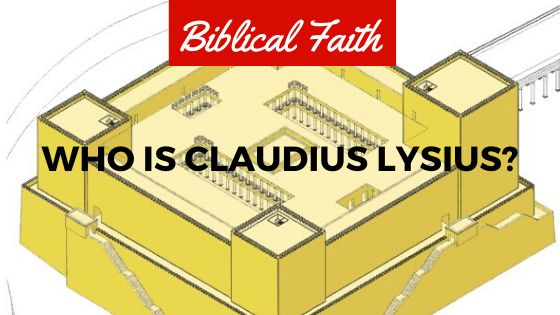
Reconstruction of Fort Antonia by Ehud Netzer in Biblical Archaeology Review 35.1 (Jan.-Feb. 2009).

Claudius Lysias, the Tribune

Claudius Lysias is called “the tribune” (χιλίαρχος, chilíarchos) 16 times within Acts 21-24 (21:31-33, 37; 22:24, 26-29; 23:10, 15, 17, 19, 22; 24:22); 17 times if Claudius Lysias is also included in among the “military tribunes” in the “audience hall” when Herod Agrippa II and Bernice come to hear Paul (Acts 25:23). However, such speculation is uncertain, especially considering a minimum of two years from when Claudius Lysias sent Paul to the Procurator Marcus Antonius Felix in c. AD 57/58 Acts 23:26-35, to within the first few months of the new Procurator Porcius Festus who rules from AD 60-62 (Acts 24:27-25:1-22).

The Greek term chilíarchos is said to be used to translate the Roman tribunus militum (following Polybius), and also for the phrase tribuni militares consulari potestate (Plutarch). The responsibilities of a chilíarchos were as a “commander of a thousand men”.[1] Essentially, Claudius Lysias is “a high ranking military officer in charge” of anywhere from 600 to 1,000 men,[2] and this appears to be the case for it is said that his command was over a “cohort” (σπειρα, speira) in Jerusalem which is “the tenth part of a Roman legion having about 600 men” (Acts 21:31).[3]

Tribune of a Jerusalem Cohort

Claudius Lysias’s complete description as found in the New Testament book of the Acts of the Apostles is “the tribune of the cohort” in Jerusalem, which resided in nearby “barracks” (Acts 21:34, 37; 22:24, 23:10, 16, 32). It takes six cohorts to make up a legion, and each legion had six tribunes with a thousand men (“soldiers and centurions” Acts 21:32) under his command if the cohort was full; consequently, Claudius Lysias was a part of a larger military force.

The exact numbers in his cohort may never be known, however, he had sufficient men to spare two centurions, two hundred soldiers, seventy horsemen, and two hundred spearmen to accompany Paul to Caesarea Acts 23:23-24. Furthermore, when the security detail arrives before Antipatris (Acts 23:31), Claudius Lysias allows for the seventy horsemen to go on with him and Paul to Caesarea, the headquarters of the Procurator Felix (Acts 23:32-35).

The “barracks” referenced in the book of Acts (21:34, 37; 22:24; 23:10, 16, 32), in connection to Claudius Lysias and his cohort are references to the Tower of Antonia, which Herod the Great rebuilt from a previous structure and named it after Marc Antony.[4] The Antonia was added on to the northwest side of the Temple facilities, “from which stairs descend into the outer court of the temple” (Acts 21:32, 35, 22:30).[5] For this reason, the Roman Tribune could hear the commotion caused by the confusing riot over Paul’s presence in the Temple and respond with speed (Acts 21:27-32).

Claudius Lysias in the New Testament

The military tribune Claudius Lysias enters the New Testament narrative when he protects Paul of Tarsus from a hostile Jewish mob on the outside of the Temple grounds in Jerusalem (Acts 21:30-32). The Acts text does not explicitly state why the tribune arrests Paul aside from asking “who he was and what he had done” (Acts 21:33); consequently, it appears Paul is detained for investigation as reflected later in Paul’s interrogation in the Antonian barracks because he was a cause of instigation among the Jews (Acts 22:23-24).

Claudius Lysias is aware of Jewish anarchistic movements, for when Paul speaking in Greek asks permission to speak to the shouting Jewish mob, the tribune appears shocked that he speaks Greek (Acts 21:37). Paul, as a controversial Greek-speaking Hebrew, evidently met some of the criteria for Lysias to conclude he was a Jewish revolutionist. Consequently, it appears that Lysias suspects him of being “the Egyptian” who “stirred up a revolt and led the four thousand men of the Assassins [σικαρίων] out into the wilderness” (Acts 21:38).

This individual operated around A.D. 53, and this revolution amounted to amassing these four thousand men, positioning themselves upon the Mount of Olives outside Jerusalem, and anticipating the walls of Jerusalem to collapse at his command. The Romans attacked this band of men, and the Egyptian lost six hundred men, and fled into the wilderness where he disappears awaiting “further revelation.” Evidently, “the Egyptian” was still on the run, wanted by the Roman military and the tribune was going to see if Paul was this anarchist.[6]

Paul was able to persuade Lysias that he was not an agitator, and provides him with his provincial citizenship as being from Tarsus, in the province of Cilicia (Acts 21:39). This was not an “obscure city” and either this suggests his citizenship could be authenticated, or Paul distinguished himself from the obscure Egyptian. In either case, Paul’s point is clear, he is not the Egyptian; the tribune accepts Paul’s case, and grants Paul an opportunity to speak to the Jews on the steps of the Temple facilities adjoined to the Antonian fortress (Acts 22:39-40).

The Jews did not respond peaceably to Paul’s speech, and Claudius Lysias decides to take Paul into the “barracks” of Antonia and “examine” him through the process of binding him to flog him (Acts 22:22-24). On receiving a report that Paul was a Roman citizen and then making a personal inquiry, Claudius is afraid of having violated the rights of a Roman by having him bound (see “Roman Citizenship” below). Claudius desires to arrive at the truth concerning the Jewish case against Paul and commands the Sanhedrin to assemble. Dissension among the Sanhedrin towards Paul arises again and causes Claudius Lysias to order his men to take Paul to the safety of the Antonian barracks (Acts 22:30-23:10).

Upon learning of a plot to kill Paul, Claudius Lysias summoned a military convoy to leave for Caesarea Maritima. In compliance with Roman law, he also sent a statement of the case to the procurator Antonius Felix. The letter reads:

Claudius Lysias, to his Excellency the governor Felix, greetings.

This man was seized by the Jews and was about to be killed by them when I came upon them with the soldiers and rescued him, having learned that he was a Roman citizen. And desiring to know the charge for which they were accusing him, I brought him down to their council. I found that he was being accused about questions of their law, but charged with nothing deserving death or imprisonment. 

And when it was disclosed to me that there would be a plot against the man, I sent him to you at once, ordering his accusers also to state before you what they have against him. (Acts 23:26-30, English Standard Version)

The letter format is consistent with the general format in the Graeco-Roman world, of “author” to “recipient” with a “greeting” with the subsequent content of the reason for the letter.[7] This letter, however, was not altogether factual. It is an interesting “specimen” of Roman military correspondence (Acts 23:26-30).

Although acknowledging Paul’s innocence, Claudius Lysias gave the impression that he had rescued Paul because of having learned that the apostle was a Roman, whereas in reality, he had violated Paul’s citizenship rights by having him bound and even ordering that he be examined under scourgings. As to the disciple Luke’s knowledge of the letter’s contents, it may be that the letter itself was read at the time Paul’s case was heard.

Roman Citizenship

In Acts 22:23-29, a discussion between Paul and Claudius emerges on the topic of Roman citizenship. Part of Claudius’ investigation procedure to find out more information was to stretch out the detained for whips and flog them.

Before his flogging begins, Paul questions the centurion given this detail, “Is it lawful for you to flog a man who is a Roman citizen and uncondemned?” (Acts 22:25). Roman citizenship had a number of privileges, as John Polhill writes:

A Roman citizen was subject to Roman law and thus was protected from such things as being beaten without a trial, from cruel punishments like crucifixion, and from unlawful imprisonment, rights which did not belong to an ordinary provincial (peregrinus). Citizens had the right of appeal. Only a Roman citizen could legally marry another Roman citizen. Citizens were exempted from certain taxes. Beyond this, there was the considerable factor of honor and deference such a status afforded.[8]

It was such a valued honor, that some people risked the death penalty given for falsely claiming citizenship.[9] Interestingly, one could hold dual citizenship, as Paul was not only a citizen of the city of Rome but was also a citizen of the city of Tarsus from the province of Cilicia (Acts 21.39; 23.34).

Roman citizenship was conferred in a number of ways. The basic ones are as follows:

(1) The most common way was being born of two Roman citizens.

This is the claim Paul makes when asked how he obtained his citizenship (“I am a citizen by birth” Acts 22:28), which implies that both of Paul’s parents were Jewish Roman citizens (cf. #4).

(2) One could obtain citizenship as a reward for military service.

Regularly, military veterans were given citizenship upon discharge. This was the surest way to get it, taking 20 to 25 years depending on the level of ranking.

(3) Imperial conference, though heard of, was not entirely common.

Nevertheless, the emperor could confer citizenship, either on individuals or on whole communities, as in the establishment of a new colony. Often the result of doing some loyal service to Rome. Also, many times through these services, one gained an audience with the Emperor through expensive gifts to members of the inner Imperial court.

This may have been how the Tribune Claudius Lysias gained his citizenship (Acts 22:27-28). In fact, the tribune’s name provides evidence to assume the plausibility that Emperor Claudius (A.D. 41 – A.D. 54) conferred upon Lysias citizenship since those granted this honor would bear the name (the nomen) of the family or patron which conferred it; hence, Lysias gained the name of his patron Claudius. It has been noted that the emperor was quite “promiscuous” in his conference of citizenship.[10]

(4) Roman citizenship was also conferred through the emancipation of a slave from the house of a Roman citizen.

Some have suggested that Paul’s ancestors may have been freedmen from among the thousands of Jews whom Pompey took as slaves in 63 B.C.[11]

Endnotes

  1. H. G. Liddell, An Intermediate Greek-English Lexicon: Abridged from Liddel and Scott’s Greek-English Lexicon (1888; repr.; Oak Harbor, Wash.: Logos Research Systems, 1996), 888.
  2. Barclay Newman, Jr., A Concise Greek-English Dictionary of the New Testament, revised ed. (Stuttgart: Deutsche Bibelgesellschaft, 2010), 200.
  3. Newman, A Concise Greek-English Dictionary, 167.
  4. Josephus, Antiquities 15.293; 15.409.
  5. George A. Smith, et al., “Jerusalem,” Encyclopaedia Biblica, eds. T. K. Cheyne and J. Southerland Black (London: A & C Black, 1901), 1:2429.
  6. Robert M. Grant, The Sword and the Cross (New York, NY: Macmillan, 1955), 49.
  7. T. C. Mitchell, Biblical Archaeology: Documents from the British Museum (New York, NY: University of Cambridge, 1988), 89.
  8. John B. Polhill, “Political Background of the New Testament,” Foundations for Biblical Interpretation, eds. David S. Dockery, et al. (Nashville, TN: Broadman & Holman, 1994), 531-32.
  9. Abraham J. Malherbe, “Life in the Graeco-Roman World,” The World of the New Testament, ed. Abraham J. Malherbe (1967; repr., Abilene, Tex.: Abilene Christian University Press, 1984), 9.
  10. Polhill, “Political Background of the New Testament,” 532.
  11. John B. Polhill, “Political Background of the New Testament,” 532; Richard R. Losch, The Uttermost Part of the Earth: A Guide to Places in the Bible (Grand Rapids, MI: Eerdmans, 2005), 176-77.

This originally appeared as a fully edited submission to Wikipedia.org. I have posted this here in case it is revised or rewritten.