Family Ministry: Evaluating Garland on “Power and Roles”

In the December 2015 issue of the Gospel Advocate magazine, my article, “The Widows Church of Christ” was published.[1] It focused on my experience one summer filling in at a small congregation near Freed-Hardeman University that at the time was composed exclusively of women and widows. In the piece, I briefly retold a conversation I had with one of the sisters there, rehearsed a few biblical examples of areas of women’s evangelistic involvement, and discussed women’s role in the assembly.

A reader called my attention to share her disagreement with the following few lines:

Scripture shows that Christian women prophesied and prayed in New Testament times (1 Corinthians 11:5; Acts 22:8-9), taught the Word of God accurately (Acts 18:26), and brought people to salvation (2 Timothy 1:5; 3:14-15). Christian women also served one another in many diverse ways (1 Timothy 5:2; Titus 2:3-5; Acts 9:36-43). Too, Christian women were patrons, fellow workers for the truth, and “house church” hostesses (Romans 16:1-16).[2]

She disagreed with my assessment, but not because the early church used women in its ministry. She said, “I disagree because we [i.e. women] are stupid.” I responded, “Who told you women are stupid?” She matter-of-factly responded, “we are.” I flatly denied her claim. I do not know who taught her this, all I know is that an entire life in the church has not changed her mind. Unfortunately, this has not been my only experience.

Many women in church ask me to speak on their behalf about ideas. Why? It is not because they are shy, but because they are “women” and women have no “right to share” ideas about the church. Perhaps it is not fair to put all the blame on the church. However, if the church truly embraces a culture of female dignity and equality as image-bearers of God, and equality as recipients of salvation (Gal 3:26-28), then it would be hoped that our sisters and fellow heirs in Christ should have a better perception of themselves as women in the church and society, and as wives and mothers in the home.

The issue at hand may be reduced to one word —power. Who has the power and who does not in the family, the church, in the world? Who should? Furthermore, what is power, and is it an innate quality or something else. The late Diana A. Garland (d. 2015), former dean of the Baylor School of Social Work at Baylor University, discusses power in detail within the sociological perspective of marital relationships and the impact of biblical interpretation in a chapter of her insightful volume, Family Ministry: A Comprehensive Guide.[3]

In it, she provides a working definition of power, explores Jesus’ teaching about power in Mark 9:33-37, summarizes gender roles in the home within the American context of the last century, and offers her interpretations of certain key biblical passages (Gen 1-3; Col 3:18-19; Eph 5:21-33, 1 Pet 3:1-6; 1 Cor 7, etc). It is argued here that Garland has presented a cohesive argument regarding power and Jesus’ teaching about power, but they are not complete discussions. Furthermore, Garland presents a brief social-historical summarization of gender roles which reflects a hierarchy —a model of marital headship— that has a built-in “inferiority of women” point of view. Garland’s interpretive trajectory is built on this framework.

This is problematic because Garland generalizes this viewpoint as one that is shared across cultures and eras, which it is not; moreover, she proceeds an attempt to dispel the notion that the biblical references of marriage and family headship do not teach an “inferiority of women” model. Garland offers an egalitarian framework, but although she raises important concerns, I believe a complementarian framework is a better-supported framework for matters of church work.

Definition of Power

Defining Power

In the first place, it is important to understand Garland’s point of view on power, gender roles, and hierarchy.[4] Garland provides a working definition of power that is helpful as a starting point for the present discussion and builds her discussion of power with M. Weber’s words in mind: “the probability that one person is able to exert his or her will despite resistance from others.” Such power may be an influence on another “whether or not that influence is resisted or even recognized by any of the actors.” From this it is suggested that power is not best thought of as a personal characteristic but instead as an influence from relational dynamics; thus, “power is,” Garland concludes, “a dynamic in all family relationships. We are always attempting to influence one another.”

While she regards power as ultimately “neutral” she points out that this relationship influence may be used for good (protect the vulnerable) or for ill (take advantage of the vulnerable).

Power and Gender Hierarchy

Garland paints a picture of a community and culture which shapes a power dynamic within the family that has historically given men more power in marriage than women.[5] Similarly, family theorists David H. Olson and John DeFrain suggest: “Tradition has dictated that considerable power go to the males in the family,” and add the caveat, “but women often have more power than they or anyone else admit.”[6] Still, Garland argues that culture and economics have played a historic role in reinforcing certain gender roles in the home and the workforce.

For example, Garland argues that in “traditional” homes husbands earned a living for the family, and gave their wives “an allowance,” and the wife, in turn, managed the emotional and interpersonal relationships of the home. As an extension of the prevailing culture, the church followed suit by emphasizing strong hierarchal gender roles where men had authority and power, while women were expected to submit and obey their husbands in keeping with a military-type paradigm of authority and submission.[7]

Vulnerable and Inferior Women

This unavoidably led to what Garland speaks of as a view of hierarchy—or headship—with a built-in “inferiority of woman” model. In this view, women are vulnerable, in need of protection, in need of structure, and in need of a man to insulate them from the attacks of Satan.[8] She cites Judith Miles as her “poster child” of this viewpoint, who argues in her own work, “I was to treat my own human husband as though he were the Lord, resident in our own humble home.”[9] Consequently, she would never question her husband on anything because such was to question the Lord himself.

Unfortunately, not only did some hold that women were theologically vulnerable, but some even advocated women were emotionally not “up to the task” of ministry. The rise of a liberation movement of women stems was therefore a response to this form of hierarchy model that held an implied inferiority view of women. As the woman’s liberation movement emerged in the 1960s and 1970s, the church, according to Garland, was threatened by the rise of demands by women for better (egalitarian) family relationships.

This is Garland’s starting point: a historically rigid view of hierarchy and gender roles in society and the home as reinforced by society and church, which not only implied an “inferior woman” model but in many cases overstated the headship of man.

Inferiority Illustrated

Garland’s portrayal should not be dismissed out of hand as it relates to the American church. The relationship between culture and church is not always easily discernible. The church has been affected by this type of “inferior women” hierarchy and has been reaping the whirlwind of this type of gender oversimplification. A few examples are in order.

Roy H. Lanier, Sr., in his Contending for the Faith column, “The Problem Page,” once responded to a letter from an elder’s wife.[10] Her problem focused on her husband’s mistreatment and undermining of her maternal role based on stereotypical female “problems” (emotional and biological). His dismissive treatment of her had now trickled down to their children. Lanier’s response was extensive and centered on a demonstration from Ephesians 5:21–33 that headship does not permit, nor condone, such treatment. Lanier argued, “it is obvious that her husband does not love her as Christ loves His church.”[11]

In F. Dale Simpson’s 1972 book on leadership, Simpson addressed the problem of women in the mission field: “most married missionaries have to overcome the resistance of their wives to go to a foreign mission field.”[12] Therefore, while

women are biologically stronger than men… are as intelligent as men and more careful about details… women are not as temperamentally suited for carrying out the great commission as men.

F. Dale Simpson, Leading the First-Century Church in the Space Age

Simpson offers only his experience and his opinion about the temperament of women in the mission field.

Long-time missionary and educator, Earl D. Edwards, provides a correction based on several behavioral studies.[13] Edwards rightly points out that different genders tend to have differences that are present at birth and socially amplified; yet, such gender-specific roles (functions) are gender differences and are not a reflection of gender inferiorities or superiorities.[14]

The Struggle is Real

In short, Garland is addressing a real problem about church culture and power, and how it relates to women and wives. It strikes at the heart of a woman’s worth in the home and in the church, and in ministry in general. The church would be wise to hear her call to be alert to this problem. However, Garland does not reject a simply abusive hierarchal power within the marriage as expressed in certain stereotyped gender roles. She clearly rejects any hierarchy with a power structure within marriage—i.e., male headship is not biblical and therefore not normative biblical teaching.

Jesus’ Teaching on Power

In the second place, Garland moves toward a brief exploration of Jesus’ teaching about power in Mark 9:33–37 and uses it to frame her discussion of power dynamics within two broad Christian family contexts: gender roles and discipline.[15]

And they came to Capernaum. And when he was in the house he asked them, “What were you discussing on the way?” But they kept silent, for on the way they had argued with one another about who was the greatest. And he sat down and called the twelve. And he said to them, “If anyone would be first, he must be last of all and servant of all.” And he took a child and put him in the midst of them, and taking him in his arms, he said to them, “Whoever receives one such child in my name receives me, and whoever receives me, receives not me but him who sent me.” (Mark 9:33–37 ESV)

In this passage, Jesus’ illustrates and demonstrates the true use of power in light of the fact that the disciples had been arguing over “who was the greatest” (Mark 9:34).[16] The passage is, then, a corrective focused on “how his followers should use what they have to serve others rather than exalt themselves.”[17] Indeed, greatness is measured in service, in welcoming the smallest, least powerful, to the most vulnerable of society (Mark 9:35). Unfortunately, the disciples still did not retain the lesson since Jesus must correct them again (Mark 10:13–14); yet, Garland sees Jesus’ point as follows:

Rather than using your power to benefit yourself, use it to serve and benefit others. Order your life as Christians by protecting and caring for those most at risk of others abusing their power.[18]

Diana Garland, Family Ministry

Garland affirms that Jesus “used his own power to care for them” by completing the passion of the cross which he predicts three times (Mark 8:31; 9:30–31; 10:32–34). Power is never conserved for oneself but instead is the instrument to serve others. Elsewhere Jesus says,

The kings of the Gentiles exercise lordship over them, and those in authority over them are called benefactors. But not so with you. Rather, let the greatest among you become as the youngest, and the leader as one who serves. (Luke 22:25–26).

Garland’s Miscue

What appears to be lacking in Garland’s treatment of power in Mark 9:33–37 is the broader literary concern with discipleship in the kingdom of God which begins in Mark 8:26 and ends in Mark 10:52.[19] This is not a small matter because, in Mark 8:34, Jesus frames the discussion of true discipleship: “If anyone would come after me, let him deny himself and take up his cross and follow me.”

To follow Jesus means to submit to his plan, to submit to one’s role in the kingdom of God. “Discipleship… comes then with the commitment to humility and self-denial, rejection and suffering.”[20] The hard lesson the disciples continued to fail to appropriate is that the kingdom of God is at the disposal of others—especially the vulnerable—is the transformative experience of discipleship. Thus, power and one’s role are interwoven. Jesus demonstrates this by submitting to his role as God’s servant on the cross (Luke 22:42).

The matter is not simply about power and influence, for Mark 9:33–37 and Mark 10:13–16 teach that discipleship includes one’s submission to God’s transforming kingdom. It is not that Garland is wrong, but that her framing appears incomplete which, for the attention given to her work overall, is a significant oversight.

Overgeneralizations on Power and Gender Roles

In the third place, Garland generalizes that power and gender roles have been male-dominated across cultures and eras, which it is not.[21] This is an important drawback. The American church may be influenced by the surrounding culture and societal gender role expectations (even as traditional roles are presently eroding), but extrapolating from it that all cultures share a similar or comparable power structure along gender lines in families is problematic.

Cultural Anthropology

Not all cultures share the same expectations for gender roles. For example, Paul G. Hiebert, anthropologist and missionary, writes,

while most societies place some responsibility on the father for rearing the child, this is not universal. But the biological and social dependency of an infant on its mother is recognized in all social societies.[22]

Paul G. Hiebert, Cultural Anthropology

It appears that certain biological relationships (mother-child) have built-within them influences that exert power on behaviors, and while they may manifest differently in various cultures, they do not imply inferiority or lack of equality. These relationships, do, however, create forms of power management that can create a displacement of power. This is a vital element to evaluate Garland’s overarching premise that power exercised implies the inferiority of one influenced by another.

The Psychology of Parental Authority

Psychologists David G. Myers and C. Nathan DeWall describe that within parent-child relationships authority, or, power, is observable in three parenting styles: authoritarian, permissive, and authoritative.[23] The extent to which parents try to control their children is, “the most heavily researched aspect of parenting.” Parents either “set rules and expect obedience” (authoritarian) which tends to affect their children’s social skills and self-esteem. Or, they “give in to their children’s desires” (permissive) which tends to develop children who are agreeable and immature. And, parents who “are both demanding and responsive” (authoritative) tend to produce children who are well-rounded emotionally and socially.

A parent’s use, abuse, or nonuse of power can tend to have drastically different outcomes. The presumed element here in these relationships is that a parent is in a hierarchal relationship with their children (cf. Eph 6:1-4), and within this relationship, power is being managed and applied. Garland’s overarching point is that this is in principle antithetical to Jesus’ teaching on power, but power and role are inseparable. 

Family Power Management

Olson and DeFrain explore the wide range of “family power” management which is of significance here. According to them, “family power is the ability of one family member to change the behavior of the other family members.”[24] And while Garland concedes that “power” and “influence” are morally neutral, she approaches the subject of gender roles, power, and marriage from a morally negative point of view. Yet, as Olson and DeFrain point out, power —particularly family power— is a complex, dynamic interactive feature of a family system. Everyone in a family has power and everyone exerts it on the other member of the family. Even infants, according to Garland, have power. Yet, Garland suggests that a male headship hierarchy historically has mitigated women’s power in the marriage relationship, and therefore, empowers men and silences women, encouraging male power and delegitimizing female power and influence. Garland is not wrong if painting with broad strokes.

Marital Hierarchy

Garland’s argument that the removal of the hierarchy in male-female roles in marriage and family, and therefore must be applied to the church, is problematic.

Garland attempts to dispel the notion that the biblical references to marriage and family headship do not teach an “inferiority of women” model. The creation account in Genesis 1–3 “provides,” according to Garland, “the primary foundation for a hierarchical understanding of husband-wife relationships.”[25] The order of creation does not prove male headship nor female submission; instead, Garland proposes that the pre-fall notation of “them” in Genesis 1:26–31 suggests shared dominion, shared identity, and a shared name. Moreover, the woman was not simply a “helpmeet” (KJV), but instead, is a soul-mate helper who is a “bone-and-flesh mirror image of the man who remains incomplete without her.”[26]

The Hebrew term ‘ezer certainly points to a “help” that comes from someone strong (Gen 2:20), as it is used in “warrior-esque” passages (Deut 33:29; Ezek 12:14), and is even used to describe God (Exod 18:4; Psa 121:1–2, 8). Thus, this is not a chain-of-command relationship where Eve is the weaker and more vulnerable of the two.

Garland provides a view of these passages that are cohesive and within reason of the evidence, but it is in Genesis 3:16, where the trouble lies. Garland argues that change after the fall is not a curse from God, but instead a pronouncement by God of how the relationship between Adam and Eve will now be.

In her view, God is being descriptive, not prescriptive. This is not an edict that imposes a new hierarchical relationship based on gender. Observe Garland’s argument that the fall

results in dire consequences for their relationship: the husband now shall rule over the wife. This new development implies that it was not what God had originally determined for their relationship. The dominance of the husband in Genesis 3:16 is described, not prescribed… it is the consequence of their joint disobedience.

Thus, the idea of hierarchical gender relationships is nothing but “a perversion of God’s intention in creation. The partnership has been destroyed. Sin disfigures the good God offered us.“[27] A variety of authors have offered a similar take in recent years. Linda L. Belleville, for example, is certainly at the forefront of pressing this interpretive option against the traditional view of male headship from Genesis 2–3.[28] Belleville, likewise affirms:

male rule finds no explicit place in the Bible’s theology at all. Adam’s sin is noted (Rom 5:12-19; 1 Cor 15:20-22), as is Eve’s deception (2 Cor 11:3; 1 Tim 2:14). But the man’s rule over the woman is not cited even once (not even for the husband-wife relationship). The simple fact is that male rule does not reappear in the OT. The woman is nowhere commanded to obey the man (not even her husband), and the man is nowhere commanded to rule the woman (not even his wife).[29]

Belleville likewise suggests that Genesis 3:16 is a statement of the natural outcomes of the husband-wife relationship to follow due to the “fallen condition” of the world.

Garland, Headship, and the Biblical Narrative

It is the view taken here, in response to Garland––and to some degree Belleville––that Genesis 1:1–2:3 and 2:4–25 do provide the foundation for the traditional view of gender roles and should be regarded as normative.[30] The account of day six in Genesis 1 is a broad-picture passage. It speaks to the equality shared between man and woman as a distinct created order, or class, that is made in the image of God, and for this reason, have a human responsibility together to “have dominion… Be fruitful and multiply and fill the earth and subdue it” (Gen 1:26–28). But, when day six is given an expanded view in 2:4–25, the foundation for how human power is to be managed is explained—it is to be done in a relationship with someone just like Adam.

This power and influence are managed between husband and wife (2:20–24). And while the family power style is not explained in Genesis 2, Genesis 3:16 becomes an informative model of the way the husband-wife relationship exists outside the garden due to sin as God punished Adam (3:17–19) and the serpent (3:14–15), so God punishes Eve (3:16).

Problems with the Descriptive View

The argument that God is only describing how things will be, clearly undermines several theological themes which begin at this point. These are not mere descriptions of the fallen world.

First, God declared the serpent’s dust-filled days but also that he will feel the consequence of a crushed head by “the woman’s” offspring. This is not descriptive, this is a proclamation of Divine action and judgment upon the serpent, and salvation for humanity (John 16:11).

Second, God declared that Adam would face further hardship in the production of food and nourishment. Adam already understood work. He knew how to til and maintain the vegetation of the garden since day six (2:15). Whatever is forthcoming outside the garden for him is new and punishment for his sin. They are consequential.

And finally, God addresses Eve’s actions with further pain associated with childbearing and nuance to the relationship between her and her husband. When God says, “I will surely” do this and that, it must be interpreted as a consequence. The most pertinent here is the following, “Your desire shall be contrary to your husband, but he shall rule over you” (Gen 3:16b).

The curse upon Eve is clearly speaking of a matter of power management within the husband-wife relationship. It is the same vocabulary and issue of power management in Genesis 4:7 with Cain and his personified anger who desired to control Cain. Cain must rule over its desire. Moreover, the language is found again in the Song of Solomon, where the bride turns this “curse” into a wedding vow, “I am my beloved’s, and his desire is for me” (Song 7:10). Contrary to Belleville’s claim that the “simple fact is that male rule does not reappear in the OT,” the Bible does recognize implicitly male headship.

Biblically Grounded Patriarchy is Never Condemned

Interestingly, Old Testament scholar Bruce K. Waltke points out that of all the social injustices mentioned by the prophets of Israel, patriarchy is never mentioned among them. Following Abraham Heschel, he argues:

They challenged the injustices of their culture. The prophet is an iconoclast, challenging the apparently holy, revered and awesome beliefs cherished as certainties, institutions endowed with supreme sanctity. They exposed the scandalous pretensions, they challenged kings, priests, institutions and even the temple.[31]

Waltke is probably correct when he argues that the problem that often affects interpretation is the definitions of concepts of patriarchy and equality brought to bear on the texts of Scripture. Eve was every bit Adam’s equal. They both shared the power and authority over the creation given to them by God. That power was to be worked out in their marriage in some form of family power style.

In Genesis and throughout the rest of the Bible, the family power structure to manage power is a hierarchy, with the husband as head of the wife and as Christ head of the church (Eph 5:23). Yet, such headship does not exist in a vacuum. A husband’s headship does not exist properly without being sacrificial, loving, or nourishing. Neither does it embrace a tyrannical hold on his wife. He is to be as self-sacrificing as Jesus was and is for the church. If the husband is head of the wife as Christ is head of the church —his bride— then one should be careful in calling headship structure “a perversion of God’s intention” and a “partnership” destroyed as Garland has. For this reason, her work and view would be detrimental to family ministry.

Endnotes

  1. Jovan Payes, “The Widows Church of Christ,” Gospel Advocate 157.12 (Dec 2015): 29–30.
  2. Payes, “Widows Church of Christ,” 30.
  3. “Power and Roles” is chapter 11 in Diana R. Garland, Family Ministry: A Comprehensive Guide, 2d ed. (Downers Grove, IL: IVP Academic, 2012), 370–411.
  4. Garland, Family Ministry, 370. All proceeding quotations in this paragraph are from page 370.
  5. Garland, Family Ministry, 372.
  6. David H. Olson and John DeFrain, Marriages and Families: Intimacy, Diversity, and Strengths, 4th ed. (New York, NY: McGraw-Hill, 2003), 213. Power, control, and authority are continuously exercised in families, and struggles for personal power in families are exceedingly common. 
  7. Garland, Family Ministry, 372.
  8. Garland, Family Ministry, 373.
  9. Ibid.
  10. Roy H. Lanier, Sr., “An Elder’s Wife has a Problem,” 20 Years of the Problem Page (Abilene, TX: Quality, 1984), 1:177–81.
  11. Lanier, “An Elder’s Wife,” 178.
  12. F. Dale Simpson, Leading the First-Century Church in the Space Age (Abilene, TX: Quality Printing, 1972), 121–22. 
  13. Earl D. Edwards, “The Role of Women in the Work and Worship of the Church,” Protecting Our Blind Side: A Discussion of Contemporary Concerns in churches of Christ (Henderson, TN: Hester Publications, 2007), 255–57.
  14. Edwards, “Role of Women,” 156–57.
  15. Garland, Family Ministry, 371–72.
  16. Unless otherwise stated all Scripture quotations are taken from the English Standard Version of The Holy Bible (Wheaton, IL: Crossway, 2001).
  17. Garland, Family Ministry, 371.
  18. Garland, Family Ministry, 371.
  19. Jovan Payes, “Leaders Stand Up for the Weak,” In My Place: The Servant Savior in Mark, ed. Douglas Y. Burleson (Delight, AR: Gospel Light, 2015), 376–77.
  20. Payes, “Leaders Stand Up,” 376.
  21. Garland, Family Ministry, 372–92.
  22. Paul G. Hiebert, Cultural Anthropology, 2d ed. (1983; repr., Grand Rapids, MI: Baker Books, 1999), 197.
  23. David G. Myers and C. Nathan DeWall, Psychology in Everyday Life, 3rd ed. (New York, NY: Worth Publishers, 2014), 84.
  24. Olson and DeFrain, Marriage and Families, 213.
  25. Garland, Family Ministry, 374.
  26. Garland, Family Ministry, 376.
  27. Garland, Family Ministry, 376–77. Emphasis original.
  28. See Linda L. Belleville, “Women in Ministry: An Egalitarian Perspective,” Two Views on Women in Ministry, rev. ed., ed. James R. Beck (Grand Rapids, MI: Zondervan, 2005), 21–103.
  29. Belleville, “Women in Ministry,” 31.
  30. Bruce K. Waltke, “The Role of Women in the Bible,” Crux 31.3 (Sept 1995): 29–40; reprinted in Bruce K. Waltke, The Dance Between God and Humanity: Reading the Bible Today as the People of God (Grand Rapids, MI: Eerdmans, 2013), 457–75.
  31. Waltke, “The Role of Women in the Bible,” 30.

Bibliography

Beck, James R. Editor. Two Views on Women in Ministry. Revised edition. Grand Rapids, MI: Zondervan, 2005.

Edwards, Earl D. Protecting Our “Blind Side”: A Discussion of Contemporary Concerns in churches of Christ. Henderson, TN: Hester Publications, 2007.

Garland, Diana R. Family Ministry: A Comprehensive Guide. 2d edition. Downers Grove, IL: IVP Academic, 2012.

Hiebert, Paul G. Cultural Anthropology. 2d edition. 1983. Repr., Grand Rapids, MI: Baker Books, 1999.

Lanier, Roy H., Sr. 20 Years of the Problem Page. 2 volumes. Abilene, TX: Quality Publications, 1984.

Myers, David G., and C. Nathan DeWall. Psychology in Everyday Life. 3rd edition. New York, NY: Worth Publishers, 2014.

Olson, David H., and John DeFrain. Marriages and Families: Intimacy, Diversity, and Strengths. 4th edition. Boston, MA: McGraw-Hill, 2003.

Payes, Jovan. “Leaders Stand Up for the Weak.” Pages 375–81 in In My Place: The Servant Savior in Mark. Edited by Douglas Y. Burleson. Delight, AR: Gospel Light, 2015.

_____. “The Widows Church of Christ.” Gospel Advocate 157.12 (Dec 2015): 29–30.

Simpson, F. Dale. Leading the First Century Church in the Space Age. Abilene, TX: Quality Printing, 1972.

Waltke, Bruce K. The Dance Between God and Humanity: Reading the Bible Today as the People of God. Grand Rapids, MI: Eerdmans, 2013.

_____. “The Role of Women in the Bible.” Crux 31.3 (Sept 1995): 29–40.


Family Ministry: How Strong is Your Family?

If you were to take a sheet of paper and list what you believe are the top ten qualities of a strong family, what would you put down? And, from among these ten qualities, which would be among the top six?

The February 2002 issue of NebFact a resource bulletin of The University of Nebraska’s Institute of Agriculture and Natural Resources in Lincoln, Nebraska, provided just this kind of information.[1] It focused on the issue of family life relationships. It summarized the research work of the Nebraska professor, Dr. John DeFrain, on “American Family Strengths.”

Built on extensive research, covering a span of 25 years, DeFrain concludes that while what constitutes a strong family varies from culture to culture, and society to society, they have one thing in common: they have “qualities that contribute to the family members’ sense of personal worth and feelings of satisfaction in their relationships with each other.”

Psalm 133 and Family Strength

It should be the goal of every family that each member can say two things: (1) “I matter to them” and (2) “I love being with my family.” When both of these statements are realized, then the practical foundations for a strong family are in place.

The 133rd Psalm suggests as much:

Behold, how good and pleasant it is when brothers dwell in unity!

It is like the precious oil on the head, running down on the beard, on the beard of Aaron, running down on the collar of his robes!

It is like the dew of Hermon, which falls on the mountains of Zion! For there the Lord has commanded the blessing, life forevermore. (Psalm 133:1–3 ESV)[2]

This psalm of David (per the superscription) centers on family, a family that is united in their bond and in the Lord.

The psalm is certainly an echo of the Genesis account and the first family. The Lord assesses the Creation as “good” (tob) when God gave the light (1:4), gave the earth and the waters (1:10), gave the plants and the trees (1:12), gave the moon and the sun (1:18), and gave the animals of the sea and air (1:21). Yet, it was decidedly “not good” for Adam to be alone (2:18). It was only until humanity became a family unit (“one”) that things are described to be “very good” (2:18–25; cf. 1:31). The use of “good,” then, in this psalm is a reminder or a call to embrace the goodness and the pleasantness of family together as God intended.

The portrayal of this unity is found along two images: the pouring of oil and the dew of the mountain. As a member of the family, one should feel as integrated to each member of the family like oil that pours upon the head, down to the beard, and on throughout the garments (v. 2). The pouring of oil to soothe or to consecrate did not isolate head, or beard, or garment — it applied wholly to the person and garments. As was the dew that descended on Mt. Hermon and extended to the mountains of Zion, the dew on the land united the land. Zion may be where God descends and where Israel ascended, but the dew united them (v. 3).

We should not walk away from the truth that family has been forged by God, and receives a blessing when it submits to His provisions (Deuteronomy 6:4–9). Nancy deClaissé-Walford reminds us:

the words of the whole psalm reminded the people that their family relationship was established not by blood, but by their mutual share in the community of God, a community that received blessing [sic] from its God.[3]

As sure as the family is to be a blessing to its own members, the family is how God planned to bring about the gospel blessing through Abraham (Genesis 12:3): “in you all the families of the earth shall be blessed.”

What Makes a Family Strong?

John DeFrain and his colleague David H. Olson point to six general overlapping qualities which have a proven record to make families strong. Olson and DeFrain call these qualities, “The Family Strengths Framework,” and they are (1) commitment, (2) positive communication, (3) spiritual well-being, (4) appreciation and affection, (5) enjoyable time together, and (6) the ability to cope with stress and crisis.[4] The following is a summary of these qualities of strong families (according to Olson and DeFrain) along with some supplemental perspectives I have picked up along the way.

First, commitment. Key Qualities: trust, honesty, dependability, faithfulness.

Members of strong families demonstrate a commitment to one another with an investment of time and energy toward them, marking the family as their highest priority. This is not a controlling commitment but one that empowers, encourages, and trusts, especially with regards to marital sexual fidelity.

Ed Wheat and Gloria Okes Perkins’ emphasize from the Greek word storge the importance of creating the atmosphere of “belonging” with “natural affection” (Romans 12:10).[5] This fits well with the trusting and honest environment which comprises a family strength. Wheat and Perkins go on to paint a picture of welcomeness. It is not a “spectacular” and swooping love that builds strong marriages. Instead, it is a “comfort love,” necessary and nourishing, taken for granted and unexciting.

The family culture it creates needs to allow for members of the family to trust they can be comfortable in “their own skin” and safely accepted by their family when the outside world rejects them.

Second, Positive Communication. Key Qualities: sharing feelings, giving compliments, avoiding blame, being able to compromise, agreeing to disagree.

Members of strong families spend time “talking with and listening to one another” in meaningful ways (sharing feelings). They will not always agree with each other but will have the coping skills to disagree, agree to disagree, and compromise without blaming each other. Humor is also a significant unifying feature, a stress reducer, and a way to bring levity to struggles of daily life.

Gary Smalley’s “Five Levels of Intimacy” model fits well here (cf. Making Love Last Forever): (Level 1) having shallow (think clichés) discussions (“good morning,” etc.), (Level 2) sharing basic facts about life or self (“it was hot,” etc), (Level 3) sharing opinions, concerns, or expectations (may risk an argument), (Level 4) honest sharing of one’s deepest feelings with an honorable safe listening environment (“Let me see if I understand what you’re feeling…”), and (Level 5) honest sharing of one’s deepest needs with an honorable safe listening environment (“Let me see if I understand what you need…”).[6]

Communication is the glue that keeps the whole family together. We would do well to enjoy each other’s company through positive communication.

Third, Spiritual Well-Being. Key Qualities: hope, faith, humor, compassion, shared ethical values, oneness with humankind.

Members of strong families believe that faith, hope, or optimism about life are important to a healthy connection to the world. There is a sense in which transcendence of the “every day” to the sacred is embraced, shared, and desired. Their ethics and values emerge from their spiritual orientation. The sense of belonging to a caring and supportive community is important to connect the family to the world. This is considered to be “the most controversial finding of the family strengths” research.

According to F. M. Bernt, research shows that culturally, there has been a move away from a culturally shared value toward a personal/subjective sense of what is important.[7] In other words, people used to have a stronger sense of a shared morality and priority, but that frame of reference has eroded. Today, people are more likely to lean on their own priorities – moral and spiritual. Case in point,  research shows that a “strong marriage/family” will seek a strong spiritual well-being. However, when polled to list the top five traits parents wish to pass on to their children “loyalty to church” is never included. Instead, the top five traits listed are: “willingness to work hard,” “frankness/honest,” “independence,” and a three-way tie between “social mindedness,” “economy in money matters,” and “good manners.”

This fits well with George Barna’s research, Growing True Disciples.[8] The Barna Group, a church statistics ministry, shows that many believers say faith matters, but few, in fact, admit to investing the kind of energy to pursue actual spiritual growth. This may point to a partial answer to a very complex question: “why are our young people leaving the church after they leave their ‘church going’ families?” It seems that discipleship is not a real practical priority. “Dragging” children to church is one thing, training them to become disciples of Jesus is quite another thing. If adult members of the family do not embrace discipleship, it will be very hard to expect the children to embrace such.

The church cannot be expected to raise people’s children, but we need to create an environment for all members to develop as disciples of Christ (1 Timothy 2:1–2).

Fourth, Appreciation and Affection. Key Qualities: caring for each other, friendship, respect for individuality, playfulness.

Members of strong families regularly show their deep feelings for one another through care, friendship, respect, and even playfulness. This does not mean the family is free of tension. Strong families do not ignore negativity. Yet, sharing criticism is outweighed by a genuine concern to show respect. Marital sexual intimacy in strong marriages is likewise built on this positive interplay of friendship and respect.

Gary Chapman’s model of The 5 Love Languages[9] provides very practical ways to demonstrate appreciation and affection; namely: words of affirmation, quality time, receiving gifts, acts of service, and physical touch. This is not only for marital intimacy but also works in broad ways for all family members, acknowledging that some people react better to certain expressions of love.

The key is to remember that healthier families are nurturing with care, affection, friendship, togetherness, and the joy of each other’s company. This takes effort and a commitment to creating a home culture where the language of family interaction is endearing.

Fifth, Enjoyable Time Together. Key Qualities: quality time in great quantity, good things take time, enjoying each other’s company, simple good times, sharing fun times.

Members of strong families create happy memories by spending considerable quality time together. Despite the tension of “much” time versus “quality” time, the focus of strong families are to make every moment together memorable, grounded in simple good times, where the “shared times” (picnics, fishing, meals, trips, etc.) leave indelible marks of joy on each member of the family.

In keeping with the above, Paul Faulkner discusses, in What Every Family Needs with Carl Breechen,[10] the importance of “spending quality time.” Faulkner asserts that there are four hindrances to spending quality time together. These “big fours” are built into American’s aggressive consumer and materialistic culture ([1] money, [2] beauty/sex, [3] intelligence, and [4] athletic ability). These make it hard for families to spend time together.

The scriptures show that money is not evil, but it is the “love of money” that leads to every kind of evil (1 Timothy 5:10). Beauty and sex-appeal is only as enduring as the godly fearfulness and prudence beneath the skin (Proverbs 11:22; 31:30). The vaunted praise of the naturalistic mindset of our society is limited by its detrimental lack to include God in it (Romans 1:19–20). And finally, the obsession with athletes and their skills to the point they displace God as the focus of our hearts is truly the stuff of idolatry (Acts 8:9–11).

It is, therefore, important to be proactive, not passive, in making time —as a priority— for family members in order to overcome the persuasive time killers. Husband and wives need to work together by changing work schedules, reducing professional involvements, and even giving spouses “veto powers” over these matters.

Sixth, Ability to Cope with Stress and Crisis. Key Qualities: adaptability, seeing crises as challenges and opportunities, growing through crises together, openness to change, resilience.

Members of strong families will develop the skill to effectively cope with the unavoidable troubles, stresses, and crises of life. Strong families are less crisis-prone than dysfunctional families because they often prevent the sort of troubles that their counterparts do not. The four main troubles strong families face are —in statistical order— illness and surgery, death, marital problems, and the problems of their children. Strong families adapt to these, and other troubles, through a series of strategies that help family members pull together. The resilience to admit the need for help is listed here in statistical order: every member has a part to play to ease the burden, help is sought to solve problems that the family cannot, counseling is sought to learn better-coping methods.

Parents and guardians of children would be wise to have a preexisting list of recommended Christian counselors, psychologists, or psychiatrists of all ages available to assist their families to cope with stress and crises. Aside from other services, the American Association of Christian Counselors website may be a good place to start to find helpful Christian counseling resources. Counselors are available to help assess our stability and situation: mental, spiritual, or emotional.

Nevertheless, we should always remember that God is the only true help for the ill that no pill can cure (Psalm 121:1).

Concluding Thoughts

There are no perfect families, and this includes the “strong families.” The conclusions by Olson and DeFrain, and others, simply illustrate the sorts of behaviors that have shown to yield a healthy family atmosphere. You might even consider this simply a survey of “best practices” among families that have healthier relationships than others. They do not, however, promise to create perfect families.

In the end, all families -including Christians ones- can gain a great deal when these Family Strength qualities are pursued and practiced. Christian families are no less prone to dysfunction as non-Christian families are, and vice-versa. Families essentially boil down to relationships, and the value felt and satisfaction experienced from being together. We return to the two overarching signs of a healthy family: (1) “I matter to them” and (2) “I love being with my family.” 

For the child of God, we seek another dynamic to be at play in the success or strength of the family, and that is God and his Word, and our story together revealed in Scripture to be at the core of what we do as a family. Moses’ call to Israel is for all of God’s people and ought to be “heard” today:

Hear, O Israel: The Lord our God, the Lord is one. You shall love the Lord your God with all your heart and with all your soul and with all your might. And these words that I command you today shall be on your heart. You shall teach them diligently to your children, and shall talk of them when you sit in your house, and when you walk by the way, and when you lie down, and when you rise. You shall bind them as a sign on your hand, and they shall be as frontlets between your eyes. You shall write them on the doorposts of your house and on your gates. (Deuteronomy 6:4–9)

Endnotes

  1. John DeFrain, “Creating a Strong Family: American Family Strengths Inventory: A Teaching Tool for Generating Discussion on the Qualities that Make a Family Strong.”
  2. Unless otherwise stated all quotations are taken from the English Standard Version of The Holy Bible (Wheaton, IL: Crossway, 2016)
  3. Nancy deClaissé-Walford, Rolf A. Jacobson, and Beth Laneel Tanner, The Book of the Psalms, NICOT, ed. E. J. Young, et al. (Grand Rapids, MI: Eerdmans, 2014), 939.
  4. See, “The Family Strengths Framework” in David H. Olson and John DeFrain, Marriages and Families: Intimacy, Diversity, and Strengths, 4th ed. (Boston, MA: McGraw-Hill, 2003), 75–80.
  5. Ed Wheat and Gloria Okes Perkins, Love Life for Every Married Couple (New York: Inspirational Press, 1980), 80.
  6. Gary Smalley, Making Love Last Forever (Dallas, TX: Word Publishing, 1996), 142–44.
  7. F. M. Bernt, “The Ends and Means of Raising Children: A Parent Interview Activity,” Activities Handbook for the Teaching of Psychology, vol. 4, eds. L. T. Benjamin, et al. (Washington, DC: American Psychological Association, 1999), table 55-2.
  8. (Colorado Springs: Water Brook, 2001).
  9. (Grand Rapids: Zondervan, 1992).
  10. Carl Brecheen and Paul Faulkner, What Every Family Needs: Whatever Happened to Mom, Dad, and the Kids? (Nashville, TN: Gospel Advocate, 1994), 177–79.

Book Review: Love Must Be Tough

Love must be tough

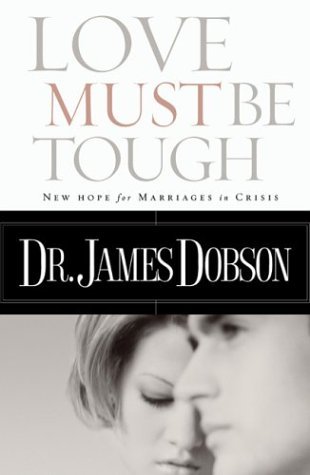
James C. Dobson, Love Must Be Tough: New Hope for Families in Crisis (1983; repr., Tyndale Momentum, 2007), hardback, 238 pages.

Dr. James Dobson (1936-) is a well known and established licensed psychologist (Ph.D., University of Southern California), who has addressed social and family issues from an evangelical perspective for about 40 years. He held a teaching post at USC’s School of Medicine as Associate Clinical Professor of Pediatrics and was on staff at the Children’s Hospital in Los Angeles for many years. And he served on a number government advisory panels and testified at several government hearings.[1]

Dr. Dobson is perhaps known more for the ministry network Focus on the Family he founded in 1977 through which he has provided a steady evangelical voice with regards to social issues on radio, television, print, and online. Since 2010, however, Dr. Dobson formally transitioned away from Focus on the Family and established another multi-media ministry venture, Dr. James Dobson’s Family Talk.

Love Must Be Tough to Save Families

The book under review, Love Must be Tough, is not a new contribution. Dr. Dobson wrote it in 1983 and because of its popularity, it is often reprinted. I read this book as part of a family ministry class. I found it to be an insightful and highly useful volume designed to provide a strategic proposal to help restore marriages struggling under the burden and crisis of marital infidelity. Dr. Dobson argues that his strategy strikes at the heart of the recovery from marital infidelity better than those provided by the then-current advice by counselors and literature.

What appears to be at the heart of the problem lies at a spouse’s passivity and allowance for the other spouse to have all the control in the relationship. This imbalance is subversive to the marriage. Dr. Nancy M. Rockstroh, M.D., who often recommends Love Must be Tough agrees:

when the balance of power switches so that one person has undue control, the potential for abuse of that power becomes imminent. Once individuals have the opportunity to do anything with the tacit acceptance of their partner, they have carte blanche to engage in destructive patterns of behavior without fear of losing the benefits of the relationship.[2]

Nancy Moultrie Rockstroh, “Love Must Be Tough: Proven Hope for Families in Crisis,” Primary Care Companion to the Journal of Clinical Psychiatry (2000)

It is not just theories or bad counseling which Dobson believes to be destructive and subversive to marital restoration. Marriage culture also is to blame, in particular, those which are so co-dependent that there is a loss of self-respect and the mutual respect which should exist within a marriage. Or, as Dobson argues, what marriages in crisis really need is the application of a simple principle: love must be tough.

Book Overview

Dr. Dobson develops his thesis by first showcasing the destructive nature of common approaches advised for reclaiming an unfaithful spouse. But, perhaps most instructive is the fact that he shares real experiences of infidelity and how the wounded spouse attempts to restore the marriage. According to Dobson, counselors tend to advise self-loathing, fault assuming, affair indulgent, and spiritually careless strategies. But even still further, wounded spouses often attempt to regain their unfaithful spouse through strategies (planned or not) that can be summed in the phrase: a complete lack of self-respect and identity (Panic, appeasement, etc).

This behavior must be stopped. Dobson argues strongly that this lack of self-respect and identity is a leading contributor for both the circumstances for a spouse to become unfaithful and for the pushing away of a cheating spouse. Dobson explains this character “defect” can be permissive as it “allows” flirtation with a potential lover, or it passively “allows” the spouse to continue dangerous relationships with a would-be lover. And once suspicion (or infidelity) occurs, the concerned spouse begins to tighten their grasp upon their beloved in order to keep them, but this often times pushes them farther away. The distrusted spouse feels caged and develops a need to escape. The spouse needs freedom. To further aggravate the situation, the worried partner who cannot feel complete without their spouse loses their individual identity and panics only to try to appease their unfaithful spouse. This behavior feels more like constrictions around the unfaithful spouse’s neck, and continue to fuel the desire for freedom (extramarital freedom).

Case upon actual case is rehearsed as testimonial evidence to support Dobson’s thesis that love must be tough. Consequently, if Dobson is right that popular counseling has it wrong in its strategic opinions, and that a consistent lack of self-respect and identity provide the stimulus for infidelity, then a new approach must be considered. Dobson argues therefore that the marriage relationship must include a number of applied principles. Despite the concept of “union” in marriage, each partner must exist with their sense of individuality intact, and each partner must be able to respect themselves. This sets forth the building blocks for a healthy sense of mutual accountability needed in a marriage that will allow it to thrive.

Thus, should signs of a potential extramarital affair begin to loom in the distance, a perceptive spouse can be grounded in their self-respect and identity, provide strong warnings set forth in love, self-respect, freedom, and independence (example: “I love you, but if you continue this course, then I will leave”). Spouses must be able to hold their ground, despite loving their spouse and not wishing them to depart. This “willingness to end a relationship,” says Dr. Rockstroh, “is the very essence of freedom and independence.”[3] Yet, this principle must be, according to Dobson, practiced with caution (see below).

Chapter 12 provides a timeline of eleven benchmarks showing how good marriages end in abandonment, adultery, divorce, and guilt. Side-by-side, the storyline of a husband and wife is unfolded. It shows how emotional starvation experienced by a loving spouse can lead to frustration and depression, only to work the heart into fertile soil for an extramarital affair. Preoccupations, such as work, only blind them of their beloved’s pain and that they too have contributed to this isolation. Eventually, an affair does ensue and is discovered. At this point, Dobson argues, the marriage can still be saved if both partners want to use “tough love” to regain themselves and restore their marriage. In this scenario that Dobson narrates, the cheating spouse leaves and a divorce is finalized. As in many cases which Dobson is aware of, at the end, the love affair turns mundane, the enabling but wounded spouse lives in ignorance of their contribution and the guilt for the children’s situation overshadows their heart.

Here Dobson makes one more appeal to confront misunderstandings that affect marital happiness. He appeals to the fact that culture essentially lies to our young ladies and young men in the aspect of who provides the happiness in the home. For the women, the lie is simple but devastating: “that marriage is a lifelong romantic experience.”[4] Moreover, the husband is entirely responsible for making this a reality; hence, women enter marriage with unrealistic expectations. And when these expectations are not met, it is her husband’s fault. For the men, the lie is relatively clear: “his only responsibility is to provide materially for his family.”[5] The love must be tough principle affirms individual responsibility for one’s happiness, and each spouse must play a role in creating marital happiness.

Of many of the valuable aspects of the book, is Dobson’s honesty that as much as the love must be tough principle is valuable and helpful, it can also be dangerously misapplied. The development of self-respect, individual identity, of creating a culture of freedom, of forgiveness, and many other traits can be so developed to the point where the wounded spouse uses them to destroy the marriage. For example, a person may become so independent that they want nothing to do with their spouse. Another spouse might defend their self-respect to the point where they become so outspoken that there is no mutual accountability. Dobson, therefore, warns against running wild with this strategy.

A Critique on Dobson’s Divorce and Remarriage View

There is no debate that Dr. Dobson’s book is valuable; however, his discussion on divorce and remarriage is perhaps the most egregious section in an otherwise well-developed book.[6] To Dobson’s credit, he inserts a disclaimer that he knows some Bible students will disagree with him. I register here as one who finds Dobson’s discussion of what constitutes a scriptural divorce and remarriage completely lacking biblical support.

Dobson affirms three matters to keep in mind in the discussion of divorce and remarriage. We agree with his discussion on what constitutes adultery in Matthew 19:9 so we will focus on the second passage discussed.

First, Dobson alleges that 2 Corinthians 5:17 sanctions the notion that it “includes divorce prior to salvation,” leading him to conclude:

when the marriage and divorce occurred prior to salvation, I believe God grants His “new creation” the freedom to remarry.[7]

James Dobson, Love Must Be Tough: New Hope for Families in Crisis (1983)

Dobson’s view hinges upon a phrase in this passage, namely “old things.” “Old things” as part of the “new creature” is typological imagery that supports the real emphasis of the verse, namely, that of a new creation. The personnot his/her marital situation– is made “new.” Paul had said previously to the Corinthian church that some of them had been adulterers (1 Cor 6:9-10) but not anymore because of their conversion (1 Cor 6:11). They changed their behavior. Conversion requires a change in behavior (Acts 2:38), it is not a simply a status change.

The third discussion Dobson enters is based upon a misrepresentation of 1 Corinthian 7:25-40. Dobson alleges that if a Christian is abandoned the believer has a right to remarry. Maybe there are other circumstances involved in the abandonment (i.e., adultery), but that is not discussed in this passage. Paul, however, argues that the abandoned spouse is not under an obligation -enslaved- to follow the departing spouse. The emphasis here is about fidelity to God’s sexual and marital laws (cf. 7:1ff). In fact, earlier in the passage Paul addresses “the married” and the potential of a legal separation,[8] to which he clearly gives two options: remain separated or be reconciled (1 Cor 7:10-11).

These are significant drawbacks from an otherwise really helpful book. I further understand that many would disagree with my critique of Dobson’s view. Still, neither conversion nor mere abandonment is biblical grounds for divorce and a subsequent remarriage.

Concluding Thoughts

In the final analysis, the book is generally sound and very helpful. But, because of the material on divorce and remarriage, I would recommend an alternative to sharing its articulation Dobson’s love must be tough strategy. Perhaps create a series of handouts (with due credit) with the strategies listed and illustrated. Or, recommendations to people well versed in the scriptural teachings on marriage, divorce, and remarriage. The material on self-worth and boundaries is the relevant and helpful element of Dobson’s work.

Dobson tackles a hard issue but the counsel he offers is advantageous. It is dated somewhat. For that reason, I would use Love Must Be Tough as a supplemental work to the more current volume by Henry Cloud and John Townsend, Boundaries in Marriage.[9] “Boundaries,” as Cloud and Townsend articulate, help to develop the issues Dobson is concerned with: a healthy sense of identity, personal responsibility, and mutual accountability. So, in the end, I offer a limited recommendation of Dobson’s book for the counselor and minister.

Endnotes

  1. James Dobson,” Wikipedia.org.
  2. Nancy Moultrie Rockstroh, “Love Must Be Tough: Proven Hope for Families in Crisis,” Primary Care Companion to the Journal of Clinical Psychiatry 2.6 (Dec. 2000): 229.
  3. Rockstroh, “Love Must Be Tough.”
  4. James Dobson, Love Must Be Tough: New Hope for Families in Crisis (1983; repr., Waco, TX: Word, 1996), 176.
  5. Dobson, Love Must Be Tough, 176.
  6. Dobson, Love Must Be Tough, 129-33.
  7. Dobson, Love Must Be Tough, 130.
  8. It is documented by R. L. Roberts, Jr., very clearly that the passive phrase “to be separated” (Grk. choristhenai) in these verses is a “technical expression for divorce” as it exists in ancient legal documents before and during the apostolic era (“The Meaning of Chorizo and Douloo in 1 Corinthians 7:10-17,″ Restoration Quarterly 8.3 [1965]: 179-80). Consequently, those that only see a “separation” as we commonly conceive of it as temporary “space” between spouses are unreasonably limiting the meaning of this word here.
  9. Henry Cloud and John Townsend, Boundaries in Marriage (Grand Rapids, MI: Zondervan, 1999).