Among the various collections of Greek writings essential to understanding early Judaism and emerging Christianity is the Greek translation of the Hebrew Bible, commonly called the Septuagint (LXX). What is this translation? Where did it come from? What sort of books were in it? In this piece I seek to provide a short snapshot of this ancient Bible translation, surveying the origin and contents of this corpus, noting its impact on Second Temple Judaism and the New Testament, and its role in Bible transmission will be an indispensable starting point for Bible students.
Origins
The traditional “origin story” of the Septuagint is told in the Letter to Aristeas, a self-described “narrative” recounting how the Jewish Law arrived in Alexandria, Egypt, and was translated into Greek by 70–72 Judean scribes during the reign of Ptolemy II Philadelphus (282–246 BCE).[1] This translation of the Law–and Greek translations of the rest of the Old Testament–is commonly called the Septuagint, for being the translation of the alleged seventy (abbreviated LXX).[2] The historical accuracy of the account in Aristeas is heavily questioned by scholars, but a mid-third century BCE dating and an Alexandrian setting for this translation is regarded as the most likely historical scenario.[3] Additionally, the origin of the Greek translations of the rest of the Old Testament is not well understood except that they were likely present by the first century.
Content
The LXX became the Bible for Jews living in the Hellenic world and the “first scriptures” for an emerging Christianity, but it must be remembered that the LXX was not a set corpus of books. According to Aristeas, the Pentateuch alone was translated into Greek. Later the LXX would include “all of the books of what [is called] the Hebrew Bible,” additional writings translated from Hebrew or Aramaic, and a body of Greek literature.[4] These additional books are called Apocryphal by Protestants and Deuterocanonical by Roman Catholics, 13 of these are typically found in collections together while the Greek Orthodox and Slavonic Bibles include others. The earliest “complete” Greek Christian Bibles from the fourth and fifth centuries CE (Alexandrinus, Vaticanus, and Sinaiticus) do not include the same list of these books.[5] It is anachronistic, then, to treat the content of the LXX as a stable list of books that determined which books should be in the Bible.[6]
Influence
Nevertheless, its impact on Judaism and the New Testament is unmistakable. The LXX provided Greek-speaking Jews of the Hellenistic period with the word of God throughout the diaspora, but its reception was not without extremes. Some ancients (and some modern people) shared the belief, as suggested in Aristeas, that the LXX was inspired; meanwhile, other ancient believers were not persuaded and continued to produce editions of the LXX reflecting varying translation philosophies (Theodotion, Aquila, and Symmachus).[7] Early Christians, being Jewish, used the LXX as their “first Bible.” The New Testament books cite passages from the LXX, even revisions of passages, quotations from memory, or employ modifications.[8] As Christian use of the LXX went “mainstream” as their Bible, Bruce Metzger notes, “more and more Jews ceased using the Septuagint” by the end of the first century CE. As a result, the Greek translation became the “only source” in the church for access to the Old Testament.[9]
Textual Witness
The LXX tradition is a vital witness to our knowledge of the state of the transmission of the “original reading of the biblical text” of the Hebrew and Aramaic manuscripts.[10] The LXX tradition contributes to Old Testament textual criticism by giving insight into the “original” biblical manuscripts the LXX translators had in front of them which no longer exist today. The study of the LXX also helps to assess the habits of both translators and scribes.[11] Sometimes, for example, these translators and scribes changed a reading believed to be discrepant; other times, they “updated” the text to fit the context of their times. Still, modern study of the LXX in light of the Dead Sea Scrolls has underscored that its translators provided, “reliably and accurately reflect what lay before them.”[12]
Conclusion
The influence of the Septuagint in the history of the Second Temple Period and its career for early Christianity as the Bible of God’s people continues today regardless of whether it is perceived by the average Bible reader.
Benjamin G. Wright, III, “Aristeas, Letter of,” Eerdmans Dictionary of Early Judaism, eds. John J. Collins and Daniel C. Harlow (Grand Rapids: Eerdmans, 2010),376.
I will use LXX in this paper to refer to this Greek translation tradition of the Hebrew Scriptures.
Edmon L. Gallagher, Translation of the Seventy: History, Reception, and Contemporary Use of the Septuagint (Abilene: Abilene Christian University Press, 2021), 33–34.
Leonard J. Greenspoon, “Septuagint,” Eerdmans Dictionary of Early Judaism, eds. John J. Collins and Daniel C. Harlow (Grand Rapids: Eerdmans, 2010), 1218.
On this point of what additional books were included, Lee Martin McDonald describes how in the early church there was a “lack of universal agreement on the scope of and order of the church’s OT canon, though by the fourth century there was broad but never universal agreement on the scope of church’s first scriptures [i.e., LXX],” in John J. Collins, Craig A. Evans, and Lee McDonald, Ancient Jewish and Christian Scriptures: New Developments in Canon Controversy (Louisville: Westminster John Knox, 2020),79.
Gallagher, Translation, 52–55. In Gallagher’s assessment, the LXX did not impact the development of the biblical canon, “The Septuagint had no bearing on the development of the canon of Scripture” (47).
Gallagher, Translation, 113–20.
Greenspoon, “Septuagint,” 1219.
Bruce M. Metzger, The Bible in Translation: Ancient and English Versions (Grand Rapids, MI: Abaker Academic, 2001), 18.
Amy Anderson and Wendy Widder, Textual Criticism of the Bible, rev. ed., Lexham Methods Series, ed. Douglas Mangum (Bellingham: Lexham, 2018), 40–41.
Anderson and Widder, Textual Criticism, 95. There is a movement within Old Testament textual criticism that has shifted from seeking the wording of the original manuscripts (i.e., the autographs) to seeking the earliest authoritative form of the text. This latter focus places the goal away from the original words of the text and emphasizes that from various versions one became the authoritative form.
David G. Hagopian, editor, The Genesis Debate: Three Views on the Days of Creation (Mission Viejo, CA: CruXpress, 2001), pb., 319pp.
Reading The Genesis Debate: Three Views of the Days of Creation provided a front row seat at how heated the conversation about origins among fellow-believers can be. The book brings together three teams of Christian scholars set to represent three views on the days of creation and how these views impact Christian thinking about origins and cosmology.
The Teams and Views
Each team is made up of two terminal-credentialed scholars, who present their view and critique the other viewpoints. Team one is made up of Presbyterian affiliated scholars J. Ligon Duncan, III, and David W. Hall. They write a chapter on the traditional 24-hour view of the days of creation, and engage the other view points from this young earth lens.
Team two is comprised of astrophysicist Hugh Ross and Old Testament scholar Gleason L. Archer, representing the Day-Age view of the days of creation in which they believe natural theology informs reading the days of creation from a deep time perspective. The final team provides a literary-framework approach to reading the creation story of Genesis 1. The literary framing of the story of creation is the heart of how to read the creation development outlined by Genesis 1. This chapter is written by New Testament scholar, Lee Irons, with Old Testament scholar Meredith G. Kline.
Observations
Due to the nature of this views book, I want to make some general observations about the interactions found in this work. I am doing this for a couple of reasons. First, some of the missteps I believe in this book provide examples to learn from to improve my own case-making. Second, while I believe in the legitimacy of a young earth and universe point of view, and that we ought to engage other viewpoints, fellow-believers should participate in gracious disagreement.
Evangelical Scholars Misunderstand Each Other
Each team complained of being misunderstood. The most pronounced and heated misunderstandings came from the exchanges between Duncan-Hall and Ross-Archer.[1] Duncan-Hall’s assertion of the testimony of the history of interpretation was misunderstood as the elevation of ecclesial dogma over scripture.[2] Ross-Archer’s assertion that evidence must be gained from both special revelation and natural revelation was misunderstood as an equivocation to anti-supernatural science.[3] Irons-Kline’s non-sequential framework was marginalized as a version of Ross-Archer’s Day-Age theory.[4] At various times, these evangelical scholars did misread and inadvertently misrepresented their opponent’s argument.
I was greatly concern in how the teams misread and misrepresented their opponents. It made me wonder how much crosstalk there should be between scholars on opposite sides if the purpose is to flesh out differences and promote solutions. This was not an oral discussion subject to off the cuff remarks. Surely, there was sufficient time to properly understand their opponent’s view. It strained reason for Ross-Archer to sidestep Duncan-Hall’s point about Jesus turning water into wine as example of Divine control over substance to illustrate God’s creative power. It showed an unwillingness to see Duncan-Hall’s point by reducing the miracle into “flavor” and “color” changes. Ross-Archer’s explanation ultimately calls into question the miracle of Cana in their fake whiskey story.[5] Listening carefully is important.
Methods Slant Emphasis
Each team presented their position from their unique methodological emphases which illustrates that conclusions are not only derived from the text but also from the methodology one employs. Duncan-Hall seize on the exegetical tradition of the church to buttress their position from which they will not be moved.[6] Ross-Archer find corroboration between “modern science” of an old cosmos and Genesis 1 from which they offer a radically different life origins narrative.[7] Irons-Kline uniquely offer an elastic approach able to embrace old or young cosmos viewpoints because their approach to the literary features of Genesis 1 allows them to read the text as providing a figurative portrait of a real historical event.[8]
The debate helped me reflect on the methods I use for interpretation. I should not be surprised at the results of the methods employed. If the method is to only use the rule of faith, the history of interpretation, then it should not surprise me that I may defend traditional interpretations. If I emphasize the tools of literary criticism, then I should not be surprised that it may force me to purely literary conclusions which may not be able to account for macro-theological truth. Methods which seek knowledge from natural revelation to inform my reading of the scriptures may subject the text to eisegesis. The methodologies used by Duncan-Hall, Ross-Archer, and Irons-Kline have strengths, but each were shown to have weaknesses as well.
Humility: Same Commitment, Different Results
Humility is vital when evangelicals hold the same core commitments, but their divergent methodologies lead them to different conclusions.[9] Although I gravitate towards Duncan-Hall, I found that they had the most difficulty with humility throughout the discussion. Their responses to Ross-Archer and Irons-Kline revealed their intolerance for their views. In fact, their disposition forced the discussion into a two-views debate rather than three-views. There was far more cordiality between Ross-Archer and Irons-Kline. The aggressive responses by Duncan-Hall provided impetus for more detailed responses by Ross-Archer and Irons-Kline in their critiques of their view.
This made me do some self-reflection. The assumptions I held about the Day-Age View and the Framework View before reading this book were very uncharitable. There is one exception. I was aware of the Framework approach and found it helpful for seeing additional layers to what could be seen in the text of Genesis 1. After reading their commitment to the core elements of creation I felt more sympathetic to each of their views. Furthermore, Ross-Archer and Irons-Kline really gave Duncan-Hall a powerful pushback and criticism. Duncan-Hall presented a “change my mind” argument, failing to offer an exegetical foundation for their argument.
While I remain in general favor of a 24-hour viewpoint, I truly appreciated the tone, presentation and engagement of Ross-Archer and Irons-Kline. They raise some really important questions and offer an approach that should not be dismissed out of hand. Their arguments did not provide enough reason for me to change my view, but their disposition made them come off as cool heads in a heated discussion.
As a final note here, I make a plea to those who wade into the tempestuous waters of the debate on how to read Genesis 1. I support being forthright in case-making, but let us not confuse rudeness with directness–they are not the same.
Recommendation
Despite some of the weaknesses in this book, in particular the cross-talking and overt suspicion of sincerity, each chapter represents a clear argument that explains their view. I would strongly encourage to focus on the author’s commitment to a belief in God as the source of creation, give consideration to their methodology and their assumptions. As a “debate book” it was unnecessarily combative. Aside from this concern, it represents a helpful volume to understanding the sorts of issues believers debate over regarding how to read the creation days of Genesis 1.
Endnotes
[1] David G. Hagopian, ed., The Genesis Debate (Mission Viejo, CA: Crux Press, 2001), 189, 195–211.
[9] The three teams shared a clear commitment to God’s existence, fiat ex nihilo creation, Genesis 1 affirms a historical event, and special creation of humankind; yet, they are divergent on their young earth, old earth, temporal agnosticism conclusions.
Amy Anderson and Wendy Widder, Textual Criticism of the Bible, revised ed., Lexham Methods Series, edited by Douglas Mangum (Bellingham, WA: Lexham Press, 2018), Paperback, 236 pages.
The authors of the present volume are professional scholars in Old Testament (Wendy Widder) and New Testament (Amy Anderson) respectively.[1] Widder, a contributing editor for Logos Mobile Education, holds a Ph.D. in Near Eastern Studies from the University of the Free State (South Africa), an M.A. in Hebrew and Semitic Studies (University of Wisconsin-Madison) and the M.Div. from Grand Rapids Theological Seminary. Her published works include a technical linguistic work for the BZAW series (De Gruyter), commentaries on Daniel (ZECOT, SGBC), and was the original author of the first edition of the present work (2014).[2]
Amy Anderson joins the revision of this project as co-author. She is Professor of New Testament and Ancient Greek at North Central University (Minneapolis, MN), and holds a Ph.D. in New Testament Textual Criticism (University of Birmingham) and an M.A. in New Testament from Fuller Theological Seminary (Pasadena, CA). Additionally, Anderson has published technical works on New Testament textual criticism for Brill (Texts and Studies) and serves on the steering committee of the Editio Critica Maior for the SBL steering unit of the International Greek New Testament project (IGNT).[3]
Thesis of the Book
In keeping with the stated goal of the Lexham Methods Series to provide an overview of the “broad movements” within the fields of biblical criticism, Anderson and Widder introduce textual criticism of the Bible for the emerging scholar and biblical interpreter in order to better equip them to understand the basic question for many English readers of the Bible is translation: why are there differences in among the English versions?[4] Anderson and Widder offer an updated guided tour of textual criticism to equip the emerging scholar to “take on” the text critical issues that are behind some of the more technical reasons which account for these differences among Bible translations of the ancient original language manuscript copies.[5]
Summary of the Book
In the “Introduction” the authors isolate the practical importance of how understanding the field of textual criticism contributes to providing sensible answers for certain variations among contemporary Bible translations.[6] As a “ground clearing” chapter, it distinguishes changes brought about by the theories and practice of translation from the task of resolving “variations in the readings of [the] ancient manuscripts” of the Bible in pursuit of the ancient form of the text, i.e., the Ausgangstext.
In chapter two Anderson and Widder provide a general introduction to the field of textual criticism of the Bible. Despite different textual evidence for each Testament, the general principles of the discipline apply overall and the authors illustrate what is common to both fields.[7] As no two ancient hand-copied manuscripts of the Bible agree in every detail, the authors demonstrate the various types of scribal errors detected when comparing the extant copies of the manuscripts (accidental omissions, additions, misspellings, and intentional changes).[8] These examples illustrate the goal of textual criticism is to “establish the original reading of the biblical text” of the autographs, which for the transmission history of the Old Testament it is “more complicated” due various unknowns of scribal and editorial activity over a vastly longer period of time than the New.[9] The authors explain the importance in knowing the difference between external evidence and internal evidence, and how the former focuses on “what kinds of manuscripts is a given variant found” and the latter considers what is probable habits of the transcriber(s) of the manuscript and the author of the book (intrinsic).[10]
Chapter three offers a short history of the unique difficulties found in the transmission of the Old Testament. With no manuscripts available predating the canonical copies of the Dead Sea Scrolls (250 BC–AD 135), the authors begin their history with awareness of variants in the Hebrew text by early Christians. Representative of this early period are Origen’s textual notes in the fifth column of his Hexapla.[11] The textual history of the Old Testament is largely interwoven with Christian history (Greek and Latin translations, and other ancient polyglot texts) and the medieval scribal tradents of the Masoretic manuscript tradition. The Hebrew text in the modern period is represented in the two types of critical editions, diplomatic (e.g., BHK, BHS, HUB) and eclectic editions (e.g., HBCE). The textual resources available today (Masoretic Text, LXX, Dead Sea Scrolls, and translations) demonstrate the importance of carefully assessing each variants in light of the probabilities of the scribal habits of each tradition and the which reflects an older state of the Hebrew text.[12]
Chapter four introduces the history of the Greek New Testament text.[13] This history reveals not only a proliferation of the early translation, citation, and copying of these texts, but also that a number of copying communities can be detected in the “patterns of variation” found in groups or family of manuscripts (Alexandrian, Western, Caesarean).[14] With the rise of Christianity, Byzantium (Constantinople) became a center for transmission, giving rise to the period of standardization culminating in the advent of the printing press in which a Greek New Testament would be printed (700s–1600s). This gave rise to what is called the Byzantine text-type. Today, scholarship has largely moved away from the Textus Receptus (or, Majority Text) in favor of eclectic critical approach to establish the Greek New Testament text, which weighs the strength and weakness of variants and manuscripts (seen in UBS, NA). Today, there are over fifty-five hundred manuscripts (papyri, majuscules, and minuscules) from which textual critics must work with in establishing the original wording of the text (the Ausgangstext), as they seek “to identify the reading that best explains how the other readings arose.”[15]
In chapter five, the authors bring their discussion to a close as they comment on the connection between textual criticism and English translations, and how many of the variations between them rely on the text the translation committee agrees to work from.[16] The scholarship of textual criticism directly impacts the practical life of church life, especially one’s doctrine of Scripture, inerrancy and infallibility, and its authority. While debated extremes exist, the inspiration of the text can be maintained as it relates to the original manuscripts. The transmission of the text of Scripture is a history of God’s providential use of imperfect human scribes to reliably preserve the text of the Bible for all generations.
Strengths and Weaknesses
Anderson and Widder have produced a very effective pedagogical-centered volume introducing the field of textual criticism to the emerging scholar of the Bible. The authors were neither overly academic nor did their discussions lack the specialty knowledge essential to this field of methodology. The strongest contribution is the practical hands-on approach illustrating how to evaluate textual variants, how to use the critical apparatus and critical sigla, and how to interact with the different resources (manuscripts, translations, lexicography, etc.) available to the emerging textual critic.[17] These helpful text-critical walkthroughs will guide the students well moving from theory to practice.
Overall, it is very difficult to find weaknesses in the current volume, but when they observed that biblical scholarship seeks to establish the “final form” of the authoritative text instead of the “original wording” of the autographs, little space is provided to address this important text-critical topic.[18] Outside the mention of the philosophical debate over the Urtext, the matter is only briefly commented on.[19] With the lack of older witnesses, important questions are sidelined, such as, “is seeking the original wording of the autograph no longer feasible in Old Testament studies? What are the implications of this issue?” I humbly suggest that Anderson and Widder would have served their readers better by exploring this question.
Endnotes
[1] Amy Anderson and Wendy Widder, Textual Criticism of the Bible, rev. ed., Lexham Methods Series, ed. Douglas Mangum (Bellingham, WA: Lexham Press, 2018).
[8] Anderson and Widder, Textual Criticism, 16–40.
[7] Anderson and Widder, Textual Criticism, 11–48.
[9] Anderson and Widder, Textual Criticism, 40–41. For this reason, Anderson and Widder note that the Old Testament critic “has to decide exactly which state of the OT composition or transmission is the goal” (41).
[10] Anderson and Widder, Textual Criticism, 42–46.
[11] Anderson and Widder, Textual Criticism, 49–114.
[12] For example, the hands-on section of the text critical process illustrates that sometimes translations are preferred over original language manuscripts as they reflect “what Hebrew the translators had in front of them” (Anderson and Widder, Textual Criticism, 95).
[13] Anderson and Widder, Textual Criticism, 115–77.
[16] Anderson and Widder, Textual Criticism, 179–87.
[17] Anderson and Widder, Textual Criticism, 90–109, 149–74.
[18] Anderson and Widder, Textual Criticism, 41–42. This concern may be theological motivated but more clarity would have appreciated (cf. Ferguson, “Textual Criticism of the Bible,” Presbyterion 46 [2020]: 158–59).
[19] Anderson and Widder, Textual Criticism, 93. If this was intended to supplement the “final authoritative form” discussion raised earlier, it seems completely disconnected (54–57).
Bibliography
Anderson, Amy, and Wendy Widder. Textual Criticism of the Bible. Revised ed. Lexham Methods Series 1. Edited by Douglas Mangum, et al. Bellingham, WA: Lexham Press, 2018.
Ferguson, Anthony. “Textual Criticism of the Bible, by Amy Anderson and Wendy Widder. Revised edition. Bellingham, WA: Lexham Press, 2018. Pp. xv + 236. ISBN 978-1-57799-663-7.” Presbyterion 46.1 (2020): 157–59.
when our integrity is on the line, it is comforting to stand before God, depend on God’s relationship with each of us before we go out and face the not-so-forgiving world.”
in The Book of Psalms (Eerdmans, 2014)
As God’s people, meditating over the rich world of Psalm 26 can help us meet the challenges of this unforgiving world.
Genre and Context
Genre. Psalm 26 is a poetic prayer framed in the language of a plea of vindication, asking God to evaluate David’s commitment to the path of integrity. There are other genre suggestions made to account for the palatable sense of a legal complaint, or a priestly approach to God (26:6–8), a lament (26:1), or of its liturgical sensibilities for God’s people to approach God (26:6–8).
A complaint appeal to God seems, however, to be the most fitting literary form for the psalm. David implies throughout that his spiritual and moral integrity is under scrutiny, and explicitly invites the Lord’s assessment, confident that he will be found “on level ground” (26:12).
Context. There are nine psalms with the superscription (i.e., the headings) which reads, “Of David” (Psalms 25–28, 35, 37, 103, 138, 144). Although these are very ancient, they have never been thought of as inspired. They often provide ancient information about either its background (Psalm 51), its liturgical usage (“to the choirmaster,” Psalm 31), or its collection or authorship (Asaph, Psalm 80). “Of David” is so abbreviated and limited, Psalm 26 could be from any period of David’s life.
There are two additional ways to explore the context of individual psalms: their placement in the Psalter and internal references to other biblical themes. Psalm 26 is placed in Book 1 (Psalms 1–41) cataloging 37 Davidic psalms. The psalm also presumes an understanding of the priestly and sacrificial system (26:6–8), and the “path” of the righteous from Psalm 1.
Movements and Theology
Movements. The psalm clearly moves from the demand to be vindicated by God, with the declaration of having “walked in… integrity” (26:1) to the promise to “walk in … integrity” (26:12). The walk in integrity motif serves as an inclusio—two phrases serving as literary bookends. This is at the heart of the movement of the psalm. Once David’s past and present are vindicated by God’s refining fire of judgment, he promises to continue walking in integrity.
Our English translations do not always agree on how to divide these literary units but the most helpful way to see the movement of thought within the psalm is a five-part outline: (1) 26:1–3, (2) 26:4–5, (3) 26:6–8, (4) 26:9–10, and (5) 26:11–12. At the center of this outline are verses 6–8, which emphasize priestly preparation to stand in the presence of God (“Psalms” in The Transforming Word [ACU Press, 2009]). Clearly, David’s confidence in his innocence is not to be confused with a sense of sinlessness, for this reason, he pleads for redemption and grace (26:11b).
Theology. There are a few significant theological themes to soak in:
(1) A theology of vindication: In the opening invocation of God, David uses the verbal shopheteni (“vindicate me”; 26:1), a judicial term for “passing judgment.” It is used in the positive sense of “demonstrate my innocence.” The same phrase appears two other times: “Vindicate me, O Lord, My God” (35:24), and, “Vindicate me, O God, and defend my cause against ungodly people…” (43:1). Vindication of the righteous sufferer is a common theme throughout scripture (cf. Job; 1 Pet 2:18–25; Phil 2:5–11). David, too, insisted that God prove, try, and test his heart and mind (26:2).
(2) God’s Benevolent Faithfulness: Steadfast love (hesed) and faithfulness (‘emet) are found together fifty times in the Psalms. It affirms God’s character revealed at Mount Sinai: “The Lord, the Lord, a God merciful and gracious, slow to anger, and abounding in steadfast love and faithfulness, keeping steadfast love for thousands, forgiving iniquity and transgression and sin, but who will by no means clear the guilty…” (Exodus 34:6–7). As Jonah reluctantly learned, this God also exists for those outside of his covenant as well (Jonah 4:2). David knows his God prefers a redemptive relationship over penal punishment.
(3) The priestly approach: In Exodus 30:17–21, the priests who serve in the tabernacle (i.e., the Lord’s house; Psalm 26:8) must wash their hands and their feet in a bronze basin before entering, “so that they may not die” (17:21). Temple rituals for coming into the presence of God are often spiritualized by those outside the Levitical guild. David affirms that he appropriately prepares himself to be in God’s house since only by the grace of God do we have access to redemption, praise, and worship in his presence (Psalm 26:6–8, 11).
(4) The two paths: The first psalm establishes the two paths: the way of the righteous and the way of the wicked (Psalm 1:1, 4–6). The wicked and the righteous, and their deeds, are fully known by God; likewise, their fates are determined by their lifestyle. This theological framing is found in Psalm 26. David appeals to this language when he disavowed association with the wicked (26:5; 1:1), and in his request not to be lumped in among the sinners when God scoops them all together in judgment (26:9; 1:1, 5).
Application
It is hard to know the particular scenario in David’s life which gave rise to this psalm. The power of the inspired poetic form, however, is found in the accessibility of our contemporary settings despite the differences.
The integrity of God’s people will be challenged, but such an inspection should be welcomed if God’s people are seeking the way of the righteous in a humble, graceful, and redemptive way
Sources
Tanner, Beth LaNeel. “Psalm 26: Prepare to Appear” in DeClaissé-Walford, Nancy L., Rolf A. Jacobson, and Beth LaNeel Tanner. The Book of Psalms. NICOT Edited by E. J. Young, R. K. Harrison, and Robert L. Hubbard, Jr. Grand Rapids, MI: Eerdmans, 2014.
Marrs, Rick R. “Psalms” in The Transforming Word One-Volume Commentary on the Bible. Edited by Mark W. Hamilton. Abilene, TX: Abilene Christian University Press, 2009.
In Jonah 4:2 the prophet appeals to the Hebrew noun חֶסֶד (hesed) as a Divine character trait reflected in relational actions. This term is one of the most profound words in the Hebrew Bible, but this profundity is complicated by the fact no single translation really captures its meaning. For this reason, deClaissé-Walford, Jacobson and Tanner opted to transliterate the term throughout their commentary on the Psalms:
Traditionally, a wide range of English terms have been employed in the attempt to capture the meaning of hesed: “mercy,” “loving-kindness,” “steadfast love,” “faithfulness,” “covenantal love,” “loving faithfulness,” and the like. We find that none of these words or phrases satisfactorily express the range and depth of hesed.[1]
The present word study, then, seeks to provide sufficient contours for the word’s usage in the Hebrew Bible and then suggest Jonah’s usage is not only a matter of subversion but also an acknowledgment that the LORD is a God of “benevolent love” (Exod 34:6–7).
Hesed Throughout the Hebrew Bible
There is no agreement of how many instances of hesed there are in the Hebrew Bible. In ascending order, based on BHS4 Kohlenberger and Swanson index the noun 244 times.[2] Stoebe and Zobel list 245 instances; yet, Gordon counts 246.[3] In their popular grammar, Practico and Van Pelt supply a 249 wordcount; meanwhile, Koehler, Baumgartner, and Stamm, and therefore Holladay, calculate about 250 instances.[4] This apparent statistics fluctuation for the frequency of hesed is probably due, at least, to variants in the critical Hebrew texts upon which their analyses were based.
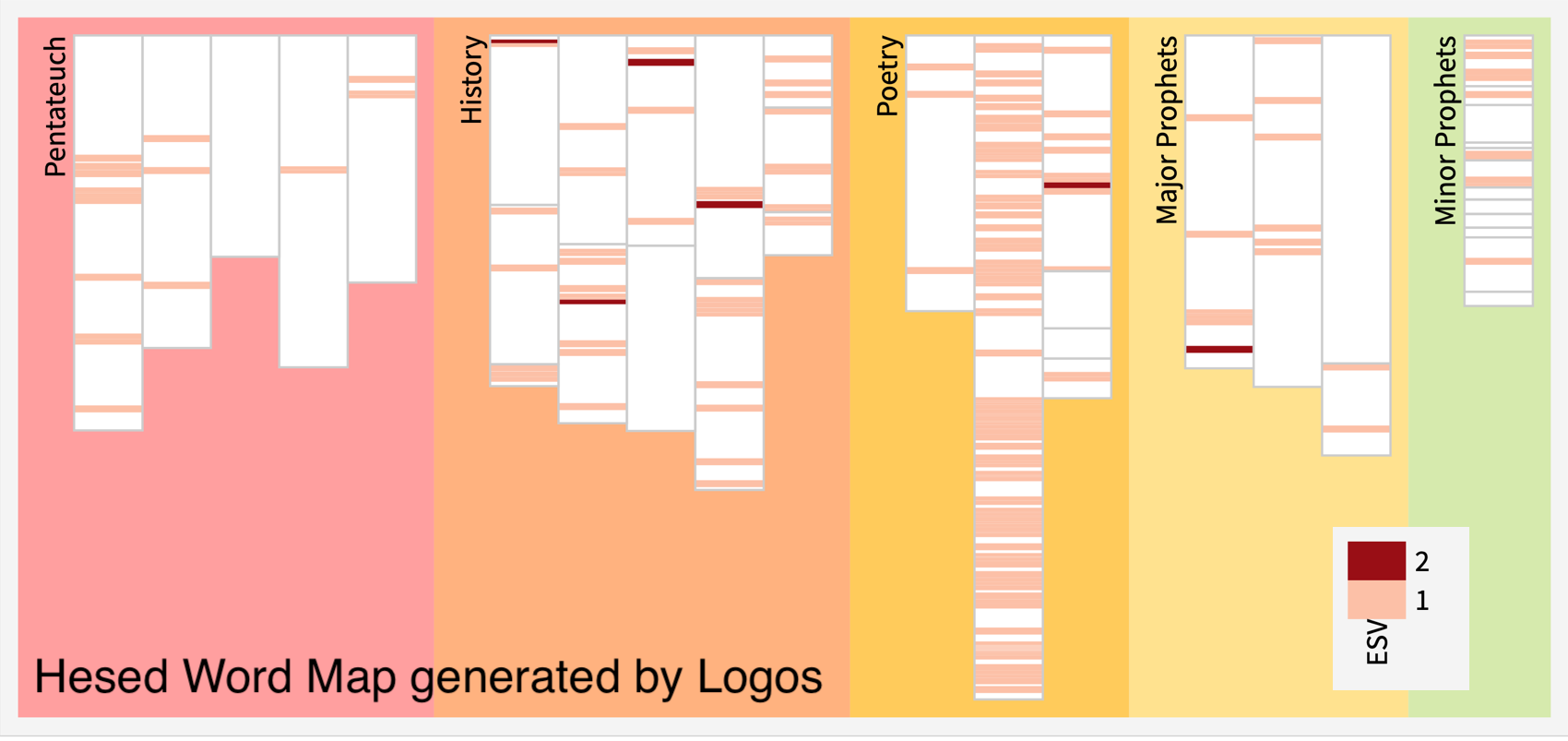
Hesed is widely distributed across all biblical literary categories of the Hebrew Bible, which is arranged differently than the Christian Bible (see word map below). It is found in the Torah 20 times, in the Prophets (Nevi’im) 53 times, and the Writings (Ketuvim) 172[3] times.[5] The twelve books where hesed does not appear, however, are Leviticus, 2 Kings, Ezekiel, seven of the twelve minor prophets (Amos, Obadiah, Nahum, Habakkuk, Zephaniah, Haggai, and Malachi), Song of Solomon and Ecclesiastes.
Hesed appears in the first book and the last book of the Hebrew Bible; from the rescuing of Lot in Genesis 19:19 to the faithful deeds of Josiah’s reformation in 2 Chronicles 35:26:
you have shown me great kindness [hesed] in saving my life. (NRSV)[6]
the rest of the acts of Josiah and his faithful [hesed] deeds in accordance with what is written in the law of the Lord. (NRSV)
The last reference reflected in the Protestant arrangement of the Bible (see word map below) closes with the prophetic oracle of Zechariah 7:9-10:
Thus says the Lord of hosts: Render true judgments, show kindness [hesed] and mercy to one another; do not oppress the widow, the orphan, the alien, or the poor; and do not devise evil in your hearts against one another. (NRSV)
Word Map: The Hesed (חֶסֶד) word map is based on the English Standard Version generated by Logos Bible software. The pink horizontal lines represent single and double instances.
The books which have ten or more references of hesed are Proverbs (10 times), Genesis (11 times), 1–2 Chronicles (15 times), 1–2 Samuel (16 times), and the Psalms (127[8] times). The majority of these books reflect the relational nature of hesed in the human realm. In Proverbs the end goal of wisdom is to teach practical relational hesed (31:26, 21:21), it is not a false front but the foundation of one’s reputation by its presence in their life (20:6, 28).
In Genesis, “kindness” is requested in prayer to God by Abraham’s servant to find a wife for Isaac (Gen 24:12, 14, 27). Then, Laban and Bethuel act in hesed (“kindness”) by cosigning their approval of Rebekah’s consent to be given as wife to Isaac.
1–2 Chronicles and 1–2 Samuel show that hesed expressed in reciprocal social acts. Saul reciprocates and excuses the Kenites from his assault on the Amalekites because they has shown hesed to Israel in ages past (1 Sam 15:6). Hushai’s “love” (loyalty?) for David is questioned during his infiltration of Absolam’s forces (2 Sam 16:17). The hesed shared between David and Jonathan is a story of deep loyalty and mutual reciprocity (1 Sam 20:8, 14–15). The Divine hesed is evidenced as well (2 Sam 15:20). Nathan enshrined the Davidic lineage and kingdom on behalf of God,
“my love will never be taken away from him” (2 Sam 7:15 NIV; 1 Chr 17:13, 2 Chr 1:8, 6:42; Psa 18:25[26]).
The Psalms contain close to half of all uses of the noun hesed (127[8] times); but it does not appear in 55% (83 psalms) of the 150 psalms. In brief, there are 23 instances in Book I (1-41), 16 instances in Book II (42–72), 14 and 13 times in Book III (73–89) and IV (90–106) respectively. In Book V (107–150), however, the frequency count skyrockets to 60 instances. Psalm 136 alone celebrates the Divine hesed in each of its twenty-six verses. It is in the Psalms that “both God and human worshipers describe God’s hesed as everlasting.”[7] Indeed,
While the term is used of both humans and God, in the Psalter it is above all a theological term that describes God’s essential character as well as God’s characteristic ways of acting—especially God’s characteristic ways of acting in electing, delivering, and sustaining the people of Israel. Hesed is both who the Lord is and what the Lord does. Hesed is an ancient term that defined for Israel who its God is.[8]
The saturation of hesed in the Psalms suggests that God’s people should always be mindful in prayer and worship of its content, its deeds, and the God who so relates to his people (Psa 36:5, 7, 10).
As pertains to the present study, it should be noted that the noun hesed only features twice in Jonah.Jonah is only one of four minor prophets where the term is employed (Hosea, Joel, and Micah). The first instance is in Jonah’s prayer of lament while in the “great fish” wherein he affirms that pagan idolators will miss out on “the grace [hasdam] that could be theirs” (2:8[9] NIV). The other instance is in 4:2 where Jonah laments what he knows about the LORD, who is “abounding in love” (NIV, warabhesed) and willing to change his mind about bringing judgment on the penitent people of Nineveh.
Semantic Range and Related Hebrew Words
As Silzer and Finley remind, “[w]ords normally have more than one meaning. The specific meaning of the word depends on its context.”[9] It is not sufficient, then, to rely on English translations (archaic or contemporary), nor to force lexical glosses to determine the meaning of a word.[10]
Brown, Driver, and Briggs groups hesedwith its verbal (hasad 2 times) and adjectival (hasid 32 times) forms, along with a few proper names, such asBen-Hesed (“son of Hesed” 1 Kgs 4:10) and Hasadiah (“Yah is Hesed” 1 Chr 3:20).[11] Lastly, is the unclean hasidah (6 times) often translated “stork” or “heron.” The root connection is believed to be due to their fond, “kind and affectionate” nature with their young.[12] This is a feature that is never appealed to in the Hebrew Bible.
The semantic range of hesed extends to the secular and the religious. In each, hesed manifests in concrete actions of goodwill, loyalty, and communal love whether in or outside of the covenant.[13] Divergent views emerge here with polarizing understandings over the meaning of hesed. Nelson Glueck saw in hesed a hardline covenantal legal obligation, H. J. Stoebe and others countered that hesedwas a free relational demonstration of loyal love.[14]
In the secular sense hesed speaks to certain “ethical norms of human intercourse” where mutuality exists that focuses on “the closest of human bonds.”[15] For example, Ruth exhibits this sense (1:8, 2:20, 3:10). Naomi blesses her daughters-in-law reciprocally, “May the Lord deal kindly [hesed] with you, as you have dealt with the dead and with me” (NRSV).
Religiously, the Divine demonstration of hesed does not function very differently than from the secular.[16] Exodus 34:1–7 provide a clear liturgical formula which demonstrates that Israel’s God abounds “in steadfast love and faithfulness” (34:6 NRSV; Psa 86:15, 89:14, Num 14:18).
The Lord passed before him, and proclaimed, “The Lord, the Lord, God merciful and gracious, slow to anger, and abounding in steadfast love [hesed] and faithfulness, keeping steadfast love [hesed] for the thousandth generation, forgiving iniquity and transgression and sin, yet by no means clearing the guilty, but visiting the iniquity of the parents upon the children and the children’s children, to the third and the fourth generation.” (Exod 34:6-7 NRSV)
This divine expression stresses the LORD’s multi-generational hesed and faithfulness. Moses now knows (33:13) that the LORD relates to his people through his benevolent and enduring nature. The words are quoted and echoed throughout the Hebrew Bible which suggests that they became formulaic or institutionalized to extoll the attributes of the God of Israel (Num 14:18, Jer 32:18, Joel 2:13, Nah 1:3, Psa 86:15, 103:8, 111:4, 112:4, 116:5, 145:8, Neh 9:17, 31, 2 Chron. 30:9)[17]
There are several words that appear frequently with hesed. They provide some dynamic appreciation for its usage in the Hebrew Bible.[18]Hesed may be done (‘asah) in concrete choices (Ruth 1:8). The LORD God keeps (shamar) and abounds (rab) in hesed (Deut 7:9, Neh 9:17). It is often associated with various nouns of “mercy” as in Psa 103:4 where the psalmist speaks of being crowned by God with hesed and rahamim(mercy). Likewise, hesed appears together with ’emet (faithfulness) probably as a hendiadys such as in Exod 34:6 and Psa 86:15.[19]
Hesed in Jonah 4:2
He prayed to the Lord and said, “O Lord! Is not this what I said while I was still in my own country? That is why I fled to Tarshish at the beginning; for I knew that you are a gracious God and merciful, slow to anger, and abounding in steadfast love [hesed], and ready to relent from punishing. And now, O Lord, please take my life from me, for it is better for me to die than to live.” (Jonah 4:2–3 NRSV)
This survey of hesed in the Hebrew Bible should help to determine the possible range of meaning for how Jonah 4:2 should be understood. Words have meaning only in context. With the above range in mind, the context appears to reflect Jonah’s usage of the formulaic hesedlanguage of Exodus 34:6–7. Instead of celebrating his God with these words, Jonah is subversively using this language to express his frustration with the LORD’s restraint against the city of Nineveh.
Jonah is using God’s own words against him. For this reason, it appears the meaning for Hebrew word hesedfound in Jonah 4:2 should be understood as “benevolent love.” Jonah knows how LORD acts out in concrete acts of hesed, these being grace, mercy, “slow to anger,” and relenting from judgment. Since there is no evidence that the LORD is in covenant with Nineveh, this supports the supposition that divine hesed may be expressed in free relational demonstrations of benevolent love. God relates to repentance with the reciprocal response of grace, mercy, patience/forbearance, relenting from judgment.
Jonah 2:8[9] further supports this view. It reveals that the prophet desires for judgment those who do not enjoy a covenant relationship with the LORD. It appears that for Jonah, idolatry is the “deal-breaker” for having a relationship with the LORD based on hesed. Yet, the irony fails to make any headway with the nationalistic prophet, since he rejected his prophetic call on the basis that he knew what the LORD would do should Nineveh repent. Both he and pagans have rejected God. Jonah is not only selfish with his relationship with his faithful God (“save me from the fish!”) but is resentful that God is “sharing the love” with foreigners (“you saved them from judgment!”).
Jonah wants his curse to come true, that those who “cling to worthless idols forfeit the grace [hesed] that could be theirs” (2:8[9] NIV). It is this forfeiture of Divine hesedwhich Jonah still desires for Nineveh, reflected in his willingness to proclaim that the city “will be overturned” (3:4) and his bitterness that it was not (4:1–11). Jonah knew that God would choose relationship over punishment. The LORD said as much (4:11). Humans, unfortunately, seem to choose punishment over relationship. Jonah shows as much.
This focused study on hesed and Jonah 4:2 brings to mind that the caricature of the bloodthirsty wrathful God of the Old Testament is just that an exaggerated cartoon (cf. Jas 2:13). As Baer and Gordon powerfully remind:
The insight that, while both anger and love are appropriate divine responses, the latter outlasts the former, is an important one for biblical theology. Wrath is a true word, a right word, sometimes an inevitable word, such passages seem to say. But God would not have it be his last word. That honor is reserved for his unfailing love (hesed).[20]
The burden of Jonah was to provide concrete witness to the people of Nineveh that God seeks to extend and establish benevolent love with all nations. As one who has experienced Divine benevolent love, Jonah should have been moved to be a spokesman for Divine benevolent love. In this he struggled and failed; nevertheless, God succeeded even if for a brief time (cf. Nahum 1:1?).
Conclusion
The meaning for Hebrew word hesedfound in Jonah 4:2 should be understood as “benevolent love.” The formulaic language of Exodus 34:6–7 is surely the theological and context for Jonah’s use of hesed. In Exodus as in Jonah 4:11, the LORD shows that he has the concern to establish and maintain a communal relationship with Israel. The benevolent concerns of preserving others and acting on the basis of moral uprightness anchor the LORD’s demands of repentance. Jonah knew if Nineveh took seriously the burden of his message, his God would become their God. They would collectively experience Divine benevolent love.
A final thought should be emphasized. Even though there are many excellent translations in the English language their primary function is simply to provide a reading text. Some significant and complex words, like hesed, merit the focused investigation which a word study provides. As developed above, hesed stresses relationships, community, loyalty and the ethical demands of love, responsibility, care, and obligation words which no single translation can do justice. Word studies reveal facets and these usages are combined into a framework. This framework provides the contours for understanding what a word means within its context, for usage determines meaning.
Endnotes
Rolf A. Jacobson, “Text, Title, and Interpretation,” in The Book of Psalms, NICOT, eds. E. J. Young, R. K. Harrison, and Robert L. Hubbard (Grand Rapids, MI: Eerdmans, 2014), 7–8.
John R. Kohlenberger III. and James A. Swanson, The Hebrew-English Concordance to the Old Testament (Grand Rapids, MI: Zondervan, 1998), v, 559.
H. J. Stoebe, “hesed kindness,” TLOT 2:449; H.-J. Zobel, “hesed,” TDOT 5:45; Robert P. Gordon, “hesed,” NIDOTTE 2:211.
Gray D. Practico and Miles V. Van Pelt, Basics of Biblical Hebrew, 2d ed. (Grand Rapids, MI: Zondervan, 2007), 105; Koehler, Baumgartner, and Stamm, “hesed,” HALOT 1:336; William L. Holladay, A Concise Hebrew and Aramaic Lexicon of the Old Testament (1971; repr., Grand Rapids, MI: Eerdmans, 2000), 111.
The Torah includes Genesis-Deuteronomy; the Nevi’im includes Joshua-2 Kings, Isaiah, Jeremiah and Ezekiel, and the Minor Prophets; and the Ketuvim includes Psalms, Proverbs, Job, Song of Solomon, Ruth, Lamentation, Ecclesiastes, Esther, Daniel, Ezra-Nehemiah, and 1–2 Chronicles.
The two English translations the Holy Bible used in this paper are the New Revised Standard Version (Nashville, TN: Nelson, 1989) and the New International Version (Nashville, TN: HarperCollins, 2011) cited as NRSV and NIV respectively.
David A. Baer and Robert P. Gordon, “hesed,” IDOTTE 2:212–17.
Jacobson, “Text, Title, and Interpretation,” 8.
Peter James Silzer and Thomas John Finley, How Biblical Languages Work: A Student’s Guide to Learning Hebrew and Greek (Grand Rapids, MI: Kregel Publications, 2004), 164.
Douglas Stuart, Old Testament Exegesis: A Handbook for Students and Pastors, 4th ed. (Louisville, KY: Westminster John Knox, 2009), 182–83.
BDB 338–39.
BDB 339; HALOT 1:336; TLOT 2:449.
IDOTTE 2:212–17; HALOT 1:336–37; TDOT 5:46–64.
R. Laird Harris, “hesed,” TWOT 1:305–06.
TDOT 5:47–48.
TDOT 5:54–55.
Nahum M. Sarna, Exodus, JPS Torah Commentary, ed. Nahum M. Sarna (Philadelphia, PA: Jewish Publication Society, 1991), 216.
HALOT 1:337.
TWOT 1:307.
IDOTTE 2:214.
Bibliography
Baer, David A., and Robert P. Gordon. “חסד.” Pages 211–18 in vol. 2 of New International Dictionary of Old Testament Theology and Exegesis. Grand Rapids, MI: Zondervan, 2012.
Brown, Francis, S. R. Driver, and Charles A. Briggs. A Hebrew and English Lexicon of the Old Testament. Oxford: Clarendon Press, 1907.
Ford, David. “Keeping up Biblical Languages while in the Ministry.” Foundations 14 (1985): 41–44.
Gordon, Robert P. “חסד.” Pages 211–18 in vol. 2 of New International Dictionary of Old Testament Theology and Exegesis. Edited by Willem A. VanGemeren. Grand Rapids, MI: Zondervan, 1997.
Harris, R. Laird. “חסד (hsd).” Pages 305–07 in vol. 1 of Theological Wordbook of the Old Testament. Edited by R. Laird Harris, Gleason L. Archer, Jr., and Bruce K. Waltke. Chicago, IL: Moody Press, 1980.
Holladay, William L. A Concise Hebrew and Aramaic Lexicon of the Old Testament. 1971. Repr., Grand Rapids, MI: Eerdmans, 2000.
Jacobson, Rolf A. “Text, Title, and Interpretation.” Pages 2–9 in The Book of Psalms. NICOT. Edited by E. J. Young, R. K. Harrison, and Robert L. Hubbard. Grand Rapids, MI: Eerdmans, 2014.
Koehler, Ludwig, Walter Baumgartner, and Johann J. Stamm. The Hebrew and Aramaic Lexicon of the Old Testament. Translated and edited under the supervision of Mervyn E. J. Richardson. 5 vols. New York: Brill, 1994–1999.
Kohlenberger, John R., III., and James A. Swanson. The Hebrew-English Concordance to the Old Testament. Grand Rapids, MI: Zondervan, 1998.
Practico, Gray D., and Miles V. Van Pelt. Basics of Biblical Hebrew. 2d edition. Grand Rapids, MI: Zondervan, 2007.
Sarna, Nahum M. Exodus. JPS Torah Commentary. Edited by Nahum M. Sarna. Philadelphia, PA: Jewish Publication Society, 1991.
Silzer, Peter James, and Thomas John Finley. How Biblical Languages Work: A Student’s Guide to Learning Hebrew and Greek. Grand Rapids, MI: Kregel Publications, 2004.
Stoebe, H. J. “חֶסֶד, hesed kindness.” Pages 449–64 in vol. 2 of Theological Lexicon of the Old Testament. Edited by Ernst Jenni and Claus Westermann. Translated by Mark E. Biddle. 3 vols. Peabody, MA: Hendrickson, 1997.
Stuart, Douglas. Old Testament Exegesis: A Handbook for Students and Pastors. 4th edition. Louisville, KY: Westminster John Knox, 2009.
Wegner, Paul D. Using Old Testament Hebrew in Preaching: A Guide for Students and Pastors. Grand Rapids, MI: Kregel Publications, 2009.
Zobel, H.-J. “(חֶסֶד, hesed).” Pages 44–64 in vol. 5 of Theological Dictionary of the Old Testament. Edited by G. Johannes Botterweck and Helmer Ringgren. Translated by David E. Green. Grand Rapids, MI: Eerdmans, 1977.
In 2 Timothy, Paul encourages the evangelist Timothy to trust in “[a]ll scripture” as the “useful” source for transformative instruction which empowers God’s people to accomplish “every good work” (3:16–17 NRSV).[1] There is a reason to believe this reference to “scripture” is primarily an allusion to the Hebrew Bible.[2] Study of the Hebrew language, then, would be a necessary acquisition for the minister. The benefits of studying biblical Hebrew are vast and significant, ranging from practical to technical. The insights gained from the study of Hebrew allow the minister to provide biblical clarity for the benefit of their audience.
The Benefits of Studying Biblical Hebrew
There are several benefits of studying Hebrew but only a selected few will be set forward for consideration. The ultimate benefit and goal for any minister of the Hebrew Bible are “to learn to exegete the Hebrew text accurately in order to preach authoritative, relevant sermons.”[3] Studying biblical Hebrew improves the proficiency to preach and teach what amounts to two-thirds of the biblical canon, a literary world that is often a difficult foreign terrain for most people.[4]
Further, a knowledge of biblical Hebrew also liberates ministers from being dependent on commentaries, and other secondary literature, and helps avoid making arguments exclusively from scholarly consensus.[5] Instead, proficient knowledge of Hebrew will allow the minister to provide fresh and original messages that guide the church based on deep personal wrestling with the original languages.[6]
For the minister, there are several benefits from a technical (professional) vantage point. The minister ought to know their subject matter in deeper ways than the average Bible reader.[7] Silzer and Finley point out that much of the exegetical task is to understand how language works to convey meaning, in other words, semantics.[8] A steady daily program of working through biblical Hebrew, along with the right tools (lexicons, grammar, and other aids) will increase exposure and proficiency in how the language functions.[9]
Ideally, such would help mitigate against linguistic fallacies such as root, the figure of speech confusion, and totality transfer which reflect ignorance of how languages work.[10] Furthermore, the exegetical process helps the minister sort through technical questions which have no homiletic value but are required by the exegetical task. “The meaning of a sentence is not always obvious from the meaning of the individual words.”[11] This process to let context determine the meaning of words and phrases whether literal or figurative, ambiguous or clear ought to encourage humility (Jas 4:10), a much-needed “benefit” to the craft of preaching and teaching.[12]
The Task of Ministers to Clarify the Biblical Text
The insights gained from the study of Hebrew allow the minister to be in a better position to clarify the biblical text using languages and images their audience understands. This task emerges from various needs.
First, ministers are often asked to answer questions about translations and teachings.[13] The question “which translation is correct?” may seem a daunting one but it is actually an opportunity to help the person take their first steps into a larger world of Bible study. The minister must help to provide guidance and clarity in this sensitive but crucial area of Bible knowledge that all translations are interpretive aids to understand the original language of the text.[14] Finally, a minister who has adequate proficiency in biblical Hebrew will have the ability to address questions concerning the accuracy of certain proposed teachings or the need to correct inaccurate teachings.
Second, ministers must know when to bring out relevant insights from the text that English translations do not highlight but are quite helpful to see another level of depth to the pericope.[15] Wegner, for example, points to the phrase tōhu wābōhu which appears in the Hebrew Bible twice (Jer 4:23 and Gen 1:2).[16] It seems the prophet Jeremiah is using this unique phrase from Genesis (“a formless void” NRSV) to affirm that due to the sins of Israel, the earth is once again “waste and void” (NRSV). This intertextual insight would most likely have gone unnoticed without work in the Hebrew text.
Finally, and perhaps most significantly is the clarity that comes from a fresh and relevant application of the Hebrew text to the contemporary life of the congregation. Exegesis always has the singular aim “to produce a deeper understanding of biblical truth,”[17] the sermon for the contemporary setting must be shaped by these “freshly pressed” insights.
Conclusion
A knowledge of biblical Hebrew certainly provides practical and technical benefits for the minister who maintains a steady program to improve their proficiency in the language. Likewise, the insights gained from the study of Hebrew allow the minister to provide clarity when preaching and teaching.
This will often include addressing questions regarding translations, and teachings, or providing fresh insight from the Hebrew text hidden by an English text; and finally, by aligning the message to the contours of the exegetical work in the original language.
Endnotes
All Scripture references are taken from the New Revised Standard Version unless otherwise noted.
Paul D. Wegner, Using Old Testament Hebrew in Preaching: A Guide for Students and Pastors (Grand Rapids, MI: Kregel Publications, 2009), 17.
Wegner, Using Old Testament Hebrew, 13.
Wegner, Using Old Testament Hebrew, 13–14; Peter James Silzer and Thomas John Finley, How Biblical Languages Work: A Student’s Guide to Learning Hebrew and Greek (Grand Rapids, MI: Kregel Publications, 2004), 161.
Wegner, Using Old Testament Hebrew, 15–16; David Ford, “Keeping up Biblical Languages while in the Ministry,” Foundations 14 (1985), 42; Douglas Stuart, Old Testament Exegesis: A Handbook for Students and Pastors, 4th ed. (Louisville, KY: Westminster John Knox, 2009), 181.
Ford, “Keeping up Biblical Languages,” 42, 44; Wegner, Using Old Testament Hebrew, 15–17.
Wegner, Using Old Testament Hebrew, 17.
Silzer and Finley, How Biblical Languages Work, 160.
Wegner, Using Old Testament Hebrew, 20–22.
Silzer and Finley, How Biblical Languages Work, 162, 165; Stuart, Old Testament Exegesis, 182–83.
Silzer and Finley, How Biblical Languages Work, 176.
Silzer and Finley, How Biblical Languages Work, 180.
Wegner, Using Old Testament Hebrew, 16.
Wegner, Using Old Testament Hebrew, 15.
Ford, “Keeping up Biblical Languages,” 42.
Wegner, Using Old Testament Hebrew, 15.
Ford, “Keeping up Biblical Languages,” 43.
Bibliography
Ford, David. “Keeping up Biblical Languages while in the Ministry.” Foundations 14 (1985): 41–44.
Silzer, Peter James, and Thomas John Finley. How Biblical Languages Work: A Student’s Guide to Learning Hebrew and Greek. Grand Rapids, Mich: Kregel Publications, 2004.
Stuart, Douglas. Old Testament Exegesis: A Handbook for Students and Pastors. 4th edition. Louisville, Kent: Westminster John Knox, 2009.
Wegner, Paul D. Using Old Testament Hebrew in Preaching: A Guide for Students and Pastors. Grand Rapids, Mich: Kregel Publications, 2009.
Reprinted with permission from the February 2018 issue of Gospel AdvocateMagazine.
Hebrews affirms, “For the word of God is living and active, sharper than any two-edged sword, piercing to the division of soul and of spirit, of joints and of marrow, and discerning the thoughts and intentions of the heart” (4:12 ESV). This is part of a warning in Hebrews, which affirms that Christians who defect from God will fail to meet their rest as their Israelite counterparts did (vv. 1-11). God holds his people —and His creation— accountable by His presence (“sight”) in the word of God (Hebrews 4:13). This is a raw incontrovertible truth.
This passage makes no caveats; it makes no attempt to remedy a distinction between God’s word and God’s presence. They are both manifested at the same time. God is involved with real life (time and space) with Israel and with Christians. God makes promises and keeps his word regarding their “rest,” and God holds His people and creation accountable to His word. God is Lord of heaven and earth and everything in between, and He holds it together by the power residing in Jesus (Hebrews 1:3; Colossians 1:17). The word of God is connected not only to the authority of God but also to His nature and how He reveals Himself to the world.
Let me say the above in a differently. Our God, who is beyond time and space (God’s transcendence), enters our earthly “realm” bound by time and space (God’s immanence) with His divinity and authority (sovereignty) intact; furthermore, God enters into relationship with His creation (Abraham, Israel, Christians) by revealing Himself in creation and in His word. God is active both in creation and in His word. Creation reveals God’s existence and hints at elements of His attributes (natural theology), but it is His word that reveals God and His “will” so that humanity can enter into covenant with God. The word of God was both proclaimed orally through particular spokesmen (patriarchs, prophets, kings, apostles), but the prophetic word was not only through oracles but also in written communiqués embedded with the same divine authority (2 Peter 1:16–21). These writings reveal the mind of God (1 Corinthians 2:11–16), His purposes and mystery (Ephesians 3:1–6), His involvement in human events (Acts 17:26–27), and the righteousness by which He will bring justice to the world (Acts 17:30–31).
To say it bluntly, the Bible is the word of God set in a permanent written form. Paul declared, “all scripture is breathed out by God” (2 Timothy 3:16). The Scripture bears the character of God and is no “dead” codebook, for it transforms every “man of God” into a competent, equipped servant (2 Timothy 3:17). The profitability ofall Scripture is due to its quality as “God’s breath.” There is no pecking order between the spoken or written word of God. The inspired written word is as inerrant as God’s character. There is no source outside of the Holy Spirit-given Scripture that speaks God’s transforming work since it is the depository of the gospel’s message. What the word of God promises, God will do; what God proclaims, God’s holds His creation accountable to (1 Thessalonians 2:13).
The above may seem to belabor the point, but as anticipated by the title of this piece, we will sketch how the word of God is handled among Liberal (Modern) and Neoorthodox influences. It is essential for the church to reflect on these twentieth-century influences because dialogue is healthy, truth has nothing from which to hide, and any redefinition of biblical Christianity must be given due consideration (Galatians 1:6-7).
The following historical sketches will probably not satisfy everyone, but they will be enough to see their direction and how they redefine significant elements of historic Christian beliefs and their tendency to subvert scriptural authority.
Liberalism/Modernism
The word “liberal” is a very loaded word. It is often used with contempt to show disapproval of someone else thought to be progressive (instrumental music, expanded role of women, etc.). But this is not the historic sense of the word. Liberalism emerged in the late nineteenth century through the interplay of many players, thinkers, and philosophical trends. The influence of Liberalism, or Modernism, is seen in three levels: (1) revelation is not the final answer to reality, (2) naturalism is the key to reality and religion, and (3) since the Christian documents are built on ancient myths and superstitions, the historic supernatural claims of Christianity is immaterial. To be a “Christian” is a matter of experience and the “essence” of its teaching.
Liberalism, as an intellectual revolution, is a child of the Age of Reason (the Enlightenment). The “Age” saw the elevation of human reason over the institutional “church,” which wielded divine revelation. It was “the church” that dictated to the people what to believe about reality. Divine revelation was the final answer to determining truth and what really happened in the past. This was displaced with rationalism, scientific history (criticism), and naturalism as final answers to genuine and authentic history and truth. In essence, as Stanley Grenz and Roger Olsen point out, the maxim “I believe in order that I may understand” was turned to “I believe what I can understand.”[1] Faith was overturned by a reason informed by modern findings — thus, this point of view is called “Modernism.”
Everything that was received as genuine knowledge, now, was shaped by the natural world. This was further supported by what is called “the principle of analogy,” popularized by the liberal theologian Ernst Troelsch (1865–1923), which argued that the present is the best way to understand the past. The consequence was detrimental in the extreme on the trustworthiness of Scripture. The supernatural elements interwoven in Scripture are, by definition, myths and superstitions. This meant that there are no miracles, no supernatural interventions by God, and no resurrection of Jesus Christ. Thus, many new schools of “criticism” emerged to study Scripture with mixed results.
This naturally led to an embrace of “the essence of Christianity” so long as reason and experience allowed. “Liberals” are open to the modern findings from the natural world, open to a religious humanism and science —in particularly embracing Darwinian evolution as the process by which God created. If God exists, He could only be revealed through religious “experience.” It was also immaterial if the events of Scripture happened or not because religion is a condition of the heart. Yet, the apostle Paul makes it abundantly clear that if the resurrection event has not occurred, both our preaching and faith are in vain and we are still in our sins (1 Corinthians 15:14, 17).
Another arm of Liberalism is the demythologizing of the New Testament pioneered by the “Form Critic” Rudolf Bultmann (1884–1976). Bultmann argued that historic person of Jesus is built on untrustworthy sources. The New Testament is Christian propaganda shrouded in the imagery of the Greek myths and Roman legends. As such, they are not relevant for faith nor spiritual truth claims. It is the symbolism that matters. Today, one only need to watch the latest “history” programming to find modern theological liberals interviewed. Theological liberalism has significant questions that need to be answered, but it brings Christianity to a logical dead end.
Neoorthodoxy
The Swiss theologian Karl Barth (1886–1968) ignited a movement when he published his commentary on Romans in 1919. It charted a new theological direction away from Liberalism/Modernism. Barth (pronounced “bart”) was not fond of the misnomer “neoorthodoxy,” but his strand of thinking regarding the meaning of “revelation” and “the word of God” would rival the prevailing traditional belief held historically by the church. As a consequence, many regard Barth as one of the great theologians and the father of modern theology.
Orthodoxy affirms the teaching of historic Christian truth based on Scripture. This includes, for example, the following concepts: the inerrant inspiration of scripture, the triune Godhead, the deity and virgin birth of Christ, the historic creation and fall of humanity, the bodily resurrection and ascension of Christ, the return and final judgment. Barth argued, on the other hand, that “revealed truth” was not written, but was the outcome of an encounter (an experience) with God. Thus, instead of scripture as being the objective word of God, Barth argued for a subjective experience with God initiated by reading the Bible.
Barth was offering a completely different course of thought altogether. “Revelation” does not appear in the form of propositional truths. Arguing book, chapter, verse, or appeals to the very words of scripture is insufficient to reveal God. Revelation (the word of God), it is argued, is an “event” in which God acts in history (God’s immanence). Barth even argued that revelation is not found in natural theology (Acts 17; Psalm 19; Romans 1) but, instead, in events like the call of Abraham, the exodus, and the resurrection. Millard Erickson is spot on when he classifies Neoorthodoxy as an illumination theory divorced from an objective standard.[2]
Although Neoorthodoxy is not a unified movement, there are three interconnected witnesses (modes/forms) that shape its view on revelation.[3] First, Jesus is the word of God in the truest sense, for He reveals God in the event of His incarnation, life, ministry, death and resurrection. This is true revelation, the very gospel. Second, Scripture points to Jesus but it is a flawed human (read “errant”) attempt to provide a witness to divine revelation. It is instrumentally God’s word but not properly. Third, the proclamation within the faith community —Barth preferred “community” to church— is likewise instrumentally God’s word. The Bible, then, only becomes God’s word when God uses it to reveal Jesus Christ in the encounter, contrary to 2 Timothy 3:16.
In fact, Neo-orthodoxy is quite a popular approach to handling the Word of God, even among churches of Christ. A popular theological branch of this movement is “Canonical Criticism,” popularized by the late American scholar Brevard Childs (1923–2007). It seeks to broadly bypass much of the liberal destructive criticism of the twentieth century by accepting the texts of Scripture as literary units. Nevertheless, this point of view struggles, as did Barth’s, to embrace the Bible as a very human (errant) book while appealing to its authority for theological thought as if they were inerrant. They seek, in the words of one sympathetic Abilene Christian University professor, to “articulate a doctrine of Scripture that recognizes human flaws in it.”[4] Treating the Bible as an inerrant text is simply a form of bibliolatry.
Keeping the Faith
Today, the phrase “Word of God” means different things to different believers, and that includes preachers. Liberalism ultimately rejects a supernatural Christian faith, and is at home with amputating its historic claims of a resurrected ascended Lord Jesus, in exchange for a subjective diluted Christianity. Neoorthodoxy, on the other hand, embraces a supernatural Christian faith, but it rejects the supernatural origin, inerrancy, and authority of the Scriptures which undergird its claims. The Word of God has always been a manifestation of God’s presence in our lives, in His proclamation, and in His Scripture without pecking order. Let us join Paul who declares, “Let God be true though every one were a liar” (Romans 3:4).
Notes
Stanley J. Grenz and Roger E. Olsen, 20th Century Theology (Downers Grove: InterVarsity, 1992), 17.
Millard J. Erickson, Christian Theology, 3rd ed. (Grand Rapids, Baker Academic, 2013), 220–21.
Karl Barth, Evangelical Theology: An Introduction, trans. G. Foley (New York: Holt, 1963), 26–36.







 biblicalfaith.online