“And who knows whether you have not come to the kingdom for such a time as this?” (Esther 4:14b).
Have you ever looked back and said, “that was the providence of God working.” Providence is acts of normal circumstances guided by God for the use of his will to be accomplished.
Let’s look at Esther and how the Jewish people were saved. After King Ahasuerus, king of Susa, ordered Queen Vashti to never again come before the king when she did not obey his order, Esther was chosen among many young virgins to become his new queen.
Mordecai, Esther’s cousin, who raised her, was sitting at the king’s gate, overhearing two of the king’s eunuchs arguing, wanting to lay their hands on the king. Mordecai told this to Esther, and Esther relayed the information to the king in Mordecai’s name. It was then put into the book of chronicles.
Haman, King Ahasuerus’ right-hand man had been advanced above all other officials. Haman devised a plot to kill all the Jews after Mordecai did not bow to pay homage to him and learned he was a Jew.
Mordecai told Esther it was up to her to save the Jews. He asked her, “And who knows whether you have not come to the kingdom for such a time as this?” (Esther 4:14b)
Esther served two meals for the king and Haman. After the first meal, that night the King couldn’t sleep. He requested the Chronicles to be read to him. The king found out that Mordecai had not been honored for turning in the men’s names who were plotting against him. The king asked Haman, how should honor be given to one who the king delights. Haman, thinking it was him, told the king all the elaborate royalty to be given to him. The king told Haman to go and do all these things to Mordecai. This upset Haman all the more.
At the second meal, Esther tells the king of the one who is planning to destroy and annihilate her and her people. She told him it was the wicked man, Haman. Haman tried begging for his life but the king ordered for Haman to be hung on the gallows he prepared for Mordecai.
God is not mentioned throughout the book of Esther but he is working behind the scenes. Mordecai was honored and given the position of Haman. The Jews defended themselves in battle. Ultimately they won and the Jewish nation was saved.
The providence of God saved Christ’s lineage, God’s chosen people.
Remember to never complain about your circumstances, and have a strong and Godly spirit like Esther. For we never know if we are put in a position, for such a time as this.
The Bible is a library of 66 books, composed over a period of fifteen hundred years. The authors involved in this inspired anthology come from a variety of backgrounds, locations, historical situations, professions, and ethnicities.
While each book has its individual purpose, each work develops the overarching theme that humanity is the creation of an eternal Creator, and due to personal sin has fallen spiritually. This fallen state is addressed both historically and theologically in the development of the scheme of redemption, finally materializing in the ministry of Jesus.
In order to appreciate this history of redemption and the books of the Bible, it is vital to have a working knowledge of the divisions of the Bible. Moreover, a better understanding of the Bible improves one’s comprehension of sermons and Bible classes. The following is an extremely brief sketch of the Bible and its arrangement of content as we have it in our modern Bibles.
Chronological Divisions
The Patriarchal Period
The name of this period derives from the method God communicated his will, by speaking the “fathers” of the family (Adam, Noah, Abraham, etc.); hence, the term “patriarch” which means “the male head of a family” (Heb 1:1). The biblical content covering this period is Genesis 1-50 and Exodus 1-19, that of the creation and the fall, the flood, and the call of Abraham to be in covenant with God and to be the father of “many nations”.
Through the nation of Israel, God would bring about the redemptive “seed” (Jesus, Gal 3:15-16) to bless all the nations of the world (Gen 12:3). Moreover, this covenant promise was reiterated to Isaac (Gen 26:1-5), Jacob/Israel (Gen 35:9-15), and the children of Israel after the exodus from Egypt on Mt. Sinai.
The Hebrew Period
While technically the story of the Hebrews in the biblical record goes back to Abraham the Hebrew (Gen 14:13), as a major division of the biblical story the Hebrew period reflects the story of God and His covenant people Israel (cf. Acts 7:2-53). This period covers Exodus 20-Malachi, and the time period of the ministry of Jesus (Matt–John). The historical story of the Exodus transitions into the giving of the Law at Sinai.
During this period, Israel received “the law”, wandered in the wilderness for forty years, conquered and settled into the Promised Land, and transitioned from a theocracy (where God ruled through prophets) to a monarchy (where God ruled through kings). This period also covers the history of the divided kingdoms of Israel (North) and Judah (South) and their eventual demise. The kingdom and the covenant were both to be superseded by a new kingdom (Dan 2:44-45), and a new covenant (Jer 31:31-34); the design of which was to prepare the world for the coming of Jesus (Gal 3:19-29; Heb 9:11-28).
The Christian Period
The Christian Period technically begins upon the death of Jesus of Nazareth, when the “testament” came into effect (Heb 9:16-17); however, the teaching of Jesus as it anticipated the Christian era is found in the Gospel Narratives and occurred while under the Law of Moses was still in effect (Matt–John; Gal 4:4-6). Moreover, the confirmation of this “new” testament was accomplished in Christ by God in the resurrection from the dead (Rom 1:4-5; Acts 2:14-36; 1 Cor 15:1-11).
This period begins then with the establishment of Christianity in Jerusalem (Acts 2), and continues on through the expansion of the Christian faith not only geographically (Acts 1:8) but also ethnically (Acts 2:39, 10:28, 11:18). The Christian era will continue, time-wise, until the return of Jesus, at the Second Coming (Matt 28.20; 1 Cor 15:22-28); and at this time the present world will dissolve away and we will be with our God (2 Pet 3:8-13; 1 Thess 4:13-18).
Division of Books by Category
The following is a listing of the books of the Bible according to categories, along with a useful numeric memory tool to learn the divisions of each section.
The 39 Old Testament Books (5, 12, 5, 5, 12)
Books of Moses (5). Written by Moses to provide the origins of the human family, the Hebrew nation, and incorporates the Law of Moses (Genesis, Exodus, Leviticus, Numbers, Deuteronomy).
Hebrew History (12). Follows the story of Joshua and the conquest and settlement of Canaan to the rise and demise of the Hebrew Kingdom, and the exile into Babylon and their return (Joshua, Judges, Ruth, 1-2 Samuel, 1-2 Kings, 1-2 Chronicles, Ezra, Nehemiah, Esther).
Hebrew Poetry (5). A series of volumes set in Hebrew poetic prose, written by a number of authors, designed to impart divine wisdom and perspective (Job, Ecclesiastes, Psalms, Song of Solomon, Proverbs).
Major Prophets (5). Popularly so-called due to the size of each work, and not for their spiritual value. (Isaiah, Jeremiah, Lamentations, Ezekiel, Daniel).
Book of the Twelve (12). Grouped together from ancient times, the “Minor” prophets are brief volumes that pack spiritual “punch” (Hosea, Joel, Amos, Obadiah, Jonah, Micah, Nahum, Habakkuk, Zephaniah, Haggai, Zechariah, Malachi). Both the Major and the Minor Prophets are from various time periods, these works contain words of woes, judgments, and hope; moreover, they provide a great wealth of messianic prophecies.
The 27 New Testament Books (4, 1, 21, 1)
Gospel Narratives (4). Written to chronicle the teaching and ministry of Jesus of Nazareth, his rejection, crucifixion, and resurrection. Two of the four authors are apostles (Matthew, John), one is known to be an associate of Paul (Luke), and the other is believed to be of Peter (Mark).
Acts of Apostles (1). As the sequel to the Gospel of Luke, Acts covers the beginning of the church, and its expansion from Jerusalem to Rome, roughly a period of some 30-plus years.
Apostolic Letters (21). Written to churches and individuals teaching and exhorting Christians to live faithful; furthermore, the letters address false teachings and local issues (Roman, 1-2 Corinthians, Galatians, Ephesians, Philippians, Colossians, 1-2 Thessalonians, 1-2 Timothy, Titus, Philemon, Hebrews, James, 1-2 Peter, 1-3 John, Jude).
Revelation (1). Addressed to seven churches in Asia, this final “revelation” is a message of victory of God and His people over their enemies. It is rich in apocalyptic language, much like Daniel, Ezekiel, and other prophetic books.
Concluding Thoughts
When Vince Lombardi took the helm of the coaching staff of the Green Bay Packers, it is said that he gave a speech that established clearly the importance of the basics. It runs as follows:
Everybody stop and gather around,” he said. Then he knelt down, picked up the pigskin, and said, “Let’s start at the beginning. This is a football. These are the yard markers. I’m the coach. You are the players.” He went on, in the most elementary of ways, to explain the basics of football.
The team became very successful, and this anecdote reminds us of the importance of getting back to basics. Understanding the fundamental components of the Bible is essential to obtaining the wisdom needed to know what to do to be saved (2 Tim 3:13-14). May we all be so blessed.
The book of Joshua finds itself in a unique position in the Holy Writ. Few books express such a pivotal moment in Redemptive History as does the book of Joshua. Within its twenty-four chapters is found how, with Divine oversight, Joshua and the Israelites conquered and settled the land of Canaan. This was not, however, a haphazard situation but rather one of a destiny realized.
The materializing of God’s promise to Abraham was before their very eyes and in their very hands. A brief exploration of this promise and the physical features of the land will aid in understanding and appreciating the historical accounts in Joshua. Likewise, attention will be given the limitation of occupation God incorporated into the “deed” of the Land of Promise.
The Abrahamic Covenant of Faith
A major theme that runs through the book of Genesis is that God has called Abraham to dwell in a land which would eventually be given to him as a possession (i.e., Palestine; Gen 12:1-3, 13:14-15; Acts 7:2-4):[1]
Now the LORD said to Abram, “Go from your country and your kindred and your father’s house to the land that I will show you. And I will make of you a great nation, and I will bless you and make your name great, so that you will be a blessing. I will bless those who bless you, and him who dishonors you I will curse, and in you all the families of the earth shall be blessed.” (Gen 12:1-3)
Furthermore, he would be the father of the Hebrew nation, Israel, through whom the Messiah would come to redeem a fallen humanity (Gen 22:17-18; Gal 3:16). The whole world was offered redemption (John 3:16) so that it would be the beneficiary of this promise – not just the Hebrews (1 John 2:2).
However despite this promise, and despite the panoramic view God gave Abraham (Gen 13:14-18), the great patriarch of the Hebrews never obtained the land as a possession. He had to obtain it through his descendants. The writer of Hebrews recalls the fact Abraham and his offspring did not literally possess the land while they dwelt on its soil.
By faith Abraham obeyed when he was called to go out to a place that he was to receive as an inheritance. And he went out, not knowing where he was going. By faith he went to live in the land of promise, as in a foreign land, living in tents with Isaac and Jacob, heirs with him of the same promise. For he was looking forward to the city that has foundations, whose designer and builder is God. (Heb 11:8-10)
Beginning from chapter 12 of Genesis, the great patriarchs of the Israelites (Abraham, Isaac, and Jacob) dwell in a nomadic sense in the land promised to them by God – though never really possessing it. Possession of the land does not occur until after the period of Egyptian bondage, the wilderness wanderings, and then finally after the conquest of most of the Promised Land under Joshua and Caleb (Josh 11:23, 13:1).
Finally, before moving past this brief introduction to the promises of God to Abraham in Genesis 12, it is highly important to observe Paul’s insight on these passages related to the redemptive role Abraham’s “seed” would play. In Galatians 3, Paul argues how those who have Abrahamic faith will be justified in Jesus Christ.
And the Scripture, foreseeing that God would justify the Gentiles by faith, preached the gospel beforehand to Abraham, saying, “In you shall all the nations be blessed.” So then, those who are of faith are blessed along with Abraham, the man of faith (3:8-9).
Now the promises were made to Abraham and to his offspring. It does not say, “And to offsprings,” referring to many, but referring to one, “And to your offspring,” who is Christ (3:16).
The point Paul makes is that despite Abraham having many descendants, there is one particular offspring in mind that would bless all nations – Jesus the Christ. And it is through a faithful and obedient response to Jesus and his teaching that makes us children of Abraham (Gal 3:24-29). This is a vital aspect of the Abrahamic covenant, for it anticipated the Christian religion in its culminating redemptive work among all nations (Matt 28:19-20, Mark 16:15-16, Luke 24:44-49, John 1:1-14, Acts 1:8, 11:18).
Joshua and the Israelites Divide and Conquer
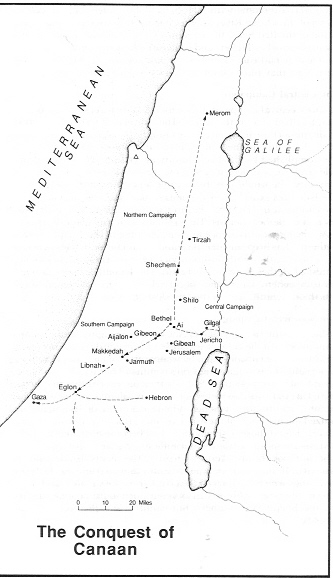
The book of Joshua is demonstrative proof that God fulfilled his land promise to Abraham. Israel must depend upon the Lord to conquer the land. The conquest is normally described as a three-pronged method of attack.[2] But the text does not describe the unfolding of these events in a strategic way. Initially, it was conceived to be an all-out conquest of the cities in the land much like Jericho and Ai; however, later conquests demonstrate to be more the result of preemptive strikes from other kingdoms upon Israel due to its successful military campaigns in the region.
First, the Israelites penetrated into the center of the Canaanite land (Joshua 6-9). The cities of Jericho (6:1-27) and Ai (7:1-8:29) were the first to experience the Israelite forces, as the Israelites initially took the land. And, the Gibeonite people were subjugated into servants, “cutters of wood and drawers of water for the congregation and for the altar of the Lord” due to their attempt at political deception (9:1-27). They claimed to come from a distant land, though they were an established group of inhabitants in the land with several cities all their own such as Gibeon, Chephirah, Beeroth, and Kiriath-jearim (9:16-17, 22).
Second, the Israelites respond to a strike upon the newly acquired inhabitants (the Gibeonites) by a band of five aggressive Amorite Kings of southern Canaan (Joshua 10). These five kings are listed in 10:5: Adoni-zedek, the king of Jerusalem, Hoham king of Hebron, the king of Jarmuth, the king of Lachish, and the king of Eglon. Since, Gibeon was a renowned city with many valiant warriors, and it had now become a part of the Israelites who conquered Jericho and Ai, these kings embraced the “strike first” strategy. Little did they know that “the Lord fought for Israel” (10:14), and that their fate would end with their cities being conquered (10:16-21, 29-38) and by suffering execution under the hand of Joshua in Makkedah (10:22-28).
The Conquest of Canaan (Laney, Concise Bible Atlas)
At the end of this campaign, the chronicler[3] of these events concludes this aspect of the conquest with following words:
So Joshua struck the whole land, the hill country and the Negeb and the lowland and the slopes, and all their kings. He left none remaining, but devoted to destruction all that breathed, just as the Lord God of Israel commanded. And Joshua struck them from Kadesh-barnea as far as Gaza, and all the country of Goshen, as far as Gibeon. And Joshua captured all these kings and their land at one time, because the Lord God of Israel fought for Israel. Then Joshua returned, and all Israel with him, to the camp at Gilgal. (10:40-43)
It was during this campaign that the famous “sun stood still” miracle occurred (10:12-13). Some dispute that the event was miraculous, but “conservative scholars are in agreement that this circumstance involved a genuine miracle, and that the account is not a mere poetic or mythological description of an ancient victory.”[4]
Finally, Joshua and company have a military victory over a northern Canaanite confederacy (Joshua 11). The land was conquered (Josh 11:16). It must be observed though, that the conquest was aided supernaturally by Divine intervention (Josh 5:13-15). Therefore, “the Lord gave to Israel all the land of which He had sworn to give to their fathers, and they took possession of it and dwelt in it” (Josh 21:43, 44-45 NKJV). After some 500 years after the initial promise, the promise is fulfilled.
The Dimensions of the Land
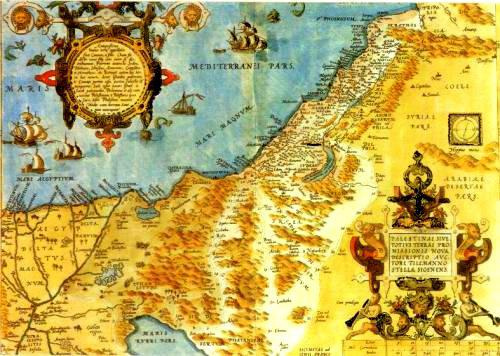
The land awaiting the Hebrew nation was extremely remarkable. Both Abraham and Moses had been privileged to see its beauty (Gen 13:14-18; Deut 32:49). In his guide book, Guy Duffield writes that from Mt. Nebo “on a clear day, the entire land of Canaan can be seen inasmuch as it is so small – 150 miles from the Jordan River to the Mediterranean.”[5] This is a “parallelogram about 150 miles from north to south and varying in width from 45 to 70 miles”,[6] and was highly diverse botanically, zoologically, meteorologically, and geographically.[7] One writer has said, “Within such small compass the country must have been unequalled for charm and variety.”[8] Even with a brief geographical overview of Palestine a value for the lands diversity can be ascertained.
Beginning from the land east of the Jordan River and venturing across the river into northern and southern extents of Palestine, the children of Israel found themselves in a very geographically dynamic territory. Carl Laney writes that the “land can be divided longitudinally into four distinct geographical regions: the coastal plain, the hill country, the Great Rift Valley, and the Transjordan highlands.”[9] While others have developed the subdivisions of these regions more exhaustively,[10] space here allows for only brief remarks as they relate to the conquest and settlement of Canaan.
The land on either side of the Jordan River is home to the historical narrative of the conquest implemented by the Israelites. The book of Joshua opens with the Israelites on the east side of the Jordan River. In fact, the books of Numbers and Deuteronomy catalog their conquest of this region, known as the Transjordan highlands (Num 31; Deut 2:26-3:11). The land spreads 150 miles from Mt. Hermon in the north to the southern tip of the Dead Sea.[11] The territory was subdivided and given to the tribes of Reuben and Gad, and to half of the tribe of Manasseh (Deut 3:12-22). This high plateau stands nearly at 4,000 feet, which “becomes higher as it extends southward, rising from two to five thousand feet in elevation.”[12] From the western side of this highland, it descends “steeply” down to the Jordan valley.[13] A key monument in the land would be Mt. Nebo, where Moses viewed the Promised Land before his death (Deut 3:23-29).
After crossing the Jordan River, the Israelites transverse a challenging topography throughout their conquests. In it they encountered the deep chasm of the Rift Valley and the mountainous geography of the western Hill Country. As the Israelites crossed the Jordan River, they where trekking through a great “fissure in the earth’s crust.”[14] The Rift Valley is “some 1,700 feet above sea level at the source of the Jordan River (near Caesarea-Philippi) and almost 1,300 feet below sea level at the Dead Sea in the south.”[15] This becomes a major border between the tribes one each side so that the “Rift made it virtually impossible for Transjordan to become integrally united with Samaria and Judah on a permanent basis.”[16]
After walking across the Jordan River, the Israelites encounter the Hill Country. This land is home to a roller coaster of valleys and mountain ranges. This is the backdrop of the central, southern and northern campaigns. This is the home of the rest of the Hebrew nation. North to south, the land consists of:
Upper Galilee, Lower Galilee, the hill country of Samaria and Judea, the “Shefelah” (a natural terrace on the western side of the mountains), and the Negeb (rendered ‘South Country’ in the Scriptures), which extends south of Hebron into the Arabian Desert.[17]
This land division stretches from the Upper Galilean region, where the elevations reach their zenith at nearly 4,000 feet, down through the Samaritan and Judean regions (where lower elevations exist) to the dry Negev plain.[18] One can appreciate then the notion that the Israelites were of a rugged deportment – this is probably accredited to their sojourn in the wilderness.
As the Israelites divided the land, many of their territories would include a portion of the coastal plain (Joshua 14-21). This beach front is “a band of sandy and alluvial soil bordering the Mediterranean Sea.”[19] North to South, it extends some 165 miles from the “Ladder of Tyre (Rosh Ha-Niqra)” to the “Wadi el-‘Arish”, all the while broadening the width of its land from 3 miles in the North to approximately “twenty-five miles” in the south.[20] “The whole coastal region readily lends itself to a threefold division: the Plain of Philistia, the Plain of Sharon, and the Plain of Acre.”[21]
The Divine Transplantation
Jehovah God fulfilled His promise to the Hebrew patriarchs and gave the Israelites the land of promise. The description of the land itself yields a very rugged picture, yet God gave these nomads victory over the established societies encountered therein.
Henry H. Halley captures the magnitude of such a feat. He declares that such a monumental liberation and migration of a nation could not be explained sufficiently with naturalistic conclusions. For Halley, it can be spoken of in no other terms aside from the miraculous:
Aside from various accompanying miracles, the Transplanting of a Whole Great Nation, bodily, from one land to another, meanwhile maintaining it 40 years in a Desert, was in itself one of the most Stupendous Miracles of the ages.[22]
What other explanation would there be for Pharoah to relinquish his profitable workforce – the slave labor of Israel? What other explanation would there be for the survival of millions of Israelites in the desert? Moreover, how can there be a reasonable naturalistic explanation for a nomadic force overtaking fortified cities?
No doubt, the naturalist – or skeptic – can raise criticisms; however, for the theist, the best and simplest explanation is found in Divine intervention. If God created the universe and has provided for every creature, then surely God can lead and provide a nation with liberation from slavery, and then set them on the center stage of the geopolitical tensions of the Mediterranean coastline.
Indeed, the greatest problem for the skeptic and atheist resides in Genesis 1:1 –“In the beginning God.” Such a tremendous experience should have yielded a sense of unwavering dedication to the God of their salvation (Exod 14:28-31), but, unfortunately, Israel’s history retells the cyclical problem of rebellion and idolatry.
It was this problem to which God addressed himself and anticipated in the Law of Moses. The Old Testament is transparent in God’s conditional relationship with Israel.[23] The relationship was dependent upon their faithfulness. Notice a sample of a few verses:
“And if you faithfully obey the voice of the Lord your God, being careful to do all his commandments that I command you today, the Lord your God will set you high above all the nations of the earth” (Deut 28:1).
And the Lord said to Moses, “How long will this people despise me? And how long will they not believe in me, in spite of all the signs that I have done among them? I will strike them with the pestilence and disinherit them, and I will make of you a nation greater and mightier than they” (Num 14:12).
“Be very careful, therefore, to love the Lord your God. For if you turn back and cling to the remnant of these nations remaining among you and make marriages with them, so that you associate with them and they with you, know for certain that the Lord your God will no longer drive out these nations before you, but they shall be a snare and a trap for you, a whip on your sides and thorns in your eyes, until you perish from off this good ground that the Lord your God has given you” (Josh 23:11-13).
“But just as all the good things that the Lord your God promised concerning you have been fulfilled for you, so the Lord will bring upon you all the evil things, until he has destroyed you from off this good land that the Lord your God has given you, if you transgress the covenant of the Lord your God, which he commanded you, and go and serve other gods and bow down to them. Then the anger of the Lord will be kindled against you, and you shall perish quickly from off the good land that he has given to you” (Josh 23:15-16).
The majority of the Hebrew Bible is the retells the story of the consistent Israelite rebellion against their God, God’s warning a recalcitrant nation of wrath, and then the culminating judgment brought upon them. One biblical student summarizes the situation in the following way:
Because of the accelerating rebellion of the nation, consummated by the murder of Jesus Christ, God rejected the Hebrew people. Inexcusably, the Jews rejected their own Messiah; accordingly, Jehovah repudiated that nation and determined to scatter them as dust (Matthew 21:44). Thus, in the providence of God, the Roman armies came against Palestine in A.D. 70, and Judaism was destroyed (cf. Matthew 22:7; 24:1-34); the Jewish “vessel” was smashed, and it cannot be put back together (cf. Jeremiah 19:11). According to Josephus, some 1.1 million Hebrews were slaughtered, and thousands were taken into slavery. All Jewish records were lost in that holocaust. Today, there is not a single Jew who knows his tribal ancestry (McClintock and Strong, 1969, 771). The physical nation of Israel is dead. The “Jews” that make up the State of Israel today (less than twenty-five percent of the world Jewish population) cannot legitimately be called a “nation.”[24]
Conclusion
The biblical record is clear that God had promised to Abraham and his children His covenant to bless them and to give them a land for their descendants (Acts 13:16-25). This land, as demonstrated by ample biblical references was a possession for as long as they remained faithful to God. Sadly, they showed a consistent spirit of rebellion, and as a consequence, a new covenant was to replace the Mosaic Covenant and fulfill the Abrahamic covenant.
Aside from physical blessings, this covenant had spiritual emphases as well – it anticipated the coming offspring that would bless all nations with salvation (Gen 22:17-18; Gal 3:16). Indeed, as the Hebrew writer observes, Joshua may have provided the Jews with a Sabbath rest after the conquest of Palestine, but Jesus provides a rest yet to be experienced – redemption in Heaven (Heb 4:1-10).
Works Cited
Unless otherwise stated, all Scripture quotations are taken from the English Standard Version of the Holy Bible (Wheaton, IL: Crossway, 2001).
Norman L. Geisler, A Popular Survey of the Old Testament (Grand Rapids, MI: Baker, 2000), 97.
I use the name “chronicler” due to the fact that Joshua is, like many Old Testament books, anonymous. Raymond B. Dillard and Tremper Longman, III, stress that ascertaining authorship and date for Joshua’s composition is “bound up with larger historical and theological questions” than mere internal and external argumentation (An Introduction to the Old Testament [Grand Rapids, MI: Zondervan, 1994], 108). David Malick lists a number of features within Joshua (i.e. internal evidence) pointing to various authors; among them, Joshua (“eyewitness quality”) and others who finished the book later – “but not much later” (“An Introduction to the Book of Joshua“). Malick concludes his discussion of authorship by observing that since critical scholarship results rejecting Joshua authorship lacks unanimity, the traditional view that Joshua wrote the majority of the book that bears his name is therefore a good assumption. The book should be viewed as “true to form” written in the days of Joshua and the elders that outlived him (Josh 24:31).
Wayne Jackson, “How Do You Explain Joshua’s Long Day?,” ChristianCourier.com (Accessed: 22 Mar. 2002). This is a brief introduction to the subject, it would be worth consulting.
Guy P. Duffield, Handbook of Bible Lands (Glendale, CA: Regal, 1969), 140.
“Palestine of the Holy Land,” New Standard Reference Bible (Chicago, IL: Hertel, 1955), 756.
Wayne Jackson, Background Bible Study (1986; repr., Stockton, CA: Christian Courier Publications, 2000), 1-18, 67-74.
Alfred Edersheim, Sketches of Jewish Social Life, updated ed. (Peabody, MA: Hendrickson, 1994), 2.
J. Carl Laney, Concise Bible Atlas: A Geographical Survey of Bible History (Peabody, MA: Hendrickson, 1998), 41.
J. McKee Adams, Biblical Backgrounds, revised ed., rev. Joseph A. Callaway (Nashville, TN: Broadman, 1965), 52-85.
Laney, Concise Bible Atlas, 79.
Laney, Concise Bible Atlas, 79.
Laney, Concise Bible Atlas, 42.
Laney, Concise Bible Atlas, 42.
Jackson, Background Bible Study, 3.
Laney, Concise Bible Atlas, 83.
Jackson, Background Bible Study, 3.
Laney, Concise Bible Atlas, 41.
Laney, Concise Bible Atlas, 41.
Laney, Concise Bible Atlas, 131.
Adams, Biblical Backgrounds, 56.
Henry H. Halley, Halley’s Bible Handbook, 24th ed. (Grand Rapids, MI: Zondervan, 1965), 22.



 biblicalfaith.online