The Humanity of Jesus the Son

The phrases Jesus Christ, the Christ of faith, the Jesus of history, and Jesus the Divine Son all reflect significant themes pertaining to the central figure of the New Testament, Jesus of Nazareth. These concepts fall within a specialized area of theology known as Christology, which is a systematic “study of Christ” based on the full biblical picture derived from scripture.

A bit more formally, this field of study speaks to the Christian endeavor to map Jesus’ placement within “time and eternity, humanity and divinity, particularity and universality.” It answers how the life of a seemingly benign first-century Jewish rabbi could be so “relevant for all people and all times” (McGrath 2017, 207).

The present discussion maps Jesus’ Son-relationship in the triune unity of God, and the nature of his humanity. It then reflects on how the humanity of Jesus is relevant to the Christian’s personal walk before God.

Jesus the Son and the Trinity

The Trinitarian Formula

The divinity of Jesus is established in many passages of the New Testament. For example, Matthew closes with an appearance of Jesus where he affirms his authority “in heaven and on earth.” With this authority, he commissions his disciples for an international burden,

“Go therefore and make disciples of all nations, baptizing them in the name of the Father and of the Son and of the Holy Spirit” (28:18–19 NRSV). [All Scripture references are from the New Revised Standard Version unless otherwise noted.]

Three themes are clear in this passage: Jesus’ divine authority, discipleship made in baptism, and the trinitarian language of Father, Son, and Holy Spirit. In the early generations of the church, the above trinitarian formula would represent a highly nuanced concept of monotheism affirmed to be in continuity with the “one God” of the Hebrew Bible.

What forced early Jewish Christians to accept this nuanced view of monotheism? The answer: the character and nature of Jesus did. It is not subversive of the “oneness” of God (Deut 6:4) but depends on the New Testament’s clarification that the “one God” is not a simplistic model. As the clarification argues, the Divine Son is not God the Father, nor is he the Holy Spirit. This raises tough questions that the historical church has discussed in earnest and in conflict for generations.

How do we map this out theologically?

The Divine Son Portrayed

We turn to the presence of Jesus and how He is portrayed in relation to the Father and the Holy Spirit.

In the first century, the prologue to the Fourth Gospel (John 1:1–3, 14) affirms that the person and nature of Jesus is the driving force to reshape the whole biblical landscape of the concept of God (Gen 1:1; Exod 20:11).

In the beginning was the Word, and the Word was with God, and the Word was God. He was in the beginning with God. All things came into being through him, and without him not one thing came into being... And the Word became flesh and lived among us, and we have seen his glory, the glory as of a father’s only son, full of grace and truth. (John 1:1–3a, 14) 

Jesus not only pre-existed as the lógos at the time of creation (John 1:1), but he also “emptied” (ekénōsen) himself to take on the “form [morphē] of a slave”—a human (Phil 2:6–7). Leaning heavily on John 1:14, the Alexandrian theologian, Athanasius, concluded that this “human body” was taken by this same “Word of God” (Placher 2003, 184).

On this view, there was no room within this theology for Arius’ affirmation that Jesus the Son—the Word—was a created being who subsequently became divine. This view reduced Jesus to a creature impotent to redeem humanity (McGrath 2017, 217–19).

The Divine Association

As McGrath (2017, 214) chronicles, the divinity of Christ was one of the first major theological battles of the early church as it sought to hammer out its understanding of the contours of a very genuine human being in Jesus who, at the same time, was portrayed as being more than a mere human. The “battle” was not over the deity of Christ as such (that was established), but how to understand the relationship between his humanity and his divinity.

The divinity of Jesus was therefore accepted as true as his humanity—as affirmed in Chalcedon (AD 451)—which means that the question left to map out was the relationship between Jesus and the Father and the Holy Spirit.

The only way to do this is by evaluating Scripture (Jenson 2003, 194). Despite certain reservations, Jenson argues clearly that Peter’s application of the divine title “Lord” from Joel 2 (kyrios LXX) to Jesus in Acts 2:33–34 (kyrios) demonstrates that

the risen Christ, without violation of God’s singularity, does what only the God of Israel himself does, and that he does this precisely by virtue of his situation with the God of Israel. (2003, 194)

Jensen in Essentials of Christian Theology (2003)

Jensen points out that the emerging notion of association that comes from the word “with” points to the “inescapably observable fact” that the biblical narrative is framed by three divine characters in its drama (2003, 195): the God of Israel, Jesus his Son, and the life-giving Spirit of God.

Agreeing with Jenson (2003, 196), Jesus should not be viewed as a mere successive mode of God’s presence in time (modalism) or as the Father’s subordinate agent with the Spirit in time (subordinationism). Instead, Jesus maintains an eternally mutual and reciprocal relationship with the Father and the Spirit. For this reason, ancient Christians used an analogy inspired by the theater, that is to say, that the Father, the Son, and the Holy Spirit although three in persona (mask) are one in Divine substance. Another model is found in Martin Buber’s I-You relationship model (McGrath 2017,179–80).

Understanding the Humanity of Jesus

What, then, goes into mapping this theological tension of the Son and the Trinity?

Mapping the nature of Jesus’ humanity—in balance with his divinity—requires great caution. The traditional doctrine of the incarnation (literally, “becoming bodily”) affirms both the full humanity of Jesus and his divinity. Any attempt to isolate what is organically interwoven in the person and work of Jesus runs a high risk of distortion.

Overcompensating to account for the humanity of Jesus has typically been met with the “stamp” of heresy. Three, in particular, are Ebionism, Arianism, and Docetism (McGrath 2017, 214–20). 

The roots of Ebionism are Jewish. It framed Jesus through the lenses of a human prophet, as called and anointed by the Holy Spirit. As a low Christology, Jesus is only a “spiritually superior” human. This does not align with the picture of his eternal pre-existence as Creator.

Plotted on another point on the map is Arianism (named after Arius), which called into question the “fully divine” and “fully human” affirmation due to an irreconcilable application of the Greek notion of divine impassability and the doctrine of the incarnation. God cannot be both changeable (fully human) and transcendent (fully divine), therefore, the incarnation strikes at the perfect nature of the one God. Jesus must therefore be a “superior created being” with nothing divine to report. This failed to account for the actual testimony of the gospels where in fact this is possible.

Meanwhile, Docetism affirmed, with its hardline separation of God and the present evil world of matter (due to its gnostic foundation), the divine incarnation of John 1:14 was nothing more than “pretend.” The heresy’s name (or tendency) is derived from the Greek word dokéō (“to seem”) affirming Jesus only “seemed” to have a body in which he suffered and died, making the incarnation “into a fake” (Placher 2003, 183). Scripturally, the work of Christ is dependent on the fully human (Luke 24:38–39) and fully divine Jesus manifested in the death of the cross and resurrection from the dead (Rom 1:3–4).

Similarly, the opening line of 1 John affirms the humanity of the “Word of Life”: “what we have heard, what we have seen with our eyes, what we have looked at and touched with our hands” (1:1).

Likewise, in the second century CE, Ignatius of Antioch (ca. 35–ca. 110) stressed his concern to the Christians of Trallia that they should guard against (“be deaf,” kōphóthēte 9.1) anything which undermines the humanity of Christ with the following words:

Jesus Christ, who was of the family of David, who was the son of Mary; who really was born, who both ate and drank; who really was persecuted under Pontius Pilate, who really was crucified and died while those in heaven and on earth and under the earth look on; who, moreover, really was raised from the dead when his Father raised him up, who—his Father, that is—in the same way will likewise also raise us up in Christ Jesus who believe in him, apart from whom we have no true life. (“To the Trallians” 9.1–2)

Ignatius of Antioch, “To the Trallians” 9.1-2

The example of Ignatius is interesting because it is early and strongly affirms Jesus’ human form, “who really” (hos alethōs) an adverb repeated four times to assert what is true, actual because it corresponds to what is really so (BDAG 44). For Ignatius, Jesus actually was born, ate and drank, persecuted, crucified and died, and raised from the dead. Ignatius saw denying the humanity of Christ as subversive to the soteriological (the saving, redeeming) and eschatological (end times, fulfilling) work of Christ.

What Does This Mean?

What then does it mean for the Christian that God became flesh to redeem us in the person of Jesus Christ? Two extremes must be cautioned against here. One extreme is to moralize the life of Jesus (1 Pet 2:21), and as such reduces Jesus to a mere good teacher. Another extreme is to make Jesus’ life and teaching into a disjointed symbolic presence of God (i.e., Paul Tillich).

The humanity of Jesus provides me with a great deal of assurance as a believer that God knows through Christ the human plight. Jesus has “assumed all” and can, therefore “heal all” of humanity (Placher 2003, 184). When the “name” Immanuel (“God is with us”) is given to Jesus (Matt 1:23) the associated promise is that “he will save his people from their sins (Matt 1:21). God’s presence in the human child to be born provides a personal locus that can be isolated to time, space, and history.

For all humans, it then becomes quite clear that God is joining the human continuum to reconcile not only “us” but also “the world to himself” in Christ (2 Cor 5:18–19). Paul’s application has massive personal repercussions,

“if anyone is in Christ, there is a new creation: everything old has passed away; see, everything has become new!” (5:17) 

The humanity of Jesus is not simply a modal expression of God, but God entering into time and space to save, forgive, reconcile, and renew humanity and creation.

It provides the seedbed to take the particular localized Jesus and affirm his enduring value for all humans for all time. As Ignatius wrote, God “will likewise also raise us up in Christ Jesus who believe in him, apart from whom we have no true life” (“To the Trallians” 9.2).

Truly, the humanity of the God-Man Jesus is relevant for the Christian’s personal walk before God because it is the seedbed for all our hopes, especially, hope for the resurrection (1 Cor 15:12–19).

Bibliography

(BDAG) Bauer, Walter, Frederick W. Danker, W. F. Ardnt, and F. W. Gingrich. 2000. A Greek-English Lexicon of the New Testament and Other Early Christian Literature. 3rd edition. Chicago: University of Chicago.

Ignatius. 1999. “The Letters of Ignatius, Bishop of Antioch.” Pages 128–201 in The Apostolic Fathers: Greek Texts and English Translations. 2d edition. Edited and revised by Michael W. Holmes. Grand Rapids: Baker Books.

Jenson, Robert W. 2003. “Does Jesus Make a Difference? The Person and Work of Jesus Christ” Pages 191–205 in Essentials of Christian Theology. Edited by William C. Placher. Louisville, Kent: Westminster John Knox.

McGrath, Alister E. 2017. Christian Theology: An Introduction. 6th edition. Maldon, Ma: Wiley Blackwell.

Placher, William C. 2003. “Does Jesus Make a Difference? The Person and Work of Jesus Christ” Pages 183–91 in Essentials of Christian Theology. Edited by William C. Placher. Louisville, Kent: Westminster John Knox.

Word Study: Jonah and God’s Benevolent Love (Jonah 4:2)

college papers

In Jonah 4:2 the prophet appeals to the Hebrew noun חֶסֶד (hesed) as a Divine character trait reflected in relational actions. This term is one of the most profound words in the Hebrew Bible, but this profundity is complicated by the fact no single translation really captures its meaning. For this reason, deClaissé-Walford, Jacobson and Tanner opted to transliterate the term throughout their commentary on the Psalms:

Traditionally, a wide range of English terms have been employed in the attempt to capture the meaning of hesed: “mercy,” “loving-kindness,” “steadfast love,” “faithfulness,” “covenantal love,” “loving faithfulness,” and the like. We find that none of these words or phrases satisfactorily express the range and depth of hesed.[1]

The present word study, then, seeks to provide sufficient contours for the word’s usage in the Hebrew Bible and then suggest Jonah’s usage is not only a matter of subversion but also an acknowledgment that the LORD is a God of “benevolent love” (Exod 34:6–7).

Hesed Throughout the Hebrew Bible

There is no agreement of how many instances of hesed there are in the Hebrew Bible. In ascending order, based on BHS4 Kohlenberger and Swanson index the noun 244 times.[2] Stoebe and Zobel list 245 instances; yet, Gordon counts 246.[3] In their popular grammar, Practico and Van Pelt supply a 249 wordcount; meanwhile, Koehler, Baumgartner, and Stamm, and therefore Holladay, calculate about 250 instances.[4] This apparent statistics fluctuation for the frequency of hesed is probably due, at least, to variants in the critical Hebrew texts upon which their analyses were based.

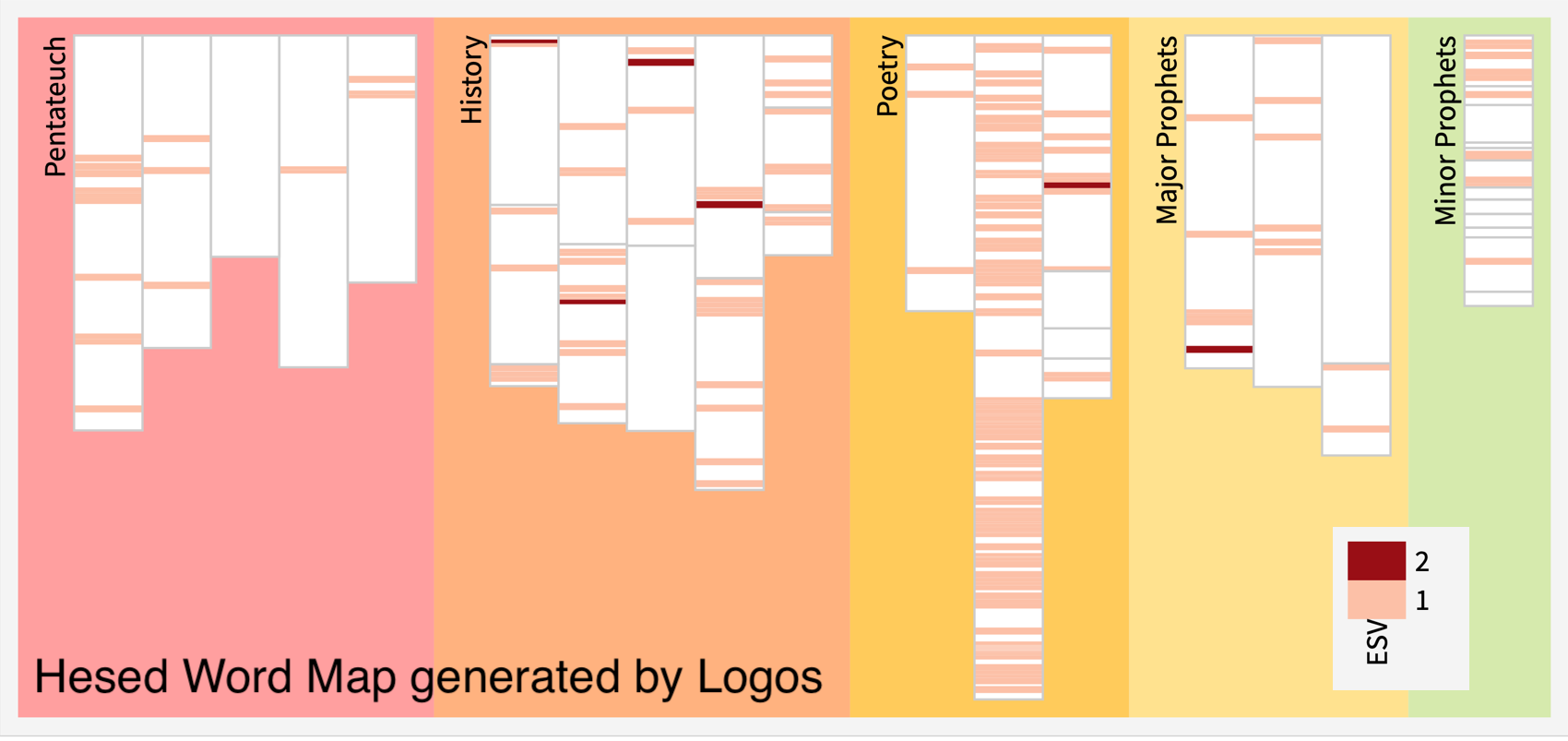
Hesed is widely distributed across all biblical literary categories of the Hebrew Bible, which is arranged differently than the Christian Bible (see word map below). It is found in the Torah 20 times, in the Prophets (Nevi’im) 53 times, and the Writings (Ketuvim) 172[3] times.[5] The twelve books where hesed does not appear, however, are Leviticus, 2 Kings, Ezekiel, seven of the twelve minor prophets (Amos, Obadiah, Nahum, Habakkuk, Zephaniah, Haggai, and Malachi), Song of Solomon and Ecclesiastes.

Hesed appears in the first book and the last book of the Hebrew Bible; from the rescuing of Lot in Genesis 19:19 to the faithful deeds of Josiah’s reformation in 2 Chronicles 35:26:

you have shown me great kindness [hesed] in saving my life. (NRSV)[6] 

the rest of the acts of Josiah and his faithful [hesed] deeds in accordance with what is written in the law of the Lord. (NRSV)

The last reference reflected in the Protestant arrangement of the Bible (see word map below) closes with the prophetic oracle of Zechariah 7:9-10:

Thus says the Lord of hosts: Render true judgments, show kindness [hesed] and mercy to one another; do not oppress the widow, the orphan, the alien, or the poor; and do not devise evil in your hearts against one another. (NRSV)

Result Map of חֶ֫סֶד:2 in ESV.png
Word Map: The Hesed (חֶסֶד) word map is based on the English Standard Version generated by Logos Bible software. The pink horizontal lines represent single and double instances.

The books which have ten or more references of hesed are Proverbs (10 times), Genesis (11 times), 1–2 Chronicles (15 times), 1–2 Samuel (16 times), and the Psalms (127[8] times). The majority of these books reflect the relational nature of hesed in the human realm. In Proverbs the end goal of wisdom is to teach practical relational hesed (31:26, 21:21), it is not a false front but the foundation of one’s reputation by its presence in their life (20:6, 28).

In Genesis, “kindness” is requested in prayer to God by Abraham’s servant to find a wife for Isaac (Gen 24:12, 14, 27). Then, Laban and Bethuel act in hesed (“kindness”) by cosigning their approval of Rebekah’s consent to be given as wife to Isaac.

1–2 Chronicles and 1–2 Samuel show that hesed expressed in reciprocal social acts. Saul reciprocates and excuses the Kenites from his assault on the Amalekites because they has shown hesed to Israel in ages past (1 Sam 15:6). Hushai’s “love” (loyalty?) for David is questioned during his infiltration of Absolam’s forces (2 Sam 16:17). The hesed shared between David and Jonathan is a story of deep loyalty and mutual reciprocity (1 Sam 20:8, 14–15). The Divine hesed is evidenced as well (2 Sam 15:20). Nathan enshrined the Davidic lineage and kingdom on behalf of God,

“my love will never be taken away from him” (2 Sam 7:15 NIV; 1 Chr 17:13, 2 Chr 1:8, 6:42; Psa 18:25[26]).

The Psalms contain close to half of all uses of the noun hesed (127[8] times); but it does not appear in 55% (83 psalms) of the 150 psalms. In brief, there are 23 instances in Book I (1-41), 16 instances in Book II (42–72), 14 and 13 times in Book III (73–89) and IV (90–106) respectively. In Book V (107–150), however, the frequency count skyrockets to 60 instances. Psalm 136 alone celebrates the Divine hesed in each of its twenty-six verses. It is in the Psalms that “both God and human worshipers describe God’s hesed as everlasting.”[7] Indeed,

While the term is used of both humans and God, in the Psalter it is above all a theological term that describes God’s essential character as well as God’s characteristic ways of acting—especially God’s characteristic ways of acting in electing, delivering, and sustaining the people of Israel. Hesed is both who the Lord is and what the Lord does. Hesed is an ancient term that defined for Israel who its God is.[8]

The saturation of hesed in the Psalms suggests that God’s people should always be mindful in prayer and worship of its content, its deeds, and the God who so relates to his people (Psa 36:5, 7, 10).

As pertains to the present study, it should be noted that the noun hesed only features twice in Jonah. Jonah is only one of four minor prophets where the term is employed (Hosea, Joel, and Micah). The first instance is in Jonah’s prayer of lament while in the “great fish” wherein he affirms that pagan idolators will miss out on “the grace [hasdam] that could be theirs” (2:8[9] NIV). The other instance is in 4:2 where Jonah laments what he knows about the LORD, who is “abounding in love” (NIV, warabhesed) and willing to change his mind about bringing judgment on the penitent people of Nineveh. 

Semantic Range and Related Hebrew Words

As Silzer and Finley remind, “[w]ords normally have more than one meaning. The specific meaning of the word depends on its context.”[9] It is not sufficient, then, to rely on English translations (archaic or contemporary), nor to force lexical glosses to determine the meaning of a word.[10]

Brown, Driver, and Briggs groups hesed with its verbal (hasad 2 times) and adjectival (hasid 32 times) forms, along with a few proper names, such as Ben-Hesed (“son of Hesed” 1 Kgs 4:10) and Hasadiah (“Yah is Hesed” 1 Chr 3:20).[11] Lastly, is the unclean hasidah (6 times) often translated “stork” or “heron.” The root connection is believed to be due to their fond, “kind and affectionate” nature with their young.[12] This is a feature that is never appealed to in the Hebrew Bible.

The semantic range of hesed extends to the secular and the religious. In each, hesed manifests in concrete actions of goodwill, loyalty, and communal love whether in or outside of the covenant.[13] Divergent views emerge here with polarizing understandings over the meaning of hesed. Nelson Glueck saw in hesed a hardline covenantal legal obligation, H. J. Stoebe and others countered that hesed was a free relational demonstration of loyal love.[14]

In the secular sense hesed speaks to certain “ethical norms of human intercourse” where mutuality exists that focuses on “the closest of human bonds.”[15] For example, Ruth exhibits this sense (1:8, 2:20, 3:10). Naomi blesses her daughters-in-law reciprocally, “May the Lord deal kindly [hesed] with you, as you have dealt with the dead and with me” (NRSV).

Religiously, the Divine demonstration of hesed does not function very differently than from the secular.[16] Exodus 34:1–7 provide a clear liturgical formula which demonstrates that Israel’s God abounds “in steadfast love and faithfulness” (34:6 NRSV; Psa 86:15, 89:14, Num 14:18).

The Lord passed before him, and proclaimed, “The Lord, the Lord, God merciful and gracious, slow to anger, and abounding in steadfast love [hesed] and faithfulness, keeping steadfast love [hesed] for the thousandth generation, forgiving iniquity and transgression and sin, yet by no means clearing the guilty, but visiting the iniquity of the parents upon the children and the children’s children, to the third and the fourth generation.” (Exod 34:6-7 NRSV)

This divine expression stresses the LORD’s multi-generational hesed and faithfulness. Moses now knows (33:13) that the LORD relates to his people through his benevolent and enduring nature. The words are quoted and echoed throughout the Hebrew Bible which suggests that they became formulaic or institutionalized to extoll the attributes of the God of Israel (Num 14:18, Jer 32:18, Joel 2:13, Nah 1:3, Psa 86:15, 103:8, 111:4, 112:4, 116:5, 145:8, Neh 9:17, 31, 2 Chron. 30:9)[17]

There are several words that appear frequently with hesed. They provide some dynamic appreciation for its usage in the Hebrew Bible.[18] Hesed may be done (‘asah) in concrete choices (Ruth 1:8). The LORD God keeps (shamar) and abounds (rab) in hesed (Deut 7:9, Neh 9:17). It is often associated with various nouns of “mercy” as in Psa 103:4 where the psalmist speaks of being crowned by God with hesed and rahamim (mercy). Likewise, hesed appears together with ’emet (faithfulness) probably as a hendiadys such as in Exod 34:6 and Psa 86:15.[19]

Hesed in Jonah 4:2

He prayed to the Lord and said, “O Lord! Is not this what I said while I was still in my own country? That is why I fled to Tarshish at the beginning; for I knew that you are a gracious God and merciful, slow to anger, and abounding in steadfast love [hesed], and ready to relent from punishing. And now, O Lord, please take my life from me, for it is better for me to die than to live.” (Jonah 4:23 NRSV)

This survey of hesed in the Hebrew Bible should help to determine the possible range of meaning for how Jonah 4:2 should be understood. Words have meaning only in context. With the above range in mind, the context appears to reflect Jonah’s usage of the formulaic hesed language of Exodus 34:6–7. Instead of celebrating his God with these words, Jonah is subversively using this language to express his frustration with the LORD’s restraint against the city of Nineveh.

Jonah is using God’s own words against him. For this reason, it appears the meaning for Hebrew word hesed found in Jonah 4:2 should be understood as “benevolent love.” Jonah knows how LORD acts out in concrete acts of hesed, these being grace, mercy, “slow to anger,” and relenting from judgment. Since there is no evidence that the LORD is in covenant with Nineveh, this supports the supposition that divine hesed may be expressed in free relational demonstrations of benevolent love. God relates to repentance with the reciprocal response of grace, mercy, patience/forbearance, relenting from judgment.

Jonah 2:8[9] further supports this view. It reveals that the prophet desires for judgment those who do not enjoy a covenant relationship with the LORD. It appears that for Jonah, idolatry is the “deal-breaker” for having a relationship with the LORD based on hesed. Yet, the irony fails to make any headway with the nationalistic prophet, since he rejected his prophetic call on the basis that he knew what the LORD would do should Nineveh repent. Both he and pagans have rejected God. Jonah is not only selfish with his relationship with his faithful God (“save me from the fish!”) but is resentful that God is “sharing the love” with foreigners (“you saved them from judgment!”).

Jonah wants his curse to come true, that those who “cling to worthless idols forfeit the grace [hesed] that could be theirs” (2:8[9] NIV). It is this forfeiture of Divine hesed which Jonah still desires for Nineveh, reflected in his willingness to proclaim that the city “will be overturned” (3:4) and his bitterness that it was not (4:1–11). Jonah knew that God would choose relationship over punishment. The LORD said as much (4:11). Humans, unfortunately, seem to choose punishment over relationship. Jonah shows as much.

This focused study on hesed and Jonah 4:2 brings to mind that the caricature of the bloodthirsty wrathful God of the Old Testament is just that an exaggerated cartoon (cf. Jas 2:13). As Baer and Gordon powerfully remind:

The insight that, while both anger and love are appropriate divine responses, the latter outlasts the former, is an important one for biblical theology. Wrath is a true word, a right word, sometimes an inevitable word, such passages seem to say. But God would not have it be his last word. That honor is reserved for his unfailing love (hesed).[20]

The burden of Jonah was to provide concrete witness to the people of Nineveh that God seeks to extend and establish benevolent love with all nations. As one who has experienced Divine benevolent love, Jonah should have been moved to be a spokesman for Divine benevolent love. In this he struggled and failed; nevertheless, God succeeded even if for a brief time (cf. Nahum 1:1?).

Conclusion

The meaning for Hebrew word hesed found in Jonah 4:2 should be understood as “benevolent love.” The formulaic language of Exodus 34:6–7 is surely the theological and context for Jonah’s use of hesed. In Exodus as in Jonah 4:11, the LORD shows that he has the concern to establish and maintain a communal relationship with Israel. The benevolent concerns of preserving others and acting on the basis of moral uprightness anchor the LORD’s demands of repentance. Jonah knew if Nineveh took seriously the burden of his message, his God would become their God. They would collectively experience Divine benevolent love.

A final thought should be emphasized. Even though there are many excellent translations in the English language their primary function is simply to provide a reading text. Some significant and complex words, like hesed, merit the focused investigation which a word study provides. As developed above, hesed stresses relationships, community, loyalty and the ethical demands of love, responsibility, care, and obligation words which no single translation can do justice. Word studies reveal facets and these usages are combined into a framework. This framework provides the contours for understanding what a word means within its context, for usage determines meaning.

Endnotes

  1. Rolf A. Jacobson, “Text, Title, and Interpretation,” in The Book of Psalms, NICOT, eds. E. J. Young, R. K. Harrison, and Robert L. Hubbard (Grand Rapids, MI: Eerdmans, 2014), 78.
  2. John R. Kohlenberger III. and James A. Swanson, The Hebrew-English Concordance to the Old Testament (Grand Rapids, MI: Zondervan, 1998), v, 559.
  3. H. J. Stoebe, “hesed kindness,” TLOT 2:449; H.-J. Zobel, “hesed,TDOT 5:45; Robert P. Gordon, “hesed,” NIDOTTE 2:211.
  4. Gray D. Practico and Miles V. Van Pelt, Basics of Biblical Hebrew, 2d ed. (Grand Rapids, MI: Zondervan, 2007), 105; Koehler, Baumgartner, and Stamm, “hesed,” HALOT 1:336; William L. Holladay, A Concise Hebrew and Aramaic Lexicon of the Old Testament (1971; repr., Grand Rapids, MI: Eerdmans, 2000), 111.
  5. The Torah includes Genesis-Deuteronomy; the Nevi’im includes Joshua-2 Kings, Isaiah, Jeremiah and Ezekiel, and the Minor Prophets; and the Ketuvim includes Psalms, Proverbs, Job, Song of Solomon, Ruth, Lamentation, Ecclesiastes, Esther, Daniel, Ezra-Nehemiah, and 12 Chronicles.
  6. The two English translations the Holy Bible used in this paper are the New Revised Standard Version (Nashville, TN: Nelson, 1989) and the New International Version (Nashville, TN: HarperCollins, 2011) cited as NRSV and NIV respectively.
  7. David A. Baer and Robert P. Gordon, “hesed,” IDOTTE 2:212–17.
  8. Jacobson, “Text, Title, and Interpretation,” 8.
  9. Peter James Silzer and Thomas John Finley, How Biblical Languages Work: A Student’s Guide to Learning Hebrew and Greek (Grand Rapids, MI: Kregel Publications, 2004), 164.
  10. Douglas Stuart, Old Testament Exegesis: A Handbook for Students and Pastors, 4th ed. (Louisville, KY: Westminster John Knox, 2009), 182–83.
  11. BDB 338–39.
  12. BDB 339; HALOT 1:336; TLOT 2:449.
  13. IDOTTE 2:212–17; HALOT 1:336–37; TDOT 5:46–64.
  14. R. Laird Harris, “hesed,” TWOT 1:305–06.
  15. TDOT 5:47–48.
  16. TDOT 5:54–55.
  17. Nahum M. Sarna, Exodus, JPS Torah Commentary, ed. Nahum M. Sarna (Philadelphia, PA: Jewish Publication Society, 1991), 216.
  18. HALOT 1:337.
  19. TWOT 1:307.
  20. IDOTTE 2:214.

Bibliography

Baer, David A., and Robert P. Gordon. “חסד.” Pages 211–18 in vol. 2 of New International Dictionary of Old Testament Theology and Exegesis. Grand Rapids, MI: Zondervan, 2012.

Brown, Francis, S. R. Driver, and Charles A. Briggs. A Hebrew and English Lexicon of the Old Testament. Oxford: Clarendon Press, 1907.

Ford, David. “Keeping up Biblical Languages while in the Ministry.” Foundations 14 (1985): 41–44.

Gordon, Robert P. “חסד.” Pages 211–18 in vol. 2 of New International Dictionary of Old Testament Theology and Exegesis. Edited by Willem A. VanGemeren. Grand Rapids, MI: Zondervan, 1997.

Harris, R. Laird. “חסד (hsd).” Pages 305–07 in vol. 1 of Theological Wordbook of the Old Testament. Edited by R. Laird Harris, Gleason L. Archer, Jr., and Bruce K. Waltke. Chicago, IL: Moody Press, 1980.

Holladay, William L. A Concise Hebrew and Aramaic Lexicon of the Old Testament. 1971. Repr., Grand Rapids, MI: Eerdmans, 2000.

Jacobson, Rolf A. “Text, Title, and Interpretation.” Pages 29 in The Book of Psalms. NICOT. Edited by E. J. Young, R. K. Harrison, and Robert L. Hubbard. Grand Rapids, MI: Eerdmans, 2014.

Koehler, Ludwig, Walter Baumgartner, and Johann J. Stamm. The Hebrew and Aramaic Lexicon of the Old Testament. Translated and edited under the supervision of Mervyn E. J. Richardson. 5 vols. New York: Brill, 1994–1999.

Kohlenberger, John R., III., and James A. Swanson. The Hebrew-English Concordance to the Old Testament. Grand Rapids, MI: Zondervan, 1998.

Practico, Gray D., and Miles V. Van Pelt. Basics of Biblical Hebrew. 2d edition. Grand Rapids, MI: Zondervan, 2007.

Sarna, Nahum M. Exodus. JPS Torah Commentary. Edited by Nahum M. Sarna. Philadelphia, PA: Jewish Publication Society, 1991.

Silzer, Peter James, and Thomas John Finley. How Biblical Languages Work: A Student’s Guide to Learning Hebrew and Greek. Grand Rapids, MI: Kregel Publications, 2004.

Stoebe, H. J. “חֶסֶד, hesed kindness.” Pages 449–64 in vol. 2 of Theological Lexicon of the Old Testament. Edited by Ernst Jenni and Claus Westermann. Translated by Mark E. Biddle. 3 vols. Peabody, MA: Hendrickson, 1997.

Stuart, Douglas. Old Testament Exegesis: A Handbook for Students and Pastors. 4th edition. Louisville, KY: Westminster John Knox, 2009.

Wegner, Paul D. Using Old Testament Hebrew in Preaching: A Guide for Students and Pastors. Grand Rapids, MI: Kregel Publications, 2009.

Zobel, H.-J. “(חֶסֶד, hesed).” Pages 44–64 in vol. 5 of Theological Dictionary of the Old Testament. Edited by G. Johannes Botterweck and Helmer Ringgren. Translated by David E. Green. Grand Rapids, MI: Eerdmans, 1977.