The Bible is a library of 66 books, composed over a period of fifteen hundred years. The authors involved in this inspired anthology come from a variety of backgrounds, locations, historical situations, professions, and ethnicities.
While each book has its individual purpose, each work develops the overarching theme that humanity is the creation of an eternal Creator, and due to personal sin has fallen spiritually. This fallen state is addressed both historically and theologically in the development of the scheme of redemption, finally materializing in the ministry of Jesus.
In order to appreciate this history of redemption and the books of the Bible, it is vital to have a working knowledge of the divisions of the Bible. Moreover, a better understanding of the Bible improves one’s comprehension of sermons and Bible classes. The following is an extremely brief sketch of the Bible and its arrangement of content as we have it in our modern Bibles.
Chronological Divisions
The Patriarchal Period
The name of this period derives from the method God communicated his will, by speaking the “fathers” of the family (Adam, Noah, Abraham, etc.); hence, the term “patriarch” which means “the male head of a family” (Heb 1:1). The biblical content covering this period is Genesis 1-50 and Exodus 1-19, that of the creation and the fall, the flood, and the call of Abraham to be in covenant with God and to be the father of “many nations”.
Through the nation of Israel, God would bring about the redemptive “seed” (Jesus, Gal 3:15-16) to bless all the nations of the world (Gen 12:3). Moreover, this covenant promise was reiterated to Isaac (Gen 26:1-5), Jacob/Israel (Gen 35:9-15), and the children of Israel after the exodus from Egypt on Mt. Sinai.
The Hebrew Period
While technically the story of the Hebrews in the biblical record goes back to Abraham the Hebrew (Gen 14:13), as a major division of the biblical story the Hebrew period reflects the story of God and His covenant people Israel (cf. Acts 7:2-53). This period covers Exodus 20-Malachi, and the time period of the ministry of Jesus (Matt–John). The historical story of the Exodus transitions into the giving of the Law at Sinai.
During this period, Israel received “the law”, wandered in the wilderness for forty years, conquered and settled into the Promised Land, and transitioned from a theocracy (where God ruled through prophets) to a monarchy (where God ruled through kings). This period also covers the history of the divided kingdoms of Israel (North) and Judah (South) and their eventual demise. The kingdom and the covenant were both to be superseded by a new kingdom (Dan 2:44-45), and a new covenant (Jer 31:31-34); the design of which was to prepare the world for the coming of Jesus (Gal 3:19-29; Heb 9:11-28).
The Christian Period
The Christian Period technically begins upon the death of Jesus of Nazareth, when the “testament” came into effect (Heb 9:16-17); however, the teaching of Jesus as it anticipated the Christian era is found in the Gospel Narratives and occurred while under the Law of Moses was still in effect (Matt–John; Gal 4:4-6). Moreover, the confirmation of this “new” testament was accomplished in Christ by God in the resurrection from the dead (Rom 1:4-5; Acts 2:14-36; 1 Cor 15:1-11).
This period begins then with the establishment of Christianity in Jerusalem (Acts 2), and continues on through the expansion of the Christian faith not only geographically (Acts 1:8) but also ethnically (Acts 2:39, 10:28, 11:18). The Christian era will continue, time-wise, until the return of Jesus, at the Second Coming (Matt 28.20; 1 Cor 15:22-28); and at this time the present world will dissolve away and we will be with our God (2 Pet 3:8-13; 1 Thess 4:13-18).
Division of Books by Category
The following is a listing of the books of the Bible according to categories, along with a useful numeric memory tool to learn the divisions of each section.
The 39 Old Testament Books (5, 12, 5, 5, 12)
Books of Moses (5). Written by Moses to provide the origins of the human family, the Hebrew nation, and incorporates the Law of Moses (Genesis, Exodus, Leviticus, Numbers, Deuteronomy).
Hebrew History (12). Follows the story of Joshua and the conquest and settlement of Canaan to the rise and demise of the Hebrew Kingdom, and the exile into Babylon and their return (Joshua, Judges, Ruth, 1-2 Samuel, 1-2 Kings, 1-2 Chronicles, Ezra, Nehemiah, Esther).
Hebrew Poetry (5). A series of volumes set in Hebrew poetic prose, written by a number of authors, designed to impart divine wisdom and perspective (Job, Ecclesiastes, Psalms, Song of Solomon, Proverbs).
Major Prophets (5). Popularly so-called due to the size of each work, and not for their spiritual value. (Isaiah, Jeremiah, Lamentations, Ezekiel, Daniel).
Book of the Twelve (12). Grouped together from ancient times, the “Minor” prophets are brief volumes that pack spiritual “punch” (Hosea, Joel, Amos, Obadiah, Jonah, Micah, Nahum, Habakkuk, Zephaniah, Haggai, Zechariah, Malachi). Both the Major and the Minor Prophets are from various time periods, these works contain words of woes, judgments, and hope; moreover, they provide a great wealth of messianic prophecies.
The 27 New Testament Books (4, 1, 21, 1)
Gospel Narratives (4). Written to chronicle the teaching and ministry of Jesus of Nazareth, his rejection, crucifixion, and resurrection. Two of the four authors are apostles (Matthew, John), one is known to be an associate of Paul (Luke), and the other is believed to be of Peter (Mark).
Acts of Apostles (1). As the sequel to the Gospel of Luke, Acts covers the beginning of the church, and its expansion from Jerusalem to Rome, roughly a period of some 30-plus years.
Apostolic Letters (21). Written to churches and individuals teaching and exhorting Christians to live faithful; furthermore, the letters address false teachings and local issues (Roman, 1-2 Corinthians, Galatians, Ephesians, Philippians, Colossians, 1-2 Thessalonians, 1-2 Timothy, Titus, Philemon, Hebrews, James, 1-2 Peter, 1-3 John, Jude).
Revelation (1). Addressed to seven churches in Asia, this final “revelation” is a message of victory of God and His people over their enemies. It is rich in apocalyptic language, much like Daniel, Ezekiel, and other prophetic books.
Concluding Thoughts
When Vince Lombardi took the helm of the coaching staff of the Green Bay Packers, it is said that he gave a speech that established clearly the importance of the basics. It runs as follows:
Everybody stop and gather around,” he said. Then he knelt down, picked up the pigskin, and said, “Let’s start at the beginning. This is a football. These are the yard markers. I’m the coach. You are the players.” He went on, in the most elementary of ways, to explain the basics of football.
The team became very successful, and this anecdote reminds us of the importance of getting back to basics. Understanding the fundamental components of the Bible is essential to obtaining the wisdom needed to know what to do to be saved (2 Tim 3:13-14). May we all be so blessed.
The book of Joshua finds itself in a unique position in the Holy Writ. Few books express such a pivotal moment in Redemptive History as does the book of Joshua. Within its twenty-four chapters is found how, with Divine oversight, Joshua and the Israelites conquered and settled the land of Canaan. This was not, however, a haphazard situation but rather one of a destiny realized.
The materializing of God’s promise to Abraham was before their very eyes and in their very hands. A brief exploration of this promise and the physical features of the land will aid in understanding and appreciating the historical accounts in Joshua. Likewise, attention will be given the limitation of occupation God incorporated into the “deed” of the Land of Promise.
The Abrahamic Covenant of Faith
A major theme that runs through the book of Genesis is that God has called Abraham to dwell in a land which would eventually be given to him as a possession (i.e., Palestine; Gen 12:1-3, 13:14-15; Acts 7:2-4):[1]
Now the LORD said to Abram, “Go from your country and your kindred and your father’s house to the land that I will show you. And I will make of you a great nation, and I will bless you and make your name great, so that you will be a blessing. I will bless those who bless you, and him who dishonors you I will curse, and in you all the families of the earth shall be blessed.” (Gen 12:1-3)
Furthermore, he would be the father of the Hebrew nation, Israel, through whom the Messiah would come to redeem a fallen humanity (Gen 22:17-18; Gal 3:16). The whole world was offered redemption (John 3:16) so that it would be the beneficiary of this promise – not just the Hebrews (1 John 2:2).
However despite this promise, and despite the panoramic view God gave Abraham (Gen 13:14-18), the great patriarch of the Hebrews never obtained the land as a possession. He had to obtain it through his descendants. The writer of Hebrews recalls the fact Abraham and his offspring did not literally possess the land while they dwelt on its soil.
By faith Abraham obeyed when he was called to go out to a place that he was to receive as an inheritance. And he went out, not knowing where he was going. By faith he went to live in the land of promise, as in a foreign land, living in tents with Isaac and Jacob, heirs with him of the same promise. For he was looking forward to the city that has foundations, whose designer and builder is God. (Heb 11:8-10)
Beginning from chapter 12 of Genesis, the great patriarchs of the Israelites (Abraham, Isaac, and Jacob) dwell in a nomadic sense in the land promised to them by God – though never really possessing it. Possession of the land does not occur until after the period of Egyptian bondage, the wilderness wanderings, and then finally after the conquest of most of the Promised Land under Joshua and Caleb (Josh 11:23, 13:1).
Finally, before moving past this brief introduction to the promises of God to Abraham in Genesis 12, it is highly important to observe Paul’s insight on these passages related to the redemptive role Abraham’s “seed” would play. In Galatians 3, Paul argues how those who have Abrahamic faith will be justified in Jesus Christ.
And the Scripture, foreseeing that God would justify the Gentiles by faith, preached the gospel beforehand to Abraham, saying, “In you shall all the nations be blessed.” So then, those who are of faith are blessed along with Abraham, the man of faith (3:8-9).
Now the promises were made to Abraham and to his offspring. It does not say, “And to offsprings,” referring to many, but referring to one, “And to your offspring,” who is Christ (3:16).
The point Paul makes is that despite Abraham having many descendants, there is one particular offspring in mind that would bless all nations – Jesus the Christ. And it is through a faithful and obedient response to Jesus and his teaching that makes us children of Abraham (Gal 3:24-29). This is a vital aspect of the Abrahamic covenant, for it anticipated the Christian religion in its culminating redemptive work among all nations (Matt 28:19-20, Mark 16:15-16, Luke 24:44-49, John 1:1-14, Acts 1:8, 11:18).
Joshua and the Israelites Divide and Conquer
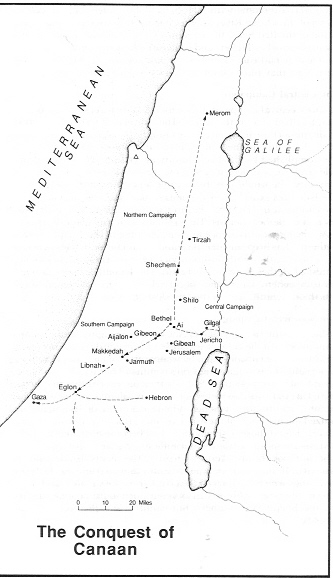
The book of Joshua is demonstrative proof that God fulfilled his land promise to Abraham. Israel must depend upon the Lord to conquer the land. The conquest is normally described as a three-pronged method of attack.[2] But the text does not describe the unfolding of these events in a strategic way. Initially, it was conceived to be an all-out conquest of the cities in the land much like Jericho and Ai; however, later conquests demonstrate to be more the result of preemptive strikes from other kingdoms upon Israel due to its successful military campaigns in the region.
First, the Israelites penetrated into the center of the Canaanite land (Joshua 6-9). The cities of Jericho (6:1-27) and Ai (7:1-8:29) were the first to experience the Israelite forces, as the Israelites initially took the land. And, the Gibeonite people were subjugated into servants, “cutters of wood and drawers of water for the congregation and for the altar of the Lord” due to their attempt at political deception (9:1-27). They claimed to come from a distant land, though they were an established group of inhabitants in the land with several cities all their own such as Gibeon, Chephirah, Beeroth, and Kiriath-jearim (9:16-17, 22).
Second, the Israelites respond to a strike upon the newly acquired inhabitants (the Gibeonites) by a band of five aggressive Amorite Kings of southern Canaan (Joshua 10). These five kings are listed in 10:5: Adoni-zedek, the king of Jerusalem, Hoham king of Hebron, the king of Jarmuth, the king of Lachish, and the king of Eglon. Since, Gibeon was a renowned city with many valiant warriors, and it had now become a part of the Israelites who conquered Jericho and Ai, these kings embraced the “strike first” strategy. Little did they know that “the Lord fought for Israel” (10:14), and that their fate would end with their cities being conquered (10:16-21, 29-38) and by suffering execution under the hand of Joshua in Makkedah (10:22-28).
The Conquest of Canaan (Laney, Concise Bible Atlas)
At the end of this campaign, the chronicler[3] of these events concludes this aspect of the conquest with following words:
So Joshua struck the whole land, the hill country and the Negeb and the lowland and the slopes, and all their kings. He left none remaining, but devoted to destruction all that breathed, just as the Lord God of Israel commanded. And Joshua struck them from Kadesh-barnea as far as Gaza, and all the country of Goshen, as far as Gibeon. And Joshua captured all these kings and their land at one time, because the Lord God of Israel fought for Israel. Then Joshua returned, and all Israel with him, to the camp at Gilgal. (10:40-43)
It was during this campaign that the famous “sun stood still” miracle occurred (10:12-13). Some dispute that the event was miraculous, but “conservative scholars are in agreement that this circumstance involved a genuine miracle, and that the account is not a mere poetic or mythological description of an ancient victory.”[4]
Finally, Joshua and company have a military victory over a northern Canaanite confederacy (Joshua 11). The land was conquered (Josh 11:16). It must be observed though, that the conquest was aided supernaturally by Divine intervention (Josh 5:13-15). Therefore, “the Lord gave to Israel all the land of which He had sworn to give to their fathers, and they took possession of it and dwelt in it” (Josh 21:43, 44-45 NKJV). After some 500 years after the initial promise, the promise is fulfilled.
The Dimensions of the Land
The land awaiting the Hebrew nation was extremely remarkable. Both Abraham and Moses had been privileged to see its beauty (Gen 13:14-18; Deut 32:49). In his guide book, Guy Duffield writes that from Mt. Nebo “on a clear day, the entire land of Canaan can be seen inasmuch as it is so small – 150 miles from the Jordan River to the Mediterranean.”[5] This is a “parallelogram about 150 miles from north to south and varying in width from 45 to 70 miles”,[6] and was highly diverse botanically, zoologically, meteorologically, and geographically.[7] One writer has said, “Within such small compass the country must have been unequalled for charm and variety.”[8] Even with a brief geographical overview of Palestine a value for the lands diversity can be ascertained.
Beginning from the land east of the Jordan River and venturing across the river into northern and southern extents of Palestine, the children of Israel found themselves in a very geographically dynamic territory. Carl Laney writes that the “land can be divided longitudinally into four distinct geographical regions: the coastal plain, the hill country, the Great Rift Valley, and the Transjordan highlands.”[9] While others have developed the subdivisions of these regions more exhaustively,[10] space here allows for only brief remarks as they relate to the conquest and settlement of Canaan.
The land on either side of the Jordan River is home to the historical narrative of the conquest implemented by the Israelites. The book of Joshua opens with the Israelites on the east side of the Jordan River. In fact, the books of Numbers and Deuteronomy catalog their conquest of this region, known as the Transjordan highlands (Num 31; Deut 2:26-3:11). The land spreads 150 miles from Mt. Hermon in the north to the southern tip of the Dead Sea.[11] The territory was subdivided and given to the tribes of Reuben and Gad, and to half of the tribe of Manasseh (Deut 3:12-22). This high plateau stands nearly at 4,000 feet, which “becomes higher as it extends southward, rising from two to five thousand feet in elevation.”[12] From the western side of this highland, it descends “steeply” down to the Jordan valley.[13] A key monument in the land would be Mt. Nebo, where Moses viewed the Promised Land before his death (Deut 3:23-29).
After crossing the Jordan River, the Israelites transverse a challenging topography throughout their conquests. In it they encountered the deep chasm of the Rift Valley and the mountainous geography of the western Hill Country. As the Israelites crossed the Jordan River, they where trekking through a great “fissure in the earth’s crust.”[14] The Rift Valley is “some 1,700 feet above sea level at the source of the Jordan River (near Caesarea-Philippi) and almost 1,300 feet below sea level at the Dead Sea in the south.”[15] This becomes a major border between the tribes one each side so that the “Rift made it virtually impossible for Transjordan to become integrally united with Samaria and Judah on a permanent basis.”[16]
After walking across the Jordan River, the Israelites encounter the Hill Country. This land is home to a roller coaster of valleys and mountain ranges. This is the backdrop of the central, southern and northern campaigns. This is the home of the rest of the Hebrew nation. North to south, the land consists of:
Upper Galilee, Lower Galilee, the hill country of Samaria and Judea, the “Shefelah” (a natural terrace on the western side of the mountains), and the Negeb (rendered ‘South Country’ in the Scriptures), which extends south of Hebron into the Arabian Desert.[17]
This land division stretches from the Upper Galilean region, where the elevations reach their zenith at nearly 4,000 feet, down through the Samaritan and Judean regions (where lower elevations exist) to the dry Negev plain.[18] One can appreciate then the notion that the Israelites were of a rugged deportment – this is probably accredited to their sojourn in the wilderness.
As the Israelites divided the land, many of their territories would include a portion of the coastal plain (Joshua 14-21). This beach front is “a band of sandy and alluvial soil bordering the Mediterranean Sea.”[19] North to South, it extends some 165 miles from the “Ladder of Tyre (Rosh Ha-Niqra)” to the “Wadi el-‘Arish”, all the while broadening the width of its land from 3 miles in the North to approximately “twenty-five miles” in the south.[20] “The whole coastal region readily lends itself to a threefold division: the Plain of Philistia, the Plain of Sharon, and the Plain of Acre.”[21]
The Divine Transplantation
Jehovah God fulfilled His promise to the Hebrew patriarchs and gave the Israelites the land of promise. The description of the land itself yields a very rugged picture, yet God gave these nomads victory over the established societies encountered therein.
Henry H. Halley captures the magnitude of such a feat. He declares that such a monumental liberation and migration of a nation could not be explained sufficiently with naturalistic conclusions. For Halley, it can be spoken of in no other terms aside from the miraculous:
Aside from various accompanying miracles, the Transplanting of a Whole Great Nation, bodily, from one land to another, meanwhile maintaining it 40 years in a Desert, was in itself one of the most Stupendous Miracles of the ages.[22]
What other explanation would there be for Pharoah to relinquish his profitable workforce – the slave labor of Israel? What other explanation would there be for the survival of millions of Israelites in the desert? Moreover, how can there be a reasonable naturalistic explanation for a nomadic force overtaking fortified cities?
No doubt, the naturalist – or skeptic – can raise criticisms; however, for the theist, the best and simplest explanation is found in Divine intervention. If God created the universe and has provided for every creature, then surely God can lead and provide a nation with liberation from slavery, and then set them on the center stage of the geopolitical tensions of the Mediterranean coastline.
Indeed, the greatest problem for the skeptic and atheist resides in Genesis 1:1 –“In the beginning God.” Such a tremendous experience should have yielded a sense of unwavering dedication to the God of their salvation (Exod 14:28-31), but, unfortunately, Israel’s history retells the cyclical problem of rebellion and idolatry.
It was this problem to which God addressed himself and anticipated in the Law of Moses. The Old Testament is transparent in God’s conditional relationship with Israel.[23] The relationship was dependent upon their faithfulness. Notice a sample of a few verses:
“And if you faithfully obey the voice of the Lord your God, being careful to do all his commandments that I command you today, the Lord your God will set you high above all the nations of the earth” (Deut 28:1).
And the Lord said to Moses, “How long will this people despise me? And how long will they not believe in me, in spite of all the signs that I have done among them? I will strike them with the pestilence and disinherit them, and I will make of you a nation greater and mightier than they” (Num 14:12).
“Be very careful, therefore, to love the Lord your God. For if you turn back and cling to the remnant of these nations remaining among you and make marriages with them, so that you associate with them and they with you, know for certain that the Lord your God will no longer drive out these nations before you, but they shall be a snare and a trap for you, a whip on your sides and thorns in your eyes, until you perish from off this good ground that the Lord your God has given you” (Josh 23:11-13).
“But just as all the good things that the Lord your God promised concerning you have been fulfilled for you, so the Lord will bring upon you all the evil things, until he has destroyed you from off this good land that the Lord your God has given you, if you transgress the covenant of the Lord your God, which he commanded you, and go and serve other gods and bow down to them. Then the anger of the Lord will be kindled against you, and you shall perish quickly from off the good land that he has given to you” (Josh 23:15-16).
The majority of the Hebrew Bible is the retells the story of the consistent Israelite rebellion against their God, God’s warning a recalcitrant nation of wrath, and then the culminating judgment brought upon them. One biblical student summarizes the situation in the following way:
Because of the accelerating rebellion of the nation, consummated by the murder of Jesus Christ, God rejected the Hebrew people. Inexcusably, the Jews rejected their own Messiah; accordingly, Jehovah repudiated that nation and determined to scatter them as dust (Matthew 21:44). Thus, in the providence of God, the Roman armies came against Palestine in A.D. 70, and Judaism was destroyed (cf. Matthew 22:7; 24:1-34); the Jewish “vessel” was smashed, and it cannot be put back together (cf. Jeremiah 19:11). According to Josephus, some 1.1 million Hebrews were slaughtered, and thousands were taken into slavery. All Jewish records were lost in that holocaust. Today, there is not a single Jew who knows his tribal ancestry (McClintock and Strong, 1969, 771). The physical nation of Israel is dead. The “Jews” that make up the State of Israel today (less than twenty-five percent of the world Jewish population) cannot legitimately be called a “nation.”[24]
Conclusion
The biblical record is clear that God had promised to Abraham and his children His covenant to bless them and to give them a land for their descendants (Acts 13:16-25). This land, as demonstrated by ample biblical references was a possession for as long as they remained faithful to God. Sadly, they showed a consistent spirit of rebellion, and as a consequence, a new covenant was to replace the Mosaic Covenant and fulfill the Abrahamic covenant.
Aside from physical blessings, this covenant had spiritual emphases as well – it anticipated the coming offspring that would bless all nations with salvation (Gen 22:17-18; Gal 3:16). Indeed, as the Hebrew writer observes, Joshua may have provided the Jews with a Sabbath rest after the conquest of Palestine, but Jesus provides a rest yet to be experienced – redemption in Heaven (Heb 4:1-10).
Works Cited
Unless otherwise stated, all Scripture quotations are taken from the English Standard Version of the Holy Bible (Wheaton, IL: Crossway, 2001).
Norman L. Geisler, A Popular Survey of the Old Testament (Grand Rapids, MI: Baker, 2000), 97.
I use the name “chronicler” due to the fact that Joshua is, like many Old Testament books, anonymous. Raymond B. Dillard and Tremper Longman, III, stress that ascertaining authorship and date for Joshua’s composition is “bound up with larger historical and theological questions” than mere internal and external argumentation (An Introduction to the Old Testament [Grand Rapids, MI: Zondervan, 1994], 108). David Malick lists a number of features within Joshua (i.e. internal evidence) pointing to various authors; among them, Joshua (“eyewitness quality”) and others who finished the book later – “but not much later” (“An Introduction to the Book of Joshua“). Malick concludes his discussion of authorship by observing that since critical scholarship results rejecting Joshua authorship lacks unanimity, the traditional view that Joshua wrote the majority of the book that bears his name is therefore a good assumption. The book should be viewed as “true to form” written in the days of Joshua and the elders that outlived him (Josh 24:31).
Wayne Jackson, “How Do You Explain Joshua’s Long Day?,” ChristianCourier.com (Accessed: 22 Mar. 2002). This is a brief introduction to the subject, it would be worth consulting.
Guy P. Duffield, Handbook of Bible Lands (Glendale, CA: Regal, 1969), 140.
“Palestine of the Holy Land,” New Standard Reference Bible (Chicago, IL: Hertel, 1955), 756.
Wayne Jackson, Background Bible Study (1986; repr., Stockton, CA: Christian Courier Publications, 2000), 1-18, 67-74.
Alfred Edersheim, Sketches of Jewish Social Life, updated ed. (Peabody, MA: Hendrickson, 1994), 2.
J. Carl Laney, Concise Bible Atlas: A Geographical Survey of Bible History (Peabody, MA: Hendrickson, 1998), 41.
J. McKee Adams, Biblical Backgrounds, revised ed., rev. Joseph A. Callaway (Nashville, TN: Broadman, 1965), 52-85.
Laney, Concise Bible Atlas, 79.
Laney, Concise Bible Atlas, 79.
Laney, Concise Bible Atlas, 42.
Laney, Concise Bible Atlas, 42.
Jackson, Background Bible Study, 3.
Laney, Concise Bible Atlas, 83.
Jackson, Background Bible Study, 3.
Laney, Concise Bible Atlas, 41.
Laney, Concise Bible Atlas, 41.
Laney, Concise Bible Atlas, 131.
Adams, Biblical Backgrounds, 56.
Henry H. Halley, Halley’s Bible Handbook, 24th ed. (Grand Rapids, MI: Zondervan, 1965), 22.
Adultery. Not exactly the warmest of words. For some, it evokes the pain that can only be felt from experiencing a broken home. For others, it is a reminder of what could have been if certain circumstances had presented themselves. There are some who think of this word as an obstacle that was overcome and they are survivors indeed. While yet still, there are others who are ever vigilant of all the steps that lead to this dreaded sin.
And finally, there are some who stand humbled in the rubble around them (a life destroyed), that was brought to fruition through that terrible act of adultery. They enjoyed their brief night in paradise, only to be awoken by the torrents of horror in the morning.
The Word Adultery
It is amazing that some who would set forth the claim that their interests are in teaching the Word of God hold a variety of views as to the nature and meaning of adultery contrary to the biblical data. Without considerable interaction with these distinct points of view, let us press on to consider some of the Old Testament evidence as to the meaning and nature of adultery. How does God represent it in the Hebrew Bible?
But where does the word adultery come from. The actual derivation of the English word for adultery is quite enlightening. It actually derives from combining a number of Latin terms into one:
The word adultery originates not from “adult”, as is commonly thought, but from the Late Latin word for “to alter, corrupt”: adulterare. Adulterarein turn is formed by the combination of ad (“towards”), and alter (“other”), together with the infinitive form are (making it a verb).
So, in English the word adultery has the idea of one person moving towards another person in order to make a new personal arrangement. Moreover, in some cases the Latin term adulterare carried the meaning of “to pollute” – taking something that is pure, and contaminating it.
When we say that someone has committed adultery, we are simply stating that a person has corrupted his or her marriage by introducing a third party. The marriage has been altered, changed, and polluted. The English word is quite graphic, but since the Old Testament was written primarily in Hebrew we would be wise to consult the meaning of this term there.
The Old Testament Term
In the Old Testament, the primary Hebrew word for adultery is nā’ap. As with any word, it is part of a grouping of words with similar meanings. Many of these words emphasize a range of meanings; for example, they can take literal or figurative meanings, and even describe those who are married or betrothed who are unfaithful. However, nā’apis the found the majority of the time to state that a person has – as we say – “cheated” on their spouse.[1]
William Wilson notes that nā’ap “is confined to adultery in the exclusive sense of the term or fornication by a married person.”[2] James Swanson amplifies the meaning, stating that it refers to a person who has “sexual intercourse with [someone] other than a spouse, as a married or betrothed person, generally, a person of low social status.”[3]
One of the earliest appearances of nā’ap in the Old Testament is in the reading of the “10 Commandments” (Exod 20:14). God says transparently, “You shall not commit adultery.” This command is cradled between the “shall not’s” of murder and stealing, which should give us an indication as to the severity of adultery in the eyes of God (Exod 20:13, 15 cf. Lev 20:10).
Clyde Woods makes the observation that in this command, the “sacredness of marriage” is emphasized, and it is this “principle of social purity” that “provides the basis for numerous [other] laws regarding sexual relationships and offenses” (cf. Exod 22:19; Lev 18:1-18; Deut 22:13-30).[4] And in this connection, R. Alan Cole finds in Joseph’s rejection of Potiphar’s wife the fact that:
For a man to have intercourse with another man’s wife was considered as the heinous sin against God as well as man, long before the law, in patriarchal times (Gen 39:9).[5]
R. Alan Cole, Exodus (1979)
The holiness of God demands that the matrimonial bed be undefiled by extra-marital affairs (Heb 13:4). Some people defile their marriage by actually sleeping with someone other than their spouse (John 8:4), others have so saturated their minds with “daydreams” of scenarios to have affairs, that if circumstances presented themselves they would do it (Matt 5:28); and yet still, there are those who have slipped on more rings on their one wedding finger than many super bowl champions have on their whole hand – and with little to no effort (John 4:16-19). From the beginning, however, this was not God’s ideal plan for marriage (Matt 19:9 cf. Gen 2:24).
Literal and Figurative Adultery
Nā’ap may mean literal adultery, but it also carries figurative, or more precisely, a spiritual application as well. Swanson explains: “in some contexts this refers to religious adultery, usually in which Israel is viewed as the unfaithful female spouse to the Lord in a covenantal marriage contract.”[6] Wilhelm Gesenius likewise remarks, “it is applied to the turning aside of Israel from the true God to the worship of idols” (Jer 3:8-9, 5:7, 9:1, 23:14).[7]
Even as Jeremiah writes of the faithless one – the Northern kingdom of Israel:
The Lord said to me in the days of King Josiah: “Have you seen what she did, that faithless one, Israel, how she went up on every high hill and under every green tree, and there played the whore? And I thought, ‘After she has done all this she will return to me,’ but she did not return, and her treacherous sister Judah saw it. She saw that for all the adulteries of that faithless one, Israel, I had sent her away with a decree of divorce. Yet her treacherous sister Judah did not fear, but she too went and played the whore. Because she took her whoredom lightly, she polluted the land, committing adultery with stone and tree. Yet for all this her treacherous sister Judah did not return to me with her whole heart, but in pretense, declares the Lord.” (Jeremiah 3:6-10)
Judah had not learned the lesson of her sister Israel. The Northern kingdom of Israel’s fixation with idolatry is amply substantiated in the Hebrew Bible, and, in fact, was a foundational aspect of its administration and spirituality (cf. 1 Kings 12:25-33). It was this faithless one that committed adultery with stone and tree.
We see then that the literal usages of nā’ap enhance the figurative-spiritual uses. The literal and figurative uses share a reciprocal connection; that is to say, they enhance each other.[8] And, this makes perfect sense, for there are very few – if any – words that do not lend themselves to figurative or metaphorical uses.
Examples of Adultery in the Old Testament
Several times in the book of Ezekiel, the spiritual appraisal of Israel is pictured in terms of adultery. Principally, the first 24 chapters of Ezekiel address themselves to this theme. Chapters 15 through 17 explain the doom of Jerusalem by means of allegories and parables.[9] Within this framework, chapter 16 portrays the spiritual infidelity of the Hebrews in the unmistakably graphic picture of marital sexual infidelity.
Observe some snippets from the chapter that the English Standard Version translators call “The Lord’s Faithless Bride” (Ezek 16:1-58):
“When I passed by you again and saw you, behold, you were at the age for love, and I spread the corner of my garment over you and covered your nakedness; I made my vow to you and entered into a covenant with you, declares the Lord GOD, and you became mine.” (vs. 8)
“But you trusted in your beauty and played the whore [were unfaithful; ESV footnote #2] because of the renown and lavished your whorings on any passerby; your beauty became his.” (vs. 15)
“At the head of every street you built your lofty place and made your beauty an abomination, offering yourself [“Hebrew spreading your legs”; ESV footnote #1; cf. ASV “opened thy feet […]”] to any passerby and multiplying your whoring.” (vs. 25)
“Adulterous [nā’ap] wife, who receives strangers instead of her husband!” (vs. 32)
With great precision, the prophet presents God’s anger and sense of betrayal with the imagery of adultery. As Samuel Schultz and Gary Smith summarize:
[I]n an allegory, Ezekiel compared Judah to a young girl that God cared for and married. But the bride ignored her husband and loved others (foreign customs, idols, her own beauty).[10]
Exploring the Old Testament (2001)
Jeremiah, a contemporary of Ezekiel during the Babylonian captivity, ministered in Jerusalem and abroad. Numerous false prophets declared that this captivity was merely temporary and that God would return them soon. In Jeremiah 29:1-28, the prophet sends a letter from Jerusalem to the captives in Babylon encouraging them in their situation, rebuking those who oppose the truth of God’s punishment upon Judah, and re-enforcing the fact that Judah will remain in Babylon for 70 years. One of the blistering comments rendered to the false prophets is that they were adulterers (Jeremiah 29:20-23).
Jeremiah says that Ahab and Zedekiah, the false prophets, “have done an outrageous thing in Israel, they have committed adultery [nā’ap] with their neighbors’ wives, and they have spoken in my name lying words that I did not command them” (vs. 23). This language is as transparent as Leviticus 20:10 where Moses writes, “if a man commits adultery with the wife of his neighbor, both the adulterer and the adulteress shall surely be put to death.”
Adultery, literal or figurative, describes the most intimate of interactions. Literally, it refers to actual sexual encounters with someone other than their spouse. Spiritually, it expands upon the literal meaning of adultery and give it a figurative flavor stressing the deep treachery felt by God from his people who give their beauty to another.
Conclusion
Literally, then, adultery is sexual activity between a married person and a person who is not their spouse. Spiritually, then, adultery is spiritual and moral activity contrary to God’s teaching. While Old Testament and the New Testament are uniform in their presentation of adultery, space has been given to a brief investigation of the concept in the Old Testament. The Old Testament and New Testament are two testimonies that share the same conception of adultery, a behavior that Russell describes as, a “special and aggravated case of fornication.”[11]
This concept has not been altered or distorted through the passing of time; consequently, we have no right to redefine it in modern times, contemporary times, or in any subsequent generation to come, for God’s truth endures to all generations (Psa 100:5). He means what he says. Heaven help us to keep it secure and unaltered in our minds!
References
James Swanson, “nā’ap,” Dictionary of Biblical Languages with Semantic Domains: Hebrew (Old Testament), 2d ed., electronic ed. (Oak Harbor, WA: Logos Research Systems, 1997).
William Wilson, Wilson’s Old Testament Word Studies (repr., Peabody, MA: Hendrickson, n.d.), 6.
Swanson, Dictionary of Biblical Languages.
Clyde M. Woods, Genesis-Exodus (Henderson, TN: Woods, 1972), 179.
R. Alan Cole, Exodus: An Introduction and Commentary (1973; repr., Downers Grove, IL: InterVarsity, 1979), 160.
Swanson, Dictionary of Biblical Languages.
Wilhelm Gesenius and Samuel Prideaux Tregelles, Gesenius’ Hebrew and Chaldee Lexicon to the Old Testament Scriptures, electronic ed. (Bellingham, WA: Logos Research Systems, 2003), 525.
Emmet Russell observes this exact point when he writes, “the figurative use enhances the literal sense, emphasizing the divine institution and nature of marriage” (Zondervan’s Pictorial Bible Dictionary, ed. Merrill C. Tenney [Grand Rapids, MI: Zondervan, 1967], 17).
It has been a few years since Mel Gibson’s movie, “The Passion of the Christ,” was all that the world could talk about. It was a situation bound to receive controversial media coverage – it just comes with the territory of religion in the media. A case in point was the February 16 issue of Newsweek published in anticipation of Gibson’s film. About a week before this publication hit the stands, Jon Meacham’s cover story entitled, “Who Killed Jesus?,” was published online on MSNBC.com in four internet pages – then later archived on Newsweek.com.
Meacham’s article feigned an attempt to evaluate Gibson’s new movie, and instead, assaulted the biblical text. He openly affirms, “the Bible is the product of human authors.” He further argues that these authors were producing religious propaganda for Christianity, and like any other literary work the Bible is plagued with historical inaccuracies. Concerning the Bible Meacham writes:
The Bible can be a problematic source. Though countless believers take it as the immutable word of God, Scripture is not always a faithful record of historical events; the Bible is the product of human authors who were writing in particular times and places with particular points to make and visions to advance.[1]
This is just one quote from a number of similar statements found throughout the article. The editor of Newsweek couches his statement with liberal theological overtones. In other words, Scripture is regarded as human produced literature designed only to give morals, void of any direct involvement of God. We shall see that the problematic source is not the Bible, it is Meacham’s theological presumptions.
The Media’s Treatment of the Bible
Meacham’s view of the Bible articulates three ways the Bible is often misrepresented in mainstream American media: (1) the Bible is of sole human origin, (2) the Scriptures are unreliable historical records, and (3) the biblical sources are legendary that need specious sources to embellish the narrative to provide the “true story.” With a national circulation over 3 million plus, there is no doubt that the church, our neighbors (religious or otherwise) and our youth are influenced by this.
How shall we respond? Bible believers need to be able to affirm the following response. Although these erroneous views of the Bible are widespread, the Bible (i.e. Scripture) is beyond that of human production and consequently trustworthy, because the internal evidence of predictive prophecy, the uncanny historical accuracy, and the marvelous unity of the 66 books is of supernatural origin and guidance.
Predictive Prophecy
Predictive prophecy is one of the most powerful lines of evidence that the Bible is beyond that of human production. The specific foretelling of future events serves as an accurate brief definition. Moreover, there are at least three criteria: (1) it must be given separated by a significant amount of time, (2) there are specific details (not generalities) and, (3) 100% fulfillment must follow (not 95% etc.). As an example, observe the prophecy of the rise and fall of four world powers of antiquity given in Daniel 2 and its relationship to the establishment of the church in the first century.
The image of Nebuchadnezzar’s dream (Dan. 2:1-24) was a picture of 4 sequential kingdoms: Babylonia (605-539 B.C), Persia (539-331 B.C.), Hellenistic (331-63 B.C.), and Roman (63 B.C-A.D. 476).[2] Daniel living in the 6th century B.C. predicted the fall of Babylon and the rise of these world empires. Furthermore, in Daniel 2:44-45 the prophecy was declared that during the reign of Imperial Rome, the God of heaven would establish His kingdom for all time.
While Rome was in power Jesus was born, lived, ministered, died, and resurrected (Gal 4:4). He declared that he was going to establish His church (Matt 16:18), which in this context means His kingdom (Matt. 16:19-20; Mark 9:1). This kingdom-church would come after the Holy Spirit had come upon the 12 Apostles (Acts 1:4-8), which arrived on the day of Pentecost (Acts 2). The prophecy was fulfilled as precisely as it was given centuries in advance.[3]
Precise Historical Accuracy
Historical accuracy is another line of reasoning which demonstrates that the Bible is beyond that of human production. The book of Acts is a powerful example. Luke wrote the book of Acts, which is a chronicle of the labors of Peter and Paul as the gospel goes from Jerusalem to the entire world.
The accuracy of Acts is such that no human could have been so accurate, except for the guidance of the Holy Spirit; observe:
This companion of Paul was a careful and meticulous historian. For instance, in Acts he mentions thirty-two countries, fifty-four cities, and nine Mediterranean islands. He also mentions ninety-five persons in Acts, sixty-two of which are not named elsewhere in the New Testament. He is thoroughly familiar with the geographical and political conditions of his day. And this is really amazing since the political/territorial situation was in a constant state of flux and flow in Luke’s time.[4]
Wayne Jackson, Biblical Studies in the Light of Archaeology (1982)
Accessibility to libraries was minimal due to how few or exclusive they were, and even if they had reference works, “the events Luke was trying to chronicle had taken place – at least at the beginning – in what the people of that day would have said were remote areas of the world.”[5]
There has yet to be the historical accuracy of the magnitude of Acts and the Bible recovered from antiquity to the present.
Unity of the Scriptures
A third line of argumentation is the unparalleled unity of the Scriptures. For instance, Jeremiah 25:1 and Daniel 1:1 are among a variety of passages appealed to for the claim that the Bible is not a harmonious work. Here is the argument. Jeremiah 25:1 and Daniel 1:1 refer to the same event in antiquity, the invasion of Judah by Nebuchadnezzar.
In the third year of the reign of Jehoiakim king of Judah, Nebuchadnezzar king of Babylon came to Jerusalem and besieged it. (Daniel 1:1 ESV)
The word that came to Jeremiah concerning all the people of Judah, in the fourth year of Jehoiakim the son of Josiah, king of Judah (that was the first year of Nebuchadnezzar king of Babylon)... (Jer 25:1 ESV)
However, the date of the event mentioned appears upon face value discrepant for Jeremiah says the event happened in the 4th year of Jehoiakim’s reign while Daniel says the timeframe was during the 3rd year of Jehoiakim’s rule (see “System” chart[6]).
SYSTEM
1ST Sovereign
2ND Sovereign
3RD Sovereign
4TH Sovereign
Babylonian
Year of Ascension
1st Year of Reign
2nd Year of Reign
3rd Year of Reign
Palestinian
1st Year of Reign
2nd Year of Reign
3rd Year of Reign
4th Year of Reign
If the two accounts cannot be harmonized then this is a historical mistake, underscoring a purely human enterprise. The answer to this riddle, however, lies in the distinct systems of dating regnal years used by Daniel and Jeremiah. Bruce K. Waltke writes:
In Babylonia the year in which the king ascended the throne was designated specifically as “the year of accession to the kingdom,” and this was followed by the first, second, and subsequent years of rule. In Palestine, on the other hand, there was no accession year as such, so that the length of rule was computed differently, with the year of accession being regarded as the first year of the king’s reign.[7]
Bruce K. Waltke, “The Date of the Book of Daniel,” Bibliotheca Sacra (1976)
Therefore, Daniel living in Babylonia used that system, while Jeremiah employed the Palestinian method. The unity spans cross-cultural methods of communication, how wonderful! The remarkable unity is so strong that even difficult passages backfire on the critic.
As so often happens, the supposed discrepancies become evidence against the critics of the Bible.
Conclusion
The Bible is not a problematic source; however, that does not mean that it has no range of complexity. The Bible is “a faithful record of historical events,” and its principles are grounded upon historical reality (e.g. creation, the Exodus, the resurrection of Jesus, etc.). The Bible comes together like pieces of a jig-saw puzzle. It is due to overwhelming evidence like this that we affirm that the Bible is beyond human production. The “problematic source” is Meacham’s liberal perspective – it is not the Bible!
Wayne Jackson, Biblical Studies in the Light of Archaeology (Montgomery, AL: Apologetics Press, 1982), 46.
James M. Boice, Acts: An Expositional Commentary (Grand Rapids, MI: Baker, 1997), 14.
Jovan Payes, “Ascertaining the Date of Daniel: A First Look,” BiblicalFaith.wordpress.com. This particular line of reasoning is important evidence supporting the unity of Scriptures against baseless accusations of intertextual (book to book) problems. We are not suggesting there are not difficult passages that take more depth to study, but we are asserting that this “problem” passage is an eloquent statement of intertextual unity.
Bruce K. Waltke, “The Date of the Book of Daniel,” BSac 133 (1976): 326.
One of the most fundamental principles articulated in the Bible is that God created the universe and that within this grand cosmos, a focal point was given to a small globe predominately covered in water – the planet earth. It is upon this planet that God organized the elements for human habitation over a period of six days (Exod 20:7). During the sixth day, the uncaused Creator made humanity (Gen 1:26-27):[1]
Then God said, "Let us make man in our image, after our likeness […] So God created man in his own image, in the image of God he created him; male and female he created them."
When God created humanity, the Scriptures show that he also created the first marriage, and consequently the first family. The narrative of this origin is the foundation for a godly marriage. The current study is a brief look into some of the vital lessons found in the creation of the human family – and first marriage.
The Historical Setting
In Genesis 2, the sixth day of creation is elaborated upon (2:4-25). There is a common literary device in the book of Genesis that perhaps is obscured by the English translation to which we call brief attention. It usually is styled the Toledoth formula, and is often translated as “these are the generations,” “this is the family history,” “this is the account,” or some other formulation (Gen 2:4, 5:1, 6:9, 10:1, 11:10, 11:27, 25:19, 36:1, 9, 37:2).
Attention is given to this literary device for two reasons – though several other thoughts could be developed. First, it is one of the clearest features in Genesis that displays to biblical students the “structure intended” by the author.[2] Second, this series of episodes throughout the book both provides a strong sense of unity and harmony within its narrative, and indicates a “historical impulse” to be understood while reading Genesis.[3]
These narratives are not mere “fairy-tales” given for ancient religious and philosophical contemplation. Instead, the biblical material is styled in such a way to make it obvious “the author intended it to be read as a work of history that recounts what has taken place in the far-distant past.”[4]
Therefore, in Genesis 2:4, when it reads, “These are the generations of the heavens and the earth […],” we are beginning a historical – albeit theological – pilgrimage that starts with the historical creation of our forefathers made in the “image of God” (1:27).
Humanity – The Pinnacle of Creation
Heaven’s joy in creating humanity is perhaps seen quite clearly when we compare how God assessed the situation when humans come into the picture. In general, God saw His creation as “good” – “And God saw that it was good” (Gen 1:4, 10, 12, 18, 21, 25). The Hebrew word for “good” in Genesis 1 (Heb. tob) has many applications in the Old Testament, employed by different authors as many times as 741 times.
In the Creation Account, “good” anticipates the theme of the fall of Adam and Eve,[5] but at the same time demonstrates that the Creation as God intended was an ideal place for the well-being of its inhabitants.[6] Consequently, at the close of the sixth day, after the creation of humanity God surveyed his handiwork, and saw that “it was very good.”
Perhaps our Creator observed that all the pieces to his creation were now in place, and so now the planet was a very good place to live – God’s ideal world realized. Though not in contradistinction, perhaps we are reading a phrase of great emotion and tenderness, as the only creation made in the Imago Dei (“image of God”) now walks the earth. Furthermore, humanity is entrusted with sovereignty over the animals and with the planets overall care (Gen 1:26); humanity is thus the crown of creation.
The sweet psalmist of Israel (2 Sam 23:1) sets forth a beautiful hymn of praise to God for His creative acts, but most importantly, for his emphasis upon the human family. A segment of the 8th Psalm is as follows:
When I look at your heavens, the work of your fingers, the moon and the stars, which you have set in place, what is man that you are mindful of him, and the son of man that you care for him? Yet you have made him a little lower than the heavenly beings and crowned him with glory and honor. You have given him dominion over the works of your hands; you have put all things under his feet. (Psalm 8:3–6)
No doubt as King of Israel, David had pondered over the Creation Account several times (Psa 19). Perhaps he became more intimately involved in its study since it was his duty as King to be a Scribe of the Law as well (Deut 17:18-20).
God Created the Family
Returning to Genesis 2:4, we see a narrative serving much as a prism fragmenting a beam of light into many unique colors of spiritual insight. We may focus upon many of them as we have done above, but here attention is drawn to one in particular. When God created humanity, he also created the fundamental building block of human society – God created the family.
God employed His sovereignty and created a human community on the sixth day made up of one male and one female. Genesis 1:27 abbreviates the day, but 2:4-25 reiterates and expands upon the sixth day, a common feature in Old Testament narration to focus upon a critical moment that pushes the story forward.[7] We find Adam created from earthen materials, and fashioned into a “living soul” with the “breathe of life” given to him (2:7); however, he was alone, and that was not good for the well-being of the creation (2:18).
One of the aspects of being made in the image of God is that humans are by-in-large social beings. God is a trinity; in other words, God is a community of love made of the Father, Jesus, and the Holy Spirit (Matt 28:19; 2 Cor 13:14; 1 Pet 1:2, etc.). Should it be all that surprising that the Imago Dei is likewise a social being? Hardly, and God saw the loneliness and incompleteness Adam felt and addresses the matter.
In what appears to be an animal parade of potential companions organized by God, Adam still finds no animal that would be a “a helper fit for him” (2:18-20). In other words, “a helper corresponding to him,”[8] suggesting Adam’s deep need to have another person just like him to help fulfill his responsibilities of governing the creation. A companion was needed to work side-by-side, another person like Adam to continue the human family, another person to create a community of love made in the image of God.
Consequently, when no animal met those criteria, the Lord caused a great sleep to fall upon Adam. When Adam awoke, God had created a new being that corresponded to him; someone who would help him in this new world. God presented this person to Adam and he named her Woman (Heb. ‘issah), which is the logical result since she was taken out of man (Heb. ‘is 2.22-23).
Raymond C. Ortlund, Jr., makes a very important point here worthy to be reflected upon:
Unlike the animals – indeed, unlike the man himself – she did not come up from the ground below but out from human flesh, putting her alone at the man’s level.[9]
Raymond C. Ortlund, Jr., Whoredom: God’s Unfaithful Wife in Biblical Theology (1996)
This was indeed a public proclamation of her status as his only true companion in the garden.[10]
Boy Meets Girl for the First Time
It is amazing to fathom how God collaborated with Adam to find a solution to his solitude. God orchestrated the events that led to the creation of Eve, and Adam knew exactly what he saw: “This at last is bone of my bones and flesh of my flesh” (Gen 2:23). We might respectfully paraphrase Adam as saying, “Finally, a person made just like me!” The event was quite literally that of a match made by Heaven.
Together, they were to share the dominion over the planet (1:26), and dwell in an environment objectively unaware of the evil uses of the sexual appetite – hence “they were naked and not ashamed.”[11]
After Adam’s great announcement of finding his companion, the bedrock biblical principle of marriage is declared in terms of a logical consequence derived from the events of day six leading to the creation of womankind. Moses addresses his post-fall contemporaries, and places a prescriptive emphasis upon this pre-fall narrative: “Therefore a man shall leave his father and his mother and hold fast to his wife, and they shall become one flesh” (2:24).[12]
There have been departures from God’s intent for marriage since the polygamy practiced by Abraham, Jacob, David, and Solomon (etc.), or whether it is the tolerated relaxation of the original marriage code in Genesis 2:24 allowed under the Mosaic system due to the “hardness of heart” (Matt 19:8).
Jesus appealing back to this Genesis narrative affirms that “from the beginning [of time] it was not so” (Matt 19:8).[13] The marriage can only be severed on the basis of adultery, and while many pollute this teaching, the Lord is quite clear on the subject (Matt 5:32).[14]
The “One Flesh” Aspect
Jesus addressed a much-needed foundational marriage issue, one that our contemporary culture is in dire need of emphasizing: divorce and remarriage is not for any cause.
When God created male and female, and gave them the garden for their home, reproduction as an aspect of life, and delegated the authority to them for the governance of the world and its other inhabitants, He joined Adam and Eve into one flesh (2:24; 1:26-28). Their example is designed to serve all subsequent generations on earth as the templar for the permanent nature of marriage (and its goals).
As we conclude this piece focused upon the first encounter between boy and girl – rather man and woman (Heb. ‘is and ‘issah respectively), it is vital to give some attention to the concept of one flesh. In doing so, there are three pivotal principles articulated by Ortlund based upon Genesis 2:24.[15]
Viewed negatively, marriage severs the strongest of human bonds – parental; and as such, “elevates the marital union above all other personal loyalties, under God.”
Viewed positively, marriage is the context where the male “devotes his primary loyalty to his wife” emotionally, sexually, and socially.
Likewise, “the new life [as one flesh] created by a marriage fuses a man and wife together into one, fully shared human experience, prompting mutual care, tenderness and love.”
These are beautiful principles that would enrich any marriage.
Conclusion
The teaching from Genesis 2:24 is set forth before the Mosaic and Christian covenant, and this means that its teaching applies to the entirety of the human race.[16] God did not allow the creation week to end without the creation of humanity, and subsequently the family.
It was not consistent with the well-being of the creation for Adam to be alone, and God created the perfect companion to help him navigate through the world of Eden. This was the first marriage, and God designed marriage to be a permanent relationship of a “fully shared human experience” – the good, the bad, and the ugly. Human interference in the marriage is strongly warned against by Jesus (Matt 19:6, 9).
All we can do is ponder over these principles, find avenues in our lives to enact them, and allow the idealistic Edenic garden to be planted, cultivated, and blossomed in our marriages. As it is written in the Scriptures:
Awake, O north wind, and come O south wind! Blow upon my garden, let its spices flow. Let my beloved come to his garden, and eat its choicest fruits. I came to my garden, my sister, my bride, I gathered my myrrh with my spice, I ate my honeycomb with my honey, I drank my wine with my milk. Eat, friends, drink, and be drunk with love! (Song of Solomon 4:16–5:1)
Sources
All Scripture references are from the English Standard Version unless otherwise noted.
Raymond B. Dillard and Tremper Longman, III, An Introduction to the Old Testament (Grand Rapids, MI: Zondervan, 1994), 48.
Dillard and Longman, An Introduction to the Old Testament, 48-49.
Dillard and Longman, An Introduction to the Old Testament, 49.
Ernst Jenni and Claus Westermann, Theological Lexicon of the Old Testament, trans. Mark E. Biddle. (1997; repr., Peabody, MA: Hendrickson, 2004), 2:491-92.
William E. Vine, Merrill F. Unger, and William White, Jr., Vine’s Complete Expository Dictionary of Old and New Testament Words (Nashville, TN: Nelson, 1984), 1:100.
Robert Alter, The Art of Biblical Narrative (New York, NY: Basic Books, 1981), 50-51.
Clyde M. Woods, Genesis-Exodus (Henderson, TN: Woods, 1972), 9.
Raymond C. Ortlund, Jr., Whoredom: God’s Unfaithful Wife in Biblical Theology (Grand Rapids, MI: Eerdmans, 1996), 19.
Ortlund, Whoredom, 19.
Woods, Genesis-Exodus, 9.
Ortlund, Whoredom, 20-21.
Wayne Jackson, The Teaching of Jesus Christ on Divorce and Remarriage: A Critical Study of Matthew 19:9, revised ed. (Stockton, CA: Christian Courier Publications, 2002), 2-8.
Jack P. Lewis, The Gospel According to Matthew (1976; repr., Abilene, TX: Abilene Christian University Press, 1984), 2:67. Some, however, attempt to use 1 Corinthians 7:15 as support for divorce for the cause of desertion, claiming Paul was applying the teaching of Jesus to a new situation. While the teaching of Jesus was certainly being applied to a new situation, there is no reason to assert that desertion in 1 Corinthians 7:15 serves as an additional allowance for divorce and remarriage. We recommend Wayne Jackson article, “What Is the Meaning of ‘Not under Bondage’ (1 Cor. 7:15)?” (ChristianCourier.com), in response to this viewpoint.
Ortlund, Whoredom, 21-23.
Cf. Jackson, The Teaching of Jesus Christ on Divorce and Remarriage, 5-6.




 biblicalfaith.online