When I was a young man, my mom would stress her concern to me regarding the person I was becoming. As a Central American mother, she would often say to me this Spanish proverb, “Dime con quién andas y te dire quién eres,” which means, “Tell me whom you are with, and I will tell you who you are.” She had good reason for concern. I was slipping into the world of street gangs, violence, and drugs. She was attempting to make me aware that the company I kept said a lot about who I was becoming.
In church-ese, we speak of those with him we share “fellowship.”
A Perspective
This word is typically reserved for formal relationships, it is not a word commonly used in everyday talk. Yet, what this word means is readily accessible. The English word “fellowship” tells us who or what we shape our life around. It describes certain boundaries that shape our lives, our relationships, and even our priorities. We could say it a fellowship is a circle we draw that includes certain relationships and excludes others. To make this more complicated, we may have many overlapping fellowships.
Our English New Testaments remind us that what we fellowship is important. For example, “Take no part in the unfruitful works of darkness, but instead expose them” (Ephesians 5:11, English Standard Version). “Take no part,” this means Christians are called to be disassociated from what spiritual darkness creates. As light has no common ground with darkness (2 Corinthians 6:14), Christians have no partnership with evil except to expose it for the spiritual corruption it is (Ephesians 5:7–10). This is what light does, it shines to expose what is hiding in the dark.
Light does not allow darkness to hide its contents, and neither should Christians allow spiritual darkness of sinful corruption to hide what it is doing in the world we live in. We may live in a world surrounded by corruption, but we are called to be disassociated from it.
Additionally, the apostle John provides a “test” of sorts to help God’s people realize that our fellowship with God comes with personal responsibility: “If we say we have fellowship with him [i.e., God] while we walk in darkness, we lie and do not practice the truth” (1 John 1:6). The claim to be in fellowship with God must be supported by a life living in the light, not darkness. Otherwise, our claim is a work of pure fiction. It is this truth that makes the Christian faith so consequential. It means our fellowship with God affects our lifestyle and our priorities, for it shapes the boundaries of what we will accept and what we must reject.
More positively, John follows up his caution with another maxim, “But if we walk in the light, as he is in the light, we have fellowship with one another, and the blood of Jesus his Son cleanses us from all sin” (1 John 1:7). Our fellowship with God entails the redemptive and sanctifying gifts of God provided we “walk in the light” with God.
Being with Likeminded Kindred
Fellowship is a practical thing that God’s people do. Not only does it provide a boundary marker of godly living amid a corrupt world which sharpens our understanding of what a faithful life before God looks like. It also provides a clear way to share in the life of other like-minded kindred. The early church participated in “the fellowship” of those who devoted themselves to the apostle’s teaching, the breaking of bread, and praying together (Acts 2:42).
As David proclaimed in Psalm 119:63, “I am a companion of all who fear you, of those who keep your precepts.” Christianity is not a lonesome religion. In this way, it stands against the trend within Western society of individualism, which is a form of thinking of ourselves in isolation from our community, our family, and our ancestors. This problem has only worsened in our post-pandemic world in which “going to church” is as easy as hopping online and clicking on a few buttons while still in our pajamas.
The in-person “fellowship” of God’s people, once a marker of togetherness, unity, and godly accountability, as a spiritual biome where God’s redemption is lived out has become a privatized novelty. Yet, when Paul wrote to the Corinthian believers, he reminded them, “God is faithful, by whom you were called into the fellowship of his Son, Jesus Christ our Lord” (1 Corinthians 1:9). The “you” in “you were called” is part of a plural verb. Christians experience the fellowship of the Son together as brothers and sisters, not in isolation together.
Ultimately, fellowship is a vital part of being disciples of Christ and a worshiper of God. Our fellowship with God guides us to make clear distinctions between us and corrupting evil in the world. It also has a practical communal part to it, as we join with other fellow believers in worship. The more we appreciate this, the better the language of the communal worship will penetrate our hearts: “Behold, how good and pleasant it is when brothers dwell in unity!” (Psalm 133:1).
This article originally appeared in Think magazine. To subscribe click here. There are slight edits in this version.
Romans 15:33 is an interesting break in Paul’s great letter to the culturally diverse brethren who fellowshipped in the city of Rome (1:7). It is so abrupt that it marks a clear line between the main teaching component of the letter (1:14-15:32) and the salutations and quick words Paul sends to specific house churches in Rome (16:1-23).
Romans 15 marks the apostle Paul’s desire for continued mission work to Spain (15:28), where Christ has not been proclaimed (15:20-21; Isa 52:15). His belief in the power and influence of the prayers of the saints to be incorporated in the providence of God is clear from his pleas to his brethren to pray for him (15:30-32).
Moreover, Paul anticipates considerable opposition to his upcoming ministry to the “poor saints” in Jerusalem (15:26). Recalling that he had already been hindered to come to Rome before (15:22), he enlists his Roman brethren to pray on his behalf so that he make it to Rome (15:28) on his way to Spain, the “very ends of the earth” (Acts 1:8).
Paul anticipates a joyful and refreshing environment to accompany his visit to Rome (15:32).
“For the kingdom of God is not a matter of eating and drinking but of righteousness and peace and joy in the Holy Spirit.” (Romans 14:17)
Romans 15:33 finalizes, then, Paul’s great desire to evangelize the world, cooperate with the Roman brethren in ministry, and to enjoy the power of fellowship. He closes this section of the letter with a prayer of blessing:
“May the God of peace be among all of you, Amen.” (Romans 15:33)
(1) Paul calls upon God. The text has no verb but it is supplied since it is a call for God to be among His people. In this prayer of blessing (i.e, a benediction), Paul calls upon their creator (1:19), their justifier (4:25-26), their savior (10:13-17), and their peacemaker (1:7, 5:1).
(2) Paul seeks for Peace. “The God of peace” speaks to character of God (i.e, “the Peaceful God”). This is a hebraic way of emphasizing God’s attribute of peace and harmony. Here, Paul alludes to the need the church has for harmony to overcome the internal turmoil it experienced.
(3) Paul desires that God blesses their fellowship. The focus of Paul’s prayer towards the Christians in Rome, is that God be among all of them (“among all of you”). There is no partiality in his prayer. This prayer calls attention to both our individual relationship with God, and His presence within the community of His people.
(4) Paul stamps his spiritual desire. “Amen” is a Hebrew phrase used to express a variety of ideas. As the counterpart to God’s “it shall be,” amen means, “let it be so” (Vine, et al., Expository Dictionary, 2:25). Most commonly, it is to express agreement to the content of a public prayer (1 Cor 14:16). The prayer ends with this call to agreement.
Are there troubles in your Christian life? Are there hinderances to things you want to do for Christ? Are there internal problems among us? Paul’s answer: Invoke the presence of God. We must include God in our private lives, and our church life, to become who God’s wants us to be. In turn we will become the church He intended us to be. So doing we will invite peace and harmony because the God of peace is among us. So, can I get an “Amen”?
Christians must always be reminded of their responsibility to live out lives reflective of the high calling of God (Eph 4:1; Phil 3:14). There is a tremendous passage in 1 Thessalonians 1:9–10, which provides the Christian with the basic aspects of Christian living. Here is the passage:
For they themselves report concerning us the kind of reception we had among you, and how you turned to God from idols to serve the living and true God, and to wait for his Son from heaven, whom he raised from the dead, Jesus who delivers us from the wrath to come. (1 Thessalonians 1:9–10 English Standard Version)
Let us examine this passage, and reflect on the four aspects of this passage: (1) reception of the word, (2) conversion, (3) consecrated service and (4) hope of deliverance.
I hope to invite modern Christians to reflect on the importance of turning to God in conversion, to living a sanctified life in anticipation of the final day when Jesus comes again.
The Background
First, let us consider some background information.
After leaving the city of Philippi, Paul and Silas traveled probably on horseback some 100 miles on the Egnatian Way through Amphipolis and Apollonia only to pause their trip in Thessalonica.[1] It is highly likely this was a three-staged trek to Thessalonica: Philippi to Amphipolis (30 mi.), Amphipolis to Apollonia (27 mi.), and Apollonia to Thessalonica (35 mi.).[2] Situated on the Egnatian Way, ancient Thessalonica was at the heart of Roman travel, communication, and culture in Macedonia. So much so, that William Barclay succinctly said, “East and West converged on Thessalonica.”[3]
The Book of Acts chronicles Paul’s initial evangelistic efforts in that great city (Acts 17:1–9), as he enters the synagogue and presents various elements of the gospel message as found in the prophetic writing of the Old Testament. In fact, in Acts 17:2, Luke says Paul spent three weeks “reasoning” with the Jews on the Sabbath, the word suggesting a rigorous discussion or possibly hints at a debate style of presentation (Grk. dialegomai).
Unfortunately, in this case, Luke does not inform us which scriptures Paul uses to build his case (cf. 1 Thess 1:10; 1 Cor 15:3–5; Isa 53:2–8; Psa 22:1, 16:10; Acts 2:31). He only affirms that the suffering, death, and resurrection of Jesus of Nazareth is the embodiment of these prophetic utterings which adherents of the synagogue would have been familiar.
Luke observes the response of those that believed:
some of them were persuaded and joined Paul and Silas, as did a great many of the devout Greeks and not a few of the leading women. (Acts 17:4)
Unfortunately, a number of Jews responded to the missionaries with political manipulation and leveraging. These Jews, operating out of jealousy, enlisted the worst of society and orchestrated a riot, and attacked and arrested Jason who was hosting Paul and his company (Acts 17:5–6).
When presenting their case against Jason and the Christians, this mob describes them with politically subversive language. They are those “who have turned the world upside down” (Acts 17:6), “they are all acting against the decrees of Caesar” (Acts 17:7a), and “they are all… saying that there is another king, Jesus” (Acts 17:7b). Due to this charge, Jason is released to Paul and Silas on the conditions of payment of bail (“security”) and their departure (Acts 17:8–9). Paul later describes this as being “torn away” from them (1 Thess 2:17).
Reception of the Word
Sometime after leaving Thessalonica, Paul was restless and sent Timothy to Thessalonica for a report. Timothy returns with an encouraging report of their faithfulness (1 Thess 3:6). This faithfulness began when they believed Paul’s preaching in the synagogue (Acts 17:4). Luke notes that some Jews, and many devout Greeks (likely God-fearers) and leading women were “persuaded and joined Paul and Silas.” These are passive verbs, suggesting the work of the Spirit’s word compelled those with honest hearts to identify with the gospel proclaimers.
When Paul wrote to this young church, he recalls this moment. In fact, he frames their conversion as an example of the success of the gospel message received as God’s word:
And we also thank God constantly for this, that when you received the word of God, which you heard from us, you accepted it not as the word of men but as what it really is, the word of God, which is at work in you believers. (1 Thessalonians 2:13)
The “makings” of a Christian begin when the gospel is heard not as just another philosophy, or religious message. Instead, as Paul recalls, before one becomes a Christian it is imperative that the preaching is regarded as the very word of God. This is the foundation; if this is not believed spiritual failure is surely looming in the distance.
Conversion: Turned from Idols
The actual verb “turned” in 1 Thessalonians 1:9 (Grk. epistrépho) carries the idea of turning around and directing this move towards a new object or a person. In Acts, the noun is used for conversion to God (Grk. epistrephe). Together with its more common verb “to turn” they appear a total of twelve times in the Book of Acts (3:19; 9:35, 40; 11:21; 14:15; 15:3 [noun], 19, 36; 16:18; 26:18, 20; 28:27). Except for three instances (9:40, 15:36, and 16:18), the terms are exclusively used with reference to people turning to God in response to the Gospel.
Paul celebrates that as a result of accepting the word of God as authoritative and believing the gospel message, the Thessalonians turned to God after a life of serving “idols” (1 Thess 1:9). While Luke plants the conversion of the Thessalonians to those connected to the synagogue, in his letter Paul emphasizes a defection from the pagan background of the Greco-Roman converts.
This likely points to their lack of participation in the cults of their clans and tribes, temple, city, and “states” gods, which would have created a wedge between them and their neighbors. Albert Bell, Jr., notes that “the more gods a city worshiped, the better its chances of divine favor.”[4] It is known, for example, the people of Thessalonica worshipped Zeus, Asclepius, Aphrodite, and Demeter, and even the Egyptian gods Serapis and Isis. They were also given to the Samothrace cult of Cabrius.[5]
According to the Greco-Roman cultic mindset, Christians turning from the gods was not only difficult to understand but also came off as unpatriotic to the state. In their mind, it would not only have been subversive to the Spirit of Roma (Rome worshipped) and even the deified Caesar but also this behavior would have been seen as inviting divine disfavor (1 Thess 2:14). Paul celebrated their choice in doing this.
Children of God must remember their conversion was a choice. W. E. Vine insightfully comments on this conversion:
[It was] an immediate and decisive change, consequent upon a deliberate choice; a conversion is a voluntary act in response to the presentation of truth.[6]
They chose to leave their sins behind; they did not take them along in their new life as God’s people.
Consecrated Service
Again, the Thessalonians did not bring their old life with them. Instead, they were changed “to serve the living and true God.” In fact, Paul later writes to them that “God has not called us for impurity, but in holiness” (1 Thess 4:7). Service to God is expressed in the rejection of “the passions” of the past which reflects a rejection and of God (1 Thess 4:5).
Christian service is a demonstration that the things which were important and governed the fundamentals of our pre-Christian lives no longer function in this way. Christians are not to lean upon their past; instead, they are called to “stand fast in the Lord” (1 Thess 3:8).
In other words, Christians are to live lives devoted to serving God over our own ambitions. This is the “how to” of our service to God, to accept God sanctifying his people. Notice this emphasis on a consecrated and holy life:
For you know how, like a father with his children, we exhorted each one of you and encouraged you and charged you to walk in a manner worthy of God, who calls you into his own kingdom and glory. (1 Thessalonians 2:11–12)

Now may our God and Father himself, and our Lord Jesus, direct our way to you, and may the Lord make you increase and abound in love for one another and for all, as we do for you, so that he may establish your hearts blameless in holiness before our God and Father, at the coming of our Lord Jesus with all his saints. (1Thessalonians 3:11–13)

For you know what instructions we gave you through the Lord Jesus. For this is the will of God, your sanctification: that you abstain from sexual immorality...  For God has not called us for impurity, but in holiness. (1 Thessalonians 4:2–3, 7)

Now may the God of peace himself sanctify you completely, and may your whole spirit and soul and body be kept blameless at the coming of our Lord Jesus Christ. (1 Thessalonians 5:23)
As a result of being converted, Christians are washed, consecrated, and remade for righteous service (1 Cor 6:9–11; Eph 2:10). Contemporary Christians need to take this message of consecration to heart.
Hope of Deliverance
Christians live in the present with a living hope which anticipates the second coming of Jesus. Paul is very clear when he affirms that there is a future point of hope and deliverance for which Christians wait for (1 Thess 1:10).
For they themselves report concerning us the kind of reception we had among you, and how you turned to God from idols to serve the living and true God, and to wait for his Son from heaven, whom he raised from the dead, Jesus who delivers us from the wrath to come. (1 Thessalonians 1:9–10)
Christians anticipate the Son to come “from heaven.” This last line is heavily loaded with theological truth. The Son is further described as the one God “raised from the dead, Jesus who delivers us from the wrath to come.” This is a statement of hope. The hope of the advent of Jesus (i.e., the second coming) is directly linked to God’s power demonstrated in the resurrection of Jesus. That God raised Jesus from the dead makes the claim that Jesus is returning from heaven a firm expectation.
With the certainty of the second coming of the Son “out from the heavens” (literal rendering of the Greek) established in the Christian mind, it affirmed that the Son, Jesus, will come with judgment for the unbelieving world (i.e., “the wrath to come”) but deliverance for the believer. Paul calls this “the day of the Lord,” a period of judgment and final consummation of God’s plan (1 Thess 4:13–5:11; 2 Thess 1:5–12).
Final Words
The gospel found fertile soils in the heart of early Thessalonian Christians. The congregation had a culturally and religiously diverse background, but they accepted the gospel as the word of God. Their faith in the God who raised Jesus from the dead was also at work as they followed their call to holy living as they anticipate Jesus coming to judge the living and the dead, and delivering those who are his.
Sources
J. Carl Laney, Concise Bible Atlas (Peabody, MA: Hendrickson, 1998), 229.
Colin J. Hemer, The Book of Acts in the Setting of Hellenistic History, ed. Conrad H. Gempf (Winona Lake, IN: Eisenbrauns, 1990), “The mention of Amphipolis and of Apollonia should probably be taken to imply that these were the places where the travellers [sic] spent successive nights, dividing the journey to Thessalonica into three stages of about 30, 27 and 35 miles” (115).
William Barclay, The Letters to the Philippians, Colossians and Thessalonians, revised edition (Louisville, KY: Westminster, 1975), 180.
Albert A. Bell, Jr., Exploring the New Testament World (Nashville, TN: Nelson, 1998), 126.
Nijay K. Gupta, 1-2 Thessalonians: A New Covenant Commentary, New Covenant Commentary Series, eds. Michael F. Bird and Craig Keener (Eugene, OR: Cascade Books, 2016), 4. Russell Morton, “Samothrace” in Lexham Bible Dictionary, Logos electronic edition, ed. John D. Berry, et al. (Bellingham, WA: Lexham, 2016).
W. E. Vine, Merrill F. Unger, and William White, Jr., Vine’s Complete Expository Dictionary of Old and New Testament Words (Nashville, TN: Nelson, 1984), 2:647.
“–and raised us up with him and seated us with him in the heavenly places in Christ Jesus.” (Ephesians 2:6 NASB)
Everywhere we go we all try to find the best seat in the house. We want the best seat at a theater. Some like up close, some farther back. How about on an airplane? I like a seat by the window. Others might like an aisle seat. What about when booking a seat for a ballgame you look for a seat that’s good but in your price range.
Growing up we each had our own seat at the kitchen table. Our dad sat at the end, the head of the table. Even at church, everyone seems to have their own seat. Don’t sit in that seat, it is Brother so-and-so’s seat. Which actually has been said many times.
We are told how the scribes and the Pharisees were being very hypocritical doing all their deeds to be seen with long fringes on their clothing… “and they love the place of honor at feasts and the best seats in the synagogues” (Matthew 23:5–6). Also, we’re told in Luke “Woe to you Pharisees! For you love the best seat in the synagogues and greetings in the marketplaces” (Luke 11:43).
It is sometimes important what seat we sit in. At some functions such as a wedding reception or a retirement party, there are seats for the guest of honor.
We read that Christ is seated at the right hand of God:
“If then you have been raised with Christ, seek the things that are above, where Christ is, seated at the right hand of God.” (Colossians 3:1 ESV)
We don’t want to be like the Scribes and Pharisees, who boasted about their status and position. But we can be reassured that when we have died to our sins and have been raised from the grave of baptism (Colossians 2:12), by the grace of God we will be seated in the heavenly places in Christ Jesus.
We all will appear before the judgment seat of Christ (2 Corinthians 5:10). It is a joy to know we do have a seat reserved for us in heaven, as long as we continue to live a faithful life.
Recently, in discussing the character and omnipotence of God Titus 1:2 was cited to extend the argument that while God may have all power (omnipotence) to do what lends itself to being accomplished, there are certain tensions one must also accept. Namely, there are some things God cannot do or be. Despite having all power God does not tempt people to do evil (Jas 1:13), nor is it possible for God to lie (Heb 6:18). It was argued then that temptation and deception are against his nature despite all of his power.
Is Choice Implied?
There seemed to be some confusion, however, based on the translation of the phrase ho apseudēs theos, “God, who does not lie” (NIV, REB, NAB), “God, never lies” (ESV, NRSV), and the older, “God, who cannot lie” (KJV, NKJV, ASV, NASB95). These are the most common translations of two terms in Titus 1:2, the adjective apseudēs (truthful/deceitless) and God (theos).
It was suggested in a discussion that the translation of the NIV (cf. LEB, REB, NABR, TEV, NIRV, JB, NLT), could lend itself to the notion that it is possible for God to lie but He does not because He chooses not to lie. This would reframe the discussion of the nature and character of God by opening the possibility that God is good by choice rather than being good by nature.
This raises the question of whether the character of God is immutable, that is whether his holy character changes over time or not. The immutability of God means, for example, that God is holy and will always be holy.[1] On this view, there will never be a time when God is not holy. If God’s character is mutable (subject to change), however, then it is possible for God to act in an unholy manner. This view is inconsistent with the overall theme of God’s infinite holy character.
Does Titus 1:2 lend itself as evidence to this point of view? No, for three reasons. First, the term apseudēs is used in various Greek sources as a description (as an adjective) for “gods and divine things.”[2]Second, the adjective is verbless and without action. Third, the context of the letter to Titus contrasts the lying Cretans (1:12) against the truthful God (1:2).
The Adjective
First. Apseudēs is used in various Greek sources as a description (an adjective) for “gods and divine things”; however, Titus 1:2 is its only biblical use. It is also found once in Greek Jewish wisdom literature regarding the “unerring knowledge” given by God (Sirach 7:17 NRSV). Unlike the usual positive word for “truth” in the NT (alétheia), apseudēs is a negative word (non-liar) which means: “without lie and deceit, … sincere, trusty,”[3] “free from all deceit, … trustworthy,”[4] and “pertaining to not speaking falsehood — ‘truthful.’”[5]
The word is a striking description of “divine beings” and God. This use is found between the 5th century BC to the early second century AD.[6] Paul is known to quote ancient Greek sources as in the probable use of the playwright Menander in 1 Corinthians 15:33: “Bad company ruins good morals” (Thais). Paul usedthe infamous saying of the Cretan teacher named Epimenides (500 BC) in Titus 1:12: “Cretans are always liars, evil beasts, lazy gluttons.”
Plato said, “the divine and the divinity are free from falsehood” and “that Phoebus’ divine mouth could not lie” (Republic 2.382e, 383b). Ignatius, a known disciple of John, spoke of Jesus’ mouth as “the unerring mouth” of revelation (Romans 8.2). In the Martyrdom of Polycarp, Polycarp prays to God at his death “you are the unerring and true God” (14.2). Greeks used the term to describe their gods; meanwhile, Christians used it to describe the true God.[7]
It is important to remember that Paul leans on the thought patterns of the Hebrew Bible (Rom 3:3–4, 2 Tim 2:13).[8] Balaam spoke the Lord’s word when he said, “God is not man, that he should lie” (Num 23:19), and Samuel told King Saul that “the Glory of Israel [i.e. God] will not lie…” (1 Sam 15:29). Likewise, in keeping with these verses are the inspired words, “it is impossible for God to lie” (Heb 6:18).
The Descriptive
Second. The adjective is verbless and without action. In English, adjectives often are said to describe a person, place, thing, or function. For example, “it was a fast train” and “the clock was fast.” In Greek, however, the adjective can function in two technical ways, it either (a) makes an assertion about the noun — the word is good (predicate), or (b) limits or tells what noun we are referring to — the good word (attributive). The adjective, then, “modifies a noun by ascribing a quality to it.”[9]
Here are a couple of examples of how this plays out in other passages with a similar grammatical structure as Titus 1:2:
“the first day” = “the day — namely thefirst one” (Phil 1:5)
“the good shepherd” = “the shepherd — namely the good one” (John 10:11)
“the good wine” = “the wine — namely the good one” (John 2:10)
In the same way, the adjective here describes God as deceitless, not that God chooses to not lie. He is God — namely the deceitless One. Thus, Titus 1:2 is not a statement of action, but a description of Divine character (God’s attributes). God does not lie because God is void of falseness.
The Contextual Purpose
Third. The context of the letter to Titus contrasts the lying Cretans (1:12) against the truthful God (1:2). The description of God as apseudēs (deceitless) is in contrast to the Cretans who are pseustai — liars. It is the only time both words are used in Titus. The significance of the connection is found in 1:2, speaking of the hope of eternal life established by God who is deceitless in the quality of His character (Heb 6:18). This message and hope are contrasted with the teachers on the island of Crete who are asserted to be deceivers (“liars,” 1:12).
The difference is subtle but the difference is everything.
Interestingly, Epimenides’ infamous saying is based on the Cretan claim “to possess a tomb of Zeus, who, of course, as a god, cannot have died!”[10] It is said that even in ancient times this was criticized by Callimachus (305–240 BC) as inconceivable that the king of the gods should be dead and buried.[11] The absurdity illustrates the need to reject and silence the false teachers who are equally “liars,” opportunists, and reject the truth (Titus 1:10-16).
Titus, on the other hand, bears a message of hope and salvation, and embraces truth (1:1) because it issues from the “God, whose very nature is the absence of falsehood.”[12]
Conclusion
This short piece only reminds us that human language has limits when we engage “God talk” (i.e., theology), but we can usually find a reasonable understanding.
Does Titus 1:2 suggest that God chooses to be truthful and not lie, or is this a statement about God’s character as being deceitless, a non-liar? The above lines of reasoning suggest that the Greek phrase ho apseudēs theos is a description of God’s character, God — namely the deceitless God.
Unfortunately, to make the thought more natural in English translations supply an action verb, but this is not the sense. Still, it is perhaps best, but not perfect, to translate Titus 1:2 as: “Our God is no liar” (The Voice).
Endnotes
R. C. Sproul, What Can We Know About God? (Orlando, FL: Reformation Trust, 2017), 8.
Martin Dibelius and Hans Conzelmann, Pastoral Epistles, trans. P. Buttolph and A. Yarbro (Philadelphia: Fortress, 1972), 131.
H. G. Liddell, Intermediate Greek-English Lexicon, electronic ed. (1888; repr., Oak Harbor: Logos Research Systems, 1996), 142.
BDAG 161.
L&N 88.40.
Dibelius and Conzelmann, Pastoral Epistles, 131.
BDAG 161
George W. knight, III. Pastoral Epistles (1992; repr., Grand Rapids: Eerdmans, 2013), 284.
James A. Brooks and Carolton L. Winbery, Syntax of New Testament Greek (1979; repr., Lanham: University Press of America, 1988), 70.
Gordon D. Fee, 1 and 2 Timothy, Titus (1988; repr., Peabody: Hendrickson, 2000), 179.
Ralph P. Martin, “1, 2 Timothy, Titus,” in Harper’s Bible Commentary, ed. James L. Mays (San Francisco: Harper & Row, 1988), 1243.
Homer A. Kent, Jr., The Pastoral Epistles: Studies in 1 and 2 Timothy and Titus, rev. ed. (1986; repr., Winona Lake, IN: BMH Books, 2006), 210.
Sources
(BDAG) Bauer, Walter, et al. A Greek-English Lexicon of the New Testament and Other Early Christian Literature. 3rd edition. Chicago: University of Chicago, 2000.
Brooks, J.A., and C.L. Winbery. Syntax of New Testament Greek. 1979. Reprint, Lanham: University Press of America, 1988.
Dibelius, M., and H. Conzelmann. Pastoral Epistles. Trans. P. Buttolph and A. Yarbro. Philadelphia: Fortress, 1972.
Fee, Gordon D. 1 and 2 Timothy, Titus. 1988. Reprint, Peabody: Hendrickson, 2000.
Kent, H.A., Jr. The Pastoral Epistles: Studies in 1 and 2 Timothy and Titus. Revised ed. 1986. Reprint, Winona Lake, IN: BMH Books, 2006.
Knight, George W., III. Pastoral Epistles. 1992. Reprint, Grand Rapids: Eerdmans, 2013.
(L&N) Louw, J.P., and E.A. Nida. A Greek-English Lexicon Based on Semantic Domains. 2d edition. New York: United Bible Societies, 1996.
Liddell, H.G. Intermediate Greek-English Lexicon. 1888. Reprint, Oak Harbor: Logos Research Systems, 1996.
Martin, Ralph P. “1, 2 Timothy, Titus” in Harper’s Bible Commentary, edited by James L. Mays. San Francisco: Harper & Row, 1988.
Sproul, R. C. What Can We Know About God? Orlando, FL: Reformation Trust, 2017.
These lectures form a series on the basis of Christian unity based on Ephesians 4:1–3 delivered at the annual Faithbuilders of the Northwest conference held in Tacoma, Washington, at the Lakeview church of Christ as a collective work of many congregations of the Pacific Northwest. The theme of the conference: “That They May All Be One” (John 17:21).
I believe that Paul’s instruction beginning in Ephesians 4 lays the responsibility of maintaining the unity Jesus died for, the Holy Spirit secures, and the Father purposed on the redeemed, on us Christians. It takes people redeemed and led by the Spirit of God in order to accomplish a unity that cannot be achieved in no other way. I pray these talks will provide you with the same hope they have given me when I was preparing them.
I therefore, a prisoner for the Lord, urge you to walk in a manner worthy of the calling to which you have been called, with all humility and gentleness, with patience, bearing with one another in love, eager to maintain the unity of the Spirit in the bond of peace.
Ephesians 4:1–3 (English Standard Version)
1 – Unity Requires a Worthy Lifestyle (Ephesians 4:1)
Watch the lecture on YouTube.com
Description: Paul places a high priority on a Christian’s lifestyle and how it must be anchored to what God is doing in Christ as a community. Christians are not to think in terms of individuality, but about what God is doing by uniting the body of Christ. We must live worthy of this work in Christ.
2 – Unity Requires Three Attitudes (Ephesians 4:2)
Watch the lecture on YouTube.com
Description: We must develop the attitudes of humility, gentleness, and patience if we are going to contribute to the greater fullness of the unity found in Christ. We must (1) realize that in Christ, our egos have gone to die, (2) learn to embrace our shared need for acceptance, and (3) learn to take the long view of God’s grace applied to all members of the body of Christ.
3 – Unity Requires Two Behaviors (Ephesians 4:3)
Watch the lecture on YouTube.com
Description: Actions manifest our attitudes. We speak with actions. Unity is spoken clearly felt and communicated when Christians learn to endure the challenges of life in the body. We are all prickly in our own way, we must demonstrate love for each other with our endurance. This feeds into another behavior which is to trust God’s Spirit to bind us rather than our perfection. God’s organic work of unity is our goal to bring all nations together into the family of God.
[Note: This paper has been published. Go to the end of the article to download the published version.]
The historical bodily resurrection of Jesus Christ from the dead is the foundation of orthodox Christianity. The apostle Paul asserts, “if Christ has not been raised, then our preaching is in vain and your faith is in vain” (1 Cor 15:14).[1] One argument skeptics, like former Catholic Priest and Jesus Seminar scholar John Dominic Crossan, use to counter the force of the historical claim of a bodily resurrection of Jesus is to say that the early Christians experienced hallucinations.
I intend to demonstrate the early Christian claim of Jesus appearing bodily after his resurrection, as reflected in Paul, is the best explanation for the resurrection appearances of the New Testament over Crossan’s hallucination theory.
I first critique the hallucination theory of Crossan for contradicting the bodily resurrection language of the New Testament. Second, I demonstrate how Crossan’s trance mechanism for a hallucination imposes an anachronistic understanding on Paul’s words. Finally, I dispute Crossan’s denial of the falsifiable of the bodily resurrection of Jesus.
Early Christians Believed in a Bodily Resurrection
The language of the miracle claim asserts that Jesus resurrected and appeared bodily to his disciples (John 20:27; Luke 24:39). However, a secular worldview primed by naturalism demands an alternative explanation of “what really happened” to Jesus other than a bodily resurrection.[2] The horns of the dilemma were posed by David F. Strauss (1808–1874), “either Jesus was not really dead, or he did not really rise again.”[3] However, all the details of passion-week Friday, such as, scourging, dehydration, crucifixion, etc., make any interpretation Jesus did not die to be “at odds with modern medical knowledge.”[4] The category of hallucination, as an explanation theory, is a popular attempt to claim the disciples hallucinated the bodily appearances of Jesus, and mass hysteria then spread their claim. As Dale C. Allison, Jr., frames it,
it was not the empty tomb that begot the hallucinations but hallucinations that begot the empty tomb.[5]
Dale C. Allison, Jr., Resurrecting Jesus (T&T Clark, 2005)
The charge is ancient. In the third-century AD, Origen of Alexandria (d. 254) combatted Celsus’ second-century claim that the disciples suffered a “delusion.”[6]
Another pushback against the orthodox view of a bodily resurrection is that it is just a fictional myth that developed over time as a result of a personal hallucination of Paul. To establish this claim, liberal Bible critic Crossan introduces the writings of two early non-Christian historians (Josephus and Tacitus) which he believes limit “what happened both before and after Jesus’s execution.” [7] Crossan argues their religious profiles of the Christian movement lack mention of the resurrection. Additionally, the Gospel of Thomas speaks of the “living Jesus” and the Epistle of Barnabas is void of resurrection talk. Crossan believes this evidence affirms that early Christian faith did not need to believe in a post-mortem appearance of Jesus. He further claims that Paul uses his experience of Jesus appearing to him (1 Cor 15:8) to give him the gravitas to be the equal of all the apostles in a political powerplay.[8]
Crossan’s novel hallucination theory also requires that the present passive indicative verb ōphthē, translated “appeared” in most translations, actually means “revealed.” This would be a culturally conditioned “trance” where Paul experienced an “altered state of consciousness” and used this personal experience to stabilize the infighting in the Corinthian church.[9] Crossan’s theory requires the church to have completely misread Paul’s testimony by taking his personal experience for apostolic orthodoxy. Crossan’s theory offers a “growth-politics” twist to the category of the hallucination theory.
The words of Paul in 1 Corinthians 15:3–11, however, do not support Crossan’s theory. In fact, this passage is a test-case of the united shape of the earliest Christian tradition concerning the resurrection appearances of Jesus.[10] The minimal facts theory of apologist Gary R. Habermas provides a firm critical foundation to respond to Crossan. The minimal facts theory is a critical approach that uses “the minimal, best-established facts surrounding the appearances” of Jesus that even Bible critics grant “to determine what really happened after Jesus’ death.”[11] Habermas has established four historical facts.
First, there is very little controversy that Paul wrote 1 Corinthians, as even Crossan dates the letter to AD 53–54.[12] Second, Paul’s articulation of the gospel predates him, “I delivered to you… what I also received” (1 Cor 15:3). Here Paul affirms the normative nature of what he is preaching. Third, Paul received this “tradition” anywhere between AD 32–38, less than a decade after the crucifixion.[13] Fourth, this reception of the creed occurred during Paul’s Jerusalem information gathering “visit” (cf. historéō) with Peter and James (Gal 1:18–20) and anchors his tradition to the early Jerusalem church.[14]
Bible critical scholar, A. M. Hunter (1906–1991), argues that Paul claims in this passage “a very early Christian summary” of what the united apostolic voice affirms about the gospel and Jesus resurrection appearances (15:11);[15] namely, “that Christ died for our sins… that he was buried, that he was raised on the third day… and that he appeared” (15:3–5). The bodily death and resurrection appearances of Jesus legitimizes the existence of the Christian faith, for “in fact Christ has been raised from the dead, the firstfruits of those who have fallen asleep” (15:20; cf. 15:6, 14). There is no powerplay. Paul is in fact arguing from within the earliest Christian tradition and meaning of resurrection appearance. This is a substantial point since Crossan’s theory offers a reinterpretation of the early Christian tradition which cannot be sustained internally.
Ultimately, a naturalistic argument forces Crossan’s hand to redefine what is a resurrection and how one experiences it. Resurrection was not, according to N. T. Wright, a generic term for “life after death” but instead “the second stage in a two-stage process of what happens after death: the first stage being nonbodily and the second being a renewed bodily existence… Paul really did believe in the bodily resurrection” (cf. 1 Cor 9:1).[16] It is precisely this firm belief in the bodily resurrection that invalidates Crosson’s theory for Paul, and is in conformity with other the New Testament descriptions of the bodily resurrection appearances of Jesus.[17]
Beyond the evidence of Paul’s words in 1 Corinthians 15:3–11 of multiple eyewitnesses there are the public resurrection expectations and appearances in the Gospels; moreover, there are the resurrection creedal statements in the sermons of Acts.[18] It points to a clear unified belief among the earliest Christians that Jesus rose bodily from the dead and appeared in a renewed bodily existence. Bodily existence is the expected concept non-believers were to understand as the Christian view of the resurrection, as Judean Procurator Festus explains to Herod Agrippa II, “a certain Jesus, who was dead, but whom Paul asserted to be alive” (Acts 25:19; Acts 17:32). The New Testament evidence affirms, then, the early Christian claim that Jesus was a live again.
No Mechanism for Hallucination
As we shall argue, there are no cause for Paul to need a hallucination. Such a theory redefines the unified Christian claim of the bodily resurrection of Jesus. Crossan, keenly aware that Paul provides the earliest creedal statement, posits that Paul is the key for all the New Testament internal evidence. For Crossan what really happened is Paul was desperate to have a trance experience of the resurrection. He theorizes the Easter tradition developed over the years into its current boundaries of the canonical New Testament. Crossan offers “apparition–which involves trance” as the alternative dissociated state in which he believes Paul experienced resurrection.[19]
Based on the work by Erika Bourguignon on “dissociational” states, Crossan affirms trance to be “a human universal” that may be a culturally trained and controlled experience by one’s social and religious expectations.[20] Crossan’s reading of Paul’s words is an eisegetical fallacy importing a modern socio-religious model of an “altered state of consciousness” into Paul’s experiences to establish his political equality with the other apostles.[21] Again Crossan claims, “Paul needs… to equate his own experience” with the apostles to establish “its validity and legitimacy but not necessarily its mode or manner.”[22] Crossan’s methodology is problematic on this point.
However, there are three major problems with Crossan’s hallucination theory. First, Crossan imports an anachronistic definition into the use ōphthē in Paul’s words. It should be noted with significance that in the Greek Old Testament ōphthē is used in appearances of God (i.e., theophanies) to Abraham, and clearly to Abraham in bodily form where he ate with the Lord (Gen 18:1).[23] Paul was quite familiar with Genesis as he makes substantial arguments about justification by faith with the stories of Abraham in Galatians and Romans. To posit a modern theory while ignoring this Old Testament tradition of the verb, “he appeared,” ignores the textual evidence. Furthermore, it calls into question the validity of Crossan’s exegetical methodology.
Second, he exchanges his own meaning for Paul’s intended meaning of the verb ōphthē.[24] Crossan’s claim puts the power of the trance in Paul’s hands, but Paul’s verbal word choice indicates the appearance was out of his hands. Greek scholar, Daniel B. Wallace, reminds in grammatical instances like this, “volition rests wholly with the subject [Jesus], while the dative noun is merely recipient [Paul].”[25] It is Jesus who “appeared.” Paul did not conjure a “revelation” of Jesus.
Third, Crossan’s portrayal of Paul as desperate for apostolic power does not agree with Paul’s own success in Judaism prior to his conversion and call. He writes,
I was advancing in Judaism beyond many of my own age among my people, so extremely jealous was I for the traditions of my fathers. (Gal 1:13b–14)
Paul had the pedigree of a rising Jewish leader (Phil 3:4–8). There is no explainable mechanism which accounts for exchanging this advancement in Judaism for the trials of following Christ outside of an actual appearance of the resurrected Jesus which he did not initiate in a trance. Paul joins the pre-existing united voice of the apostolic witnesses, other earlier skeptical witnesses (non-believing siblings of Jesus), and the large groups seeing Jesus post-burial. Crossan’s theory do not adequately take these elements into account. Furthermore, Habermas’s minimal facts theory renders his mechanism historically implausible since its critical timetable places Paul as recipient, not creator, of the bodily resurrection confession.
Paul’s Claim was Falsifiable
This conclusion then leads to question of falsifiability. The early Christians claimed a dead man lived again. Writing about twenty years after the resurrection Paul asserts there were many eyewitnesses who could verify or falsify his claim that Jesus rose bodily. Paul wrote, “I delivered to you…what I also received” (1 Cor 15:2) and proceeds to outline six lines of eyewitness testimony evidence: Cephas, the twelve, over five hundred, James, all the apostles, and Paul. The most audacious claim is that Jesus appeared “to more than five hundred brothers at one time, most of whom are still alive, though some have fallen asleep” (1 Cor 15:6). Paul’s submission invites investigation into the genuineness of the resurrection of Jesus and is essential to Paul’s argument for the validity of the gospel. Paul’s claim to have “seen the Lord” is falsifiable (1 Cor 9:1). Even Crossan understands the surface argument of this passage, and observes, “no Jesus resurrection, no general resurrection; or, no general resurrection, no Jesus resurrection.”[26] He does not however believe it.
Crossan believes that it would be impossible to falsify the traditional empty tomb and resurrection stories. When asked whether “the empty tomb” was historical, Crossan emphatically responds, “No.” Crossan expands,
“I doubt there was any tomb for Jesus in the first place. I don’t think any of Jesus’ followers even knew where he was buried–if he was buried at all.”[27]
John Dominic Crossan in Who is Jesus? Answers to Your Question About the Historical Jesus (Westminster John Knox, 1996)
From Roman sources Crossan argues the Roman expectation for the crucified was the denial of both body and burial.[28] To the point, Crossan says, the “final penalty was to lie unburied as food for carrion birds and beasts [i.e., animals that eat decaying flesh].”[29] Crucifixion meant, then, “death-without-burial” and “body-as-carrion”; consequently, there was little likelihood of Jesus’ body making it off the cross let alone into the tomb of Joseph of Arimathea (Mark 15:42; Matt 27:1–61).[30] It would likely take “bribery, mercy, or indifference” to get the Romans to release the body over to a Jew seeking to avoid violating Jewish protocols of burying the hung (Deut 21:22–23).
Such a “hope” would be the exception, for only one contemporary crucified body remains have been found where thousands have been so executed; as such, it “is not history.”[31] This clearly undermines the Gospel tradition of the empty tomb where Jesus had been buried.
Crossan’s historical reconstruction of customary expectations and practices is a strong counterargument against falsification by the presentation of the cadaver of Jesus. If there is no body which survives the cross, there is no body to be buried, and therefore the Christian claim cannot be falsified. However, Crossan cannot historically rule out that Jesus was buried as Mark affirms. He can only suggest burial would be highly unlikely. Crossan’s alternative depends on advancing a legendary basis for the burial of Jesus. Yet, William Lane Craig responds this “would ignore the specific evidence” in Jesus’ case.[32] As established by the “minimal facts” critical theory, the creedal statement in 1 Corinthians 15:3–5 is very early. Furthermore, this four-line creedal formula affirms crucifixion, burial, resurrection, and then appearance.
The burial of Jesus was essential to the creed and Mark’s reference to it is substantial corroboration. First, the “assured results” of critical scholarship considers Mark the earliest gospel as it is the most “bare bones” narrative of Jesus.[33] Second, the Passion week narrative includes Jesus’ rejection and crucifixion. Third, Mark introduces Jesus’ burial in Joseph of Arimathea’s tomb from which he resurrects. Mark retains the burial tradition.[34] Crossan’s methodology is prejudicial because it rules out, beforehand (a priori), the established testimony of the earliest claim of the Christians: Christ was buried, was raised, and he appeared.
Conclusion
This paper affirms the bodily resurrection of Jesus over the challenge raised by the hallucination theory developed by Crossan. The language of the New Testament asserts that Jesus resurrected and appeared bodily to his disciples, to unbelievers, and to many others. Crossan claimed that the resurrection from the dead was not a main element of the Christian faith. However, a critical examination of the words of Paul in 1 Corinthians 15:3–11 verifies that the primary and earlier Christian creedal tradition which teaches that Jesus arose bodily and appeared. There is no other normative belief in the New Testament than Jesus resurrected from the dead.
Second, Crossan’s trance mechanism for a hallucination imposes an anachronistic understanding on Paul’s words. The alternative theory offered by Crossan that Paul had a dissociative hallucination-trance experience to gain religious political power is based on seriously flawed exegetical methodology. There is ultimately no proper mechanism for Paul’s conversion to Christianity and his claim of seeing the resurrected Jesus, when he was living a successful Jewish life as a persecutor of the church. Paul’s claim that he saw the Lord resurrected must be taken seriously.
Finally, I asserted the early Christian claim of a bodily resurrection would have been falsifiable by the cadaver of Jesus. Crossan’s claim that Jesus’ body would likely never have survived nor made it to a burial actually is self-defeating because he cannot rule out known exceptions. In Jesus’ case, there were elements to his story that made it possible for Jesus to be taken off the cross and buried in the tomb of Joseph of Arimathea. This is in keeping with the earliest Christian claim regarding his burial.
Endnotes
Unless otherwise noted, all Scripture quotations are from the English Standard Version of The Holy Bible (Wheaton, IL: Crossway Bibles, 2016).
Gary R. Habermas explains that a naturalist theory for the resurrection draws “from a host of philosophical backgrounds, the basic idea is to suggest an alternative explanation in place of divine causation… ‘Jesus didn’t rise from the dead. What really happened is (fill in the blank).’” Habermas, “The Late Twentieth-Century Resurgence of Naturalistic Responses to Jesus’ Resurrection,” Trinity Journal 22 (2001): 180.
David F. Strauss, The Life of Jesus Critically Examined, 4th edition, translated by George Eliot (London: Sonnenschein, 1902), 736. The longer form: “a dead man has returned to life, is composed of two such contradictory elements, that whenever it is attempted to maintain the one, the other threatens to disappear. If he has really returned to life, it is natural to conclude that he was not wholly dead; if he was really dead, it is difficult to believe that he has really become living” (735–36).
William Edwards, Wesley J. Gabel, and Floyd E. Hosmer, “On the Physical Death of Jesus Christ,” Journal of the American Medical Association 255.11 (1986): 1436.
Dale C. Allison, Jr., Resurrecting Jesus: The Earliest Christian Tradition and Its Interpreters (New York: T&T Clark, 2005), 204. Allison offers seven categories and sub-categories of resurrection appearance hypotheses each with different psychological catalysts (199–213).
Origen Contra Celsum 2.60: “But Celsus, unwilling to admit any such view, will have it that some dreamed a waking dream, and, under the influence of a perverted imagination, formed to themselves such an image as they desired. Now it is not irrational to believe that a dream may take place while one is asleep; but to suppose a waking vision in the case of those who are not altogether out of their senses, and under the influence of delirium or hypochondria, is incredible. And Celsus, seeing this, called the woman half-mad,— a statement which is not made by the history recording the fact, but from which he took occasion to charge the occurrences with being untrue.”
Josephus Antiquities 18.63; Tacitus Annals 15.44. cf. Crossan, Jesus: A Revolutionary Biography (New York: HarperCollins, 1994), 161–62. Italics added.
Crossan, Jesus, 166.
Ibid., 167; 87–88.
The following four arguments presume the work of Gary R. Habermas, “The Resurrection Appearances of Jesus,” In Defense of Miracles, ed. R. Douglas Geivett and Gary R. Habermas (Downers Grove, IL: InterVarsity, 1997), 264.
Habermas, “Resurrection Appearances,” 262.
Possibly later, like 64. Stephen Neill and Tom Wright, The Interpretation of the New Testament: 1861–1986, 2nd edition (New York: Oxford University, 1988), 308; Crossan, Jesus, 163.
C. H. Dodd argues that Paul’s first visit to Jerusalem was “not more than seven years after the Crucifixion,” The Apostolic Preaching and Its Developments (reprint, New York: Harper & Brothers, n.d.), 16.
A. M. Hunter, Jesus: Lord and Saviour (reprint, Grand Rapids, MI: Eerdmans, 1978), 99. John Dominic Crossan argues that Paul went to great pains to validate his own apostleship, yet, it was not the voice but acompeting voice among many regarding the importance of the resurrection, Jesus, 159–92.
N. T. Wright and John Dominic Crossan, “The Resurrection: Historical Event or Theological Explanation? A Dialogue,” The Resurrection of Jesus: John Dominic Crossan and N. T. Wright in Dialogue, ed. Robert B. Stewart (Minneapolis, MN: Fortress, 2006), 17.
1 John 1:1–4; John 20:1–21:24; Acts 1:1–3, 2:29–32.
Expectations: Matt 28:8–20; Luke 24:13–52; John 20:10–23, 26–30, 21:1–14; Mark 16:6–7; statements: 1:1–3; 2:23–24, 32; 3:15; 4:10; 10:41; 13:30–34; 17:31; 23:6; 24:21; 26:8, 23.
Crossan, Jesus, 160–61. Italics are original.
Ibid., 87–89.
Ibid., 166–67; Acts 9:3–4, 22:6–7, 26:13–14.
Ibid., 169.
Genesis 12:7; 17:1; 18:1; 26:2, 24.
The following argument is based on Daniel B. Wallace’s discussion of the dative + the present passive indicative form of ōphthē in the New Testament in his Greek Grammar Beyond the Basics: An Exegetical Syntax of the New Testament (Grand Rapids, MI: Zondervan, 1996), 165, footnote 72; “horáo,” Walter Bauer, Frederick W. Danker, William F. Ardnt, and F. Wilbur Gingrich A Greek-English Lexicon of the New Testament and Other Christian Literature, 3rd ed. (Chicago, IL: University of Chicago Press, 2000), 719.
Wallace, Greek Grammar, 165. What Wallace says for Paul applies equally to all listed in 1 Corinthians 15:5–8: Cephas and the twelve, the “more than five-hundred,” and James and the apostles. Crossan, Jesus, 164.
John Dominic Crossan and Richard G. Watts, Who is Jesus? Answers to Your Question About the Historical Jesus (Louisville, KY: Westminster John Knox, 1996), 122.
John Dominic Crossan, Who Killed Jesus? Exposing the Roots of Antisemitism in the Gospel Story of the Death of Jesus (New York: HarperCollins, 1995), 160.
Crossan, Who Killed Jesus, 163. In Crossan’s perspective, Joseph of Arimathea is purely a construct of Mark’s imagination; see his discussion on Luke 23:50–54 and John 19:35–42.
Crossan, Who Killed Jesus, 163–68.
Lee Strobel, The Case for Christ (Grand Rapids, MI: Zondervan, 1998), 208.
Donald Guthrie, New Testament Introduction, 4th ed. (Downers Grove, IL: InterVarsity, 1990), 150.
Strobel, Case for Christ, 209.
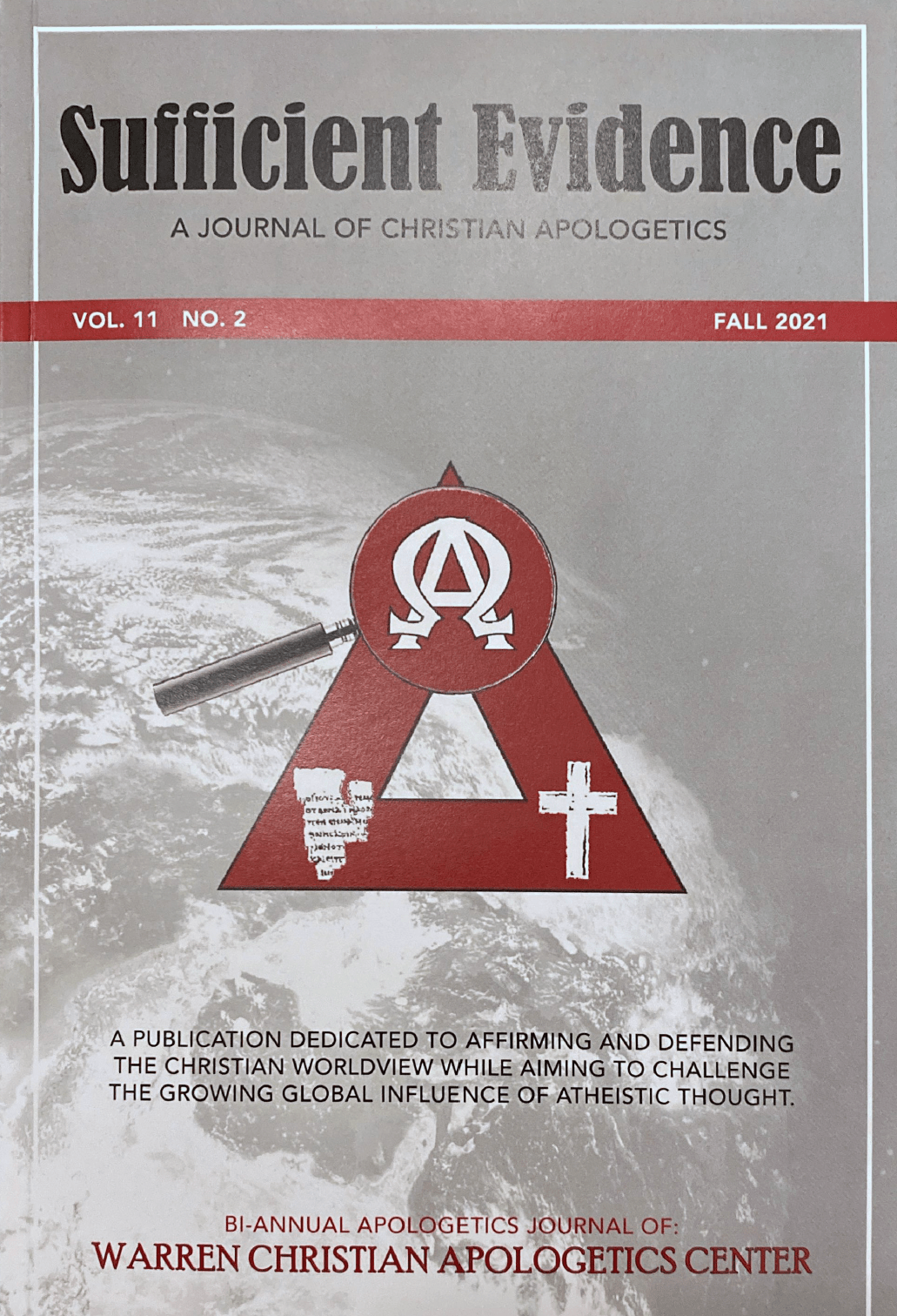
Click here to download the published version of this research paper. To subscribe to Sufficient Evidence click here.






 biblicalfaith.online