Word Study: Jonah and God’s Benevolent Love (Jonah 4:2)

college papers

In Jonah 4:2 the prophet appeals to the Hebrew noun חֶסֶד (hesed) as a Divine character trait reflected in relational actions. This term is one of the most profound words in the Hebrew Bible, but this profundity is complicated by the fact no single translation really captures its meaning. For this reason, deClaissé-Walford, Jacobson and Tanner opted to transliterate the term throughout their commentary on the Psalms:

Traditionally, a wide range of English terms have been employed in the attempt to capture the meaning of hesed: “mercy,” “loving-kindness,” “steadfast love,” “faithfulness,” “covenantal love,” “loving faithfulness,” and the like. We find that none of these words or phrases satisfactorily express the range and depth of hesed.[1]

The present word study, then, seeks to provide sufficient contours for the word’s usage in the Hebrew Bible and then suggest Jonah’s usage is not only a matter of subversion but also an acknowledgment that the LORD is a God of “benevolent love” (Exod 34:6–7).

Hesed Throughout the Hebrew Bible

There is no agreement of how many instances of hesed there are in the Hebrew Bible. In ascending order, based on BHS4 Kohlenberger and Swanson index the noun 244 times.[2] Stoebe and Zobel list 245 instances; yet, Gordon counts 246.[3] In their popular grammar, Practico and Van Pelt supply a 249 wordcount; meanwhile, Koehler, Baumgartner, and Stamm, and therefore Holladay, calculate about 250 instances.[4] This apparent statistics fluctuation for the frequency of hesed is probably due, at least, to variants in the critical Hebrew texts upon which their analyses were based.

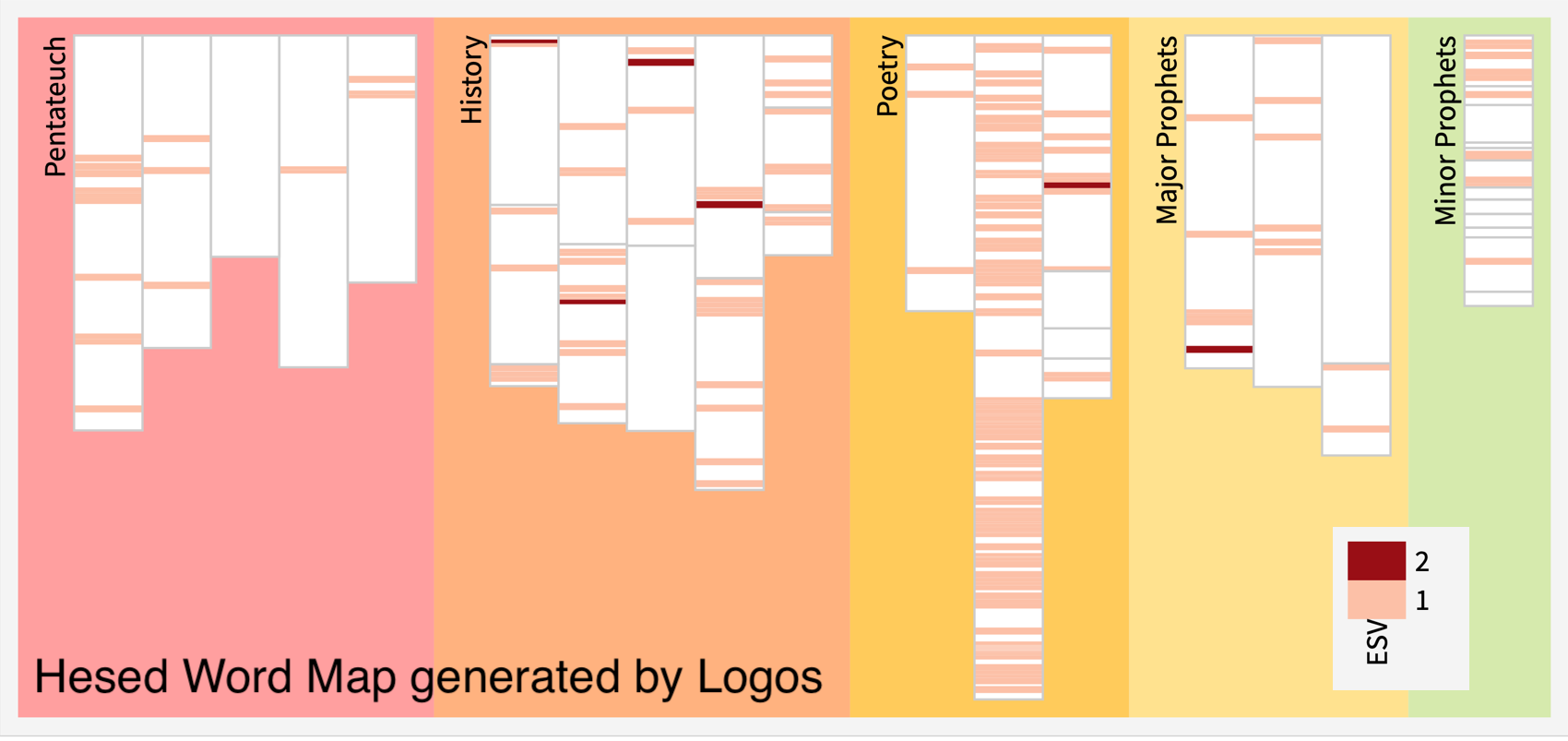
Hesed is widely distributed across all biblical literary categories of the Hebrew Bible, which is arranged differently than the Christian Bible (see word map below). It is found in the Torah 20 times, in the Prophets (Nevi’im) 53 times, and the Writings (Ketuvim) 172[3] times.[5] The twelve books where hesed does not appear, however, are Leviticus, 2 Kings, Ezekiel, seven of the twelve minor prophets (Amos, Obadiah, Nahum, Habakkuk, Zephaniah, Haggai, and Malachi), Song of Solomon and Ecclesiastes.

Hesed appears in the first book and the last book of the Hebrew Bible; from the rescuing of Lot in Genesis 19:19 to the faithful deeds of Josiah’s reformation in 2 Chronicles 35:26:

you have shown me great kindness [hesed] in saving my life. (NRSV)[6] 

the rest of the acts of Josiah and his faithful [hesed] deeds in accordance with what is written in the law of the Lord. (NRSV)

The last reference reflected in the Protestant arrangement of the Bible (see word map below) closes with the prophetic oracle of Zechariah 7:9-10:

Thus says the Lord of hosts: Render true judgments, show kindness [hesed] and mercy to one another; do not oppress the widow, the orphan, the alien, or the poor; and do not devise evil in your hearts against one another. (NRSV)

Result Map of חֶ֫סֶד:2 in ESV.png
Word Map: The Hesed (חֶסֶד) word map is based on the English Standard Version generated by Logos Bible software. The pink horizontal lines represent single and double instances.

The books which have ten or more references of hesed are Proverbs (10 times), Genesis (11 times), 1–2 Chronicles (15 times), 1–2 Samuel (16 times), and the Psalms (127[8] times). The majority of these books reflect the relational nature of hesed in the human realm. In Proverbs the end goal of wisdom is to teach practical relational hesed (31:26, 21:21), it is not a false front but the foundation of one’s reputation by its presence in their life (20:6, 28).

In Genesis, “kindness” is requested in prayer to God by Abraham’s servant to find a wife for Isaac (Gen 24:12, 14, 27). Then, Laban and Bethuel act in hesed (“kindness”) by cosigning their approval of Rebekah’s consent to be given as wife to Isaac.

1–2 Chronicles and 1–2 Samuel show that hesed expressed in reciprocal social acts. Saul reciprocates and excuses the Kenites from his assault on the Amalekites because they has shown hesed to Israel in ages past (1 Sam 15:6). Hushai’s “love” (loyalty?) for David is questioned during his infiltration of Absolam’s forces (2 Sam 16:17). The hesed shared between David and Jonathan is a story of deep loyalty and mutual reciprocity (1 Sam 20:8, 14–15). The Divine hesed is evidenced as well (2 Sam 15:20). Nathan enshrined the Davidic lineage and kingdom on behalf of God,

“my love will never be taken away from him” (2 Sam 7:15 NIV; 1 Chr 17:13, 2 Chr 1:8, 6:42; Psa 18:25[26]).

The Psalms contain close to half of all uses of the noun hesed (127[8] times); but it does not appear in 55% (83 psalms) of the 150 psalms. In brief, there are 23 instances in Book I (1-41), 16 instances in Book II (42–72), 14 and 13 times in Book III (73–89) and IV (90–106) respectively. In Book V (107–150), however, the frequency count skyrockets to 60 instances. Psalm 136 alone celebrates the Divine hesed in each of its twenty-six verses. It is in the Psalms that “both God and human worshipers describe God’s hesed as everlasting.”[7] Indeed,

While the term is used of both humans and God, in the Psalter it is above all a theological term that describes God’s essential character as well as God’s characteristic ways of acting—especially God’s characteristic ways of acting in electing, delivering, and sustaining the people of Israel. Hesed is both who the Lord is and what the Lord does. Hesed is an ancient term that defined for Israel who its God is.[8]

The saturation of hesed in the Psalms suggests that God’s people should always be mindful in prayer and worship of its content, its deeds, and the God who so relates to his people (Psa 36:5, 7, 10).

As pertains to the present study, it should be noted that the noun hesed only features twice in Jonah. Jonah is only one of four minor prophets where the term is employed (Hosea, Joel, and Micah). The first instance is in Jonah’s prayer of lament while in the “great fish” wherein he affirms that pagan idolators will miss out on “the grace [hasdam] that could be theirs” (2:8[9] NIV). The other instance is in 4:2 where Jonah laments what he knows about the LORD, who is “abounding in love” (NIV, warabhesed) and willing to change his mind about bringing judgment on the penitent people of Nineveh. 

Semantic Range and Related Hebrew Words

As Silzer and Finley remind, “[w]ords normally have more than one meaning. The specific meaning of the word depends on its context.”[9] It is not sufficient, then, to rely on English translations (archaic or contemporary), nor to force lexical glosses to determine the meaning of a word.[10]

Brown, Driver, and Briggs groups hesed with its verbal (hasad 2 times) and adjectival (hasid 32 times) forms, along with a few proper names, such as Ben-Hesed (“son of Hesed” 1 Kgs 4:10) and Hasadiah (“Yah is Hesed” 1 Chr 3:20).[11] Lastly, is the unclean hasidah (6 times) often translated “stork” or “heron.” The root connection is believed to be due to their fond, “kind and affectionate” nature with their young.[12] This is a feature that is never appealed to in the Hebrew Bible.

The semantic range of hesed extends to the secular and the religious. In each, hesed manifests in concrete actions of goodwill, loyalty, and communal love whether in or outside of the covenant.[13] Divergent views emerge here with polarizing understandings over the meaning of hesed. Nelson Glueck saw in hesed a hardline covenantal legal obligation, H. J. Stoebe and others countered that hesed was a free relational demonstration of loyal love.[14]

In the secular sense hesed speaks to certain “ethical norms of human intercourse” where mutuality exists that focuses on “the closest of human bonds.”[15] For example, Ruth exhibits this sense (1:8, 2:20, 3:10). Naomi blesses her daughters-in-law reciprocally, “May the Lord deal kindly [hesed] with you, as you have dealt with the dead and with me” (NRSV).

Religiously, the Divine demonstration of hesed does not function very differently than from the secular.[16] Exodus 34:1–7 provide a clear liturgical formula which demonstrates that Israel’s God abounds “in steadfast love and faithfulness” (34:6 NRSV; Psa 86:15, 89:14, Num 14:18).

The Lord passed before him, and proclaimed, “The Lord, the Lord, God merciful and gracious, slow to anger, and abounding in steadfast love [hesed] and faithfulness, keeping steadfast love [hesed] for the thousandth generation, forgiving iniquity and transgression and sin, yet by no means clearing the guilty, but visiting the iniquity of the parents upon the children and the children’s children, to the third and the fourth generation.” (Exod 34:6-7 NRSV)

This divine expression stresses the LORD’s multi-generational hesed and faithfulness. Moses now knows (33:13) that the LORD relates to his people through his benevolent and enduring nature. The words are quoted and echoed throughout the Hebrew Bible which suggests that they became formulaic or institutionalized to extoll the attributes of the God of Israel (Num 14:18, Jer 32:18, Joel 2:13, Nah 1:3, Psa 86:15, 103:8, 111:4, 112:4, 116:5, 145:8, Neh 9:17, 31, 2 Chron. 30:9)[17]

There are several words that appear frequently with hesed. They provide some dynamic appreciation for its usage in the Hebrew Bible.[18] Hesed may be done (‘asah) in concrete choices (Ruth 1:8). The LORD God keeps (shamar) and abounds (rab) in hesed (Deut 7:9, Neh 9:17). It is often associated with various nouns of “mercy” as in Psa 103:4 where the psalmist speaks of being crowned by God with hesed and rahamim (mercy). Likewise, hesed appears together with ’emet (faithfulness) probably as a hendiadys such as in Exod 34:6 and Psa 86:15.[19]

Hesed in Jonah 4:2

He prayed to the Lord and said, “O Lord! Is not this what I said while I was still in my own country? That is why I fled to Tarshish at the beginning; for I knew that you are a gracious God and merciful, slow to anger, and abounding in steadfast love [hesed], and ready to relent from punishing. And now, O Lord, please take my life from me, for it is better for me to die than to live.” (Jonah 4:23 NRSV)

This survey of hesed in the Hebrew Bible should help to determine the possible range of meaning for how Jonah 4:2 should be understood. Words have meaning only in context. With the above range in mind, the context appears to reflect Jonah’s usage of the formulaic hesed language of Exodus 34:6–7. Instead of celebrating his God with these words, Jonah is subversively using this language to express his frustration with the LORD’s restraint against the city of Nineveh.

Jonah is using God’s own words against him. For this reason, it appears the meaning for Hebrew word hesed found in Jonah 4:2 should be understood as “benevolent love.” Jonah knows how LORD acts out in concrete acts of hesed, these being grace, mercy, “slow to anger,” and relenting from judgment. Since there is no evidence that the LORD is in covenant with Nineveh, this supports the supposition that divine hesed may be expressed in free relational demonstrations of benevolent love. God relates to repentance with the reciprocal response of grace, mercy, patience/forbearance, relenting from judgment.

Jonah 2:8[9] further supports this view. It reveals that the prophet desires for judgment those who do not enjoy a covenant relationship with the LORD. It appears that for Jonah, idolatry is the “deal-breaker” for having a relationship with the LORD based on hesed. Yet, the irony fails to make any headway with the nationalistic prophet, since he rejected his prophetic call on the basis that he knew what the LORD would do should Nineveh repent. Both he and pagans have rejected God. Jonah is not only selfish with his relationship with his faithful God (“save me from the fish!”) but is resentful that God is “sharing the love” with foreigners (“you saved them from judgment!”).

Jonah wants his curse to come true, that those who “cling to worthless idols forfeit the grace [hesed] that could be theirs” (2:8[9] NIV). It is this forfeiture of Divine hesed which Jonah still desires for Nineveh, reflected in his willingness to proclaim that the city “will be overturned” (3:4) and his bitterness that it was not (4:1–11). Jonah knew that God would choose relationship over punishment. The LORD said as much (4:11). Humans, unfortunately, seem to choose punishment over relationship. Jonah shows as much.

This focused study on hesed and Jonah 4:2 brings to mind that the caricature of the bloodthirsty wrathful God of the Old Testament is just that an exaggerated cartoon (cf. Jas 2:13). As Baer and Gordon powerfully remind:

The insight that, while both anger and love are appropriate divine responses, the latter outlasts the former, is an important one for biblical theology. Wrath is a true word, a right word, sometimes an inevitable word, such passages seem to say. But God would not have it be his last word. That honor is reserved for his unfailing love (hesed).[20]

The burden of Jonah was to provide concrete witness to the people of Nineveh that God seeks to extend and establish benevolent love with all nations. As one who has experienced Divine benevolent love, Jonah should have been moved to be a spokesman for Divine benevolent love. In this he struggled and failed; nevertheless, God succeeded even if for a brief time (cf. Nahum 1:1?).

Conclusion

The meaning for Hebrew word hesed found in Jonah 4:2 should be understood as “benevolent love.” The formulaic language of Exodus 34:6–7 is surely the theological and context for Jonah’s use of hesed. In Exodus as in Jonah 4:11, the LORD shows that he has the concern to establish and maintain a communal relationship with Israel. The benevolent concerns of preserving others and acting on the basis of moral uprightness anchor the LORD’s demands of repentance. Jonah knew if Nineveh took seriously the burden of his message, his God would become their God. They would collectively experience Divine benevolent love.

A final thought should be emphasized. Even though there are many excellent translations in the English language their primary function is simply to provide a reading text. Some significant and complex words, like hesed, merit the focused investigation which a word study provides. As developed above, hesed stresses relationships, community, loyalty and the ethical demands of love, responsibility, care, and obligation words which no single translation can do justice. Word studies reveal facets and these usages are combined into a framework. This framework provides the contours for understanding what a word means within its context, for usage determines meaning.

Endnotes

  1. Rolf A. Jacobson, “Text, Title, and Interpretation,” in The Book of Psalms, NICOT, eds. E. J. Young, R. K. Harrison, and Robert L. Hubbard (Grand Rapids, MI: Eerdmans, 2014), 78.
  2. John R. Kohlenberger III. and James A. Swanson, The Hebrew-English Concordance to the Old Testament (Grand Rapids, MI: Zondervan, 1998), v, 559.
  3. H. J. Stoebe, “hesed kindness,” TLOT 2:449; H.-J. Zobel, “hesed,TDOT 5:45; Robert P. Gordon, “hesed,” NIDOTTE 2:211.
  4. Gray D. Practico and Miles V. Van Pelt, Basics of Biblical Hebrew, 2d ed. (Grand Rapids, MI: Zondervan, 2007), 105; Koehler, Baumgartner, and Stamm, “hesed,” HALOT 1:336; William L. Holladay, A Concise Hebrew and Aramaic Lexicon of the Old Testament (1971; repr., Grand Rapids, MI: Eerdmans, 2000), 111.
  5. The Torah includes Genesis-Deuteronomy; the Nevi’im includes Joshua-2 Kings, Isaiah, Jeremiah and Ezekiel, and the Minor Prophets; and the Ketuvim includes Psalms, Proverbs, Job, Song of Solomon, Ruth, Lamentation, Ecclesiastes, Esther, Daniel, Ezra-Nehemiah, and 12 Chronicles.
  6. The two English translations the Holy Bible used in this paper are the New Revised Standard Version (Nashville, TN: Nelson, 1989) and the New International Version (Nashville, TN: HarperCollins, 2011) cited as NRSV and NIV respectively.
  7. David A. Baer and Robert P. Gordon, “hesed,” IDOTTE 2:212–17.
  8. Jacobson, “Text, Title, and Interpretation,” 8.
  9. Peter James Silzer and Thomas John Finley, How Biblical Languages Work: A Student’s Guide to Learning Hebrew and Greek (Grand Rapids, MI: Kregel Publications, 2004), 164.
  10. Douglas Stuart, Old Testament Exegesis: A Handbook for Students and Pastors, 4th ed. (Louisville, KY: Westminster John Knox, 2009), 182–83.
  11. BDB 338–39.
  12. BDB 339; HALOT 1:336; TLOT 2:449.
  13. IDOTTE 2:212–17; HALOT 1:336–37; TDOT 5:46–64.
  14. R. Laird Harris, “hesed,” TWOT 1:305–06.
  15. TDOT 5:47–48.
  16. TDOT 5:54–55.
  17. Nahum M. Sarna, Exodus, JPS Torah Commentary, ed. Nahum M. Sarna (Philadelphia, PA: Jewish Publication Society, 1991), 216.
  18. HALOT 1:337.
  19. TWOT 1:307.
  20. IDOTTE 2:214.

Bibliography

Baer, David A., and Robert P. Gordon. “חסד.” Pages 211–18 in vol. 2 of New International Dictionary of Old Testament Theology and Exegesis. Grand Rapids, MI: Zondervan, 2012.

Brown, Francis, S. R. Driver, and Charles A. Briggs. A Hebrew and English Lexicon of the Old Testament. Oxford: Clarendon Press, 1907.

Ford, David. “Keeping up Biblical Languages while in the Ministry.” Foundations 14 (1985): 41–44.

Gordon, Robert P. “חסד.” Pages 211–18 in vol. 2 of New International Dictionary of Old Testament Theology and Exegesis. Edited by Willem A. VanGemeren. Grand Rapids, MI: Zondervan, 1997.

Harris, R. Laird. “חסד (hsd).” Pages 305–07 in vol. 1 of Theological Wordbook of the Old Testament. Edited by R. Laird Harris, Gleason L. Archer, Jr., and Bruce K. Waltke. Chicago, IL: Moody Press, 1980.

Holladay, William L. A Concise Hebrew and Aramaic Lexicon of the Old Testament. 1971. Repr., Grand Rapids, MI: Eerdmans, 2000.

Jacobson, Rolf A. “Text, Title, and Interpretation.” Pages 29 in The Book of Psalms. NICOT. Edited by E. J. Young, R. K. Harrison, and Robert L. Hubbard. Grand Rapids, MI: Eerdmans, 2014.

Koehler, Ludwig, Walter Baumgartner, and Johann J. Stamm. The Hebrew and Aramaic Lexicon of the Old Testament. Translated and edited under the supervision of Mervyn E. J. Richardson. 5 vols. New York: Brill, 1994–1999.

Kohlenberger, John R., III., and James A. Swanson. The Hebrew-English Concordance to the Old Testament. Grand Rapids, MI: Zondervan, 1998.

Practico, Gray D., and Miles V. Van Pelt. Basics of Biblical Hebrew. 2d edition. Grand Rapids, MI: Zondervan, 2007.

Sarna, Nahum M. Exodus. JPS Torah Commentary. Edited by Nahum M. Sarna. Philadelphia, PA: Jewish Publication Society, 1991.

Silzer, Peter James, and Thomas John Finley. How Biblical Languages Work: A Student’s Guide to Learning Hebrew and Greek. Grand Rapids, MI: Kregel Publications, 2004.

Stoebe, H. J. “חֶסֶד, hesed kindness.” Pages 449–64 in vol. 2 of Theological Lexicon of the Old Testament. Edited by Ernst Jenni and Claus Westermann. Translated by Mark E. Biddle. 3 vols. Peabody, MA: Hendrickson, 1997.

Stuart, Douglas. Old Testament Exegesis: A Handbook for Students and Pastors. 4th edition. Louisville, KY: Westminster John Knox, 2009.

Wegner, Paul D. Using Old Testament Hebrew in Preaching: A Guide for Students and Pastors. Grand Rapids, MI: Kregel Publications, 2009.

Zobel, H.-J. “(חֶסֶד, hesed).” Pages 44–64 in vol. 5 of Theological Dictionary of the Old Testament. Edited by G. Johannes Botterweck and Helmer Ringgren. Translated by David E. Green. Grand Rapids, MI: Eerdmans, 1977.


The Value of Learning Biblical Hebrew

college papers

In 2 Timothy, Paul encourages the evangelist Timothy to trust in “[a]ll scripture” as the “useful” source for transformative instruction which empowers God’s people to accomplish “every good work” (3:16–17 NRSV).[1] There is a reason to believe this reference to “scripture” is primarily an allusion to the Hebrew Bible.[2] Study of the Hebrew language, then, would be a necessary acquisition for the minister. The benefits of studying biblical Hebrew are vast and significant, ranging from practical to technical. The insights gained from the study of Hebrew allow the minister to provide biblical clarity for the benefit of their audience.

The Benefits of Studying Biblical Hebrew

There are several benefits of studying Hebrew but only a selected few will be set forward for consideration. The ultimate benefit and goal for any minister of the Hebrew Bible are “to learn to exegete the Hebrew text accurately in order to preach authoritative, relevant sermons.”[3] Studying biblical Hebrew improves the proficiency to preach and teach what amounts to two-thirds of the biblical canon, a literary world that is often a difficult foreign terrain for most people.[4]

Further, a knowledge of biblical Hebrew also liberates ministers from being dependent on commentaries, and other secondary literature, and helps avoid making arguments exclusively from scholarly consensus.[5] Instead, proficient knowledge of Hebrew will allow the minister to provide fresh and original messages that guide the church based on deep personal wrestling with the original languages.[6]

For the minister, there are several benefits from a technical (professional) vantage point. The minister ought to know their subject matter in deeper ways than the average Bible reader.[7] Silzer and Finley point out that much of the exegetical task is to understand how language works to convey meaning, in other words, semantics.[8] A steady daily program of working through biblical Hebrew, along with the right tools (lexicons, grammar, and other aids) will increase exposure and proficiency in how the language functions.[9]

Ideally, such would help mitigate against linguistic fallacies such as root, the figure of speech confusion, and totality transfer which reflect ignorance of how languages work.[10] Furthermore, the exegetical process helps the minister sort through technical questions which have no homiletic value but are required by the exegetical task. “The meaning of a sentence is not always obvious from the meaning of the individual words.”[11] This process to let context determine the meaning of words and phrases whether literal or figurative, ambiguous or clear ought to encourage humility (Jas 4:10), a much-needed “benefit” to the craft of preaching and teaching.[12]

The Task of Ministers to Clarify the Biblical Text

The insights gained from the study of Hebrew allow the minister to be in a better position to clarify the biblical text using languages and images their audience understands. This task emerges from various needs.

First, ministers are often asked to answer questions about translations and teachings.[13] The question “which translation is correct?” may seem a daunting one but it is actually an opportunity to help the person take their first steps into a larger world of Bible study. The minister must help to provide guidance and clarity in this sensitive but crucial area of Bible knowledge that all translations are interpretive aids to understand the original language of the text.[14] Finally, a minister who has adequate proficiency in biblical Hebrew will have the ability to address questions concerning the accuracy of certain proposed teachings or the need to correct inaccurate teachings.

Second, ministers must know when to bring out relevant insights from the text that English translations do not highlight but are quite helpful to see another level of depth to the pericope.[15] Wegner, for example, points to the phrase tōhu wābōhu which appears in the Hebrew Bible twice (Jer 4:23 and Gen 1:2).[16] It seems the prophet Jeremiah is using this unique phrase from Genesis (“a formless void” NRSV) to affirm that due to the sins of Israel, the earth is once again “waste and void” (NRSV). This intertextual insight would most likely have gone unnoticed without work in the Hebrew text.

Finally, and perhaps most significantly is the clarity that comes from a fresh and relevant application of the Hebrew text to the contemporary life of the congregation. Exegesis always has the singular aim “to produce a deeper understanding of biblical truth,”[17] the sermon for the contemporary setting must be shaped by these “freshly pressed” insights.

Conclusion

A knowledge of biblical Hebrew certainly provides practical and technical benefits for the minister who maintains a steady program to improve their proficiency in the language. Likewise, the insights gained from the study of Hebrew allow the minister to provide clarity when preaching and teaching.

This will often include addressing questions regarding translations, and teachings, or providing fresh insight from the Hebrew text hidden by an English text; and finally, by aligning the message to the contours of the exegetical work in the original language.

Endnotes

  1. All Scripture references are taken from the New Revised Standard Version unless otherwise noted.
  2. Paul D. Wegner, Using Old Testament Hebrew in Preaching: A Guide for Students and Pastors (Grand Rapids, MI: Kregel Publications, 2009), 17.
  3. Wegner, Using Old Testament Hebrew, 13.
  4. Wegner, Using Old Testament Hebrew, 13–14; Peter James Silzer and Thomas John Finley, How Biblical Languages Work: A Student’s Guide to Learning Hebrew and Greek (Grand Rapids, MI: Kregel Publications, 2004), 161.
  5. Wegner, Using Old Testament Hebrew, 15–16; David Ford, “Keeping up Biblical Languages while in the Ministry,” Foundations 14 (1985), 42; Douglas Stuart, Old Testament Exegesis: A Handbook for Students and Pastors, 4th ed. (Louisville, KY: Westminster John Knox, 2009), 181.
  6. Ford, “Keeping up Biblical Languages,” 42, 44; Wegner, Using Old Testament Hebrew, 15–17.
  7. Wegner, Using Old Testament Hebrew, 17.
  8. Silzer and Finley, How Biblical Languages Work, 160.
  9. Wegner, Using Old Testament Hebrew, 20–22.
  10. Silzer and Finley, How Biblical Languages Work, 162, 165; Stuart, Old Testament Exegesis, 182–83.
  11. Silzer and Finley, How Biblical Languages Work, 176.
  12. Silzer and Finley, How Biblical Languages Work, 180.
  13. Wegner, Using Old Testament Hebrew, 16.
  14. Wegner, Using Old Testament Hebrew, 15.
  15. Ford, “Keeping up Biblical Languages,” 42.
  16. Wegner, Using Old Testament Hebrew, 15.
  17. Ford, “Keeping up Biblical Languages,” 43.

Bibliography

Ford, David. “Keeping up Biblical Languages while in the Ministry.” Foundations 14 (1985): 41–44.

Silzer, Peter James, and Thomas John Finley. How Biblical Languages Work: A Student’s Guide to Learning Hebrew and Greek. Grand Rapids, Mich: Kregel Publications, 2004.

Stuart, Douglas. Old Testament Exegesis: A Handbook for Students and Pastors. 4th edition. Louisville, Kent: Westminster John Knox, 2009.

Wegner, Paul D. Using Old Testament Hebrew in Preaching: A Guide for Students and Pastors. Grand Rapids, Mich: Kregel Publications, 2009.


A Brief Look at Patronage as Background for the New Testament

college papers

The present study is an inquiry into the interconnected reciprocal nature of patronage in the Greco-Roman imperial social setting, as one background component from the New Testament world. One would be wrong to think that such a social dynamic’s presence was minimal. In actuality, patronage and its vocabulary not only appears specifically in the New Testament (Luke 22:25; Acts 10:38; Rom 16:2; Philm 17-20, Phil 4:14-20, etc), but the social reciprocal dynamics in which its value and cultural powers are also assumed (shame, honor, unity, gratitude, fellowship, etc.). The reader who knows what to look for will see it in numerous contexts shaping the life of the body.[1] Unfortunately, the many elements vital to the matrix of patronage can only be pointed to. Yet, as Bruce J. Malina observes, it was “the most significant form of social interaction in the limited-good world of the first century is an informal principle of reciprocity, a sort of implicit, non-legal contractual obligation, unenforceable by any authority apart from one’s sense of honor and shame.”[2] The challenge in this paper is to briefly and accurately describe it.

In seeking to understand the New Testament accurately, scholars propose various exegetical principles and contextualizing models to accomplish this task.[3] The process here requires an approach which appreciates the cultural background of the New Testament to contextualize its vocabulary. This, Albert A. Bell reminds, is the “crucial part of understanding any written text.”[4] Greco-Roman words have a socially conditioned context that the modern reader may not readily identify. “Without a comprehension of the sociological dynamics of that world, our understanding… is terribly superficial at best and woefully mistaken at worst.”[5] The most crucial need for the reader of the New Testament, then, is to be able to bridge the cultural and time gap between the original (native) context and the reader’s contemporary context. This linguistic and cultural divide can be managed. In advancing a cultural-anthropological reading model, Jerome H. Neyrey argues that one can avoid ethnocentric and anachronistic readings of Paul (and the New Testament) by appreciating the difference between reading him as member of the same culture (an emic reading), and by reading him informed by the analytical and descriptive works of specialists and ethnographers (an etic reading).[6] As one gets closer to this “emic reading,” the modern reader comes closer to better appreciate the symbolic universe of Paul’s and Jesus’ culture.[7] The goal here is to gain a realistic perception from “native informants” which can illustrate and contextualize patronage as a Greco-Roman phenomenon.[8]

The presentation to follow will demonstrate how significant the social form of patronage was in the daily life of the Greco-Roman world, it will outline the vocabulary of patronage in Latin and Greek primary sources, it will sharpen this outline to differentiate between political and social patronage, and then offer a realistic scenarios that can illuminate reading the New Testament in its social and cultural world.

Daily Significance of Patronage

In modern analogy, patronage was like an ancient informal “welfare system.” Social services, like the modern model of the United States, would have been quite foreign. Instead, patronage was a cultural phenomenon in which there was a reciprocal relationship between the upper class and the lower class. It benefited lower classes with protection and patronage by means of reasonable support (legal, financial, medical, marital, etc.) for public support, the running of errands, odd jobs, escorting through streets, and providing social honor in exchange (a return). In exchange for the daily allowance (sportula), the client was at the patron’s call. Thus, it was a form of social investment between patron-client; interestingly, even slaves of wealthy households were known to have clients who hoped the slave could use their influence upon their master.[9] Greco-Roman and Christian scholarship is unequivocal about the daily and social significance of the patron-client network of relationships.[10]

Martial, in his colorful Epigrams, clocks what city life was like in the urbs (4.8.1-4): “The first and second hours wear out clients greeting their patrons.” The imagery evokes the crushing nature of the daily dependence of clients upon their patronus. A step further, Juvenal shows how important this allowance of money was for the everyday professional and collegia with his sarcastic words in the Satires (1.95-126):

For no deity is held in such reverence amongst us as Wealth; though as yet, O baneful money, thou hast no temple of thine own; not yet have we reared altars to Money in like manner as we worship Peace and Honour, Victory and Virtue, or that Concord that clatters when we salute her nest.[11]

This fits the common view that the patron-client phenomena were important to the daily life of every social stratum of the Greco-Roman world. To this point, Jérôme Carcopinodescribes that whether employed or unemployed, freedman or the parasite do-nothing, aristocrats or lower plebeians, clients “were no sooner out of bed than they were in the grip of the duties inseparable from being a ‘client.’ […] there was no man in Rome who did not feel himself bound to someone more powerful above him by the same obligations of respect, or, to use the technical term, the same obsequium.”[12] This honor-bound relationship allowed those in various professions and collegia to survive by means of this small daily “dole as their main source of revenue.”

Patronage in Latin and Greek Sources

Extant Greek and Latin sources (literary and epigraphic) speak of patronage, benefaction, and euergetism (good-doing) from political and social perspectives. Ideas such protection, assistance, help, advocacy, and philanthropy appear. Consider the following samples. It seems that patronage was initially borne out of political power and civic duty, but that distinction apparently broke down over time into a social network between the upper and lower classes in the Greco-Roman world among the rich, the poor, the freedman and freedwoman.[13]

The Roman historian Livy stretches back about four centuries to the early Roman Republic and recounts the story of Cincinnatus, the famed aristocratic plebeian consul, turn poor plebeian farmer, turn dictator, turn savior of Roman (History of Rome 3.26-29). According to Livy, his actions as dictator were reciprocated with honor and status. Livy frames (stylizes?) the response of the army as recognizing “the benefit [beneficii] they had received at his hands,” honored him with a golden crown, and “saluted him as their protector [patronum salutaverit]” (History of Rome 3.29.3). They had become his “clients,” and Cincinnatus would use this social bond to his advantage to “clear” the charges against his son Caeso who was on the run for charges of murder. The protector of Rome, then, returned his powers of dictator and returned to the rustic farm life. Later, when Augustus consolidates his power, Tacitus recounts his use of “gratuities” (donis) among the military and the poor (Annals 1.2). Michael Grant[14] interprets this as Augustus letting “it be understood that the old institution of patrons and clients had been recast, so that henceforward all the people were his own, personal clients, including the poorest citizens.” Thus, as principis Augustus and the emperors after him would portray (politically?) to the citizens of Rome and its subjects a bond of reciprocal loyalty.

Greek sources also illuminate various aspects of patronage. In the fifth century BCE, Sophocles frames the tragic Oedipus as gratefully exchanging protection from Thebes and “help [prostátisi] of the dread goddesses” who reigns in their districts, with obtaining “a great savior [sōtēr’] for this city, and troubles for my enemies” in him (Oedipus at Colunus 455-460). The Apocrypha[15] likewise points to the political upheavals in the Maccabean storyline connected to concepts of patronage. In 2 Maccabees, Simon slanders Onias, who is designated “a plotter against the government the man who was the benefactor [tòn euergétēn] of the city, the protector [tòn kēdemóna] of his compatriots, and a zealot for the laws” (4:2).[16]

In 3 Maccabees 3:13-29, “King Ptolemy Philopater” declares to his “generals and soldiers” that despite his goodwill (philanthrōpía), a desire to do good (eū poiēsaí), and to honor (timēsai) in the Jewish temple (3:15-17), the Jews “manifest ill-will toward us” and are “the only people among all nations who hold their heads high in defiance of kings and their own benefactors [euergétais], and are unwilling to regard any action as sincere” (3:19). The accommodative and benevolent king (philanthrópōs 3:20) declares that such rebellious Jews should be arrested, bound, and deported and that any who harbor them should be severely punished (3:25-29). Eventually, Philopator descends upon the Jews but is subdued by two angels. The king breaks down to pity and tears, and blames and threatens his “friends” (toís phílois):  “You are committing treason and surpassing tyrants in cruelty; and even me, your benefactor [euergétēn]” (6:24).

Political and Social Patronage in Rome

In the Greco-Roman world of the first century CE, there appears to be evidence distinguishing between political and social patronage. This can be confusing since sources often use terms like benefactor, euergetes, and patron in the process of discussion. The masculine form of the Greek prostát– (see verbal use above for “help”) is somewhat problematic. It is often considered synonymous with the Latin patronus. Interestingly, the New Testament the feminine form προστάτις is used in Romans 16:2 and translated as patron and benefactor (ESV; NIV, NRSV, HCSB). Erlend D. MacGillivray[17] takes exception to the view that these two forms are completely synonymous. The masculine appears in both Attic Greek and in the Roman Empire and carries both legal and a variety of leadership benefaction roles, but not the feminine form. MacGillivray argues that applying the masculine meaning upon prostátis is exegetically problematic for this reason. Benefaction is in view, but one must distinguish between political patronage from some interpersonal social networking.

MacGillivray argues that understanding prostátis depends, then, upon understanding the fluid nature of ancient Mediterranean reciprocal dynamics, recognizing the patron-client model is far too limiting and misleading. There is a difference between the narrow and nuanced meaning of classical patronage and the broad euergetistic/altruistic benefaction. While epigraphical gratitude evidence shows that prostátis and prostátes imply civic prestige, the nature of the evidence is, however, often weak to force synonymity. Part of the problem stems from the near normative templates in honorary Greco-Roman epigraphs that do not always neatly distinguish between the various kinds of patronage. Thus, the presence of these terms do not prove exclusively a classical patronage/patronus; consequently, MacGillivray’s work argues that prostátis and prostátes are not demonstrably synonymous.

R. A. Kearsley[18] extends this trajectory and explores several first century CE gratitude (honorarium) inscriptions shedding light on the first-century distinction between political and social patronage. These aristocratic women are named, Iunia Theodora and Claudia Metrodora, and are celebrated as female benefactors/patrons who operated in mid-first century CE Asia Minor. The cities of Lycia (Myra, Patara, Tel-messos) recount the influence of Theodora. Theodora apparently had multiple-citizenships, she freely shared her wealth, applied influenced for political and commercial purposes, and is described consistently in benefactor terms (sōphronōs, philolúkios) in Lycia. Such amounts to Theodora functioning as a social benefactor. On the other hand, Metrodora of Chiot Island likewise held multiple-citizenships, did hold political office as magistrate (stephanephoros), which required benefaction toward the people although she surpassed such requirements. She functioned in banquets, directed imperial games, gymnasiarch, public bathhouse donation, basileia in Ionia, and was praised for her public virtue. She was a benefactor as part of holding office.

Realistic Patronage Scenarios for Reading the New Testament

The above illustrations provide insight into the deep and ancient tradition of patronage and how such played out in various settings. There are two passages where patronage vocabulary is explicitly found in the New Testament.

First, in Luke, the political aspect of patronage is evident in Jesus’ counter-intuitive teaching on greatness. Jesus corrects the “greatness debate” among the disciples by saying,

“The kings of the Gentiles exercise lordship over them, and those in authority over them are called benefactors [euergétai]. But not so with you. Rather, let the greatest among you become as the youngest, and the leader as one who serves” (22:25-26).

Frederick W. Danker observes, euergétai “served as a title for rulers in Syria and Egypt… In many cases the title would conceal tyranny under extravagant expenditure” (cf. Greek Esther 16:2-3, 13-14).[19] One might argue that Jesus is taking for granted a political euergétai known to abuse such roles, and parts from the fundamental principle of the patron-client relationship: “a service performed or a favor done shall not be transformed into status and honor.”[20] Jesus’ leadership principle, then, is that one serves detached from the demands of reciprocity and the honor and status it brings (cf. Acts 10:38).[21]

Second, in Romans 16:1-2 patronage appears to have a social component. Paul commends Phoebe to the church as “a servant of the church at Cenchreae” and as one who should be helped —reciprocally— “for she has been a patron [prostátis] of many and of myself as well.” Caroline F. Whelan[22] relates this passage to the context of Roman reciprocal social conventions within associations (collegia). Whelan maintains that women not only had the Roman legal standing to operate their wealth independently of guardians, they also functioned as civic patrons for collegia. Secondly, comparable “recommendation” letters reveal two types of reciprocal relationships. There is the superior-inferior recommendation rhetoric, and two, the social-equals recommendation rhetoric; each reflecting in some sense the inherent nature of reciprocity in Rome’s social structure, the matrix of which fuses together the economic and social. Romans 16:1-2, then, points to one of these realistic scenarios. Whelan argues that the patronage between social equals (amica, friends) is probably in view. Phoebe needs Paul’s influence among those addressed in Romans 16 (thus the recommendation), but as “equals” such rhetoric is not for his own social benefit. Instead, it is a gesture of gratitude for her own social activity as a social patron (euergetistic) to the collegia of the church in Cenchrea.

Conclusion

Robert Wilken asserts: “We have a distorted view of the history of early Christianity… The historian of Christianity has given the impression that the rest of the canvas is simply background for the closeup —relegating the general history of the times to an introductory chapter of vague generalities.”[23] Hopefully, this paper provides a closer, native (emic) reading. The smaller the cultural and linguistic gap is, the more accurate the reading. May this paper accomplish its task, to gain realistic perceptions from primary sources which can illustrate and contextualize patronage as an important Greco-Roman imperial phenomenon.

Endnotes

  1. David A. deSilva, “Honor and Shame,” “Patronage,” DNTB 518-22, 766-71; Donald Walker, “Benefactor,” DNTB 157-59; Halvor Moxnes, “Patron-Client Relations and the New Community in Luke-Acts,” in The Social World of Luke-Acts, ed. J. H. Neyrey (1991; repr., Peabody: Hendrickson, 1993), 241-68; Everett Ferguson, Backgrounds of Early Christianity, 3rd ed. (Grand Rapids: Eerdmans, 2003), 66-69.
  2. Bruce J. Malina, The New Testament World (Louisville: John Knox, 1981), 80.
  3. Ralph P. Martin, “Approaches to New Testament Exegesis,” in New Testament Interpretation, ed. I. Howard Marshall (Grand Rapids: Eerdmans, 1977), 220-51.
  4. Albert A. Bell, Jr., Exploring the New Testament World (Nashville: Nelson, 1998), 2.
  5. M. Robert Mulholland, Jr., “Sociological Criticism,” in Interpreting the New Testament, eds. David A. Black and David S. Dockery (Nashville: B&H, 2001), 171.
  6. Jerome H. Neyrey, Paul, In Other Words (Louisville: Westminster John Knox, 1990), 13.
  7. Neyrey, Paul, 14-17. Neyrey’s distinctions and concerns have value, but he makes a hardline dichotomy between Paul as one who receives supra-cultural insight (i.e., from God) and Paul as a fully incarnated product of his times (18). This distinction ignores Paul’s stated role from God. This is one of Mulholland’s four critiques of this model, it tends to be human-centered, often grounded in dynamic models foreign to the Roman world, imposes the model on the evidence, and lends itself to sociological reductionism (“Sociological Criticism,” 178-80).
  8. David A. deSilva, The Hope of Glory: Honor Discourse and New Testament Interpretation (Collegeville: Liturgical, 1999). The “native informants” are “our best instructors” (xi).
  9. Bell, Exploring the New Testament World, 191-92.
  10. Ferguson, Backgrounds, 67; Florence DuPont, Daily Life in Ancient Rome, trans. C. Woodall (Oxford: Blackwell, 1993); Micahel Grant, A Social History of Greece and Rome (New York: Scribner’s Sons, 1992).
  11. Juvenal, Satire 1.95-126, http://sourcebooks.fordham.edu/halsall/ancient/juv-sat1eng.asp.
  12. Jérôme Carcopino, Daily Life in Ancient Rome, ed. Henry T. Rowell, trans. E. O. Lorimer (1940; repr., New Haven: Yale University, 1968), 171.
  13. Grant, Social History of Greece and Rome, 30, 54, 70-76, 114-119.
  14. Grant, Social History of Greece and Rome, 75-76.
  15. See also the verbal, and substantival, usages in Wisdom 3:5, 11:5, 13, 16:2, 19:13-14; 2 Macc 8:6; 4 Macc 8:6; Greek Esther 16:2-3 = 8:12c (tōn euergetoúntōn), 13 = 8:12n (euergétēn). Of these sources, Mordecai is framed as sōtēra and euergétēn (cf. God in LXX Psa 12:6, 56:3, 114:7).
  16. Quotations for the Old Testament Apocrypha are taken from New Revised Standard Version of the Holy Bible (Nashville: Nelson, 1989). The Greek text is from Septuaginta (Stuttgart: Deutsche Bibelgesellschaft, 1996).
  17. Erlend D. MacGillivray, “Romans 16:2, prostátis/prostátes, and the Application of Reciprocal Relationships to New Testament Texts,” NovT 53 (2011): 183-99.
  18. R. A. Kearsley, “Women in Public Life in the Roman East: Iunia Theodora, Claudia Metrodora and Phoebe, Benefactress of Paul,” TynB 50.2 (1999): 189-211.
  19. Frederick W. Danker, Jesus and the New Age According to St. Luke (St. Louis: Clayton Publishing, 1979), 222.
  20. Moxnes, “Patron-Client Relations,” 261.
  21. Halvor Moxnes, The Economy of the Kingdom (1988; repr., Eugene: Wipf & Stock, 2004), 158.
  22. Caroline F. Whelan, “Amica Pauli: The Role of Phoebe in the Early Church,” JSNT 49 (1993): 67-85.
  23. Robert L. Wilken, The Christians as the Romans Saw Them (New Haven: Yale University, 1984), xiv.

Bibliography

Bell, Albert A., Jr. Exploring the New Testament World: An Illustrated Guide to the World of Jesus and the First Christians. Nashville, TN: Nelson, 1998.

Carcopino, Jérôme. Daily Life in Ancient Rome: The People and the City at the Height of the Empire. Edited by Henry T. Rowell. Translated by E. O. Lorimer. 1940. Repr., New Haven, CT: Yale University, 1968.

Danker, Frederick W. Jesus and the New Age According to St. Luke: A Commentary on the Third Gospel. 1972. Repr., St. Louis, MO: Clayton Publishing, 1979.

deSilva, David A. “Honor and Shame.” DNTB. 518-22.

deSilva, David A. The Hope of Glory: Honor Discourse and New Testament Interpretation. Collegeville, MN: Liturgical Press, 1999.

deSilva, David A. “Patronage” DNTB. 766-71.

DuPont, Florence. Daily Life in Ancient Rome. Translated by Christopher Woodall. Oxford: Blackwell, 1993.

Ferguson, Everett. Backgrounds of Early Christianity. 3rd edition. Grand Rapids, MI: Eerdmans, 2003.

Grant, Michael. A Social History of Greece and Rome. New York, NY: Scribner’s Sons, 1992.

Kearsley, R. A. “Women in Public Life in the Roman East: Iunia Theodora, Claudia Metrodora and Phoebe, Benefactress of Paul.” TynB 50.2 (1999): 189-211.

MacGillivray, Erlend D. “Romans 16:2, prostátis/prostátes, and the Application of Reciprocal Relationships to New Testament Texts.” NovT 53 (2011): 183-99.

Malina, Bruce J. The New Testament World: Insight from Cultural Anthropology. Atlanta, GA: Knox, 1981.

Moxnes, Halvor. The Economy of the Kingdom: Social Conflict and Economic Relations in Luke’s Gospel. Minneapolis, MN: Augsburg Fortress, 1988. Repr., Eugene, OR: Wipf & Stock, 2004.

——-. “Patron-Client Relations and the New Community in Luke-Acts.” Pages 241-68 in The Social World of Luke-Acts: Models for Interpretation. Edited by Jerome H. Neyrey. 1991. Repr., Peabody, MA: Hendrickson, 1993.

Mulholland, M. Robert, Jr. “Sociological Criticism.” Pages 170-86 in Interpreting the New Testament: Essays on Methods and Issues. Edited by David Alan Black and David S. Dockery. Nashville, TN: B&H, 2001.

Neyrey, Jerome H. Paul, In Other Words: A Cultural Reading of His Letters. Louisville, KY: Westminster John Knox, 1990.

Walker, Donald D. “Benefactor.” DNTB. 157-59.

Whelan, Caroline F. “Amica Pauli: The Role of Phoebe in the Early Church.” JSNT 49 (1993): 67-85.

Wilken, Robert L. The Christians as the Romans Saw Them. New Haven, CT: Yale University, 1984.

Regarding the Divide Between the Christ of Faith and the Jesus of History

college papers

There is a long-standing view that an impassible divide exists between the Jesus of history and the Christ of faith. This paper is about crossing this epistemic divide centered on what can be known about Jesus. Many scholars believe this divide cannot be bridged, but this paper argues that it can. This challenge reminds me of two cautionary tales.

Growing up in San Francisco, I was surrounded by bridges. Traveling northbound from the San Francisco peninsula, one crosses the Golden Gate Straight by virtue of the world-famous Golden Gate Bridge. Traveling eastbound, out of “the city,” there is the less famous double-stacked Oakland Bay Bridge, which is the workhorse among the Bay Area bridges. There are two events connected to these bridges that have taught me two relevant lessons.

First, few know that many said the Golden Gate straight could not be bridged. In fact, engineering experts said a bridge would never be built because the straight was too long, the winds were too strong, the waters would be a nightmare for construction, and the fog would further hamper the process. Yet, four years of construction (1933-1937) later, the impossible expanse was built. Sometimes, the naysayers give you the planks upon which to build your bridge.

Second, during the 6.9m 1989 Loma Prieta earthquake, a large section of the top-level (outbound) of the Bay Bridge collapsed. I watched, on a small battery-powered radio/tv, a news report of a vehicle attempting to jump the divide, only to fail tragically. The vehicle had no ability to jump the gap. I learned that day that hope is not enough to cross a wide gap. We must evaluate the evidence to “look before we leap.”

Christianity and the Impassable Divide

These anecdotes inspire me to challenge the so-called “impassable” ditch at hand. It is not a small challenge, for the claim has been made by some of the sharpest minds in “thinking” history. It is, nevertheless, part of the calling of every Christian to be “prepared to make a defense to anyone who asks you for a reason for the hope that is in you” (1 Pet 3:15 ESV).[1] Peter was aware that Christians will be called upon to explain the connection between their behavior and their conviction in Jesus as Lord (1 Pet 4:1-5). Life and faith converge in Jesus. What some would argue is an impassable gulf -reality and value/significance- was the connective tissues of a Christian ethical apologetic. It may be argued, then, that first-century Christians were already crossing the “impassable” bridge between the Jesus of history and the Christ of faith.

Peter anticipated no epistemic difficulty -no crisis- explaining how “Jesus as Lord” connects with significance to the everyday issues of his life and his future. Accordingly, this early text assumes that the full identity of Jesus held an immediate significance to the lives of struggling Christians. It is the result of both his historic existence and his spiritual Lordship viewed as one tightly interwoven reality. This “interwoven reality” is not, however, the view of many within the academic circles of biblical and philosophical criticism.

This issue at hand is multifaceted and complicated, but it is not insurmountable nor impassable. One must evaluate the evidence and acknowledge the complexity of the problem at hand in order to offer a solution. For instance, there is a large time-gap between today and the first-century. This raises a lot of genuine historical questions all by itself concerning sources which provide any measure of access to Jesus. Further, those ancient sources must be evaluated to test their genuineness to weigh their authenticity and accuracy to verify if they are primary or secondary sources, literary or non-literary sources. These and many other questions are used to evaluate ancient sources that allow the historian to reconstruct a probable and revisable picture of the ancient past. If the current matter were simply an issue regarding sources, then there are numerous literary sources from the first-century which point to Jesus, the events and personalities surrounding his ministry, his death, and the belief and practices of early Christians. Many have discussed and debated these sources,[2] but the tension at hand focuses on a level a bit “deeper” than literary sources (though they will be considered).

At its core, the problem at hand is epistemic; that is, it centers on “how” knowledge is obtained, how knowledge connects the self “within” (internal) to the world “without” (external).[3] David Lipe briefly summarizes it as, “the study of the origin, nature, extent and reliability of knowledge.”[4] Vergilius Ferm points out that epistemology seeks to answer the following questions:

What is the source of human knowledge? What are its limitations? How do we come by our knowledge of the external world, of ourselves, of others? How can we trust our ideas as valid?[5]

“Epistemology,” in Twentieth Century Encyclopedia of Religious Knowledge, ed. Lefferts A. Loetscher (Baker Books, 1955)

Schools of thought, such as empiricism and rationalism, and the debates which they create have formed the basis of the dichotomy that pits the “historical Jesus” against the Christ faith-claim. In particular, with rationalism (Decartes, Spinoza, Leibniz), mind (a priori) is regarded as being given authority/primacy over the senses (a posteriori); that is, a priori knowledge is superior to a posteriori knowledge. Conclusions drawn would be deductively reasoned knowledge such as Aristotle’s “laws of thought.” On the other hand, empiricism (Locke, Berkeley, Hume) approaches knowledge from the other direction -the senses/experience; that is, a posteriori knowledge is regarded superior to a priori knowledge. This would be inductively experienced knowledge grounded in life.[6]

Enter Immanuel Kan (1724-1804). In the late eighteenth century, Kant would attempt to split the difference by attempting to synthesize and hold both in tension. That is, we can know “how” we know something, but the knowledge is completely subjective. Knowledge is only a perception, a “representation,” and not actually real to life (the thing in-itself).[7] Kant develops the thought this way:

all our intuition is nothing but the representation of appearance; that the things that we intuit are not in themselves what we intuit them to be, nor are their relations so constituted in themselves as they appear to us; and that if we remove our own subject or even only the subjective constitution of the senses in general, then all constitution, all relations of objects in space and time, indeed space and time themselves would disappear, and as appearances they cannot exist in themselves, but only in us. What may be the case with objects in themselves and abstracted from all this receptivity of our sensibility remains entirely unknown to us.[8]

Michael Rohlf, “Immanuel Kant,” https://plato.stanford.edu/index.html

Yet, as Norman Geisler points out, Kant’s epistemology results into a self-defeating “philosophical agnosticism.”[9] Attempts like these to explain how we obtain knowledge is at the core of the so-called impassable gulf between the Jesus of history and the Christ of faith.

The Contours of the Impassable Divide

This debate fundamentally represents the struggle between connecting the tangible to the intangible, life and significance, the historic and the historical. In addition to a number of certain epistemic concerns, the divide is infused with an anti-supernatural bias which has manifested in at least five forms.[10] They are summarized briefly here, with the danger of oversimplification:

  • Gotthold E. Lessing (1729-1781) argued that there is an “ugly ditch” between historical contingent truths and the eternal necessary truths. His “ugly ditch” language has essentially framed the whole conversation.
  • Immanuel Kant (1724-1804) argued that there is a gulf between facts (contingent truths) and values (experience/reasons) that cannot be bridged but by faith (not knowledge).
  • Martin Kähler (1835-1912) expressed his concern for a reconstructed (historical) Jesus that must be mediated by the trained hands of critical scholarship. Kähler affirmed an impassable divide between the historical (reconstructed) Jesus and the historic (real) Jesus that cannot be cross unless by faith evoked by the historic Jesus. 
  • Søren Kierkegaard (1813-1855) viewed that the “historical” has no connection to the eternal, so real history is immaterial to the “leap of faith” toward the spiritual/eternal.
  • Rudolph Bultmann (1884-1976), argued that Jesus —as built on untrustworthy sources (Christian testimony, myths, and legends)— is not relevant for faith nor spiritual truth claims. It is the symbolism that matters at an existential level, that is, the meaning intended by such “sources.”

These all reflect a gap, a ditch, a divide, for which it is claimed that they cannot be bridged. It will be, then, the approach of this paper to first briefly critique the arguments for this impassable gap. Then, attention will be given to ancient sources, both within the New Testament canon and outside the New Testament canon to demonstrate that history and value claims must be intertwined to make sense of evidence. From this, provisional conclusions will be made that are reasonable and consistent with this evidence.

Critique of the Impassable Gap of the Historical Quest

The problem with the arguments used to articulate the dichotomy of the Jesus of history and the Christ of faith are typically self-defeating and beg the question at the methodological level. The “gap” issue significantly touches on the crux of the quest for historical Jesus. Albert Schweitzer (1875-1965) points to Lessing’s publication of Herman S. Reimarus’ Fragments in which Reimarus separates what the apostles said about Jesus from what Jesus said about himself.[11] Since Schweitzer, the publication of Fragments has been viewed as the early stages of the quest for the historical Jesus.

Gotthold E. Lessing

Reimarus influenced Lessing, and who in turn, affirmed a tension between the relationship of history and revelation. Lessing states this as “the ugly broad ditch”; namely, “accidental truths of history can never become the proof of necessary truths of reason [and revelation].”[12] For Lessing, a Spinozan pantheistic deist, there is no supernaturalism in the world. So, events are fortuitous (accidental) and have no meaning/significance of themselves. Why, because like Spinoza, Lessing argues that since God is immanent and extends throughout creation, he naturally governs the world with its unbreakable natural law. Accordingly, supernatural activity (miracles, providence, etc) is impossible because to do so would violate his own nature as expressed in natural law. Thus, miracles are impossible and God does not reveal himself in history. Thus, Jesus the real-person (a posteriori) is not associated with the faith-truth as the Christ (a priori) by definition. In fact, no religious claim can be absolutely true.

Lessing’s argument, however, presumes that “natural law” is inflexible. A further problem in Lessing’s epistemology is its self-defeating agnosticism that not only arbitrarily forces a divide between history and truth. For, in order to make the observation (a posteriori) that history and value (a priori) are detached from one another, Lessing must make an absolute value statement based on how history and value relate to each other historically. So, Lessing is doing what his thesis says is impossible to do: to intertwine history and evaluative judgments.

Immanuel Kant

This is essentially the same fundamental flaw in Immanuel Kant’s agnosticism (that he knows that one can perceive but not know a thing in itself). Again, Kant says,

We are acquainted with nothing except our way of perceiving them, which is peculiar to us, and which therefore does not necessarily pertain to every being, though to be sure it pertains to every human being.[13]

Quoted in Rohlf, “Immanuel Kant.”

People only know what they think they know, and what they know is not necessarily true “in itself.” This is the tension of his contradictions (“antinomies”) which, therefore, force him to reject a priori (and ontologically) arguments for believing a thing to be true in itself. For example, what is logically necessary, is not actually necessary.[14] Consequently, the Bible is not the result of God adapting to human finiteness (which is logically necessary) but is instead a book of mythology. It is not actually necessary that the Bible be from God, and such a truth claim is only a perception. Instead, what has more logical value and tangible significance to Kant is one’s duty to their neighbor.[15] Thus, the events of Jesus portrayed in the Gospels, then, is a subjective statement of a spiritual truth-claim that Jesus is the Christ of faith.

In order for Kant to make this claim (that we only know perceptions, no what is real in-itself), he is must make an absolute truth (a priori) claim in a world that he has argued can only be perceived in a subjective manner. Kant self-defeats himself by crossing the divine he denies is possible cross. Would not the argument, “I know for certain that it is impossible to know a thing in itself” argue that Kant knows this as a historical truth claim in itself? Kant derails himself.

Søren Kierkegaard

Kierkegaard argued for a dichotomy which “real history” is unimportant to faith, or rather, that it is impossible to move from the historical toward the spiritual. Kierkegaard finds no causation between a historical event and meaning (its value, or truth). In fact, this is his great paradox when it comes to truth claims since human knowledge is unable to have certainty about meaning and significance. Thus, for example, spiritual truth is beyond human rationality. For Kierkegaard seeking how to explain or understand the nature of God, one enters a paradox/contradiction. The act to explain the nature of God, is in effect, to limit a full understanding of God. To be certain about something is to limit what can be known about something.

In this sense faith —in particular, Christian faith— is a different beast altogether, for it carries within it a built-in certainty to its truth claims. In Kierkegaard’s view, it is purely nonsense that by understanding what happens in history (Jesus of history), one can obtain knowledge of the contradiction — the non-historical (Jesus of faith). Therefore, fact and history are not as important to Kierkegaard as the “leap of faith.” The problem is, as Geisler sums up, “while the historical as such does not bring one into contact wth the eternal, neither can the eternal be divorced from real history.”[16] Yet, Kiekergaard’s case proves too much on this point, for “the shift in emphasis from fact to value leads to the denial of fact and its support of faith.” It is not that all of his observations are to be dismissed, but he undermines the role of fact to understand value-claims.

Martin Kähler

Martin Kähler, who builds on Kant, also voiced his concern that the “real Christ” is not the Christ of Faith. This point is easily misunderstood. Kähler rightly argued that historical research should inform faith, so he was loved by liberals but hated by conservatives. Kähler also rejected attempts to separate the Jesus of history from the Christ of faith and was loved by conservatives and hated by liberals. He served, therefore, as a middle ground historical critic, who was “loved” and “hated” by conservative and liberals but for different reasons. Kähler coined the phrases “historical Jesus” (historische) and “historic Jesus” (geschichtliche), yet what he meant by the terms is not how most employ the term today. The “historical Jesus,” according to Kähler is a reconstructed Jesus based on scholarship which may, or may not correspond to the “historic Jesus” — that is, the real-life Jesus. Kähler took issue with equation the two.[17]

It came down to two problems. First, there is limited knowledge, or the lack thereof, to sufficiently “reconstruct” Jesus. Second, believers are at the mercy of the “fluid results” of scholarly reconstructions about Jesus. Jesus was, therefore, mediated by the elite scholars. For this reason, Kähler declares, “the real Christ, that is, the influential Christ, with whom millions in history have had fellowship in a childlike faith… is the preached Christ.”[18] The proclaimed Christ solved this problem. For this reason, Kähler made a distinction between the “historical Jesus” from the “historic Jesus.”

The line he draws on this point, between the two, is too strong and undermines the fact that the New Testament builds its case upon sources which are built on eyewitness accounts (Luke 1:1-4; Acts 1:1-3). Even if one were to argue that there is a minimal amount of authentic evidential sources about Jesus, then to that degree a faithful reconstruction of the historic Jesus can be made and understood. Which in many respects is the case for everything that could be said about Jesus of Nazareth has not been recorded (John 20:30; 21:25).

Rudolf Bultmann

One of the most significant contributors to the dichotomy of the Jesus of history and the Christ of faith is Bultmann. Bultmann’s significance for New Testament criticism and theology are, according to Ricard N. Soulen and R. Kendall Soulen, equaled by few and excelled by none in the areas of form-criticism and the practice of demythologizing the New Testament.[19] Working on his form-critical methodology, Bultmann differentiated between the sayings of Jesus and the deeds of Jesus (e.g. Reimarus), between the pre-scientific worldview of Jesus’ day and today, and the fact that to accept this worldview would be to sacrifice one’s intellect. Thus, he argued for a non-historical symbolism based upon kerygmatic (proclamation) themes.

What matters from the New Testament point of view, he argued, are the transcendent truths of faith (existential meaning). Thus, the resurrection “myth” did not happen, but what matters is the transcendent truth the “resurrection” is suppose to provide.[20] However, form-criticism, when properly applied is about finding genres and even sub-genres of types of literature within a text(s). It is not inherently anti-supernatural as Bultmann wielded it. In one way, it is a tool for genre classification. In another, it provides the framework for what tools an exegete may require for interpretation.[21]

Yet, Bultmann infused his approach with a naturalism which rejects the supernatural by definition. Consequently, at the methodological level, Bultmann begs the question that miracles are not possible and builds an interpretive framework in which miracles do not make sense. However, if one employs a theistic worldview that leaves the possibility open that miracles are possible,[22] then Bultmann’s approach would not have created his mythological approach to understanding Jesus, which his student Ernst Kasemann viewed as docetic.

Ancient Sources on Jesus of Nazareth

Turning now to consider sources within the New Testament canon and those outside the New Testament canon. The New Testament documents clearly emphasize a concern for and establish the historical underpinnings of the gospel message. It is the presentation of Jesus as a historic, and not mythic, figure which leads Edward M. Blaiklock to affirm that “Christianity triumphed over its most serious opponent, the soldiers’ worship of the soldierly Mithras, largely because Christianity could oppose to the legendary Mithras the historical reality of Christ.”[23]

Canonical Christian Sources

Broadly, though, there are three tests of historicity, according to James P. Moreland, that establish that New Testament documents are “as reliable as, superior to, most other ancient documents.”[24] These general tests are: bibliographical tests, internal tests, and external tests.

First, is the bibliographical test, which establishes the number of extant manuscripts and how far removed they are from the originals. In the case of the New Testament documents, the extant Greek manuscript copies exceed 5,000 (not including quotations, ancient translation, lectionaries), in fragmentary or complete form, many of which are from the second-century. In this regard, the New Testament is the most attested document of the ancient world.[25]

Second, the internal tests evaluate any claims of representing eyewitness history. The Gospel accounts and Acts reflect eyewitness testimony (Luke 1:1-4; 3:1-2; ). Luke tells us explicitly that his Gospel is in keeping with three aspects of early Christian testimony: preexisting accounts, earliest eyewitness testimony, and those who served to deliver the Word to the world. Moreover, Luke chronicles his involvement as a collaborator with Paul (Acts 16:10-17, 20:5-15, 21:1-18, 27:1-38, 28:1-10). The letters reflect personal encounters with Jesus (1 John 1:1-4; 2 Pet 1:16-17; 1 Cor 9:1; 15:1-11), or with those close to first-generation disciples of Jesus (Gal 1:18-19; 2:1-14).

Third, the external test verifies if there is material evidence to confirm the reliability of the document. Edwin M. Yamauchi demonstrates that despite a long-standing skepticism against the historicity of New Testament, there are numerous significant and “insignificant” confirmation of the social, political, and geographical background of the New Testament and demonstrates the literary source to be reliable.[26] One instance may illustrate these observations. In Acts 18:12-17,  Paul stands before the tribunal of the governor (proconsul) of Greece (Achaia), one L. Junius Gallio. There is an inscription was found from Delphi with Gallio’s name on it. Most likely it refers to his proconsulship during July 51 to July 52, which means Paul’s year-and-a-half stay began a year or so before this time (ca. 50-51).[27]

Non-Christian Sources

The other side of this issue is ancient testimony outside of the New Testament. Rudolf Bultmann belief that the quest for the historical Jesus lacked non-Christian sources. He ignored Christian sources specifically because they eyewitness documents which he believed inserted legendary and mythological elements, and therefore, cannot be trusted. While the extant sources are not all the kinds which a historian might like (legal documentation, birth records, etc.), what is available serve as independent literary reinforcement of that Jesus of History and Christ of faith are one interwoven as one figure.

E. M. Blaiklock surveys the sort of extant ancient sources available from the first-century. The majority of which are not focused on the region of Judea nor on history. In fact, he writes, “Bookends set a foot apart on this desk where I write would enclose the works from those significant years. Curiously, much of it comes from Spanish emigrants in Rome.”[28] Yet, what is available impressively corroborates with the historical framework of the New Testament and the significance they assert for Jesus of Nazareth.

Non-Christian sources, moreover, may be grouped into six categories of various weight and detail.[29] There are ancient historians (Tacitus, Suetonius, Josephus, Thallus), government official correspondence between (Pliny the Younger, Emperor Trajan, Emperor Hadrian), Jewish sources (Talmudic references to Jesus, Toledoth Jesu document), other Gentile sources which do not speak favorably of Christianity (Lucian, Mara Bar-Serapion), and gnostic sources (Gospel of Truth, Apocryphon of John, Treatise on Resurrection). The latter certainly have their theological slants, but they to point to Jesus as a historical figure.

Of these non-Christian sources, two sources will receive particular attention: first-century references to Jesus in the Roman historian Cornelius Tacitus (ca. AD 56-121) and Jewish historian Flavius Josephus (ca. AD 37-100).

Cornelius Tacitus

Tacitus was a Friend of Pliny and Suetonius. He began writing history in AD 98 with a volume about his father-in-law, Argicola, and another about Germany, Germania. Then early in the second-century, Tacitus published two more volumes, Histories (ca. AD 100-109) and Annals (ca. AD 109-116).[30] The Histories focus on the political troubles of Rome during A.D. 69-96, including the destruction of Jerusalem (Histories 5). The Annals chronicle the reign of Augustus to Nero (AD 14-68). In describing the depravity of the Caesars, Tacitus digresses with a note about the burning of Rome:

Consequently, to get rid of the report, Nero fastened the guilt and inflicted the most exquisite tortures on a class hated for their abominations, called Christians by the populace. Christus, from whom the name had its origin, suffered the extreme penalty during the reign of Tiberius at the hands of one of our procurators, Pontius Pilatus, and a most mischievous superstition, thus checked for the moment, again broke out not only in Judaea, the first source of the evil, but even in Rome, where all things hideous and shameful from every part of the world find their centre and become popular.[31]

(Annals 15.44)

Robert L. Wilken explains the usage of the term “superstition” (Lat. superstitio) in its common and familiar sense, “the term superstition referred to beliefs and practices that were foreign and strange to the Romans… that had penetrated the Roman world from surrounding lands.”[32] This is how Tacitus and other Romans felt about such groups.

More to the point, Tacitus is a Roman historian with no interest in proving Jesus existed; however, he knew the basic facts of his death as he “suffered the extreme penalty” and during the proper time frame and location while Pilate was procurator in Judea (AD 26–36).

Flavius Josephus

Flavius Josephus is a self-described first-century Pharisee and Jewish rebel during the early Jewish rebellion against Rome, who surrendered to Rome.[33] He wrote of the Jewish and Roman dynamics of the Jewish War provides a retelling of Jewish history in Antiquities of the Jews, an autobiography (Vita), and a defense of Judaism (Against Apion). There are three references in his works which are of interest, Antiquities 18:63-64, 18.116-119 and 20.200. The latter two are rather straightforward as they reference John the Baptist and James the brother of Jesus.

The first reference is Antiquities 18.116–117, in which John the Baptist is mentioned:

Now, some of the Jews thought that the destruction of Herod’s army came from God, and that very justly, as a punishment of what he did against John, that was called the Baptist; for Herod slew him, who was a good man, and commanded the Jews to exercise virtue, both as to righteousness towards one another, and piety towards God, and so to come to baptism; for that the washing [with water] would be acceptable to him, if they made use of it, not in order to the putting away [or the remission] of some sins [only], but for the purification of the body; supposing still that the soul was thoroughly purified beforehand by righteousness.

The reference is strikingly similar to the way the Gospel accounts outline the fate of John the Baptist (Mark 6:14-29).

The second reference is Antiquities 20.200, in which the Christian leader, James, is mentioned in passing as a digression to Josephus’s discussion of Ananus’s ambition to exercise his authority. Josephus mentions him as “the brother of Jesus, who was called Christ… James”:

Festus was now dead, and Albinus was put upon the road; so he assembled the Sanhedrin of judges, and brought before them the brother of Jesus, who was called Christ, whose name was James, and some others; and, when he had formed an accusation against them as breakers of the law, he delivered them to be stoned.

Jesus is James’s “famous” brother. The Gospel accounts describe Jesus as having siblings (Matt 13:55; Mark 6:3; John 6:42) and the apostle Paul acknowledged James as “the Lord’s brother” (Gal 1:19). Interestingly, Origen (ca. 184-253) comments on this reference, “though he [Josephus] did not accept Jesus as Christ, he yet gave testimony that the righteousness of James was so great” (Comm in Matt 10.17).[34]

The third reference, known as the Testimonium Flavianum (18:63-64), is complicated by Josephus’ favorable description of Jesus. The passage includes such descriptions of that question whether one should call Jesus “a man,” “he was [the] Christ,” “a doer of wonderful works,” “for he appeared to them [the disciples] alive again the third day,” and “as the divine prophets had foretold.” The textual strength of the passage is strong, but it appears to be out of balance with what is know about Josephus’s belief about Jesus (Origen above).

Origen, who appears knowledgeable of this material in Josephus, curiously does not seize upon the passage as it stands today. Eusebius appears to be the first ancient author to cite the testimonium in its present form (Ecclesiastical History 1.11).[35] James South argues, along with many scholars, that this passages is evidence of a tampering with the passage, the “culprit” most likely being an unknown Christian scribe.[36] The general approach, then, is to redact the passage to eliminate the positive language from the passage.[37] Like the following redaction of William Whiston’s translation:

Now, there was about this time, Jesus a wise man. He drew over to him both many of the Jews, and many of the Gentiles; and when Pilate, at the suggestion of the principal men amongst us, had condemned him to the cross, those that loved him at the first did not forsake him; and the tribe of Christians, so named from him, are not extinct at this day.

Nevertheless, historical scholarship agrees that Josephus said something about Jesus here. What is clear, though, is that Josephus, a premier historian of first-century Judea is fully aware of Jesus, as he is aware of Pilate, Herod, John the Baptist, and James.

Concluding Thoughts

A study like this needs to come to a sense of balance with regards to objectivity. Norman Geisler reminds that “if objective means, ‘a fair but revisable presentation that reasonable men and women should accept,’ then the door is open to the possibility of objectivity.”[38] The goal has been to cross the impassable epistemic gulf believed to exist between the Jesus of history and the Christ of faith. It is believed that the goal has been reached. There are just a few general observations which should be made in conclusion. First, E. P. Sanders makes an important point and warning about sifting through the available sources concerning Jesus:

Ancient history is difficult. It requires above all common sense and a good feel for sources. Our sources contain information about Jesus, but we cannot get at it by dogmatically deciding that some sentences are completely accurate and some are fiction. The truth will usually lie somewhere in between. As I have already said more than once, and may repeat several more times, we have very good knowledge of Jesus at a somewhat general level. With regard to chronology, we know that he was active during some part of the period 26-36 C.E. It is wrongheaded to try to turn the gospels – and, for that matter, Josephus – into modern encyclopaedia [sic] articles, or to suppose that one sentence is dead right, and the others are completely wrong.[39]

Only when we seek to establish by the ancient evidence what can be established historically, then we are in the position to intertwine reliable history (a posteriori) and the significance (a priori) of the life of Jesus of Nazareth. The impossible bridge, then has been made. Second, despite the complexity of historic inquiry, a worldview and framework can be articulated that is objective and not be anti-supernatural.

Third, both Christian and non-Christian sources do provide evidence and information that is objective and informative regarding what was believed to have occurred by eyewitnesses and historians. Finally, at minimum here, it can be affirmed that historical evidence points to Jesus as a “wise man” who “drew over to him both many of the Jews, and many of the Gentiles,” died under the proconsulship of “Pilate” who was influenced by the “principal men” among the Jews to condemned Jesus “to the cross;” nevertheless, Jesus had disciples “that loved him at the first who did not forsake” and they are may thought of as “tribe of Christians… so named from him… [and] … are not extinct at this day.” Bridge toll paid.

Endnotes

  1. Unless otherwise stated all quotations are taken from the English Standard Version of The Holy Bible (Wheaton, IL: Crossway, 2001).
  2. Gary R. Habermas, The Historical Jesus: Ancient Evidence for the Life of Christ (Joplin, MO: College Press, 1996), 187–228; F. F. Bruce, Jesus and Christian Origins Outside the New Testament (Grand Rapids, MI: Eerdmans, 1974); Edward M. Blaiklock, Jesus Christ: Man or Myth? (1974; repr. Nashville, TN: Nelson, 1984),19–31; Craig Blomberg, The Historical Reliability of the Gospels (Downers Grove, IL: InterVarsity, 1987), 190–233; Graham N. Stanton, The Gospels and Jesus (Oxford: Oxford University, 1989), 139–49.
  3. C. Stephen Evans, Pocket Dictionary of Apologetics and Philosophy of Religion (Downers Grove, IL: InterVarsity, 2002), 39–40.
  4. David L. Lipe, Values in Thought and Action (Henderson, TN: Hester Publications, 2001), 7.
  5. Vergilius Ferm, “Epistemology,” in Twentieth Century Encyclopedia of Religious Knowledge, ed. Lefferts A. Loetscher (Grand Rapids, MI: Baker Books, 1955), 1:385.
  6. Ferm, “Epistemology,” 386.
  7. Michael Rohlf, “Immanuel Kant,” https://plato.stanford.edu/entries/kant/#TraIde.
  8. Rohlf, “Immanuel Kant.”
  9. Norman L. Geisler, Baker Encyclopedia of Christian Apologetics (Grand Rapid, MI: Baker Books, 1999), 401–05.
  10. Geisler, Encyclopedia of Christian Apologetics, 141–42.
  11. Geisler, Encyclopedia of Christian Apologetics, 385–86
  12. Ricard N. Soulen and R. Kendall Soulen, Handbook of Biblical Criticism, 3rd ed. (Louisville, KY: Westminster John Knox, 2001), 102.
  13. Rohlf, “Immanuel Kant.”
  14. Geisler, Encyclopedia of Christian Apologetics, 402.
  15. Lipe, Values, 78.
  16. Geisler, Encyclopedia of Christian Apologetics, 409.
  17. Soulen and Soulen, Biblical Criticism, 92.
  18. Martin Kähler, “Martin Kähler on the Historical Jesus,” in The Christian Theology Reader, 2d ed., ed. Alister E. McGrath (Malden, MA: Blackwell Publishing, 2001), 294.
  19. Soulen and Soulen, Biblical Criticism, 28, Evans, Apologetics and Philosophy, 18–19.
  20. Geisler, Encyclopedia of Christian Apologetics, 517–18; Colin Brown, “Quest of Historical Jesus,” DJG 334–35.
  21. Stephen H. Travis, “Form Criticism,” in New Testament Interpretation: Essays on Principles and Methods, ed. I. Howard Marshall (1977; repr., Grand Rapids, MI: Eerdmans, 1979), 153–64.
  22. Geisler, Encyclopedia of Christian Apologetics, 320–30.
  23. Blaiklock, Jesus Christ, 11.
  24. James P. Moreland, Scaling the Secular City: A Defense of Christianity (1987; repr., Grand Rapids, MI: Baker Books, 1988), 133–57.
  25. Moreland, Scaling the Secular City, 135-37; Philip W. Comfort, Encountering the Manuscripts: An Introduction to New Testament Paleography and Textual Criticism (Nashville, TN: Broadman & Holman, 2005), 103–98.
  26. Edwin Yamauchi, “Archaeology and the New Testament,” in The Expositor’s Bible Commentary, ed. Frank E. Gæbelein (Grand Rapids, MI: Zondervan, 1979), 1:647–69.
  27. Everett Ferguson, Backgrounds of Early Christianity, 3rd ed. (Grand Rapids, MI: Eerdmans, 2003), 545-86; Mark Cartwright, “Corinth,” http://www.ancient.eu/corinth/.
  28. Blaiklock, Jesus Christ, 11-12; see, Wayne Jackson, “Jesus Christ: Myth or Genuine History,” https://www.christiancourier.com/articles/1061-jesus-christ-myth-or-genuine-history.
  29. Habermas, The Historical Jesus, 187–228; Geisler, Encyclopedia of Christian Apologetics, 381–85; James T. South, Just Jesus: The Evidence of History, Kindle ed. (Chillicothe, OH: DeWard Publications, 2012), loc. 237–555.
  30. Albert A. Bell, Exploring the New Testament World (Nashville, TN: Nelson, 1998), 289.
  31. Tacitus, Annals 15.44. http://www.perseus.tufts.edu/hopper/text?doc=urn:cts:latinLit:phi1351.phi005.perseus-eng1:15.44.
  32. Robert L. Wilken, The Christians as the Romans Saw Them (New Haven, CT: Yale University Press, 1984), 50.
  33. Bell, New Testament World, 289.
  34. Origen, “Commentary on the Gospel of Matthew Book 10.” http://www.newadvent.org/fathers/101610.htm.
  35. Ken Olsen, “Eusebius Reading of the Testimonium Flavianum,” http://chs.harvard.edu/CHS/article/display/5871.
  36. South writes, “What we have here is likely a legitimate text from Josephus, in which he mentioned Jesus, but which has been re-worked by a Christian editor” (Just Jesus, loc. 318); Charles K. Barrett, New Testament Background: Selected Documents (1956; repr., New York, NY: Harper & Row, 1961), 198.
  37. Olsen, “Eusebius Reading of the Testimonium Flavianum”; Bruce, Jesus and Christian Origins, 39.
  38. Geisler, Encyclopedia of Christian Apologetics, 320–30.
  39. E. P. Sanders, The Historical Figure of Jesus (repr. London: Penguin Books, 1995), 55–56.

Bibliography

Barrett, Charles K. New Testament Background: Selected Documents.1956. Repr., New York, NY: Harper & Row, 1961.

Bell, Albert A. Exploring the New Testament World. Nashville: Nelson, 1998.

Blackburn, Simon. Oxford Dictionary of Philosophy. 2d edition. Oxford: Oxford University, 2005.

Blaiklock, Edward M. Jesus Christ: Man or Myth? 1974. Repr., Nashville, TN: Nelson, 1984.

Blomberg, Craig. The Historical Reliability of the Gospel. Downers Grove, IL: InverVarsity, 1987.

Brown, Colin. “Quest of Historical Jesus.” DJG 326–41.

Bruce, Frederick F. Jesus and Christian Origins Outside the New Testament. London: Hodder and Stoughton, 1974. Grand Rapids, MI: Eerdmans, 1974.

Bultmann, Rudolf. History of the Synoptic Tradition. Translated by John Marsh. Revised edition. Repr., Peabody, MA: Hendrickson, n.d.

Comfort, Philip W. Encountering the Manuscripts: An Introduction to New Testament Paleography and Textual Criticism. Nashville, TN: Broadman & Holman, 2005.

Craig, William Lane. “‘Noli Me Tangere’: Why John Meier Won’t Touch the Risen Lord.” http://www.reasonablefaith.org/noli-me-tangere-why-john-meier-wont-touch-the-risen-lord.

Evans, C. Stephen. Pocket Dictionary of Apologetics and Philosophy of Religion. Downers Grove, IL: InterVarsity, 2002.

Evans, Craig A. “Do the New Testament Gospels Present a Reliable Portrait of the Historical Jesus?CTR n.s. 13.2 (Spring 2016): 17–26.

Farnell, F. David. “Three Searches for the ‘Historical Jesus’ but no Biblical Christ: The Rise of the Searches (Part 1).” Master’s Seminary Journal 23.1 (Spring 2012): 7–42.

Farnell, F. David. “Three Searches for the ‘Historical Jesus’ but no Biblical Christ (Part 2): Evangelical Participation in the Search for the ‘Historical Jesus.’” Master’s Seminary Journal 24.1 (Spring 2013): 25–67.

Ferguson, Everett. Backgrounds of Early Christianity. 3rd edition. Grand Rapids, MI: Eerdmans, 2003.

Ferm, Vergilius. “Epistemology.” Pages 385-87 in vol. 1 of Twentieth Century Encyclopedia of Religious Knowledge. Edited by Lefferts A. Loetscher. Grand Rapids, MI: Baker Books, 1955.

Geisler, Norman L. Baker Encyclopedia of Christian Apologetics. Baker Reference Library. Grand Rapids, MI: Baker Books, 1999.

Habermas, Gary R. The Historical Jesus: Ancient Evidence for the Life of Christ. Joplin, MO: College Press, 1996.

Habermas, Gary R. “The Minimal Facts Approach to the Resurrection of Jesus: The Role of Methodology as a Crucial Component in Establishing Historicity.” Southeastern Theological Review 3.1 (Sum 2012): 15–26. Repr., http://www.garyhabermas.com.

Jackson, Wayne. “Jesus Christ: Myth or Genuine.” https://www.christiancourier.com/articles/1061-jesus-christ-myth-or-genuine-history.

Jackson, Wayne. “The Nature of History.” https://www.christiancourier.com/articles/1332-nature-of-history-the.

Kähler, Martin. “Martin Kähler on the Historical Jesus.” Pages 292-95 in The Christian Theology Reader. 2d edition. Edited by Alister E. McGrath. Malden, MA: Blackwell Publishing, 2001.

Lipe, David L. Values in Thought and Action. Henderson, TN: Hester Publications, 2001.

Moreland, James P. Scaling the Secular City: A Defense of Christianity. 1987. Repr., Grand Rapids, MI: Baker Books, 1988.

Olsen, Ken. “Eusebius Reading of the Testimonium Flavianum.” http://chs.harvard.edu/CHS/article/display/5871.

Rohlf, Michael. “Immanuel Kant.” https://plato.stanford.edu/entries/kant.

Sanders, E. P. The Historical Figure of Jesus. New York, NY: Penguin Books, 1993.

Soulen, Richard N., and R. Kendall Soulen. Handbook of Biblical Criticism. 3rd edition. Louisville, KY: Westminster John Knox, 2001.

South, James T. Just Jesus: The Evidence of History. Kindle edition. Chillicothe, OH: DeWard Publishing, 2012.

Stanton, Graham N. The Gospel and Jesus. Oxford Bible Series. Edited by Peter R. Ackroyd and Graham N. Stanton. Oxford: Oxford University Press, 1989.

Travis, Stephen H. “Form Criticism.” Pages 153-64 in New Testament Interpretation: Essays on Principles and Methods. Edited by I. Howard Marshall. 1977. Repr., Grand Rapids, MI: Eerdmans, 1979.

Wilken, Robert L. The Christians as the Romans Saw Them. New Haven, CT: Yale University, 1984.

Yamauchi, Edwin M. “Archaeology and the New Testament.” Pages 647–69 in vol. 1 of The Expositor’s Bible Commentary. Edited by Frank Gæbelein. Grand Rapids, MI: Zondervan, 1979.


On the Relationship between 2 Peter and Jude

college papers

Introduction

It has been suggested that in recent years the epistolary genre has received greater academic attention among scholars than in previous generations.[1] These advancements in the nature, function, and composition conventions which have been made in the last century, are demonstrated by the works of  E. Randolph Richard (1991, 2004), Jerome Murphy-O’Connor (1995), William G. Doty (1988), and Stanley K. Stower (1989).[2] The overall impact of the New Testament genre of the letter is demonstrated by Simon Kistemaker’s observation that in the letters, “the writers develop the teachings of the gospels and apply those teachings to churches and individuals,” and with regard to 2 Peter and Jude, they “address themselves to the perseverance of the saints and to the doctrine of the last things.”[3] This importance embedded within them, in addition to canonical considerations, has called attention to this genre, providing an impetus to analyze this part of the New Testament canon.[4]

Among the 21 New Testament letters, eight of them are normally called “Catholic,” or “General,” because the Christian audiences of the epistles have been taken to be universal in scope.[5] They are Hebrews, James, 1 Peter, 2 Peter, 1 John, 2 John, 3 John, and Jude. Despite the recognition of their universal application for Christian living, it appears that, in both academic and ministerial circumstances, they have been neglected considerably for their individual contributions and context. This is not to say the General Epistles have been totally abandoned, but that in comparison to the Gospel accounts and Pauline literature, they have suffered practical orphanage.[6] So much so that J. Daryl Charles applies Rowston’s infamous declaration that 2 Peter is the most neglected book in the New Testament to the entire General group.[7] Unfortunately, due to this lack of attention, the General letters are a troublesome spot in New Testament analysis; especially, because these letters “are sufficiently different from one another to preclude any general treatment of those historical features that may group these letters into a discrete and coherent collection.”[8]

Of the several trouble spots within the General letters is the relationship between 2 Peter and Jude. The basic problem of this relationship is the similarities that exist in 2 Peter 2 and Jude regarding their treatment of certain libertine opponents (2 Peter 2:1-3:3; Jude 2-16). It is this relationship that this paper will address itself; however, this is simply one among a number of problems. For example, within some academic circles, the authorship of 1 and 2 Peter is questioned and the conclusions drawn from that study impacts how one examines the relationship between the latter and Jude.[9] Moreover, Jude’s use and reliance on certain Hebrew sources (pseudepigrapha) move some to call into question the use of Jude by an inspired apostolic author;[10] thus, granting a rationale to see non-apostolic authorship of 2 Peter. This paper by necessity will hint at these issues; however, they cannot be discussed at length, as they do not necessarily bear upon the investigation at hand.[11]

The basic problem being addressed is as follows: how shall the similarities of 2 Peter and Jude be explained. Academic circles are divided, as is common with any issue of a critical nature, but many sources I am aware of assert or assume that these similarities are best explained by Judaic priority. This priority is typically advanced to mean that the author of 2 Peter depends upon Jude for the bulk of his denunciation of the false teachers. As will be described below, this position is not unassailable; furthermore, there are other solutions to the evidence. This critical matter shall be examined in a three-fold matter.

First, the question of whether or not dependency exists shall be examined. Second, an evaluation of key solutions to the dependency question shall be developed. Third, following the analysis of the dependency problem conclusions shall be drawn regarding the compatibility between the solution proposed and the dogma of inspiration.

Evidence Considered Germane to the Dependency Question

When 2 Peter 2:1-3:3 are studied it is a rather difficult matter to dismiss the contribution and illumination that Jude 2-18 provide;[12] however, it can be studied independently with great profit,[13] and it should be.[14] Despite these remarks, the subject matter and vocabulary are so similar that many students have suspected a dependency issue between them. Douglas J. Rowston states:

If one compares Jude 4-16 and 2 Pet 2:1-18, one is led to the conclusion that there is a literary relationship between Jude and 2 Peter. The parallels may be accounted for in four ways. It is possible, not probable, to explain the parallels as coincidental. By the very nature of the parallels this is most unlikely.[15]

“The Most Neglected Book in the New Testament,” NTS 21 (1975)

The argument is that the similarities between 2 Peter and Jude are so strong that scholars suggest this “literary relationship” cannot be explained away as “coincidental.” Michael Green observes that, “of twenty-five verses in Jude no less than fifteen appear, in whole or in part, in 2 Peter” and that “many of the identical ideas, words, and phrases occur in parallel in the two writings.” Consequently, this makes it difficult to “doubt that there is some sort of literary relationship between them.”[16]

The question faced here is whether or not this similarity demands that dependency exists. This will be accomplished by evaluating the evidence typically advanced to affirm dependency. The lines of evidence typically advanced are following in two broad argumentations: thematic content and language. Udo Schnelle provides an example of the argument:

How heavily dependent 2 Peter is on Jude is seen in the numerous details of subject matter and vocabulary as well as in the similarities in the structure of the two letters: after the introductory greeting both authors remind their churches of the faith transmitted in the tradition, a faith that now must be preserved in view of the threats of the false teachers. Then follows a description of the heretical teachers, to which are joined admonitions to hold firmly to the right faith and to be vigilant.[17]

The History and Theology of the New Testament Writings (Fortress Press, 1998)

Denial of the similarities is, consequently, impossible and it is obvious that some type of relationship explains the similarities existing between 2 Peter and Jude.

The false teachers of 2 Peter 2 are described in five ways. Jerome H. Neyrey discusses this matter in balance to Jude.[18] The theme of a denunciation against the opponents is developed as the author of 2 Peter describes them as false teachers (2 Pet 2:15, 19, 3:3-4, 15-17), who deny authority and judgment (2 Pet 2:10-11, 20, 3:4, 9; Jude 4, 8, 10, 16), whose faulty theology leads to immorality (2 Pet 2:13-14, 18, 20-22; Jude 4, 8, 16), for which judgment and ruination await (2 Pet 2:4-10, 12, 16-17, 3:5-8, 10, 16; Jude 4). With such thematic parallels, it is understandable to see the evidence for an impetus to affirm a dependency of some kind. Those like Bauckham believe that dependency flows from 2 Peter upon Jude, principally because of the brevity of Jude and the comparatively larger size of 2 Peter.[19]

Guthrie, likewise, points out that the problem between these two documents is “how it came about that both epistles use such similar descriptions of these people [i.e. false teachers] and the natural conclusion is that one has used the other.”[20] Consider Guthrie’s last clause, “the natural conclusion is that one has used the other.” This conclusion has given rise to the certainty that the parallels being so strong, literary dependency then automatically seems to imply one author had to use the epistolary work of another. However, Guthrie reminds, us that there exists another possibility – “that both have used the same source, incorporating the materials into their epistles in different ways.”[21] Still, even here, Guthrie implicitly accepts that this source is of a literary variety, which it seems is rarely disputed. However, this assumption may prove to be more of a weakness, than it is a strength.

It is interesting to observe how proponents of Judaic priority argue with the evidence. Often an expression of certainty is made regarding the conclusion that 2 Peter 2 is based upon Jude, and then the author proceeds to detail how actually it is not that certain. This line of thinking applies not only to the thematic issues between the two epistles but also to the vocabulary similarities as well. Terrance Callan is an excellent example; he writes:

It seems obvious to all readers that there is some kind of close relationship between Jude and 2 Peter. For good reasons it is now widely accepted that 2 Peter is dependent on Jude. This is so much the case that authors at times overstate this dependence, saying that 2 Peter has simply incorporated Jude. A closer examination shows that the relationship is not this simple. The author of 2 Peter adopted Jude 4-18 in 2 Pet 2:1-3:3.[22]

“Use of the Letter of Jude by the Second Letter of Peter,” Bib 85 (2004)

What is commonly described as a dependency of Jude by the author of 2 Peter is actually an adaptation, not a literary dependency; in fact, Callan continues by observing that 2 Peter “has not adapted Jude by quoting it directly.”[23] Instead, it is regarded as a redaction of Jude by the author of 2 Peter, which means it is a “free paraphrase.”[24]

Before a complete evaluation is rendered towards the thematical similarities between Jude and 2 Peter, the second line of reasoning, vocabulary, must be considered. Statistics vary regarding how much is similar, but one thing remains constant, there are exact points of contact between Jude and 2 Peter. This may appear impressive; however, even Richard Bauckham, a proponent of Judaic priority and pseudepigraphical origin for 2 Peter, writes:

Despite the large number of rare words in Jude, it is relevant to notice that 2 Peter has, in taking over material from Jude, taken over few rare words. Of thirty-eight words in 2 Peter which occur only once or twice elsewhere in the NT, only four occur in Jude and these are only four words which are found exclusively in Jude and 2 Peter in the NT (asebeîn, empaíktēs, suneuōcheísthai, hupérongkos, and of these asebeîn is probably not borrowed from Jude). This suggests that, despite its dependence on other sources as well as Jude, few of 2 Peter’s rare words are likely to derive from sources. They belong to the author’s own vocabulary.[25]

Jude, 2 Peter  (Word, 1983)

Now observe, out of these 38 words found in 2 Peter, only four are in Jude at the most, and quite possibly only three. What sort of dependency is this then, if the author of 2 Peter can only be said to have employed three words for “certain”? Not to mention Bauckham’s belief that these particular rare words belong to the author of 2 Peter’s own vocabulary.

Donald A. Carson, Douglas J. Moo, and Leon Morris likewise have questioned this argumentation; though, they have decided to remain somewhat moderate on the issue. They suggest that there is nothing inherently opposed to 2 Peter incorporating some verbiage that is Judaic, a moderation that Michael J. Gilmour has argued for at length.[26] Guthrie presents the following evidence regarding the verbal parallels, and seems to have the last word on the impact of such matters:

It is often overlooked that although the parallels between these epistles stretch to a wide range of subject-matter, yet verbal agreements are not impressive. If statistics are any guide, the following data may supply some indication. Out of the parallel passages comprising 2 Peter 1:2, 12; 2:1-4, 6, 10-12, 15-18; 3:2-3 and Jude 2, 4-13, 17-18, the former contain 297 words and the latter 256 words, but they share only 78 in common. This means that if 2 Peter is the borrower he has changed 70% of Jude’s language and added more of his own, whereas if Jude borrowed from 2 Peter, the percentage of alteration is slightly higher, combined with a reduction in quantity.[27]

New Testament Introduction, 4th ed. (InterVarsity, 1990)

The matter for Guthrie must still remain open because the evidence to “too short to lead to certainty”; however, he affirms based upon this evidence that “neither author can be considered more concise than the other.”[28]

The question remains if thematic and linguistic considerations are the ground upon which dependency is based, how does this evidence point exclusively to any other kind of dependency other than 2 Peter borrowing from Jude when the dependency is not airtight as is generally believed to be? The question has merit because even the proponents of Judaic priority observe, “despite the great similarity of theme and terminology one detects here, as elsewhere, very different agenda on the part of the two authors.”[29] Furthermore, they argue forcefully, that “Jude and 2 Peter are very different works, from very different historical contexts,” thus it is suggested, “the literary relationship between 2 Peter and Jude does not justify the common habit of classing these two works together as similar works.”[30] With a testimony of this nature, it is difficult to be persuaded that literary dependence between the two epistles is as viable as it is popular.

Furthermore, much is made of the similarities between 2 Peter and Jude; meanwhile, there are considerable matters that are distinct between the two epistles, at least six.[31] Jude 1-4 and 20-25 (the beginning and close) are distinct from 2 Peter 2 and are not parallel, being the “most important and distinctive parts of Jude.”[32] Jude exclusively employs triplet constructions (Jude 1-2, 4-8, 11-13, 20-23, 25), while 2 Peter breaks them up. Jude quotes the Pseudepigrapha (9, 14-16), while 2 Peter does not (2:2-22). In fact, he is very vague in his allusions to such traditions. 2 Peter refers to the false teachers in the future tense (2:1-3); meanwhile, Jude does not (5-7, 9). Jude’s Greek is less difficult than that of 2 Peter. In fact, Daniel C. Arichea and Howard A. Hatton write:

As to style, scholars have noticed that 2 Peter is characterized by long sentences and elaborate constructions. These are all attributed to Greek influences, which have also somewhat influenced the contents of the letter. But in contrast to 2 Peter, Jude seems to use simpler constructions, although not lacking in eloquence and in figurative language […].[33]

A Handbook on the Letter from Jude and the Second Letter from Peter (United Bible Societies, 1993)

Finally, mockers in Jude do not ridicule the delay of the Lord’s coming; however, it is abundantly clear that the opponents in 2 Peter do (3:1-7).

What may be said then about the facts and the proposals given by scholars regarding the relationship between Jude and 2 Peter? Is there reason to believe that there is a dependency issue? Little could be said which would shift the attention away from the fact that Jude and 2 Peter have similarities, but again, do these similarities demand literary dependence? Moreover, what may be said of their differences? It appears that this is not necessary to conclude that there is a literary dependency where one had the other’s epistle before them as they composed their letter. This last point will be examined when the four solutions often proposed to explain this critical problem are considered. But for now, it is sufficient to summarize that despite the thematic similarities and some vocabulary parallels, the testimony of the evidence and those who promote a literary model of dependency concede the point that such is not the solid ground upon which to build a wholesale use of Jude by 2 Peter.

An Evaluation of the Key Solutions to the Dependency Question

There are four basic proposals that have been used to explain the relationship that exists between Jude and 2 Peter. Michael Green succinctly notes them when he writes “that there is a dependence either of 2 Peter on Jude or of Jude on 2 Peter, of both on some lost document, or that both share a common author, is certain”:[34]

  1. Dependence of 2 Peter on Jude
  2. Dependence of Jude on 2 Peter
  3. Dependence of 2 Peter and Jude on a lost document
  4. 2 Peter and Jude share a common author

Others would reclassify Green’s third proposals more generally, suggesting that Jude and 2 Peter may be based on a common source. Generally speaking, scholarship tends to argue that dependency flows from the author of 2 Peter. Powerful presentations of the 2 Peter dependency proposal is represented in commentaries by Richard J. Bauckham (1983) and Jerome H. Neyrey (1993).[35] These works, among others, demonstrate that there is weight behind this proposal. Although there is a general scholarly consensus that the author of 2 Peter employed the epistle of Jude to compose the bulk of 2 Peter 2, a case can be adequately presented that argues that 2 Peter and Jude drew upon a common source to combat a common problem. The case is based upon the clear problem of defining the nature of dependency involved and the strength of some kind of common source theory.

The Problem of Defining Dependency

Arguing for literary dependency can be a misleading enterprise, especially in epistolary material. As noted above, it is difficult to argue that there is no relationship between Jude and 2 Peter, but this difficulty does not within itself demand an exclusive means to explain dependency. Literary dependency is not as foolproof as it is often assumed to be as G. Barr explains:

Beyond the area of literary dependence which is involved in direct copying, there lies a large grey [sic] area in which an author may use many synonyms of words found in another’s work, and may employ parallel syntactical constructions. In such cases it is difficult to distinguish between material which shows familiarity with the written work of another author and material which has been produced after shared discussion, each author writing up the discussion in his own way.[36]

“Literary Dependence in the New Testament Epistles,” IBS 19.4 (1997)

An exclusive means to explain dependency is, therefore, unnecessary since there is another valid explanation. It is very true that at least two types of dependency exist: literary and thought (i.e. Barr’s “shared discussion”), and sometimes it is difficult to distinguish familiarity from literary dependence. Consequently, for all its prominence as a viable explanation, a weakness is evidence that suggests that literary dependency is not the only appropriate explanation for the similarities that exist between Jude and 2 Peter.

It is a virtually uniform approach to Jude and 2 Peter where scholars advance that the author of 2 Peter 2 employed the bulk of Jude in their argumentation. It is interesting, though, that it is proposed that Jude’s argument and language were copied, and yet modifications are accepted and assumed and explained as the letter writer making adjustments to fit the purposes of a pseudepigraphic argument. Callan employs phrases such as “no sentence of Jude is quoted in 2 Peter,” “2 Peter re-wrote Jude, avoiding direct quotation,” “2 Peter has changed Jude’s critique,” Callan constantly claims 2 Peter changed, rewrote, omitted a phrase or a verb and as a final example 2 Peter 2:4-10a is “a thorough revision of Jude 5-8a.”[37] Such description betrays more assumption than critical analysis because the case can be easily explained as familiarity with the subject at hand rather than literary dependence upon a letter.

To affirm dependency on a literary basis Barr’s case must be acknowledged, which is that instead of low calculations such as Guthrie pointed out above, demonstrating a low level of contact, there should be a high level of contact. For dependency of a literary nature is the:

copying of vocabulary, phrases, sentences and ideas, [but it] will not be rich in synonyms as the copyist is in a position of dependence and may be unsure of precise shades of meaning. The points of contact may well cluster in the original, as some particular passages are likely to appeal to the copyist as containing the essence of the work. The borrowed portions of text may also preserve something of the order of the original.[38]

Barr, “Literary Dependence”

In a sense, it is what may be called “synoptical dependency.” In the Gospel narratives, there is strong verbal agreement and arrangement. The “points of contact” are so strong that there is virtually no other way to explain the relationship except the wholesale employment of a previous document, no matter which arrangement of dependency is argued for among the Gospel narratives. Among the Gospels,

not only is the wording almost exact (as is true in the Greek original), but each of the three evangelists inserts an abrupt break in Jesus’ words at the same point. Such duplication of unusual or awkward constructions occur at other places, along with passages in which tow or three of the evangelists use precisely the same words, in the same order, over several lines of text.[39]

Donald A. Carson, James D. Moo, and Leon Morris, An Introduction to the New Testament (Zondervan, 1992)

However, the relationship between Jude and 2 Peter is such that it does not enjoy the same literary dependency, as the synoptical record. Instead, exact “points of contact” are few, but this paucity is rationalized as redaction.[40]

In truth, the literary dependency, which supposedly exists between 2 Peter and Jude, is rather weak since it requires a significant theory of revision. On such grounds, it stands or falls. The premises upon which the Judaic priority theory is based must be constantly reevaluated in light of fresh thinking and research. Here it is argued that it should be rejected, on the grounds that the relationship can be well explained through another theory that best explains the relationship. As Merrill Unger argues in his article, “Scientific Biblical Criticism and Exegesis”:

True scientific approach to the Bible must also severely test the validity of its presuppositions and the hypotheses it advances. […]. It must question relentlessly any hypothesis of literary criticism, […] that is constructed on the assumption of not only the fallibility but the actually falsity […] of the Sacred Record. […] In other words, a true scientific approach to Biblical criticism must be erected on the proper foundation of authority with its expression directed by this guiding star into channels of constructive research where human reason, enlightened and liberated by faith, will make a fair and honest effort to harmonize this sound position with the inductive difficulties of the text. ‘But in no case is the doctrine of inspiration accommodated to the difficulties. If orthodoxy were to tolerate such accommodation, it would forfeit the principle by which any Christian doctrine is established.’”[41]

“Scientific Biblical Criticism and Exegesis,” BSac 121 (1964)

Despite the fact that a majority of published scholars accept a certain view on the literary relationship between 2 Peter and Jude, such a consensus must not automatically dictate opinion to any investigator of truth. Thus, the dependency solutions, for “one of the most vexing issues” of the New Testament, have been briefly reevaluated here.[42]

Three of the proposals in Green’s list and an additional proposal will be considered below. (1) Is it possible that 2 Peter and Jude independent of each other? (2) Did Jude write his letter based on 2 Peter? (3) Was it the other way around as many believe; did Peter depend upon Jude in writing 2 Peter? (4) Or, are these two letters bound by a common source(s) that can account for the similarities and the differences?

2 Peter and Jude wrote Independently

One of the presuppositions of the present author is that revelation and inspiration can explain and support that 2 Peter and Jude were composed independently of each other. If the Holy Spirit guided all inspired writers into all truth (John 14), then it is not a stretch to affirm that each was composed independently. As Donald Fream observes:

The inspired writings of the Scriptures have a supernatural relationship that is not found in secular writings. Inspiration of the Holy Spirit gives each book of the Bible a common source and a common planner […] Thus quotations and imitations of the different writers in the planned revelation of God are not to be judged on the same basis as the writings of uninspired authors.[43]

A Chain of Jewels from James and Jude (1965; repr., College Press, 1987)

However, since we are evaluating this relationship rationally, it must be evaluated if the independent composition is still a viable alternative.

From a rationalistic point of view, we would be hard-pressed to explain away the thematic and linguistic relationship – which is strong but not decisive. It may be advanced that both authors based their argumentation on contemporary Jewish exegesis of the Old Testament and Hebrew sources.  J. Daryl Charles’ work on the General letters offers some insight into this point of view.[44] Charles argues that the authors:

Reflect a conspicuous debt to the OT and to contemporary Jewish exegesis of the OT. They are rich in their appropriation of characters, events, and imagery associated with Israel’s history. In the main it is the literary tendency of the General Epistles to display their relationship to the OT technically through indirect allusions rather than direct citations.[45]

“Interpreting the General Epistles,” in Interpreting the New Testament: Essays on Methods and Issues, eds. David A. Black and David S. Dockery (Broadman & Holman, 2001)

This includes non-canonical tradition material where “they mirror a Jewish religio-cultural matrix to which their message as well as mode of literary expression are owing.”[46] E. Earle Ellis likewise follows this line of reasoning in his analysis of Jude, and labels this method as “midrash patterns common to first century Judaism.”[47]

Consequently, the ability to argue in a similar fashion, and yet remain distinct can be explained through this medium. However, ancient methods of hortatory exegesis cannot unassailably stand, because there are moments within the two letters that demonstrate a similar vein of argumentation and this may weaken the case of impendent authorship.[48] Particularly, because there are words that are common between the two epistles, even if few. Still Green observes that if the two epistles are based upon a style of preaching and teaching (i.e., “catechesis”), the similarities and differences between the two presentations will be easy to understand since “neither writes in slavish dependence on his outline.”[49] Ultimately, although this is a valid possibility because first-century Jews were “accustomed to accept rabbinical explanations and additions to Scripture,” it is currently not widely held.[50]

Jude used 2 Peter

In his fourth-century work, Eusebius chronicles the “current” status of “canonical affairs” and writes:

At this point it may be appropriate to list the New Testament writings already referred to. The holy quartet of the Gospels are first, followed by the Acts of the Apostles. Next are Paul’s epistles, 1 John, and 1 Peter. The Revelation of John may be added […]. These are the recognized books. Those that are disputed yet known to most are the epistles called James, Jude, 2 Peter, and the so-named 2 and 3 John, the work of the Evangelist or of someone else with the same name.[51]

Eusebius: The Church History – A New Translation with Commentary, trans. Paul L. Maier (Kregel, 1999)

Eusebius continues this discussion with another brief list, of spurious and heretical works under which the book of Revelation (some viewed it spurious) was listed since it was still not fully recognized. Eusebius’ work is of great value since it demonstrates that the early church had difficulty with a majority of the general epistles; of which, 2 Peter and Jude are named as disputed.[52]

However, J. Neyrey makes the observation that the early church tradition accepted that Jude was dependent upon 2 Peter. This, of course, makes sense in a context where a higher premium was given to an apostolic source, a time of pre-critical naiveté.[53] “Those who favour [sic] the priority of Peter lay stress on the unity of style in 2 Peter which makes it unlikely that he made wholesale borrowings from another author.”[54] Nevertheless, “it is also difficult to understand why, if he had the whole of 2 Peter before him, the author of Jude restricted his borrowings so drastically (it surely contained much else that he could have exploited profitably), and why he speaks vaguely (17) of ‘the apostles of our Lord’ instead of mentioning Peter by name.”[55]

One might argue based on a parody of 2 Peter that Jude should have acknowledged Peter by name if he were depending upon his second letter for composing Jude. Peter employs and calls upon the letters of Paul in 2 Peter 3:14-16 as a spiritual foreground for his letter. It allows the reader to understand that Peter’s discussions allude to and rest upon in some fashion the writings of the beloved Paul. Meanwhile, Jude makes no such allusion to Peter individually in v. 17, only the collective “apostles” who similarly predicted “scoffers/mockers” (based on the same root empaiz-) as in 2  Peter 3:1-3. If Jude was using 2 Peter as part of the spiritual foreground for his letter, the lack of inclusion of Peter’s name is a curious omission.

Kistemaker suggests two weaknesses to further dismiss this option. Despite the antiquity of this view, there appears to be a subjective bias that rules out “that [1] Peter could not have borrowed passages from Jude and [2] that Jude had to consult 2 Peter.”[56] Moreover, since little is known about Jude, the widespread impact of Jude’s ministry is a mystery. This may be similarly said regarding the historical context of his letter.[57] Consequently, historical ambiguity and perceived “inconsistency” in dependence by Jude to not mention Peter when he refers to the apostles (Jude 17) suggests this as an unconvincing solution –though not outside the bounds of possibility.

2 Peter used Jude

What benefit is there to discuss a matter that is viewed by a great deal of New Testament scholars to be so self-evident[58] that rejection of the priority of Jude in the dependency question of Jude and 2 Peter implicates one as being a theologically biased student?[59] Perhaps this is a pessimistic appraisal of the academic atmosphere regarding this topic. It cannot be overlooked, however, that Jude’s priority is so widely accepted that many assume it as orthodoxy and propose how the author of 2 Peter used, augmented, revised, or omitted portions of Jude’s letter without even an equally balanced consideration of genuine Petrine articulation.[60] This is somewhat alarming since to a great extent, the explanations proposed are based upon possibilities and probabilities, not upon crisp fact.[61]

Michael Green observes that “those who favour [sic] the priority of Jude stress the freshness and vitality of the letter compared with the more restrained style of 2 Peter and the probability that the longer letter, 2 Peter, drew from the shorter, rather than vice versa.”[62] Especially is this possible when Jude is viewed as having the more “simpler constructions” than the 2 Peter’s elaborate constructions.[63] Fornberg writes, “the incidence in 2 Peter 1 and 2 Peter 3 of parallels to Jude strongly suggests that Jude, or possibly a text very like it, was the original for 2 Peter 2 rather than vice versa. There is also a general consensus that Jude can be regarded as a direct source for 2 Peter.”[64] Of this, Terrance Callan repeatedly affirms 2 Peter’s redaction of Jude;[65] however, Jerome Neyrey makes the observation, “The difficulties for an accurate interpretation of the redaction lie in the historical and theological scenario which commentators imagine to be the background of each document.”[66]

This means one’s reconstruction of the church setting plays a large role in interpreting the relationship between these two letters. If 2 Peter is viewed to be a pseudepigraph (lit., “false writing”), then the document is traditionally thought to be a late first-century to early-second-century document written in the power, weight, and theological tradition and authority/name of Peter. It would then be no stretch to see a Christian author writing a commemorative letter for the church to advance an “orthodox” point of view, and basing it upon the letter of Jude to do so. Hence, if one reconstructs the setting for 2 Peter as a pseudepigraph, then dependency upon Jude naturally flows.


For more on First-Century Evidence for 2 Peter read my article, “Canonization of Scripture and 2 Peter 3:15-16”


It is impressive when one stops to contemplate that a majority of biblical scholars believe that 2 Peter incorporated to some extent, Jude. Not all conclude that 2 Peter is pseudepigraphical, such as Green; however, this is a minor consideration. Nevertheless, those who promote Judaic priority, concede the inability to have completely closed the gap on this theory’s validity. In other words, as Neyrey observes, “these studies have all added weight to the hypothesis of Jude’s priority by offering convincing interpretations of 2 Peter’s use of Jude, but they have by no means proven it.”[67] And as mentioned earlier above, there are serious weaknesses in affirming that 2 Peter borrowed from Jude; namely, that “it is difficult to distinguish between material which shows familiarity with the written work of another author and material which has been produced after shared discussion.”[68] How does one tell the difference with any degree of certainty? It appears, then, that one may still appeal to another solution to the dependency issue with academic credibility intact.

2 Peter and Jude used a Common Source

If taken here that there is no rationale that requires Jude’s dependence on 2 Peter, nor that there is a necessity to conclude that 2 Peter employed in some fashion Jude; but instead, there was probably a common source of some kind rendering composition of each epistle somewhat independently. A common source is usually considered to be a written source. For example, Norman Hillyer writes that the explanation where “both writers have employed a common written source, seems more probable, for while the same topics are touched upon in the same sequence, the differences in treatment are palpable” and it just seems unlikely that they copied from one another.[69] Yet, J. N. D. Kelly remarks that while, “one point advanced in favor of this is the fact that, for all their close correspondences, actual verbal agreement is rare; the only clauses where they are identical are 2 Pet 2:17b and Jude 13b”; nevertheless, the uniformity of the logical framework of the argument in both weakens this solution.[70]

The parallels being so strong, dependency then automatically seems to imply one author had to use the epistolary work of another. After all, as Guthrie points out that the problem between these two documents is “how it came about that both epistles use such similar descriptions of these people [i.e. false teachers] and the natural conclusion is that one has used the other.”[71] Observe Guthrie’s last clause, “the natural conclusion is that one has used the other.” This natural conclusion has given rise to the certainty that the dependency issue is literary, meaning that one had to borrow from the other. However, even as Guthrie reminds, “But there is a third possibility – that both have used the same source, incorporating the materials into their epistles in different ways.”[72] Guthrie seems to implicitly accept that this source is of a literary variety, but Barr and Charles independently demonstrate this is an unnecessary limitation for the source may be a preaching style or shared theological discussion on false teachers. Since the former has already been introduced, the latter will be discussed.

Dependency may be based upon “shared theological discussion” and articulation. Again Barr is quite useful here for the definition and explanation of this type of dependency; in which he observes that while the epistles:

May show points of contact without there being any question of literary dependence, synonyms may be more commonly used as both authors are fluent in the subject. It is more difficult to distinguish between the latter case [i.e. fluency in the subject] and one in which an author is familiar with the written work of another [i.e. literary dependence], rather than having engaged in discussion with him.[73]

Barr, “Literary Dependence”

The case Barr makes is that “points of contact” may exist, particularly if it is allowed that the author may be fluent in the subject being addressed, which may have been obtained through discussion. There are examples of this within the New Testament.

Adding to the concept of dependence based upon previous dialog and articulation among the apostolic or inspired circles of the New Testament canon, Barr contributes substantially when he pens:

The writers of the New Testament epistles were […] original researchers breaking in new ground, developing new vocabulary in discussion of giving old words (such as agápē) new meanings. They had to tackle rival philosophies and heretical tendencies. […] Much discussion must have taken place in the group of apostolic writers as the expression of the Christian faith developed, and each writer reflected the discussion in his own way. If dependence of one upon another is to be established, then it must be shown that there is a difference between the kind of literary dependence in which one writer has before him the text of another author and copies key terms, ideas or syntactical rhythms from it, and the kind of similarities which arise from the sharing of thought and terminology among partners engaged in research and discussion.[74]

Barr, “Literary Dependence”

The quotation is lengthy but vital to the present discussion. Validity must be given to this observation; otherwise, the apostolic circle of authors is viewed as extremely one-dimensional and exempt from the communications which modern-day preachers and Bible students enjoy today. This seems particularly impractical; especially, since such occasions have existed within church history during apostolic times (cf. Acts 15).

It appears that the only thing next to consider is how this latter position, which appears to explain the similarities, differences, hermeneutical preaching styles, and exact word choices of each epistle, and agrees with pre-existent situations, is to consider it in light of the dogma of inspiration. Does the “Pre-existent discussion” theory, as developed here, alter the dogma of inspiration? It will be argued that it does not.

The Impact of the “Pre-Existent Discussion” Theory upon Inspiration

A common misconception regarding the Bible has to do with its origin and production. There are many who allege that the Bible originated through the sole ingenuity of humanity. The statement, “the Bible was written by men,” is a common affirmation by those who often wish to reject its message. A more accurate rendition of this negative epithet is that “that Bible was written by God-guided men.” However, how does this conception of the Bible interact with the “Pre-Existent Discussion” Theory suggested here to bring about a solution for the supposed tension between 2 Peter and Jude? In order to answer this question the nature of both revelation and inspiration will be examined, and then a discussion will be generated to see if this theory is compatible with the dogma of inspiration.

The Nature of Revelation

The word revelation is a rather expressive term that clearly distinguishes an individual preacher from another. When Paul is demonstrating the independent and authentic nature of his preaching, in contrast to those that were troubling the Galatian Christians (1:6-9), he discusses the concept of revelation. He affirms:

For I would have you know, brothers, that the gospel that was preached by me is not man’s gospel. For I did not receive it from any man, nor was I taught it, but I received it through a revelation of Jesus Christ. (Gal 1:11–12, English Standard Version)

In fact, he mentions his encounter with the Apostles in Jerusalem, and that after he rehearsed to them his preaching, they “added nothing” to his preaching (2:1-10). There are several points of interest in this passage that contribute to an appropriate understanding of revelation. The word revelation comes from apocalúpsis, an “uncovering,” but when applied to the gospel means, “an expression of the mind of God for the instruction of the church.”[75] Again, revelation “has to do with that which could not be known except by direct communication from Jehovah.”[76] 

Consequently, revelation is God unveiling his mind to his people. Furthermore, Galatians 1:11-12 provides three more observations: First, Revelation is received it is not a religious epiphany; second, revelation has not derived from human intellect; and third, revelation is received from Jesus Christ.

The Nature of Inspiration

Revelation is God’s action of expressing his message to his prophets (1 Cor 2:11-16); inspiration, however, is a related but somewhat distinct term. The apostle Paul’s second letter to Timothy provides the clearest case of what inspiration is. Paul writes to Timothy the following words:

But as for you, continue in what you have learned and have firmly believed, knowing from whom you learned it and how from childhood you have been acquainted with the sacred writings, which are able to make you wise for salvation through faith in Christ Jesus. All Scripture is breathed by God and profitable for teaching, for reproof, for correction, and for training in righteousness, that the man of God may be competent, equipped for every good work. (2 Tim 3:14–17)

As Paul encourages his young friend to have confidence in his ministry and his training, placing all confidence in the “sacred writings” (here the OT), Paul uses one of the most unique words in the entire New Testament –used only once, theópneustos (“God-breathed”).

The word has often been translated as inspired, an English word that needs some clarification as to its origin. Jack P. Lewis discusses this point in Questions You’ve asked about Bible Translations. Latin translators of the New Testament used, Lewis observes, the phrase divinitus inspirata, meaning “Divinely breathed in,” not “God breathed,” and this rendition has affected English translations for subsequent generations.[77] The difference between the two is this: First, “Divinely breathed in” refers to a characteristic of Scripture; while second, “God breathed” is a statement of how Scripture came to be. To capture the meaning of “God breathed” Scripture, Louw and Nida suggest that the phrase “all Scripture God breathed” be understood as: “Scripture, the writer of which was influenced by God.”[78] Ultimately, inspiration is a characteristic of every ounce of Scripture, but this is not Paul’s point here. Paul’s point is that the origin of Scripture is due to God’s guidance.

Revelation and Inspiration

Although revelation and inspiration overlap in some aspects of their meaning, it is important to keep them distinct. It has been correctly noted, “all revelatory material contained in the Bible is inspired of God, but not all inspired material was revelatory in nature.”[79] Meaning, there are parts of Scripture that did not need God to reveal a thing, as in the case of eyewitness testimony. For example, the apostle Matthew would not have needed revelation per se to produce his Gospel account; however, he would need God’s guidance to select the appropriate narratives and emphases. Furthermore, there are examples where Paul quotes poets (Aratus in Acts 17:28), play-rights (Menander in 1 Cor 15:33), and philosophers (Epimenides in Titus 1:12). Inspiration secures that when a writer uses non-biblical literature or “un-revealed” sources, such will be selected and reproduced on God’s terms.

Turning attention to the question regarding how revelation and inspiration impact one’s perception of the Bible, it is important to recognize that God revealed and secured the accuracy of the message penned. It is interesting to reflect upon the fact that what God had his prophet preached, is the substance of what God had his prophets pen (Isa 30:8-17). The Bible is the product of revelation (a God-given message) and inspiration (God’s message accurately reproduced). The written word is as authentic and authoritative as the spoken word because each avenue of communication was Divinely guided, observe:

And we have something more sure, the prophetic word, to which you will do well to pay attention as to a lamp shining in a dark place, until the day dawns and the morning star rises in your hearts, knowing this first of all, that no prophecy of Scripture comes from someone’s own interpretation. For no prophecy was ever produced by the will of man, but men spoke from God as they were carried along by the Holy Spirit. (2 Pet 1:19-21)

Any student of the Scriptures must understand that its message is God-given, produced through the guiding hand of God, and finally committed to written form. “God’s Word is thus not limited to books or scrolls, the prophetic words are known only because they were committed to writing.”[80] This implies that one should not suppose that it is within the epistolary documents themselves that are found the origin of all that is contained within them.

Concluding Thoughts on the Dependency Question and Common Source

Attention must now be turned to inspiration and the discussion theory. Earlier Barr was quoted defining the theory, underscoring that “points of contact” may exist, particularly if it is allowed that the author may be fluent in the subject being addressed. Moreover, this would have been obtained through discussion. Furthermore, it was advanced that examples exist within the New Testament. In the book of Acts, an example exists where Apostles, elders, and preachers gathered together to discuss what shall be done with the Gentiles who had obeyed the Gospel (Acts 15:6-21). Were they to submit to the rite of circumcision or just the fundamental laws of holiness instructed within the Hebrew Bible? There was an interchange between several individuals which some would feel had no need to discuss the matter; however, Paul and Barnabas who had been preaching the Gospel came to discuss the matter, and Peter along with the Jerusalem leadership – which consisted of apostles (Acts 15:6).

Paul and Barnabas “declared all that God had done with them” (Acts 15:4). Peter and James likewise stood up before a multitude and provided impute on this matter, regarding the Gentiles’ reception into the kingdom. Each provided positive testimony as to why the Gentiles should need to submit to the rite of circumcision. As a consequence of this shared discussion, “the apostles and the elders, with the whole church” (Acts 15:22) sent a letter with the results of their conference. In fact, they place in their epistle two unique phrases: first, they say, “it has seemed good to us, having come to one accord, to choose men and send them to you […]” (Acts 15:25); and second, “it has seemed good to the Holy Spirit and to us to lay on you no greater burden than these requirements” (Acts 15:28). The requirements were consistent with the conclusions drawn in the “conference” at Jerusalem.

The fact that such an example exists, without any negative and derogatory statement on the part of Luke, demonstrates that quite possibly when difficult issues arose Holy Spirit lead men would come together to discuss the matter. Shared discussion from such events would create a common vocabulary and common argumentation methods. Thus, it is quite within reason, and Scripture demonstrates that such has happened, that discussion can generate epistolary action and theological vocabulary to address doctrinal matters. Indeed, it almost sounds like modern conferences on biblical themes; however, their advantage is that they were guided by God to produce Scripture.

Consequently, the “Pre-Existing Discussion” Theory as we have developed it is very valid and possible. In fact, it appears to have been a convention of the early church to gather together and discuss the matter. Despite the paucity of evidence, Acts 15 is strong positive evidence for this theory. Inspiration, therefore, is preserved and buttressed as this solution theory maintains the traditional approach to 2 Peter and Jude, and the inspiration of these letters.

Endnotes

  1. Richard R. Melick, Jr., “Literary Criticism of the New Testament,” in Foundations for Biblical Interpretation, eds. David S. Dockery, et al. (Nashville, TN: Broadman & Holman, 1994), 436; Richard N. Longenecker, “On the Form, Function, and Authority of the New Testament Letters,” Scripture and Truth, eds. Donald A. Carson and John D. Woodbridge (1983; repr., Grand Rapids, MI: Zondervan, 1992), 101-12.
  2. E. Randolph Richards’s landmark study, The Secretary in the Letters of Paul (Tübingen: Mohr, 1991), later supplemented with his Paul and First-Century Letter WritingSecretaries, Composition, and Collection (Downers Grove, IL: InterVarsity, 2004); Jerome Murphy-O’Connor, Paul the Letter-Writer: His World, His Options, His Skills (Collegeville, MN: Liturgical, 1995); William G. Doty’s introduction Letters in Primitive Christianity (Philadelphia, PA: Fortress, 1988); Stanley K. Stower’s Letter Writing in Greco-Roman Antiquity (Philadelphia, PA: Westminster, 1989).
  3. Simon J. Kistemaker, “The Canon of the New Testament,” JETS 20 (1977): 12.
  4. E. Iliff Robson, “Composition and Dictation in New Testament Books,” JTS 18 (1917): 288-91.
  5. Arthur G. Patzia, The Making of the New Testament: Origin, Collection, Text and Canon (Downers Grove, IL: InterVarsity, 1995), 92-93.
  6. J. Daryl Charles, “Interpreting the General Epistles,” in Interpreting the New Testament: Essays on Methods and Issues, eds. David A. Black and David S. Dockery (Nashville, TN: Broadman & Holman, 2001), 34.
  7. Charles, “Interpreting,” 434; Douglas J. Rowston, “The Most Neglected Book in the New Testament,” NTS 21 (1975): 554-63.
  8. Robert W. Wall, “Introduction to Epistolary Literature,” NIB 10:377.
  9. Richard J. Bauckham, Jude, 2 Peter  (Waco, TX: Word, 1983), 143-47.
  10. Rowston, “The Most Neglected Book,” 562-63.
  11. Consequently, a few items are assumed to be well within the framework of academic reality; such as: (1) it will be assumed that the authorship question between 1 and 2 Peter can be well explained by similar Petrine authorship (Donald Guthrie, New Testament Introduction., 4th rev. ed. [Downers Grove, IL: Intervarsity, 1990], 762-81, 812-34), E. Randolph Richards’s strong argumentation notwithstanding (“Silvanus Was Not Peter’s Secretary: Theological Bias in Interpreting dià Silouanoûégrapsa,” JETS 43:3 [Sept. 2000]: 417-32); (2) the pseudonymous theory for the authorship of 2 Peter is without substantial merit (James I. Packer, Fundamentalism and the Word of God: Some Evangelical Perspectives [Grand Rapids, MI: Eerdmans, 1958], 182-86); and (3) the role of an amanuensis plays a fundamental role in the examination of epistolary literature (Murphy-O’Connor, Paul the Letter-Writer, 6-40).
  12. D. Edmond. Hiebert, “Selected Studies from 2 Peter Part 3: A Portrayal of False Teachers: An Exposition of 2 Peter 2:1–3,” BSac 141.563 (July-Sept. 1984): 255-63.
  13. Duane A. Dunham, “An Exegetical Study of 2 Peter 2:18–22,” BSac 140.557 (Jan.-March 1983): 40-51.
  14. Bauckham, Jude, 2 Peter, 143.
  15. Rowston, “The Most Neglected Book,” 562-63.
  16. Michael Green, The Second Epistle of Peter and the Epistle of Jude: An Introduction and Commentary, 2d ed. (1987; Grand Rapids, MI: Eerdmans, 2002), 23-24.
  17. Udo Schnelle, The History and Theology of the New Testament Writings, trans. M. Eugene Boring (Minneapolis, MN: Fortress Press, 1998), 429.
  18. Jerome H. Neyrey, 2 Peter, Jude: A New Translation with Introduction and Commentary (New York, NY: Doubleday, 1993), 186-93.
  19. Bauckham, Jude, 2 Peter, 142.
  20. Guthrie, New Testament Introduction, 917.
  21. Guthrie, New Testament Introduction, 917.
  22. Terrance Callan, “Use of the Letter of Jude by the Second Letter of Peter,” Bib 85 (2004): 42.
  23. Callan, “Use of the Letter of Jude,” 42.
  24. Earl J. Richard, Reading 1 Peter, Jude, and 2 Peter: A Literary and Theological Commentary (Macon, GA: Smyth & Helwys, 2000), 303-05; Callan, “Use of the Letter of Jude,” 43.
  25. Bauckham, Jude, 2 Peter, 136.
  26. Donald A. Carson, James D. Moo, and Leon Morris, An Introduction to the New Testament (Grand Rapids, MI: Zondervan, 1992), 438; Michael J. Gilmour, “Reflections on the Authorship of 2 Peter,” EvQ 73.4 (Oct.-Dec. 2001): 299-302.
  27. Guthrie, New Testament Introduction, 925, footnote 1.
  28. Guthrie, New Testament Introduction, 925.
  29. Richard, Reading 1 Peter, Jude, and 2 Peter, 303.
  30. Bauckham, Jude, 2 Peter, 143.
  31. Green, 2 Peter and Jude, 59.
  32. Green, 2 Peter and Jude, 52.
  33. Daniel C. Arichea and Howard A. Hatton, A Handbook on the Letter from Jude and the Second Letter from Peter (New York, NY: United Bible Societies, 1993), 3.
  34. Green, 2 Peter and Jude, 23.
  35. Richard J. Bauckham, Jude, 2 Peter  (Waco, TX: Word, 1983) and Jerome H. Neyrey, 2 Peter, Jude: A New Translation with Introduction and Commentary (New York, NY: Doubleday, 1993).
  36. George K. Barr, “Literary Dependence in the New Testament Epistles,” IBS 19.4 (Oct. 1997): 149.
  37. Callan, “Use of the Letter of Jude,” 42-52.
  38. Barr, “Literary Dependence,” 153.
  39. Carson, Moo, and Morris, An Introduction, 26.
  40. Tord Fornberg, An Early Church in a Pluralistic Society: A Study of 2 Peter (Lund: Gleerup, 1977), 33-59.
  41. Merrill F. Unger, “Scientific Biblical Criticism and Exegesis,” BSac 121.481 (Jan.-March 1964): 62-63. Unger here cites E. J. Carnell, A Case for Orthodox Theology, 110.
  42. Thomas R. Schreiner, 1, 2 Peter, Jude (Nashville, TN: Broadman & Holman, 2003), 415.
  43. Donald Fream, A Chain of Jewels from James and Jude (1965; repr., Joplin, MO: College Press, 1987), 246.
  44. J. Daryl Charles, “Interpreting the General Epistles,” in Interpreting the New Testament: Essays on Methods and Issues, eds. David A. Black and David S. Dockery (Nashville, TN: Broadman & Holman, 2001), 433-56.
  45. Charles, “Interpreting,” 438.
  46. Charles, “Interpreting,” 440.
  47. E. Earle Ellis, Prophecy and Hermeneutic in Early Christianity (1978; repr., Grand Rapids, MI: Baker Books, 1993), 221-36.
  48. J. N. D. Kelly, The Epistles of Peter and of Jude (1969; repr., Grand Rapids, MI: Baker Books, 1993), 226.
  49. Green, 2 Peter and Jude, 62.
  50. Walter M. Dunnett, “The Hermeneutics of Jude and 2 Peter: The Use of Ancient Jewish Traditions,” JETS 31.3 (Sept. 1988): 290.
  51. Paul L. Maier, trans., Eusebius: The Church History – A New Translation with Commentary. (Grand Rapids, MI: Kregel, 1999), 115.
  52. It is highly important to stress here that simply because they are labeled “disputed” does not mean that they can be capriciously rejected as non-canonical –i.e., not inspired.
  53. Neyrey 2 Peter, Jude, 121.
  54. Green, 2 Peter and Jude, 59.
  55. Kelly, Peter and Jude, 226.
  56. Simon J. Kistemaker, Exposition of the Epistles of Peter and of the Epistle of Jude (Grand Rapids, MI: Baker, 1987), 222.
  57. Douglas J. Moo, 2 Peter, Jude (Grand Rapids, MI: Zondervan, 1996), 28.
  58. Bauckham, Jude, 2 Peter, 142-43; Callan, “Use of the Letter of Jude,” 42; Neyrey, 2 Peter, Jude, 122; Ben Witherington, III, “A Petrine Source in 2 Peter,” SBLSP (1985): 187.
  59. Gary B. Ferngren, “Internal Criticism as a Criterion for Authorship in the New Testament,” BSac 134.536 (Oct.-Dec. 1977): 331.
  60. Callan, “Use of the Letter of Jude,” 42-64.
  61. Ferngren, “Internal Criticism,” 334-38; Gilmour, “Reflections,” 673-78.
  62. Green, 2 Peter and Jude, 60.
  63. Arichea and Hatton, Handbook, 3.
  64. Fornberg, Early Church in a Pluralistic Society, 34.
  65. Callan, “Use of the Letter of Jude,” 63.
  66. Neyrey, 2 Peter, Jude, 121.
  67. Neyrey, 2 Peter, Jude, 122.
  68. Barr, “Literary Dependence,” 149.
  69. Norman Hillyer, 1 and 2 Peter, Jude, rev. ed. (Peabody, MA: Hendrickson, 1992), 14, 18.
  70. Kelly, Peter and Jude, 226.
  71. Guthrie, New Testament Introduction, 917.
  72. Guthrie, New Testament Introduction, 917.
  73. Barr, “Literary Dependence,” 153.
  74. Barr, “Literary Dependence,” 152-53.
  75. William E. Vine, et al., Vine’s Complete Expository Dictionary of Old and New Testament Words (Nashville, TN: Nelson, 1986), 2:532.
  76. Wayne Jackson, Essays in Apologetics, eds. Bert Thompson and Wayne Jackson (Montgomery, AL: Apologetics Press, 1984), 2:236.
  77. Jack P. Lewis, Questions You’ve Asked about Bible Translations (Searcy, AR: Resource, 1991), 74-76.
  78. L&N 1:418
  79. Jackson, Essays in Apologetics, 2:236.
  80. Ken Cukrowski, Mark Hamilton, and James Thompson, God’s Holy Fire: The Nature and Function of Scripture (Abilene, TX: Abilene Christian University Press, 2002), 28. This volume appears to be on the spectrum of a neoorthodox view of Scripture, but this quote is dead right on the importance of the shared weight and authority of the prophetic word and the written word.

Bibliography

Arichea, Daniel C., and Howard A. Hatton. A Handbook on the Letter from Jude and the Second Letter from Peter. New York, NY: United Bible Societies, 1993.

Barr, George K. “Literary Dependence in the New Testament Epistles.” Irish Biblical Studies 19.4 (Oct. 1997): 148-160.

Bauckham, Richard J. Jude, 2 Peter. Word Biblical Commentary. Vol. 50. Gen. eds. David A. Hubbard and Glenn W. Barker. Waco, TX: Word, 1983.

Callan, Terrance. “Use of the Letter of Jude by the Second Letter of Peter.” Biblica 85 (2004): 42-64.

Carson, Donald A., James D. Moo, and Leon Morris. An Introduction to the New Testament. Grand Rapids, MI: Zondervan, 1992.

Charles, J. Daryl. “Interpreting the General Epistles.” Pages 433-56 in Interpreting the New Testament: Essays on Methods and Issues. Edited by David Alan Black and David S. Dockery. Nashville, TN: Broadman & Holman, 2001.

Cukrowski, Ken, Mark Hamilton, and James Thompson. God’s Holy Fire: The Nature and Function of Scripture. Abilene, TX: Abilene Christian University Press, 2002.

Doty, William G. Letters in Primitive Christianity. Guides to Biblical Scholarship. New Testament. Edited by Dan O. Via, Jr. Philadelphia, PA: Fortress, 1988.

Dunham, Duane A. “An Exegetical Study of 2 Peter 2:18–22,” Bibliotheca Sacra 140.557 (Jan.-March 1983): 40-51.

Dunnett, Walter M. “The Hermeneutics of Jude and 2 Peter: The Use of Ancient Jewish Traditions.” Journal of the Evangelical Theological Society 31.3 (Sept. 1988): 287-92.

Ellis, E. Earle. Prophecy and Hermeneutic in Early Christianity. Grand Rapids, MI: Eerdmans, 1978. Repr., Grand Rapids, MI: Baker Books, 1993.

Ferngren, Gary B. “Internal Criticism as a Criterion for Authorship in the New Testament.” Bibliotheca Sacra 134.536 (Oct.-Dec. 1977): 329-42.

Fornberg, Tord. An Early Church in a Pluralistic Society: A Study of 2 Peter. Lund: Gleerup, 1977.

Fream, Donald. A Chain of Jewels from James and Jude. Bible Study Textbook. 1965. Repr., Joplin, MO: College Press, 1987.

Gilmour, Michael J. “Reflections on the Authorship of 2 Peter.” The Evangelical Quarterly 73.4 (Oct.-Dec. 2001): 291-309.

Green, Michael. The Second Epistle of Peter and the Epistle of Jude: An Introduction and Commentary. 2d edition. Tyndale New Testament Commentaries. Vol. 18. Edited by Leon Morris. 1987. Repr., Grand Rapids, MI: Eerdmans, 2002.

Guthrie, Donald. New Testament Introduction. 4th revised edition. Downers Grove, IL: Intervarsity, 1990.

Hiebert, D. Edmond. “Selected Studies from 2 Peter Part 3: A Portrayal of False Teachers: An Exposition of 2 Peter 2:1–3.” Bibliotheca Sacra 141.563 (July-Sept. 1984): 255-63.

Hillyer, Norman. 1 and 2 Peter, Jude. Revised ed. New International Biblical Commentary. New Testament Series. Vol. 16. Edited by W. Ward Gasque. Peabody, MA: Hendrickson, 1992.

Jackson, Wayne. Essays in Apologetics. Edited by Bert Thompson and Wayne Jackson. Montgomery, AL: Apologetics Press, 1984.

Kelly, J. N. D. The Epistles of Peter and of Jude. Black’s New Testament Commentary. London: A & C Black, 1969. Repr., Grand Rapids, MI: Baker Books, 1993.

Kistemaker, Simon J. “The Canon of the New Testament.” Journal of Evangelical Theological Society 20 (1977):  3-14.

—. Exposition of the Epistles of Peter and of the Epistle of Jude. New Testament Commentary. Grand Rapids, MI: Baker, 1987.

Lewis, Jack P. Questions You’ve Asked About Bible Translations. Searcy, AR: Resource, 1991.

Longenecker, Richard N. “On the Form, Function, and Authority of the New Testament Letters.” Pages 101-14 in Scripture and Truth. Edited by Donald A. Carson and John D. Woodbridge. 1983. Repr., Grand Rapids, MI: Baker Book House, 1992.

(L&N) Louw, Johannes P., and Eugene A. Nida. Editors. Greek-English Lexicon of the New Testament Based on Semantic Domains,. 2d edition. New York, NY: United Bible Society, 1989.

Maier, Paul L. Trans. Eusebius: The Church History – A New Translation with Commentary. Grand Rapids, MI: Kregel, 1999.

Melick, Jr., Richard R. “Literary Criticism of the New Testament.” Pages 434-53 in Foundations for Biblical Interpretation. Edited by David S. Dockery, Kenneth A. Mathews, and Robert B. Sloan. Nashville, TN: Broadman & Holman, 1994.

Moo, Douglas J. 2 Peter, Jude. The NIV Application Commentary. Edited by Terry C. Muck. Grand Rapids, MI: Zondervan Publishing House, 1996.

Murphy-O’Connor, Jerome. Paul the Letter-Writer: His World, His Options, His Skills. Good News Studies 41. Collegeville, MN: Liturgical, 1995.

Neyrey, Jerome H. 2 Peter, Jude: A New Translation with Introduction and Commentary. Anchor Bible. Vol. 37 C. Gen. Edited by William F. Albright and David Noel Freedman. New York: Doubleday, 1993.

Packer, James I. Fundamentalism and the Word of God: Some Evangelical Perspectives. 1958. Repr., Grand Rapids, MI: Eerdmans, n.d.

Patzia, Arthur G. The Making of the New Testament: Origin, Collection, Text and Canon. Downers Grove, IL: InterVarsity, 1995.

Richard, Earl J. Reading 1 Peter, Jude, and 2 Peter: A Literary and Theological Commentary. Reading the New Testament Series. Edited by Charles H. Talbert. Macon, GA: Smyth & Helwys, 2000.

Richards, E. Randolph. Paul and First-Century Letter Writing: Secretaries, Composition, and Collection. Downers Grove, IL: InterVarsity, 2004.

—. The Secretary in the Letters of Paul. Tübingen: Mohr, 1991.

—. “Silvanus Was Not Peter’s Secretary: Theological Bias in Interpreting dià Silouanoûégrapsa.” Journal of the Evangelical Theological Society 43:3 (Sept. 2000): 417-41.

Robson, E. Iliff. “Composition and Dictation in New Testament Books.” Journal of Theological Studies 18 (1917): 288–301.

Rowston, Douglas J. “The Most Neglected Book in the New Testament.” New Testament Studies 21 (1975): 554-563.

Schnelle, Udo. The History and Theology of the New Testament Writings. Translated by M. Eugene Boring. Minneapolis, MN: Fortress Press, 1998. Translation of Einleitung in das Neue Testament. Göttingen: Vandenhoeck & Ruprecht, 1994.

Schreiner, Thomas R. 1, 2 Peter, Jude. New American Commentary. 37. Edited by E. Ray Clendenen, Kenneth A. Mathews, and David S. Dockery. Nashville, TN: Broadman & Holman, 2003.

Stowers, Stanley K. Letter Writing in Greco-Roman Antiquity. Library of Early Christianity. Vol. 8. Edited by Wayne A. Meeks. Philadelphia, PA: Westminster, 1989.

Unger, Merrill F. “Scientific Biblical Criticism and Exegesis.” Bibliotheca Sacra 121.481 (Jan.-March 1964): 58-65.

Vine, William E., Merrill F. Unger, and William White, Jr., Vine’s Complete Expository Dictionary of Old and New Testament Words. Nashville, TN: Nelson, 1984.

Wall, Robert W. “Introduction to Epistolary Literature.” Pages 369-91 in vol 10 of The New Interpreter’s Bible. Edited by Leander E. Keck. Nashville, TN: Abingdon, 2002.

Witherington, III, Ben. “A Petrine Source in 2 Peter.” Society of Biblical Literature Seminar Papers (1985): 187-92.


Canonization of Scripture and 2 Peter 3:15-16

college papers

It is generally the case that many critical issues arise from the study of the canonical letter 2 Peter. Objectively, this may be said for any canonical New Testament work. Since, however, the majority of modern scholarship basically denies Petrine authorship (relegating it as a second-century composition by some unknown author), any discussion which is principally based upon 2 Peter requires interaction with this critical problem. Failure to consider this vital element of Petrine studies in the discussion of any textual topic seems to stop short of objectivity. The need to grapple with this issue is readably seen in a consideration of the canonization of Scripture as studied in light of the statement penned in 2 Pet 3:15-16.

The view taken regarding the authorship of 2 Peter plays a major role not only in the evaluation of any passage but also the implications derived from it. As in the case of 2 Peter 3:15-16, divergent views regarding the canonization process, nature of Scripture, Pauline literature, and ethics of deception arise due to one’s position of authorship. For example, the statements from 3:15-16 may argue either that the apostle Peter believes that Pauline letters are “Scripture” and should always be regarded as such;[1] in contradistinction, the passage may be employed as evidence to demonstrate that some second century disciple, writing under Peter’s name and authority attempted to contribute to the normative use of the Pauline corpus as Scripture.[2]

The divergence here centers upon which argumentation for authorship is accepted by the student. Again, if 2 Peter is penned by some fictitious “Simeon Peter” (2 Pet 1:1), purporting to be an apostle of Jesus Christ, what ethical impact does this have upon the normative prohibitives of bearing false witness (Exod 20:16)? This poses an ethical dilemma, especially when the author warns against “false prophets” who employ “false words” (2:1-3).

The canonization of Scripture and 2 Peter 3:15-16 will be evaluated in 3 steps. First, the argument of 2 Peter 3:15-16 will be evaluated at face value in light of the rest of document. Second, the concept of canon and a sketch of the New Testament canon will be outlined as it relates to 2 Peter. Finally, we will consider evidence for the first-century use of 2 Peter and its implications for an early collection of Paul’s letters (i.e. a Pauline corpus).

The Argument of 2 Peter 3:15-16 in Context

To gain as near as possible to a proper understanding of 2 Peter 3:15-16 and its place in the process of the canonization of Scripture, attention must be given to the argument of the passage.

Jerome H. Neyrey depends upon a rhetorical model in order to outline and understand the flow of argument of 2 Peter,[3] suggesting that the letter is best divided into three rhetorical phases: (1) the exodium (1:3-15), (2) the probatio (1:16-3:13), and (3) the peroratio (3:14-18).[4] The exordium “announces the hortatory intention of the speaker/writer, suggests the topics to be developed in the remainder of the writing, and requests a serious hearing” (1:3-15).[5] The probatio is basically the “proof” of the author’s case which is to persuade the intended audience by refuting the opposition’s claims, thus demonstrating the validity of Peter’s claims (1:16-3:13).[6] Finally, the peroratio which consists of two integral parts: the recapitulation (repetitio) of central ideas of the document (i.e. a summation), and an emotional appeal (adfectus) to the audience based upon the validity of the arguments found within the body of the letter (3:14-18).[7]

In this light, 2 Peter 3:14-18 should then be viewed in balance to the “themes and issues raised” from the beginning of the letter (1:16-3:13); namely, eschatological godliness through knowledge, and this knowledge mediated through genuine and normative teaching (the prophetic scritpures).[8] Fittingly, this section begins with the use of the inferential conjunction dió (“therefore”) in 3:14 which serves to show these verses are logically connected either as a deduction, conclusion or even as a summary. It brings into clear view that the logical connection is “self evident” (2 Pet 1:10, 12).[9] Without laboring this point much more, dió transitions to Peter’s insistence “that the link between faith and conduct must be maintained.”[10]

The arguments raised against the heresy –a religio-philosophical school of thought– addressed in 2 Peter 2 concludes with an exhortation to live right (2 Pet 3:1-13). Thomas R. Schreiner notes that here “many themes from its [2 Peter’s] beginning reappears” and astutely observes:

Peter’s argument is not pragmatic […] he did not invent the idea of a future judgment to foster ethical living now. On the contrary, the day of the Lord, consisting of both judgment and salvation, was bedrock reality for him. On the basis of this reality, believers are exhorted to godliness.[11]

Thomas R. Schreiner, 1, 2 Peter, Jude (Broadman, 2003)

Bauckham likewise shows how this moral argument is given weight and authority throughout 3:14-18 in three ways:[12] (1) “eschatology supplies a motive for ethical conduct” (3:14-15a), (2) accurately exegeted Pauline literature supports this rationale (3:15b-16), and (3) by way of a reminder of 2 Peter’s polemic against these false teachers (3:17).

2 Peter 3:14-17 is consequently the capstone of a moral argument set forth throughout the letter, rising from both apostolic theology and eschatology. The text may be translated as follows:

[14] Therefore, loved ones, since you wait for these things be eager to be found by him as spotless ones and blameless ones in peace; [15] and consider the patience of our Lord as salvation, just as also our beloved brother Paul (according to the wisdom entrusted to him) wrote to you, [16] as also by all [his] letters addressing these things in them, in which it is hard to understand some things, which those who are ignorant and unstable twist to their own destruction as also the remaining Scriptures. [17] You therefore, loved ones, knowing in advance, be on your guard, in order that you may not be carried away from [your] firm footing by the error of lawless people. (Author's Translation)

Of particular interest here is the vocabulary employed in versus 15-16. 2 Peter employs the authoritative weight of the Apostle Paul and a collection of his letters (pásais taís epistolaìs, “all [his] letters”) to support his argument. The false teachers, moreover, are characterized as “ignorant” (amatheìs) and “unstable” (astēriktoi), are twisting (streblōsousin) Paul’s words and the “remaining Scriptures” (tàs loipàs graphàs) to their “destruction” (apōleian).

The language itself embraces canonical language; in other words, the sort of language which recognizes normative revelation.[13] The recipients of 2 Peter were expected to obey these words. Conceptionally, then, the author of 2 Peter is appealing to an inspired holy prophet (i.e., Paul 3:15; cf. 1:20-21; 3:2), the normative Scriptures of the Hebrews (3:5-6), and himself implicitly as one who can identify the “prophetic word” (1:19). This simple observation must not be overlooked. Neyrey, who questions the validity of the argument here, recognizes that this may be a claim of “legitimacy” since there “is only one tradition of teaching of God’s judgment and Jesus’ parousia.”[14] This has the double effect of authenticating 2 Peter’s argument, while “automatically discrediting” the false teachers.[15] Richard Bauckham likewise agrees that the author, whoever he is, “wishes to point out that his own teaching (specifically in 3:14-15a) is in harmony with Paul’s because Paul was an important authority for his readers.”[16] The appeal to a normative standard is definitely a necessity in order to demonstrate the validity of the argument. Is that not a canonical concept?

If the author of 2 Peter is employing normative, or standard, theological argumentation based upon authoritative figures (i.e. Paul and the Old Testament) the implication is that the false teachers are not. Yet, the text show that the false teachers are so misconstruing Paul and the Old Testament’s affirmations that they are “torturing” them, to the point of making them appear as if they teach something that they do not (streblōsousin);[17] thus, the audience is to understand that there is a normative standard which is being replaced by a foreign “interpretation” (2 Pet 1:20-21). The language of the passage is again revealing. Paul is regarded as one who was endowed with wisdom (dotheisan autō sophían), which is a natural allusion to his direct reception of revelation elsewhere synonymously described (1 Cor 2:11-13; Gal 1:12-17).[18] Paul’s letters are saturated with wisdom, but his words are subject to specious interpretive methods which disjoint their intent and meaing, and lead to a behavior that leads to a self-imposed destruction.

It seems, then, that this destruction stems from the fact that Paul’s letters and “the remaining Scriptures” (tàs loipàs graphàs) in some way share the same character.[19] 2 Peter 3:16 connects this torture of tàs loipàs graphàs to their destruction as well, meaning that the same kind of punishment awaiting those who distort the meaning of Paul’s letters is awaiting those who twist the “rest of the Scriptures.”[20] Contextually, this phrase refers to the Old Testament Scriptures since the New Testament had not been collected and collated as modern Christians experience.[21] Even Bauckham, who is opposed to Petrine authorship of 2 Peter, acknowledges that “it would make no sense to take graphàs in the nontechnical sense of ‘writings’; the definite article requires us to give it its technical sense” though he conceives of other books in the author’s purview.[22] Likewise, Earl J. Richard simply observes, “that the author means to include in this category the OT Scriptures is obvious, but beyond that it is unclear what Christian works would have been thus labeled.”[23] 

From these observations, the proposition is advanced here that the author of 2 Peter grounds his argumentation in a reference to accepted authority (tradition, or standard). This authority is threefold: (1) his prophetic office as an apostle, (2) the Apostle Paul’s letters, and (3) the rest of the writings (i.e., Old Testament). This internal textual argumentation is generally accepted despite some questions regarding 2 Peter 3:15-16 and its admission of the “hard sayings” in Paul’s treatment of some matters.[24]

2 Peter and the New Testament Canon

In order to properly evaluate the relationship between 2 Peter, the Pauline corpus, and the balance of the New Testament documents, let us consider a working sketch of the development of the New Testament canon.

The Term. Harry Gamble makes the observation that if examined “within the full context of early Christian literature, the documents which came to constitute the NT canon are not, as a group, recognizably unique.”[25] It still remains, according to King McCarver, that “the formation of the canon cannot be understood apart from divine authority.”[26] McCarver argues that the initial recipients of the New Testament books could identify these works, and because of the ability to distinguish (with varying degrees) those documents from other early Christian literature. Gamble must be taken in balance with this observation.

The term canon (kanōn) is a semitic loanword which for our purpose has three basic meanings which play, as Gamble observes, some role in the conception of the canonization of Scripture.[27] First, deriving from the literal origin of being a reed of bulrush or papyrus, kanōn came to denote for the craftsman a “measuring rod,” a “rule,” or simply put “a tool for measurement or alignment” hence a “straight rod.”[28] Second, the literal meaning gave way to metaphorical usage in keeping with the concept of standardization; thus, canon became also synonymous with “an ideal standard, a firm criterion against which something could be evaluated and judged.” Third, kanōn also came to mean “a list” or “a catalogue” which seems to have been based upon the calibration marks on the reed stick.[29] All these uses of kanōn have also found their way into the broader limits of the liberal arts for identifying unparalleled standards, but when it applies to sacred literature “canon denotes a list or collection of authoritative books.”[30] Canon, when addressing Christian literature regarded as Scripture, means that these works are “the rule of faith” (regula fidei) and “the rule of truth” (regula veritatis); consequently, they are governing normative standards of apostolic faith.[31]

A brief note on the use of kanōn in the New Testament is relevant here. Its use in the New Testament is minimal, a total of four times. Of these four uses only Galatians 6:16 carries this sense of a standard rule, “And as for all who walk by this rule [tō kanóni], peace and mercy be upon them, and upon the Israel of God.” The other three uses are found in the same context of 2 Corinthians 10 in the sense of a measured area of ministerial labor and growth outlined by God (10:13, 15-16). This shows the spectrum of the use and meaning of kanōn in the New Testament and how the term canon came to be used to describe the authoritative writings of God’s people.

A Historical Sketch. A sketch of the development of the New Testament canon will assist to properly evaluate the relationship between 2 Peter and the letters of Paul.

For purpose of this study attention is given (1) to some factors which impeded the canonization process,[32] (2) to some of the debates among the extant Apostolic Fathers.[33]

First, factors which impeded the canonization process. Dowell Flatt in his lecture, “Why Twenty Seven New Testament Books?,” notes that there are at least seven important factors which impeded the canonization process of the New Testament documents.[34] In summary form, these are:

  1. The early church accepted the Hebrew Bible as an authoritative body of divine literature and interpreted it christologically; consequently, “it did not immediately appear that another set of books would be needed.” 
  2. The early church was still under the shadow of the Lord’s presence and life, and many of them would feel “no need for a written account of his life.”
  3. Eyewitness testimony (i.e. apostles and close disciples) to the Lord’s life and work was still abundant and alive (1 Cor 15:6); consequently, so long as living witnesses were available there was a low need for a written account (#2).
  4. Oral tradition was a vital element in the early Jewish culture and the make-up of the early church, and “as strange as it might sound to modern ears, many Jewish teachers did not commit their teachings to writing.” Oral tradition was important even around 130 A.D., for Papias felt that “the word of a living, surviving voice” was more important than “information from books.”[35] Other factors placing an importance upon oral tradition are the expense of books, the spectrum of literacy and illiteracy among the classes,[36] and that there is no record of Jesus specifically writing nor commanding a written record be composed.[37] 
  5. The nature of many apostolic writings was letters, not literary works, so is it understandable that “such writings” as the letters “were slow to be fully recognized as Scripture.” 
  6. The early church manifested in a belief of a first-century return of Jesus to consume the age (eschatology) had “some influence” to hinder the canonization process.
  7. The divinely inspired would speak a prophetic word, and while this was available the church was in no need of a written record per se. Kurt Aland observes the second-century church, living beyond this blessing, “began to carefully distinguish between the apostolic past and the present.”[38]

McCarver adds to this list an eighth factor which slowed the canonization process:

  • There was no “ecclesiastical organization” which “composed or established the canon,” but instead the slow reception of these works at various intervals, across a large geographical region, of the early church was the context of the early sifting process before the councils.[39]

No doubt other factors were in play but these allow us to appreciate the forces at work in the early church during this process.

Second, some of the debates among the extant Apostolic Fathers centered on early Christian literature and their authority. Gamble presents the various discussions and canonical debates in two significant time periods:[40] (1) the second century and (2) the third and fourth centuries. Gamble’s survey demonstrates that it was not an easy time for the early church. There were many signs of the church in transition. In particular, it manifiested in a responsibility that had never been the universal church’s responsibility, namely, the collecting and sorting out the authoritative documents of the new covenant. These were extraordinary times indeed.

The extant records of the Apostolic Fathers demonstrate that not all churches had the same documents. Furthermore, some viewed certain works inspired while others did not, meanwhile, some would use certain documents later found to be spurious and reject them.[41] One of the largest subjects to discussed was the authenticity of the Gospel narratives and that of the letters of the Apostle Paul; especially, their place when compared to other similar gospel accounts and letters. Some employed Gospel narratives which are not in our present canonical and others rejected the use of some of Paul’s letters.[42] Kurt Aland observes that “contemporary with the abating of the prophetic impulse there developed the awareness of history.”[43] In other words, the church was truly without the aid of the apostles and prophets, and its future would be now in the hands of the documents they left behind (John 16:13).

Cecil M. Robeck, Jr., gives a detailed analysis of another major problem of the second century, and well into the third century, namely that the early church had to begin sifting through Christian literature which claimed prophetic inspiration.[44] The early church was consequently embroiled in a matrix of canonical upheaval, but building upon the growing recognized canon and “the rule of faith,” it wrestled back and forth accepting what they thought was prophetic and rejecting documents having no validity and those which were inconsistent with apostolic tradition.[45] Gamble observes the travels of Origen, who was considerably informed of what documents the church had in its possession, and summarizes the items which lacked in the both the eastern and western church.[46]

The fourth century provides the work of Eusebius who was one the most informed leaders of his time. In his Church History, Eusebius informs his readers as follows regarding the state of “canonical affairs”:

At this point is may be appropriate to list the New Testament writings already referred to. The holy quartet of the Gospels are first, followed by the Acts of the Apostles. Next are Paul’s epistles, 1 John, and 1 Peter. The Revelation of John may be added […] These are the recognized books. Those that are disputed yet known to most are the epistles called James, Jude, 2 Peter, and the so-named 2 and 3 John, the work of the Evangelist or of someone else with the same name.[47]

Eusebius: The Church History – A New Translation with Commentary, trans. Paul L. Maier (Kregel, 1999)

Eusebius continues this discussion with another brief list, of spurious and heretical works under which the book of Revelation (some viewed it spurious) was still not fully recognized. These disputed volumes were often styled the antilegomena; meaning, they were not heretical, they was simply a continued debate over their authority. Still, Gamble concludes from Eusebius, “It seems that little development had taken place during the third century” for those works where were acknowledged are “precisely” those acknowledged at the end of the second century.[48] The fourth century would see a significant change in this accepted list.

Various lists are extant from the fourth century, besides that offered by Eusebius. The Cheltenham canon (A.D. 360) recognized our entire canon except Hebrews, James, Jude, 2 Peter, and 2 and 3 John.[49] The Festal Letter of Athanasius (A.D. 367) set forth for the first time a list named “as exclusively authoritative exactly the twenty-seven books which make up our NT.”[50] This did not sway the eastern church for a number of reasons. The most basic was that the Syrian church was going through its own sifting system and was recognizing books in its own time; consequently, “into the early fifth century, the Syrian church typically admitted only twenty-two books.”[51] For example, 2 Peter, 2-3 John, Jude, and Revelation did not appear in the early original Peshitta collections of the New Testament until 508 AD in the Philoxenian revision of the whole Syrian Bible.[52]

The early church was indeed grappling with the issue of canon for at least 350 years, traditionally somewhere in the mid-second century and encroaching into the fifth century A.D. During this time the Apostolic Fathers, as a body of strong church leadership evaluated what the communities of believers had received as Scripture. It is important to focus again to an important point, that there were factors which encouraged a slow process of canonization as mentioned above, and that early on there was no ecclesiastical government to encourage the universal collection, the collation, and the transmission of apostolic documents. Furthermore, it has been advanced above that the first recipients of the documents would have recognized the apostolic authority behind them and would have made a distinction between them and those which were regarded traditional but not authoritative.

In light of these points, Simon J. Kistemaker argues that the documents themselves were intrinsically authoritative, but it took time for the church universal to sift through this tremendous body of literature and come to an agreement. In other words, the early church was working to make a distinction between the words of the Spirit versus the words of Christian teachers. Kistemaker argues that the church was accepting a qualitative canon until it accepted a quantitative canon:

The books themselves, of course, have always been uniquely authoritative from the time of their composition. Therefore, we speak of a qualitative canon in early stages that led to a quantitative canon centuries later. The incipient canon began to exist near the end of the first century. The completed canon was recognized by the Church near the end of the fourth century.[53]

The Canon of the New Testament,” JETS 20 (1977)

Consequently, as has often been maintained, “the church did not create the canon,”[54] but instead, developing from the early post-apostolic church structure to the top in the various councils to give focused attention to the authenticity of these works.[55] We may argue then that while the canon did not come into existence in a simple moment, and that the canon did increase as each document was published by a New Testament apostle and prophet (qualitative canon), but that it took a historical process to separate these individual volumes from similar Christian documents which the early church had incorporated into its lifeblood (quantitative canon). 

First-Century Evidence for 2 Peter and a Pauline Corpus?

Finally, there is the first-century evidence for 2 Peter and collection processes of the letters of Paul. Robert E. Picirilli has shown that 2 Peter cannot be quickly dismissed as a second-century document, and finds evidence 2 Peter through allusions by late first-century and early second-century Apostolic Fathers.[56] Also, E. Randolph Richards likewise provides some context for evaluating the some of the natural movements for the collection of an early Pauline corpus.[57]

A brief history of the developing canon of the New Testament shows that 2 Peter and the letters of Paul had different historical “experiences” in their reception by the church universal. 2 Peter was often grouped with others volumes that were debated as to their authority, whereas Paul’s letters were often grouped together in different collections subject to criticisms due to their content by the likes of the gnostic heretic Marcion who reduced Paul’s letters to ten. In Marcion’s case, he may have done more to force the church to evaluate and determine what are the canonical New Testament documents.

It is sometimes argued that 2 Peter has no external attestation until late second century AD, but Picirilli’s work argues to the contrary. 2 Peter has early attestation through allusions by the late first-century and early second-century Apostolic Fathers.[58] Allusions are different from quotations, of course, as quotations are much stronger evidence than allussions since the quotation is a direct appeal to the source text; however, if the allusion has significant verbal similarity (correspondence) to a source, then its passing reference should not be, nor cannot be, ignored as a witness to its text source.

Among the earliest sources with allusions to 2 Peter are 1 Clement (95-95)[59] and 2 Clement (98-100?).[60] Picirilli claims that there are “three distinctive phrases that are common to Clement and 2 Peter”:[61] (1) a periphrasis (an indirect way) for the name of God (1 Clem 9:2), (2) the description of the Christian life (1 Clem 35:5), and (3) the description of the Scriptures (2 Clem 11:2). Picirilli pays careful attention to this verbal similarity, and argues for the priority of 2 Peter to demonstrate the dependence of 1 and 2 Clement.

First, Clement writes “Let us fix our eyes on those who perfectly served his magnificent glory” (1 Clem 9:2).[62] This indirect reference to God as “his magnificent glory” (tē megaloprepei dóxe autou) has strong verbal agreement to 2 Peter 1:17.[63] Here it is says, “For when he received honor and glory from God the Father, and the voice was borne to him by the Majestic Glory [tēs megaloprepous doxēs], ‘This is my beloved Son, with whom I am well pleased’” (ESV).

Second, 1 Clement 35:5 calls the Christian life, “the way of truth” (tē hodō tēs alētheías), which resembles 2 Peter 2:2, calling attention to some who are blaspheming the Christian lifestyle – “the way of truth” (hē hodòs tēs alētheías).[64]

Third, 2 Clement 11:2 refers to the Scriptures as “the prophetic Word” (ho prophētikos lógos); and in like manner 2 Peter 1:19 “the prophetic word” (ton prophētikon lógon). This latter example seems impressive since the argument in 2 Clement is to support eschatology in exactly the same polemic context as 2 Peter, against false teachers (2 Clem 10:1-11.7; 2 Pet 1:16-3:13).[65]

In observing this verbal agreement between 2 Peter and 1 and 2 Clement, Picirilli affirms, “it is interesting that three of 2 Peter’s distinctive phrases, unique in the Bible, are used in ‘Clement’, and in exactly the same way.”[66] Picirilli recognizes that several objections can be made against his researched conclusion, but despite all these objections the Apostolic Fathers demonstrate to be a strong verbal source for other allusions to 2 Peter within the first century.[67]

In addition, Guthrie argues that the greater amount of early external attestation one gets, then the greater support for the traditional date of 2 Peter.[68] Both Picirilli and Guthrie have been criticized by Michael J. Gilmour.[69] Gilmour argues that Picirilli’s observations are not helpful in arguing for an early origin of 2 Peter despite the possible allusions from the late first-century AD, because scholars who believe it was penned prior to the second century still hold that it is pseudonymous. Further, Guthrie’s point is weakened for Paul still had to warn against contemporary pseudonymous writers (2 Thess 2:1-2).[70] In other words, possible allusions do not prove authoriship since even the first-century saw the problem of assuming Paul’s name in order to distribute their views.

However, Picirilli’s work is a response to the constant argument that 2 Peter is not known in the first century, nor quoted until late into the second. After demonstrating that significant verbal allusions to 2 Peter exist within the first-century, he argues that those who still wish to oppose the traditional view of 2 Peter must prove that “their convictions of 2 Peter’s lateness is based on some grounds other than lack of possible allusions.”[71] Gilmour may be right that allusions do not prove authorship, but he does not discredit Picirlli’s demonstration of first-century verbal allusions.

Plainly stated, 2 Peter is a first-century document strikingly alluded to by Christian leaders in the late first-century. For the purpose of this study, the present point is sufficient, though we maintain the strength of Peter’s authorship of 2 Peter. So this makes its reference to a body of Paul’s letters all the more important. It is a major feature of its final conclusion which pleads his recipients to adhere to authoritative (orthodox) writings for the shaping of their faithful lives, and apparently, Paul’s letters were meaningful in this process.

2 Peter 3:15-16, then, reflects the existence of a Pauline corpus of indefinite size (en pásais taís epistolaìs) that both the author and his audience were (presumably) aware of. Therefore, some consideration of an early Pauline corpus must be given. Some concept of how Paul’s letters were collected and then circulated must be considered. It is argued here that the process was both gradual in scope but immediate to Paul.

The basis for this belief is grounded in slow circulation among the churches,[72] the typical secretarial duty to make copies, and the arrival and usage of the codex.[73] McCarver observes that the occasional nature of the epistles highlights the point that there was some specificity to a given locale, and consequently as other churches desired copies the “exchange and copying” was gradual.[74] Randolph Richards argues that the collection was unintentional, but provides evidence that on the analogy of ancient letter writers Paul would have had a copy of any letter in which he employed a secretary, or letter-writer (an amanuensis).[75] Likewise, consistent with this analogy, the secretary would have a copy of the letters for records.[76] Consequently, a collection of Paul’s was inevitable due to custom.

2 Timothy 4:11-13 also contributes to this discussion. Despite the fact that 1-2 Timothy and Titus are often considered pseudonymous by many scholars, a strong case can be made in favor of Pauline authorship. Still, the text reads:

Luke alone is with me. Get Mark and bring him with you, for he is very useful to me for ministry. Tychicus I have sent to Ephesus. When you come, bring the cloak that I left with Carpus at Troas, also the books, and above all the parchments. (1 Tim 4:11–13, ESV)

The term “the parchments” (tàs membránas) is rather interesting since Paul, according to Richards, “is the only Greek writer of the first century to refer to membra€nai, a Roman invention.”[77] Parchments codices were used to retain copies of letters for future use to prepare rough drafts of other letters later written for delivery.[78] Richards does engage how this passage is affected if the 2 Timothy is non-Pauline. In agreement, we argue that it only affects the explicit claim by Paul, but one can still “contend for Paul’s retaining his copies in a codex notebook solely because of customary practice.”[79] 

Thus, 2 Peter’s reference to a body of Pauline writings is consistent with available evidence of cannonical history, the use of 2 Peter, and the practice of collecting letters among ancient letter writers.

Concluding Thoughts

Attention now turns to drawing some conclusions. The traditional view towards 2 Peter would argue that 2 Peter 3:15-16 is the earliest apostolic witness to a corpus of Pauline letters which a community of Christians also knew about. The implicit awareness that the community of 2 Peter possibly owned a copy of a corpus, of indefinite proportion, is a tremendous support for the fact that the letters were authoritative not only for the original recipient, but this authority extends any community of believers dealing with the same issues. Consequently, despite these letters being directed for an alternative audience, its contents are “the rule of faith” (regula fidei) and “the rule of truth” (regula veritatis) for Peter’s recipients. In other words, they are: normative, an authoritative standard, canonical. Moreover, despite the limited acknowledgement of 2 Peter throughout the canonical history, and some of the problematic issues with the reception of the Pauline corpus, these letters are (with the above presupposition) authoritative.

If 2 Peter is the product of a pseudonymous author, despite its ethical problems, 2 Peter is still a product of the last half of the first-century AD, and at the very least the author was aware of a Pauline corpus. Moreover, if as Bauckham observes, 2 Peter is a testamentary letter where the audience understood that the letter is a fictitious document the audience then, it seems, would be also aware of a Pauline corpus of indefinite size. It therefore must be one of the earliest, if not the first, in the list of post-apostolic literature that appeals to a set standard to theology and ethics based upon an authoritative set of works (or canon), the prophetic office, the Old Testament, and Pauline literature. Even then, when viewed as a late first-century AD document, canonicity is a major and early grounding point in the minds of some in the early church, who were living in the shadows of the apostolic authority. This observation also implies that grounding teaching upon an authoritative group of documents is not strange but expected.

In summary, the meaning of 2 Peter 3:15-16 demonstrates a strong appeal to an authoritative body of literature based on the prophetic-apostolic office, the Old Testament, and Pauline literature. The concept of canon and a sketch of the history of the New Testament canon highlighted the complex matrix the Apostolic Fathers found themselves in. In this setting, the process was slow and developed differently in the east and the west. The unique vocabulary of 2 Peter is arguably found in the first century A.D., and despite some criticism concerning the implications which stem from this fact, a first century placement is a strong viable case. The Pauline corpus grew very naturally as both a quick and gradual process, by means of slow copying and exchange of the churches, the work of a secretary who would make multiple copies for the author and amanuensis, and the usage of a codex (membránas) made it available for a collection to exist and grew as Paul produced more letters. All these factors are particularly important when evaluating 2 Peter 3:15-16 and the process of canonization.

Endnotes

  1. Raymond C. Kelcy, The Letters of Peter and Jude (Abilene, TX: Abilene Christian University Press, 1987), 109-16; Donald Guthrie, New Testament Introduction, 4th ed. (Downers Grove, IL: InterVarsity, 1990), 812.
  2. Fred B. Craddock, First and Second Peter and Jude (Louisville, KY: WJK, 1993), 122; Archibald M. Hunter, Introducing the New Testament, 3rd edition (Philadelphia, PA:  Westminster, 1972), 186.
  3. Despite scholars showing variation in the structural outline of 2 Peter, on the main there is agreement on in the thought outline of the document. Thomas R. Schreiner, 1, 2 Peter, Jude (Nashville, TN: Broadman, 2003), 282; Richard J. Bauckham, Jude, 2 Peter (Waco, TX: Word Publishing, 1983), 135; Michael Green, 2 Peter and Jude (Grand Rapids, MI: Eerdmans, 2002), 65-66; Simon J. Kistemaker, Exposition of the Epistles of Peter and of the Epistle of Jude (Grand Rapids: Baker, 1987), 232-33.
  4. Jerome H. Neyrey, 2 Peter, Jude: A New Translation with Introduction and Commentary (New York, NY: Doubleday, 1993), 113-18.
  5. Neyrey, 2 Peter, Jude, 113.
  6. Neyrey, 2 Peter, Jude, 116.
  7. Neyrey, 2 Peter, Jude, 117-18.
  8. Neyrey, 2 Peter, Jude247.
  9. L&N 89.47.
  10. D. Edmond Hiebert, “Selected Studies from 2 Peter Part 4: Directives for Living in Dangerous Days: An Exposition of 2 Peter 3:14-18a,” BSac 141 (1984): 331.
  11. Schreiner, 1, 2 Peter, Jude, 393; cf. Bauckham, Jude, 2 Peter, 334; Luke T. Johnson, The Writings of the New Testament: An Interpretation (Philadelphia, PA: Fortress, 1986), 449.
  12. Bauckham, Jude, 2 Peter, 334-37.
  13. Hiebert, “2 Peter 3:14-18a,” 336.
  14. Neyrey, 2 Peter, Jude, 250.
  15. Neyrey, 2 Peter, Jude, 250.
  16. Bauckham, Jude, 2 Peter, 328.
  17. BDAG 948.
  18. Bauckham, Jude, 2 Peter, 329.
  19. Hiebert, “2 Peter 3:14-18a,” 336; Schreiner, 1, 2 Peter, Jude, 397-98; L&N 1:61.
  20. BDAG 602; W. Günther H. Krienke, “Remnant, Leave,” NIDNTT, 3:252.
  21. Kelcy, Letters of Peter and Jude, 162; Tord Fornberg, An Early Church in a Pluralistic Society: A Study of 2 Peter, trans. Jean Gray (Sweden: Boktryckeri, 1977), 22; Krienke, “Remnant, Leave,” 252.
  22. Bauckham, Jude, 2 Peter, 333.
  23. Earl J. Richard, Reading 1 Peter, Jude, and 2 Peter: A Literary and Theological Commentary (Macon, GA: Smyth, 2000), 390.
  24. Johnson, Writings of the New Testament, 443-44; Richard, Reading 1 Peter, Jude, and 2 Peter, 388; Neyrey, 2 Peter, Jude, 250.
  25. Harry Y. Gamble, The New Testament Canon: Its Making and Meaning (Philadelphia, PA: Fortress, 1985), 13.
  26. King McCarver, “Why are These Books in the Bible? – New Testament” in God’s Word for Today’s World: The Biblical Doctrine of Scripture, Don Jackson, et al. (Kosciusko, MS: Magnolia Bible College, 1986), 89.
  27. Gamble, New Testament Canon, 15-18; Hermann W. Beyer, “kanōn,” TDNT 3:596-602; BDAG 507-08; L&N 33.335, 80.2; H. G. Liddell, An Intermediate Greek-English Lexicon, Logos electronic ed. (Oak Harbor, WA: Logos Research Systems, Inc., 1996), 399.
  28. Gamble, New Testament Canon, 15; M-M 320.
  29. Gamble, New Testament Canon, 15.
  30. Richard N. Soulen and R. Kendall Soulen, Handbook of Biblical Criticism, 3rd ed. (Louisville, KY: WJK, 2001), 29.
  31. Cecil M. Robeck, Jr., “Canon, Regulae Fidei, and Continuing Revelation in the Early Church” in Church, Word, and Spirit:  Historical and Theological Essays in Honor of Geoffrey W. Bromiley, eds. James E. Bradley and Richard A. Muller (Grand Rapids, MI: Eerdmans, 1987), 70; Gamble, New Testament Canon, 16-17; Linda L. Belleville, “Canon of the New Testament” in Foundations for Biblical Interpretation, eds. David S. Dockery, et al. (Nashville, TN: Broadman, 1994), 375; Thomas D. Lea and David Alan Black, The New Testament: Its Background and Message, 2d ed. (Nashville, TN: Broadman, 2003), 70-71.
  32. Dowell Flatt, “Why Twenty Seven New Testament Books?” in Settled in Heaven:  Applying the Bible to Life, ed. David Lipe (Henderson, TN: Freed-Hardeman University Press, 1996), 138-40.
  33. Gamble, New Testament Canon, 23-56.
  34. Flatt, “Why Twenty Seven New Testament Books?” 139; James A. Brooks, Broadman Bible Commentary, ed. Clifton J. Allen (Nashville, TN: Broadman, 1969), 8:18-21.
  35. Paul L. Maier, trans. Eusebius: The Church History – A New Translation with Commentary (Grand Rapids, MI: Kregel, 1999), 127.
  36. Alan Millard, Reading and Writing in the Time of Jesus (Sheffield, England: Sheffield, 2001), 154-84.
  37. Flatt, “Why Twenty Seven New Testament Books?” 139; D. I. Lanslots, The Primitive Church: The Church in the Days of the Apostles (1926; repr., Rockford, IL: Tan, 1980), 102-09.
  38. Kurt Aland, “The Problem of Anonymity and Pseudonymity in Christian Literature of the First Two Centuries,” JTS 12 (1961): 47.
  39. McCarver, “Why are These Books in the Bible?” 88; Kistemaker, “The Canon of the New Testament,” JETS 20 (1977): 13.
  40. Gamble, New Testament Canon, 24-56.
  41. Montague Rhodes James, trans., The Apocryphal New Testament (Oxford: Clarendon, 1969), xii-xxii.
  42. Gamble, New Testament Canon, 28-34, 44-46.
  43. Aland, “The Problem of Anonymity,” 47.
  44. Robeck, “Canon, Regulae Fidei, and Continuing Revelation,” 72-74.
  45. Robeck, “Canon, Regulae Fidei, and Continuing Revelation,” 75-86.
  46. Robeck, “Canon, Regulae Fidei, and Continuing Revelation,” 50-53.
  47. Maier, Eusebius, 115.
  48. Gamble, New Testament Canon, 53.
  49. Gamble, New Testament Canon, 54.
  50. Gamble, New Testament Canon, 54.
  51. Gamble, New Testament Canon, 55.
  52. Frederick F. Bruce, The Books and the Parchments: Some Chapters on the Transmission of the Bible, 3rd ed. (Westwood, NJ: Revell, 1963), 200.
  53. Kistemaker, “The Canon of the New Testament,” 13.
  54. Kistemaker, “The Canon of the New Testament,” 13; McCarver, “Why are These Books in the Bible?” 88-90; Flatt, “Why Twenty Seven New Testament Books?” 140-42.
  55. Kistemaker, “The Canon of the New Testament,” 13.
  56. Robert E. Picirilli, “Allusions to 2 Peter in the Apostolic Fathers,” JSNT 33 (1988): 58-74.
  57. E. Randolph Richards, “The Codex and the Early Collection of Paul’s Letters,” BBR 8 (1998): 155-62.
  58. Picirilli, “Allusions to 2 Peter,” 57-83.
  59. J. B. Lightfoot and J. R. Harmer, trans., The Apostolic Fathers, 2d edition, ed. Michael W. Holmes (Grand Rapids, MI: Baker, 2000), 25.
  60. Lightfoot and Harmer, Apostolic Fathers, 65-67.
  61. Picirilli, “Allusions to 2 Peter,” 60-61.
  62. Lightfoot and Harmer, Apostolic Fathers33.
  63. Bauckham, Jude, 2 Peter, 218.
  64. Bauckham, Jude, 2 Peter, 242.
  65. Picirilli, “Allusions to 2 Peter,” 60-61.
  66. Picirilli, “Allusions to 2 Peter,” 60.
  67. Picirilli, “Allusions to 2 Peter,” 74-77.
  68. Guthrie, Introduction, 810-11.
  69. Michael J. Gilmour, “Reflections on the Authorship of 2 Peter,” EvQ 73 (2001): 298-99.
  70. Gilmour, “Authorship of 2 Peter,” 299.
  71. Picirilli, “Allusions to 2 Peter,” 75.
  72. McCarver, “Why are These Books in the Bible?” 88.
  73. Richards, “The Codex and the Early Collection,” 155-66.
  74. McCarver, “Why are These Books in the Bible?” 88.
  75. Richards, “The Codex and the Early Collection,” 158-59.
  76. Richards, “The Codex and the Early Collection,” 156.
  77. Richards, “The Codex and the Early Collection,” 161.
  78. Richards, “The Codex and the Early Collection,” 161.
  79. Richards, “The Codex and the Early Collection,” 159-62.
Continue reading “Canonization of Scripture and 2 Peter 3:15-16”

An Exegetical Analysis of 1 Timothy 2:11-15

college papers

There is a considerable body of research and literature available to discuss 1 Tim 2:11-15 which is one of the key New Testament passages discussing gender roles in worship and ministry of the church. This paper can only hope to provide introductory insight to the issues and difficulties of bringing the words of Paul from Greek into English so that the church can apply these apostolic words in the twenty-first century. In fact, Ann L. Bowman, a complementarian, summarizes the difficulties every exegete must face when sifting through the various grains of this passage.[1] In spite of these difficulties, a satisfactory translation of 1 Tim 2:11-15 can be rendered into English, the epistolary pericope can be analyzed syntactically, and the results from this analysis can be helpful in providing guideposts for application in the worship and ministry of the Lord’s body.

Textual Observations

The textual basis for this translation of 1 Tim 2:11-15 is the fifth revised edition of The Greek New Testament (UBS5), supplemented by the 28th revised edition Novum Testamentum Graece (NA28).[2] There are only two textual matters of interest, the first being a textual variant in 2:14 and other focuses upon whether “the faithful saying” (3:1a) concludes the paragraph at 2:15. A third issue is the way certain words can or should be translated, especially the hapax legomenon authentéō. In the first case, the NA28 critical apparatus shows a variant in 2:14. Instead of the eksapatētheîsa (“having been thoroughly deceived”) found in the main text, late manuscript evidence has apatētheîsa (“having been deceived”). Clearly, the manuscript evidence for eksapatētheîsa is earlier (4th to 6th centuries) and stronger (Aleph*, A, D*), than the late (7th-9th centuries) and weaker evidence for apatētheîsa (Aleph2, D1). The late reading most likely is a result of late editorial harmonization of the apatáō verbs in 2:14.

Second, the paragraph structure in UBS5 and NA28 are in agreement the “faithful saying” of 3:1a conclude the paragraph. introduce the “saying” regarding guardians (3:1b). A. T. Robertson, for example, affirms this “phrase points to the preceding words (not like 1:15) and should close the preceding paragraph.”[3] However, the “faithful saying” can be viewed as introducing the protasis, “if someone aspires…,” in the present simple conditional clause of 3:1b.[4] Third, certain constructions and verbals were significantly difficult to translate with precision. The prepositional phrase en hēsuchía in 2:11, 12 may be translated as the act of “silence,” or “quietness, gentleness” as a quality of behavior. The perfective compound aorist passive participle eksapatētheîsa “when she was fully deceived in transgression”[5] in balance with the force of historic use of the perfect active indicative gégonen is unsatisfactorily rendered into English as “was.”[6] Two more substantial problems for translation and interpretation are the verbs authentéō (2:12) and sōzō (2:15a).

A Translation of 1 Timothy 2:11-15

The tentative translation which follows is presented based on the analysis and considerations and interpretive decisions as explained later in this paper.

11 Let a woman learn in silence in full submission; 12 and I do not permit a woman to teach nor to have authority over a man, but to be in quietness. 13 For Adam was formed first, afterwards Eve. 14 And Adam was not deceived, but as for the woman, she was when she was fully deceived in transgression; 15 but she shall be delivered by bearing children, if they continue in faith and love and consecration with sound judgment. (Author's Translation)

One of the concerns this translation intends to address is to express, as clear as possible, that the domestic realm is where submissive women find non-soteriological “deliverance.”

Context and Exegetical Analysis

It is important to observe that 1 Tim 2:11-15 is a part of larger context specifically dealing with the connection of Christian women and the assembly of the church.[7] This topic begins in 2:9, although an argument can be made that the theme begins in 2:8 since it establishes the location where Paul’s instructions are to take place with the phrase en pantì tópō (“in every place”). This locative expression appears to be a shorthand for “in every place of assembly.”[8] It is in this context that the third movement of desired conduct “in every assembly” of the church is argued (2:8, 9-10, 11-15). First, godly Christian men are to lead prayer in the place of assembly (2:8). Second, Christian women are to profess godliness through good works (2:9-10). Thirdly, as an extension of 2:9-10, Christian women are instructed to exhibit submissiveness in the assembly by being learners, not instructors (2:11-15).

The overall structure of 1 Tim 2:11-15 may be subdivided into two groups marked by Paul’s imperatival command, manthanétō (11-12), followed by the explanatory gàr (13-15) which directs his reader(s) to the rationale for this command. Each group is bound structurally with the postpositive , marking their internal connection and transitions. This then provides a structural framework toward from: 11  12, gàr 13 kaì 14  15. This does not remove the complexity of the passage as a whole, but the grouping does allow the exegete to focus on the syntax of these two movements.

In the first group, for example, the subject of the present active imperative manthanétō could have been supplied from 2:9-10 (gunaîkas, gunaiksin), but the word order of 2:11 begins with an anarthrous nominative gunē.[9] Its repetition along with the verb can be viewed as an important “topic marker or shifter” (295);[10] hence, the command “let a woman learn” shifts toward a new topic from 2:9-10.[11] Paul places “a requirement” upon the “woman” in the assembly[12] which he expects to be followed in “an ongoing process.”[13] The manner of learning in the assembly is defined by the two dative prepositional phrases (en hēsuchía and en pásē hupotagē). The meaning for hēsuchía pivots between “silence” and “quietness, rest,”[14] but uses of the prepositional phrase en hēsuchía in non-biblical Greek (Philo and Ignatius)[15] meaning “in silence” provides some insight here and in verse 12.[16] The manner (action or circumstance) under consideration, then, is probably “in silence.” Likewise, the silence is en pásē hupotagē (instrumental of manner), “in full submission” anticipates further nuance in verse 12.

1 Tim 2:12 nuances the prohibition with a list of three complementary infinitives[17] and the gnomic present active indicative[18] verb epitrépō. The postpositive  marks this connection and transition. Furthermore, if S. E. Porter is right, placing the infinitival didáskein first in its clause marks it as the “most important element” in its clause.[19] The prohibition’s main concern then is didáskein gunaikì (“to teach by a woman”) and its counterpart authenteîn andrós (“to have authority over a man”). Paul specifically prohibits (ouk) theses activities within the assembly. Despite some difficulty in ascertaining the precise contextual meaning of authenteîn (taken here as “to have authority over”),[20] oudè joins these two infinitives to “explains what sort, or what manner, of teaching is prohibited to women.”[21] The contrastive alla is brought in to provide a strong contrast to the prohibition by setting up the “permission” eînai en hēsuchía (“to be in quietness”). The implied helper verb epitrépō reinforces, as an exhortation, the positive command in 2:11 to “learn in silence in full submission.” This second use of the instrumental of manner en hēsuchía gives strength to the view that verses 11-12 solidifies submission and quietness as the hallmarks of Christian women receiving instruction in the assembly.[22]

The second group of verses (2:13-15) is marked by an explanatory gàr providing insight into the prohibition of 2:11-12. The explanation in 2:13 does not stem from any noticeable wordplay within the context; instead, a logical appeal is made to biblical texts outside of 1 Tim. The argument and explanation is derived from Genesis 2-3 in the LXX, and it serves as the foundation for the boundaries of Christian women in the church assembly.[23] The aorist passive indicative verb eplásethē is constative in force and views the formation (the creation) of Adam and Eve as completed.[24] The emphasis is laid upon the order of creation marked by the use of the adjectival use of prôtos, which suggest “first of several” in order to provide clarity to the substantive it modifies.[25] Thus, the prôtos and adverbial eîta have the chronological force of, “Adam, the first one, was formed, next Eve was.”[26]

Paul extends his thought with kaì, adding a “second fact” to his argument.[27] He begins the clause with a subject and its predicate (2:14). The first clause takes Adam and the aorist passive constative ouk ēpatēthē  (“Adam was not deceived”);[28] in the second clause, calls “attention to the singularity” of the woman being “deceived in transgression”;[29] hence, the translation, “but as for the woman, she was [deceived].”[30] The perfect active indicative verb (gégonen) takes on the historic emphasis calling dramatic attention to the act of “being” deceived. In addition, the compound anarthrous nominative aorist passive participle eksapatētheîsa is perhaps perfective[31] in that ek intensifies the verb (“fully deceived”). Following hē gunē argues for it to be read adjectivally, and places the adjectival participle in the predicate position; asserting, that it is “the woman who was fully deceived.” It is this large subject which is modified by the dative of reference en parabásei “with reference to transgression.” The subject and its modifiers are viewed historically (gégonen), and echoes Eve’s confession, “The woman [hē gunē ] said, ‘the serpent deceived [ēpátēsén] me” (Gen 3:13).[32] “Paul bases his arguments,” observes egalitarian T. C. Geer, “on the creation stories in Genesis.”[33]

As in verse 12, the  in 2:15 marks the sustained continuity from 2:13-14 which serve as the logical basis for Paul’s command in 2:11 and prohibition in 2:12. 1 Timothy 2:15 concludes the argument with an inverted third class conditional statement.[34] While there are several important “exegetical cruxes” in 2:15,[35] this is the overarching grammatical crux since it is the verse’s organizing principle. First, conditional sentences are comprised of two clauses, the “if” clause (protasis) and the “then” clause (apodosis). In general, the first clause contains the contingency under consideration; meanwhile, the second clause is a statement (the portrayal) about what will happen, or not happen, should the contingent action occur. There may be, however, other relationships at work besides a cause and effect one, and context must inform the exegete.[36] Second, contrary to a usual “if-then” structure, the apodosis is introduced first followed by the protasis (“then-if”). This can be done since the apodosis is “grammatically independent,” but it is still “semantically dependent” upon the protasis for understanding its fulfillment (Matt 4:9; Heb 6:3).[37]

1 Timothy 2:15, then, begins with the fulfillment clause sōthēsetai (apodosis), and concludes with the condition clause eàn meínōsin (protasis). The first clause, then, portrays the future expectation (portrayal) of “being saved” by means (ablative) of “bearing children” (dià tēs teknogonías). Arranging the apodosis first connects the future active indicative third person verb sōthēsetai to the nominative feminine singular hē gunē “the woman will be saved” (2:14).[38] The verb sōthēsetai is future passive indicative (“will be saved”) and serves to “grammaticalize,” as Porter observes, “a projection or expectation, not an assertion, about reality.”[39] The question, here, concerns the portrayed future meaning of sōzō, a verb which has a wide lexical range.[40] In what way will she be saved? The context must provide the answer.[41] Its use in 2:15, however, is connected to the transgression (parabásei) of Eve (2:14), so the natural “Christian” sense of salvation is certainly possible as component of lives which profess godliness (5:14, teknogoneîn).[42] This expectation, however, only has a probability of occurring “when the conditions stated in the protasis are met.”[43]

The second clause (2:15b) marks the protasis of the third class condition, eàn with the aorist active subjunctive. The protasis, eàn meínōsin (“if they continue”), points to the woman’s salvation (2:15a) rather than the subjects of the third person plural verb here (2:15b).[44] Knight sees this “as a fact assumed to be true”;[45] hence, the sense, may very well be, “it is assumed to be true that if they continue.” The nearest antecedent to meínōsin (“if they continue”) is perhaps implied by teknogonías (2:15a), which is children.[46] Alternatively, however, “woman” is the subject of the entire pericope[47] and this is most likely the implied semantic subject for meínōsin. Consequently, the verb refers to Christian women who “continue in faith and love and consecration with sound judgment.” This is the condition of the protasis. If Christian women continue a life of godliness and faith, then they will be saved by means of their reception of their domestic role.

Ralph Gilmore once observed, “it is easier to show what the biblical principles involved are than to apply them in specific instances.”[48] The implications of this evaluation of the syntax of 1 Tim 2:11-15 are not easily summarized, but a few suggested guideposts can be suggested. The passage does divide into two main lines of thought (11-12 and 13-15).

The occasional nature of the problem, however, does not undermine the truth which it teaches. The guidelines may have emerged from a need to address heresy; however, heresy is corrected by truth. In 1 Tim 2:4, Paul made it clear that God “desires all men to be saved and to come to the knowledge of truth.” This instruction then is to provide the truth regarding the contours of gender responsibilities in the assembly and outside of the assembly. This instruction can be difficult to digest, but that is a modern problem of application. It perhaps reflects a contemporary bias rather than an internal problem of the text itself. Moreover, Paul introduces the foundation for the command and prohibitions of 2:11-12 in the next verses (2:13-15).

First, 2:11-12 represents the second main injunction upon women in the assembly (2:8). It is first introduced as a command and then nuanced by two prohibitions, and finally balanced by an exhortation towards “quietness.” Despite some difficulty in the proper meaning of en hēsuchia, the fact that the phrase brackets the internal works of Paul’s command, prohibition, and exhortation, would suggest that the content defines how Paul used the phrase. In other words, having a focus on receiving biblical instruction (learn), while refraining from giving instruction in the assembly (not to teach) and having (therefore using) authority over a man, serve as explaining en hēsuchia . An attitude of gentleness which manifests itself in silence and full submission. This does perhaps imply that there was a serious breach in the Pauline protocol for women in the assembly which required instruction.

Second, 2:13-15 is a clear explanation that the command and prohibitions are logically connected to the creation narrative of Adam and Eve, and the narrative of the serpents deception of Eve and the willful participation to eat from the tree of the knowledge of good and evil (Gen 2-3). Despite the literary mountain of literature designed to reconstruct the religious and philosophical world of Ephesus which may or may not provide insight into the internal problems of heresy in 1 Tim, the appeal to Gen 2-3 demonstrates that these “scriptures are not tied to culture. They are tied to creation.”[49] This is a significant commitment to the words of Paul. If the argument stems from Gen, then matters such as the order of creation, headship, Eve as a complement to Adam, Eve’s role in the fall by being deceived, Adam’s role in the fall void of deception, and the Divine punishments upon Adam, Eve, and the serpent are all integral parts of the theological foundation for 2:11-12.

Christian men and Christian women are to understand their identity and roles in this world from Scripture. Three particular issues are brought up to shape Paul’s readers understanding of gender roles in the assembly and when not assembled. First, Adam was formed first. When Adam was formed, it was not good that man should be alone so God “constructed” Eve out of his rib. Eve as a complement to Adam demonstrates a joint purpose and companionship; however, the fact remains Adam was formed first. There is an inherent position of responsibility and privilege for the first born males of a family in the Old Testament. This implies a standing expectation or responsibility on the part of men; however, this does not diminish women nor provide a reason to abdicate any responsibility or authority she may have.

Second, Eve was deceived and transgressed God’s command. When Paul quotes and alludes from Gen 3, he provides a window into Eve’s plight. Why did the serpent focus upon Eve? Speculations abound. The fact is she was full deceived in transgression. Gen 3 piers into Eve’s mind, “the woman saw that the tree was good for food, and that it was a delight to the eyes, and that the tree was to be desired to make one wise” (Gen 3:6 ESV). What is interesting is the LXX arranges the verb in the aorist active indicative “he deceived/enticed me”; however, in 1 Tim 2 Paul places the verbs in the aorist passive “he was formed/she was deceived.” Eve alone concedes to being deceived (Gen 3:16). In all of this, it must be remembered that regardless of the order of creation, regardless of the deception, regardless of the transgression, the woman as a profound role in the framework of God saving the world through Jesus.

Third, the limitations which exist when the church is assembled is not a reflection on her salvation. The true measure of the salvation which she longs to have is found in “child bearing/bearing children,” the unique capacity and role to be, like Eve, the mother of all the living (Gen 3:20). In fact, the “renaming” of Eve in LXX into Zoe following the Hebrew text, demonstrate that even outside of Eden, in the shadow of the garden there was still a profound role Eve played. The mirror image, or type and antitype, is seen in the profound role of continuing on in a manner consistent with faith, love, and sanctification with sound judgment. The implications from this study no doubt raises many questions to our “modern” ears.

Conclusion

Bruce Morton summarizes well our understanding of the text in the face of negative reactions. He writes,

In a time filled with male and female ability and confidence, the teaching swims against a strong current. But the apostle is not saying that women should avoid teaching the Word. Instead, he is announcing the purposes and roles within church assemblies.[50]

Deceiving Winds: Christians Navigating the Storm of Mysticism, Leadership Struggles and Sensational Worship (21st Century Christian, 2009)

1 Timothy 2:11-15 is as profound as it is complicated, but if one focuses on the flow of the syntax the exegete can eliminate some biases, whether they be complementarian or egalitarian. Personally, I have no vested interest in either point of view; what matters is how the syntax and the internal logic of the passage develops. The most difficult problem I see in applying 1 Tim 2:11-15 is that “the assembly” of first-century churches was vastly different than contemporary assemblies. This factor alone causes some the majority of the problems with concepts such as “having authority” and being “in silence/quietness.” In the end, churches and leaders always need to reassess their practices by what the text says, and here the boundaries of women participating in the assembly are based on creation and its principles not upon culture.

Endnotes

  1. Ann L. Bowman points to the difficulty of “unusual vocabulary … awkward grammar … references to the Old Testament … significant theological issues … and a flow of thought that is not so clear as it may seem at first glance.” See “Women in Ministry: An Exegetical Study of 1 Timothy 2:11-15,” BSac 149.594 (April-June 1992): 193.
  2. Barbara Aland, et al., eds., The Greek New Testament, 5th rev. ed. (Germany: Deutsche Bibelgesellschaft, 2014); Eberhard Nestle and Erwin Nestle, Novum Testamentum Graece, 28th rev. ed., eds. Barbara Aland, et al. (Germany: Deutsche Bibelgesellschaft, 2012).
  3. Robertson, Word Pictures in the New Testament (1931; repr. Nashville, TN: Broadman, n.d.), 4:572.
  4. Gordon D. Fee, 1 and 2 Timothy, Titus, rev. ed. (Peabody, MA: Hendrickson, 1988. repr., Peabody, MA: Hendrickson, 2000), 79. Herbert W. Smyth, A Greek Grammar for Colleges (New York, NY: American Book Company, 1920), par. 2297. Walter Lock, A Critical and Exegetical Commentary on the Pastoral Epistles (Edinburgh: T & T Clark, 1924), 35.
  5. James A. Brooks and Carlton L. Winbery, Syntax of New Testament Greek (Langham, MD: University Press of America, 1979), 146.
  6. Daniel B. Wallace, Greek Grammar Beyond the Basics: An Exegetical Syntax of the New Testament (Grand Rapids, MI: Zondervan, 1996), 578-79.
  7. See George W. Knight, III, The Pastoral Epistles (Grand Rapids, MI: Eerdmans, 1992; repr., Grand Rapids, MI: Eerdmans, 2013), 130-49.
  8. Everett Ferguson, “Tópos in 1 Timothy 2:8,” ResQ 33.2 (1991): 65-73. Ferguson disputes the entry in “topos,” BAGD, as “everywhere that Christian people or Christians live” (822). To this Ferguson affirms, “This is inadequate, for a stronger statement may be made to the effect that among Jews ‘place’ acquired in some contexts a technical reference to the ‘place of worship’” (66). The force of Ferguson’s contribution did not affect, unfortunately, the entry of the third edition (“topos,” BDAG 1011).
  9. Stanley E. Porter, Idioms of the Greek New Testament, 2d ed. (1992; repr., Sheffield: Sheffield Academic, 2005). Porter describes this word order structure as “Subject-predicate” which is a very basic pattern, but it does point to gune as the expressed subject (294-95). It is grammatically legitimate for manthaneto to find its subject in 2:9 (gunaikas), so the repetition (the “expressed subject”) is important as a “form of topic marker or shifter” (295).
  10. Porter, Idioms of the Greek New Testament, 295.
  11. As a caveat, this is not a prohibition, which “forbids an action,” for it lacks the customary structural mē. This also dispels any notion to view the phrase as a suggestion or an option. See Wallace, Greek Grammar Beyond the Basics, 486-87.
  12. Wallace, Greek Grammar Beyond the Basics, 486.
  13. Robertson and Hersey remind that “all imperatives are future in idea” which underscores the anticipation of obedience. See, Archibald T. Robertson and W. Hersey Davis, A New Short Grammar of the Greek Testament, 10th ed. (New York, NY: Harper & Brothers, 1933; repr., Grand Rapids, MI: Baker Books, 1979), 165. Wallace, Greek Grammar Beyond the Basics, 485. Chamberlain reminds that “the present imperative may have any of the characteristic ideas of linear action.” William D. Chamberlain, An Exegetical Grammar of the Greek New Testament (New York, NY: Macmillan, 1941; repr., Grand Rapids, MI: Baker Book House, 1981), 86.
  14. hēsuchia,” BDAG 440.
  15. Philo, On Dreams 2.263, and Ignatius Eph 19.1; see “hēsuchia,” BDAG 440.
  16. Jack P. Lewis, “Quietness or Silence?” Gospel Advocate 130.7 (July 1988): 11-12. Lewis writes, “That silence from sound is an undisputed meaning of hēsuchia, plus the parallels to the prepositional phrase en hēsuchia, which we have cited, creates the presupposition that that is the proper meaning of 1 Timothy 2:11, 12. I would be glad to see a linguistic demonstration to the contrary” (12).
  17. Wallace, Greek Grammar Beyond the Basics, 598-99. Wallace cites epitrepo as a “helper verb” which requires an infinite to supplement and complete its meaning.
  18. Brooks and Winbery, Syntax of New Testament Greek, 86-87. Wallace, Greek Grammar Beyond the Basics, 525. Wallace argues extensively as to why epitrepo should be taken as a gnomic present over descriptive (progressive) present. Three points in particular were persuasive. There are no temporal indicators, the present tense is used with a generic object (gunaiki), and the exhortation is tied to creation.
  19. Porter, Idioms of the Greek New Testament, 296.
  20. Barclay M. Newman, “authenteo,” A Concise Greek-English Dictionary to the New Testament, rev. ed. (Stuttgart: Deutsche Bibelgesellschaft, 2010), 29; The meaning of this New Testament hapax is the subject of considerable study and debate and beyond the scope of this paper. In BDAG it falls under the basic category “to assume a stance of independent authority” such as “to give orders to, dictate to” (150); however, semantically, L&N have “to control in a domineering manner” (37.21). For opposing views, see Richard Clark Kroeger and Catherine Clark Kroeger, 1 Suffer not a Woman: Rethinking 1 Timothy 2:11-15 in Light of Ancient Evidence (Grand Rapids, MI: Baker Books, 1992; repr., Grand Rapids, MI: Baker Books, 2001), 87-98; Andreas J. Köstenberger and Thomas R. Schreiner, eds., Women in the Church: An Analysis and Application of 1 Timothy 2:9-15, 2d ed. (Grand Rapids, MI: Baker Academic, 2005).
  21. Kroeger and Kroeger, Suffer not a Woman, 83-84.
  22. Some see a chiastic structure in 11-12 with en hēsuchia marking this group as a unit. (A) gunē en hēsuchia manthaneto en pasē hupotagē· (B) didaskein de gunaiki ouk epitrepo (B’) oude authentein andros, (A’) all’ einai en hēsuchia (Bowmann, “Women in Ministry,” 202-03).
  23. This citation to the Greek Genesis record reveals that there are corresponding verbs and nouns demonstrating an intentional recapitulation of the events in Eden in order to provide the rationale for the gender roles played out “in every place of assembly” (2:8-15).
  24. Wallace, Greek Grammar Beyond the Basics, 557-58.
  25. protos,” BDAG 725. George Benedict Winer, A Grammar of the Idiom of the New Testament, 7th ed. enl. and impr. ed., ed. Joseph H. Thayer, trans. Gottlieb Lünemann (Andover: Draper, 1886), 464.
  26. Whereas Paul uses aorist passive indicative third person singular form, eplasthē, the LXX employs aorist active indicative third person singular, eplasen, four times in Gen 2 each time as a reference to God’s formation of Adam (7, 8, 15, 19). Moreover, a different word is used to describe the construction of Eve in Gen 2:19: okodomesen kurios ho theos ten pleuran … eis gunaika.
  27. R. C. H. Lenski writes, “kai adds the second fact to the first. This is not done because a second is needed; yet Paul lets two witnesses speak.” The Interpretation of St. Paul’s Epistles to the Colossians, to the Thessalonians, to Timothy, to Titus, and to Philemon (Lutheran Book Concern, 1937; repr., Peabody, MA: Hendrickson, 2001), 567.
  28. Albrecht Oepke, “apatáō, eksapatáō, apátē,” TDNT 1:384-85. Oepke demonstrates briefly that the LXX use of the verb is seen commonly “to deceive” or “entice,” but only provides one tentative example of eksapatáō in the second century A.D. by Jewish translator Theodotion (Sus 56). The Old Greek version uses apatáō. In this passage, either verb attempts to offer a distortion (to entice, deceive).
  29. de,” BDAG 212.
  30. Wallace, Greek Grammar Beyond the Basics, 578-79.
  31. Bruce M. Metzger, Lexical Aids for Students of New Testament Greek, 3rd ed. (Princeton, NJ: Theological Book Agency, 1969; repr., Grand Rapids, MI: Baker Books, 2002), 79, 82. Knight does not place too much emphasis on the compound verb, but keeps this point open (The Pastoral Epistles, 144).
  32. eîpen hē gunē Ho óphis ēpátēsén me (Gen 3:13 LXX).
  33. Thomas C. Geer, Jr., “Admonitions to Women in 1 Tim. 2:8-15,” in vol. 1 of Essays on Women in Earliest Christianity. ed. Carroll D. Osburn (Joplin, MO: College Press, 1993; repr., Joplin, MO: College Press, 1995), 295. Geer is right that the order of creation does not point to male “superiority” and that it is a reminder of complement Eve is to Adam, but he ignores that the Old Testament does give a voice to “the first born” as a pecking order for authority, responsibility, and privileges (Bowman, “Women in Ministry,” 204-05).
  34. Wallace, Greek Grammar Beyond the Basics, 696-97. Dana and Mantey observe, that the contingency implies a certain level of “uncertainty,” yet it carries a tone of being “hopeful but hesitant.” Harvey E. Dana and Julius R. Mantey, A Manual Grammar of the Greek New Testament (1927; repr., New York, NY: Macmillan, 1957), 290.
  35. Knight, The Pastoral Epistles, 144-49.
  36. Wallace, Greek Grammar Beyond the Basics, 682-87. Wallace points out that some conditional relationships may have a semantic force such as “evidence-inference” or even “equivalence” (687).
  37. Wallace, Greek Grammar Beyond the Basics, 684. Wallace goes on to say that the protasis is “grammatically dependent, but semantically independent.” The apodosis can form a complete thought, but the protasis inherently cannot.
  38. Making this connection does not resolve the difficulty of coming to a conclusion as to the meaning of sōthēsetai.
  39. Porter, Idioms of the Greek New Testament, 262.
  40. Newman, “sōzō,” A Concise Greek-English Dictionary to the New Testament. Newman has the following glosses: “save (of Christian salvation); save, rescue, deliver; keep safe, preserve; cure, make well” (179).
  41. In 1 Tim the use of the verb (1:15, 2:4, 4:16) shows connection to eternal life (1:15-16), arrive at gospel truth (2:4), and the result of remaining in the teaching (4:16).
  42. Werner Foerster, “sōzō, sōtēria,” TDNT 7:995. Foerster, observes, such a view “cannot be ruled out at” grammatically. Bowman surveys six possible interpretations and argues that an “interpretation that satisfies the grammatical and lexical problems and that also fit the larger context is … women will enter into eschatological salvation, with its accompanying rewards, through faithfulness to their proper role, exemplified in motherhood and in godly living generally” (“Women in Ministry,” 208).
  43. Brooks and Winbery, Syntax of New Testament Greek, 183.
  44. Carl Spain, The Letters of Paul to Timothy and Titus (Austin, TX: Sweet Co., 1970), 52.
  45. Knight, The Pastoral Epistles, 148.
  46. Spain, The Letters of Paul to Timothy and Titus, 52.
  47. Knight, The Pastoral Epistles, 148. Knight makes an excellent point, “The concept of ‘remaining’ or ‘continuing’ would also seem to tie the subject of this verb to the subject of the previous clause (gunēγ); one does not talk about ‘continuing’ with a new subject but with a continuation of the previous subject.”
  48. Robert Randolph, et al., Gender and Ministry: The Role of the Women in the Work and Worship of the Church (Huntsville, AL: Publishing Designs, 1990), 77.
  49. Randolph, Gender and Ministry, 57.
  50. Bruce Morton, Deceiving Winds: Christians Navigating the Storm of Mysticism, Leadership Struggles and Sensational Worship (Nashville, TN: 21st Century Christian, 2009), 135.