The Word of God among the Denominations

Reprinted with permission from the February 2018 issue of Gospel Advocate Magazine.
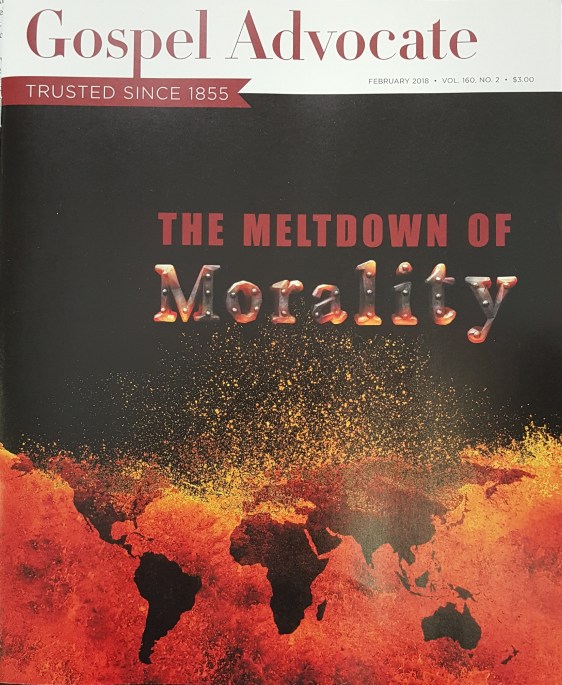
20180124_150851.jpg

Hebrews affirms, “For the word of God is living and active, sharper than any two-edged sword, piercing to the division of soul and of spirit, of joints and of marrow, and discerning the thoughts and intentions of the heart” (4:12 ESV). This is part of a warning in Hebrews, which affirms that Christians who defect from God will fail to meet their rest as their Israelite counterparts did (vv. 1-11). God holds his people —and His creation— accountable by His presence (“sight”) in the word of God (Hebrews 4:13). This is a raw incontrovertible truth.

This passage makes no caveats; it makes no attempt to remedy a distinction between God’s word and God’s presence. They are both manifested at the same time. God is involved with real life (time and space) with Israel and with Christians. God makes promises and keeps his word regarding their “rest,” and God holds His people and creation accountable to His word. God is Lord of heaven and earth and everything in between, and He holds it together by the power residing in Jesus (Hebrews 1:3; Colossians 1:17). The word of God is connected not only to the authority of God but also to His nature and how He reveals Himself to the world.

Let me say the above in a differently. Our God, who is beyond time and space (God’s transcendence), enters our earthly “realm” bound by time and space (God’s immanence) with His divinity and authority (sovereignty) intact; furthermore, God enters into relationship with His creation (Abraham, Israel, Christians) by revealing Himself in creation and in His word. God is active both in creation and in His word. Creation reveals God’s existence and hints at elements of His attributes (natural theology), but it is His word that reveals God and His “will” so that humanity can enter into covenant with God. The word of God was both proclaimed orally through particular spokesmen (patriarchs, prophets, kings, apostles), but the prophetic word was not only through oracles but also in written communiqués embedded with the same divine authority (2 Peter 1:16–21). These writings reveal the mind of God (1 Corinthians 2:11–16), His purposes and mystery (Ephesians 3:1–6), His involvement in human events (Acts 17:26–27), and the righteousness by which He will bring justice to the world (Acts 17:30–31).

To say it bluntly, the Bible is the word of God set in a permanent written form. Paul declared, “all scripture is breathed out by God” (2 Timothy 3:16). The Scripture bears the character of God and is no “dead” codebook, for it transforms every “man of God” into a competent, equipped servant (2 Timothy 3:17). The profitability of all Scripture is due to its quality as “God’s breath.” There is no pecking order between the spoken or written word of God. The inspired written word is as inerrant as God’s character. There is no source outside of the Holy Spirit-given Scripture that speaks God’s transforming work since it is the depository of the gospel’s message. What the word of God promises, God will do; what God proclaims, God’s holds His creation accountable to (1 Thessalonians 2:13).

The above may seem to belabor the point, but as anticipated by the title of this piece, we will sketch how the word of God is handled among Liberal (Modern) and Neoorthodox influences. It is essential for the church to reflect on these twentieth-century influences because dialogue is healthy, truth has nothing from which to hide, and any redefinition of biblical Christianity must be given due consideration (Galatians 1:6-7).

The following historical sketches will probably not satisfy everyone, but they will be enough to see their direction and how they redefine significant elements of historic Christian beliefs and their tendency to subvert scriptural authority.

Liberalism/Modernism

The word “liberal” is a very loaded word. It is often used with contempt to show disapproval of someone else thought to be progressive (instrumental music, expanded role of women, etc.). But this is not the historic sense of the word. Liberalism emerged in the late nineteenth century through the interplay of many players, thinkers, and philosophical trends. The influence of Liberalism, or Modernism, is seen in three levels: (1) revelation is not the final answer to reality, (2) naturalism is the key to reality and religion, and (3) since the Christian documents are built on ancient myths and superstitions, the historic supernatural claims of Christianity is immaterial. To be a “Christian” is a matter of experience and the “essence” of its teaching.

Liberalism, as an intellectual revolution, is a child of the Age of Reason (the Enlightenment). The “Age” saw the elevation of human reason over the institutional “church,” which wielded divine revelation. It was “the church” that dictated to the people what to believe about reality. Divine revelation was the final answer to determining truth and what really happened in the past. This was displaced with rationalism, scientific history (criticism), and naturalism as final answers to genuine and authentic history and truth. In essence, as Stanley Grenz and Roger Olsen point out, the maxim “I believe in order that I may understand” was turned to “I believe what I can understand.”[1] Faith was overturned by a reason informed by modern findings — thus, this point of view is called “Modernism.”

Everything that was received as genuine knowledge, now, was shaped by the natural world. This was further supported by what is called “the principle of analogy,” popularized by the liberal theologian Ernst Troelsch (1865–1923), which argued that the present is the best way to understand the past. The consequence was detrimental in the extreme on the trustworthiness of Scripture. The supernatural elements interwoven in Scripture are, by definition, myths and superstitions. This meant that there are no miracles, no supernatural interventions by God, and no resurrection of Jesus Christ. Thus, many new schools of “criticism” emerged to study Scripture with mixed results.

This naturally led to an embrace of “the essence of Christianity” so long as reason and experience allowed. “Liberals” are open to the modern findings from the natural world, open to a religious humanism and science —in particularly embracing Darwinian evolution as the process by which God created. If God exists, He could only be revealed through religious “experience.” It was also immaterial if the events of Scripture happened or not because religion is a condition of the heart. Yet, the apostle Paul makes it abundantly clear that if the resurrection event has not occurred, both our preaching and faith are in vain and we are still in our sins (1 Corinthians 15:14, 17).

Another arm of Liberalism is the demythologizing of the New Testament pioneered by the “Form Critic” Rudolf Bultmann (1884–1976). Bultmann argued that historic person of Jesus is built on untrustworthy sources. The New Testament is Christian propaganda shrouded in the imagery of the Greek myths and Roman legends. As such, they are not relevant for faith nor spiritual truth claims. It is the symbolism that matters. Today, one only need to watch the latest “history” programming to find modern theological liberals interviewed. Theological liberalism has significant questions that need to be answered, but it brings Christianity to a logical dead end.

Neoorthodoxy

The Swiss theologian Karl Barth (1886–1968) ignited a movement when he published his commentary on Romans in 1919. It charted a new theological direction away from Liberalism/Modernism. Barth (pronounced “bart”) was not fond of the misnomer “neoorthodoxy,” but his strand of thinking regarding the meaning of “revelation” and “the word of God” would rival the prevailing traditional belief held historically by the church. As a consequence, many regard Barth as one of the great theologians and the father of modern theology.

Orthodoxy affirms the teaching of historic Christian truth based on Scripture. This includes, for example, the following concepts: the inerrant inspiration of scripture, the triune Godhead, the deity and virgin birth of Christ, the historic creation and fall of humanity, the bodily resurrection and ascension of Christ, the return and final judgment. Barth argued, on the other hand, that “revealed truth” was not written, but was the outcome of an encounter (an experience) with God. Thus, instead of scripture as being the objective word of God, Barth argued for a subjective experience with God initiated by reading the Bible.

Barth was offering a completely different course of thought altogether. “Revelation” does not appear in the form of propositional truths. Arguing book, chapter, verse, or appeals to the very words of scripture is insufficient to reveal God. Revelation (the word of God), it is argued, is an “event” in which God acts in history (God’s immanence). Barth even argued that revelation is not found in natural theology (Acts 17; Psalm 19; Romans 1) but, instead, in events like the call of Abraham, the exodus, and the resurrection. Millard Erickson is spot on when he classifies Neoorthodoxy as an illumination theory divorced from an objective standard.[2]

Although Neoorthodoxy is not a unified movement, there are three interconnected witnesses (modes/forms) that shape its view on revelation.[3] First, Jesus is the word of God in the truest sense, for He reveals God in the event of His incarnation, life, ministry, death and resurrection. This is true revelation, the very gospel. Second, Scripture points to Jesus but it is a flawed human (read “errant”) attempt to provide a witness to divine revelation. It is instrumentally God’s word but not properly. Third, the proclamation within the faith community —Barth preferred “community” to church— is likewise instrumentally God’s word. The Bible, then, only becomes God’s word when God uses it to reveal Jesus Christ in the encounter, contrary to 2 Timothy 3:16.

In fact, Neo-orthodoxy is quite a popular approach to handling the Word of God, even among churches of Christ. A popular theological branch of this movement is “Canonical Criticism,” popularized by the late American scholar Brevard Childs (1923–2007). It seeks to broadly bypass much of the liberal destructive criticism of the twentieth century by accepting the texts of Scripture as literary units. Nevertheless, this point of view struggles, as did Barth’s, to embrace the Bible as a very human (errant) book while appealing to its authority for theological thought as if they were inerrant. They seek, in the words of one sympathetic Abilene Christian University professor, to “articulate a doctrine of Scripture that recognizes human flaws in it.”[4] Treating the Bible as an inerrant text is simply a form of bibliolatry.

Keeping the Faith

Today, the phrase “Word of God” means different things to different believers, and that includes preachers. Liberalism ultimately rejects a supernatural Christian faith, and is at home with amputating its historic claims of a resurrected ascended Lord Jesus, in exchange for a subjective diluted Christianity. Neoorthodoxy, on the other hand, embraces a supernatural Christian faith, but it rejects the supernatural origin, inerrancy, and authority of the Scriptures which undergird its claims. The Word of God has always been a manifestation of God’s presence in our lives, in His proclamation, and in His Scripture without pecking order. Let us join Paul who declares, “Let God be true though every one were a liar” (Romans 3:4).

Notes

  1. Stanley J. Grenz and Roger E. Olsen, 20th Century Theology (Downers Grove: InterVarsity, 1992), 17.
  2. Millard J. Erickson, Christian Theology, 3rd ed. (Grand Rapids, Baker Academic, 2013), 220–21.
  3. Karl Barth, Evangelical Theology: An Introduction, trans. G. Foley (New York: Holt, 1963), 26–36.
  4. Christopher Hutson, “Scripture as the Human Word of God: Why Faith Contradicts Inerrancy,” Lexington Theological Quarterly 44.1 (2011): 210–21. Hutson serves as a professor of ministry and missions at Abilene Christian University.

To subscribe to Gospel Advocate, click here.

The Divisions of the Bible: A Starting Place

The Bible is a library of 66 books, composed over a period of fifteen hundred years. The authors involved in this inspired anthology come from a variety of backgrounds, locations, historical situations, professions, and ethnicities.

While each book has its individual purpose, each work develops the overarching theme that humanity is the creation of an eternal Creator, and due to personal sin has fallen spiritually. This fallen state is addressed both historically and theologically in the development of the scheme of redemption, finally materializing in the ministry of Jesus.

In order to appreciate this history of redemption and the books of the Bible, it is vital to have a working knowledge of the divisions of the Bible. Moreover, a better understanding of the Bible improves one’s comprehension of sermons and Bible classes. The following is an extremely brief sketch of the Bible and its arrangement of content as we have it in our modern Bibles.

Chronological Divisions

The Patriarchal Period

The name of this period derives from the method God communicated his will, by speaking the “fathers” of the family (Adam, Noah, Abraham, etc.); hence, the term “patriarch” which means “the male head of a family” (Heb 1:1). The biblical content covering this period is Genesis 1-50 and Exodus 1-19, that of the creation and the fall, the flood, and the call of Abraham to be in covenant with God and to be the father of “many nations”.

Through the nation of Israel, God would bring about the redemptive “seed” (Jesus, Gal 3:15-16) to bless all the nations of the world (Gen 12:3). Moreover, this covenant promise was reiterated to Isaac (Gen 26:1-5), Jacob/Israel (Gen 35:9-15), and the children of Israel after the exodus from Egypt on Mt. Sinai.

The Hebrew Period

While technically the story of the Hebrews in the biblical record goes back to Abraham the Hebrew (Gen 14:13), as a major division of the biblical story the Hebrew period reflects the story of God and His covenant people Israel (cf. Acts 7:2-53). This period covers Exodus 20-Malachi, and the time period of the ministry of Jesus (Matt–John). The historical story of the Exodus transitions into the giving of the Law at Sinai.

During this period, Israel received “the law”, wandered in the wilderness for forty years, conquered and settled into the Promised Land, and transitioned from a theocracy (where God ruled through prophets) to a monarchy (where God ruled through kings). This period also covers the history of the divided kingdoms of Israel (North) and Judah (South) and their eventual demise. The kingdom and the covenant were both to be superseded by a new kingdom (Dan 2:44-45), and a new covenant (Jer 31:31-34); the design of which was to prepare the world for the coming of Jesus (Gal 3:19-29; Heb 9:11-28).

The Christian Period

The Christian Period technically begins upon the death of Jesus of Nazareth, when the “testament” came into effect (Heb 9:16-17); however, the teaching of Jesus as it anticipated the Christian era is found in the Gospel Narratives and occurred while under the Law of Moses was still in effect (Matt–John; Gal 4:4-6). Moreover, the confirmation of this “new” testament was accomplished in Christ by God in the resurrection from the dead (Rom 1:4-5; Acts 2:14-36; 1 Cor 15:1-11).

This period begins then with the establishment of Christianity in Jerusalem (Acts 2), and continues on through the expansion of the Christian faith not only geographically (Acts 1:8) but also ethnically (Acts 2:39, 10:28, 11:18). The Christian era will continue, time-wise, until the return of Jesus, at the Second Coming (Matt 28.20; 1 Cor 15:22-28); and at this time the present world will dissolve away and we will be with our God (2 Pet 3:8-13; 1 Thess 4:13-18).

Division of Books by Category

The following is a listing of the books of the Bible according to categories, along with a useful numeric memory tool to learn the divisions of each section.

The 39 Old Testament Books (5, 12, 5, 5, 12)

Books of Moses (5). Written by Moses to provide the origins of the human family, the Hebrew nation, and incorporates the Law of Moses (Genesis, Exodus, Leviticus, Numbers, Deuteronomy).

Hebrew History (12). Follows the story of Joshua and the conquest and settlement of Canaan to the rise and demise of the Hebrew Kingdom, and the exile into Babylon and their return (Joshua, JudgesRuth, 1-2 Samuel, 1-2 Kings, 1-2 Chronicles, Ezra, Nehemiah, Esther).

Hebrew Poetry (5). A series of volumes set in Hebrew poetic prose, written by a number of authors, designed to impart divine wisdom and perspective (Job, Ecclesiastes, Psalms, Song of SolomonProverbs).

Major Prophets (5). Popularly so-called due to the size of each work, and not for their spiritual value. (Isaiah, Jeremiah, Lamentations, Ezekiel, Daniel).

Book of the Twelve (12). Grouped together from ancient times, the “Minor” prophets are brief volumes that pack spiritual “punch” (Hosea, Joel, Amos, Obadiah, Jonah, Micah, Nahum, HabakkukZephaniah, Haggai, Zechariah, Malachi). Both the Major and the Minor Prophets are from various time periods, these works contain words of woes, judgments, and hope; moreover, they provide a great wealth of messianic prophecies.

The 27 New Testament Books (4, 1, 21, 1)

Gospel Narratives (4). Written to chronicle the teaching and ministry of Jesus of Nazareth, his rejection, crucifixion, and resurrection. Two of the four authors are apostles (Matthew, John), one is known to be an associate of Paul (Luke), and the other is believed to be of Peter (Mark).

Acts of Apostles (1). As the sequel to the Gospel of Luke, Acts covers the beginning of the church, and its expansion from Jerusalem to Rome, roughly a period of some 30-plus years.

Apostolic Letters (21). Written to churches and individuals teaching and exhorting Christians to live faithful; furthermore, the letters address false teachings and local issues (Roman, 1-2 CorinthiansGalatians, Ephesians, Philippians, Colossians, 1-2 Thessalonians, 1-2 Timothy, TitusPhilemon, Hebrews, James, 1-2 Peter, 1-3 John, Jude).

Revelation (1). Addressed to seven churches in Asia, this final “revelation” is a message of victory of God and His people over their enemies. It is rich in apocalyptic language, much like Daniel, Ezekiel, and other prophetic books.

Concluding Thoughts

When Vince Lombardi took the helm of the coaching staff of the Green Bay Packers, it is said that he gave a speech that established clearly the importance of the basics. It runs as follows:

Everybody stop and gather around,” he said. Then he knelt down, picked up the pigskin, and said, “Let’s start at the beginning. This is a football. These are the yard markers. I’m the coach. You are the players.” He went on, in the most elementary of ways, to explain the basics of football.

The team became very successful, and this anecdote reminds us of the importance of getting back to basics. Understanding the fundamental components of the Bible is essential to obtaining the wisdom needed to know what to do to be saved (2 Tim 3:13-14). May we all be so blessed.


Church: A Preliminary Survey

With so many “churches” in the religious world, people interested in visiting one are often sidelined by the inevitable question, “which church should I go to?” After all, there are as many “churches” as there are potential opinions on what a church should be like. But where should a person begin as they search for a church, should they simply jump out on a whim? Hardly.

Searching for a church should be a reverent endeavor, especially since in the New Testament the “church” is said to have been “purchased” by the very blood of Jesus Christ (Acts 20.28). Consequently, if the church was that important to Jesus and the Father, those seeking to “go to church” should realize this spiritual venture should not be taken lightly.

Where then might a person find the necessary perspective from which to begin this search? The relevant information is found in the New Testament documents, the documents which record the formative forces which began the church in the first place; moreover, the New Testament provides ample information about how people became members of the blood-bought church of Jesus, along with important church organizational references.

This piece is a primer, in a sense, on the nature of the church. There are many ways that this topic can be addressed. But, nevertheless, below are some relevant points to glean from the New Testament on the topic of the church of Christ (Rom. 16.16).

The New Testament Documents

In the New Testament, from the beginning to end, the thought and actual fact that the saved existed as a collective known as the “church” or body of Christ is clearly self-evident (Matt 16:18 and Eph 1:22, 23, 4:4; Acts 2:47). Consider a sample of the New Testament documents.

There are four accounts of the ministry of Jesus, they are called Gospels. The term “church” is found only in the Gospel of Matthew, particularly in chapters 16 and 18. In chapter 16, Jesus speaks of building His church – “my church” (16:18). He explains that death (Grk. hades – not hell, contra KJV) will be incapable of deterring his plans to bring His church into reality.[1] In chapter 18, verses 15-17 describe the disciplinarian process regarding a Christian brother living in sin, and hence, needing private correction. The final stage is to bring the sin to the public forum by telling it to the church, with the intention that it can act as a loving measure of leverage to pressure the brother to quit the sinful practice. Thus, in Matthew Jesus speaks of his church in two ways: (1) that it will be built (Matt 16:18), and (2) as the ultimate forum for maintaining moral purity among God’s people (Matt 18:15-17).

The Acts of the Apostles is the inspired historical account of the church – albeit a history with a theological focus. It is most definitely a primary source for the church, and therefore a logical document to examine in order to find the biblical church. To save space, consider what we find in only the first half of Acts (Acts 1-12). We find it was “the church”[2] that had become fearful after the Divine retribution against Ananias and Sapphira was administered by the Lord (Acts 5:11); the object of Saul of Tarsus’ brutal obsession was “the church” anywhere it assembled (Acts 8:1, 3; cf. Gal 1:13); it was “the church” at large in Samaria and Judea that enjoyed peace when the persecuting Saul became the believing Paul (Acts 9.31).

We find Barnabas and Paul (Saul) laboring in “the church,” particularly in Antioch of Syria,[3] and labeling the disciples (i.e. the individual members of the church) Christians (Acts 11:22, 26); several members of “the church” suffered persecution under the hand of King Herod (Acts 12:1, 5); “the church” in Antioch of Pisidia had prophets and inspired teachers, and sent Paul and Barnabas out to accomplish their first missionary call (Acts 13:1ff.); Paul and Barnabas had appointed elders in every “church” they established on their missionary labors (Acts 14:23), and upon their return to Antioch they recounted they travel to “the church” (Acts 14:27).

The largest sub-category of the New Testament documents is The Letter (also commonly styled, “epistle”) – 21 letters to be exact.[4] They are further divided by the prophets which God employed to pen them: Paul (13 letters), John (3), Peter (2), James (1), Jude (1), and the unknown author of the Letter to the Hebrews. This is a vast amount of literature to scan, but we can reflect on the following citations of “the church” among the letters and observe that “the church” is the redeemed body of Jesus believers. It goes without saying – at least it should be by students – that the New Testament Letters assume their audience is the redeemed body of Jesus disciples.

Ancient letter writing etiquette had the author’s name first and then the recipient’s name; thus, we read, “from me… to you.” When Paul wrote his letters, he often addressed the recipients with the nomenclature “saints” (cf. Rom 1:7; 1 Cor 1:2; 2 Cor 1:1; Eph 1:1; Phil 1:1; Col 1:2). The term “saint” is the general description of all members of “the church” in the respect that they have been sanctified in baptism, and this sanctification continues in obedience shown by a holy life (Matt 26:28; Acts 2:38; 1 Cor 6:11-13; 1 John 1:6-7). The “saints” are members of the church viewed from the perspective of consecration. In fact, many times the letters begin like this: to the church with the saints.

Some appear to use Jewish terminology, like James and Peter, to describe the people of God. The letter of James is written to “the twelve tribes in the Dispersion” (1:1); meanwhile, the audience for the Letters of Peter (if to the same audience) is depicted in the following way: “To those who are elect exiles of the dispersion” (1 Pet 1:1). However, in Peter’s second letter, he speaks of his audience as “those who have obtained a faith of equal standing with ours by the righteousness of our God and Savior Jesus Christ” (2 Pet 1:1). It seems like the language applies the covenant aspect that biblical Israel had with God, and here it is applied in a new way to demonstrate that Peter’s audience is the new covenant people of God (Jer 31:31; Heb 8:13). These are members of the biblical church.

The Letter of Jude addresses his recipients with the nomenclature “called” and “beloved” (vs. 1). Their calling seems from the simple fact that they received their invitation (a clearer meaning of the term, kleitos translated “called”) to share the “common salvation”. Moreover, they received access to the love of God actuated in the redemption of their soul accomplished through Jesus Christ, thus, they are the beloved of God. What Jude emphasized that their identity was related to their Divine relationship through obedience to the Gospel. For our purposes, we are to understand that these “saints” and “beloved” ones are members of the New Testament church.

The First Letter of John, much like Hebrews, does not begin in the traditional letter format. Some describe them as tractates or some larger form of literary work sent as a letter. Nevertheless, John assumes a relationship – a fellowship between the apostolic circle, God, and themselves – that is based on obedient living and faithful confession of sin as they strive to live a disciplined life (1 John 1:1-10). They already are in this relationship, they are saved. Again, in Hebrews 2:1-4, the evidence is provided regarding the recipients. They are encouraged to remain vigilant, not neglecting their salvation which was shown to have a supernatural origin. Likewise, these recipients are members of the biblical church.

The last document in the New Testament is the Apocalypse, the Book of Revelation. The document opens up with these words: “John to the seven churches that are in Asia” (Rev 1:4). In the doxology, it is Jesus “who loves us and has freed us from our sins by his blood, and made us a kingdom, priests to his God and Father” (Rev 1:5-6). The audience, the churches, share salvation and the love of God, are part of a kingdom, and share involvement in the priesthood of God. The message of Revelation is the victory over the enemies of God as it is revealed in the inability of these satanic forces to prevent the faithful saints from entering the New Jerusalem, wherein lies the tree of life (Rev. 22.14). The brief but spiritually dense letters sent to the churches of Asia in Revelation 2 and 3 show among other things, the audience intended for the prophecies embedded into the fabric of this symbolic book. They assume that the recipients are already Christians, members of the church.

The picture should be clear that the New Testament is a collection of 27 books which speak to or about the church of Jesus Christ. Consequently, anyone looking for a church should reverently approach the prospect with the New Testament as the guiding source for determining what the church that God established should look like and be like.

The Church: A Brief Word Analysis

We may survey some of the information from the New Testament regarding the “church” and the redeemed which make up the “church”, but what does “church” mean? The term “church” is the most common, though unclear, translation for the New Testament Greek term ekklesia. Often times, “church” is thought of as solely “the building” in which a person congregates with others to worship God; however, ekklesia does not refer to a building – hence, “church” is an unclear translation if not misleading altogether. But the term is so commonplace that it need not be shelved; after all, even modern dictionaries have various nuances for the word “church.”

The English word “church” has a peculiar history that demands some attention. Hugo McCord (1911-2004) – professor, translator, and preacher – briefly summarizes the history of the word:

Historically, the English word “church” comes from the Middle English “cherche” or “chirche,” which is from the Anglo-Saxon “circe” or “cyrce,” which is from the German “Kirche,” which is from the Greek kuriakos, meaning “belonging to the Lord.” Webster says that the Greek word doma, “house,” has to be added to kuriakos to make the word “church,” that is, a “church” is “the Lord’s house.”[5]

McCord further observes that only twice does kuriakos – “the Lord’s” – appear in the New Testament (“the Lord’s supper” 1 Cor. 11.20; “the Lord’s day” Rev. 1.10), but in neither case is the phrase “the Lord’s house” ever employed.[6]

Basically, the etymology of the word translated “church” (ekklesia) derives itself from the adjoining of two words, ek and kaleo (ek-kaleo “call out”), into one verb originally “used for the summons to an army to assemble.” As a noun, ekklesia, denoted “the popular assembly of the full citizens of the polis, or Greek city state” (cf. Acts 19:32, 41).[7] This is, in a nutshell, the Greek background of the word beneath our religious word “church.”

Its existence in the Old Testament is due to the Greek translation of the Hebrew Scriptures. In the Septuagint (abbreviated LXX), ekklesia appears about one hundred times and is frequently employed to translate the Hebrew term qahal.[8] It is not so much the frequency to translate qahal which is intriguing; instead, it is the regularity of the context when ekklesia is employed which should attract contemplation. O’Brien writes:

Of particular significance are those instances of ekklesia (rendering qahal) which denote the congregation of Israel when it assembled to hear the Word of God on Mt. Sinai, or later on Mt. Zion where all Israel was required to assemble three times a year.[9]

Interestingly, the Hebrew writer similarly speaks of the redeemed in Hebrews 12:22-24. Thus, a raw translation of ekklesia may suggest the meaning to be, “the called out ones.”[10] In the biblical tradition, however, it seems better to emphasize that it carries the spiritual depiction of an assembly of God’s people prepared to hear and be led by His word in the covenantal sense.

Stephen, the first Christian martyr, recounts how Israel was an ekklesia during the forty years of wandering in the wilderness due to their rebellion and lack of faith (Acts 7:38). And it was during this time that they were taught how to depend upon the Lord. The beautiful and yet tragic relationship between the faithful God and his unbelieving nation is set forth clearly in Psalm 78 (cf. Hos 11:1-9). The Lord’s goal was to “shepherd” and “guide” them with his powerful word and through the demonstration of his presence.

With regards to the Lord’s church which Jesus promised to “build,” it is important that we consider these thoughts in our understanding of the kind of church Jesus was thinking of; as a consequence, it should guide our assessment of how “church” should behave. Individuals gathered together to hear and abide in his teaching, so that in it, they may be shepherded and guided (1 Tim 4:13). Meanwhile, leadership in the church (i.e. elders/shepherds) is to be “able to teach” and “manage” his household, and use these skills as he executes his God’s appointed office (Acts 20:28, 1 Tim 3:1-5). When the church considers this relationship and responsibility and embraces its challenge, we will be taking strong steps to finding a congregation of the Lord – a church of Christ.

Conclusion

We find in the New Testament a consciousness the early Christians held regarding the church. Jesus was to build his church, and after his death, the church began in Jerusalem and spread throughout the Roman world through Judea, Samaria, and to the furthermost extents of known Roman world (Acts 1.8ff). As the church expanded, the apostles and other inspired authors wrote to Christians regarding the ministry of Jesus and concerning Christian living.

Through these documents, important information is related to the nature of the church. Anyone searching for a “church” to attend should not settle for any church but should study the New Testament reverently identifying the nature of the church revealed in its pages.

When examining the English word “church” we find that we are not talking about a building, but instead, the emphasis should be placed upon an assembly of people. These individuals are assembled to hear the word of God, and make those Divine words translate into everyday action – everyday living. Only until we hear and practice the Word will we become the church (ekklesia) of Christ.

Endnotes

  1. The King James Version (a.k.a. the A.V.) is quite misleading here, for the Greek text reads pulai hadou – literally, “the gates of hades.” The Analytical-Literal Translation of the New Testament (ALT) has the following descriptive rendering of the passage,”[the] gates of the realm of the dead [Gr., hades] will not prevail against it” (ATL Matt. 16.18).
  2. Again we disagree with the A.V./KJV-Byzantine tradition in Acts 2.47, where the word “church” (ekklesia) is part of a variant reading of the text. Instead, we agree with others who find that the ending better reads epi to auto, a phrase often used to refer to the “Christian body” in a collective sense (Acts 1.15; 2.1, 47; 1 Cor 11.20; 14.23; Bruce Metzger, A Textual Commentary on the Greek New Testament, 2d ed. [Germany: Deutsche Bibelgesellschaft, 2001], 264-65).
  3. Antioch of Syria is not to be confused with the Antioch of Pisidia in Asia Minor. BiblePlaces.com has good images of both Antioch of Syria (link) and of Pisidia (Link).
  4. Technically, there are a few more letters in the New Testament record, but each is embedded in other books. For example, the book of Acts has two letters (a) 15.22-29, and (b) 23.23-30; and, the book of Revelation has seven letters to the church of Asia (Rev. 1-3).
  5. Hugo McCord, The Everlasting Gospel: Plus Genesis, Psalms, and Proverbs, 4th ed. (Henderson, TN: Freed-Hardeman University, 2000), 696. This edition is known also as FHV4.
  6. McCord, The Everlasting Gospel, 696.
  7. Peter T. O’Brien, “Church,” DPHL, 123.
  8. O’Brien, “Church,” 124; TDNT 3:527; BDAG, 303.
  9. O’Brien, “Church,” 124.
  10. Etymologically, ekklesia does suggest that individuals were “called out” from their lifestyles by the Gospel (2 Thess 2:14). There is obviously a separation that occurs (2 Cor 6:17, 1 John 2:15-17). These etymological considerations corroborate with New Testament teaching on the church. However, the word has a richer heritage as is seen in its Old Testament use of the Greek language. These aspects must be appreciated in balance with each other.

Suggested Reading

  1. Wayne Jackson, “The Origin of Christianity,” ChristianCourier.com.
  2. Wayne Jackson, “The Restoration of First-Century Christianity,” ChristianCourier.com.