Rise of Empires: Persia and Rome in Profile

[Note: In light of the fact that both Persia and Rome are significant empires integral to the biblical narrative in both the Old Testament (Persia) and New Testament (Rome), sharing this historical background paper may be helpful to gain a broad appreciation of these empires. Obviously, this is only a rough sketch of these two global ancient empires.]

There are many areas to evaluate and examine ancient empires. In this paper, the Persian and Roman Empires will be evaluated based on their similarities and differences. This will be done by considering four lines of comparisons and contrasts.

First, I look at the rise of the Persian and Roman Empires, then, the political and economic bases that sustained each empire. Third, I consider the impact of environmental factors upon Persia and Rome and conclude with the major internal and external challenges that Persia and Rome confronted and how they were resolved.

These areas of discussion will be considered in light of class lecture notes[1] on the Persian and the Roman Empires respectively, and the related sections of Craig A. Lockard’s book, Societies, Networks, and Transitions: A Global History, 3rd edition (abbreviated SNT).[2]

The Rise to Empire

Persia. The rise of the Persian Empire is connected to its expansion through conquest. In the seventh century B.C.E., the Persian kingdom competed against the Medes until Persian dominance displaced them. The Persian kingdom begins significant expansion during the reign of Cyrus II (Cyrus the Great) in the sixth century B.C.E. (r. 550-530) and Cambyses II (r. 530-522 B.C.E.). These kings were members of the “ruling family” known as the Achaemenid and they reigned during the “peak” of the classical Persian Empire (SNT 140). Then, King Darius I (r. 521-486 B.C.E.) who usurped the throne continued Persian expansion on to the time of Xerxes I (r. 486-465 B.C.E.). 

In a period of fewer than one hundred years, the small coastal Persian kingdom expanded through conquest to include Afghanistan, western India along the Indus River, and Central Asia in the east; in the west, their geographic control included Mesopotamia, Syria, Palestine, Egypt, and all of Anatolia including the most western Anatolian kingdom of Lydia.

Rome. Concerning the rise of the Roman Empire, the expansion through conquest does not occur during the imperial period (31 B.C.E.-476 C.E.), but instead during the period of the Republic (509-31 B.C.E.).

As Map 8.2 in SNT (169) demonstrates, there was still unrest in certain areas of the Empire despite the Pax Romana (13 B.C.E.-180 C.E.); moreover, territories were still being added to the Roman Empire by the death of Emperor Hadrian (138 C.E.). The vast geographic territory touching the Mediterranean Sea (southern Europe, Greece, Anatolia, northern Africa, Egypt, etc.), however, is not technically the product of the Roman Empire (SNT 165).

The rise of the Roman Empire is more the result of political maneuvering away from a representative government towards a government of concentrated power in one man. This maneuvering begins with Julius Caesar.

Caesar is a victorious general who desires to become a member of the Republic Senate and was named Dictator upon arrival in the city of Rome. He violated the traditions of disarming at the city limits and the military one-day celebration to show the spoils of war; instead, Caesar crosses the Rubicon river armed, and celebrated for three days. Consequently, the senate responds to his actions by assassinating him. This ushered in a political civil war, where Caesar’s adopted son (nephew) Octavian and the allies of Julius Caesar take revenge upon all the assassins and their families, confiscate lands, and even kill slaves.

Octavian ultimately would become the first Roman Emperor, renamed himself Augustus, and reigned for approximately forty-one years (r. 27 B.C.E.–14 C.E.). The consequence was the loss of democracy, the rise of consolidated power, and as Juvenal notes distractions (“bread and circuses” SNT 168).

Thus, the rise of these two empires is seen from two different arcs. With Persia, the kingdom becomes an empire through traditional means – conquest and domination. The Roman Empire emerged due to political maneuvering rather than conquest. Yet, the rise of these empires emerges from a similar source: a small region or city that becomes a dominant world power.

Politics and Economics

Persia. Lockard describes the Persian rule during the imperial expansion as an “autocratic but culturally tolerant government” (SNT 141). In general, then, the diplomacy strategies of the Persian kings provided codified and humanitarian laws, kind economic policies, provincial governments, and expressed religious and social-cultural tolerance toward the peoples they conquered by force. Cyrus II (the Great) issued what is often called the first charter of human rights, and Darius I provided a codified law similar to that of Hammurabi.

The provinces were governed by a satrap (“protector of the kingdom”) who enforced established laws and paid taxes yearly to the king (SNT 143). Also, the religious and social-cultural tolerance shown to the diversity (language, religion, territories) of the growing empire is thought of as “most crucial” to its political success since it allowed Persia stability and flexibility not only in governing but also in battle and in commerce. Xerxes, however, was a less tolerant and more burdensome king (SNT 145).

Economically, other elements complimented Persia’s political success such as Darius completing the first Suez canal which temporarily unifies the Mediterranean Sea to the Red Sea, thus expanding the land-based commerce of Persia (e.g. the “royal road”) to also include maritime trade from the west to the east. The trade routes not only reinforce the economic forces of the Persian Empire but also extends the political power of its aristocracy.

Rome. The Roman Empire, on the other hand, saw unquestioned control of the Mediterranean for nearly a century and a half (27 B.C.E.-180 C.E.) following the emergence of Caesar Augustus. This is known as the Pax Romana (Roman Peace). By the first century C.E., Rome was a multinational, diversely populated empire. Despite this diversity, there was equality under Roman law and emphasized personal responsibility before the law. It is believed that Stoicism, a Greek philosophy, influenced Roman law in its policies of tolerance, moderation, and acceptance of life (SNT 168).

Meanwhile, the economic bases of the Roman Empire came from its growing trade routes and industries which took advantage of its maritime technologies and routes, and its vast networks of Roman roads across land extending over 150,000 miles (SNT 171). The trade routes on land not only connected Europe, Greece, Anatolia, and Egypt, but Rome made contact with India on the Silk Road, and even with China. Unfortunately, overconsumption and lack of productivity from the western part of the Empire would overburden the economic system, inflation would be a problem, and expensive conquests would deplete the mines and the farmlands (SNT 172).

Thus, the political and economic bases of Persia and Rome faced similar challenges of managing a multinational population and a vast expanding trading network. They both extended a measure of political toleration and equality, and both took advantage of land-based and maritime trading and commerce. Yet, in Persia it would appear that the policies of intolerance would hurt the empire; meanwhile, in Rome, it would be the overconsumption of its scarce resources, and a lack of fiscal responsibility that would hurt its political and economic future.

Environmental Factors

Considering the environmental factors of both the Persian and Roman Empires, respectively, geography is crucial. Map 7.1 in SNT (142) demonstrates some topographical elements of the geographic environment of the Persian kingdom and the breadth of the Persian Empire at its height (cir. 500 B.C.E.).

The Persian homeland was on the northwestern shore of the Persian Gulf and would suggest the potential to have some maritime trade and quite possibly some naval strength needed to control those waters. Persia would then have some connection to India, China, and Egypt. It would also probably have rich fisheries. However, on its northern borders, the Persian kingdom faces the Zagros Mountains and other mountain ranges. It is therefore landlocked on this side. The Persian kingdom also would then have depended upon land-based trade.

When the imperial expansion occurred, trade opportunities were strengthened along newly controlled waterways (Indus River Valley, Suez, the Mediterranean Sea, etc). It may be observed that many of the environmental factors that shaped Persia were overcome through expansion as a result of conquest.

Based on Map 8.2 in SNT (168), there would be a tremendous impact of environmental factors upon the Roman Empire.

First, the fact that the Mediterranean Sea is the center of the Roman Empire suggests its importance in shaping the environment of Rome. There would be fishing, and fisheries, maritime travel and trade, maritime technologies, and naval capacities. There would also imply that the world would be more connected due to maritime travel.

Second, the mountainous European lands like Greece and Italy would also imply that it would be possible to be landlocked in various places, so on land, there would be difficulty in travel and communication. The valleys and small communities would also be a natural place for the growing of grapes and shepherding. This would suggest then wool, fabrics, textiles, and dairy products. The environmental factors of the Roman Empire would also imply the sharing of many ideas from the farthest parts of their world.

Thus, both the Persians and the Romans had experienced due to their environments maritime travel, trade, and diet. Rome however appears to have had more diversity in land-based production in dairy, wool, olive trees, and vineyards.

The Challenges of Empire

Every political system and government has pressures working on it from within and from outside. For all their success, the Persian and Roman Empires are no different.

Persia. Persia faces significant challenges, particularly during the reign of Xerxes (486-465 B.C.E.), son of Darius I, which will ultimately weaken the empire. Xerxes inherits a larger kingdom after his father’s conquests, but it comes with growing unrest among the Greek-speaking communities in the west which do not like Persian rule. The Scythians and several Ionic coastal cities become increasingly rebellious and Xerxes is forced to deal with the expensive task of shutting down their rebellion. Xerxes does so and desires to completely conquer the divided and weak Grecian peninsula; but, what should have been a “cakewalk” ends in an epic failure.

Moreover, Xerxes’ reign represents a significant shift towards intolerance, internal Achaemenid strife, and financial instability. Xerxes and his successors “unwisely reversed” the policies which had brought about the Persian Empire’s greatest strengths and flexibilities (SNT 145). The weight of these policy shifts weakened and exacerbated the empire internally and externally, and as a consequence, concluded with Alexander the Great’s conquest of the Persian Empire in 330 B.C.E.

Rome. Rome, as well, faced major internal and external challenges. As mentioned above, later in the Roman Empire there were significant political and economic problems that undermined it. As a result of an over-reliance upon soldiers, the emperor would eventually come from soldier-backed emperors and this transition did not come without consequences.

For example, “none died peacefully in old age” (SNT 172). Yet, also, conquests would end due to the overconsumption of natural and agricultural resources. Externally, Rome would face in its declining years the rise of the Celtic and German societies in Europe. These societies exhausted Roman military resources, especially since Romans could not raise enough taxes to pay for soldiers to fight them off, especially the Germans (SNT 172-173).

Thus, the internal and external conflicts seem more focused on the Empire during the days of Xerxes when there was a reversal of policies away from tolerance and goodwill towards its subjects. Instead, there was internal unrest and military embarrassment in his failure to conquer the Grecian peninsula. Meanwhile, Rome struggled with political shifts as well, but it suffered tremendously due to mismanagement of natural and financial resources, and the unrest generated by the Celtics and the Germans.

Observations

In conclusion, there are few observations that can be made regarding the similarities and differences between the Persian and Roman Empires.

First, while the Persian Empire rose to world power through traditional means of expansion through conquest, the Roman Empire emerges due to political maneuvering and the transition from a representative government to one of consolidated power in Caesar.

Second, the political and economic bases that sustained the Persian and Roman Empires demonstrate similar demands for managing multinational populations under their rule and the economic capacity to trade and connect to other nations, but each empire succumbed to undermining what made it strong. For the Persians, it was their political tolerance and for the Romans, it was their lack of restraint with their resources.

Third, both the Persians and the Romans had experienced due to their environment: maritime travel, trade, and diet. Rome however appears to have had more diversity it land-based production in dairy, wool, olive trees, and vineyards.

Fourth, the internal and external challenges which confronted Persia and Rome are similar in that are rooted in policy changes and military interaction with outsiders. In the case of Persia, it was a drastic change in policy, while in Rome’s case it was a lack of management.

Endnotes

  1. The class lectures referenced here are from Professor Ann Wiederrecht, Bakersfield College. The citation format/style for the paper will remain as submitted (cf. SNT, page).
  2. Craig A. Lockard, Societies, Networks, and Transitions: A Global History Volume 1: To 1500, 3rd ed. (Stamford, CT: Cengage Learning, 2015).

A Brief Look at Patronage as Background for the New Testament

college papers

The present study is an inquiry into the interconnected reciprocal nature of patronage in the Greco-Roman imperial social setting, as one background component from the New Testament world. One would be wrong to think that such a social dynamic’s presence was minimal. In actuality, patronage and its vocabulary not only appears specifically in the New Testament (Luke 22:25; Acts 10:38; Rom 16:2; Philm 17-20, Phil 4:14-20, etc), but the social reciprocal dynamics in which its value and cultural powers are also assumed (shame, honor, unity, gratitude, fellowship, etc.). The reader who knows what to look for will see it in numerous contexts shaping the life of the body.[1] Unfortunately, the many elements vital to the matrix of patronage can only be pointed to. Yet, as Bruce J. Malina observes, it was “the most significant form of social interaction in the limited-good world of the first century is an informal principle of reciprocity, a sort of implicit, non-legal contractual obligation, unenforceable by any authority apart from one’s sense of honor and shame.”[2] The challenge in this paper is to briefly and accurately describe it.

In seeking to understand the New Testament accurately, scholars propose various exegetical principles and contextualizing models to accomplish this task.[3] The process here requires an approach which appreciates the cultural background of the New Testament to contextualize its vocabulary. This, Albert A. Bell reminds, is the “crucial part of understanding any written text.”[4] Greco-Roman words have a socially conditioned context that the modern reader may not readily identify. “Without a comprehension of the sociological dynamics of that world, our understanding… is terribly superficial at best and woefully mistaken at worst.”[5] The most crucial need for the reader of the New Testament, then, is to be able to bridge the cultural and time gap between the original (native) context and the reader’s contemporary context. This linguistic and cultural divide can be managed. In advancing a cultural-anthropological reading model, Jerome H. Neyrey argues that one can avoid ethnocentric and anachronistic readings of Paul (and the New Testament) by appreciating the difference between reading him as member of the same culture (an emic reading), and by reading him informed by the analytical and descriptive works of specialists and ethnographers (an etic reading).[6] As one gets closer to this “emic reading,” the modern reader comes closer to better appreciate the symbolic universe of Paul’s and Jesus’ culture.[7] The goal here is to gain a realistic perception from “native informants” which can illustrate and contextualize patronage as a Greco-Roman phenomenon.[8]

The presentation to follow will demonstrate how significant the social form of patronage was in the daily life of the Greco-Roman world, it will outline the vocabulary of patronage in Latin and Greek primary sources, it will sharpen this outline to differentiate between political and social patronage, and then offer a realistic scenarios that can illuminate reading the New Testament in its social and cultural world.

Daily Significance of Patronage

In modern analogy, patronage was like an ancient informal “welfare system.” Social services, like the modern model of the United States, would have been quite foreign. Instead, patronage was a cultural phenomenon in which there was a reciprocal relationship between the upper class and the lower class. It benefited lower classes with protection and patronage by means of reasonable support (legal, financial, medical, marital, etc.) for public support, the running of errands, odd jobs, escorting through streets, and providing social honor in exchange (a return). In exchange for the daily allowance (sportula), the client was at the patron’s call. Thus, it was a form of social investment between patron-client; interestingly, even slaves of wealthy households were known to have clients who hoped the slave could use their influence upon their master.[9] Greco-Roman and Christian scholarship is unequivocal about the daily and social significance of the patron-client network of relationships.[10]

Martial, in his colorful Epigrams, clocks what city life was like in the urbs (4.8.1-4): “The first and second hours wear out clients greeting their patrons.” The imagery evokes the crushing nature of the daily dependence of clients upon their patronus. A step further, Juvenal shows how important this allowance of money was for the everyday professional and collegia with his sarcastic words in the Satires (1.95-126):

For no deity is held in such reverence amongst us as Wealth; though as yet, O baneful money, thou hast no temple of thine own; not yet have we reared altars to Money in like manner as we worship Peace and Honour, Victory and Virtue, or that Concord that clatters when we salute her nest.[11]

This fits the common view that the patron-client phenomena were important to the daily life of every social stratum of the Greco-Roman world. To this point, Jérôme Carcopinodescribes that whether employed or unemployed, freedman or the parasite do-nothing, aristocrats or lower plebeians, clients “were no sooner out of bed than they were in the grip of the duties inseparable from being a ‘client.’ […] there was no man in Rome who did not feel himself bound to someone more powerful above him by the same obligations of respect, or, to use the technical term, the same obsequium.”[12] This honor-bound relationship allowed those in various professions and collegia to survive by means of this small daily “dole as their main source of revenue.”

Patronage in Latin and Greek Sources

Extant Greek and Latin sources (literary and epigraphic) speak of patronage, benefaction, and euergetism (good-doing) from political and social perspectives. Ideas such protection, assistance, help, advocacy, and philanthropy appear. Consider the following samples. It seems that patronage was initially borne out of political power and civic duty, but that distinction apparently broke down over time into a social network between the upper and lower classes in the Greco-Roman world among the rich, the poor, the freedman and freedwoman.[13]

The Roman historian Livy stretches back about four centuries to the early Roman Republic and recounts the story of Cincinnatus, the famed aristocratic plebeian consul, turn poor plebeian farmer, turn dictator, turn savior of Roman (History of Rome 3.26-29). According to Livy, his actions as dictator were reciprocated with honor and status. Livy frames (stylizes?) the response of the army as recognizing “the benefit [beneficii] they had received at his hands,” honored him with a golden crown, and “saluted him as their protector [patronum salutaverit]” (History of Rome 3.29.3). They had become his “clients,” and Cincinnatus would use this social bond to his advantage to “clear” the charges against his son Caeso who was on the run for charges of murder. The protector of Rome, then, returned his powers of dictator and returned to the rustic farm life. Later, when Augustus consolidates his power, Tacitus recounts his use of “gratuities” (donis) among the military and the poor (Annals 1.2). Michael Grant[14] interprets this as Augustus letting “it be understood that the old institution of patrons and clients had been recast, so that henceforward all the people were his own, personal clients, including the poorest citizens.” Thus, as principis Augustus and the emperors after him would portray (politically?) to the citizens of Rome and its subjects a bond of reciprocal loyalty.

Greek sources also illuminate various aspects of patronage. In the fifth century BCE, Sophocles frames the tragic Oedipus as gratefully exchanging protection from Thebes and “help [prostátisi] of the dread goddesses” who reigns in their districts, with obtaining “a great savior [sōtēr’] for this city, and troubles for my enemies” in him (Oedipus at Colunus 455-460). The Apocrypha[15] likewise points to the political upheavals in the Maccabean storyline connected to concepts of patronage. In 2 Maccabees, Simon slanders Onias, who is designated “a plotter against the government the man who was the benefactor [tòn euergétēn] of the city, the protector [tòn kēdemóna] of his compatriots, and a zealot for the laws” (4:2).[16]

In 3 Maccabees 3:13-29, “King Ptolemy Philopater” declares to his “generals and soldiers” that despite his goodwill (philanthrōpía), a desire to do good (eū poiēsaí), and to honor (timēsai) in the Jewish temple (3:15-17), the Jews “manifest ill-will toward us” and are “the only people among all nations who hold their heads high in defiance of kings and their own benefactors [euergétais], and are unwilling to regard any action as sincere” (3:19). The accommodative and benevolent king (philanthrópōs 3:20) declares that such rebellious Jews should be arrested, bound, and deported and that any who harbor them should be severely punished (3:25-29). Eventually, Philopator descends upon the Jews but is subdued by two angels. The king breaks down to pity and tears, and blames and threatens his “friends” (toís phílois):  “You are committing treason and surpassing tyrants in cruelty; and even me, your benefactor [euergétēn]” (6:24).

Political and Social Patronage in Rome

In the Greco-Roman world of the first century CE, there appears to be evidence distinguishing between political and social patronage. This can be confusing since sources often use terms like benefactor, euergetes, and patron in the process of discussion. The masculine form of the Greek prostát– (see verbal use above for “help”) is somewhat problematic. It is often considered synonymous with the Latin patronus. Interestingly, the New Testament the feminine form προστάτις is used in Romans 16:2 and translated as patron and benefactor (ESV; NIV, NRSV, HCSB). Erlend D. MacGillivray[17] takes exception to the view that these two forms are completely synonymous. The masculine appears in both Attic Greek and in the Roman Empire and carries both legal and a variety of leadership benefaction roles, but not the feminine form. MacGillivray argues that applying the masculine meaning upon prostátis is exegetically problematic for this reason. Benefaction is in view, but one must distinguish between political patronage from some interpersonal social networking.

MacGillivray argues that understanding prostátis depends, then, upon understanding the fluid nature of ancient Mediterranean reciprocal dynamics, recognizing the patron-client model is far too limiting and misleading. There is a difference between the narrow and nuanced meaning of classical patronage and the broad euergetistic/altruistic benefaction. While epigraphical gratitude evidence shows that prostátis and prostátes imply civic prestige, the nature of the evidence is, however, often weak to force synonymity. Part of the problem stems from the near normative templates in honorary Greco-Roman epigraphs that do not always neatly distinguish between the various kinds of patronage. Thus, the presence of these terms do not prove exclusively a classical patronage/patronus; consequently, MacGillivray’s work argues that prostátis and prostátes are not demonstrably synonymous.

R. A. Kearsley[18] extends this trajectory and explores several first century CE gratitude (honorarium) inscriptions shedding light on the first-century distinction between political and social patronage. These aristocratic women are named, Iunia Theodora and Claudia Metrodora, and are celebrated as female benefactors/patrons who operated in mid-first century CE Asia Minor. The cities of Lycia (Myra, Patara, Tel-messos) recount the influence of Theodora. Theodora apparently had multiple-citizenships, she freely shared her wealth, applied influenced for political and commercial purposes, and is described consistently in benefactor terms (sōphronōs, philolúkios) in Lycia. Such amounts to Theodora functioning as a social benefactor. On the other hand, Metrodora of Chiot Island likewise held multiple-citizenships, did hold political office as magistrate (stephanephoros), which required benefaction toward the people although she surpassed such requirements. She functioned in banquets, directed imperial games, gymnasiarch, public bathhouse donation, basileia in Ionia, and was praised for her public virtue. She was a benefactor as part of holding office.

Realistic Patronage Scenarios for Reading the New Testament

The above illustrations provide insight into the deep and ancient tradition of patronage and how such played out in various settings. There are two passages where patronage vocabulary is explicitly found in the New Testament.

First, in Luke, the political aspect of patronage is evident in Jesus’ counter-intuitive teaching on greatness. Jesus corrects the “greatness debate” among the disciples by saying,

“The kings of the Gentiles exercise lordship over them, and those in authority over them are called benefactors [euergétai]. But not so with you. Rather, let the greatest among you become as the youngest, and the leader as one who serves” (22:25-26).

Frederick W. Danker observes, euergétai “served as a title for rulers in Syria and Egypt… In many cases the title would conceal tyranny under extravagant expenditure” (cf. Greek Esther 16:2-3, 13-14).[19] One might argue that Jesus is taking for granted a political euergétai known to abuse such roles, and parts from the fundamental principle of the patron-client relationship: “a service performed or a favor done shall not be transformed into status and honor.”[20] Jesus’ leadership principle, then, is that one serves detached from the demands of reciprocity and the honor and status it brings (cf. Acts 10:38).[21]

Second, in Romans 16:1-2 patronage appears to have a social component. Paul commends Phoebe to the church as “a servant of the church at Cenchreae” and as one who should be helped —reciprocally— “for she has been a patron [prostátis] of many and of myself as well.” Caroline F. Whelan[22] relates this passage to the context of Roman reciprocal social conventions within associations (collegia). Whelan maintains that women not only had the Roman legal standing to operate their wealth independently of guardians, they also functioned as civic patrons for collegia. Secondly, comparable “recommendation” letters reveal two types of reciprocal relationships. There is the superior-inferior recommendation rhetoric, and two, the social-equals recommendation rhetoric; each reflecting in some sense the inherent nature of reciprocity in Rome’s social structure, the matrix of which fuses together the economic and social. Romans 16:1-2, then, points to one of these realistic scenarios. Whelan argues that the patronage between social equals (amica, friends) is probably in view. Phoebe needs Paul’s influence among those addressed in Romans 16 (thus the recommendation), but as “equals” such rhetoric is not for his own social benefit. Instead, it is a gesture of gratitude for her own social activity as a social patron (euergetistic) to the collegia of the church in Cenchrea.

Conclusion

Robert Wilken asserts: “We have a distorted view of the history of early Christianity… The historian of Christianity has given the impression that the rest of the canvas is simply background for the closeup —relegating the general history of the times to an introductory chapter of vague generalities.”[23] Hopefully, this paper provides a closer, native (emic) reading. The smaller the cultural and linguistic gap is, the more accurate the reading. May this paper accomplish its task, to gain realistic perceptions from primary sources which can illustrate and contextualize patronage as an important Greco-Roman imperial phenomenon.

Endnotes

  1. David A. deSilva, “Honor and Shame,” “Patronage,” DNTB 518-22, 766-71; Donald Walker, “Benefactor,” DNTB 157-59; Halvor Moxnes, “Patron-Client Relations and the New Community in Luke-Acts,” in The Social World of Luke-Acts, ed. J. H. Neyrey (1991; repr., Peabody: Hendrickson, 1993), 241-68; Everett Ferguson, Backgrounds of Early Christianity, 3rd ed. (Grand Rapids: Eerdmans, 2003), 66-69.
  2. Bruce J. Malina, The New Testament World (Louisville: John Knox, 1981), 80.
  3. Ralph P. Martin, “Approaches to New Testament Exegesis,” in New Testament Interpretation, ed. I. Howard Marshall (Grand Rapids: Eerdmans, 1977), 220-51.
  4. Albert A. Bell, Jr., Exploring the New Testament World (Nashville: Nelson, 1998), 2.
  5. M. Robert Mulholland, Jr., “Sociological Criticism,” in Interpreting the New Testament, eds. David A. Black and David S. Dockery (Nashville: B&H, 2001), 171.
  6. Jerome H. Neyrey, Paul, In Other Words (Louisville: Westminster John Knox, 1990), 13.
  7. Neyrey, Paul, 14-17. Neyrey’s distinctions and concerns have value, but he makes a hardline dichotomy between Paul as one who receives supra-cultural insight (i.e., from God) and Paul as a fully incarnated product of his times (18). This distinction ignores Paul’s stated role from God. This is one of Mulholland’s four critiques of this model, it tends to be human-centered, often grounded in dynamic models foreign to the Roman world, imposes the model on the evidence, and lends itself to sociological reductionism (“Sociological Criticism,” 178-80).
  8. David A. deSilva, The Hope of Glory: Honor Discourse and New Testament Interpretation (Collegeville: Liturgical, 1999). The “native informants” are “our best instructors” (xi).
  9. Bell, Exploring the New Testament World, 191-92.
  10. Ferguson, Backgrounds, 67; Florence DuPont, Daily Life in Ancient Rome, trans. C. Woodall (Oxford: Blackwell, 1993); Micahel Grant, A Social History of Greece and Rome (New York: Scribner’s Sons, 1992).
  11. Juvenal, Satire 1.95-126, http://sourcebooks.fordham.edu/halsall/ancient/juv-sat1eng.asp.
  12. Jérôme Carcopino, Daily Life in Ancient Rome, ed. Henry T. Rowell, trans. E. O. Lorimer (1940; repr., New Haven: Yale University, 1968), 171.
  13. Grant, Social History of Greece and Rome, 30, 54, 70-76, 114-119.
  14. Grant, Social History of Greece and Rome, 75-76.
  15. See also the verbal, and substantival, usages in Wisdom 3:5, 11:5, 13, 16:2, 19:13-14; 2 Macc 8:6; 4 Macc 8:6; Greek Esther 16:2-3 = 8:12c (tōn euergetoúntōn), 13 = 8:12n (euergétēn). Of these sources, Mordecai is framed as sōtēra and euergétēn (cf. God in LXX Psa 12:6, 56:3, 114:7).
  16. Quotations for the Old Testament Apocrypha are taken from New Revised Standard Version of the Holy Bible (Nashville: Nelson, 1989). The Greek text is from Septuaginta (Stuttgart: Deutsche Bibelgesellschaft, 1996).
  17. Erlend D. MacGillivray, “Romans 16:2, prostátis/prostátes, and the Application of Reciprocal Relationships to New Testament Texts,” NovT 53 (2011): 183-99.
  18. R. A. Kearsley, “Women in Public Life in the Roman East: Iunia Theodora, Claudia Metrodora and Phoebe, Benefactress of Paul,” TynB 50.2 (1999): 189-211.
  19. Frederick W. Danker, Jesus and the New Age According to St. Luke (St. Louis: Clayton Publishing, 1979), 222.
  20. Moxnes, “Patron-Client Relations,” 261.
  21. Halvor Moxnes, The Economy of the Kingdom (1988; repr., Eugene: Wipf & Stock, 2004), 158.
  22. Caroline F. Whelan, “Amica Pauli: The Role of Phoebe in the Early Church,” JSNT 49 (1993): 67-85.
  23. Robert L. Wilken, The Christians as the Romans Saw Them (New Haven: Yale University, 1984), xiv.

Bibliography

Bell, Albert A., Jr. Exploring the New Testament World: An Illustrated Guide to the World of Jesus and the First Christians. Nashville, TN: Nelson, 1998.

Carcopino, Jérôme. Daily Life in Ancient Rome: The People and the City at the Height of the Empire. Edited by Henry T. Rowell. Translated by E. O. Lorimer. 1940. Repr., New Haven, CT: Yale University, 1968.

Danker, Frederick W. Jesus and the New Age According to St. Luke: A Commentary on the Third Gospel. 1972. Repr., St. Louis, MO: Clayton Publishing, 1979.

deSilva, David A. “Honor and Shame.” DNTB. 518-22.

deSilva, David A. The Hope of Glory: Honor Discourse and New Testament Interpretation. Collegeville, MN: Liturgical Press, 1999.

deSilva, David A. “Patronage” DNTB. 766-71.

DuPont, Florence. Daily Life in Ancient Rome. Translated by Christopher Woodall. Oxford: Blackwell, 1993.

Ferguson, Everett. Backgrounds of Early Christianity. 3rd edition. Grand Rapids, MI: Eerdmans, 2003.

Grant, Michael. A Social History of Greece and Rome. New York, NY: Scribner’s Sons, 1992.

Kearsley, R. A. “Women in Public Life in the Roman East: Iunia Theodora, Claudia Metrodora and Phoebe, Benefactress of Paul.” TynB 50.2 (1999): 189-211.

MacGillivray, Erlend D. “Romans 16:2, prostátis/prostátes, and the Application of Reciprocal Relationships to New Testament Texts.” NovT 53 (2011): 183-99.

Malina, Bruce J. The New Testament World: Insight from Cultural Anthropology. Atlanta, GA: Knox, 1981.

Moxnes, Halvor. The Economy of the Kingdom: Social Conflict and Economic Relations in Luke’s Gospel. Minneapolis, MN: Augsburg Fortress, 1988. Repr., Eugene, OR: Wipf & Stock, 2004.

——-. “Patron-Client Relations and the New Community in Luke-Acts.” Pages 241-68 in The Social World of Luke-Acts: Models for Interpretation. Edited by Jerome H. Neyrey. 1991. Repr., Peabody, MA: Hendrickson, 1993.

Mulholland, M. Robert, Jr. “Sociological Criticism.” Pages 170-86 in Interpreting the New Testament: Essays on Methods and Issues. Edited by David Alan Black and David S. Dockery. Nashville, TN: B&H, 2001.

Neyrey, Jerome H. Paul, In Other Words: A Cultural Reading of His Letters. Louisville, KY: Westminster John Knox, 1990.

Walker, Donald D. “Benefactor.” DNTB. 157-59.

Whelan, Caroline F. “Amica Pauli: The Role of Phoebe in the Early Church.” JSNT 49 (1993): 67-85.

Wilken, Robert L. The Christians as the Romans Saw Them. New Haven, CT: Yale University, 1984.

Book Review: Exploring the New Testament World

bell-the-new-testament-world-book-cover

Albert A. Bell, Jr., Exploring the New Testament World: An Illustrated Guide to the World of Jesus and the First Christians (Nashville, TN: Nelson, 1998), paperback, 336 pages.

As a New Testament student, I have a deep interest in the social, cultural, political, and religious world from which my faith and these documents, in particular, have emerged. I always like books that help me better understand this world.

This review is focused on a popular volume from Dr. Albert A. Bell, Jr., who is current faculty and professor of history at Hope College in Holland, Michigan, which he joined in 1978. Bell is an eclectic author who has been published in academic circles (Jewish QuarterlyThe Classical WorldThe Classical Journal), as well as being an accomplished mystery novelist, and fiction and non-fiction author.

One of Bell’s passions is the New Testament and its world, and in 1998, he published an expanded and revised edition of his Guide to the New Testament World (Herald Press, 1994) with Thomas Nelson Publishing under the title, Exploring the New Testament World (abbreviated here as ENTW). It is a fairly well-known volume, and over the course of nearly 20 years, is has served as a required textbook in various colleges and university settings.

I initially purchased this volume while an undergrad. I did so because I recognized the name on the “Foreward” by-line as the venerable Bruce M. Metzger. With his endorsement that Bell’s book was the new standard,[1] I ante-ed up and added this volume to my personal library. Since then, I have read chapters and sections here and there, using them in college papers, sermons, or for insight. But recently, I read the book cover to cover, as part of my graduate coursework covering the New Testament World.

The following is a brief survey of the book and some thoughts about its strengths and weaknesses. Here we go.

Survey of Exploring the New Testament World

Bell organizes ENTW to cover nine chapters. There are ten total chapters, plus two appendices (a glossary of ancient writers, genealogies of the Julio-Claudian Caesars, and the Herods), but in terms of NT world material, there are only nine sections. In the first chapter, Bell provides a straightforward argument explaining the importance of placing the NT writings and narratives within the context of the Greco-Roman world, and the importance of the ancient sources that inform students of this first-century world in order to provide an accurate picture of the ancient realities early Christians faced.

Chapter Two develops several important contours of first-century Judaism. It surveys the issues of Hellenism and its tensions within the Jewish community, the importance of oral traditions, the various sects of the Jews (Pharisees, Sadducees, Herodians, etc.), and some of the tensions between the Jesus movement and early Judaism.

Chapters three to nine cover the Greco-Roman world and its social, political, religious, and philosophical contours, and their impact and interaction with early Christianity. The chapters provide context and provide significant high points in each of these areas. The Roman political structure is introduced, along with the emergence of the Caesars, and how a little city-state managed an empire that includes Judea. The benefits and penalties of Roman law it was applied to citizens and non-citizens, to the aristocracy and the lower class, along with the government’s concern for subversion. A concern, the Christians easily could arouse.

The interests and concerns for religions and philosophies in the Greco-Roman world are much different than modern concerns, as one could be religiously pluralistic, but such flexibility was not held among the philosophies. Religion was not about relationships nor morality, per se, but about personal success and the appeasement of the gods. Philosophy was about framing the proper worldview for justice, truth, and reality, and building a lifestyle consistent with that philosophy (Epicureanism, Stoicism, the Cynics, etc.).

In the Greco-Roman world, status was everything, and even then, the social world was immanently connected (patronage, slavery, free classes). The NT language of dichotomy –slave or free, male or female, Jew or Greek, etc.– comes alive, when one appreciates the first-century world’s penchant for status. Moreover, the Roman concern for “property” is equally of value as it plays out in the social and family life of the Romans (pater familias). Finally, the volume closes with attention to the “approximate” view of time versus the modern obsession with millisecond accuracy view of time, the way distances were measured, and the various means and methods of traveling — and yes, they did sight-seeing and had vacations, and the “they” are typically the rich.

I could not agree more with Dr. David A. deSilva’s Logos.com review on ENTW, “this is a great point of entry into the NT world. It covers a great deal of ground in a short compass.” deSilva is no slouch when it comes to studying the NT world.

Strengths and Weaknesses

First, the strengths. Bell offers a volume that is not intended for the scholar, but for a “lay readership.” In fact, he clearly says, “I don’t assume anything on the part of the reader except an interest in the New Testament and an openness to exploration.”[2] So it strikes me odd that Andreas J. Köstenberger “roughs up” Bell regarding the concern for the “general reader” as being an example of “a lack of focus.”[3] That’s why I bought the book in the first place. Mission accomplished.

This is where Bell’s a folksy, novelist, writing style serves as a major asset and strength. Bell is fun to read. He provides common sense illustrations. He is not encumbered with “scholar speak.” The material covered in ENTW can be dry and dull, but Bell’s popular writing style really makes the materials appealing and memorable. Is that not the mark of a good teacher?

Clearly, “the most outstanding feature,” as Köstenberger states,[4] is the robust bibliographies at the end of each chapter which allow the emerging NT world student ample “next step” resources and direction for further study. Even though now 20 years old, the bibliographies are still helpful because many of the articles cited are still primary resources that must be consulted today anyways. I had thought about placing the “dated” bibliographies only in the weaknesses column, but they are still valuable.

Second, the weaknesses. I still have to list that while bibliographies in ENTW are excellent, there have been 20 years of research since 1998. This research may push an understanding of a Greco-Roman or Jewish phenomenon in different, more accurate directions. So, in light of newer contributions to understanding the New Testament World, Bell’s work is dated by comparison.[5] An updated revision would certainly be welcomed.

Bell’s knowledge of the Greco-Roman world is certainly evident but it comes at a cost. Bell is disproportionate in his treatment of the Greco-Roman world compared to his treatment of the Jewish world, demonstrated by seven chapters to one chapter on the Jewish milieu.[6] ENTW would certainly be a much larger and different book if Bell provided equal space.

Finally, there is a limitation built into ENTW. The volume is an introductory volume for a readership at the very beginning of the New Testament and background study. For this reason, many of his discussions need refinement.[7] Other topics Bell brings up are irrelevant or vaguely touch on New Testament background research, such as his inclusion of the Shroud of Turin.[8] It would seem this speaks to his intended audience, but this does suggest the limits of the volume.

Recommendations

I loved reading ENTW, but by the above tally, there are several strengths and weaknesses to consider. While I have profited from the book, I would agree that it should not bear the sole burden of the main textbook without supplements. As E. P. Sanders says, “Ancient history is difficult. It requires above all common sense and a good feel for sources.”[9] Still, Bell’s achievement is a resource that is easy to read, well researched, and it serves its purpose well to be a “point of entry” (daSilva). For being nearly twenty years old, the book has stood out well. It has accomplished its task.

In this vein, then, I would recommend ENTW to the average churchgoer and those new to reading the New Testament illuminated by understanding the world its documents emerged from. It would certainly provide illustrative help for teachers and preachers of the New Testament documents. And perhaps, in this segment of New Testament students, Bell’s work will still have much life and longevity.

If, however, we are thinking in terms of college reading then, if there is no revision in sight to update the discussions or to reassess its attention to the Jewish world, then either make ENTW supplemental reading, not the core (because it reads so easily) or replace it with a more complete and scholarly work like Everett Ferguson’s Backgrounds of Early Christianity, 3rd ed. (Grand Rapids, MI: Eerdmans, 2003). Or, a blend of the two.

References

  1. Metzger’s “Foreword” begins like this, “Previous generations of students were instructed and entranced by T. R. Glover’s classic book, The World of the New Testament […] That book, now longer in print, will no be replaced for other generations of readers by the present volume written by Dr. Albert A. Bell, Jr.” (ix). That is a pretty intense opening line, and I experienced it like the opening word-crawl from Star Wars.
  2. Bell, Exploring, xii.
  3. Andreas J. Köstenberger, “Exploring the New Testament World. Albert A. Bell, Jr. Nashville; Nelson, 1998, xiv + 322 pp., $14.99,” JETS 42.4 (Dec 1999): 754.
  4. Köstenberger, “Exploring,” 754.
  5. Newer resources like Joel B. Green and Lee Martin McDonald, eds., The World of the New Testament: Social, Cultural, and Historical Contexts (Grand Rapids, MI: Baker Academic, 2013) would certainly have “fresher” insights.
  6. Köstenberger, “This may reflect more the author’s area of expertise than a conscious presupposition concerning the preeminence of a Greco-Roman over against a Jewish background for the NT. Nevertheless, it would have been helpful to acknowledge this focus at some point in the volume as well as in the title of the book” (754).
  7. Köstenberger points out a footnote comment, regarding the largely controverted discussion regarding the authorship of Paul’s letters to Timothy and Titus (754). Bell seems to keep open the option for pseudonymity (Exploring, 150, n. 7), without qualification.
  8. Bell, Exploring, 13.
  9. E. P. Sanders, The Historical Figure of Jesus (London: Penguin Books, 1995), 55.

Who is Claudius Lysias?

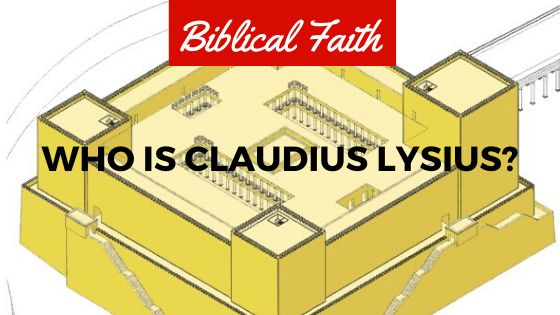
Reconstruction of Fort Antonia by Ehud Netzer in Biblical Archaeology Review 35.1 (Jan.-Feb. 2009).

Claudius Lysias, the Tribune

Claudius Lysias is called “the tribune” (χιλίαρχος, chilíarchos) 16 times within Acts 21-24 (21:31-33, 37; 22:24, 26-29; 23:10, 15, 17, 19, 22; 24:22); 17 times if Claudius Lysias is also included in among the “military tribunes” in the “audience hall” when Herod Agrippa II and Bernice come to hear Paul (Acts 25:23). However, such speculation is uncertain, especially considering a minimum of two years from when Claudius Lysias sent Paul to the Procurator Marcus Antonius Felix in c. AD 57/58 Acts 23:26-35, to within the first few months of the new Procurator Porcius Festus who rules from AD 60-62 (Acts 24:27-25:1-22).

The Greek term chilíarchos is said to be used to translate the Roman tribunus militum (following Polybius), and also for the phrase tribuni militares consulari potestate (Plutarch). The responsibilities of a chilíarchos were as a “commander of a thousand men”.[1] Essentially, Claudius Lysias is “a high ranking military officer in charge” of anywhere from 600 to 1,000 men,[2] and this appears to be the case for it is said that his command was over a “cohort” (σπειρα, speira) in Jerusalem which is “the tenth part of a Roman legion having about 600 men” (Acts 21:31).[3]

Tribune of a Jerusalem Cohort

Claudius Lysias’s complete description as found in the New Testament book of the Acts of the Apostles is “the tribune of the cohort” in Jerusalem, which resided in nearby “barracks” (Acts 21:34, 37; 22:24, 23:10, 16, 32). It takes six cohorts to make up a legion, and each legion had six tribunes with a thousand men (“soldiers and centurions” Acts 21:32) under his command if the cohort was full; consequently, Claudius Lysias was a part of a larger military force.

The exact numbers in his cohort may never be known, however, he had sufficient men to spare two centurions, two hundred soldiers, seventy horsemen, and two hundred spearmen to accompany Paul to Caesarea Acts 23:23-24. Furthermore, when the security detail arrives before Antipatris (Acts 23:31), Claudius Lysias allows for the seventy horsemen to go on with him and Paul to Caesarea, the headquarters of the Procurator Felix (Acts 23:32-35).

The “barracks” referenced in the book of Acts (21:34, 37; 22:24; 23:10, 16, 32), in connection to Claudius Lysias and his cohort are references to the Tower of Antonia, which Herod the Great rebuilt from a previous structure and named it after Marc Antony.[4] The Antonia was added on to the northwest side of the Temple facilities, “from which stairs descend into the outer court of the temple” (Acts 21:32, 35, 22:30).[5] For this reason, the Roman Tribune could hear the commotion caused by the confusing riot over Paul’s presence in the Temple and respond with speed (Acts 21:27-32).

Claudius Lysias in the New Testament

The military tribune Claudius Lysias enters the New Testament narrative when he protects Paul of Tarsus from a hostile Jewish mob on the outside of the Temple grounds in Jerusalem (Acts 21:30-32). The Acts text does not explicitly state why the tribune arrests Paul aside from asking “who he was and what he had done” (Acts 21:33); consequently, it appears Paul is detained for investigation as reflected later in Paul’s interrogation in the Antonian barracks because he was a cause of instigation among the Jews (Acts 22:23-24).

Claudius Lysias is aware of Jewish anarchistic movements, for when Paul speaking in Greek asks permission to speak to the shouting Jewish mob, the tribune appears shocked that he speaks Greek (Acts 21:37). Paul, as a controversial Greek-speaking Hebrew, evidently met some of the criteria for Lysias to conclude he was a Jewish revolutionist. Consequently, it appears that Lysias suspects him of being “the Egyptian” who “stirred up a revolt and led the four thousand men of the Assassins [σικαρίων] out into the wilderness” (Acts 21:38).

This individual operated around A.D. 53, and this revolution amounted to amassing these four thousand men, positioning themselves upon the Mount of Olives outside Jerusalem, and anticipating the walls of Jerusalem to collapse at his command. The Romans attacked this band of men, and the Egyptian lost six hundred men, and fled into the wilderness where he disappears awaiting “further revelation.” Evidently, “the Egyptian” was still on the run, wanted by the Roman military and the tribune was going to see if Paul was this anarchist.[6]

Paul was able to persuade Lysias that he was not an agitator, and provides him with his provincial citizenship as being from Tarsus, in the province of Cilicia (Acts 21:39). This was not an “obscure city” and either this suggests his citizenship could be authenticated, or Paul distinguished himself from the obscure Egyptian. In either case, Paul’s point is clear, he is not the Egyptian; the tribune accepts Paul’s case, and grants Paul an opportunity to speak to the Jews on the steps of the Temple facilities adjoined to the Antonian fortress (Acts 22:39-40).

The Jews did not respond peaceably to Paul’s speech, and Claudius Lysias decides to take Paul into the “barracks” of Antonia and “examine” him through the process of binding him to flog him (Acts 22:22-24). On receiving a report that Paul was a Roman citizen and then making a personal inquiry, Claudius is afraid of having violated the rights of a Roman by having him bound (see “Roman Citizenship” below). Claudius desires to arrive at the truth concerning the Jewish case against Paul and commands the Sanhedrin to assemble. Dissension among the Sanhedrin towards Paul arises again and causes Claudius Lysias to order his men to take Paul to the safety of the Antonian barracks (Acts 22:30-23:10).

Upon learning of a plot to kill Paul, Claudius Lysias summoned a military convoy to leave for Caesarea Maritima. In compliance with Roman law, he also sent a statement of the case to the procurator Antonius Felix. The letter reads:

Claudius Lysias, to his Excellency the governor Felix, greetings.

This man was seized by the Jews and was about to be killed by them when I came upon them with the soldiers and rescued him, having learned that he was a Roman citizen. And desiring to know the charge for which they were accusing him, I brought him down to their council. I found that he was being accused about questions of their law, but charged with nothing deserving death or imprisonment. 

And when it was disclosed to me that there would be a plot against the man, I sent him to you at once, ordering his accusers also to state before you what they have against him. (Acts 23:26-30, English Standard Version)

The letter format is consistent with the general format in the Graeco-Roman world, of “author” to “recipient” with a “greeting” with the subsequent content of the reason for the letter.[7] This letter, however, was not altogether factual. It is an interesting “specimen” of Roman military correspondence (Acts 23:26-30).

Although acknowledging Paul’s innocence, Claudius Lysias gave the impression that he had rescued Paul because of having learned that the apostle was a Roman, whereas in reality, he had violated Paul’s citizenship rights by having him bound and even ordering that he be examined under scourgings. As to the disciple Luke’s knowledge of the letter’s contents, it may be that the letter itself was read at the time Paul’s case was heard.

Roman Citizenship

In Acts 22:23-29, a discussion between Paul and Claudius emerges on the topic of Roman citizenship. Part of Claudius’ investigation procedure to find out more information was to stretch out the detained for whips and flog them.

Before his flogging begins, Paul questions the centurion given this detail, “Is it lawful for you to flog a man who is a Roman citizen and uncondemned?” (Acts 22:25). Roman citizenship had a number of privileges, as John Polhill writes:

A Roman citizen was subject to Roman law and thus was protected from such things as being beaten without a trial, from cruel punishments like crucifixion, and from unlawful imprisonment, rights which did not belong to an ordinary provincial (peregrinus). Citizens had the right of appeal. Only a Roman citizen could legally marry another Roman citizen. Citizens were exempted from certain taxes. Beyond this, there was the considerable factor of honor and deference such a status afforded.[8]

It was such a valued honor, that some people risked the death penalty given for falsely claiming citizenship.[9] Interestingly, one could hold dual citizenship, as Paul was not only a citizen of the city of Rome but was also a citizen of the city of Tarsus from the province of Cilicia (Acts 21.39; 23.34).

Roman citizenship was conferred in a number of ways. The basic ones are as follows:

(1) The most common way was being born of two Roman citizens.

This is the claim Paul makes when asked how he obtained his citizenship (“I am a citizen by birth” Acts 22:28), which implies that both of Paul’s parents were Jewish Roman citizens (cf. #4).

(2) One could obtain citizenship as a reward for military service.

Regularly, military veterans were given citizenship upon discharge. This was the surest way to get it, taking 20 to 25 years depending on the level of ranking.

(3) Imperial conference, though heard of, was not entirely common.

Nevertheless, the emperor could confer citizenship, either on individuals or on whole communities, as in the establishment of a new colony. Often the result of doing some loyal service to Rome. Also, many times through these services, one gained an audience with the Emperor through expensive gifts to members of the inner Imperial court.

This may have been how the Tribune Claudius Lysias gained his citizenship (Acts 22:27-28). In fact, the tribune’s name provides evidence to assume the plausibility that Emperor Claudius (A.D. 41 – A.D. 54) conferred upon Lysias citizenship since those granted this honor would bear the name (the nomen) of the family or patron which conferred it; hence, Lysias gained the name of his patron Claudius. It has been noted that the emperor was quite “promiscuous” in his conference of citizenship.[10]

(4) Roman citizenship was also conferred through the emancipation of a slave from the house of a Roman citizen.

Some have suggested that Paul’s ancestors may have been freedmen from among the thousands of Jews whom Pompey took as slaves in 63 B.C.[11]

Endnotes

  1. H. G. Liddell, An Intermediate Greek-English Lexicon: Abridged from Liddel and Scott’s Greek-English Lexicon (1888; repr.; Oak Harbor, Wash.: Logos Research Systems, 1996), 888.
  2. Barclay Newman, Jr., A Concise Greek-English Dictionary of the New Testament, revised ed. (Stuttgart: Deutsche Bibelgesellschaft, 2010), 200.
  3. Newman, A Concise Greek-English Dictionary, 167.
  4. Josephus, Antiquities 15.293; 15.409.
  5. George A. Smith, et al., “Jerusalem,” Encyclopaedia Biblica, eds. T. K. Cheyne and J. Southerland Black (London: A & C Black, 1901), 1:2429.
  6. Robert M. Grant, The Sword and the Cross (New York, NY: Macmillan, 1955), 49.
  7. T. C. Mitchell, Biblical Archaeology: Documents from the British Museum (New York, NY: University of Cambridge, 1988), 89.
  8. John B. Polhill, “Political Background of the New Testament,” Foundations for Biblical Interpretation, eds. David S. Dockery, et al. (Nashville, TN: Broadman & Holman, 1994), 531-32.
  9. Abraham J. Malherbe, “Life in the Graeco-Roman World,” The World of the New Testament, ed. Abraham J. Malherbe (1967; repr., Abilene, Tex.: Abilene Christian University Press, 1984), 9.
  10. Polhill, “Political Background of the New Testament,” 532.
  11. John B. Polhill, “Political Background of the New Testament,” 532; Richard R. Losch, The Uttermost Part of the Earth: A Guide to Places in the Bible (Grand Rapids, MI: Eerdmans, 2005), 176-77.

This originally appeared as a fully edited submission to Wikipedia.org. I have posted this here in case it is revised or rewritten.