Book Review: Textual Criticism of the Bible, Revised Edition

Amy Anderson and Wendy Widder, Textual Criticism of the Bible, revised ed., Lexham Methods Series, edited by Douglas Mangum (Bellingham, WA: Lexham Press, 2018), Paperback, 236 pages.

The authors of the present volume are professional scholars in Old Testament (Wendy Widder) and New Testament (Amy Anderson) respectively.[1] Widder, a contributing editor for Logos Mobile Education, holds a Ph.D. in Near Eastern Studies from the University of the Free State (South Africa), an M.A. in Hebrew and Semitic Studies (University of Wisconsin-Madison) and the M.Div. from Grand Rapids Theological Seminary. Her published works include a technical linguistic work for the BZAW series (De Gruyter), commentaries on Daniel (ZECOT, SGBC), and was the original author of the first edition of the present work (2014).[2]

Amy Anderson joins the revision of this project as co-author. She is Professor of New Testament and Ancient Greek at North Central University (Minneapolis, MN), and holds a Ph.D. in New Testament Textual Criticism (University of Birmingham) and an M.A. in New Testament from Fuller Theological Seminary (Pasadena, CA). Additionally, Anderson has published technical works on New Testament textual criticism for Brill (Texts and Studies) and serves on the steering committee of the Editio Critica Maior for the SBL steering unit of the International Greek New Testament project (IGNT).[3]

Thesis of the Book

In keeping with the stated goal of the Lexham Methods Series to provide an overview of the “broad movements” within the fields of biblical criticism, Anderson and Widder introduce textual criticism of the Bible for the emerging scholar and biblical interpreter in order to better equip them to understand the basic question for many English readers of the Bible is translation: why are there differences in among the English versions?[4] Anderson and Widder offer an updated guided tour of textual criticism to equip the emerging scholar to “take on” the text critical issues that are behind some of the more technical reasons which account for these differences among Bible translations of the ancient original language manuscript copies.[5]

Summary of the Book

In the “Introduction” the authors isolate the practical importance of how understanding the field of textual criticism contributes to providing sensible answers for certain variations among contemporary Bible translations.[6] As a “ground clearing” chapter, it distinguishes changes brought about by the theories and practice of translation from the task of resolving “variations in the readings of [the] ancient manuscripts” of the Bible in pursuit of the ancient form of the text, i.e., the Ausgangstext.

In chapter two Anderson and Widder provide a general introduction to the field of textual criticism of the Bible. Despite different textual evidence for each Testament, the general principles of the discipline apply overall and the authors illustrate what is common to both fields.[7] As no two ancient hand-copied manuscripts of the Bible agree in every detail, the authors demonstrate the various types of scribal errors detected when comparing the extant copies of the manuscripts (accidental omissions, additions, misspellings, and intentional changes).[8] These examples illustrate the goal of textual criticism is to “establish the original reading of the biblical text” of the autographs, which for the transmission history of the Old Testament it is “more complicated” due various unknowns of scribal and editorial activity over a vastly longer period of time than the New.[9] The authors explain the importance in knowing the difference between external evidence and internal evidence, and how the former focuses on “what kinds of manuscripts is a given variant found” and the latter considers what is probable habits of the transcriber(s) of the manuscript and the author of the book (intrinsic).[10]

Chapter three offers a short history of the unique difficulties found in the transmission of the Old Testament. With no manuscripts available predating the canonical copies of the Dead Sea Scrolls (250 BC–AD 135), the authors begin their history with awareness of variants in the Hebrew text by early Christians. Representative of this early period are Origen’s textual notes in the fifth column of his Hexapla.[11] The textual history of the Old Testament is largely interwoven with Christian history (Greek and Latin translations, and other ancient polyglot texts) and the medieval scribal tradents of the Masoretic manuscript tradition. The Hebrew text in the modern period is represented in the two types of critical editions, diplomatic (e.g., BHK, BHS, HUB) and eclectic editions (e.g., HBCE). The textual resources available today (Masoretic Text, LXX, Dead Sea Scrolls, and translations) demonstrate the importance of carefully assessing each variants in light of the probabilities of the scribal habits of each tradition and the which reflects an older state of the Hebrew text.[12]

Chapter four introduces the history of the Greek New Testament text.[13] This history reveals not only a proliferation of the early translation, citation, and copying of these texts, but also that a number of copying communities can be detected in the “patterns of variation” found in groups or family of manuscripts (Alexandrian, Western, Caesarean).[14] With the rise of Christianity, Byzantium (Constantinople) became a center for transmission, giving rise to the period of standardization culminating in the advent of the printing press in which a Greek New Testament would be printed (700s–1600s). This gave rise to what is called the Byzantine text-type. Today, scholarship has largely moved away from the Textus Receptus (or, Majority Text) in favor of eclectic critical approach to establish the Greek New Testament text, which weighs the strength and weakness of variants and manuscripts (seen in UBS, NA). Today, there are over fifty-five hundred manuscripts (papyri, majuscules, and minuscules) from which textual critics must work with in establishing the original wording of the text (the Ausgangstext), as they seek “to identify the reading that best explains how the other readings arose.”[15]

In chapter five, the authors bring their discussion to a close as they comment on the connection between textual criticism and English translations, and how many of the variations between them rely on the text the translation committee agrees to work from.[16] The scholarship of textual criticism directly impacts the practical life of church life, especially one’s doctrine of Scripture, inerrancy and infallibility, and its authority. While debated extremes exist, the inspiration of the text can be maintained as it relates to the original manuscripts. The transmission of the text of Scripture is a history of God’s providential use of imperfect human scribes to reliably preserve the text of the Bible for all generations.

Strengths and Weaknesses

Anderson and Widder have produced a very effective pedagogical-centered volume introducing the field of textual criticism to the emerging scholar of the Bible. The authors were neither overly academic nor did their discussions lack the specialty knowledge essential to this field of methodology. The strongest contribution is the practical hands-on approach illustrating how to evaluate textual variants, how to use the critical apparatus and critical sigla, and how to interact with the different resources (manuscripts, translations, lexicography, etc.) available to the emerging textual critic.[17] These helpful text-critical walkthroughs will guide the students well moving from theory to practice.

Overall, it is very difficult to find weaknesses in the current volume, but when they observed that biblical scholarship seeks to establish the “final form” of the authoritative text instead of the “original wording” of the autographs, little space is provided to address this important text-critical topic.[18] Outside the mention of the philosophical debate over the Urtext, the matter is only briefly commented on.[19] With the lack of older witnesses, important questions are sidelined, such as, “is seeking the original wording of the autograph no longer feasible in Old Testament studies? What are the implications of this issue?” I humbly suggest that Anderson and Widder would have served their readers better by exploring this question.


Endnotes

[1] Amy Anderson and Wendy Widder, Textual Criticism of the Bible, rev. ed., Lexham Methods Series, ed.  Douglas Mangum (Bellingham, WA: Lexham Press, 2018).

[2] For more information regarding Dr. Widder see her blog: https://wendywidder.com.

[3] For more information regarding Dr. Anderson see her teacher’s page at North Central University: https://www.northcentral.edu/academics/amy-anderson-2.

[4] Anderson and Widder, Textual Criticism, ix–x, 2–3.

[5] Anderson and Widder, Textual Criticism, 7–8.

[6] Anderson and Widder, Textual Criticism, 1–9.

[8] Anderson and Widder, Textual Criticism, 16–40.

[7] Anderson and Widder, Textual Criticism, 11–48.

[9] Anderson and Widder, Textual Criticism, 40–41. For this reason, Anderson and Widder note that the Old Testament critic “has to decide exactly which state of the OT composition or transmission is the goal” (41).

[10] Anderson and Widder, Textual Criticism, 42–46.

[11] Anderson and Widder, Textual Criticism, 49–114.

[12] For example, the hands-on section of the text critical process illustrates that sometimes translations are preferred over original language manuscripts as they reflect “what Hebrew the translators had in front of them” (Anderson and Widder, Textual Criticism, 95).

[13] Anderson and Widder, Textual Criticism, 115–77.

[14] Anderson and Widder, Textual Criticism, 116.

[15] Anderson and Widder, Textual Criticism, 158.

[16] Anderson and Widder, Textual Criticism, 179–87.

[17] Anderson and Widder, Textual Criticism, 90–109, 149–74.

[18] Anderson and Widder, Textual Criticism, 41–42. This concern may be theological motivated but more clarity would have appreciated (cf. Ferguson, “Textual Criticism of the Bible,” Presbyterion 46 [2020]: 158–59).

[19] Anderson and Widder, Textual Criticism, 93. If this was intended to supplement the “final authoritative form” discussion raised earlier, it seems completely disconnected (54–57).


Bibliography

Anderson, Amy, and Wendy Widder. Textual Criticism of the Bible. Revised ed. Lexham Methods Series 1. Edited by Douglas Mangum, et al. Bellingham, WA: Lexham Press, 2018.

Ferguson, Anthony. “Textual Criticism of the Bible, by Amy Anderson and Wendy Widder. Revised edition. Bellingham, WA: Lexham Press, 2018. Pp. xv + 236. ISBN 978-1-57799-663-7.” Presbyterion 46.1 (2020): 157–59.


Do We Have the Old Testament?

A person of faith often assumes that there are no problems ascertaining the wording of certain passages. But reality demonstrates that there are instances where this proves to be untrue. What a believer expects God to do in His providential care of the planet may not always line up with how life unfolds itself, but such disorientation has been common among the faithful.

Despite all the miracles employed to compel Pharoah to release the Israelites from Egypt, when the environment became less than comfortable fear and panic overcame God’s people (Exod 14). Even Moses had initial problems with understanding the situation he was faced with when he was sent to Pharoah to have him release the Israelites (Exod 5). Examples could be multiplied to demonstrate that a person of faith at times needs “more” in order to calm their nerves.

The following brief study gives attention to the textual basis of the Old Testament, considering a few lines of thought that contribute to a more informed outlook on how copies of the Hebrew Bible have been transmitted into modern hands, and what the sources of the copies used today so that translators are able to produce translations of the Hebrew Bible.

It must be emphasized that this is not an exhaustive treatment of the subject. So much more is available for analysis; be that as it may, a survey of this material is sufficient to adequately support the above affirmation of the adequate veracity of the Hebrew Bible.

A Skeptic’s Concern

A skeptical approach to the Bible essentially argues that for a collection of books so old, for a collection of books that have passed through so many hands, or for a collection of anonymously published volumes, it is a hard sell to affirm that the Bible – here the Hebrew Bible – is trustworthy in any sense.

Regarding the textual certainty of the Bible in general, skeptic Donald Morgan puts the matter bluntly in the following words:

No original manuscripts exist. There is probably not one book that survives in anything like its original form. There are hundreds of differences between the oldest manuscripts of any one book. These differences indicate that numerous additions and alterations were made to the originals by various copyists and editors.[1]

The argument basically affirms that there is no way for the Bible to be an accurate record of the words of God, and therefore, it is not “trustworthy.”  The sheer force of this argument is designed to rob the Bible believer’s faith in God. Implicit with this is the futility of having a religion founded upon the Bible’s guidance.

What can be said of this dire depiction, except that one must not be persuaded by mere affirmations, but instead by the available evidence. Not only is it paramount to see the evidence, but it is imperative that a proper evaluation is given to it.

The OT Accurately Transmitted

The Scribal Evidence

The overall scribal evidence suggests that the Hebrew Bible has been adequately preserved. The “scribe” trade goes back very early in recorded antiquity and therefore is a field of has a rich heritage of scholarship and workmanship behind it.[2]  J. W. Martin notes that the field of transmitting literature is a known trade skill from the 2nd millennium B.C. and observes, “men were being trained not merely as scribes, but as expert copyists.”[3]  Copying occurred during the Babylonian exile. F. C. Grant writes, “in far-away Babylonia the study and codification, the copying and interpretation of the Sacred Law had steadily continued.”[4]

This means that extending back beyond the time of Abraham (19th century B.C.) and Moses (15th century B.C.), down to the time of the exilic and post-exilic scribes (the predecessors to the “scribes who copied and explained the Law in the New Testament times”),[5] “advanced” and “scrupulous” methods would likely be used to copy any text, including the Hebrew canon.

The next question in need of an answer, though, is: what were those methods? Briefly, observe the mentality and professionalism which exemplify the sheer reverential ethic towards the transmission of the Biblical text characterized by the scribes.

The Hebrew Scribes revered the sanctity of the Scriptures. Moses commanded the people not to “add to the word,” nor to “take from it” (Deut 4:2). The Hebrews respected this command. Josephus weighs in as support for this point. In arguing for the superiority of the Hebrew Bible against the conflicting mythologies of the Greeks fraught with evident contradicting alterations to their content, Josephus bases his argument upon the reverential mentality towards these writings.

Josephus testifies to this sense of reverence (Against Apion 1.8.41-42):

[41] It is true, our history hath been written since Artaxerxes very particularly, but hath not been esteemed of the like authority with the former by our forefathers, because there hath not been an exact succession of prophets since that time; [42] and how firmly we have given credit to those books of our own nation, is evident by what we do; for during so many ages as have already passed, no one has been so bold as either to add anything to them, to take anything from them, or to make any change in them; but it becomes natural to all Jews, immediately and from their very birth, to esteem those books to contain divine doctrines, and to persist in them, and, if occasion be, willingly to die for them.[6]

William Whiston, Translator

Even though there are variants, produced by scribes, the fundamental historical truth stresses that the Hebrew scribes revered the Scriptures and dared never to add or take away from them. This important truth must not be forgotten. Moreover, this fact emphasizes the great care they had with the transmission of the text.

The scribal methods changed as time progressed, and this seems to be for the better and for the worst. One thing is transparent, however, and that is this: consistent with the reverential appreciation of the scriptures, the Hebrew scribes exercised acute professionalism in their methods, however superstitious they were at times. Rabbinic literature testifies to the early scribal school. Clyde Woods reproduces 17 crucial rabbinic rules demonstrating the rigors of the early scribal methodology.[7] The specifics concerning the writing materials, the preparation of the document, the veracity of the authenticity of the template, the conduct displayed when writing divine names, and other critical rules are thus enumerated underscoring the diligent professionalism of the early scribes.

The Masoretes succeeded and exceeded these scribes as a professional group of transmitters of the Hebrew Bible, laboring from A.D. 500 to A.D. 1000.[8] Lightfoot summarizes a number of procedures the Masoretes employed to “eliminate scribal slips of addition and omission.”[9] The Masoretes counted and located the number of “verses, words, and letters of each book,” thereby passing on the text that they have received. This intricate methodology in preservation is of extreme importance in modern textual studies,[10] and answers the reason why these reliable “medieval manuscripts” are commonly the underlying text of modern English translations[11] and represented in the Biblia Hebraica Stuttgartensia (cf. English Standard Version).[12]

The concern for the accurate preservation of the Biblical text cannot, however, dismiss the fallible humanity which copied the text by hand, thereby producing inevitable scribal variations.[13] René Paché recounts the “herculean” endeavors of scholars evaluating the variants which have “crept into the manuscripts of the Scriptures” (e.g. B. Kennicott, Rossi, and J. H. Michaelis). These labors have also encompassed the analysis of the oldest versions and numerous citations and allusions from Jewish and Christian works. Robert D. Wilson’s observations in his work, A Scientific Investigation of the Old Testament, noted that the 581 Hebrew manuscripts studied by Kennicott are composed of 280 million letters comprised of only 900,000 variants. These variants are boiled down to 150,000 because 750,000 are “insignificant changes” of letter switches.[14]

This is represented as 1 variant for every 316 letters, but putting these unimportant variants aside, the count stands at 1 variant for every 1,580 letters. Moreover, “very few variants occur in more than one of the 200-400 manuscripts of each book of the Old Testament.”[15] The point that needs recognition, however, is that we must recognize that the scribes have done their best, but there are variations that must be accounted for. These variations are not sufficient enough to call into question the adequate preservation of the Hebrew Bible.

Textual Evidence

After evaluating some of the problems in the textual evidence for the Old Testament, it can be said that the overall material adequately preserves the Hebrew Bible. This investigation is comparable to a roller coaster. There are both ups and downs, making one more confident while at the same time bringing some concern. For example, Peter Craigie notes, “there is no original copy of any Old Testament book; indeed, not even a single verse has survived in its original autograph. This is not a radical statement, simply a statement of fact.”[16]

The Bible believer might feel a bit disconcerted to know this fact, but there is no genuine need to feel this way. Truth endures because of its very nature no matter if one destroys the materials upon which it is written (Jer 36:23-32). Moreover, the scribal evidence adequately demonstrates an amazingly high level of accurate transmission and preservation of the Old Testament, even though the autographs are not available. One might speculate as to why these important documents are not providentially preserved for posterity, but the observation that such a course of action “is a highly dangerous procedure” is promptly recognized.[17]

Nevertheless, there are historical issues relating to this question and to the question of why there are such a small number of manuscript copies of the Old Testament when compared to the textual evidence of the New Testament. The most important fact is that the Hebrew scribes destroyed old manuscripts (autographs and copies). Clyde M. Woods writes:

The relative paucity [i.e. smallness of number] of earlier Hebrew manuscripts is due not only to the perishable nature of ancient writing materials (skins and papyri) and to the effort of hostile enemies to destroy the Hebrew Scriptures, but, perhaps more significantly, to the fact that the Jews evidently destroyed some worn out manuscripts to prevent their falling into profane hands.[18]

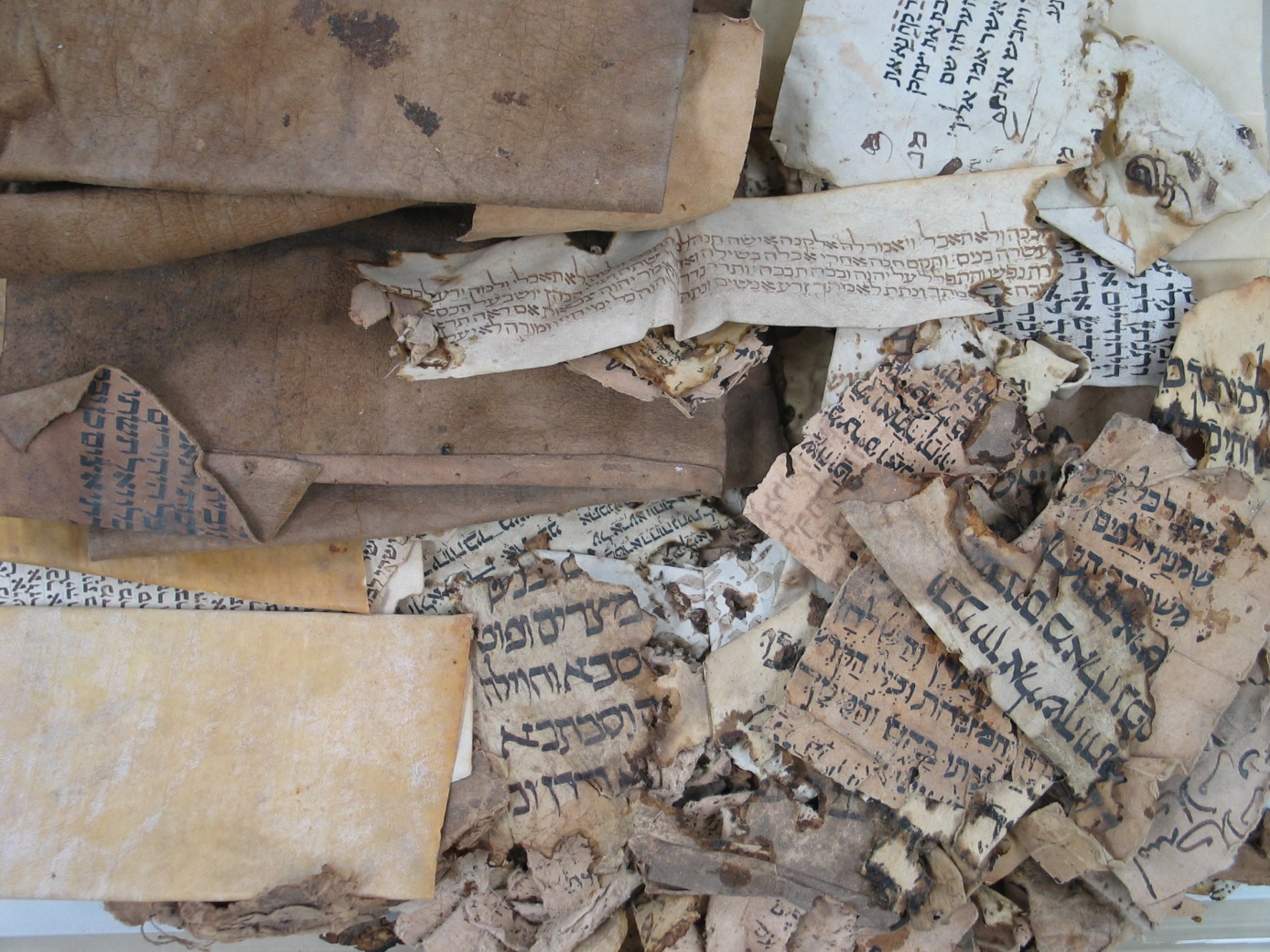
This explains why there is comparatively less textual witness for the Old Testament than for the New, however, as Donald Demaray notes, “there is the compensating factor that the Jews copied their Scriptures with greater care than did the Christians.”[19] There are accounts of scribes having burial ceremonies for the manuscripts,[20] and the storage “of scrolls [in a “Genizah” depository] no longer considered fit for use.”[21]


Cairo Genizah - Cambridge Library Blog - Fig1
Image Credit: Cambridge University Library Special Collections. “Fragments from the Cairo Genizah prior to conservation and cataloguing [sic]” (Emma Nichols, “Conservation of the Lewis-Gibson Collection: Re-Treatment of Manuscript Fragments from the Cairo Genizah“)

A second major factor is the A.D. 303 declaration by Emperor Diocletian to destroy any “sacred” literature associated with the Christian religion.[22] F. C. Grant frames the significance as follows:

As never before, the motive of the Great Persecution which began in 303 was the total extirpation of Christianity: […]. The first of Diocletian’s edicts directed to this end prohibited all assemblies of Christians for purposes of worship, and commanded that their churches and sacred books should be destroyed.[23]

This would further contribute to the lack of Hebrew Bible manuscripts.

Modern manuscript evidence for the Hebrew Bible, therefore, does not include the autographa (“original manuscripts”) and is generally never expected to, as desirable as the obtainment of these documents is.[24] What remains is the collection of manuscripts which together allow textual scholars to reproduce as close as possible the Hebrew Old Testament. This body of textual evidence goes very far to close the gap between the present day and the autographa. What are these manuscript witnesses to the Hebrew Bible? There are primary and secondary witnesses but where space is limited to the manuscripts.

Bruce Waltke observes that the textual witnesses to the text are the extant Hebrew manuscripts and Hebrew Vorlage obtained from the early versions of the Hebrew text.[25] While the term “manuscript” is typically recognized, the term Vorlage is probably unfamiliar to the general Bible student. This term refers to the text that “lies before” the translation or a theoretical “prototype or source document” from which it is based.[26] The Masoretic text (MT), the Samaritan Pentateuch (SP), and the Dead Sea Scrolls (DSS) are the principal manuscript witnesses. These manuscripts coupled with the Vorlage are the “documents” at our disposal.

Craigie’s presentation on this material[27] when compared to Waltke leaves something to be desired, and that something is more data and deeper investigation. However, Craigie presents the evidence that the manuscript evidence (including early translations) extends from the 2nd century B.C to the MT of the late 9th century B.C.[28] Leaving a considerable gap, as he notes, of “several centuries, the time varying from one Old Testament book to another, between the earliest extant manuscripts and no longer existing original manuscripts.”[29]

Waltke presents a fuller presentation of the two substantiating Craigie’s observations and would extend from the available data that the Vorlage of some of the DSS and SP points to a Proto-MT at least somewhere in the 5th century B.C.[30] Moreover, the oldest evidence is found in 2 extremely small silver rolls containing the Aaronic priestly blessing from Numbers 6:24-26, dating to the 7th or 6th centuries B.C.[31] The text reads:

May Yahweh bless you and keep you;
May Yahweh cause his face to
Shine upon you and grant you
Peace
(Michael D. Coogan)

Consequently, the worst case holds that the textual evidence goes only to the 2nd century, while the best case goes back some 300-500 years further back to a purer source as of yet unavailable.

H. G. G. Herklots has compiled a generous amount of information concerning the production of harmonization work which underlies the works of present-day manuscripts.[32] By doing this Herklots highlights that there are variations in the textual witnesses that the early stewards of the text attempted to dispose of but this has in some sense complicated the matter, making the study more laborious than it already is.[33] Variations are not as problematic as the skeptic supposes. To be sure, there are occasions of serious textual dissonance, but these are far from the plethoras of insignificant, obvious, and correctable variations.[34]

Waltke affirms, that “90 percent of the text contains no variants,” and of the remnant “10 percent of textual variations, only a few percent are significant and warrant scrutiny; 95 percent of the OT is therefore textually sound.”[35] Douglas Stuart notes that when considering the variations, “it is fair to say that the verses, chapters, and books of the Bible would read largely the same, and would leave the same impression with the reader, even if one adopted virtually every possible alternative reading.”[36] The variations of the extant textual evidence hardly, therefore, pose an indomitable problem to the adequate preservation of the Old Testament. The skeptic’s argument has no leg to stand upon.

Extra-Hebrew Bible Sources

Besides the extant Biblical literature of the Hebrew Bible, there are miscellaneous sources that demonstrate the veracity of the text, and implicitly note the accountability of the Hebrew Bible to a textual investigation. While these witnesses cannot reproduce the entire Old Testament, they can be compared with the manuscript evidence for accuracy and enlightened evidence when certain passages or words appear obscure. Briefly, consider two sources.

First, the Targums are a set of Jewish works in Aramaic that are paraphrastic (i.e. “interpretive translation”) of parts of the Old Testament.[37] Targums are said to be used in the synagogue to give the Aramaic-speaking Jews the “sense” of the Hebrew Bible.[38] This is comparable to the verbal translation that had to occur at the inauguration of the Law under Ezra, where there were assistants who “gave the sense, so that the people understood the reading” (Neh 8:8 ESV).

Targums have been written upon every section of the Hebrew Bible; they ranged from “very conservative” to “interpretive” (Onkelos and Jonathon respectively), and are useful for the light they show upon traditional Jewish interpretation.[39] In the history of the transmission of the Hebrew Bible, at times the Targum was placed along the side of a Hebrew text, a Greek text, and a Latin text (as in the Complutensian Polyglot) to “enable a reader with little Hebrew to understand the meaning of the Scriptures in his own language.”[40] It seems agreeable to suggest and affirm that the Targum serves as an appropriate and practical source to obtain a general understanding of the Hebrew text, which will definitely aid the textual scholar in analyzing obscure passages.

Second, there is the New Testament, which is a virtual galaxy of Old Testament citations and allusions as it connects Jesus and his followers as a continuation -fulfillment- of its message. Consequently, it serves as a proper witness to the passages cited or alluded to. E. E. Ellis writes:

there are some 250 express citations of the Old Testament in the New. If indirect or partial quotations and allusions are added, the total exceeds a thousand.[41]

The Greek New Testament, published by the United Bible Society, has 2 notable reference indexes. The first index lists the “Quotations” while the other catalogs “Allusions and Verbal Parallels.”[42]

The New Testament writers used and quoted not only the Hebrew Bible, but also the LXX (with some variations suggesting different Greek translations), and other sources such as the Old Testament Targums.[43] In addition, the New Testament, in terms of textual evidence (manuscript, early version, and patristic quotations), is the most attested document from antiquity[44] emphasizes the reliability of the New Testament evidence for the Old Testament.[45]

Concluding Thoughts

In summation, we have examined some of the evidence in a survey and observed that the typical skeptical claim against the Bible is fallacious. We are more than confident that the textual transmission of the Bible has adequately preserved the Bible. There are so many avenues from which data pours in that for all practical purposes the gap from these extant materials to the originals is irrelevant. Gaps of greater magnitude exist for other works of antiquity, but no finger of resistance is pressed against their adequate representation of the autographic materials.

The Bible experiences this sort of attack partly because ignorant friends of the Bible fighting with a broken sword affirm that we have the Bible and that it has no textual problems. Other times, skeptics misrepresent textual studies of the Bible in order to support their case that the Bible is not the inerrant inspired word of God. Be that as it may, the scribal evidence demands that the scribes held a high reverence and professionalism in the transmission of the text, the textual evidence is, though having some problems, near 100 percent sound. Moreover, the New Testament and Talmud are examples of sources that uphold the Biblical text and allow textual scholars to examine the accuracy of the textual data.

Finally, the skeptical attack has been viewed a considered only for it to be concluded that it is fallacious and of no need to be considered a viable position based on the evidence. In connection with this conclusion, observe some observations by Robert D. Wilson and Harry Rimmer. Rimmer writes that a scientific approach to the Bible inquiry is to adopt a hypothesis and then test it and see if there are supportive data that establishes it. He writes:

If the hypothesis cannot be established and if the facts will not fit in with its framework, we reject that hypothesis and proceed along the line of another theory. If facts sustain the hypothesis, it then ceases to be theory and becomes an established truth.[46]

Wilson makes a similar argument and ties an ethical demand to it. After ably refuting a critical argument against Daniel, Wilson remarks that when prominent critical scholars make egregious affirmations adequately shown to be so, “what dependence will you place on him when he steps beyond the bounds of knowledge into the dim regions of conjecture and fancy?.”[47]

Endnotes

  1. Donald Morgan, “Introduction to the Bible and Biblical Problems,” Infidels Online (Accessed 2003). Mr. Morgan is just a classic example of the skepticism that many share regarding the integrity of the biblical record.
  2. Daniel Arnaud, “Scribes and Literature,” NEA 63.4 (2000): 199.
  3. J. W. Martin, et al., “Texts and Versions,” in The New Bible Dictionary, eds. J. D. Douglas (Grand Rapids, MI: Eerdmans, 1962), 1254.
  4. Fredrick C. Grant, Translating the Bible (Greenwich, CT: Seabury, 1961), 8 (emph. added).
  5. Grant, Translating the Bible, 10-11.
  6. Flavius Josephus, The Works of Josephus: Complete and Unabridged, trans. William Whiston (repr., Peabody, MA: Hendrickson, 1987).
  7. Clyde M. Woods, “Can we be Certain of the Text? – Old Testament,” in God’s Word for Today’s World: The Biblical Doctrine of Scripture (Kosciusko, MI: Magnolia Bible College, 1986), 98.
  8. Martin, et al., “Texts and Versions,” 1255; René Paché, The Inspiration and Authority of Scripture, trans. Helen I. Needham (Chicago, IL: Moody, 1969), 187.
  9. Neil R. Lightfoot, How We Got the Bible, 2d ed. (Grand Rapids, MI: Baker, 2001), 92.
  10. Lightfoot, How We Got the Bible, 92.
  11. Peter C. Craigie, The Old Testament: Its Background, Growth, and Content (Nashville, TN: Abingdon, 1986), 32.
  12. English Standard Version of The Holy Bible (Wheaton, IL: Crossway, 2001), ix.
  13. Lightfoot, How We Got the Bible, 91.
  14. Robert D. Wilson, A Scientific Investigation of the Old Testament, revised ed., Edward J. Young (Chicago, IL: Moody, 1967), .
  15. ctd. in Paché, Inspiration and Authority of Scripture, 189–90.
  16. Craigie, The Old Testament, 34.
  17. Dowell Flatt, “Can we be Certain of the Text? – New Testament,” in God’s Word for Today’s World: The Biblical Doctrine of Scripture (Kosciusko, MI: Magnolia Bible College, 1986), 104: “The books of the New Testament were originally copied by amateurs,” the variants multiplied from persecution pressures and translations issues up until the “standardization of the text” in the 4th to 8th centuries A.D.
  18. Woods, “Can we be Certain of the Text?,” 96.
  19. Donald E. Demaray, Bible Study Sourcebook, (Grand Rapids, MI: Zondervan, 1964), 35; Flatt, “Can we be Certain of the Text?,” 106.
  20. Lightfoot, How We Got the Bible, 90.
  21. Martin, et al., “Texts and Versions,” 1256-57; Paché, Inspiration and Authority of Scripture, 187-88; F. C. Grant notes that the Synagogue of Old Cairo’s Geniza has been found, throwing “great light upon Biblical studies” (Translating the Bible, 40). Biblical scrolls were discovered from 1890 and, onwards including Targums and rabbinic literature (Martin, et al., “Texts and Versions,” 1256-57).
  22. Michael Grant, The Roman Emperors: a Biographical Guide to the Rulers of Imperial Rome 31 B.C.–A.D. 476 (1985; repr., New York, NY: Barnes & Noble, 1997), 208.
  23. Grant, Translating the Bible, 208.
  24. Lightfoot, How We Got the Bible, 90.
  25. Bruce K. Waltke, “Old Testament Textual Criticism,” in Foundations for Biblical Interpretation, eds. David S. Dockery, et al. (Nashville, TN: Broadman, 1994), 159-68.
  26. Matthew S. DeMoss, Pocket Dictionary for the Study of New Testament Greek (Downers Grove, IL: Intervarsity, 2001), 128.
  27. Craigie, The Old Testament, 32-37.
  28. Craigie, The Old Testament, 36, 32.
  29. Craigie, The Old Testament, 34.
  30. Waltke, “Old Testament Textual Criticism,” 162.
  31. Waltke, “Old Testament Textual Criticism,” 163.
  32. H. G. G. Herklots, How Our Bible Came to Us: Its Texts and Versions (New York, NY: Oxford University, 1957), 29-40, 109-23
  33. Herklots, How Our Bible Came to Us, 116-23, Waltke, “Old Testament Textual Criticism,” 164-167.
  34. Waltke, “Old Testament Textual Criticism,” 157.
  35. Waltke, “Old Testament Textual Criticism,” 157-58.
  36. qtd. in Waltke, “Old Testament Textual Criticism,” 157.
  37. D. F. Payne, “Targums,” in The New Bible Dictionary, ed. J. D. Douglas (Grand Rapids, MI: Eerdmans, 1962), 1238.
  38. Payne, “Targums,” 1238.
  39. Payne, “Targums,” 1239.
  40. Herklots, How Our Bible Came to Us, 35-36.
  41. E. E. Ellis, “Quotations (in the New Testament),” in The New Bible Dictionary, ed. J. D. Douglas (Grand Rapids, MI: Eerdmans, 1962), 1071.
  42. Barbara Aland, et al., eds., The Greek New Testament, 4th rev. ed. (Stuttgart: United Bible Societies, 2002), 887-901.
  43. Ellis, “Quotations (in the New Testament),” 1071.
  44. Wayne Jackson, Fortify Your Faith In an Age of Doubt (Montgomery, AL: Apologetics Press, 1974), 70-75.
  45. Harry Rimmer, Internal Evidence of Inspiration, 7th edition (Grand Rapids, MI: Eerdmans, 1946), 36.
  46. Wilson, A Scientific Investigation of the Old Testament, 98.

Bibliography

Aland, Barbara, et al. Editors. The Greek New Testament. 4th rev. ed. Stuttgart: United Bible Societies, 2002.

Arnaud, Daniel. “Scribes and Literature.” NEA 63.4 (2000): 199.

Craigie, Peter C. The Old Testament: Its Background, Growth, and Content. Nashville, TN: Abingdon, 1986.

Demaray, Donald E. Bible Study Sourcebook. Grand Rapids, MI: Zondervan, 1964.

DeMoss, Matthew S. Pocket Dictionary for the Study of New Testament Greek. Downers Grove, IL: InterVarsity, 2001.

Ellis, E. E. “Quotations (in the New Testament).” Page 1071 in The New Bible Dictionary. Edited by J. D. Douglas. Grand Rapids, MI: Eerdmans, 1962.

Flatt, Dowell. “Can we be Certain of the Text? – New Testament.” Pages 103-10 in God’s Word for Today’s World: the Biblical Doctrine of Scripture. Don Jackson, Samuel Jones, Cecil May, Jr., and Donald R. Taylor. Kosciusko, MS: Magnolia Bible College, 1986.

Grant, Fredrick C. Translating the Bible. Greenwich, CT: Seabury, 1961.

Grant, Michael. The Roman Emperors: a Biographical Guide to the Rulers of Imperial Rome 31 B.C.–A.D. 476. 1985. Repr., New York, NY: Barnes, 1997.

Herklots, H. G. G. How Our Bible Came to Us: Its Texts and Versions. New York, NY: Oxford University, 1957.

Jackson, Wayne. Fortify Your Faith In an Age of Doubt. Montgomery, AL: Apologetics Press, 1974.

Josephus, Flavius. The Works of Josephus: Complete and Unabridged. Translated by William Whiston. Repr. Peabody, MA: Hendrickson, 1987.

Lightfoot, Neil R. How We Got the Bible. 2d edition. Grand Rapids, MI: Baker, 2001.

Martin, W. J., et. al. “Texts and Versions.” Pages 1254-69 in The New Bible Dictionary. Edited by J. D. Douglas. Grand Rapids, MI: Eerdmans, 1962.

Morgan, Donald. “Introduction to the Bible and Biblical Problems.” Infidels Online.

Paché, René. The Inspiration and Authority of Scripture. Translated by Helen I. Needham. Chicago, IL: Moody, 1969.

Payne, D.F. “Targums.” Pages 1238-39 in The New Bible Dictionary. Edited by J. D. Douglas. Grand Rapids, MI: Eerdmans, 1962.

Rimmer, Harry. Internal Evidence of Inspiration. 7th edition. Grand Rapids, MI: Eerdmans, 1946.

Waltke, Bruce K. “Old Testament Textual Criticism.” Pages 156-86 in Foundations for Biblical Interpretation. Edited by David S. Dockery, Kenneth A. Mathews, and Robert B. Sloan. Nashville, TN: Broadman, 1994.

Wilson, Robert D. A Scientific Investigation of the Old Testament. Revised edition. Revised by Edward J Young. Chicago, IL: Moody Press, 1967.

Woods, Clyde. “Can we be Certain of the Text? – Old Testament.” Pages 94-102 in God’s Word for Today’s World: the Biblical Doctrine of Scripture. Don Jackson, Samuel Jones, Cecil May, Jr., and Donald R. Taylor. Kosciusko, MS: Magnolia Bible College, 1986.


Who is to Care for the Widows? (1 Tim 5:16)

college papers

If any believing woman has relatives who are widows, let her care for them. Let the church not be burdened, so that it may care for those who are truly widows. (ESV)

If any believing man or woman has widows, let them relieve them, and do not let the church be burdened, that it may relieve those who are really widows. (NKJV)

The opening words of 1 Timothy 5:16 is plagued with four variant readings. At the outset, this paper will follow the order of the fifth revised edition of The Greek New Testament (UBS5)[1] textual apparatus in arranging the variant readings. The first reading is in that which is in the main body of the UBS5 Greek text, “a woman that believes” (pistē), the second variant reading is “a man that believes” (pistos), the third variant reading is the longer “man or woman that believes” (pistos e pistē), and the fourth variant reading is the accusative plural “women that believe” (pistas).

The variants throw into question who are the believers to care for their widows. Is it Christian women or men (variants 1-2)? Is it either or (variant 3), or is it a general call to care (variant 4)? The following processes will be followed: (1) evaluate the external and internal evidence, then (2) observe its effect on modern translations, and then (3) apply the most probable reading to approach an understanding of the reading in 1 Timothy 5:16.

Evaluating the Evidence

External Evidence

The weight of the external evidence of the four variant readings are early, but they are not of the same strength. In particular, the second (pistos) and fourth (pistas) variant readings are void of extant Greek manuscripts. The second reading is represented by the Ethiopic tradition from the sixth century, half of Ambrose (397), Augustine (430), and a Latin translation of Theodore of Mopsuestia, Cilicia. The meager witnesses for the fourth reading are exclusively translational itg (ninth) and vgmss (fourth and fifth).

The third longer reading (pistos e piste) is represented with witnesses which begin in the fourth and fifth centuries. The reading appears early in patristic witnesses such as John Chrysostom (407), Ambrosiaster (post 384), and also Ambrose; moreover, it has witness in Old Latin translations from the third and sixth centuries (itb, d). The earliest extant Greek manuscript witness, however, is the bilingual (Greek and Latin) sixth-century uncial Codex Claromontanus (D 06).[2]

Despite the earlier witness of the longer variant reading against pistos and pistas, the uncials which support the first reading (pistē) are much earlier. These witnesses are from the fourth and fifth centuries and are traditionally more substantial in their textual value.[3] The fourth-century evidence has Aleph (Sinaiticus), along with fifth-century codexes Alexandrinus (A) and palimpsests Ephraem (C 04), and uncial 048.[4] Patristic evidence has early witnesses as Athanasius (373) and mid-fifth century Pelagius. Translational evidence for the preferred reading is in the fourth-century Sahidic Coptic text in Egypt (copsa). The early dates of the external evidence weigh in agreement with the UBS5 inclusion of the preferred reading.

Geographic Distribution

The geographical distribution is spread somewhat evenly among Eastern and Western text-type lines. The longer reading is distributed widely in the West more so than in the East. The inclusion of the longer reading is supported by Alexandrian Uncials, Western D, and Byzantium readings (K 018, L020). It is also distributed in the Greek Church (Chrysostom, and a majority of Lectionary readings) and Latin Fathers Ambrosiaster and Ambrose. Nevertheless, pistē has the widest breadth of distribution, impressively stretching from Greek Father Athanasius (373) in Alexandria, Egypt, in the East to the Latin Father Pelagius (418) in Britain in the far West at roughly the same time. The overlap of both readings in the translational evidence is also equally distributed and this is best typified by Latin Father Ambrose who is a witness to both readings; however, the longer reading is mainly supported by the Western witnesses. The geographical distribution of the second and third readings are both substantially Western.

Regarding text-type affinities and other aspects of these particular variants, the first and third variants share text types and there is some external evidence that needs to be considered. First, the first and third readings both share Alexandrian and Western text types, with the longer reading, having late witnesses from the Byzantium text type. The second and fourth readings have no text-type witnesses. Second, in the evaluation of the external evidence of the four readings, it is clear that the second and fourth readings have connections to early witnesses but are relegated to translational evidence in Old Latin and the Vulgate.

Moreover, even the patristic witnesses for the second reading are Latin such as Ambrose and Augustine, and even the witness from Greek Father Theodore of Mopsuestia, Cilicia, is only found in a Latin translation. This suggests that unless better evidence emerges, the second and fourth readings should continue to be viewed as inferior readings which are probably translational in origin.[5]

One piece of the manuscript evidence which has not been considered is that the textual apparatus also lists a considerable amount of minuscule evidence for the longer reading both from Western and Eastern text types; however, the earliest minuscule witnesses are from the tenth century (1175, 1739, 1912), eleventh century (104, 256, 424, 459, 1962), and later. This evidence is consistent with the late witnesses from the ninth century in Byzantium uncials K and L, and the Alexandrian 044 from a similar period. The abundance of these manuscripts which are geographically dispersed very well may prove to be sufficient evidence for their primacy as the text reading; however, the majority of late manuscripts are not weightier than the strong early Alexandrian texts which support the preferred text of the UBS5.

There are strong lines of evidence for dismissing the second and fourth readings because the external evidence is purely translational and patristic. The first and the third readings have competitive manuscript witnesses and have comparative geographic distribution, which slightly leans toward the third reading; nevertheless, the quality of the early uncial witnesses, translational evidence, and distribution between patristic fathers from Alexandria to Britain in the same window of time favor the preferred reading of “woman that believes” (pistē).

Internal Probabilities

Next, it is important to evaluate the internal evidence of the four variants readings and determine which reading has the best transcriptional probability of being the correct reading.[6] Currently, the editorial committee of the UBS5 places a {B} rating for the short reading piste which “indicates that the text is almost certain.”[7] Among the variants, there are three short readings (piste, pistos, pistas) and one longer reading (pistos e pistē).

The shortest reading (pistē) with the most external support is a difficult reading, for it makes Christian women solely responsible for the care of widows,[8] as opposed to a more general statement that calls all believers to care for the widows of the Christian community. It would certainly be more likely to have been broadened, especially in light of a few broad tis statements in 1 Timothy 5 (4, 8, 15).

Among the shorter readings, the second (pistos) and fourth (pistas) readings appear as linguistic changes intended to understand the care for widows as a broad Christian responsibility (“if any believer” and “if anyone has widows who are believers”). It would be likely for a scribe, or translator, to broaden the responsibility to “anyone” or to “a believer” than to limit it to the more difficult shorter reading, “a woman who believes” (i.e. a Christian sister). The latter best explains the former two readings.

The shorter reading and in the longer third reading (pistos e pistē). The longer reading makes the care of widows a gender-inclusive responsibility in the church (“any man or woman who believes”). Regarding longer variant readings, the conventional textual critical wisdom prefers a longer reading so long as the change is unintentional;[9] from a practical point of view, a copyist would “more likely” omit words than to add words.

Metzger concedes that “it is possible” that, if the longer reading is original, a copyist may have accidentally omitted pistos e;[10] however, the longer reading has late attestation and may be best explained as a conflation of the variants (pistos and pistas) attempting to broaden the responsibility to care for widows in 1 Timothy 5:16 to both male and female believers (cf. 4, 8). This would effectively diminish the leading role of believing women that Paul had in mind.[11] However, the more difficult reading is piste and is better attested; in fact, it requires an explanation as to why Christian sisters are called to care for their widows. The first reading, then, is better attested, shorter, and more difficult; and in terms of probability is a natural impetus to explain the other variants.

How English Translations Stack

The direction most modern translations go is to follow the strength of the textual basis for piste, “a woman who believes” over the longer reading in 1 Timothy 5:16.

Major English New Testaments which take the longer variant reading, however, are the AV/KJV tradition (1611, 1979), Moffatt (1922), NEB (1961); moreover, less familiar versions such as The Living Oracles/Sacred Writings (1828) and McCord’s Everlasting Gospel/FHV5 (2005) also include the longer reading.

Since the time of the American Standard tradition (1901, 1971, 1995), the following major translation has accepted the shorter reading: the Revised Standard tradition (1952, 1990), JB tradition (1966, 1985), the NAB tradition (1970, 1986, 2011), TEV (1976), the NIV tradition (1984, 2002, 2011), ETR (1987), REB (1989), NCV (1991), CEV (1995), NET (1996-2006), HCSB (1999), and ESV (2001). The less-known Plain English Bible (2003), The Voice Bible (2012), and the Jehovah’s Witness’ NWTR (2013) also have shorter and better-attested reading.

The wholesale selection of the shorter reading by the vast majority of modern English translations provides a supportive scholastic culture to the present evaluation of the external and internal evidence in favor of pistē.

Applying “Believing Woman”

Finally, it is critical to find the application of the present conclusion that the shorter variant has the strongest probability to be the text of 1 Timothy 5:16 and understand Paul’s instruction to Timothy regarding the care of widows in the church. The verse is situated in the final words of the pericope concerning directives for the care of widows and the expectations of young widows (1 Tim 5:3-16).[12] 

There is a strong distinction made between the church (5:8b, 9, 16) and Christian families with widows (5:4, 8a), and a distinction made between vulnerable widows to which the church has a responsibility to (5:5-7, 9-10) and young widows who should remarry and establish a proper family life (5:11-15). The last verse (5:16) apparently weaves these four counterpoint groups into a praxis for ministry towards widows which brings the Christian family to the forefront of such benevolent ministry; moreover, every Christian sister (widowed or not) is placed at the focal point to care for any widows they are related to (“she has”).

The counterpoint in this text is that such family ministry in Christian homes, carried out by a “woman who believes,” allows the church to care for the widows who are truly vulnerable (5:3, 5a, 16b). Bruce Winter observes:

Christian women were being called upon to relieve the church of the extra mouths to feed who were their widowed relatives. There is no censure in v. 16, but a call to shoulder responsibility for kinship relationships so that the church can adequately support widows who are without relatives.[13]

Bruce W. Winter, “Providentia for the Widows of 1 Timothy 5:3-16.” TynBul 39 (1988)

Indeed, this Pauline injunction demonstrates a corrective in the Ephesian church culture where Timothy evangelized. Apparently, the church had been “burdened” and “exhausted” (bareō/omai) financially for sure;[14] but also, perhaps the capacity to serve had reached its limit and so the church was significantly fettered.

Nevertheless, Paul is clear there are widows whom the church, as a community, must help (the true widow), but there are widows who must be cared for by their Christian families. In the latter point, Paul argues out the principle at stake: “if anyone does not provide for his relatives, and especially for members of his household, he has denied the faith and is worse than an unbeliever” (1 Tim 5:8). Paul then calls upon Christian women specifically to meet this ministry need.

In the ideal realm, Christian families are responsible for their own widowed grandmother as a demonstration of godly repayment (5:4). Christians males (5:8) are responsible for this service (presumably the husband of the family), but the transition to women believers (remarried women, wives) is significant since they are described as the ones who “run” and “control” their household (5:14).[15]

Part of the power of connecting “wife” and household authority is that it “implies the new and improved position which was secured to women by the Gospel.”[16] Furthermore, this requires a full range of administrative responsibilities.[17] The practical application, then, appears to ask of the “believing woman” her full range of resources and ability to care for “her widow.” As such, if “a woman took good care of her household [including her widow], the enemy would not be able to say anything against them.”[18]

This understanding would encourage a multi-generational inclusive model of family responsibilities as part of a Christian worldview. There are, however, many methods of care for the older members of the family. Still, as Walter Liefeld[19] observes, a few considerations should be made to evaluate the need of a widow:

  1. Determine the actual needs of the widow. Do not presume to know their needs or abilities. It is critical to appreciate their abilities – known or latent. Moreover, consider that not all needs are physical (financial, home); some needs are emotional, spiritual, and intellectual.
  2. Revisit and reaffirm family ties and responsibilities. For family cultures that tend to live far from each other, it is vital to reconnect and reestablish family ties. Distance is not an excuse. Communication, visitation, and creating space for one’s widow to find their new or expanded niche.
  3. One must take into account a widow’s responsibility. Truly, a widow must learn to grieve in a healthy manner. Paul encouraged the younger widows to reestablish a family and marry. He further recognized a widow’s need to manage and maintain her relationship with God. Ultimately, she must find her role in ministry to others.
  4. The church has a role in supporting a family to care for their widow. (a) Consider enlisting a member to qualify for hospice care in order to be a bridge between the congregation and the grieving widow. (b) Develop an awareness of the stages of bereavement to better help to bring comfort and encouragement. (c) Develop a team that is knowledgeable of basic financial instruments and entitlement programs one might be amenable to. This would help bring awareness of issues. (d) There should be a visitation program that the elders, deacons and preachers, and members should participate in to check in on various needs. (e) While a congregation should not act as a private investigator’s office, a congregation should not act blindly toward senior abuse.

These are but a few items to consider in the quest toward New Testament discipleship concerning the care of widows.

Concluding Thoughts

While this paper was specifically focused upon the injunction by Paul to “any woman of faith” and her responsibility to care for “her” widow, it is critical to remember that this is one side of the coin for the care of widows in the church. It is true that the church should not be so burdened that it cannot function to carry out its mission; however, the community of the church has a responsibility toward its widows who are widows indeed.

The conclusion drawn here is that the shorter, well-attested variant reading piste best explains the other variants. Furthermore, it better weaves within the counterpoints in the discussion which finds closure in verse 16. It provides insight into the service which Christian women rendered on behalf of their faith, as an extension of their Christian family, and as an asset to the church and its ministry to its own widows. To add the fourth reading (pistos e pistē) provides an additional counterpoint that detracts from the focus on the “younger widows” (5:11).

Instead of carousing (5:11-13) they are to remarry and minister to their own widows whoever they may be (14-15). Knight legitimately proposes the possibility that this ministry to widows is an extension of the Christian sister’s husband and her household;[19] therefore, it seems reasonable to conclude that when she ministers to her widows, she ministers to her family’s widow.

The focus on “a woman who believes” is a powerful reminder of the importance Christian sister have in the church’s ministry and in their Christian homes. As in the early church, so today the need for “women of faith” to minister still exists within the church and their families.

The Voice Bible rendering reflects this emphasis:

Tell any woman of faith: if you have a widow in your family, help her so the church is unencumbered and is free to extend aid to the widows who are truly in need of its help.[20]

Endnotes

  1. (UBS5) Barbara Aland, et al., eds., The Greek New Testament, 5th rev. ed. (Stuttgart, Germany: Deutsche Bibelgesellschaft, 2014).
  2. Frederick G. Kenyon, The Text of the Greek Bible: A Students Handbook, Rev. ed. (London: Duckworth, 1949), 96.
  3. (NA28) Eberhard Nestle and Erwin Nestle, Novum Testamentum Graece, 28th rev. ed., eds. Barbara Aland, et al. (Stuttgart, Germany: Deutsche Bibelgesellschaft, 2012), 63*. There exists no papyrus testimony which supports any of the variant readings in 1 Timothy 5:16.
  4. The fourth-century Codex Vaticanus (B) is silent on the variant readings due to the fact that it lacks the letters to Timothy. See Neil R. Lightfoot, How We Got the Bible, 3rd ed. (Grand Rapids, MI: Baker Books, 2003), 38.
  5. Bruce M. Metzger, A Textual Commentary on the Greek New Testament, 2d ed. (1994; repr., Stuttgart, Germany: Deutsche Bibelgesellschaft, 2001), 574-75.
  6. Metzger, Textual Commentary, 12*-14*; J. Harold Greenlee, Introduction to New Testament Textual Criticism, Rev. ed. (Grand Rapids, MI: Eerdmans, 1964; repr., Peabody, MA: Hendrickson, 1999), 111-14.
  7. Metzger, Textual Commentary, 14*.
  8. Donald Guthrie, The Pastoral Epistles: An Introduction and Commentary (1957; repr., Grand Rapids, MI: Eerdmans, 1978), 104.
  9. Greenlee, New Testament Textual Criticism, 112.
  10. Since the extant evidence for these two variants is translational it is possible that the variants emerged in that process (Metzger, Textual Commentary, 575), or in the process of oral transmission since pistos and pistas may be pronounced the same (Greenlee, New Testament Textual Criticism, 57).
  11. Walter L. Liefeld, 1 & 2 Timothy, Titus, Kindle ed. (Grand Rapids, MI: Zondervan, 1999), loc. 9699. Liefeld writes, this “would not be the first time that an ancient copyist changed the text to give preference to the male” (fn 21).
  12. Bruce W. Winter, “Providentia for the Widows of 1 Timothy 5:3-16.” TynBul 39 (1988): 83-99.
  13. George W. Knight, III, The Pastoral Epistles (1992.; repr., Grand Rapids, Mich.: Eerdmans, 2013), 222. Winter, “Providentia for the Widows of 1 Timothy 5:3-16,” 94.
  14. Gottlob Schrenk, “baros, barus, bareō,” TDNT 1: 561.
  15. Karl Heinrich Rengstorf, “despotes, oikodespotēs, oikodespoteō,” TDNT 2: 49.
  16. Walter Lock, A Critical and Exegetical Commentary on the Pastoral Epistles, ICC (Edinburgh: T&T Clark, 1924), 61.
  17. Linda Belleville, “Commentary on 1 Timothy,” Cornerstone Biblical Commentary, ed. Philip W. Comfort (Carol Stream, IL: Tyndale House Publishers, 2009), CBC 17: 95.
  18. Belleville, CBC 17: 101.
  19. Liefeld, 1 & 2 Timothy, 186-88 (loc. 3722-65).
  20. Knight, The Pastoral Epistles, 229.
  21. The Voice Bible: Step into the Story of Scripture (Nashville, TN: Nelson, 2012).

Philippians 4:13: Did Paul Write “Christ”?

As the apostle Paul closes his immediate words acknowledging a recent gift from the Philippians (Phil 4:10-12), Paul interweaves a statement which transcends gifts and the encouragement to endure that they provide. In Philippians 4:13, Paul’s words read, “I can do all things through…”[1]

It ellipses into a scene from a role playing game. At this point, the verse breaks out into three possibilities (variant readings) as to how the verse ends. The first two are represented by mainline translations, but the third is my translation (AT) since there are none that I am aware of to represent it:

(A) I can do all things through Christ who strengthens me. (NKJV; CEV, FHV4, KJV, NLT, Tyndale)
(B) I can do all things through him who strengthens me. (ESV; ASV, Barclay, CEB, HCSB, NASB95, NET, NIV, NRSV, Phillips, RSV, Weymouth, Wycliffe)
(C) I can be able to do all things through Christ. (AT)

In truth, Paul’s point is transparent regardless of the textual problem. In them, Paul, at bottom line, concludes his statement with a powerful declaration that “Christ/God gives me the strength to face anything.” Yet, at times questions are asked as to why a translation has this word or is missing that word, so this aspect of the text will be explored here.[2]

So here, in this note, we are not so concerned with the sense of the passage than we are with the original wording of the passage. For while these variants are theologically harmonious, they differ but in two ways; case in point, did Paul label Christ as his enabler, or did he leave it undefined for a reason? Let us consider the textual question, then attempt to put the most probable words in context.

Don’t Get Jittery, We Love the Bible

Every early Sesame Street kid remembers the lyrics: “Three of these things are kind of the same; Can you guess which one of these doesn’t belong here?” Sometimes when the topic of textual criticism emerges upon the scene of our faith it feels so flippant and cruel. “You mean to tell me that it was God’s Word in the time of my grandma but now ‘scholars’ know [sarcasm] it isn’t.”

But the study and search for the earliest wording of the biblical text is an act of devotion to God’s word and not some academic display of nerdiness. While there are areas of subjectivity to the evaluation process of the textual variants, so much as been done to minimize them as much as possible.

Why? Because for the most part textual criticism shows a love for the Bible. So in the words of the late Dr. Dowell Flatt, let us be clear that the search for the earliest wording of the biblical text is not (1) a liberal versus conservative issue, (2) a high view versus a low view of inspiration debate, nor is it (3) a study of the varied English versions, or (4) a study of what the providence of God should have done or not done.[3]

However, variants make it necessary to “arrive at nearest thing we can have to that which” is God-breathed;[4] “it is, after all, somewhat difficult to study or interpret a document accurately unless one first knows exactly what the document says.”[5] This is, then, a necessary element of biblical interpretation.

How can one explain the text if there is an uncertainty in the wording of the text? Unfortunately, the everyday student of the Scriptures (versus someone like an academically trained student of the Scriptures) rarely walks through these ancient halls and so it becomes something of a mystery. It does not need to be so.

An Evaluation of the Textual Variants

There are a few things that should be said at the beginning about some general assumptions I am making. There are more refined treatments of this subject to be sure,[6] but these will at least give some reason for the approach taken here.

First, this evaluation is based upon the premise that (within reasonable limits) the closer a manuscript is in age to the timeframe of its composition, then the more probable it is that it represents its autographic wording (i.e. original wording). The closer one is to the source it is typically regarded more pure.

Second, wide geographic distribution is a vastly important consideration of the evidence,[7] but it is not as weighty as the date of the manuscript evidence. For example, a reading may have a significantly wide geographic distribution, but if an earlier reading exists also having a wide distribution, then (all things being equal) the oldest reading is more probable to be the autographic wording.

Third, in most cases one must consider what is the variant which is the hardest to explain and would be most likely create a need to correct or clarify a difficult reading. Sometimes, for example, the shorter reading is taken to be the most probable reading since variations are often additions rather than deletions.

There are many exceptions to these general assumptions, but these are laid out in full disclosure. Let us, then, turn to the three textual variants of Philippians 4:13b.

From the Least Likely to the Best Supported

First, the (C) variant has the weakest evidence to be the probable reading of the early text of Philippians 4:13. It is only mentioned in the UBS4 textual apparatus.

The only manuscript supporting this reading in the apparatus is from the twelfth to thirteenth century (minuscule 1573). This variant can be easily dismissed due to its weak and late support, but it is an interesting combination of the next two variants. It is also weak since because variants (A) and (B) are more difficult to explain than the (C) variant.[8]

Second, the (A) variant is perhaps the most well-known among the three to the English reader. This is due in large part to the influence and dominance of the King James/Authorize Version tradition (1611). It is well known and it clearly establishes the source of Paul’s endurance – Christ.

I can do all things through Christ who strengthens me.

Manuscripts. The strongest manuscript evidence is seen in second hand “corrections” to the text of both Aleph (4th century) and Claromontanus (6th century). Yet, since they are second corrections the Christo notes are from about 7th century (Aleph) and 9th century (Claromontanus) respectively.[9] Despite support in the later Byzantine text (Byz) and in church lectionary readings (Lect), the reading is found in the ancient versions of the Syrian Peshitta (5th century) and Ethiopian tradition (6th century).

The evidence in the early church leaders (i.e. Church Fathers) is mixed. The mid-4th century finds roughly about half of Eusebius’s manuscripts which include “Christ,” and several late 4th and early 5th century Greek writers with verifiable references to 4:13 (Basil, Gregory, Chrysostom, Cyril, Theodore in latin). Four-fifths of Jerome’s unstable Latin text (419-20) and Paulinus-Nola (481) are witnesses of the Latin church. 

Distribution. While this variant has a wide geographic distribution among its witnesses (Western, Alexandrian, Byz), the strongest and earliest examples are substantially late and statistically problematic. David A. Black calls us to be open-minded to the possibility that “a later MS may preserve an early reading. It is the date of the reading and not of the MS, that is important.”[10] Still, the strength of this variant reading is its wide geographic distribution.

Probabilities. The earliest witnesses for this reading come from ancient translations and quotations from church leaders in both the Latin and Greek church and are omitted in the body of earlier Greek manuscripts. Instead, they exist in much later corrections notes. This leads to the probability that the reading emerged as “a later addition for the sake of clarity,” perhaps due to influential church leaders and the lectionaries harmonizing Philippians 4:13 with other passages with similar wording (2 Tim 4:17 and Eph 6:10).[11]

In other words, the reading emerged to identify the one who strengthens Paul and all subsequent Christians. Further, as Metzger observes, “If the word [Christo] had been present in the original text, there would have been no reason to omit it.”[12] One would more likely need to explain the “elusiveness” of the text rather than to delete Christ from the verse, as such, it would be a “predictable” variant.[13]

Third, on the whole, the evidence for the (B) variant is decidedly better to be the wording of the earliest text of verse 13. It’s vagueness better explains (A) and (C) because it is the most difficult reading between the three.

I can do all things through him who strengthens me.

Manuscripts. This reading has a strong representation from the manuscripts regarded as the most reliable witnesses of the New Testament. They date from the 4th century (Aleph*,[14] Vaticanus) and the fifth century (Alexandrinus). Also, it is represented in the fragmented Freerianus (5th century) and the Claromontanus (D* 6th century) manuscripts.

It is also represented by early third-century text of Clement of Alexandria (before 215). It is insightful that statistically there are alternative texts among fourth-century church leaders Eusebius (1/3) and Didymus (1/3) with this reading. This shows a similar instability of their texts which include variant (A) above. Still, various fourth and fifth-century witnesses to this reading are from Latin church leaders.

Distribution. Witnesses to this reading are geographically broad. It is found in Alexandria and Western manuscripts to eastern translations (Armenian, Vulgate, Coptic), and as far West as Britain (Pelagius after 418). This distribution weighs stronger for the (B) variant due not only to its distribution but also due to its earlier witness.

Probabilities. The evidence of the manuscripts and early church leaders indicates strongly that this variation is older and is in the best position to explain variants (A) and (C). The later “scribes” understood Paul’s intent to be Christo (“Christ”), no doubt because Paul, as Gerald Hawthorne observes, “paradoxically gained all by losing all for Christ; he who longed to know Christ and the power of his resurrection (3:7-10), and so on, could only envision Christ as his true source of inner strength.”[15]

So we conclude here that the text reads, “I can do all things through him who strengthens me” (ESV). The evidence above explains why the majority of modern translation have the “unspecified” reading in the body of their texts (ASV, Barclay, CEB, HCSB, NASB95, NET, NIV, NRSV, Phillips, RSV, Weymouth, Wycliffe). So if this is the text, who then is “the one who strengthens” Paul?

So Why the Vagueness Paul?

Let us start with a verb. The verb endunamao used in Philippians 4:13 (“I make strong”) is used approximately 7 times in the New Testament, the majority of time by Paul (Rom 4:20; Eph 6:10; 1 Tim 1:12; 2 Tim 2:1, 4:17). The balance is one reference about Paul gaining strength as an early Christian (Acts 9:22) and those whom the world was not worthy due to their faith (Heb 11:34). The verb itself is part of a larger word family (based on the duna- stem),[16] but we will limit ourselves to endunamao.

Abraham, Paul argues, “grew strong in his faith as he gave glory to God” (Rom 4:20). Before Timothy, Paul evokes in prayer “him who has given me strength, Christ Jesus our Lord” (1 Tim 1:12). In his last letter, Paul both encourages Timothy and acknowledges the role of “the grace that is in Christ Jesus” and “the Lord [who] stood by” has in their lives to strengthen them (2 Tim 2:1, 4:17). Moreover, in Ephesians Paul empowers his readers with, “Finally be strong in the Lord and in the strength of his might” (Eph 6:10). The title “Lord” (kurios) is predominately a title for Christ Jesus in the letter.

Aside from Paul’s discussion of Abraham’s faith in Romans, Paul is clear to connect the empowering force in his life with the Lord Jesus Christ, his grace, and God his Father. This leaves us with Philippians 4:13b and its “vagueness.” The phrase, “the one who strengthens me,” requires explanation – who is that?

The truth is that Paul was not vague, elusive, or unspecific. Paul was perfectly clear. The articular particple (to endunamounte) points back to the “Lord” (kurios) in 4:10a. Again, consistent with Paul’s use in Ephesians, “Lord” (kurios) is used throughout the Philippian letter for “Jesus Christ” (Phil 1:1; 3:20). There is perhaps no greater example in Philippians that “Lord” refers to Jesus than 2:11: “every tongue confess that Jesus Christ is Lord, to the glory of God the Father.”

In the immediate context of 4:13b, Paul already expresses his great joy to be “in the Lord” (4:10; 3:1). Paul repeats this locative phrase “in the Lord” several times in Philippians (1:14; 2:19, 24, 29; 3:1, 4:1-2, 4) and such a phrase is unique to Paul. It is one of those phrases that he seems to have just made up to convey a Christian concept where the Lord Jesus’ presence dwells within – an immanent Christian context.[17] “In the Lord” means, then, “Jesus is here” or “in the presence of Jesus.”

So contextually, “the one who strengthens me” (4:13b) goes back to the presence of Jesus (“in the Lord”) in 4:10a and it is obvious that this is Paul’s intended meaning, even though it is not Paul’s words. But why the so-called “vagueness”? Perhaps it is simply a matter of style or syntax convention.

Consider one example along these lines. In Philippians 1:6, there is a similar example of a “vague” articular participle, “he who began a good work in you…” The context begins with “God” (1:3). “God our Father” is always connected to the work of Jesus Christ (1:1). Even in the context of 4:10-13, Paul calls upon God to “supply every need” of the Philippians “according to this riches in glory in Christ Jesus” (4:19) as part of his gratitude for their gift (4:18). But it is God who is the source of our salvation (1:28) and the exaltation of the Lord Jesus (2:9). It is God who consummates the work He begins in His children at the day of Christ (2:13-16).

So contextually, the “vague” articular participle, “he who began a good work in you,” goes back to “God” in 1:3. This is a parallel to 4:13b and leads me to conclude that Paul is not being vague, elusive, or unspecific.

In both cases, Paul leads with God or the Lord, then references back with an articular participle. It is God “who began a good work in you” (1:6) and it is the Lord through whom Paul can “do all things” (4:13). These participles are functioning as anaphoric abstract adjectives for God and for the Lord.[18] In other words, it points back up the text and to a previous referent (God, Lord).

Concluding Words

In seeking an answer to the textual variant in the Greek text of Philippians 4:13b, we walked through some history of the text in the early church. Christians seem to have needed a stronger sense of the one through whom Paul was empowered to endure all things. Was it a slip of the pen? Was it a theological harmonization with other passages using so many similar words? Hard to say.

But the history of the text shows a few things. Theologically, the variant is insignificant because all three variant readings are essentially harmonious. They say the same thing just with a difference in nuance.

Still the question remains: why so vague Paul? The answer is most likely a matter of convention. It is not that Paul is purposely elusive as if he wishes the Philippians to guess. We see a parallel in 1:6 and 4:13 using the articular participle to tell us more about God and Jesus.

So what Paul wants his readers to know is that Jesus is here, in his life, manifesting the power of the resurrection and it gives Paul (1) insight to be content in the face of real challenges and (2) the capacity to endure all things that come his way (Phil 3:7-11, 4:10-13). This is the grace and source of strength for all those whose citizenship is in heaven (Phil 3:20).

References

  1. The Greek texts and apparatuses used are the following: (NA28) Barbara Aland, et al., eds. Novum Testamentum Graece, 28th ed. (Stuttgart: Deutsche Bibelgesellschaft, 2012); (UBS5) Barbara Aland, et al., eds. The Greek New Testament, 5th revised ed. (Germany: Deutsche Bibelgesellschaft, 2014).
  2. Bruce M. Metzger, A Textual Commentary on the Greek New Testament, 2d ed. (Stuttgart: Deutsche Bibelgesellschaft, 2001), 11*; Jack P. Lewis, Questions You’ve Asked about Bible Translations (Searcy, AR: Resource Publications, 1991), 91; David Alan Black, “Textual Criticism of the New Testament,” Foundations for Biblical Interpretation, eds. David S. Dockery, et al. (Nashville, TN: Broadman & Holman, 1994), 396-97.
  3. Dowell Flatt, “Can We Be Certain of the Text? —New Testament,” in
    God’s Word for Today’s World: The Biblical Doctrine of Scripture,
    eds. Don Jackson, et. al (Kusciusko, MI: Magnolia Bible College, 1986), 103-04.
  4. Lewis, Questions You’ve Asked about Bible Translations, 100.
  5. Michael W. Holmes, “Textual Criticism,” Interpreting the New Testament: Essays on Methods and Issues, eds. David Alan Black and David S. Dockery (Nashville, TN: B&H, 2001), 46.
  6. Black, “Textual Criticism of the New Testament,” 396-413; J. Harold Greenlee, Introduction to New Testament Textual Criticism, revised ed. (Grand Rapids, MI: Eerdmans, 1964; repr., Peabody, MA: Hendrickson, 1999); Michael W. Holmes, “Textual Criticism,” 46-73; Frank Pack, “New Testament Textual Criticism,” Biblical Interpretation Principles and Practice: Studies in Honor of Jack Pearl Lewis, eds. F. Furman Kearley, et al. (Grand Rapids, MI: Baker Books, 1986), 214-25.
  7. “A geographically widespread reading is more likely to be original than a reading preserved in only one locale” (Black, “Textual Criticism of the New Testament,” 404).
  8. Metzger, A Textual Commentary, 13*-14*.
  9. NA28, 59*.
  10. Black, “Textual Criticism of the New Testament,” 404.
  11. Jacobus Johannes Müller, The Epistles of Paul to the Philippians and to Philemon (Grand Rapids, MI: Eerdmans, 1955), 147; Archibald T. Robertson, Paul’s Joy in Christ: Studies in Philippians (New York, NY: Revell, 1917), 256; Alfred Plummer, A Commentary on St. Paul’s Epistle to the Philippians (London: Roxburghe, 1919), 102; Frederick F. Bruce, Philippians (Peabody, MA: Hendrickson, 2002), 151. Compare this variant of Philippians 4:13 (to endunamounti me Christo) with (a) 1 Timothy 1:12, endunamosanti me Christo Iesou, (b) 2 Timothy 4:17, endunamosen me, and (c) Ephesians 6:10, enedunamousthe en kurio.
  12. Metzger, Textual Commentary, 550.
  13. After evaluating the variants, the footnote in NET Bible has this comment: “But this kind of reading is patently secondary, and is a predictable variant. Further, the shorter reading is much harder, for it leaves the agent unspecified.”
  14. The * in Aleph* and D* (Claromontanus*) refers to the original hand of a given manuscript. That is to say, it is the reading in the main body of the manuscript text, versus a correction of the text in the margins.
  15. Gerald F. Hawthorne, Philippians (Nashville, TN: Nelson, 1983), 201; William Hendrickson agrees (Exposition of Philippians [Grand Rapids, MI: Baker, 1962], 206); Handley C. G. Moule labels this variation (A) “a true ‘gloss’” (Studies in Philippians [1893; repr., Grand Rapids, MI: Kregel, 1977], 118).
  16. Walter Grundmann, “dunamai, et al.,” TDNT 2:284-317.
  17. Albrecht Oepke, “en,” TDNT 2:541. Albrecht Oepke observes that en kurio is a formula that is “not found prior to Paul” and is “rare outside the Pauline corpus.” In fact, Oepke speculates that not only is this formula “peculiar to Paul,” but that such constructions perhaps find origin with him. The phrase en kurio “characterizes an activity or state as Christian.”
  18. Daniel B. Wallace, The Basics of New Testament Syntax: An Intermediate Greek Grammar (Grand Rapids, MI: Zondervan, 2000), 98-104.