Book Review: Leadership Questions Confronting the Church

Jack P. Lewis, Leadership Questions Confronting the Church (Nashville, TN: Gospel Advocate, 1985), paperback, 111 pages.

Dr. Jack Pearl Lewis (1919–2018) was educated at Abilene Christian University and Sam Houston State Teacher’s College, receiving a PhD. from both Harvard University and Hebrew Union College. Lewis was associated with the Harding Graduate School of Religion (now Harding School of Theology) since it opened in 1958.[1] Lewis’s biblical scholarship, his influence as a teacher, his involvement as a translator of the NIV, his estimation in the academic community, and his love for the Lord’s church earned him a great deal of respect. He has laid much ground for those seeking an understanding of the biblical text and its historical context.

When I was a residential student attending Freed-Hardeman University (Henderson, TN), Lewis’s lectures were always a “must attend” session during the Annual Bible Lectureships. Thanks to my Greek professor, I had a chance to talk with him. When I asked him what an undergraduate Bible major should focus on when preaching and teaching Dr. Lewis said in his understated voice: “be prepared.” Clearly, it was advice he lived by as Dr. Lewis “prepared” himself for the task of providing guidance in the study of God’s word. As a result, he became a scholar’s scholar.

In 1985, Lewis released an anthology of articles from a variety of Christian periodicals and lectureships on critical leadership topics. These articles were collected into a single volume of fifteen chapters, Leadership Questions Confronting the Church.[2] Chapters 4 and 7 are the exceptions, having been serialized word studies now combined here. Each chapter can stand alone as a profitable study on leadership questions, but as a collection, it provides a helpful series of studies.

In the “Foreword,” Dr. Lewis states the reason for the collection: “The reception they received, both from those who criticized and those who applauded, suggested that they would be of use to a wider audience.”[3] The goal of this collection rests in his prayer, “May the Lord help us to find out and to practice his will in matters of leadership as well as in all other matters.”[4]

Well-Researched

The best feature of this compact volume is the wealth of research, analytical thinking, and practical wisdom crystallized on every page. In 111 pages, Dr. Lewis tackles a variety of thorny issues regarding the eldership, the eldership authority-influence debate, leadership without elders, preachers, and their function and authority, and responds to misunderstandings regarding authority (who has it, what kind is it, etc) in a style that is often described as an “economy of words.”

Dr. Lewis places the biblical evidence on display, summarizes the evidence in a few words, and calls attention to complications that often fall upon the church in applying the thrust of a word or passage. There are many instances where Dr. Lewis reveals his heart for the Lord’s church as a church “statesman” (Dr. Lewis would probably prefer Bible student). All these observations seem to be best demonstrated with the following quotation:

Words create the patterns in which men think. Before we divide the church over the implications of a word that does not occur in the Bible in the context with which we are differing from each other, would it not be rational to give thought to the possibility of the need for a more Biblical pattern in which to express ourselves? If we use Biblical terms we might not find ourselves so far apart after all.[5]

Jack P. Lewis, Leadership Questions Confronting the Church (1985)

Dr. Lewis is sensitive to pointing out a perceived or traditional view of leadership that is influenced by denominational tendencies, early Restoration Movement misconceptions, or a lack of preparation to study the Scriptures. He calls on the teaching leaders in the Lord’s church to adequately prepared themselves to understand their function and purpose by properly studying and applying Scripture. Only then will they have a foundation for their ministry.

Valuable Word Studies

A second aspect that makes the volume very useful is the word studies on the elders (ch. 4) and on the preacher (ch. 7).[6] The majority of the chapters are brief; however, the section on word studies stand as the bulk of the book. It demonstrates Lewis’s painstaking scholarship and his confidence in the Bible as the source for Biblical research.

While these approaches have their place and invite a wide appeal, Dr. Lewis approaches such topics by delving into the language of the Scriptures reflecting the very principles he calls others to apply:

“You must apply the seat of your pants to a chair for long periods of time.”[7]

In the course of these word studies, Dr. Lewis explores the various terms in all of their cognate and morphological considerations in order to explore their contextual use.

Where some may spurn such a study, Dr. Lewis explores the stewardship necessary to understand what God has said regarding leadership roles in the church. For this very reason, Dr. Lewis encourages his readers,

“As a preacher you need time in your schedule, not directly related to sermon preparation, when you are not available for the telephone […] a time in which you will sharpen up your Greek and Hebrew.”[8]

Why? Lewis explains the responsibility,

“Have you ever thought of the presumption there is in passing yourself off as an interpreter of a book you cannot read?”[9]

His words are a wake-up call to every leader who desires to understand God’s Word and to lead God’s people in the follow-through of obedience.

Slight Limitations and Suggestions

In general, it may be said that Leadership Questions Confronting the Church is quite valuable and provides guidance in particular areas; however, Dr. Lewis only indirectly addresses questions confronting the church with regard to the role of women and the topic of deacons. Dr. Lewis touches on certain elements of the role of women in chapters 1 and 2 but does not address the broader issues. It should be said that Dr. Lewis addresses the positive case of Scripture — what does the Scripture say? — and then proceeds to call upon church leaders to uphold what the Scripture teaches.[10] In both cases, Dr. Lewis concedes his focus is not to exhaustively treat the question of women’s roles in the church.[11]

Regarding the leadership question of deacons, Dr. Lewis pays little direct attention aside from allusions to certain similarities of qualifications with elders or in those distinctive qualifications that separate the two ministries.[12]

In the second place, there are a few modest suggestions that would improve the usefulness of Dr. Lewis’s anthology as a leadership resource. Should a revised or updated edition be considered, an index of Scriptural, Rabbinic, and Ancient Literature references, an original language word listing index, and a topical index would be a welcomed feature of the book. The content is very rich and quickly invites many personal notations and highlights, these suggested indexes would be very welcomed to make this book more useable.

Another suggestion that would require an updated edition is to re-release in two formats, in print and electronically (Mobi, Kindle, Logos, Adobe, etc). This suggestion would bring a very helpful book into the hands of the “e-reader” generation, and such an update would allow perhaps an appendix to include other available material such as his “A Challenge to New Elders.”[13]

Recommendation: High

For its size and for the fact that Leadership Questions Confronting the Church is nearing its 40th anniversary, Dr. Lewis has produced a primer of enduring value for those searching for answers to broad and thorny issues regarding the ministry of elders and preachers. Few books can boast that kind of longevity. The scholarship, the wisdom, the clear thinking, and the leadership to call out observed inconsistencies in brotherhood applications make this small volume a must-read for preachers in training and the veteran, for newly called elders, and elders who have been in the work for some time.

Christian leaders need to sharpen their deliberative skill set, as Dr. Lewis writes, “The most valuable thing about a man is his power of judgment.” The work is well written and there is much to chew on, and aside from the larger specialized word study chapters (4 and 7), this series of articles would benefit every concerned leader and Christian looking for guidance on these leadership topics. Leadership Questions Confronting the Church is more than a mere series of articles, it is a reminder of the importance that church leadership must constantly be undergirded by biblical authority and proper study of the Scriptures.

Endnotes

  1. Jack P. Lewis, Basic Beliefs (Nashville, TN: 21st Century Christian, 2013), 7.
  2. Jack P. Lewis, Leadership Questions Confronting the Church (Nashville, TN: Gospel Advocate, 1985).
  3. Lewis, Leadership Questions, “Foreword.”
  4. Ibid.
  5. Lewis, Leadership Questions, 11–12.
  6. Lewis, Leadership Questions, 13–35, 49–70.
  7. Lewis, Leadership Questions, 104.
  8. Lewis, Leadership Questions, 106.
  9. Ibid.
  10. In one instance he writes, “It is not the purpose of this paper to discuss the minutia of what women can and cannot scripturally do. It is to call attention to specious reasoning that is being engaged in on a concept that is not in the Greek text at all” (Lewis, Leadership Questions, 8)
  11. Lewis, Leadership Question, 6, 8. Elsewhere Lewis addresses the matter of Phoebe in “Servants or Deaconesses? Romans 16:1” in Exegesis of Difficult Biblical Passages (1988; repr., Henderson, TN: Hester Publications, no date), 105–09.
  12. At the time of publication, Dr. Lewis had not addressed New Testament materials regarding deacons of the church. See Annie May Lewis, “Bibliography of the Scholarly Writings of Jack P. Lewis, ” Biblical Interpretation: Principles and Practice – Studies in Honor of Jack Pearl Lewis (ed. F. Furman Kearley et al.; Grand Rapids, Mich.: Baker, 1986), 329-36. An online search on the Restoration Serial Index results in no articles by Lewis on deacons.
  13. Jack P. Lewis, “A Challenge to New Elders,” Gospel Advocate 143.5 (May 2001): 34-35. Another suggestion would be to include, “Elders’ Wives,” Gospel Advocate 136.12 (Dec 1994): 35.
  14. Lewis, Leadership Questions, 37

Word Study: Jonah and God’s Benevolent Love (Jonah 4:2)

college papers

In Jonah 4:2 the prophet appeals to the Hebrew noun חֶסֶד (hesed) as a Divine character trait reflected in relational actions. This term is one of the most profound words in the Hebrew Bible, but this profundity is complicated by the fact no single translation really captures its meaning. For this reason, deClaissé-Walford, Jacobson and Tanner opted to transliterate the term throughout their commentary on the Psalms:

Traditionally, a wide range of English terms have been employed in the attempt to capture the meaning of hesed: “mercy,” “loving-kindness,” “steadfast love,” “faithfulness,” “covenantal love,” “loving faithfulness,” and the like. We find that none of these words or phrases satisfactorily express the range and depth of hesed.[1]

The present word study, then, seeks to provide sufficient contours for the word’s usage in the Hebrew Bible and then suggest Jonah’s usage is not only a matter of subversion but also an acknowledgment that the LORD is a God of “benevolent love” (Exod 34:6–7).

Hesed Throughout the Hebrew Bible

There is no agreement of how many instances of hesed there are in the Hebrew Bible. In ascending order, based on BHS4 Kohlenberger and Swanson index the noun 244 times.[2] Stoebe and Zobel list 245 instances; yet, Gordon counts 246.[3] In their popular grammar, Practico and Van Pelt supply a 249 wordcount; meanwhile, Koehler, Baumgartner, and Stamm, and therefore Holladay, calculate about 250 instances.[4] This apparent statistics fluctuation for the frequency of hesed is probably due, at least, to variants in the critical Hebrew texts upon which their analyses were based.

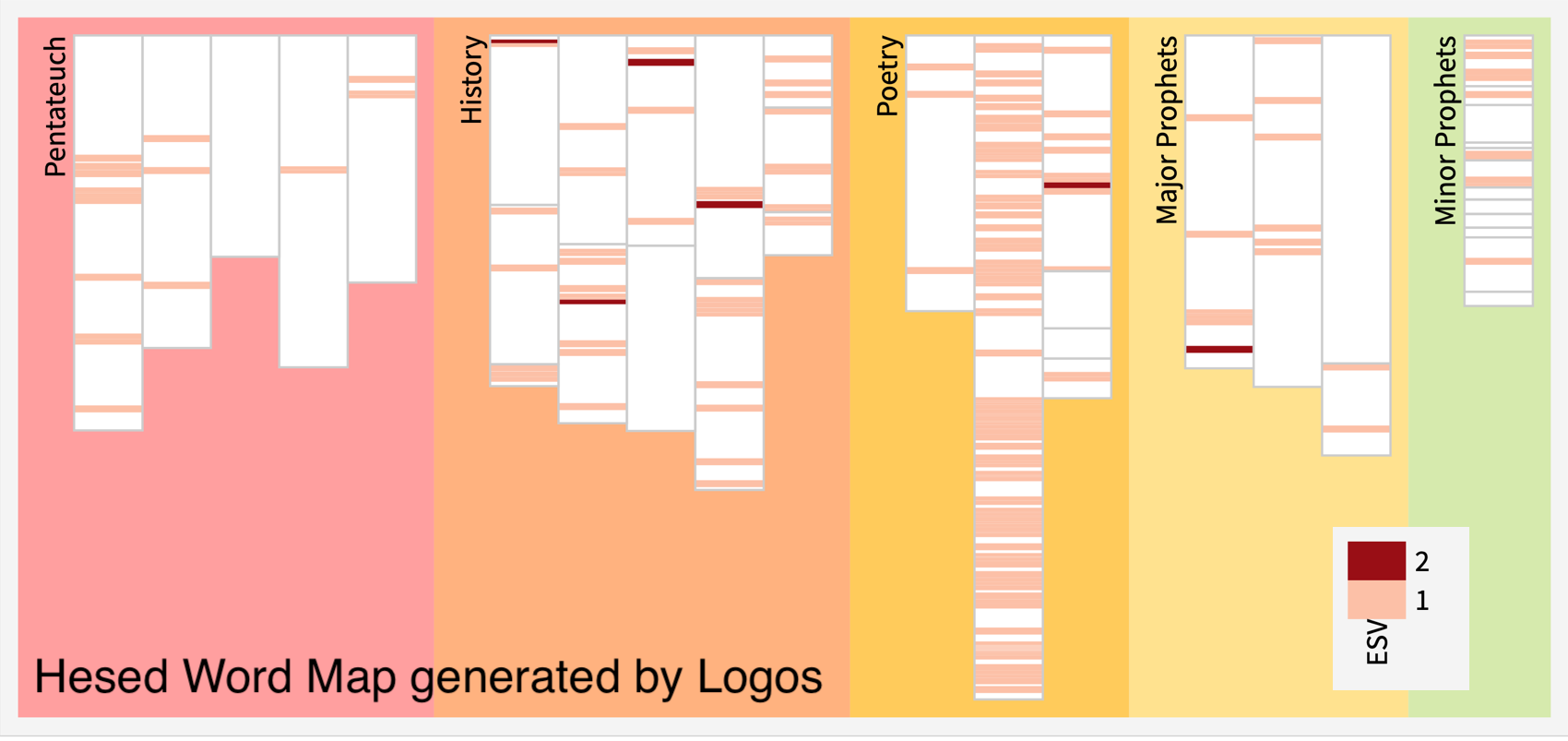
Hesed is widely distributed across all biblical literary categories of the Hebrew Bible, which is arranged differently than the Christian Bible (see word map below). It is found in the Torah 20 times, in the Prophets (Nevi’im) 53 times, and the Writings (Ketuvim) 172[3] times.[5] The twelve books where hesed does not appear, however, are Leviticus, 2 Kings, Ezekiel, seven of the twelve minor prophets (Amos, Obadiah, Nahum, Habakkuk, Zephaniah, Haggai, and Malachi), Song of Solomon and Ecclesiastes.

Hesed appears in the first book and the last book of the Hebrew Bible; from the rescuing of Lot in Genesis 19:19 to the faithful deeds of Josiah’s reformation in 2 Chronicles 35:26:

you have shown me great kindness [hesed] in saving my life. (NRSV)[6] 

the rest of the acts of Josiah and his faithful [hesed] deeds in accordance with what is written in the law of the Lord. (NRSV)

The last reference reflected in the Protestant arrangement of the Bible (see word map below) closes with the prophetic oracle of Zechariah 7:9-10:

Thus says the Lord of hosts: Render true judgments, show kindness [hesed] and mercy to one another; do not oppress the widow, the orphan, the alien, or the poor; and do not devise evil in your hearts against one another. (NRSV)

Result Map of חֶ֫סֶד:2 in ESV.png
Word Map: The Hesed (חֶסֶד) word map is based on the English Standard Version generated by Logos Bible software. The pink horizontal lines represent single and double instances.

The books which have ten or more references of hesed are Proverbs (10 times), Genesis (11 times), 1–2 Chronicles (15 times), 1–2 Samuel (16 times), and the Psalms (127[8] times). The majority of these books reflect the relational nature of hesed in the human realm. In Proverbs the end goal of wisdom is to teach practical relational hesed (31:26, 21:21), it is not a false front but the foundation of one’s reputation by its presence in their life (20:6, 28).

In Genesis, “kindness” is requested in prayer to God by Abraham’s servant to find a wife for Isaac (Gen 24:12, 14, 27). Then, Laban and Bethuel act in hesed (“kindness”) by cosigning their approval of Rebekah’s consent to be given as wife to Isaac.

1–2 Chronicles and 1–2 Samuel show that hesed expressed in reciprocal social acts. Saul reciprocates and excuses the Kenites from his assault on the Amalekites because they has shown hesed to Israel in ages past (1 Sam 15:6). Hushai’s “love” (loyalty?) for David is questioned during his infiltration of Absolam’s forces (2 Sam 16:17). The hesed shared between David and Jonathan is a story of deep loyalty and mutual reciprocity (1 Sam 20:8, 14–15). The Divine hesed is evidenced as well (2 Sam 15:20). Nathan enshrined the Davidic lineage and kingdom on behalf of God,

“my love will never be taken away from him” (2 Sam 7:15 NIV; 1 Chr 17:13, 2 Chr 1:8, 6:42; Psa 18:25[26]).

The Psalms contain close to half of all uses of the noun hesed (127[8] times); but it does not appear in 55% (83 psalms) of the 150 psalms. In brief, there are 23 instances in Book I (1-41), 16 instances in Book II (42–72), 14 and 13 times in Book III (73–89) and IV (90–106) respectively. In Book V (107–150), however, the frequency count skyrockets to 60 instances. Psalm 136 alone celebrates the Divine hesed in each of its twenty-six verses. It is in the Psalms that “both God and human worshipers describe God’s hesed as everlasting.”[7] Indeed,

While the term is used of both humans and God, in the Psalter it is above all a theological term that describes God’s essential character as well as God’s characteristic ways of acting—especially God’s characteristic ways of acting in electing, delivering, and sustaining the people of Israel. Hesed is both who the Lord is and what the Lord does. Hesed is an ancient term that defined for Israel who its God is.[8]

The saturation of hesed in the Psalms suggests that God’s people should always be mindful in prayer and worship of its content, its deeds, and the God who so relates to his people (Psa 36:5, 7, 10).

As pertains to the present study, it should be noted that the noun hesed only features twice in Jonah. Jonah is only one of four minor prophets where the term is employed (Hosea, Joel, and Micah). The first instance is in Jonah’s prayer of lament while in the “great fish” wherein he affirms that pagan idolators will miss out on “the grace [hasdam] that could be theirs” (2:8[9] NIV). The other instance is in 4:2 where Jonah laments what he knows about the LORD, who is “abounding in love” (NIV, warabhesed) and willing to change his mind about bringing judgment on the penitent people of Nineveh. 

Semantic Range and Related Hebrew Words

As Silzer and Finley remind, “[w]ords normally have more than one meaning. The specific meaning of the word depends on its context.”[9] It is not sufficient, then, to rely on English translations (archaic or contemporary), nor to force lexical glosses to determine the meaning of a word.[10]

Brown, Driver, and Briggs groups hesed with its verbal (hasad 2 times) and adjectival (hasid 32 times) forms, along with a few proper names, such as Ben-Hesed (“son of Hesed” 1 Kgs 4:10) and Hasadiah (“Yah is Hesed” 1 Chr 3:20).[11] Lastly, is the unclean hasidah (6 times) often translated “stork” or “heron.” The root connection is believed to be due to their fond, “kind and affectionate” nature with their young.[12] This is a feature that is never appealed to in the Hebrew Bible.

The semantic range of hesed extends to the secular and the religious. In each, hesed manifests in concrete actions of goodwill, loyalty, and communal love whether in or outside of the covenant.[13] Divergent views emerge here with polarizing understandings over the meaning of hesed. Nelson Glueck saw in hesed a hardline covenantal legal obligation, H. J. Stoebe and others countered that hesed was a free relational demonstration of loyal love.[14]

In the secular sense hesed speaks to certain “ethical norms of human intercourse” where mutuality exists that focuses on “the closest of human bonds.”[15] For example, Ruth exhibits this sense (1:8, 2:20, 3:10). Naomi blesses her daughters-in-law reciprocally, “May the Lord deal kindly [hesed] with you, as you have dealt with the dead and with me” (NRSV).

Religiously, the Divine demonstration of hesed does not function very differently than from the secular.[16] Exodus 34:1–7 provide a clear liturgical formula which demonstrates that Israel’s God abounds “in steadfast love and faithfulness” (34:6 NRSV; Psa 86:15, 89:14, Num 14:18).

The Lord passed before him, and proclaimed, “The Lord, the Lord, God merciful and gracious, slow to anger, and abounding in steadfast love [hesed] and faithfulness, keeping steadfast love [hesed] for the thousandth generation, forgiving iniquity and transgression and sin, yet by no means clearing the guilty, but visiting the iniquity of the parents upon the children and the children’s children, to the third and the fourth generation.” (Exod 34:6-7 NRSV)

This divine expression stresses the LORD’s multi-generational hesed and faithfulness. Moses now knows (33:13) that the LORD relates to his people through his benevolent and enduring nature. The words are quoted and echoed throughout the Hebrew Bible which suggests that they became formulaic or institutionalized to extoll the attributes of the God of Israel (Num 14:18, Jer 32:18, Joel 2:13, Nah 1:3, Psa 86:15, 103:8, 111:4, 112:4, 116:5, 145:8, Neh 9:17, 31, 2 Chron. 30:9)[17]

There are several words that appear frequently with hesed. They provide some dynamic appreciation for its usage in the Hebrew Bible.[18] Hesed may be done (‘asah) in concrete choices (Ruth 1:8). The LORD God keeps (shamar) and abounds (rab) in hesed (Deut 7:9, Neh 9:17). It is often associated with various nouns of “mercy” as in Psa 103:4 where the psalmist speaks of being crowned by God with hesed and rahamim (mercy). Likewise, hesed appears together with ’emet (faithfulness) probably as a hendiadys such as in Exod 34:6 and Psa 86:15.[19]

Hesed in Jonah 4:2

He prayed to the Lord and said, “O Lord! Is not this what I said while I was still in my own country? That is why I fled to Tarshish at the beginning; for I knew that you are a gracious God and merciful, slow to anger, and abounding in steadfast love [hesed], and ready to relent from punishing. And now, O Lord, please take my life from me, for it is better for me to die than to live.” (Jonah 4:23 NRSV)

This survey of hesed in the Hebrew Bible should help to determine the possible range of meaning for how Jonah 4:2 should be understood. Words have meaning only in context. With the above range in mind, the context appears to reflect Jonah’s usage of the formulaic hesed language of Exodus 34:6–7. Instead of celebrating his God with these words, Jonah is subversively using this language to express his frustration with the LORD’s restraint against the city of Nineveh.

Jonah is using God’s own words against him. For this reason, it appears the meaning for Hebrew word hesed found in Jonah 4:2 should be understood as “benevolent love.” Jonah knows how LORD acts out in concrete acts of hesed, these being grace, mercy, “slow to anger,” and relenting from judgment. Since there is no evidence that the LORD is in covenant with Nineveh, this supports the supposition that divine hesed may be expressed in free relational demonstrations of benevolent love. God relates to repentance with the reciprocal response of grace, mercy, patience/forbearance, relenting from judgment.

Jonah 2:8[9] further supports this view. It reveals that the prophet desires for judgment those who do not enjoy a covenant relationship with the LORD. It appears that for Jonah, idolatry is the “deal-breaker” for having a relationship with the LORD based on hesed. Yet, the irony fails to make any headway with the nationalistic prophet, since he rejected his prophetic call on the basis that he knew what the LORD would do should Nineveh repent. Both he and pagans have rejected God. Jonah is not only selfish with his relationship with his faithful God (“save me from the fish!”) but is resentful that God is “sharing the love” with foreigners (“you saved them from judgment!”).

Jonah wants his curse to come true, that those who “cling to worthless idols forfeit the grace [hesed] that could be theirs” (2:8[9] NIV). It is this forfeiture of Divine hesed which Jonah still desires for Nineveh, reflected in his willingness to proclaim that the city “will be overturned” (3:4) and his bitterness that it was not (4:1–11). Jonah knew that God would choose relationship over punishment. The LORD said as much (4:11). Humans, unfortunately, seem to choose punishment over relationship. Jonah shows as much.

This focused study on hesed and Jonah 4:2 brings to mind that the caricature of the bloodthirsty wrathful God of the Old Testament is just that an exaggerated cartoon (cf. Jas 2:13). As Baer and Gordon powerfully remind:

The insight that, while both anger and love are appropriate divine responses, the latter outlasts the former, is an important one for biblical theology. Wrath is a true word, a right word, sometimes an inevitable word, such passages seem to say. But God would not have it be his last word. That honor is reserved for his unfailing love (hesed).[20]

The burden of Jonah was to provide concrete witness to the people of Nineveh that God seeks to extend and establish benevolent love with all nations. As one who has experienced Divine benevolent love, Jonah should have been moved to be a spokesman for Divine benevolent love. In this he struggled and failed; nevertheless, God succeeded even if for a brief time (cf. Nahum 1:1?).

Conclusion

The meaning for Hebrew word hesed found in Jonah 4:2 should be understood as “benevolent love.” The formulaic language of Exodus 34:6–7 is surely the theological and context for Jonah’s use of hesed. In Exodus as in Jonah 4:11, the LORD shows that he has the concern to establish and maintain a communal relationship with Israel. The benevolent concerns of preserving others and acting on the basis of moral uprightness anchor the LORD’s demands of repentance. Jonah knew if Nineveh took seriously the burden of his message, his God would become their God. They would collectively experience Divine benevolent love.

A final thought should be emphasized. Even though there are many excellent translations in the English language their primary function is simply to provide a reading text. Some significant and complex words, like hesed, merit the focused investigation which a word study provides. As developed above, hesed stresses relationships, community, loyalty and the ethical demands of love, responsibility, care, and obligation words which no single translation can do justice. Word studies reveal facets and these usages are combined into a framework. This framework provides the contours for understanding what a word means within its context, for usage determines meaning.

Endnotes

  1. Rolf A. Jacobson, “Text, Title, and Interpretation,” in The Book of Psalms, NICOT, eds. E. J. Young, R. K. Harrison, and Robert L. Hubbard (Grand Rapids, MI: Eerdmans, 2014), 78.
  2. John R. Kohlenberger III. and James A. Swanson, The Hebrew-English Concordance to the Old Testament (Grand Rapids, MI: Zondervan, 1998), v, 559.
  3. H. J. Stoebe, “hesed kindness,” TLOT 2:449; H.-J. Zobel, “hesed,TDOT 5:45; Robert P. Gordon, “hesed,” NIDOTTE 2:211.
  4. Gray D. Practico and Miles V. Van Pelt, Basics of Biblical Hebrew, 2d ed. (Grand Rapids, MI: Zondervan, 2007), 105; Koehler, Baumgartner, and Stamm, “hesed,” HALOT 1:336; William L. Holladay, A Concise Hebrew and Aramaic Lexicon of the Old Testament (1971; repr., Grand Rapids, MI: Eerdmans, 2000), 111.
  5. The Torah includes Genesis-Deuteronomy; the Nevi’im includes Joshua-2 Kings, Isaiah, Jeremiah and Ezekiel, and the Minor Prophets; and the Ketuvim includes Psalms, Proverbs, Job, Song of Solomon, Ruth, Lamentation, Ecclesiastes, Esther, Daniel, Ezra-Nehemiah, and 12 Chronicles.
  6. The two English translations the Holy Bible used in this paper are the New Revised Standard Version (Nashville, TN: Nelson, 1989) and the New International Version (Nashville, TN: HarperCollins, 2011) cited as NRSV and NIV respectively.
  7. David A. Baer and Robert P. Gordon, “hesed,” IDOTTE 2:212–17.
  8. Jacobson, “Text, Title, and Interpretation,” 8.
  9. Peter James Silzer and Thomas John Finley, How Biblical Languages Work: A Student’s Guide to Learning Hebrew and Greek (Grand Rapids, MI: Kregel Publications, 2004), 164.
  10. Douglas Stuart, Old Testament Exegesis: A Handbook for Students and Pastors, 4th ed. (Louisville, KY: Westminster John Knox, 2009), 182–83.
  11. BDB 338–39.
  12. BDB 339; HALOT 1:336; TLOT 2:449.
  13. IDOTTE 2:212–17; HALOT 1:336–37; TDOT 5:46–64.
  14. R. Laird Harris, “hesed,” TWOT 1:305–06.
  15. TDOT 5:47–48.
  16. TDOT 5:54–55.
  17. Nahum M. Sarna, Exodus, JPS Torah Commentary, ed. Nahum M. Sarna (Philadelphia, PA: Jewish Publication Society, 1991), 216.
  18. HALOT 1:337.
  19. TWOT 1:307.
  20. IDOTTE 2:214.

Bibliography

Baer, David A., and Robert P. Gordon. “חסד.” Pages 211–18 in vol. 2 of New International Dictionary of Old Testament Theology and Exegesis. Grand Rapids, MI: Zondervan, 2012.

Brown, Francis, S. R. Driver, and Charles A. Briggs. A Hebrew and English Lexicon of the Old Testament. Oxford: Clarendon Press, 1907.

Ford, David. “Keeping up Biblical Languages while in the Ministry.” Foundations 14 (1985): 41–44.

Gordon, Robert P. “חסד.” Pages 211–18 in vol. 2 of New International Dictionary of Old Testament Theology and Exegesis. Edited by Willem A. VanGemeren. Grand Rapids, MI: Zondervan, 1997.

Harris, R. Laird. “חסד (hsd).” Pages 305–07 in vol. 1 of Theological Wordbook of the Old Testament. Edited by R. Laird Harris, Gleason L. Archer, Jr., and Bruce K. Waltke. Chicago, IL: Moody Press, 1980.

Holladay, William L. A Concise Hebrew and Aramaic Lexicon of the Old Testament. 1971. Repr., Grand Rapids, MI: Eerdmans, 2000.

Jacobson, Rolf A. “Text, Title, and Interpretation.” Pages 29 in The Book of Psalms. NICOT. Edited by E. J. Young, R. K. Harrison, and Robert L. Hubbard. Grand Rapids, MI: Eerdmans, 2014.

Koehler, Ludwig, Walter Baumgartner, and Johann J. Stamm. The Hebrew and Aramaic Lexicon of the Old Testament. Translated and edited under the supervision of Mervyn E. J. Richardson. 5 vols. New York: Brill, 1994–1999.

Kohlenberger, John R., III., and James A. Swanson. The Hebrew-English Concordance to the Old Testament. Grand Rapids, MI: Zondervan, 1998.

Practico, Gray D., and Miles V. Van Pelt. Basics of Biblical Hebrew. 2d edition. Grand Rapids, MI: Zondervan, 2007.

Sarna, Nahum M. Exodus. JPS Torah Commentary. Edited by Nahum M. Sarna. Philadelphia, PA: Jewish Publication Society, 1991.

Silzer, Peter James, and Thomas John Finley. How Biblical Languages Work: A Student’s Guide to Learning Hebrew and Greek. Grand Rapids, MI: Kregel Publications, 2004.

Stoebe, H. J. “חֶסֶד, hesed kindness.” Pages 449–64 in vol. 2 of Theological Lexicon of the Old Testament. Edited by Ernst Jenni and Claus Westermann. Translated by Mark E. Biddle. 3 vols. Peabody, MA: Hendrickson, 1997.

Stuart, Douglas. Old Testament Exegesis: A Handbook for Students and Pastors. 4th edition. Louisville, KY: Westminster John Knox, 2009.

Wegner, Paul D. Using Old Testament Hebrew in Preaching: A Guide for Students and Pastors. Grand Rapids, MI: Kregel Publications, 2009.

Zobel, H.-J. “(חֶסֶד, hesed).” Pages 44–64 in vol. 5 of Theological Dictionary of the Old Testament. Edited by G. Johannes Botterweck and Helmer Ringgren. Translated by David E. Green. Grand Rapids, MI: Eerdmans, 1977.


Church: A Preliminary Survey

With so many “churches” in the religious world, people interested in visiting one are often sidelined by the inevitable question, “which church should I go to?” After all, there are as many “churches” as there are potential opinions on what a church should be like. But where should a person begin as they search for a church, should they simply jump out on a whim? Hardly.

Searching for a church should be a reverent endeavor, especially since in the New Testament the “church” is said to have been “purchased” by the very blood of Jesus Christ (Acts 20.28). Consequently, if the church was that important to Jesus and the Father, those seeking to “go to church” should realize this spiritual venture should not be taken lightly.

Where then might a person find the necessary perspective from which to begin this search? The relevant information is found in the New Testament documents, the documents which record the formative forces which began the church in the first place; moreover, the New Testament provides ample information about how people became members of the blood-bought church of Jesus, along with important church organizational references.

This piece is a primer, in a sense, on the nature of the church. There are many ways that this topic can be addressed. But, nevertheless, below are some relevant points to glean from the New Testament on the topic of the church of Christ (Rom. 16.16).

The New Testament Documents

In the New Testament, from the beginning to end, the thought and actual fact that the saved existed as a collective known as the “church” or body of Christ is clearly self-evident (Matt 16:18 and Eph 1:22, 23, 4:4; Acts 2:47). Consider a sample of the New Testament documents.

There are four accounts of the ministry of Jesus, they are called Gospels. The term “church” is found only in the Gospel of Matthew, particularly in chapters 16 and 18. In chapter 16, Jesus speaks of building His church – “my church” (16:18). He explains that death (Grk. hades – not hell, contra KJV) will be incapable of deterring his plans to bring His church into reality.[1] In chapter 18, verses 15-17 describe the disciplinarian process regarding a Christian brother living in sin, and hence, needing private correction. The final stage is to bring the sin to the public forum by telling it to the church, with the intention that it can act as a loving measure of leverage to pressure the brother to quit the sinful practice. Thus, in Matthew Jesus speaks of his church in two ways: (1) that it will be built (Matt 16:18), and (2) as the ultimate forum for maintaining moral purity among God’s people (Matt 18:15-17).

The Acts of the Apostles is the inspired historical account of the church – albeit a history with a theological focus. It is most definitely a primary source for the church, and therefore a logical document to examine in order to find the biblical church. To save space, consider what we find in only the first half of Acts (Acts 1-12). We find it was “the church”[2] that had become fearful after the Divine retribution against Ananias and Sapphira was administered by the Lord (Acts 5:11); the object of Saul of Tarsus’ brutal obsession was “the church” anywhere it assembled (Acts 8:1, 3; cf. Gal 1:13); it was “the church” at large in Samaria and Judea that enjoyed peace when the persecuting Saul became the believing Paul (Acts 9.31).

We find Barnabas and Paul (Saul) laboring in “the church,” particularly in Antioch of Syria,[3] and labeling the disciples (i.e. the individual members of the church) Christians (Acts 11:22, 26); several members of “the church” suffered persecution under the hand of King Herod (Acts 12:1, 5); “the church” in Antioch of Pisidia had prophets and inspired teachers, and sent Paul and Barnabas out to accomplish their first missionary call (Acts 13:1ff.); Paul and Barnabas had appointed elders in every “church” they established on their missionary labors (Acts 14:23), and upon their return to Antioch they recounted they travel to “the church” (Acts 14:27).

The largest sub-category of the New Testament documents is The Letter (also commonly styled, “epistle”) – 21 letters to be exact.[4] They are further divided by the prophets which God employed to pen them: Paul (13 letters), John (3), Peter (2), James (1), Jude (1), and the unknown author of the Letter to the Hebrews. This is a vast amount of literature to scan, but we can reflect on the following citations of “the church” among the letters and observe that “the church” is the redeemed body of Jesus believers. It goes without saying – at least it should be by students – that the New Testament Letters assume their audience is the redeemed body of Jesus disciples.

Ancient letter writing etiquette had the author’s name first and then the recipient’s name; thus, we read, “from me… to you.” When Paul wrote his letters, he often addressed the recipients with the nomenclature “saints” (cf. Rom 1:7; 1 Cor 1:2; 2 Cor 1:1; Eph 1:1; Phil 1:1; Col 1:2). The term “saint” is the general description of all members of “the church” in the respect that they have been sanctified in baptism, and this sanctification continues in obedience shown by a holy life (Matt 26:28; Acts 2:38; 1 Cor 6:11-13; 1 John 1:6-7). The “saints” are members of the church viewed from the perspective of consecration. In fact, many times the letters begin like this: to the church with the saints.

Some appear to use Jewish terminology, like James and Peter, to describe the people of God. The letter of James is written to “the twelve tribes in the Dispersion” (1:1); meanwhile, the audience for the Letters of Peter (if to the same audience) is depicted in the following way: “To those who are elect exiles of the dispersion” (1 Pet 1:1). However, in Peter’s second letter, he speaks of his audience as “those who have obtained a faith of equal standing with ours by the righteousness of our God and Savior Jesus Christ” (2 Pet 1:1). It seems like the language applies the covenant aspect that biblical Israel had with God, and here it is applied in a new way to demonstrate that Peter’s audience is the new covenant people of God (Jer 31:31; Heb 8:13). These are members of the biblical church.

The Letter of Jude addresses his recipients with the nomenclature “called” and “beloved” (vs. 1). Their calling seems from the simple fact that they received their invitation (a clearer meaning of the term, kleitos translated “called”) to share the “common salvation”. Moreover, they received access to the love of God actuated in the redemption of their soul accomplished through Jesus Christ, thus, they are the beloved of God. What Jude emphasized that their identity was related to their Divine relationship through obedience to the Gospel. For our purposes, we are to understand that these “saints” and “beloved” ones are members of the New Testament church.

The First Letter of John, much like Hebrews, does not begin in the traditional letter format. Some describe them as tractates or some larger form of literary work sent as a letter. Nevertheless, John assumes a relationship – a fellowship between the apostolic circle, God, and themselves – that is based on obedient living and faithful confession of sin as they strive to live a disciplined life (1 John 1:1-10). They already are in this relationship, they are saved. Again, in Hebrews 2:1-4, the evidence is provided regarding the recipients. They are encouraged to remain vigilant, not neglecting their salvation which was shown to have a supernatural origin. Likewise, these recipients are members of the biblical church.

The last document in the New Testament is the Apocalypse, the Book of Revelation. The document opens up with these words: “John to the seven churches that are in Asia” (Rev 1:4). In the doxology, it is Jesus “who loves us and has freed us from our sins by his blood, and made us a kingdom, priests to his God and Father” (Rev 1:5-6). The audience, the churches, share salvation and the love of God, are part of a kingdom, and share involvement in the priesthood of God. The message of Revelation is the victory over the enemies of God as it is revealed in the inability of these satanic forces to prevent the faithful saints from entering the New Jerusalem, wherein lies the tree of life (Rev. 22.14). The brief but spiritually dense letters sent to the churches of Asia in Revelation 2 and 3 show among other things, the audience intended for the prophecies embedded into the fabric of this symbolic book. They assume that the recipients are already Christians, members of the church.

The picture should be clear that the New Testament is a collection of 27 books which speak to or about the church of Jesus Christ. Consequently, anyone looking for a church should reverently approach the prospect with the New Testament as the guiding source for determining what the church that God established should look like and be like.

The Church: A Brief Word Analysis

We may survey some of the information from the New Testament regarding the “church” and the redeemed which make up the “church”, but what does “church” mean? The term “church” is the most common, though unclear, translation for the New Testament Greek term ekklesia. Often times, “church” is thought of as solely “the building” in which a person congregates with others to worship God; however, ekklesia does not refer to a building – hence, “church” is an unclear translation if not misleading altogether. But the term is so commonplace that it need not be shelved; after all, even modern dictionaries have various nuances for the word “church.”

The English word “church” has a peculiar history that demands some attention. Hugo McCord (1911-2004) – professor, translator, and preacher – briefly summarizes the history of the word:

Historically, the English word “church” comes from the Middle English “cherche” or “chirche,” which is from the Anglo-Saxon “circe” or “cyrce,” which is from the German “Kirche,” which is from the Greek kuriakos, meaning “belonging to the Lord.” Webster says that the Greek word doma, “house,” has to be added to kuriakos to make the word “church,” that is, a “church” is “the Lord’s house.”[5]

McCord further observes that only twice does kuriakos – “the Lord’s” – appear in the New Testament (“the Lord’s supper” 1 Cor. 11.20; “the Lord’s day” Rev. 1.10), but in neither case is the phrase “the Lord’s house” ever employed.[6]

Basically, the etymology of the word translated “church” (ekklesia) derives itself from the adjoining of two words, ek and kaleo (ek-kaleo “call out”), into one verb originally “used for the summons to an army to assemble.” As a noun, ekklesia, denoted “the popular assembly of the full citizens of the polis, or Greek city state” (cf. Acts 19:32, 41).[7] This is, in a nutshell, the Greek background of the word beneath our religious word “church.”

Its existence in the Old Testament is due to the Greek translation of the Hebrew Scriptures. In the Septuagint (abbreviated LXX), ekklesia appears about one hundred times and is frequently employed to translate the Hebrew term qahal.[8] It is not so much the frequency to translate qahal which is intriguing; instead, it is the regularity of the context when ekklesia is employed which should attract contemplation. O’Brien writes:

Of particular significance are those instances of ekklesia (rendering qahal) which denote the congregation of Israel when it assembled to hear the Word of God on Mt. Sinai, or later on Mt. Zion where all Israel was required to assemble three times a year.[9]

Interestingly, the Hebrew writer similarly speaks of the redeemed in Hebrews 12:22-24. Thus, a raw translation of ekklesia may suggest the meaning to be, “the called out ones.”[10] In the biblical tradition, however, it seems better to emphasize that it carries the spiritual depiction of an assembly of God’s people prepared to hear and be led by His word in the covenantal sense.

Stephen, the first Christian martyr, recounts how Israel was an ekklesia during the forty years of wandering in the wilderness due to their rebellion and lack of faith (Acts 7:38). And it was during this time that they were taught how to depend upon the Lord. The beautiful and yet tragic relationship between the faithful God and his unbelieving nation is set forth clearly in Psalm 78 (cf. Hos 11:1-9). The Lord’s goal was to “shepherd” and “guide” them with his powerful word and through the demonstration of his presence.

With regards to the Lord’s church which Jesus promised to “build,” it is important that we consider these thoughts in our understanding of the kind of church Jesus was thinking of; as a consequence, it should guide our assessment of how “church” should behave. Individuals gathered together to hear and abide in his teaching, so that in it, they may be shepherded and guided (1 Tim 4:13). Meanwhile, leadership in the church (i.e. elders/shepherds) is to be “able to teach” and “manage” his household, and use these skills as he executes his God’s appointed office (Acts 20:28, 1 Tim 3:1-5). When the church considers this relationship and responsibility and embraces its challenge, we will be taking strong steps to finding a congregation of the Lord – a church of Christ.

Conclusion

We find in the New Testament a consciousness the early Christians held regarding the church. Jesus was to build his church, and after his death, the church began in Jerusalem and spread throughout the Roman world through Judea, Samaria, and to the furthermost extents of known Roman world (Acts 1.8ff). As the church expanded, the apostles and other inspired authors wrote to Christians regarding the ministry of Jesus and concerning Christian living.

Through these documents, important information is related to the nature of the church. Anyone searching for a “church” to attend should not settle for any church but should study the New Testament reverently identifying the nature of the church revealed in its pages.

When examining the English word “church” we find that we are not talking about a building, but instead, the emphasis should be placed upon an assembly of people. These individuals are assembled to hear the word of God, and make those Divine words translate into everyday action – everyday living. Only until we hear and practice the Word will we become the church (ekklesia) of Christ.

Endnotes

  1. The King James Version (a.k.a. the A.V.) is quite misleading here, for the Greek text reads pulai hadou – literally, “the gates of hades.” The Analytical-Literal Translation of the New Testament (ALT) has the following descriptive rendering of the passage,”[the] gates of the realm of the dead [Gr., hades] will not prevail against it” (ATL Matt. 16.18).
  2. Again we disagree with the A.V./KJV-Byzantine tradition in Acts 2.47, where the word “church” (ekklesia) is part of a variant reading of the text. Instead, we agree with others who find that the ending better reads epi to auto, a phrase often used to refer to the “Christian body” in a collective sense (Acts 1.15; 2.1, 47; 1 Cor 11.20; 14.23; Bruce Metzger, A Textual Commentary on the Greek New Testament, 2d ed. [Germany: Deutsche Bibelgesellschaft, 2001], 264-65).
  3. Antioch of Syria is not to be confused with the Antioch of Pisidia in Asia Minor. BiblePlaces.com has good images of both Antioch of Syria (link) and of Pisidia (Link).
  4. Technically, there are a few more letters in the New Testament record, but each is embedded in other books. For example, the book of Acts has two letters (a) 15.22-29, and (b) 23.23-30; and, the book of Revelation has seven letters to the church of Asia (Rev. 1-3).
  5. Hugo McCord, The Everlasting Gospel: Plus Genesis, Psalms, and Proverbs, 4th ed. (Henderson, TN: Freed-Hardeman University, 2000), 696. This edition is known also as FHV4.
  6. McCord, The Everlasting Gospel, 696.
  7. Peter T. O’Brien, “Church,” DPHL, 123.
  8. O’Brien, “Church,” 124; TDNT 3:527; BDAG, 303.
  9. O’Brien, “Church,” 124.
  10. Etymologically, ekklesia does suggest that individuals were “called out” from their lifestyles by the Gospel (2 Thess 2:14). There is obviously a separation that occurs (2 Cor 6:17, 1 John 2:15-17). These etymological considerations corroborate with New Testament teaching on the church. However, the word has a richer heritage as is seen in its Old Testament use of the Greek language. These aspects must be appreciated in balance with each other.

Suggested Reading

  1. Wayne Jackson, “The Origin of Christianity,” ChristianCourier.com.
  2. Wayne Jackson, “The Restoration of First-Century Christianity,” ChristianCourier.com.