Book Review: Emerging Elders

Emerging Elders

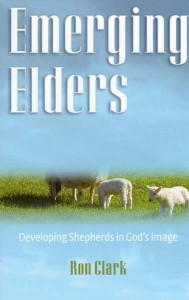
Ron Clark, Emerging Elders: Developing Shepherds in God’s Image (Abilene, TX: Leafwood Publishers, 2008), 203 pages. Paperback.

Ron Clark is the lead church planter with the Agape church of Christ in Portland, Oregon. He holds M.Div. and D.Min. degrees from Harding School of Theology (Memphis, TN) and serves as an adjunct instructor for George Fox Evangelical Seminary. He is also a member of the Oregon Attorney General’s Sexual Assault Task Force.

Clark has contributed to various publications such as New Wineskins, The Christian Chronicle, Stone-Campbell Journal, and Restoration Quarterly; moreover, he has recently published The God of Second Chances (2012) and Setting the Captives Free (2005) along with the current volume which is the subject of this book review.

Emerging Elders: Developing Shepherds in God’s Image provides a theological platform for training current elders and potential elders. Clark explores the text and terminology of the descriptive terms for “pastor” (elder, overseer) and explores such leadership in light of an incarnation model. Clark believes that only when God’s word is actually lived out and exemplified by its the church’s leaders shepherding cannot truly be what God intended it to be.

The Book

Clark has provided the body of Christ a unique text which addresses the needs of the organizational structure of churches of Christ. This is perhaps its greatest overall strength. As Clark observes, “few books are written specifically for ministers about our style of ministry” where the pastor and the preacher are distinct ministries in the body of Christ.[1] Clark observes that most church leadership material is based upon church models which are dissimilar to churches of Christ, or based upon business models which have been given a Christian spin. Consequently, to address the lack of literature on the subject Emerging Elders is an attempt at providing a resource and a solution to the vacuum of pastoral development in light of this distinction.

In Emerging Elders, Clark provides a solid response to this lack of material to address In section one, Clark develops the need for elders who are equipped to lead the body of Christ (chapters 1-2). In section two, Clark provides a dynamic model of God as shepherd and what that means for the leaders of God’s people, he offers a situational and contextual applications of the pastoral qualifications, and then emphasizes that both God’s example and Paul’s instructions are to be applied incarnationally (chapters 3-8).

In section three, Clark provides a series of chapters which specifically address the tensions and problems within church life in particular and churches of Christ in general that emerging elders must address in an incarnational model. “These leaders are appointed to imitate God’s care and concern for people.”[2] The chapters on predators and care of the preacher were particularly exceptional and passionate, and are often not treated in the manner in which Clark has done (chapters 9-15).

Suggestions

What perhaps would have made Emerging Elders more helpful would have been in the area of conflict resolution (chapter 10) and the elder development program (chapter 15). In chapter 10, Clark explores the role elders have in the promotion and maintenance of unity. This lays heavily upon John 17 and Eph 4:1-6, and according to Clark speaks to the needs of the elders to “encourage reconciliation.” To be sure, Clark is complete in his development of the reconciliation process: “Reconciliation requires, conflict resolution, validation, and reinstatement of a relationship.”[3] However, I walked away from that section wishing that Clark had spent more time on developing these ideas, diagrams notwithstanding.

Secondly, I felt that the last chapter (ch. 15) was almost a letdown. With the idea of elder development as the core of the book, I anticipated the last chapter, “Suggested Elder Development Program,” to have more details. Maybe I am being over judgmental. The cycles are a great suggestion and using a quarter year system for elders and potential elders is very helpful. The book reading suggestions are also very appropriate. But what about the first steps it takes, the conversations needful to create the atmosphere to offer and provide these classes? I anticipated more help in creating the development program; however, even in saying this the program offered and the notes to use certain sections of the book along with corresponding cycles is very helpful.

Recommendation: High

In balance, Emerging Elders is a perfect balance of scholarship and the heart of a servant attempting to live incarnationally. Incarnational leadership is at the heart of Emerging Elders and it should be at the heart of how Christian leaders serve, and how Christians serve their church, family, and community. It does not provide easy answers to the flesh and blood problems in the church, nor does it provide answers that are so impossible to achieve. Emerging Elders calls Christians to lead God’s church biblically (incarnationally), and to address the real-life problems the people of God face with the most fundamental gift God has given his people agape love.

Emerging Elders calls every would-be elder to be living examples of faith, integrity, and loving concern for all. I highly recommend Ron Clark’s Emerging Elders to every husband and wife who serve in their church, every preaching couple, every elder and his wife, every deacon, and his wife. They are truly the focus of this book. As Clark observes,

We must help families inside and outside the church heal, but this must come from incarnational leaders who model God’s style of marriage and parenting. God has a pattern; leaders follow and call others to do the same. They follow by modeling his nature through the fruits of the Holy Spirit, becoming a father like God, and being approachable. These individuals reflect God’s character to both the church and the world.[4]

Endnotes

  1. Ron Clark, Emerging Elders: Developing Shepherds in God’s Image (Abilene, TX: Leafwood Publishers, 2008), 9.
  2. Clark, Emerging Elders, 46.
  3. Clark, Emerging Elders, 139.
  4. Clark, Emerging Elders, 101.

“Is the Pastor In?”: A Brief Look at a Misnomer

The telephone rings and I answer it. The person on the other end asks the following question: “is the pastor in?” To which I reply, “No, we have no pastors, but I’m an evangelist can I help you?” The phone is silent for a few seconds, often followed by some stuttering; the refrain repeats uneasily, “is the pastor in?”

I am not purposely being difficult. I am however being biblical. I receive letter after letter, and call after call, where people (usually salespeople) are looking for or seeking “the pastor.” They are seeking the preacher but that is not the preacher’s title or description in the New Testament.

It is a rather unfortunate situation. It is also very awkward. I am often introduced (sometimes even by Christians) or greeted as a “pastor.” It really chills the occasion when I say, “no, I am not a pastor, I am an evangelist.” Somehow, that just rubs the world of Christendom the wrong way.

Maybe I should find a better time or way to correct that misunderstanding. In fact, there is a wholesale need to correct this application of the term “pastor” to the preacher.

The biblical use in the New Testament makes it clear that this is one of a few terms used with reference to a select group of congregational leaders.

Elders, Overseers, and Pastors (Shepherds)

It is just seems ingrained within the world of Christendom that the preacher must be a “pastor” of some kind. J. W. Roberts writes:

Some think of a priestly group; some think of the ministry of the Word and the preacher or ‘pastor’ of the flock; others with the metropolitan or diocesan concept think of the denominational ‘bishop.’ In truth, Paul means none of these.[1]

Roberts is correct. In Acts 20:17, the “elders” were summoned from Miletus to Ephesus; these “elders” were qualified by the Holy Spirit to be “overseers” in the church “to shepherd” the church (Acts 20:28).

Students of the New Testament are quite observant that these terms refer to the same office. In fact, one can see the interchange of these terms in 1 Peter 5:1-2, “I exhort the elders among you to pastor the flock of God that is in your charge, exercising the oversight.”[2]

Notice the three terms used in 1 Peter 5:1-2 which are exclusively for “a body of men in the primitive churches called elders.[3] The “elders” (Grk. presbuterous) are to “pastor” (Grk. poimaino) the church, employing “oversight” (Grk. episcopountes). The New Testament demonstrates that each congregation had a plurality of men so described (Phil 1:1-2, etc).

To apply the term pastor to an evangelist/preacher is to do so without New Testament precedent. “Such is a non-biblical use of the term ‘pastor,’ in spite of the popularity of such in modern society.”[4]

Does it Really Matter?

When a practice has no biblical basis, should we not simply abandon its use? This is at the heart of the problem.

Timothy and Titus represent a category of Christian workers known as “evangelist” (2 Tim 4:5) who “preach the word” (2 Tim 4:2). This is their “ministry” (2 Tim 4:5). The main obligations of the work are explained in 1 Timothy 4:13, 15 and 2 Timothy 4:2-5.

In summary, it has been observed by Earl D. Edwards that “every aspect of their work had meaning only as related to ‘the Word.’”[5] When one evaluates the basic responsibilities found in these passages a few things are evident:

The evangelist had the duty, first of all, to ‘preach’ the Word and then ‘correct’ those who did not follow that Word, and even ‘rebuke’ those who attempted to undermine the Word. He was also to ‘encourage’ with gentleness that Christians might follow the Word without becoming discouraged. In addition he was to ‘devote’ himself to the ‘public reading’ and ‘teaching’ of the Word.[6]

While the elder (pastor/overseer) must have the capacity and ability to be a teacher (1 Tim 3:2) in order to shepherd the flock, it is clear that the evangelist holds a complementary role for congregational development and a public proclamation of the gospel.

The preacher’s work is not the elder’s work. The most important qualification for the evangelist is that they are “faithful” recipients and heralds of the message (2 Tim 2:2). An elder, also, may fulfill the role of an evangelist (1 Tim 5:17; Eph 4:11); however, a preacher is not necessarily a pastor.

Not all faithful males may serve in the office of a pastor, for these men must possess specific qualifications (1 Tim 3:1-7 and Tit 1:5-9). Thus, the use of the term “pastor” to refer to the “preacher” is incorrect – a misnomer – and should be abandoned.

Concluding Thoughts

Some may be thinking, “No, I don’t buy it. A pastor is the one who leads the flock.” To which I would argue in response, “yes, pastors after a biblical pattern do lead the flock of God.” But our discussion is centered on the misuse of the term, and consequently, a blending of two distinct ministries found in the New Testament church.

There are those who are elders (overseers, pastors) who serve in a very unique office only after they met the qualifications set forth by the Holy Spirit (1 Tim 3:1ff; Acts 20:28). There are others, however, who serve as heralds of the word; that is to say, they preach the word as they labor alongside the pastors of a particular congregation (Eph 4:11).

Consider this final thought. Suppose one encounters a missionary from the Latter Day Saints, who in fact use the title “Elder”. “Elder Smith” however is a young man, single, and has no children. Yet, the inspired instruction from the Apostle Paul clearly indicates that the man must be of age (hence the term elder), must be a married man (1 Tim 3:2), and have children over which he has shown leadership (1 Tim 3:4-5).

Can we honestly say, in light of the biblical data, that these young men flashing the “Elder” badge are elders after a biblical order? Hardly, This is precisely our point. The New Testament use of the term elder (overseer, pastor) applies to a very uniquely qualified man, as he serves within a group of other men of equal caliber. Let us seek to call biblical things with Bible names, and do Bible things in biblical ways.

Sources

  1. J. W. Roberts, Letters to Timothy (Austin, TX: Sweet Publishing, 1961), 26.
  2. Everett Ferguson, The Church of Christ: A Biblical Ecclesiology for Today (Grand Rapids, MI: Eerdmans, 1996), 318-23.
  3. John W. McGarvey, The Eldership (1870; repr., Murfreesboro, TN: DeHoff Christian Bookstore, 2002), 9.
  4. Wayne Jackson, Before I Die: Paul’s Letters to Timothy and Titus (Stockton, CA: Christian Courier Publications, 2007), 82.
  5. Earl D. Edwards, “The Evangelist in the Epistles to Timothy and Titus (Book 1),” Alternative 8.3 (Summer 1982), 19.
  6. Edwards, “The Evangelist in the Epistles to Timothy and Titus,” 19-20.