Defining Gospel: A New Testament Glance

Words are strange creatures. Often, they mean what we want them to mean. It has been said that words are the patterns by which people think. Since words frame our thinking world, it is really important that we correctly shape our ideas with properly defined words. In the case at hand, understanding the meaning of the Christian word gospel depends on understanding how the word gospel is presented in the New Testament.[1] 

The English word Gospel most likely derives from the Old English word gōd spell, which meant “good story” or “good message.” William Deal points out that gōd spell meant a good mystery, doctrine, or secret, something hidden which was being brought out.[2] And the gospel is definitely a mystery revealed (Ephesians 3:1-14). The words translated gospel is, however, roughly the result of the combination of two Greek words: eu (good) and angelia (message, news). It roughly approximates “a good message,” but even this is not enough to tell us how the word is shaped by the New Testament.

Within the 27 New Testament volumes, the gospel is connected to three focuses: (1) “the gospel” as a message (euangelion), (2) the action of “preaching/bearing the gospel” (euangelizo), and (3) those individuals who proclaim the gospel (euangelistes). These words have a combined total of 133 instances, scattered over 20 of the 27 New Testament books.[3] The only books that do not use these words are the Gospel of John and his three Letters, and James, 2 Peter, and Jude. These books tend to use other words which emphasize the same ideas (cf. truth, proclaiming, hope, light, the message, etc.).

Let us consider a few lines of thought that will help us define and shape an accurate understanding of the gospel message.

How do you Define Gospel?

First, the gospel is not the result of religious evolution and philosophical development. In the ancient world, a number of religions and beliefs often blend into each other or break out into their own religions. For example, the far eastern religions such as Hinduism, Buddhism, and Confucianism resulted from a philosophical and religious reaction to their view of social order (the caste system) and how to become one with the ultimate reality of the universe. This development of ideas is not along parallel lines with how the gospel message is defined in the person of Jesus of Nazareth.  

Second, the gospel is not the result of social progress. One of the modern concerns in the industrial world is that of social concern for equality. These social concerns tug at our values, and our ethics. Equality is the hallmark (gospel) of the modern social order, and because of it, we are seeking ways to save everything. Yet, as the late atheist and satirical comedian George Carlin quips against this elevation of self-importance:

Save the trees, save the bees, save the whales, save those snails.” And the greatest arrogance of all: save the planet. […. explicit deleted] Save the planet[?], we don’t even know how to take care of ourselves yet […][4]

I would argue that here inlays the problem of a socially derived “good news”; The gospel must be defined by other means. Humanity needs help from the Creator.

Third, the gospel is the result of divine revelation (Galatians 1:11-17). The authors of the Bible in general and the New Testament in particular assume and argue that their religious instruction is not the result of human philosophy or development. For example, Paul affirms his source is Jesus Christ:

For I make known to you, brethren, as touching the gospel which was preached by me, that it is not after man. For neither did I receive it from man, nor was I taught it, but it came to me through revelation of Jesus Christ. (1:11–12).[5] 

The contrast between “not after man” and “through revelation of Jesus” is clear. The gospel of the New Testament is, by definition, from God and not from the insights of humanity (1 Corinthians 2:1-16). 

The New Testament Gospel

But how should we understand the word gospel? In its basic sense, the word gospel is focused on something positive being announced (military victory, news, etc). This meaning is older than in New Testament times but it is found in a few verses. For example, Paul writes to the Christians in Thessalonica about the good feelings they felt for him and his ministry, he writes,

when Timothy came even now unto us from you, and brought us glad tidings [euangelisamenou] of your faith and love, and that ye have good remembrance of us always, longing to see us, even as we also to see you. (1 Thessalonians 3:6).

The report of Timothy was positive, a good report, an enjoyable announcement (cf. Galatians 3:8, proeuangelizomai).

More significantly, when the Gospel of Mark —a biography of Jesus’s ministry— opens we read, “The beginning of the gospel of Jesus Christ, the Son of God” (Mark 1:1). This tells us something about the story of Jesus. It starts out by anticipating a message to embrace as a celebration and victory (Matthew 11:5). The content of the gospel not only includes the ministry and message of Jesus, but also his rejection, crucifixion, resurrection, and glorification of Jesus.

The four Gospel Accounts (Matthew-John) are so named because they provide the “building blocks” of what is to be proclaimed as the message of the gospel (Mark 1:14-15), by those whose role it is to proclaim it and bear it to the world (Acts 21:8; Ephesians 4:11; 2 Timothy 4:5; Mark 16:15). At the beginning, Jesus proclaimed a message based upon the kingdom of God, repentance, his role as the son of God, and the gospel’s role to change people’s lives (Matthew 4:23; 9:35). Later, after the resurrection of Jesus, the gospel is to be proclaimed on behalf of Jesus throughout the world (Matthew 24:14, 26:13; Colossians 1:23).

It is not surprising, then, to see the apostle Paul in Athens described by onlookers as one who “preached Jesus and the resurrection” (Acts 17:18). Paul made it a ministry goal to “to preach the gospel, not where Christ was already named, that I might not build upon another man’s foundation” (Romans 15:16, 19-20). Indeed, he explains his “aim” as a sense of indebtedness to mankind to share this message (Romans 1:14-15). For this reason, he affirms clearly:

I am not ashamed of the gospel: for it is the power of God unto salvation to every one that believeth; to the Jew first, and also to the Greek. (Romans 1:16-17)

Paul would seek to pass along this conviction to his protégé Timothy (2 Timothy 1:8-10). It is the responsibility of every Christian to boldly share this victorious good news (2:2). 

The Earliest Gospel “Statement”

Among the New Testament writers, the earliest statement of the content of the preaching of the gospel is found in Paul’s words in 1 Corinthians 15:1-11. Paul’s activity in ancient Corinth is around the early fifties of the first century AD, and this letter is dated to this timeframe no later than AD 55.[6]

In this letter, Paul presents a lengthy discussion —and definition— of the gospel message that he preached. The passage of 1 Corinthians 15:1-11 can be outlined based upon key elements of the gospel message:

(1) the preaching of the gospel word provides salvation to the believer (15:1-2),

Now I make known unto you brethren, the gospel which I preached unto you, which also ye received, wherein also ye stand, by which also ye are saved, if ye hold fast the word which I preached unto you, except ye believed in vain.

(2) the compelling force of the gospel is from the foretelling of events fulfilled in Jesus’ death, burial, and resurrection (15:3-4),

For I delivered unto you first of all that which also I received: that Christ died for our sins according to the scriptures; and that he was buried; and that he hath been raised on the third day according to the scriptures;

(3) the gospel is based on the eyewitness testimony of those who witnessed Jesus, resurrected bodily from the dead (15:5-8), and

and that he appeared to Cephas; then to the twelve; then he appeared to above five hundred brethren at once, of whom the greater part remain until now, but some are fallen asleep; then he appeared to James; then to all the apostles; and last of all, as to the child untimely born, he appeared to me also.

(4) the gospel is based upon God’s offer of unearned grace and humanity’s response of faith (9-11).

For I am the least of the apostles, that am not meet to be called an apostle, because I persecuted the church of God. But by the grace of God I am what I am: and his grace which was bestowed upon me was not found vain; but I labored more abundantly than they all: yet not I, but the grace of God which was with me. Whether then it be I or they, so we preach, and so ye believed.

The passage is significant, first, because Paul has an early and authentic message. Paul even “checked in” with Peter in Jerusalem and at some point compared notes regarding the gospel (Galatians 1:18). Second, the outline of this passage is significant because of its point-by-point details. Thirdly, it shows that the gospel bridges the gap between earth’s history and God. The victory message of the gospel is based upon the supernatural events firmly established in the historical life, ministry, death, resurrection, and exaltation as Lord and God (John 20:24-29).

Concluding Thoughts

In short, to understand the gospel one must understand Jesus, the purpose of his teaching and his ministry, the death-burial-and-resurrection of Jesus, and the life-changing message of the kingdom of God. It is not insignificant to point out that gospel obedience is described as an imitation of Jesus’ death, burial, and resurrection in baptism. In this way, the gospel is lived out in the Christian life manifested in obedience (Romans 6:1-10; Colossians 3:1-3).

Endnotes

  1. See, Doug Burleson, “Gospel,” in One Word Study Guide, eds. Chad Landman, et al. (Mt. Juliet, TN: Mt. Juliet church of Christ, 2016), 134-36. Burleson provides a perfect snapshot of “good news” in the Hebrew Bible (besorah) and the New Testament (euangelion).
  2. William S. Deal, Pictorial Introduction to the Bible, 3rd ed. (1982; repr., Peabody, MA: Hendrickson, 1997), 246.
  3. Figures worked out based upon calculations from the Logos Bible platform’s “Bible Word Study” for euangelion (76), euangelizo (54), euangelistes (3).
  4. George Carlin, “The Planet is Fine” routine in the 1992 HBO George Carlin: Jammin’ in New York Comedy Special (Cable Stuff Productions).
  5. All Scripture references are from the American Standard Version unless otherwise noted.
  6. This is argued on the basis of two points:
    First, the Book of Acts recounts his trip to Corinth (18:12-17), during which time he stands for religious accusations before the tribunal of the governor (proconsul) of Greece (Achaia), one L. Junius Gallio. Because this was a matter of Jewish religion and not Roman law, Gallio lets Paul go. 
    Second, an inscription was found from Delphi with Gallio’s name on it. Most likely it refers to his proconsulship from July 51 to July 52, which means Paul’s year-and-a-half stay began a year or so before this time (ca. 50-51). This is often regarded as one of the surest historical points of New Testament chronology. A few years later, Paul writes to the Corinthians. This would be no later than 55 AD. See, Everett Ferguson, Backgrounds of Early Christianity, 3rd ed. (Grand Rapids, MI: Eerdmans, 2003), 545-86. For an online source see Mark Cartwright, “Corinth,” Ancient History Encyclopedia.

This is a reformatted and expanded version of the article originally published in The Glendale Gleaner (Newbern, TN: Glendale church of Christ).

Leaving a Street Gang for Christ

20180131_130404

Reprinted from the April 2015 issue of Gospel Advocate Magazine.

Paul writes, “Do not be conformed to this world, but be transformed by the renewal of your mind, that by testing you may discern what is the will of God, what is good and acceptable and perfect” (Romans 12:2 ESV). It has been my experience that I am often unaware of the transforming process of the gospel until I see the contrast of who I used to be and who I am now. The transformation Paul speaks of reflects a fundamental change in character, and such change does not happen except by a “renewal” of the mind over a consistent and indeterminate period of time.

My story is of one foolish soul who was transformed by the gospel. I am afraid that at times I feel that I carry the memories of another man. Nevertheless, I was what I was, and I am what I am; may God be glorified by this thorn-riddled soul only to the extent that I find closure in my weaknesses and glory in His strength (2 Corinthians 12:7-10).

Before you are the beginnings of a hoodlum who was transformed by Christ, and that hoodlum (spoiler alert) was me. This is how I tell it.

The Transformation

One day in the summer of 1996, I was sitting on a rest stop at the corner of 24th and Mission streets in San Francisco, Calif. The intersection is a major hub in the Mission District, a major Latino district. Amidst the sounds of cars and bus traffic, the commotion of people talking and shopping, and bullhorn preachers shouting aloud, I came to a personal decision that would change my life forever.

At the time, I was a member of a local gang. I used drugs and alcohol. I was a high school drop out. I tried drug dealing. I was a thief. I was violent. The picture is rather rough, and the only reason I believe it is because I still have most of the memories.

That day I just wanted to relax. I was tired of it all. I saw girls calling home informing their families that they were never coming home (prostitution). I saw children in waves seeking to join our gang because they had created enemies in their own neighborhoods. I realized that I was just exhausted by the lunacy of it all.

I found myself at a fork in the road. What I wanted was an afternoon of drinking with my friends. What happened is that I realized that I had created a life full of potential dangers that forced me to think of ways to handle them. “If I go to the park,” I was thinking, “there is a good chance that along the way I would face the potential of retaliation.” At this point, I was not afraid of dealing with the problem. It was just that I was tired of the problem.

My mind raced with other options. I could take the 14 Mission (a bus) toward downtown, headed toward Pier 39. I had spent quite a bit of time there as a younger child, breakdancing for tourists with my big “brother” Rick (technically my cousin) on Fisherman’s Wharf. That thought quickly faded with the reality that I would pass through rival neighborhoods with those who would hurt me simply because of the color of my clothes (this is gang-banger logic). Again, I just wanted to relax.

I turned my attention southward, toward Daly City, a suburb of San Francisco. The broken record continued, “I just want to relax.” The last time I was on that bus route, some friends and I were shot at. In all fairness, we instigated it; still, I felt no need to travel alone just to prove a point. So I canceled that plan. It really dawned on me how much destruction and danger surrounded me because of my choices.

I said to myself, “go home and go out tonight.” I counseled myself, “make sure no one follows you.” I have gone to people’s homes banging on their doors in order to elicit a fight, so it was not beyond the possibility that I could be followed at some point. It was a life of paranoia. It was at this point when my heart uttered the words that would change my life forever: “I just want to go to heaven.” Those words made so much sense to me.

At some point, I found a Bible under my bed. It was inexplicable. I had no idea I even possessed a Bible! I began to search and read through the Bible with the feeling that I was getting closer to God. I look back at this moment much like I do when I read the conversion story of Cornelius in Acts 10 – yet in my sins, reaching for God, searching for His words to save me.

Left: Jovan after a street fight (photo taken by SFPD). Right: Jovan during a medical mission campaign in Panama, Central America.

Many Hands

A few months later, Rick was visiting home while on leave from the Army. I didn’t know he had been baptized into Christ earlier in the year by his superior officer. He approached me in our living room with these words: “Jovan, I found the church.” I sarcastically responded, “Yeah, you found a church, great.” I was thinking in terms of the city cathedrals like St. Paul’s Catholic Church, which was down the street, or Mission Delores, or even the Cathedral of St. Mary of the Assumption. Pick a saint, we Catholics had a cathedral for them.

Rick said, “No, I found the church that you can read about in the Bible.” This intrigued me, and I asked him to tell me more. By this time, I had read most of the New Testament, and I was already trying to be “Christian.” We proceeded to talk for a few months, and a couple of days after Christmas 1996 I was convicted by the gospel. I realized I needed to follow through with my change of heart, so I was immersed in water for the remission of my sins. I was added to the redeemed (Acts 2:47).

Civic Center church of Christ (a Google Street View of the old building): Home of The College of Evangelists, the birth place of Contending for the Faith. The people who met here established the Oceanview church of Christ in Pacifica, CA.

By and by, as we say, I became a member of the Civic Center Church of Christ in San Francisco. This is where my education in the gospel would lead me to face a series of challenging events and point me down the path to prepare myself for ministry. Much like the eunuch from Ethiopia (Acts 8), I had a wonderful mentor in Donald W. Hinds. If ever I had a father in the gospel, it was him; if ever there was a troubled child in the gospel, it was me. Don received me as Christ receives us all (Romans 15:7). I am forever indebted to his influence on my life, along with his son, David Hinds; together, they planted God’s Word in my heart, watered it, and in due season it bore fruit (2 Timothy 2:2; Amos 7:14-15; Psalm 1).

The truth is, I had no aspirations of preaching. Don had another thought altogether. Don sat me down every chance he could to teach me something new – well, new to me – during our Sunday lunch break between services. From studying the Bible to inspiring me to teach the gospel to believing in me to preach the gospel, it was in a very real way a tangible experience much like Paul and Timothy. Brethren, hands-on mentoring transforms young people.

One Wednesday afternoon I faced the consequences of leaving the gang life behind. I was confronted with the decision to return to the street life I had left behind. I was surrounded by my former “associates” with an ultimatum. My conviction to Christ led me to be beaten and left lying in a driveway in some small street in the Mission. I remember telling my family that I had left the gangs behind. I remember attending Wednesday night Bible study that very night, telling my friend and mentor Don, “I sowed to the flesh, and I hope I reaped its final harvest.”

My wife has also been a transformative figure in my life. On March 3, 2001, I assumed the challenge of being the head of my own household; actually, I believe Cindy Tuggle accepted the challenge of being my wife. I would love to say that I have been the best husband ever, but I can only say that I have been a better man and husband because we have overcome so much together. The reason for our success has been trusting in God’s transforming Word to take what we have made of our lives and reform it to His glory. Today after 14 years of marriage, we are blessed with three children – something I never thought possible.

Pressing Forward

I have made many mistakes along the way, so it is hard for me to speak of transformation. God’s grace continues to inspire me to renew my mind and transform. This much is certain, transformation through the gospel is possible – no matter who you are, no matter where you have been, no matter what you have done, there is a place for you in the kingdom of God. I was a knuckle-headed thug from the streets of San Francisco who became a Christian, and through the grace of God a husband, a father, a preacher, and at times a mentor. Pray for me that I may:

“know him and the power of his resurrection, and [that I] may share his sufferings, becoming like him in his death, that by any means possible I may attain the resurrection from the dead” (Philippians 3:10-11).

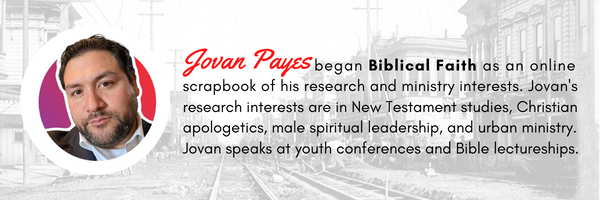
Jovan Payes preaches for the Highland Church of Christ in Bakersfield, Calif.

To subscribe to Gospel Advocate, click here.


“Is the Pastor In?”: A Brief Look at a Misnomer

The telephone rings and I answer it. The person on the other end asks the following question: “is the pastor in?” To which I reply, “No, we have no pastors, but I’m an evangelist can I help you?” The phone is silent for a few seconds, often followed by some stuttering; the refrain repeats uneasily, “is the pastor in?”

I am not purposely being difficult. I am however being biblical. I receive letter after letter, and call after call, where people (usually salespeople) are looking for or seeking “the pastor.” They are seeking the preacher but that is not the preacher’s title or description in the New Testament.

It is a rather unfortunate situation. It is also very awkward. I am often introduced (sometimes even by Christians) or greeted as a “pastor.” It really chills the occasion when I say, “no, I am not a pastor, I am an evangelist.” Somehow, that just rubs the world of Christendom the wrong way.

Maybe I should find a better time or way to correct that misunderstanding. In fact, there is a wholesale need to correct this application of the term “pastor” to the preacher.

The biblical use in the New Testament makes it clear that this is one of a few terms used with reference to a select group of congregational leaders.

Elders, Overseers, and Pastors (Shepherds)

It is just seems ingrained within the world of Christendom that the preacher must be a “pastor” of some kind. J. W. Roberts writes:

Some think of a priestly group; some think of the ministry of the Word and the preacher or ‘pastor’ of the flock; others with the metropolitan or diocesan concept think of the denominational ‘bishop.’ In truth, Paul means none of these.[1]

Roberts is correct. In Acts 20:17, the “elders” were summoned from Miletus to Ephesus; these “elders” were qualified by the Holy Spirit to be “overseers” in the church “to shepherd” the church (Acts 20:28).

Students of the New Testament are quite observant that these terms refer to the same office. In fact, one can see the interchange of these terms in 1 Peter 5:1-2, “I exhort the elders among you to pastor the flock of God that is in your charge, exercising the oversight.”[2]

Notice the three terms used in 1 Peter 5:1-2 which are exclusively for “a body of men in the primitive churches called elders.[3] The “elders” (Grk. presbuterous) are to “pastor” (Grk. poimaino) the church, employing “oversight” (Grk. episcopountes). The New Testament demonstrates that each congregation had a plurality of men so described (Phil 1:1-2, etc).

To apply the term pastor to an evangelist/preacher is to do so without New Testament precedent. “Such is a non-biblical use of the term ‘pastor,’ in spite of the popularity of such in modern society.”[4]

Does it Really Matter?

When a practice has no biblical basis, should we not simply abandon its use? This is at the heart of the problem.

Timothy and Titus represent a category of Christian workers known as “evangelist” (2 Tim 4:5) who “preach the word” (2 Tim 4:2). This is their “ministry” (2 Tim 4:5). The main obligations of the work are explained in 1 Timothy 4:13, 15 and 2 Timothy 4:2-5.

In summary, it has been observed by Earl D. Edwards that “every aspect of their work had meaning only as related to ‘the Word.’”[5] When one evaluates the basic responsibilities found in these passages a few things are evident:

The evangelist had the duty, first of all, to ‘preach’ the Word and then ‘correct’ those who did not follow that Word, and even ‘rebuke’ those who attempted to undermine the Word. He was also to ‘encourage’ with gentleness that Christians might follow the Word without becoming discouraged. In addition he was to ‘devote’ himself to the ‘public reading’ and ‘teaching’ of the Word.[6]

While the elder (pastor/overseer) must have the capacity and ability to be a teacher (1 Tim 3:2) in order to shepherd the flock, it is clear that the evangelist holds a complementary role for congregational development and a public proclamation of the gospel.

The preacher’s work is not the elder’s work. The most important qualification for the evangelist is that they are “faithful” recipients and heralds of the message (2 Tim 2:2). An elder, also, may fulfill the role of an evangelist (1 Tim 5:17; Eph 4:11); however, a preacher is not necessarily a pastor.

Not all faithful males may serve in the office of a pastor, for these men must possess specific qualifications (1 Tim 3:1-7 and Tit 1:5-9). Thus, the use of the term “pastor” to refer to the “preacher” is incorrect – a misnomer – and should be abandoned.

Concluding Thoughts

Some may be thinking, “No, I don’t buy it. A pastor is the one who leads the flock.” To which I would argue in response, “yes, pastors after a biblical pattern do lead the flock of God.” But our discussion is centered on the misuse of the term, and consequently, a blending of two distinct ministries found in the New Testament church.

There are those who are elders (overseers, pastors) who serve in a very unique office only after they met the qualifications set forth by the Holy Spirit (1 Tim 3:1ff; Acts 20:28). There are others, however, who serve as heralds of the word; that is to say, they preach the word as they labor alongside the pastors of a particular congregation (Eph 4:11).

Consider this final thought. Suppose one encounters a missionary from the Latter Day Saints, who in fact use the title “Elder”. “Elder Smith” however is a young man, single, and has no children. Yet, the inspired instruction from the Apostle Paul clearly indicates that the man must be of age (hence the term elder), must be a married man (1 Tim 3:2), and have children over which he has shown leadership (1 Tim 3:4-5).

Can we honestly say, in light of the biblical data, that these young men flashing the “Elder” badge are elders after a biblical order? Hardly, This is precisely our point. The New Testament use of the term elder (overseer, pastor) applies to a very uniquely qualified man, as he serves within a group of other men of equal caliber. Let us seek to call biblical things with Bible names, and do Bible things in biblical ways.

Sources

  1. J. W. Roberts, Letters to Timothy (Austin, TX: Sweet Publishing, 1961), 26.
  2. Everett Ferguson, The Church of Christ: A Biblical Ecclesiology for Today (Grand Rapids, MI: Eerdmans, 1996), 318-23.
  3. John W. McGarvey, The Eldership (1870; repr., Murfreesboro, TN: DeHoff Christian Bookstore, 2002), 9.
  4. Wayne Jackson, Before I Die: Paul’s Letters to Timothy and Titus (Stockton, CA: Christian Courier Publications, 2007), 82.
  5. Earl D. Edwards, “The Evangelist in the Epistles to Timothy and Titus (Book 1),” Alternative 8.3 (Summer 1982), 19.
  6. Edwards, “The Evangelist in the Epistles to Timothy and Titus,” 19-20.