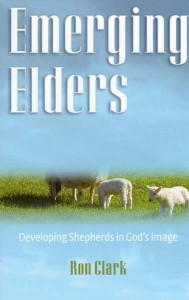
Book Review: Emerging Elders

Emerging Elders

Ron Clark, Emerging Elders: Developing Shepherds in God’s Image (Abilene, TX: Leafwood Publishers, 2008), 203 pages. Paperback.

Ron Clark is the lead church planter with the Agape church of Christ in Portland, Oregon. He holds M.Div. and D.Min. degrees from Harding School of Theology (Memphis, TN) and serves as an adjunct instructor for George Fox Evangelical Seminary. He is also a member of the Oregon Attorney General’s Sexual Assault Task Force.

Clark has contributed to various publications such as New Wineskins, The Christian Chronicle, Stone-Campbell Journal, and Restoration Quarterly; moreover, he has recently published The God of Second Chances (2012) and Setting the Captives Free (2005) along with the current volume which is the subject of this book review.

Emerging Elders: Developing Shepherds in God’s Image provides a theological platform for training current elders and potential elders. Clark explores the text and terminology of the descriptive terms for “pastor” (elder, overseer) and explores such leadership in light of an incarnation model. Clark believes that only when God’s word is actually lived out and exemplified by its the church’s leaders shepherding cannot truly be what God intended it to be.

The Book

Clark has provided the body of Christ a unique text which addresses the needs of the organizational structure of churches of Christ. This is perhaps its greatest overall strength. As Clark observes, “few books are written specifically for ministers about our style of ministry” where the pastor and the preacher are distinct ministries in the body of Christ.[1] Clark observes that most church leadership material is based upon church models which are dissimilar to churches of Christ, or based upon business models which have been given a Christian spin. Consequently, to address the lack of literature on the subject Emerging Elders is an attempt at providing a resource and a solution to the vacuum of pastoral development in light of this distinction.

In Emerging Elders, Clark provides a solid response to this lack of material to address In section one, Clark develops the need for elders who are equipped to lead the body of Christ (chapters 1-2). In section two, Clark provides a dynamic model of God as shepherd and what that means for the leaders of God’s people, he offers a situational and contextual applications of the pastoral qualifications, and then emphasizes that both God’s example and Paul’s instructions are to be applied incarnationally (chapters 3-8).

In section three, Clark provides a series of chapters which specifically address the tensions and problems within church life in particular and churches of Christ in general that emerging elders must address in an incarnational model. “These leaders are appointed to imitate God’s care and concern for people.”[2] The chapters on predators and care of the preacher were particularly exceptional and passionate, and are often not treated in the manner in which Clark has done (chapters 9-15).

Suggestions

What perhaps would have made Emerging Elders more helpful would have been in the area of conflict resolution (chapter 10) and the elder development program (chapter 15). In chapter 10, Clark explores the role elders have in the promotion and maintenance of unity. This lays heavily upon John 17 and Eph 4:1-6, and according to Clark speaks to the needs of the elders to “encourage reconciliation.” To be sure, Clark is complete in his development of the reconciliation process: “Reconciliation requires, conflict resolution, validation, and reinstatement of a relationship.”[3] However, I walked away from that section wishing that Clark had spent more time on developing these ideas, diagrams notwithstanding.

Secondly, I felt that the last chapter (ch. 15) was almost a letdown. With the idea of elder development as the core of the book, I anticipated the last chapter, “Suggested Elder Development Program,” to have more details. Maybe I am being over judgmental. The cycles are a great suggestion and using a quarter year system for elders and potential elders is very helpful. The book reading suggestions are also very appropriate. But what about the first steps it takes, the conversations needful to create the atmosphere to offer and provide these classes? I anticipated more help in creating the development program; however, even in saying this the program offered and the notes to use certain sections of the book along with corresponding cycles is very helpful.

Recommendation: High

In balance, Emerging Elders is a perfect balance of scholarship and the heart of a servant attempting to live incarnationally. Incarnational leadership is at the heart of Emerging Elders and it should be at the heart of how Christian leaders serve, and how Christians serve their church, family, and community. It does not provide easy answers to the flesh and blood problems in the church, nor does it provide answers that are so impossible to achieve. Emerging Elders calls Christians to lead God’s church biblically (incarnationally), and to address the real-life problems the people of God face with the most fundamental gift God has given his people agape love.

Emerging Elders calls every would-be elder to be living examples of faith, integrity, and loving concern for all. I highly recommend Ron Clark’s Emerging Elders to every husband and wife who serve in their church, every preaching couple, every elder and his wife, every deacon, and his wife. They are truly the focus of this book. As Clark observes,

We must help families inside and outside the church heal, but this must come from incarnational leaders who model God’s style of marriage and parenting. God has a pattern; leaders follow and call others to do the same. They follow by modeling his nature through the fruits of the Holy Spirit, becoming a father like God, and being approachable. These individuals reflect God’s character to both the church and the world.[4]

Endnotes

  1. Ron Clark, Emerging Elders: Developing Shepherds in God’s Image (Abilene, TX: Leafwood Publishers, 2008), 9.
  2. Clark, Emerging Elders, 46.
  3. Clark, Emerging Elders, 139.
  4. Clark, Emerging Elders, 101.

Jon Meacham, the Bible, and His “Problematic Source”

It has been a few years since Mel Gibson’s movie, “The Passion of the Christ,” was all that the world could talk about. It was a situation bound to receive controversial media coverage – it just comes with the territory of religion in the media. A case in point was the February 16 issue of Newsweek published in anticipation of Gibson’s film. About a week before this publication hit the stands, Jon Meacham’s cover story entitled, “Who Killed Jesus?,” was published online on MSNBC.com in four internet pages – then later archived on Newsweek.com.

Meacham’s article feigned an attempt to evaluate Gibson’s new movie, and instead, assaulted the biblical text. He openly affirms, “the Bible is the product of human authors.” He further argues that these authors were producing religious propaganda for Christianity, and like any other literary work the Bible is plagued with historical inaccuracies. Concerning the Bible Meacham writes:

The Bible can be a problematic source. Though countless believers take it as the immutable word of God, Scripture is not always a faithful record of historical events; the Bible is the product of human authors who were writing in particular times and places with particular points to make and visions to advance.[1]

Jon Meacham, “Who Killed Jesus?,” Newsweek (2004)

This is just one quote from a number of similar statements found throughout the article. The editor of Newsweek couches his statement with liberal theological overtones. In other words, Scripture is regarded as human produced literature designed only to give morals, void of any direct involvement of God. We shall see that the problematic source is not the Bible, it is Meacham’s theological presumptions.

The Media’s Treatment of the Bible

Meacham’s view of the Bible articulates three ways the Bible is often misrepresented in mainstream American media: (1) the Bible is of sole human origin, (2) the Scriptures are unreliable historical records, and (3) the biblical sources are legendary that need specious sources to embellish the narrative to provide the “true story.” With a national circulation over 3 million plus, there is no doubt that the church, our neighbors (religious or otherwise) and our youth are influenced by this.

How shall we respond? Bible believers need to be able to affirm the following response. Although these erroneous views of the Bible are widespread, the Bible (i.e. Scripture) is beyond that of human production and consequently trustworthy, because the internal evidence of predictive prophecy, the uncanny historical accuracy, and the marvelous unity of the 66 books is of supernatural origin and guidance.

Predictive Prophecy

Predictive prophecy is one of the most powerful lines of evidence that the Bible is beyond that of human production. The specific foretelling of future events serves as an accurate brief definition. Moreover, there are at least three criteria: (1) it must be given separated by a significant amount of time, (2) there are specific details (not generalities) and, (3) 100% fulfillment must follow (not 95% etc.). As an example, observe the prophecy of the rise and fall of four world powers of antiquity given in Daniel 2 and its relationship to the establishment of the church in the first century.

The image of Nebuchadnezzar’s dream (Dan. 2:1-24) was a picture of 4 sequential kingdoms: Babylonia (605-539 B.C), Persia (539-331 B.C.), Hellenistic (331-63 B.C.), and Roman (63 B.C-A.D. 476).[2] Daniel living in the 6th century B.C. predicted the fall of Babylon and the rise of these world empires. Furthermore, in Daniel 2:44-45 the prophecy was declared that during the reign of Imperial Rome, the God of heaven would establish His kingdom for all time.

While Rome was in power Jesus was born, lived, ministered, died, and resurrected (Gal 4:4). He declared that he was going to establish His church (Matt 16:18), which in this context means His kingdom (Matt. 16:19-20; Mark 9:1). This kingdom-church would come after the Holy Spirit had come upon the 12 Apostles (Acts 1:4-8), which arrived on the day of Pentecost (Acts 2). The prophecy was fulfilled as precisely as it was given centuries in advance.[3]

Precise Historical Accuracy

Historical accuracy is another line of reasoning which demonstrates that the Bible is beyond that of human production. The book of Acts is a powerful example. Luke wrote the book of Acts, which is a chronicle of the labors of Peter and Paul as the gospel goes from Jerusalem to the entire world.

The accuracy of Acts is such that no human could have been so accurate, except for the guidance of the Holy Spirit; observe:

This companion of Paul was a careful and meticulous historian. For instance, in Acts he mentions thirty-two countries, fifty-four cities, and nine Mediterranean islands. He also mentions ninety-five persons in Acts, sixty-two of which are not named elsewhere in the New Testament. He is thoroughly familiar with the geographical and political conditions of his day. And this is really amazing since the political/territorial situation was in a constant state of flux and flow in Luke’s time.[4]

Wayne Jackson, Biblical Studies in the Light of Archaeology (1982)

Accessibility to libraries was minimal due to how few or exclusive they were, and even if they had reference works, “the events Luke was trying to chronicle had taken place – at least at the beginning – in what the people of that day would have said were remote areas of the world.”[5]

There has yet to be the historical accuracy of the magnitude of Acts and the Bible recovered from antiquity to the present.

Unity of the Scriptures

A third line of argumentation is the unparalleled unity of the Scriptures. For instance, Jeremiah 25:1 and Daniel 1:1 are among a variety of passages appealed to for the claim that the Bible is not a harmonious work. Here is the argument. Jeremiah 25:1 and Daniel 1:1 refer to the same event in antiquity, the invasion of Judah by Nebuchadnezzar.

In the third year of the reign of Jehoiakim king of Judah, Nebuchadnezzar king of Babylon came to Jerusalem and besieged it. (Daniel 1:1 ESV)
The word that came to Jeremiah concerning all the people of Judah, in the fourth year of Jehoiakim the son of Josiah, king of Judah (that was the first year of Nebuchadnezzar king of Babylon)... (Jer 25:1 ESV)

However, the date of the event mentioned appears upon face value discrepant for Jeremiah says the event happened in the 4th year of Jehoiakim’s reign while Daniel says the timeframe was during the 3rd year of Jehoiakim’s rule (see “System” chart[6]).

SYSTEM1ST Sovereign2ND Sovereign3RD
Sovereign
4TH Sovereign
BabylonianYear of Ascension1st Year of Reign2nd Year of Reign3rd Year of Reign
Palestinian1st Year of Reign2nd Year of Reign3rd Year of Reign4th Year of Reign

If the two accounts cannot be harmonized then this is a historical mistake, underscoring a purely human enterprise. The answer to this riddle, however, lies in the distinct systems of dating regnal years used by Daniel and Jeremiah. Bruce K. Waltke writes:

In Babylonia the year in which the king ascended the throne was designated specifically as “the year of accession to the kingdom,” and this was followed by the first, second, and subsequent years of rule. In Palestine, on the other hand, there was no accession year as such, so that the length of rule was computed differently, with the year of accession being regarded as the first year of the king’s reign.[7]

Bruce K. Waltke, “The Date of the Book of Daniel,” Bibliotheca Sacra (1976)

Therefore, Daniel living in Babylonia used that system, while Jeremiah employed the Palestinian method. The unity spans cross-cultural methods of communication, how wonderful! The remarkable unity is so strong that even difficult passages backfire on the critic.

As so often happens, the supposed discrepancies become evidence against the critics of the Bible.

Conclusion

The Bible is not a problematic source; however, that does not mean that it has no range of complexity. The Bible is “a faithful record of historical events,” and its principles are grounded upon historical reality (e.g. creation, the Exodus, the resurrection of Jesus, etc.). The Bible comes together like pieces of a jig-saw puzzle. It is due to overwhelming evidence like this that we affirm that the Bible is beyond human production. The “problematic source” is Meacham’s liberal perspective – it is not the Bible!

Sources

  1. Jon Meacham, “Who Killed Jesus?,” Newsweek.com (Accessed: 16 Feb. 2004), par. 6.
  2. Robert T. Boyd, World’s Bible Handbook (Nashville, TN: Nelson, 1996), 309.
  3. Jason Jackson, “How Can the Church be the Fulfillment of Daniel 2:44?,” ChristianCourier.com (Accessed: 28 Sept. 2005).
  4. Wayne Jackson, Biblical Studies in the Light of Archaeology (Montgomery, AL: Apologetics Press, 1982), 46.
  5. James M. Boice, Acts: An Expositional Commentary (Grand Rapids, MI: Baker, 1997), 14.
  6. Jovan Payes, “Ascertaining the Date of Daniel: A First Look,” BiblicalFaith.wordpress.com. This particular line of reasoning is important evidence supporting the unity of Scriptures against baseless accusations of intertextual (book to book) problems. We are not suggesting there are not difficult passages that take more depth to study, but we are asserting that this “problem” passage is an eloquent statement of intertextual unity.
  7. Bruce K. Waltke, “The Date of the Book of Daniel,” BSac 133 (1976): 326.