
At 18 I began in earnest to expand my reading beyond the Bible and gathered literature to inform my studies of the Scriptures. Months after my conversion to the Christian faith, I began transforming my bedroom so that I could study. My main hurdle was that as a high school drop-out I had no “equipment” that I imagined other kids my age would have had at the time: a desk, a bookshelf, highlighters, paper–you get the picture–study stuff.
On top of that, I felt I had a lifetime of study to catch up on. After reading the gospels and coming to faith in Jesus, I wanted to know more. Sermons and Bible classes seemed to talk about things that just went over my head, and I had more questions than the preachers had time to sit with me. I had great teachers and they often answered my questions, but like Johnny Five–a warbot that became alive–I needed “more input.”
Back then Bible tracts were the best way to share Bible studies, essays, and mini-monographs. Today we would call these blog posts. As I collected, collated, and created a cache of these tracts I had a problem of organizing and housing them. My solution was to repurpose something from my gaming life.
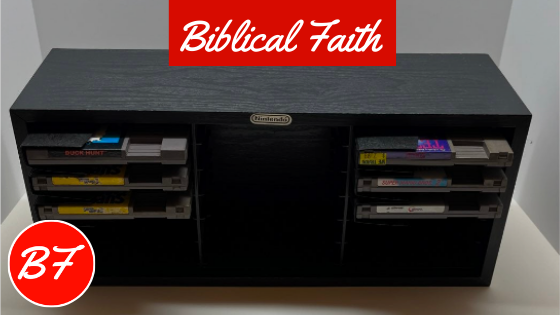
I remember it well. It was an old Nintendo Entertainment System Cartridge Library. Originally, it was designed to hold 18 NES games on three columns with six slots. It was my first “bookshelf” dedicated to my training and knowledge building as a young Christian interested in biblical studies.
How My Library Began
My modest library began with tracts and booklets. An older preacher encouraged me to collect tracts and booklets on whatever topics I could find. Church foyers were like scavenger hunts in my quest to stockpile tracts on subjects I had not heard of before, or topics I wanted multiple studies on. The best part of it is they were free for the curious student.
Back then I used to don a moss green pullover jacket with a kangaroo pouch from Abercombie and Fitch. I would always find a way to “smuggle” some tracts out of every church service I attended. The outcome: a pile of tracts began to collect upon my desk.
There came a point when I did not know where to place my cache of tracts and booklets. So what was an eighteen-year-old, new convert, who had not grown up on Bible lessons and sermons to do? I needed to find a better way to organize my pile. Remember, the internet was still a hit-and-miss resource, and pretty much the wild, wild West when it came to content. Google would not be born, so no real search engines. If I wanted a digital encyclopedia I needed a computer and a CD-ROM. AOL reigned supreme. Amazon wouldn’t be consequential for years.
Amid the chaos of my childhood relics came the NES cartridge library case. It had served me well in the past to house my games. Now it would be my “little library” bookshelf to fuel my newest interest of reading a variety of theological topics.
And so it was; I began to organize my little volumes in alphabetical order. The tracts that would fit I kept organized within the NES Library, and as my library expanded the more I became resourceful to contain it (the larger ones when into my drawers). Not only would I be able to house and organize them, but I began to strengthen my reading muscles that had atrophied.
Today, I have a couple thousand volumes in my library. At times, I am surprised to think that it started with this little box about a foot long by 10 inches tall. Now I have books on shelves and in boxes, journals, and magazines in filing cabinets, the near-limitless possibilities of software and the internet allow for e-books and audiobooks.
In the process I have learned that some books are worth keeping, others reading and passing on, and still others worth discarding. Books are much like selecting fruit: the joy is all in picking and savoring. But the rotten ones need to be tossed away!
Everyone Needs a Biblical Library
I firmly believe that God intends for His people to be readers, thinkers, and meditators:
You shall love the Lord your God with all your heart and with all your soul and with all your might. (Deuteronomy 6:5 ESV)[1]
Simply looking at the word “heart” (lēbāb) should cause us to consider that it is “the totality of man’s inner or immaterial nature” by which God’s people must love God.[2] Its root lēb refers to three elements of this inner world: emotion, thought, and will.[3] Much like its counterpart in the Greek Old Testament and New Testament, the metaphoric use of kardía points to the center of “the whole inner life.”[4] The heart controls the spiritual culture of one’s inner world, and love for God leverages such control.
Keep your heart with all vigilance, for from it flow the springs of life. (Proverbs 4:23)
It is then important to inform the heart, guide the heart, and supply the heart with the meditations which will strengthen our faith. Reading is an essential aspect of our faith. There is no way around that. The content of the faith reaches the heart through the mind. To do that God gave us a collection of sixty-six volumes mediated through a wide range of literary genres and styles, each with different rules of engagement.
To be ignorant of God’s word is to be in a dangerous position. Hosea lamented saying that his people are destroyed due to a lack of knowledge (Hosea 4:6). To be ignorant of how to approach scripture may equally be disastrous.
Moreover, the maintenance of our faith and impact upon our salvation is also to be accomplished through the “public reading” of the Scriptures. Paul makes this abundantly clear to Timothy (1 Tim 4:13; Col 4:16). And while the Bible is a book that can be understood by the average person, any astute reader of this small library will acknowledge that sometimes we need help to guide us through the text (Acts 8:30–31).
To be a diligent student of God’s word requires us to explore other areas of knowledge. From Geography to regional political backgrounds; or from linguistics to religious thematic studies, etc., – good resources are essential to illuminate the text to promote an accurate understanding. Helpful resources prevent us–readers separated by thousands of years–from making uninformed conclusions.
This principle has been well stated:
[I]t is the epitome of folly to ignore the labors of countless Bible scholars across the centuries who have made available, by means of the printed page, the results of their research.[5]
Wayne Jackson, A Study Guide to Greater Bible Knowledge (1986)
There seems to be a connection, then, between being “people of the book” and being “book people.” It is one of the tragic currents of contemporary Christianity that it has become of religion that embraces being “people of emotion” rather than God’s written word–the subjective over the objective.
Every Christian and Christian home should have a budding romance with good literature which reinforces an understanding of God’s word, the Christian worldview, and engage reading that critiques our views.
Build A Library
There is a sense in which we will always be learning. In the apocryphal book Ecclesiasticus, the grandson of Jesus ben Sirach (c. mid-second century BC) writes about the importance of reading for spiritual growth:
Many great teachings have been given to us through the Law and the Prophets and the others that followed them, and for these we should praise Israel for instruction and wisdom. Now, those who read the scriptures must not only themselves understand them, but must also as lovers of learning be able through the spoken and written word to help the outsiders. So my grandfather Jesus, who had devoted himself especially to the reading of the Law and the Prophets and the other books of our ancestors, and had acquired considerable proficiency in them, was himself also led to write something pertaining to instruction and wisdom, so that by becoming familiar also with his book those who love learning might make even greater progress in living according to the law. (Ecclesiastes/Sirach Prologue, NRSV)[6]
Reading the scriptures and “other books” can be very helpful. They create dialogue partners. When I opened those little tracts, I would often think what can this person add to my thinking about this topic. Sometimes I learned how to best summarize an idea, other times I learned about an approach to avoid. Some tracts proved outdated in the examples, but strong in the timeless instruction. There were plenty of times, the author would address the topic so firmly and with the conviction it was of “vital importance” but I left the conversation unconvinced or worse confused. Reading is a battlefield, but that is where we learn.
I soon began to find authors who had a gift for writing and I began to single them out. There is something artistic and soul-nourishing to be found in good writing–whether I always agree with the author(s) or not in every detail.
I started going to used book stores to find books and authors referenced in my little library. I found a small paperback copy of Mere Christianity by C. S. Lewis (1898–1963) for a few bucks. I bought that and a Bible–the shop owner gave me the Bible. I found his writing style so compelling and personal. Lewis had a knack for not just pulling you in with his preliminary words but he could hold you together disarmingly well as he made his case for Christian theism or philosophy.
At a Gospel Meeting in South San Francisco, CA, I heard a preacher–Wayne Jackson (1937–2020)–who I had only read in his articles. I purchased a copy of his A Study Guide to Greater Bible Knowledge. To this day, it is probably one of the most important books in my personal developement as a young Christian. Jackson had a crisp, no fluff, popular writing style which made reading an enjoyable experience. Whether you agreed with him or not, he never left you to wonder if you understood his conclusion.
There is little doubt in my mind that reading is an experience of the soul, and we should do what we can to have the best, brightest, and engaging soul experiences possible. Reading has been my main strategy for fulfilling Paul’s command:
I appeal to you therefore, brothers, by the mercies of God, to present your bodies as a living sacrifice, holy and acceptable to God, which is your spiritual worship. Do not be conformed to this world, but be transformed by the renewal of your mind, that by testing you may discern what is the will of God, what is good and acceptable and perfect. (Romans 12:1–2)
For this reason, I encourage everyone to build their own personal library.
Some Suggestions
I offer five (5) suggestions about what types of books should be included in a personal Bible-focused library. Solomon reminds us, “of making many books there is no end” (Eccl 12:12).
(1) Choose materials that respect biblical inspiration and authority.
Moses told the Israelites not to “add” or “take from” the Lord’s word:
You shall not add to the word that I command you, nor take from it, that you may keep the commandments of the Lord your God that I command you. (Deuteronomy 4:2)
John closes the Revelation with the same sobering warning (22:18–19).
God’s word is to be respected and observed without any intrusion of human opinion. It is a hard task to limit our opinions but if we are vigilant we can acknowledge them or debunk them in our study. Every word within the sacred text is from God (2 Tim 3:16–17). Consequently, it is important to select literature that is in keeping with these truths.
(2) Choose materials that have ongoing usefulness.
Not one can be expected to know everything, not even the expert. One of the keys to learning is to know where to locate information.
For this reason, I highly recommended getting access to Bible dictionaries, encyclopedias, handbooks, and Bible atlases. Most of these types of resources are available digitally.
Use them to refresh your mind, to introduce you to a topic, or expand your thinking. These resources are indispensable.
(3) Choose materials that illuminate the biblical text.
There is too much spiritual fluff peddled in the “Christian” markets. They do little to help understand the Scriptures. They may provide personal inspirational value, but they do not offer textual insight.
In his book Making Sense of the Old Testament, Old Testament scholar Tremper Longman, III, reminds us to respect the fact that the Bible we read is an ancient text, translated from an ancient language, set in an ancient world with ancient socio-economic customs. We would be wise to recognize the danger of imposing our own modern perspective when reading them.[7] This caution applies for both testaments.
It is important to include special background studies which will improve one’s knowledge of the world of the Scripture (archaeology, word studies, culture, and religion, etc.). These often contain information that is often inaccessible. Today, however, specialty blogs, background Study Bibles, and websites provide greater access to this information.
(4) Choose materials that have practical importance for a life of faith.
It is important to obtain practical and useful volumes which address marriage and the family, Christian Apologetics, how the Bible came to man, Christian history and denominationalism.
Books on doubt, the problem of pain and suffering, moral issues, or matters of personal nature are also important for faith development; issues that confront our faith daily.
In an age when we often feel our way to a conclusion, we must fight against the current and reason our way to solid ground.
(5) Choose faithful authors who are experts in their field.
An important criterion for selecting books is that they are written by those of proven worth, ability, and faithfulness. Some authors are well known for their knowledge depth on particular matters – experts.
No one would want a self-trained novice operating on them; but rather, a board-certified surgeon. So it is with those authors we invite into our minds and engage in our studies in the Scriptures.
Concluding Thoughts
As we conclude, we pray that our readers will begin to build a useful faith-building library. It does take time and money to accumulate the needed volumes, but the results of such an investment are tremendous. As Desiderius Erasmus (1469-1536) once said, “When I get a little money I buy books, and if any is left I buy food and clothes“.[8] Only someone who knew the value of study and learning could make such an irrational statement.

In the shadow of Paul’s final days, he asks Timothy to have John Mark accompany him on Timothy’s visit to the imprisoned apostle in Rome (2 Tim 2:11). Among the items Paul requests is a cloak, “the books” (to biblia), and “the parchments” (tas membranas; cf. 2 Tim 2:13).
There is no telling exactly what “the books” are but evidence shows that the apostle was quite familiar with a wider world of literature (cf. Acts 17); yet, “the parchments” is a unique technical term referring to a codice (a bound volume like a book) which retains copies of letters – possibly his letters.[9]
The point we conclude with is that as Christians we have a long tradition of reading and studying. Let us not lose sight of this noble task. Let our homes be a place where we may have access to resources to better inform our faith in order that we may do the most important work ahead of us – understanding and applying Scripture.
Sources
- Unless otherwise stated all quotations of The Holy Bible are from the English Standard Version (Wheaton, IL: Crossway, 2016).
- Andrew Bowling, “lēbāb,” Theological Wordbook of the Old Testament (Chicago: Moody Press, 1999), 466.
- TWOT 466.
- Johan Lust, Erik Eynikel, and Katrin Hauspie, A Greek-English Lexicon of the Septuagint, rev. ed. (Deutsche Bibelgesellschaft: Stuttgart, 2003).
- Wayne Jackson, A Study Guide to Greater Bible Knowledge (Stockton, CA: Apologetics Press, 1986), 83.
- New Revised Standard Version of The Holy Bible (Nashville, TN: Nelson, 1989).
- Tremper Longman, III, Making Sense of the Old Testament: Three Crucial Questions (Grand Rapids, MI: Baker Academic, 2006).
- Desiderius Erasmus, “Desiderius Erasmus Quotes”, ThinkExist.com.
- E. Randolph Richards, “The Codex and the Early Collection of Paul’s Letters,” Bulletin for Biblical Research 8 (1998): 159-62.

 biblicalfaith.online