The Value of Godly Women to the Church

Define value. Dictionary definitions notwithstanding, John Keats (1795-1821) begins his poem, “Endymion,” with the words, “a thing of beauty is a joy forever.” Keats speaks to the power that people —their character and actions— have in retrospect. “That, whether there be shine or gloom o’ercast, They always must be with us, or we die.” The Scriptures show, however, what is “a joy forever”; in a word: godliness. Paul writes, “for bodily exercise is profitable for a little: but godliness is profitable unto all things, having promise of the life which now is, and of that which is to come” (1 Tim 4:8). [All Scripture references are from the American Standard Version unless otherwise noted.]

Nothing is more valuable and potent in this world than “godly seed” (i.e., offspring; Mal 2:15). Humanity, after all, was made to bear the image of God on the earth (Gen 1:26-31): “Let us make man in our image, after our likeness.” While there is tremendous learning to be gained from understanding the binary nature of humanity (“male and female”), we wish to pursue a study on the value of godly women to the cause of God as it is manifested in the NT church in the past and today.

Godliness is a Matter of Character

Godliness is reflected in the content of a person’s character and conduct. The church is an amazing place full of potential when it reflects the character of its godly women. There is no greater influence in the Lord’s church than godly women. For example, David once said,

know that Jehovah hath set apart for himself [she] that is godly: Jehovah will hear when I call unto [her]. Stand in awe, and sin not: Commune with your own heart upon your bed, and be still.[1] (Psalm 4:3-4, ASV edited)

The Hebrew word (hāsîd) for “godly” (holy) one implies a “kindness” that extends grace toward others because they have at one point received grace.[2] The word is used with great regularity in the Psalms. Godliness is seen, then, as a matter of character, of piety.

Godliness is fundamental to Christian conduct (2 Pet 1:6-7, 10-11). Paul writes that Christian women are to profess godliness through good works:

that women adorn themselves in modest apparel, with shamefastness and sobriety; not with braided hair, and gold or pearls or costly raiment; but (which becometh women professing godliness) through good works. (1 Timothy 2:9-10)

The Greek word (theosébeia) for “godliness” speaks to a reverence for God manifested in a set of beliefs and practices.[2] Christian women are to ground their value in their character and reverence for God (1 Tim 4:7-8; 6:11; 2 Tim 3:12; Tit 1:1, 2:12; eusébeia).[3]

Godly women of such character are of inestimable worth to the church. They leave an indelible mark upon everyone they touch. When they show divine kindness to their neighbor when they extend grace to others because they have experienced it as well, and when godly women focus on the content of their character and faithfulness to God, then the world will understand the value of godly women to the cause of Christ. Any home, company, and the church know the powerful influence of such godly women for they cast a beautiful shadow of faith and devotion, service and evangelism, determination and selflessness. This value is seen at the end of Proverbs 31 (10-31), “a woman that feareth Jehovah, she shall be praised. Give her of the fruit of her hands; And let her works praise her in the gates” (30-31).

Examples of Godly Women in New Testament

Let us consider a few examples of the value women have to the church. Women disciples have always been a part of Jesus’ ministry (Matt 27:55; Mark 15:41; Luke 10:38-42; John 4:1-26).

Financiers

Luke’s Gospel Account provides a note on some of the financial supporters and companions of Jesus as he and the twelve went throughout cities and villages “preaching and bringing the good tidings of the kingdom of God” (Luke 8:1-3).

Soon afterward he went on through cities and villages, proclaiming and bringing the good news of the kingdom of God. And the twelve were with him, and also some women who had been healed of evil spirits and infirmities: Mary, called Magdalene, from whom seven demons had gone out, and Joanna, the wife of Chuza, Herod’s household manager, and Susanna, and many others, who provided for them out of their means. (Luke 8:1–3)

Among these many women were named three in particular: Mary Magdalene, Joanna, and Susanna. They served Jesus and the twelve from their own possessions and property (“their substance”). After being healed from infirmities and evil spirits, they served as continuous financial supporters of Jesus presumably to bring the same “good tidings” into the lives of others.

Disciples

The Gospel accounts reveal that the women disciples of Jesus were the first to witness and share the resurrection event of Jesus with the disciples. Matthew recounts the encounter of Mary Magdalene and the “other” Mary who came to Jesus sepulcher and were greeted by the angel who had rolled back the stone of the tomb (28:1-10). Mark adds that the “other” Mary is the mother of James and that a third woman was them – Salome (16:1-8). Luke adds that there was a second angelic man, and several other women including Joanna that were greeted with, “Why seek ye the living among the dead?” (24:1-12). John’s Gospel shows Mary Magdalene confused over the empty tomb, comforted by Jesus himself, and told to say that Jesus would ascend to the Father (20:1-18). At a time when the prevailing cultural theory was that a woman’s testimony was inferior to a man’s, the earliest witnesses to the empty tomb of Jesus are the women disciples of Jesus.

Message Sharing

Luke continues to demonstrate the value and influence of women in the early church. The Acts of the Apostles demonstrates at every turn the value of godly women to the church. Women (including Mary, Jesus’ mother) were among the disciples in the upper room as they waited for the coming of the Holy Spirit promised by Jesus (1:14), and Peter declares the prophetic words of Joel (2:28ff) that “your daughters shall prophesy… and on my handmaidens… will I pour forth of my Spirit” (2:17-18).

And in the last days it shall be, God declares, that I will pour out my Spirit on all flesh, and your sons and your daughters shall prophesy, and your young men shall see visions, and your old men shall dream dreams; even on my male servants and female servants in those days I will pour out my Spirit, and they shall prophesy. (Acts 2:17–18)

Paul himself would abide with Philip the evangelist who “had four virgin daughters, who prophesied” (21:8-9; 1 Cor 11:5).

Doing Good

Luke, by the Spirit, give ample attention to a disciple named Tabitha who “was full of good works and alms deeds” who had fallen ill and died (9:36-37). Peter would be summoned by the church to be with them during this time. Her good works and influence were demonstrated by those who grieved at her death because “all the widows stood by him weeping, and showing the coats and garments” she made “while she was with them” (9:39). Caring for others —particularly widows— has always been an important demonstration of pure religion before God (Jas 1:27). Paul would instruct on the importance of the church and women of faith to care of widows (1 Tim 5:1-17; Acts 6:1-7).

All Encompassing

As the Hebrew writer says (11:32), “for the time will fail me” to continue tell of Christian women who were patrons, fellow workers for the truth, founding members of congregations and “house church” hostesses (Acts 16:11-15). They corrected false teachers (Acts 18:24-28). They raise up godly men to be evangelists (2 Tim 1:3-8, 3:12-17). They loved their husbands and children and demonstrated administrative skill in their homes (1 Tim 5:14; 1 Pet 3:1-6). Finally, Romans 16:1-16 demonstrates that many sisters served in the Lord as servants of God, evangelistic collaborators, teachers and financiers. Christian women ministered the gospel to the first-century world without hindrance.

Godly Women in the Church Today

The Lord-God envisioned an invaluable and elevated place for women in the world. These divine truths hold true today despite the ongoing debate over social gender expectation of men and women. Godly women have tremendous value to the church today, because their roles are still as invaluable as ever. Godly women continue to manage their homes, whether they are a full time stay-at-home wife/mother, work from home, or go to the office. They embrace their domestic role in the home as wife and mother (1 Tim 2:15).

Single women, however, bring a singleness of zeal to the church. Paul says they are “careful for the things of the Lord” (1 Cor 7:34). The breadth of their valuable influence is tremendous. They lead ladies’ Bible classes and workshops, are congregational Bible class teachers, write books and blogs, and contribute to academia. They mentor other disciples.

Our sisters minister to the widows and widowers in senior/assisted living homes, and they comfort the sick in hospitals —some even being/training to be hospital chaplains. Some with a medical background participate in medical-evangelistic campaigns. Others enter the world of missions, focusing their energies on evangelistic pursuits. Many have been brought to Christ due to the teaching efforts of godly women who teach overseas through Bible teaching correspondence courses.

Concluding Thoughts

May the church always embrace the ministries women have in the kingdom of God. This being said I am struck with the climate which often arises in the necessary discussion concerning the ministry of women in the church. I often feel the discussion is filled with much angst and the second guessing of motives when it comes to the reconsideration of my beloved’s sisters’ role in the world. Unfortunately, I think some roadblocks also lie in gender expectations which are culturally driven (“perceived” roles) rather than biblically driven (“biblical” roles). Nevertheless, this brief essay is about extolling the influence of godly women to the church and I believe it has succeeded to reach our goal.

Endnotes

  1. I have replaced the masculine for the feminine in brackets [] simply to express the point of this essay, which is to emphasize the godliness of women.
  2. William Wilson, Wilson’s Old Testament Word Studies (repr., Peabody, MA: Hendrickson, n.d.), 196; R. Laird Harris, “hsd,” Theological Wordbook of the Old Testament, eds. R. Laird Harris, et al. (Chicago, IL: Moody Press, 1980), TWOT 1:305-07.
  3. theosébeia,” BDAG 452.
  4. eusébeia,” BDAG 412.

This is a reformatted and slightly expanded version of the article which was originally published in The Glendale Gleaner (Newbern, TN: Glendale church of Christ).


Chasing the Book of Acts (Free Audio)

Chasing the Book of Acts (1)

The NT church was a force and demonstration of God working through his people. They cared for each other, they cared for their neighbors, they were passionate about God’s word, they were passionate about bringing light into a world of darkness.

The primitive church was not without his flaws, but Scripture demonstrates that despite occasional setbacks due to ignorance, or sin, or prejudice, the disciples of Jesus chased the cause for which they were sent into the world with vigor: to bring the gospel light and forgiveness into the world.

to open their eyes, so that they may turn from darkness to light and from the power of Satan to God, that they may receive forgiveness of sins and a place among those who are sanctified by faith in me.’ (Acts 26:18 ESV)

All Jovan ever wanted to be was a member of the church he can read about in the Bible. In these lessons, he challenges all followers of Christ to chase the Book of Acts. He hopes you have a clearer vision of the purpose of the early church. May you challenge your current church setting in order to draw it closer to the primitive biblical church, that you will draw closer to God. Encourage others to chase the same Spirit which led the early church.

Just image what church can be like if we only seek to chase God the way the primitive church did. We can, we must. Join me in this series: Chasing the Book of Acts.

Study Guide

In development

Working Through Church Problems

Are you looking for a perfect congregation? Take a number and stand in line. The perfect congregation is elusive because they are composed of imperfect people.

Yes, problems happen. If anything should tip our hand to this fact it ought to be the apostolic letters to the churches found in the New Testament. Even though the Spirit of God dwelt in the primitive church, the New Testament reveals those congregations were still imperfect.

Problems emerged, emerge, and will continue to emerge within the church, and within a congregation. Paul said that the heartache of “factions” can provide a lens to recognize who is “genuine” in the church (1 Cor 11:19 ESV).

We have been given biblical teaching as to how to respond to disruptions caused by Christian misconduct. The answers are found in the apostolic word. Consider three examples.

1. The Thessalonians

Certain members of the congregation in Thessalonica would not work in order to be self-sufficient (2 Thess 3:11-12), but instead, burdened the church as they received dietary support. Such was described as living in “idleness.”

Such was described as “busybodies,” which is a play on words contrasting the appropriate Christian ethic of being “busy at work.”

The point is some members of the Lord’s church in Thessalonica refrained from being productive in the workforce and had become guilty of lifestyles that were unproductive, intrusive, and disruptive to their lives about them.

The apostle Paul sets forth an apostolic injunction to prohibit those who willfully reject the divine ideal to “earn their own living” and received benevolent sustenance from the church: “if one is not willing to work, let him not eat” (2 Thess 3:10).

The church suffered at the hands of their disruptive behavior (i.e. “busybodies”). Since they were subsidized by the church, Paul aptly responds: “stop subsidizing their sinful behavior!”

Too many times, matters which affect the congregation (gossip, opinions, hypocrisy, etc.) are allowed to thrive due to a lack of solidarity to follow God’s teaching. Here Paul makes it clear that the congregation must make a stand together placing sanctions on those Christians who live contrary to the divine teaching on working to supply your own needs (2 Thess 3:6ff).

Only with a unified front, will there be sufficient godly pressure to make the defectors return to the “ranks.” The congregation is to apply the pressure of a well-intended, caring family towards “work” so that they may not be an unnecessary burden on others (3:8).

2. Paul and Barnabas

Sometimes problems develop within very successful ministry teams, particularly in matters of expediency.

In Acts 13:1-4, the setting for Paul’s ministry to evangelize the world is narrated. In fact, the Holy Spirit is quoted as saying, “Set apart for me Barnabas and Saul for the work to which I have called them” (13:2).

This Divine call to action belongs to Barnabas as much as it does Paul. Still, throughout the reports in Acts of the various evangelistic labors, it appears that Paul (Saul) begins to gain special consideration (Acts 13-14).

An interesting footnote is placed at Barnabas and Paul’s transition from the Cyprus Island to the southern Asia Minor Roman province of Pamphylia (Acts 13:13). Luke writes that “John” (= John-Mark 15:37) was with them in their evangelistic campaign functioning as an “assistant” (Acts 13:5); however, for reasons unknown he left Barnabas and Paul and returned to Jerusalem (Acts 13:13).

After some time had elapsed, Barnabas and Paul were anxious to return to the “mission field” to see the well-being of the congregations which they planted in Asia Minor. At this point, Barnabas and Paul entered a “sharp disagreement” over the inclusion of John-Mark (14:36-41).

John-Mark who had served as an “assistant” (Grk. huperetes), a term which suggests the responsibility to care, guard, and to manage the resources of another,[1] had “defected” (= ESV “had withdrawn”) from the evangelistic team. Why, is anyone else’s guess.

While Mark broke his commitment to the evangelistic team, Barnabas wanted to give John-Mark a second chance; but Paul felt him undependable – an evaluation he publically reverses over a decade later (2 Tim 4:11). Mark is enshrined in Scripture as one whom Paul came to think of as helpful, beneficial, and useful (Grk. euchrēstos, 2 Tim 2:21; Philm 11).

Still, Luke does not append any evaluation upon who made the right choice, for Barnabas and Paul part ways here never to be found together again on the pages of Scripture; and yet, never disparaged for their differences on this issue. Possibly, they were both correct, and it is one of those cases where there are two right choices for the same problem (Prov 26:4-5). Wisdom is always a contextualized answer-solution to a contextualized problem.

It is unfortunate that such a successful evangelistic team should part ways, but the most significant point is that neither party refrained from evangelism. Paul continues to fulfill his ministry, as Barnabas continues the “encouragement” he is known for (Acts 4:36; 9:27).

Here is a powerful lesson, especially for advocates of non-denominational Christianity. At various times, brethren due to opinions – even strong opinions – must part ways for the common good of sharing the gospel with the world:

There is enough room for different expedient methodologies (provided they are biblical) to thrive side by side without any sense of competition of faithfulness to intrude our works.

Paul continues his work with the prophet Silas, and along the way picks up Luke and Timothy. Barnabas takes with him John-Mark to the island of Cyprus. One dynamic team turns into two evangelistic teams with capable leaders.

Sometimes we need to step back and realize, like Abraham, that we are brethren, and as such, we should not quarrel with each other over expedients (Gen 13:8; Rom 14:13). Disagreements can be worked through if the parties involved reflect heavenly dispositions to make peace (Jas 3:13-18). Faithful children of God must strive to “agree in the Lord” (Phil 4:2-3). Might one of those agreements be in the matter of ministry methods that are different but biblical?

3. Diotrephes and Gaius (3 John)

Sometimes a church setting can be thrown off its balance by a strong vocal minority. They typically are aggressive, carnally minded, and self-absorbed. Unfortunately, good-meaning brethren can give such ones an audience -and the podium- which encourages their behavior.

Such was the case with a man by the name of Diotrephes. In brief, the apostle John sent a few preachers to the church acquainted with this man in order to be welcomed and financially supported in their evangelistic and missionary work.


Read more about Diotrephes in “Studies in 3 John: The Fellowship of the Truth”


However, pumped with his own arrogance, he rejected the apostolic request, suppressed the request, attacked those like Gaius who provided for men like these, and imposed his own will upon them by ill-treating the preachers and casting their supporters “out of the church” (9-10). In practice, he was a “missions killer.”

Such “church gangsters,” the apostle John says, must have their nefarious operations exposed (“I will bring up what he is doing”). They operate in the brotherhood “alleyways” where their true face is revealed. They are punitive. For not only do they not support a “worthy” work, but they will also subvert them at all costs.

The church must stand up against those who are intoxicated with pride, those who manipulate behind the “church” scenes, and those who “always need a villain” in order to promote their agenda and get their way.

Concluding Thoughts

Problems come, but the church has, can, does, and will overcome them if we are faithful to God and gracious to each other. Some church problems are ethical or doctrinal; consequently, as in the Thessalonian situation, the only solution is to reinforce God’s plan for Christian conduct and teaching.

Other times, church problems emerge when leaders disagree over matters of opinion. Sometimes, we must realize that not every method is the only way to carry out a biblical command or expectation. Some methods and decisions can co-exist side by side. We must learn to be flexible and gracious in such scenarios.

Finally, some problems are instigated by a divisive minority who implement their plan in the shadows rather than in a clear view of all. They are coercive and manipulative. They seek and exercise power rather than submission to God. In such cases, exposure to such conduct is warranted in order to begin the process to restore peace in the church.

These situations do not exhaust every problematic scenario, but hopefully, they provide guideposts that will be helpful. May the church learn to acknowledge and work through our problems in a peaceful and God-fearing way.

Endnote

  1. James H. Moulton and George Milligan, The Vocabulary of the Greek New Testament Illustrated from the Papyri and Other Non-Literary Sources (London: Hodder and Stoughton, 1914-1929), MM 654-55.

Who is Claudius Lysias?

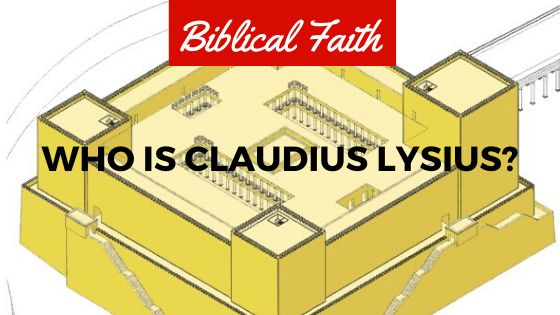
Reconstruction of Fort Antonia by Ehud Netzer in Biblical Archaeology Review 35.1 (Jan.-Feb. 2009).

Claudius Lysias, the Tribune

Claudius Lysias is called “the tribune” (χιλίαρχος, chilíarchos) 16 times within Acts 21-24 (21:31-33, 37; 22:24, 26-29; 23:10, 15, 17, 19, 22; 24:22); 17 times if Claudius Lysias is also included in among the “military tribunes” in the “audience hall” when Herod Agrippa II and Bernice come to hear Paul (Acts 25:23). However, such speculation is uncertain, especially considering a minimum of two years from when Claudius Lysias sent Paul to the Procurator Marcus Antonius Felix in c. AD 57/58 Acts 23:26-35, to within the first few months of the new Procurator Porcius Festus who rules from AD 60-62 (Acts 24:27-25:1-22).

The Greek term chilíarchos is said to be used to translate the Roman tribunus militum (following Polybius), and also for the phrase tribuni militares consulari potestate (Plutarch). The responsibilities of a chilíarchos were as a “commander of a thousand men”.[1] Essentially, Claudius Lysias is “a high ranking military officer in charge” of anywhere from 600 to 1,000 men,[2] and this appears to be the case for it is said that his command was over a “cohort” (σπειρα, speira) in Jerusalem which is “the tenth part of a Roman legion having about 600 men” (Acts 21:31).[3]

Tribune of a Jerusalem Cohort

Claudius Lysias’s complete description as found in the New Testament book of the Acts of the Apostles is “the tribune of the cohort” in Jerusalem, which resided in nearby “barracks” (Acts 21:34, 37; 22:24, 23:10, 16, 32). It takes six cohorts to make up a legion, and each legion had six tribunes with a thousand men (“soldiers and centurions” Acts 21:32) under his command if the cohort was full; consequently, Claudius Lysias was a part of a larger military force.

The exact numbers in his cohort may never be known, however, he had sufficient men to spare two centurions, two hundred soldiers, seventy horsemen, and two hundred spearmen to accompany Paul to Caesarea Acts 23:23-24. Furthermore, when the security detail arrives before Antipatris (Acts 23:31), Claudius Lysias allows for the seventy horsemen to go on with him and Paul to Caesarea, the headquarters of the Procurator Felix (Acts 23:32-35).

The “barracks” referenced in the book of Acts (21:34, 37; 22:24; 23:10, 16, 32), in connection to Claudius Lysias and his cohort are references to the Tower of Antonia, which Herod the Great rebuilt from a previous structure and named it after Marc Antony.[4] The Antonia was added on to the northwest side of the Temple facilities, “from which stairs descend into the outer court of the temple” (Acts 21:32, 35, 22:30).[5] For this reason, the Roman Tribune could hear the commotion caused by the confusing riot over Paul’s presence in the Temple and respond with speed (Acts 21:27-32).

Claudius Lysias in the New Testament

The military tribune Claudius Lysias enters the New Testament narrative when he protects Paul of Tarsus from a hostile Jewish mob on the outside of the Temple grounds in Jerusalem (Acts 21:30-32). The Acts text does not explicitly state why the tribune arrests Paul aside from asking “who he was and what he had done” (Acts 21:33); consequently, it appears Paul is detained for investigation as reflected later in Paul’s interrogation in the Antonian barracks because he was a cause of instigation among the Jews (Acts 22:23-24).

Claudius Lysias is aware of Jewish anarchistic movements, for when Paul speaking in Greek asks permission to speak to the shouting Jewish mob, the tribune appears shocked that he speaks Greek (Acts 21:37). Paul, as a controversial Greek-speaking Hebrew, evidently met some of the criteria for Lysias to conclude he was a Jewish revolutionist. Consequently, it appears that Lysias suspects him of being “the Egyptian” who “stirred up a revolt and led the four thousand men of the Assassins [σικαρίων] out into the wilderness” (Acts 21:38).

This individual operated around A.D. 53, and this revolution amounted to amassing these four thousand men, positioning themselves upon the Mount of Olives outside Jerusalem, and anticipating the walls of Jerusalem to collapse at his command. The Romans attacked this band of men, and the Egyptian lost six hundred men, and fled into the wilderness where he disappears awaiting “further revelation.” Evidently, “the Egyptian” was still on the run, wanted by the Roman military and the tribune was going to see if Paul was this anarchist.[6]

Paul was able to persuade Lysias that he was not an agitator, and provides him with his provincial citizenship as being from Tarsus, in the province of Cilicia (Acts 21:39). This was not an “obscure city” and either this suggests his citizenship could be authenticated, or Paul distinguished himself from the obscure Egyptian. In either case, Paul’s point is clear, he is not the Egyptian; the tribune accepts Paul’s case, and grants Paul an opportunity to speak to the Jews on the steps of the Temple facilities adjoined to the Antonian fortress (Acts 22:39-40).

The Jews did not respond peaceably to Paul’s speech, and Claudius Lysias decides to take Paul into the “barracks” of Antonia and “examine” him through the process of binding him to flog him (Acts 22:22-24). On receiving a report that Paul was a Roman citizen and then making a personal inquiry, Claudius is afraid of having violated the rights of a Roman by having him bound (see “Roman Citizenship” below). Claudius desires to arrive at the truth concerning the Jewish case against Paul and commands the Sanhedrin to assemble. Dissension among the Sanhedrin towards Paul arises again and causes Claudius Lysias to order his men to take Paul to the safety of the Antonian barracks (Acts 22:30-23:10).

Upon learning of a plot to kill Paul, Claudius Lysias summoned a military convoy to leave for Caesarea Maritima. In compliance with Roman law, he also sent a statement of the case to the procurator Antonius Felix. The letter reads:

Claudius Lysias, to his Excellency the governor Felix, greetings.

This man was seized by the Jews and was about to be killed by them when I came upon them with the soldiers and rescued him, having learned that he was a Roman citizen. And desiring to know the charge for which they were accusing him, I brought him down to their council. I found that he was being accused about questions of their law, but charged with nothing deserving death or imprisonment. 

And when it was disclosed to me that there would be a plot against the man, I sent him to you at once, ordering his accusers also to state before you what they have against him. (Acts 23:26-30, English Standard Version)

The letter format is consistent with the general format in the Graeco-Roman world, of “author” to “recipient” with a “greeting” with the subsequent content of the reason for the letter.[7] This letter, however, was not altogether factual. It is an interesting “specimen” of Roman military correspondence (Acts 23:26-30).

Although acknowledging Paul’s innocence, Claudius Lysias gave the impression that he had rescued Paul because of having learned that the apostle was a Roman, whereas in reality, he had violated Paul’s citizenship rights by having him bound and even ordering that he be examined under scourgings. As to the disciple Luke’s knowledge of the letter’s contents, it may be that the letter itself was read at the time Paul’s case was heard.

Roman Citizenship

In Acts 22:23-29, a discussion between Paul and Claudius emerges on the topic of Roman citizenship. Part of Claudius’ investigation procedure to find out more information was to stretch out the detained for whips and flog them.

Before his flogging begins, Paul questions the centurion given this detail, “Is it lawful for you to flog a man who is a Roman citizen and uncondemned?” (Acts 22:25). Roman citizenship had a number of privileges, as John Polhill writes:

A Roman citizen was subject to Roman law and thus was protected from such things as being beaten without a trial, from cruel punishments like crucifixion, and from unlawful imprisonment, rights which did not belong to an ordinary provincial (peregrinus). Citizens had the right of appeal. Only a Roman citizen could legally marry another Roman citizen. Citizens were exempted from certain taxes. Beyond this, there was the considerable factor of honor and deference such a status afforded.[8]

It was such a valued honor, that some people risked the death penalty given for falsely claiming citizenship.[9] Interestingly, one could hold dual citizenship, as Paul was not only a citizen of the city of Rome but was also a citizen of the city of Tarsus from the province of Cilicia (Acts 21.39; 23.34).

Roman citizenship was conferred in a number of ways. The basic ones are as follows:

(1) The most common way was being born of two Roman citizens.

This is the claim Paul makes when asked how he obtained his citizenship (“I am a citizen by birth” Acts 22:28), which implies that both of Paul’s parents were Jewish Roman citizens (cf. #4).

(2) One could obtain citizenship as a reward for military service.

Regularly, military veterans were given citizenship upon discharge. This was the surest way to get it, taking 20 to 25 years depending on the level of ranking.

(3) Imperial conference, though heard of, was not entirely common.

Nevertheless, the emperor could confer citizenship, either on individuals or on whole communities, as in the establishment of a new colony. Often the result of doing some loyal service to Rome. Also, many times through these services, one gained an audience with the Emperor through expensive gifts to members of the inner Imperial court.

This may have been how the Tribune Claudius Lysias gained his citizenship (Acts 22:27-28). In fact, the tribune’s name provides evidence to assume the plausibility that Emperor Claudius (A.D. 41 – A.D. 54) conferred upon Lysias citizenship since those granted this honor would bear the name (the nomen) of the family or patron which conferred it; hence, Lysias gained the name of his patron Claudius. It has been noted that the emperor was quite “promiscuous” in his conference of citizenship.[10]

(4) Roman citizenship was also conferred through the emancipation of a slave from the house of a Roman citizen.

Some have suggested that Paul’s ancestors may have been freedmen from among the thousands of Jews whom Pompey took as slaves in 63 B.C.[11]

Endnotes

  1. H. G. Liddell, An Intermediate Greek-English Lexicon: Abridged from Liddel and Scott’s Greek-English Lexicon (1888; repr.; Oak Harbor, Wash.: Logos Research Systems, 1996), 888.
  2. Barclay Newman, Jr., A Concise Greek-English Dictionary of the New Testament, revised ed. (Stuttgart: Deutsche Bibelgesellschaft, 2010), 200.
  3. Newman, A Concise Greek-English Dictionary, 167.
  4. Josephus, Antiquities 15.293; 15.409.
  5. George A. Smith, et al., “Jerusalem,” Encyclopaedia Biblica, eds. T. K. Cheyne and J. Southerland Black (London: A & C Black, 1901), 1:2429.
  6. Robert M. Grant, The Sword and the Cross (New York, NY: Macmillan, 1955), 49.
  7. T. C. Mitchell, Biblical Archaeology: Documents from the British Museum (New York, NY: University of Cambridge, 1988), 89.
  8. John B. Polhill, “Political Background of the New Testament,” Foundations for Biblical Interpretation, eds. David S. Dockery, et al. (Nashville, TN: Broadman & Holman, 1994), 531-32.
  9. Abraham J. Malherbe, “Life in the Graeco-Roman World,” The World of the New Testament, ed. Abraham J. Malherbe (1967; repr., Abilene, Tex.: Abilene Christian University Press, 1984), 9.
  10. Polhill, “Political Background of the New Testament,” 532.
  11. John B. Polhill, “Political Background of the New Testament,” 532; Richard R. Losch, The Uttermost Part of the Earth: A Guide to Places in the Bible (Grand Rapids, MI: Eerdmans, 2005), 176-77.

This originally appeared as a fully edited submission to Wikipedia.org. I have posted this here in case it is revised or rewritten.


Jon Meacham, the Bible, and His “Problematic Source”

It has been a few years since Mel Gibson’s movie, “The Passion of the Christ,” was all that the world could talk about. It was a situation bound to receive controversial media coverage – it just comes with the territory of religion in the media. A case in point was the February 16 issue of Newsweek published in anticipation of Gibson’s film. About a week before this publication hit the stands, Jon Meacham’s cover story entitled, “Who Killed Jesus?,” was published online on MSNBC.com in four internet pages – then later archived on Newsweek.com.

Meacham’s article feigned an attempt to evaluate Gibson’s new movie, and instead, assaulted the biblical text. He openly affirms, “the Bible is the product of human authors.” He further argues that these authors were producing religious propaganda for Christianity, and like any other literary work the Bible is plagued with historical inaccuracies. Concerning the Bible Meacham writes:

The Bible can be a problematic source. Though countless believers take it as the immutable word of God, Scripture is not always a faithful record of historical events; the Bible is the product of human authors who were writing in particular times and places with particular points to make and visions to advance.[1]

Jon Meacham, “Who Killed Jesus?,” Newsweek (2004)

This is just one quote from a number of similar statements found throughout the article. The editor of Newsweek couches his statement with liberal theological overtones. In other words, Scripture is regarded as human produced literature designed only to give morals, void of any direct involvement of God. We shall see that the problematic source is not the Bible, it is Meacham’s theological presumptions.

The Media’s Treatment of the Bible

Meacham’s view of the Bible articulates three ways the Bible is often misrepresented in mainstream American media: (1) the Bible is of sole human origin, (2) the Scriptures are unreliable historical records, and (3) the biblical sources are legendary that need specious sources to embellish the narrative to provide the “true story.” With a national circulation over 3 million plus, there is no doubt that the church, our neighbors (religious or otherwise) and our youth are influenced by this.

How shall we respond? Bible believers need to be able to affirm the following response. Although these erroneous views of the Bible are widespread, the Bible (i.e. Scripture) is beyond that of human production and consequently trustworthy, because the internal evidence of predictive prophecy, the uncanny historical accuracy, and the marvelous unity of the 66 books is of supernatural origin and guidance.

Predictive Prophecy

Predictive prophecy is one of the most powerful lines of evidence that the Bible is beyond that of human production. The specific foretelling of future events serves as an accurate brief definition. Moreover, there are at least three criteria: (1) it must be given separated by a significant amount of time, (2) there are specific details (not generalities) and, (3) 100% fulfillment must follow (not 95% etc.). As an example, observe the prophecy of the rise and fall of four world powers of antiquity given in Daniel 2 and its relationship to the establishment of the church in the first century.

The image of Nebuchadnezzar’s dream (Dan. 2:1-24) was a picture of 4 sequential kingdoms: Babylonia (605-539 B.C), Persia (539-331 B.C.), Hellenistic (331-63 B.C.), and Roman (63 B.C-A.D. 476).[2] Daniel living in the 6th century B.C. predicted the fall of Babylon and the rise of these world empires. Furthermore, in Daniel 2:44-45 the prophecy was declared that during the reign of Imperial Rome, the God of heaven would establish His kingdom for all time.

While Rome was in power Jesus was born, lived, ministered, died, and resurrected (Gal 4:4). He declared that he was going to establish His church (Matt 16:18), which in this context means His kingdom (Matt. 16:19-20; Mark 9:1). This kingdom-church would come after the Holy Spirit had come upon the 12 Apostles (Acts 1:4-8), which arrived on the day of Pentecost (Acts 2). The prophecy was fulfilled as precisely as it was given centuries in advance.[3]

Precise Historical Accuracy

Historical accuracy is another line of reasoning which demonstrates that the Bible is beyond that of human production. The book of Acts is a powerful example. Luke wrote the book of Acts, which is a chronicle of the labors of Peter and Paul as the gospel goes from Jerusalem to the entire world.

The accuracy of Acts is such that no human could have been so accurate, except for the guidance of the Holy Spirit; observe:

This companion of Paul was a careful and meticulous historian. For instance, in Acts he mentions thirty-two countries, fifty-four cities, and nine Mediterranean islands. He also mentions ninety-five persons in Acts, sixty-two of which are not named elsewhere in the New Testament. He is thoroughly familiar with the geographical and political conditions of his day. And this is really amazing since the political/territorial situation was in a constant state of flux and flow in Luke’s time.[4]

Wayne Jackson, Biblical Studies in the Light of Archaeology (1982)

Accessibility to libraries was minimal due to how few or exclusive they were, and even if they had reference works, “the events Luke was trying to chronicle had taken place – at least at the beginning – in what the people of that day would have said were remote areas of the world.”[5]

There has yet to be the historical accuracy of the magnitude of Acts and the Bible recovered from antiquity to the present.

Unity of the Scriptures

A third line of argumentation is the unparalleled unity of the Scriptures. For instance, Jeremiah 25:1 and Daniel 1:1 are among a variety of passages appealed to for the claim that the Bible is not a harmonious work. Here is the argument. Jeremiah 25:1 and Daniel 1:1 refer to the same event in antiquity, the invasion of Judah by Nebuchadnezzar.

In the third year of the reign of Jehoiakim king of Judah, Nebuchadnezzar king of Babylon came to Jerusalem and besieged it. (Daniel 1:1 ESV)
The word that came to Jeremiah concerning all the people of Judah, in the fourth year of Jehoiakim the son of Josiah, king of Judah (that was the first year of Nebuchadnezzar king of Babylon)... (Jer 25:1 ESV)

However, the date of the event mentioned appears upon face value discrepant for Jeremiah says the event happened in the 4th year of Jehoiakim’s reign while Daniel says the timeframe was during the 3rd year of Jehoiakim’s rule (see “System” chart[6]).

SYSTEM1ST Sovereign2ND Sovereign3RD
Sovereign
4TH Sovereign
BabylonianYear of Ascension1st Year of Reign2nd Year of Reign3rd Year of Reign
Palestinian1st Year of Reign2nd Year of Reign3rd Year of Reign4th Year of Reign

If the two accounts cannot be harmonized then this is a historical mistake, underscoring a purely human enterprise. The answer to this riddle, however, lies in the distinct systems of dating regnal years used by Daniel and Jeremiah. Bruce K. Waltke writes:

In Babylonia the year in which the king ascended the throne was designated specifically as “the year of accession to the kingdom,” and this was followed by the first, second, and subsequent years of rule. In Palestine, on the other hand, there was no accession year as such, so that the length of rule was computed differently, with the year of accession being regarded as the first year of the king’s reign.[7]

Bruce K. Waltke, “The Date of the Book of Daniel,” Bibliotheca Sacra (1976)

Therefore, Daniel living in Babylonia used that system, while Jeremiah employed the Palestinian method. The unity spans cross-cultural methods of communication, how wonderful! The remarkable unity is so strong that even difficult passages backfire on the critic.

As so often happens, the supposed discrepancies become evidence against the critics of the Bible.

Conclusion

The Bible is not a problematic source; however, that does not mean that it has no range of complexity. The Bible is “a faithful record of historical events,” and its principles are grounded upon historical reality (e.g. creation, the Exodus, the resurrection of Jesus, etc.). The Bible comes together like pieces of a jig-saw puzzle. It is due to overwhelming evidence like this that we affirm that the Bible is beyond human production. The “problematic source” is Meacham’s liberal perspective – it is not the Bible!

Sources

  1. Jon Meacham, “Who Killed Jesus?,” Newsweek.com (Accessed: 16 Feb. 2004), par. 6.
  2. Robert T. Boyd, World’s Bible Handbook (Nashville, TN: Nelson, 1996), 309.
  3. Jason Jackson, “How Can the Church be the Fulfillment of Daniel 2:44?,” ChristianCourier.com (Accessed: 28 Sept. 2005).
  4. Wayne Jackson, Biblical Studies in the Light of Archaeology (Montgomery, AL: Apologetics Press, 1982), 46.
  5. James M. Boice, Acts: An Expositional Commentary (Grand Rapids, MI: Baker, 1997), 14.
  6. Jovan Payes, “Ascertaining the Date of Daniel: A First Look,” BiblicalFaith.wordpress.com. This particular line of reasoning is important evidence supporting the unity of Scriptures against baseless accusations of intertextual (book to book) problems. We are not suggesting there are not difficult passages that take more depth to study, but we are asserting that this “problem” passage is an eloquent statement of intertextual unity.
  7. Bruce K. Waltke, “The Date of the Book of Daniel,” BSac 133 (1976): 326.