The Code of Hammurabi and the Law of Moses: A Selected Comparative Look

[Note: This was a comparative historical paper for a history course exploring ancient societies. It forced me to examine ancient literature–even the Bible–as a historical source. ]

If one were to think of the most significant influences in lawmaking one who be hard-pressed to consider two greater and oldest than that the Code of Hammurabi and the Law of Moses. Even today, hanging above the gallery doors of the House Chamber in Washington, D.C., are twenty-three marble relief portraits of all those whose works have influenced the establishment of the principles of American law.

Among them are King Hammurabi and the prophet Moses (“About Relief Portrait” in SNT 36). Hammurabi’s Law ( or “Code”) is available today due to a monument relief and extant manuscript evidence (Roth 336). The Law of Moses has been preserved in the biblical manuscripts used for both the Hebrew and Christian Bibles.

In this paper, I focus on four touching points between the “Code of Hammurabi” (Roth) and the Law of Moses (Exod 19:3–24:8) by examining their similarities and suggesting some differences. These touching points are their sources of authority and their significance, the relationship between Moses and his people with the relationship between Hammurabi and his people, the position(s) of women in both societies as revealed by the laws, and what both sources of the law reveal about their two societies.

While this is not an exhaustive evaluation, it is an attempt to understand from these literary sources insights helpful toward a historical understanding of ancient Mesopotamia and ancient Israel. The most fundamental conclusion from this comparison and contrast may be that despite the similar concerns for establishing order in their respective societies, the differences demonstrate the unique trajectories of each society’s beliefs, expectations, and social concerns.

Sources of Authority

The first touching point is their source(s) of authority and their significance. There are points of comparison between the Code of Hammurabi and the Law of Moses when it comes to their sources of authority; however, there are significant contrasts that highlight the unique trajectory of each set of laws.

On the one hand, the preamble of the Code of Hammurabi and the beginning chapters leading to the specific Laws of Moses share a similar concern with establishing the view that each law has a divine source. Lockard points to a black basalt stone in the temple of Marduk (Babylon’s patron god) which pictures Hammurabi “receiving” kingship from Shamash (sun-god and lawgiver), and this provides the divine authority for the king to enforce his code of 282 laws upon his people (SNT 37). The preamble of the Code of Hammurabi likewise enlists this motif of the kings being “called” by name to bring justice and protection for the weak a reality. The laws of Moses, very similarly, presume the call of Moses for the Hebrews to be a “treasured possession” of the “Lord God” as a “kingdom of priests and a holy nation” (Exod 19:5–6).

The very connection between man and the divine realm supports the shared worldview of theism and the order and accountability that follows from that view. Accordingly, then, such a relationship would make Hammurabi and Moses mediators of such divinely given laws rather than their chief architects.

On the other hand, the divine sources of authority are significantly distinct in their presumption of polytheism and monotheism. The first words in the “Code of Hammurabi” are, “When the exalted Anum king of the Annunaki.” Anum is the “sky god of the old Babylonian pantheon” of which the Annunaki were the “lesser Babylonian gods of heaven who served Enlil.” This demonstrates the full placement of the polytheistic belief system of Hammurabi and the Babylonian world (Roth 335). For example, Roth’s translation reads,

“When the august god Anu, king of the Anunnaku deities” (335). 

The preamble affirms that both gods Anum and Enlil gave all power to the god Marduk (son of Ea) and elevated him above the “Igigu deities.” It is this pantheon, as it were, of Babylonian and Mesopotamian gods that form the authoritative source for the call of Hammurabi as mediator of his law. The inclusion of these unifying acts in the heavens would create a significant plea for unity under this law on earth.

Yet, Moses and the laws in the Exodus record are based on a monotheistic view and this is significant since it ties in with their heritage. The Hebrews are believed to be descendants of a man named Abraham who departed from the Mesopotamian city of Ur (Gen. 12–13) and abandoned polytheism and idolatry. The Laws of Moses reaffirm this belief system, for example, in Exodus:

“You shall have no other gods besides me” (20:3 NJPS)

“With Me, therefore, you shall not make any gods of silver, nor shall you make for yourselves any gods of gold” (20:23 NJPS).

The monotheistic tone set at the beginning and throughout connects the Hebrews to their heritage, the sense that the God of Abraham has overthrown the gods of Egypt, and will be their only “LORD God” even in the future in polytheistic lands (Exod 23:23–24 ESV). This law will be their guide and source of unity in such conflicting environments.

Relationship with the Governed

The second touching point is the relationship between Moses and his people with the relationship between Hammurabi and his people. On the one hand, Moses is described as a servant rather than a prince. Moses dialogues with the “LORD God,” and then is said to communicate the conclusion of that dialogue to the people. As briefly noted above, Moses was called by the Lord God; however, the Exodus narrative describes Moses as one who does not always have the trust of the people. Nevertheless, it is the exodus (mass migration) out of Egypt and the procession toward the mountain of the “LORD God” that establishes the relationship for which he is known most, the servant of the “Lord God,” mediator, and law-giver (Exod. 19; 20:19-21). It is through Moses that the Hebrews agree in the community to the Laws of the Lord (Exod. 24:3). Moses does not appear as an architect or prince, but as the mediator chosen by the people and by the Lord God.

On the other hand, Hammurabi’s relationship with his empire is distinct. He comes to the throne, according to Roth, as a descendant of Sumu-abum (c. 1894-1881 B.C.E.) and consequently has an established relationship with the Mesopotamian empire (Roth 335). It is clear from the Code of Hammurabi that the king was involved in the development of the laws:

When the god Marduk commanded me to provide just ways for the people of the land (in order to attain) appropriate behavior, I established truth and justice as the declaration of the land, I enhanced the well-being of the people. (Roth 337)

Lockard describes the significant career of the king as one who stabilized, maintained, and expanded his kingdom. Consequently, Hammurabi’s relationship was far more formal than that of Moses with the Hebrews.

The Status of Women

The third touching point is the position(s) of women in both societies as revealed by the laws. On the one hand, information in the “Code of Hammurabi” demonstrates a considerable need to regulate the treatment and care of women facing a variety of injustices. Lockard holds a similar view (SNT 36). Following Roth’s and Harper’s sectioning of the Laws, sections §131-136 demonstrate considerable regulations on how to treat an accusation of adultery.

§131 If her husband accuses his own wife (of adultery), although she has not been seized lying with another male, she shall swear (to her innocence by) an oath by the god, and return to her house.
§132 If a man’s wife should have a finger pointed against her in accusation involving another male, although she has not been seized lying with another male, she shall submit to the divine River Ordeal for her husband.
§133a If a man should be captured and there are sufficient provisions in his house, his wife […, she will not] enter [another’s house].
§133b If that woman does not keep herself chaste but enters another’s house, they shall charge and convict that woman and cast her into the water.
§134 If a man should be captured and there are not sufficient provisions in his house, his wife may enter another’s house; that woman will not be subject to any penalty.
§135 If a man should be captured and there are not sufficient provisions in his house, before his return his wife enters another’s house and bears children, and afterwards her husband returns and gets back to his city, that woman shall return to her first husband; the children shall inherit from their father.
§136 If a man deserts his city and flees, and after his departure his wife enters another’s house — if that man then should return and seize his wife, because he repudiated his city and fled, the wife of the deserter will not return to her husband. (Roth COS 343)

Apparently, there was such considerable mistreatment that legislation was provided to give the local judges the necessary guidelines to protect mistreated women and children.

Some of the more intriguing laws that deal with the protection of women are in the cases of abandonment and mistreatment (section 138-141).

§138 If a man intends to divorce his first-ranking wife who did not bear him children, he shall give her silver as much as was her bridewealth and restore to her the dowry that she brought from her father’s house, and he shall divorce her. 
§139 If there is no bridewealth, he shall give her 60 shekels of silver as a divorce settlement.
§140 If he is a commoner, he shall give her 20 shekels of silver.
§141 If the wife of a man who is residing in the man’s house should decide to leave, and she appropriates goods, squanders her household possessions, or disparages her husband, they shall charge and convict her; and if her husband should declare his intention to divorce her, then he shall divorce her; neither her travel expenses, nor her divorce settlement, nor anything else shall be given to her. If her husband should declare his intention to not divorce her, then her husband may marry another woman and that (first) woman shall reside in her husband’s house as a slave woman. (Roth COS 343)

It is not that every law was written in the women’s favor because there appears evidence that a woman’s marital conduct can be actionable if abusive to her husband, but they implicitly suggest that these laws were needed in Hammurabi’s empire. Yet, this is only based on literary evidence. Nevertheless, it implies there was a negative treatment of women, so much so that it required legislation.

On the other hand, in Exodus 21:1–23:33 there are several sections addressing varying roles women were found in. Apparently, some fathers sold their daughters as slaves (21:7) but her potential manumission was legislated, as was legitimate marriage to the family’s son (21:7–11).

“When a man sells his daughter as a slave, she shall not go out as the male slaves do. 

If she does not please her master, who has designated her for himself, then he shall let her be redeemed. He shall have no right to sell her to a foreign people, since he has broken faith with her. If he designates her for his son, he shall deal with her as with a daughter. 10 If he takes another wife to himself, he shall not diminish her food, her clothing, or her marital rights. 11 And if he does not do these three things for her, she shall go out for nothing, without payment of money. (ESV)

There were also retributive laws of justice if a pregnant woman was hurt or killed (21:22–32).

22 “When men strive together and hit a pregnant woman, so that her children come out, but there is no harm, the one who hit her shall surely be fined, as the woman’s husband shall impose on him, and he shall pay as the judges determine. 23 But if there is harm, then you shall pay life for life, 24 eye for eye, tooth for tooth, hand for hand, foot for foot, 25 burn for burn, wound for wound, stripe for stripe.26 “When a man strikes the eye of his slave, male or female, and destroys it, he shall let the slave go free because of his eye. 27 If he knocks out the tooth of his slave, male or female, he shall let the slave go free because of his tooth. 28 “When an ox gores a man or a woman to death, the ox shall be stoned, and its flesh shall not be eaten, but the owner of the ox shall not be liable. 29 But if the ox has been accustomed to gore in the past, and its owner has been warned but has not kept it in, and it kills a man or a woman, the ox shall be stoned, and its owner also shall be put to death. 30 If a ransom is imposed on him, then he shall give for the redemption of his life whatever is imposed on him. 31 If it gores a man’s son or daughter, he shall be dealt with according to this same rule. 32 If the ox gores a slave, male or female, the owner shall give to their master thirty shekels of silver, and the ox shall be stoned. (ESV)

Even in the case of consensual premarital sex, the Law legislated that the male “give the bride-price” for her to legitimize the marriage (22:16–17; NJPS 22:15–16). Sociological morés of promiscuity would have rendered the woman vulnerable to social scandal and familial shame.

16 “If a man seduces [or, entices] a virgin who is not betrothed and lies with her, he shall give the bride-price for her and make her his wife. 17 If her father utterly refuses to give her to him, he shall pay money equal to the bride-price for virgins. (ESV)

Widows were to be cared for and never mistreated, and if so the perpetrators would receive the sword so their wives would become widows (22:22–24; NJPS 22:21–23). The language carries a passionate emphasis:

22 You shall not mistreat any widow or fatherless child. 23 If you do mistreat them, and they cry out to me, I will surely hear their cry, 24 and my wrath will burn, and I will kill you with the sword, and your wives shall become widows and your children fatherless. (ESV)

Related to the issue of adultery, there was a clear prohibition against such practices in the Law: “You shall not commit adultery” (Exod 20:14). In contrast to the wide practice of polygamy (but not polyandry) in ancient societies of the Near East, the LORD God established monogamy as the mandated ideal of marriage (Gen 2:24). Consequently, adultery was viewed as a social wrong and a violation against God’s order. There was a concession for divorce and remarriage found in the teachings of Moses (Deut 24:1–4), but it is very restrictive.

Overall, such legislation in Israel was required because there were problems with the mistreatment of widows and slave girls, and also the abuse of rejection or abandonment of women after premarital sex.

If one is careful to read between the lines, Hammurabi and the Exodus Laws seek correctives on matters of injustice and oppression. These may not meet the modern social expectations regarding what are protective laws for women, but it should be noted different social norms and morés are being addressed in the ancient world than those of today.

Impact on the Society

The fourth observation focuses on what both sources of law reveal about these two societies. The earlier society of Hammurabi appears to have considerable social unrest and a sense of injustice in the air. The sorts of laws are of such a micromanagement level that they reflect a tremendous amount of abuse in society at large. The laws do cover more than just social matters, but it cannot be ignored that Hammurabi’s Code was, as he affirms, to:

“make justice to appear in the land, to destroy evil and the wicked that the strong might not oppress the weak.” 

This law reveals that retribution towards evil, the wicked, and oppression was not only viewed as a social necessity but was also a divine ruling. The gods will hold the mortals accountable for their mistreatment of others.

Likewise, in the emerging society of the Hebrews, it was expected that all previous and current expectations of justice and injustice must now be reevaluated from the perspective of the moral and religious expectation of the “LORD God.” One of the premises of the Exodus Law is their liberation from Egyptian slavery and its moral application to how a neighbor treats their neighbor. The case law nature of the Mosaic Law demonstrates this transition, especially in the Ten Commandments proper (Exod 20:1–17). The good standing in the Hebrew community was based upon how one interacted with their neighbor; consequently, it may be inferred from the law section of Exodus that Hebrew society needed much legislation to correct their conduct toward their neighbor: “…you shall love your neighbor as yourself: I am the Lord (Leviticus 19:18 ESV).

Observations

Initially, it may be said that despite the similar concerns for establishing order in their respective societies, the Code of Hammurabi and the Law of Moses demonstrate the unique trajectories of each society’s beliefs, expectations, and social concerns.

This is seen in the following four areas as evaluated above. First, despite sharing a concern with connecting their source(s) of authority with the divine realm (i.e., the gods/God), and thus, making Moses and Hammurabi mediators of a law that centers on moral accountability and justice, they are markedly distinct in their theism.

Second, despite there being a common motif of mediation between the gods/God and the people they led, Moses and Hammurabi held distinct relationships with their people. Moses rose to leadership and was summoned to lead by the people; whereas, Hammurabi ascended to the thorn and had an established and formal regnal relationship with his empire.

Third, although the Hammurabi handout had selected sections on what is available shows that when compared to Exodus Laws, both were concerned with correcting and abolishing, through retributive legislation, the abuse of women in their communities in areas of sexuality, honor, abandonment, and humiliation.

Finally, both sources of law reveal that human societies always deal with matters of injustice and oppression, and these tend to be focused on the mistreatment of vulnerable women and widows. The consequences of such laws demonstrate the rough and violent nature of society and its expectations.

Bibliography

(ESV) English Standard Version of The Holy Bible. Wheaton, IL: Crossway, 2001.

Harper, Robert Francis. The Code of Hammurabi King of Babylon About 2250. 2nd edition. Chicago, IL: University of Chicago, 1904.

(NJPS) TANAKH: The Holy Scriptures, A New Translation of the Holy Scriptures According to the Traditional Hebrew Text. Philadelphia, PA: Jerusalem Publication Society, 1985.

(SNT) Lockard, Craig A. Societies, Networks, and Transitions: A Global History. Volume I: To 1500. 3rd edition. Stamford, CT: Cengage Learning, 2015.

(COS) Roth, Martha. “The Laws of Hammurabi.” In volume 3 of The Context of Scripture: Archival Documents from the Biblical World. Edited by William W. Hallo and K. Lawson Younger, Jr. New York: Brill, 2002.
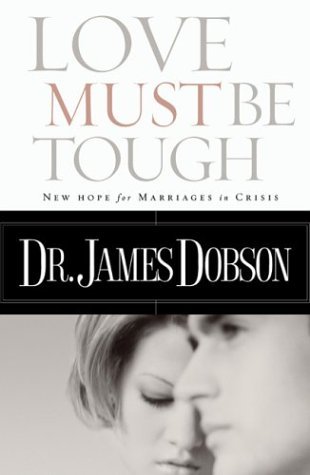
Book Review: Love Must Be Tough

Love must be tough

James C. Dobson, Love Must Be Tough: New Hope for Families in Crisis (1983; repr., Tyndale Momentum, 2007), hardback, 238 pages.

Dr. James Dobson (1936-) is a well known and established licensed psychologist (Ph.D., University of Southern California), who has addressed social and family issues from an evangelical perspective for about 40 years. He held a teaching post at USC’s School of Medicine as Associate Clinical Professor of Pediatrics and was on staff at the Children’s Hospital in Los Angeles for many years. And he served on a number government advisory panels and testified at several government hearings.[1]

Dr. Dobson is perhaps known more for the ministry network Focus on the Family he founded in 1977 through which he has provided a steady evangelical voice with regards to social issues on radio, television, print, and online. Since 2010, however, Dr. Dobson formally transitioned away from Focus on the Family and established another multi-media ministry venture, Dr. James Dobson’s Family Talk.

Love Must Be Tough to Save Families

The book under review, Love Must be Tough, is not a new contribution. Dr. Dobson wrote it in 1983 and because of its popularity, it is often reprinted. I read this book as part of a family ministry class. I found it to be an insightful and highly useful volume designed to provide a strategic proposal to help restore marriages struggling under the burden and crisis of marital infidelity. Dr. Dobson argues that his strategy strikes at the heart of the recovery from marital infidelity better than those provided by the then-current advice by counselors and literature.

What appears to be at the heart of the problem lies at a spouse’s passivity and allowance for the other spouse to have all the control in the relationship. This imbalance is subversive to the marriage. Dr. Nancy M. Rockstroh, M.D., who often recommends Love Must be Tough agrees:

when the balance of power switches so that one person has undue control, the potential for abuse of that power becomes imminent. Once individuals have the opportunity to do anything with the tacit acceptance of their partner, they have carte blanche to engage in destructive patterns of behavior without fear of losing the benefits of the relationship.[2]

Nancy Moultrie Rockstroh, “Love Must Be Tough: Proven Hope for Families in Crisis,” Primary Care Companion to the Journal of Clinical Psychiatry (2000)

It is not just theories or bad counseling which Dobson believes to be destructive and subversive to marital restoration. Marriage culture also is to blame, in particular, those which are so co-dependent that there is a loss of self-respect and the mutual respect which should exist within a marriage. Or, as Dobson argues, what marriages in crisis really need is the application of a simple principle: love must be tough.

Book Overview

Dr. Dobson develops his thesis by first showcasing the destructive nature of common approaches advised for reclaiming an unfaithful spouse. But, perhaps most instructive is the fact that he shares real experiences of infidelity and how the wounded spouse attempts to restore the marriage. According to Dobson, counselors tend to advise self-loathing, fault assuming, affair indulgent, and spiritually careless strategies. But even still further, wounded spouses often attempt to regain their unfaithful spouse through strategies (planned or not) that can be summed in the phrase: a complete lack of self-respect and identity (Panic, appeasement, etc).

This behavior must be stopped. Dobson argues strongly that this lack of self-respect and identity is a leading contributor for both the circumstances for a spouse to become unfaithful and for the pushing away of a cheating spouse. Dobson explains this character “defect” can be permissive as it “allows” flirtation with a potential lover, or it passively “allows” the spouse to continue dangerous relationships with a would-be lover. And once suspicion (or infidelity) occurs, the concerned spouse begins to tighten their grasp upon their beloved in order to keep them, but this often times pushes them farther away. The distrusted spouse feels caged and develops a need to escape. The spouse needs freedom. To further aggravate the situation, the worried partner who cannot feel complete without their spouse loses their individual identity and panics only to try to appease their unfaithful spouse. This behavior feels more like constrictions around the unfaithful spouse’s neck, and continue to fuel the desire for freedom (extramarital freedom).

Case upon actual case is rehearsed as testimonial evidence to support Dobson’s thesis that love must be tough. Consequently, if Dobson is right that popular counseling has it wrong in its strategic opinions, and that a consistent lack of self-respect and identity provide the stimulus for infidelity, then a new approach must be considered. Dobson argues therefore that the marriage relationship must include a number of applied principles. Despite the concept of “union” in marriage, each partner must exist with their sense of individuality intact, and each partner must be able to respect themselves. This sets forth the building blocks for a healthy sense of mutual accountability needed in a marriage that will allow it to thrive.

Thus, should signs of a potential extramarital affair begin to loom in the distance, a perceptive spouse can be grounded in their self-respect and identity, provide strong warnings set forth in love, self-respect, freedom, and independence (example: “I love you, but if you continue this course, then I will leave”). Spouses must be able to hold their ground, despite loving their spouse and not wishing them to depart. This “willingness to end a relationship,” says Dr. Rockstroh, “is the very essence of freedom and independence.”[3] Yet, this principle must be, according to Dobson, practiced with caution (see below).

Chapter 12 provides a timeline of eleven benchmarks showing how good marriages end in abandonment, adultery, divorce, and guilt. Side-by-side, the storyline of a husband and wife is unfolded. It shows how emotional starvation experienced by a loving spouse can lead to frustration and depression, only to work the heart into fertile soil for an extramarital affair. Preoccupations, such as work, only blind them of their beloved’s pain and that they too have contributed to this isolation. Eventually, an affair does ensue and is discovered. At this point, Dobson argues, the marriage can still be saved if both partners want to use “tough love” to regain themselves and restore their marriage. In this scenario that Dobson narrates, the cheating spouse leaves and a divorce is finalized. As in many cases which Dobson is aware of, at the end, the love affair turns mundane, the enabling but wounded spouse lives in ignorance of their contribution and the guilt for the children’s situation overshadows their heart.

Here Dobson makes one more appeal to confront misunderstandings that affect marital happiness. He appeals to the fact that culture essentially lies to our young ladies and young men in the aspect of who provides the happiness in the home. For the women, the lie is simple but devastating: “that marriage is a lifelong romantic experience.”[4] Moreover, the husband is entirely responsible for making this a reality; hence, women enter marriage with unrealistic expectations. And when these expectations are not met, it is her husband’s fault. For the men, the lie is relatively clear: “his only responsibility is to provide materially for his family.”[5] The love must be tough principle affirms individual responsibility for one’s happiness, and each spouse must play a role in creating marital happiness.

Of many of the valuable aspects of the book, is Dobson’s honesty that as much as the love must be tough principle is valuable and helpful, it can also be dangerously misapplied. The development of self-respect, individual identity, of creating a culture of freedom, of forgiveness, and many other traits can be so developed to the point where the wounded spouse uses them to destroy the marriage. For example, a person may become so independent that they want nothing to do with their spouse. Another spouse might defend their self-respect to the point where they become so outspoken that there is no mutual accountability. Dobson, therefore, warns against running wild with this strategy.

A Critique on Dobson’s Divorce and Remarriage View

There is no debate that Dr. Dobson’s book is valuable; however, his discussion on divorce and remarriage is perhaps the most egregious section in an otherwise well-developed book.[6] To Dobson’s credit, he inserts a disclaimer that he knows some Bible students will disagree with him. I register here as one who finds Dobson’s discussion of what constitutes a scriptural divorce and remarriage completely lacking biblical support.

Dobson affirms three matters to keep in mind in the discussion of divorce and remarriage. We agree with his discussion on what constitutes adultery in Matthew 19:9 so we will focus on the second passage discussed.

First, Dobson alleges that 2 Corinthians 5:17 sanctions the notion that it “includes divorce prior to salvation,” leading him to conclude:

when the marriage and divorce occurred prior to salvation, I believe God grants His “new creation” the freedom to remarry.[7]

James Dobson, Love Must Be Tough: New Hope for Families in Crisis (1983)

Dobson’s view hinges upon a phrase in this passage, namely “old things.” “Old things” as part of the “new creature” is typological imagery that supports the real emphasis of the verse, namely, that of a new creation. The personnot his/her marital situation– is made “new.” Paul had said previously to the Corinthian church that some of them had been adulterers (1 Cor 6:9-10) but not anymore because of their conversion (1 Cor 6:11). They changed their behavior. Conversion requires a change in behavior (Acts 2:38), it is not a simply a status change.

The third discussion Dobson enters is based upon a misrepresentation of 1 Corinthian 7:25-40. Dobson alleges that if a Christian is abandoned the believer has a right to remarry. Maybe there are other circumstances involved in the abandonment (i.e., adultery), but that is not discussed in this passage. Paul, however, argues that the abandoned spouse is not under an obligation -enslaved- to follow the departing spouse. The emphasis here is about fidelity to God’s sexual and marital laws (cf. 7:1ff). In fact, earlier in the passage Paul addresses “the married” and the potential of a legal separation,[8] to which he clearly gives two options: remain separated or be reconciled (1 Cor 7:10-11).

These are significant drawbacks from an otherwise really helpful book. I further understand that many would disagree with my critique of Dobson’s view. Still, neither conversion nor mere abandonment is biblical grounds for divorce and a subsequent remarriage.

Concluding Thoughts

In the final analysis, the book is generally sound and very helpful. But, because of the material on divorce and remarriage, I would recommend an alternative to sharing its articulation Dobson’s love must be tough strategy. Perhaps create a series of handouts (with due credit) with the strategies listed and illustrated. Or, recommendations to people well versed in the scriptural teachings on marriage, divorce, and remarriage. The material on self-worth and boundaries is the relevant and helpful element of Dobson’s work.

Dobson tackles a hard issue but the counsel he offers is advantageous. It is dated somewhat. For that reason, I would use Love Must Be Tough as a supplemental work to the more current volume by Henry Cloud and John Townsend, Boundaries in Marriage.[9] “Boundaries,” as Cloud and Townsend articulate, help to develop the issues Dobson is concerned with: a healthy sense of identity, personal responsibility, and mutual accountability. So, in the end, I offer a limited recommendation of Dobson’s book for the counselor and minister.

Endnotes

  1. James Dobson,” Wikipedia.org.
  2. Nancy Moultrie Rockstroh, “Love Must Be Tough: Proven Hope for Families in Crisis,” Primary Care Companion to the Journal of Clinical Psychiatry 2.6 (Dec. 2000): 229.
  3. Rockstroh, “Love Must Be Tough.”
  4. James Dobson, Love Must Be Tough: New Hope for Families in Crisis (1983; repr., Waco, TX: Word, 1996), 176.
  5. Dobson, Love Must Be Tough, 176.
  6. Dobson, Love Must Be Tough, 129-33.
  7. Dobson, Love Must Be Tough, 130.
  8. It is documented by R. L. Roberts, Jr., very clearly that the passive phrase “to be separated” (Grk. choristhenai) in these verses is a “technical expression for divorce” as it exists in ancient legal documents before and during the apostolic era (“The Meaning of Chorizo and Douloo in 1 Corinthians 7:10-17,″ Restoration Quarterly 8.3 [1965]: 179-80). Consequently, those that only see a “separation” as we commonly conceive of it as temporary “space” between spouses are unreasonably limiting the meaning of this word here.
  9. Henry Cloud and John Townsend, Boundaries in Marriage (Grand Rapids, MI: Zondervan, 1999).

Defining Adultery in the Old Testament

Adultery. Not exactly the warmest of words. For some, it evokes the pain that can only be felt from experiencing a broken home. For others, it is a reminder of what could have been if certain circumstances had presented themselves. There are some who think of this word as an obstacle that was overcome and they are survivors indeed. While yet still, there are others who are ever vigilant of all the steps that lead to this dreaded sin.

And finally, there are some who stand humbled in the rubble around them (a life destroyed), that was brought to fruition through that terrible act of adultery. They enjoyed their brief night in paradise, only to be awoken by the torrents of horror in the morning.

The Word Adultery

It is amazing that some who would set forth the claim that their interests are in teaching the Word of God hold a variety of views as to the nature and meaning of adultery contrary to the biblical data. Without considerable interaction with these distinct points of view, let us press on to consider some of the Old Testament evidence as to the meaning and nature of adultery. How does God represent it in the Hebrew Bible?

But where does the word adultery come from. The actual derivation of the English word for adultery is quite enlightening. It actually derives from combining a number of Latin terms into one:

The word adultery originates not from “adult”, as is commonly thought, but from the Late Latin word for “to alter, corrupt”: adulterare. Adulterare in turn is formed by the combination of ad (“towards”), and alter (“other”), together with the infinitive form are (making it a verb).

Wikipedia.org

So, in English the word adultery has the idea of one person moving towards another person in order to make a new personal arrangement. Moreover, in some cases the Latin term adulterare carried the meaning of “to pollute” – taking something that is pure, and contaminating it.

When we say that someone has committed adultery, we are simply stating that a person has corrupted his or her marriage by introducing a third party. The marriage has been altered, changed, and polluted. The English word is quite graphic, but since the Old Testament was written primarily in Hebrew we would be wise to consult the meaning of this term there.

The Old Testament Term

In the Old Testament, the primary Hebrew word for adultery is nā’ap. As with any word, it is part of a grouping of words with similar meanings. Many of these words emphasize a range of meanings; for example, they can take literal or figurative meanings, and even describe those who are married or betrothed who are unfaithful. However, nā’ap is the found the majority of the time to state that a person has – as we say – “cheated” on their spouse.[1]

William Wilson notes that nā’ap “is confined to adultery in the exclusive sense of the term or fornication by a married person.”[2] James Swanson amplifies the meaning, stating that it refers to a person who has “sexual intercourse with [someone] other than a spouse, as a married or betrothed person, generally, a person of low social status.”[3]

One of the earliest appearances of nā’ap in the Old Testament is in the reading of the “10 Commandments” (Exod 20:14). God says transparently, “You shall not commit adultery.” This command is cradled between the “shall not’s” of murder and stealing, which should give us an indication as to the severity of adultery in the eyes of God (Exod 20:13, 15 cf. Lev 20:10).

Clyde Woods makes the observation that in this command, the “sacredness of marriage” is emphasized, and it is this “principle of social purity” that “provides the basis for numerous [other] laws regarding sexual relationships and offenses” (cf. Exod 22:19; Lev 18:1-18; Deut 22:13-30).[4] And in this connection, R. Alan Cole finds in Joseph’s rejection of Potiphar’s wife the fact that:

For a man to have intercourse with another man’s wife was considered as the heinous sin against God as well as man, long before the law, in patriarchal times (Gen 39:9).[5]

R. Alan Cole, Exodus (1979)

The holiness of God demands that the matrimonial bed be undefiled by extra-marital affairs (Heb 13:4). Some people defile their marriage by actually sleeping with someone other than their spouse (John 8:4), others have so saturated their minds with “daydreams” of scenarios to have affairs, that if circumstances presented themselves they would do it (Matt 5:28); and yet still, there are those who have slipped on more rings on their one wedding finger than many super bowl champions have on their whole hand – and with little to no effort (John 4:16-19). From the beginning, however, this was not God’s ideal plan for marriage (Matt 19:9 cf. Gen 2:24).

Literal and Figurative Adultery

Nā’ap may mean literal adultery, but it also carries figurative, or more precisely, a spiritual application as well. Swanson explains: “in some contexts this refers to religious adultery, usually in which Israel is viewed as the unfaithful female spouse to the Lord in a covenantal marriage contract.”[6] Wilhelm Gesenius likewise remarks, “it is applied to the turning aside of Israel from the true God to the worship of idols” (Jer 3:8-9, 5:7, 9:1, 23:14).[7]

Even as Jeremiah writes of the faithless one – the Northern kingdom of Israel:

The Lord said to me in the days of King Josiah: “Have you seen what she did, that faithless one, Israel, how she went up on every high hill and under every green tree, and there played the whore? And I thought, ‘After she has done all this she will return to me,’ but she did not return, and her treacherous sister Judah saw it. She saw that for all the adulteries of that faithless one, Israel, I had sent her away with a decree of divorce. Yet her treacherous sister Judah did not fear, but she too went and played the whore. Because she took her whoredom lightly, she polluted the land, committing adultery with stone and tree. Yet for all this her treacherous sister Judah did not return to me with her whole heart, but in pretense, declares the Lord.” (Jeremiah 3:6-10)

Judah had not learned the lesson of her sister Israel. The Northern kingdom of Israel’s fixation with idolatry is amply substantiated in the Hebrew Bible, and, in fact, was a foundational aspect of its administration and spirituality (cf. 1 Kings 12:25-33). It was this faithless one that committed adultery with stone and tree.

We see then that the literal usages of nā’ap enhance the figurative-spiritual uses. The literal and figurative uses share a reciprocal connection; that is to say, they enhance each other.[8] And, this makes perfect sense, for there are very few – if any – words that do not lend themselves to figurative or metaphorical uses.

Examples of Adultery in the Old Testament

Several times in the book of Ezekiel, the spiritual appraisal of Israel is pictured in terms of adultery. Principally, the first 24 chapters of Ezekiel address themselves to this theme. Chapters 15 through 17 explain the doom of Jerusalem by means of allegories and parables.[9] Within this framework, chapter 16 portrays the spiritual infidelity of the Hebrews in the unmistakably graphic picture of marital sexual infidelity.

Observe some snippets from the chapter that the English Standard Version translators call “The Lord’s Faithless Bride” (Ezek 16:1-58):

  • “When I passed by you again and saw you, behold, you were at the age for love, and I spread the corner of my garment over you and covered your nakedness; I made my vow to you and entered into a covenant with you, declares the Lord GOD, and you became mine.” (vs. 8)
  • “But you trusted in your beauty and played the whore [were unfaithful; ESV footnote #2] because of the renown and lavished your whorings on any passerby; your beauty became his.” (vs. 15)
  • “At the head of every street you built your lofty place and made your beauty an abomination, offering yourself [“Hebrew spreading your legs”; ESV footnote #1; cf. ASV “opened thy feet […]”] to any passerby and multiplying your whoring.” (vs. 25)
  • “Adulterous [nā’ap] wife, who receives strangers instead of her husband!” (vs. 32)

With great precision, the prophet presents God’s anger and sense of betrayal with the imagery of adultery. As Samuel Schultz and Gary Smith summarize:

[I]n an allegory, Ezekiel compared Judah to a young girl that God cared for and married. But the bride ignored her husband and loved others (foreign customs, idols, her own beauty).[10]

Exploring the Old Testament (2001)

Jeremiah, a contemporary of Ezekiel during the Babylonian captivity, ministered in Jerusalem and abroad. Numerous false prophets declared that this captivity was merely temporary and that God would return them soon. In Jeremiah 29:1-28, the prophet sends a letter from Jerusalem to the captives in Babylon encouraging them in their situation, rebuking those who oppose the truth of God’s punishment upon Judah, and re-enforcing the fact that Judah will remain in Babylon for 70 years. One of the blistering comments rendered to the false prophets is that they were adulterers (Jeremiah 29:20-23).

Jeremiah says that Ahab and Zedekiah, the false prophets, “have done an outrageous thing in Israel, they have committed adultery [nā’ap] with their neighbors’ wives, and they have spoken in my name lying words that I did not command them” (vs. 23). This language is as transparent as Leviticus 20:10 where Moses writes, “if a man commits adultery with the wife of his neighbor, both the adulterer and the adulteress shall surely be put to death.”

Adultery, literal or figurative, describes the most intimate of interactions. Literally, it refers to actual sexual encounters with someone other than their spouse. Spiritually, it expands upon the literal meaning of adultery and give it a figurative flavor stressing the deep treachery felt by God from his people who give their beauty to another.

Conclusion

Literally, then, adultery is sexual activity between a married person and a person who is not their spouse. Spiritually, then, adultery is spiritual and moral activity contrary to God’s teaching. While Old Testament and the New Testament are uniform in their presentation of adultery, space has been given to a brief investigation of the concept in the Old Testament. The Old Testament and New Testament are two testimonies that share the same conception of adultery, a behavior that Russell describes as, a “special and aggravated case of fornication.”[11]

This concept has not been altered or distorted through the passing of time; consequently, we have no right to redefine it in modern times, contemporary times, or in any subsequent generation to come, for God’s truth endures to all generations (Psa 100:5). He means what he says. Heaven help us to keep it secure and unaltered in our minds!

References

  1. James Swanson, “nā’ap,” Dictionary of Biblical Languages with Semantic Domains: Hebrew (Old Testament), 2d ed., electronic ed. (Oak Harbor, WA: Logos Research Systems, 1997).
  2. William Wilson, Wilson’s Old Testament Word Studies (repr., Peabody, MA: Hendrickson, n.d.), 6.
  3. Swanson, Dictionary of Biblical Languages.
  4. Clyde M. Woods, Genesis-Exodus (Henderson, TN: Woods, 1972), 179.
  5. R. Alan Cole, Exodus: An Introduction and Commentary (1973; repr., Downers Grove, IL: InterVarsity, 1979), 160.
  6. Swanson, Dictionary of Biblical Languages.
  7. Wilhelm Gesenius and Samuel Prideaux Tregelles, Gesenius’ Hebrew and Chaldee Lexicon to the Old Testament Scriptures, electronic ed. (Bellingham, WA: Logos Research Systems, 2003), 525.
  8. Emmet Russell observes this exact point when he writes, “the figurative use enhances the literal sense, emphasizing the divine institution and nature of marriage” (Zondervan’s Pictorial Bible Dictionary, ed. Merrill C. Tenney [Grand Rapids, MI: Zondervan, 1967], 17).
  9. Homer Hailey, Hailey’s Comments (Las Vegas, NV: Nevada Publications, 1985), 1:201-04.
  10. Samuel J. Schultz and Gary V. Smith, Exploring the Old Testament (Wheaton, IL: Crossway, 2001), 191.
  11. Russell, ZPBD 17.