
Do We Have the Old Testament?

A person of faith often assumes that there are no problems ascertaining the wording of certain passages. But reality demonstrates that there are instances where this proves to be untrue. What a believer expects God to do in His providential care of the planet may not always line up with how life unfolds itself, but such disorientation has been common among the faithful.

Despite all the miracles employed to compel Pharoah to release the Israelites from Egypt, when the environment became less than comfortable fear and panic overcame God’s people (Exod 14). Even Moses had initial problems with understanding the situation he was faced with when he was sent to Pharoah to have him release the Israelites (Exod 5). Examples could be multiplied to demonstrate that a person of faith at times needs “more” in order to calm their nerves.

The following brief study gives attention to the textual basis of the Old Testament, considering a few lines of thought that contribute to a more informed outlook on how copies of the Hebrew Bible have been transmitted into modern hands, and what the sources of the copies used today so that translators are able to produce translations of the Hebrew Bible.

It must be emphasized that this is not an exhaustive treatment of the subject. So much more is available for analysis; be that as it may, a survey of this material is sufficient to adequately support the above affirmation of the adequate veracity of the Hebrew Bible.

A Skeptic’s Concern

A skeptical approach to the Bible essentially argues that for a collection of books so old, for a collection of books that have passed through so many hands, or for a collection of anonymously published volumes, it is a hard sell to affirm that the Bible – here the Hebrew Bible – is trustworthy in any sense.

Regarding the textual certainty of the Bible in general, skeptic Donald Morgan puts the matter bluntly in the following words:

No original manuscripts exist. There is probably not one book that survives in anything like its original form. There are hundreds of differences between the oldest manuscripts of any one book. These differences indicate that numerous additions and alterations were made to the originals by various copyists and editors.[1]

The argument basically affirms that there is no way for the Bible to be an accurate record of the words of God, and therefore, it is not “trustworthy.”  The sheer force of this argument is designed to rob the Bible believer’s faith in God. Implicit with this is the futility of having a religion founded upon the Bible’s guidance.

What can be said of this dire depiction, except that one must not be persuaded by mere affirmations, but instead by the available evidence. Not only is it paramount to see the evidence, but it is imperative that a proper evaluation is given to it.

The OT Accurately Transmitted

The Scribal Evidence

The overall scribal evidence suggests that the Hebrew Bible has been adequately preserved. The “scribe” trade goes back very early in recorded antiquity and therefore is a field of has a rich heritage of scholarship and workmanship behind it.[2]  J. W. Martin notes that the field of transmitting literature is a known trade skill from the 2nd millennium B.C. and observes, “men were being trained not merely as scribes, but as expert copyists.”[3]  Copying occurred during the Babylonian exile. F. C. Grant writes, “in far-away Babylonia the study and codification, the copying and interpretation of the Sacred Law had steadily continued.”[4]

This means that extending back beyond the time of Abraham (19th century B.C.) and Moses (15th century B.C.), down to the time of the exilic and post-exilic scribes (the predecessors to the “scribes who copied and explained the Law in the New Testament times”),[5] “advanced” and “scrupulous” methods would likely be used to copy any text, including the Hebrew canon.

The next question in need of an answer, though, is: what were those methods? Briefly, observe the mentality and professionalism which exemplify the sheer reverential ethic towards the transmission of the Biblical text characterized by the scribes.

The Hebrew Scribes revered the sanctity of the Scriptures. Moses commanded the people not to “add to the word,” nor to “take from it” (Deut 4:2). The Hebrews respected this command. Josephus weighs in as support for this point. In arguing for the superiority of the Hebrew Bible against the conflicting mythologies of the Greeks fraught with evident contradicting alterations to their content, Josephus bases his argument upon the reverential mentality towards these writings.

Josephus testifies to this sense of reverence (Against Apion 1.8.41-42):

[41] It is true, our history hath been written since Artaxerxes very particularly, but hath not been esteemed of the like authority with the former by our forefathers, because there hath not been an exact succession of prophets since that time; [42] and how firmly we have given credit to those books of our own nation, is evident by what we do; for during so many ages as have already passed, no one has been so bold as either to add anything to them, to take anything from them, or to make any change in them; but it becomes natural to all Jews, immediately and from their very birth, to esteem those books to contain divine doctrines, and to persist in them, and, if occasion be, willingly to die for them.[6]

William Whiston, Translator

Even though there are variants, produced by scribes, the fundamental historical truth stresses that the Hebrew scribes revered the Scriptures and dared never to add or take away from them. This important truth must not be forgotten. Moreover, this fact emphasizes the great care they had with the transmission of the text.

The scribal methods changed as time progressed, and this seems to be for the better and for the worst. One thing is transparent, however, and that is this: consistent with the reverential appreciation of the scriptures, the Hebrew scribes exercised acute professionalism in their methods, however superstitious they were at times. Rabbinic literature testifies to the early scribal school. Clyde Woods reproduces 17 crucial rabbinic rules demonstrating the rigors of the early scribal methodology.[7] The specifics concerning the writing materials, the preparation of the document, the veracity of the authenticity of the template, the conduct displayed when writing divine names, and other critical rules are thus enumerated underscoring the diligent professionalism of the early scribes.

The Masoretes succeeded and exceeded these scribes as a professional group of transmitters of the Hebrew Bible, laboring from A.D. 500 to A.D. 1000.[8] Lightfoot summarizes a number of procedures the Masoretes employed to “eliminate scribal slips of addition and omission.”[9] The Masoretes counted and located the number of “verses, words, and letters of each book,” thereby passing on the text that they have received. This intricate methodology in preservation is of extreme importance in modern textual studies,[10] and answers the reason why these reliable “medieval manuscripts” are commonly the underlying text of modern English translations[11] and represented in the Biblia Hebraica Stuttgartensia (cf. English Standard Version).[12]

The concern for the accurate preservation of the Biblical text cannot, however, dismiss the fallible humanity which copied the text by hand, thereby producing inevitable scribal variations.[13] René Paché recounts the “herculean” endeavors of scholars evaluating the variants which have “crept into the manuscripts of the Scriptures” (e.g. B. Kennicott, Rossi, and J. H. Michaelis). These labors have also encompassed the analysis of the oldest versions and numerous citations and allusions from Jewish and Christian works. Robert D. Wilson’s observations in his work, A Scientific Investigation of the Old Testament, noted that the 581 Hebrew manuscripts studied by Kennicott are composed of 280 million letters comprised of only 900,000 variants. These variants are boiled down to 150,000 because 750,000 are “insignificant changes” of letter switches.[14]

This is represented as 1 variant for every 316 letters, but putting these unimportant variants aside, the count stands at 1 variant for every 1,580 letters. Moreover, “very few variants occur in more than one of the 200-400 manuscripts of each book of the Old Testament.”[15] The point that needs recognition, however, is that we must recognize that the scribes have done their best, but there are variations that must be accounted for. These variations are not sufficient enough to call into question the adequate preservation of the Hebrew Bible.

Textual Evidence

After evaluating some of the problems in the textual evidence for the Old Testament, it can be said that the overall material adequately preserves the Hebrew Bible. This investigation is comparable to a roller coaster. There are both ups and downs, making one more confident while at the same time bringing some concern. For example, Peter Craigie notes, “there is no original copy of any Old Testament book; indeed, not even a single verse has survived in its original autograph. This is not a radical statement, simply a statement of fact.”[16]

The Bible believer might feel a bit disconcerted to know this fact, but there is no genuine need to feel this way. Truth endures because of its very nature no matter if one destroys the materials upon which it is written (Jer 36:23-32). Moreover, the scribal evidence adequately demonstrates an amazingly high level of accurate transmission and preservation of the Old Testament, even though the autographs are not available. One might speculate as to why these important documents are not providentially preserved for posterity, but the observation that such a course of action “is a highly dangerous procedure” is promptly recognized.[17]

Nevertheless, there are historical issues relating to this question and to the question of why there are such a small number of manuscript copies of the Old Testament when compared to the textual evidence of the New Testament. The most important fact is that the Hebrew scribes destroyed old manuscripts (autographs and copies). Clyde M. Woods writes:

The relative paucity [i.e. smallness of number] of earlier Hebrew manuscripts is due not only to the perishable nature of ancient writing materials (skins and papyri) and to the effort of hostile enemies to destroy the Hebrew Scriptures, but, perhaps more significantly, to the fact that the Jews evidently destroyed some worn out manuscripts to prevent their falling into profane hands.[18]

This explains why there is comparatively less textual witness for the Old Testament than for the New, however, as Donald Demaray notes, “there is the compensating factor that the Jews copied their Scriptures with greater care than did the Christians.”[19] There are accounts of scribes having burial ceremonies for the manuscripts,[20] and the storage “of scrolls [in a “Genizah” depository] no longer considered fit for use.”[21]
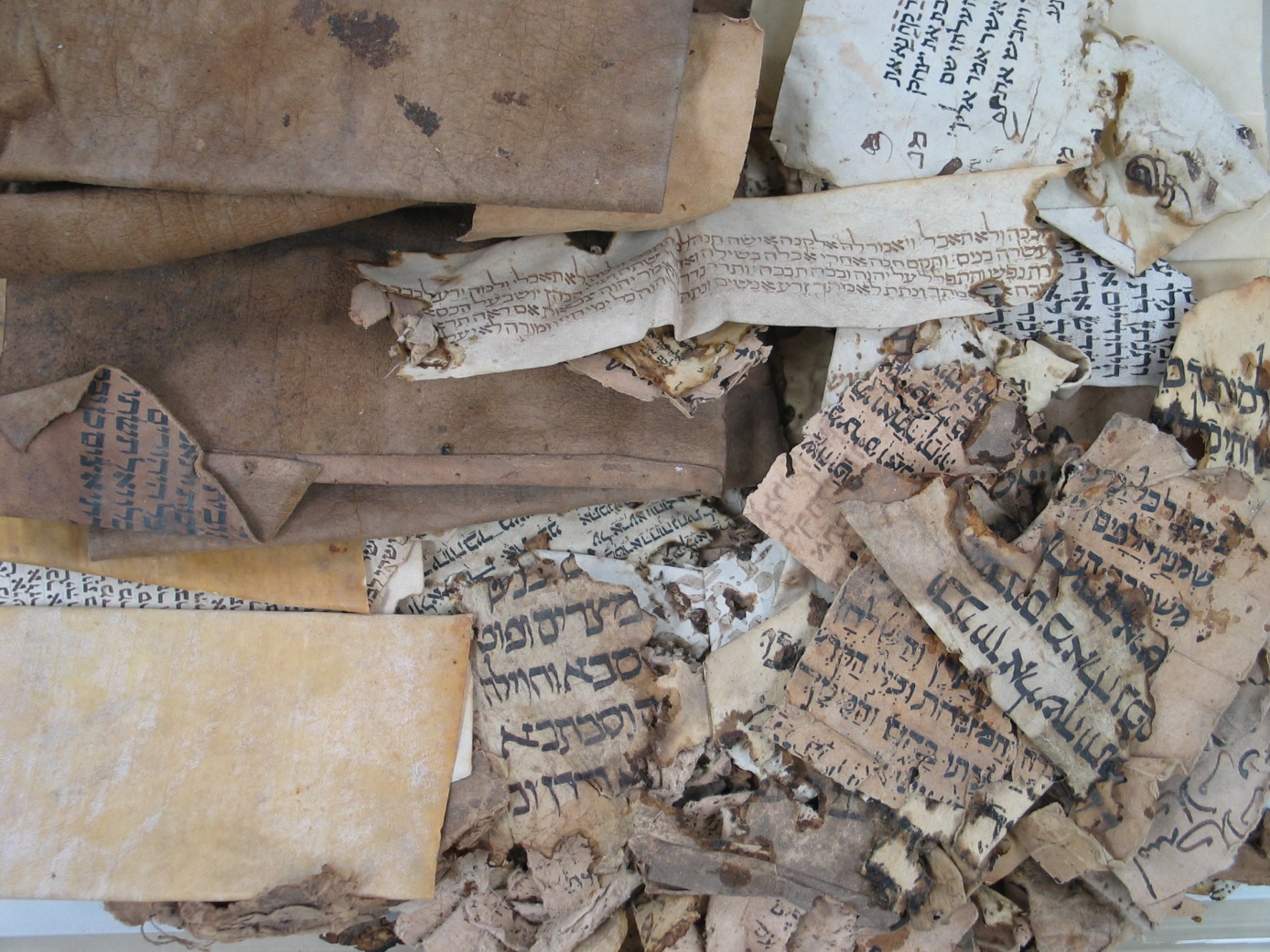

Cairo Genizah - Cambridge Library Blog - Fig1
Image Credit: Cambridge University Library Special Collections. “Fragments from the Cairo Genizah prior to conservation and cataloguing [sic]” (Emma Nichols, “Conservation of the Lewis-Gibson Collection: Re-Treatment of Manuscript Fragments from the Cairo Genizah“)

A second major factor is the A.D. 303 declaration by Emperor Diocletian to destroy any “sacred” literature associated with the Christian religion.[22] F. C. Grant frames the significance as follows:

As never before, the motive of the Great Persecution which began in 303 was the total extirpation of Christianity: […]. The first of Diocletian’s edicts directed to this end prohibited all assemblies of Christians for purposes of worship, and commanded that their churches and sacred books should be destroyed.[23]

This would further contribute to the lack of Hebrew Bible manuscripts.

Modern manuscript evidence for the Hebrew Bible, therefore, does not include the autographa (“original manuscripts”) and is generally never expected to, as desirable as the obtainment of these documents is.[24] What remains is the collection of manuscripts which together allow textual scholars to reproduce as close as possible the Hebrew Old Testament. This body of textual evidence goes very far to close the gap between the present day and the autographa. What are these manuscript witnesses to the Hebrew Bible? There are primary and secondary witnesses but where space is limited to the manuscripts.

Bruce Waltke observes that the textual witnesses to the text are the extant Hebrew manuscripts and Hebrew Vorlage obtained from the early versions of the Hebrew text.[25] While the term “manuscript” is typically recognized, the term Vorlage is probably unfamiliar to the general Bible student. This term refers to the text that “lies before” the translation or a theoretical “prototype or source document” from which it is based.[26] The Masoretic text (MT), the Samaritan Pentateuch (SP), and the Dead Sea Scrolls (DSS) are the principal manuscript witnesses. These manuscripts coupled with the Vorlage are the “documents” at our disposal.

Craigie’s presentation on this material[27] when compared to Waltke leaves something to be desired, and that something is more data and deeper investigation. However, Craigie presents the evidence that the manuscript evidence (including early translations) extends from the 2nd century B.C to the MT of the late 9th century B.C.[28] Leaving a considerable gap, as he notes, of “several centuries, the time varying from one Old Testament book to another, between the earliest extant manuscripts and no longer existing original manuscripts.”[29]

Waltke presents a fuller presentation of the two substantiating Craigie’s observations and would extend from the available data that the Vorlage of some of the DSS and SP points to a Proto-MT at least somewhere in the 5th century B.C.[30] Moreover, the oldest evidence is found in 2 extremely small silver rolls containing the Aaronic priestly blessing from Numbers 6:24-26, dating to the 7th or 6th centuries B.C.[31] The text reads:

May Yahweh bless you and keep you;
May Yahweh cause his face to
Shine upon you and grant you
Peace
(Michael D. Coogan)

Consequently, the worst case holds that the textual evidence goes only to the 2nd century, while the best case goes back some 300-500 years further back to a purer source as of yet unavailable.

H. G. G. Herklots has compiled a generous amount of information concerning the production of harmonization work which underlies the works of present-day manuscripts.[32] By doing this Herklots highlights that there are variations in the textual witnesses that the early stewards of the text attempted to dispose of but this has in some sense complicated the matter, making the study more laborious than it already is.[33] Variations are not as problematic as the skeptic supposes. To be sure, there are occasions of serious textual dissonance, but these are far from the plethoras of insignificant, obvious, and correctable variations.[34]

Waltke affirms, that “90 percent of the text contains no variants,” and of the remnant “10 percent of textual variations, only a few percent are significant and warrant scrutiny; 95 percent of the OT is therefore textually sound.”[35] Douglas Stuart notes that when considering the variations, “it is fair to say that the verses, chapters, and books of the Bible would read largely the same, and would leave the same impression with the reader, even if one adopted virtually every possible alternative reading.”[36] The variations of the extant textual evidence hardly, therefore, pose an indomitable problem to the adequate preservation of the Old Testament. The skeptic’s argument has no leg to stand upon.

Extra-Hebrew Bible Sources

Besides the extant Biblical literature of the Hebrew Bible, there are miscellaneous sources that demonstrate the veracity of the text, and implicitly note the accountability of the Hebrew Bible to a textual investigation. While these witnesses cannot reproduce the entire Old Testament, they can be compared with the manuscript evidence for accuracy and enlightened evidence when certain passages or words appear obscure. Briefly, consider two sources.

First, the Targums are a set of Jewish works in Aramaic that are paraphrastic (i.e. “interpretive translation”) of parts of the Old Testament.[37] Targums are said to be used in the synagogue to give the Aramaic-speaking Jews the “sense” of the Hebrew Bible.[38] This is comparable to the verbal translation that had to occur at the inauguration of the Law under Ezra, where there were assistants who “gave the sense, so that the people understood the reading” (Neh 8:8 ESV).

Targums have been written upon every section of the Hebrew Bible; they ranged from “very conservative” to “interpretive” (Onkelos and Jonathon respectively), and are useful for the light they show upon traditional Jewish interpretation.[39] In the history of the transmission of the Hebrew Bible, at times the Targum was placed along the side of a Hebrew text, a Greek text, and a Latin text (as in the Complutensian Polyglot) to “enable a reader with little Hebrew to understand the meaning of the Scriptures in his own language.”[40] It seems agreeable to suggest and affirm that the Targum serves as an appropriate and practical source to obtain a general understanding of the Hebrew text, which will definitely aid the textual scholar in analyzing obscure passages.

Second, there is the New Testament, which is a virtual galaxy of Old Testament citations and allusions as it connects Jesus and his followers as a continuation -fulfillment- of its message. Consequently, it serves as a proper witness to the passages cited or alluded to. E. E. Ellis writes:

there are some 250 express citations of the Old Testament in the New. If indirect or partial quotations and allusions are added, the total exceeds a thousand.[41]

The Greek New Testament, published by the United Bible Society, has 2 notable reference indexes. The first index lists the “Quotations” while the other catalogs “Allusions and Verbal Parallels.”[42]

The New Testament writers used and quoted not only the Hebrew Bible, but also the LXX (with some variations suggesting different Greek translations), and other sources such as the Old Testament Targums.[43] In addition, the New Testament, in terms of textual evidence (manuscript, early version, and patristic quotations), is the most attested document from antiquity[44] emphasizes the reliability of the New Testament evidence for the Old Testament.[45]

Concluding Thoughts

In summation, we have examined some of the evidence in a survey and observed that the typical skeptical claim against the Bible is fallacious. We are more than confident that the textual transmission of the Bible has adequately preserved the Bible. There are so many avenues from which data pours in that for all practical purposes the gap from these extant materials to the originals is irrelevant. Gaps of greater magnitude exist for other works of antiquity, but no finger of resistance is pressed against their adequate representation of the autographic materials.

The Bible experiences this sort of attack partly because ignorant friends of the Bible fighting with a broken sword affirm that we have the Bible and that it has no textual problems. Other times, skeptics misrepresent textual studies of the Bible in order to support their case that the Bible is not the inerrant inspired word of God. Be that as it may, the scribal evidence demands that the scribes held a high reverence and professionalism in the transmission of the text, the textual evidence is, though having some problems, near 100 percent sound. Moreover, the New Testament and Talmud are examples of sources that uphold the Biblical text and allow textual scholars to examine the accuracy of the textual data.

Finally, the skeptical attack has been viewed a considered only for it to be concluded that it is fallacious and of no need to be considered a viable position based on the evidence. In connection with this conclusion, observe some observations by Robert D. Wilson and Harry Rimmer. Rimmer writes that a scientific approach to the Bible inquiry is to adopt a hypothesis and then test it and see if there are supportive data that establishes it. He writes:

If the hypothesis cannot be established and if the facts will not fit in with its framework, we reject that hypothesis and proceed along the line of another theory. If facts sustain the hypothesis, it then ceases to be theory and becomes an established truth.[46]

Wilson makes a similar argument and ties an ethical demand to it. After ably refuting a critical argument against Daniel, Wilson remarks that when prominent critical scholars make egregious affirmations adequately shown to be so, “what dependence will you place on him when he steps beyond the bounds of knowledge into the dim regions of conjecture and fancy?.”[47]

Endnotes

  1. Donald Morgan, “Introduction to the Bible and Biblical Problems,” Infidels Online (Accessed 2003). Mr. Morgan is just a classic example of the skepticism that many share regarding the integrity of the biblical record.
  2. Daniel Arnaud, “Scribes and Literature,” NEA 63.4 (2000): 199.
  3. J. W. Martin, et al., “Texts and Versions,” in The New Bible Dictionary, eds. J. D. Douglas (Grand Rapids, MI: Eerdmans, 1962), 1254.
  4. Fredrick C. Grant, Translating the Bible (Greenwich, CT: Seabury, 1961), 8 (emph. added).
  5. Grant, Translating the Bible, 10-11.
  6. Flavius Josephus, The Works of Josephus: Complete and Unabridged, trans. William Whiston (repr., Peabody, MA: Hendrickson, 1987).
  7. Clyde M. Woods, “Can we be Certain of the Text? – Old Testament,” in God’s Word for Today’s World: The Biblical Doctrine of Scripture (Kosciusko, MI: Magnolia Bible College, 1986), 98.
  8. Martin, et al., “Texts and Versions,” 1255; René Paché, The Inspiration and Authority of Scripture, trans. Helen I. Needham (Chicago, IL: Moody, 1969), 187.
  9. Neil R. Lightfoot, How We Got the Bible, 2d ed. (Grand Rapids, MI: Baker, 2001), 92.
  10. Lightfoot, How We Got the Bible, 92.
  11. Peter C. Craigie, The Old Testament: Its Background, Growth, and Content (Nashville, TN: Abingdon, 1986), 32.
  12. English Standard Version of The Holy Bible (Wheaton, IL: Crossway, 2001), ix.
  13. Lightfoot, How We Got the Bible, 91.
  14. Robert D. Wilson, A Scientific Investigation of the Old Testament, revised ed., Edward J. Young (Chicago, IL: Moody, 1967), .
  15. ctd. in Paché, Inspiration and Authority of Scripture, 189–90.
  16. Craigie, The Old Testament, 34.
  17. Dowell Flatt, “Can we be Certain of the Text? – New Testament,” in God’s Word for Today’s World: The Biblical Doctrine of Scripture (Kosciusko, MI: Magnolia Bible College, 1986), 104: “The books of the New Testament were originally copied by amateurs,” the variants multiplied from persecution pressures and translations issues up until the “standardization of the text” in the 4th to 8th centuries A.D.
  18. Woods, “Can we be Certain of the Text?,” 96.
  19. Donald E. Demaray, Bible Study Sourcebook, (Grand Rapids, MI: Zondervan, 1964), 35; Flatt, “Can we be Certain of the Text?,” 106.
  20. Lightfoot, How We Got the Bible, 90.
  21. Martin, et al., “Texts and Versions,” 1256-57; Paché, Inspiration and Authority of Scripture, 187-88; F. C. Grant notes that the Synagogue of Old Cairo’s Geniza has been found, throwing “great light upon Biblical studies” (Translating the Bible, 40). Biblical scrolls were discovered from 1890 and, onwards including Targums and rabbinic literature (Martin, et al., “Texts and Versions,” 1256-57).
  22. Michael Grant, The Roman Emperors: a Biographical Guide to the Rulers of Imperial Rome 31 B.C.–A.D. 476 (1985; repr., New York, NY: Barnes & Noble, 1997), 208.
  23. Grant, Translating the Bible, 208.
  24. Lightfoot, How We Got the Bible, 90.
  25. Bruce K. Waltke, “Old Testament Textual Criticism,” in Foundations for Biblical Interpretation, eds. David S. Dockery, et al. (Nashville, TN: Broadman, 1994), 159-68.
  26. Matthew S. DeMoss, Pocket Dictionary for the Study of New Testament Greek (Downers Grove, IL: Intervarsity, 2001), 128.
  27. Craigie, The Old Testament, 32-37.
  28. Craigie, The Old Testament, 36, 32.
  29. Craigie, The Old Testament, 34.
  30. Waltke, “Old Testament Textual Criticism,” 162.
  31. Waltke, “Old Testament Textual Criticism,” 163.
  32. H. G. G. Herklots, How Our Bible Came to Us: Its Texts and Versions (New York, NY: Oxford University, 1957), 29-40, 109-23
  33. Herklots, How Our Bible Came to Us, 116-23, Waltke, “Old Testament Textual Criticism,” 164-167.
  34. Waltke, “Old Testament Textual Criticism,” 157.
  35. Waltke, “Old Testament Textual Criticism,” 157-58.
  36. qtd. in Waltke, “Old Testament Textual Criticism,” 157.
  37. D. F. Payne, “Targums,” in The New Bible Dictionary, ed. J. D. Douglas (Grand Rapids, MI: Eerdmans, 1962), 1238.
  38. Payne, “Targums,” 1238.
  39. Payne, “Targums,” 1239.
  40. Herklots, How Our Bible Came to Us, 35-36.
  41. E. E. Ellis, “Quotations (in the New Testament),” in The New Bible Dictionary, ed. J. D. Douglas (Grand Rapids, MI: Eerdmans, 1962), 1071.
  42. Barbara Aland, et al., eds., The Greek New Testament, 4th rev. ed. (Stuttgart: United Bible Societies, 2002), 887-901.
  43. Ellis, “Quotations (in the New Testament),” 1071.
  44. Wayne Jackson, Fortify Your Faith In an Age of Doubt (Montgomery, AL: Apologetics Press, 1974), 70-75.
  45. Harry Rimmer, Internal Evidence of Inspiration, 7th edition (Grand Rapids, MI: Eerdmans, 1946), 36.
  46. Wilson, A Scientific Investigation of the Old Testament, 98.

Bibliography

Aland, Barbara, et al. Editors. The Greek New Testament. 4th rev. ed. Stuttgart: United Bible Societies, 2002.

Arnaud, Daniel. “Scribes and Literature.” NEA 63.4 (2000): 199.

Craigie, Peter C. The Old Testament: Its Background, Growth, and Content. Nashville, TN: Abingdon, 1986.

Demaray, Donald E. Bible Study Sourcebook. Grand Rapids, MI: Zondervan, 1964.

DeMoss, Matthew S. Pocket Dictionary for the Study of New Testament Greek. Downers Grove, IL: InterVarsity, 2001.

Ellis, E. E. “Quotations (in the New Testament).” Page 1071 in The New Bible Dictionary. Edited by J. D. Douglas. Grand Rapids, MI: Eerdmans, 1962.

Flatt, Dowell. “Can we be Certain of the Text? – New Testament.” Pages 103-10 in God’s Word for Today’s World: the Biblical Doctrine of Scripture. Don Jackson, Samuel Jones, Cecil May, Jr., and Donald R. Taylor. Kosciusko, MS: Magnolia Bible College, 1986.

Grant, Fredrick C. Translating the Bible. Greenwich, CT: Seabury, 1961.

Grant, Michael. The Roman Emperors: a Biographical Guide to the Rulers of Imperial Rome 31 B.C.–A.D. 476. 1985. Repr., New York, NY: Barnes, 1997.

Herklots, H. G. G. How Our Bible Came to Us: Its Texts and Versions. New York, NY: Oxford University, 1957.

Jackson, Wayne. Fortify Your Faith In an Age of Doubt. Montgomery, AL: Apologetics Press, 1974.

Josephus, Flavius. The Works of Josephus: Complete and Unabridged. Translated by William Whiston. Repr. Peabody, MA: Hendrickson, 1987.

Lightfoot, Neil R. How We Got the Bible. 2d edition. Grand Rapids, MI: Baker, 2001.

Martin, W. J., et. al. “Texts and Versions.” Pages 1254-69 in The New Bible Dictionary. Edited by J. D. Douglas. Grand Rapids, MI: Eerdmans, 1962.

Morgan, Donald. “Introduction to the Bible and Biblical Problems.” Infidels Online.

Paché, René. The Inspiration and Authority of Scripture. Translated by Helen I. Needham. Chicago, IL: Moody, 1969.

Payne, D.F. “Targums.” Pages 1238-39 in The New Bible Dictionary. Edited by J. D. Douglas. Grand Rapids, MI: Eerdmans, 1962.

Rimmer, Harry. Internal Evidence of Inspiration. 7th edition. Grand Rapids, MI: Eerdmans, 1946.

Waltke, Bruce K. “Old Testament Textual Criticism.” Pages 156-86 in Foundations for Biblical Interpretation. Edited by David S. Dockery, Kenneth A. Mathews, and Robert B. Sloan. Nashville, TN: Broadman, 1994.

Wilson, Robert D. A Scientific Investigation of the Old Testament. Revised edition. Revised by Edward J Young. Chicago, IL: Moody Press, 1967.

Woods, Clyde. “Can we be Certain of the Text? – Old Testament.” Pages 94-102 in God’s Word for Today’s World: the Biblical Doctrine of Scripture. Don Jackson, Samuel Jones, Cecil May, Jr., and Donald R. Taylor. Kosciusko, MS: Magnolia Bible College, 1986.


Ascertaining the Date of Daniel: A First Look

college papers

Discussion concerning the date for the composition of Daniel is controversial. The traditional view is that it is of 6th century B.C. origin, while the critical view argues for a late 2nd century B.C. time frame of completion. On the surface, it seems that critical scholars have removed any thought of retaining a traditional view of the composition of the book of Daniel. Supporters of the traditional view, however, have responded in numerous scholarly ways.

Yet, it appears to be the case that the majority of biblical scholars, i.e. the critics, agree that the traditional view is saturated with egregious errors (interpretive and historical) and consequently is not a feasible alternative. Traditionalists have combated further by exploiting the weaknesses of critical approaches to date the composition of Daniel. The controversy, though, still wages and the effects of the implications of each model are felt in biblical academia.

Two Basic Approaches

The roots of each model run deep into certain presuppositions relative to supernaturalism. While each view will be given consideration below, here it seems necessary to make mention of this because it plays such a vital role in evaluating the available evidence. Generally speaking, the critical approach brings to the evaluation of the evidence of the supposition that the production of Biblical books is solely the product of human enterprise to the exclusion of Divine guidance and revelatory intervention. This view is in practical terms, deistic. Meanwhile, traditionalists usually believe that Divine guidance and revelatory intervention coupled with the utility of man are possible and the means by which God makes his will known to humanity.

Issues such as predictive prophecy and inspiration are therefore readily accepted by traditionalists, but this is denied by the critics, for they take a naturalistic (or rationalistic) approach because they view supernatural intervention as incapable of occurring. The two approaches are diametrically opposed. Ultimately, one is false and the other is the correct approach. The proposition under discussion here is that although the critical position of a late Maccabean period for the date of composition of the book of Daniel is predominately accepted by biblical scholars, the traditional position that the book of Daniel is of an early 6th century B.C. composition is adequately supported by the linguistic and historical evidence.

The approaches for dating the composition of the book of Daniel are composed of numerous methods of argumentation, with varying degrees of complexity. In general, though, the two basic approaches can be condensed with some generalizations.

The Traditional Approach

The traditional approach for ascertaining the date of composition for the book of Daniel argues that the book is a literary product of the 6th century B.C., composed by Daniel (the book’s hero) by the inspiration and guidance of the God of Israel. According to this approach, the story is both a historical and a prophetic document; consequently, it is not a mythological book of imagery. The historical setting of the book and its composition, then, is in Babylonian captivity and subsequently into the early years of Medo-Persian imperial rule (c. 603-536 BC).[1]

This view is the earliest extant view held between Hebrew and Christian writings to date. Harold Ginsberg, who is in favor of the critical approach, concedes in the Encyclopaedia Judaica that the traditional view is the earliest position concerning the date of composition for Daniel. He writes:

Both the rabbis of the Talmudic Age and the Christian Church Fathers accepted the book’s own statements that the four apocalypses of Daniel B [chapters 7-12] were written by a man named Daniel in the last years of the Babylonian Age and in the first ones of the Persian Age, […] and they did not question the historicity of any part of Daniel A [chapters 1-6].[2]

Harold Louis Ginsberg, “Daniel, Book of,” in Encyclopaedia Judaica

Even though no other position is known earlier than the Hebrew tradition, it has not remained unchallenged by critical scholars. Raymond Dillard and Tremper Longman, however, observe that it was not until the 1900s that things changed because up until the 20th century the book of Daniel was viewed as being composed by the historical Daniel (statesman and prophet of God) who ministered prominently in the 500s B.C. and who revealed the future political progression of four kingdoms and the implementation of God’s kingdom.[3]

The Critical Approach

In contradistinction to the traditional approach stands the critical approach for ascertaining the date for the composition of Daniel. As the antagonist to the traditional view, the critical position affirms that the book of Daniel is a rather late production by some unknown author or editor of the 2nd century B.C. Critical scholars view the book of Daniel as a pseudepigraph (“false” writing)[4] and consequently cannot have been written by Daniel nor capable to predict the future, because the critical approach does not believe that predictive prophecy can occur.

Instead of relating past and future events, Daniel was written to inflame the patriotic muscles of the Israelites in order to confront Antiochus IV Epiphanes (a Seleucid) and his people from Syria for Antiochus’ desecration of the temple in Jerusalem. The prophecies are said to be written: “after the event” (vaticinium ex eventu).

The earliest denial of the traditional view is found in the writings of a Neoplatonic philosopher named Porphyry. About 2 centuries after Jesus Christ had described Daniel as “the prophet” (Matt 23:15), Porphyry put his stylus to the maximum level of labor and produced a 15-volume work entitled, Against the Christians.[5] According to Jerome’s commentary on Daniel, which is the only source that reproduces Porphyry’s arguments, in his 12th volume Porphyry attacks “the prophecy of Daniel” and affirms that there are characteristics of the book which betray a late 2nd century B.C. period for composition.[6]

Prominent critical scholar J.J. Collins observes that while Porphyry’s argument was resisted for about a millennium, modern critics from the 18th century to today acknowledge their “validity” and his “insight.”[7] Yet those who still resist Porphyry’s work do so principally on the grounds that his reasoning is based upon the a priori supposition that predictive prophecy is impossible.[8]

The Present Approach

With these two approaches considered, a working knowledge of both the approach to the book and the evaluation of evidence is acquired. The burden to provide adequate evidence to substantiate the claims made above falls upon the shoulders of each approach. Majority consensus is not to be confused with absolute certainty, and the term “conservative approach” need not blind one’s eye to discernment in the evaluation of the data. The case must stand based on the evidence available and proper critique of what it means and substantiates. This shall presently be done.

There are numerous avenues of approaches to dating the materials in the book of Daniel. For example, the earliest extant tradition of the date of composition can greatly aid in approaching the problem, however, there are more issues to deal with than just tradition. As is typical with the critical approach, various issues are raised dealing with the history of both the text and its composition, linguistic analysis, theological development, and any possible discrepant exegetical material. Edwin Yamauchi has discussed some of these issues in 1980.[9] The scope of this discussion is large, so attention will be given to the issues relative to linguistics and history.

Linguistic Concerns

Linguistic analysis is a broad field of analysis that looks at the languages employed, the grammar used, and the literary genre implemented to carry out the production of the document. As in practically every book placed under the scalpel of criticism one of the areas of discussion and controversy is the literary characteristics of the given book. Daniel is no exception.

Hebrew, Aramaic, and Loan Words

Critics argue that the language and stylistic materials in Daniel betray a late date. In staunch disagreement stand scholars taking the traditional approach, asserting that the literary content of Daniel is best explained by an early date. The last century and a half (roughly) reflect this debate. It seems evident, however, that the growing data relative to the literary content of Daniel weighs in strongly for an early date. In 1976, Bruce K. Waltke observed:

From [S.R.] Driver’s classic statement of the linguistic evidence in 1897 to the commentary by [Norman W.] Porteous in 1965, there has been no reappraisal of the evidence by the literary critics of Daniel in spite of the increasing mass of evidence that the language of Daniel can no longer be regarded as belonging to the second century B.C.[10]

Waltke, “The Date of the Book of Daniel” BSac 133 (1976)

It is, therefore, important to analyze this line of reasoning to observe the nature of the evidence and make a conclusion as to what the details suggest in order to make an educated assertion. Two major areas of contention are the mixture of Hebrew (Dan 1:1-2:4a; 8:1-12) and Aramaic (2:4b-7:28) languages in the book of Daniel and the loan words from the Persian and Greek languages.

Hebrew and Aramaic Composition

The book of Daniel is the product of two languages; Hebrew and Aramaic. This book does not stand alone in having this admixture of languages, however, the book of Ezra is of similar composition (Aramaic sections Ezra 4:8-6:18; 7:12-26).[11]

4QDan

Critical scholars allege that the book was originally composed in Aramaic and later the present transitions (1:1-2:4a and 8:1-12) were translated into Hebrew.[12] Neil R. Lightfoot remarks that the Hebrew to Aramaic and Aramaic to Hebrew sections in Daniel has been confirmed by the Dead Sea Scrolls (DSS).[13] While Lightfoot does not identify the specific fragments, Gerhard Hasel identifies them in his work as 1QDana (Dan 2:2-6), 4QDana (7:25-8:5), 4QDanb (Dan 7:26-8:1-8).[14] Overall, “we have at our disposal from the Dead Sea scrolls parts of all chapters, except Daniel 9 and 12.”[15] This is striking information because when the scrolls were discovered one of the main questions was concerning what precise sections were preserved.

Moreover, the earliest extant text before the DSS was the Masoretic Text (MT c. A.D. 980), the accuracy of which was seriously challenged by critical scholars because of the great gap between the MT and the autographs. The transitions in Daniel received equal criticism; however, there is no reason to argue against them, except if one is biased toward the critical view, that the Hebrew and Aramaic sections are authentic. The authenticity of the composition of Daniel argues strongly that the book is one whole unit.[16]

Critics typically argue that Daniel is the result of a long process of composition. They argue that Daniel A, that is Daniel 1-6, is the first and oldest unit of the book, and Daniel B, that is Daniel 7-12, is principally of late authorship or redaction.[17] The critical scholar John G. Gammie has argued that there have been three stages in the growth of the book.[18] Hasel observes that the oldest scroll published before 1992 is 4QDanc dating to the late 2nd century B.C. The manuscript evidence for Daniel is 50 years closer to the supposed Maccabean date of composition than anything extant.[19] Moreover, “there is great harmony between the MT and the Cave 4 finds of the book of Daniel” and Hasel notes 4 powerful lines of supporting material.[20] The unity and early date for the DSS is far more problematic to the critic than the traditionalist because:

Is there enough time for the supposed tradition-historical and redaction-critical developments [as mentioned above] allegedly needed for the growth of the book? […] The verdict seems negative, and an earlier date for Daniel than the second century is unavoidable.[21]

The rather simple observation is that the language transitions are original and a mark of an authentic composition, and consequently of an earlier date than is supposed by critics. Yet the critic is not content with this conception; instead, it appears that the critic must contrive another hypothesis.

Loanwords: Persian, Greek, and Egyptian

The book of Daniel has Persian and Greek loanwords along with one Egyptian loanword. This has served as a source of contention between both approaches. The only agreement as of yet is that they exist; the evidence that they provide is interpreted distinctively. Critics argue that these words reflect a late period. In fact, it has been argued that their placement in Daniel is the result of a deliberate desire to give the impression of being really from the 6th century B.C. but not done consistently.[22]

According to Driver’s classical arguments, critics argue that Greek loanwords objectively support the case; moreover, as Peter W. Coxon argues, it is the “strongest evidence in favor of the second century B.C.” position.[23] Traditional scholars are not impressed with such assertions on the grounds that there is no need to limit the utility of each respective language to the 2nd century B.C.; therefore, the argument (based upon a precise but faulty linguistic chronology) falls by the wayside as compelling “proof.”

The Egyptian loanword hartummin (Dan 2:10, 27; 4:4), another formation is rab hartummayya (Dan 4:6, 5:11), is the Egyptian word for “magician.”[24] L. F. Hartman, in “The Great Tree and Nobuchodonosor’s Madness,” argues that this loanword should “strictly” only apply to “Egyptian magicians” who would are not to be found in the Babylonian court of Nebuchadnezzar.[25] In response, Yamauchi suggests two lines of evidence to demonstrate how frail the argument is. First, the Jehoiachin ration tablets illuminate the setting by noting that among other nations “Egyptians were given provision by the royal court.” Second, I. Eph’al demonstrates that there were Mesopotamian Egyptians professionally serving as lubare (“diviners”) and luhartibi (“dream interpreters”) in the 5th and 6th centuries B.C. Luhartibi is a cognate of the word in question. While Yamauchi argues that the word does not necessarily have to be a reference to Egyptian nationals, “the idea that there were Egyptian magicians and soothsayers in Mesopotamia is not so far fetched as Harman believes.”[26]

The Persian and Greek loanwords are said, respectively, to “presuppose a period after the Persian empire had been well established” and “demand […] a date after the conquest of Palestine by Alexander the Great (B.C. 332).”[27] Yet, Montgomery is said to point out that allowance must be made for the influence of cultures to be more widespread than earlier presumed.[28] In other words, the classical linguistic argument is not as strong as it used to be. In fact, Driver’s famous linguistic conclusion abbreviated above included Aramaic which is now known to be difficult to distinguish between early and late periods.[29]

Nevertheless, some would still use this argument in support of a late date, but to this, there is an answer. Yamauchi has completely crippled this notion by chronicling the channels of transmissions (i.e. musical notation, merchant exchange, and that of foreign captives).[30] Moreover, he has demonstrably chronicled there has been Grecian contact with Mesopotamia from even before 1000 B.C. to at least the 400s B.C.,[31] and any appearance of these Greek words “is not proof of Hellenistic date, in view of the abundant opportunities for contact between the Aegean and the Near East.”[32]

The Persians loanwords fare no better as evidence of a late date. Waltke gleans three observations from Kenneth Kitchen’s 1965 work “The Aramaic of Daniel” published in Notes on Some Problems in the Book of Daniel.[33] First, by way of objectivity, it must be noted that the Persian words are “old Persian words” which typically are found in the 300s B.C. Second, it is egregious to assume that it would take an absorbent amount of time for Persian words to be borrowed into Aramaic, because if Daniel did exist he would have become acclimated to the Persian vocabulary sooner rather than later.

Third, four of nineteen Persian words the old Greek translations are mere guesswork which bears this implication: “if Daniel were wholly a product of 165 B.C., then just a century or so in a continuous tradition is surely embarrassingly inadequate as a sufficient interval for that loss (or change) of meaning to occur by Near Eastern standards.”[34] In 1976, Millard, citing this work, notes that these loanwords are “quite at home in a sixth century context” and that Kitchen’s observations “have been accepted by leading linguists.”[35]

Canonical Placement

Wisdom or Prophetic Literature?

Based upon the placement of Daniel among the Ketubim (Writings) of the Hebrew Bible and not among the Nevi’im (Prophets), critics dismiss Daniel because it is mere wisdom literature with no true prophetic import instead it is a pseudepigraphic work utilizing vaticinium ex eventu prophecy (i.e. utterances appearing prophetic but were composed post-event). Klaus Koch notes that by “presupposing” an early date for the completion of the canon around c.200 A.D., “scholars made the incorporation of Daniel among the writings a cornerstone of the so-called Maccabean Theory.”[36]

First, the placement of the book does not illegitimate it from being both wisdom and prophetic. David Malick argues that Daniel is historical literature along the lines of Ezra (an accepted book by the critics) and therefore “applies because the prophetic visions are also a record (in advance) of the sovereign work of God in history.”[37]

Second, after evaluating the positive and negative evidence of the placement of Daniel, Kloch argues that there is the negative evidence is inconclusive,[38] while the positive evidence suggests an earlier “Jewish diaspora canon”[39] and “at some point the rabbis transferred the book from the prophetic corpus to the last third of their collection of Holy Scripture. That probably happened long before the fifth century” A.D.[40]

In other words, there appears to be a strong case that Daniel was initially in the Nebhim and was later transferred to the Ketubim, which is in total disagreement with the critical attack.

Historical Concerns

The Archaeological Record is Incomplete but Reliable

Since the historical issues are directly related to the issue of the date of composition, it is important to evaluate the faulty view that archaeology has revealed everything relative to historical studies of biblical narratives. It must be understood that not all of the desired archaeological data is available to the Bible student. However, what is available impressively agrees with the biblical narrative.

In discussing the fragmentary nature of the archaeological evidence, Yamauchi briefly and candidly lays out the situation. In summary, he lists 4 factors.[41]

First, artifact remains (written or manufactured) are minute. Second, a small fraction of the possible sites were surveyed or excavated. Third, generally speaking, only a small fraction of these sites are even excavated. Fourth, a small percentage of what has been found has been written upon, and even when they are there is typically a great delay of time between excavation and publication. This is important to recognize because it is typically the case that the critics argue that “since we do not have certain corroborative evidence for something mentioned in the textual tradition, the reference must be anachronistic.”[42]

For example, Daniel 5:30 mentions Belshazzar, a person who for years was a personage relegated to myth by critics, therefore being a serious divergence in the biblical account from historical veracity. However, as Gonzalo Baez-Carmargo writes “the problem continued until new archaeological evidence showed that the two reports [from history and the Bible] could be reconciled.”[43] 

It is not foolish to suggest, therefore (when there is a lack of evidence on a given point of contention) that one must wait for new evidence to arrive. Sadly, that is not what typically occurs, and instead, as H. C. Leupold observes, whenever the Bible is the sole source for reporting history, the “prevailing tendency is to discredit the biblical statement” never mind that in other situations single statements from other sources are received without much alarm.[44]

Daniel 1:1 and Jeremiah 25:1

Robert A. Anderson, taking the critical approach, comments upon Daniel 1:1 and writes that “reference is often made to a historical inaccuracy within these opening verses.”[45] Anderson refers to the alleged contradiction between Daniel 1:1 and Jeremiah 25:1. Anderson also represents the naturalistic critical mindset when he writes that “historical inexactitudes are not infrequent in” Daniel.

First among the supposed historical blunders to be considered is the invasion into Judah by Nebuchadnezzar. Bruce K. Waltke asks the following question:

How can one square the statement in Daniel 1:1 that Nebuchadnezzar in his first year as king besieged Jerusalem in the third year of Jehoiakim with the statement in Jeremiah 25:1, 9; 46:1[-2] that Nebuchadnezzar defeated Pharaoh Necho in the fourth year of Jehoiakim?[46]

Waltke, “The Date of the Book of Daniel,” BSac 133 (1976)

After all, if they cannot be harmonized then this is an occasion of a “historical inexactitude” which would underscore a purely human enterprise in the composition of either Daniel or Jeremiah which implicitly affirms that there was no supernatural guidance in their production as the dogma of inspiration necessitates.

Waltke suggests that the superficial discrepancy between Daniel and Jeremiah is the result of comparing the use of two distinct systems of dating, citing Edwin Thiele’s work The Mysterious Numbers of the Hebrew Kings. Waltke further writes:

In Babylonia the year in which the king ascended the throne was designated specifically as “the year of accession to the kingdom,” and this was followed by the first, second, and subsequent years of rule. In Palestine, on the other hand, there was no accession year as such, so that the length of rule was computed differently, with the year of accession being regarded as the first year of the king’s reign.[47]

Waltke, “The Date of the Book of Daniel,” BSac 133 (1976)

Likewise, based upon R. K Harrison’s 1973 work on Jeremiah and Lamentations (Tyndale Old Testament commentary) Wayne Jackson notes that critics “once alleged that this passage was in conflict with Daniel 1:1, but archaeological discoveries have demonstrated that Jeremiah used the Jewish method of computing reigns, while Daniel employed the Babylonian system.”[48]

If this harmonization is correct then it becomes a line of argumentation for the early 6th century B.C. date of composition because the dating is not in conflict.[49]

Darius the Mede

The next issue under consideration encircles the identity of the illusive personage of Darius the Mede. Critics basically assert that “no such figure as Darius the Mede is known to history,”[50] or as Frost words it, Darius the Mede “never existed.”[51] Collins argues that it is the confusion by the Maccabean author for Darius I of Persia (522-486 B.C.).[52] Frost notes two options that are: this illusive one does not exist or he “is known to history by some other name.”[53] Frost lucidly summarizes Rowley’s work on ascertaining the Mede’s identity and notes that it could not be Astyages (too early), Cambyses (not a Mede), Gobryas (either Babylonian or Persian), nor Cyaxares (a fictional person).[54]

Since no one fits that description, coupled with the discovery of two dated overlapping Babylonian tablets by two months depicting that after Nabonidus reigned, succeeded only by Belshazzar, Cyrus ruled; consequently, Frost’s either-or scenario seems to imply that the illusive Mede is fictitious.

However, Dillard and Longman present the work of Shea conducted from 1971-1982 which affirms that there was a unique situation in the 1st year of the reign of Cyrus noting that he did not take on the title “king of Babylon” only until as late as the end of his 1st year. This has led Shea to conclude that there is space to put in a possible vassal, biblically identified as Darius the Mede.[55] Moreover, there is room for debate, however, Shea’s second option is that consistent with the Babylonian dating system, the Cambyses-Cyrus co-regency is “dated to the latter’s second year,” which is consistent with “Cambyses’ participation in the Babylonian New Year’s festival” placed at the beginning of Cyrus’ second year of reign.

This is, as Shea writes, “tantamount to designating him as king.”[56] The point is, the issue can be given a soluble response enmeshed in historical facts. This answers Frost’s either-or position leaving another possible persona Rowley perhaps had not considered.

Jesus and Daniel the Prophet

The last historical evidence is the testimony of Jesus, the founder of the Christian religion. Jesus regards exilic Daniel as a prophet (Matt 24:15), and many have seized upon this as proof that Daniel is prophetic, thereby arguing for a sixth-century B.C. date of composition. Samuel A. Cartledge, observing this, affirms that this is not definite proof that Daniel is the author of the book which bears his name. “Jesus may have known that the book was written by someone else and still have spoken of it in a popular way.”[57] For Cartledge, it may conceivably be this or another occasion where the Lord has limited his knowledge as in the case of the time of his return.[58]

However, the grammar of the passage is rather vivid. It is observed that dia with the genitive (as is the case in verse 15) “is common for the intermediate agent in contrast with” hupo with the genitive (“the immediate agent”) as in hupo kurioo dia too profetoo “by the Lord through the prophet.”[59] This intermediate agency of Daniel in the predicting of the “abomination of desolation” (Dan 9:27; 11:31; 12:11) has made Gleason Archer observe the following:

Christ was not simply referring to some book in the Old Testament named “Daniel” but rather to the agency of Daniel personally, since dia with the genitive always implies personal human agency [emphasis added]. If these words of Christ are reliably reported […] we can only conclude that Christ personally believed that the historic personage Daniel was the author of the book that contained this eschatological phrase.[60]

ArcherNew International Encyclopedia of Bible Difficulties (1982)

It must be conceded that the context must determine that human participation is in view; however, if Archer’s argument is sound in general (and it appears that it is) then this is a strong case for Daniel to be regarded as a prophet. Also, it underscores what the Apostle Matthew and the church under his leadership believed concerning Daniel’s prophetic office.

Daniel would consequently satisfy the prophetic criteria of Deuteronomy 18:22. It seems appropriate to suggest that Cartledge assumes far too much when he provides his fanciful options. He also explains away what would be obvious to the first-century reader of the Greek text.

Final Observations

In brief, the major linguistic issues are not demonstrably in favor of the late 2nd century B.C. view. The evaluation of such data is not easy and is meticulous; however, the linguistic transitions from Hebrew to Aramaic and Aramaic to Hebrew are only separated (if taking the critical approach) from the autographs by 50 years; thus, the earliest extant testimony to their authenticity and the early unity of Daniel. The Egyptian, Persian, and Greek loanwords do not demonstrably prove that the composition is of a late date. Instead, there are vast amounts of opportunities for these terms to be used throughout the captivity, exploding the small window of opportunity for usage provided by the critical position.

The evidence does not prove or substantially support the critical approach, meanwhile, the traditional view in light of the data from the foregoing research does, however, stand in a stronger position.

Likewise, the controverted historical data, while at times difficult to sort through, can be harmonized to the point that it does not contradict history. It must be recognized that everything available from archaeology is not uncovered and that even that which is recovered is a small fraction of a bygone world. Consequently, patience and watchfulness must be given in affirming a conclusion based on that evidence. Be that as it may, the historical data relative to Daniel better supports the traditional literal approach to Daniel.

The relegation of Daniel to mere wisdom literature with no true prophetic import is fallacious at best and a biased interpretation at worst. Attacks upon the biblical account of the invasion of Jerusalem can be harmonized satisfactorily. The great difficulty of identifying Darius the Mede is not insoluble, but critical scholars have no demonstrable right to affirm that this character must be relegated to mythology as a historical confusion. Finally, the testimony of Jesus affirms that Daniel is considered a prophet by the first-century Jews which, at least for the Lord, had an unfinished prophecy to be fulfilled.

At worst this is the testimony of a Rabbi living earlier than the Christian antagonist Porphyry and a little under two millennia earlier than the modern critics, and at best the testimony of the God in the flesh.

One might conclude with the “Danielic” words “MENE, MENE, TEKEL” (Dan 5:25), but instead, consider some observations by Robert D. Wilson and Harry Rimmer. Rimmer writes that a scientific approach to the Bible inquiry is to adopt a hypothesis and then test it and see if there are supportive data that establishes it. Rimmer writes:

If the hypothesis cannot be established and if the facts will not fit in with its framework, we reject that hypothesis and proceed along the line of another theory. If facts sustain the hypothesis, it then ceases to be theory and becomes an established truth.[61]

Harry Rimmer, Internal Evidence of Inspiration (1946)

Wilson makes a similar argument and ties an ethical demand to it. After ably refuting a critical argument against Daniel, Wilson remarks that when prominent critical scholars make egregious affirmations adequately shown to be so, “what dependence will you place on him when he steps beyond the bounds of knowledge into the dim regions of conjecture and fancy?”[62]

This is important to consider when the Bible is supported by abundant evidence of its authenticity (as is the case for Daniel), for “upon what ground of common sense or law of evidence are we to be induced to believe that these documents are false or forged when charges absolutely unsupported by evidence are made against them?”[63] There is no reason to. Yet many will be subdued by critical scholarship spouting that it holds the majority view of the date of composition. For those who look at the evidence, there really is no cause to accept the critical view of a late date of Daniel.

Works Cited

  1. J. Carl Laney, Concise Bible Atlas: a Geographical Survey of Bible History (Peabody: Hendrickson, 1998), 153. 
  2. Harold Louis Ginsberg, “Daniel, Book of,” in Encyclopaedia Judaica (Jerusalem: Judaica, 1973), 5:1281.
  3. Raymond B. Dillard and Tremper Longman, III, An Introduction to the Old Testament (Grand Rapids, MI: Zondervan, 1994), 330.
  4. For a strong critique see Gleason L. Archer, “The Aramaic of the ‘Genesis Apocryphon’ Compared with the Aramaic of Daniel,” in New Perspectives on the Old Testament., ed. J. Barton Payne (Waco, TX: Word, 1970), 160-69.
  5. Bruce K. Waltke, “The Date of the Book of Daniel” BSac 133 (1976): 319.
  6. J. J. Collins, “Daniel, Book of,” Anchor Bible Dictionary, ed. David Noel Freedman (New York, NY: Doubleday, 1992. 29-37), 2:30.
  7. Collins, “Daniel, Book of,” ABD 2:30.
  8. Waltke, “The Date of the Book of Daniel,” 319.
  9. Edwin M. Yamauchi, Hermeneutical Issues in the Book of Daniel,” JETS 23 (1980): 13-21.
  10. Waltke, “The Date of the Book of Daniel,” 322.
  11. Neil R. Lightfoot, How We Got the Bible, 2nd ed. (Grand Rapids, MI: Baker, 2001), 30.
  12. Robert A. Anderson, Daniel: Signs and Wonders, eds. George A. F. Knight and Fredrick Carlson Holmgren (Grand Rapids, MI: Eerdmans, 1984), 13.
  13. Lightfoot, How We Got the Bible, 30.
  14. Gerhard Hasel, “New Light on the Book of Daniel from the Dead Sea Scrolls,” Archaeology and Biblical Research 5.2 (1992): 45-53.
  15. Hasel, “New Light on the Book of Daniel from the Dead Sea Scrolls,” 46.
  16. On this point, see Hasel, “New Light on the Book of Daniel from the Dead Sea Scrolls,” 50.
  17. Collins, “Daniel, Book of,” ABD 2:31, 33.
  18. John G. Gammie, The Classification, Stages of Growth, and Changing Intentions in the Book of Daniel,” JBL 95.2 (1976): 196-202.
  19. Hasel, “New Light on the Book of Daniel from the Dead Sea Scrolls,” 47.
  20. Hasel, “New Light on the Book of Daniel from the Dead Sea Scrolls,” 50.
  21. Hasel, “New Light on the Book of Daniel from the Dead Sea Scrolls,” 48.
  22. Gammie, “The Classification, Stages of Growth, and Changing Intentions in the Book of Daniel,” 199.
  23. Edwin M. Yamauchi, The Archaeological Background of Daniel,” BSac 137.545 (1980): 11.
  24. Gammie, “The Classification, Stages of Growth, and Changing Intentions in the Book of Daniel,” 199.
  25. Yamauchi, “The Archaeological Background of Daniel,” 10.
  26. Yamauchi, “The Archaeological Background of Daniel,” 10.
  27. Stanley B. Frost, “Daniel,” Interpreter’s Dictionary of the Bible, ed. George Arthur Buttrick (New York, NY: Abingdon, 1962), 1:768.
  28. Frost, “Daniel,” IDB 1:763.
  29. Frost, “Daniel,” IDB 1:763.
  30. Edwin M. Yamauchi, “The Greek Words in Daniel in the Light of Greek Influence in the Near East,” in New Perspectives on the Old Testament, ed. J. Barton Payne (Waco, TX: Word, 1970), 176.
  31. Yamauchi, “The Greek Words in Daniel in the Light of Greek Influence in the Near East,” 177-92.
  32. Yamauchi, “The Greek Words in Daniel in the Light of Greek Influence in the Near East,” 192.
  33. Waltke, “The Date of the Book of Daniel,” 323-24.
  34. Waltke, “The Date of the Book of Daniel,” 234.
  35. Allan R. Millard, “Daniel” in The International Bible Commentary, rev. ed., ed. Frederick F. Bruce (Grand Rapids: Zondervan, 1986), 848.
  36. Klaus Kloch, “Is Daniel also Among the Prophets?” Int 39 (1985): 118.
  37. David Malick, “An Introduction to the Book of Daniel,” Bible.org. 2015.
  38. Kloch, “Is Daniel also Among the Prophets?,” 119-20.
  39. Kloch, “Is Daniel also Among the Prophets?,” 121.
  40. Kloch, “Is Daniel also Among the Prophets?,” 122.
  41. Yamauchi, “The Greek Words in Daniel in the Light of Greek Influence in the Near East,” 171-74.
  42. Yamauchi, “The Greek Words in Daniel in the Light of Greek Influence in the Near East,” 170.
  43. Gonzalo Baez-Carmargo, Archaeological Commentary on the Bible, trans. American Bible Society (Garden City, NY: Doubleday, 1984), 180.
  44. H. C. Leupold, Exposition of Genesis: 1-19 (repr. Grand Rapids: Baker, 1975), 365-66.
  45. Anderson, Daniel, 1.
  46. Waltke, “The Date of the Book of Daniel,” 325-26.
  47. Waltke, “The Date of the Book of Daniel,” 326.
  48. Wayne Jackson, Jeremiah and Lamentations (Stockton, CA: Courier, 1997), 61.
  49. Waltke, “The Date of the Book of Daniel,” 326.
  50. Collins, “Daniel, Book of,” ABD 2:30.
  51. Frost, “Daniel,” IDB 1:765.
  52. Collins, “Daniel, Book of,” ABD 2:30.
  53. Frost, “Daniel,” IDB 1:765.
  54. Frost, “Daniel,” IDB 1:765.
  55. Dillard and Longman, An Introduction to the Old Testament, 336.
  56. Dillard and Longman, An Introduction to the Old Testament, 337.
  57. Samuel A. Cartledge, A Conservative Introduction to the Old Testament (Athens, GA: University of Georgia Press, 1944), 221.
  58. Cartledge, A Conservative Introduction to the Old Testament, 221.
  59. Archibald T. Robertson and W. Hersey Davis, A New Short Grammar of the Greek Testament, 10th ed. (repr. Grand Rapids: Baker, 1979), 254.
  60. Gleason L. ArcherNew International Encyclopedia of Bible Difficulties (Grand Rapids, MI: Zondervan, 1982), 284.
  61. Harry Rimmer, Internal Evidence of Inspiration, 7th ed. (Grand Rapids: Eerdmans, 1946), 36.
  62. Robert D. Wilson, A Scientific Investigation of the Old Testament, rev. ed., ed. Edward J. Young (Chicago, IL: Moody, 1967), 98.
  63. Wilson, A Scientific Investigation of the Old Testament, 99.

Bibliography

Alexander, David, and Pat Alexander. Eds. Eerdmans’ Handbook to the Bible. Grand Rapids: Eerdmans, 1973.

Anderson, Robert A. Daniel: Signs and Wonders. Gen. eds. George A.F. Knight and Fredrick Carlson Holmgren. Grand Rapids: Eerdmans, 1984.

Archer, Gleason. L. “The Aramaic of the ‘Genesis Apocryphon’ Compared with the Aramaic of Daniel.” New Perspectives on the Old Testament. Ed. J. Barton Payne. Waco, TX: Word, 1970. 160–69.

_____.“Modern Rationalism and the Book of Daniel.” Bibliotheca Sacra 136.542 (1979): 129–47.

_____. New International Encyclopedia of Bible Difficulties. Grand Rapids: Zondervan, 1982.

Baez-Carmargo, Gonzalo. Archaeological Commentary on the Bible. Trans. American Bible Society. Garden City, NY: Doubleday, 1984.

Brantley, Garry K. “The Dead Sea Scrolls and Biblical Integrity.” Apologetics Press on the Web. 1995. 20 Sept. 2003 <http://www.apologeticspress.org/rr/rr1995/r&r9504a.htm>.

Cartledge, Samuel A. A Conservative Introduction to the Old Testament. Athens, GA: U Georgia P, 1944.

Collins, J.J. “Daniel, Book of.” Anchor Bible Dictionary. vol. 2. Gen. ed. David Noel Freedman. New York: Doubleday, 1992. 29–37.

Dillard, Raymond B., and Tremper Longman III. An Introduction to the Old Testament. Grand Rapids: Zondervan, 1994.

Frost, Stanley B. “Daniel.” The Interpreter’s Dictionary of the Bible. vol. 1. Ed. George Arthur Buttrick. New York: Abingdon, 1962. 768.

Gammie, John G. “The Classification, Stages of Growth, and Changing Intentions in the Book of Daniel.” Journal of Biblical Literature 95.2 (1976): 191–204.

Geisler, Norman L. A Popular Survey of the Old Testament. Grand Rapids: Zondervan, 2000.

Ginsberg, Harold Louis. “Daniel, Book of.” Encyclopaedia Judaica. vol. 5. Jerusalem: Judaica, 1973.1277–89.

Harrison, R.K. “Daniel, Book of.” International Standard Bible Encyclopedia. Rev. ed. vol. 1. Gen. ed. Geoffrey W. Bromiley. Grand Rapids: Eerdmans, 1979. 859–66.

Hasel, Gerhard. “New Light on the Book of Daniel from the Dead Sea Scrolls.” Archaeology and Biblical Research 5.2 (1992): 45–53. [Also published in Ministry (Jan. 1992): 10–13.]

Jackson, Wayne. Jeremiah and Lamentations. Stockton, CA: Courier, 1997.

Laney, J. Carl. Concise Bible Atlas: A Geographical Survey of Bible History. Peabody: Hendrickson, 1998.

Leupold, H.C. Exposition of Genesis: 1–19. Grand Rapids: Baker, 1975.

Lightfoot, Neil R. How We Got the Bible. 2nd ed. Grand Rapids: Baker, 2001.

Malick, David. “An Introduction to the Book of Daniel.” Biblical Studies Foundation on Web. 1996. 19 Sept. 2003 <http://www.bible.org/docs/ot/books/dan/dan-intr.htm&gt;.

Millard, A.R. “Daniel.” The International Bible Commentary. Gen ed. F.F. Bruce. Grand Rapids: Zondervan, 1986. 847–70.

Rimmer, Harry. Internal Evidence of Inspiration. 7th ed. Grand Rapids: Eerdmans, 1946

Roberston, A.T., and W. Hersey Davis. A New Short Grammar of the Greek Testament. 10th ed. Grand Rapids: Baker, 1979.

Waltke, Bruce. K. “The Date of the Book of Daniel.” Bibliotheca Sacra 133 (1976): 319–33.

Wilson, Robert D. A Scientific Investigation of the Old Testament. Rev. ed. Edward J. Young. Chicago: Moody, 1967.

Yamauchi, Edwin M. “The Archaeological Background of Daniel.” Bibliotheca Sacra 137.545 (1980): 3–16.

_____. “The Greek Words in Daniel in the Light of Greek Influence in the Near East.” New Perspectives on the Old Testament. Ed. J. Barton Payne. Waco, TX: Word, 1970.

_____. “Hermeneutical Issues in the Book of Daniel.” Journal of the Evangelical Theological Society 23 (1980): 13–21.


1 Peter 3:15: Do You have an Answer?

It has long been observed that Christians must always be “prepared to make a defense” as to why we have “a reason for the hope” of Christ (1 Pet 3:15).[1] The high calling of God is a unique phenomenon (Eph 4:1; 1 Pet 4:4), so much so that those who are both antagonistic, and genuinely curious, about the Lord’s way will ask us questions. We must give them, in return, rational answers.

Before focusing attention on the Christian’s responsibility of knowing why there is hope, we must not overlook an implicit truth of this passage: confidence in the Lord and commitment to his doctrine are never to be divorced (Luke 6:46).

Christian Apologetics

Peter instructs Christians to give a “reason” for their faith and hope. What does this mean? The corresponding word for “reason” is apologia and it has a legal background, meaning the argumentation employed as a “verbal defense” in a court hearing.[2] From time to time, it will be demanded of Christians to defend their faith and explain why they live “differently” in contrast to the world. The apostles and early-inspired men of the first century likewise defended the Christian faith in two ways: (1) verbally (Acts 22:1; Phil 1:7, 16; 2 Tim 4:16) and (2) by means of literature (1 Cor 9:3).

The New Testament documents themselves often have a defensive purpose. One of the aspects of Luke’s two-volume work (Luke-Acts) is its defensive nature. By taking into account Paul’s judicial context in Rome, scholars have observed that Luke-Acts – as Paul’s defense brief – provides excellent testimony to the Greco-Roman world that the Lord’s way is a benefit to society and not a subversive politico-religious system as many claimed Christianity to be.[3]

The apostle John’s Gospel and his first epistle are both defensive documents, responding to different challenges that the early church faced. The Gospel establishes the rationale for our hope on the Christ as Deity (John 20:30-31); meanwhile, 1 John refutes misconceptions of how to live godly in the face of the docetic-gnostic teachers who infiltrated the church (1 John 2:1).

The apostle’s use of apologia demonstrates that the field of Christian defense is centuries old. This word is, in fact, the basis for our modern word apologetics. Its incorporation by Christians from the legal setting, where it was a “legal speech for the defense” to be delivered before the judicial authorities and subsequently published,[4] was therefore not a large leap (Acts 22:1; Phil 1:17). In fact, it partially explains the publishing of Luke-Acts, and fits well with trumped-up political hearings where Christians had to defend themselves verbally (cf. 6:10-15, 18:12-17, 22:1, etc.; Matt 10:19).

Besides biblical examples, from about 185-250 A.D. there was a series of apologies designed to “explain the origin, doctrine, and worship” (i.e. the historical basis) of the church to their contemporaries –antagonistic or supportive.[5] The works of Justin (his Apologies, Dialogue with Trypho), Athenagoras (Apology, On the Resurrection), and Tertullian (Against Marcion, Prescription of Heretics) are usually thought of in this light.

Christian Apologetics was not, however, limited to the study of science, philosophy, evolution, and creationism. These are topics that consume Christian Apologetics today; however, in the early church apologetics was more a defense of why Christians live the way they live. This is not a criticism of contemporary apologetics, but a call to provide a rational defense of Christian ethics – religious and moral. Before moving on, observe that historically emotions have never been the sole basis for a proper defense of one’s beliefs.

As the need arose in the first century, our responsibility to give reasons for our hope to our modern neighbors has not diminished. Antagonists and genuine inquisitors are constant factors in the Christian’s life; consequently, Christians must provide solid well-studied responses. Likewise, every generation carries the responsibility of preaching the gospel to a dying world (Matt 28:18-20).

To fulfill this work Christians must study the Bible, believe and follow through with its instruction, and teach it rigorously so that the next generation can continue in this Divinely given cycle (2 Tim 2:1-2).

The Need for Personal Bible Study

To be sure, there are many Christians who are diligent and capable Bible students; some, however, engage in superficial study and have rendered themselves incapable of giving a defense of their faith – or even passing it on. For this reason, it is important to recognize the value of congregational Bible study; but we must understand that congregational Bible study is only a foundation to be built upon. It should not be the only time Christians are exposed to God or His instruction.

Again, congregational Bible study is not a substitute for personal spiritual maturing (2 Tim 2:15, 3:16-17); neither does it replace the daily light needed for living before God (Psa 119:11, 105). To be truly blessed, Bible study must be a part of one’s meditation and life – “both day and night” (Psa 1:1-2). God’s guidance must come from personal contact with His revelation.

Principles for Proficient Bible Study

It is sufficient to say, then, that in order to be proficient in one’s faith true Bible study cannot be superficial. Spiritually nurturing Bible study includes, at the very least: ample time for study, rigorous mental industry, a respect for the text, and a patient and prayerful consideration of all the facts. We will introduce and briefly consider these points below.

Our consideration here is limited of course; however, the points below are so vital to effective study that books are devoted to the pursuit of implementing each of them.

1. There must be ample time for study

Time is a valuable commodity. In the business world the phrase “time is money” illustrates how valuable time is. With regards to Bible study, we might coin the phrase “time is life.” There is no substitute for having plenty of valuable time with the word of God.

Renewing one’s mind requires proper time with the word (Col 3:9-10). However, the media-based culture we find ourselves in makes it difficult for some to spend time with the pages of inspiration. Nevertheless, we must make the time available (Rom 13:14).

We must remember that it takes time to read the biblical passage, it takes time to understand how a specific passage fits into the rest of Scripture, and it takes time to examine both the context and words employed. Just as it takes time to mature through life, it requires time to mature spiritually (Psa 1:1-3).

2. There must be mental industry

This is not a matter of intellectual genius. This is a matter of determination, exposure, and focus. Here is an example: in 1 Corinthians 15:1-11 Paul reminds the church of the Gospel that they received and believed. Now notice verses 3 and 4:

For I delivered to you as of first importance what I also received: that Christ died for our sins in accordance with the Scriptures, that he was buried, that he was raised on the third day in accordance with the Scriptures. (1 Corinthians 15:3–4)

This brief section of scripture yields an enormous amount of information. It is, as one scholar observes, a “busy” section of Scripture.[6] It is the basis of the Christian faith, the source of Christian evangelism, and the foundation to develop Christian spirituality.

As one determines to study the Scriptures, the level of exposure to biblical concepts increases. We must remain focused on the task of understanding the passage, noting unique phrases and points. For example, the phrase “in accordance with the Scriptures” above refers to a precise instance where Scripture has fulfilled prophetic passages regarding the death, burial, and resurrection of Jesus (Acts 2:24-36).

The next step, then, is to find what scriptures predicted these events (Isa 53:5-12; Psa 16:8-11). When these passages are found and studied in collaboration with the Gospel message, untold spiritual fortification will occur. But remember, this is a matter of mental industry, not of mental genius.

3. There must be respect for the nature of the text

In other words, we must recognize numerous aspects of a passage. There are, of course, numerous facets or angles that a passage may be studied, but some of the most significant ones are the context of the passage, the original purpose of the passage, the method used to prove the author’s point, and the covenantal context of the passage (e.g. Patriarchal, Mosaic, or Christian).

See our article “The Divisions of the Bible: A Starting Place”

For example, animal sacrifice was offered both during the Patriarchal and Mosaic systems; however, the ramifications of the New Testament covenant demonstrate that this method of atonement is no longer a viable way to forgive man’s sins (Heb 9:1-10:18). One cannot overestimate solid principles of interpretations.[7]

One more issue that must be considered separately is the acknowledgment that the Bible was not written in English. One must also respect the fact that the Bible English readers have is a translation of the Hebrew, Aramaic, and Greek languages. This fact must never be ignored, ridiculed, or underestimated in the study of God’s word.

Jack P. Lewis expresses this caution in the following way:

In the ultimate analysis every significant Biblical question is to be solved on the basis of what a writer meant by a Hebrew, Greek, or Aramaic expression.[8]

Inspiration and Authority of the Bible,” Alternative 5.2 (1979)

Observing this one principle can sometimes help distinguish biblical truth from both liberal and legalistic conclusions.

4. There must be patience and prayerful consideration of all the facts

There is no value in jumping to conclusions. This is a fundamental principle to rational thinking. To understand the Bible’s teaching on a subject, we must take a slow and prayerful approach in coming to a conclusion. This way, one is as thorough as humanly possible.

James D. Thomas reminds us of the importance of thorough Bible study:

All facts must be considered. One white horse can ruin an hypothesis [sic] that all horses are brown, and one contrary fact can ruin any inductive-reasoning hypothesis, meaning that research must start again. This means that for perfect, absolute exegesis, every stone must be turned – every fact possible must be determined and taken into account, in order to complete scholarly research.[9]

Harmonizing Hermeneutics (Gospel Advocate, 1991)

No one of genuine concern wants to be wrong on what the Bible teaches. Therefore, we must be cautious and ready to see all the biblical evidence as slowly or quickly as it is analyzed.

In principle, it is what we find in Paul’s instruction to the Thessalonians:

"Do not quench the Spirit. Do not despise prophecies, but test everything; hold fast what is good. Abstain from every form of evil.” (1 Thessalonians 5:19-22)

We must be patient and let the scriptural facts reveal themselves on their own terms.

Conclusion

Christians will always be called upon to share their hope with the world; no matter what generation it is. Providing answers so that people may understand the nature of the Christian faith is the true purpose of Christian Apologetics. In order to comply with the apostle Peter’s instruction, Christians must be diligent Bible students; however, this is not always the case.

While congregations are to be supporters of the truth (1 Tim 3:15), individual members must abide by the words of the Gospel (John 8:31-32). By engaging in proficient Bible study, Christians will have knowledge of their faith and hope, and therefore be able to share their faith.

Sources

  1. Unless otherwise noted all Scripture references are taken from the English Standard Version of the Holy Bible (Wheaton, IL: Crossway, 2001).
  2. Barclay M. Newman, Jr., A Concise Greek-English Dictionary of the New Testament (Stuttgart: Deutsche Biblegesellschaft, 1993), 22.
  3. Donald A. Carson, James D. Moo, and Leon Morris, An Introduction to the New Testament (Grand Rapids, MI: Zondervan, 1992), 196–97.
  4. G. L. Carey, “Apologists,” New International Dictionary of the Christian Church, ed. J. D. Douglas (Grand Rapids, MI: Zondervan, 1974), 57.
  5. F. W. Mattox and John McRay, The Eternal Kingdom, revised ed. (Delight, AR: Gospel Light Publications, 1961), 67–87; Ronald S. Wallace, “Apologetics,” New International Dictionary of the Christian Church, 56–57.
  6. Wayne Jackson, “The Gospel in Miniature,” Christian Courier 43.1 (May 2007): 3.
  7. Wayne Jackson, A Study Guide to Greater Bible Knowledge (Stockton, CA: Courier Publications, 1986), 20–29.
  8. Jack P. Lewis, “Inspiration and Authority of the Bible,” Alternative 5.2 (1979): 6.
  9. James D. Thomas, Harmonizing Hermeneutics (Nashville: Gospel Advocate, 1991), 87.

This is a reformatted version of the article originally published in The Words of Truth (Montgomery, AL: 6th Ave Church of Christ).