Chapel Talk: Knowing God (Acts 7)


Changed to Serve, Living in Hope (1 Thess 1:9–10)

Christians must always be reminded of their responsibility to live out lives reflective of the high calling of God (Eph 4:1; Phil 3:14). There is a tremendous passage in 1 Thessalonians 1:9–10, which provides the Christian with the basic aspects of Christian living. Here is the passage:

For they themselves report concerning us the kind of reception we had among you, and how you turned to God from idols to serve the living and true God, and to wait for his Son from heaven, whom he raised from the dead, Jesus who delivers us from the wrath to come. (1 Thessalonians 1:9–10 English Standard Version)

Let us examine this passage, and reflect on the four aspects of this passage: (1) reception of the word, (2) conversion, (3) consecrated service and (4) hope of deliverance.

I hope to invite modern Christians to reflect on the importance of turning to God in conversion, to living a sanctified life in anticipation of the final day when Jesus comes again.

The Background

First, let us consider some background information.

After leaving the city of Philippi, Paul and Silas traveled probably on horseback some 100 miles on the Egnatian Way through Amphipolis and Apollonia only to pause their trip in Thessalonica.[1] It is highly likely this was a three-staged trek to Thessalonica: Philippi to Amphipolis (30 mi.), Amphipolis to Apollonia (27 mi.), and Apollonia to Thessalonica (35 mi.).[2] Situated on the Egnatian Way, ancient Thessalonica was at the heart of Roman travel, communication, and culture in Macedonia. So much so, that William Barclay succinctly said, “East and West converged on Thessalonica.”[3]

The Book of Acts chronicles Paul’s initial evangelistic efforts in that great city (Acts 17:1–9), as he enters the synagogue and presents various elements of the gospel message as found in the prophetic writing of the Old Testament. In fact, in Acts 17:2, Luke says Paul spent three weeks “reasoning” with the Jews on the Sabbath, the word suggesting a rigorous discussion or possibly hints at a debate style of presentation (Grk. dialegomai).

Unfortunately, in this case, Luke does not inform us which scriptures Paul uses to build his case (cf. 1 Thess 1:10; 1 Cor 15:3–5; Isa 53:2–8; Psa 22:1, 16:10; Acts 2:31). He only affirms that the suffering, death, and resurrection of Jesus of Nazareth is the embodiment of these prophetic utterings which adherents of the synagogue would have been familiar.

Luke observes the response of those that believed:

some of them were persuaded and joined Paul and Silas, as did a great many of the devout Greeks and not a few of the leading women. (Acts 17:4)

Unfortunately, a number of Jews responded to the missionaries with political manipulation and leveraging. These Jews, operating out of jealousy, enlisted the worst of society and orchestrated a riot, and attacked and arrested Jason who was hosting Paul and his company (Acts 17:5–6).

When presenting their case against Jason and the Christians, this mob describes them with politically subversive language. They are those “who have turned the world upside down” (Acts 17:6), “they are all acting against the decrees of Caesar” (Acts 17:7a), and “they are all… saying that there is another king, Jesus” (Acts 17:7b). Due to this charge, Jason is released to Paul and Silas on the conditions of payment of bail (“security”) and their departure (Acts 17:8–9). Paul later describes this as being “torn away” from them (1 Thess 2:17).

Reception of the Word

Sometime after leaving Thessalonica, Paul was restless and sent Timothy to Thessalonica for a report. Timothy returns with an encouraging report of their faithfulness (1 Thess 3:6). This faithfulness began when they believed Paul’s preaching in the synagogue (Acts 17:4). Luke notes that some Jews, and many devout Greeks (likely God-fearers) and leading women were “persuaded and joined Paul and Silas.” These are passive verbs, suggesting the work of the Spirit’s word compelled those with honest hearts to identify with the gospel proclaimers.

When Paul wrote to this young church, he recalls this moment. In fact, he frames their conversion as an example of the success of the gospel message received as God’s word:

And we also thank God constantly for this, that when you received the word of God, which you heard from us, you accepted it not as the word of men but as what it really is, the word of God, which is at work in you believers. (1 Thessalonians 2:13)

The “makings” of a Christian begin when the gospel is heard not as just another philosophy, or religious message. Instead, as Paul recalls, before one becomes a Christian it is imperative that the preaching is regarded as the very word of God. This is the foundation; if this is not believed spiritual failure is surely looming in the distance.

Conversion: Turned from Idols

The actual verb “turned” in 1 Thessalonians 1:9 (Grk. epistrépho) carries the idea of turning around and directing this move towards a new object or a person. In Acts, the noun is used for conversion to God (Grk. epistrephe). Together with its more common verb “to turn” they appear a total of twelve times in the Book of Acts (3:19; 9:35, 40; 11:21; 14:15; 15:3 [noun], 19, 36; 16:18; 26:18, 20; 28:27). Except for three instances (9:40, 15:36, and 16:18), the terms are exclusively used with reference to people turning to God in response to the Gospel.

Paul celebrates that as a result of accepting the word of God as authoritative and believing the gospel message, the Thessalonians turned to God after a life of serving “idols” (1 Thess 1:9). While Luke plants the conversion of the Thessalonians to those connected to the synagogue, in his letter Paul emphasizes a defection from the pagan background of the Greco-Roman converts.

This likely points to their lack of participation in the cults of their clans and tribes, temple, city, and “states” gods, which would have created a wedge between them and their neighbors. Albert Bell, Jr., notes that “the more gods a city worshiped, the better its chances of divine favor.”[4] It is known, for example, the people of Thessalonica worshipped Zeus, Asclepius, Aphrodite, and Demeter, and even the Egyptian gods Serapis and Isis. They were also given to the Samothrace cult of Cabrius.[5]

According to the Greco-Roman cultic mindset, Christians turning from the gods was not only difficult to understand but also came off as unpatriotic to the state. In their mind, it would not only have been subversive to the Spirit of Roma (Rome worshipped) and even the deified Caesar but also this behavior would have been seen as inviting divine disfavor (1 Thess 2:14). Paul celebrated their choice in doing this.

Children of God must remember their conversion was a choice. W. E. Vine insightfully comments on this conversion:

[It was] an immediate and decisive change, consequent upon a deliberate choice; a conversion is a voluntary act in response to the presentation of truth.[6] 

They chose to leave their sins behind; they did not take them along in their new life as God’s people.

Consecrated Service

Again, the Thessalonians did not bring their old life with them. Instead, they were changed “to serve the living and true God.” In fact, Paul later writes to them that “God has not called us for impurity, but in holiness” (1 Thess 4:7). Service to God is expressed in the rejection of “the passions” of the past which reflects a rejection and of God (1 Thess 4:5).

Christian service is a demonstration that the things which were important and governed the fundamentals of our pre-Christian lives no longer function in this way. Christians are not to lean upon their past; instead, they are called to “stand fast in the Lord” (1 Thess 3:8).

In other words, Christians are to live lives devoted to serving God over our own ambitions. This is the “how to” of our service to God, to accept God sanctifying his people. Notice this emphasis on a consecrated and holy life:

For you know how, like a father with his children, we exhorted each one of you and encouraged you and charged you to walk in a manner worthy of God, who calls you into his own kingdom and glory. (1 Thessalonians 2:11–12)

Now may our God and Father himself, and our Lord Jesus, direct our way to you, and may the Lord make you increase and abound in love for one another and for all, as we do for you, so that he may establish your hearts blameless in holiness before our God and Father, at the coming of our Lord Jesus with all his saints. (1Thessalonians 3:11–13)

For you know what instructions we gave you through the Lord Jesus. For this is the will of God, your sanctification: that you abstain from sexual immorality...  For God has not called us for impurity, but in holiness. (1 Thessalonians 4:2–3, 7)

Now may the God of peace himself sanctify you completely, and may your whole spirit and soul and body be kept blameless at the coming of our Lord Jesus Christ. (1 Thessalonians 5:23)

As a result of being converted, Christians are washed, consecrated, and remade for righteous service (1 Cor 6:9–11; Eph 2:10). Contemporary Christians need to take this message of consecration to heart.

Hope of Deliverance

Christians live in the present with a living hope which anticipates the second coming of Jesus. Paul is very clear when he affirms that there is a future point of hope and deliverance for which Christians wait for (1 Thess 1:10).

For they themselves report concerning us the kind of reception we had among you, and how you turned to God from idols to serve the living and true God, and to wait for his Son from heaven, whom he raised from the dead, Jesus who delivers us from the wrath to come. (1 Thessalonians 1:9–10)

Christians anticipate the Son to come “from heaven.” This last line is heavily loaded with theological truth. The Son is further described as the one God “raised from the dead, Jesus who delivers us from the wrath to come.” This is a statement of hope. The hope of the advent of Jesus (i.e., the second coming) is directly linked to God’s power demonstrated in the resurrection of Jesus. That God raised Jesus from the dead makes the claim that Jesus is returning from heaven a firm expectation.

With the certainty of the second coming of the Son “out from the heavens” (literal rendering of the Greek) established in the Christian mind, it affirmed that the Son, Jesus, will come with judgment for the unbelieving world (i.e., “the wrath to come”) but deliverance for the believer. Paul calls this “the day of the Lord,” a period of judgment and final consummation of God’s plan (1 Thess 4:13–5:11; 2 Thess 1:5–12).

Final Words

The gospel found fertile soils in the heart of early Thessalonian Christians. The congregation had a culturally and religiously diverse background, but they accepted the gospel as the word of God. Their faith in the God who raised Jesus from the dead was also at work as they followed their call to holy living as they anticipate Jesus coming to judge the living and the dead, and delivering those who are his.

Sources

  1. J. Carl Laney, Concise Bible Atlas (Peabody, MA: Hendrickson, 1998), 229.
  2. Colin J. Hemer, The Book of Acts in the Setting of Hellenistic History, ed. Conrad H. Gempf (Winona Lake, IN: Eisenbrauns, 1990), “The mention of Amphipolis and of Apollonia should probably be taken to imply that these were the places where the travellers [sic] spent successive nights, dividing the journey to Thessalonica into three stages of about 30, 27 and 35 miles” (115).
  3. William Barclay, The Letters to the Philippians, Colossians and Thessalonians, revised edition (Louisville, KY: Westminster, 1975), 180.
  4. Albert A. Bell, Jr., Exploring the New Testament World (Nashville, TN: Nelson, 1998), 126.
  5. Nijay K. Gupta, 1-2 Thessalonians: A New Covenant Commentary, New Covenant Commentary Series, eds. Michael F. Bird and Craig Keener (Eugene, OR: Cascade Books, 2016), 4. Russell Morton, “Samothrace” in Lexham Bible Dictionary, Logos electronic edition, ed. John D. Berry, et al. (Bellingham, WA: Lexham, 2016).
  6. W. E. Vine, Merrill F. Unger, and William White, Jr., Vine’s Complete Expository Dictionary of Old and New Testament Words (Nashville, TN: Nelson, 1984), 2:647.

The Value of Godly Women to the Church

Define value. Dictionary definitions notwithstanding, John Keats (1795-1821) begins his poem, “Endymion,” with the words, “a thing of beauty is a joy forever.” Keats speaks to the power that people —their character and actions— have in retrospect. “That, whether there be shine or gloom o’ercast, They always must be with us, or we die.” The Scriptures show, however, what is “a joy forever”; in a word: godliness. Paul writes, “for bodily exercise is profitable for a little: but godliness is profitable unto all things, having promise of the life which now is, and of that which is to come” (1 Tim 4:8). [All Scripture references are from the American Standard Version unless otherwise noted.]

Nothing is more valuable and potent in this world than “godly seed” (i.e., offspring; Mal 2:15). Humanity, after all, was made to bear the image of God on the earth (Gen 1:26-31): “Let us make man in our image, after our likeness.” While there is tremendous learning to be gained from understanding the binary nature of humanity (“male and female”), we wish to pursue a study on the value of godly women to the cause of God as it is manifested in the NT church in the past and today.

Godliness is a Matter of Character

Godliness is reflected in the content of a person’s character and conduct. The church is an amazing place full of potential when it reflects the character of its godly women. There is no greater influence in the Lord’s church than godly women. For example, David once said,

know that Jehovah hath set apart for himself [she] that is godly: Jehovah will hear when I call unto [her]. Stand in awe, and sin not: Commune with your own heart upon your bed, and be still.[1] (Psalm 4:3-4, ASV edited)

The Hebrew word (hāsîd) for “godly” (holy) one implies a “kindness” that extends grace toward others because they have at one point received grace.[2] The word is used with great regularity in the Psalms. Godliness is seen, then, as a matter of character, of piety.

Godliness is fundamental to Christian conduct (2 Pet 1:6-7, 10-11). Paul writes that Christian women are to profess godliness through good works:

that women adorn themselves in modest apparel, with shamefastness and sobriety; not with braided hair, and gold or pearls or costly raiment; but (which becometh women professing godliness) through good works. (1 Timothy 2:9-10)

The Greek word (theosébeia) for “godliness” speaks to a reverence for God manifested in a set of beliefs and practices.[2] Christian women are to ground their value in their character and reverence for God (1 Tim 4:7-8; 6:11; 2 Tim 3:12; Tit 1:1, 2:12; eusébeia).[3]

Godly women of such character are of inestimable worth to the church. They leave an indelible mark upon everyone they touch. When they show divine kindness to their neighbor when they extend grace to others because they have experienced it as well, and when godly women focus on the content of their character and faithfulness to God, then the world will understand the value of godly women to the cause of Christ. Any home, company, and the church know the powerful influence of such godly women for they cast a beautiful shadow of faith and devotion, service and evangelism, determination and selflessness. This value is seen at the end of Proverbs 31 (10-31), “a woman that feareth Jehovah, she shall be praised. Give her of the fruit of her hands; And let her works praise her in the gates” (30-31).

Examples of Godly Women in New Testament

Let us consider a few examples of the value women have to the church. Women disciples have always been a part of Jesus’ ministry (Matt 27:55; Mark 15:41; Luke 10:38-42; John 4:1-26).

Financiers

Luke’s Gospel Account provides a note on some of the financial supporters and companions of Jesus as he and the twelve went throughout cities and villages “preaching and bringing the good tidings of the kingdom of God” (Luke 8:1-3).

Soon afterward he went on through cities and villages, proclaiming and bringing the good news of the kingdom of God. And the twelve were with him, and also some women who had been healed of evil spirits and infirmities: Mary, called Magdalene, from whom seven demons had gone out, and Joanna, the wife of Chuza, Herod’s household manager, and Susanna, and many others, who provided for them out of their means. (Luke 8:1–3)

Among these many women were named three in particular: Mary Magdalene, Joanna, and Susanna. They served Jesus and the twelve from their own possessions and property (“their substance”). After being healed from infirmities and evil spirits, they served as continuous financial supporters of Jesus presumably to bring the same “good tidings” into the lives of others.

Disciples

The Gospel accounts reveal that the women disciples of Jesus were the first to witness and share the resurrection event of Jesus with the disciples. Matthew recounts the encounter of Mary Magdalene and the “other” Mary who came to Jesus sepulcher and were greeted by the angel who had rolled back the stone of the tomb (28:1-10). Mark adds that the “other” Mary is the mother of James and that a third woman was them – Salome (16:1-8). Luke adds that there was a second angelic man, and several other women including Joanna that were greeted with, “Why seek ye the living among the dead?” (24:1-12). John’s Gospel shows Mary Magdalene confused over the empty tomb, comforted by Jesus himself, and told to say that Jesus would ascend to the Father (20:1-18). At a time when the prevailing cultural theory was that a woman’s testimony was inferior to a man’s, the earliest witnesses to the empty tomb of Jesus are the women disciples of Jesus.

Message Sharing

Luke continues to demonstrate the value and influence of women in the early church. The Acts of the Apostles demonstrates at every turn the value of godly women to the church. Women (including Mary, Jesus’ mother) were among the disciples in the upper room as they waited for the coming of the Holy Spirit promised by Jesus (1:14), and Peter declares the prophetic words of Joel (2:28ff) that “your daughters shall prophesy… and on my handmaidens… will I pour forth of my Spirit” (2:17-18).

And in the last days it shall be, God declares, that I will pour out my Spirit on all flesh, and your sons and your daughters shall prophesy, and your young men shall see visions, and your old men shall dream dreams; even on my male servants and female servants in those days I will pour out my Spirit, and they shall prophesy. (Acts 2:17–18)

Paul himself would abide with Philip the evangelist who “had four virgin daughters, who prophesied” (21:8-9; 1 Cor 11:5).

Doing Good

Luke, by the Spirit, give ample attention to a disciple named Tabitha who “was full of good works and alms deeds” who had fallen ill and died (9:36-37). Peter would be summoned by the church to be with them during this time. Her good works and influence were demonstrated by those who grieved at her death because “all the widows stood by him weeping, and showing the coats and garments” she made “while she was with them” (9:39). Caring for others —particularly widows— has always been an important demonstration of pure religion before God (Jas 1:27). Paul would instruct on the importance of the church and women of faith to care of widows (1 Tim 5:1-17; Acts 6:1-7).

All Encompassing

As the Hebrew writer says (11:32), “for the time will fail me” to continue tell of Christian women who were patrons, fellow workers for the truth, founding members of congregations and “house church” hostesses (Acts 16:11-15). They corrected false teachers (Acts 18:24-28). They raise up godly men to be evangelists (2 Tim 1:3-8, 3:12-17). They loved their husbands and children and demonstrated administrative skill in their homes (1 Tim 5:14; 1 Pet 3:1-6). Finally, Romans 16:1-16 demonstrates that many sisters served in the Lord as servants of God, evangelistic collaborators, teachers and financiers. Christian women ministered the gospel to the first-century world without hindrance.

Godly Women in the Church Today

The Lord-God envisioned an invaluable and elevated place for women in the world. These divine truths hold true today despite the ongoing debate over social gender expectation of men and women. Godly women have tremendous value to the church today, because their roles are still as invaluable as ever. Godly women continue to manage their homes, whether they are a full time stay-at-home wife/mother, work from home, or go to the office. They embrace their domestic role in the home as wife and mother (1 Tim 2:15).

Single women, however, bring a singleness of zeal to the church. Paul says they are “careful for the things of the Lord” (1 Cor 7:34). The breadth of their valuable influence is tremendous. They lead ladies’ Bible classes and workshops, are congregational Bible class teachers, write books and blogs, and contribute to academia. They mentor other disciples.

Our sisters minister to the widows and widowers in senior/assisted living homes, and they comfort the sick in hospitals —some even being/training to be hospital chaplains. Some with a medical background participate in medical-evangelistic campaigns. Others enter the world of missions, focusing their energies on evangelistic pursuits. Many have been brought to Christ due to the teaching efforts of godly women who teach overseas through Bible teaching correspondence courses.

Concluding Thoughts

May the church always embrace the ministries women have in the kingdom of God. This being said I am struck with the climate which often arises in the necessary discussion concerning the ministry of women in the church. I often feel the discussion is filled with much angst and the second guessing of motives when it comes to the reconsideration of my beloved’s sisters’ role in the world. Unfortunately, I think some roadblocks also lie in gender expectations which are culturally driven (“perceived” roles) rather than biblically driven (“biblical” roles). Nevertheless, this brief essay is about extolling the influence of godly women to the church and I believe it has succeeded to reach our goal.

Endnotes

  1. I have replaced the masculine for the feminine in brackets [] simply to express the point of this essay, which is to emphasize the godliness of women.
  2. William Wilson, Wilson’s Old Testament Word Studies (repr., Peabody, MA: Hendrickson, n.d.), 196; R. Laird Harris, “hsd,” Theological Wordbook of the Old Testament, eds. R. Laird Harris, et al. (Chicago, IL: Moody Press, 1980), TWOT 1:305-07.
  3. theosébeia,” BDAG 452.
  4. eusébeia,” BDAG 412.

This is a reformatted and slightly expanded version of the article which was originally published in The Glendale Gleaner (Newbern, TN: Glendale church of Christ).


Chasing the Book of Acts (Free Audio)

Chasing the Book of Acts (1)

The NT church was a force and demonstration of God working through his people. They cared for each other, they cared for their neighbors, they were passionate about God’s word, they were passionate about bringing light into a world of darkness.

The primitive church was not without his flaws, but Scripture demonstrates that despite occasional setbacks due to ignorance, or sin, or prejudice, the disciples of Jesus chased the cause for which they were sent into the world with vigor: to bring the gospel light and forgiveness into the world.

to open their eyes, so that they may turn from darkness to light and from the power of Satan to God, that they may receive forgiveness of sins and a place among those who are sanctified by faith in me.’ (Acts 26:18 ESV)

All Jovan ever wanted to be was a member of the church he can read about in the Bible. In these lessons, he challenges all followers of Christ to chase the Book of Acts. He hopes you have a clearer vision of the purpose of the early church. May you challenge your current church setting in order to draw it closer to the primitive biblical church, that you will draw closer to God. Encourage others to chase the same Spirit which led the early church.

Just image what church can be like if we only seek to chase God the way the primitive church did. We can, we must. Join me in this series: Chasing the Book of Acts.

Study Guide

In development

Working Through Church Problems

Are you looking for a perfect congregation? Take a number and stand in line. The perfect congregation is elusive because they are composed of imperfect people.

Yes, problems happen. If anything should tip our hand to this fact it ought to be the apostolic letters to the churches found in the New Testament. Even though the Spirit of God dwelt in the primitive church, the New Testament reveals those congregations were still imperfect.

Problems emerged, emerge, and will continue to emerge within the church, and within a congregation. Paul said that the heartache of “factions” can provide a lens to recognize who is “genuine” in the church (1 Cor 11:19 ESV).

We have been given biblical teaching as to how to respond to disruptions caused by Christian misconduct. The answers are found in the apostolic word. Consider three examples.

1. The Thessalonians

Certain members of the congregation in Thessalonica would not work in order to be self-sufficient (2 Thess 3:11-12), but instead, burdened the church as they received dietary support. Such was described as living in “idleness.”

Such was described as “busybodies,” which is a play on words contrasting the appropriate Christian ethic of being “busy at work.”

The point is some members of the Lord’s church in Thessalonica refrained from being productive in the workforce and had become guilty of lifestyles that were unproductive, intrusive, and disruptive to their lives about them.

The apostle Paul sets forth an apostolic injunction to prohibit those who willfully reject the divine ideal to “earn their own living” and received benevolent sustenance from the church: “if one is not willing to work, let him not eat” (2 Thess 3:10).

The church suffered at the hands of their disruptive behavior (i.e. “busybodies”). Since they were subsidized by the church, Paul aptly responds: “stop subsidizing their sinful behavior!”

Too many times, matters which affect the congregation (gossip, opinions, hypocrisy, etc.) are allowed to thrive due to a lack of solidarity to follow God’s teaching. Here Paul makes it clear that the congregation must make a stand together placing sanctions on those Christians who live contrary to the divine teaching on working to supply your own needs (2 Thess 3:6ff).

Only with a unified front, will there be sufficient godly pressure to make the defectors return to the “ranks.” The congregation is to apply the pressure of a well-intended, caring family towards “work” so that they may not be an unnecessary burden on others (3:8).

2. Paul and Barnabas

Sometimes problems develop within very successful ministry teams, particularly in matters of expediency.

In Acts 13:1-4, the setting for Paul’s ministry to evangelize the world is narrated. In fact, the Holy Spirit is quoted as saying, “Set apart for me Barnabas and Saul for the work to which I have called them” (13:2).

This Divine call to action belongs to Barnabas as much as it does Paul. Still, throughout the reports in Acts of the various evangelistic labors, it appears that Paul (Saul) begins to gain special consideration (Acts 13-14).

An interesting footnote is placed at Barnabas and Paul’s transition from the Cyprus Island to the southern Asia Minor Roman province of Pamphylia (Acts 13:13). Luke writes that “John” (= John-Mark 15:37) was with them in their evangelistic campaign functioning as an “assistant” (Acts 13:5); however, for reasons unknown he left Barnabas and Paul and returned to Jerusalem (Acts 13:13).

After some time had elapsed, Barnabas and Paul were anxious to return to the “mission field” to see the well-being of the congregations which they planted in Asia Minor. At this point, Barnabas and Paul entered a “sharp disagreement” over the inclusion of John-Mark (14:36-41).

John-Mark who had served as an “assistant” (Grk. huperetes), a term which suggests the responsibility to care, guard, and to manage the resources of another,[1] had “defected” (= ESV “had withdrawn”) from the evangelistic team. Why, is anyone else’s guess.

While Mark broke his commitment to the evangelistic team, Barnabas wanted to give John-Mark a second chance; but Paul felt him undependable – an evaluation he publically reverses over a decade later (2 Tim 4:11). Mark is enshrined in Scripture as one whom Paul came to think of as helpful, beneficial, and useful (Grk. euchrēstos, 2 Tim 2:21; Philm 11).

Still, Luke does not append any evaluation upon who made the right choice, for Barnabas and Paul part ways here never to be found together again on the pages of Scripture; and yet, never disparaged for their differences on this issue. Possibly, they were both correct, and it is one of those cases where there are two right choices for the same problem (Prov 26:4-5). Wisdom is always a contextualized answer-solution to a contextualized problem.

It is unfortunate that such a successful evangelistic team should part ways, but the most significant point is that neither party refrained from evangelism. Paul continues to fulfill his ministry, as Barnabas continues the “encouragement” he is known for (Acts 4:36; 9:27).

Here is a powerful lesson, especially for advocates of non-denominational Christianity. At various times, brethren due to opinions – even strong opinions – must part ways for the common good of sharing the gospel with the world:

There is enough room for different expedient methodologies (provided they are biblical) to thrive side by side without any sense of competition of faithfulness to intrude our works.

Paul continues his work with the prophet Silas, and along the way picks up Luke and Timothy. Barnabas takes with him John-Mark to the island of Cyprus. One dynamic team turns into two evangelistic teams with capable leaders.

Sometimes we need to step back and realize, like Abraham, that we are brethren, and as such, we should not quarrel with each other over expedients (Gen 13:8; Rom 14:13). Disagreements can be worked through if the parties involved reflect heavenly dispositions to make peace (Jas 3:13-18). Faithful children of God must strive to “agree in the Lord” (Phil 4:2-3). Might one of those agreements be in the matter of ministry methods that are different but biblical?

3. Diotrephes and Gaius (3 John)

Sometimes a church setting can be thrown off its balance by a strong vocal minority. They typically are aggressive, carnally minded, and self-absorbed. Unfortunately, good-meaning brethren can give such ones an audience -and the podium- which encourages their behavior.

Such was the case with a man by the name of Diotrephes. In brief, the apostle John sent a few preachers to the church acquainted with this man in order to be welcomed and financially supported in their evangelistic and missionary work.


Read more about Diotrephes in “Studies in 3 John: The Fellowship of the Truth”


However, pumped with his own arrogance, he rejected the apostolic request, suppressed the request, attacked those like Gaius who provided for men like these, and imposed his own will upon them by ill-treating the preachers and casting their supporters “out of the church” (9-10). In practice, he was a “missions killer.”

Such “church gangsters,” the apostle John says, must have their nefarious operations exposed (“I will bring up what he is doing”). They operate in the brotherhood “alleyways” where their true face is revealed. They are punitive. For not only do they not support a “worthy” work, but they will also subvert them at all costs.

The church must stand up against those who are intoxicated with pride, those who manipulate behind the “church” scenes, and those who “always need a villain” in order to promote their agenda and get their way.

Concluding Thoughts

Problems come, but the church has, can, does, and will overcome them if we are faithful to God and gracious to each other. Some church problems are ethical or doctrinal; consequently, as in the Thessalonian situation, the only solution is to reinforce God’s plan for Christian conduct and teaching.

Other times, church problems emerge when leaders disagree over matters of opinion. Sometimes, we must realize that not every method is the only way to carry out a biblical command or expectation. Some methods and decisions can co-exist side by side. We must learn to be flexible and gracious in such scenarios.

Finally, some problems are instigated by a divisive minority who implement their plan in the shadows rather than in a clear view of all. They are coercive and manipulative. They seek and exercise power rather than submission to God. In such cases, exposure to such conduct is warranted in order to begin the process to restore peace in the church.

These situations do not exhaust every problematic scenario, but hopefully, they provide guideposts that will be helpful. May the church learn to acknowledge and work through our problems in a peaceful and God-fearing way.

Endnote

  1. James H. Moulton and George Milligan, The Vocabulary of the Greek New Testament Illustrated from the Papyri and Other Non-Literary Sources (London: Hodder and Stoughton, 1914-1929), MM 654-55.

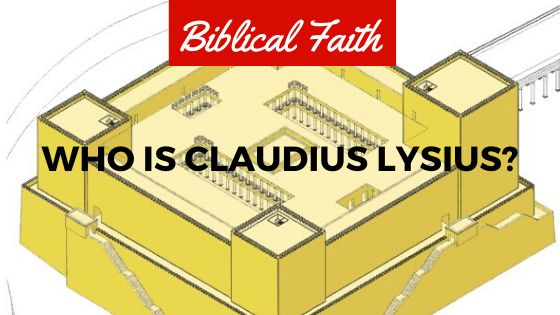
Who is Claudius Lysias?

Reconstruction of Fort Antonia by Ehud Netzer in Biblical Archaeology Review 35.1 (Jan.-Feb. 2009).

Claudius Lysias, the Tribune

Claudius Lysias is called “the tribune” (χιλίαρχος, chilíarchos) 16 times within Acts 21-24 (21:31-33, 37; 22:24, 26-29; 23:10, 15, 17, 19, 22; 24:22); 17 times if Claudius Lysias is also included in among the “military tribunes” in the “audience hall” when Herod Agrippa II and Bernice come to hear Paul (Acts 25:23). However, such speculation is uncertain, especially considering a minimum of two years from when Claudius Lysias sent Paul to the Procurator Marcus Antonius Felix in c. AD 57/58 Acts 23:26-35, to within the first few months of the new Procurator Porcius Festus who rules from AD 60-62 (Acts 24:27-25:1-22).

The Greek term chilíarchos is said to be used to translate the Roman tribunus militum (following Polybius), and also for the phrase tribuni militares consulari potestate (Plutarch). The responsibilities of a chilíarchos were as a “commander of a thousand men”.[1] Essentially, Claudius Lysias is “a high ranking military officer in charge” of anywhere from 600 to 1,000 men,[2] and this appears to be the case for it is said that his command was over a “cohort” (σπειρα, speira) in Jerusalem which is “the tenth part of a Roman legion having about 600 men” (Acts 21:31).[3]

Tribune of a Jerusalem Cohort

Claudius Lysias’s complete description as found in the New Testament book of the Acts of the Apostles is “the tribune of the cohort” in Jerusalem, which resided in nearby “barracks” (Acts 21:34, 37; 22:24, 23:10, 16, 32). It takes six cohorts to make up a legion, and each legion had six tribunes with a thousand men (“soldiers and centurions” Acts 21:32) under his command if the cohort was full; consequently, Claudius Lysias was a part of a larger military force.

The exact numbers in his cohort may never be known, however, he had sufficient men to spare two centurions, two hundred soldiers, seventy horsemen, and two hundred spearmen to accompany Paul to Caesarea Acts 23:23-24. Furthermore, when the security detail arrives before Antipatris (Acts 23:31), Claudius Lysias allows for the seventy horsemen to go on with him and Paul to Caesarea, the headquarters of the Procurator Felix (Acts 23:32-35).

The “barracks” referenced in the book of Acts (21:34, 37; 22:24; 23:10, 16, 32), in connection to Claudius Lysias and his cohort are references to the Tower of Antonia, which Herod the Great rebuilt from a previous structure and named it after Marc Antony.[4] The Antonia was added on to the northwest side of the Temple facilities, “from which stairs descend into the outer court of the temple” (Acts 21:32, 35, 22:30).[5] For this reason, the Roman Tribune could hear the commotion caused by the confusing riot over Paul’s presence in the Temple and respond with speed (Acts 21:27-32).

Claudius Lysias in the New Testament

The military tribune Claudius Lysias enters the New Testament narrative when he protects Paul of Tarsus from a hostile Jewish mob on the outside of the Temple grounds in Jerusalem (Acts 21:30-32). The Acts text does not explicitly state why the tribune arrests Paul aside from asking “who he was and what he had done” (Acts 21:33); consequently, it appears Paul is detained for investigation as reflected later in Paul’s interrogation in the Antonian barracks because he was a cause of instigation among the Jews (Acts 22:23-24).

Claudius Lysias is aware of Jewish anarchistic movements, for when Paul speaking in Greek asks permission to speak to the shouting Jewish mob, the tribune appears shocked that he speaks Greek (Acts 21:37). Paul, as a controversial Greek-speaking Hebrew, evidently met some of the criteria for Lysias to conclude he was a Jewish revolutionist. Consequently, it appears that Lysias suspects him of being “the Egyptian” who “stirred up a revolt and led the four thousand men of the Assassins [σικαρίων] out into the wilderness” (Acts 21:38).

This individual operated around A.D. 53, and this revolution amounted to amassing these four thousand men, positioning themselves upon the Mount of Olives outside Jerusalem, and anticipating the walls of Jerusalem to collapse at his command. The Romans attacked this band of men, and the Egyptian lost six hundred men, and fled into the wilderness where he disappears awaiting “further revelation.” Evidently, “the Egyptian” was still on the run, wanted by the Roman military and the tribune was going to see if Paul was this anarchist.[6]

Paul was able to persuade Lysias that he was not an agitator, and provides him with his provincial citizenship as being from Tarsus, in the province of Cilicia (Acts 21:39). This was not an “obscure city” and either this suggests his citizenship could be authenticated, or Paul distinguished himself from the obscure Egyptian. In either case, Paul’s point is clear, he is not the Egyptian; the tribune accepts Paul’s case, and grants Paul an opportunity to speak to the Jews on the steps of the Temple facilities adjoined to the Antonian fortress (Acts 22:39-40).

The Jews did not respond peaceably to Paul’s speech, and Claudius Lysias decides to take Paul into the “barracks” of Antonia and “examine” him through the process of binding him to flog him (Acts 22:22-24). On receiving a report that Paul was a Roman citizen and then making a personal inquiry, Claudius is afraid of having violated the rights of a Roman by having him bound (see “Roman Citizenship” below). Claudius desires to arrive at the truth concerning the Jewish case against Paul and commands the Sanhedrin to assemble. Dissension among the Sanhedrin towards Paul arises again and causes Claudius Lysias to order his men to take Paul to the safety of the Antonian barracks (Acts 22:30-23:10).

Upon learning of a plot to kill Paul, Claudius Lysias summoned a military convoy to leave for Caesarea Maritima. In compliance with Roman law, he also sent a statement of the case to the procurator Antonius Felix. The letter reads:

Claudius Lysias, to his Excellency the governor Felix, greetings.

This man was seized by the Jews and was about to be killed by them when I came upon them with the soldiers and rescued him, having learned that he was a Roman citizen. And desiring to know the charge for which they were accusing him, I brought him down to their council. I found that he was being accused about questions of their law, but charged with nothing deserving death or imprisonment. 

And when it was disclosed to me that there would be a plot against the man, I sent him to you at once, ordering his accusers also to state before you what they have against him. (Acts 23:26-30, English Standard Version)

The letter format is consistent with the general format in the Graeco-Roman world, of “author” to “recipient” with a “greeting” with the subsequent content of the reason for the letter.[7] This letter, however, was not altogether factual. It is an interesting “specimen” of Roman military correspondence (Acts 23:26-30).

Although acknowledging Paul’s innocence, Claudius Lysias gave the impression that he had rescued Paul because of having learned that the apostle was a Roman, whereas in reality, he had violated Paul’s citizenship rights by having him bound and even ordering that he be examined under scourgings. As to the disciple Luke’s knowledge of the letter’s contents, it may be that the letter itself was read at the time Paul’s case was heard.

Roman Citizenship

In Acts 22:23-29, a discussion between Paul and Claudius emerges on the topic of Roman citizenship. Part of Claudius’ investigation procedure to find out more information was to stretch out the detained for whips and flog them.

Before his flogging begins, Paul questions the centurion given this detail, “Is it lawful for you to flog a man who is a Roman citizen and uncondemned?” (Acts 22:25). Roman citizenship had a number of privileges, as John Polhill writes:

A Roman citizen was subject to Roman law and thus was protected from such things as being beaten without a trial, from cruel punishments like crucifixion, and from unlawful imprisonment, rights which did not belong to an ordinary provincial (peregrinus). Citizens had the right of appeal. Only a Roman citizen could legally marry another Roman citizen. Citizens were exempted from certain taxes. Beyond this, there was the considerable factor of honor and deference such a status afforded.[8]

It was such a valued honor, that some people risked the death penalty given for falsely claiming citizenship.[9] Interestingly, one could hold dual citizenship, as Paul was not only a citizen of the city of Rome but was also a citizen of the city of Tarsus from the province of Cilicia (Acts 21.39; 23.34).

Roman citizenship was conferred in a number of ways. The basic ones are as follows:

(1) The most common way was being born of two Roman citizens.

This is the claim Paul makes when asked how he obtained his citizenship (“I am a citizen by birth” Acts 22:28), which implies that both of Paul’s parents were Jewish Roman citizens (cf. #4).

(2) One could obtain citizenship as a reward for military service.

Regularly, military veterans were given citizenship upon discharge. This was the surest way to get it, taking 20 to 25 years depending on the level of ranking.

(3) Imperial conference, though heard of, was not entirely common.

Nevertheless, the emperor could confer citizenship, either on individuals or on whole communities, as in the establishment of a new colony. Often the result of doing some loyal service to Rome. Also, many times through these services, one gained an audience with the Emperor through expensive gifts to members of the inner Imperial court.

This may have been how the Tribune Claudius Lysias gained his citizenship (Acts 22:27-28). In fact, the tribune’s name provides evidence to assume the plausibility that Emperor Claudius (A.D. 41 – A.D. 54) conferred upon Lysias citizenship since those granted this honor would bear the name (the nomen) of the family or patron which conferred it; hence, Lysias gained the name of his patron Claudius. It has been noted that the emperor was quite “promiscuous” in his conference of citizenship.[10]

(4) Roman citizenship was also conferred through the emancipation of a slave from the house of a Roman citizen.

Some have suggested that Paul’s ancestors may have been freedmen from among the thousands of Jews whom Pompey took as slaves in 63 B.C.[11]

Endnotes

  1. H. G. Liddell, An Intermediate Greek-English Lexicon: Abridged from Liddel and Scott’s Greek-English Lexicon (1888; repr.; Oak Harbor, Wash.: Logos Research Systems, 1996), 888.
  2. Barclay Newman, Jr., A Concise Greek-English Dictionary of the New Testament, revised ed. (Stuttgart: Deutsche Bibelgesellschaft, 2010), 200.
  3. Newman, A Concise Greek-English Dictionary, 167.
  4. Josephus, Antiquities 15.293; 15.409.
  5. George A. Smith, et al., “Jerusalem,” Encyclopaedia Biblica, eds. T. K. Cheyne and J. Southerland Black (London: A & C Black, 1901), 1:2429.
  6. Robert M. Grant, The Sword and the Cross (New York, NY: Macmillan, 1955), 49.
  7. T. C. Mitchell, Biblical Archaeology: Documents from the British Museum (New York, NY: University of Cambridge, 1988), 89.
  8. John B. Polhill, “Political Background of the New Testament,” Foundations for Biblical Interpretation, eds. David S. Dockery, et al. (Nashville, TN: Broadman & Holman, 1994), 531-32.
  9. Abraham J. Malherbe, “Life in the Graeco-Roman World,” The World of the New Testament, ed. Abraham J. Malherbe (1967; repr., Abilene, Tex.: Abilene Christian University Press, 1984), 9.
  10. Polhill, “Political Background of the New Testament,” 532.
  11. John B. Polhill, “Political Background of the New Testament,” 532; Richard R. Losch, The Uttermost Part of the Earth: A Guide to Places in the Bible (Grand Rapids, MI: Eerdmans, 2005), 176-77.

This originally appeared as a fully edited submission to Wikipedia.org. I have posted this here in case it is revised or rewritten.


Church: A Preliminary Survey

With so many “churches” in the religious world, people interested in visiting one are often sidelined by the inevitable question, “which church should I go to?” After all, there are as many “churches” as there are potential opinions on what a church should be like. But where should a person begin as they search for a church, should they simply jump out on a whim? Hardly.

Searching for a church should be a reverent endeavor, especially since in the New Testament the “church” is said to have been “purchased” by the very blood of Jesus Christ (Acts 20.28). Consequently, if the church was that important to Jesus and the Father, those seeking to “go to church” should realize this spiritual venture should not be taken lightly.

Where then might a person find the necessary perspective from which to begin this search? The relevant information is found in the New Testament documents, the documents which record the formative forces which began the church in the first place; moreover, the New Testament provides ample information about how people became members of the blood-bought church of Jesus, along with important church organizational references.

This piece is a primer, in a sense, on the nature of the church. There are many ways that this topic can be addressed. But, nevertheless, below are some relevant points to glean from the New Testament on the topic of the church of Christ (Rom. 16.16).

The New Testament Documents

In the New Testament, from the beginning to end, the thought and actual fact that the saved existed as a collective known as the “church” or body of Christ is clearly self-evident (Matt 16:18 and Eph 1:22, 23, 4:4; Acts 2:47). Consider a sample of the New Testament documents.

There are four accounts of the ministry of Jesus, they are called Gospels. The term “church” is found only in the Gospel of Matthew, particularly in chapters 16 and 18. In chapter 16, Jesus speaks of building His church – “my church” (16:18). He explains that death (Grk. hades – not hell, contra KJV) will be incapable of deterring his plans to bring His church into reality.[1] In chapter 18, verses 15-17 describe the disciplinarian process regarding a Christian brother living in sin, and hence, needing private correction. The final stage is to bring the sin to the public forum by telling it to the church, with the intention that it can act as a loving measure of leverage to pressure the brother to quit the sinful practice. Thus, in Matthew Jesus speaks of his church in two ways: (1) that it will be built (Matt 16:18), and (2) as the ultimate forum for maintaining moral purity among God’s people (Matt 18:15-17).

The Acts of the Apostles is the inspired historical account of the church – albeit a history with a theological focus. It is most definitely a primary source for the church, and therefore a logical document to examine in order to find the biblical church. To save space, consider what we find in only the first half of Acts (Acts 1-12). We find it was “the church”[2] that had become fearful after the Divine retribution against Ananias and Sapphira was administered by the Lord (Acts 5:11); the object of Saul of Tarsus’ brutal obsession was “the church” anywhere it assembled (Acts 8:1, 3; cf. Gal 1:13); it was “the church” at large in Samaria and Judea that enjoyed peace when the persecuting Saul became the believing Paul (Acts 9.31).

We find Barnabas and Paul (Saul) laboring in “the church,” particularly in Antioch of Syria,[3] and labeling the disciples (i.e. the individual members of the church) Christians (Acts 11:22, 26); several members of “the church” suffered persecution under the hand of King Herod (Acts 12:1, 5); “the church” in Antioch of Pisidia had prophets and inspired teachers, and sent Paul and Barnabas out to accomplish their first missionary call (Acts 13:1ff.); Paul and Barnabas had appointed elders in every “church” they established on their missionary labors (Acts 14:23), and upon their return to Antioch they recounted they travel to “the church” (Acts 14:27).

The largest sub-category of the New Testament documents is The Letter (also commonly styled, “epistle”) – 21 letters to be exact.[4] They are further divided by the prophets which God employed to pen them: Paul (13 letters), John (3), Peter (2), James (1), Jude (1), and the unknown author of the Letter to the Hebrews. This is a vast amount of literature to scan, but we can reflect on the following citations of “the church” among the letters and observe that “the church” is the redeemed body of Jesus believers. It goes without saying – at least it should be by students – that the New Testament Letters assume their audience is the redeemed body of Jesus disciples.

Ancient letter writing etiquette had the author’s name first and then the recipient’s name; thus, we read, “from me… to you.” When Paul wrote his letters, he often addressed the recipients with the nomenclature “saints” (cf. Rom 1:7; 1 Cor 1:2; 2 Cor 1:1; Eph 1:1; Phil 1:1; Col 1:2). The term “saint” is the general description of all members of “the church” in the respect that they have been sanctified in baptism, and this sanctification continues in obedience shown by a holy life (Matt 26:28; Acts 2:38; 1 Cor 6:11-13; 1 John 1:6-7). The “saints” are members of the church viewed from the perspective of consecration. In fact, many times the letters begin like this: to the church with the saints.

Some appear to use Jewish terminology, like James and Peter, to describe the people of God. The letter of James is written to “the twelve tribes in the Dispersion” (1:1); meanwhile, the audience for the Letters of Peter (if to the same audience) is depicted in the following way: “To those who are elect exiles of the dispersion” (1 Pet 1:1). However, in Peter’s second letter, he speaks of his audience as “those who have obtained a faith of equal standing with ours by the righteousness of our God and Savior Jesus Christ” (2 Pet 1:1). It seems like the language applies the covenant aspect that biblical Israel had with God, and here it is applied in a new way to demonstrate that Peter’s audience is the new covenant people of God (Jer 31:31; Heb 8:13). These are members of the biblical church.

The Letter of Jude addresses his recipients with the nomenclature “called” and “beloved” (vs. 1). Their calling seems from the simple fact that they received their invitation (a clearer meaning of the term, kleitos translated “called”) to share the “common salvation”. Moreover, they received access to the love of God actuated in the redemption of their soul accomplished through Jesus Christ, thus, they are the beloved of God. What Jude emphasized that their identity was related to their Divine relationship through obedience to the Gospel. For our purposes, we are to understand that these “saints” and “beloved” ones are members of the New Testament church.

The First Letter of John, much like Hebrews, does not begin in the traditional letter format. Some describe them as tractates or some larger form of literary work sent as a letter. Nevertheless, John assumes a relationship – a fellowship between the apostolic circle, God, and themselves – that is based on obedient living and faithful confession of sin as they strive to live a disciplined life (1 John 1:1-10). They already are in this relationship, they are saved. Again, in Hebrews 2:1-4, the evidence is provided regarding the recipients. They are encouraged to remain vigilant, not neglecting their salvation which was shown to have a supernatural origin. Likewise, these recipients are members of the biblical church.

The last document in the New Testament is the Apocalypse, the Book of Revelation. The document opens up with these words: “John to the seven churches that are in Asia” (Rev 1:4). In the doxology, it is Jesus “who loves us and has freed us from our sins by his blood, and made us a kingdom, priests to his God and Father” (Rev 1:5-6). The audience, the churches, share salvation and the love of God, are part of a kingdom, and share involvement in the priesthood of God. The message of Revelation is the victory over the enemies of God as it is revealed in the inability of these satanic forces to prevent the faithful saints from entering the New Jerusalem, wherein lies the tree of life (Rev. 22.14). The brief but spiritually dense letters sent to the churches of Asia in Revelation 2 and 3 show among other things, the audience intended for the prophecies embedded into the fabric of this symbolic book. They assume that the recipients are already Christians, members of the church.

The picture should be clear that the New Testament is a collection of 27 books which speak to or about the church of Jesus Christ. Consequently, anyone looking for a church should reverently approach the prospect with the New Testament as the guiding source for determining what the church that God established should look like and be like.

The Church: A Brief Word Analysis

We may survey some of the information from the New Testament regarding the “church” and the redeemed which make up the “church”, but what does “church” mean? The term “church” is the most common, though unclear, translation for the New Testament Greek term ekklesia. Often times, “church” is thought of as solely “the building” in which a person congregates with others to worship God; however, ekklesia does not refer to a building – hence, “church” is an unclear translation if not misleading altogether. But the term is so commonplace that it need not be shelved; after all, even modern dictionaries have various nuances for the word “church.”

The English word “church” has a peculiar history that demands some attention. Hugo McCord (1911-2004) – professor, translator, and preacher – briefly summarizes the history of the word:

Historically, the English word “church” comes from the Middle English “cherche” or “chirche,” which is from the Anglo-Saxon “circe” or “cyrce,” which is from the German “Kirche,” which is from the Greek kuriakos, meaning “belonging to the Lord.” Webster says that the Greek word doma, “house,” has to be added to kuriakos to make the word “church,” that is, a “church” is “the Lord’s house.”[5]

McCord further observes that only twice does kuriakos – “the Lord’s” – appear in the New Testament (“the Lord’s supper” 1 Cor. 11.20; “the Lord’s day” Rev. 1.10), but in neither case is the phrase “the Lord’s house” ever employed.[6]

Basically, the etymology of the word translated “church” (ekklesia) derives itself from the adjoining of two words, ek and kaleo (ek-kaleo “call out”), into one verb originally “used for the summons to an army to assemble.” As a noun, ekklesia, denoted “the popular assembly of the full citizens of the polis, or Greek city state” (cf. Acts 19:32, 41).[7] This is, in a nutshell, the Greek background of the word beneath our religious word “church.”

Its existence in the Old Testament is due to the Greek translation of the Hebrew Scriptures. In the Septuagint (abbreviated LXX), ekklesia appears about one hundred times and is frequently employed to translate the Hebrew term qahal.[8] It is not so much the frequency to translate qahal which is intriguing; instead, it is the regularity of the context when ekklesia is employed which should attract contemplation. O’Brien writes:

Of particular significance are those instances of ekklesia (rendering qahal) which denote the congregation of Israel when it assembled to hear the Word of God on Mt. Sinai, or later on Mt. Zion where all Israel was required to assemble three times a year.[9]

Interestingly, the Hebrew writer similarly speaks of the redeemed in Hebrews 12:22-24. Thus, a raw translation of ekklesia may suggest the meaning to be, “the called out ones.”[10] In the biblical tradition, however, it seems better to emphasize that it carries the spiritual depiction of an assembly of God’s people prepared to hear and be led by His word in the covenantal sense.

Stephen, the first Christian martyr, recounts how Israel was an ekklesia during the forty years of wandering in the wilderness due to their rebellion and lack of faith (Acts 7:38). And it was during this time that they were taught how to depend upon the Lord. The beautiful and yet tragic relationship between the faithful God and his unbelieving nation is set forth clearly in Psalm 78 (cf. Hos 11:1-9). The Lord’s goal was to “shepherd” and “guide” them with his powerful word and through the demonstration of his presence.

With regards to the Lord’s church which Jesus promised to “build,” it is important that we consider these thoughts in our understanding of the kind of church Jesus was thinking of; as a consequence, it should guide our assessment of how “church” should behave. Individuals gathered together to hear and abide in his teaching, so that in it, they may be shepherded and guided (1 Tim 4:13). Meanwhile, leadership in the church (i.e. elders/shepherds) is to be “able to teach” and “manage” his household, and use these skills as he executes his God’s appointed office (Acts 20:28, 1 Tim 3:1-5). When the church considers this relationship and responsibility and embraces its challenge, we will be taking strong steps to finding a congregation of the Lord – a church of Christ.

Conclusion

We find in the New Testament a consciousness the early Christians held regarding the church. Jesus was to build his church, and after his death, the church began in Jerusalem and spread throughout the Roman world through Judea, Samaria, and to the furthermost extents of known Roman world (Acts 1.8ff). As the church expanded, the apostles and other inspired authors wrote to Christians regarding the ministry of Jesus and concerning Christian living.

Through these documents, important information is related to the nature of the church. Anyone searching for a “church” to attend should not settle for any church but should study the New Testament reverently identifying the nature of the church revealed in its pages.

When examining the English word “church” we find that we are not talking about a building, but instead, the emphasis should be placed upon an assembly of people. These individuals are assembled to hear the word of God, and make those Divine words translate into everyday action – everyday living. Only until we hear and practice the Word will we become the church (ekklesia) of Christ.

Endnotes

  1. The King James Version (a.k.a. the A.V.) is quite misleading here, for the Greek text reads pulai hadou – literally, “the gates of hades.” The Analytical-Literal Translation of the New Testament (ALT) has the following descriptive rendering of the passage,”[the] gates of the realm of the dead [Gr., hades] will not prevail against it” (ATL Matt. 16.18).
  2. Again we disagree with the A.V./KJV-Byzantine tradition in Acts 2.47, where the word “church” (ekklesia) is part of a variant reading of the text. Instead, we agree with others who find that the ending better reads epi to auto, a phrase often used to refer to the “Christian body” in a collective sense (Acts 1.15; 2.1, 47; 1 Cor 11.20; 14.23; Bruce Metzger, A Textual Commentary on the Greek New Testament, 2d ed. [Germany: Deutsche Bibelgesellschaft, 2001], 264-65).
  3. Antioch of Syria is not to be confused with the Antioch of Pisidia in Asia Minor. BiblePlaces.com has good images of both Antioch of Syria (link) and of Pisidia (Link).
  4. Technically, there are a few more letters in the New Testament record, but each is embedded in other books. For example, the book of Acts has two letters (a) 15.22-29, and (b) 23.23-30; and, the book of Revelation has seven letters to the church of Asia (Rev. 1-3).
  5. Hugo McCord, The Everlasting Gospel: Plus Genesis, Psalms, and Proverbs, 4th ed. (Henderson, TN: Freed-Hardeman University, 2000), 696. This edition is known also as FHV4.
  6. McCord, The Everlasting Gospel, 696.
  7. Peter T. O’Brien, “Church,” DPHL, 123.
  8. O’Brien, “Church,” 124; TDNT 3:527; BDAG, 303.
  9. O’Brien, “Church,” 124.
  10. Etymologically, ekklesia does suggest that individuals were “called out” from their lifestyles by the Gospel (2 Thess 2:14). There is obviously a separation that occurs (2 Cor 6:17, 1 John 2:15-17). These etymological considerations corroborate with New Testament teaching on the church. However, the word has a richer heritage as is seen in its Old Testament use of the Greek language. These aspects must be appreciated in balance with each other.

Suggested Reading

  1. Wayne Jackson, “The Origin of Christianity,” ChristianCourier.com.
  2. Wayne Jackson, “The Restoration of First-Century Christianity,” ChristianCourier.com.