Book Review: Textual Criticism of the Bible, Revised Edition

Amy Anderson and Wendy Widder, Textual Criticism of the Bible, revised ed., Lexham Methods Series, edited by Douglas Mangum (Bellingham, WA: Lexham Press, 2018), Paperback, 236 pages.

The authors of the present volume are professional scholars in Old Testament (Wendy Widder) and New Testament (Amy Anderson) respectively.[1] Widder, a contributing editor for Logos Mobile Education, holds a Ph.D. in Near Eastern Studies from the University of the Free State (South Africa), an M.A. in Hebrew and Semitic Studies (University of Wisconsin-Madison) and the M.Div. from Grand Rapids Theological Seminary. Her published works include a technical linguistic work for the BZAW series (De Gruyter), commentaries on Daniel (ZECOT, SGBC), and was the original author of the first edition of the present work (2014).[2]

Amy Anderson joins the revision of this project as co-author. She is Professor of New Testament and Ancient Greek at North Central University (Minneapolis, MN), and holds a Ph.D. in New Testament Textual Criticism (University of Birmingham) and an M.A. in New Testament from Fuller Theological Seminary (Pasadena, CA). Additionally, Anderson has published technical works on New Testament textual criticism for Brill (Texts and Studies) and serves on the steering committee of the Editio Critica Maior for the SBL steering unit of the International Greek New Testament project (IGNT).[3]

Thesis of the Book

In keeping with the stated goal of the Lexham Methods Series to provide an overview of the “broad movements” within the fields of biblical criticism, Anderson and Widder introduce textual criticism of the Bible for the emerging scholar and biblical interpreter in order to better equip them to understand the basic question for many English readers of the Bible is translation: why are there differences in among the English versions?[4] Anderson and Widder offer an updated guided tour of textual criticism to equip the emerging scholar to “take on” the text critical issues that are behind some of the more technical reasons which account for these differences among Bible translations of the ancient original language manuscript copies.[5]

Summary of the Book

In the “Introduction” the authors isolate the practical importance of how understanding the field of textual criticism contributes to providing sensible answers for certain variations among contemporary Bible translations.[6] As a “ground clearing” chapter, it distinguishes changes brought about by the theories and practice of translation from the task of resolving “variations in the readings of [the] ancient manuscripts” of the Bible in pursuit of the ancient form of the text, i.e., the Ausgangstext.

In chapter two Anderson and Widder provide a general introduction to the field of textual criticism of the Bible. Despite different textual evidence for each Testament, the general principles of the discipline apply overall and the authors illustrate what is common to both fields.[7] As no two ancient hand-copied manuscripts of the Bible agree in every detail, the authors demonstrate the various types of scribal errors detected when comparing the extant copies of the manuscripts (accidental omissions, additions, misspellings, and intentional changes).[8] These examples illustrate the goal of textual criticism is to “establish the original reading of the biblical text” of the autographs, which for the transmission history of the Old Testament it is “more complicated” due various unknowns of scribal and editorial activity over a vastly longer period of time than the New.[9] The authors explain the importance in knowing the difference between external evidence and internal evidence, and how the former focuses on “what kinds of manuscripts is a given variant found” and the latter considers what is probable habits of the transcriber(s) of the manuscript and the author of the book (intrinsic).[10]

Chapter three offers a short history of the unique difficulties found in the transmission of the Old Testament. With no manuscripts available predating the canonical copies of the Dead Sea Scrolls (250 BC–AD 135), the authors begin their history with awareness of variants in the Hebrew text by early Christians. Representative of this early period are Origen’s textual notes in the fifth column of his Hexapla.[11] The textual history of the Old Testament is largely interwoven with Christian history (Greek and Latin translations, and other ancient polyglot texts) and the medieval scribal tradents of the Masoretic manuscript tradition. The Hebrew text in the modern period is represented in the two types of critical editions, diplomatic (e.g., BHK, BHS, HUB) and eclectic editions (e.g., HBCE). The textual resources available today (Masoretic Text, LXX, Dead Sea Scrolls, and translations) demonstrate the importance of carefully assessing each variants in light of the probabilities of the scribal habits of each tradition and the which reflects an older state of the Hebrew text.[12]

Chapter four introduces the history of the Greek New Testament text.[13] This history reveals not only a proliferation of the early translation, citation, and copying of these texts, but also that a number of copying communities can be detected in the “patterns of variation” found in groups or family of manuscripts (Alexandrian, Western, Caesarean).[14] With the rise of Christianity, Byzantium (Constantinople) became a center for transmission, giving rise to the period of standardization culminating in the advent of the printing press in which a Greek New Testament would be printed (700s–1600s). This gave rise to what is called the Byzantine text-type. Today, scholarship has largely moved away from the Textus Receptus (or, Majority Text) in favor of eclectic critical approach to establish the Greek New Testament text, which weighs the strength and weakness of variants and manuscripts (seen in UBS, NA). Today, there are over fifty-five hundred manuscripts (papyri, majuscules, and minuscules) from which textual critics must work with in establishing the original wording of the text (the Ausgangstext), as they seek “to identify the reading that best explains how the other readings arose.”[15]

In chapter five, the authors bring their discussion to a close as they comment on the connection between textual criticism and English translations, and how many of the variations between them rely on the text the translation committee agrees to work from.[16] The scholarship of textual criticism directly impacts the practical life of church life, especially one’s doctrine of Scripture, inerrancy and infallibility, and its authority. While debated extremes exist, the inspiration of the text can be maintained as it relates to the original manuscripts. The transmission of the text of Scripture is a history of God’s providential use of imperfect human scribes to reliably preserve the text of the Bible for all generations.

Strengths and Weaknesses

Anderson and Widder have produced a very effective pedagogical-centered volume introducing the field of textual criticism to the emerging scholar of the Bible. The authors were neither overly academic nor did their discussions lack the specialty knowledge essential to this field of methodology. The strongest contribution is the practical hands-on approach illustrating how to evaluate textual variants, how to use the critical apparatus and critical sigla, and how to interact with the different resources (manuscripts, translations, lexicography, etc.) available to the emerging textual critic.[17] These helpful text-critical walkthroughs will guide the students well moving from theory to practice.

Overall, it is very difficult to find weaknesses in the current volume, but when they observed that biblical scholarship seeks to establish the “final form” of the authoritative text instead of the “original wording” of the autographs, little space is provided to address this important text-critical topic.[18] Outside the mention of the philosophical debate over the Urtext, the matter is only briefly commented on.[19] With the lack of older witnesses, important questions are sidelined, such as, “is seeking the original wording of the autograph no longer feasible in Old Testament studies? What are the implications of this issue?” I humbly suggest that Anderson and Widder would have served their readers better by exploring this question.


Endnotes

[1] Amy Anderson and Wendy Widder, Textual Criticism of the Bible, rev. ed., Lexham Methods Series, ed.  Douglas Mangum (Bellingham, WA: Lexham Press, 2018).

[2] For more information regarding Dr. Widder see her blog: https://wendywidder.com.

[3] For more information regarding Dr. Anderson see her teacher’s page at North Central University: https://www.northcentral.edu/academics/amy-anderson-2.

[4] Anderson and Widder, Textual Criticism, ix–x, 2–3.

[5] Anderson and Widder, Textual Criticism, 7–8.

[6] Anderson and Widder, Textual Criticism, 1–9.

[8] Anderson and Widder, Textual Criticism, 16–40.

[7] Anderson and Widder, Textual Criticism, 11–48.

[9] Anderson and Widder, Textual Criticism, 40–41. For this reason, Anderson and Widder note that the Old Testament critic “has to decide exactly which state of the OT composition or transmission is the goal” (41).

[10] Anderson and Widder, Textual Criticism, 42–46.

[11] Anderson and Widder, Textual Criticism, 49–114.

[12] For example, the hands-on section of the text critical process illustrates that sometimes translations are preferred over original language manuscripts as they reflect “what Hebrew the translators had in front of them” (Anderson and Widder, Textual Criticism, 95).

[13] Anderson and Widder, Textual Criticism, 115–77.

[14] Anderson and Widder, Textual Criticism, 116.

[15] Anderson and Widder, Textual Criticism, 158.

[16] Anderson and Widder, Textual Criticism, 179–87.

[17] Anderson and Widder, Textual Criticism, 90–109, 149–74.

[18] Anderson and Widder, Textual Criticism, 41–42. This concern may be theological motivated but more clarity would have appreciated (cf. Ferguson, “Textual Criticism of the Bible,” Presbyterion 46 [2020]: 158–59).

[19] Anderson and Widder, Textual Criticism, 93. If this was intended to supplement the “final authoritative form” discussion raised earlier, it seems completely disconnected (54–57).


Bibliography

Anderson, Amy, and Wendy Widder. Textual Criticism of the Bible. Revised ed. Lexham Methods Series 1. Edited by Douglas Mangum, et al. Bellingham, WA: Lexham Press, 2018.

Ferguson, Anthony. “Textual Criticism of the Bible, by Amy Anderson and Wendy Widder. Revised edition. Bellingham, WA: Lexham Press, 2018. Pp. xv + 236. ISBN 978-1-57799-663-7.” Presbyterion 46.1 (2020): 157–59.
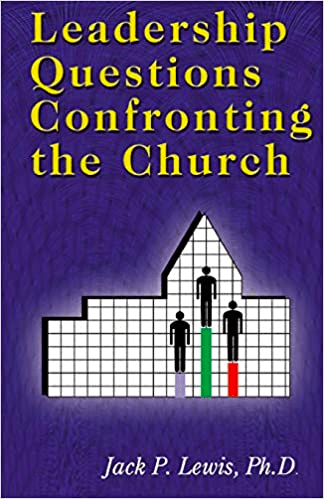
Book Review: Leadership Questions Confronting the Church

Jack P. Lewis, Leadership Questions Confronting the Church (Nashville, TN: Gospel Advocate, 1985), paperback, 111 pages.

Dr. Jack Pearl Lewis (1919–2018) was educated at Abilene Christian University and Sam Houston State Teacher’s College, receiving a PhD. from both Harvard University and Hebrew Union College. Lewis was associated with the Harding Graduate School of Religion (now Harding School of Theology) since it opened in 1958.[1] Lewis’s biblical scholarship, his influence as a teacher, his involvement as a translator of the NIV, his estimation in the academic community, and his love for the Lord’s church earned him a great deal of respect. He has laid much ground for those seeking an understanding of the biblical text and its historical context.

When I was a residential student attending Freed-Hardeman University (Henderson, TN), Lewis’s lectures were always a “must attend” session during the Annual Bible Lectureships. Thanks to my Greek professor, I had a chance to talk with him. When I asked him what an undergraduate Bible major should focus on when preaching and teaching Dr. Lewis said in his understated voice: “be prepared.” Clearly, it was advice he lived by as Dr. Lewis “prepared” himself for the task of providing guidance in the study of God’s word. As a result, he became a scholar’s scholar.

In 1985, Lewis released an anthology of articles from a variety of Christian periodicals and lectureships on critical leadership topics. These articles were collected into a single volume of fifteen chapters, Leadership Questions Confronting the Church.[2] Chapters 4 and 7 are the exceptions, having been serialized word studies now combined here. Each chapter can stand alone as a profitable study on leadership questions, but as a collection, it provides a helpful series of studies.

In the “Foreword,” Dr. Lewis states the reason for the collection: “The reception they received, both from those who criticized and those who applauded, suggested that they would be of use to a wider audience.”[3] The goal of this collection rests in his prayer, “May the Lord help us to find out and to practice his will in matters of leadership as well as in all other matters.”[4]

Well-Researched

The best feature of this compact volume is the wealth of research, analytical thinking, and practical wisdom crystallized on every page. In 111 pages, Dr. Lewis tackles a variety of thorny issues regarding the eldership, the eldership authority-influence debate, leadership without elders, preachers, and their function and authority, and responds to misunderstandings regarding authority (who has it, what kind is it, etc) in a style that is often described as an “economy of words.”

Dr. Lewis places the biblical evidence on display, summarizes the evidence in a few words, and calls attention to complications that often fall upon the church in applying the thrust of a word or passage. There are many instances where Dr. Lewis reveals his heart for the Lord’s church as a church “statesman” (Dr. Lewis would probably prefer Bible student). All these observations seem to be best demonstrated with the following quotation:

Words create the patterns in which men think. Before we divide the church over the implications of a word that does not occur in the Bible in the context with which we are differing from each other, would it not be rational to give thought to the possibility of the need for a more Biblical pattern in which to express ourselves? If we use Biblical terms we might not find ourselves so far apart after all.[5]

Jack P. Lewis, Leadership Questions Confronting the Church (1985)

Dr. Lewis is sensitive to pointing out a perceived or traditional view of leadership that is influenced by denominational tendencies, early Restoration Movement misconceptions, or a lack of preparation to study the Scriptures. He calls on the teaching leaders in the Lord’s church to adequately prepared themselves to understand their function and purpose by properly studying and applying Scripture. Only then will they have a foundation for their ministry.

Valuable Word Studies

A second aspect that makes the volume very useful is the word studies on the elders (ch. 4) and on the preacher (ch. 7).[6] The majority of the chapters are brief; however, the section on word studies stand as the bulk of the book. It demonstrates Lewis’s painstaking scholarship and his confidence in the Bible as the source for Biblical research.

While these approaches have their place and invite a wide appeal, Dr. Lewis approaches such topics by delving into the language of the Scriptures reflecting the very principles he calls others to apply:

“You must apply the seat of your pants to a chair for long periods of time.”[7]

In the course of these word studies, Dr. Lewis explores the various terms in all of their cognate and morphological considerations in order to explore their contextual use.

Where some may spurn such a study, Dr. Lewis explores the stewardship necessary to understand what God has said regarding leadership roles in the church. For this very reason, Dr. Lewis encourages his readers,

“As a preacher you need time in your schedule, not directly related to sermon preparation, when you are not available for the telephone […] a time in which you will sharpen up your Greek and Hebrew.”[8]

Why? Lewis explains the responsibility,

“Have you ever thought of the presumption there is in passing yourself off as an interpreter of a book you cannot read?”[9]

His words are a wake-up call to every leader who desires to understand God’s Word and to lead God’s people in the follow-through of obedience.

Slight Limitations and Suggestions

In general, it may be said that Leadership Questions Confronting the Church is quite valuable and provides guidance in particular areas; however, Dr. Lewis only indirectly addresses questions confronting the church with regard to the role of women and the topic of deacons. Dr. Lewis touches on certain elements of the role of women in chapters 1 and 2 but does not address the broader issues. It should be said that Dr. Lewis addresses the positive case of Scripture — what does the Scripture say? — and then proceeds to call upon church leaders to uphold what the Scripture teaches.[10] In both cases, Dr. Lewis concedes his focus is not to exhaustively treat the question of women’s roles in the church.[11]

Regarding the leadership question of deacons, Dr. Lewis pays little direct attention aside from allusions to certain similarities of qualifications with elders or in those distinctive qualifications that separate the two ministries.[12]

In the second place, there are a few modest suggestions that would improve the usefulness of Dr. Lewis’s anthology as a leadership resource. Should a revised or updated edition be considered, an index of Scriptural, Rabbinic, and Ancient Literature references, an original language word listing index, and a topical index would be a welcomed feature of the book. The content is very rich and quickly invites many personal notations and highlights, these suggested indexes would be very welcomed to make this book more useable.

Another suggestion that would require an updated edition is to re-release in two formats, in print and electronically (Mobi, Kindle, Logos, Adobe, etc). This suggestion would bring a very helpful book into the hands of the “e-reader” generation, and such an update would allow perhaps an appendix to include other available material such as his “A Challenge to New Elders.”[13]

Recommendation: High

For its size and for the fact that Leadership Questions Confronting the Church is nearing its 40th anniversary, Dr. Lewis has produced a primer of enduring value for those searching for answers to broad and thorny issues regarding the ministry of elders and preachers. Few books can boast that kind of longevity. The scholarship, the wisdom, the clear thinking, and the leadership to call out observed inconsistencies in brotherhood applications make this small volume a must-read for preachers in training and the veteran, for newly called elders, and elders who have been in the work for some time.

Christian leaders need to sharpen their deliberative skill set, as Dr. Lewis writes, “The most valuable thing about a man is his power of judgment.” The work is well written and there is much to chew on, and aside from the larger specialized word study chapters (4 and 7), this series of articles would benefit every concerned leader and Christian looking for guidance on these leadership topics. Leadership Questions Confronting the Church is more than a mere series of articles, it is a reminder of the importance that church leadership must constantly be undergirded by biblical authority and proper study of the Scriptures.

Endnotes

  1. Jack P. Lewis, Basic Beliefs (Nashville, TN: 21st Century Christian, 2013), 7.
  2. Jack P. Lewis, Leadership Questions Confronting the Church (Nashville, TN: Gospel Advocate, 1985).
  3. Lewis, Leadership Questions, “Foreword.”
  4. Ibid.
  5. Lewis, Leadership Questions, 11–12.
  6. Lewis, Leadership Questions, 13–35, 49–70.
  7. Lewis, Leadership Questions, 104.
  8. Lewis, Leadership Questions, 106.
  9. Ibid.
  10. In one instance he writes, “It is not the purpose of this paper to discuss the minutia of what women can and cannot scripturally do. It is to call attention to specious reasoning that is being engaged in on a concept that is not in the Greek text at all” (Lewis, Leadership Questions, 8)
  11. Lewis, Leadership Question, 6, 8. Elsewhere Lewis addresses the matter of Phoebe in “Servants or Deaconesses? Romans 16:1” in Exegesis of Difficult Biblical Passages (1988; repr., Henderson, TN: Hester Publications, no date), 105–09.
  12. At the time of publication, Dr. Lewis had not addressed New Testament materials regarding deacons of the church. See Annie May Lewis, “Bibliography of the Scholarly Writings of Jack P. Lewis, ” Biblical Interpretation: Principles and Practice – Studies in Honor of Jack Pearl Lewis (ed. F. Furman Kearley et al.; Grand Rapids, Mich.: Baker, 1986), 329-36. An online search on the Restoration Serial Index results in no articles by Lewis on deacons.
  13. Jack P. Lewis, “A Challenge to New Elders,” Gospel Advocate 143.5 (May 2001): 34-35. Another suggestion would be to include, “Elders’ Wives,” Gospel Advocate 136.12 (Dec 1994): 35.
  14. Lewis, Leadership Questions, 37

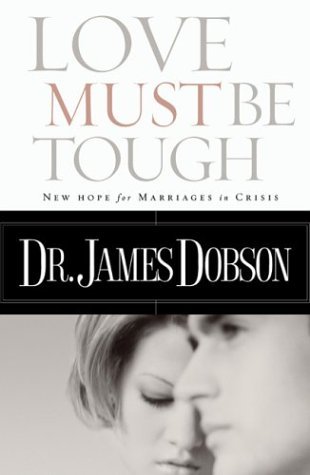
Book Review: Love Must Be Tough

Love must be tough

James C. Dobson, Love Must Be Tough: New Hope for Families in Crisis (1983; repr., Tyndale Momentum, 2007), hardback, 238 pages.

Dr. James Dobson (1936-) is a well known and established licensed psychologist (Ph.D., University of Southern California), who has addressed social and family issues from an evangelical perspective for about 40 years. He held a teaching post at USC’s School of Medicine as Associate Clinical Professor of Pediatrics and was on staff at the Children’s Hospital in Los Angeles for many years. And he served on a number government advisory panels and testified at several government hearings.[1]

Dr. Dobson is perhaps known more for the ministry network Focus on the Family he founded in 1977 through which he has provided a steady evangelical voice with regards to social issues on radio, television, print, and online. Since 2010, however, Dr. Dobson formally transitioned away from Focus on the Family and established another multi-media ministry venture, Dr. James Dobson’s Family Talk.

Love Must Be Tough to Save Families

The book under review, Love Must be Tough, is not a new contribution. Dr. Dobson wrote it in 1983 and because of its popularity, it is often reprinted. I read this book as part of a family ministry class. I found it to be an insightful and highly useful volume designed to provide a strategic proposal to help restore marriages struggling under the burden and crisis of marital infidelity. Dr. Dobson argues that his strategy strikes at the heart of the recovery from marital infidelity better than those provided by the then-current advice by counselors and literature.

What appears to be at the heart of the problem lies at a spouse’s passivity and allowance for the other spouse to have all the control in the relationship. This imbalance is subversive to the marriage. Dr. Nancy M. Rockstroh, M.D., who often recommends Love Must be Tough agrees:

when the balance of power switches so that one person has undue control, the potential for abuse of that power becomes imminent. Once individuals have the opportunity to do anything with the tacit acceptance of their partner, they have carte blanche to engage in destructive patterns of behavior without fear of losing the benefits of the relationship.[2]

Nancy Moultrie Rockstroh, “Love Must Be Tough: Proven Hope for Families in Crisis,” Primary Care Companion to the Journal of Clinical Psychiatry (2000)

It is not just theories or bad counseling which Dobson believes to be destructive and subversive to marital restoration. Marriage culture also is to blame, in particular, those which are so co-dependent that there is a loss of self-respect and the mutual respect which should exist within a marriage. Or, as Dobson argues, what marriages in crisis really need is the application of a simple principle: love must be tough.

Book Overview

Dr. Dobson develops his thesis by first showcasing the destructive nature of common approaches advised for reclaiming an unfaithful spouse. But, perhaps most instructive is the fact that he shares real experiences of infidelity and how the wounded spouse attempts to restore the marriage. According to Dobson, counselors tend to advise self-loathing, fault assuming, affair indulgent, and spiritually careless strategies. But even still further, wounded spouses often attempt to regain their unfaithful spouse through strategies (planned or not) that can be summed in the phrase: a complete lack of self-respect and identity (Panic, appeasement, etc).

This behavior must be stopped. Dobson argues strongly that this lack of self-respect and identity is a leading contributor for both the circumstances for a spouse to become unfaithful and for the pushing away of a cheating spouse. Dobson explains this character “defect” can be permissive as it “allows” flirtation with a potential lover, or it passively “allows” the spouse to continue dangerous relationships with a would-be lover. And once suspicion (or infidelity) occurs, the concerned spouse begins to tighten their grasp upon their beloved in order to keep them, but this often times pushes them farther away. The distrusted spouse feels caged and develops a need to escape. The spouse needs freedom. To further aggravate the situation, the worried partner who cannot feel complete without their spouse loses their individual identity and panics only to try to appease their unfaithful spouse. This behavior feels more like constrictions around the unfaithful spouse’s neck, and continue to fuel the desire for freedom (extramarital freedom).

Case upon actual case is rehearsed as testimonial evidence to support Dobson’s thesis that love must be tough. Consequently, if Dobson is right that popular counseling has it wrong in its strategic opinions, and that a consistent lack of self-respect and identity provide the stimulus for infidelity, then a new approach must be considered. Dobson argues therefore that the marriage relationship must include a number of applied principles. Despite the concept of “union” in marriage, each partner must exist with their sense of individuality intact, and each partner must be able to respect themselves. This sets forth the building blocks for a healthy sense of mutual accountability needed in a marriage that will allow it to thrive.

Thus, should signs of a potential extramarital affair begin to loom in the distance, a perceptive spouse can be grounded in their self-respect and identity, provide strong warnings set forth in love, self-respect, freedom, and independence (example: “I love you, but if you continue this course, then I will leave”). Spouses must be able to hold their ground, despite loving their spouse and not wishing them to depart. This “willingness to end a relationship,” says Dr. Rockstroh, “is the very essence of freedom and independence.”[3] Yet, this principle must be, according to Dobson, practiced with caution (see below).

Chapter 12 provides a timeline of eleven benchmarks showing how good marriages end in abandonment, adultery, divorce, and guilt. Side-by-side, the storyline of a husband and wife is unfolded. It shows how emotional starvation experienced by a loving spouse can lead to frustration and depression, only to work the heart into fertile soil for an extramarital affair. Preoccupations, such as work, only blind them of their beloved’s pain and that they too have contributed to this isolation. Eventually, an affair does ensue and is discovered. At this point, Dobson argues, the marriage can still be saved if both partners want to use “tough love” to regain themselves and restore their marriage. In this scenario that Dobson narrates, the cheating spouse leaves and a divorce is finalized. As in many cases which Dobson is aware of, at the end, the love affair turns mundane, the enabling but wounded spouse lives in ignorance of their contribution and the guilt for the children’s situation overshadows their heart.

Here Dobson makes one more appeal to confront misunderstandings that affect marital happiness. He appeals to the fact that culture essentially lies to our young ladies and young men in the aspect of who provides the happiness in the home. For the women, the lie is simple but devastating: “that marriage is a lifelong romantic experience.”[4] Moreover, the husband is entirely responsible for making this a reality; hence, women enter marriage with unrealistic expectations. And when these expectations are not met, it is her husband’s fault. For the men, the lie is relatively clear: “his only responsibility is to provide materially for his family.”[5] The love must be tough principle affirms individual responsibility for one’s happiness, and each spouse must play a role in creating marital happiness.

Of many of the valuable aspects of the book, is Dobson’s honesty that as much as the love must be tough principle is valuable and helpful, it can also be dangerously misapplied. The development of self-respect, individual identity, of creating a culture of freedom, of forgiveness, and many other traits can be so developed to the point where the wounded spouse uses them to destroy the marriage. For example, a person may become so independent that they want nothing to do with their spouse. Another spouse might defend their self-respect to the point where they become so outspoken that there is no mutual accountability. Dobson, therefore, warns against running wild with this strategy.

A Critique on Dobson’s Divorce and Remarriage View

There is no debate that Dr. Dobson’s book is valuable; however, his discussion on divorce and remarriage is perhaps the most egregious section in an otherwise well-developed book.[6] To Dobson’s credit, he inserts a disclaimer that he knows some Bible students will disagree with him. I register here as one who finds Dobson’s discussion of what constitutes a scriptural divorce and remarriage completely lacking biblical support.

Dobson affirms three matters to keep in mind in the discussion of divorce and remarriage. We agree with his discussion on what constitutes adultery in Matthew 19:9 so we will focus on the second passage discussed.

First, Dobson alleges that 2 Corinthians 5:17 sanctions the notion that it “includes divorce prior to salvation,” leading him to conclude:

when the marriage and divorce occurred prior to salvation, I believe God grants His “new creation” the freedom to remarry.[7]

James Dobson, Love Must Be Tough: New Hope for Families in Crisis (1983)

Dobson’s view hinges upon a phrase in this passage, namely “old things.” “Old things” as part of the “new creature” is typological imagery that supports the real emphasis of the verse, namely, that of a new creation. The personnot his/her marital situation– is made “new.” Paul had said previously to the Corinthian church that some of them had been adulterers (1 Cor 6:9-10) but not anymore because of their conversion (1 Cor 6:11). They changed their behavior. Conversion requires a change in behavior (Acts 2:38), it is not a simply a status change.

The third discussion Dobson enters is based upon a misrepresentation of 1 Corinthian 7:25-40. Dobson alleges that if a Christian is abandoned the believer has a right to remarry. Maybe there are other circumstances involved in the abandonment (i.e., adultery), but that is not discussed in this passage. Paul, however, argues that the abandoned spouse is not under an obligation -enslaved- to follow the departing spouse. The emphasis here is about fidelity to God’s sexual and marital laws (cf. 7:1ff). In fact, earlier in the passage Paul addresses “the married” and the potential of a legal separation,[8] to which he clearly gives two options: remain separated or be reconciled (1 Cor 7:10-11).

These are significant drawbacks from an otherwise really helpful book. I further understand that many would disagree with my critique of Dobson’s view. Still, neither conversion nor mere abandonment is biblical grounds for divorce and a subsequent remarriage.

Concluding Thoughts

In the final analysis, the book is generally sound and very helpful. But, because of the material on divorce and remarriage, I would recommend an alternative to sharing its articulation Dobson’s love must be tough strategy. Perhaps create a series of handouts (with due credit) with the strategies listed and illustrated. Or, recommendations to people well versed in the scriptural teachings on marriage, divorce, and remarriage. The material on self-worth and boundaries is the relevant and helpful element of Dobson’s work.

Dobson tackles a hard issue but the counsel he offers is advantageous. It is dated somewhat. For that reason, I would use Love Must Be Tough as a supplemental work to the more current volume by Henry Cloud and John Townsend, Boundaries in Marriage.[9] “Boundaries,” as Cloud and Townsend articulate, help to develop the issues Dobson is concerned with: a healthy sense of identity, personal responsibility, and mutual accountability. So, in the end, I offer a limited recommendation of Dobson’s book for the counselor and minister.

Endnotes

  1. James Dobson,” Wikipedia.org.
  2. Nancy Moultrie Rockstroh, “Love Must Be Tough: Proven Hope for Families in Crisis,” Primary Care Companion to the Journal of Clinical Psychiatry 2.6 (Dec. 2000): 229.
  3. Rockstroh, “Love Must Be Tough.”
  4. James Dobson, Love Must Be Tough: New Hope for Families in Crisis (1983; repr., Waco, TX: Word, 1996), 176.
  5. Dobson, Love Must Be Tough, 176.
  6. Dobson, Love Must Be Tough, 129-33.
  7. Dobson, Love Must Be Tough, 130.
  8. It is documented by R. L. Roberts, Jr., very clearly that the passive phrase “to be separated” (Grk. choristhenai) in these verses is a “technical expression for divorce” as it exists in ancient legal documents before and during the apostolic era (“The Meaning of Chorizo and Douloo in 1 Corinthians 7:10-17,″ Restoration Quarterly 8.3 [1965]: 179-80). Consequently, those that only see a “separation” as we commonly conceive of it as temporary “space” between spouses are unreasonably limiting the meaning of this word here.
  9. Henry Cloud and John Townsend, Boundaries in Marriage (Grand Rapids, MI: Zondervan, 1999).

Book Review: Exploring the New Testament World

bell-the-new-testament-world-book-cover

Albert A. Bell, Jr., Exploring the New Testament World: An Illustrated Guide to the World of Jesus and the First Christians (Nashville, TN: Nelson, 1998), paperback, 336 pages.

As a New Testament student, I have a deep interest in the social, cultural, political, and religious world from which my faith and these documents, in particular, have emerged. I always like books that help me better understand this world.

This review is focused on a popular volume from Dr. Albert A. Bell, Jr., who is current faculty and professor of history at Hope College in Holland, Michigan, which he joined in 1978. Bell is an eclectic author who has been published in academic circles (Jewish QuarterlyThe Classical WorldThe Classical Journal), as well as being an accomplished mystery novelist, and fiction and non-fiction author.

One of Bell’s passions is the New Testament and its world, and in 1998, he published an expanded and revised edition of his Guide to the New Testament World (Herald Press, 1994) with Thomas Nelson Publishing under the title, Exploring the New Testament World (abbreviated here as ENTW). It is a fairly well-known volume, and over the course of nearly 20 years, is has served as a required textbook in various colleges and university settings.

I initially purchased this volume while an undergrad. I did so because I recognized the name on the “Foreward” by-line as the venerable Bruce M. Metzger. With his endorsement that Bell’s book was the new standard,[1] I ante-ed up and added this volume to my personal library. Since then, I have read chapters and sections here and there, using them in college papers, sermons, or for insight. But recently, I read the book cover to cover, as part of my graduate coursework covering the New Testament World.

The following is a brief survey of the book and some thoughts about its strengths and weaknesses. Here we go.

Survey of Exploring the New Testament World

Bell organizes ENTW to cover nine chapters. There are ten total chapters, plus two appendices (a glossary of ancient writers, genealogies of the Julio-Claudian Caesars, and the Herods), but in terms of NT world material, there are only nine sections. In the first chapter, Bell provides a straightforward argument explaining the importance of placing the NT writings and narratives within the context of the Greco-Roman world, and the importance of the ancient sources that inform students of this first-century world in order to provide an accurate picture of the ancient realities early Christians faced.

Chapter Two develops several important contours of first-century Judaism. It surveys the issues of Hellenism and its tensions within the Jewish community, the importance of oral traditions, the various sects of the Jews (Pharisees, Sadducees, Herodians, etc.), and some of the tensions between the Jesus movement and early Judaism.

Chapters three to nine cover the Greco-Roman world and its social, political, religious, and philosophical contours, and their impact and interaction with early Christianity. The chapters provide context and provide significant high points in each of these areas. The Roman political structure is introduced, along with the emergence of the Caesars, and how a little city-state managed an empire that includes Judea. The benefits and penalties of Roman law it was applied to citizens and non-citizens, to the aristocracy and the lower class, along with the government’s concern for subversion. A concern, the Christians easily could arouse.

The interests and concerns for religions and philosophies in the Greco-Roman world are much different than modern concerns, as one could be religiously pluralistic, but such flexibility was not held among the philosophies. Religion was not about relationships nor morality, per se, but about personal success and the appeasement of the gods. Philosophy was about framing the proper worldview for justice, truth, and reality, and building a lifestyle consistent with that philosophy (Epicureanism, Stoicism, the Cynics, etc.).

In the Greco-Roman world, status was everything, and even then, the social world was immanently connected (patronage, slavery, free classes). The NT language of dichotomy –slave or free, male or female, Jew or Greek, etc.– comes alive, when one appreciates the first-century world’s penchant for status. Moreover, the Roman concern for “property” is equally of value as it plays out in the social and family life of the Romans (pater familias). Finally, the volume closes with attention to the “approximate” view of time versus the modern obsession with millisecond accuracy view of time, the way distances were measured, and the various means and methods of traveling — and yes, they did sight-seeing and had vacations, and the “they” are typically the rich.

I could not agree more with Dr. David A. deSilva’s Logos.com review on ENTW, “this is a great point of entry into the NT world. It covers a great deal of ground in a short compass.” deSilva is no slouch when it comes to studying the NT world.

Strengths and Weaknesses

First, the strengths. Bell offers a volume that is not intended for the scholar, but for a “lay readership.” In fact, he clearly says, “I don’t assume anything on the part of the reader except an interest in the New Testament and an openness to exploration.”[2] So it strikes me odd that Andreas J. Köstenberger “roughs up” Bell regarding the concern for the “general reader” as being an example of “a lack of focus.”[3] That’s why I bought the book in the first place. Mission accomplished.

This is where Bell’s a folksy, novelist, writing style serves as a major asset and strength. Bell is fun to read. He provides common sense illustrations. He is not encumbered with “scholar speak.” The material covered in ENTW can be dry and dull, but Bell’s popular writing style really makes the materials appealing and memorable. Is that not the mark of a good teacher?

Clearly, “the most outstanding feature,” as Köstenberger states,[4] is the robust bibliographies at the end of each chapter which allow the emerging NT world student ample “next step” resources and direction for further study. Even though now 20 years old, the bibliographies are still helpful because many of the articles cited are still primary resources that must be consulted today anyways. I had thought about placing the “dated” bibliographies only in the weaknesses column, but they are still valuable.

Second, the weaknesses. I still have to list that while bibliographies in ENTW are excellent, there have been 20 years of research since 1998. This research may push an understanding of a Greco-Roman or Jewish phenomenon in different, more accurate directions. So, in light of newer contributions to understanding the New Testament World, Bell’s work is dated by comparison.[5] An updated revision would certainly be welcomed.

Bell’s knowledge of the Greco-Roman world is certainly evident but it comes at a cost. Bell is disproportionate in his treatment of the Greco-Roman world compared to his treatment of the Jewish world, demonstrated by seven chapters to one chapter on the Jewish milieu.[6] ENTW would certainly be a much larger and different book if Bell provided equal space.

Finally, there is a limitation built into ENTW. The volume is an introductory volume for a readership at the very beginning of the New Testament and background study. For this reason, many of his discussions need refinement.[7] Other topics Bell brings up are irrelevant or vaguely touch on New Testament background research, such as his inclusion of the Shroud of Turin.[8] It would seem this speaks to his intended audience, but this does suggest the limits of the volume.

Recommendations

I loved reading ENTW, but by the above tally, there are several strengths and weaknesses to consider. While I have profited from the book, I would agree that it should not bear the sole burden of the main textbook without supplements. As E. P. Sanders says, “Ancient history is difficult. It requires above all common sense and a good feel for sources.”[9] Still, Bell’s achievement is a resource that is easy to read, well researched, and it serves its purpose well to be a “point of entry” (daSilva). For being nearly twenty years old, the book has stood out well. It has accomplished its task.

In this vein, then, I would recommend ENTW to the average churchgoer and those new to reading the New Testament illuminated by understanding the world its documents emerged from. It would certainly provide illustrative help for teachers and preachers of the New Testament documents. And perhaps, in this segment of New Testament students, Bell’s work will still have much life and longevity.

If, however, we are thinking in terms of college reading then, if there is no revision in sight to update the discussions or to reassess its attention to the Jewish world, then either make ENTW supplemental reading, not the core (because it reads so easily) or replace it with a more complete and scholarly work like Everett Ferguson’s Backgrounds of Early Christianity, 3rd ed. (Grand Rapids, MI: Eerdmans, 2003). Or, a blend of the two.

References

  1. Metzger’s “Foreword” begins like this, “Previous generations of students were instructed and entranced by T. R. Glover’s classic book, The World of the New Testament […] That book, now longer in print, will no be replaced for other generations of readers by the present volume written by Dr. Albert A. Bell, Jr.” (ix). That is a pretty intense opening line, and I experienced it like the opening word-crawl from Star Wars.
  2. Bell, Exploring, xii.
  3. Andreas J. Köstenberger, “Exploring the New Testament World. Albert A. Bell, Jr. Nashville; Nelson, 1998, xiv + 322 pp., $14.99,” JETS 42.4 (Dec 1999): 754.
  4. Köstenberger, “Exploring,” 754.
  5. Newer resources like Joel B. Green and Lee Martin McDonald, eds., The World of the New Testament: Social, Cultural, and Historical Contexts (Grand Rapids, MI: Baker Academic, 2013) would certainly have “fresher” insights.
  6. Köstenberger, “This may reflect more the author’s area of expertise than a conscious presupposition concerning the preeminence of a Greco-Roman over against a Jewish background for the NT. Nevertheless, it would have been helpful to acknowledge this focus at some point in the volume as well as in the title of the book” (754).
  7. Köstenberger points out a footnote comment, regarding the largely controverted discussion regarding the authorship of Paul’s letters to Timothy and Titus (754). Bell seems to keep open the option for pseudonymity (Exploring, 150, n. 7), without qualification.
  8. Bell, Exploring, 13.
  9. E. P. Sanders, The Historical Figure of Jesus (London: Penguin Books, 1995), 55.

Book Review: Emerging Elders

Emerging Elders

Ron Clark, Emerging Elders: Developing Shepherds in God’s Image (Abilene, TX: Leafwood Publishers, 2008), 203 pages. Paperback.

Ron Clark is the lead church planter with the Agape church of Christ in Portland, Oregon. He holds M.Div. and D.Min. degrees from Harding School of Theology (Memphis, TN) and serves as an adjunct instructor for George Fox Evangelical Seminary. He is also a member of the Oregon Attorney General’s Sexual Assault Task Force.

Clark has contributed to various publications such as New Wineskins, The Christian Chronicle, Stone-Campbell Journal, and Restoration Quarterly; moreover, he has recently published The God of Second Chances (2012) and Setting the Captives Free (2005) along with the current volume which is the subject of this book review.

Emerging Elders: Developing Shepherds in God’s Image provides a theological platform for training current elders and potential elders. Clark explores the text and terminology of the descriptive terms for “pastor” (elder, overseer) and explores such leadership in light of an incarnation model. Clark believes that only when God’s word is actually lived out and exemplified by its the church’s leaders shepherding cannot truly be what God intended it to be.

The Book

Clark has provided the body of Christ a unique text which addresses the needs of the organizational structure of churches of Christ. This is perhaps its greatest overall strength. As Clark observes, “few books are written specifically for ministers about our style of ministry” where the pastor and the preacher are distinct ministries in the body of Christ.[1] Clark observes that most church leadership material is based upon church models which are dissimilar to churches of Christ, or based upon business models which have been given a Christian spin. Consequently, to address the lack of literature on the subject Emerging Elders is an attempt at providing a resource and a solution to the vacuum of pastoral development in light of this distinction.

In Emerging Elders, Clark provides a solid response to this lack of material to address In section one, Clark develops the need for elders who are equipped to lead the body of Christ (chapters 1-2). In section two, Clark provides a dynamic model of God as shepherd and what that means for the leaders of God’s people, he offers a situational and contextual applications of the pastoral qualifications, and then emphasizes that both God’s example and Paul’s instructions are to be applied incarnationally (chapters 3-8).

In section three, Clark provides a series of chapters which specifically address the tensions and problems within church life in particular and churches of Christ in general that emerging elders must address in an incarnational model. “These leaders are appointed to imitate God’s care and concern for people.”[2] The chapters on predators and care of the preacher were particularly exceptional and passionate, and are often not treated in the manner in which Clark has done (chapters 9-15).

Suggestions

What perhaps would have made Emerging Elders more helpful would have been in the area of conflict resolution (chapter 10) and the elder development program (chapter 15). In chapter 10, Clark explores the role elders have in the promotion and maintenance of unity. This lays heavily upon John 17 and Eph 4:1-6, and according to Clark speaks to the needs of the elders to “encourage reconciliation.” To be sure, Clark is complete in his development of the reconciliation process: “Reconciliation requires, conflict resolution, validation, and reinstatement of a relationship.”[3] However, I walked away from that section wishing that Clark had spent more time on developing these ideas, diagrams notwithstanding.

Secondly, I felt that the last chapter (ch. 15) was almost a letdown. With the idea of elder development as the core of the book, I anticipated the last chapter, “Suggested Elder Development Program,” to have more details. Maybe I am being over judgmental. The cycles are a great suggestion and using a quarter year system for elders and potential elders is very helpful. The book reading suggestions are also very appropriate. But what about the first steps it takes, the conversations needful to create the atmosphere to offer and provide these classes? I anticipated more help in creating the development program; however, even in saying this the program offered and the notes to use certain sections of the book along with corresponding cycles is very helpful.

Recommendation: High

In balance, Emerging Elders is a perfect balance of scholarship and the heart of a servant attempting to live incarnationally. Incarnational leadership is at the heart of Emerging Elders and it should be at the heart of how Christian leaders serve, and how Christians serve their church, family, and community. It does not provide easy answers to the flesh and blood problems in the church, nor does it provide answers that are so impossible to achieve. Emerging Elders calls Christians to lead God’s church biblically (incarnationally), and to address the real-life problems the people of God face with the most fundamental gift God has given his people agape love.

Emerging Elders calls every would-be elder to be living examples of faith, integrity, and loving concern for all. I highly recommend Ron Clark’s Emerging Elders to every husband and wife who serve in their church, every preaching couple, every elder and his wife, every deacon, and his wife. They are truly the focus of this book. As Clark observes,

We must help families inside and outside the church heal, but this must come from incarnational leaders who model God’s style of marriage and parenting. God has a pattern; leaders follow and call others to do the same. They follow by modeling his nature through the fruits of the Holy Spirit, becoming a father like God, and being approachable. These individuals reflect God’s character to both the church and the world.[4]

Endnotes

  1. Ron Clark, Emerging Elders: Developing Shepherds in God’s Image (Abilene, TX: Leafwood Publishers, 2008), 9.
  2. Clark, Emerging Elders, 46.
  3. Clark, Emerging Elders, 139.
  4. Clark, Emerging Elders, 101.