“Then he sent forth a dove from him, to see if the waters had subsided from the face of the ground.” (Genesis 8:8)
The dove, a beautiful bird with a lovely cooing sound is one of God’s creatures that has many symbols. We find many of them in the Bible.
Let us learn a little bit about the nature of doves. Doves, turtle doves (a dainty dove), and pigeons (larger in size) are from the order Columbiformes family of birds. A dove’s eyes are on the sides of their head, having a 340° vision. They can see in front and in back at the same time. This is necessary for an animal of prey to watch out for predators.
Doves can fly up to speeds of fifty-five mph.
Doves will only descend when they know it is safe and trust where it will land. Once a dove starts its descent, it doesn’t have the ability to go in reverse.
We first read of the dove in Genesis 8:9. After Noah sent out a raven, he sent out a dove. It flew to and fro, then came back after no place to land. Seven days went by, and Noah sent the dove out again. This time by evening the dove brought back an olive branch. This is where the symbol of hope, peace, and a new beginning came from.
In the gospel accounts we read that the Holy Spirit descended as a dove when Jesus was baptized.
“The heavens were opened to him, and he saw the Spirit of God descending like a dove and coming to rest on him” (Matthew 3:16b; cf. Mark 1:10, Luke 3:22, John 1:32).
When Jesus was baptized the Holy Spirit came down and rested upon Jesus to stay. Just as when we are baptized, we receive the gift of the Holy Spirit, there is trust. And I say, “Oh, that I had wings like a dove! I would fly away and be at rest” (Psalm 55:6). A symbol of peace.
Genesis is the wellspring of all biblical thought and serves as the foundation for any well-rounded biblical worldview. Genesis reports the rise of nations and ethnicities is the result of God’s judgment on human rebellion. Is it myth or history?
Genesis as Theological Literature
First, Genesis is written in historical prose. It recounts in succession fashion early human stories, their consequences, and God’s responses. Genesis has a literary genre (historical prose), and it is theological because God is the central figure of the book.
Moreover, it is important to understand God also has inspired the form of his word. God selected the genre (i.e., form) as well as the words to be the vehicles of his word and message. Knowing this and following the scripture’s lead will help us to read the Bible closer to how God intended to experience its transforming and soul-searching power (Romans 12:1-2; Hebrews 4:12-13).
Following basic genre guidelines will help us to identify what to expect when reading the book to, therefore, understand God’s intent; discouraging a subjective, privatized, understanding of God’s word. As Paul writes, “For whatever was written in former days was written for our instruction, that through endurance and through the encouragement of the Scriptures we might have hope” (English Standard Version).[1]
God has spoken variously: “Long ago, at many times and in many ways, God spoke to our fathers by the prophets, but in these last days he has spoken to us by his Son…” (Hebrews 1:1-2). This “many ways” phrase (polytropōs) indicates diversity. Our job as readers is to recognize this literary diversity and read scripture accordingly.
There are challenges to reading this ancient historical narrative. One challenge is its age because it is “older than most books we read… [and] the Bible’s antiquity provides a challenge to our understanding.”[2] We are separated by some two-and-a-half thousand years before we were born. Also, narratives often “make their points indirectly,” so we must read much larger portions of the book to improve our grasp of the book.[3] For example, how many Bible reading plans have died at the genealogies? Why? It is not part of our modern story reading expectations, which means such reports, lists, or ancient story forms are often lost on us.
Genesis as Theological History
Second, Genesis tells us a tremendous amount about God and about the human story. But is all of it historical? Did it happen? These are serious questions asked in our secular and skeptical world. Unfortunately, even Bible scholars are counted among the skeptics.
The 2017 faith-based documentary, Is Genesis History?, argued that the historical narrative of Genesis 1–11 happened.[4] Sadly, Bible professors of Wheaton College reacted negatively to the film’s showing on their campus, a majority of whom are reportedly theistic evolutionists who believe that God used evolutionary processes to produce all the variety of organic life today.[5] This presumption calls into question the historicity of the Adam and Eve story and leads to shattering confidence in the historicity of the rest of the stories relegating them to mere theological myth.
There are clues in Genesis that it is theological history. For example, Genesis uses the phrase “these are the generations” or “this is the history” (toledoth) eleven times to mark historical events, genealogies, or literary movements (2:4; 5:1; 6:9; 10:1; 11:10, 27; 25:12, 19; 36:1, 9; 37:2). Except for Genesis 2:4, ten references include a personal name to mark narrative’s events, much like in later times when events are timestamped to the year of a historical person’s reign (Jeremiah 1:1–2; Daniel 1:1; Luke 3:1–3). I believe this literary pattern asks the readers to have a historical expectation.
Unfortunately, a school of skeptical and naturalistic archaeologists (i.e., the supernatural does not exist) has been very successful in pushing their agenda that Genesis is unreliable history. To be clear, archaeology is not my field of training, but I have been reading about these issues for some time.
There are a few important counterpoints to consider: (a) the ancient world is vastly lost to us moderns due to site plundering, destructive wars and occupation, and natural erosion or burial; (b) many early discoveries were not properly cataloged, obtained, lack translation, lack proper chain of custody; (c) there are many areas that have not been excavated due to politics or lack of funding; and yet (d) what is available to us has provided two valuable interpretation tools: the contemporary setting and context to set the biblical narratives against.[6]
The field of archaeology, nevertheless, provides limited and revisableinterpretations of locations, texts, and artifacts, which often illuminate the realism and narratives we read. Genesis is consistent with what we know of the ancient world.
Finally, Genesis affirms the possibility of miracles. The argument is simple: “if God exists, then miracles are possible.”[7] One of the main problems with reading the Bible is found in the first sentence of Genesis: “In the beginning God…” If the reader keeps the door open to the existence of God, then the miraculous events throughout the book that seem improbable (creation from nothing, a global flood, confusion of languages) are quite possible or probable. The naturalist, on the other hand, keeps the door tightly shut against such possibilities.[8] Yet, Genesis presumes the existence of a God.
The Rise of Nations and Ethnicities
Third, Paul summarizes dozens of passages about God’s hand in the human story:
And he made from one man every nation of mankind to live on all the face of the earth, having determined allotted periods and the boundaries of their dwelling place… (Acts 17:28)
Every “nation” (ethnos) of humanity is derived from “one” (heis) person.
The nations go back to one historical human figure: Adam through Noah (Genesis 10:1). This biblical truth, tied to the historical creation of humankind (Adam and Eve) made in the image of God, is the foundation for understanding the unity, value, and indivisibility of the human race. There is no basis found for teaching prejudice toward others based on the color of one’s skin (there is no curse of Ham, Genesis 9:25). Instead, we are all descendants of the same person.
The rise of nations and ethnicities begins with the literary toledoth key in Genesis 10:1. The “criteria of division” used are genealogical, regional, and political divines of various relevant nations which interacted with Israel. A key point is, that “ancient peoples were more concerned with distinctions based on nationality, linguistics and ethnicity.”[9] By listing the personal names of the patriarchs (Noah, Shem, Ham, Japheth), the names of their descendants as the names of political nations, and noting their linguistic differences (10:5, 20, 31), we are to understand a big picture development of early human history. All of these nations and languages are known to this day.
“The Nations of Genesis 10,” Nelson’s Map Collection[10]
The snapshots of the family of Noah in Genesis 10 prepare us to understand the “Tower of Babel” story in Genesis 11:1–9. To this point, Genesis connects the human story from one act of uncontrolled rebellion and sinful pride to another. Babel, the ancient Mesopotamian city founded by Nimrod (10:6–10), was the epicenter of a human endeavor to build a community around a tower to the heavens (11:1–5). Today, it is well documented that in ancient Mesopotamia such pagan temples existed. These are known as ziggurats, three-to-seven-tiered mountain-shaped tower structures.
Babylon, the later name of Babel, means “gate of god” and was known for its ziggurat in the center of the court of the temple of the pagan deity Marduk.[11] As Arnold and Beyer point out, “with a single international language and advanced building technology, humanity was unified in rebellion.”[12] In a dramatic ironic twist, God made the “gate of god” the source of their confusion and dispersed humanity into the nations and ethnicities previously mentioned in Genesis 10 (11:6–9). These nations would eventually have historical interactions with the nation of Israel.
Conclusion
Genesis recounts the historical rise of nations and ethnicities. First, there are good reasons to believe that Genesis was intended to be read historically and that the events it reports did happen even if reported in stereotyped ways. Second, reading Genesis reveals our presuppositions about miracles, evolution, and archaeological certainty. If God exists, the epic events recorded in Genesis are possible. Finally, the rise of nations and ethnicities emerged as a consequence of human rebellion; thus, amid the confusion of languages, arose ancient nations and ethnicities from which we all descend.
Endnotes
Unless otherwise noted all Bible quotations are from the English Standard Version of The Holy Bible (Wheaton, IL: Crossway Bibles, 2016).
Tremper Longman, III, Making Sense of the Old Testament: Three Crucial Questions (Grand Rapids, MI: Baker Academic, 2006), 19–20.
William W. Klein, Craig L. Blomberg, and Robert L. Hubbard, Jr., Introduction to Biblical Interpretation, 3rd ed. (Grand Rapids, MI: Zondervan, 2017), 424.
See, Edwin M. Yamauchi, “The Greek Words in Daniel in the Light of Greek Influence in the Near East,” in New Perspectives on the Old Testament, ed. J. Barton Payne (Waco, TX: Word, 1970), H. Darrell Lance, The Old Testament and the Archaeologist, Guides to Biblical Scholarship: Old Testament, ed. Gene M. Tucker (Philadelphia, PA: Fortress, 1981); Josh McDowell and Sean McDowell, Evidence that Demands a Verdict: Life-Changing Truth for a Skeptical World (Nashville, TN: Nelson, 2017).
Norman L. Geisler and Ronald M. Brooks, When Skeptics Ask: A Handbook on Christian Evidences, rev. ed. (Grand Rapids, MI: Baker, 2013), 71.
Even some so-called supernaturalists, like John Clayton, have trouble with the miraculous components of these early Genesis stories cf. Does God Exist? 49.3 (2022).
John H. Walton and Victor H. Matthews, IVP Bible Background Commentary: Genesis-Deuteronomy (Downers Grove, IL: InterVarsity, 1997), 31.
“The Nations of Genesis 10,” Nelson’s Map Collection, Logos electronic ed. (Nashville, TN: Nelson, 1997).
“Babylon,” Archaeological Encyclopedia of the Holy Land, electronic ed., eds. Avraham Negev and Shimon Gibson (New York: Prentice-Hall, 1990).
Bill T. Arnold and Bruan E. Beyer, Encountering the Old Testament: A Christian Survey (Grand Rapids, MI: Zondervan Academic, 1999), 86.
In Jonah 4:2 the prophet appeals to the Hebrew noun חֶסֶד (hesed) as a Divine character trait reflected in relational actions. This term is one of the most profound words in the Hebrew Bible, but this profundity is complicated by the fact no single translation really captures its meaning. For this reason, deClaissé-Walford, Jacobson and Tanner opted to transliterate the term throughout their commentary on the Psalms:
Traditionally, a wide range of English terms have been employed in the attempt to capture the meaning of hesed: “mercy,” “loving-kindness,” “steadfast love,” “faithfulness,” “covenantal love,” “loving faithfulness,” and the like. We find that none of these words or phrases satisfactorily express the range and depth of hesed.[1]
The present word study, then, seeks to provide sufficient contours for the word’s usage in the Hebrew Bible and then suggest Jonah’s usage is not only a matter of subversion but also an acknowledgment that the LORD is a God of “benevolent love” (Exod 34:6–7).
Hesed Throughout the Hebrew Bible
There is no agreement of how many instances of hesed there are in the Hebrew Bible. In ascending order, based on BHS4 Kohlenberger and Swanson index the noun 244 times.[2] Stoebe and Zobel list 245 instances; yet, Gordon counts 246.[3] In their popular grammar, Practico and Van Pelt supply a 249 wordcount; meanwhile, Koehler, Baumgartner, and Stamm, and therefore Holladay, calculate about 250 instances.[4] This apparent statistics fluctuation for the frequency of hesed is probably due, at least, to variants in the critical Hebrew texts upon which their analyses were based.
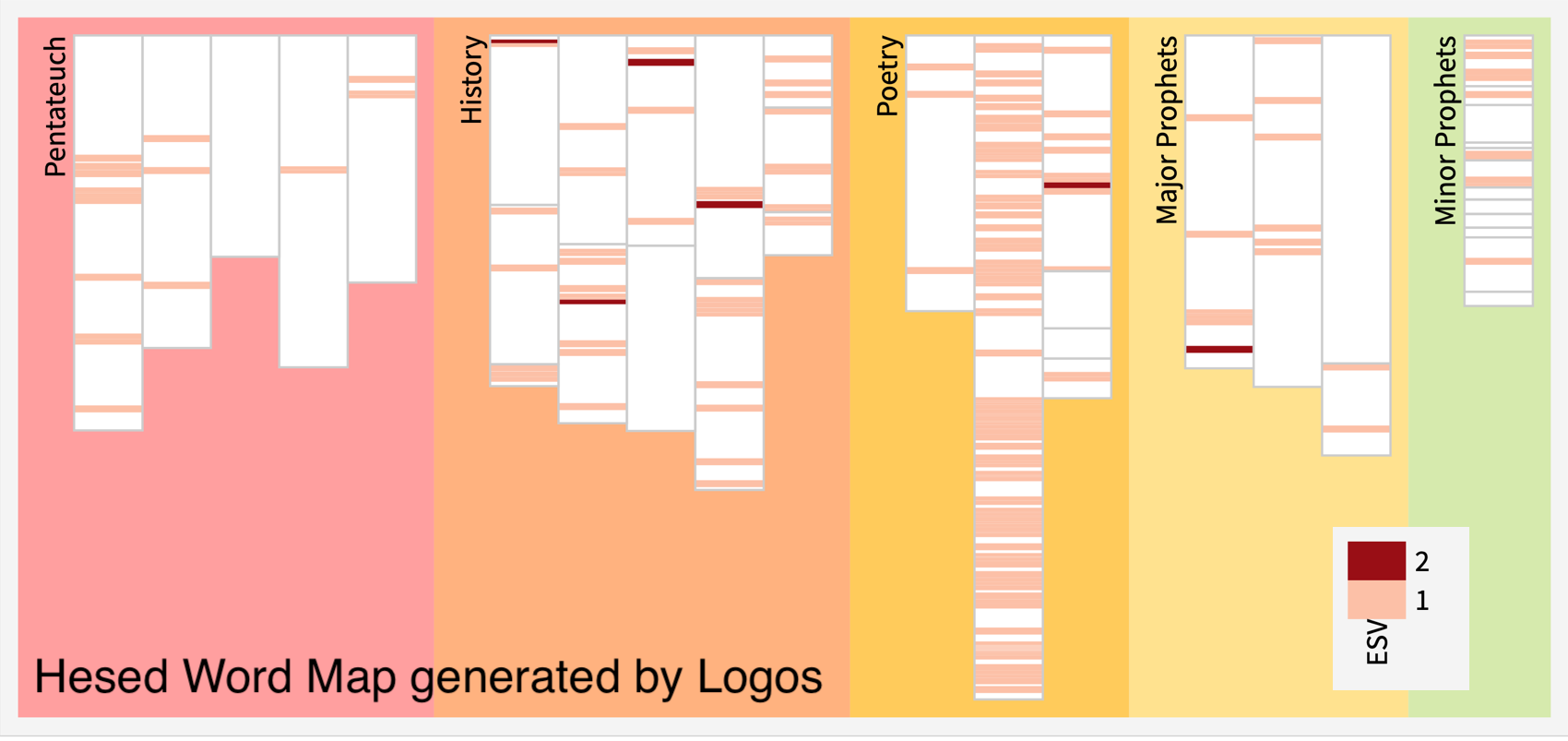
Hesed is widely distributed across all biblical literary categories of the Hebrew Bible, which is arranged differently than the Christian Bible (see word map below). It is found in the Torah 20 times, in the Prophets (Nevi’im) 53 times, and the Writings (Ketuvim) 172[3] times.[5] The twelve books where hesed does not appear, however, are Leviticus, 2 Kings, Ezekiel, seven of the twelve minor prophets (Amos, Obadiah, Nahum, Habakkuk, Zephaniah, Haggai, and Malachi), Song of Solomon and Ecclesiastes.
Hesed appears in the first book and the last book of the Hebrew Bible; from the rescuing of Lot in Genesis 19:19 to the faithful deeds of Josiah’s reformation in 2 Chronicles 35:26:
you have shown me great kindness [hesed] in saving my life. (NRSV)[6]
the rest of the acts of Josiah and his faithful [hesed] deeds in accordance with what is written in the law of the Lord. (NRSV)
The last reference reflected in the Protestant arrangement of the Bible (see word map below) closes with the prophetic oracle of Zechariah 7:9-10:
Thus says the Lord of hosts: Render true judgments, show kindness [hesed] and mercy to one another; do not oppress the widow, the orphan, the alien, or the poor; and do not devise evil in your hearts against one another. (NRSV)
Word Map: The Hesed (חֶסֶד) word map is based on the English Standard Version generated by Logos Bible software. The pink horizontal lines represent single and double instances.
The books which have ten or more references of hesed are Proverbs (10 times), Genesis (11 times), 1–2 Chronicles (15 times), 1–2 Samuel (16 times), and the Psalms (127[8] times). The majority of these books reflect the relational nature of hesed in the human realm. In Proverbs the end goal of wisdom is to teach practical relational hesed (31:26, 21:21), it is not a false front but the foundation of one’s reputation by its presence in their life (20:6, 28).
In Genesis, “kindness” is requested in prayer to God by Abraham’s servant to find a wife for Isaac (Gen 24:12, 14, 27). Then, Laban and Bethuel act in hesed (“kindness”) by cosigning their approval of Rebekah’s consent to be given as wife to Isaac.
1–2 Chronicles and 1–2 Samuel show that hesed expressed in reciprocal social acts. Saul reciprocates and excuses the Kenites from his assault on the Amalekites because they has shown hesed to Israel in ages past (1 Sam 15:6). Hushai’s “love” (loyalty?) for David is questioned during his infiltration of Absolam’s forces (2 Sam 16:17). The hesed shared between David and Jonathan is a story of deep loyalty and mutual reciprocity (1 Sam 20:8, 14–15). The Divine hesed is evidenced as well (2 Sam 15:20). Nathan enshrined the Davidic lineage and kingdom on behalf of God,
“my love will never be taken away from him” (2 Sam 7:15 NIV; 1 Chr 17:13, 2 Chr 1:8, 6:42; Psa 18:25[26]).
The Psalms contain close to half of all uses of the noun hesed (127[8] times); but it does not appear in 55% (83 psalms) of the 150 psalms. In brief, there are 23 instances in Book I (1-41), 16 instances in Book II (42–72), 14 and 13 times in Book III (73–89) and IV (90–106) respectively. In Book V (107–150), however, the frequency count skyrockets to 60 instances. Psalm 136 alone celebrates the Divine hesed in each of its twenty-six verses. It is in the Psalms that “both God and human worshipers describe God’s hesed as everlasting.”[7] Indeed,
While the term is used of both humans and God, in the Psalter it is above all a theological term that describes God’s essential character as well as God’s characteristic ways of acting—especially God’s characteristic ways of acting in electing, delivering, and sustaining the people of Israel. Hesed is both who the Lord is and what the Lord does. Hesed is an ancient term that defined for Israel who its God is.[8]
The saturation of hesed in the Psalms suggests that God’s people should always be mindful in prayer and worship of its content, its deeds, and the God who so relates to his people (Psa 36:5, 7, 10).
As pertains to the present study, it should be noted that the noun hesed only features twice in Jonah.Jonah is only one of four minor prophets where the term is employed (Hosea, Joel, and Micah). The first instance is in Jonah’s prayer of lament while in the “great fish” wherein he affirms that pagan idolators will miss out on “the grace [hasdam] that could be theirs” (2:8[9] NIV). The other instance is in 4:2 where Jonah laments what he knows about the LORD, who is “abounding in love” (NIV, warabhesed) and willing to change his mind about bringing judgment on the penitent people of Nineveh.
Semantic Range and Related Hebrew Words
As Silzer and Finley remind, “[w]ords normally have more than one meaning. The specific meaning of the word depends on its context.”[9] It is not sufficient, then, to rely on English translations (archaic or contemporary), nor to force lexical glosses to determine the meaning of a word.[10]
Brown, Driver, and Briggs groups hesedwith its verbal (hasad 2 times) and adjectival (hasid 32 times) forms, along with a few proper names, such asBen-Hesed (“son of Hesed” 1 Kgs 4:10) and Hasadiah (“Yah is Hesed” 1 Chr 3:20).[11] Lastly, is the unclean hasidah (6 times) often translated “stork” or “heron.” The root connection is believed to be due to their fond, “kind and affectionate” nature with their young.[12] This is a feature that is never appealed to in the Hebrew Bible.
The semantic range of hesed extends to the secular and the religious. In each, hesed manifests in concrete actions of goodwill, loyalty, and communal love whether in or outside of the covenant.[13] Divergent views emerge here with polarizing understandings over the meaning of hesed. Nelson Glueck saw in hesed a hardline covenantal legal obligation, H. J. Stoebe and others countered that hesedwas a free relational demonstration of loyal love.[14]
In the secular sense hesed speaks to certain “ethical norms of human intercourse” where mutuality exists that focuses on “the closest of human bonds.”[15] For example, Ruth exhibits this sense (1:8, 2:20, 3:10). Naomi blesses her daughters-in-law reciprocally, “May the Lord deal kindly [hesed] with you, as you have dealt with the dead and with me” (NRSV).
Religiously, the Divine demonstration of hesed does not function very differently than from the secular.[16] Exodus 34:1–7 provide a clear liturgical formula which demonstrates that Israel’s God abounds “in steadfast love and faithfulness” (34:6 NRSV; Psa 86:15, 89:14, Num 14:18).
The Lord passed before him, and proclaimed, “The Lord, the Lord, God merciful and gracious, slow to anger, and abounding in steadfast love [hesed] and faithfulness, keeping steadfast love [hesed] for the thousandth generation, forgiving iniquity and transgression and sin, yet by no means clearing the guilty, but visiting the iniquity of the parents upon the children and the children’s children, to the third and the fourth generation.” (Exod 34:6-7 NRSV)
This divine expression stresses the LORD’s multi-generational hesed and faithfulness. Moses now knows (33:13) that the LORD relates to his people through his benevolent and enduring nature. The words are quoted and echoed throughout the Hebrew Bible which suggests that they became formulaic or institutionalized to extoll the attributes of the God of Israel (Num 14:18, Jer 32:18, Joel 2:13, Nah 1:3, Psa 86:15, 103:8, 111:4, 112:4, 116:5, 145:8, Neh 9:17, 31, 2 Chron. 30:9)[17]
There are several words that appear frequently with hesed. They provide some dynamic appreciation for its usage in the Hebrew Bible.[18]Hesed may be done (‘asah) in concrete choices (Ruth 1:8). The LORD God keeps (shamar) and abounds (rab) in hesed (Deut 7:9, Neh 9:17). It is often associated with various nouns of “mercy” as in Psa 103:4 where the psalmist speaks of being crowned by God with hesed and rahamim(mercy). Likewise, hesed appears together with ’emet (faithfulness) probably as a hendiadys such as in Exod 34:6 and Psa 86:15.[19]
Hesed in Jonah 4:2
He prayed to the Lord and said, “O Lord! Is not this what I said while I was still in my own country? That is why I fled to Tarshish at the beginning; for I knew that you are a gracious God and merciful, slow to anger, and abounding in steadfast love [hesed], and ready to relent from punishing. And now, O Lord, please take my life from me, for it is better for me to die than to live.” (Jonah 4:2–3 NRSV)
This survey of hesed in the Hebrew Bible should help to determine the possible range of meaning for how Jonah 4:2 should be understood. Words have meaning only in context. With the above range in mind, the context appears to reflect Jonah’s usage of the formulaic hesedlanguage of Exodus 34:6–7. Instead of celebrating his God with these words, Jonah is subversively using this language to express his frustration with the LORD’s restraint against the city of Nineveh.
Jonah is using God’s own words against him. For this reason, it appears the meaning for Hebrew word hesedfound in Jonah 4:2 should be understood as “benevolent love.” Jonah knows how LORD acts out in concrete acts of hesed, these being grace, mercy, “slow to anger,” and relenting from judgment. Since there is no evidence that the LORD is in covenant with Nineveh, this supports the supposition that divine hesed may be expressed in free relational demonstrations of benevolent love. God relates to repentance with the reciprocal response of grace, mercy, patience/forbearance, relenting from judgment.
Jonah 2:8[9] further supports this view. It reveals that the prophet desires for judgment those who do not enjoy a covenant relationship with the LORD. It appears that for Jonah, idolatry is the “deal-breaker” for having a relationship with the LORD based on hesed. Yet, the irony fails to make any headway with the nationalistic prophet, since he rejected his prophetic call on the basis that he knew what the LORD would do should Nineveh repent. Both he and pagans have rejected God. Jonah is not only selfish with his relationship with his faithful God (“save me from the fish!”) but is resentful that God is “sharing the love” with foreigners (“you saved them from judgment!”).
Jonah wants his curse to come true, that those who “cling to worthless idols forfeit the grace [hesed] that could be theirs” (2:8[9] NIV). It is this forfeiture of Divine hesedwhich Jonah still desires for Nineveh, reflected in his willingness to proclaim that the city “will be overturned” (3:4) and his bitterness that it was not (4:1–11). Jonah knew that God would choose relationship over punishment. The LORD said as much (4:11). Humans, unfortunately, seem to choose punishment over relationship. Jonah shows as much.
This focused study on hesed and Jonah 4:2 brings to mind that the caricature of the bloodthirsty wrathful God of the Old Testament is just that an exaggerated cartoon (cf. Jas 2:13). As Baer and Gordon powerfully remind:
The insight that, while both anger and love are appropriate divine responses, the latter outlasts the former, is an important one for biblical theology. Wrath is a true word, a right word, sometimes an inevitable word, such passages seem to say. But God would not have it be his last word. That honor is reserved for his unfailing love (hesed).[20]
The burden of Jonah was to provide concrete witness to the people of Nineveh that God seeks to extend and establish benevolent love with all nations. As one who has experienced Divine benevolent love, Jonah should have been moved to be a spokesman for Divine benevolent love. In this he struggled and failed; nevertheless, God succeeded even if for a brief time (cf. Nahum 1:1?).
Conclusion
The meaning for Hebrew word hesedfound in Jonah 4:2 should be understood as “benevolent love.” The formulaic language of Exodus 34:6–7 is surely the theological and context for Jonah’s use of hesed. In Exodus as in Jonah 4:11, the LORD shows that he has the concern to establish and maintain a communal relationship with Israel. The benevolent concerns of preserving others and acting on the basis of moral uprightness anchor the LORD’s demands of repentance. Jonah knew if Nineveh took seriously the burden of his message, his God would become their God. They would collectively experience Divine benevolent love.
A final thought should be emphasized. Even though there are many excellent translations in the English language their primary function is simply to provide a reading text. Some significant and complex words, like hesed, merit the focused investigation which a word study provides. As developed above, hesed stresses relationships, community, loyalty and the ethical demands of love, responsibility, care, and obligation words which no single translation can do justice. Word studies reveal facets and these usages are combined into a framework. This framework provides the contours for understanding what a word means within its context, for usage determines meaning.
Endnotes
Rolf A. Jacobson, “Text, Title, and Interpretation,” in The Book of Psalms, NICOT, eds. E. J. Young, R. K. Harrison, and Robert L. Hubbard (Grand Rapids, MI: Eerdmans, 2014), 7–8.
John R. Kohlenberger III. and James A. Swanson, The Hebrew-English Concordance to the Old Testament (Grand Rapids, MI: Zondervan, 1998), v, 559.
H. J. Stoebe, “hesed kindness,” TLOT 2:449; H.-J. Zobel, “hesed,” TDOT 5:45; Robert P. Gordon, “hesed,” NIDOTTE 2:211.
Gray D. Practico and Miles V. Van Pelt, Basics of Biblical Hebrew, 2d ed. (Grand Rapids, MI: Zondervan, 2007), 105; Koehler, Baumgartner, and Stamm, “hesed,” HALOT 1:336; William L. Holladay, A Concise Hebrew and Aramaic Lexicon of the Old Testament (1971; repr., Grand Rapids, MI: Eerdmans, 2000), 111.
The Torah includes Genesis-Deuteronomy; the Nevi’im includes Joshua-2 Kings, Isaiah, Jeremiah and Ezekiel, and the Minor Prophets; and the Ketuvim includes Psalms, Proverbs, Job, Song of Solomon, Ruth, Lamentation, Ecclesiastes, Esther, Daniel, Ezra-Nehemiah, and 1–2 Chronicles.
The two English translations the Holy Bible used in this paper are the New Revised Standard Version (Nashville, TN: Nelson, 1989) and the New International Version (Nashville, TN: HarperCollins, 2011) cited as NRSV and NIV respectively.
David A. Baer and Robert P. Gordon, “hesed,” IDOTTE 2:212–17.
Jacobson, “Text, Title, and Interpretation,” 8.
Peter James Silzer and Thomas John Finley, How Biblical Languages Work: A Student’s Guide to Learning Hebrew and Greek (Grand Rapids, MI: Kregel Publications, 2004), 164.
Douglas Stuart, Old Testament Exegesis: A Handbook for Students and Pastors, 4th ed. (Louisville, KY: Westminster John Knox, 2009), 182–83.
BDB 338–39.
BDB 339; HALOT 1:336; TLOT 2:449.
IDOTTE 2:212–17; HALOT 1:336–37; TDOT 5:46–64.
R. Laird Harris, “hesed,” TWOT 1:305–06.
TDOT 5:47–48.
TDOT 5:54–55.
Nahum M. Sarna, Exodus, JPS Torah Commentary, ed. Nahum M. Sarna (Philadelphia, PA: Jewish Publication Society, 1991), 216.
HALOT 1:337.
TWOT 1:307.
IDOTTE 2:214.
Bibliography
Baer, David A., and Robert P. Gordon. “חסד.” Pages 211–18 in vol. 2 of New International Dictionary of Old Testament Theology and Exegesis. Grand Rapids, MI: Zondervan, 2012.
Brown, Francis, S. R. Driver, and Charles A. Briggs. A Hebrew and English Lexicon of the Old Testament. Oxford: Clarendon Press, 1907.
Ford, David. “Keeping up Biblical Languages while in the Ministry.” Foundations 14 (1985): 41–44.
Gordon, Robert P. “חסד.” Pages 211–18 in vol. 2 of New International Dictionary of Old Testament Theology and Exegesis. Edited by Willem A. VanGemeren. Grand Rapids, MI: Zondervan, 1997.
Harris, R. Laird. “חסד (hsd).” Pages 305–07 in vol. 1 of Theological Wordbook of the Old Testament. Edited by R. Laird Harris, Gleason L. Archer, Jr., and Bruce K. Waltke. Chicago, IL: Moody Press, 1980.
Holladay, William L. A Concise Hebrew and Aramaic Lexicon of the Old Testament. 1971. Repr., Grand Rapids, MI: Eerdmans, 2000.
Jacobson, Rolf A. “Text, Title, and Interpretation.” Pages 2–9 in The Book of Psalms. NICOT. Edited by E. J. Young, R. K. Harrison, and Robert L. Hubbard. Grand Rapids, MI: Eerdmans, 2014.
Koehler, Ludwig, Walter Baumgartner, and Johann J. Stamm. The Hebrew and Aramaic Lexicon of the Old Testament. Translated and edited under the supervision of Mervyn E. J. Richardson. 5 vols. New York: Brill, 1994–1999.
Kohlenberger, John R., III., and James A. Swanson. The Hebrew-English Concordance to the Old Testament. Grand Rapids, MI: Zondervan, 1998.
Practico, Gray D., and Miles V. Van Pelt. Basics of Biblical Hebrew. 2d edition. Grand Rapids, MI: Zondervan, 2007.
Sarna, Nahum M. Exodus. JPS Torah Commentary. Edited by Nahum M. Sarna. Philadelphia, PA: Jewish Publication Society, 1991.
Silzer, Peter James, and Thomas John Finley. How Biblical Languages Work: A Student’s Guide to Learning Hebrew and Greek. Grand Rapids, MI: Kregel Publications, 2004.
Stoebe, H. J. “חֶסֶד, hesed kindness.” Pages 449–64 in vol. 2 of Theological Lexicon of the Old Testament. Edited by Ernst Jenni and Claus Westermann. Translated by Mark E. Biddle. 3 vols. Peabody, MA: Hendrickson, 1997.
Stuart, Douglas. Old Testament Exegesis: A Handbook for Students and Pastors. 4th edition. Louisville, KY: Westminster John Knox, 2009.
Wegner, Paul D. Using Old Testament Hebrew in Preaching: A Guide for Students and Pastors. Grand Rapids, MI: Kregel Publications, 2009.
Zobel, H.-J. “(חֶסֶד, hesed).” Pages 44–64 in vol. 5 of Theological Dictionary of the Old Testament. Edited by G. Johannes Botterweck and Helmer Ringgren. Translated by David E. Green. Grand Rapids, MI: Eerdmans, 1977.
If you were to take a sheet of paper and list what you believe are the top ten qualities of a strong family, what would you put down? And, from among these ten qualities, which would be among the top six?
The February 2002 issue of NebFact a resource bulletin of The University of Nebraska’s Institute of Agriculture and Natural Resources in Lincoln, Nebraska, provided just this kind of information.[1] It focused on the issue of family life relationships. It summarized the research work of the Nebraska professor, Dr. John DeFrain, on “American Family Strengths.”
Built on extensive research, covering a span of 25 years, DeFrain concludes that while what constitutes a strong family varies from culture to culture, and society to society, they have one thing in common: they have “qualities that contribute to the family members’ sense of personal worth and feelings of satisfaction in their relationships with each other.”
Psalm 133 and Family Strength
It should be the goal of every family that each member can say two things: (1) “I matter to them” and (2) “I love being with my family.” When both of these statements are realized, then the practical foundations for a strong family are in place.
The 133rd Psalm suggests as much:
Behold, how good and pleasant it is when brothers dwell in unity!
It is like the precious oil on the head, running down on the beard, on the beard of Aaron, running down on the collar of his robes!
It is like the dew of Hermon, which falls on the mountains of Zion! For there the Lord has commanded the blessing, life forevermore. (Psalm 133:1–3 ESV)[2]
This psalm of David (per the superscription) centers on family, a family that is united in their bond and in the Lord.
The psalm is certainly an echo of the Genesis account and the first family. The Lord assesses the Creation as “good” (tob) when God gave the light (1:4), gave the earth and the waters (1:10), gave the plants and the trees (1:12), gave the moon and the sun (1:18), and gave the animals of the sea and air (1:21). Yet, it was decidedly “not good” for Adam to be alone (2:18). It was only until humanity became a family unit (“one”) that things are described to be “very good” (2:18–25; cf. 1:31). The use of “good,” then, in this psalm is a reminder or a call to embrace the goodness and the pleasantness of family together as God intended.
The portrayal of this unity is found along two images: the pouring of oil and the dew of the mountain. As a member of the family, one should feel as integrated to each member of the family like oil that pours upon the head, down to the beard, and on throughout the garments (v. 2). The pouring of oil to soothe or to consecrate did not isolate head, or beard, or garment — it applied wholly to the person and garments. As was the dew that descended on Mt. Hermon and extended to the mountains of Zion, the dew on the land united the land. Zion may be where God descends and where Israel ascended, but the dew united them (v. 3).
We should not walk away from the truth that family has been forged by God, and receives a blessing when it submits to His provisions (Deuteronomy 6:4–9). Nancy deClaissé-Walford reminds us:
the words of the whole psalm reminded the people that their family relationship was established not by blood, but by their mutual share in the community of God, a community that received blessing [sic] from its God.[3]
As sure as the family is to be a blessing to its own members, the family is how God planned to bring about the gospel blessing through Abraham (Genesis 12:3): “in you all the families of the earth shall be blessed.”
What Makes a Family Strong?
John DeFrain and his colleague David H. Olson point to six general overlapping qualities which have a proven record to make families strong. Olson and DeFrain call these qualities, “The Family Strengths Framework,” and they are (1) commitment, (2) positive communication, (3) spiritual well-being, (4) appreciation and affection, (5) enjoyable time together, and (6) the ability to cope with stress and crisis.[4] The following is a summary of these qualities of strong families (according to Olson and DeFrain) along with some supplemental perspectives I have picked up along the way.
Members of strong families demonstrate a commitment to one another with an investment of time and energy toward them, marking the family as their highest priority. This is not a controlling commitment but one that empowers, encourages, and trusts, especially with regards to marital sexual fidelity.
Ed Wheat and Gloria Okes Perkins’ emphasize from the Greek word storge the importance of creating the atmosphere of “belonging” with “natural affection” (Romans 12:10).[5] This fits well with the trusting and honest environment which comprises a family strength. Wheat and Perkins go on to paint a picture of welcomeness. It is not a “spectacular” and swooping love that builds strong marriages. Instead, it is a “comfort love,” necessary and nourishing, taken for granted and unexciting.
The family culture it creates needs to allow for members of the family to trust they can be comfortable in “their own skin” and safely accepted by their family when the outside world rejects them.
Second, Positive Communication. Key Qualities: sharing feelings, giving compliments, avoiding blame, being able to compromise, agreeing to disagree.
Members of strong families spend time “talking with and listening to one another” in meaningful ways (sharing feelings). They will not always agree with each other but will have the coping skills to disagree, agree to disagree, and compromise without blaming each other. Humor is also a significant unifying feature, a stress reducer, and a way to bring levity to struggles of daily life.
Gary Smalley’s “Five Levels of Intimacy” model fits well here (cf. Making Love Last Forever): (Level 1) having shallow (think clichés) discussions (“good morning,” etc.), (Level 2) sharing basic facts about life or self (“it was hot,” etc), (Level 3) sharing opinions, concerns, or expectations (may risk an argument), (Level 4) honest sharing of one’s deepest feelings with an honorable safe listening environment (“Let me see if I understand what you’re feeling…”), and (Level 5) honest sharing of one’s deepest needs with an honorable safe listening environment (“Let me see if I understand what you need…”).[6]
Communication is the glue that keeps the whole family together. We would do well to enjoy each other’s company through positive communication.
Members of strong families believe that faith, hope, or optimism about life are important to a healthy connection to the world. There is a sense in which transcendence of the “every day” to the sacred is embraced, shared, and desired. Their ethics and values emerge from their spiritual orientation. The sense of belonging to a caring and supportive community is important to connect the family to the world. This is considered to be “the most controversial finding of the family strengths” research.
According to F. M. Bernt, research shows that culturally, there has been a move away from a culturally shared value toward a personal/subjective sense of what is important.[7] In other words, people used to have a stronger sense of a shared morality and priority, but that frame of reference has eroded. Today, people are more likely to lean on their own priorities – moral and spiritual. Case in point, research shows that a “strong marriage/family” will seek a strong spiritual well-being. However, when polled to list the top five traits parents wish to pass on to their children “loyalty to church” is never included. Instead, the top five traits listed are: “willingness to work hard,” “frankness/honest,” “independence,” and a three-way tie between “social mindedness,” “economy in money matters,” and “good manners.”
This fits well with George Barna’s research, Growing True Disciples.[8] The Barna Group, a church statistics ministry, shows that many believers say faith matters, but few, in fact, admit to investing the kind of energy to pursue actual spiritual growth. This may point to a partial answer to a very complex question: “why are our young people leaving the church after they leave their ‘church going’ families?” It seems that discipleship is not a real practical priority. “Dragging” children to church is one thing, training them to become disciples of Jesus is quite another thing. If adult members of the family do not embrace discipleship, it will be very hard to expect the children to embrace such.
The church cannot be expected to raise people’s children, but we need to create an environment for all members to develop as disciples of Christ (1 Timothy 2:1–2).
Fourth, Appreciation and Affection. Key Qualities: caring for each other, friendship, respect for individuality, playfulness.
Members of strong families regularly show their deep feelings for one another through care, friendship, respect, and even playfulness. This does not mean the family is free of tension. Strong families do not ignore negativity. Yet, sharing criticism is outweighed by a genuine concern to show respect. Marital sexual intimacy in strong marriages is likewise built on this positive interplay of friendship and respect.
Gary Chapman’s model of The 5 Love Languages[9] provides very practical ways to demonstrate appreciation and affection; namely: words of affirmation, quality time, receiving gifts, acts of service, and physical touch. This is not only for marital intimacy but also works in broad ways for all family members, acknowledging that some people react better to certain expressions of love.
The key is to remember that healthier families are nurturing with care, affection, friendship, togetherness, and the joy of each other’s company. This takes effort and a commitment to creating a home culture where the language of family interaction is endearing.
Fifth, Enjoyable Time Together. Key Qualities: quality time in great quantity, good things take time, enjoying each other’s company, simple good times, sharing fun times.
Members of strong families create happy memories by spending considerable quality time together. Despite the tension of “much” time versus “quality” time, the focus of strong families are to make every moment together memorable, grounded in simple good times, where the “shared times” (picnics, fishing, meals, trips, etc.) leave indelible marks of joy on each member of the family.
In keeping with the above, Paul Faulkner discusses, in What Every Family Needs with Carl Breechen,[10] the importance of “spending quality time.” Faulkner asserts that there are four hindrances to spending quality time together. These “big fours” are built into American’s aggressive consumer and materialistic culture ([1] money, [2] beauty/sex, [3] intelligence, and [4] athletic ability). These make it hard for families to spend time together.
The scriptures show that money is not evil, but it is the “love of money” that leads to every kind of evil (1 Timothy 5:10). Beauty and sex-appeal is only as enduring as the godly fearfulness and prudence beneath the skin (Proverbs 11:22; 31:30). The vaunted praise of the naturalistic mindset of our society is limited by its detrimental lack to include God in it (Romans 1:19–20). And finally, the obsession with athletes and their skills to the point they displace God as the focus of our hearts is truly the stuff of idolatry (Acts 8:9–11).
It is, therefore, important to be proactive, not passive, in making time —as a priority— for family members in order to overcome the persuasive time killers. Husband and wives need to work together by changing work schedules, reducing professional involvements, and even giving spouses “veto powers” over these matters.
Sixth, Ability to Cope with Stress and Crisis. Key Qualities: adaptability, seeing crises as challenges and opportunities, growing through crises together, openness to change, resilience.
Members of strong families will develop the skill to effectively cope with the unavoidable troubles, stresses, and crises of life. Strong families are less crisis-prone than dysfunctional families because they often prevent the sort of troubles that their counterparts do not. The four main troubles strong families face are —in statistical order— illness and surgery, death, marital problems, and the problems of their children. Strong families adapt to these, and other troubles, through a series of strategies that help family members pull together. The resilience to admit the need for help is listed here in statistical order: every member has a part to play to ease the burden, help is sought to solve problems that the family cannot, counseling is sought to learn better-coping methods.
Parents and guardians of children would be wise to have a preexisting list of recommended Christian counselors, psychologists, or psychiatrists of all ages available to assist their families to cope with stress and crises. Aside from other services, the American Association of Christian Counselors website may be a good place to start to find helpful Christian counseling resources. Counselors are available to help assess our stability and situation: mental, spiritual, or emotional.
Nevertheless, we should always remember that God is the only true help for the ill that no pill can cure (Psalm 121:1).
Concluding Thoughts
There are no perfect families, and this includes the “strong families.” The conclusions by Olson and DeFrain, and others, simply illustrate the sorts of behaviors that have shown to yield a healthy family atmosphere. You might even consider this simply a survey of “best practices” among families that have healthier relationships than others. They do not, however, promise to create perfect families.
In the end, all families -including Christians ones- can gain a great deal when these Family Strength qualities are pursued and practiced. Christian families are no less prone to dysfunction as non-Christian families are, and vice-versa. Families essentially boil down to relationships, and the value felt and satisfaction experienced from being together. We return to the two overarching signs of a healthy family: (1) “I matter to them” and (2) “I love being with my family.”
For the child of God, we seek another dynamic to be at play in the success or strength of the family, and that is God and his Word, and our story together revealed in Scripture to be at the core of what we do as a family. Moses’ call to Israel is for all of God’s people and ought to be “heard” today:
Hear, O Israel: The Lord our God, the Lord is one. You shall love the Lord your God with all your heart and with all your soul and with all your might. And these words that I command you today shall be on your heart. You shall teach them diligently to your children, and shall talk of them when you sit in your house, and when you walk by the way, and when you lie down, and when you rise. You shall bind them as a sign on your hand, and they shall be as frontlets between your eyes. You shall write them on the doorposts of your house and on your gates. (Deuteronomy 6:4–9)
Unless otherwise stated all quotations are taken from the English Standard Version of The Holy Bible (Wheaton, IL: Crossway, 2016)
Nancy deClaissé-Walford, Rolf A. Jacobson, and Beth Laneel Tanner, The Book of the Psalms, NICOT, ed. E. J. Young, et al. (Grand Rapids, MI: Eerdmans, 2014), 939.
See, “The Family Strengths Framework” in David H. Olson and John DeFrain, Marriages and Families: Intimacy, Diversity, and Strengths, 4th ed. (Boston, MA: McGraw-Hill, 2003), 75–80.
Ed Wheat and Gloria Okes Perkins, Love Life for Every Married Couple (New York: Inspirational Press, 1980), 80.
Gary Smalley, Making Love Last Forever (Dallas, TX: Word Publishing, 1996), 142–44.
F. M. Bernt, “The Ends and Means of Raising Children: A Parent Interview Activity,” Activities Handbook for the Teaching of Psychology, vol. 4, eds. L. T. Benjamin, et al. (Washington, DC: American Psychological Association, 1999), table 55-2.
(Colorado Springs: Water Brook, 2001).
(Grand Rapids: Zondervan, 1992).
Carl Brecheen and Paul Faulkner, What Every Family Needs: Whatever Happened to Mom, Dad, and the Kids? (Nashville, TN: Gospel Advocate, 1994), 177–79.
One of the most fundamental principles articulated in the Bible is that God created the universe and that within this grand cosmos, a focal point was given to a small globe predominately covered in water – the planet earth. It is upon this planet that God organized the elements for human habitation over a period of six days (Exod 20:7). During the sixth day, the uncaused Creator made humanity (Gen 1:26-27):[1]
Then God said, "Let us make man in our image, after our likeness […] So God created man in his own image, in the image of God he created him; male and female he created them."
When God created humanity, the Scriptures show that he also created the first marriage, and consequently the first family. The narrative of this origin is the foundation for a godly marriage. The current study is a brief look into some of the vital lessons found in the creation of the human family – and first marriage.
The Historical Setting
In Genesis 2, the sixth day of creation is elaborated upon (2:4-25). There is a common literary device in the book of Genesis that perhaps is obscured by the English translation to which we call brief attention. It usually is styled the Toledoth formula, and is often translated as “these are the generations,” “this is the family history,” “this is the account,” or some other formulation (Gen 2:4, 5:1, 6:9, 10:1, 11:10, 11:27, 25:19, 36:1, 9, 37:2).
Attention is given to this literary device for two reasons – though several other thoughts could be developed. First, it is one of the clearest features in Genesis that displays to biblical students the “structure intended” by the author.[2] Second, this series of episodes throughout the book both provides a strong sense of unity and harmony within its narrative, and indicates a “historical impulse” to be understood while reading Genesis.[3]
These narratives are not mere “fairy-tales” given for ancient religious and philosophical contemplation. Instead, the biblical material is styled in such a way to make it obvious “the author intended it to be read as a work of history that recounts what has taken place in the far-distant past.”[4]
Therefore, in Genesis 2:4, when it reads, “These are the generations of the heavens and the earth […],” we are beginning a historical – albeit theological – pilgrimage that starts with the historical creation of our forefathers made in the “image of God” (1:27).
Humanity – The Pinnacle of Creation
Heaven’s joy in creating humanity is perhaps seen quite clearly when we compare how God assessed the situation when humans come into the picture. In general, God saw His creation as “good” – “And God saw that it was good” (Gen 1:4, 10, 12, 18, 21, 25). The Hebrew word for “good” in Genesis 1 (Heb. tob) has many applications in the Old Testament, employed by different authors as many times as 741 times.
In the Creation Account, “good” anticipates the theme of the fall of Adam and Eve,[5] but at the same time demonstrates that the Creation as God intended was an ideal place for the well-being of its inhabitants.[6] Consequently, at the close of the sixth day, after the creation of humanity God surveyed his handiwork, and saw that “it was very good.”
Perhaps our Creator observed that all the pieces to his creation were now in place, and so now the planet was a very good place to live – God’s ideal world realized. Though not in contradistinction, perhaps we are reading a phrase of great emotion and tenderness, as the only creation made in the Imago Dei (“image of God”) now walks the earth. Furthermore, humanity is entrusted with sovereignty over the animals and with the planets overall care (Gen 1:26); humanity is thus the crown of creation.
The sweet psalmist of Israel (2 Sam 23:1) sets forth a beautiful hymn of praise to God for His creative acts, but most importantly, for his emphasis upon the human family. A segment of the 8th Psalm is as follows:
When I look at your heavens, the work of your fingers, the moon and the stars, which you have set in place, what is man that you are mindful of him, and the son of man that you care for him? Yet you have made him a little lower than the heavenly beings and crowned him with glory and honor. You have given him dominion over the works of your hands; you have put all things under his feet. (Psalm 8:3–6)
No doubt as King of Israel, David had pondered over the Creation Account several times (Psa 19). Perhaps he became more intimately involved in its study since it was his duty as King to be a Scribe of the Law as well (Deut 17:18-20).
God Created the Family
Returning to Genesis 2:4, we see a narrative serving much as a prism fragmenting a beam of light into many unique colors of spiritual insight. We may focus upon many of them as we have done above, but here attention is drawn to one in particular. When God created humanity, he also created the fundamental building block of human society – God created the family.
God employed His sovereignty and created a human community on the sixth day made up of one male and one female. Genesis 1:27 abbreviates the day, but 2:4-25 reiterates and expands upon the sixth day, a common feature in Old Testament narration to focus upon a critical moment that pushes the story forward.[7] We find Adam created from earthen materials, and fashioned into a “living soul” with the “breathe of life” given to him (2:7); however, he was alone, and that was not good for the well-being of the creation (2:18).
One of the aspects of being made in the image of God is that humans are by-in-large social beings. God is a trinity; in other words, God is a community of love made of the Father, Jesus, and the Holy Spirit (Matt 28:19; 2 Cor 13:14; 1 Pet 1:2, etc.). Should it be all that surprising that the Imago Dei is likewise a social being? Hardly, and God saw the loneliness and incompleteness Adam felt and addresses the matter.
In what appears to be an animal parade of potential companions organized by God, Adam still finds no animal that would be a “a helper fit for him” (2:18-20). In other words, “a helper corresponding to him,”[8] suggesting Adam’s deep need to have another person just like him to help fulfill his responsibilities of governing the creation. A companion was needed to work side-by-side, another person like Adam to continue the human family, another person to create a community of love made in the image of God.
Consequently, when no animal met those criteria, the Lord caused a great sleep to fall upon Adam. When Adam awoke, God had created a new being that corresponded to him; someone who would help him in this new world. God presented this person to Adam and he named her Woman (Heb. ‘issah), which is the logical result since she was taken out of man (Heb. ‘is 2.22-23).
Raymond C. Ortlund, Jr., makes a very important point here worthy to be reflected upon:
Unlike the animals – indeed, unlike the man himself – she did not come up from the ground below but out from human flesh, putting her alone at the man’s level.[9]
Raymond C. Ortlund, Jr., Whoredom: God’s Unfaithful Wife in Biblical Theology (1996)
This was indeed a public proclamation of her status as his only true companion in the garden.[10]
Boy Meets Girl for the First Time
It is amazing to fathom how God collaborated with Adam to find a solution to his solitude. God orchestrated the events that led to the creation of Eve, and Adam knew exactly what he saw: “This at last is bone of my bones and flesh of my flesh” (Gen 2:23). We might respectfully paraphrase Adam as saying, “Finally, a person made just like me!” The event was quite literally that of a match made by Heaven.
Together, they were to share the dominion over the planet (1:26), and dwell in an environment objectively unaware of the evil uses of the sexual appetite – hence “they were naked and not ashamed.”[11]
After Adam’s great announcement of finding his companion, the bedrock biblical principle of marriage is declared in terms of a logical consequence derived from the events of day six leading to the creation of womankind. Moses addresses his post-fall contemporaries, and places a prescriptive emphasis upon this pre-fall narrative: “Therefore a man shall leave his father and his mother and hold fast to his wife, and they shall become one flesh” (2:24).[12]
There have been departures from God’s intent for marriage since the polygamy practiced by Abraham, Jacob, David, and Solomon (etc.), or whether it is the tolerated relaxation of the original marriage code in Genesis 2:24 allowed under the Mosaic system due to the “hardness of heart” (Matt 19:8).
Jesus appealing back to this Genesis narrative affirms that “from the beginning [of time] it was not so” (Matt 19:8).[13] The marriage can only be severed on the basis of adultery, and while many pollute this teaching, the Lord is quite clear on the subject (Matt 5:32).[14]
The “One Flesh” Aspect
Jesus addressed a much-needed foundational marriage issue, one that our contemporary culture is in dire need of emphasizing: divorce and remarriage is not for any cause.
When God created male and female, and gave them the garden for their home, reproduction as an aspect of life, and delegated the authority to them for the governance of the world and its other inhabitants, He joined Adam and Eve into one flesh (2:24; 1:26-28). Their example is designed to serve all subsequent generations on earth as the templar for the permanent nature of marriage (and its goals).
As we conclude this piece focused upon the first encounter between boy and girl – rather man and woman (Heb. ‘is and ‘issah respectively), it is vital to give some attention to the concept of one flesh. In doing so, there are three pivotal principles articulated by Ortlund based upon Genesis 2:24.[15]
Viewed negatively, marriage severs the strongest of human bonds – parental; and as such, “elevates the marital union above all other personal loyalties, under God.”
Viewed positively, marriage is the context where the male “devotes his primary loyalty to his wife” emotionally, sexually, and socially.
Likewise, “the new life [as one flesh] created by a marriage fuses a man and wife together into one, fully shared human experience, prompting mutual care, tenderness and love.”
These are beautiful principles that would enrich any marriage.
Conclusion
The teaching from Genesis 2:24 is set forth before the Mosaic and Christian covenant, and this means that its teaching applies to the entirety of the human race.[16] God did not allow the creation week to end without the creation of humanity, and subsequently the family.
It was not consistent with the well-being of the creation for Adam to be alone, and God created the perfect companion to help him navigate through the world of Eden. This was the first marriage, and God designed marriage to be a permanent relationship of a “fully shared human experience” – the good, the bad, and the ugly. Human interference in the marriage is strongly warned against by Jesus (Matt 19:6, 9).
All we can do is ponder over these principles, find avenues in our lives to enact them, and allow the idealistic Edenic garden to be planted, cultivated, and blossomed in our marriages. As it is written in the Scriptures:
Awake, O north wind, and come O south wind! Blow upon my garden, let its spices flow. Let my beloved come to his garden, and eat its choicest fruits. I came to my garden, my sister, my bride, I gathered my myrrh with my spice, I ate my honeycomb with my honey, I drank my wine with my milk. Eat, friends, drink, and be drunk with love! (Song of Solomon 4:16–5:1)
Sources
All Scripture references are from the English Standard Version unless otherwise noted.
Raymond B. Dillard and Tremper Longman, III, An Introduction to the Old Testament (Grand Rapids, MI: Zondervan, 1994), 48.
Dillard and Longman, An Introduction to the Old Testament, 48-49.
Dillard and Longman, An Introduction to the Old Testament, 49.
Ernst Jenni and Claus Westermann, Theological Lexicon of the Old Testament, trans. Mark E. Biddle. (1997; repr., Peabody, MA: Hendrickson, 2004), 2:491-92.
William E. Vine, Merrill F. Unger, and William White, Jr., Vine’s Complete Expository Dictionary of Old and New Testament Words (Nashville, TN: Nelson, 1984), 1:100.
Robert Alter, The Art of Biblical Narrative (New York, NY: Basic Books, 1981), 50-51.
Clyde M. Woods, Genesis-Exodus (Henderson, TN: Woods, 1972), 9.
Raymond C. Ortlund, Jr., Whoredom: God’s Unfaithful Wife in Biblical Theology (Grand Rapids, MI: Eerdmans, 1996), 19.
Ortlund, Whoredom, 19.
Woods, Genesis-Exodus, 9.
Ortlund, Whoredom, 20-21.
Wayne Jackson, The Teaching of Jesus Christ on Divorce and Remarriage: A Critical Study of Matthew 19:9, revised ed. (Stockton, CA: Christian Courier Publications, 2002), 2-8.
Jack P. Lewis, The Gospel According to Matthew (1976; repr., Abilene, TX: Abilene Christian University Press, 1984), 2:67. Some, however, attempt to use 1 Corinthians 7:15 as support for divorce for the cause of desertion, claiming Paul was applying the teaching of Jesus to a new situation. While the teaching of Jesus was certainly being applied to a new situation, there is no reason to assert that desertion in 1 Corinthians 7:15 serves as an additional allowance for divorce and remarriage. We recommend Wayne Jackson article, “What Is the Meaning of ‘Not under Bondage’ (1 Cor. 7:15)?” (ChristianCourier.com), in response to this viewpoint.
Ortlund, Whoredom, 21-23.
Cf. Jackson, The Teaching of Jesus Christ on Divorce and Remarriage, 5-6.





 biblicalfaith.online