when our integrity is on the line, it is comforting to stand before God, depend on God’s relationship with each of us before we go out and face the not-so-forgiving world.”
in The Book of Psalms (Eerdmans, 2014)
As God’s people, meditating over the rich world of Psalm 26 can help us meet the challenges of this unforgiving world.
Genre and Context
Genre. Psalm 26 is a poetic prayer framed in the language of a plea of vindication, asking God to evaluate David’s commitment to the path of integrity. There are other genre suggestions made to account for the palatable sense of a legal complaint, or a priestly approach to God (26:6–8), a lament (26:1), or of its liturgical sensibilities for God’s people to approach God (26:6–8).
A complaint appeal to God seems, however, to be the most fitting literary form for the psalm. David implies throughout that his spiritual and moral integrity is under scrutiny, and explicitly invites the Lord’s assessment, confident that he will be found “on level ground” (26:12).
Context. There are nine psalms with the superscription (i.e., the headings) which reads, “Of David” (Psalms 25–28, 35, 37, 103, 138, 144). Although these are very ancient, they have never been thought of as inspired. They often provide ancient information about either its background (Psalm 51), its liturgical usage (“to the choirmaster,” Psalm 31), or its collection or authorship (Asaph, Psalm 80). “Of David” is so abbreviated and limited, Psalm 26 could be from any period of David’s life.
There are two additional ways to explore the context of individual psalms: their placement in the Psalter and internal references to other biblical themes. Psalm 26 is placed in Book 1 (Psalms 1–41) cataloging 37 Davidic psalms. The psalm also presumes an understanding of the priestly and sacrificial system (26:6–8), and the “path” of the righteous from Psalm 1.
Movements and Theology
Movements. The psalm clearly moves from the demand to be vindicated by God, with the declaration of having “walked in… integrity” (26:1) to the promise to “walk in … integrity” (26:12). The walk in integrity motif serves as an inclusio—two phrases serving as literary bookends. This is at the heart of the movement of the psalm. Once David’s past and present are vindicated by God’s refining fire of judgment, he promises to continue walking in integrity.
Our English translations do not always agree on how to divide these literary units but the most helpful way to see the movement of thought within the psalm is a five-part outline: (1) 26:1–3, (2) 26:4–5, (3) 26:6–8, (4) 26:9–10, and (5) 26:11–12. At the center of this outline are verses 6–8, which emphasize priestly preparation to stand in the presence of God (“Psalms” in The Transforming Word [ACU Press, 2009]). Clearly, David’s confidence in his innocence is not to be confused with a sense of sinlessness, for this reason, he pleads for redemption and grace (26:11b).
Theology. There are a few significant theological themes to soak in:
(1) A theology of vindication: In the opening invocation of God, David uses the verbal shopheteni (“vindicate me”; 26:1), a judicial term for “passing judgment.” It is used in the positive sense of “demonstrate my innocence.” The same phrase appears two other times: “Vindicate me, O Lord, My God” (35:24), and, “Vindicate me, O God, and defend my cause against ungodly people…” (43:1). Vindication of the righteous sufferer is a common theme throughout scripture (cf. Job; 1 Pet 2:18–25; Phil 2:5–11). David, too, insisted that God prove, try, and test his heart and mind (26:2).
(2) God’s Benevolent Faithfulness: Steadfast love (hesed) and faithfulness (‘emet) are found together fifty times in the Psalms. It affirms God’s character revealed at Mount Sinai: “The Lord, the Lord, a God merciful and gracious, slow to anger, and abounding in steadfast love and faithfulness, keeping steadfast love for thousands, forgiving iniquity and transgression and sin, but who will by no means clear the guilty…” (Exodus 34:6–7). As Jonah reluctantly learned, this God also exists for those outside of his covenant as well (Jonah 4:2). David knows his God prefers a redemptive relationship over penal punishment.
(3) The priestly approach: In Exodus 30:17–21, the priests who serve in the tabernacle (i.e., the Lord’s house; Psalm 26:8) must wash their hands and their feet in a bronze basin before entering, “so that they may not die” (17:21). Temple rituals for coming into the presence of God are often spiritualized by those outside the Levitical guild. David affirms that he appropriately prepares himself to be in God’s house since only by the grace of God do we have access to redemption, praise, and worship in his presence (Psalm 26:6–8, 11).
(4) The two paths: The first psalm establishes the two paths: the way of the righteous and the way of the wicked (Psalm 1:1, 4–6). The wicked and the righteous, and their deeds, are fully known by God; likewise, their fates are determined by their lifestyle. This theological framing is found in Psalm 26. David appeals to this language when he disavowed association with the wicked (26:5; 1:1), and in his request not to be lumped in among the sinners when God scoops them all together in judgment (26:9; 1:1, 5).
Application
It is hard to know the particular scenario in David’s life which gave rise to this psalm. The power of the inspired poetic form, however, is found in the accessibility of our contemporary settings despite the differences.
The integrity of God’s people will be challenged, but such an inspection should be welcomed if God’s people are seeking the way of the righteous in a humble, graceful, and redemptive way
Sources
Tanner, Beth LaNeel. “Psalm 26: Prepare to Appear” in DeClaissé-Walford, Nancy L., Rolf A. Jacobson, and Beth LaNeel Tanner. The Book of Psalms. NICOT Edited by E. J. Young, R. K. Harrison, and Robert L. Hubbard, Jr. Grand Rapids, MI: Eerdmans, 2014.
Marrs, Rick R. “Psalms” in The Transforming Word One-Volume Commentary on the Bible. Edited by Mark W. Hamilton. Abilene, TX: Abilene Christian University Press, 2009.
[Chapter submission for the 84th Annual Freed-Hardeman University Lectureship (2020), Henderson, Tennessee. This is part of the “Anticipating the Future: My Story is His Story” Series. Our Place in His Story: Remembering the Past, Anticipating the Future (Link to book). Listen to the audio lecture as delivered clicking here.]
Everyone has a past. Every conversion to Christ has a past from which it starts and a future to which it clings. Early in Paul’s letter to the Thessalonians he wrote of their decisive change from paganism to the faith and hope that is found in Christ, noting, “how you turned to God from idols to serve the living and true God, and to wait for his Son from heaven, whom he raised from the dead, Jesus who delivers us from the wrath to come” (1 Thess 1:9–10). [All Scripture references are from the English Standard Version unless otherwise stated.] This is the basic grammar of the Christian life: a conversion to serve God awaiting future deliverance at the return of Jesus. Between these two bookends (the past and future) the Christian experiences grace which is greater than our all past associations.
The Past is Worthless
In his autobiographical moments, Paul affirmed that the grace he experienced as a Christian—and apostle—surpassed any value attached to his past Jewish heritage. For example, in Philippians 3, Paul weighs the value of his life outside of Christ against what he finds “in Christ.” His past and present reads much like a “pros” (present) and “cons” (past) list. His past was filled with Israelite hubris and Jewish accolades (3:5–6). Richard Peace well observes,
not only was he blessed by birth with impeccable religious credentials, but as the result of his own accomplishments he had risen to the pinnacle of first-century Jewish spirituality. (31).
Richard Peace, Conversion in the New Testament (1999)
On paper, he was truly a “Hebrew of Hebrews” and it showed. Paul had been a blameless Benjamite Pharisee who zealously persecuted the church. Yet, at the time, his “zeal for God” was “not according to knowledge” (Rom 10:2). On the other side of the ledger, the “gain” (kérdos) this activity afforded him —Jewish “street cred”—amounted to being “loss” (Phil 3:7, 8) and “rubbish”[1] (3:8). Real “gain” is found in Paul’s slogan, “to live is Christ, and to die is gain [kérdos]” (Phil 1:21). Why? Paul had attained a full and realized relationship with Jesus Christ (3:8–16) manifested in the Lord’s “grace” (1:2, 7; 4:23). This is what every Christian shares in, grace that is greater than one’s past associations.
1 Timothy 1:12–14
Lost in Speculation (1 Tim 1:3–7)
Another important autobiographical statement by Paul is found in 1 Timothy 1:12–14.[2] Contextually, it comes off the heals of his reminder to Timothy that he was charged to address the dangers of “certain ones” (tís) bringing into the church religious “speculations” (ekzétesis) which emerge from teaching other doctrine(s) (hetero + didaskaleín) and indulging in myths and genealogies (1:3–4). Paul’s stress for doctrinal purity is well established. In Galatians 1:6, for example, Paul is opposed to any desertion to a “different gospel” (héteron euangélion). In Ephesus, the “end game” of those teaching other doctrines was simply “the inquiry” into the theoretical which subverts the actual carrying out of the plan of God (oikonomía; Knight 75) empowered by faith. The economy of God’s plan is not empowered by theory but by a Christian whose love is saturated by their pure heart, good conscience, and sincere personal faith (1:5). A Christian, distracted by “overthinking,” untouched by the work of God in their life will never be able to truly carry out their call to share the gospel of Jesus (1:6–7).
Healthy Teaching Restrains Evil (1 Tim 1:8–11)
There is no sin in exploring the contours of the faith nor engaging in deep religious and theological conversations, but this must never hinder teaching the law of God with its concrete condemnation of sin in all of its forms. Paul mentions thirteen types of “lawless” ones (1:9–10) for whom the law properly applies (nomímōs, 1:8). Paul affirms it is the primary purpose of the law “to restrain evil doing” (Guthrie 74) and this is why those that teach other doctrine(s) (1:3) fail in their endeavor to be “teachers of the law” (nomodidáskaloi, 1:7). Their speculations only offer that which is “contrary” (antíkeimai), and different (héteros),[3] to what is “healthy teaching” as concretely found and expressed in the law (1:10). This is the source of the convicting component of the gospel message, for through it God convicts humanity of sin but he does not leave sinners in their judgment. He incorporates them into the economy of his plan. This may be restated as, “no matter who you are, no matter where you have been, no matter what you have done, there is a place for you in the kingdom of God” (Payes). This key principle is the foundation for Paul’s own autobiographical thanksgiving in the next verses (1:12–14).
Thankful for the Grace of Jesus (1 Tim 1:12–14)
Paul frequently uses the Greek word chárin (grace, thanks, gift, favor, etc.) in his letters (100 times). In fact, he opens and closes all of his letters with chárin. This segment of 1 Timothy likewise opens (1:12) and closes (1:14) with this word, but with two different emphases—gratitude and favor (MM 684). Paul’s gratitude to his Lord Christ Jesus recognizes not only the enabling power (endunamóō) he receives from the Lord, but also the confidence placed on Paul to serve in his ministry (diakonía). Participating in the economy of God’s saving plan gave the apostle the experience of an overflowing “grace” (chárin). Paul never forgot his past, grace does not delete the past. It is clear that Paul’s past as “a blasphemer, persecutor, and insolent opponent” served as a motivation for his gratitude and zeal (Petrillo 18). His example demonstrates that God’s grace and mercy provides the means to cross the bridge from condemnation (1:8–10) to arrive at the healing place which creates the pure heart, good conscience, and a sincere faith (1:5) within the “foremost” sinner (1:15).
Paul’s “unbelief” (apistía) was met with the Lord’s compassion (eleéō), his “sins” and lawless behavior was met with the embrace of “the faith and love that are in Christ Jesus” (1:14). When Paul was brought into the “in Christ” relationship mercy was shown to him, he did not have to earn it. In his case, however, his rebellion was in ignorance while zealous for God (cf. Rom 10:2); nevertheless, he was in sin, and he acknowledged that God initiated a relationship with him out of compassion. Luke records this divine extension of mercy and Paul’s response (Acts 9:1–19; 22:16). On paper, Paul should stand condemned, but God does the overflowing abundant thing by empowering him to be an example to every believer after him (1 Tim 1:16).
Grace Greater than the Past
If one is not careful there is no greater enemy than the past. The powerful functions of the brain to store and to recall memories, decisions, mistakes, sins, and to imprint on them feelings anew can leave a person in an emotionally dangerous depressive cycle. If ever there was a divine commentary to how the human conscience lives in agony face to face with the evil done in the body it is David and his penitential prayer in Psalm 51. It is felt in the imperatives of the first two verses: have mercy, blot out, wash me, cleanse me. David makes these petitions trusting in God’s “steadfast love” (chesed) and “abundant mercy” (rōb + rahamim). Grief over moral failure is real, it hurts, and it lingers; however, the Lord provides the healing presence of his Spirit to find “a clean heart” and a renewed “right spirit” (10–11). It will require working through grief and regret, and to take these weaknesses that will always be there, and allow God to supply the power of his overflowing grace to take such weaknesses and turn them into strengths (2 Cor 12:9–10). There are some Christians who will never let go, they will hold grudges, but God’s grace is greater than past moral failures and greater than the self-righteous critics.
The reason grace is so powerful is that God turns human expectations on their heads and forces his people to reorient themselves to accommodate how the grace of God is rolled out. The Scottish wordsmith theologian, William Barclay (1907–1978), wrote about “the essential grace” in his volume The Mind of Paul. There are a few points to appreciate. First, “grace always moves in the realm of winsomeness, of loveliness, of attractiveness, of beauty and of charm” (154). Second, “grace has always in it the idea of a gift which is completely free and entirely undeserved” (155). For Barclay, grace always has an esthetic value, it can be appreciated for its beauty and attractiveness, and it also can be exchanged without quid pro quo. Third, God’s grace is inexhaustible as well as “undeserved generosity” (161–62). Indeed, Barclay affirms:
Grace is not a thing of narrow limitations, it is not a thing measured out in painstakingly accurate quantities with just enough and no more, as an ingredient might be in a recipe for some concoction; in grace there is a certain infinity; a certain complete adequacy; a certain inexhaustibility and illimitableness. No demand that can ever be made on it can exhaust it or strain its capacity and its power. (Barclay 163)
William Barclay, The Mind of Paul (1958)
It enabled Paul to embrace and celebrate the Christian experience of grace in all of its surpassing capacity (2 Cor 9:8, 14; Rom 5:20; Eph 1:7, 2:7).
Grace empowers the child of God to move forward, it is not a crutch to revert back into lawlessness. There is no cheap grace with God. Grace is rich and deep, but it is not an excuse to continue in sin (Rom 6:1–2). The connection between immersion and grace is firmly established with the Christian’s identification with Jesus’ resurrection, for the risen Christian emerges to serve God in grace (6:3–14). The past is not ignored, but the legal metaphor[4] based on the Roman slave trade is employed to paint the transition in ownership explains how Christians went from servants of sin to become “servants of righteousness” and experiencing the grace of God (Rom 6:15–23). Grace enables the Christian to serve God unimpeded.
A Personal Aside
It is easy to get lost in the academic side of this study, but grace is not a sterile observable entity. Grace is an environment of generosity designed to rehabilitate those made in the image of God through the gospel (2 Cor 5:17). Over twenty years ago, I was on a street corner in the Mission District of San Francisco. I was a drug dealer and user. I abused alcohol. I was sexually immoral. I was in a gang. I was violent. I was a criminal. I contributed to the urban system of violence and fear. I was a sinner. But by the grace of God, I had the opportunity to read about Jesus in a Bible I found under my bed. The beauty of his grace was attractive. I desired it and wanted to share it with others. I traded in my old life for a life in Christ and was immersed for the forgiveness of my sins (Acts 2:38).
I never expected to be a preacher—I never expected to live past 18 years old. Today I am more than twice that age, and by the grace of God I preach the gospel and share it with my community in Bakersfield, CA. I’ve had some serious growing pains in the course of my Christian life. Some will only see me for my mistakes. Others have spurred me along because they too know that the grace of God is greater than our past associations and failures. Let us all ever be so minded.
Endnotes
The word skúbalon is translated variously as “dung” (KJV, NET, CSB), “rubbish” (ESV, NABRE, NASB95, NKJV, NRSV), “refuse” (ASV, RSV), or “garbage” (CEV, NIV2011). Some think this word is either a swear/crude word (i.e, the s-word) or the closest thing to it. It certainly is a word that may literally mean “dung” (Sir 27:4) so in this sense it is construed as a vulgar word (TDNT 7:446; Wallace); however, the available lexical data does not support its use as an invective curse word (Manning). According to Friedrich Lang’s research, skúbalon is found to be an apt religious and philosophical analog for human “corruptibility” and “worthlessness” (TDNT 7:445). This appears to be clearly Paul’s point as he intensifies from “loss” to skúbalon; as in, his past is “all worthless trash” (ERV). It would have provided some shock value but not because it was a curse word.
While some scholars argue that certain internal and contextual factors surrounding 1 Timothy—along with 2 Timothy and Titus—are not in keeping with the traditional view that Paul is its author (Dibelius and Conzelmann 1–5), they are however far from definitive (Knight 21–52) and do not make Pauline authorship impossible (Guthrie 58). The present study presupposes Pauline authorship for the thirteen letters traditionally associated to him.
The ASV reads, “if there be any other thing [héteros] contrary to the sound doctrine” (1:10), which more clearly keeps at the forefront Paul’s use of héteros than the rendering of the ESV, “whatever else [héteros].”
For further reading on the legal metaphor in Romans 6 see, Francis Lyall, “Legal Metaphors in the Epistles,” TynB 32 (1981):81–95.
Works Cited
Barclay, William. The Mind of Paul. 1958. Repr., New York: Harper & Row, 1975.
Dibelius, Martin, and Hans Conzelmann. The Pastoral Epistles. Translated by Philip Buttolph and Adela Yarbro. Herm. Edited by Helmut Koester, et al. Philadelphia: Fortress, 1972.
Guthrie, Donald. The Pastoral Epistles: An Introduction and Commentary. 2d edition. TNTC. Vol. 14. Edited by Leon Morris. 1990. Repr., Downers Grove: IVP Academic, 2009.
Knight, George W., III. The Pastoral Epistles. NIGTC. Edited by I. Howard Marshall and W. Ward Gasque. 1992. Repr., Grand Rapids: Eerdmans, 2013.
Lang, Friedrich. “skúbalon.” Theological Dictionary of the New Testament. Vol. 7. Edited by Gerhard Kittel and Gerhard Friedrich. Translated by Geoffrey W. Bromiley. Grand Rapids: Eerdmans, 1964.
Lyall, Francis. “Legal Metaphors in the Epistles.” TynB 32 (1981): 81–95.
In Jonah 4:2 the prophet appeals to the Hebrew noun חֶסֶד (hesed) as a Divine character trait reflected in relational actions. This term is one of the most profound words in the Hebrew Bible, but this profundity is complicated by the fact no single translation really captures its meaning. For this reason, deClaissé-Walford, Jacobson and Tanner opted to transliterate the term throughout their commentary on the Psalms:
Traditionally, a wide range of English terms have been employed in the attempt to capture the meaning of hesed: “mercy,” “loving-kindness,” “steadfast love,” “faithfulness,” “covenantal love,” “loving faithfulness,” and the like. We find that none of these words or phrases satisfactorily express the range and depth of hesed.[1]
The present word study, then, seeks to provide sufficient contours for the word’s usage in the Hebrew Bible and then suggest Jonah’s usage is not only a matter of subversion but also an acknowledgment that the LORD is a God of “benevolent love” (Exod 34:6–7).
Hesed Throughout the Hebrew Bible
There is no agreement of how many instances of hesed there are in the Hebrew Bible. In ascending order, based on BHS4 Kohlenberger and Swanson index the noun 244 times.[2] Stoebe and Zobel list 245 instances; yet, Gordon counts 246.[3] In their popular grammar, Practico and Van Pelt supply a 249 wordcount; meanwhile, Koehler, Baumgartner, and Stamm, and therefore Holladay, calculate about 250 instances.[4] This apparent statistics fluctuation for the frequency of hesed is probably due, at least, to variants in the critical Hebrew texts upon which their analyses were based.
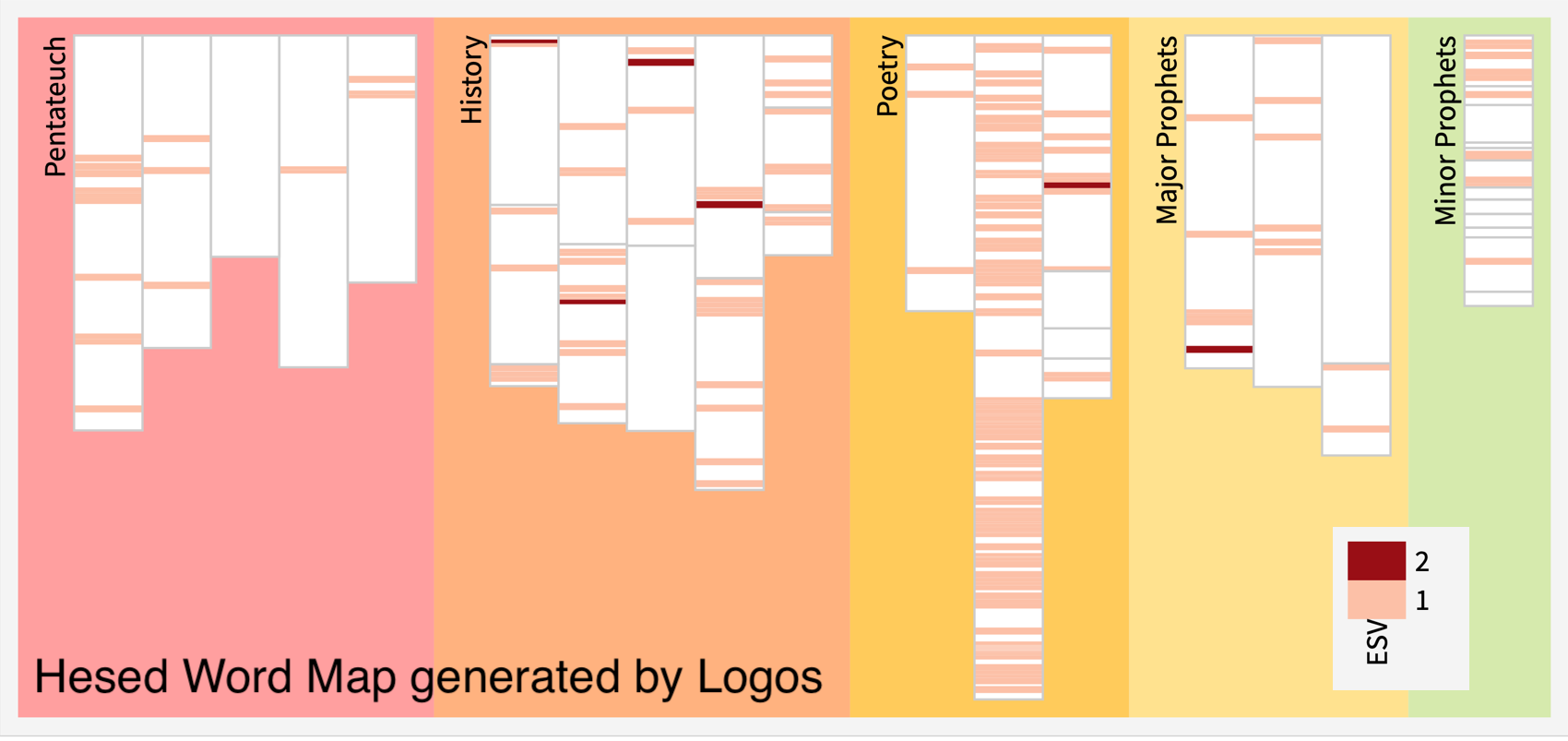
Hesed is widely distributed across all biblical literary categories of the Hebrew Bible, which is arranged differently than the Christian Bible (see word map below). It is found in the Torah 20 times, in the Prophets (Nevi’im) 53 times, and the Writings (Ketuvim) 172[3] times.[5] The twelve books where hesed does not appear, however, are Leviticus, 2 Kings, Ezekiel, seven of the twelve minor prophets (Amos, Obadiah, Nahum, Habakkuk, Zephaniah, Haggai, and Malachi), Song of Solomon and Ecclesiastes.
Hesed appears in the first book and the last book of the Hebrew Bible; from the rescuing of Lot in Genesis 19:19 to the faithful deeds of Josiah’s reformation in 2 Chronicles 35:26:
you have shown me great kindness [hesed] in saving my life. (NRSV)[6]
the rest of the acts of Josiah and his faithful [hesed] deeds in accordance with what is written in the law of the Lord. (NRSV)
The last reference reflected in the Protestant arrangement of the Bible (see word map below) closes with the prophetic oracle of Zechariah 7:9-10:
Thus says the Lord of hosts: Render true judgments, show kindness [hesed] and mercy to one another; do not oppress the widow, the orphan, the alien, or the poor; and do not devise evil in your hearts against one another. (NRSV)
Word Map: The Hesed (חֶסֶד) word map is based on the English Standard Version generated by Logos Bible software. The pink horizontal lines represent single and double instances.
The books which have ten or more references of hesed are Proverbs (10 times), Genesis (11 times), 1–2 Chronicles (15 times), 1–2 Samuel (16 times), and the Psalms (127[8] times). The majority of these books reflect the relational nature of hesed in the human realm. In Proverbs the end goal of wisdom is to teach practical relational hesed (31:26, 21:21), it is not a false front but the foundation of one’s reputation by its presence in their life (20:6, 28).
In Genesis, “kindness” is requested in prayer to God by Abraham’s servant to find a wife for Isaac (Gen 24:12, 14, 27). Then, Laban and Bethuel act in hesed (“kindness”) by cosigning their approval of Rebekah’s consent to be given as wife to Isaac.
1–2 Chronicles and 1–2 Samuel show that hesed expressed in reciprocal social acts. Saul reciprocates and excuses the Kenites from his assault on the Amalekites because they has shown hesed to Israel in ages past (1 Sam 15:6). Hushai’s “love” (loyalty?) for David is questioned during his infiltration of Absolam’s forces (2 Sam 16:17). The hesed shared between David and Jonathan is a story of deep loyalty and mutual reciprocity (1 Sam 20:8, 14–15). The Divine hesed is evidenced as well (2 Sam 15:20). Nathan enshrined the Davidic lineage and kingdom on behalf of God,
“my love will never be taken away from him” (2 Sam 7:15 NIV; 1 Chr 17:13, 2 Chr 1:8, 6:42; Psa 18:25[26]).
The Psalms contain close to half of all uses of the noun hesed (127[8] times); but it does not appear in 55% (83 psalms) of the 150 psalms. In brief, there are 23 instances in Book I (1-41), 16 instances in Book II (42–72), 14 and 13 times in Book III (73–89) and IV (90–106) respectively. In Book V (107–150), however, the frequency count skyrockets to 60 instances. Psalm 136 alone celebrates the Divine hesed in each of its twenty-six verses. It is in the Psalms that “both God and human worshipers describe God’s hesed as everlasting.”[7] Indeed,
While the term is used of both humans and God, in the Psalter it is above all a theological term that describes God’s essential character as well as God’s characteristic ways of acting—especially God’s characteristic ways of acting in electing, delivering, and sustaining the people of Israel. Hesed is both who the Lord is and what the Lord does. Hesed is an ancient term that defined for Israel who its God is.[8]
The saturation of hesed in the Psalms suggests that God’s people should always be mindful in prayer and worship of its content, its deeds, and the God who so relates to his people (Psa 36:5, 7, 10).
As pertains to the present study, it should be noted that the noun hesed only features twice in Jonah.Jonah is only one of four minor prophets where the term is employed (Hosea, Joel, and Micah). The first instance is in Jonah’s prayer of lament while in the “great fish” wherein he affirms that pagan idolators will miss out on “the grace [hasdam] that could be theirs” (2:8[9] NIV). The other instance is in 4:2 where Jonah laments what he knows about the LORD, who is “abounding in love” (NIV, warabhesed) and willing to change his mind about bringing judgment on the penitent people of Nineveh.
Semantic Range and Related Hebrew Words
As Silzer and Finley remind, “[w]ords normally have more than one meaning. The specific meaning of the word depends on its context.”[9] It is not sufficient, then, to rely on English translations (archaic or contemporary), nor to force lexical glosses to determine the meaning of a word.[10]
Brown, Driver, and Briggs groups hesedwith its verbal (hasad 2 times) and adjectival (hasid 32 times) forms, along with a few proper names, such asBen-Hesed (“son of Hesed” 1 Kgs 4:10) and Hasadiah (“Yah is Hesed” 1 Chr 3:20).[11] Lastly, is the unclean hasidah (6 times) often translated “stork” or “heron.” The root connection is believed to be due to their fond, “kind and affectionate” nature with their young.[12] This is a feature that is never appealed to in the Hebrew Bible.
The semantic range of hesed extends to the secular and the religious. In each, hesed manifests in concrete actions of goodwill, loyalty, and communal love whether in or outside of the covenant.[13] Divergent views emerge here with polarizing understandings over the meaning of hesed. Nelson Glueck saw in hesed a hardline covenantal legal obligation, H. J. Stoebe and others countered that hesedwas a free relational demonstration of loyal love.[14]
In the secular sense hesed speaks to certain “ethical norms of human intercourse” where mutuality exists that focuses on “the closest of human bonds.”[15] For example, Ruth exhibits this sense (1:8, 2:20, 3:10). Naomi blesses her daughters-in-law reciprocally, “May the Lord deal kindly [hesed] with you, as you have dealt with the dead and with me” (NRSV).
Religiously, the Divine demonstration of hesed does not function very differently than from the secular.[16] Exodus 34:1–7 provide a clear liturgical formula which demonstrates that Israel’s God abounds “in steadfast love and faithfulness” (34:6 NRSV; Psa 86:15, 89:14, Num 14:18).
The Lord passed before him, and proclaimed, “The Lord, the Lord, God merciful and gracious, slow to anger, and abounding in steadfast love [hesed] and faithfulness, keeping steadfast love [hesed] for the thousandth generation, forgiving iniquity and transgression and sin, yet by no means clearing the guilty, but visiting the iniquity of the parents upon the children and the children’s children, to the third and the fourth generation.” (Exod 34:6-7 NRSV)
This divine expression stresses the LORD’s multi-generational hesed and faithfulness. Moses now knows (33:13) that the LORD relates to his people through his benevolent and enduring nature. The words are quoted and echoed throughout the Hebrew Bible which suggests that they became formulaic or institutionalized to extoll the attributes of the God of Israel (Num 14:18, Jer 32:18, Joel 2:13, Nah 1:3, Psa 86:15, 103:8, 111:4, 112:4, 116:5, 145:8, Neh 9:17, 31, 2 Chron. 30:9)[17]
There are several words that appear frequently with hesed. They provide some dynamic appreciation for its usage in the Hebrew Bible.[18]Hesed may be done (‘asah) in concrete choices (Ruth 1:8). The LORD God keeps (shamar) and abounds (rab) in hesed (Deut 7:9, Neh 9:17). It is often associated with various nouns of “mercy” as in Psa 103:4 where the psalmist speaks of being crowned by God with hesed and rahamim(mercy). Likewise, hesed appears together with ’emet (faithfulness) probably as a hendiadys such as in Exod 34:6 and Psa 86:15.[19]
Hesed in Jonah 4:2
He prayed to the Lord and said, “O Lord! Is not this what I said while I was still in my own country? That is why I fled to Tarshish at the beginning; for I knew that you are a gracious God and merciful, slow to anger, and abounding in steadfast love [hesed], and ready to relent from punishing. And now, O Lord, please take my life from me, for it is better for me to die than to live.” (Jonah 4:2–3 NRSV)
This survey of hesed in the Hebrew Bible should help to determine the possible range of meaning for how Jonah 4:2 should be understood. Words have meaning only in context. With the above range in mind, the context appears to reflect Jonah’s usage of the formulaic hesedlanguage of Exodus 34:6–7. Instead of celebrating his God with these words, Jonah is subversively using this language to express his frustration with the LORD’s restraint against the city of Nineveh.
Jonah is using God’s own words against him. For this reason, it appears the meaning for Hebrew word hesedfound in Jonah 4:2 should be understood as “benevolent love.” Jonah knows how LORD acts out in concrete acts of hesed, these being grace, mercy, “slow to anger,” and relenting from judgment. Since there is no evidence that the LORD is in covenant with Nineveh, this supports the supposition that divine hesed may be expressed in free relational demonstrations of benevolent love. God relates to repentance with the reciprocal response of grace, mercy, patience/forbearance, relenting from judgment.
Jonah 2:8[9] further supports this view. It reveals that the prophet desires for judgment those who do not enjoy a covenant relationship with the LORD. It appears that for Jonah, idolatry is the “deal-breaker” for having a relationship with the LORD based on hesed. Yet, the irony fails to make any headway with the nationalistic prophet, since he rejected his prophetic call on the basis that he knew what the LORD would do should Nineveh repent. Both he and pagans have rejected God. Jonah is not only selfish with his relationship with his faithful God (“save me from the fish!”) but is resentful that God is “sharing the love” with foreigners (“you saved them from judgment!”).
Jonah wants his curse to come true, that those who “cling to worthless idols forfeit the grace [hesed] that could be theirs” (2:8[9] NIV). It is this forfeiture of Divine hesedwhich Jonah still desires for Nineveh, reflected in his willingness to proclaim that the city “will be overturned” (3:4) and his bitterness that it was not (4:1–11). Jonah knew that God would choose relationship over punishment. The LORD said as much (4:11). Humans, unfortunately, seem to choose punishment over relationship. Jonah shows as much.
This focused study on hesed and Jonah 4:2 brings to mind that the caricature of the bloodthirsty wrathful God of the Old Testament is just that an exaggerated cartoon (cf. Jas 2:13). As Baer and Gordon powerfully remind:
The insight that, while both anger and love are appropriate divine responses, the latter outlasts the former, is an important one for biblical theology. Wrath is a true word, a right word, sometimes an inevitable word, such passages seem to say. But God would not have it be his last word. That honor is reserved for his unfailing love (hesed).[20]
The burden of Jonah was to provide concrete witness to the people of Nineveh that God seeks to extend and establish benevolent love with all nations. As one who has experienced Divine benevolent love, Jonah should have been moved to be a spokesman for Divine benevolent love. In this he struggled and failed; nevertheless, God succeeded even if for a brief time (cf. Nahum 1:1?).
Conclusion
The meaning for Hebrew word hesedfound in Jonah 4:2 should be understood as “benevolent love.” The formulaic language of Exodus 34:6–7 is surely the theological and context for Jonah’s use of hesed. In Exodus as in Jonah 4:11, the LORD shows that he has the concern to establish and maintain a communal relationship with Israel. The benevolent concerns of preserving others and acting on the basis of moral uprightness anchor the LORD’s demands of repentance. Jonah knew if Nineveh took seriously the burden of his message, his God would become their God. They would collectively experience Divine benevolent love.
A final thought should be emphasized. Even though there are many excellent translations in the English language their primary function is simply to provide a reading text. Some significant and complex words, like hesed, merit the focused investigation which a word study provides. As developed above, hesed stresses relationships, community, loyalty and the ethical demands of love, responsibility, care, and obligation words which no single translation can do justice. Word studies reveal facets and these usages are combined into a framework. This framework provides the contours for understanding what a word means within its context, for usage determines meaning.
Endnotes
Rolf A. Jacobson, “Text, Title, and Interpretation,” in The Book of Psalms, NICOT, eds. E. J. Young, R. K. Harrison, and Robert L. Hubbard (Grand Rapids, MI: Eerdmans, 2014), 7–8.
John R. Kohlenberger III. and James A. Swanson, The Hebrew-English Concordance to the Old Testament (Grand Rapids, MI: Zondervan, 1998), v, 559.
H. J. Stoebe, “hesed kindness,” TLOT 2:449; H.-J. Zobel, “hesed,” TDOT 5:45; Robert P. Gordon, “hesed,” NIDOTTE 2:211.
Gray D. Practico and Miles V. Van Pelt, Basics of Biblical Hebrew, 2d ed. (Grand Rapids, MI: Zondervan, 2007), 105; Koehler, Baumgartner, and Stamm, “hesed,” HALOT 1:336; William L. Holladay, A Concise Hebrew and Aramaic Lexicon of the Old Testament (1971; repr., Grand Rapids, MI: Eerdmans, 2000), 111.
The Torah includes Genesis-Deuteronomy; the Nevi’im includes Joshua-2 Kings, Isaiah, Jeremiah and Ezekiel, and the Minor Prophets; and the Ketuvim includes Psalms, Proverbs, Job, Song of Solomon, Ruth, Lamentation, Ecclesiastes, Esther, Daniel, Ezra-Nehemiah, and 1–2 Chronicles.
The two English translations the Holy Bible used in this paper are the New Revised Standard Version (Nashville, TN: Nelson, 1989) and the New International Version (Nashville, TN: HarperCollins, 2011) cited as NRSV and NIV respectively.
David A. Baer and Robert P. Gordon, “hesed,” IDOTTE 2:212–17.
Jacobson, “Text, Title, and Interpretation,” 8.
Peter James Silzer and Thomas John Finley, How Biblical Languages Work: A Student’s Guide to Learning Hebrew and Greek (Grand Rapids, MI: Kregel Publications, 2004), 164.
Douglas Stuart, Old Testament Exegesis: A Handbook for Students and Pastors, 4th ed. (Louisville, KY: Westminster John Knox, 2009), 182–83.
BDB 338–39.
BDB 339; HALOT 1:336; TLOT 2:449.
IDOTTE 2:212–17; HALOT 1:336–37; TDOT 5:46–64.
R. Laird Harris, “hesed,” TWOT 1:305–06.
TDOT 5:47–48.
TDOT 5:54–55.
Nahum M. Sarna, Exodus, JPS Torah Commentary, ed. Nahum M. Sarna (Philadelphia, PA: Jewish Publication Society, 1991), 216.
HALOT 1:337.
TWOT 1:307.
IDOTTE 2:214.
Bibliography
Baer, David A., and Robert P. Gordon. “חסד.” Pages 211–18 in vol. 2 of New International Dictionary of Old Testament Theology and Exegesis. Grand Rapids, MI: Zondervan, 2012.
Brown, Francis, S. R. Driver, and Charles A. Briggs. A Hebrew and English Lexicon of the Old Testament. Oxford: Clarendon Press, 1907.
Ford, David. “Keeping up Biblical Languages while in the Ministry.” Foundations 14 (1985): 41–44.
Gordon, Robert P. “חסד.” Pages 211–18 in vol. 2 of New International Dictionary of Old Testament Theology and Exegesis. Edited by Willem A. VanGemeren. Grand Rapids, MI: Zondervan, 1997.
Harris, R. Laird. “חסד (hsd).” Pages 305–07 in vol. 1 of Theological Wordbook of the Old Testament. Edited by R. Laird Harris, Gleason L. Archer, Jr., and Bruce K. Waltke. Chicago, IL: Moody Press, 1980.
Holladay, William L. A Concise Hebrew and Aramaic Lexicon of the Old Testament. 1971. Repr., Grand Rapids, MI: Eerdmans, 2000.
Jacobson, Rolf A. “Text, Title, and Interpretation.” Pages 2–9 in The Book of Psalms. NICOT. Edited by E. J. Young, R. K. Harrison, and Robert L. Hubbard. Grand Rapids, MI: Eerdmans, 2014.
Koehler, Ludwig, Walter Baumgartner, and Johann J. Stamm. The Hebrew and Aramaic Lexicon of the Old Testament. Translated and edited under the supervision of Mervyn E. J. Richardson. 5 vols. New York: Brill, 1994–1999.
Kohlenberger, John R., III., and James A. Swanson. The Hebrew-English Concordance to the Old Testament. Grand Rapids, MI: Zondervan, 1998.
Practico, Gray D., and Miles V. Van Pelt. Basics of Biblical Hebrew. 2d edition. Grand Rapids, MI: Zondervan, 2007.
Sarna, Nahum M. Exodus. JPS Torah Commentary. Edited by Nahum M. Sarna. Philadelphia, PA: Jewish Publication Society, 1991.
Silzer, Peter James, and Thomas John Finley. How Biblical Languages Work: A Student’s Guide to Learning Hebrew and Greek. Grand Rapids, MI: Kregel Publications, 2004.
Stoebe, H. J. “חֶסֶד, hesed kindness.” Pages 449–64 in vol. 2 of Theological Lexicon of the Old Testament. Edited by Ernst Jenni and Claus Westermann. Translated by Mark E. Biddle. 3 vols. Peabody, MA: Hendrickson, 1997.
Stuart, Douglas. Old Testament Exegesis: A Handbook for Students and Pastors. 4th edition. Louisville, KY: Westminster John Knox, 2009.
Wegner, Paul D. Using Old Testament Hebrew in Preaching: A Guide for Students and Pastors. Grand Rapids, MI: Kregel Publications, 2009.
Zobel, H.-J. “(חֶסֶד, hesed).” Pages 44–64 in vol. 5 of Theological Dictionary of the Old Testament. Edited by G. Johannes Botterweck and Helmer Ringgren. Translated by David E. Green. Grand Rapids, MI: Eerdmans, 1977.





 biblicalfaith.online