The Word of God among the Denominations

Reprinted with permission from the February 2018 issue of Gospel Advocate Magazine.
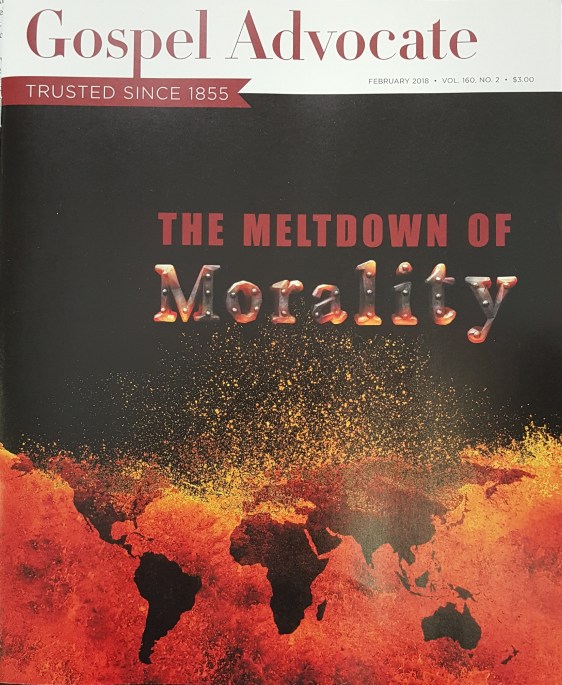
20180124_150851.jpg

Hebrews affirms, “For the word of God is living and active, sharper than any two-edged sword, piercing to the division of soul and of spirit, of joints and of marrow, and discerning the thoughts and intentions of the heart” (4:12 ESV). This is part of a warning in Hebrews, which affirms that Christians who defect from God will fail to meet their rest as their Israelite counterparts did (vv. 1-11). God holds his people —and His creation— accountable by His presence (“sight”) in the word of God (Hebrews 4:13). This is a raw incontrovertible truth.

This passage makes no caveats; it makes no attempt to remedy a distinction between God’s word and God’s presence. They are both manifested at the same time. God is involved with real life (time and space) with Israel and with Christians. God makes promises and keeps his word regarding their “rest,” and God holds His people and creation accountable to His word. God is Lord of heaven and earth and everything in between, and He holds it together by the power residing in Jesus (Hebrews 1:3; Colossians 1:17). The word of God is connected not only to the authority of God but also to His nature and how He reveals Himself to the world.

Let me say the above in a differently. Our God, who is beyond time and space (God’s transcendence), enters our earthly “realm” bound by time and space (God’s immanence) with His divinity and authority (sovereignty) intact; furthermore, God enters into relationship with His creation (Abraham, Israel, Christians) by revealing Himself in creation and in His word. God is active both in creation and in His word. Creation reveals God’s existence and hints at elements of His attributes (natural theology), but it is His word that reveals God and His “will” so that humanity can enter into covenant with God. The word of God was both proclaimed orally through particular spokesmen (patriarchs, prophets, kings, apostles), but the prophetic word was not only through oracles but also in written communiqués embedded with the same divine authority (2 Peter 1:16–21). These writings reveal the mind of God (1 Corinthians 2:11–16), His purposes and mystery (Ephesians 3:1–6), His involvement in human events (Acts 17:26–27), and the righteousness by which He will bring justice to the world (Acts 17:30–31).

To say it bluntly, the Bible is the word of God set in a permanent written form. Paul declared, “all scripture is breathed out by God” (2 Timothy 3:16). The Scripture bears the character of God and is no “dead” codebook, for it transforms every “man of God” into a competent, equipped servant (2 Timothy 3:17). The profitability of all Scripture is due to its quality as “God’s breath.” There is no pecking order between the spoken or written word of God. The inspired written word is as inerrant as God’s character. There is no source outside of the Holy Spirit-given Scripture that speaks God’s transforming work since it is the depository of the gospel’s message. What the word of God promises, God will do; what God proclaims, God’s holds His creation accountable to (1 Thessalonians 2:13).

The above may seem to belabor the point, but as anticipated by the title of this piece, we will sketch how the word of God is handled among Liberal (Modern) and Neoorthodox influences. It is essential for the church to reflect on these twentieth-century influences because dialogue is healthy, truth has nothing from which to hide, and any redefinition of biblical Christianity must be given due consideration (Galatians 1:6-7).

The following historical sketches will probably not satisfy everyone, but they will be enough to see their direction and how they redefine significant elements of historic Christian beliefs and their tendency to subvert scriptural authority.

Liberalism/Modernism

The word “liberal” is a very loaded word. It is often used with contempt to show disapproval of someone else thought to be progressive (instrumental music, expanded role of women, etc.). But this is not the historic sense of the word. Liberalism emerged in the late nineteenth century through the interplay of many players, thinkers, and philosophical trends. The influence of Liberalism, or Modernism, is seen in three levels: (1) revelation is not the final answer to reality, (2) naturalism is the key to reality and religion, and (3) since the Christian documents are built on ancient myths and superstitions, the historic supernatural claims of Christianity is immaterial. To be a “Christian” is a matter of experience and the “essence” of its teaching.

Liberalism, as an intellectual revolution, is a child of the Age of Reason (the Enlightenment). The “Age” saw the elevation of human reason over the institutional “church,” which wielded divine revelation. It was “the church” that dictated to the people what to believe about reality. Divine revelation was the final answer to determining truth and what really happened in the past. This was displaced with rationalism, scientific history (criticism), and naturalism as final answers to genuine and authentic history and truth. In essence, as Stanley Grenz and Roger Olsen point out, the maxim “I believe in order that I may understand” was turned to “I believe what I can understand.”[1] Faith was overturned by a reason informed by modern findings — thus, this point of view is called “Modernism.”

Everything that was received as genuine knowledge, now, was shaped by the natural world. This was further supported by what is called “the principle of analogy,” popularized by the liberal theologian Ernst Troelsch (1865–1923), which argued that the present is the best way to understand the past. The consequence was detrimental in the extreme on the trustworthiness of Scripture. The supernatural elements interwoven in Scripture are, by definition, myths and superstitions. This meant that there are no miracles, no supernatural interventions by God, and no resurrection of Jesus Christ. Thus, many new schools of “criticism” emerged to study Scripture with mixed results.

This naturally led to an embrace of “the essence of Christianity” so long as reason and experience allowed. “Liberals” are open to the modern findings from the natural world, open to a religious humanism and science —in particularly embracing Darwinian evolution as the process by which God created. If God exists, He could only be revealed through religious “experience.” It was also immaterial if the events of Scripture happened or not because religion is a condition of the heart. Yet, the apostle Paul makes it abundantly clear that if the resurrection event has not occurred, both our preaching and faith are in vain and we are still in our sins (1 Corinthians 15:14, 17).

Another arm of Liberalism is the demythologizing of the New Testament pioneered by the “Form Critic” Rudolf Bultmann (1884–1976). Bultmann argued that historic person of Jesus is built on untrustworthy sources. The New Testament is Christian propaganda shrouded in the imagery of the Greek myths and Roman legends. As such, they are not relevant for faith nor spiritual truth claims. It is the symbolism that matters. Today, one only need to watch the latest “history” programming to find modern theological liberals interviewed. Theological liberalism has significant questions that need to be answered, but it brings Christianity to a logical dead end.

Neoorthodoxy

The Swiss theologian Karl Barth (1886–1968) ignited a movement when he published his commentary on Romans in 1919. It charted a new theological direction away from Liberalism/Modernism. Barth (pronounced “bart”) was not fond of the misnomer “neoorthodoxy,” but his strand of thinking regarding the meaning of “revelation” and “the word of God” would rival the prevailing traditional belief held historically by the church. As a consequence, many regard Barth as one of the great theologians and the father of modern theology.

Orthodoxy affirms the teaching of historic Christian truth based on Scripture. This includes, for example, the following concepts: the inerrant inspiration of scripture, the triune Godhead, the deity and virgin birth of Christ, the historic creation and fall of humanity, the bodily resurrection and ascension of Christ, the return and final judgment. Barth argued, on the other hand, that “revealed truth” was not written, but was the outcome of an encounter (an experience) with God. Thus, instead of scripture as being the objective word of God, Barth argued for a subjective experience with God initiated by reading the Bible.

Barth was offering a completely different course of thought altogether. “Revelation” does not appear in the form of propositional truths. Arguing book, chapter, verse, or appeals to the very words of scripture is insufficient to reveal God. Revelation (the word of God), it is argued, is an “event” in which God acts in history (God’s immanence). Barth even argued that revelation is not found in natural theology (Acts 17; Psalm 19; Romans 1) but, instead, in events like the call of Abraham, the exodus, and the resurrection. Millard Erickson is spot on when he classifies Neoorthodoxy as an illumination theory divorced from an objective standard.[2]

Although Neoorthodoxy is not a unified movement, there are three interconnected witnesses (modes/forms) that shape its view on revelation.[3] First, Jesus is the word of God in the truest sense, for He reveals God in the event of His incarnation, life, ministry, death and resurrection. This is true revelation, the very gospel. Second, Scripture points to Jesus but it is a flawed human (read “errant”) attempt to provide a witness to divine revelation. It is instrumentally God’s word but not properly. Third, the proclamation within the faith community —Barth preferred “community” to church— is likewise instrumentally God’s word. The Bible, then, only becomes God’s word when God uses it to reveal Jesus Christ in the encounter, contrary to 2 Timothy 3:16.

In fact, Neo-orthodoxy is quite a popular approach to handling the Word of God, even among churches of Christ. A popular theological branch of this movement is “Canonical Criticism,” popularized by the late American scholar Brevard Childs (1923–2007). It seeks to broadly bypass much of the liberal destructive criticism of the twentieth century by accepting the texts of Scripture as literary units. Nevertheless, this point of view struggles, as did Barth’s, to embrace the Bible as a very human (errant) book while appealing to its authority for theological thought as if they were inerrant. They seek, in the words of one sympathetic Abilene Christian University professor, to “articulate a doctrine of Scripture that recognizes human flaws in it.”[4] Treating the Bible as an inerrant text is simply a form of bibliolatry.

Keeping the Faith

Today, the phrase “Word of God” means different things to different believers, and that includes preachers. Liberalism ultimately rejects a supernatural Christian faith, and is at home with amputating its historic claims of a resurrected ascended Lord Jesus, in exchange for a subjective diluted Christianity. Neoorthodoxy, on the other hand, embraces a supernatural Christian faith, but it rejects the supernatural origin, inerrancy, and authority of the Scriptures which undergird its claims. The Word of God has always been a manifestation of God’s presence in our lives, in His proclamation, and in His Scripture without pecking order. Let us join Paul who declares, “Let God be true though every one were a liar” (Romans 3:4).

Notes

  1. Stanley J. Grenz and Roger E. Olsen, 20th Century Theology (Downers Grove: InterVarsity, 1992), 17.
  2. Millard J. Erickson, Christian Theology, 3rd ed. (Grand Rapids, Baker Academic, 2013), 220–21.
  3. Karl Barth, Evangelical Theology: An Introduction, trans. G. Foley (New York: Holt, 1963), 26–36.
  4. Christopher Hutson, “Scripture as the Human Word of God: Why Faith Contradicts Inerrancy,” Lexington Theological Quarterly 44.1 (2011): 210–21. Hutson serves as a professor of ministry and missions at Abilene Christian University.

To subscribe to Gospel Advocate, click here.


Jon Meacham, the Bible, and His “Problematic Source”

It has been a few years since Mel Gibson’s movie, “The Passion of the Christ,” was all that the world could talk about. It was a situation bound to receive controversial media coverage – it just comes with the territory of religion in the media. A case in point was the February 16 issue of Newsweek published in anticipation of Gibson’s film. About a week before this publication hit the stands, Jon Meacham’s cover story entitled, “Who Killed Jesus?,” was published online on MSNBC.com in four internet pages – then later archived on Newsweek.com.

Meacham’s article feigned an attempt to evaluate Gibson’s new movie, and instead, assaulted the biblical text. He openly affirms, “the Bible is the product of human authors.” He further argues that these authors were producing religious propaganda for Christianity, and like any other literary work the Bible is plagued with historical inaccuracies. Concerning the Bible Meacham writes:

The Bible can be a problematic source. Though countless believers take it as the immutable word of God, Scripture is not always a faithful record of historical events; the Bible is the product of human authors who were writing in particular times and places with particular points to make and visions to advance.[1]

Jon Meacham, “Who Killed Jesus?,” Newsweek (2004)

This is just one quote from a number of similar statements found throughout the article. The editor of Newsweek couches his statement with liberal theological overtones. In other words, Scripture is regarded as human produced literature designed only to give morals, void of any direct involvement of God. We shall see that the problematic source is not the Bible, it is Meacham’s theological presumptions.

The Media’s Treatment of the Bible

Meacham’s view of the Bible articulates three ways the Bible is often misrepresented in mainstream American media: (1) the Bible is of sole human origin, (2) the Scriptures are unreliable historical records, and (3) the biblical sources are legendary that need specious sources to embellish the narrative to provide the “true story.” With a national circulation over 3 million plus, there is no doubt that the church, our neighbors (religious or otherwise) and our youth are influenced by this.

How shall we respond? Bible believers need to be able to affirm the following response. Although these erroneous views of the Bible are widespread, the Bible (i.e. Scripture) is beyond that of human production and consequently trustworthy, because the internal evidence of predictive prophecy, the uncanny historical accuracy, and the marvelous unity of the 66 books is of supernatural origin and guidance.

Predictive Prophecy

Predictive prophecy is one of the most powerful lines of evidence that the Bible is beyond that of human production. The specific foretelling of future events serves as an accurate brief definition. Moreover, there are at least three criteria: (1) it must be given separated by a significant amount of time, (2) there are specific details (not generalities) and, (3) 100% fulfillment must follow (not 95% etc.). As an example, observe the prophecy of the rise and fall of four world powers of antiquity given in Daniel 2 and its relationship to the establishment of the church in the first century.

The image of Nebuchadnezzar’s dream (Dan. 2:1-24) was a picture of 4 sequential kingdoms: Babylonia (605-539 B.C), Persia (539-331 B.C.), Hellenistic (331-63 B.C.), and Roman (63 B.C-A.D. 476).[2] Daniel living in the 6th century B.C. predicted the fall of Babylon and the rise of these world empires. Furthermore, in Daniel 2:44-45 the prophecy was declared that during the reign of Imperial Rome, the God of heaven would establish His kingdom for all time.

While Rome was in power Jesus was born, lived, ministered, died, and resurrected (Gal 4:4). He declared that he was going to establish His church (Matt 16:18), which in this context means His kingdom (Matt. 16:19-20; Mark 9:1). This kingdom-church would come after the Holy Spirit had come upon the 12 Apostles (Acts 1:4-8), which arrived on the day of Pentecost (Acts 2). The prophecy was fulfilled as precisely as it was given centuries in advance.[3]

Precise Historical Accuracy

Historical accuracy is another line of reasoning which demonstrates that the Bible is beyond that of human production. The book of Acts is a powerful example. Luke wrote the book of Acts, which is a chronicle of the labors of Peter and Paul as the gospel goes from Jerusalem to the entire world.

The accuracy of Acts is such that no human could have been so accurate, except for the guidance of the Holy Spirit; observe:

This companion of Paul was a careful and meticulous historian. For instance, in Acts he mentions thirty-two countries, fifty-four cities, and nine Mediterranean islands. He also mentions ninety-five persons in Acts, sixty-two of which are not named elsewhere in the New Testament. He is thoroughly familiar with the geographical and political conditions of his day. And this is really amazing since the political/territorial situation was in a constant state of flux and flow in Luke’s time.[4]

Wayne Jackson, Biblical Studies in the Light of Archaeology (1982)

Accessibility to libraries was minimal due to how few or exclusive they were, and even if they had reference works, “the events Luke was trying to chronicle had taken place – at least at the beginning – in what the people of that day would have said were remote areas of the world.”[5]

There has yet to be the historical accuracy of the magnitude of Acts and the Bible recovered from antiquity to the present.

Unity of the Scriptures

A third line of argumentation is the unparalleled unity of the Scriptures. For instance, Jeremiah 25:1 and Daniel 1:1 are among a variety of passages appealed to for the claim that the Bible is not a harmonious work. Here is the argument. Jeremiah 25:1 and Daniel 1:1 refer to the same event in antiquity, the invasion of Judah by Nebuchadnezzar.

In the third year of the reign of Jehoiakim king of Judah, Nebuchadnezzar king of Babylon came to Jerusalem and besieged it. (Daniel 1:1 ESV)
The word that came to Jeremiah concerning all the people of Judah, in the fourth year of Jehoiakim the son of Josiah, king of Judah (that was the first year of Nebuchadnezzar king of Babylon)... (Jer 25:1 ESV)

However, the date of the event mentioned appears upon face value discrepant for Jeremiah says the event happened in the 4th year of Jehoiakim’s reign while Daniel says the timeframe was during the 3rd year of Jehoiakim’s rule (see “System” chart[6]).

SYSTEM1ST Sovereign2ND Sovereign3RD
Sovereign
4TH Sovereign
BabylonianYear of Ascension1st Year of Reign2nd Year of Reign3rd Year of Reign
Palestinian1st Year of Reign2nd Year of Reign3rd Year of Reign4th Year of Reign

If the two accounts cannot be harmonized then this is a historical mistake, underscoring a purely human enterprise. The answer to this riddle, however, lies in the distinct systems of dating regnal years used by Daniel and Jeremiah. Bruce K. Waltke writes:

In Babylonia the year in which the king ascended the throne was designated specifically as “the year of accession to the kingdom,” and this was followed by the first, second, and subsequent years of rule. In Palestine, on the other hand, there was no accession year as such, so that the length of rule was computed differently, with the year of accession being regarded as the first year of the king’s reign.[7]

Bruce K. Waltke, “The Date of the Book of Daniel,” Bibliotheca Sacra (1976)

Therefore, Daniel living in Babylonia used that system, while Jeremiah employed the Palestinian method. The unity spans cross-cultural methods of communication, how wonderful! The remarkable unity is so strong that even difficult passages backfire on the critic.

As so often happens, the supposed discrepancies become evidence against the critics of the Bible.

Conclusion

The Bible is not a problematic source; however, that does not mean that it has no range of complexity. The Bible is “a faithful record of historical events,” and its principles are grounded upon historical reality (e.g. creation, the Exodus, the resurrection of Jesus, etc.). The Bible comes together like pieces of a jig-saw puzzle. It is due to overwhelming evidence like this that we affirm that the Bible is beyond human production. The “problematic source” is Meacham’s liberal perspective – it is not the Bible!

Sources

  1. Jon Meacham, “Who Killed Jesus?,” Newsweek.com (Accessed: 16 Feb. 2004), par. 6.
  2. Robert T. Boyd, World’s Bible Handbook (Nashville, TN: Nelson, 1996), 309.
  3. Jason Jackson, “How Can the Church be the Fulfillment of Daniel 2:44?,” ChristianCourier.com (Accessed: 28 Sept. 2005).
  4. Wayne Jackson, Biblical Studies in the Light of Archaeology (Montgomery, AL: Apologetics Press, 1982), 46.
  5. James M. Boice, Acts: An Expositional Commentary (Grand Rapids, MI: Baker, 1997), 14.
  6. Jovan Payes, “Ascertaining the Date of Daniel: A First Look,” BiblicalFaith.wordpress.com. This particular line of reasoning is important evidence supporting the unity of Scriptures against baseless accusations of intertextual (book to book) problems. We are not suggesting there are not difficult passages that take more depth to study, but we are asserting that this “problem” passage is an eloquent statement of intertextual unity.
  7. Bruce K. Waltke, “The Date of the Book of Daniel,” BSac 133 (1976): 326.

Revelation and Inspiration – A Look Into Their Meaning

A common misconception regarding the Bible has to do with its origin and production. There are many who allege that the Bible originated through the sole ingenuity of humanity. The statement, “the Bible was written by men,” is a common affirmation by those who often wish to reject its message. With this belief, many limit the Bible’s message to the cultural mores of its authors and affirm it to be outdated because modern humanity continues to progress in wisdom and knowledge. So the Bible is, to many, an antiquated anthology of religious instruction.

If the Bible speaks of itself as a religious resource, collected over time to give practical religious instruction with no Divine contribution, then the Bible student has no reason to be antagonistic toward this view of the Bible. However, this is not what the biblical evidence demonstrates. In fact, the testimony of the biblical evidence compels us to affirm that the Bible is beyond human production. Consequently, although many today believe –-even some of our religious neighbors-– that the Bible is the sole production of the human intellect, the Bible is the product of Divine revelation and Divinely inspired human beings.

But what are these concepts? Do they mean the same thing? How should they impact our perception of the Bible? These are the questions that will be explored here.

The Nature of Revelation

To the average church attendee, the word revelation is not foreign. Quite typically, the word revelation is employed in Bible class and in sermons; however, what does this word mean? Paul speaks of a revelation:

For I would have you know, brothers, that the gospel that was preached by me is not man’s gospel. For I did not receive it from any man, nor was I taught it, but I received it through a revelation of Jesus Christ. (Gal 1:11-12 ESV)

In this context, Paul is demonstrating the independent and authentic nature of his preaching, in contrast to those that were troubling the Galatian Christians (1:6-9). In fact, he mentions his encounter with the Apostles in Jerusalem, noting that they “added nothing” to his preaching or Gospel education (2:1-10).

There are several points of interest in this passage contributing to an appropriate understanding of revelation. The word “revelation” comes from apocalupsis, an “uncovering”; but more particular, when applied to the gospel message suggests “an expression of the mind of God for the instruction of the church.”[1] Again, revelation “has to do with that which could not be known except by direct communication from Jehovah.”[2] Consequently, revelation is God unveiling his mind to his people.

Furthermore, Galatians 1:11-12 gives us three points regarding the nature of revelation. (1) Revelation is not derived from the logistical faculties of mankind; (2) revelation is received – it is not a religious epiphany; but (3) it is received from a Divine Source – here Jesus Christ.[3]

The Nature of Inspiration

Revelation is God’s action of expressing his message to his prophets (1 Cor 2:11-16); inspiration is a related but somewhat distinct term. The apostle Paul’s second letter to Timothy provides the clearest case of what inspiration is. Paul writes to Timothy the following words:

But as for you, continue in what you have learned and have firmly believed, knowing from whom you learned it and how from childhood you have been acquainted with the sacred writings, which are able to make you wise for salvation through faith in Christ Jesus. All Scripture is breathed by God and profitable for teaching, for reproof, for correction, and for training in righteousness, that the man of God may be competent, equipped for every good work. (2 Tim 3:14-17)

As Paul encourages his young friend to have confidence in his ministry and his training, placing all confidence in the “sacred writings” (here the OT), Paul uses one of the most unique words in the entire New Testament –-used only once, theoneustos (“God breathed”).[4]

The word has often been translated as inspired, an English word that needs some clarification as to its origin. Jack P. Lewis discusses this point in Questions You’ve Asked about Bible Translations. Latin translators of the New Testament used the phrase divinitus inspirata, meaning “Divinely breathed in,” not “God breathed,” and this rendition has affected English translations for subsequent generations.[5]

The difference between the two is this: (a) “Divinely breathed in” refers to a characteristic of Scripture, while (b)God breathed” is a statement of how Scripture came to be. To capture the meaning of “God breathed” Scripture, E. Nida and J. Louw suggest that the phrase “all Scripture God breathed” be understood as: “Scripture, the writer of which was influenced by God.”[6] Ultimately, inspiration is a characteristic of every ounce of Scripture, but this is not Paul’s point here (a distinction that should be appreciated).[7]

The Relationship between Revelation and Inspiration

Although revelation and inspiration overlap in some aspects in their meaning, it is important to keep them distinct. It has been correctly noted, “all revelatory material contained in the Bible is inspired of God, but not all inspired material was revelatory in nature.”[8] Meaning, there are parts of Scripture that did not need God to reveal them, as in the case of eyewitness testimony. For example, the apostle Matthew would not have needed revelation per se to produce his Gospel account; however, he would need God’s guidance to select the appropriate narratives and emphases.

Furthermore, there are examples where Paul quotes poets (Aratus in Acts 17:28), playrights (Menander in 1 Cor 15:33), and philosophers (Epimenides in Tit 1:12). Likewise, Jude refers to non-inspired Jewish literature in verses 9 (Assumption of Moses) and 14 (Book of Enoch). C. A. Wilson explains: “Jude was probably using a current idea to teach a spiritual lesson, and the Holy Spirit has seen fit to include this particular statement in Holy Writ.”[9] Wilson’s comment on Jude is equally applicable to Paul and any other inspired writer. Inspiration secures that prophetic writers used non-biblical literature –-as noted above-– correctly.

The Impact of Revelation and Inspiration

Turning attention to the question regarding how revelation and inspiration should impact one’s perception of the Bible, it is important to recognize that God revealed and secured the accuracy of the message penned. It is vital to reflect upon the fact that what God had his prophets preach, became the substance of what God had his prophets pen (Isa 30:8-17).

When we read the Bible we are reading the product of revelation (a God given message) and inspiration (God’s message accurately reproduced), observe:

And we have something more sure, the prophetic word, to which you will do well to pay attention as to a lamp shining in a dark place, until the day dawns and the morning star rises in your hearts, knowing this first of all, that no prophecy of Scripture comes from someone’s own interpretation. For no prophecy was ever produced by the will of man, but men spoke from God as they were carried along by the Holy Spirit. (2 Pet 1:19-21)

The Scriptures are God-given, produced through the guiding hand of God into an unchangeable and enduring format –-the written. And “although God’s Word is thus not limited to books or scrolls, the prophetic words are known only because they were committed to writing.”[10] The written word is as authentic and authoritative as the spoken word.

Conclusion

Contrary to the notions of some of our religious friends, all that exists in modern times is the written word and its exposition (1 Cor 13:8-13). As disciples of Christ, we must be impressed with the importance of biblical exposition, because it the not the word of men. Instead, it is the word of God, shining fresh in our modern era to guide us through life’s tempestuous struggles.

When we hear the statement, “the Bible was written by men,” we must not be afraid. Instead, we must understand that God revealed his message to men, guided men to speak this message, and then to ultimately commit God’s message into a written format. Yes, men wrote the Bible, but these were Holy-Spirit-lead men. The Bible is truly the Word of God, no matter if there was human participation (1 Thess 2:13).

Endnotes

  1. William E. Vine, et al., Complete Expository Dictionary of Old and New Testament Words (Nashville, TN: Nelson, 1986), 2:532.
  2. Wayne Jackson, Essays in Apologetics, eds. Bert Thompson and Wayne Jackson (Montgomery, AL: Apologetics Press, 1984), 2:236.
  3. Ceslas Spicq, Theological Lexicon of the New Testament, trans. James D. Ernest (Peabody, MA: Hendrickson, 1996), 2:250.
  4. H. Wayne House, “Inspiration of the Bible in 2 Tim. 3.16,” BSac 137 (1980): 54-61. This is an engaging article on the nature, conception, and meaning of a keystone passage on the inspiration of the Bible. Cf. John H. Bennetch, “2 Timothy 3:16a – A Greek Study,” BSac 106 (1949): 187-95.
  5. Jack P. Lewis, Questions You’ve Asked about Bible Translations (Searcy, AR: Resource, 1991), 74-76.
  6. Johannes P. Louw and Eugene A. Nida, eds., Greek-English Lexicon of the New Testament Based on Semantic Domains, 2d ed. (New York, NY: United Bible Society, 1989), 1:418.
  7. Daniel B. Wallace, The Basics of New Testament Syntax: An Intermediate Greek Grammar (Grand Rapids, MI: Zondervan, 2000), 139.
  8. Jackson, Essays in Apologetics, 2:236; emphasis added.
  9. Clifford A. Wilson, New Light on New Testament Letters (Grand Rapids, MI: Baker, 1975), 103.
  10. Ken Cukrowski, Mark Hamilton, and James Thompson, God’s Holy Fire: The Nature and Function of Scripture (Abilene, TX: Abilene Christian University Press, 2002), 28.

This is a reformatted and slightly expanded version of the article originally published in The Words of Truth (Montgomery, AL: 6th Ave church of Christ).