
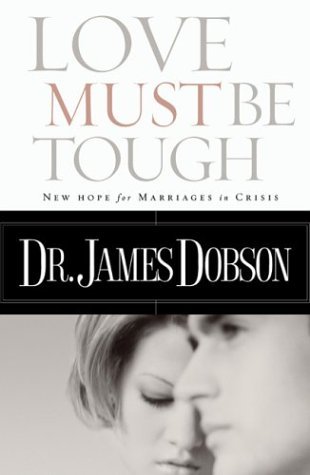
James C. Dobson, Love Must Be Tough: New Hope for Families in Crisis (1983; repr., Tyndale Momentum, 2007), hardback, 238 pages.
Dr. James Dobson (1936-) is a well known and established licensed psychologist (Ph.D., University of Southern California), who has addressed social and family issues from an evangelical perspective for about 40 years. He held a teaching post at USC’s School of Medicine as Associate Clinical Professor of Pediatrics and was on staff at the Children’s Hospital in Los Angeles for many years. And he served on a number government advisory panels and testified at several government hearings.[1]
Dr. Dobson is perhaps known more for the ministry network Focus on the Family he founded in 1977 through which he has provided a steady evangelical voice with regards to social issues on radio, television, print, and online. Since 2010, however, Dr. Dobson formally transitioned away from Focus on the Family and established another multi-media ministry venture, Dr. James Dobson’s Family Talk.
Love Must Be Tough to Save Families
The book under review, Love Must be Tough, is not a new contribution. Dr. Dobson wrote it in 1983 and because of its popularity, it is often reprinted. I read this book as part of a family ministry class. I found it to be an insightful and highly useful volume designed to provide a strategic proposal to help restore marriages struggling under the burden and crisis of marital infidelity. Dr. Dobson argues that his strategy strikes at the heart of the recovery from marital infidelity better than those provided by the then-current advice by counselors and literature.
What appears to be at the heart of the problem lies at a spouse’s passivity and allowance for the other spouse to have all the control in the relationship. This imbalance is subversive to the marriage. Dr. Nancy M. Rockstroh, M.D., who often recommends Love Must be Tough agrees:
when the balance of power switches so that one person has undue control, the potential for abuse of that power becomes imminent. Once individuals have the opportunity to do anything with the tacit acceptance of their partner, they have carte blanche to engage in destructive patterns of behavior without fear of losing the benefits of the relationship.[2]
Nancy Moultrie Rockstroh, “Love Must Be Tough: Proven Hope for Families in Crisis,” Primary Care Companion to the Journal of Clinical Psychiatry (2000)
It is not just theories or bad counseling which Dobson believes to be destructive and subversive to marital restoration. Marriage culture also is to blame, in particular, those which are so co-dependent that there is a loss of self-respect and the mutual respect which should exist within a marriage. Or, as Dobson argues, what marriages in crisis really need is the application of a simple principle: love must be tough.
Book Overview
Dr. Dobson develops his thesis by first showcasing the destructive nature of common approaches advised for reclaiming an unfaithful spouse. But, perhaps most instructive is the fact that he shares real experiences of infidelity and how the wounded spouse attempts to restore the marriage. According to Dobson, counselors tend to advise self-loathing, fault assuming, affair indulgent, and spiritually careless strategies. But even still further, wounded spouses often attempt to regain their unfaithful spouse through strategies (planned or not) that can be summed in the phrase: a complete lack of self-respect and identity (Panic, appeasement, etc).
This behavior must be stopped. Dobson argues strongly that this lack of self-respect and identity is a leading contributor for both the circumstances for a spouse to become unfaithful and for the pushing away of a cheating spouse. Dobson explains this character “defect” can be permissive as it “allows” flirtation with a potential lover, or it passively “allows” the spouse to continue dangerous relationships with a would-be lover. And once suspicion (or infidelity) occurs, the concerned spouse begins to tighten their grasp upon their beloved in order to keep them, but this often times pushes them farther away. The distrusted spouse feels caged and develops a need to escape. The spouse needs freedom. To further aggravate the situation, the worried partner who cannot feel complete without their spouse loses their individual identity and panics only to try to appease their unfaithful spouse. This behavior feels more like constrictions around the unfaithful spouse’s neck, and continue to fuel the desire for freedom (extramarital freedom).
Case upon actual case is rehearsed as testimonial evidence to support Dobson’s thesis that love must be tough. Consequently, if Dobson is right that popular counseling has it wrong in its strategic opinions, and that a consistent lack of self-respect and identity provide the stimulus for infidelity, then a new approach must be considered. Dobson argues therefore that the marriage relationship must include a number of applied principles. Despite the concept of “union” in marriage, each partner must exist with their sense of individuality intact, and each partner must be able to respect themselves. This sets forth the building blocks for a healthy sense of mutual accountability needed in a marriage that will allow it to thrive.
Thus, should signs of a potential extramarital affair begin to loom in the distance, a perceptive spouse can be grounded in their self-respect and identity, provide strong warnings set forth in love, self-respect, freedom, and independence (example: “I love you, but if you continue this course, then I will leave”). Spouses must be able to hold their ground, despite loving their spouse and not wishing them to depart. This “willingness to end a relationship,” says Dr. Rockstroh, “is the very essence of freedom and independence.”[3] Yet, this principle must be, according to Dobson, practiced with caution (see below).
Chapter 12 provides a timeline of eleven benchmarks showing how good marriages end in abandonment, adultery, divorce, and guilt. Side-by-side, the storyline of a husband and wife is unfolded. It shows how emotional starvation experienced by a loving spouse can lead to frustration and depression, only to work the heart into fertile soil for an extramarital affair. Preoccupations, such as work, only blind them of their beloved’s pain and that they too have contributed to this isolation. Eventually, an affair does ensue and is discovered. At this point, Dobson argues, the marriage can still be saved if both partners want to use “tough love” to regain themselves and restore their marriage. In this scenario that Dobson narrates, the cheating spouse leaves and a divorce is finalized. As in many cases which Dobson is aware of, at the end, the love affair turns mundane, the enabling but wounded spouse lives in ignorance of their contribution and the guilt for the children’s situation overshadows their heart.
Here Dobson makes one more appeal to confront misunderstandings that affect marital happiness. He appeals to the fact that culture essentially lies to our young ladies and young men in the aspect of who provides the happiness in the home. For the women, the lie is simple but devastating: “that marriage is a lifelong romantic experience.”[4] Moreover, the husband is entirely responsible for making this a reality; hence, women enter marriage with unrealistic expectations. And when these expectations are not met, it is her husband’s fault. For the men, the lie is relatively clear: “his only responsibility is to provide materially for his family.”[5] The love must be tough principle affirms individual responsibility for one’s happiness, and each spouse must play a role in creating marital happiness.
Of many of the valuable aspects of the book, is Dobson’s honesty that as much as the love must be tough principle is valuable and helpful, it can also be dangerously misapplied. The development of self-respect, individual identity, of creating a culture of freedom, of forgiveness, and many other traits can be so developed to the point where the wounded spouse uses them to destroy the marriage. For example, a person may become so independent that they want nothing to do with their spouse. Another spouse might defend their self-respect to the point where they become so outspoken that there is no mutual accountability. Dobson, therefore, warns against running wild with this strategy.
A Critique on Dobson’s Divorce and Remarriage View
There is no debate that Dr. Dobson’s book is valuable; however, his discussion on divorce and remarriage is perhaps the most egregious section in an otherwise well-developed book.[6] To Dobson’s credit, he inserts a disclaimer that he knows some Bible students will disagree with him. I register here as one who finds Dobson’s discussion of what constitutes a scriptural divorce and remarriage completely lacking biblical support.
Dobson affirms three matters to keep in mind in the discussion of divorce and remarriage. We agree with his discussion on what constitutes adultery in Matthew 19:9 so we will focus on the second passage discussed.
First, Dobson alleges that 2 Corinthians 5:17 sanctions the notion that it “includes divorce prior to salvation,” leading him to conclude:
when the marriage and divorce occurred prior to salvation, I believe God grants His “new creation” the freedom to remarry.[7]
James Dobson, Love Must Be Tough: New Hope for Families in Crisis (1983)
Dobson’s view hinges upon a phrase in this passage, namely “old things.” “Old things” as part of the “new creature” is typological imagery that supports the real emphasis of the verse, namely, that of a new creation. The person –not his/her marital situation– is made “new.” Paul had said previously to the Corinthian church that some of them had been adulterers (1 Cor 6:9-10) but not anymore because of their conversion (1 Cor 6:11). They changed their behavior. Conversion requires a change in behavior (Acts 2:38), it is not a simply a status change.
The third discussion Dobson enters is based upon a misrepresentation of 1 Corinthian 7:25-40. Dobson alleges that if a Christian is abandoned the believer has a right to remarry. Maybe there are other circumstances involved in the abandonment (i.e., adultery), but that is not discussed in this passage. Paul, however, argues that the abandoned spouse is not under an obligation -enslaved- to follow the departing spouse. The emphasis here is about fidelity to God’s sexual and marital laws (cf. 7:1ff). In fact, earlier in the passage Paul addresses “the married” and the potential of a legal separation,[8] to which he clearly gives two options: remain separated or be reconciled (1 Cor 7:10-11).
These are significant drawbacks from an otherwise really helpful book. I further understand that many would disagree with my critique of Dobson’s view. Still, neither conversion nor mere abandonment is biblical grounds for divorce and a subsequent remarriage.
Concluding Thoughts
In the final analysis, the book is generally sound and very helpful. But, because of the material on divorce and remarriage, I would recommend an alternative to sharing its articulation Dobson’s love must be tough strategy. Perhaps create a series of handouts (with due credit) with the strategies listed and illustrated. Or, recommendations to people well versed in the scriptural teachings on marriage, divorce, and remarriage. The material on self-worth and boundaries is the relevant and helpful element of Dobson’s work.
Dobson tackles a hard issue but the counsel he offers is advantageous. It is dated somewhat. For that reason, I would use Love Must Be Tough as a supplemental work to the more current volume by Henry Cloud and John Townsend, Boundaries in Marriage.[9] “Boundaries,” as Cloud and Townsend articulate, help to develop the issues Dobson is concerned with: a healthy sense of identity, personal responsibility, and mutual accountability. So, in the end, I offer a limited recommendation of Dobson’s book for the counselor and minister.
Endnotes
- “James Dobson,” Wikipedia.org.
- Nancy Moultrie Rockstroh, “Love Must Be Tough: Proven Hope for Families in Crisis,” Primary Care Companion to the Journal of Clinical Psychiatry 2.6 (Dec. 2000): 229.
- Rockstroh, “Love Must Be Tough.”
- James Dobson, Love Must Be Tough: New Hope for Families in Crisis (1983; repr., Waco, TX: Word, 1996), 176.
- Dobson, Love Must Be Tough, 176.
- Dobson, Love Must Be Tough, 129-33.
- Dobson, Love Must Be Tough, 130.
- It is documented by R. L. Roberts, Jr., very clearly that the passive phrase “to be separated” (Grk. choristhenai) in these verses is a “technical expression for divorce” as it exists in ancient legal documents before and during the apostolic era (“The Meaning of Chorizo and Douloo in 1 Corinthians 7:10-17,″ Restoration Quarterly 8.3 [1965]: 179-80). Consequently, those that only see a “separation” as we commonly conceive of it as temporary “space” between spouses are unreasonably limiting the meaning of this word here.
- Henry Cloud and John Townsend, Boundaries in Marriage (Grand Rapids, MI: Zondervan, 1999).

 biblicalfaith.online