Defining Gospel: A New Testament Glance

Words are strange creatures. Often, they mean what we want them to mean. It has been said that words are the patterns by which people think. Since words frame our thinking world, it is really important that we correctly shape our ideas with properly defined words. In the case at hand, understanding the meaning of the Christian word gospel depends on understanding how the word gospel is presented in the New Testament.[1] 

The English word Gospel most likely derives from the Old English word gōd spell, which meant “good story” or “good message.” William Deal points out that gōd spell meant a good mystery, doctrine, or secret, something hidden which was being brought out.[2] And the gospel is definitely a mystery revealed (Ephesians 3:1-14). The words translated gospel is, however, roughly the result of the combination of two Greek words: eu (good) and angelia (message, news). It roughly approximates “a good message,” but even this is not enough to tell us how the word is shaped by the New Testament.

Within the 27 New Testament volumes, the gospel is connected to three focuses: (1) “the gospel” as a message (euangelion), (2) the action of “preaching/bearing the gospel” (euangelizo), and (3) those individuals who proclaim the gospel (euangelistes). These words have a combined total of 133 instances, scattered over 20 of the 27 New Testament books.[3] The only books that do not use these words are the Gospel of John and his three Letters, and James, 2 Peter, and Jude. These books tend to use other words which emphasize the same ideas (cf. truth, proclaiming, hope, light, the message, etc.).

Let us consider a few lines of thought that will help us define and shape an accurate understanding of the gospel message.

How do you Define Gospel?

First, the gospel is not the result of religious evolution and philosophical development. In the ancient world, a number of religions and beliefs often blend into each other or break out into their own religions. For example, the far eastern religions such as Hinduism, Buddhism, and Confucianism resulted from a philosophical and religious reaction to their view of social order (the caste system) and how to become one with the ultimate reality of the universe. This development of ideas is not along parallel lines with how the gospel message is defined in the person of Jesus of Nazareth.  

Second, the gospel is not the result of social progress. One of the modern concerns in the industrial world is that of social concern for equality. These social concerns tug at our values, and our ethics. Equality is the hallmark (gospel) of the modern social order, and because of it, we are seeking ways to save everything. Yet, as the late atheist and satirical comedian George Carlin quips against this elevation of self-importance:

Save the trees, save the bees, save the whales, save those snails.” And the greatest arrogance of all: save the planet. […. explicit deleted] Save the planet[?], we don’t even know how to take care of ourselves yet […][4]

I would argue that here inlays the problem of a socially derived “good news”; The gospel must be defined by other means. Humanity needs help from the Creator.

Third, the gospel is the result of divine revelation (Galatians 1:11-17). The authors of the Bible in general and the New Testament in particular assume and argue that their religious instruction is not the result of human philosophy or development. For example, Paul affirms his source is Jesus Christ:

For I make known to you, brethren, as touching the gospel which was preached by me, that it is not after man. For neither did I receive it from man, nor was I taught it, but it came to me through revelation of Jesus Christ. (1:11–12).[5] 

The contrast between “not after man” and “through revelation of Jesus” is clear. The gospel of the New Testament is, by definition, from God and not from the insights of humanity (1 Corinthians 2:1-16). 

The New Testament Gospel

But how should we understand the word gospel? In its basic sense, the word gospel is focused on something positive being announced (military victory, news, etc). This meaning is older than in New Testament times but it is found in a few verses. For example, Paul writes to the Christians in Thessalonica about the good feelings they felt for him and his ministry, he writes,

when Timothy came even now unto us from you, and brought us glad tidings [euangelisamenou] of your faith and love, and that ye have good remembrance of us always, longing to see us, even as we also to see you. (1 Thessalonians 3:6).

The report of Timothy was positive, a good report, an enjoyable announcement (cf. Galatians 3:8, proeuangelizomai).

More significantly, when the Gospel of Mark —a biography of Jesus’s ministry— opens we read, “The beginning of the gospel of Jesus Christ, the Son of God” (Mark 1:1). This tells us something about the story of Jesus. It starts out by anticipating a message to embrace as a celebration and victory (Matthew 11:5). The content of the gospel not only includes the ministry and message of Jesus, but also his rejection, crucifixion, resurrection, and glorification of Jesus.

The four Gospel Accounts (Matthew-John) are so named because they provide the “building blocks” of what is to be proclaimed as the message of the gospel (Mark 1:14-15), by those whose role it is to proclaim it and bear it to the world (Acts 21:8; Ephesians 4:11; 2 Timothy 4:5; Mark 16:15). At the beginning, Jesus proclaimed a message based upon the kingdom of God, repentance, his role as the son of God, and the gospel’s role to change people’s lives (Matthew 4:23; 9:35). Later, after the resurrection of Jesus, the gospel is to be proclaimed on behalf of Jesus throughout the world (Matthew 24:14, 26:13; Colossians 1:23).

It is not surprising, then, to see the apostle Paul in Athens described by onlookers as one who “preached Jesus and the resurrection” (Acts 17:18). Paul made it a ministry goal to “to preach the gospel, not where Christ was already named, that I might not build upon another man’s foundation” (Romans 15:16, 19-20). Indeed, he explains his “aim” as a sense of indebtedness to mankind to share this message (Romans 1:14-15). For this reason, he affirms clearly:

I am not ashamed of the gospel: for it is the power of God unto salvation to every one that believeth; to the Jew first, and also to the Greek. (Romans 1:16-17)

Paul would seek to pass along this conviction to his protégé Timothy (2 Timothy 1:8-10). It is the responsibility of every Christian to boldly share this victorious good news (2:2). 

The Earliest Gospel “Statement”

Among the New Testament writers, the earliest statement of the content of the preaching of the gospel is found in Paul’s words in 1 Corinthians 15:1-11. Paul’s activity in ancient Corinth is around the early fifties of the first century AD, and this letter is dated to this timeframe no later than AD 55.[6]

In this letter, Paul presents a lengthy discussion —and definition— of the gospel message that he preached. The passage of 1 Corinthians 15:1-11 can be outlined based upon key elements of the gospel message:

(1) the preaching of the gospel word provides salvation to the believer (15:1-2),

Now I make known unto you brethren, the gospel which I preached unto you, which also ye received, wherein also ye stand, by which also ye are saved, if ye hold fast the word which I preached unto you, except ye believed in vain.

(2) the compelling force of the gospel is from the foretelling of events fulfilled in Jesus’ death, burial, and resurrection (15:3-4),

For I delivered unto you first of all that which also I received: that Christ died for our sins according to the scriptures; and that he was buried; and that he hath been raised on the third day according to the scriptures;

(3) the gospel is based on the eyewitness testimony of those who witnessed Jesus, resurrected bodily from the dead (15:5-8), and

and that he appeared to Cephas; then to the twelve; then he appeared to above five hundred brethren at once, of whom the greater part remain until now, but some are fallen asleep; then he appeared to James; then to all the apostles; and last of all, as to the child untimely born, he appeared to me also.

(4) the gospel is based upon God’s offer of unearned grace and humanity’s response of faith (9-11).

For I am the least of the apostles, that am not meet to be called an apostle, because I persecuted the church of God. But by the grace of God I am what I am: and his grace which was bestowed upon me was not found vain; but I labored more abundantly than they all: yet not I, but the grace of God which was with me. Whether then it be I or they, so we preach, and so ye believed.

The passage is significant, first, because Paul has an early and authentic message. Paul even “checked in” with Peter in Jerusalem and at some point compared notes regarding the gospel (Galatians 1:18). Second, the outline of this passage is significant because of its point-by-point details. Thirdly, it shows that the gospel bridges the gap between earth’s history and God. The victory message of the gospel is based upon the supernatural events firmly established in the historical life, ministry, death, resurrection, and exaltation as Lord and God (John 20:24-29).

Concluding Thoughts

In short, to understand the gospel one must understand Jesus, the purpose of his teaching and his ministry, the death-burial-and-resurrection of Jesus, and the life-changing message of the kingdom of God. It is not insignificant to point out that gospel obedience is described as an imitation of Jesus’ death, burial, and resurrection in baptism. In this way, the gospel is lived out in the Christian life manifested in obedience (Romans 6:1-10; Colossians 3:1-3).

Endnotes

  1. See, Doug Burleson, “Gospel,” in One Word Study Guide, eds. Chad Landman, et al. (Mt. Juliet, TN: Mt. Juliet church of Christ, 2016), 134-36. Burleson provides a perfect snapshot of “good news” in the Hebrew Bible (besorah) and the New Testament (euangelion).
  2. William S. Deal, Pictorial Introduction to the Bible, 3rd ed. (1982; repr., Peabody, MA: Hendrickson, 1997), 246.
  3. Figures worked out based upon calculations from the Logos Bible platform’s “Bible Word Study” for euangelion (76), euangelizo (54), euangelistes (3).
  4. George Carlin, “The Planet is Fine” routine in the 1992 HBO George Carlin: Jammin’ in New York Comedy Special (Cable Stuff Productions).
  5. All Scripture references are from the American Standard Version unless otherwise noted.
  6. This is argued on the basis of two points:
    First, the Book of Acts recounts his trip to Corinth (18:12-17), during which time he stands for religious accusations before the tribunal of the governor (proconsul) of Greece (Achaia), one L. Junius Gallio. Because this was a matter of Jewish religion and not Roman law, Gallio lets Paul go. 
    Second, an inscription was found from Delphi with Gallio’s name on it. Most likely it refers to his proconsulship from July 51 to July 52, which means Paul’s year-and-a-half stay began a year or so before this time (ca. 50-51). This is often regarded as one of the surest historical points of New Testament chronology. A few years later, Paul writes to the Corinthians. This would be no later than 55 AD. See, Everett Ferguson, Backgrounds of Early Christianity, 3rd ed. (Grand Rapids, MI: Eerdmans, 2003), 545-86. For an online source see Mark Cartwright, “Corinth,” Ancient History Encyclopedia.

This is a reformatted and expanded version of the article originally published in The Glendale Gleaner (Newbern, TN: Glendale church of Christ).

The Public Reading of Scripture: Six Practical Suggestions

Reprinted with permission from the March 2017 issue of Gospel Advocate Magazine.

A vital element to the worship assembly of the body of Christ in the first century was the reading aloud of the Scriptures (1 Timothy 4:13; Acts 13:15). Today, it is probably hard to imagine a time when God’s word was accessible only when assembled with God’s people; it was a communal experience. The proliferation of Bibles today has truly made reading Scripture an individualized practice; yet, this has not always been so. In fact, the meaning of “church” (ekklesia; “an assembly”) presumes a people gathered to hear, to commit to, and to act upon the Word of God (Matthew 16:18; Deuteronomy 4:10-11; 31:9-13). Thus, hearing God’s Word is part of who we are as “the church” (Acts 11:26; 14:27).

The church needs to elevate the importance of the Scripture reading assignment in our assembly (Act 13:15; 2 Corinthians 3:14). There is a tendency to be too casual about this assignment. Perhaps it is because we take literacy for granted, though the capacity to read words is not the same as understanding the words being read. In this connection, we may then take for granted that anyone can read the Scripture aloud to the church. In some societies, reading is still regarded as a technical skill, much as it was in Bible times.

If reading the Scriptures will make a child of God “complete, equipped for every good work” (2 Timothy 3:17 ESV) when read for private devotion, then the same God-breathed writings read aloud will provide the same effect for the congregation. In the Scripture reading, God is speaking to His people. For this reason, the public reading of Scripture is a crucial element of the worship assembly and should not be taken casually or lightly.

A Note on the Context

In fact, Paul anchored to this very core principle when he wrote to Timothy to provide a strategy for the faithful to protect themselves from a departure from the faith, which will consist of Christians “devoting themselves to deceitful spirits and teachings of demons” (1 Timothy 4:1). The antidote against “irreverent, silly myths” (4:6-7) and any possible competitors to divine revelation is the healthy teaching from God (4:13). Public reading of Scripture inoculates against false teaching and invites faithful discipleship and commitment to God (Exodus 23:22; 24:7). It syncs us up with God.

Paul makes similar requests in other letters to the churches of the first century. When detailing the unveiling of the mystery of Christ, Paul anticipates and expects the church to share his understanding (Ephesians 3:4-6). After he writes on the supreme role of Christ in redemptive history, he expected the Colossian congregation to letter swap with Laodicea (Colossians 4:16). And, to the Thessalonians, he was quite strong when he placed “an oath before the Lord to have this letter read to all the brothers” (1 Thessalonians 5:27), for through the reading aloud of his letters they would be taught (2 Thessalonians 2:14-15). And in the final revelation of Jesus, the apocalyptic portrayal of divine victory through the gospel is framed as one that must be read aloud and safeguarded against addition and omission (Revelation 1:3; 22:16-19).

Reading Scripture aloud can bring the church into sync with God’s word. The more exposure, the better our biblical literacy; then, ideally, the healthier our churches will become. Let us switch gears, now, to provide practical suggestions for this powerful act of reading Scriptures aloud in our worship assembly.

Six Suggestions for Reading Scripture Aloud

There must be a spiritual gravitas connected to reading Scripture before the assembly. I had a mentor, Don W. Hinds, that would stop me when I misread a passage aloud. He would use the adage, “take heed how you read,” to instill in me the importance of properly reading the biblical text aloud. I would like to use this as a refrain as we consider some practical guideposts for reading the Scriptures aloud when the church is assembled for worship — although these suggestions can be applied in various settings of church life.

Furthermore, in many congregations, those who manage or arrange the various elements of the worship assembly (deacons, elders, etc) should seriously consider the points below as they select public readers of Scripture. We are worshipping God and engaging in spiritual and divine matters, we are not merely filling a roster. God’s word must be the centerpiece of our worship.

First, the reading should be met with a respect for proper pronunciation and performance. This is the “oral” spiritual heritage of God’s people, to hear and understand God’s word (Nehemiah 8:1-8). Not only should one practice to read clearly and distinctly, but some types of Scripture (genre) require an element of performance (cf. Psalms). For example, we should not read a psalm of lament (Psalms 51) as if it were a genealogy. Take heed how you read.

Second, we should consider the verbal skill set of those who will read before the assembly. The goal is to instill an understanding of God and to invite the church to obedience. There is no verse that prohibits individuals with speech problems from publicly reading Scripture. We should both be sensitive and inclusive. Fortunately, audio technology facilitates what requires loud speaking in other settings. Still, as long as the public reading reaches its goal then it has accomplished its purpose. Take heed who will read.

Third, the reading selection should be long enough to understand the message. This is especially true when the selection is independent from the sermon. Some congregations may design their readings to go through a book (Psalms) or a large section of Scripture (Major Prophets). Other times, they are connected to the sermon. The readings must be of sufficient length to provide context and understanding and should have a natural and intended connection to the worship service. All things being equal, we may ask, “why read from the Song of Solomon when the sermon is on the ‘second death’ of Revelation?” Take heed what you read.

Fourth, the readings must be the Scriptures free from alteration. From time to time some like to add a few impromptu thoughts in connection with the reading of the Scripture. The points may be very excellent, but they run the risk to be of another variety. It is important to keep to the task at hand, which is to read the assigned portion of Scripture. There are many reasons for this. The most significant reason is to elevate the word of God over the words of men. As Revelation 22:18-19 warns, the text must be read without omission and addition. Take heed that you read.

Fifth, the reading of Scripture must be purposeful. There should be communication before hand to prepare those who will read aloud in worship. Sometimes we can displace others when we lean upon “good readers” in a pinch. With a purposeful schedule, we can give enough notice so that our readers can prepare, become familiar with the text, and develop a comfort level. Preparation and practice are the best helps to reduce “stage fright.” Take heed before you read.

Sixth, the reader should not cause a distraction by what they wear. It is true that God seeks and looks at the heart (1 Samuel 16:7; Matthew 15:8), but one should dress for the spiritual occasion (Matthew 22:11-14). While attire may sometimes be a distraction, it is more important that the reader’s lifestyle should not be a distraction. If those who pray in assembly should have “holy hands” (1 Timothy 2:8), what of those who read Scripture. Paul told Timothy that he should be an example; this would make an additional influence when he would read aloud the Scriptures to the church (1 Timothy 4:12). Take heed by whom you read.

Concluding Thoughts

The public reading of Scripture was an essential component of the first-century worship assembly. If in today’s time, the church seeks to be in conformity with the early worship practices of the New Testament church, then it will seek to incorporate this practice and develop those who will read. Moreover, the church will grow when she integrates the three-fold instruction given to Timothy: the public reading of Scripture, the exhortation, and the teaching (1 Timothy 4:13). In a day and time when so many church groups are seeking new and innovative methods to “enhance” worship, the age-tested and inspired method to read aloud God’s word must be in the forefront of our worship assemblies. Blessings to the reader, and blessings to the hearer.

Jovan Payes preaches for the Highland Church of Christ in Bakersfield, Calif.

To subscribe to Gospel Advocate, click here.


Book Review: Relaunch

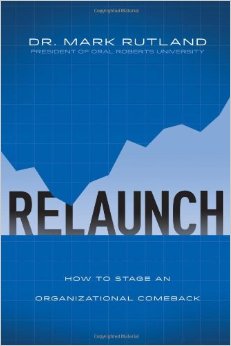
Relaunch - Rutland - Cover

Mark Rutland, Relaunch: How to Stage an Organizational Comeback (Colorado Springs, CO: Cook, 2013), hardback, 206 pages.

A walk in the clearance section (because I hate paying full price) of my local Lifeway Christian bookstore led me to the present volume on leadership. The price, packaging, and presentation of this David C. Cook book persuaded me to purchase it. I am very thankful I did and now I feel I’m playing catch-up on leadership insights from Dr. Mark Rutland.

Dr. Mark Rutland has 13 books under his belt that can be obtained in many formats, and he also maintains an active teaching, humanitarian and blogging presence through his National Institute of Christian Leadership and Global Servants organization. In Relaunch, Rutland provides insights into his ministerial roles as Associate Pastor (Mt. Paran Church of God) and Senior Pastor (Calvary Assembly of God), and his presidential posts (Southeastern University, Oral Roberts University). These experiences serve as a springboard to show his credibility to speak to leaders about the core issues of turnaround leadership in a variety of settings.

ReLaunch: A Survey

ReLaunch is about turnaround leadership. It is comprised of 14 chapters, arranged in three parts followed by an epilogue all wrapped within 206 pages. In Part 1 (chapters 1-4), Rutland casts a common-sense vision for understanding the intangible nature of leadership. Leadership is, in a nutshell, the art and skill to understand an organization’s goal and dream and to connect all its actions into realizing the dream, so that when the leader’s work is “done” the organization is in a better position for the next person to lead. Leadership then is to make the dream a reality by being the everyday “driving force” behind this achievement.[1] Here, Rutland spends some time surveying key experiences within three organizations’ turnarounds (Calvary Assembly of God, Southeastern University, and Oral Roberts University).

In Part 2 (5-11), Rutland articulates and sets forth seven steps that are critical to turnaround leadership within a failing organization. Turnaround leadership, according to Rutland, cannot be accomplished without facing institutional reality and communicating the organization’s vision relentlessly from top to bottom (Steps 1-2). Turnaround leadership must focus on alignment for the organization within the correct niche market, by its message, and through the most effective medium (Step 3). This requires creating an executable strategy by finding which system within your organization that can make the most impact (Step 4). Rutland demonstrates that in a turnaround you must either restore or create the organization’s dream and this is done by shifting its internal culture so that its members can support the organization’s promise to the world (Step 5); moreover, this fuels the need to keep an eye on quality, which is to say it that the organization clearly delivers what it publically promises (Step 6). Finally, Rutland underscores the psychological importance of measuring and celebrating success within a turnaround because these actions promote meaning and value, and generate higher levels of positive energy within the members of the organization as they drive towards turnaround (Step 7).

In Part 3 (12-14), Rutland closes ReLaunch with a section on how to build a turnaround team. I believe these chapters alone would be worth the purchase of the book. The premise of building a turnaround team is to have the proper alignment within the organization. In such a case, adding new members (“hiring”) who fit the goals, vision, and culture of the turnaround is critical because, otherwise, you are starting “the old cycle over again.”[2]  This boils down to finding the right person, at the right time, for the right reason (“job”). Rutland spends time developing a system he uses to put the right people in the right roles (his helpful Finder-Binder-Minder-Grinder system). Unfortunately, the changes which take place during a turnaround are hard for the established members (employees, board members, volunteers, etc.) of the organization. Rutland discusses, then, the last resort a turnaround leader must face when preexisting employees can not adjust – he talks about the troubling art of firing. Rutland shows compassionate insight. It is important to clearly promote your new vision and continue to hold everyone accountable to this turnaround goal to recapture the old dream (or create a new one). He counsels, “Some can make the change. Some can be retrained. But not everyone can make the turn.”[3] Finally, Rutland addresses the importance of forming a board and sketches the difference between an emotional (undependable) board, a legalistic (robotic; holds to if-then thinking) board, and a holistic (balances the tensions found in emotional/legalistic thinking) board. Rutland praises those boards which respect their limits, support their leader’s role in the organization, and “empowers” their leader to do their best.

ReLaunch ends with the Epilogue where Rutland speaks to the inner life of the turnaround leader. It is honest, frank, and interwoven with experience of a leader who has “nosedived” and had his own inner turnaround within his life and family. Rutland warns that a leader must keep pushing forward and never fall into the trap that defeat or victory are final experiences. Also, leadership is costly because it is all-consuming: “There is always a cost.”[4] I found a sense of great depth when Rutland discusses “the most important truth” he has learned: to be a healthy leader, “stay free in God’s hand.” In other words, be willing to take the roles you are “called” into, execute its duties faithfully, but understand that you do not need to have it; moreover, learn that you can be “good” (acceptance) if you have to leave that role. Your identity should not be tied to your role, but instead, tied to your God.

Strengths and Weaknesses

ReLaunch is about turnaround leadership and Rutland succeeds in providing the key principles and steps which can deliver what he himself has accomplished and promises – turnaround. Rutland clearly articulates, with a narrator’s voice, addressing the philosophical terrain of turnaround realities. There is no fluff in this book, it is direct honesty, based on real-life examples and personal illustrations. If anything, ReLaunch provides excellent insights on how to point out the turnaround benchmarks when discussing the future of your congregation, school, and organization. This is not a book on theory alone, but practice, and framed by someone who has lived on the front lines. The seven steps are “shovel ready” and await a bold leader to employ them when faced with the need to stage an organizational comeback. ReLaunch is a real book for real leaders.

I found the leadership insight focused as Rutland epitomizes his definition of leadership as tethering all of an organization’s parts to its dream and goals. This is particularly displayed in this compassion and awareness when discussing hiring and firing team members during the turnaround. Also, Rutland’s experience with working with a board demonstrates the common problems felt not only in the business world but also in the church. It illuminates that even within churches elderships (“boards”) may not always embrace a healthy culture (emotional, legalistic). Too many times, we tie such roles with a right to be right, but Rutland shows that boards and elderships may be vulnerable to being imbalanced. Rutland is spot on.

If I had to make a critique regarding ReLaunch it would be in terms of its top-down leadership approach (as assumed in the book) and its application to the leadership model of the church as revealed in the New Testament. Dr. Rutland assumes the equivalent role of pastor and preacher which is common in many circles of Christendom.[5] The New Testament does not make these equivalent roles, instead, a pastor (= elder, overseer) is a distinct responsibility that applies to a very uniquely qualified man, as he serves within a group of other men of equal caliber. This does not apply to the role of preacher or evangelist.[6] This is not to say that mentors cannot shepherd their fellow believers, but in terms of a distinct church role, the terms are not equivalent. Still, this does not undermine the richness and essence of the book, but it does begin the leadership discussion from a different point than the New Testament. Rutland would probably disagree with that assessment.

Of course, Rutland addresses a readership from a broad spectrum. ReLaunch is not specifically a church leadership book, it is a book that may apply to a ministerial context like mine among churches of Christ. Nevertheless, the preacher often finds the need to be the Chief Culture Officer (CCO) of the congregation; consequently, a preacher can within their role help lead an organizational comeback with the cooperative efforts of their overseeing eldership. But, as Ron Clark observes, “few books are written specifically for ministers about our style of ministry” where the pastor and the preacher are distinct ministries in the body of Christ. Clark observes that most church leadership material is based upon church models which are dissimilar to churches of Christ, or based upon business models which have been given a Christian spin.[7] Again, this is not to say the principles are not applicable, nor does this speak to the quality of ReLaunch. The quality of the content of the book exceeded my expectations.

Recommendations

Aside from the exception and critique provided above, Dr. Mark Rutland provides a leadership model that is exceptional. An administrator, board member, president, father and mother, elder, preacher, deacon, and if there is anyone in between can yield a great deal of practical wisdom for a turnaround in their public and professional lives but also in their private lives. The principles in ReLaunch and their capacity to effect meaningful change have broad applications.

I would recommend this book to every leader in any context. I would also recommend ReLaunch to every incoming preacher entering an established church, and to every incoming administrator entering a new organization. I would also recommend this book to every elder and leader who believe their church, ministry, or organization is in decline. The truth is, every organization needs to ReLaunch at times. We must at times create a new dream, but most of the time we must recapture the dream and relaunch it to do so. Jesus even told the church in Ephesus to relaunch, “But I have this against you, that you have abandoned the love you had at first. Remember therefore from where you have fallen; repent, and do the works you did at first” (Rev 2:4-5 ESV).[8]

Endnotes

  1. Rutland says, “Some dream well. Some define well. Others may tether well or excel at organizing. The art, though -the great craft of leading others- is the connection between the dream, its proclamation, and making the dream the driving force of everything that is done” (23).
  2. Rutland warns, “You can’t let the people who are devoted to the old ways do the hiring, or else you’ll just start the old cycle over again. You’re cultivating the soil in which your new vision and culture can grow” (161).
  3. Rutland counsels, “when you are honest about your expectations, and your team members are honest about their ability and their commitment, parting ways doesn’t have to be a crisis or a drama. In the end, you have to articulate exactly what you expect from your employees. You have to hold people accountable. If you’re going to turn a ship, there are going to be people who did things a certain way to get them into this mess. Some can make the change. Some can be retrained. But not everybody can make the turn. You need to communicate this to your staff long before it becomes an issue” (174).
  4. Rutland frankly says, “There is always a cost. If we don’t consider it before we begin to lead, then the cost may catch us by surprise midcourse. Emotional and mental exhaustion can lead to a dangerous level of toxicity” (198).
  5. By Christendom I mean to describe all religious groups (denominations, non-denominations, etc.) which historically follow Jesus of Nazareth as God’s Messiah (Christ), and accept the Bible as the revealed word of God. I make a distinction between Christendom and Christianity revealed in the New Testament and supported by the Hebrew Scriptures.
  6. I have written several essays in connection to elders, overseers (“guardians”), and pastors. They are available on my blog: “‘Is the Pastor In?’: A Brief Look at a Misnomer,” “Guardians of the Church: A Reading of 1 Timothy 3:1-7,” and “Organizing God’s House in 1-2 Timothy and Titus.”
  7. Ron Clark, Emerging Elders: Developing Shepherds in God’s Image (Abilene, TX: Leafwood Publishers, 2008), 9; Jovan Payes, “Book Review: Emerging Elders,” BiblicalFaith.wordpress.com.
  8. English Standard Version of the Holy Bible (Wheaton, IL: Crossway, 2001).

The Divisions of the Bible: A Starting Place

The Bible is a library of 66 books, composed over a period of fifteen hundred years. The authors involved in this inspired anthology come from a variety of backgrounds, locations, historical situations, professions, and ethnicities.

While each book has its individual purpose, each work develops the overarching theme that humanity is the creation of an eternal Creator, and due to personal sin has fallen spiritually. This fallen state is addressed both historically and theologically in the development of the scheme of redemption, finally materializing in the ministry of Jesus.

In order to appreciate this history of redemption and the books of the Bible, it is vital to have a working knowledge of the divisions of the Bible. Moreover, a better understanding of the Bible improves one’s comprehension of sermons and Bible classes. The following is an extremely brief sketch of the Bible and its arrangement of content as we have it in our modern Bibles.

Chronological Divisions

The Patriarchal Period

The name of this period derives from the method God communicated his will, by speaking the “fathers” of the family (Adam, Noah, Abraham, etc.); hence, the term “patriarch” which means “the male head of a family” (Heb 1:1). The biblical content covering this period is Genesis 1-50 and Exodus 1-19, that of the creation and the fall, the flood, and the call of Abraham to be in covenant with God and to be the father of “many nations”.

Through the nation of Israel, God would bring about the redemptive “seed” (Jesus, Gal 3:15-16) to bless all the nations of the world (Gen 12:3). Moreover, this covenant promise was reiterated to Isaac (Gen 26:1-5), Jacob/Israel (Gen 35:9-15), and the children of Israel after the exodus from Egypt on Mt. Sinai.

The Hebrew Period

While technically the story of the Hebrews in the biblical record goes back to Abraham the Hebrew (Gen 14:13), as a major division of the biblical story the Hebrew period reflects the story of God and His covenant people Israel (cf. Acts 7:2-53). This period covers Exodus 20-Malachi, and the time period of the ministry of Jesus (Matt–John). The historical story of the Exodus transitions into the giving of the Law at Sinai.

During this period, Israel received “the law”, wandered in the wilderness for forty years, conquered and settled into the Promised Land, and transitioned from a theocracy (where God ruled through prophets) to a monarchy (where God ruled through kings). This period also covers the history of the divided kingdoms of Israel (North) and Judah (South) and their eventual demise. The kingdom and the covenant were both to be superseded by a new kingdom (Dan 2:44-45), and a new covenant (Jer 31:31-34); the design of which was to prepare the world for the coming of Jesus (Gal 3:19-29; Heb 9:11-28).

The Christian Period

The Christian Period technically begins upon the death of Jesus of Nazareth, when the “testament” came into effect (Heb 9:16-17); however, the teaching of Jesus as it anticipated the Christian era is found in the Gospel Narratives and occurred while under the Law of Moses was still in effect (Matt–John; Gal 4:4-6). Moreover, the confirmation of this “new” testament was accomplished in Christ by God in the resurrection from the dead (Rom 1:4-5; Acts 2:14-36; 1 Cor 15:1-11).

This period begins then with the establishment of Christianity in Jerusalem (Acts 2), and continues on through the expansion of the Christian faith not only geographically (Acts 1:8) but also ethnically (Acts 2:39, 10:28, 11:18). The Christian era will continue, time-wise, until the return of Jesus, at the Second Coming (Matt 28.20; 1 Cor 15:22-28); and at this time the present world will dissolve away and we will be with our God (2 Pet 3:8-13; 1 Thess 4:13-18).

Division of Books by Category

The following is a listing of the books of the Bible according to categories, along with a useful numeric memory tool to learn the divisions of each section.

The 39 Old Testament Books (5, 12, 5, 5, 12)

Books of Moses (5). Written by Moses to provide the origins of the human family, the Hebrew nation, and incorporates the Law of Moses (Genesis, Exodus, Leviticus, Numbers, Deuteronomy).

Hebrew History (12). Follows the story of Joshua and the conquest and settlement of Canaan to the rise and demise of the Hebrew Kingdom, and the exile into Babylon and their return (Joshua, JudgesRuth, 1-2 Samuel, 1-2 Kings, 1-2 Chronicles, Ezra, Nehemiah, Esther).

Hebrew Poetry (5). A series of volumes set in Hebrew poetic prose, written by a number of authors, designed to impart divine wisdom and perspective (Job, Ecclesiastes, Psalms, Song of SolomonProverbs).

Major Prophets (5). Popularly so-called due to the size of each work, and not for their spiritual value. (Isaiah, Jeremiah, Lamentations, Ezekiel, Daniel).

Book of the Twelve (12). Grouped together from ancient times, the “Minor” prophets are brief volumes that pack spiritual “punch” (Hosea, Joel, Amos, Obadiah, Jonah, Micah, Nahum, HabakkukZephaniah, Haggai, Zechariah, Malachi). Both the Major and the Minor Prophets are from various time periods, these works contain words of woes, judgments, and hope; moreover, they provide a great wealth of messianic prophecies.

The 27 New Testament Books (4, 1, 21, 1)

Gospel Narratives (4). Written to chronicle the teaching and ministry of Jesus of Nazareth, his rejection, crucifixion, and resurrection. Two of the four authors are apostles (Matthew, John), one is known to be an associate of Paul (Luke), and the other is believed to be of Peter (Mark).

Acts of Apostles (1). As the sequel to the Gospel of Luke, Acts covers the beginning of the church, and its expansion from Jerusalem to Rome, roughly a period of some 30-plus years.

Apostolic Letters (21). Written to churches and individuals teaching and exhorting Christians to live faithful; furthermore, the letters address false teachings and local issues (Roman, 1-2 CorinthiansGalatians, Ephesians, Philippians, Colossians, 1-2 Thessalonians, 1-2 Timothy, TitusPhilemon, Hebrews, James, 1-2 Peter, 1-3 John, Jude).

Revelation (1). Addressed to seven churches in Asia, this final “revelation” is a message of victory of God and His people over their enemies. It is rich in apocalyptic language, much like Daniel, Ezekiel, and other prophetic books.

Concluding Thoughts

When Vince Lombardi took the helm of the coaching staff of the Green Bay Packers, it is said that he gave a speech that established clearly the importance of the basics. It runs as follows:

Everybody stop and gather around,” he said. Then he knelt down, picked up the pigskin, and said, “Let’s start at the beginning. This is a football. These are the yard markers. I’m the coach. You are the players.” He went on, in the most elementary of ways, to explain the basics of football.

The team became very successful, and this anecdote reminds us of the importance of getting back to basics. Understanding the fundamental components of the Bible is essential to obtaining the wisdom needed to know what to do to be saved (2 Tim 3:13-14). May we all be so blessed.


Church: A Preliminary Survey

With so many “churches” in the religious world, people interested in visiting one are often sidelined by the inevitable question, “which church should I go to?” After all, there are as many “churches” as there are potential opinions on what a church should be like. But where should a person begin as they search for a church, should they simply jump out on a whim? Hardly.

Searching for a church should be a reverent endeavor, especially since in the New Testament the “church” is said to have been “purchased” by the very blood of Jesus Christ (Acts 20.28). Consequently, if the church was that important to Jesus and the Father, those seeking to “go to church” should realize this spiritual venture should not be taken lightly.

Where then might a person find the necessary perspective from which to begin this search? The relevant information is found in the New Testament documents, the documents which record the formative forces which began the church in the first place; moreover, the New Testament provides ample information about how people became members of the blood-bought church of Jesus, along with important church organizational references.

This piece is a primer, in a sense, on the nature of the church. There are many ways that this topic can be addressed. But, nevertheless, below are some relevant points to glean from the New Testament on the topic of the church of Christ (Rom. 16.16).

The New Testament Documents

In the New Testament, from the beginning to end, the thought and actual fact that the saved existed as a collective known as the “church” or body of Christ is clearly self-evident (Matt 16:18 and Eph 1:22, 23, 4:4; Acts 2:47). Consider a sample of the New Testament documents.

There are four accounts of the ministry of Jesus, they are called Gospels. The term “church” is found only in the Gospel of Matthew, particularly in chapters 16 and 18. In chapter 16, Jesus speaks of building His church – “my church” (16:18). He explains that death (Grk. hades – not hell, contra KJV) will be incapable of deterring his plans to bring His church into reality.[1] In chapter 18, verses 15-17 describe the disciplinarian process regarding a Christian brother living in sin, and hence, needing private correction. The final stage is to bring the sin to the public forum by telling it to the church, with the intention that it can act as a loving measure of leverage to pressure the brother to quit the sinful practice. Thus, in Matthew Jesus speaks of his church in two ways: (1) that it will be built (Matt 16:18), and (2) as the ultimate forum for maintaining moral purity among God’s people (Matt 18:15-17).

The Acts of the Apostles is the inspired historical account of the church – albeit a history with a theological focus. It is most definitely a primary source for the church, and therefore a logical document to examine in order to find the biblical church. To save space, consider what we find in only the first half of Acts (Acts 1-12). We find it was “the church”[2] that had become fearful after the Divine retribution against Ananias and Sapphira was administered by the Lord (Acts 5:11); the object of Saul of Tarsus’ brutal obsession was “the church” anywhere it assembled (Acts 8:1, 3; cf. Gal 1:13); it was “the church” at large in Samaria and Judea that enjoyed peace when the persecuting Saul became the believing Paul (Acts 9.31).

We find Barnabas and Paul (Saul) laboring in “the church,” particularly in Antioch of Syria,[3] and labeling the disciples (i.e. the individual members of the church) Christians (Acts 11:22, 26); several members of “the church” suffered persecution under the hand of King Herod (Acts 12:1, 5); “the church” in Antioch of Pisidia had prophets and inspired teachers, and sent Paul and Barnabas out to accomplish their first missionary call (Acts 13:1ff.); Paul and Barnabas had appointed elders in every “church” they established on their missionary labors (Acts 14:23), and upon their return to Antioch they recounted they travel to “the church” (Acts 14:27).

The largest sub-category of the New Testament documents is The Letter (also commonly styled, “epistle”) – 21 letters to be exact.[4] They are further divided by the prophets which God employed to pen them: Paul (13 letters), John (3), Peter (2), James (1), Jude (1), and the unknown author of the Letter to the Hebrews. This is a vast amount of literature to scan, but we can reflect on the following citations of “the church” among the letters and observe that “the church” is the redeemed body of Jesus believers. It goes without saying – at least it should be by students – that the New Testament Letters assume their audience is the redeemed body of Jesus disciples.

Ancient letter writing etiquette had the author’s name first and then the recipient’s name; thus, we read, “from me… to you.” When Paul wrote his letters, he often addressed the recipients with the nomenclature “saints” (cf. Rom 1:7; 1 Cor 1:2; 2 Cor 1:1; Eph 1:1; Phil 1:1; Col 1:2). The term “saint” is the general description of all members of “the church” in the respect that they have been sanctified in baptism, and this sanctification continues in obedience shown by a holy life (Matt 26:28; Acts 2:38; 1 Cor 6:11-13; 1 John 1:6-7). The “saints” are members of the church viewed from the perspective of consecration. In fact, many times the letters begin like this: to the church with the saints.

Some appear to use Jewish terminology, like James and Peter, to describe the people of God. The letter of James is written to “the twelve tribes in the Dispersion” (1:1); meanwhile, the audience for the Letters of Peter (if to the same audience) is depicted in the following way: “To those who are elect exiles of the dispersion” (1 Pet 1:1). However, in Peter’s second letter, he speaks of his audience as “those who have obtained a faith of equal standing with ours by the righteousness of our God and Savior Jesus Christ” (2 Pet 1:1). It seems like the language applies the covenant aspect that biblical Israel had with God, and here it is applied in a new way to demonstrate that Peter’s audience is the new covenant people of God (Jer 31:31; Heb 8:13). These are members of the biblical church.

The Letter of Jude addresses his recipients with the nomenclature “called” and “beloved” (vs. 1). Their calling seems from the simple fact that they received their invitation (a clearer meaning of the term, kleitos translated “called”) to share the “common salvation”. Moreover, they received access to the love of God actuated in the redemption of their soul accomplished through Jesus Christ, thus, they are the beloved of God. What Jude emphasized that their identity was related to their Divine relationship through obedience to the Gospel. For our purposes, we are to understand that these “saints” and “beloved” ones are members of the New Testament church.

The First Letter of John, much like Hebrews, does not begin in the traditional letter format. Some describe them as tractates or some larger form of literary work sent as a letter. Nevertheless, John assumes a relationship – a fellowship between the apostolic circle, God, and themselves – that is based on obedient living and faithful confession of sin as they strive to live a disciplined life (1 John 1:1-10). They already are in this relationship, they are saved. Again, in Hebrews 2:1-4, the evidence is provided regarding the recipients. They are encouraged to remain vigilant, not neglecting their salvation which was shown to have a supernatural origin. Likewise, these recipients are members of the biblical church.

The last document in the New Testament is the Apocalypse, the Book of Revelation. The document opens up with these words: “John to the seven churches that are in Asia” (Rev 1:4). In the doxology, it is Jesus “who loves us and has freed us from our sins by his blood, and made us a kingdom, priests to his God and Father” (Rev 1:5-6). The audience, the churches, share salvation and the love of God, are part of a kingdom, and share involvement in the priesthood of God. The message of Revelation is the victory over the enemies of God as it is revealed in the inability of these satanic forces to prevent the faithful saints from entering the New Jerusalem, wherein lies the tree of life (Rev. 22.14). The brief but spiritually dense letters sent to the churches of Asia in Revelation 2 and 3 show among other things, the audience intended for the prophecies embedded into the fabric of this symbolic book. They assume that the recipients are already Christians, members of the church.

The picture should be clear that the New Testament is a collection of 27 books which speak to or about the church of Jesus Christ. Consequently, anyone looking for a church should reverently approach the prospect with the New Testament as the guiding source for determining what the church that God established should look like and be like.

The Church: A Brief Word Analysis

We may survey some of the information from the New Testament regarding the “church” and the redeemed which make up the “church”, but what does “church” mean? The term “church” is the most common, though unclear, translation for the New Testament Greek term ekklesia. Often times, “church” is thought of as solely “the building” in which a person congregates with others to worship God; however, ekklesia does not refer to a building – hence, “church” is an unclear translation if not misleading altogether. But the term is so commonplace that it need not be shelved; after all, even modern dictionaries have various nuances for the word “church.”

The English word “church” has a peculiar history that demands some attention. Hugo McCord (1911-2004) – professor, translator, and preacher – briefly summarizes the history of the word:

Historically, the English word “church” comes from the Middle English “cherche” or “chirche,” which is from the Anglo-Saxon “circe” or “cyrce,” which is from the German “Kirche,” which is from the Greek kuriakos, meaning “belonging to the Lord.” Webster says that the Greek word doma, “house,” has to be added to kuriakos to make the word “church,” that is, a “church” is “the Lord’s house.”[5]

McCord further observes that only twice does kuriakos – “the Lord’s” – appear in the New Testament (“the Lord’s supper” 1 Cor. 11.20; “the Lord’s day” Rev. 1.10), but in neither case is the phrase “the Lord’s house” ever employed.[6]

Basically, the etymology of the word translated “church” (ekklesia) derives itself from the adjoining of two words, ek and kaleo (ek-kaleo “call out”), into one verb originally “used for the summons to an army to assemble.” As a noun, ekklesia, denoted “the popular assembly of the full citizens of the polis, or Greek city state” (cf. Acts 19:32, 41).[7] This is, in a nutshell, the Greek background of the word beneath our religious word “church.”

Its existence in the Old Testament is due to the Greek translation of the Hebrew Scriptures. In the Septuagint (abbreviated LXX), ekklesia appears about one hundred times and is frequently employed to translate the Hebrew term qahal.[8] It is not so much the frequency to translate qahal which is intriguing; instead, it is the regularity of the context when ekklesia is employed which should attract contemplation. O’Brien writes:

Of particular significance are those instances of ekklesia (rendering qahal) which denote the congregation of Israel when it assembled to hear the Word of God on Mt. Sinai, or later on Mt. Zion where all Israel was required to assemble three times a year.[9]

Interestingly, the Hebrew writer similarly speaks of the redeemed in Hebrews 12:22-24. Thus, a raw translation of ekklesia may suggest the meaning to be, “the called out ones.”[10] In the biblical tradition, however, it seems better to emphasize that it carries the spiritual depiction of an assembly of God’s people prepared to hear and be led by His word in the covenantal sense.

Stephen, the first Christian martyr, recounts how Israel was an ekklesia during the forty years of wandering in the wilderness due to their rebellion and lack of faith (Acts 7:38). And it was during this time that they were taught how to depend upon the Lord. The beautiful and yet tragic relationship between the faithful God and his unbelieving nation is set forth clearly in Psalm 78 (cf. Hos 11:1-9). The Lord’s goal was to “shepherd” and “guide” them with his powerful word and through the demonstration of his presence.

With regards to the Lord’s church which Jesus promised to “build,” it is important that we consider these thoughts in our understanding of the kind of church Jesus was thinking of; as a consequence, it should guide our assessment of how “church” should behave. Individuals gathered together to hear and abide in his teaching, so that in it, they may be shepherded and guided (1 Tim 4:13). Meanwhile, leadership in the church (i.e. elders/shepherds) is to be “able to teach” and “manage” his household, and use these skills as he executes his God’s appointed office (Acts 20:28, 1 Tim 3:1-5). When the church considers this relationship and responsibility and embraces its challenge, we will be taking strong steps to finding a congregation of the Lord – a church of Christ.

Conclusion

We find in the New Testament a consciousness the early Christians held regarding the church. Jesus was to build his church, and after his death, the church began in Jerusalem and spread throughout the Roman world through Judea, Samaria, and to the furthermost extents of known Roman world (Acts 1.8ff). As the church expanded, the apostles and other inspired authors wrote to Christians regarding the ministry of Jesus and concerning Christian living.

Through these documents, important information is related to the nature of the church. Anyone searching for a “church” to attend should not settle for any church but should study the New Testament reverently identifying the nature of the church revealed in its pages.

When examining the English word “church” we find that we are not talking about a building, but instead, the emphasis should be placed upon an assembly of people. These individuals are assembled to hear the word of God, and make those Divine words translate into everyday action – everyday living. Only until we hear and practice the Word will we become the church (ekklesia) of Christ.

Endnotes

  1. The King James Version (a.k.a. the A.V.) is quite misleading here, for the Greek text reads pulai hadou – literally, “the gates of hades.” The Analytical-Literal Translation of the New Testament (ALT) has the following descriptive rendering of the passage,”[the] gates of the realm of the dead [Gr., hades] will not prevail against it” (ATL Matt. 16.18).
  2. Again we disagree with the A.V./KJV-Byzantine tradition in Acts 2.47, where the word “church” (ekklesia) is part of a variant reading of the text. Instead, we agree with others who find that the ending better reads epi to auto, a phrase often used to refer to the “Christian body” in a collective sense (Acts 1.15; 2.1, 47; 1 Cor 11.20; 14.23; Bruce Metzger, A Textual Commentary on the Greek New Testament, 2d ed. [Germany: Deutsche Bibelgesellschaft, 2001], 264-65).
  3. Antioch of Syria is not to be confused with the Antioch of Pisidia in Asia Minor. BiblePlaces.com has good images of both Antioch of Syria (link) and of Pisidia (Link).
  4. Technically, there are a few more letters in the New Testament record, but each is embedded in other books. For example, the book of Acts has two letters (a) 15.22-29, and (b) 23.23-30; and, the book of Revelation has seven letters to the church of Asia (Rev. 1-3).
  5. Hugo McCord, The Everlasting Gospel: Plus Genesis, Psalms, and Proverbs, 4th ed. (Henderson, TN: Freed-Hardeman University, 2000), 696. This edition is known also as FHV4.
  6. McCord, The Everlasting Gospel, 696.
  7. Peter T. O’Brien, “Church,” DPHL, 123.
  8. O’Brien, “Church,” 124; TDNT 3:527; BDAG, 303.
  9. O’Brien, “Church,” 124.
  10. Etymologically, ekklesia does suggest that individuals were “called out” from their lifestyles by the Gospel (2 Thess 2:14). There is obviously a separation that occurs (2 Cor 6:17, 1 John 2:15-17). These etymological considerations corroborate with New Testament teaching on the church. However, the word has a richer heritage as is seen in its Old Testament use of the Greek language. These aspects must be appreciated in balance with each other.

Suggested Reading

  1. Wayne Jackson, “The Origin of Christianity,” ChristianCourier.com.
  2. Wayne Jackson, “The Restoration of First-Century Christianity,” ChristianCourier.com.

The Value of the New Testament Records

The New Testament is an ancient collection of 27 documents produced in the last few decades of the first century of the Common Era (i.e. AD). They represent the only authentic witness to the teaching of Jesus Christ and the application of His teaching to a variety of questions and issues that confronted the early Christians. Originally, each document was composed individually to address a certain issue, and slowly they were being collected together by individuals and church communities. Today, modern Christians have the luxury of purchasing these documents from antiquity in an anthology – a collected and organized body of related literature.

The present piece is a brief survey of some aspects of the New Testament documents which make them possess inherent value and enduring value sufficient enough to demand the attention of any reasonable person who has a concern for their soul and their eternal destiny. Everything that could be said on the subject is obviously not said here, but we commend the following points for a preliminary investigation.

The New Testament is a Written Record

As a written record, the New Testament holds enduring value. Several years ago, Norman L. Geisler and William E. Nix made the argument that while God could have used angelic revelations, visions, and dreams, moral “oughtness”, or direct divine communication and intervention, God chose a permanent method to dispense his teaching and will – “the time-tested superiority of a written record of truth.”[1]

The value of a written record, particularly a religiously written record, is seen in Geisler and Nix’s concluding argument:

A written record has one additional advantage as well, namely, it can stimulate memory and conjure up within the individual’s imagination a host of personal implications that are latent within the given symbols or words of that record. Words, then, are not wooden as to prevent a “personal blessing” for the individual reader, particularly in light of the fact that biblical words are the objective vehicle through which the Holy Spirit applies truth personally and subjectively to each reader individually (cf. John 16:13; 1 Pet 1:11).[2]

Norman L. Geisler and William E. Nix, A General Introduction to the Bible (Moody, 1986)

The New Testament, then, is a written record – a durative witness – to the life and teaching of Jesus Christ. A life that existed in eternity, was revealed in the sinless life of a human servant of God, and fully demonstrated to be divine in the death and resurrection of himself, Jesus of Nazareth (John 1:1-3, 14; Phil 2:5-8; 1 Tim 3:16; Rom 1:1-4). This is a permanent record of the Greatest Story Ever Told.

The New Testament is a Preserved Ancient Document

The modern availability of the printed word is somewhat deceptive. A printer was not some machine that vibrates and rumbles until the document we want comes into existence. A “printer” was far more a human process than the mechanical one that it is today, and for that reason the modern scene of printing is deceptive. Technology, for all its usefulness, also provides with its services a handicap in practice or perspective. When a person desired to publish a work during the pre-printing press era, it was accomplished manually – by hand.

Hence, like all ancient documents before the printing press, the only way the New Testament was published for churches and redistributed to the masses was to copy it by hand. The publisher is often described as a scribe, and it is a profession that goes back very early in recorded antiquity. Scribal work has a rich heritage of scholarship and workmanship behind it. The field of transmitting literature is a known trade skill from the 2nd millennium B.C. – where “men were being trained not merely as scribes, but as expert copyists.”[3]

At times the New Testament documents were copied at times by professional scribes, while other times it is evident that they were transmitted by genuinely concerned, but non-professional Christians. From a theological point of view, we must remember that inspiration belongs to the original documents (Isa 28:13; Jer 36:4, 27-32). The essential preservation of the word of God falls within the domain of God’s providential care (2 Kings 22:3-13). Consequently, inspiration secures the teaching we are to obey, while God preserves His message for posterity so that all may know his will.

The New Testament has survived the attempts of many to extinguish it from the face of the planet. One of the earliest forces against the church and its literature was the Roman Empire. The Roman Empire had a very strong negative position on foreign religions, viewing them “as threats to the morality and the very existence of the state and its own official religion.”[4] Furthermore, the Romans were against conspiracies, thinking that they were “bound together by oaths sealed in human blood.”[5] And finally, when enforcement of the Roman religion was in vogue, or some other political situation emerged requiring allegiance, suppression of foreign religions included the opportunity to recant and “the confiscation of foreign religious documents.”[6] These were applied to all foreign religions.

Eventually, Christianity became the object of Roman wrath and suppression as a foreign religion. Christians had to face life or death situations, the burning of their biblical literature or suffering as a martyr. Many kept their faith intact and met their Creator in obedience. Since these early centuries, others have tried to destroy the Bible and remove it from the world’s grasp but have been woefully unsuccessful. And while there may be modern advocates for the demise of Christianity, the New Testament (the Bible for that matter) stands strong.

The sheer existence of this collection of literature speaks volumes of the New Testament’s enduring value.

The New Testament is Abundantly Attested

There is another vantage point to which attention must be given in this discussion. As far as books from antiquity are concerned, the New Testament is the most attested ancient document in history. Recalling that the New Testament is not a product of the English language, modern Greek Testaments are the result of laborious research and study. Essentially, every Greek Testament is an edited text of thousands of ancient witnesses (i.e. copies, translations, and quotations) of the New Testament.

Is it true that the original manuscripts (autographs) of the New Testament no longer exist? Yes. Does that automatically make the reliability of these 27 documents suspect? No. If so, “If one operated on the premise that no document is genuine unless the original is possessed, he would have to throw away the bulk of ancient literature.”[7]

It is important to know that there is a Mount Everest of evidence bearing testimony to the wording of the New Testament documents, more so than for any ancient document – or set of documents – to date. A comparison with other ancient works will help put the matter into perspective. Such ancient works like those of Homer, Plato, Aristotle, and Julius Caesar are made available based upon a handful of manuscripts (fragmentary or complete) dated close to millennia (1000 years), or so, after their original composition – if not later.[8]

Meanwhile, copies of the New Testament documents exist within less than half a century of their original composition and publication. The evidence exists in terms of manuscript copies, ancient translations, and allusions or direct quotations of these New Testament documents. Let us consider simply the manuscript evidence.

There are more than 5,000 manuscripts dating from the first few decades of the second century until the time of the printing press. Even within the shadow of their original composition, copies of the New Testament documents exist in part and in essential completeness in such a way that exceeds other ancient classical works.

In an article from Duke University’s Papyri Archive database, Peter van Minnen describes this unique phenomenon of the early New Testament manuscripts:

A careful comparison of the papyrus documents and manuscripts of the second and third centuries [100 to 299 AD] has established beyond doubt that about forty Greek papyrus manuscripts of the New Testament date from this very period. Unfortunately only six of them are extensively preserved.[9]

Peter van Minnen, “Dating the Oldest New Testament Manuscripts,” Duke Papyrus Archive

For example, the earliest fragment of the New Testament is found in Papyrus 52 (P52), an early witness to the copying of the Gospel of John beginning at least in the early second century. It is dated between AD 100-125 by most textual critics and when discovered in Egypt it created quite a stir,[10] for in conjunction with other papyri (P76, P66) it destroyed the academic notion of a second-century composition for the Fourth Gospel.[11]

The earliest and most complete manuscripts of the New Testament date to the fourth and fifth centuries AD. They are Vaticanus (4th century AD), Sinaiticus (4th century AD), Alexandrinus (5th century AD), and Ephraemi Rescriptus (5th century AD). These represent just about every literary category of the New Testament: the Gospels, Acts, Letters of Paul, General Letters, and Revelation. Vaticanus, however, does not have Revelation.

However, “even the book of Revelation, the most poorly attested writing in the NT, more than 300 Greek MSS have been found,” observes David Alan Black, Professor of New Testament at Southeastern Baptist Theological Seminary.[12] The earliest manuscript of Revelation (verso/back of P98) is dated to the second century AD, containing the text of Revelation 1:13-2:1.[13]

That there exist 300 manuscripts alone for the book of Revelation is astounding since we observed earlier that other classical works have a handful of witnesses upon which their translations are based.[14] Specifically, there are no manuscripts of Homer’s works the Iliad and the Odyssey, fragments or essentially complete, until the sixth and thirteenth centuries AD respectively. Homer is said to have lived somewhere around the ninth or eighth century BC, so this is a gap of some fifteen centuries.

Likewise, consider the man Gaius Julius Caesar (c. 102 BC-44 BC). Surely, there would be manuscript witnesses to any literary work of this man whose honors include the titles Pater Patriae (Father of the Fatherland), Pontifex Maximus (Highest Priest), Dictator, and in 43 BC the senate voted that Julius Caesar be regarded as Divus (Divine), posthumously included among the pantheon of Roman deities.[15] And, as a testament to the impact of this man and his name upon history, one source observes, “for two thousand years after Julius Caesar’s assassination, there was at least one head of state bearing his name” (link).

The Gallic War, or Commentaries on the Gallic War (Commentarii de Bello Gallico), recounts the complete victory of the Romans over the whole of Gaul (cf. “Gaul being entirely reduced” Gallic Wars 8:1)[16] and bringing an expansion to the Republic of Rome. One could assume, then, that Caesar’s Gallic War, the production of his later years (58 BC-50 BC), would be preserved amply. Instead, very few copies exist; to be exact, “only about nine reasonably good manuscripts” exist, “and they date to some 900 years this side of the originals.”[17] Nothing even remotely close to the half-decade gap between one of the last documents of the New Testament composed and the fragment papyrus P52 (100 AD-125 AD) which bears testimony to John 18:31-33 (recto) and vv. 37-38 (verso).

Concluding Thoughts

First, the New Testament is a preserved record of the teaching of Jesus. As such, it is more reliable than religions that depend upon oral traditions and folklore. Moreover, a solid record of revelation provides a stable record free from doctrinal revisions, unlike the on-again, off-again positions of the Latter Day Saints.[18] We may assume then, that since God provided the books of the New Testament in a written format, God has laid a high premium upon the value of these books. A follower of Jesus cannot subscribe to the notion that they can have Jesus apart from his word, for Jesus specifically denounces such a concept (John 15:1-11). The New Testament, then, is the indispensable resource for the faithful disciple of Christ – don’t leave home without it (cf. Prov. 7).

Second, in the providential hand of God, the New Testament has withstood the destructive forces of time and those brazen desires of the enemies of God who would attempt to destroy the words of Jesus. Scribes and everyday Christians have been copying the New Testament since the first century AD, and faithful Christians sacrificed their own lives to smuggle their faith into the hands of future generations. This story reflects the biblical tradition to share the Gospel with the world (Matt 28:19-20; 1 Pet 4:6). Paul instructed Timothy to train faithful men in the teaching and preaching of the word (1 Tim 2:2). This is the ministry of reconciliation (2 Cor 5:18), this is the ministry of mercy wherein we believe and speak of the redemption Christ offers (2 Cor 4:1-14). This faith is our responsibility to pass on to others.

Third, there are several hundred copies of the New Testament available from the second and third centuries AD testifying to the wording of these documents. The gap between the date of composition and manuscript evidence of their transmission is extremely narrow for an ancient document, or anthology of ancient documents when compared to the large gaps that exist among several classical works and their manuscript evidence. If these large gaps do not seem to make these classic works any less reliable, how then should we view the New Testament’s reliability when the gaps between composition and available copies are so much smaller? We should view its reliability as far more certain and established.

For these preliminary reasons, we then strongly submit that the New Testament has the enduring value sufficient to demand the attention of the spiritually sensitive and discerning. The child of God can ponder over these historical aspects of the New Testament, but in time we hope to offer an article to address some of the theological issues that also contribute to this argument that the New Testament record has enduring value.

Sources

  1. Norman L. Geisler and William E. Nix, A General Introduction to the Bible, revised and expanded (Chicago, IL: Moody, 1986), 323.
  2. Geisler and Nix, A General Introduction to the Bible, 324.
  3. W. J. Martin, et al., “Texts and Versions,” The New Bible Dictionary, ed. J. D. Douglas (Grand Rapids, MI: Eerdmans, 1962), 1254; Daniel Arnaud, “Scribes and Literature,” Near Eastern Archaeology 63.4 (2000): 199.
  4. Robert M. Grant, The Sword and the Cross (New York, NY: Macmillan, 1955), 13.
  5. Grant, The Sword and the Cross, 15.
  6. Grant, The Sword and the Cross, 20.
  7. Wayne Jackson, “Are the New Testament Books Historically Credible?ChristianCourier.com (Accessed 4 Mar. 2002), par. 1.
  8. Jackson, “Are the New Testament Books Historically Credible?,” pars. 3-6.
  9. Peter van Minnen, “Dating the Oldest New Testament Manuscripts,” Duke Papyrus Archive Online (Accessed 12 Dec. 1995), par. 7.
  10. Philip W. Comfort and David P. Barrett, The Text of the Earliest New Testament Greek Manuscripts, corrected and enlarged ed. (Wheaton, IL: Tyndale, 2001), 365.
  11. Luke T. Johnson and Todd C. Penner, The Writings of the New Testament: An Interpretation, revised ed. (Minneapolis, MN: Fortress, 1999), 526.
  12. David A. Black, “Textual Criticism of the New Testament” Foundations for Biblical Interpretation, eds. David S. Dockery, et al. (Nashville, TN: Broadman & Holman, 1994), 398.
  13. Comfort and Barrett, The Text of the Earliest New Testament Greek Manuscripts, 628.
  14. Jackson, “Are the New Testament Books Historically Credible?,” pars. 3-6.
  15. Grant, The Sword and the Cross, 34.
  16. Gaius Julius Caesar, The Gallic Wars, trans. W. A. McDevitte and W.S. Bohn, MIT’s The Internet Classics Library.
  17. Jackson, “Are the New Testament Books Historically Credible?,” par. 6.
  18. In 1843, Joseph Smith wrote, “[35] God commanded Abraham, and Sarah gave Hagar to Abraham to wife. And why did she do it? Because this was the law; and from Hagar sprang many people. This, therefore, was fulfilling, among other things, the promises. [36] Was Abraham, therefore, under condemnation? Verily I say unto you, Nay; for I, the Lord, commanded it.” (Doctrine and Covenants Sect. 132 pars. 29-40). Now the “mainline” Latter Day Saints do not practice polygamy due to doctrinal changes; however, as clearly evident by recent media, original-Joseph-Smith-Mormans are still practicing polygamy undercover.

Revelation and Inspiration – A Look Into Their Meaning

A common misconception regarding the Bible has to do with its origin and production. There are many who allege that the Bible originated through the sole ingenuity of humanity. The statement, “the Bible was written by men,” is a common affirmation by those who often wish to reject its message. With this belief, many limit the Bible’s message to the cultural mores of its authors and affirm it to be outdated because modern humanity continues to progress in wisdom and knowledge. So the Bible is, to many, an antiquated anthology of religious instruction.

If the Bible speaks of itself as a religious resource, collected over time to give practical religious instruction with no Divine contribution, then the Bible student has no reason to be antagonistic toward this view of the Bible. However, this is not what the biblical evidence demonstrates. In fact, the testimony of the biblical evidence compels us to affirm that the Bible is beyond human production. Consequently, although many today believe –-even some of our religious neighbors-– that the Bible is the sole production of the human intellect, the Bible is the product of Divine revelation and Divinely inspired human beings.

But what are these concepts? Do they mean the same thing? How should they impact our perception of the Bible? These are the questions that will be explored here.

The Nature of Revelation

To the average church attendee, the word revelation is not foreign. Quite typically, the word revelation is employed in Bible class and in sermons; however, what does this word mean? Paul speaks of a revelation:

For I would have you know, brothers, that the gospel that was preached by me is not man’s gospel. For I did not receive it from any man, nor was I taught it, but I received it through a revelation of Jesus Christ. (Gal 1:11-12 ESV)

In this context, Paul is demonstrating the independent and authentic nature of his preaching, in contrast to those that were troubling the Galatian Christians (1:6-9). In fact, he mentions his encounter with the Apostles in Jerusalem, noting that they “added nothing” to his preaching or Gospel education (2:1-10).

There are several points of interest in this passage contributing to an appropriate understanding of revelation. The word “revelation” comes from apocalupsis, an “uncovering”; but more particular, when applied to the gospel message suggests “an expression of the mind of God for the instruction of the church.”[1] Again, revelation “has to do with that which could not be known except by direct communication from Jehovah.”[2] Consequently, revelation is God unveiling his mind to his people.

Furthermore, Galatians 1:11-12 gives us three points regarding the nature of revelation. (1) Revelation is not derived from the logistical faculties of mankind; (2) revelation is received – it is not a religious epiphany; but (3) it is received from a Divine Source – here Jesus Christ.[3]

The Nature of Inspiration

Revelation is God’s action of expressing his message to his prophets (1 Cor 2:11-16); inspiration is a related but somewhat distinct term. The apostle Paul’s second letter to Timothy provides the clearest case of what inspiration is. Paul writes to Timothy the following words:

But as for you, continue in what you have learned and have firmly believed, knowing from whom you learned it and how from childhood you have been acquainted with the sacred writings, which are able to make you wise for salvation through faith in Christ Jesus. All Scripture is breathed by God and profitable for teaching, for reproof, for correction, and for training in righteousness, that the man of God may be competent, equipped for every good work. (2 Tim 3:14-17)

As Paul encourages his young friend to have confidence in his ministry and his training, placing all confidence in the “sacred writings” (here the OT), Paul uses one of the most unique words in the entire New Testament –-used only once, theoneustos (“God breathed”).[4]

The word has often been translated as inspired, an English word that needs some clarification as to its origin. Jack P. Lewis discusses this point in Questions You’ve Asked about Bible Translations. Latin translators of the New Testament used the phrase divinitus inspirata, meaning “Divinely breathed in,” not “God breathed,” and this rendition has affected English translations for subsequent generations.[5]

The difference between the two is this: (a) “Divinely breathed in” refers to a characteristic of Scripture, while (b)God breathed” is a statement of how Scripture came to be. To capture the meaning of “God breathed” Scripture, E. Nida and J. Louw suggest that the phrase “all Scripture God breathed” be understood as: “Scripture, the writer of which was influenced by God.”[6] Ultimately, inspiration is a characteristic of every ounce of Scripture, but this is not Paul’s point here (a distinction that should be appreciated).[7]

The Relationship between Revelation and Inspiration

Although revelation and inspiration overlap in some aspects in their meaning, it is important to keep them distinct. It has been correctly noted, “all revelatory material contained in the Bible is inspired of God, but not all inspired material was revelatory in nature.”[8] Meaning, there are parts of Scripture that did not need God to reveal them, as in the case of eyewitness testimony. For example, the apostle Matthew would not have needed revelation per se to produce his Gospel account; however, he would need God’s guidance to select the appropriate narratives and emphases.

Furthermore, there are examples where Paul quotes poets (Aratus in Acts 17:28), playrights (Menander in 1 Cor 15:33), and philosophers (Epimenides in Tit 1:12). Likewise, Jude refers to non-inspired Jewish literature in verses 9 (Assumption of Moses) and 14 (Book of Enoch). C. A. Wilson explains: “Jude was probably using a current idea to teach a spiritual lesson, and the Holy Spirit has seen fit to include this particular statement in Holy Writ.”[9] Wilson’s comment on Jude is equally applicable to Paul and any other inspired writer. Inspiration secures that prophetic writers used non-biblical literature –-as noted above-– correctly.

The Impact of Revelation and Inspiration

Turning attention to the question regarding how revelation and inspiration should impact one’s perception of the Bible, it is important to recognize that God revealed and secured the accuracy of the message penned. It is vital to reflect upon the fact that what God had his prophets preach, became the substance of what God had his prophets pen (Isa 30:8-17).

When we read the Bible we are reading the product of revelation (a God given message) and inspiration (God’s message accurately reproduced), observe:

And we have something more sure, the prophetic word, to which you will do well to pay attention as to a lamp shining in a dark place, until the day dawns and the morning star rises in your hearts, knowing this first of all, that no prophecy of Scripture comes from someone’s own interpretation. For no prophecy was ever produced by the will of man, but men spoke from God as they were carried along by the Holy Spirit. (2 Pet 1:19-21)

The Scriptures are God-given, produced through the guiding hand of God into an unchangeable and enduring format –-the written. And “although God’s Word is thus not limited to books or scrolls, the prophetic words are known only because they were committed to writing.”[10] The written word is as authentic and authoritative as the spoken word.

Conclusion

Contrary to the notions of some of our religious friends, all that exists in modern times is the written word and its exposition (1 Cor 13:8-13). As disciples of Christ, we must be impressed with the importance of biblical exposition, because it the not the word of men. Instead, it is the word of God, shining fresh in our modern era to guide us through life’s tempestuous struggles.

When we hear the statement, “the Bible was written by men,” we must not be afraid. Instead, we must understand that God revealed his message to men, guided men to speak this message, and then to ultimately commit God’s message into a written format. Yes, men wrote the Bible, but these were Holy-Spirit-lead men. The Bible is truly the Word of God, no matter if there was human participation (1 Thess 2:13).

Endnotes

  1. William E. Vine, et al., Complete Expository Dictionary of Old and New Testament Words (Nashville, TN: Nelson, 1986), 2:532.
  2. Wayne Jackson, Essays in Apologetics, eds. Bert Thompson and Wayne Jackson (Montgomery, AL: Apologetics Press, 1984), 2:236.
  3. Ceslas Spicq, Theological Lexicon of the New Testament, trans. James D. Ernest (Peabody, MA: Hendrickson, 1996), 2:250.
  4. H. Wayne House, “Inspiration of the Bible in 2 Tim. 3.16,” BSac 137 (1980): 54-61. This is an engaging article on the nature, conception, and meaning of a keystone passage on the inspiration of the Bible. Cf. John H. Bennetch, “2 Timothy 3:16a – A Greek Study,” BSac 106 (1949): 187-95.
  5. Jack P. Lewis, Questions You’ve Asked about Bible Translations (Searcy, AR: Resource, 1991), 74-76.
  6. Johannes P. Louw and Eugene A. Nida, eds., Greek-English Lexicon of the New Testament Based on Semantic Domains, 2d ed. (New York, NY: United Bible Society, 1989), 1:418.
  7. Daniel B. Wallace, The Basics of New Testament Syntax: An Intermediate Greek Grammar (Grand Rapids, MI: Zondervan, 2000), 139.
  8. Jackson, Essays in Apologetics, 2:236; emphasis added.
  9. Clifford A. Wilson, New Light on New Testament Letters (Grand Rapids, MI: Baker, 1975), 103.
  10. Ken Cukrowski, Mark Hamilton, and James Thompson, God’s Holy Fire: The Nature and Function of Scripture (Abilene, TX: Abilene Christian University Press, 2002), 28.

This is a reformatted and slightly expanded version of the article originally published in The Words of Truth (Montgomery, AL: 6th Ave church of Christ).