MBT (S2:E3): Questions about Discernment


In this episode, Tim and Jovan cover the various questions about discernment… knowing the will of God… trusting our feelings… that kind of stuff.

Chris Nicola joins Tim and Jovan on the podcast!

Monkey Bread Theology is a podcast that addresses listener questions regarding faith, God, the Bible, Christianity, Jesus, and the church.

Go to our website to submit your question – www.monkeybreadtheology.com

A special thank you to the Ministry League for including us! – https://ministryleague.com

Additional Resource

Jovan Payes, Scripture Over FeelingsMaking Disciples Training Program (2017)


MBT (S2:E2 Part 1): Holy Water and Miracles & Gifts in the Modern Day


In this episode, Tim and Jovan cover the topic – “Holy Water and Miracles & Gifts in the modern day.”

An evening with a ministry student part 1 or 2. Thank you for joining us, Xander!

Monkey Bread Theology is a podcast that addresses listener questions regarding faith, God, the Bible, Christianity, Jesus, and the church.

Go to our website to submit your question – www.monkeybreadtheology.com

A special thank you to the Ministry League for including us! – https://ministryleague.com


MBT (S2:E2 Part 2): Why No Musical Instruments in Church of Christ Worship?


In this episode, Tim and Jovan cover the topic – “Why no musical instruments in Church of Christ worship”

An evening with a ministry student, part 2 or 2. Thank you for joining us, Xander!

Monkey Bread Theology is a podcast that addresses listener questions regarding faith, God, the Bible, Christianity, Jesus, and the church.

Go to our website to submit your question – www.monkeybreadtheology.com

A special thank you to the Ministry League for including us! – https://ministryleague.com

Additional Resource

Jovan Payes, An Outline Study on Instrumental Music in Worship (2017)


MBT (S2:E1): Why does God allow Pain & Suffering?


In this episode, Tim and Jovan cover the topic – “Why does God allow Pain & Suffering?”

Plus, a bit about the Mandela Effect.

Monkey Bread Theology is a podcast that addresses listener questions regarding faith, God, the Bible, Christianity, Jesus, and the church.

Go to our website to submit your question – www.monkeybreadtheology.com

A special thank you to the Ministry League for including us! – https://ministryleague.com


Does God Exist?

There is no greater worldview question that divides humans so sharply than the following: does God exist? As a Christian, I believe there are many good reasons to assert that God does exist. This short piece offers a brief overview of these arguments for the existence of the Christian God.

The Case for the Christian God

The average Christian may think arguing for the existence of God is straightforward, but this is where we must get more specific. There are many worldview definitions of God/god that are distinct from how Christians have historically defined their Creator. Additionally, sometimes arguments for the existence of God only point to reasons to believe that a god exits, but not necessarily the God of the Christian faith. This is important because as a Christian casemaker, we do not merely argue that there are good reasons to believe a god exists, but that the God of the resurrected Christ exists.

For example, the apostle Paul employs well accepted natural theology to the Greek polytheistic mind and affirms this God resurrected Jesus Christ. In Athens, Paul affirms that the God of Israel (monotheism) is the god who is unknown to them in any specific detail (Acts 17:16, 22–23). They have knowledge of God in general terms: creator of the universe and mankind, manager of the world, and moral law giver (Acts 17:24–31a). This God will call all to moral account through Jesus, and he assures this expectation on the grounds of the resurrection of Jesus (Acts 17:31b). With this move, Paul excludes all other gods.

Step One: Arguments for the Existence of God

Arguments from nature provide good reasons to believe in the existence of God. They do not stand or fall together, but they do provide a cumulative case for the reasonableness of the Christian worldview. The following groups (or families) of arguments are used to make this case. I will offer a simplistic definition for each and then provide an example or two of how they make their case.

Cosmological Arguments: the existence of the universe demands a cause, whether natural (random) or supernatural (intelligent). As Baxter reminds us, “the argument is based upon the general, universal observation that ‘Nothing comes from nothing’” (I Believe Because…, 53). There must be a cause. Being careful with our words, it is more accurate to say “nothing [physical, material] comes from nothing.” Here’s why. Some things do exist necessarily. The field of mathematics reveals that numbers, mathematical sets or entities are not caused by something else. But things like people, planets, galaxies depend on other forces to exist (Craig, On Guard, 56–57). Physical things are contingent on past forces and cannot exist by themselves. As Ralph Gilmore says, these are “iffy” things that only exist “if” certain events or states occurred. Otherwise, you are left with a series of never-ending origin stories–an equally challenging miracle!

The cosmological argument makes its case from effect (the cosmos) to a necessary cause (God). There are both narrow and broad forms of this argument. Thomas B. Warren in debate with atheistic philosopher Antony Flew (1976) argued the narrow form, affirming that the first human came about either by evolutionary forces or by supernatural means. The apostle Paul employs the broad form when he argues that the material things of the world that make plain that there is an invisible, powerful, and divine God who created the world (Romans 1:19–20). Another broad form is known as the KALAM cosmological argument. In short, the argument goes as follow: whatever begins to exist has a cause; the universe began to exist; therefore, the universe has a cause. This ultimate cause is not contingent, nor impossible, but necessary. We call this necessary cause God.

Teleological Arguments: the presence of design in, or of, the universe demands that the design have a designer who employed intelligent agency. As an argument from empirical evidence, the argument moves from a design to an intelligent agent. The process has an intuitive aspect to it, making it a very accessible family of arguments. Nevertheless, the secular worldview explains apparent design as the result of “enough time and some luck”–certainly not the result of intelligent agency. It is important then to be clear on how to identify intelligent agency in the form of design.

To illustrate, the fine-tuning of the universe argument affirms that the cosmos is life-permitting in the most basic scientific sense: “organisms […] take in food, extract energy from it, grow, adapt to their environment, and reproduce” (Craig, 110). This reality implies a Fine-Tuner. But could this be the result of chance and time? Is this feature necessary to the universe? How do we distinguish between these options? On pure naturalism there is nothing necessary to the universe that requires it to be life-permitting. To the contrary, any potential life-permitting universe is “fantastically improbable.” Instead, a life-prohibiting universe is far more likely. The odds are so bad against a fine-tuned universe we should believe the system was rigged (Craig, 112–20).

Thus, the evidence of a fine-tunned universe points to its Fine-Tuner. It is not the result (contingent) of unintelligent processes, neither can chance explain its complexity, and it exhibits specific patterns characteristic of intelligence (Dembski, Intelligent Design, 127–49). As a watch, a camera, or a painting point to their intelligent agent, so the eye, the human body, the life-permitting features of the universe point to its Intelligent Agent, whom we call God.

Moral Arguments: based on the moral order of the human experience, the Cause of this moral order must be moral and its lawgiver (God). The argument observes a fundamental reality of the human social experience, the expectation of moral obligation. Regardless of worldview we all seem to play by the same rule, there are things you “ought to do,” and there are things you “ought not to do.” This holds even when there is disagreement over specific “oughts.” It has been well said,

Wherever man is found, he is convinced there is a difference between good and evil. Men may differ as to where to make the distinction between good and evil, but all men agree that such a distinction is to be made.”

Bales, The Law in the Heart, 56

The human experience is conscious of an objective moral law; objective moral laws imply a moral lawgiver; therefore, there must be a supreme moral lawgiver (Geisler and Brooks, When Skeptics Ask, 16).

Morality is a transcendent reality, not centered within a person. The conscience may have subjective elements but ultimately, moral obligations are not personal preferences. For example, why are hate crimes against women (kidnapping, sex-trafficking, etc.) objectively wrong and not personal preferences? Or, consider how the center of moral justice has shifted towards one’s subjective “psychological self” (truth) from which the moral imperative is to liberate oneself from all oppressive (evil) power structures (Trueman, Strange New World, 157). Even here the rules are the same, something is wrong in the objective world. External, transcendent moral obligations exist grounded in an objective reality point to the Giver of this moral code.

Ontological Argument: God is a necessary being, not a contingent being, and the cause of all contingent things. The argument is based on the very concept of the being of God, it is not directly based on empirical evidence as the previous arguments (cause, design, moral). Some regard this as the weakest argument for God because it depends heavily on abstract thinking. However, it has the same logic behind believing that mathematical items, like numbers, necessarily exist. Nevertheless, it relies on the likelihood that God exists (from evidence in the world). Thus, if God exists, he necessarily exists as the First Uncaused Cause (“God is”).

Step Two: From God to Christianity

Presently, we have surveyed arguments for the existence of God. From this general case for God can a specific case for the God of the Christian Faith be made? The above arguments help us to make certain measured expectations about God. God is: infinite, singular and powerful (cosmological); intelligent, powerful with deep knowledge (teleological); personal and relational, loving and holy (moral); transcendent, great and eternal (ontological). It is reasonable to suggest that such a God would likely seek to have a relationship with his creation and this activity may be identifiable in history in supernatural ways.

Of all the various world religions which exist, the Christian faith provides the most evidential and testable historical claim that “Jesus of Nazareth [was] crucified and killed [and] God raised him up” from the dead (Acts 2:22–24; 17:32; 25:19). The historical figure of Jesus is well attested by early non-Christian sources, including the circumstances of his death by crucifixion (Tacitus, Annals 15.44; Josephus, Antiquities 18.63–64, 116–17; 20.200). The earliest Christian claim asserted that Jesus was resurrected bodily and appeared to his disciples, and to skeptics and hostile unbelievers who converted to the faith (1 Corinthians 15:1–8).

Although many naturalistic explanations have been offered to account for the rise of the Christian faith, none have the explanatory force of the historical claim that Jesus rose from the dead by the power of God.

Conclusion

Does God exist? There are very good reasons to believe so. We must, however, take this a step further and affirm that there are very good reasons to believe that the God who rose Jesus from the dead exists.

Works Cited

Bales, James D. The Law Within Their Heart. Dallas, TX: Gospel Teachers Publications, 1981.

Baxter, Batsell Barrett. I Believe Because… A Study of the Evidence Supporting Christian Faith. Grand Rapids, MI: Baker Books, 1971.

Craig, William Lane. On Guard: Defending Your Faith with Reason and Precision. Colorado Springs, CO: Cook, 2010.

Dembski, William A. Intelligent Design: The Bridge Between Science and Theology. Downers Grove, IL: InterVarsity, 1999.

Geisler, Norman L., and Ronald M. Brooks. When Skeptics Ask: A Handbook on Christian Evidences. Revised ed. Grand Rapids, MI: Baker Books, 2013.

Trueman, Carl R. Strange New World: How Thinkers and Activists Redefined Identity and Sparked the Sexual Revolution. Wheaton, IL: Crossway, 2022.

This article originally appeared in The Carolina Messenger. To subscribe for FREE click here. There are slight edits in this version.


Psalm 41: David’s Lament of Betrayal

According to the Gospel of John, during the final hours before his betrayal and crucifixion, Jesus spent the final night with his disciples. This begins the “hour” in which Jesus would be glorified (John 12:27–28). The first “teaching act” Jesus provides his disciples is to wash their feet, illustrating that leadership must be service-oriented among them whether Master and Teacher or servant and disciple (John 13:1–20).

Both Jesus and the narrator of the Fourth Gospel introduce a significant feature here: Jesus served all of his disciples by washing their feet, especially Judas whom Jesus already knew would betray him (John 13:11). This general fact Jesus makes a topic of conversation (John 13:17–20, 21–30). Jesus said:

I am not speaking of all of you; I know whom I have chosen. But the Scripture will be fulfilled, ‘He who ate my bread has lifted his heel against me.’ (John 13:18 English Standard Version)[1]

In Christian interpretation, the “Scripture” reference is to Psalm 41:9 as a prophecy of Judas. As with many New Testament quotations of the Old Testament, the use of this passage in reference to Judas’s betrayal of Jesus generates considerable questions. For example, if this scripture applies to Judas, was Psalm 41:9 void of meaning for centuries until the first century AD emergence of Jesus? This seems unlikely. Additionally, in what sense does Judas fulfill (plēroō) this passage? Is it in a typological, duel-fulfillment (telescopic), or primary/secondary fulfillment sense? These types of questions are important, but they are not the primary concern in this paper.[2]

The present brief study was prompted by the connection between Psalm 41:9 and John 13:18. Nevertheless, the most important concern in this paper is to seek to understand Psalm 41 as a unit.

Thus, the primary focus presently is on understanding Psalm 41 from its historical and biblical context (i.e., Hebrew Bible), its structural features (literary genre, organizational form), and its linguistic features. With these items in place, it will help to consider its theology and application. Finally, a consideration on how to best see how Judas’s betrayal of Jesus “fulfills” Psalm 41:9.

Historical Context

C. Hassell Bullock mentions the great dilemma of studying the historical context of any given psalm and stresses that to obtain a solid footing for explaining the context one must examine the superscriptions and content of the psalm.[3]

Edward Tesh and Walter Zorn observe that perhaps no other psalm rivals Psalm 41 in terms of providing the original setting and significance.[4] They evaluate six possible explanations and conclude that the psalm was probably borne out of a dire situation and was consequently a lament, in which the psalmist appeals for healing. From this dire circumstance, the psalm eventually was incorporated into the liturgy of the temple worship.[5] Other scholars also recognize the “lament” nature of the psalm as informative to understanding the original historical context (Carroll Stuhlmeuller, Peter C. Craigie, Robert G. Bratcher and William D. Reyburn).[6] The internal evidence, then, points to a historical context that generated a lament.

Peter Craigie represents those who argue that the Psalm must be understood in its liturgical use for the sick of Israel, instead of a personal historical context.[7] Likewise, Charles A. Briggs argued that the psalm is national in scope, not individual, because of an emphasis upon God blessing those in the land during post-exilic times (Psa 41:2).[8] The psalm proper begins:

"Blessed is the one who considers the poor! In the day of trouble the Lord delivers him; the LORD protects him and keeps him alive; he is called blessed in the land; you do not give him up to the will of his enemies." (Psalm 41:1–2). 

Canonically, the psalm is a communal outcry, and this then speaks to its shaping context. This conclusion seems to be weakened by the fact that there is still an earlier setting that precedes its Hebrew liturgical use. This amounts to a debate between the later canonical use of Psalm 41 with its initial authorial intent.

The tradition contained in the subscription may provide help in understanding the original historical context. The subscription is ancient but it is not likely to be as old as the psalm. It minimally points to what the ancients believed about this psalm. It may help understand the initial authorial intent of Psalm 41 by providing an assumption about the personal emphases throughout the psalm and the psalmist’s dependence upon God. The subscription of Psalm 41 reads: “To the Choirmaster. A psalm of David.” The psalm is Davidic by tradition. Internally, there is nothing inherent in the psalm that would dismiss it as being Davidic.

Unfortunately, some have noted that the translation of the ascription “of David” (le dwd) could be regarded as a dedication “to David.”[9] In addition to versional evidence offered to support the translation for the phrase as “of David,” similar wording can be demonstrated from the Hebrew canon to express authorship.[10] To illustrate, consider one example from Habakkuk:

A prayer of Habakkuk the prophet, according to Shigionoth. 

O Lord, I have heard the report of you, and your work, O Lord, do I fear. In the midst of the years revive it; in the midst of the years make it known; in wrath remember mercy. (Hab 3:1–2)

This is not a prayer dedicated to Habakkuk, but a prayer of the prophet, as in by the prophet. Despite later reconstructions of redaction and editorial work theories in the canonical shaping of Psalter, it seems reasonable that “to David” in the subscription is a claim of authorship. If there is no need to question Davidic authorship, then the traditional attributions may be considered accurate, and therefore be a line of argumentation against Briggs’ post-exilic interpretation of Psalm 41:2.[11]

The internal evidence, then, is supportive of a time in King David’s lifetime in which he experienced betrayal and treachery by someone close to him, and the presence and faithfulness of his God to vindicate him. This is assumed here to be during his reign in the 10th century BC. Psalm 41 may have been collated afresh in later editions of the Psalter for liturgical or national use, but these developments are secondary contexts.

Literary Form

Psalm 41 is generally regarded as a lament. Its historical context makes it more likely it was an individual lament. Laments are not simply mere prayers of pain. Laments often contours such as an outcry of pain or distress, a declaration of faith based upon some past action of God, lessons learned about God, and a statement of praise. In that sense, a lament can offer insight into a past tragedy in which the lamenter cries out to God and then contains a record of the Lord’s vindication.

For reasons like this, an alternative form for Psalm 41 is what Willem A. Van Germeren calls a “thanksgiving of the individual.”[12] If it is to be considered as a thanksgiving work, then there should be words of praise, some description of God’s gracious action, lessons learned about God, and some form of a conclusion extolling God. It is true the psalm begins with what may be read as thanksgiving for the one who considers the poor for the Lord will deliver him. But while there is certainly an undertow of gratitude throughout the psalm, there is the consistent plea for assistance, deliverance, and an appeal to God’s grace that saturates the psalm. The evidence for lament is stronger than the theme of thanksgiving.

It has also been suggested that Psalm 41 could overlap with the wisdom psalm literary form. Instead of the distressing opening lines of Psalm 22:1 (“My God, my God, why have you forsaken me?”) or Psalm 51:1 (“Have mercy on me, O God, according to your steadfast love”s 51:1”), Psalm 41 begins with a proverbial statement.[13] observe:

“Blessed is the one who considers the poor, in the day of trouble the Lord delivers him.” (Psalm 41:1)

However, the phrase “blessed” is used throughout the Psalms and does not require proverbial emphases. While it could be argued that Psalm 41 does not begin with the type of traditional outcry associated with lament, the wisdom genre does not carry the burden of how the psalmist describes his enemies as conspiring against him:

My enemies say of me in malice, “When will he die, and his name perish?” And when one comes to see me, he utters empty words, while his heart gathers iniquity; when he goes out, he tells it abroad. All who hate me whisper together about me; they imagine the worst for me. They say, “A deadly thing is poured out on him; he will not rise again from where he lies.” Even my close friend in whom I trusted, who ate my bread, has lifted his heel against me. But you, O Lord, be gracious to me, and raise me up, that I may repay them! (Psalm 41:5-10)

Wisdom provides the “how to” knowledge or the “beware” knowledge, the psalmist is decrying his situation.

The psalm begins with a focus on the individual and the Lord’s care of “he who considers the poor.” In a Spanish translation, the Hebrew word dal is translated as “el debil” (Santa Biblia: Nueva Version Internacional), meaning those who are weak. It seems essential to the lament of the psalm that the weak is the psalmist and not necessarily someone about whom the psalmist is reflecting about.

Structure

While this paper will not address the complexities of the original Hebrew text,[14] it is clear that the psalm may be given a variety of outlines depending on how the parallelism is viewed. Not all scholars seem to agree on the arrangement even if they have the same number of structural divisions. For example, the late Hugo McCord (1911–2004) sets the psalm into four stichs in his translation of the Psalms: 41:1–3, 4–6, 7–9, 10–12, and 13.[15] Tesh and Zorn divide the psalm into four different stichs: 1–4, 5–9, 10–12, and 13.[16]

I offer a personal outline for the psalm suggested: 1–3, 4–8, 9–12, and 13.

Psalm 41:1–3: Blessed is the one who considers the poor! In the day of trouble the Lord delivers him; the LORD protects him and keeps him alive; he is called blessed in the land; you do not give him up to the will of his enemies. The LORD sustains him on his sickbed; in his illness you restore him to full health.

Psalm 41:4–8: As for me, I said, “O LORD, be gracious to me heal me, for I have sinned against you!” My enemies say of me in malice, “When will he die, and his name perish?” And when one comes to see me, he utters empty words, while his heart gathers iniquity; when he goes out, he tells it abroad. All who hate me whisper together about me; they imagine the worst for me. They say, “A deadly thing is poured out on him; he will not rise again from where he lies.” 

Psalm 9–12: Even my close friend in whom I trusted, who ate my bread, has lifted his heel against me. But you, O Lord, be gracious to me, and raise me up, that I may repay them! By this I know that you delight in me: my enemy will not shout in triumph over me. But you have upheld me because of my integrity, and set me in your presence forever.

Psalm 13: Blessed be the LORD, the God of Israel, from everlasting to everlasting! Amen and Amen. 

The groupings seem to fit a thematic development. In verses 1–3, David demonstrates a balancing of the blessed environment of the one who considers the poor with the strength and sustaining power of God. Then, in verses 4–8, David describes the plight he finds himself in. While David seems to be in poor health and under spiritual duress and therefore vulnerable, his enemies reveal themselves as ambitious traitors to the crown. In verses 9–12, the case intensifies as David laments the fact that he has become so isolated that “even” his close friend betrays him. Admit the tension the Lord is appealed to for help so that the psalmist’s suffering may be avenged by the Lord. This would be all the vindication he would need.

Interestingly, the doxology of verse 13 is typically set to stand by itself perhaps as an inclusio. George Knight observes that the psalm begins with “blessed be the man” it ends with “blessed be the Lord.”[17] There is certainly an understood purpose behind this inclusio. Some speculate this verse was added by a later editor or compiler.[18] On Hebrew parallelism, it has been argued that verse 13 does not seem to formally echo or balance with verse 12.[19] Additionally, the language in Psalm 41:13 is remarkably similar to Psalm 106:48 and functions similarly as a formal doxological break between the two books. Psalm 41 closes Book I and Psalm 106 closes Book IV with the same doxology, with an expanded doxology in Psalm 106. However one accounts for verse 13, it is structurally integral to the Psalter.

Imagery

Imagery is an important aspect of Hebrew poetry. Imagery conveys messages and nuances and sometimes brings our emotions. In the Hebrew poetry of the Psalms, the poet expresses truths with images being the channel. Consider a minor sample of some of the imagery concerning God, the psalmist, and the psalmist’s enemy.

Psalm 41:3 refers to the parallel concept of the Lord who strengthens the sick man “on his bed of illness” and “sustain him on his sickbed.” The picture is graphic and is one of physical restoration, which may refer both to spiritual or real renewal.

Psalm 41:6 discusses, from the vantage point of the psalmist, his enemy. His enemy’s “heart gathers iniquity to itself; when he goes out, he tells it.” The psalmist personifies the mind of an evil man and depicts it in the act of gathering iniquity as a person may gather fruits or clothing. Man’s heart is given to iniquity, so much that he self-references is own sinfulness. The enemy of the psalmist is consequently even more devious and methodical.

In Psalm 41:9 the description of the kind of enemy the Psalmist endures is one that is a close associate, one whom he trusted. Trust and eating bread are synonymous phrases in this context, demonstrating the use of parallelism. But the synonym moves on to climatic, where the enemy goes from trusted friend to outright betrayer.

Biblical Context

As previously mentioned in the introduction, from a Christian reading of the Bible, Psalm 41 is associated with Judas Iscariot since John narrates that Jesus declared Judas’ betrayal as a fulfillment of Psalm 41:9. Sometimes the Christ-Judas relationship overshadows David’s own reason for writing the Psalm, his Sitz en Leiben (life’s setting). On the assumption of Davidic authorship of Psalm 41, are there any points in the life of David that can corroborate with the details of the psalm?

According to Briggs, the traditional Sitz en Leiben of the betrayal and sheer disadvantage displayed in Psalm 41 is that of David’s encounters with Ahithophel of Gilo, his former counselor on the side of his usurping son Absalom (2 Sam 15:1–17:29).[20] It is important to recall that one of the difficulties aligning the setting of the Psalms with the life of David is that not everything was recorded for posterity. Additionally, the narrative language may not always align with the emotional nature of poetry. So, despite the traditional election of Ahithophel (Psa 41:9), it is merely a traditional reading. Consequently, the betrayal by Absalom and Ahithophel may not be what David had intended.

Nevertheless, it is worth considering the relationship between Ahithophel and David. Ahithophel was once a trusted counselor of David (2 Sam 15:31, 34). Ahithophel’s legacy is summed up in 2 Samuel 23:34 as one of David’s mighty men, and in two verses in 1 Chronicles 27:33–34, he “was the king’s counselor… [and] was succeeded by Jehoiada the son of Benaiah, and Abiathar.” He was a man in David’s inner inner circle.

Ahithophel was “David’s counselor” who was successfully courted by David’s embittered son Absalom to overthrow his father as king of Israel in a coup d’é·tat (2 Sam 15:1–12). The tragedy is that his counsel was esteemed “as if one consulted the word of God” (2 Sam 16:23), so his complicity in the conspiracy to overthrow David cut deep (2 Sam 15:31). David, now living on the run and vulnerable, prays to the Lord for the undoing of Ahithophel. Although there is no explicit claim that the Lord rose up Hushai the Archite, this “friend” of David serves as a counter-intelligence spy and undermines confidence in Ahithophel’s military plans against David (2 Sam 15:32–37; 16:15–17:22).

Without explanation, the end of Ahithophel is revealed:

When Ahithophel saw that his counsel was not followed, he saddled his donkey and went off home to his own city. He set his house in order and hanged himself, and he died and was buried in the tomb of his father. (2 Samuel 17:23)

Is this specifically what David meant when he lamented in faith?

Even my close friend in whom I trusted, who ate my bread, has lifted his heel against me. But you, O Lord, be gracious to me, and raise me up, that I may repay them! By this I know that you delight in me: my enemy will not shout in triumph over me. But you have upheld me because of my integrity, and set me in your presence forever. (Psalm 41:9-12)

It is hard to dismiss it even if there is not a clear explicit connection.

Nine hundred years later in the New Testament, the Lord Jesus affirms that this is a reference to Judas (John 13:18). It seems that while David through the Spirit referred to his own situation–whatever it was, the Spirit hid within it a prophecy of betrayal concerning the coming Davidic Messiah likewise from deep within the inner circle. For this reason, Jesus could legitimately claim the Apostle Judas–trusted with the office of an Apostle and keeper of the group’s finances (Luke 6:12–16; John 12:6)–as the fulfillment of this Messianic prophecy. Just as in the case of Ahithophel, no clear motive is ever given for the betrayal of Jesus by Judas.

Theology

The theology of Psalm 41 is connected together by three internal figures: David, David’s God, and David’s enemies. David wrote a lament prayer to his God, who sees both his sinfulness and the injustice as he suffers at the hands of his own enemies, and repeatedly asks God for his gracious deliverance and vindication.

First, David’s lament calls on God’s people to learn the nerve-wracking truth that faithfulness to God will not always protect from the treachery and betrayal of those considered to be allies and members of one’s inner circle. David’s focus on the Lord provides a pathway for making the most important thing the priority: David knows his fellowship with God is unimpeded by his trials. David knows:

the Lord protects him and keeps him alive; he is called blessed in the land; you do not give him up to the will of his enemies (Psalm 41:2)

Second, the powerful king seems to have gone through an illness or some demonstration of weakness which emboldened his enemies to come into the light in anticipation of his collapse or death. David sees his inner court filled with two-faced loyalists, who secretly have grown disloyal to him waiting for the right moment to reveal themselves and exploit his weakness. If the story of David teaches one crucial theological truth it is that God’s anointed will suffer unjustly.

Third, God will vindicate the innocent and the compassionate. David’s ethical and moral life was turbulent. His moral lows are ethically grotesque while his spiritual highs show a deep conviction in aligning himself on the side of the Lord. David was fully aware of his sin but knew the God he served hated injustice and would help those who were poor, or of weak stature. There is comfort in knowing that even though a person may be so weak morally, spiritually, financially, or in health, God desires their protection and care. God will vindicate the taken advantage of.

Application

The message of Psalm 41 is a message for the ages. Many have had friends turn on them, and deliver a heart-piercing stab which only few can do. Intimate relationships can sometimes be vehicles for some to achieve what they want at the expense of those whom they hurt and abuse. We must have the confidence of the psalmist and take refuge in the Lord. The lament provides the language to speak to the Lord in prayer. The psalm calls on the saints to lean into the tragedies surrounding them in faith in the confidence that the Lord is not far from them.

Endnotes

  1. Unless otherwise noted all Scripture quotations are from the English Standard Version of The Holy Bible (Wheaton, IL: Crossway, 2001).
  2. While this sidesteps these important questions, prophecy and fulfillment are not the focus of this paper. In short, however, my conclusion is that while it is hard to determine the sense in which Jesus used plēroō, it seems likely he used it in a typological sense of fulfillment: as David the anointed king of Israel experienced betrayal in his kingdom, so too, the anticipated Davidic Messiah would be betrayed.
  3. C. Hassell Bullock, An Introduction to the Old Testament Poetical Books, revised ed. (Chicago: Moody, 1988), 125.
  4. S. Edward Tesh and Walter D. Zorn, Psalms (Joplin, MO: College Press, 1999), 1:306.
  5. Tesh and Zorn, Psalms, 1:309.
  6. Carroll Stuhlmeuller, Psalms (Collegeville, MN: Liturgical, 1983), 1:221; Peter C. Craigie, Psalms 1-50 (Waco, TX: Word, 1985), 321; Robert G. Bratcher and William D. Reyburn, A Handbook on the Psalms (New York: United Bible Society, 1991), 391.
  7. Craigie, Psalms 1-50, 319.
  8. Charles Augustus Briggs and Emilie Grace Briggs, A Critical and Exegetical Commentary on the Book of Psalms (Edinburgh: T&T Clark, ), 1:361.
  9. Raymond B. Dillard and Tremper Longman, III, An Introduction to the Old Testament (Grand Rapids, MI: Zondervan, 1994), 215–17.
  10. George A. F. Knight, Psalms (Philadelphia: Westminster, 1982), 1:8; Dillard and Longman, III, An Introduction, 216.
  11. Andrew E. Hill and John H. Walton, A Survey of the Old Testament (Grand Rapids: Zondervan, 1991), 274–75; Briggs and Briggs, Book of Psalms, 1:361.
  12. Willem A. Van Germeren, “Psalms” in Expository Bible Commentary, edited by Frank E. Gaebelien (Grand Rapids: Zondervan, 1991): 5:325.
  13. Craigie, Psalms 1-50, 320.
  14. As this paper is primarily an examination of the English text, linguistic concerns as the following will not be explored: W. O. E. Oesterley discusses the abruptness that is characteristic of this psalm and the natural flow of poetic realism which “shows how very human the psalmists were,” he explains however, that the “text has undergone some corruption, and in one or two cases emendation is difficult and uncertain.” See, W. E. O. Oesterley, The Psalms: Translated with Text-Critical and Exegetical Notes, 4th ed. (London: SPCK, 1953), 1:238.
  15. Hugo McCord, The Everlasting Gospel: Plus Genesis, the Psalms, and the Proverbs, 4th ed. (Henderson, TN: Freed-Hardeman UP, 2000). Granted, McCord did not provide a stylized rendering of the Hebrew poetry, but he did set them in connected paragraphs.
  16. Tesh and Zorn, Psalms, 1:308–13; Stuhlmeuller, Psalms, 1:220–21.
  17. Knight, Psalms, 199.
  18. Craigie, Psalms, 320; Tesh and Zorn, Psalms, 1:312.
  19. Stuhlmeuller, Psalms, 1:223; W. Oesterley, The Psalms, 1:240.
  20. Briggs and Briggs, Book of Psalms,1:361.

Works Cited

Bratcher, Robert G., and William D. Reyburn. A Handbook on the Psalms. New York: United Bible Society, 1991.

Briggs, Charles Augustus, and Emilie Grace Briggs. A Critical and Exegetical Commentary on the Book of Psalms. Vol. 1. International Critical Commentary. Edinburgh: Clark,

Bullock, C. Hassell. An Introduction to the Old Testament Poetical Books. Rev. ed. Chicago: Moody, 1988.

Craigie, Peter C. Psalms 1-50. Word Biblical Commentary. Vol. 19. Gen. eds. David A. Hubbard and Glenn W. Barker. Waco, TX: Word, .

Dillard, Raymond B, and Tremper Longman, III. An Introduction to the Old Testament. Grand Rapids: Zondervan, 1994.

Hill, Andrew E., and John H. Walton. A Survey of the Old Testament. Grand Rapids: Zondervan, 1991.

Knight, George A.F. Psalms. Vol. 1. Daily Study Bible: Old Testament. Gen. ed. John C.L. Gibson. Philadelphia: Westminster, 1982.

McCord, Hugo. The Everlasting Gospel: Plus Genesis, the Psalms, and the Proverbs. 4th ed. Henderson, TN: Freed-Hardeman UP, 2000.

Oesterley, W. E. O. The Psalms: Translated with Text-Critical and Exegetical Notes. 4th ed. London: SPCK, 1953.

Stuhlmeuller, Carroll. Psalms. Vol. 1. Old Testament Message. Vol. 21. Eds. Carroll Stuhlmeuller and Martine McNamara. Collegeville, MN: Liturgical, 1983.

Tesh, S. Edward, and Walter D. Zorn. Psalms. Vol. 1. College Press NIV Commentary. Eds. Terry Briley and Paul J. Kissling. Joplin, MO: College, 1999.

VanGermeren, Willem A. “Psalms.” Expository Bible Commentary. Vol. 5. Gen. ed. Frank E. Gaebelein. Grand Rapids: Zondervan, 1991.


Do We Have the Old Testament?

A person of faith often assumes that there are no problems ascertaining the wording of certain passages. But reality demonstrates that there are instances where this proves to be untrue. What a believer expects God to do in His providential care of the planet may not always line up with how life unfolds itself, but such disorientation has been common among the faithful.

Despite all the miracles employed to compel Pharoah to release the Israelites from Egypt, when the environment became less than comfortable fear and panic overcame God’s people (Exod 14). Even Moses had initial problems with understanding the situation he was faced with when he was sent to Pharoah to have him release the Israelites (Exod 5). Examples could be multiplied to demonstrate that a person of faith at times needs “more” in order to calm their nerves.

The following brief study gives attention to the textual basis of the Old Testament, considering a few lines of thought that contribute to a more informed outlook on how copies of the Hebrew Bible have been transmitted into modern hands, and what the sources of the copies used today so that translators are able to produce translations of the Hebrew Bible.

It must be emphasized that this is not an exhaustive treatment of the subject. So much more is available for analysis; be that as it may, a survey of this material is sufficient to adequately support the above affirmation of the adequate veracity of the Hebrew Bible.

A Skeptic’s Concern

A skeptical approach to the Bible essentially argues that for a collection of books so old, for a collection of books that have passed through so many hands, or for a collection of anonymously published volumes, it is a hard sell to affirm that the Bible – here the Hebrew Bible – is trustworthy in any sense.

Regarding the textual certainty of the Bible in general, skeptic Donald Morgan puts the matter bluntly in the following words:

No original manuscripts exist. There is probably not one book that survives in anything like its original form. There are hundreds of differences between the oldest manuscripts of any one book. These differences indicate that numerous additions and alterations were made to the originals by various copyists and editors.[1]

The argument basically affirms that there is no way for the Bible to be an accurate record of the words of God, and therefore, it is not “trustworthy.”  The sheer force of this argument is designed to rob the Bible believer’s faith in God. Implicit with this is the futility of having a religion founded upon the Bible’s guidance.

What can be said of this dire depiction, except that one must not be persuaded by mere affirmations, but instead by the available evidence. Not only is it paramount to see the evidence, but it is imperative that a proper evaluation is given to it.

The OT Accurately Transmitted

The Scribal Evidence

The overall scribal evidence suggests that the Hebrew Bible has been adequately preserved. The “scribe” trade goes back very early in recorded antiquity and therefore is a field of has a rich heritage of scholarship and workmanship behind it.[2]  J. W. Martin notes that the field of transmitting literature is a known trade skill from the 2nd millennium B.C. and observes, “men were being trained not merely as scribes, but as expert copyists.”[3]  Copying occurred during the Babylonian exile. F. C. Grant writes, “in far-away Babylonia the study and codification, the copying and interpretation of the Sacred Law had steadily continued.”[4]

This means that extending back beyond the time of Abraham (19th century B.C.) and Moses (15th century B.C.), down to the time of the exilic and post-exilic scribes (the predecessors to the “scribes who copied and explained the Law in the New Testament times”),[5] “advanced” and “scrupulous” methods would likely be used to copy any text, including the Hebrew canon.

The next question in need of an answer, though, is: what were those methods? Briefly, observe the mentality and professionalism which exemplify the sheer reverential ethic towards the transmission of the Biblical text characterized by the scribes.

The Hebrew Scribes revered the sanctity of the Scriptures. Moses commanded the people not to “add to the word,” nor to “take from it” (Deut 4:2). The Hebrews respected this command. Josephus weighs in as support for this point. In arguing for the superiority of the Hebrew Bible against the conflicting mythologies of the Greeks fraught with evident contradicting alterations to their content, Josephus bases his argument upon the reverential mentality towards these writings.

Josephus testifies to this sense of reverence (Against Apion 1.8.41-42):

[41] It is true, our history hath been written since Artaxerxes very particularly, but hath not been esteemed of the like authority with the former by our forefathers, because there hath not been an exact succession of prophets since that time; [42] and how firmly we have given credit to those books of our own nation, is evident by what we do; for during so many ages as have already passed, no one has been so bold as either to add anything to them, to take anything from them, or to make any change in them; but it becomes natural to all Jews, immediately and from their very birth, to esteem those books to contain divine doctrines, and to persist in them, and, if occasion be, willingly to die for them.[6]

William Whiston, Translator

Even though there are variants, produced by scribes, the fundamental historical truth stresses that the Hebrew scribes revered the Scriptures and dared never to add or take away from them. This important truth must not be forgotten. Moreover, this fact emphasizes the great care they had with the transmission of the text.

The scribal methods changed as time progressed, and this seems to be for the better and for the worst. One thing is transparent, however, and that is this: consistent with the reverential appreciation of the scriptures, the Hebrew scribes exercised acute professionalism in their methods, however superstitious they were at times. Rabbinic literature testifies to the early scribal school. Clyde Woods reproduces 17 crucial rabbinic rules demonstrating the rigors of the early scribal methodology.[7] The specifics concerning the writing materials, the preparation of the document, the veracity of the authenticity of the template, the conduct displayed when writing divine names, and other critical rules are thus enumerated underscoring the diligent professionalism of the early scribes.

The Masoretes succeeded and exceeded these scribes as a professional group of transmitters of the Hebrew Bible, laboring from A.D. 500 to A.D. 1000.[8] Lightfoot summarizes a number of procedures the Masoretes employed to “eliminate scribal slips of addition and omission.”[9] The Masoretes counted and located the number of “verses, words, and letters of each book,” thereby passing on the text that they have received. This intricate methodology in preservation is of extreme importance in modern textual studies,[10] and answers the reason why these reliable “medieval manuscripts” are commonly the underlying text of modern English translations[11] and represented in the Biblia Hebraica Stuttgartensia (cf. English Standard Version).[12]

The concern for the accurate preservation of the Biblical text cannot, however, dismiss the fallible humanity which copied the text by hand, thereby producing inevitable scribal variations.[13] René Paché recounts the “herculean” endeavors of scholars evaluating the variants which have “crept into the manuscripts of the Scriptures” (e.g. B. Kennicott, Rossi, and J. H. Michaelis). These labors have also encompassed the analysis of the oldest versions and numerous citations and allusions from Jewish and Christian works. Robert D. Wilson’s observations in his work, A Scientific Investigation of the Old Testament, noted that the 581 Hebrew manuscripts studied by Kennicott are composed of 280 million letters comprised of only 900,000 variants. These variants are boiled down to 150,000 because 750,000 are “insignificant changes” of letter switches.[14]

This is represented as 1 variant for every 316 letters, but putting these unimportant variants aside, the count stands at 1 variant for every 1,580 letters. Moreover, “very few variants occur in more than one of the 200-400 manuscripts of each book of the Old Testament.”[15] The point that needs recognition, however, is that we must recognize that the scribes have done their best, but there are variations that must be accounted for. These variations are not sufficient enough to call into question the adequate preservation of the Hebrew Bible.

Textual Evidence

After evaluating some of the problems in the textual evidence for the Old Testament, it can be said that the overall material adequately preserves the Hebrew Bible. This investigation is comparable to a roller coaster. There are both ups and downs, making one more confident while at the same time bringing some concern. For example, Peter Craigie notes, “there is no original copy of any Old Testament book; indeed, not even a single verse has survived in its original autograph. This is not a radical statement, simply a statement of fact.”[16]

The Bible believer might feel a bit disconcerted to know this fact, but there is no genuine need to feel this way. Truth endures because of its very nature no matter if one destroys the materials upon which it is written (Jer 36:23-32). Moreover, the scribal evidence adequately demonstrates an amazingly high level of accurate transmission and preservation of the Old Testament, even though the autographs are not available. One might speculate as to why these important documents are not providentially preserved for posterity, but the observation that such a course of action “is a highly dangerous procedure” is promptly recognized.[17]

Nevertheless, there are historical issues relating to this question and to the question of why there are such a small number of manuscript copies of the Old Testament when compared to the textual evidence of the New Testament. The most important fact is that the Hebrew scribes destroyed old manuscripts (autographs and copies). Clyde M. Woods writes:

The relative paucity [i.e. smallness of number] of earlier Hebrew manuscripts is due not only to the perishable nature of ancient writing materials (skins and papyri) and to the effort of hostile enemies to destroy the Hebrew Scriptures, but, perhaps more significantly, to the fact that the Jews evidently destroyed some worn out manuscripts to prevent their falling into profane hands.[18]

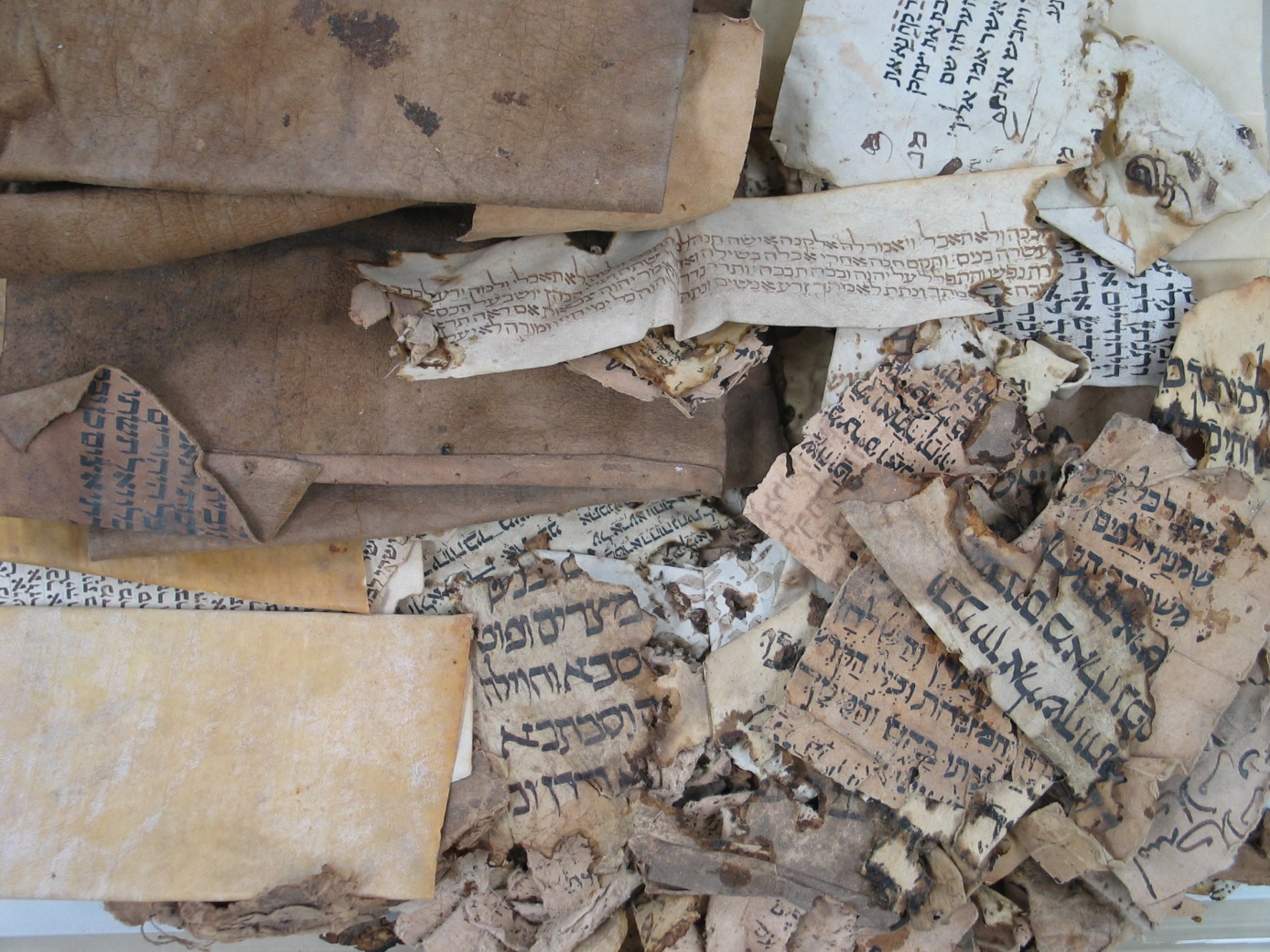
This explains why there is comparatively less textual witness for the Old Testament than for the New, however, as Donald Demaray notes, “there is the compensating factor that the Jews copied their Scriptures with greater care than did the Christians.”[19] There are accounts of scribes having burial ceremonies for the manuscripts,[20] and the storage “of scrolls [in a “Genizah” depository] no longer considered fit for use.”[21]


Cairo Genizah - Cambridge Library Blog - Fig1
Image Credit: Cambridge University Library Special Collections. “Fragments from the Cairo Genizah prior to conservation and cataloguing [sic]” (Emma Nichols, “Conservation of the Lewis-Gibson Collection: Re-Treatment of Manuscript Fragments from the Cairo Genizah“)

A second major factor is the A.D. 303 declaration by Emperor Diocletian to destroy any “sacred” literature associated with the Christian religion.[22] F. C. Grant frames the significance as follows:

As never before, the motive of the Great Persecution which began in 303 was the total extirpation of Christianity: […]. The first of Diocletian’s edicts directed to this end prohibited all assemblies of Christians for purposes of worship, and commanded that their churches and sacred books should be destroyed.[23]

This would further contribute to the lack of Hebrew Bible manuscripts.

Modern manuscript evidence for the Hebrew Bible, therefore, does not include the autographa (“original manuscripts”) and is generally never expected to, as desirable as the obtainment of these documents is.[24] What remains is the collection of manuscripts which together allow textual scholars to reproduce as close as possible the Hebrew Old Testament. This body of textual evidence goes very far to close the gap between the present day and the autographa. What are these manuscript witnesses to the Hebrew Bible? There are primary and secondary witnesses but where space is limited to the manuscripts.

Bruce Waltke observes that the textual witnesses to the text are the extant Hebrew manuscripts and Hebrew Vorlage obtained from the early versions of the Hebrew text.[25] While the term “manuscript” is typically recognized, the term Vorlage is probably unfamiliar to the general Bible student. This term refers to the text that “lies before” the translation or a theoretical “prototype or source document” from which it is based.[26] The Masoretic text (MT), the Samaritan Pentateuch (SP), and the Dead Sea Scrolls (DSS) are the principal manuscript witnesses. These manuscripts coupled with the Vorlage are the “documents” at our disposal.

Craigie’s presentation on this material[27] when compared to Waltke leaves something to be desired, and that something is more data and deeper investigation. However, Craigie presents the evidence that the manuscript evidence (including early translations) extends from the 2nd century B.C to the MT of the late 9th century B.C.[28] Leaving a considerable gap, as he notes, of “several centuries, the time varying from one Old Testament book to another, between the earliest extant manuscripts and no longer existing original manuscripts.”[29]

Waltke presents a fuller presentation of the two substantiating Craigie’s observations and would extend from the available data that the Vorlage of some of the DSS and SP points to a Proto-MT at least somewhere in the 5th century B.C.[30] Moreover, the oldest evidence is found in 2 extremely small silver rolls containing the Aaronic priestly blessing from Numbers 6:24-26, dating to the 7th or 6th centuries B.C.[31] The text reads:

May Yahweh bless you and keep you;
May Yahweh cause his face to
Shine upon you and grant you
Peace
(Michael D. Coogan)

Consequently, the worst case holds that the textual evidence goes only to the 2nd century, while the best case goes back some 300-500 years further back to a purer source as of yet unavailable.

H. G. G. Herklots has compiled a generous amount of information concerning the production of harmonization work which underlies the works of present-day manuscripts.[32] By doing this Herklots highlights that there are variations in the textual witnesses that the early stewards of the text attempted to dispose of but this has in some sense complicated the matter, making the study more laborious than it already is.[33] Variations are not as problematic as the skeptic supposes. To be sure, there are occasions of serious textual dissonance, but these are far from the plethoras of insignificant, obvious, and correctable variations.[34]

Waltke affirms, that “90 percent of the text contains no variants,” and of the remnant “10 percent of textual variations, only a few percent are significant and warrant scrutiny; 95 percent of the OT is therefore textually sound.”[35] Douglas Stuart notes that when considering the variations, “it is fair to say that the verses, chapters, and books of the Bible would read largely the same, and would leave the same impression with the reader, even if one adopted virtually every possible alternative reading.”[36] The variations of the extant textual evidence hardly, therefore, pose an indomitable problem to the adequate preservation of the Old Testament. The skeptic’s argument has no leg to stand upon.

Extra-Hebrew Bible Sources

Besides the extant Biblical literature of the Hebrew Bible, there are miscellaneous sources that demonstrate the veracity of the text, and implicitly note the accountability of the Hebrew Bible to a textual investigation. While these witnesses cannot reproduce the entire Old Testament, they can be compared with the manuscript evidence for accuracy and enlightened evidence when certain passages or words appear obscure. Briefly, consider two sources.

First, the Targums are a set of Jewish works in Aramaic that are paraphrastic (i.e. “interpretive translation”) of parts of the Old Testament.[37] Targums are said to be used in the synagogue to give the Aramaic-speaking Jews the “sense” of the Hebrew Bible.[38] This is comparable to the verbal translation that had to occur at the inauguration of the Law under Ezra, where there were assistants who “gave the sense, so that the people understood the reading” (Neh 8:8 ESV).

Targums have been written upon every section of the Hebrew Bible; they ranged from “very conservative” to “interpretive” (Onkelos and Jonathon respectively), and are useful for the light they show upon traditional Jewish interpretation.[39] In the history of the transmission of the Hebrew Bible, at times the Targum was placed along the side of a Hebrew text, a Greek text, and a Latin text (as in the Complutensian Polyglot) to “enable a reader with little Hebrew to understand the meaning of the Scriptures in his own language.”[40] It seems agreeable to suggest and affirm that the Targum serves as an appropriate and practical source to obtain a general understanding of the Hebrew text, which will definitely aid the textual scholar in analyzing obscure passages.

Second, there is the New Testament, which is a virtual galaxy of Old Testament citations and allusions as it connects Jesus and his followers as a continuation -fulfillment- of its message. Consequently, it serves as a proper witness to the passages cited or alluded to. E. E. Ellis writes:

there are some 250 express citations of the Old Testament in the New. If indirect or partial quotations and allusions are added, the total exceeds a thousand.[41]

The Greek New Testament, published by the United Bible Society, has 2 notable reference indexes. The first index lists the “Quotations” while the other catalogs “Allusions and Verbal Parallels.”[42]

The New Testament writers used and quoted not only the Hebrew Bible, but also the LXX (with some variations suggesting different Greek translations), and other sources such as the Old Testament Targums.[43] In addition, the New Testament, in terms of textual evidence (manuscript, early version, and patristic quotations), is the most attested document from antiquity[44] emphasizes the reliability of the New Testament evidence for the Old Testament.[45]

Concluding Thoughts

In summation, we have examined some of the evidence in a survey and observed that the typical skeptical claim against the Bible is fallacious. We are more than confident that the textual transmission of the Bible has adequately preserved the Bible. There are so many avenues from which data pours in that for all practical purposes the gap from these extant materials to the originals is irrelevant. Gaps of greater magnitude exist for other works of antiquity, but no finger of resistance is pressed against their adequate representation of the autographic materials.

The Bible experiences this sort of attack partly because ignorant friends of the Bible fighting with a broken sword affirm that we have the Bible and that it has no textual problems. Other times, skeptics misrepresent textual studies of the Bible in order to support their case that the Bible is not the inerrant inspired word of God. Be that as it may, the scribal evidence demands that the scribes held a high reverence and professionalism in the transmission of the text, the textual evidence is, though having some problems, near 100 percent sound. Moreover, the New Testament and Talmud are examples of sources that uphold the Biblical text and allow textual scholars to examine the accuracy of the textual data.

Finally, the skeptical attack has been viewed a considered only for it to be concluded that it is fallacious and of no need to be considered a viable position based on the evidence. In connection with this conclusion, observe some observations by Robert D. Wilson and Harry Rimmer. Rimmer writes that a scientific approach to the Bible inquiry is to adopt a hypothesis and then test it and see if there are supportive data that establishes it. He writes:

If the hypothesis cannot be established and if the facts will not fit in with its framework, we reject that hypothesis and proceed along the line of another theory. If facts sustain the hypothesis, it then ceases to be theory and becomes an established truth.[46]

Wilson makes a similar argument and ties an ethical demand to it. After ably refuting a critical argument against Daniel, Wilson remarks that when prominent critical scholars make egregious affirmations adequately shown to be so, “what dependence will you place on him when he steps beyond the bounds of knowledge into the dim regions of conjecture and fancy?.”[47]

Endnotes

  1. Donald Morgan, “Introduction to the Bible and Biblical Problems,” Infidels Online (Accessed 2003). Mr. Morgan is just a classic example of the skepticism that many share regarding the integrity of the biblical record.
  2. Daniel Arnaud, “Scribes and Literature,” NEA 63.4 (2000): 199.
  3. J. W. Martin, et al., “Texts and Versions,” in The New Bible Dictionary, eds. J. D. Douglas (Grand Rapids, MI: Eerdmans, 1962), 1254.
  4. Fredrick C. Grant, Translating the Bible (Greenwich, CT: Seabury, 1961), 8 (emph. added).
  5. Grant, Translating the Bible, 10-11.
  6. Flavius Josephus, The Works of Josephus: Complete and Unabridged, trans. William Whiston (repr., Peabody, MA: Hendrickson, 1987).
  7. Clyde M. Woods, “Can we be Certain of the Text? – Old Testament,” in God’s Word for Today’s World: The Biblical Doctrine of Scripture (Kosciusko, MI: Magnolia Bible College, 1986), 98.
  8. Martin, et al., “Texts and Versions,” 1255; René Paché, The Inspiration and Authority of Scripture, trans. Helen I. Needham (Chicago, IL: Moody, 1969), 187.
  9. Neil R. Lightfoot, How We Got the Bible, 2d ed. (Grand Rapids, MI: Baker, 2001), 92.
  10. Lightfoot, How We Got the Bible, 92.
  11. Peter C. Craigie, The Old Testament: Its Background, Growth, and Content (Nashville, TN: Abingdon, 1986), 32.
  12. English Standard Version of The Holy Bible (Wheaton, IL: Crossway, 2001), ix.
  13. Lightfoot, How We Got the Bible, 91.
  14. Robert D. Wilson, A Scientific Investigation of the Old Testament, revised ed., Edward J. Young (Chicago, IL: Moody, 1967), .
  15. ctd. in Paché, Inspiration and Authority of Scripture, 189–90.
  16. Craigie, The Old Testament, 34.
  17. Dowell Flatt, “Can we be Certain of the Text? – New Testament,” in God’s Word for Today’s World: The Biblical Doctrine of Scripture (Kosciusko, MI: Magnolia Bible College, 1986), 104: “The books of the New Testament were originally copied by amateurs,” the variants multiplied from persecution pressures and translations issues up until the “standardization of the text” in the 4th to 8th centuries A.D.
  18. Woods, “Can we be Certain of the Text?,” 96.
  19. Donald E. Demaray, Bible Study Sourcebook, (Grand Rapids, MI: Zondervan, 1964), 35; Flatt, “Can we be Certain of the Text?,” 106.
  20. Lightfoot, How We Got the Bible, 90.
  21. Martin, et al., “Texts and Versions,” 1256-57; Paché, Inspiration and Authority of Scripture, 187-88; F. C. Grant notes that the Synagogue of Old Cairo’s Geniza has been found, throwing “great light upon Biblical studies” (Translating the Bible, 40). Biblical scrolls were discovered from 1890 and, onwards including Targums and rabbinic literature (Martin, et al., “Texts and Versions,” 1256-57).
  22. Michael Grant, The Roman Emperors: a Biographical Guide to the Rulers of Imperial Rome 31 B.C.–A.D. 476 (1985; repr., New York, NY: Barnes & Noble, 1997), 208.
  23. Grant, Translating the Bible, 208.
  24. Lightfoot, How We Got the Bible, 90.
  25. Bruce K. Waltke, “Old Testament Textual Criticism,” in Foundations for Biblical Interpretation, eds. David S. Dockery, et al. (Nashville, TN: Broadman, 1994), 159-68.
  26. Matthew S. DeMoss, Pocket Dictionary for the Study of New Testament Greek (Downers Grove, IL: Intervarsity, 2001), 128.
  27. Craigie, The Old Testament, 32-37.
  28. Craigie, The Old Testament, 36, 32.
  29. Craigie, The Old Testament, 34.
  30. Waltke, “Old Testament Textual Criticism,” 162.
  31. Waltke, “Old Testament Textual Criticism,” 163.
  32. H. G. G. Herklots, How Our Bible Came to Us: Its Texts and Versions (New York, NY: Oxford University, 1957), 29-40, 109-23
  33. Herklots, How Our Bible Came to Us, 116-23, Waltke, “Old Testament Textual Criticism,” 164-167.
  34. Waltke, “Old Testament Textual Criticism,” 157.
  35. Waltke, “Old Testament Textual Criticism,” 157-58.
  36. qtd. in Waltke, “Old Testament Textual Criticism,” 157.
  37. D. F. Payne, “Targums,” in The New Bible Dictionary, ed. J. D. Douglas (Grand Rapids, MI: Eerdmans, 1962), 1238.
  38. Payne, “Targums,” 1238.
  39. Payne, “Targums,” 1239.
  40. Herklots, How Our Bible Came to Us, 35-36.
  41. E. E. Ellis, “Quotations (in the New Testament),” in The New Bible Dictionary, ed. J. D. Douglas (Grand Rapids, MI: Eerdmans, 1962), 1071.
  42. Barbara Aland, et al., eds., The Greek New Testament, 4th rev. ed. (Stuttgart: United Bible Societies, 2002), 887-901.
  43. Ellis, “Quotations (in the New Testament),” 1071.
  44. Wayne Jackson, Fortify Your Faith In an Age of Doubt (Montgomery, AL: Apologetics Press, 1974), 70-75.
  45. Harry Rimmer, Internal Evidence of Inspiration, 7th edition (Grand Rapids, MI: Eerdmans, 1946), 36.
  46. Wilson, A Scientific Investigation of the Old Testament, 98.

Bibliography

Aland, Barbara, et al. Editors. The Greek New Testament. 4th rev. ed. Stuttgart: United Bible Societies, 2002.

Arnaud, Daniel. “Scribes and Literature.” NEA 63.4 (2000): 199.

Craigie, Peter C. The Old Testament: Its Background, Growth, and Content. Nashville, TN: Abingdon, 1986.

Demaray, Donald E. Bible Study Sourcebook. Grand Rapids, MI: Zondervan, 1964.

DeMoss, Matthew S. Pocket Dictionary for the Study of New Testament Greek. Downers Grove, IL: InterVarsity, 2001.

Ellis, E. E. “Quotations (in the New Testament).” Page 1071 in The New Bible Dictionary. Edited by J. D. Douglas. Grand Rapids, MI: Eerdmans, 1962.

Flatt, Dowell. “Can we be Certain of the Text? – New Testament.” Pages 103-10 in God’s Word for Today’s World: the Biblical Doctrine of Scripture. Don Jackson, Samuel Jones, Cecil May, Jr., and Donald R. Taylor. Kosciusko, MS: Magnolia Bible College, 1986.

Grant, Fredrick C. Translating the Bible. Greenwich, CT: Seabury, 1961.

Grant, Michael. The Roman Emperors: a Biographical Guide to the Rulers of Imperial Rome 31 B.C.–A.D. 476. 1985. Repr., New York, NY: Barnes, 1997.

Herklots, H. G. G. How Our Bible Came to Us: Its Texts and Versions. New York, NY: Oxford University, 1957.

Jackson, Wayne. Fortify Your Faith In an Age of Doubt. Montgomery, AL: Apologetics Press, 1974.

Josephus, Flavius. The Works of Josephus: Complete and Unabridged. Translated by William Whiston. Repr. Peabody, MA: Hendrickson, 1987.

Lightfoot, Neil R. How We Got the Bible. 2d edition. Grand Rapids, MI: Baker, 2001.

Martin, W. J., et. al. “Texts and Versions.” Pages 1254-69 in The New Bible Dictionary. Edited by J. D. Douglas. Grand Rapids, MI: Eerdmans, 1962.

Morgan, Donald. “Introduction to the Bible and Biblical Problems.” Infidels Online.

Paché, René. The Inspiration and Authority of Scripture. Translated by Helen I. Needham. Chicago, IL: Moody, 1969.

Payne, D.F. “Targums.” Pages 1238-39 in The New Bible Dictionary. Edited by J. D. Douglas. Grand Rapids, MI: Eerdmans, 1962.

Rimmer, Harry. Internal Evidence of Inspiration. 7th edition. Grand Rapids, MI: Eerdmans, 1946.

Waltke, Bruce K. “Old Testament Textual Criticism.” Pages 156-86 in Foundations for Biblical Interpretation. Edited by David S. Dockery, Kenneth A. Mathews, and Robert B. Sloan. Nashville, TN: Broadman, 1994.

Wilson, Robert D. A Scientific Investigation of the Old Testament. Revised edition. Revised by Edward J Young. Chicago, IL: Moody Press, 1967.

Woods, Clyde. “Can we be Certain of the Text? – Old Testament.” Pages 94-102 in God’s Word for Today’s World: the Biblical Doctrine of Scripture. Don Jackson, Samuel Jones, Cecil May, Jr., and Donald R. Taylor. Kosciusko, MS: Magnolia Bible College, 1986.