Titus 1:2: Does God Choose Not to Lie?

Recently, in discussing the character and omnipotence of God Titus 1:2 was cited to extend the argument that while God may have all power (omnipotence) to do what lends itself to being accomplished, there are certain tensions one must also accept. Namely, there are some things God cannot do or be. Despite having all power God does not tempt people to do evil (Jas 1:13), nor is it possible for God to lie (Heb 6:18). It was argued then that temptation and deception are against his nature despite all of his power.

Is Choice Implied?

There seemed to be some confusion, however, based on the translation of the phrase ho apseudēs theos, “God, who does not lie” (NIV, REB, NAB), “God, never lies” (ESV, NRSV), and the older, “God, who cannot lie” (KJV, NKJV, ASV, NASB95). These are the most common translations of two terms in Titus 1:2, the adjective apseudēs (truthful/deceitless) and God (theos).

It was suggested in a discussion that the translation of the NIV (cf. LEB, REB, NABR, TEV, NIRV, JB, NLT), could lend itself to the notion that it is possible for God to lie but He does not because He chooses not to lie. This would reframe the discussion of the nature and character of God by opening the possibility that God is good by choice rather than being good by nature.

This raises the question of whether the character of God is immutable, that is whether his holy character changes over time or not. The immutability of God means, for example, that God is holy and will always be holy.[1] On this view, there will never be a time when God is not holy. If God’s character is mutable (subject to change), however, then it is possible for God to act in an unholy manner. This view is inconsistent with the overall theme of God’s infinite holy character.

Does Titus 1:2 lend itself as evidence to this point of view? No, for three reasons. First, the term apseudēs is used in various Greek sources as a description (as an adjective) for “gods and divine things.”[2] Second, the adjective is verbless and without action. Third, the context of the letter to Titus contrasts the lying Cretans (1:12) against the truthful God (1:2).

The Adjective

First. Apseudēs is used in various Greek sources as a description (an adjective) for “gods and divine things”; however, Titus 1:2 is its only biblical use. It is also found once in Greek Jewish wisdom literature regarding the “unerring knowledge” given by God (Sirach 7:17 NRSV). Unlike the usual positive word for “truth” in the NT (alétheia), apseudēs is a negative word (non-liar) which means: “without lie and deceit, … sincere, trusty,”[3] “free from all deceit, … trustworthy,”[4] and “pertaining to not speaking falsehood — ‘truthful.’”[5]

The word is a striking description of “divine beings” and God. This use is found between the 5th century BC to the early second century AD.[6] Paul is known to quote ancient Greek sources as in the probable use of the playwright Menander in 1 Corinthians 15:33: “Bad company ruins good morals” (Thais). Paul used the infamous saying of the Cretan teacher named Epimenides (500 BC) in Titus 1:12: “Cretans are always liars, evil beasts, lazy gluttons.”

Plato said, “the divine and the divinity are free from falsehood” and “that Phoebus’ divine mouth could not lie” (Republic 2.382e, 383b). Ignatius, a known disciple of John, spoke of Jesus’ mouth as “the unerring mouth” of revelation (Romans 8.2). In the Martyrdom of Polycarp, Polycarp prays to God at his death “you are the unerring and true God” (14.2). Greeks used the term to describe their gods; meanwhile, Christians used it to describe the true God.[7]

It is important to remember that Paul leans on the thought patterns of the Hebrew Bible (Rom 3:3–4, 2 Tim 2:13).[8] Balaam spoke the Lord’s word when he said, “God is not man, that he should lie” (Num 23:19), and Samuel told King Saul that “the Glory of Israel [i.e. God] will not lie…” (1 Sam 15:29). Likewise, in keeping with these verses are the inspired words, “it is impossible for God to lie” (Heb 6:18).

The Descriptive

Second. The adjective is verbless and without action. In English, adjectives often are said to describe a person, place, thing, or function. For example, “it was a fast train” and “the clock was fast.” In Greek, however, the adjective can function in two technical ways, it either (a) makes an assertion about the noun — the word is good (predicate), or (b) limits or tells what noun we are referring to — the good word (attributive). The adjective, then, “modifies a noun by ascribing a quality to it.”[9]

Here are a couple of examples of how this plays out in other passages with a similar grammatical structure as Titus 1:2:

  • “the first day” = “the day — namely the first one” (Phil 1:5)
  • “the good shepherd” = “the shepherd — namely the good one” (John 10:11)
  • “the good wine” = “the wine — namely the good one” (John 2:10)

In the same way, the adjective here describes God as deceitless, not that God chooses to not lie. He is God — namely the deceitless One. Thus, Titus 1:2 is not a statement of action, but a description of Divine character (God’s attributes). God does not lie because God is void of falseness.

The Contextual Purpose

Third. The context of the letter to Titus contrasts the lying Cretans (1:12) against the truthful God (1:2). The description of God as apseudēs (deceitless) is in contrast to the Cretans who are pseustai — liars. It is the only time both words are used in Titus. The significance of the connection is found in 1:2, speaking of the hope of eternal life established by God who is deceitless in the quality of His character (Heb 6:18). This message and hope are contrasted with the teachers on the island of Crete who are asserted to be deceivers (“liars,” 1:12).

The difference is subtle but the difference is everything.  

Interestingly, Epimenides’ infamous saying is based on the Cretan claim “to possess a tomb of Zeus, who, of course, as a god, cannot have died!”[10] It is said that even in ancient times this was criticized by Callimachus (305–240 BC) as inconceivable that the king of the gods should be dead and buried.[11] The absurdity illustrates the need to reject and silence the false teachers who are equally “liars,” opportunists, and reject the truth (Titus 1:10-16).

Titus, on the other hand, bears a message of hope and salvation, and embraces truth (1:1) because it issues from the “God, whose very nature is the absence of falsehood.”[12]

Conclusion

This short piece only reminds us that human language has limits when we engage “God talk” (i.e., theology), but we can usually find a reasonable understanding.

Does Titus 1:2 suggest that God chooses to be truthful and not lie, or is this a statement about God’s character as being deceitless, a non-liar? The above lines of reasoning suggest that the Greek phrase ho apseudēs theos is a description of God’s character, God — namely the deceitless God.

Unfortunately, to make the thought more natural in English translations supply an action verb, but this is not the sense. Still, it is perhaps best, but not perfect, to translate Titus 1:2 as: “Our God is no liar” (The Voice).

Endnotes

  1. R. C. Sproul, What Can We Know About God? (Orlando, FL: Reformation Trust, 2017), 8.
  2. Martin Dibelius and Hans Conzelmann, Pastoral Epistles, trans. P. Buttolph and A. Yarbro (Philadelphia: Fortress, 1972), 131.
  3. H. G. Liddell, Intermediate Greek-English Lexicon, electronic ed. (1888; repr., Oak Harbor: Logos Research Systems, 1996), 142.
  4. BDAG 161.
  5. L&N 88.40.
  6. Dibelius and Conzelmann, Pastoral Epistles, 131.
  7. BDAG 161
  8. George W. knight, III. Pastoral Epistles (1992; repr., Grand Rapids: Eerdmans, 2013), 284.
  9. James A. Brooks and Carolton L. Winbery, Syntax of New Testament Greek (1979; repr., Lanham: University Press of America, 1988), 70.
  10. Gordon D. Fee, 1 and 2 Timothy, Titus (1988; repr., Peabody: Hendrickson, 2000), 179.
  11. Ralph P. Martin, “1, 2 Timothy, Titus,” in Harper’s Bible Commentary, ed. James L. Mays (San Francisco: Harper & Row, 1988), 1243.
  12. Homer A. Kent, Jr., The Pastoral Epistles: Studies in 1 and 2 Timothy and Titus, rev. ed. (1986; repr., Winona Lake, IN: BMH Books, 2006), 210.

Sources

(BDAG) Bauer, Walter, et al. A Greek-English Lexicon of the New Testament and Other Early Christian Literature. 3rd edition. Chicago: University of Chicago, 2000.

Brooks, J.A., and C.L. Winbery. Syntax of New Testament Greek. 1979. Reprint, Lanham: University Press of America, 1988.

Dibelius, M., and H. Conzelmann. Pastoral Epistles. Trans. P. Buttolph and A. Yarbro. Philadelphia: Fortress, 1972.

Fee, Gordon D. 1 and 2 Timothy, Titus. 1988. Reprint, Peabody: Hendrickson, 2000.

Kent, H.A., Jr. The Pastoral Epistles: Studies in 1 and 2 Timothy and Titus. Revised ed. 1986. Reprint, Winona Lake, IN: BMH Books, 2006.

Knight, George W., III. Pastoral Epistles. 1992. Reprint, Grand Rapids: Eerdmans, 2013.

(L&N) Louw, J.P., and E.A. Nida. A Greek-English Lexicon Based on Semantic Domains. 2d edition. New York: United Bible Societies, 1996.

Liddell, H.G. Intermediate Greek-English Lexicon. 1888. Reprint, Oak Harbor: Logos Research Systems, 1996.

Martin, Ralph P. “1, 2 Timothy, Titus” in Harper’s Bible Commentary, edited by James L. Mays. San Francisco: Harper & Row, 1988.

Sproul, R. C. What Can We Know About God? Orlando, FL: Reformation Trust, 2017.

The Humanity of Jesus the Son

The phrases Jesus Christ, the Christ of faith, the Jesus of history, and Jesus the Divine Son all reflect significant themes pertaining to the central figure of the New Testament, Jesus of Nazareth. These concepts fall within a specialized area of theology known as Christology, which is a systematic “study of Christ” based on the full biblical picture derived from scripture.

A bit more formally, this field of study speaks to the Christian endeavor to map Jesus’ placement within “time and eternity, humanity and divinity, particularity and universality.” It answers how the life of a seemingly benign first-century Jewish rabbi could be so “relevant for all people and all times” (McGrath 2017, 207).

The present discussion maps Jesus’ Son-relationship in the triune unity of God, and the nature of his humanity. It then reflects on how the humanity of Jesus is relevant to the Christian’s personal walk before God.

Jesus the Son and the Trinity

The Trinitarian Formula

The divinity of Jesus is established in many passages of the New Testament. For example, Matthew closes with an appearance of Jesus where he affirms his authority “in heaven and on earth.” With this authority, he commissions his disciples for an international burden,

“Go therefore and make disciples of all nations, baptizing them in the name of the Father and of the Son and of the Holy Spirit” (28:18–19 NRSV). [All Scripture references are from the New Revised Standard Version unless otherwise noted.]

Three themes are clear in this passage: Jesus’ divine authority, discipleship made in baptism, and the trinitarian language of Father, Son, and Holy Spirit. In the early generations of the church, the above trinitarian formula would represent a highly nuanced concept of monotheism affirmed to be in continuity with the “one God” of the Hebrew Bible.

What forced early Jewish Christians to accept this nuanced view of monotheism? The answer: the character and nature of Jesus did. It is not subversive of the “oneness” of God (Deut 6:4) but depends on the New Testament’s clarification that the “one God” is not a simplistic model. As the clarification argues, the Divine Son is not God the Father, nor is he the Holy Spirit. This raises tough questions that the historical church has discussed in earnest and in conflict for generations.

How do we map this out theologically?

The Divine Son Portrayed

We turn to the presence of Jesus and how He is portrayed in relation to the Father and the Holy Spirit.

In the first century, the prologue to the Fourth Gospel (John 1:1–3, 14) affirms that the person and nature of Jesus is the driving force to reshape the whole biblical landscape of the concept of God (Gen 1:1; Exod 20:11).

In the beginning was the Word, and the Word was with God, and the Word was God. He was in the beginning with God. All things came into being through him, and without him not one thing came into being... And the Word became flesh and lived among us, and we have seen his glory, the glory as of a father’s only son, full of grace and truth. (John 1:1–3a, 14) 

Jesus not only pre-existed as the lógos at the time of creation (John 1:1), but he also “emptied” (ekénōsen) himself to take on the “form [morphē] of a slave”—a human (Phil 2:6–7). Leaning heavily on John 1:14, the Alexandrian theologian, Athanasius, concluded that this “human body” was taken by this same “Word of God” (Placher 2003, 184).

On this view, there was no room within this theology for Arius’ affirmation that Jesus the Son—the Word—was a created being who subsequently became divine. This view reduced Jesus to a creature impotent to redeem humanity (McGrath 2017, 217–19).

The Divine Association

As McGrath (2017, 214) chronicles, the divinity of Christ was one of the first major theological battles of the early church as it sought to hammer out its understanding of the contours of a very genuine human being in Jesus who, at the same time, was portrayed as being more than a mere human. The “battle” was not over the deity of Christ as such (that was established), but how to understand the relationship between his humanity and his divinity.

The divinity of Jesus was therefore accepted as true as his humanity—as affirmed in Chalcedon (AD 451)—which means that the question left to map out was the relationship between Jesus and the Father and the Holy Spirit.

The only way to do this is by evaluating Scripture (Jenson 2003, 194). Despite certain reservations, Jenson argues clearly that Peter’s application of the divine title “Lord” from Joel 2 (kyrios LXX) to Jesus in Acts 2:33–34 (kyrios) demonstrates that

the risen Christ, without violation of God’s singularity, does what only the God of Israel himself does, and that he does this precisely by virtue of his situation with the God of Israel. (2003, 194)

Jensen in Essentials of Christian Theology (2003)

Jensen points out that the emerging notion of association that comes from the word “with” points to the “inescapably observable fact” that the biblical narrative is framed by three divine characters in its drama (2003, 195): the God of Israel, Jesus his Son, and the life-giving Spirit of God.

Agreeing with Jenson (2003, 196), Jesus should not be viewed as a mere successive mode of God’s presence in time (modalism) or as the Father’s subordinate agent with the Spirit in time (subordinationism). Instead, Jesus maintains an eternally mutual and reciprocal relationship with the Father and the Spirit. For this reason, ancient Christians used an analogy inspired by the theater, that is to say, that the Father, the Son, and the Holy Spirit although three in persona (mask) are one in Divine substance. Another model is found in Martin Buber’s I-You relationship model (McGrath 2017,179–80).

Understanding the Humanity of Jesus

What, then, goes into mapping this theological tension of the Son and the Trinity?

Mapping the nature of Jesus’ humanity—in balance with his divinity—requires great caution. The traditional doctrine of the incarnation (literally, “becoming bodily”) affirms both the full humanity of Jesus and his divinity. Any attempt to isolate what is organically interwoven in the person and work of Jesus runs a high risk of distortion.

Overcompensating to account for the humanity of Jesus has typically been met with the “stamp” of heresy. Three, in particular, are Ebionism, Arianism, and Docetism (McGrath 2017, 214–20). 

The roots of Ebionism are Jewish. It framed Jesus through the lenses of a human prophet, as called and anointed by the Holy Spirit. As a low Christology, Jesus is only a “spiritually superior” human. This does not align with the picture of his eternal pre-existence as Creator.

Plotted on another point on the map is Arianism (named after Arius), which called into question the “fully divine” and “fully human” affirmation due to an irreconcilable application of the Greek notion of divine impassability and the doctrine of the incarnation. God cannot be both changeable (fully human) and transcendent (fully divine), therefore, the incarnation strikes at the perfect nature of the one God. Jesus must therefore be a “superior created being” with nothing divine to report. This failed to account for the actual testimony of the gospels where in fact this is possible.

Meanwhile, Docetism affirmed, with its hardline separation of God and the present evil world of matter (due to its gnostic foundation), the divine incarnation of John 1:14 was nothing more than “pretend.” The heresy’s name (or tendency) is derived from the Greek word dokéō (“to seem”) affirming Jesus only “seemed” to have a body in which he suffered and died, making the incarnation “into a fake” (Placher 2003, 183). Scripturally, the work of Christ is dependent on the fully human (Luke 24:38–39) and fully divine Jesus manifested in the death of the cross and resurrection from the dead (Rom 1:3–4).

Similarly, the opening line of 1 John affirms the humanity of the “Word of Life”: “what we have heard, what we have seen with our eyes, what we have looked at and touched with our hands” (1:1).

Likewise, in the second century CE, Ignatius of Antioch (ca. 35–ca. 110) stressed his concern to the Christians of Trallia that they should guard against (“be deaf,” kōphóthēte 9.1) anything which undermines the humanity of Christ with the following words:

Jesus Christ, who was of the family of David, who was the son of Mary; who really was born, who both ate and drank; who really was persecuted under Pontius Pilate, who really was crucified and died while those in heaven and on earth and under the earth look on; who, moreover, really was raised from the dead when his Father raised him up, who—his Father, that is—in the same way will likewise also raise us up in Christ Jesus who believe in him, apart from whom we have no true life. (“To the Trallians” 9.1–2)

Ignatius of Antioch, “To the Trallians” 9.1-2

The example of Ignatius is interesting because it is early and strongly affirms Jesus’ human form, “who really” (hos alethōs) an adverb repeated four times to assert what is true, actual because it corresponds to what is really so (BDAG 44). For Ignatius, Jesus actually was born, ate and drank, persecuted, crucified and died, and raised from the dead. Ignatius saw denying the humanity of Christ as subversive to the soteriological (the saving, redeeming) and eschatological (end times, fulfilling) work of Christ.

What Does This Mean?

What then does it mean for the Christian that God became flesh to redeem us in the person of Jesus Christ? Two extremes must be cautioned against here. One extreme is to moralize the life of Jesus (1 Pet 2:21), and as such reduces Jesus to a mere good teacher. Another extreme is to make Jesus’ life and teaching into a disjointed symbolic presence of God (i.e., Paul Tillich).

The humanity of Jesus provides me with a great deal of assurance as a believer that God knows through Christ the human plight. Jesus has “assumed all” and can, therefore “heal all” of humanity (Placher 2003, 184). When the “name” Immanuel (“God is with us”) is given to Jesus (Matt 1:23) the associated promise is that “he will save his people from their sins (Matt 1:21). God’s presence in the human child to be born provides a personal locus that can be isolated to time, space, and history.

For all humans, it then becomes quite clear that God is joining the human continuum to reconcile not only “us” but also “the world to himself” in Christ (2 Cor 5:18–19). Paul’s application has massive personal repercussions,

“if anyone is in Christ, there is a new creation: everything old has passed away; see, everything has become new!” (5:17) 

The humanity of Jesus is not simply a modal expression of God, but God entering into time and space to save, forgive, reconcile, and renew humanity and creation.

It provides the seedbed to take the particular localized Jesus and affirm his enduring value for all humans for all time. As Ignatius wrote, God “will likewise also raise us up in Christ Jesus who believe in him, apart from whom we have no true life” (“To the Trallians” 9.2).

Truly, the humanity of the God-Man Jesus is relevant for the Christian’s personal walk before God because it is the seedbed for all our hopes, especially, hope for the resurrection (1 Cor 15:12–19).

Bibliography

(BDAG) Bauer, Walter, Frederick W. Danker, W. F. Ardnt, and F. W. Gingrich. 2000. A Greek-English Lexicon of the New Testament and Other Early Christian Literature. 3rd edition. Chicago: University of Chicago.

Ignatius. 1999. “The Letters of Ignatius, Bishop of Antioch.” Pages 128–201 in The Apostolic Fathers: Greek Texts and English Translations. 2d edition. Edited and revised by Michael W. Holmes. Grand Rapids: Baker Books.

Jenson, Robert W. 2003. “Does Jesus Make a Difference? The Person and Work of Jesus Christ” Pages 191–205 in Essentials of Christian Theology. Edited by William C. Placher. Louisville, Kent: Westminster John Knox.

McGrath, Alister E. 2017. Christian Theology: An Introduction. 6th edition. Maldon, Ma: Wiley Blackwell.

Placher, William C. 2003. “Does Jesus Make a Difference? The Person and Work of Jesus Christ” Pages 183–91 in Essentials of Christian Theology. Edited by William C. Placher. Louisville, Kent: Westminster John Knox.

The Word of God among the Denominations

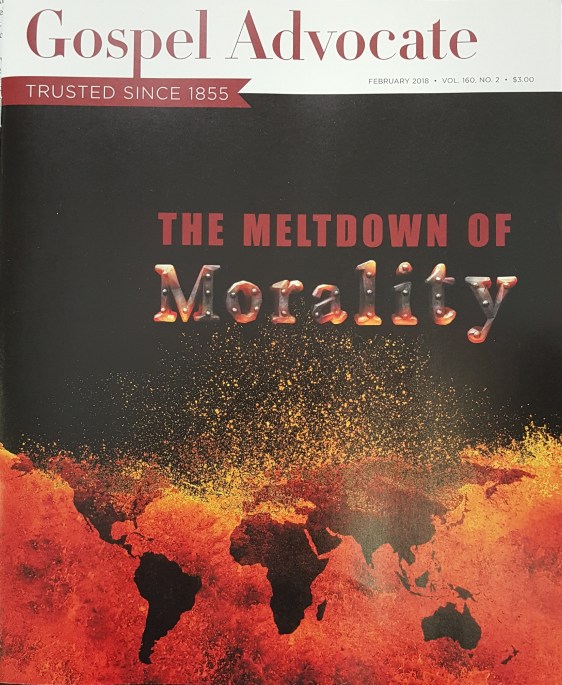
Reprinted with permission from the February 2018 issue of Gospel Advocate Magazine.

20180124_150851.jpg

Hebrews affirms, “For the word of God is living and active, sharper than any two-edged sword, piercing to the division of soul and of spirit, of joints and of marrow, and discerning the thoughts and intentions of the heart” (4:12 ESV). This is part of a warning in Hebrews, which affirms that Christians who defect from God will fail to meet their rest as their Israelite counterparts did (vv. 1-11). God holds his people —and His creation— accountable by His presence (“sight”) in the word of God (Hebrews 4:13). This is a raw incontrovertible truth.

This passage makes no caveats; it makes no attempt to remedy a distinction between God’s word and God’s presence. They are both manifested at the same time. God is involved with real life (time and space) with Israel and with Christians. God makes promises and keeps his word regarding their “rest,” and God holds His people and creation accountable to His word. God is Lord of heaven and earth and everything in between, and He holds it together by the power residing in Jesus (Hebrews 1:3; Colossians 1:17). The word of God is connected not only to the authority of God but also to His nature and how He reveals Himself to the world.

Let me say the above in a differently. Our God, who is beyond time and space (God’s transcendence), enters our earthly “realm” bound by time and space (God’s immanence) with His divinity and authority (sovereignty) intact; furthermore, God enters into relationship with His creation (Abraham, Israel, Christians) by revealing Himself in creation and in His word. God is active both in creation and in His word. Creation reveals God’s existence and hints at elements of His attributes (natural theology), but it is His word that reveals God and His “will” so that humanity can enter into covenant with God. The word of God was both proclaimed orally through particular spokesmen (patriarchs, prophets, kings, apostles), but the prophetic word was not only through oracles but also in written communiqués embedded with the same divine authority (2 Peter 1:16–21). These writings reveal the mind of God (1 Corinthians 2:11–16), His purposes and mystery (Ephesians 3:1–6), His involvement in human events (Acts 17:26–27), and the righteousness by which He will bring justice to the world (Acts 17:30–31).

To say it bluntly, the Bible is the word of God set in a permanent written form. Paul declared, “all scripture is breathed out by God” (2 Timothy 3:16). The Scripture bears the character of God and is no “dead” codebook, for it transforms every “man of God” into a competent, equipped servant (2 Timothy 3:17). The profitability of all Scripture is due to its quality as “God’s breath.” There is no pecking order between the spoken or written word of God. The inspired written word is as inerrant as God’s character. There is no source outside of the Holy Spirit-given Scripture that speaks God’s transforming work since it is the depository of the gospel’s message. What the word of God promises, God will do; what God proclaims, God’s holds His creation accountable to (1 Thessalonians 2:13).

The above may seem to belabor the point, but as anticipated by the title of this piece, we will sketch how the word of God is handled among Liberal (Modern) and Neoorthodox influences. It is essential for the church to reflect on these twentieth-century influences because dialogue is healthy, truth has nothing from which to hide, and any redefinition of biblical Christianity must be given due consideration (Galatians 1:6-7).

The following historical sketches will probably not satisfy everyone, but they will be enough to see their direction and how they redefine significant elements of historic Christian beliefs and their tendency to subvert scriptural authority.

Liberalism/Modernism

The word “liberal” is a very loaded word. It is often used with contempt to show disapproval of someone else thought to be progressive (instrumental music, expanded role of women, etc.). But this is not the historic sense of the word. Liberalism emerged in the late nineteenth century through the interplay of many players, thinkers, and philosophical trends. The influence of Liberalism, or Modernism, is seen in three levels: (1) revelation is not the final answer to reality, (2) naturalism is the key to reality and religion, and (3) since the Christian documents are built on ancient myths and superstitions, the historic supernatural claims of Christianity is immaterial. To be a “Christian” is a matter of experience and the “essence” of its teaching.

Liberalism, as an intellectual revolution, is a child of the Age of Reason (the Enlightenment). The “Age” saw the elevation of human reason over the institutional “church,” which wielded divine revelation. It was “the church” that dictated to the people what to believe about reality. Divine revelation was the final answer to determining truth and what really happened in the past. This was displaced with rationalism, scientific history (criticism), and naturalism as final answers to genuine and authentic history and truth. In essence, as Stanley Grenz and Roger Olsen point out, the maxim “I believe in order that I may understand” was turned to “I believe what I can understand.”[1] Faith was overturned by a reason informed by modern findings — thus, this point of view is called “Modernism.”

Everything that was received as genuine knowledge, now, was shaped by the natural world. This was further supported by what is called “the principle of analogy,” popularized by the liberal theologian Ernst Troelsch (1865–1923), which argued that the present is the best way to understand the past. The consequence was detrimental in the extreme on the trustworthiness of Scripture. The supernatural elements interwoven in Scripture are, by definition, myths and superstitions. This meant that there are no miracles, no supernatural interventions by God, and no resurrection of Jesus Christ. Thus, many new schools of “criticism” emerged to study Scripture with mixed results.

This naturally led to an embrace of “the essence of Christianity” so long as reason and experience allowed. “Liberals” are open to the modern findings from the natural world, open to a religious humanism and science —in particularly embracing Darwinian evolution as the process by which God created. If God exists, He could only be revealed through religious “experience.” It was also immaterial if the events of Scripture happened or not because religion is a condition of the heart. Yet, the apostle Paul makes it abundantly clear that if the resurrection event has not occurred, both our preaching and faith are in vain and we are still in our sins (1 Corinthians 15:14, 17).

Another arm of Liberalism is the demythologizing of the New Testament pioneered by the “Form Critic” Rudolf Bultmann (1884–1976). Bultmann argued that historic person of Jesus is built on untrustworthy sources. The New Testament is Christian propaganda shrouded in the imagery of the Greek myths and Roman legends. As such, they are not relevant for faith nor spiritual truth claims. It is the symbolism that matters. Today, one only need to watch the latest “history” programming to find modern theological liberals interviewed. Theological liberalism has significant questions that need to be answered, but it brings Christianity to a logical dead end.

Neoorthodoxy

The Swiss theologian Karl Barth (1886–1968) ignited a movement when he published his commentary on Romans in 1919. It charted a new theological direction away from Liberalism/Modernism. Barth (pronounced “bart”) was not fond of the misnomer “neoorthodoxy,” but his strand of thinking regarding the meaning of “revelation” and “the word of God” would rival the prevailing traditional belief held historically by the church. As a consequence, many regard Barth as one of the great theologians and the father of modern theology.

Orthodoxy affirms the teaching of historic Christian truth based on Scripture. This includes, for example, the following concepts: the inerrant inspiration of scripture, the triune Godhead, the deity and virgin birth of Christ, the historic creation and fall of humanity, the bodily resurrection and ascension of Christ, the return and final judgment. Barth argued, on the other hand, that “revealed truth” was not written, but was the outcome of an encounter (an experience) with God. Thus, instead of scripture as being the objective word of God, Barth argued for a subjective experience with God initiated by reading the Bible.

Barth was offering a completely different course of thought altogether. “Revelation” does not appear in the form of propositional truths. Arguing book, chapter, verse, or appeals to the very words of scripture is insufficient to reveal God. Revelation (the word of God), it is argued, is an “event” in which God acts in history (God’s immanence). Barth even argued that revelation is not found in natural theology (Acts 17; Psalm 19; Romans 1) but, instead, in events like the call of Abraham, the exodus, and the resurrection. Millard Erickson is spot on when he classifies Neoorthodoxy as an illumination theory divorced from an objective standard.[2]

Although Neoorthodoxy is not a unified movement, there are three interconnected witnesses (modes/forms) that shape its view on revelation.[3] First, Jesus is the word of God in the truest sense, for He reveals God in the event of His incarnation, life, ministry, death and resurrection. This is true revelation, the very gospel. Second, Scripture points to Jesus but it is a flawed human (read “errant”) attempt to provide a witness to divine revelation. It is instrumentally God’s word but not properly. Third, the proclamation within the faith community —Barth preferred “community” to church— is likewise instrumentally God’s word. The Bible, then, only becomes God’s word when God uses it to reveal Jesus Christ in the encounter, contrary to 2 Timothy 3:16.

In fact, Neo-orthodoxy is quite a popular approach to handling the Word of God, even among churches of Christ. A popular theological branch of this movement is “Canonical Criticism,” popularized by the late American scholar Brevard Childs (1923–2007). It seeks to broadly bypass much of the liberal destructive criticism of the twentieth century by accepting the texts of Scripture as literary units. Nevertheless, this point of view struggles, as did Barth’s, to embrace the Bible as a very human (errant) book while appealing to its authority for theological thought as if they were inerrant. They seek, in the words of one sympathetic Abilene Christian University professor, to “articulate a doctrine of Scripture that recognizes human flaws in it.”[4] Treating the Bible as an inerrant text is simply a form of bibliolatry.

Keeping the Faith

Today, the phrase “Word of God” means different things to different believers, and that includes preachers. Liberalism ultimately rejects a supernatural Christian faith, and is at home with amputating its historic claims of a resurrected ascended Lord Jesus, in exchange for a subjective diluted Christianity. Neoorthodoxy, on the other hand, embraces a supernatural Christian faith, but it rejects the supernatural origin, inerrancy, and authority of the Scriptures which undergird its claims. The Word of God has always been a manifestation of God’s presence in our lives, in His proclamation, and in His Scripture without pecking order. Let us join Paul who declares, “Let God be true though every one were a liar” (Romans 3:4).

Notes

  1. Stanley J. Grenz and Roger E. Olsen, 20th Century Theology (Downers Grove: InterVarsity, 1992), 17.
  2. Millard J. Erickson, Christian Theology, 3rd ed. (Grand Rapids, Baker Academic, 2013), 220–21.
  3. Karl Barth, Evangelical Theology: An Introduction, trans. G. Foley (New York: Holt, 1963), 26–36.
  4. Christopher Hutson, “Scripture as the Human Word of God: Why Faith Contradicts Inerrancy,” Lexington Theological Quarterly 44.1 (2011): 210–21. Hutson serves as a professor of ministry and missions at Abilene Christian University.

To subscribe to Gospel Advocate, click here.


Little Did They Know: The Prose Sections of Job (1:1-2:13; 42:7-17)

college papers

The prose section of the book of Job receives a variety of approaches, but the most consistent approach is to treat it as a separate folk-tale which existed independently than the present canonical form. This “campfire” tale, or this moral free legend, had grown sufficient credibility to take on a permanent form within a community. Then an unknown poet emerges who takes the folk-tale[1] and formalizes it with a series of poetic discourses and creates an extended edition, the present form of the book of Job. As such, questions emerge as to the continuity between the prose sections (1:1-2:13; 42:7-17) and the poetic sections (3:1-42:6). This source critical approach makes an assumption that the book of Job is the result of significant editorial activity, suggesting that the book has undergone considerable layering and updating. Robert Fyall argues that such a possibility does not “in itself” deny divine inspiration but it only makes poor sense in Job’s connection to the biblical canon.[2] As such, “the question of the relationship of the prologue (chs. 1-2) and the epilogue (42:10-17) to the poetic dialogue must be explored.”[3]

Nevertheless, despite the reticence among some scholars to see a significant degree of continuity vital to understanding the tensions, themes, and argument of the present form of the book of Job, it is argued here that a proper understanding of Job does not rely upon the theoretical pre-canonical form of the two independent traditions.[4] Instead, there is a “logical coherence” between the prologue, the poetic discourses, and the epilogue.[5] It is argued here that the prose sections play an integral part to understanding the canonical form of the book of Job. The style and vocabulary purposely represents an ANE setting apart of Israelite religion in the tradition of the dramatic epic, and sets the wisdom and theodicy debate in a historical context like that of the Hebrew patriarchs (Abraham, Moses). The prose sections place a large emphasis upon the heavenly court which anchors the theology and drama of the poetic discourses.

The Integral Nature of the Prose Sections

First, the prose sections play an integral part to understanding the canonical form of the book of Job. In proportion to the bulk of the book this may seem to overstate the weight of the prose sections in Job. As Bernhard Anderson argues, “if we are to understand the viewpoint of the author of Job we must rely primarily on the poems rather than on the prologue and epilogue.”[6] Nevertheless, Anderson concedes that the poems are only effective because they are “framed within the context of the folk story.”[7] The book of Job is framed by “the life-situation that occasions the poetic meditations.”[8] In general, the framework of narrative transitions are, as Robert Alter observes, an act of conscious narration “in order to reveal the imperative truth of God’s works in history.”[9] The function of the prologue and the epilogue, then, is to bracket in the core discussion of Job and this is accomplished by setting the plot, the tensions, and the characters which will enter the fray of the poetic discourses in Job 3:1-42:6.

The limits of the prose sections of Job are substantially agreed upon.[10] The usual limits of the prologue of Job are from 1:1-2:13. First, the prologue has natural and literary limits. A reading of the first chapters of Job lends its to a natural outline of a narrative that transitions to a series of discourses, but as James Patrick observes there are a series of “speech ascriptions” which provides a literary limit to the prologue in particular and the speech cycles in general (“Job opened his mouth… Job said”[11]).[12] This marks the closing limit of the prologue, which as “the frame-story of Job”[13] will find its themes continued in the poetic body of the Jobine discourses (3:3-42:6).[14] Second, the prologue, then, introduces the tension of the worthiness of God to be served, the sincerity of Job’s faith, the heavenly court and the “wager” (so Anderson), the earthly trials and suffering of a pious and prosperous patriarch, and the interaction among the heavenly realms (Yahweh, The Satan, Heavenly Court) and the earthly realm (skeptic wife, the three friends, Job the hurting) where the narrative will transition to the core discussions of the book.

The epilogue, on the other hand, is generally considered to begin in Job 42:7 and ends in 42:17.[15] First, reading the closing chapters of Job, the transition from discourse (“I despise myself, and repent in dust and ashes”) to the actions agrees with the usual outline of Job. There are however literary markers to distinguish between 42:6 and 7. John Hartley’s observation gives a semantic starting point to the epilogue with words from the Lord in favor of Job reminiscent of 1:7, and concludes in verse 42:17.[16] Although 42:7 may be viewed as a potential ascription by the narrator before a statement, it lacks the same verb phrase (וַיַּ֖עַן) used to introduce the Lord’s speeches (38:1, 40:1) and Job’s response (42:1). Second, the epilogue, then transitions from the repentance of Job and the demonstration of the wisdom of God and serves as a narrative of resolution. The epilogue the humility and restoration of Job, the tensions removed, and Yahweh honoring Job and dishonoring the three friends who “have not spoken of me what is right, as my servant Job has” (Job 42:7).

Robert H. Pfeiffer, however, nuances the prose sections (“prose folk tale”) by trimming the traditional prologue to 1:1-2:10 and the epilogue as 42:10b-17. Pfeiffer takes 2:11-13 as the introduction to the entire dialogue exchange; meanwhile, 42:7-10a as a part of the dialogue structure of Job.[17] That there is an obvious shift between 2:10 to 2:11 and 42:10a to 42:10b in content is readily conceded. Pfeiffer’s discussion of the structure of Job demonstrates the quality of his imagination to reconstruct the literary development of the book, but it fails to appreciate these verses in the prose sections as transitions within the same narrative event respectively. It is here that a significant warning finds validity: “Dissecting the book of Job into its component parts actually may diminish one’s understanding of its message.”[18] Instead, it is best to appreciate the “harmony and dissonance” between the prose and poetic discourses which force a critical rereading of the themes presented in Job.[19] The prose sections then are a vital part for understanding Job.

The Genre and Hebrew of the Book of Job

Second, the genre and vocabulary of Job represents an Ancient Near Eastern (ANE) setting apart of Israelite religion, set forth in the tradition of the dramatic epic, and sets then the discourses on the wisdom and theodicy in a historical context like that of the Hebrew patriarchs (Abraham, Moses). Epic literature centers upon episodes in the life of a known figure from history, conveying “didactic instruction concerning the gods and their relations with humanity.”[20] This area of study which has some implications for the dating and setting of Job, an area which has as many dates as interpreters. Dates range from late pre-exilic, a period between Jeremiah and Isaiah, or anywhere from the eighth century to the fourth-century B.C.E.[21] Nevertheless, another warning is called to the student of Job: “it is a mistake to infer the age of the writer from the circumstances of the hero of the book.”[22]

The Genre. Craig Broyles reminds that “the Bible must be read literarily before it can be read literally. If we think of Scripture as light (cf. Psa 119:5), exegesis acts like a prism revealing its colors.”[23] The style of the prologue and epilogue show marks of the dramatic narrative genre of the epic placed in the historical setting of reminiscent of the biblical patriarchs. Many scholars concede the point that Job defies specific genre classification (sui generis “self genre”), but on a macro-level it falls generally into the wisdom literature genre which has parallels in Babylon and Egypt.[24] The prose sections, however, seem to have points of contact with the epic elements of Genesis and Ugaritic literature suggesting that the author was either influenced by preexistence literary genre of the epic, or by specific examples.[25] In keeping with epic narratives in Genesis, Job is painted as a patriarch. His wealth is measured by his cattle and servants (1:3; 42:12), he is the head of his family in both paternal and religious aspects (1:5), and his life-span is comparable to known biblical patriarchs (42:16). Also, the Sabeans and the Chaldeans are in the land of Uz (1:15, 17). In general, then, the internal evidence portrays Job “as a Bedouin sheikh, living in the land of Uz, in northwest Arabia.”[26] It is not clear that Job is directly connected to Hebrew family; aside his connection to Uz, which may imply he is an Edomite, not much can be said of his ethnicity.[27] Most likely, Job is not an Israelite and probably predates the Abrahamic covenant.[28]

The epic genre[29] is further seen in the literary structure of the prose sections fit the literary type of epic, which are directed to an “audience” rather than “reading” public. Elements such as repetition and reiteration are symmetrically constructed throughout these sections following the “epic archetype.” These elements are seen in the celestial council (1:6-12, 2:1-7), in detailing the character of Job (1:1, 8, 22, 2:3, 10), and the three successive blows with “formulaic introduction” and “concluding refrain.” Also, the significant use of numbers within the prose sections (1:2, 42:13) is a Near Eastern literary feature, supported externally in Ugaritic epics. Furthermore, the mythology represented by the celestial beings in 1:6 and 1:21 also is a feature of epic drama. Such a concept of an assembly of celestial beings (“the assembly of the gods”) “are well attested,” according to Sarna, “in the Northwest Semitic literary sphere.” There is also the “prominence of women in epic literature” as seen in the daughters of Job. The naming of the daughters in contrast to the sons is inexplicable aside from its parallel use with Baal’s daughters over his seven named sons and other Ugaritic parallels. Moreover, in Mosaic law daughters receive an inheritance in the absence of sons (Num 27:8), Job’s daughters, however, receive theirs along with their brothers (42:15). This particular point details “quite a different social milieu” like that of Ugaritic epics. Internally, Job is placed in an ancient setting which may reflect the truth about his antiquity but may not have sufficient weight in its determining date.

The Vocabulary and Hebrew. Also, the vocabulary and type of Hebrew employed in the prose covers a significant amount of syntactical and semantic ground in the philological history of the Hebrew language and its connection to the Hebrew canon. Avi Hurvitz, however, disputes this assertion. In fact, he developed criteria to inform the Old Testament exegete whether the Hebrew volume under consideration is composed in Late Biblical Hebrew (LBH), as opposed to Early Biblical Hebrew (EBH). After Hurvitz evaluates seven terms and phrases he concludes are LBH in the prologue and epilogue, argues that “in spite of his efforts to write pure classical Hebrew and to mark his story with ‘Patriarchal colouring’, [sic] the author of the Prose Tale could not avoid certain phrases which are unmistakably characteristic of post-exilic Hebrew, thus betraying his actual late date.”[30]

Ian Young reassesses[31] this study by the criterion Hurvitz developed. In order for there to be identifiable LBH the terms must meet the following: linguistic distribution, linguistic contrast, extra-biblical attestations, and accumulation of the evidence.[32] Young’s own assessment of Hurvitz’s work was both negative and reaffirming. Young dismisses three of Hurvitz’s submissions and supplements three additional phrases as LBH. The total numbered tallied by Young is seven between these two scholars. Young questions whether or not this is sufficient accumulation to establish a LBH imprint on the prose sections of Job to warrant a late date for them and for the book as a whole.[33] To put the matter into perspective, Young places literature known for its LBH with a 500 word sample in a comparative chart to find the astonishing finding that does not line up with post-exilic LBH core books; instead, it is situated low and close to Genesis. Young then concludes, “according to Hurvitz’s own criterion of accumulation, the Prose Tale of Job is not in LBH.”[34]

This is not to say that this is evidence for an early date of the prose sections of Job. Instead, Young argues that LBH and EBH are overlapping styles of Hebrew, rather than EBH being a chronological precursor to LBH. “EBH and LBH would thus turn out to be two styles of post-exilic Hebrew.”[35] Whether Young is correct regarding overlapping styles of Hebrew, it has not been established. It would not seem outside the realm of possibility; yet, in terms of a written language a developmental Hebrew from earlier to later seems legitimate along with the fact that oral developments tend to have their history, nuances, and trajectories.[36] At this point, though Young’s suggestion is inviting, it may be best to accept that EBH and LBH are post-exilic writings styles as tentative until more information arises. As Derek Kidner observes in the face of the “inconclusiveness” of the linguistic evidence, “Happily, this open question is academic, in every sense of the word. This book is no prisoner of time.”[37]

Little Did They Know: Elements of the Prologue and Epilogue

The prose sections place a large emphasis upon the heavenly court which anchors the theology and drama of the poetic discourses.[38] This emphasis is seen in several aspects which arch over the thematic issues addressed in the poetic discourses of Job. This emphasis is more pertinent to the reader than it is to hero Job.

First, there is the setting of the heavenly court (1:6; 2:1). The heavenly court introduced in the prologue recalls to the reader that “there are powers in the universe other than God and that they exercise great influence on the course of events.”[39] The heavenly court motif in Job echoes Canaanite mythology of a council of the gods,[40] or, as Alter describes it, a “celestrial entourage” as in Psa 82:1 (1b “in the midst of the gods he holds judgment”). In the prologue, the heavenly court scene appears twice where a defense of Job’s honest fidelity to God is made to rebut “the Adversary” (“the Satan”); however, in the epilogue, it is the Lord who descends upon the early court apart from the entourage and heavenly Adversary and restore’s Job’s faith and standing.

Second, this leads to a discussion of the main characters of the prose sections which are uniquely bound to each other in Job; namely, the Lord (יְהוָ֑ה), Job, and the Satan (הַשָּׂטָ֖ן). The interaction between God and the Satan place a wager upon Job’s life that he is fully unaware of; in fact, Job is never told in epilogue. The heavenly court is the stage where the celestial adversary emerges, “the Satan” (1:6-9, 12; 2:1-4, 6-7). While it is thought by some that the articular “Satan” suggests a proper name,[41] Alter argues that the use of the definite article (הַשָּׂטָ֖ן) “indicates a function, not a proper name.”[42] Hartley also agrees, this use “functions as a title rather than as a personal name.”[43] This adversary (“the Satan”), then, functions as a celestial prosecutor against Job in response to the Lord (יהוה) proposal that Job is a unique human specimen of spiritual fidelity. This brings two particular elements into play which arch over the discourse cycles.

The drama is set, on the one hand, when Job becomes the subject of a “wager” that has his genuine devotion to the Lord questioned.[44] On the other hand, in the face of Job’s ignorance of the impending hard knocks which will challenge his faith, the Lord’s “justice is on the line and everything depends on the final verdict. God must act to vindicate not only Job but himself.”[45] This places the burden of the outcome upon God rather than Job. The Satan accuses, in essence, that positive rewards yield religious/pious service; hence, is not the person of God but instead a combination of divine bribery and human egocentric desire for these rewards which had motivated Job’s fidelity. It appears that the ideology of retribution builds upon these metrics.

In the epilogue, this theme is returned to after the series of discourses and a showing of Job’s penitence but the adversary is nowhere to be seen; instead, the Lord reinforces the righteousness and faithfulness of Job. It is the friends who have been arguing for the form of retribution the Satan argues for in the prologue, and now that they have been approaching it from the opposite angle. Job is indeed suffering. So, is Job suffering for no reason? The friends argue it is a response (Job 3:23) to Job’s hidden wickedness, so in order to return the hedge of rewards the patriarch must repent (5:17-27). But appeasing God in a religious transaction (repentance, sacrifice, etc.), or by piety, is not a foolproof plan to escape the hardships of life. Job, then, is not convicted to repent but holds to his integrity (Job 27:4-6). In the epilogue, though Job is not truly the victor of the debates, the friends have not changed their words and maintain Satan’s argument. Hence, in the friends the Satan’s accusation is proven inadequate and a great offense to the relationship God actually maintains with humanity.

Third, there is a level of “dramatic irony” which is shaped in the prologue and hangs through the discourses and ultimately returns in the epilogue. One the one hand, Job is completely unaware of what is about to happen to him; whereas the reader is fully knowledgeable of the perils which have been agreed to which are now coming upon Job. Yet, despite this lack of information, Job senses that there is a divine court to plead his case when his faith comes under scrutiny and serious questions about God and justice. This, however, is his longing and a position he is ultimately led to since the court of his contemporaries is already quite hostile and prejudicial towards him due to their conventional wisdom based upon their retributive theology.

On the other hand, the narrator establishes the irony of the story and its theological questions by granting permission to the intended audience of Job.[46] Job and the reader have completely different motivations as the discourses develop. Job’s questions emerge as seeking a better answer to his questions. The reader knows these are the wrong questions. For Job, the man, it is God who has hand picked Job (though this is true) to tear him down (this is not true). In fact, it is the Satan who has touched Job (though by God’s permission), to prove that humanity symbolized in Job will reject God faced with this unjust treatment (which Job refuses to do because of his own sense of integrity). It is Job who finds and exposes the inconsistencies of the conventional wisdom of retribution. In the midst of Job’s sense of indignity for his suffering as a senseless act of God, the reader knows the conversation is all wrong because God champions for Job.Job’s ignorance is the reader’s understanding of reality are carried from the prologue, hang during the poetic discussions, and returns in the epilogue.

It is Job’s ignorance which informs the reader’s understanding of reality. The world is not a tidy place, the good sometimes suffer despite being good, and the bad sometimes enjoy more good they do not “deserve.” The reader is carried along with this tension in mind from the prologue, as it hangs during the poetic discourse cycles, and returns in the epilogue only to be met with the knowledge that humanity does not have the depth of wisdom, the power of control, nor the skill to balance the wild and domesticated world. The epilogue benefits from Job’s confessions of his “smallness” in comparison to what he was critiquing (40:3-5) and that he spoke out of considerable ignorance (42:1-6). This is staggering since the reader supposes that in order to resolve the tension of the book, God would explain to Job why he is suffering. But that is not how the book ends. The resolution is found in the fact that instead of judgment upon Job and his friends for what they “deserve,” God forgives them all. This shows that God relates to humanity in terms of grace, but grace in a real world with hardships that are not always connected to, nor demonstrative of, their relationship with God.

Fourth, there is some foreshadowing in the prologue of the final verdict for Job reflected in the epilogue.[47] In Job 1:22 and 2:10 the narrator demonstrates the fortitude of Job’s faithfulness to God in the face of tragedy. After the first challenge to Job’s genuine devotion to God, the narrator observes, “In all this Job did not sin or charge God with wrong” (1:22); furthermore, after the second challenge, the narrator writes again, “In all this Job did not sin with his lips” (2:10). These foreshadows are realized when the Lord himself validates Job’s words, “or you have not spoken of me what is right, as my servant Job has” (42:7). It is not that Job is sinless, but that Job committed —albeit off and on — that God was not mechanical in his wrath as his friends had been arguing in their dialogues. This is the underlying argument of the three friends, asserting an unbalanced doctrine of retribution, a “doctrine of rewards and punishments that was widespread in the wisdom literature of antiquity.”[48] In the shorthand, their view amounted to two principles: virtue is rewarded and sin is punished. The prologue reveals heaven’s sabotage of this doctrine with, as Clines observes, “a most shocking infringement.”[49]

The poetic discourses did not center on the premise that “If you sin, then you will suffer,” instead the three friends “reversed the cause and effect to reach the belief that: If you suffer, then you have sinned.”[50] This theological failure on the part of the three friends demonstrates that although they claimed to “understand the meaning of life in terms of this doctrine of retribution,”[51] they lacked wisdom. In fact, they share the same problem as Job in that they are woefully ignorant of reality and are attempting to explain it with impoverished wisdom. This speaks to why Job laments his friends, “miserable comforters are you all” (Job 16:2), and why, in the epilogue, the Lord rebukes them and asks Job to intercede on their behalf (Job 42:8-9). Although the doctrine of retribution does not feature in the prose section, nor are there the explicit answer to why humans suffer, the events in the prologue create a series of events which allow the book to “disabuse one common belief, the so-called doctrine of retribution.”[52] In the end, the verdict on Job’s disparaged piety is seen in his response to the Lord in 42:5-6, “I had heard of you by the hearing of the ear, but now my eye sees you; therefore I despise myself and repent in dust and ashes.” Job’s piety is maintained and his wisdom is asserted for now he sees the Lord who provides at the cosmic level down to the human earthly level and acknowledges his relationship is based upon the charitable and gracious hand of God.

Concluding Thoughts

It has been said that Job is “the greatest monument of wisdom literature in the Old Testament.”[53] Yet, for such an epithet Job requires a demanding reservoir of critical skills to grapple with its structured tensions. The prose sections of Job require tremendous skill and patience to evaluate their contribution. There is a “logical coherence” between the prologue, the poetic discourses, and the epilogue. The prose sections play an integral part in understanding the canonical form of the book of Job. The epic genre and vocabulary places the wisdom and theodicy debate in a historical context like that of the Hebrew patriarchs. Finally, they place a large emphasis upon the heavenly court which anchors the theology and drama of the poetic discourses.

Endnotes

  1. The prologue is often considered the “oldest” element of Job, originally existing as a “simple folk tale” then forming the basis of the current story. See Raymond B. Dillard and Tremper Longman, III, An Introduction to the Old Testament (Grand Rapids, MI: Zondervan, 1994), 202.
  2. Robert S. Fyall, Now My Eyes Have Seen You: Images of Creation and Evil in the Book of Job, (Downers Grove, IL: InterVarsity Press, 2002), 19.
  3. Fyall, Now My Eyes Have Seen You, 19.
  4. This does not disregard the fact that there are a variety of serious critical questions which must be considered; however, since even the consensus view as to the pre-literary origin of the prose-discourse-prose format of Job is theoretical and limited, it seems best to treat Job in its canonical form.
  5. Dillard and Longman, An Introduction to the Old Testament, 202.
  6. Bernhard W. Anderson, Understanding the Old Testament, 4th ed. (Englewood Cliffs, N.J.: Prentice-Hall, 1986), 590.
  7. Anderson, Understanding the Old Testament, 590. Irving F. Wood disagrees. Arguing from a source-critical point of view, the poetic discourses “displace the heart of the story” of Job found in the prologue and the epilogue. See his “Folk-Tales in Old Testament Narrative,” JBL 28.1 (1909): 39-40.
  8. Anderson, Understanding the Old Testament, 590.
  9. Robert Alter, The Art of Biblical Narrative (New York, NY: Basic Books, 1981), 46.
  10. Due to space and the complexity of the issues, the prose elements which attend to the introduction of Elihu (Job 32:1-5) and his discourses will not be discussed in this essay. Milo L. Chapman, “Job,” in vol. 3 of Beacon Bible Commentary (Kansas City, MO: Beacon Hill Press of Kansas City, 1967), 101. Chapman sees this section as “part of the prose introduction of Elihu’s speeches.” See also, Pfeiffer, Introduction to the Old Testament, 665, and John E. Hartley, The Book of Job (Grand Rapids, MI: Eerdmans, 1988), 429.
  11. Unless otherwise stated all Scripture citations are from the English Standard Version of The Holy Bible (Wheaton, IL: Crossway, 2001).
  12. James E. Patrick, “The Fourfold Structure of Job: Variations on a Theme,” VT 55.2 (2005): 186. Patrick demonstrates the use of “regular speech ascriptions” throughout Job (4:1, 6:1, 8:1, 9:1, 11:1, 12:1, 15:1, 16:1, 18:1, 19:1, 20:1, 21:1, 22:1, 23:1, 25:1, etc).
  13. Alter, The Art of Biblical Narrative, 74.
  14. These themes are principally found in the lengthy arguments made by The Satan against Job (1:9-11, 2:4-5).
  15. There are some variations on the epilogue but in general this is how many outline the epilogue.
  16. Hartley, The Book of Job, 539. “Whereas Yahweh has accused Job of darkening knowledge (38:2), his charge against the friends is much stronger. Job has been genuinely groping for the truth, but the friends have spoken falsely in their attempt to defend God.”
  17. Robert H. Pfeiffer, Introduction to the Old Testament (New York, NY: Harper & Brothers, 1941; repr., New York, NY: Harper & Brothers, 1948), 660.
  18. William S. LaSor, David A. Hubbard, and Frederic W. Bush, Old Testament Survey: The Message, Form, and Background of the Old Testament, 2d ed. (Grand Rapids, MI: Eerdmans, 1996), 474.
  19. Anderson, Understanding the Old Testament, 590-91.
  20. John H. Walton, Ancient Israelite Literature in its Cultural Context: A Survey of Parallels Between Biblical and Ancient Near Eastern Texts (Grand Rapids, MI: Zondervan, 1989), 46.
  21. Anderson, Understanding the Old Testament, 593; Dillard and Longman, An Introduction to the Old Testament, 200.
  22. Avi Hurvitz, “Date of the Prose-Tale of Job Linguistically Reconsidered,” HTR 67.1 (Jan. 1974): 31-32.
  23. Craig C. Broyles, “Interpreting the Old Testament,” in Interpreting the Old Testament: A Guide for Exegesis, ed. Craig C. Broyles (Grand Rapids, MI: Baker Academic, 2001), 28.
  24. Fyall argues that “we cannot force the book into a straightjacket. The nature of the book is such that into one form can cover the variety of situations, emotions, questions, protests and characters that it introduces” (Now My Eyes Have Seen You, 23). Anderson, Understanding the Old Testament, 573; Walton places Job along side many ANE parallel wisdom texts in Ancient Israelite Literature in its Cultural Context, 169-87.
  25. See LaSor, Hubbard, and Bush, Old Testament Survey, 472. “Our prologue and epilogue contain a considerable amount of epic substratum and that our prose version would seem to be directly derived from an ancient epic of Job.” See Nahum M. Sarna, “Epic Substratum in the Prose of Job,” JBL 76.1 (March 1957): 15. Leland Ryken, however, does not list these prologues as examples of the epic in How to Read the Bible as Literature (Grand Rapids, MI: Academic Books, 1984), 78-81.
  26. Frederick F. The Wisdom Literature of the Bible: The Book of Job,” The Bible Student 23.2 (April 1952): 58.
  27. Anderson, Understanding the Old Testament, 592.
  28. Tremper and Longman, An Introduction to the Old Testament, 200-01. Still, Job as a historical figure is known to Ezekiel and his reputation is comparable to that of Daniel (Ezek 14:14, 20).
  29. Sarna, “Epic Substratum in the Prose of Job,” 15-24. Many other features and parallels of epic literature are discussed in Walton, Ancient Israelite Literature in its Cultural Context, 58-63.
  30. Hurvitz, “Date of the Prose-Tale of Job Linguistically Reconsidered,” 18.
  31. Ian Is the Prose Tale of Job in Late Biblical Hebrew,” VT 59.4 (2009): 606-29.
  32. Young, “Is the Prose Tale of Job in Late Biblical Hebrew,” 608.
  33. Young, “Is the Prose Tale of Job in Late Biblical Hebrew,” 621-26.
  34. Young, “Is the Prose Tale of Job in Late Biblical Hebrew,” 626.
  35. Young, “Is the Prose Tale of Job in Late Biblical Hebrew,” 626.
  36. A. Jeffery, “Hebrew Language,” IBD 2:555-56.
  37. Derek Kidner, The Wisdom of Proverbs, Job and Ecclesiastes: An Introduction to Wisdom Literature (Downers Grove, IL: InterVarsity Press, 1985), 76. Indeed, Tremper Longman, III, argues that it best to remain “agnostic about the date of composition” because “fortunately the answer to this question does not bear on its interpretation,” “Poetic Books,” in The IVP Introduction to the Bible, ed. Philip S. Johnston (Downers Grove, IL: InterVarsity Press, 2006), 98.
  38. The following discussion follows the lead of Fyall, Now My Eyes Have Seen You, 34-38.
  39. Fyall, Now My Eyes Have Seen You, 34.
  40. Fyall, Now My Eyes Have Seen You, 34.
  41. Wayne Jackson, The Book of Job: Analyzed and Applied (Abilene, TX: Quality Publications, 1983), 20. He connects the goings of “the Satan” with 1 Pet 5:8 and argues for the Devil; in fact, Jackson opposes the view taken here that “the Satan” is a celestial member of the heavenly court describing it as “baseless.” Fyall likewise takes “the Satan” as the personal Devil (Now My Eyes Have Seen You, 36). Outside of Job, but within the Hebrew canon, the articular “the Satan” only appears in Zechariah (3:1-2). Both contexts are legal in setting which gives weight for a legal/courtroom Adversary – the prosecutor.
  42. Robert Alter, The Wisdom Books: Job, Proverbs, and Ecclesiastes — A Translation with Commentary (New York, NY: Norton & Co., 2010), 12.
  43. Hartley, The Book of Job, 71.
  44. Fyall, Now My Eyes Have Seen You, 35.
  45. Fyall, Now My Eyes Have Seen You, 35.
  46. Fyall, Now My Eyes Have Seen You, 37-38.
  47. Fyall, Now My Eyes Have Seen You, 38.
  48. Anderson, Understanding the Old Testament, 595.
  49. David J. A. Clines, “A Brief Explanation of Job 1-3,” in Sitting with Job: Selected Studies on the Book of Job, ed. Roy B. Zuck (Eugene, OR: Wipf and Stock, 1992), 250.
  50. Dillard and Longman, An Introduction to the Old Testament, 209.
  51. Anderson, Understanding the Old Testament, 595.
  52. Dillard and Longman, An Introduction to the Old Testament, 209.
  53. Anderson, Understanding the Old Testament, 588.

Is Jesus a Poached Egg?

Weird question, I know. Let me explain. This phrase is from C. S. Lewis’s classic book Mere Christianity.[1] Lewis journeyed from atheism to a believer in Jesus as the Christ. In Mere Christianity, he articulated an argument in support of the deity of Jesus commonly styled the trilemma.

Actually, Lewis’ classic argument emerges from his desire to disabuse his readers who are tempted to accept Jesus of Nazareth “as a great moral teacher” and yet reject his claims “to be God.” Lewis is very adamant, “That is the one thing we must not say.”[2] Why? The reason is simple. Jesus made claims to have divine privileges, claims to be divine, and exercised the rights of God by forgiving others of their sins.

How could we rationalize Jesus being a “great moral teacher,” Lewis argues, when he makes such claims to which places him beyond humanity? We are forced to make a decision: accept all that Jesus teaches or attempt to separate this claim to divinity from his teachings.

Decisions, We Have to Make One

At this point, the question about Jesus of Nazareth could be reduced to a dilemma. Professor Maurice Stanley explains that the “dilemma is among the most powerful forms of argument. Like the horns of a charging bull, its alternatives seem to leave you with no escape.”[3]

For example, we may argue that either Jesus is the Christ or He is just “a great moral teacher.”

If Jesus is the Christ, then his teaching is absolutely true.

If Jesus is just a great moral teacher, then his teaching is subjective.

Consequently, you are left with two alternatives: either what Jesus taught (1) is absolutely true, or (2) it is decidedly subjective (we may pick and choose).

As a dilemma, there is no both-and. If you accept one, you deny the other conclusion.

Lewis knew, however, there was a third element regarding the case of Jesus of Nazareth. It simply is not that Jesus is either the Christ or a great moral teacher. Jesus made too many claims to divinity recorded in the Gospel Accounts to leave it at those two options.

Lewis goes to see that Jesus is either one of three things.[4] Jesus is either (1) a lunatic (Lewis’s “a poached egg”), (2) a devil, or (3) the Son of God. This is the trilemma where there is no both-and-and. If you accept one, you deny the other two conclusions.

If you accept that Jesus is a lunatic, then he is the sort of man “who says he is a poached egg” — i.e, a madman.

No madman is a “great moral teacher.” Is Charlie Manson a great moral teacher? What about Jim Jones? Or, David Koresh? Hardly. These are the questions readers of the New Testament need to ask. Interestingly, we find that these questions were raised as well during the ministry of Jesus himself.

They Said, “Jesus is Beside Himself”

In Mark 3:20-21, the family of Jesus had heard that he was home in Capernaum (2:1). They rushed “to lay hold on him: for they said, He is beside himself.” [All Scripture references are from the American Standard Version unless otherwise noted.]

The language is very vivid. Jesus’ own family was so concerned about what people were saying about Jesus that they rushed to take him into their “protective” custody. However, certain Jerusalem scribes had already come and dismissed the exorcisms of Jesus as the work and influence of Beelzebul and “the prince of the demons” (3:22).

The text forces the question concerning Jesus: He is either (1) “out of his mind” (i.e., “a poached egg”) or (2) in cooperation with evil spirits (“a demon”). In the latter point, no one disputed the supernatural elements of the exorcisms.

In this text, Jesus responds with a third option (Mark 3:22-27). He argues that He is not cooperating with Satan, nor is Satan in a civil war against himself since his kingdom would fall apart. Instead, Jesus demonstrates his power and authority over Satan by subduing him in his own home. Jesus, then, logically argues for his superiority over the demonic and satanic world.

This passage then, which questions his sanity, demonstrates that he possesses all his mental faculties (he is not crazy) and that he is no emissary of Satan (he is no deceiver). But true to his power and authority, he is in the company and presence of the Holy Spirit (he is from God). Mark presents Jesus as mentally stable and confident in his power over evil spiritual forces.

Did Jesus Go Crazy Later?

George Bernard Shaw (1856-1950), an Irish playwright, once claimed that Jesus began his teaching ministry as a sane Rabbi but later after being exalted by the masses as Christ lost his mind.[5] This is not, however, the testimony of the Gospel Accounts which are of such authenticity that they could arguably be “admissible as evidence in a court of law” as true ancient eyewitness documents.[6] This is significant since the only authentic evidence for the existence of Jesus, his teaching, and his ministry are the first-century documents of Matthew, Mark, Luke, and John.

But still, if a person claims to be God today, we would say they are insane. The Gospel Accounts, however, are united in their presentation that Jesus claimed both the power and the nature of God. In Mark 2:1-12, Jesus demonstrates that he not only has supernatural powers to heal a disabled man but also the prerogative and power of God to forgive sins (2:7). He then affirms, “that ye may know that the Son of man hath authority on earth to forgive sins” he heals the man (2:10).

Jesus not only taught that he had this divine privilege, but he also claimed to be God in the flesh (John 1:14, 10:29-33). Furthermore, he accepted worship — a significant acceptance of an act only due to God (Matt 8:2; 9:18; 14:33; 15:25; 20:20; Mark 5:6-7; John 9:35-38).

When pressed about Jesus’ “I am God” claim as a demonstration that he was insane, psychologist Dr. Gary R. Collins responded that it is important to remember that “psychologists don’t just look at what a person says. They’ll go much deeper than that.”[7]

Dr. Collins sets forth four particular problems “disturbed individuals frequently show” that Jesus does not demonstrate, namely:

(1) Emotional instability.

(2) Out of touch with reality (misperceptions, paranoia, etc).

(3) Thinking disorders (e.g. cannot think logically)

(4) Demonstration of unsuitable behavior.[8]

Instead, Collins praises the emotional and mental stability of Jesus, giving his “diagnosis” as follows: “All in all, I just don’t see signs that Jesus was suffering from any known mental illness… He was much healthier than anyone else I know —including me!”[9]

The Significance of Jesus and His Resurrection

Ultimately, the Gospel Accounts emphasize the story of Jesus and his significance. This is summed up in the word “gospel” (Grk. euangelion) which means “a good tiding” or “a tiding of joy” (Matt 4:23; Mark 1:1; Luke 1:19, 4:18; John 1:11-13). Surely, the authors would not attempt to establish their gospel message upon a delusional Rabbi from a backwater city like Nazareth (John 1:46). Yet their story hangs on such an individual.

The only thing that makes Jesus’ claim to divinity (“I and the Father are one”) credible is the resurrection from the dead (Rom 1:3-5). While Lewis would ask us to choose between the three options based upon the logic of the Gospel Accounts, the real evidence lies in the resurrection of Jesus.

The strongest evidence for the empty tomb of Jesus is seen in the various conversions of those who did not believe in Jesus (James the brother of Jesus) and those who persecuted Christianity (like Saul-Paul the apostle), who was moved from being unbelievers to significant leaders of the primitive Christian faith (1 Cor 15:1-11).

Gary Habermas reminds us that the earliest belief “that they had actually seen Jesus after his death led to a radical transformation in their lives, even to the point of being willing to die for their faith.”[10] Their conversion and capacity to endure sufferings as eyewitnesses of the resurrected Jesus are unexplainable otherwise.

Concluding Thoughts

Similar arguments can be made from various other texts, but the present discussion should be helpful to demonstrate that Jesus is no “poached egg,” nor is he a liar. We are then led to the only true credible conclusion that Jesus is the son of God.

What will you decide based upon the evidence and testimony of the Gospel Accounts (John 20:30–31; 21:25)? As Lewis reminds us:

let us not come with any patronising [sic] nonsense about His being a great human teacher. He has not left that open to us. He did not intend to.[11]

Endnotes

  1. Clive S. Lewis, Mere Christianity (NY: Macmillan, 1952).
  2. Lewis, Mere Christianity, 56.
  3. Maurice F. Stanely, Logic and Controversy (Boston, MA: Wadsworth, 2002), 192.
  4. N.T. Wright critiques Lewis’ “lunatic, liar, Lord” trilemma argument, or as he rephrases it “bad or mad or God,” by observing that the argument does not take into account the pre-existing “incarnational model” of Israel in the Scriptures and consequently “drastically short-circuits the argument” (“Simply Lewis: Reflections on a Master Apologist After 60 Years,” TouchstoneMag.com). That criticism acknowledged, Lewis does provide the basic contours of the question by forcing his readers to decide if Jesus was a lunatic, a liar, or Lord.
  5. Wayne Jackson calls attention to Shaw’s point of view in Jackson, Eric Lyons, and Kyle Butt, Surveying the Evidence (Montgomery, AL: Apologetics Press, 2008), 175.
  6. Pamela Binnings Ewen, Faith on Trial: An Attorney Analyzes the Evidence for the Death and Resurrection of Jesus (Nashville, TN: B&H, 1999). It has been reprinted with slight variation to the title, Faith on Trial: Analyze the Evidence for the Death and Resurrection of Jesus (Nashville, TN: B&H, 2013). The purpose of the volume is to demonstrate the credibility of the Gospel Accounts to have the internal evidence to stand up in a court of law as eyewitness documents. Ewen argues forcefully that they do. See also Simon Greenleaf, Faith on Trial: Analyze the Evidence for the Death and Resurrection of Jesus (1874; repr., Grand Rapids, MI: Kregel Publications, 1995).
  7. Lee Strobel, The Case for Christ: A Journalist’s Personal Investigation of the Evidence for Jesus (Grand Rapids, MI: Zondervan, 1998), 146.
  8. Strobel, The Case for Christ, 146-47.
  9. Strobel, The Case for Christ, 147.
  10. G. Habermas, To Everyone an Answer: A Case for the Christian Worldview, eds. Francis J. Beckwith, William Lane Craig, James P. Moreland (Downers Grove, IL: InterVarsity Press, 2004), 189.
  11. Lewis, Mere Christianity, 56.

This is a reformatted and slightly expanded version of the article which originally published in The Glendale Gleaner (Newbern, TN: Glendale church of Christ).