Book Review: Christian Reflections on the Leadership Challenge

Christian-Reflections-on-the-Leadership-Challenge-9780787983376

James M. Kouzes and Barry Z. Posner, Editors, Christian Reflections on the Leadership Challenge (San Francisco, CA: Jossey-Bass, 2004), hardback, 152 pages.

In Christian Reflections on the Leadership Challenge, leadership experts, James M. Kouzes and Barry Z. Posner, have assembled and edited five Christian reflection essays by exemplary leaders from various backgrounds based upon Kouzes and Posner’s highly successful original academic work, The Leadership Challenge (San Francisco, Calif.: Jossey-Bass, 1987), which is now in its fifth edition (2012). The reflections are based upon Kouzes and Posner’s “The Five Practices of Exemplary Leadership” and their application within Christian organization contexts.

Contents

The reflections are written by John C. Maxwell (“Model the Way”), David McAllister-Wilson (“Inspire a Shared Vision”), Patrick Lencioni (“Challenge the Process”), Nancy Ortberg (“Enable Others to Be”), and Ken Blanchard (“Encourage the Heart”). Moreover, Kouzes and Posner have two introductory chapters explaining and summarizing the impact and importance of their research for leadership and offer a concluding chapter in which the reflections validate their research and uphold the importance of servant leadership.

The key and central strength of Christian Reflections on the Leadership Challenge is found in its consummate anchoring to its guiding principle; namely, leadership is not about one’s position in an organization, but “about having the courage and spirit to make a significant difference” using the “The Five Practices of Exemplary Leadership.”[1] In fact, these “Practices” underscore the development of the “Servant Leader.” In the words of Ken Blanchard, “Servant leadership isn’t just an option; it’s a mandate.”[2]

The volume follows the logic of the “Five Practices” which provides the reader an opportunity to appropriate and apply each practice step by step. Examples and case studies are enlisted in the essays to vividly describe the practice discussed, and the autobiographical content from each leader-author reinforces the principle of real-life leadership decisions. This fact points also to one of the indispensable features of the book. The author of each chapter has the “flesh and blood” credibility to address the practice at hand and the wisdom gained from their leadership challenges. The insight they offer is a reservoir from which the reader gains much.

Evaluations

Christian Reflections on the Leadership Challenge has a unique strength that, if not mentioned, could be overlooked. The editors and authors are not simply writing an essay to be cataloged in an anthology. It is quite apparent that great pains of exemplary leadership were taken in order to produce the present volume. The editors, who are experts in the field, have pulled from their extensive research on leadership those that “Model the Way.” Sharing a “Vision” inspired by Maxwell, Kouzes and Posner have entered into a venture in which they have not only “Challenge the Process” to show a path to excellent leadership, but they also intended to “Enable Others” to use their model of the “Five Practices” and apply it to Christian leadership contexts.

The end user (i.e. the reader) is then to be “Encouraged” to endure the challenges and even suffer for a worthy cause. Kouzes and Posner close their volume with a chapter of gratitude to all those “hidden” names and faces involved in the production of this book. Class is not a sufficient word to describe the high level of exemplary servant leadership employed to bring this volume to fruition. This is evident on every page.

The only drawback from Kouzes and Posner is in the area of what one would expect from a multi-authored volume focused on one topic – overlap. Although the content in each chapter is solid and can stand alone as a précis on each of the “Five Practices,” at times the authors approach the “Five Practices” from a previously discussed point of view. This is to be expected. Leadership skills do not arrive in linear terms or in a vacuum. Many times leadership skills arrive from a confluence of challenges, principles, and motivations. They have a natural overlap. The challenge is to arrive at those moments and realize what is demanded from the servant leader in order to place their organization, or church, in the best possible position to accomplish its main goals. Leadership is fluid. This is not a weakness per se, yet this issue was observed at various times in the reading.

Assessment

In the final assessment, Kouzes and Posner have edited an extremely useful and hopeful resource for individuals in a field that can be extremely discouraging. Christian Reflections on the Leadership Challenge is practical and exemplary in its distillation of “The Five Practices of Exemplary Leadership” in Christian contexts. As for myself, I have found myself somewhere between groping around wondering what to do and just making a “gut” decision, from being clueless to applying conventional wisdom.

This volume helps its readers know “oneself” and understand the importance of personal integrity, developing vision, finding ways to improve, empowering others, and acknowledging the importance of others with whom we work. This book provides strategies on where to begin and to execute our service at a high level. There is a “Selected Readings on Leadership” for each chapter, and an “Index” to key terms and principles found throughout the book which contributes to further study and servant leadership development. I highly recommend this book to students, preachers, elders, deacons, Christian employers and employees. The world needs more servant leaders, whether in action or in development.

References

  1. James M. Kouzes and Barry Z. Posner, eds., Christian Reflections on the Leadership Challenge (San Francisco, Calif.: Jossey-Bass, 2004), 5.
  2. Ken Blanchard, “Reflections on Encourage the Heart,” in Christian Reflections on the Leadership Challenge (ed. James M. Kouzes and Barry Z. Posner; San Francisco: Jossey-Bass, 2004), 102.

“Is the Pastor In?”: A Brief Look at a Misnomer

The telephone rings and I answer it. The person on the other end asks the following question: “is the pastor in?” To which I reply, “No, we have no pastors, but I’m an evangelist can I help you?” The phone is silent for a few seconds, often followed by some stuttering; the refrain repeats uneasily, “is the pastor in?”

I am not purposely being difficult. I am however being biblical. I receive letter after letter, and call after call, where people (usually salespeople) are looking for or seeking “the pastor.” They are seeking the preacher but that is not the preacher’s title or description in the New Testament.

It is a rather unfortunate situation. It is also very awkward. I am often introduced (sometimes even by Christians) or greeted as a “pastor.” It really chills the occasion when I say, “no, I am not a pastor, I am an evangelist.” Somehow, that just rubs the world of Christendom the wrong way.

Maybe I should find a better time or way to correct that misunderstanding. In fact, there is a wholesale need to correct this application of the term “pastor” to the preacher.

The biblical use in the New Testament makes it clear that this is one of a few terms used with reference to a select group of congregational leaders.

Elders, Overseers, and Pastors (Shepherds)

It is just seems ingrained within the world of Christendom that the preacher must be a “pastor” of some kind. J. W. Roberts writes:

Some think of a priestly group; some think of the ministry of the Word and the preacher or ‘pastor’ of the flock; others with the metropolitan or diocesan concept think of the denominational ‘bishop.’ In truth, Paul means none of these.[1]

Roberts is correct. In Acts 20:17, the “elders” were summoned from Miletus to Ephesus; these “elders” were qualified by the Holy Spirit to be “overseers” in the church “to shepherd” the church (Acts 20:28).

Students of the New Testament are quite observant that these terms refer to the same office. In fact, one can see the interchange of these terms in 1 Peter 5:1-2, “I exhort the elders among you to pastor the flock of God that is in your charge, exercising the oversight.”[2]

Notice the three terms used in 1 Peter 5:1-2 which are exclusively for “a body of men in the primitive churches called elders.[3] The “elders” (Grk. presbuterous) are to “pastor” (Grk. poimaino) the church, employing “oversight” (Grk. episcopountes). The New Testament demonstrates that each congregation had a plurality of men so described (Phil 1:1-2, etc).

To apply the term pastor to an evangelist/preacher is to do so without New Testament precedent. “Such is a non-biblical use of the term ‘pastor,’ in spite of the popularity of such in modern society.”[4]

Does it Really Matter?

When a practice has no biblical basis, should we not simply abandon its use? This is at the heart of the problem.

Timothy and Titus represent a category of Christian workers known as “evangelist” (2 Tim 4:5) who “preach the word” (2 Tim 4:2). This is their “ministry” (2 Tim 4:5). The main obligations of the work are explained in 1 Timothy 4:13, 15 and 2 Timothy 4:2-5.

In summary, it has been observed by Earl D. Edwards that “every aspect of their work had meaning only as related to ‘the Word.’”[5] When one evaluates the basic responsibilities found in these passages a few things are evident:

The evangelist had the duty, first of all, to ‘preach’ the Word and then ‘correct’ those who did not follow that Word, and even ‘rebuke’ those who attempted to undermine the Word. He was also to ‘encourage’ with gentleness that Christians might follow the Word without becoming discouraged. In addition he was to ‘devote’ himself to the ‘public reading’ and ‘teaching’ of the Word.[6]

While the elder (pastor/overseer) must have the capacity and ability to be a teacher (1 Tim 3:2) in order to shepherd the flock, it is clear that the evangelist holds a complementary role for congregational development and a public proclamation of the gospel.

The preacher’s work is not the elder’s work. The most important qualification for the evangelist is that they are “faithful” recipients and heralds of the message (2 Tim 2:2). An elder, also, may fulfill the role of an evangelist (1 Tim 5:17; Eph 4:11); however, a preacher is not necessarily a pastor.

Not all faithful males may serve in the office of a pastor, for these men must possess specific qualifications (1 Tim 3:1-7 and Tit 1:5-9). Thus, the use of the term “pastor” to refer to the “preacher” is incorrect – a misnomer – and should be abandoned.

Concluding Thoughts

Some may be thinking, “No, I don’t buy it. A pastor is the one who leads the flock.” To which I would argue in response, “yes, pastors after a biblical pattern do lead the flock of God.” But our discussion is centered on the misuse of the term, and consequently, a blending of two distinct ministries found in the New Testament church.

There are those who are elders (overseers, pastors) who serve in a very unique office only after they met the qualifications set forth by the Holy Spirit (1 Tim 3:1ff; Acts 20:28). There are others, however, who serve as heralds of the word; that is to say, they preach the word as they labor alongside the pastors of a particular congregation (Eph 4:11).

Consider this final thought. Suppose one encounters a missionary from the Latter Day Saints, who in fact use the title “Elder”. “Elder Smith” however is a young man, single, and has no children. Yet, the inspired instruction from the Apostle Paul clearly indicates that the man must be of age (hence the term elder), must be a married man (1 Tim 3:2), and have children over which he has shown leadership (1 Tim 3:4-5).

Can we honestly say, in light of the biblical data, that these young men flashing the “Elder” badge are elders after a biblical order? Hardly, This is precisely our point. The New Testament use of the term elder (overseer, pastor) applies to a very uniquely qualified man, as he serves within a group of other men of equal caliber. Let us seek to call biblical things with Bible names, and do Bible things in biblical ways.

Sources

  1. J. W. Roberts, Letters to Timothy (Austin, TX: Sweet Publishing, 1961), 26.
  2. Everett Ferguson, The Church of Christ: A Biblical Ecclesiology for Today (Grand Rapids, MI: Eerdmans, 1996), 318-23.
  3. John W. McGarvey, The Eldership (1870; repr., Murfreesboro, TN: DeHoff Christian Bookstore, 2002), 9.
  4. Wayne Jackson, Before I Die: Paul’s Letters to Timothy and Titus (Stockton, CA: Christian Courier Publications, 2007), 82.
  5. Earl D. Edwards, “The Evangelist in the Epistles to Timothy and Titus (Book 1),” Alternative 8.3 (Summer 1982), 19.
  6. Edwards, “The Evangelist in the Epistles to Timothy and Titus,” 19-20.

Lessons Learned from Demas

Demas. His name is on a list of names posted on the pages of the New Testament as one of the most notorious of Christian apostates. There are only three references to his name and his contribution to Paul’s ministry (Col 4:14, Philm 24) and his later detraction from it (2 Tim 4:9–10).

From these limited Scriptural references what can be possibly learned from this Christian man? Apparently much. This is the goal of this particular piece, to consider the lesson of Demas who at some point was counted among Paul’s “fellow workers” but then deserted Paul at a most crucial point in his ministry.

The Man in Question

In all fairness, there is next to nothing explicitly known about Demas, so we are forced in many ways to stretch out as much as possible (within fair limits) from what we do know about him.

Demas was a common enough name to be found in documents found among the ancient papyri of the New Testament era and beyond. The name is found in the company of several Jewish names. His name is a shortened form either Demetrius (cf. Acts 19:24, 3 John 12), Demarchus, or Demaratos.[1]

He could either be a Greek convert or a convert from among the Greek speaking Jews like Timothy (Acts 16:1). The last time we read of him he is journey bound to Thessalonica (2 Tim 4:10), which could point to his origins. Paul and Silas established a congregation in that city made up Jews and Greeks (cf. Acts 17:1–9).

Ultimately, we are left with reasonable speculation as to his origins. At some point, Demas comes in contact with the Gospel and with Paul. His reputation for service is of such caliber that he joins Paul’s mission to the Gentiles (2 Tim 4:17, Acts 9:15–16, Gal 2:6–10).

All this being said, we must ask a puzzling question, “What went wrong?” Here is a gentleman that labored alongside the Apostle Paul during some of the most epic moments of his ministry only to defect at the last. It’s baffling, if not disconcerting.

Background

Perhaps a little background is in order. The New Testament reflects that Paul experienced two significant imprisonments in Rome. The first imprisonment lasted two years and dates roughly to about A.D. 61–62, the second traditionally dates around A.D. 64.

The letters of Philippians, Ephesians and Colossians, and Philemon were dispatched during the first imprisonment as he waited for his hearing before Caesar (cf. Acts 28), from which he was subsequently released (Phil 1:25–26, Rom 15:24).

Demas was there with Paul when the Apostle was awaiting trial. He stands alongside noteworthy men such as Tychicus, Onesimus, Mark, Jesus (Justus), Epaphras, and Luke (Col 4:10–17, Philm 23–44). Those arduous years in Rome were filled with much turmoil as well as victories.

No wonder he was labeled as a “fellow worker” (Philm 24). This word reflects the fact that Demas was no slouch. He was every bit as critical as those listed above. He helped in doing his part in the division of labor. Such is the meaning of the phrase “fellow worker” (Grk. synergos).[2] But just a few years later, his heart desired no part of this work.

Upon release, Paul was ready to set in motion the things necessary to go West in Spain as he wrote to Christians in Rome (Rom 15:24). Also, Paul addresses some matters with Timothy in Ephesus (1 Timothy), and Titus in Crete (Titus).

All things seem to be progressing. At some point, however, Paul is arrested again. This time it is for keeps. The city of Rome suffered a week long fire that catastrophically destroyed the center of the empire in A.D. 64. The Great Fire of Rome is said to have “deprived numerous families of their homes and caused widespread discontent.”[3]

It is widely accepted that the fire was created by Caesar Nero (A.D. 54–68), and that he blamed the Christians for this crime (Tacitus [ca. 60-120], Annals 15.44).[4] According to tradition, Paul and Peter were both caught up in the persecution which followed; both were arrested and executed under Nero.[5] In fact, early tradition says their executions happened around the same time, the fourteenth year of Nero (A.D. 67–68).[6]

Paul has the trial of his life before him and he needs “the books and the parchments” (4:13). He also needed heaven bound Christians; yet, Paul was aware that this time his outcome did not look good (4:6). Yet, he trusted in the Lord.

“Demas… has Deserted Me”

This brings us to 2 Timothy 4:10. In Paul’s final letter he laments Demas as an unfortunate casualty: 

“Demas, in love with this present world, has deserted me and gone to Thessalonica.” (4:10 ESV) 

It is quite possible that the fierceness of the persecution and atmosphere in Rome played a factor in Demas’s desert towards Thessalonica. For this reason, he asks Timothy to leave Ephesus and come to Rome in a hurry (4:9). Ironically, Timothy would sail out of the Aegean Sea, waters shared with Thessalonica.

Paul is quite clear that Demas is a “deserter.”[7] That the desertion had already happened by the time the letter is obvious. Paul felt the sting of being left behind in his bonds by one who had been so trusted an ally in Christ. Demas forsook, abandoned, and deserted Paul while he was in a dire situation. This requires little exposition, Demas left Paul abandoned in his bonds and set his course to Thessalonica.

The real curious aspect of this text is the phrase, “in love with this present world” (or “having loved the present age”). The usual word translated “world” (kosmos) which suggests the material world and universe is not used here by the Apostle; instead, Paul employs a term which means “a very long time,” like the term “eternity” (Jude 25, John 6:51, 58). It may also mean the created world (Heb 1:2; 11:3), but this use is very limited; or, as is the case here, “a segment of time” as in an “age, an epoch.”[8]

There is a moral quality to this phrase. In 1 Corinthians 3:18b, Paul writes, “If anyone among you thinks that he is wise in this age.” There is a way one is wise in the things “which people in this world think” or “think are right.”[9] Again, in Mark 4.19 we read, “the cares of the world and the deceitfulness of riches and the desires for other things enter in and choke the word, and it proves unfruitful.” It is not that much different, then, to have a “high esteem” for the present world/age with all its “cares” and “wisdom.”[10]

Demas’s interest and concern (“being in love” or “having loved”) with this present age was materialized, then, in his desertion of Paul. In fact, it would be reasonable to understand “being in love with this world/age” as defining the nature of the desertion. Demas forsook Paul “in that he held a high appraisal of this present world” over the faithfulness of God and the promises of the Gospel. It is quite clear that the vigor of faith that he had early on was now replaced by a desire to be satisfied by what the world offers. So, he departed from Paul.

What Can We Learn?

There are some painful lessons to observe from Demas. But they call upon us to be vigilant of our motives for being followers of Christ. Briefly, here are some lessons:

  • Difficult times reveal the quality of one’s conversion. Moments don’t define the quality of our conversion, they reveal it.
  • Great Christians can fall. Demas was a guy that no one perhaps would have suspected to abandon his brethren in hard times.
  • What we care about can be dangerous. Demas had become so concerned with what the world valued that it became more alluring than his witness to the world with the Gospel.
  • What matters most to you will always be revealed. Demas was unable to stay focused on the temporary nature of this life; his love of this world outweighed his love for the next life.

Demas reminds us of how fragile faith can be. More specifically, Demas gives us a spiritual “wake up” call. It is time to pick up!

Sources

  1. James H. Moulton and George Milligan, The Vocabulary of the Greek Testament Illustrated from the Papyri and Other Non-Literary Sources (London: Hodder and Stoughton, 1914-1929), 144. William Smith, A Dictionary of the Bible, rev. ed., eds. F. N. Peloubet and M. A. Peloubet (Chicago, IL: Winston Co., 1884), 142. Smith defines Demas as “governor of the people” which is not as enlightening as we would like. B. H. Throckmorton, Jr., “Demas” in The Interpreter’s Dictionary of the Bible, edited by George A. Buttrick (Nashville, TN: Abingdon, 1962), IDB 1:815.
  2. The term means, “a fellow-worker”, the verb form means “I work along with, I co-operate with” (Alexander Souter, A Pocket Lexicon to the Greek New Testament [Oxford: Clarendon Press, 1917], 248). See also Joseph H. Thayer, A Greek-English Lexicon of the New Testament (New York, NY: American Book Co., 1886), 603-04.
  3. Michael Grant, The Roman Emperors: A Biographical Guide to the Rulers of Imperial Rome 31 B.C. – A.D. 476 (1985; repr. New York, NY: Barnes & Noble, 1997), 38.
  4. See Wayne Jackson, “Nero Caesar and the Christian Faith,” ChristianCourier.com.
  5. Harvey E. Dana, The New Testament World, 3rd ed. (Nashville, TN: Broadman Press, 1937), 176.
  6. E. E. Ellis, “Pastoral Letters” in Dictionary of Paul and His Letters, eds. Gerald F. Hawthorne, et al. (Downers Grove, IL: InterVarsity Press, 1993), 662.
  7. “engkataleipo” Walter Bauer, et al., A Greek-English Lexicon of the New Testament and Other Early Christian Literature, 2nd ed. (Chicago, IL: University of Chicago Press, 1979), BAGD 215; Moulton and Milligan, The Vocabulary of the Greek Testament, 179; Henry G. Liddell and Robert Scott, An Intermediate Greek-English Lexicon (Oxford: Clarendon Press, 1889). This is in keeping with the classical meaning, “to leave in the lurch.”
  8. BAGD, 27-28. Liddell and Scott, Intermediate Greek-English Lexicon.
  9. Johannes P. Louw and Eugene Albert Nida, Greek-English Lexicon of the New Testament: Based on Semantic Domains, 2d ed. (New York: United Bible Societies, 1996), 41:38.
  10. BAGD 4-5. Agapao, “of the love for things; denoting high esteem for or satisfaction with something.”

Modesty in Speech: Reflecting God’s Image in What We Say

Introduction

Do words matter? Framed in another way, is there a fundamental connection between speaking and God? Again, is there a spiritual component to communication? Consider the following. The Bible asserts that the universe came into existence at the command of God, “God said” (Gen 1:3, 6, 9, 11, 14, 20, 24, 26, 29). The Hebrew writer asserts,

By faith we understand that the worlds have been framed by the word of God, so that what is seen hath not been made out of things which appear.

Hebrews 11:3 (All Scripture references are from the American Standard Version unless otherwise noted)

In fact, both the origin and the dissolution of the universe is subject to the declaration –“word”– of God (2 Pet 3:5-7). Communicating is, then, a core activity of God; in other words, God speaks His Mind.

There are people in this world who seek for a chance to hear God speak to them. God has spoken, in his wisdom, through two monumental venues. The first is creation; the second, are the Scriptures. In Romans 1:20, Paul affirms,

For the invisible things of him since the creation of the world are clearly seen, being perceived through the things that are made, even his everlasting power and divinity; that they may be without excuse.

Romans 1:20

The world essentially speaks of a powerful supernatural eternal being Who is the origin of all that is seen; in a nutshell, the “heavens declare the glory of God; and the firmament showeth his handiwork” (Psa 19:1).

Second, God has spoken his mind and has preserved it in the Scriptures. It is written,

For who among men knoweth the things of a man, save the spirit of the man, which is in him? even so the things of God none knoweth, save the Spirit of God. But we received, not the spirit of the world, but the spirit which is from God; that we might know the things that were freely given to us of God.

1 Corinthians 2:11-12

In fact, the unveiling of God’s mind is the cause which brought about the Scriptures. It is written, “Every scripture inspired of God” (2 Tim 3:16). God has spoken his unique message through his prophets, who have committed those oracles to print (Eph 3:1-6; 2 Pet 1:19). King David once said of himself, “The Spirit of Jehovah spake by me, And his word was upon my tongue” (2 Sam 23:2).

What this discussion points to is a fundamental truth about God. Inasmuch as God is the source of love, it is equally true that God is the source of disclosure. In other words, communicating and disclosing the eternal mind is fundamental to the nature of God. This is important for a proper understanding of human communication because humanity is made in the image of God (Gen 1:26-27). God’s people are expected to reflect their Creator’s nature. In fact, Peter writes,

but like as he who called you is holy, be ye yourselves also holy in all manner of living; because it is written, Ye shall be holy; for I am holy.

1 Peter 1:15-16

Little wonder that Peter would further admonish, “if any man speaketh, speaking as it were oracles of God” (1 Pet 4:11). Every aspect of godly living is to be set apart for God’s purposes (Rom 6:17-18), and this includes how a person speaks.

Speaking is a process which discloses the thoughts and movements within a person’s heart; it reveals what is in the heart (Matt 6:22-23; Mark 7:20-23). All things being equal, regardless of the truths or lies a person speaks, it derives from the inner workings of the heart. Since communication is a spiritual matter and reflects one’s heart, it is not surprising that Jesus would state the following: “And I say unto you, that every idle word that men shall speak, they shall give account thereof in the day of judgment. For by thy words thou shalt be justified, and by thy words thou shalt be condemned” (Matt 12:36-37; cf. Rev 21:8; Rom 14:12, 10-12; 2 Cor 5:10; Eccl 12:14; Acts 17:30-31).

What a person “says” matters because it reflects a spiritual truth about a person’s heart. The heart is the touchstone upon which Jesus makes his case for a higher level of spirituality as addressed in the “Sermon on the Mount” (Matt 5:21-22, 27-28, 33-37, 43-48). When someone tells the truth, or lies, or uses a swear word, there is a corresponding spiritual truth which points to how one reflects the image of God. If one wishes to be a faithful child of God, one must “adorn” God’s teaching on modest speech (Tit 2:10). Our speech must reflect that we are made in the image of God, and it must exemplify the gracious and righteous nature of the gospel message.

Our Speech is to Reflect the Image of God

In writing to the Christians in Colossae, Paul walks through the conversion process (Col 2:10-3.4). They went through “the circumcision of Christ; having been buried with him in baptism” (2:11-12). In this “working of God” they were “raised with him” (2:12), and made “alive together with him” for forgiveness (2:13). To reinforce their commitment, Paul urges them to “put to death” their past vices:

now do ye also put them all away: anger, wrath, malice, railing, shameful speaking out of your mouth: lie not on to another; seeing that ye have put off the old man with his doings and have put on the new man, that is being renewed unto knowledge after the image of him that created him.

Colossians 3:8-10

A child of God should so speak from the heart that it reflects God’s image rebranded upon them. There is a deep truth here to unpack. The Lord Jesus warns and instructs how Christians are to treat others. One should not insult his brother (“Raca” Matt 5:22); instead, Christians are to be “the salt of the earth” and “the light of the world” (Matt 5:13).

Unfortunately, some are so good at the craft of sarcasm and caustic acidity that though they have not transgressed moral boundaries with their vocabulary, they are quite adept at verbally abusing their brethren. Instead, Christians should “receive one another, even as Christ also received you, to the glory of God” (Rom 15:7).

Our Speech is to be Exemplary

In writing to his protégé, Paul extends to Timothy an encouraging word for his ministry in Ephesus. He admonishes, “Let no man despise thy youth; but be thou an ensample to them that believe, in word, in manner of life, in love, in faith, in purity” (1 Tim 4:12). The nature of Timothy’s “youth” (neotatos) is a matter of speculation, but based on inscriptional evidence he may have been in his twenties if not early thirties.

He needed this instruction to dissuade those that would be critical of Timothy’s ministry due to his age; namely, Timothy’s moral and spiritual reputation would be established by the moral pattern of his “word” (i.e. “speech”). Timothy’s speech is to be exemplary, a template. In these words to Timothy, when it comes to their speech Christians are enjoined upon to be a “model citizen.”

Does this mean that one is required to always speak as if they were a graduate from a charm or etiquette school? Hardly, but it does mean that God’s people should be proactive in speaking appropriately. There is room to be culturally flexible provided it is moral. Paul writes,

Let your speech be always with grace, seasoned with salt, that ye may know how ye ought to answer each one.

Colossians 4:6

Ultimately, a Christian’s speech and vocabulary ought to create an attractive environment to their neighbors so that all may feel welcomed in their presence. The obvious illusion is to create an atmosphere where evangelism may occur (1 Thess 2:13; 2 Thess 2:14). Since it is God’s goodness that leads people to repentance (Rom 2:4), then it is also true that a Christian’s goodness can point others to their good God (Matt 5:16).

Concluding Thoughts

The biblical evidence shows that speaking and communicating the thoughts of one’s heart is an important spiritual component to being created in the image of God. Communication comes with a great challenge,

If any stumbleth not in word, the same is a perfect man, able to bridle the whole body also.

James 3:2

The entire course of one’s future can be directed by the outpouring of the thoughts and intentions of the heart when spoken (Jas 3:3-12). The most important aspect of what a person can do is to use one’s words to praise God and his son Jesus the Christ. As it is written,

Wherefore also God highly exalted him, and gave unto him the name which is above every name; that in the name of Jesus every knee should bow, of things in heaven and things on earth, and that every tongue should confess that Jesus Christ is Lord, to the glory of God the Father.

Philippians 2:9-11

This is a slightly reformatted version of the article which originally published in The Glendale Gleaner (Newbern, TN: Glendale church of Christ).


Three Blessings for Every Christian (Eph 1:4-5, 13-14)

Much of the New Testament speaks to the blessings of God’s divine goodness and mercy. When God is in covenant with another, He blesses those who are His in a uniquely different fashion.

Instead of the everyday blessing such as fitting in His providential care of all humanity (Matt 5:44-45), to those who are His through Christ, there are extended “every spiritual blessing in the heavenly places in Christ” (Eph 1:3).

Let us consider some of these particular blessings as developed in the Ephesian letter which is uniquely given to the Christian.

The Blessing of Consecration

In Ephesians 1:4, Paul describes the kind of people that God chose to be his, those who would be “in him” (i.e., in Christ). As a consequence of being united with Christ, we experience the working of God to be made “holy and without blemish.”

These two terms showcase an important implication of union with Christ: in coming in contact with the redemptive Christ, His holiness and purity has been transferred to us.

This may seem to be a difficult concept to accept, but there is a biblical precedent. In Exodus 29:37 the statement is made that “whatever touches the altar shall become holy” (Lev 6:18). This is in keeping with atonement.

In the New Testament, Jesus is referred to as the “propitiation for our sins” (1 John 2:2), which reflects the fact that Jesus “is the personal means by whom God shows mercy to the sinner.”[1]

Union with Christ, and his holiness, implies that we have been identified with a righteousness that is not our own (Phil 3:8-9).

The Blessing of Adoption of Sons

In Ephesians 1:5, the apostle continues to enumerate another blessing that comes from union with Christ (i.e., “in Christ”). Paul declares God intended that through Christ the Christian has been included in the “family” of God.

Adoption implies a change of relationship; in fact, “sonship” is extended and forged in Christ. The apostle uses this language in critical moments to establish the intimate union with the Heavenly Father through Christ.

In Galatians 4:5-6, he speaks of redemption. This is not simply a matter of emancipation, it is the act to incorporate an outsider and make them an intimate member of the family with all the rights with which such an effort comes.

As a result of being integrated into the family of God, fear of spiritual slavery is removed by “the spirit of adoption as sons, by whom we cry, ‘Abba! Father!’” (ESV). Christians have membership in the family of God.

The Blessing of Being Sealed with the Holy Spirit

In Ephesians 1:13-14, the Apostle stresses the blessing of God’s faithfulness by using the language of “seals” and “pledges” used to mark that Christians are His.

The words of a Stevie Wonder song, “signed, sealed, delivered, I’m yours” would be right in keeping with the words of these verses.

Much discussion has been brought to the nature of the Holy Spirit as this seal and pledge, but it seems that the best way to appreciate the language is in the following view:

The Holy Spirit is metaphorically the anointing (1 John 2:26f.), the sealing, and the first installment of eternal life. Full payment is made in the resurrection of life and consummated at the” coming of Christ.[2]

God dwells with the Christian, and this is an exclusive blessing that demonstrates the Lord’s faithfulness. This blessing was extended to us in order to stress that we are under the Lord’s protection.[3]

Concluding Thoughts

Forgiveness is a vast subject and is the result of the atonement made on behalf of sin. The Bible develops a rich concept of all that is needed to experience forgiveness, and it also outlines tremendous blessings.

And while we have not exhaustively considered the subject of forgiveness, enough of the concept has been surveyed to appreciate the blessing forgiveness actually is and the blessings which are available to the Christian.

Consecration, “sonship,” and the faithfulness of God’s provision to keep us in His care are all tremendous blessings owing to our union with Christ.

They should make any curious soul searching for God, move towards union with His Son in immersion so that they may realize “every spiritual blessing in the heavenly places in Christ” (Eph 1:3).

References

  1. William E. Vine, et al., Vine’s Complete Expository Dictionary of Old and New Testament Words(Nashville, TN: Nelson, 1986), 2:494.
  2. George Goldman, “The Spirit Within: A Seal and Guarantee – Ephesians 1.13-14; 3.16,″ Exalting Christ in the Church: Unsearchable Riches in Ephesians and Colossians, ed. David L. Lipe (Henderson, TN: Freed-Hardeman University, 2002), 129.
  3. Bruce Morton, Deceiving Winds: Christians Navigating the Storm of Mysticism, Leadership Struggles and Sensational Worship (Nashville, TN: 21st Century Christian, 2009), 22. Morton has an excellent discussion on this section of Paul’s letter to the Ephesians, explaining rather well the background of the seal common to this part of the ancient world (21-25).

In the Beginning was the Word (John 1:1)

It is a staggering idea to contemplate God choosing self-sacrifice in order to create the opportunity for reconciliation between Himself and his rebellious creation. In fact, Paul would word the matter in the following way: “God was reconciling the world to himself, not counting their trespasses against them” (2 Cor 5:19). The agent through whom this is accomplished is Jesus Christ in His death so that we (humanity – “us”) may potentially experience the reconciliation of God (2 Cor 5:14-21).

The Gospel of John provides a fuller detail as to how God was reconciling the world to himself. The record of John is, however, unlike Matthew’s Gospel which begins with the Hebrew genealogical table which emphasizes the Lord’s lineage from David and Abraham (Matt 1:1-17). It is unlike Mark’s abrupt mention of “the beginning” of the gospel, which is marked by Jesus’ ministry inaugurated by the baptism by John (Mark 1:1-14).

It is even unlike Luke’s historically grounded retelling, beginning from Jesus’ birth announcements to the unfolding of the universal gospel call as seen in Luke’s second volume Acts (Luke 1:1-4; Acts 1:1-9). John begins the narration of his Gospel Account from the very beginning. In this way John stands upon unique footing.

Jesus the Eternal Word

photo-1.jpg

Although not being distinct in its message and general outline, John’s Gospel Account is a maverick of sorts, focusing upon the cosmic drama mentioned above which grounds the gospel message. To provide his readers the needed perspective in order to appreciate all that proceeds, John pens the first line of his account with the following words:

In the beginning was the Word, and the Word was with God, and the Word was God. He was in the beginning with God. All things were made through him, and without him was not any thing made that was made. (John 1:1–3 ESV)[1]

This eternal “Word” is explicitly identified as the Father’s son – Jesus – who indeed “became flesh and dwelt among us” (1:14). John further affirms, “and we have seen his glory, glory as of the only Son from the Father, full of grace and truth” (1:14; As an important side note stands the fact that the term “Father” is used approximately 107 times as the name for “God” in John’s Gospel).

This is a profound truth regarding Jesus’ nature and ought to inform our understanding of the Gospel message as well. Let us consider a few ideas from John 1:1, as expressed in three clauses: (a) “In the beginning was the Word,” (b) “the Word was with God,” and (c) “the Word was God.” The rich language of the first verse of John’s Gospel conveys the divine nature of “the Word” (Grk. logos), who in fact is the pre-incarnate Jesus (i.e. before he put on his human identity).

Many times the “beginnings” of Jesus of Nazareth are only considered from the standpoint of his birth and baptism; however, the implications of John 1:1 demonstrate that His beginnings are from eternity (Micah 5.2). As Jack Cottrell succinctly writes:

Each of these clauses affirms the divine nature of the Logos. The first asserts his eternity, since he was already there when everything else had its beginning (see vv. 2-3). The second asserts his eternal coordination with God. He is distinguished from God, yet placed alongside God. The third clause declares his identity or equality with God.[2]

In order to truly appreciate the gospel proclamation, it is a vital matter to understand that Jesus had an existence before he walked the rocky soil of Palestine in the 1st Century A.D. In fact, Jesus was/is an eternal divine being, namely God.

For this reason, the Gospel of John continuously makes reference to Jesus’ divine nature (5:16-17, 25-27, 6:41, 8:58), Jesus’ claims to divine authority and commission (2:16, 4:34), plus the difficulty held by those who heard Jesus make these claims (5:18, 6:42), and the rejection experienced because of this inability to accept both the human nature of Jesus and his claims to “God-hood” (2:16, 8:59). Nevertheless, it is clear from the very beginning of the Gospel of John, that his inspired Apostles believed and taught that Jesus was/is an eternal being who predates time and our universe, and has entered into His creation (John 1:2-3, 17:5).

Is Jesus “a god”?

It is a tragedy that there are groups which claim allegiance to Jesus and yet they deny the biblical doctrine of the eternal deity of Christ. One such group, the Jehovah Witnesses, offer the translation for John 1:1 in the following way:

In [the] beginning the Word was, and the Word was the God, and the Word was a god. (brackets original)[3]

In the footnote to this passage, they refer to Appendix 6A which sets forth their justification for the translation “the Word was a god.”

The essential thrust of the argument is, according to them, a grammatical one. It is here, however, that the theological bias of the Watchtower New World Translation is evident. They argue that in New Testament Greek (koine) a noun with the article “points to an identity, a personality”, but a predicate noun without the article “preceding the verb points to a quality about someone.”[4] Accordingly, it is argued that “it does not identify him [Jesus] as one and the same as God himself.”

The Watchtower followers are determined to maintain the “oneness” of God as is traditionally understood as monotheism (Deut 6:4-5); however, they affirm the “oneness” of Jehovah at the expense of robbing Jesus of His eternal divine nature – His “God-hood.” They go so far as to affirm that the Word (Jesus) is a creation of God: “The Word’s preeminent position among God’s creatures as the Firstborn, the one through whom God created all things.”[5] This is but a primer of their teaching on Jesus.

While an exhaustive response cannot be given here, the following two responses are enlisted which demonstrate the weakness – even blasphemy – of the Watchtower “reasoning”. First, the “no-article-a-god” argument based upon grammar is faulty at best, if not theologically biased at worst. As Frank Pack writes, when John writes “the Word was God” he is expressing “the quality or nature” of the Word/Logos.[6] John was not affirming that Jesus is the same person as the Father (“the Word was with God”), but that the Word was distinct in person, and yet shares the same Divine nature (Grk. theos; cf. John 20:28; Phil 2:5-8).

Second, the Gospel of John explicitly sets the “Word” as the agent through which “all things were made” (1:3). In fact, the Watchtower’s New World Translation words the last clause of verse 3 this way: “and apart from him not even one thing came into existence.” It ought to go without saying that Jesus did not self-create himself. Moreover, John expands our understanding of the creation story and is purposeful in echoing Genesis 1:1, “In the beginning, God created the heavens and the earth” (ESV). It is God (Heb. ’elohim) who said, “Let us make man in our image, after our likeness” (Gen 1:26). Denying John’s placement of Jesus in eternity and at the beginning is a tragic failure to accept basic bible teaching.

Conclusion

John 1:1 is a powerful passage serving as a gateway to understanding Jesus and the gospel story. The Eternal Divine Agent of creation (John 1:1-3) put upon himself the nature of “flesh” (1:14) and became “the Lamb of God, who takes away the sin of the world!” (1:30). May we, unlike those who deny the Lord’s deity, respond to Jesus as Thomas did and herald Him as our Lord and our God (John 20:28).

Sources

  1. Unless otherwise noted the translation employed is the English Standard Version (ESV) of the The Holy Bible (Wheaton, IL: Crossway, 2001).
  2. Jack Cottrell, The Faith Once for All (Joplin, MO: College Press, 2002), 236.
  3. (NWT) New World Translation of the Holy Scriptures with References, rev. ed. (Brooklyn, NY: Watchtower Bible and Tract Society of New York, 1984). Recently, the 2013 revision of the Watchtower’s New World Translation still maintains the following rendition of verse 1: In the beginning was the Word, and the Word was with God, and the Word was a god.” The editors have removed the brackets; however, the online edition the footnote (*) on “was a god” reads: “Or ‘was divine.'” This is not a shift in their Christology, but it is a better translation than “a god”; furthermore, it is a step in the right direction by deriving understanding of Jesus based upon the language of the text first.
  4. “Appendix 6A,” NWT, 1579. The pages for these notes have been reproduced here for those wishing to see the actual Watchtower source.
  5. Aid to Bible Understanding, 919.
  6. Frank Pack, Gospel of John 1:29; cf. Dana and Mantey, Manual Grammar of the Greek New Testament, 139-40

This is a reformatted and slightly expanded version of the article which originally published in The Glendale Gleaner (Newbern, TN: Glendale church of Christ).


Who is Claudius Lysias?

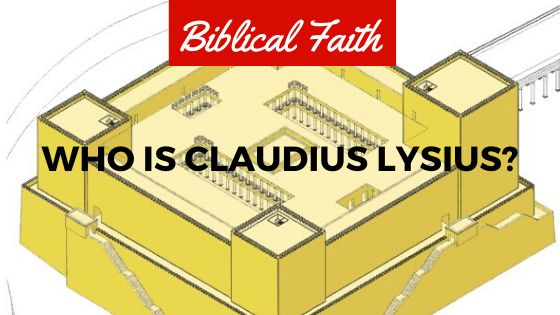
Reconstruction of Fort Antonia by Ehud Netzer in Biblical Archaeology Review 35.1 (Jan.-Feb. 2009).

Claudius Lysias, the Tribune

Claudius Lysias is called “the tribune” (χιλίαρχος, chilíarchos) 16 times within Acts 21-24 (21:31-33, 37; 22:24, 26-29; 23:10, 15, 17, 19, 22; 24:22); 17 times if Claudius Lysias is also included in among the “military tribunes” in the “audience hall” when Herod Agrippa II and Bernice come to hear Paul (Acts 25:23). However, such speculation is uncertain, especially considering a minimum of two years from when Claudius Lysias sent Paul to the Procurator Marcus Antonius Felix in c. AD 57/58 Acts 23:26-35, to within the first few months of the new Procurator Porcius Festus who rules from AD 60-62 (Acts 24:27-25:1-22).

The Greek term chilíarchos is said to be used to translate the Roman tribunus militum (following Polybius), and also for the phrase tribuni militares consulari potestate (Plutarch). The responsibilities of a chilíarchos were as a “commander of a thousand men”.[1] Essentially, Claudius Lysias is “a high ranking military officer in charge” of anywhere from 600 to 1,000 men,[2] and this appears to be the case for it is said that his command was over a “cohort” (σπειρα, speira) in Jerusalem which is “the tenth part of a Roman legion having about 600 men” (Acts 21:31).[3]

Tribune of a Jerusalem Cohort

Claudius Lysias’s complete description as found in the New Testament book of the Acts of the Apostles is “the tribune of the cohort” in Jerusalem, which resided in nearby “barracks” (Acts 21:34, 37; 22:24, 23:10, 16, 32). It takes six cohorts to make up a legion, and each legion had six tribunes with a thousand men (“soldiers and centurions” Acts 21:32) under his command if the cohort was full; consequently, Claudius Lysias was a part of a larger military force.

The exact numbers in his cohort may never be known, however, he had sufficient men to spare two centurions, two hundred soldiers, seventy horsemen, and two hundred spearmen to accompany Paul to Caesarea Acts 23:23-24. Furthermore, when the security detail arrives before Antipatris (Acts 23:31), Claudius Lysias allows for the seventy horsemen to go on with him and Paul to Caesarea, the headquarters of the Procurator Felix (Acts 23:32-35).

The “barracks” referenced in the book of Acts (21:34, 37; 22:24; 23:10, 16, 32), in connection to Claudius Lysias and his cohort are references to the Tower of Antonia, which Herod the Great rebuilt from a previous structure and named it after Marc Antony.[4] The Antonia was added on to the northwest side of the Temple facilities, “from which stairs descend into the outer court of the temple” (Acts 21:32, 35, 22:30).[5] For this reason, the Roman Tribune could hear the commotion caused by the confusing riot over Paul’s presence in the Temple and respond with speed (Acts 21:27-32).

Claudius Lysias in the New Testament

The military tribune Claudius Lysias enters the New Testament narrative when he protects Paul of Tarsus from a hostile Jewish mob on the outside of the Temple grounds in Jerusalem (Acts 21:30-32). The Acts text does not explicitly state why the tribune arrests Paul aside from asking “who he was and what he had done” (Acts 21:33); consequently, it appears Paul is detained for investigation as reflected later in Paul’s interrogation in the Antonian barracks because he was a cause of instigation among the Jews (Acts 22:23-24).

Claudius Lysias is aware of Jewish anarchistic movements, for when Paul speaking in Greek asks permission to speak to the shouting Jewish mob, the tribune appears shocked that he speaks Greek (Acts 21:37). Paul, as a controversial Greek-speaking Hebrew, evidently met some of the criteria for Lysias to conclude he was a Jewish revolutionist. Consequently, it appears that Lysias suspects him of being “the Egyptian” who “stirred up a revolt and led the four thousand men of the Assassins [σικαρίων] out into the wilderness” (Acts 21:38).

This individual operated around A.D. 53, and this revolution amounted to amassing these four thousand men, positioning themselves upon the Mount of Olives outside Jerusalem, and anticipating the walls of Jerusalem to collapse at his command. The Romans attacked this band of men, and the Egyptian lost six hundred men, and fled into the wilderness where he disappears awaiting “further revelation.” Evidently, “the Egyptian” was still on the run, wanted by the Roman military and the tribune was going to see if Paul was this anarchist.[6]

Paul was able to persuade Lysias that he was not an agitator, and provides him with his provincial citizenship as being from Tarsus, in the province of Cilicia (Acts 21:39). This was not an “obscure city” and either this suggests his citizenship could be authenticated, or Paul distinguished himself from the obscure Egyptian. In either case, Paul’s point is clear, he is not the Egyptian; the tribune accepts Paul’s case, and grants Paul an opportunity to speak to the Jews on the steps of the Temple facilities adjoined to the Antonian fortress (Acts 22:39-40).

The Jews did not respond peaceably to Paul’s speech, and Claudius Lysias decides to take Paul into the “barracks” of Antonia and “examine” him through the process of binding him to flog him (Acts 22:22-24). On receiving a report that Paul was a Roman citizen and then making a personal inquiry, Claudius is afraid of having violated the rights of a Roman by having him bound (see “Roman Citizenship” below). Claudius desires to arrive at the truth concerning the Jewish case against Paul and commands the Sanhedrin to assemble. Dissension among the Sanhedrin towards Paul arises again and causes Claudius Lysias to order his men to take Paul to the safety of the Antonian barracks (Acts 22:30-23:10).

Upon learning of a plot to kill Paul, Claudius Lysias summoned a military convoy to leave for Caesarea Maritima. In compliance with Roman law, he also sent a statement of the case to the procurator Antonius Felix. The letter reads:

Claudius Lysias, to his Excellency the governor Felix, greetings.

This man was seized by the Jews and was about to be killed by them when I came upon them with the soldiers and rescued him, having learned that he was a Roman citizen. And desiring to know the charge for which they were accusing him, I brought him down to their council. I found that he was being accused about questions of their law, but charged with nothing deserving death or imprisonment. 

And when it was disclosed to me that there would be a plot against the man, I sent him to you at once, ordering his accusers also to state before you what they have against him. (Acts 23:26-30, English Standard Version)

The letter format is consistent with the general format in the Graeco-Roman world, of “author” to “recipient” with a “greeting” with the subsequent content of the reason for the letter.[7] This letter, however, was not altogether factual. It is an interesting “specimen” of Roman military correspondence (Acts 23:26-30).

Although acknowledging Paul’s innocence, Claudius Lysias gave the impression that he had rescued Paul because of having learned that the apostle was a Roman, whereas in reality, he had violated Paul’s citizenship rights by having him bound and even ordering that he be examined under scourgings. As to the disciple Luke’s knowledge of the letter’s contents, it may be that the letter itself was read at the time Paul’s case was heard.

Roman Citizenship

In Acts 22:23-29, a discussion between Paul and Claudius emerges on the topic of Roman citizenship. Part of Claudius’ investigation procedure to find out more information was to stretch out the detained for whips and flog them.

Before his flogging begins, Paul questions the centurion given this detail, “Is it lawful for you to flog a man who is a Roman citizen and uncondemned?” (Acts 22:25). Roman citizenship had a number of privileges, as John Polhill writes:

A Roman citizen was subject to Roman law and thus was protected from such things as being beaten without a trial, from cruel punishments like crucifixion, and from unlawful imprisonment, rights which did not belong to an ordinary provincial (peregrinus). Citizens had the right of appeal. Only a Roman citizen could legally marry another Roman citizen. Citizens were exempted from certain taxes. Beyond this, there was the considerable factor of honor and deference such a status afforded.[8]

It was such a valued honor, that some people risked the death penalty given for falsely claiming citizenship.[9] Interestingly, one could hold dual citizenship, as Paul was not only a citizen of the city of Rome but was also a citizen of the city of Tarsus from the province of Cilicia (Acts 21.39; 23.34).

Roman citizenship was conferred in a number of ways. The basic ones are as follows:

(1) The most common way was being born of two Roman citizens.

This is the claim Paul makes when asked how he obtained his citizenship (“I am a citizen by birth” Acts 22:28), which implies that both of Paul’s parents were Jewish Roman citizens (cf. #4).

(2) One could obtain citizenship as a reward for military service.

Regularly, military veterans were given citizenship upon discharge. This was the surest way to get it, taking 20 to 25 years depending on the level of ranking.

(3) Imperial conference, though heard of, was not entirely common.

Nevertheless, the emperor could confer citizenship, either on individuals or on whole communities, as in the establishment of a new colony. Often the result of doing some loyal service to Rome. Also, many times through these services, one gained an audience with the Emperor through expensive gifts to members of the inner Imperial court.

This may have been how the Tribune Claudius Lysias gained his citizenship (Acts 22:27-28). In fact, the tribune’s name provides evidence to assume the plausibility that Emperor Claudius (A.D. 41 – A.D. 54) conferred upon Lysias citizenship since those granted this honor would bear the name (the nomen) of the family or patron which conferred it; hence, Lysias gained the name of his patron Claudius. It has been noted that the emperor was quite “promiscuous” in his conference of citizenship.[10]

(4) Roman citizenship was also conferred through the emancipation of a slave from the house of a Roman citizen.

Some have suggested that Paul’s ancestors may have been freedmen from among the thousands of Jews whom Pompey took as slaves in 63 B.C.[11]

Endnotes

  1. H. G. Liddell, An Intermediate Greek-English Lexicon: Abridged from Liddel and Scott’s Greek-English Lexicon (1888; repr.; Oak Harbor, Wash.: Logos Research Systems, 1996), 888.
  2. Barclay Newman, Jr., A Concise Greek-English Dictionary of the New Testament, revised ed. (Stuttgart: Deutsche Bibelgesellschaft, 2010), 200.
  3. Newman, A Concise Greek-English Dictionary, 167.
  4. Josephus, Antiquities 15.293; 15.409.
  5. George A. Smith, et al., “Jerusalem,” Encyclopaedia Biblica, eds. T. K. Cheyne and J. Southerland Black (London: A & C Black, 1901), 1:2429.
  6. Robert M. Grant, The Sword and the Cross (New York, NY: Macmillan, 1955), 49.
  7. T. C. Mitchell, Biblical Archaeology: Documents from the British Museum (New York, NY: University of Cambridge, 1988), 89.
  8. John B. Polhill, “Political Background of the New Testament,” Foundations for Biblical Interpretation, eds. David S. Dockery, et al. (Nashville, TN: Broadman & Holman, 1994), 531-32.
  9. Abraham J. Malherbe, “Life in the Graeco-Roman World,” The World of the New Testament, ed. Abraham J. Malherbe (1967; repr., Abilene, Tex.: Abilene Christian University Press, 1984), 9.
  10. Polhill, “Political Background of the New Testament,” 532.
  11. John B. Polhill, “Political Background of the New Testament,” 532; Richard R. Losch, The Uttermost Part of the Earth: A Guide to Places in the Bible (Grand Rapids, MI: Eerdmans, 2005), 176-77.

This originally appeared as a fully edited submission to Wikipedia.org. I have posted this here in case it is revised or rewritten.