Symbols of Christianity

I was recently asked to explore various symbols related to the Christian faith. I have thought about how to share these brief notes. I decided to piece them together here for your consideration. Christians respond diversely to symbols. I am using this word as an action or icon that invites reflection on Jesus and the Christian faith.

There are creedal statements like the Old Roman Symbol (c. 215) called “symbol,” of sample of it reads:

I believe in God, the Father almighty.  And in Christ Jesus, his only Son, our Lord,  who was born of the Holy Spirit of the virgin Mary,  who was crucified under Pontius Pilate and was buried,  the third day he rose from the dead.  He ascended into heaven,  is seated at the right hand of the Father.  From there he will come to judge the living and the dead.1

The following symbols have confessional value but they are not as direct as “I believe…” statements.

The Marks of Jesus

Injuries caused by persecution have a way of telling the story of our faith in Jesus. Paul wrote Galatians about a couple of years before AD 50 to Christians entangled in a crisis over the nature of the true Gospel message, likely just before the so-called Jerusalem Council (Acts 15).

Some had clearly been subject to the quick work of certain false teachers imposing a strong retention of Judaistic practices as essential to the faith. Paul dispatches Galatians to undo the corrupting influence of this false gospel by outlining that justification by faith in Christ was the essence of the Law, and always intended to transcend and consummate the Law. This was accomplished on the basis of the promises granted to Abraham, made operative by faith in Christ which is entered into at baptism (Gal 2:15-5:1). This new life in the Spirit provides the rule of life for the Christian (Gal 5:2-16). At the close of this letter, the apostle signs off with what appears to be words of exhaustion:

From now on let no one cause me trouble, for I bear on my body the marks of Jesus. The grace of our Lord Jesus Christ be with your spirit, brothers. Amen. (Galatians 6:17-18 English Standard Version2)

What is remarkable is that the apostle could claim that he wore on his body “the marks of Jesus” so early in his ministry. Let me unpack this briefly. These marks (stigmata) that Paul bears (bastadzo) on his body are likely scars.3

According to Acts, during Paul’s traditional “first” mission there is one explicit case of physical violence for this early claim (Acts 13-14). There was persecution in which Paul and Barnabas were driven out of Antioch (Acts 13:50). Early in their work in Iconium, mistreatment and stoning were attempted on them by Gentiles and Jews (Acts 14:5). Later, Jews arrived in Iconium from Antioch and stoned Paul, and then they dragged his body out of the city “supposing he was dead” (Acts 14:19). He must have looked convincingly dead-or was-from the stoning when he rose up and continued his mission (Acts 14:20).

So when Paul wrote “I bear on my body the marks [scars] of Jesus” he could literally point to the scars on his body as witnesses of persecution for his service to Jesus. This would only be the beginning of his sufferings, as the Lord Jesus explains that Paul’s calling as a chosen instrument will be accompanied by suffering: “For I will show him how much he must suffer for the sake of my name” (Acts 9:16). Paul words point to that our injuries experienced in the line of Christian duty tell the story of Jesus, his own suffering on the cross, and our faith in him as our resurrected Lord.

The Cross of Christ

In the Third Servile War (73-71 BC), rebel slaves led by Spartacus lost the war, and of the survivors all six thousand seditious slaves were crucified by General Marcus Licinius Crassus (115-53 BC) along the Appian Way in Italy. There is an irony that the symbol of the Christian faith was the Roman tool to end insurrectionists. It was a symbol of Roman power as they executed enemies of the state in one of the most humiliating public displays of power disparity.

For the executed it was a clear failure of their insurrection, as the impotence of their cause is placed on full display. Crucifixion was to execute and embarrass its victim and to announce the futility of the movement to all its followers and all who would attempt to pick up its torch. Clearly, the Jewish opponents among the leadership in Jerusalem desired to not only execute Jesus but also quell his messianic movement as others before him.

Even in the biblical text, execution by hanging was a shame and a curse:

And if a man has committed a crime punishable by death and he is put to death, and you hang him on a tree, his body shall not remain all night on the tree, but you shall bury him the same day, for a hanged man is cursed by God. You shall not defile your land that the Lord your God is giving you for an inheritance. (Deuteronomy 21:22-23)

It is remarkable that this text is equated with the shame of the cross of Christ. In Galatians, Paul writes, “Christ redeemed us from the curse of the law by becoming a curse for us—for it is written, ‘Cursed is everyone who is hanged on a tree’ ” (Gal 3:13). Peter and the apostles affirmed to the Jewish council that “the God of our fathers raised Jesus, whom you killed by hanging him on a tree” (Acts 5:30). Clearly, the redemptive outcome from the crucifixion of Christ transformed the value of the cross of Christ, and this is seen in Paul’s declaration to the Corinthians: “For I decided to know nothing among you except Jesus Christ and him crucified” (1 Cor 2:2). The cross means the humiliation of Christ, but it also means our redemption by Christ’s substitutionary death. It is to be the source of our boasting, “by which the world has been crucified to me, and I to the world” (Gal 6:14).

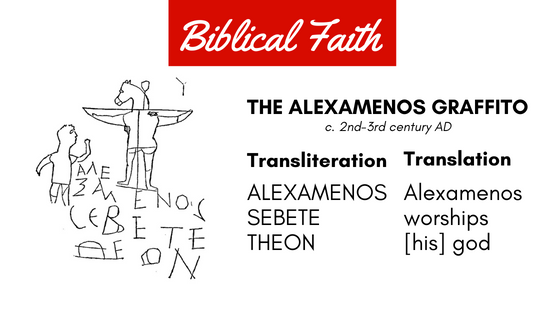
There is ample evidence that Christian persecution began early in the first century, most of it was sporadic rather than systemic. One curious example comes from an anonymous ancient antagonist who carved his aggression against a certain Christian named Alexamenos. This late second century, or early third century, carving is known as the Alexamenos Graffito, and it portrays a crucified man with the head of either a donkey or a horse and wrote around it:

ALEXAMENOS WORSHIPS [HIS?] GOD.4

Even when Christians were publicly shamed in graffiti, Christianity is represented by their “crucified god.” This type of ridicule from the public nevertheless shows a clear connection between the cross and the Christian Way and an early understanding of the divinity of Jesus.

It is possible that the Crucifix (the image of Jesus on the cross) as such emerged around the sixth century as a symbol of Christianity. The cross, however, has been forever paired with the proclamation of the gospel. Today it is in hospitals, as “the hospital” was invented by Christians who opened homes to care for the sick as early as the fourth century. The Red Cross as a benevolent organization uses the symbol of the cross as a symbol of compassion and concern, key beliefs of the Christian faith.

The Jesus Fish <><

The creativity of the ancient Christians is remarkable. Every now and then something of this ancient creativity finds its way back into the hands of the faithful. During the turbulent times of the 60’s and 70’s the fish symbol re-emerged as a cultural symbol of the Christian faith. But how did the fish symbol come to be used by ancient Christians?

One tradition says it goes back to times of persecution. When Christians would travel and find themselves in the company of strangers, they would draw on the ground an outline of a fish to see if they were among fellow believers.5 It was a symbol that veiled a hidden message: “I believe that Jesus is the Christ, the Son of God, the Savior.” The Greek word for fish (ichthus) had become an acronym for the above creedal statement.

Let’s unpack this a little more. Using our English letters to phonetically represent the Greek letters in the fish (ichthus) acronym, we have:

 i (iota) = Iesous (Jesus)
ch (chai) = Christos (Christ)
th (theta) = theos (God)
u (upsilon) = huios (son)
s (sigma) = Soter (savior)

Literally, it translates to: “Jesus Christ God Son Savior.” Sometimes it was drawn as a fish and other times as a circle with many lines like a pizza.

Note: Image taken from LeaderGuideBibleStudies.com

Today, the Jesus fish is a widely recognizable cultural icon of the Christian faith. It is no longer the hidden message it once was. Friend and foe know it as part of the Christian “branding.” Evolutionists, atheistic skeptics, and ufologists have even made their own mocking versions. Nevertheless, the Jesus fish is an ancient Christian symbol affirming our faith claim that Jesus is the Christ, the Son of God, the Savior.

Walking After His Pattern

The best image of Christ anyone will meet is the Christian who follows after the example of Jesus in the way they live their life and love their neighbor. In Peter’s letter, the apostle invites us to a life of deep commitment with the following words:

For to this you have been called, because Christ also suffered for you, leaving you an example, so that you might follow in his steps. (1 Peter 2:21)

The Christians Peter is writing to are experiencing a variety of tensions in their lives with neighbors in their community challenging them, criticizing them, and perhaps even forcing them into public legal situations where they must defend themselves and their new way of life.

Here, Peter calls on the imagery of children learning to write their letters by using a stencil to copy the letters until they can write the letters on their own. In the word “example” (hupogrammon) is found this ancient practice of children learning how to write their letters.6 Jesus is our template, our model, our tracing paper as we learn how to live a life as a servant of Christ.

In this section of his letter (1 Pet 2:21-25), Peter quotes and alludes to the suffering servant passage of Isaiah 53 as describing and outlining how Jesus endured rejection and suffering even to the point of the cross. How Jesus faced the cross, Peter argues, is how Christians ought to face the challenges of the world they live in. In short, his willingness to suffer on the cross becomes our paradigm/model for living. Scot McKnight puts a helpful perspective on this text:

Here is an early Christian interpretation of Christ’s life that is, at the same time, an exercise in the explanation of the essence of the Christian life. This little section, in other words, is a glimpse into a Christian worldview of the first century—a world not at all like our world because of the predominance of suffering in the early church, but a worldview that retains its significance for Christian living.7

Scot McKnight, 1 Peter, NIVAC

As the reasons for being a Christian drift towards matters of “to be better,” “to help others,” “to find community… a family…,” or something one could obtain from a support group or self-help book, the nagging truth of Christian discipleship formed by the paradigm of Jesus and his suffering on the cross for our redemption, the church may never come to realize its primitive spirit of sacrificial consecration prepared to do likewise as the sacrificial sheep of God.

The Christian is redeemed by the suffering Christ, and it is an essential part of the Christian life to endure suffering as we serve the Christ of the gospel we proclaim and live by.

What Symbols Do You Bear?

I hope these short reflections will help you think about how we think about Jesus in our life of faith. Are we marked by sorrow, pain, or harm from following Jesus? If not pray for others who have. Perhaps you have other ways to speak of your faith. Do you glory in his cross? Do you focus on the work of Christ on the cross and what that means for the work of Christ happening in your heart? Take time to meditate on this truth.

Our symbols may need some unpacking, like the Jesus Fish, but perhaps instead of looking at it as a “cheesey” Christian pop icon, you may see it as a meaningful symbol born from persecution for simply being a Christian. Nevertheless, the only symbol of Christ that truly touches the hearts of men is that of a Christian walking in the steps of his suffering servant Jesus.

May God bless you.

Endnotes

  1. Old Roman Symbol. ↩︎
  2. All Scripture quotations are taken from the English Standard Version (Wheaton, IL: Crossway). ↩︎
  3. J. Louis Martyn, Galatians: A New Translation with Introduction and Commentary, AYB 33A (New Haven, CT: Yale, 1974), 56. ↩︎
  4. Jen Rost suggests a broader window of c. 83 to the third century, “Alexamenos Graffito,” worldhistory.org ↩︎
  5. Elesha Coffman, “What is the Origin of the Christian Fish Symbol?,” Christianity Today (8 Aug 2008) ↩︎
  6. John H. Bennetch, “Exegetical Studies in 1 Peter,” BSac 99 (1942), 346. ↩︎
  7. Scot McKnight, 1 Peter, NIVAC (Grand Rapids, MI: Zondervan, 1996), 168. ↩︎

Psalm 41: David’s Lament of Betrayal

According to the Gospel of John, during the final hours before his betrayal and crucifixion, Jesus spent the final night with his disciples. This begins the “hour” in which Jesus would be glorified (John 12:27–28). The first “teaching act” Jesus provides his disciples is to wash their feet, illustrating that leadership must be service-oriented among them whether Master and Teacher or servant and disciple (John 13:1–20).

Both Jesus and the narrator of the Fourth Gospel introduce a significant feature here: Jesus served all of his disciples by washing their feet, especially Judas whom Jesus already knew would betray him (John 13:11). This general fact Jesus makes a topic of conversation (John 13:17–20, 21–30). Jesus said:

I am not speaking of all of you; I know whom I have chosen. But the Scripture will be fulfilled, ‘He who ate my bread has lifted his heel against me.’ (John 13:18 English Standard Version)[1]

In Christian interpretation, the “Scripture” reference is to Psalm 41:9 as a prophecy of Judas. As with many New Testament quotations of the Old Testament, the use of this passage in reference to Judas’s betrayal of Jesus generates considerable questions. For example, if this scripture applies to Judas, was Psalm 41:9 void of meaning for centuries until the first century AD emergence of Jesus? This seems unlikely. Additionally, in what sense does Judas fulfill (plēroō) this passage? Is it in a typological, duel-fulfillment (telescopic), or primary/secondary fulfillment sense? These types of questions are important, but they are not the primary concern in this paper.[2]

The present brief study was prompted by the connection between Psalm 41:9 and John 13:18. Nevertheless, the most important concern in this paper is to seek to understand Psalm 41 as a unit.

Thus, the primary focus presently is on understanding Psalm 41 from its historical and biblical context (i.e., Hebrew Bible), its structural features (literary genre, organizational form), and its linguistic features. With these items in place, it will help to consider its theology and application. Finally, a consideration on how to best see how Judas’s betrayal of Jesus “fulfills” Psalm 41:9.

Historical Context

C. Hassell Bullock mentions the great dilemma of studying the historical context of any given psalm and stresses that to obtain a solid footing for explaining the context one must examine the superscriptions and content of the psalm.[3]

Edward Tesh and Walter Zorn observe that perhaps no other psalm rivals Psalm 41 in terms of providing the original setting and significance.[4] They evaluate six possible explanations and conclude that the psalm was probably borne out of a dire situation and was consequently a lament, in which the psalmist appeals for healing. From this dire circumstance, the psalm eventually was incorporated into the liturgy of the temple worship.[5] Other scholars also recognize the “lament” nature of the psalm as informative to understanding the original historical context (Carroll Stuhlmeuller, Peter C. Craigie, Robert G. Bratcher and William D. Reyburn).[6] The internal evidence, then, points to a historical context that generated a lament.

Peter Craigie represents those who argue that the Psalm must be understood in its liturgical use for the sick of Israel, instead of a personal historical context.[7] Likewise, Charles A. Briggs argued that the psalm is national in scope, not individual, because of an emphasis upon God blessing those in the land during post-exilic times (Psa 41:2).[8] The psalm proper begins:

"Blessed is the one who considers the poor! In the day of trouble the Lord delivers him; the LORD protects him and keeps him alive; he is called blessed in the land; you do not give him up to the will of his enemies." (Psalm 41:1–2). 

Canonically, the psalm is a communal outcry, and this then speaks to its shaping context. This conclusion seems to be weakened by the fact that there is still an earlier setting that precedes its Hebrew liturgical use. This amounts to a debate between the later canonical use of Psalm 41 with its initial authorial intent.

The tradition contained in the subscription may provide help in understanding the original historical context. The subscription is ancient but it is not likely to be as old as the psalm. It minimally points to what the ancients believed about this psalm. It may help understand the initial authorial intent of Psalm 41 by providing an assumption about the personal emphases throughout the psalm and the psalmist’s dependence upon God. The subscription of Psalm 41 reads: “To the Choirmaster. A psalm of David.” The psalm is Davidic by tradition. Internally, there is nothing inherent in the psalm that would dismiss it as being Davidic.

Unfortunately, some have noted that the translation of the ascription “of David” (le dwd) could be regarded as a dedication “to David.”[9] In addition to versional evidence offered to support the translation for the phrase as “of David,” similar wording can be demonstrated from the Hebrew canon to express authorship.[10] To illustrate, consider one example from Habakkuk:

A prayer of Habakkuk the prophet, according to Shigionoth. 

O Lord, I have heard the report of you, and your work, O Lord, do I fear. In the midst of the years revive it; in the midst of the years make it known; in wrath remember mercy. (Hab 3:1–2)

This is not a prayer dedicated to Habakkuk, but a prayer of the prophet, as in by the prophet. Despite later reconstructions of redaction and editorial work theories in the canonical shaping of Psalter, it seems reasonable that “to David” in the subscription is a claim of authorship. If there is no need to question Davidic authorship, then the traditional attributions may be considered accurate, and therefore be a line of argumentation against Briggs’ post-exilic interpretation of Psalm 41:2.[11]

The internal evidence, then, is supportive of a time in King David’s lifetime in which he experienced betrayal and treachery by someone close to him, and the presence and faithfulness of his God to vindicate him. This is assumed here to be during his reign in the 10th century BC. Psalm 41 may have been collated afresh in later editions of the Psalter for liturgical or national use, but these developments are secondary contexts.

Literary Form

Psalm 41 is generally regarded as a lament. Its historical context makes it more likely it was an individual lament. Laments are not simply mere prayers of pain. Laments often contours such as an outcry of pain or distress, a declaration of faith based upon some past action of God, lessons learned about God, and a statement of praise. In that sense, a lament can offer insight into a past tragedy in which the lamenter cries out to God and then contains a record of the Lord’s vindication.

For reasons like this, an alternative form for Psalm 41 is what Willem A. Van Germeren calls a “thanksgiving of the individual.”[12] If it is to be considered as a thanksgiving work, then there should be words of praise, some description of God’s gracious action, lessons learned about God, and some form of a conclusion extolling God. It is true the psalm begins with what may be read as thanksgiving for the one who considers the poor for the Lord will deliver him. But while there is certainly an undertow of gratitude throughout the psalm, there is the consistent plea for assistance, deliverance, and an appeal to God’s grace that saturates the psalm. The evidence for lament is stronger than the theme of thanksgiving.

It has also been suggested that Psalm 41 could overlap with the wisdom psalm literary form. Instead of the distressing opening lines of Psalm 22:1 (“My God, my God, why have you forsaken me?”) or Psalm 51:1 (“Have mercy on me, O God, according to your steadfast love”s 51:1”), Psalm 41 begins with a proverbial statement.[13] observe:

“Blessed is the one who considers the poor, in the day of trouble the Lord delivers him.” (Psalm 41:1)

However, the phrase “blessed” is used throughout the Psalms and does not require proverbial emphases. While it could be argued that Psalm 41 does not begin with the type of traditional outcry associated with lament, the wisdom genre does not carry the burden of how the psalmist describes his enemies as conspiring against him:

My enemies say of me in malice, “When will he die, and his name perish?” And when one comes to see me, he utters empty words, while his heart gathers iniquity; when he goes out, he tells it abroad. All who hate me whisper together about me; they imagine the worst for me. They say, “A deadly thing is poured out on him; he will not rise again from where he lies.” Even my close friend in whom I trusted, who ate my bread, has lifted his heel against me. But you, O Lord, be gracious to me, and raise me up, that I may repay them! (Psalm 41:5-10)

Wisdom provides the “how to” knowledge or the “beware” knowledge, the psalmist is decrying his situation.

The psalm begins with a focus on the individual and the Lord’s care of “he who considers the poor.” In a Spanish translation, the Hebrew word dal is translated as “el debil” (Santa Biblia: Nueva Version Internacional), meaning those who are weak. It seems essential to the lament of the psalm that the weak is the psalmist and not necessarily someone about whom the psalmist is reflecting about.

Structure

While this paper will not address the complexities of the original Hebrew text,[14] it is clear that the psalm may be given a variety of outlines depending on how the parallelism is viewed. Not all scholars seem to agree on the arrangement even if they have the same number of structural divisions. For example, the late Hugo McCord (1911–2004) sets the psalm into four stichs in his translation of the Psalms: 41:1–3, 4–6, 7–9, 10–12, and 13.[15] Tesh and Zorn divide the psalm into four different stichs: 1–4, 5–9, 10–12, and 13.[16]

I offer a personal outline for the psalm suggested: 1–3, 4–8, 9–12, and 13.

Psalm 41:1–3: Blessed is the one who considers the poor! In the day of trouble the Lord delivers him; the LORD protects him and keeps him alive; he is called blessed in the land; you do not give him up to the will of his enemies. The LORD sustains him on his sickbed; in his illness you restore him to full health.

Psalm 41:4–8: As for me, I said, “O LORD, be gracious to me heal me, for I have sinned against you!” My enemies say of me in malice, “When will he die, and his name perish?” And when one comes to see me, he utters empty words, while his heart gathers iniquity; when he goes out, he tells it abroad. All who hate me whisper together about me; they imagine the worst for me. They say, “A deadly thing is poured out on him; he will not rise again from where he lies.” 

Psalm 9–12: Even my close friend in whom I trusted, who ate my bread, has lifted his heel against me. But you, O Lord, be gracious to me, and raise me up, that I may repay them! By this I know that you delight in me: my enemy will not shout in triumph over me. But you have upheld me because of my integrity, and set me in your presence forever.

Psalm 13: Blessed be the LORD, the God of Israel, from everlasting to everlasting! Amen and Amen. 

The groupings seem to fit a thematic development. In verses 1–3, David demonstrates a balancing of the blessed environment of the one who considers the poor with the strength and sustaining power of God. Then, in verses 4–8, David describes the plight he finds himself in. While David seems to be in poor health and under spiritual duress and therefore vulnerable, his enemies reveal themselves as ambitious traitors to the crown. In verses 9–12, the case intensifies as David laments the fact that he has become so isolated that “even” his close friend betrays him. Admit the tension the Lord is appealed to for help so that the psalmist’s suffering may be avenged by the Lord. This would be all the vindication he would need.

Interestingly, the doxology of verse 13 is typically set to stand by itself perhaps as an inclusio. George Knight observes that the psalm begins with “blessed be the man” it ends with “blessed be the Lord.”[17] There is certainly an understood purpose behind this inclusio. Some speculate this verse was added by a later editor or compiler.[18] On Hebrew parallelism, it has been argued that verse 13 does not seem to formally echo or balance with verse 12.[19] Additionally, the language in Psalm 41:13 is remarkably similar to Psalm 106:48 and functions similarly as a formal doxological break between the two books. Psalm 41 closes Book I and Psalm 106 closes Book IV with the same doxology, with an expanded doxology in Psalm 106. However one accounts for verse 13, it is structurally integral to the Psalter.

Imagery

Imagery is an important aspect of Hebrew poetry. Imagery conveys messages and nuances and sometimes brings our emotions. In the Hebrew poetry of the Psalms, the poet expresses truths with images being the channel. Consider a minor sample of some of the imagery concerning God, the psalmist, and the psalmist’s enemy.

Psalm 41:3 refers to the parallel concept of the Lord who strengthens the sick man “on his bed of illness” and “sustain him on his sickbed.” The picture is graphic and is one of physical restoration, which may refer both to spiritual or real renewal.

Psalm 41:6 discusses, from the vantage point of the psalmist, his enemy. His enemy’s “heart gathers iniquity to itself; when he goes out, he tells it.” The psalmist personifies the mind of an evil man and depicts it in the act of gathering iniquity as a person may gather fruits or clothing. Man’s heart is given to iniquity, so much that he self-references is own sinfulness. The enemy of the psalmist is consequently even more devious and methodical.

In Psalm 41:9 the description of the kind of enemy the Psalmist endures is one that is a close associate, one whom he trusted. Trust and eating bread are synonymous phrases in this context, demonstrating the use of parallelism. But the synonym moves on to climatic, where the enemy goes from trusted friend to outright betrayer.

Biblical Context

As previously mentioned in the introduction, from a Christian reading of the Bible, Psalm 41 is associated with Judas Iscariot since John narrates that Jesus declared Judas’ betrayal as a fulfillment of Psalm 41:9. Sometimes the Christ-Judas relationship overshadows David’s own reason for writing the Psalm, his Sitz en Leiben (life’s setting). On the assumption of Davidic authorship of Psalm 41, are there any points in the life of David that can corroborate with the details of the psalm?

According to Briggs, the traditional Sitz en Leiben of the betrayal and sheer disadvantage displayed in Psalm 41 is that of David’s encounters with Ahithophel of Gilo, his former counselor on the side of his usurping son Absalom (2 Sam 15:1–17:29).[20] It is important to recall that one of the difficulties aligning the setting of the Psalms with the life of David is that not everything was recorded for posterity. Additionally, the narrative language may not always align with the emotional nature of poetry. So, despite the traditional election of Ahithophel (Psa 41:9), it is merely a traditional reading. Consequently, the betrayal by Absalom and Ahithophel may not be what David had intended.

Nevertheless, it is worth considering the relationship between Ahithophel and David. Ahithophel was once a trusted counselor of David (2 Sam 15:31, 34). Ahithophel’s legacy is summed up in 2 Samuel 23:34 as one of David’s mighty men, and in two verses in 1 Chronicles 27:33–34, he “was the king’s counselor… [and] was succeeded by Jehoiada the son of Benaiah, and Abiathar.” He was a man in David’s inner inner circle.

Ahithophel was “David’s counselor” who was successfully courted by David’s embittered son Absalom to overthrow his father as king of Israel in a coup d’é·tat (2 Sam 15:1–12). The tragedy is that his counsel was esteemed “as if one consulted the word of God” (2 Sam 16:23), so his complicity in the conspiracy to overthrow David cut deep (2 Sam 15:31). David, now living on the run and vulnerable, prays to the Lord for the undoing of Ahithophel. Although there is no explicit claim that the Lord rose up Hushai the Archite, this “friend” of David serves as a counter-intelligence spy and undermines confidence in Ahithophel’s military plans against David (2 Sam 15:32–37; 16:15–17:22).

Without explanation, the end of Ahithophel is revealed:

When Ahithophel saw that his counsel was not followed, he saddled his donkey and went off home to his own city. He set his house in order and hanged himself, and he died and was buried in the tomb of his father. (2 Samuel 17:23)

Is this specifically what David meant when he lamented in faith?

Even my close friend in whom I trusted, who ate my bread, has lifted his heel against me. But you, O Lord, be gracious to me, and raise me up, that I may repay them! By this I know that you delight in me: my enemy will not shout in triumph over me. But you have upheld me because of my integrity, and set me in your presence forever. (Psalm 41:9-12)

It is hard to dismiss it even if there is not a clear explicit connection.

Nine hundred years later in the New Testament, the Lord Jesus affirms that this is a reference to Judas (John 13:18). It seems that while David through the Spirit referred to his own situation–whatever it was, the Spirit hid within it a prophecy of betrayal concerning the coming Davidic Messiah likewise from deep within the inner circle. For this reason, Jesus could legitimately claim the Apostle Judas–trusted with the office of an Apostle and keeper of the group’s finances (Luke 6:12–16; John 12:6)–as the fulfillment of this Messianic prophecy. Just as in the case of Ahithophel, no clear motive is ever given for the betrayal of Jesus by Judas.

Theology

The theology of Psalm 41 is connected together by three internal figures: David, David’s God, and David’s enemies. David wrote a lament prayer to his God, who sees both his sinfulness and the injustice as he suffers at the hands of his own enemies, and repeatedly asks God for his gracious deliverance and vindication.

First, David’s lament calls on God’s people to learn the nerve-wracking truth that faithfulness to God will not always protect from the treachery and betrayal of those considered to be allies and members of one’s inner circle. David’s focus on the Lord provides a pathway for making the most important thing the priority: David knows his fellowship with God is unimpeded by his trials. David knows:

the Lord protects him and keeps him alive; he is called blessed in the land; you do not give him up to the will of his enemies (Psalm 41:2)

Second, the powerful king seems to have gone through an illness or some demonstration of weakness which emboldened his enemies to come into the light in anticipation of his collapse or death. David sees his inner court filled with two-faced loyalists, who secretly have grown disloyal to him waiting for the right moment to reveal themselves and exploit his weakness. If the story of David teaches one crucial theological truth it is that God’s anointed will suffer unjustly.

Third, God will vindicate the innocent and the compassionate. David’s ethical and moral life was turbulent. His moral lows are ethically grotesque while his spiritual highs show a deep conviction in aligning himself on the side of the Lord. David was fully aware of his sin but knew the God he served hated injustice and would help those who were poor, or of weak stature. There is comfort in knowing that even though a person may be so weak morally, spiritually, financially, or in health, God desires their protection and care. God will vindicate the taken advantage of.

Application

The message of Psalm 41 is a message for the ages. Many have had friends turn on them, and deliver a heart-piercing stab which only few can do. Intimate relationships can sometimes be vehicles for some to achieve what they want at the expense of those whom they hurt and abuse. We must have the confidence of the psalmist and take refuge in the Lord. The lament provides the language to speak to the Lord in prayer. The psalm calls on the saints to lean into the tragedies surrounding them in faith in the confidence that the Lord is not far from them.

Endnotes

  1. Unless otherwise noted all Scripture quotations are from the English Standard Version of The Holy Bible (Wheaton, IL: Crossway, 2001).
  2. While this sidesteps these important questions, prophecy and fulfillment are not the focus of this paper. In short, however, my conclusion is that while it is hard to determine the sense in which Jesus used plēroō, it seems likely he used it in a typological sense of fulfillment: as David the anointed king of Israel experienced betrayal in his kingdom, so too, the anticipated Davidic Messiah would be betrayed.
  3. C. Hassell Bullock, An Introduction to the Old Testament Poetical Books, revised ed. (Chicago: Moody, 1988), 125.
  4. S. Edward Tesh and Walter D. Zorn, Psalms (Joplin, MO: College Press, 1999), 1:306.
  5. Tesh and Zorn, Psalms, 1:309.
  6. Carroll Stuhlmeuller, Psalms (Collegeville, MN: Liturgical, 1983), 1:221; Peter C. Craigie, Psalms 1-50 (Waco, TX: Word, 1985), 321; Robert G. Bratcher and William D. Reyburn, A Handbook on the Psalms (New York: United Bible Society, 1991), 391.
  7. Craigie, Psalms 1-50, 319.
  8. Charles Augustus Briggs and Emilie Grace Briggs, A Critical and Exegetical Commentary on the Book of Psalms (Edinburgh: T&T Clark, ), 1:361.
  9. Raymond B. Dillard and Tremper Longman, III, An Introduction to the Old Testament (Grand Rapids, MI: Zondervan, 1994), 215–17.
  10. George A. F. Knight, Psalms (Philadelphia: Westminster, 1982), 1:8; Dillard and Longman, III, An Introduction, 216.
  11. Andrew E. Hill and John H. Walton, A Survey of the Old Testament (Grand Rapids: Zondervan, 1991), 274–75; Briggs and Briggs, Book of Psalms, 1:361.
  12. Willem A. Van Germeren, “Psalms” in Expository Bible Commentary, edited by Frank E. Gaebelien (Grand Rapids: Zondervan, 1991): 5:325.
  13. Craigie, Psalms 1-50, 320.
  14. As this paper is primarily an examination of the English text, linguistic concerns as the following will not be explored: W. O. E. Oesterley discusses the abruptness that is characteristic of this psalm and the natural flow of poetic realism which “shows how very human the psalmists were,” he explains however, that the “text has undergone some corruption, and in one or two cases emendation is difficult and uncertain.” See, W. E. O. Oesterley, The Psalms: Translated with Text-Critical and Exegetical Notes, 4th ed. (London: SPCK, 1953), 1:238.
  15. Hugo McCord, The Everlasting Gospel: Plus Genesis, the Psalms, and the Proverbs, 4th ed. (Henderson, TN: Freed-Hardeman UP, 2000). Granted, McCord did not provide a stylized rendering of the Hebrew poetry, but he did set them in connected paragraphs.
  16. Tesh and Zorn, Psalms, 1:308–13; Stuhlmeuller, Psalms, 1:220–21.
  17. Knight, Psalms, 199.
  18. Craigie, Psalms, 320; Tesh and Zorn, Psalms, 1:312.
  19. Stuhlmeuller, Psalms, 1:223; W. Oesterley, The Psalms, 1:240.
  20. Briggs and Briggs, Book of Psalms,1:361.

Works Cited

Bratcher, Robert G., and William D. Reyburn. A Handbook on the Psalms. New York: United Bible Society, 1991.

Briggs, Charles Augustus, and Emilie Grace Briggs. A Critical and Exegetical Commentary on the Book of Psalms. Vol. 1. International Critical Commentary. Edinburgh: Clark,

Bullock, C. Hassell. An Introduction to the Old Testament Poetical Books. Rev. ed. Chicago: Moody, 1988.

Craigie, Peter C. Psalms 1-50. Word Biblical Commentary. Vol. 19. Gen. eds. David A. Hubbard and Glenn W. Barker. Waco, TX: Word, .

Dillard, Raymond B, and Tremper Longman, III. An Introduction to the Old Testament. Grand Rapids: Zondervan, 1994.

Hill, Andrew E., and John H. Walton. A Survey of the Old Testament. Grand Rapids: Zondervan, 1991.

Knight, George A.F. Psalms. Vol. 1. Daily Study Bible: Old Testament. Gen. ed. John C.L. Gibson. Philadelphia: Westminster, 1982.

McCord, Hugo. The Everlasting Gospel: Plus Genesis, the Psalms, and the Proverbs. 4th ed. Henderson, TN: Freed-Hardeman UP, 2000.

Oesterley, W. E. O. The Psalms: Translated with Text-Critical and Exegetical Notes. 4th ed. London: SPCK, 1953.

Stuhlmeuller, Carroll. Psalms. Vol. 1. Old Testament Message. Vol. 21. Eds. Carroll Stuhlmeuller and Martine McNamara. Collegeville, MN: Liturgical, 1983.

Tesh, S. Edward, and Walter D. Zorn. Psalms. Vol. 1. College Press NIV Commentary. Eds. Terry Briley and Paul J. Kissling. Joplin, MO: College, 1999.

VanGermeren, Willem A. “Psalms.” Expository Bible Commentary. Vol. 5. Gen. ed. Frank E. Gaebelein. Grand Rapids: Zondervan, 1991.


Your Mission Matters

It is not unusual for businesses and enterprises to have “mission statements” to outline their objectives, goals, philosophy, and proposed impact their products or services are intended to have.

When you think about it, the “statement” is a great way to bring focus to an image about an outcome, or the goal of an organization. It is also a way for there to be creative control over how we would like people to envision us, our message, and our ethics and values as we seek our mission. In short, our mission statement holds us accountable for what we seek to accomplish and it includes the culture we seek to generate in the process of reaching this mission.

What’s Your Mission?

Do you have a mission statement? Are you involved in something where you have “bought-in” to its image, message, and mentality? If you are employed then to a degree you share something of the company’s “mission” whether it be in baby care, athletic activewear, intellectual property law, or even that entrepreneurial zest.

Being on Mission at Work

When I worked at NikeTown, San Francisco in the Union Square of San Francisco, CA, as a sales floor associate, I was all in. Everything was Nike. Socks, shoes, T-shirts, jackets, watches, even my gifts were Nike. I was all in on the apparel, the knowledge of our products, and its work culture. What was my mission? To find out what our customer’s athletic needs were and match them with the proper activewear so they can achieve their goals. So when I had track and field athletes, we went over to running wear, and when I worked with the head coach of a major league soccer club we went over soccer wear. I was all in on our mission and committed to it. I loved my time there.

Then there were those jobs I had no investment in its mission. It was just a job, just a paycheck, and I did as little as possible. I came in late. I

It is not even about personal aspirations.

So the question posed here again is: Do you have a “mission statement”? Yes, this is a spiritual double entendre – I have another meaning in mind.

A Line of Thought on the Mission

First, let us begin with a few ideas. Everything around us that we see on Earth and in the universe is the result of a Creator. It is unfortunate that some do not acknowledge this truth but suppress it (Rom 1:18).

To this point, the apostle Paul writes:

For what can be known about God is plain to them, because God has shown it to them. For his invisible attributes, namely, his eternal power and divine nature, have been clearly perceived, ever since the creation of the world, in the things that have been made. So they are without excuse. (Romans 1:19–20 ESV)

The world is evidence within itself that there is a creator of limitless power and intelligence, and he is to be acknowledged by us – the product of his creation (Psa 8:3–8) – in the way we live.

The quote ends with the strong indictment that if we do not acknowledge His existence we are “without excuse” (Rom 1:20). The word has a litigious background, and essentially means that in the cosmic courtroom such are “without defense” (Gk. anapologetos).

No words, no smooth arguments, no loopholes, nothing will be grounds for a mistrial; there is simply no excusable rationale for rejecting the existence of a Creator as revealed in nature which bears the marks of intelligent design and infinite power.

Moreover, such a Creator by virtue of His very nature has the right to demand faithful service from His creative progeny – humanity (Gen 1:26–30, Rom 1:18, 21–23; 9:19–21). If we mortal parents may expect by virtue of our position to hold authority over our children, how can we expect the Father of all to hold any less authority?

Second, every expectation to obey God’s will (= Law/commandment) is a reflection of His holiness and the expectation that humanity will take upon themselves the freedom to make a choice to obey or to disobey.

This freedom of choice is reflected very clearly in the historical narrative of Adam and Eve as they are given everything in the Garden of Eden save the right to eat from the tree of the knowledge of good and evil. The stated consequence should such an infraction occur, the Lord said, is “death.”

It is not told to us how long or short the first family lived in compliance with this expectation of behavior in the garden; however, it is revealed to us that unfortunately Eve gave in to temptation as did Adam. As the initial consequence, the first couple was expelled from the Garden and lost access to the Tree of Life (Gen. 3).

Sin it is said by John, the apostle, is the rejection of God’s law (1 John 3:4). In fact, it is an expression of a lack of love and a lack of fidelity to God (1 John 5:2). Hence, what we have been given in this freedom of choice is an ability to decide our relationship with God – will we show love and fidelity, or will we show a lack thereof?

Freedom of choice is a powerful instrument of human behavior. With it, we fall from grace and the stature of one made in the image of God (Rom 3:9–18, 23), and by it we return to God and submit our powers of decision into the hands of a forgiving and holy God (Rom 2:4; 3:26).

At every instance, then, we have a choice. Will we make those choices that inherently become less as we expend more earthly time on His service or our own selfish ambitions? Surely, our plans can only be enhanced by submitting to the Mind of God (Prov 16:25; Isa 55:8–9).

Third, while we may enjoy the blessing of freedom of choice it is a privilege that swings two ways. Much like the tongue, by our choices, we may praise God or reject him (Jas 3:45). As a consequence of our decisions, sin is a common problem to all accountable individuals (Ezek 18:20). And yet, in Jesus we are given the saving message of rebirth (John 3:4), of salvation (1 Thess 1:10), and a new creation (2 Cor 5:17).

If in our sinful choices, we have lost our identity as the image of God, then surely our choices which reflect our recreation in Christ amount to a new plan of action in our lives. Paul, the apostle, writes that when we are saved we are remade to walk in certain works He has assigned us to accomplish (Eph 2:10).

Back to Our Question

What’s your mission statement? While we have freedom of choice, when a person chooses to become a Christian that person has committed to live as God directs, as Christ reflects, so that our living connects His mission with our mission in this world.

The Lord’s mission was to reconcile the world back to Himself:

[I]n Christ God was reconciling the world to himself, not counting their trespasses against them, and entrusting to us the message of reconciliation. Therefore, we are ambassadors for Christ, God making his appeal through us. We implore you on behalf of Christ, be reconciled to God. (2 Corinthians 8:19–20 ESV)

Notice how Paul acknowledges that his mission is the same as God’s mission: to appeal to others through the message of the Gospel to announce how God is reconciling the world to himself.

Christians are those recreated in Christ, and our “mission” is to help other people see God’s abundant love found in the Gospel. Our mission matters because our mission is supposed to be His mission. So how does your “mission” add up?


The Gospels: Seven Reasons to Trust Their Reliability

In the summer of 1996, I picked up a little green Gideon New Testament and began reading the gospels. At the time I was searching to see if perhaps Jesus would be the help I needed in my personal quest to leave the street gang life, overcome my dependency on illicit drug use, and establish a relationship with God. The experience had a radical impact on my hope of what was possible in my life, that I could be other than what I was, and how I could be reborn into the kingdom of God. A few days after Christmas day, I committed my life to following Jesus. In that nascent period of my emerging faith, I relied on the gospels to “tell me the story of Jesus.”

Since that time, I have immersed myself in the study of the gospels for faith and for hope, for truth, and for the renewing power of the historic Jesus who is the Christ of my faith. However, in that same period, it became clear to me that a number of sources (academic and popular) questioned the historical reliability of the Gospels (and the Bible). In this present paper, I affirm their reliability in a cumulative case, based on seven good arguments that make it more probable than not that the Gospels are historically reliable.[1]

The case will be divided into three categorical units.[2] I begin with four “ground-clearing” arguments to resolve important front-end misgivings regarding the reliability of the gospels. Second, I argue how four compositional conventions demonstrate a remarkably stable environment for writing ancient biographies of a recent figure within living memory. Then, I show how three historical features of the Gospels affirm their reliability. Finally, I offer a summation of what this abbreviated cumulative case affirms regarding the historical reliability of the Gospels.

Cumulative Argument for Reliability

There are two aspects of the present cumulative case for the reliability of the Gospels to consider before moving forward: the method and the goal. The method of a cumulative case is to use a series of individual arguments that are “less than sufficient” to bear the whole burden of a case by themselves, but together argue a compelling case that is reasonable. Former cold case detective, J. Warner Wallace, says it helps others to “see the forest for the trees.”[3] If the overlapping nature of the arguments makes for a reasonable argument, then the goal is to demonstrate that the cumulative case is more probable than the alternatives.

As an illustration, consider the colloquial commonsense argument: “If it walks like a duck, quacks like a duck, has a bill like a duck, then it is a duck.” These three arguments form a cumulative case that the “bird” is a duck. With this admittedly limited illustration, I point to the commonsense nature of overlapping lines of reasons and evidence, of varying weight, together to offer a big-picture argument.

Presently, then, the seven arguments below overlap to argue positively that it is reasonable and more probable (not just plausible) than not the Gospels are in general historically reliable as an ancient historical biography of a recent religious teacher (Jesus) within the living memory of his disciples. This is a threshold argument. Do the gospels crossover to the category of historically reliable? This is significant since the Gospels are our best available source for any historical picture of Jesus of Nazareth.[4]

Ground Clearing Arguments

The following arguments are treated as “ground-clearing” lines of evidence as they address “front-end” matters of reliability.[5] What extant sources are available for knowledge of Jesus? Has the text of the Gospels been preserved and reliably transmitted? Even if the textual tradition is adequate, are the translations reliable? How early are these Gospels and who wrote them? These are important questions that must be given consideration due to so many misgivings about them in popular circles.[6]

Ancient Sources for Jesus

In the first place, what sources exist to know that Jesus existed and what he said and did? Apart from the Gospels, there is a cache of early ancient non-Christian, often hostile, testimony about Jesus available from Graeco-Roman, Jewish, later Christian, and heretical and apocryphal literature within the first one hundred years.[7] The composite picture of what is known of Jesus from these sources remarkably corroborates with what is found in the four Gospel accounts: Jesus was a Jewish itinerant, miracle-working rabbi in the Roman province of Judea, who many believed was the Messiah; but he was executed under Pontius Pilate during the reign of Tiberius Caesar; his disciples believed he resurrected spreading this belief throughout the Rome. The Gospels remain the best sources for Jesus, but corroboration of their portrayal of Jesus with ancient non-Christian sources is a necessary starting place.

Reliable Transmission

Additionally, skeptic Richard Carrier, a historian of ancient Rome, lists “textual analysis” as the first stage of historical inquiry.[8] This second ground-clearing argument asserts the Gospels pass the “bibliographical test” as part of the reliable transmission of the Greek New Testament from the ancient text to the modern reader.[9] New Testament textual criticism can evaluate, detect, and correct textual corruptions due to the access of textual critics to over 5,800 Greek manuscripts, early ancient translations, and early church quotations.[10] There are two significant variants in the gospels which involve an entire passage (Mark 16:9–20; John 7:53–8:11), but these are the exception. According to Blomberg, we have “upwards of 97% of what the original writers wrote reconstructed beyond any reasonable doubt,” and the remaining 3% affects no Christian doctrine.[11] As an ancient, hand-copied group of books, the Gospels have been reliably transmitted.

Reliable English Translations

As a third argument, standard English Bible translations are sufficiently reliable for the purpose of knowing the deeds, sayings, and passion of Jesus in the Gospels. Translation is the work of transferring the meaning and ideas of words from one language into the language of a receptor language. Biblical scholar Philip W. Comfort notes that a translation “must reliably replicate the meaning of the text without sacrificing its readability.”[12] In translation theory, there are formal equivalence (“word for word”) translations (ESV, NASB), and there are dynamic equivalence (“thought for thought”) translations (NLT, CEB).[13] Additionally, there are optimal equivalence translations that seek an ideal blend of formal and dynamic methods (CSB, NIV).[14] No translation is perfect, but they typically succeed in producing a “reliable and readable” English text.

First-Century Documents

Finally, the Gospels are first-century biographical documents. Although the traditional authorship attributed to the Gospels attributed to them by the earliest Christian claim has been disputed and denied by critical scholarship, the dating given for most of the canonical gospels is within the window of “living memory” for the writing of ancient biographies about a historical figure.[15] Keener defines “living memory” as a time when “some people who knew the subject were still alive when the biographer wrote” their biography.[16] This is an ideal time to write a Gospel given the access to “better sources” and communal accountability to “document” events and sayings than a later biographer would have at their disposal. Scholarly consensus places the publication of each Gospel within the range of “living memory” of the first century. This fits within a literary period of the early Roman Empire in which concern for historical biographical accuracy peaked, roughly between the first century B.C. to the third century A.D.[17]

The Argument from Memory

In Christobiography, Craig Keener marshalls a compelling case that the Gospel biographies have many of the features of the ancient biographies. The following section seeks to condense Kenner’s overall argument. I argue for a remarkably stable environment for historical writing, with a focus on living memory and oral sources, which were adapted to write an ancient biography of a recent figure within living memory with a concern for accurate history telling.[18]

To focus the present argument, the historical preface to Luke-Acts will be used to inform and illustrate these conventions:

Inasmuch as many have undertaken to compile a narrative of the things that have been accomplished among us, just as those who from the beginning were eyewitnesses and ministers of the word have delivered them to us, it seemed good to me also, having followed all things closely for some time past, to write an orderly account for you, most excellent Theophilus, that you may have certainty concerning the things you have been taught. (Luke 1:1–4 English Standard Version)[19]

Luke’s preface elicits the reader to anticipate that a historical narrative is forthcoming and constrained by pre-existing Jesus knowledge. Luke readily demonstrates that a historian’s use of convention to compose history is not incompatible with the doctrine of inspiration.[20] Nevertheless, here the focus is only given to how the Gospels are examples of reliably composed ancient biographical documents using the sources and conventions available to the authors.

Luke illustrates that the early church had a depository of oral tradition available to them extending back to “those who from the beginning were eyewitnesses and ministers of the word” (Luke 1:2). The presence of oral tradition alone does not suggest stability, as it could be argued that the further away from Jerusalem over the years, the oral tradition lacked authentic “controls on the content” to prevent corruption.[21] Admittedly, this is a very complex question. It requires an appreciation that one’s memory precedes chronologically “memoir” and “oral tradition,” which brings into focus the question: how reliable was the first-generation memory of Jesus on which the Gospels are written? Part of the answer is found in the strength of the communal memory of the first generation of eyewitnesses to preserve and provide accountability to the transmission of oral tradition even if certain details were distorted, or allowable stylistic changes crept in.[22] That is to say, distortions may occur when forgetting certain details (location, timeframe), but in an organically controlled environment, memory will likely not invent new stories.

Craig Keener argues at length that memory studies “offer no reason to discount” that the Gospels, as ancient biography, “preserve substantial information about Jesus.”[23] Debates occur over how much “core” Jesus is preserved in the Gospels from the source of memory and oral tradition. The skepticism of how much ancients could remember, it should be tempered with contemporary “Westerners” use of memory to reconstruct from their own living memory, despite the natural limitations of organic memory.[24] When it comes to what the earliest disciples should have remembered, memory studies point to an expectation that the collective memory and oral tradition of the disciples should have provided a basic historical portrait of Jesus.

The retelling of the same or parallel events with stylized segments of Jesus’ teaching, the person mentioned, or details omitted, are the kinds of elements that would be found within well a preserved oral tradition and communal memory. This is particularly important for the oral teaching of Jesus in which the oral community cared more for substance (the gist) over the verbatim recollection.[25] Thus, Keener argues, there are good historical grounds for accepting the shared events, themes, teachings, and deeds of Jesus and his inner circle.[26]

Historical Arguments

The present historical arguments affirm the reliability of the Gospels. First, archaeological confirmation situates the realism of the biographical narratives. Second, early Christian letters predating the Gospels include early Christian creedal statements, possible quotations, and allusions to the teaching of Jesus.

Archaeological Corroboration

Archaeology is a precarious discipline as it does not always yield all the desired corroborating evidence for a specific event or person. Nevertheless, “evidence-based apologetics” is linked to the proper use and interpretation of archaeological findings.[27] Excavations from various cities connected to Jesus have illuminated the realism found in the Gospel narratives, but by the nature of the case, they do not confirm the supernatural deeds of Jesus.[28] It is immaterial if one’s horizon believes the Gospels exaggerate these aspects of the historical Jesus or allow for them.[29] There was a time when it was believed that archaeology could only date the birth of Christ but provide little that would illustrate Jesus’ life.[30]

Archaeology has since demonstrated places mentioned exist (e.g., Nazareth), illustrating agrarian life (mill stones, viticulture), living conditions (homes), topography, economics (Roman and Judean coins), and other socio-cultural realities.[31] In 1961, an inscription was found at Caesarea Maritimis confirming externally that Pontius Pilate was the Judean prefect during the reign of Tiberius Caesar. The realism of stories of the twelve disciples traveling by boat in the Sea of Galilee was confirmed in 1986 when a first-century fishing boat was found in the Sea of Galilee. In an impressive find, in 1968 the remains of an early first-century crucified man, named Yehohanan, were discovered in a family bone box (ossuary) found in the northern city limits of Jerusalem. This find illuminates Jewish death customs of the period, that Judean crucified victims as criminals received proper burial rites (like Jesus), instead of the claim of some that the crucified were buried in unmarked mass graves.[32]

Pre-Gospel Allusions in Paul and James

A second historical argument is made from pre-Gospel publication creedal statements, quotations, and allusion to Paul and James the Just. Paul is believed to have suffered martyrdom under Nero in Rome (A.D. 64–67).[33] In Galatians 1:11–2:10, the content of Paul’s gospel is authenticated by the earliest disciples of Jesus. In 1 Corinthians 15:1–8, Paul appeals to a pre-existing creedal statement affirming the death, burial, resurrection, and multiple resurrected appearances of Jesus (Matt 28:1–10; Luke 24:1–49). Additionally, Paul distinguishes his teaching on marital issues from known circulating instruction from Jesus (1 Cor 7:10, 12).[34] In Romans 1:1–6, is found the belief that Jesus is of Davidic lineage (Matt 1:17). In 1 Timothy 5:18, Paul cites what is likely an oral saying of Jesus that is found nearly verbatim in Luke 10:7.[35]

Additionally, James wrote an early epistle to Hebrew Christians. He was executed by high priest Ananus II during the transition from procurator Festus to Albinus (A.D. 62), alluding to the teaching of his brother Jesus.[36] Blomberg demonstrates that no epistle “contains as many passages that verbally resemble the teaching of Jesus” as James, so much so, that some believe James had access at minimum to Matthew’s sermon on the mount (Matt 5–8).[37] The resemblances seem consistent with the fluid nature of oral tradition.

These references from Paul and James, and many other letters, do not alone prove beyond the shadow of a doubt the historical reliability of the Gospels, but they do show how the Gospels fall within the continuity of pre-publication beliefs.

A Summation

The “ground clearing” arguments demonstrate that there is good ancient first-century source material that has been adequately preserved and reliably translated into English for those who would like to know about Jesus. Additionally, the oral tradition techniques and composition with available sources to write ancient history are remarkably stable to deliver the four Gospel biographies of Jesus within living memory. Finally, the external historical reliability of the Gospels is seen in the authentic writings of Paul and James, and archaeological corroboration of the realism and setting of the Gospels. I pray this cumulative case leads someone to believe that the Gospels are reliable so that one day they may come to believe in the Jesus of the Gospels.[38]


Endnotes

  1. To be clear, I do not affirm that these are the only arguments that can be made. Nor have I included all historical “ground clearing” issues (e.g., historical methodology, etc.). I have limited the discussion to these seven arguments due to space and convenience.
  2. These are my personal arrangements of the arguments.
  3. Former cold-case detective, J. Warner Wallace, remarks, “cumulative case arguments are typically built on a number of pieces of evidence, each of which may be imperfect or insufficient when considered in isolation. When examined in totality, however, the case becomes strong and reasonable.” He goes on, “opponents of cumulative cases usually attack the imperfections or insufficiencies they observe in the single pieces of evidence within the larger case. But remember, each individual evidence is admittedly less than sufficient, and this has no impact on whether or not the final conclusion, given the overwhelming nature of the cumulative case, is reasonable.” See, “Intense Investigation,” Forensic Faith: A Homicide Detective Makes the Case for a More Reasonable, Evidential Christian Faith, Logos electronic ed. (Colorado Springs, CO: Cook, 2017), n.p.
  4. Craig S. Keener, Christobiography: Memory, History, and the Reliability of the Gospels (Grand Rapids, MI: Eerdmans, 2019), 11.
  5. The idea of “ground clearing” arguments is taken from a passing statement in a lecture by Craig L. Blomberg on the reliability of the Gospels. The structure of this paper relies on the selective use of Blomberg’s lectures from a Fall 2022 Biola University graduate course titled, “The Reliability of the Gospels.”
  6. Paul Barnett likewise asserts, “our first and most basic step is to identify, date, and assess the historical value of our sources for Jesus Christ” (Finding the Historical Christ [Grand Rapids, MI: Eerdmans, 2009], 11).
  7. Craig L. Blomberg, The Historical Reliability of the Gospels, 2nd ed. (Downers Grove, IL: IVP Academic, 2007), 249–280; Barnett, Finding the Historical Christ, 11–64.
  8. Richard C. Carrier, Proving History: Bayes’s Theorem and the Quest for the Historical Jesus, Kindle ed. (Amherst, NY: Prometheus, 2012), location 174: “We have to use the methods of textual criticism and paleography to ascertain whether a document we presently have is authentic and accurately reflects its original—since usually only copies of copies exist today.”
  9. John Warwick Montgomery, History, Law and Christianity (1964; reprint, Irvine, CA: NRP Books, 2014), 11–13; Josh McDowell and Sean McDowell, Evidence that Demands a Verdict: Life-Changing Truth for a Skeptical World (Nashville, TN: Nelson, 2017), 46–47.
  10. Blomberg points out it is not a fair use of the textual evidence to suggest the earlier back one goes, there will be an increase in variants (Historical Reliability, 335–36). Still, the earliest extant manuscripts are second-century papyrus fragments of Matthew 23:30–39 (P77) and John 18:31–34 and 18:37–38 (P52), and John 18:36–19:7 (P90) attesting to the early circulation of these books (Philip W. Comfort, Early Manuscripts and Modern Translations of the New Testament [Grand Rapids, MI: Baker, 1990], 31–71). There are witnesses to Syriac and Old Latin translations of the gospels as early as the second century (Bruce M. Metzger, The Bible in Translation: Ancient and English Versions [Grand Rapids, MI: Baker Academic, 2001], 25–35). The gospels are cited or alluded to in first-to-second-century patristic literature such as Ignatius, Barnabas, Clement, Polycarp, etc. (cf. Oxford Society of Historical Theology, The New Testament in the Apostolic Fathers (reprint, Bellingham, WA: Logos Research, 2009).
  11. Blomberg, Historical Reliability, 332–33; For his alarmist rhetoric see, Bart Ehrman, “The Copyists of the Early Christian Writings” in Misquoting Jesus: The Story Behind Who Changed the Bible and Why (New York: HarperCollins, 2005), 45–69.
  12. Philip W. Comfort, Essential Guide to Bible Versions (Wheaton, IL: Tyndale House, 2000), 104.
  13. Comfort, Essential Guide, 103–04.
  14. On “optimal equivalence” see “The CSB Translation Philosophy: Optimal Equivalency” (Feb. 14, 2017).
  15. McDowell and McDowell compare the dating ranges of the four Gospels among conservative and liberal scholarship and provide these ranges in Evidence that Demands a Verdict (42–46): Matthew (early 60s–80s; 80–100), Mark (late 50s–late 60s; 70s), Luke (early 60s–80s; 70–110), John (mid-60s–100; 90–100).
  16. Keener, Christobiography, 2.
  17. Keener, Christobiography, 68–103.
  18. Due to the nature of this essay, especially this section, I am arguing the case for reliability without seeking the shortcut of appealing to “Holy Spirit-guided inspiration.” I am fully committed to the doctrine of verbal plenary inspiration. I believe God used the conventions of the day in the production of his written Word.
  19. Unless otherwise noted Scripture quotations are from the English Standard Version of The Holy Bible (Wheaton, IL: Crossway, 2016).
  20. Blomberg, Historical Reliability, 38, footnote 42: “Luke describes the composition of his Gospel according to the standard process of ancient history-writing–consulting written sources, learning from oral tradition, interviewing eyewitnesses, selecting what is deemed most important for one’s own objectives.” In Keener, Christobiography, 221–39, the two-volume work Luke-Acts is profiled as a mixture of “biohistory” with each book from a sub-category of the historical genre: Luke (ancient biography) and Acts (ancient history).
  21. J. Ed Komoszewski, M. James Sawyer, and Daniel B. Wallace, Reinventing Jesus (Grand Rapids, MI: Kregel, 2006), 30.
  22. Komoszewski, Sawyer, and Wallace, Reinventing, 33–36.
  23. Keener, Christobiography, 366.
  24. Keener, Christobiography, 373. Keener points out how memories are not “videocameras… not straightforward, objective records of what happened” (374). They include constant reworking, bias, and conflation, and are vulnerable to suggestion.
  25. Keener notes that verbatim recollection was very rare, and given the sample size of the teaching of Jesus, one should expect the kind of substance-focused material found in the Gospels (385–90). Cf. Darrell L. Bock, “The Words of Jesus in the Gospels: Live, Jive, or Memorex?” in Jesus Under Fire, eds. Michael J. Wilkins and J. P. Moreland (Grand Rapids, MI: Zondervan, 1995), 74–99.
  26. Keener, Christobiography, 384.
  27. McDowell and McDowell, Evidence that Demands a Verdict, 416.
  28. Blomberg, Historical Reliability, 326–27.
  29. I. Howard Marshall explores what is meant by “historical” as whether a person named x actually existed or whether a historical reference to someone named x is more fiction than history. Additionally, he pursues his project by seeking to go from “I believe in that there was a historical person called Jesus… what, if anything can be known about this person” (I Believe in the Historical Jesus, rev. ed. [Vancouver: Regent College, 2004], 16). C. K. Barrett assesses the uncomfortableness for the modern historian reading pre-scientific literature like the Gospels largely centers on the supernatural elements that do “not so appear in his own experience.” Still, it would be a “bad historical method to rule out a priori… such events” (Jesus and the Gospel Tradition [Philadelphia, PA: Fortress, 1968], 4). See a more recent discussion on “preunderstanding” horizons in Michael R. Licona, The Resurrection of Jesus: A New Historiographical Approach (Downers Grove, IL: IVP Academic, 2010), 38–50.
  30. James H. Charlesworth, “Jesus Research and Archaeology” in The World of the New Testament: Cultural, Social, and Historical Contexts, eds. Joel B. Green and Lee Martin McDonald (Grand Rapids, MI: Baker Academic, 2013), 441.
  31. Blomberg, Historical Reliability, 326–31. Charlesworth lists over one-hundred-twenty items ranging from the mundane to the illustrious (“Jesus Research,” 443–45).
  32. Craig A. Evans, “Jesus and the Ossuaries,” Bulletin for Biblical Research 13.1 (2003): 33. The multiply attested “burial tomb tradition” (Mark 15:42–47) has been doubted by various critical scholars, like John Dominic Crossan, who believes crucifixion meant “death-without-burial” and “body-as-carrion” (Who Killed Jesus? [New York: HarperCollins, 1995], 163–68).
  33. For Paul’s death see 1 Clement 5:5–7, 6:1; for context and historical analysis see Sean McDowell, The Fate of the Apostles: Examining the Martyrdom Accounts of the Closest Followers of Jesus (2008; reprint, New York: Routledge, 2015), 93–114.
  34. Blomberg describes this as a “powerful confirmation of the care with which the first Christians distinguished the words of the historical Jesus from later instructions inspired by his Spirit” (Historical Reliability, 287).
  35. Although critics do not list 1 Timothy among Paul’s authentic letters, the arguments are far from definitive and do not make Pauline authorship impossible (Martin Dibelius and Hans Conzelmann, The Pastoral Epistles, trans. Philip Buttolph and Adela Yarbro [Philadelphia, PA: Fortress, 1972], 1–5; George W. Knight, III, The Pastoral Epistles [1992; reprint, Grand Rapids: Eerdmans, 2013], 21–52).
  36. For the death of James the Just see Josephus Antiquities 20.197–200; For context and historical analysis see Sean McDowell, The Fate of the Apostles, 115–34.
  37. Blomberg, Historical Reliability, 292–93.
  38. This “two decision” model is taken from Wallace, Cold-Case Christianity, 255–58.

Works Cited

Barnett, Paul. Finding the Historical Christ. After Jesus, volume 3. Grand Rapids, MI: Eerdmans, 2009.

Barrett, C. K. Jesus and the Gospel Tradition. Philadelphia, PA: Fortress, 1968.

Blomberg, Craig L. The Historical Reliability of the Gospels. 2nd edition. Downers Grove, IL: IVP Academic, 2007.

Bock, Darrell L. “The Words of Jesus in the Gospels: Live, Jive, or Memorex?” in Jesus Under Fire, edited by Michael J. Wilkins and J. P. Moreland, 74–99. Grand Rapids, MI: Zondervan, 1995.

Carrier, Richard. Proving History: Bayes’s Theorem and the Quest for the Historical Jesus. Kindle edition. Amherst, New York: Prometheus Books, 2012.

Charlesworth, James H. “Jesus Research and Archaeology” in The World of the New Testament: Cultural, Social, and Historical Contexts, edited by Joel B. Green and Lee Martin McDonald, 439–66. Grand Rapids, MI: Baker Academic, 2013.

Crossan, John Dominic. Who Killed Jesus? Exposing the Roots of Antisemitism in the Gospel Story of the Death of Jesus. New York: HarperCollins, 1995.

Dibelius, Martin, and Hans Conzelmann. The Pastoral Epistles. Translated by Philip Buttolph and Adela Yarbro. Herm. Edited by Helmut Koester, et al. Philadelphia: Fortress, 1972.

Ehrman, Bart D. Misquoting Jesus: The Story Behind Who Changed the Bible and Why. New York: HarperCollins, 2005

Evans, Craig A. “Jesus and the Ossuaries.” Bulletin for Biblical Research 13.1 (2003): 21–46.

Keener, Craig S. Christobiography: Memory, History, and the Reliability of the Gospels. Grand Rapids, MI: Eerdmans, 2019.

Knight, George W., III. The Pastoral Epistles. NIGTC. Edited by I. Howard Marshall and W. Ward Gasque. 1992. Reprint, Grand Rapids: Eerdmans, 2013.

Komoszewski, J. Ed, M. James Sawyer, and Daniel B. Wallace. Reinventing Jesus: What the Da Vinci Code and other Novel Speculations Don’t Tell You. Grand Rapids, MI: Kregel Publications, 2006.

Licona, Michael R. The Resurrection of Jesus: A New Historiographical Approach. Downers Grove, IL: IVP Academic, 2010.

Marshall, I. Howard. I Believe in the Historical Jesus. Revised edition. Vancouver, BC: Regent College, 2002.

McDowell, Josh, and Sean McDowell. Evidence That Demands a Verdict: Life-Changing Truth for a Skeptical World. Nashville, TN: Nelson, 2017.

McDowell, Sean. The Fate of the Apostles: Examining the Martyrdom Accounts of the Closest Followers of Jesus. 2015. Reprint, New York: Routledge, 2018.

Montgomery, John Warwick. History, Law and Christianity. 1964. Reprint, Irvine, CA: NRP Books, 2014.

Wallace, J. Warner. Cold-Case Christianity: A Homicide Detective Investigates the Claims of the Gospels. Colorado Springs, CO: Cook, 2013.

_____. Forensic Faith: A Homicide Detective Makes the Case for a More Reasonable, Evidential Christian Faith. Colorado Springs, CO: David C Cook, 2017.


Understanding That I Cannot Live at Peace with Everyone: Living with Not Being Able to Do the Impossible

[Note: This is a pre-pub version of my article submission for The Jenkins Institute’s August 2023 issue of The Preaching & Ministry Journal.]

God created human beings to be social, and to live within community. When “God created man in his image, in the image of God he created him,” notice that the text then equates this action with, “male and female he created them” (Gen 1:27).[1] The word “man” (’adam) here is not exclusive to the male but is generic for mankind as a created order. Mankind is the only creation made in God’s image and likeness, which is to say, that elements of the human species allow us to approximate what God is like. Humans are not God, but they share a “family resemblance.” A few of these resemblances include being free social, moral, spiritual, and relational creatures.

Christian ministry among God’s people and in the world speaks to these fundamental human issues and experiences. God has always communicated his will to humanity to shape our social, moral, spiritual, and relational toward godliness through Divine action, word, or prophetic revelation (Heb 1:1–2; 4:12–13). Unfortunately, our ungodliness gets in the way. Not only is the human response to the exposing power of God’s word often filled with resistance, but often the people who pursue godly living are resisted, rejected, and in extreme cases have been persecuted (1 Pet 4:1–19). Christian ministry, then, is grounded in the understanding of God’s word, its proclamation of the gospel by which sin is condemned, and the power of God’s gracious sanctification is heralded.

The work of Christian ministry is seated right in the heart of the human experience. It challenges free will choices, condemns certain actions, and commends others, and does so with love and righteousness serving as tandem virtues. Jesus in his farewell words to his disciples, reminded them that the word of God makes enemies. For this reason, he quoted Psalm 35:19, “They hated me without a cause” (John 15:26). This raises the issue of this short essay: while ministry is often filled with wonderful experiences and we witness meaningful spiritual triumphs, it is inevitable that the ministry of the word will create conflict among those we share it. We cannot always live in peace with everyone. How do we as ministers navigate this hard bitter truth? I suggest the following spiritual and emotional tools.

Spiritual Tools

Sitting with the Rejected Jesus

When we find ourselves at the barrel end of the anger and rejection of those we minister to, we need to sit with Jesus. God’s work comes with rejection. Jesus said, “If the world hates you, know that it has hated me before it hated you” (John 15:18). The prophet Isaiah foresaw the coming of Jesus and depicted him as the rejected servant who will suffer for the healing of Israel (52:13–53:12; Acts 8:35). On the surface, he was “stricken, smitten by God, and afflicted” (Isa 53:4), but in fact, he was punished by God for Israel’s rebellion against God (Isa 53:5).

Robert Chisholm notes that Isaiah affirms that “this apparent alienation was not final” for God’s servant will be vindicated (53:10–11).[2] The Gospels recount in detail how in his ministry Jesus was rejected for the hard truths against hypocrisy, traditionalism, and lack of love and grace for the downtrodden. I have learned to sit with Jesus when I feel rejected by those to whom I minister the word of God.

The Light Must Shine in the Darkness

The light of God’s word often creates tensions with those whose sins, consciences, or beliefs are cloaked in the darkness of worldliness. There is a great temptation to preach what is agreeable to the majority. When we push beyond what is traditionally expected or on controversial topics, biblical conclusions about sin may be met with hostility. These hostilities may be warranted if the presentation lacked love or adequate biblical foundation. Other times, hostilities arise because a social norm that has become acceptable is called sin. The preaching of repentance is to trade in resistance.

Additionally, preaching God’s word trades in light and darkness, righteousness and sin, morality and immorality, and personal sins and relational sins. If we refrain to proclaim the “whole counsel of God” then we will have abdicated our role as servants of God (Acts 20:26–27; Gal 1:10). It is hard to speak God’s word to people you love when you know that you are shining God’s light into their darkness (John 1:5, 11–12), but this is the task we have accepted. Trust the light to do its work.

Compassionate without Compromise

Every preacher brings a culture to their pulpit. Our desire to be faithful to God’s word can sometimes lack compassion. We should take time to evaluate if some of our uneasy relationship with others is because we preach as if there is only one type of preaching: harsh. The oracles of Moses, the prophets, and the sermons and discourses of Jesus and the apostles provide us with diverse examples of proclamation. Jesus certainly condemns sin. Remarkably, he lovingly invites the sinner to the innermost part of his heart (Matt 11:28–30).

On one occasion, Matthew cites Isaiah 42:1–3 to describe Jesus’ healing love for the sick. His compassion is framed as “a bruised reed he will not break, and a smoldering wick he will not quench” (Matt 12:18–21). William Barclay (1907–1978) reflects on this well, “A man’s witness may be shaky and weak; the light of his life may be but a flicker and not a flame; but Jesus did not come to discourage but encourage.”[3] We should always do some soul-searching when reflecting on the friction created by our attempts to proclaim God’s word.

Emotional Tools

Disappointment is a Normal Reaction

Isaiah declared, “who has believed what he has heard from us?” (53:1). Paul himself cited this in Romans 10:16 as he discusses the problem that not everyone will believe, yet the gospel must go out. Ministry is people work. We work with people. People disappoint us, especially those that know us and our love for them. It is hard not to personally take the rejection of what we teach and preach. Jesus reminds us that when our teaching aligns with his, any rejection of the doctrine goes back to our God.

The disappointment in “ministry outcomes” can tap into our identity issues and send us down a shame and depression spiral. Not everyone will like our preaching style. Not everyone will like our personality. Not everyone will accept us either. Sadly, we will be misunderstood as well. We will be judged by word gaffes in the pulpit. Our hard stand on sin will sometimes be confused for bigotry and outdated morality. People we love may be inadvertently hurt by ministering the word of God. We always want clear skies, but we must endure cloudy days. Disappointment is a normal reaction when our good-faith intentions in ministry create personal problems with others. Love them through your disappointments.

Frustration is No Excuse for Bad Behavior

As a young man, I thought I would become an auto mechanic for Mercedes-Benz. One day in auto school, two Russian students were heard banging on a car. The teacher yelled out into the shop, “What are you doing?” In response one of the men said in a thick Russian accent, “Don’t worry, sledgehammer and screwdriver fix everything.” My teacher was not impressed. When our message offends, and it will then remember we are stewards of God’s word. When we are frustrated by how people respond to us, we need to remember it is not an excuse for short-sighted responses that satisfy our emotional fixations of retribution.

“Sledgehammer and screwdriver” will not fix everything. When reading the Gospels, Jesus certainly had his fair share of direct controversies, but he always tempered them based on the kind of person that stood before him. Frustration often seeks a release because we have been let down. It is hard to remember that the person in front of you needs the grace of Jesus, not a petty unkind word that took a second to say but may take a lifetime to overcome. Yet, we are called to be peacemakers between God and man, and with each other (Matt 5:9; Jas 3:17–18). The work of peace-making applies the transforming “heart of Jesus” to times of conflict.[4]

Pray and Meditate through the Psalms

If there ever was a biblical figure that understood conflict in his life with those who oppose God’s will, few rival David. To say David was not perfect is an understatement. He is a multi-dimensional figure. Warrior and worshiper, sinner and a man after God’s own heart, condemned and vindicated, a political rival and a Divinely appointed king. The books of Samuel also reveal him to be musically inclined. He eventually received the moniker, “the sweet psalmist of Israel” (2 Sam 23:1). 73 psalms in the Psalter explicitly are “of David.” They are prayer-songs David wrote to praise God, declare faith and trust in God, plea for divine retribution, and recount God’s deliverance. Philip Yancey says that these “150 psalms are as difficult, disordered, and messy as life itself, a fact that can bring unexpected comfort.”[5] These psalms are a powerful tool for emotionally wrestling with ministry conflicts.

A significant form of the psalm is the lament. The lament is essentially a broad category of urgent prayer for God’s redeeming and saving intervention. Despite the sense of being God’s anointed and chosen, it seems rejection follows God’s servant. Sometimes the rejection is fatal and communal (Psa 22), or betrayal (Psa 41). These laments reveal that conflict in the life of God’s servant can cause confusion despite a deep faith. They can help structure our prayer life when wrestling with conflict. Psalm 13, for example, illustrates this process: call to God with our complaint (1–2), petition God to intervene (3a), give God reasons for his intervention (3b–4), and an expression of faith or sense of vindication that God has helped us through our conflicts with others (5–6). It is an interactive type of prayer.[6] As ministers, we need a prayer life to help us cope with conflicts in ministry when we are unable to live peaceably with others.

Conclusion

The spiritual and emotional tools I have surveyed are essential tools for the minister in times of conflict. I have not listed intellectual tools because our instincts to respond to conflict and rejection are often emotional responses. As Jack Cottrell (1933–2022) reflects,

What should a Christian do when harmed by another person…? The almost-universal tendency is to personally strike back, to retaliate, to try to get even, to make the evildoer pay for the harm he has done, i.e., to seek personal revenge.”[7]

Cottrell, Romans (1998)

Paul calls all Christians to resist this tendency for vengeance, “repay no one evil for evil… if possible, so far as it depends on you, live peaceably with all” (Rom 12:17–18). My prayer for those in ministry is to develop the emotional and spiritual disciplines above so they can endure the temptations which emerge from ministerial conflict.

Endnotes

[1] All Scripture references are from the English Standard Version unless otherwise stated.

[2] Robert B. Chisholm, Jr., Handbook on the Prophets: Isaiah, Jeremiah, Lamentations, Ezekiel, Daniel, Minor Prophets (2002; reprint, Grand Rapids, MI: Baker Academic, 2009), 120–21.

[3] William Barclay, The Gospel of Matthew, rev. ed. (Philadelphia, PA: Westminster, 1975), 2:34.

[4] Ken Sande, The Peace Maker: A Biblical Guide to Resolving Personal Conflict, 3rd ed. (Grand Rapids, MI: Baker Books, 2004), 134–35.

[5] Philip Yancey, The Bible Jesus Read (Grand Rapids, MI: Zondervan, 1999), 119.

[6] Walter Brueggemann, An Introduction to the Old Testament: The Canon and Christian Imagination (Louisville, KY: Westminster John Knox, 2003), 281–84.

[7] Jack Cottrell, Romans (Joplin, MO: College Press, 1998), 2:343.

Bibliography

Barclay, William. The Gospel of Matthew. 2 vols. Revised edition. Louisville, KY: Westminster John Knox, 1975.

Brueggemann, Walter. An Introduction to the Old Testament: The Canon and Christian Imagination. Louisville, KY: Westminster John Knox, 2003.

Chisholm, Robert B., Jr. Handbook on the Prophets: Isaiah, Jeremiah, Lamentations, Ezekiel, Daniel, Minor Prophets. 2002. Reprint, Grand Rapids, MI: Baker Academic, 2009.

Cottrell, Jack. Romans. 2 vols. College Press NIV Commentary. Edited by Anthony Ash. Joplin, MO: College Press, 1998.

Sande, Ken. The Peace Maker: A Biblical Guide to Resolving Personal Conflict. 3rd edition. Grand Rapids, MI: Baker Books, 2004.

Yancey, Philip. The Bible Jesus Read. Grand Rapids, MI: Zondervan, 1999.


1 Peter 3:10-12: Dimensions of a Godly Life

The Apostle Peter describes Christians as a positive influence in society. Instead of being contentious and rebellious, Peter says we are to be a “blessing; knowing that ye are thereunto called, that ye should inherit a blessing” (1 Pet 3:9 KJV).

Peter says Christians are called to be a blessing. Similarly, God told Abraham that in his “seed” all the nations of the earth would be blessed (Gen 22:18; cf. Gen 12:3). This “seed” promise is regarded by the inspired Apostle Paul as a reference to Christ (Gal 3:16), and consequently to those who follow the Christian faith (Gal 3:26-29). Thus, Christians and the redemptive message they bring will bless the world (Matt 28:19-20; cf. Rom 10:13-15).

To prove that God’s people are to behave godly, Peter quotes Psalm 34:12-15:

For he that will love life, and see good days, let him refrain his tongue from evil, and his lips that they speak no guile: Let him eschew evil, and do good; let him seek peace, and ensue it. For the eyes of the Lord are over the righteous, and his ears are open unto their prayers: but the face of the Lord is against them that do evil. (1 Peter 3:10–12)

An important key in understanding the passage is to recognize Hebrew poetry, which focuses more upon a “rhythm of thought” rather than a framework of rhyme.[1]

The brief comments which follow are reflections on this noble passage.

He that will love life, and see good days

A person who loves life is the same person who will see good days. Among all of God’s creations, humans alone have this intense desire to see life for its peaceful and enjoyable possibilities.

Let him refrain his tongue from evil, and his lips that they speak no guile: In order to obtain the good life, immoral conduct which we accomplish through the lips must be stopped. The limerick still rings true which says: “What a tangle web we weave, when once we practice to deceive.” The tongue is dangerous.

Let him eschew evil, and do good; let him seek peace, and ensue [pursue] it

A lover of the good life seeks goodness and peace and will do all that is necessary to obtain these valuable things in life. Evil is never to be pursued.

For the eyes of the Lord are over the righteous, and his ears are open unto their prayers

There is a connection between how a person lives and how a person stands before God. If a person lives right, the verse indicates that the Lord is more inclined to help us in a way that demonstrates his particular care.

But the face of the Lord is against them that do evil

This is a reference to condemnation. It is the Lord’s face that is against evil-doers. An evil-doer is anyone who practices sin, so there may be times even Christians may fall into this situation.

When Peter quotes this passage from the Greek translation of the Hebrew Scriptures, he is giving us several reasons for living right. (1) the quality of life is better, (2) life is without immorality, (3) life is free from evil, (4) God’s inheritance of blessings is on us for living right, and (5) God will condemn the ungodly.

Sources

  1. Carroll Stuhlmueller, Psalms 1-72 (Wilmington, DE; Glazier, 1985), 28.

Do We Have the Old Testament?

A person of faith often assumes that there are no problems ascertaining the wording of certain passages. But reality demonstrates that there are instances where this proves to be untrue. What a believer expects God to do in His providential care of the planet may not always line up with how life unfolds itself, but such disorientation has been common among the faithful.

Despite all the miracles employed to compel Pharoah to release the Israelites from Egypt, when the environment became less than comfortable fear and panic overcame God’s people (Exod 14). Even Moses had initial problems with understanding the situation he was faced with when he was sent to Pharoah to have him release the Israelites (Exod 5). Examples could be multiplied to demonstrate that a person of faith at times needs “more” in order to calm their nerves.

The following brief study gives attention to the textual basis of the Old Testament, considering a few lines of thought that contribute to a more informed outlook on how copies of the Hebrew Bible have been transmitted into modern hands, and what the sources of the copies used today so that translators are able to produce translations of the Hebrew Bible.

It must be emphasized that this is not an exhaustive treatment of the subject. So much more is available for analysis; be that as it may, a survey of this material is sufficient to adequately support the above affirmation of the adequate veracity of the Hebrew Bible.

A Skeptic’s Concern

A skeptical approach to the Bible essentially argues that for a collection of books so old, for a collection of books that have passed through so many hands, or for a collection of anonymously published volumes, it is a hard sell to affirm that the Bible – here the Hebrew Bible – is trustworthy in any sense.

Regarding the textual certainty of the Bible in general, skeptic Donald Morgan puts the matter bluntly in the following words:

No original manuscripts exist. There is probably not one book that survives in anything like its original form. There are hundreds of differences between the oldest manuscripts of any one book. These differences indicate that numerous additions and alterations were made to the originals by various copyists and editors.[1]

The argument basically affirms that there is no way for the Bible to be an accurate record of the words of God, and therefore, it is not “trustworthy.”  The sheer force of this argument is designed to rob the Bible believer’s faith in God. Implicit with this is the futility of having a religion founded upon the Bible’s guidance.

What can be said of this dire depiction, except that one must not be persuaded by mere affirmations, but instead by the available evidence. Not only is it paramount to see the evidence, but it is imperative that a proper evaluation is given to it.

The OT Accurately Transmitted

The Scribal Evidence

The overall scribal evidence suggests that the Hebrew Bible has been adequately preserved. The “scribe” trade goes back very early in recorded antiquity and therefore is a field of has a rich heritage of scholarship and workmanship behind it.[2]  J. W. Martin notes that the field of transmitting literature is a known trade skill from the 2nd millennium B.C. and observes, “men were being trained not merely as scribes, but as expert copyists.”[3]  Copying occurred during the Babylonian exile. F. C. Grant writes, “in far-away Babylonia the study and codification, the copying and interpretation of the Sacred Law had steadily continued.”[4]

This means that extending back beyond the time of Abraham (19th century B.C.) and Moses (15th century B.C.), down to the time of the exilic and post-exilic scribes (the predecessors to the “scribes who copied and explained the Law in the New Testament times”),[5] “advanced” and “scrupulous” methods would likely be used to copy any text, including the Hebrew canon.

The next question in need of an answer, though, is: what were those methods? Briefly, observe the mentality and professionalism which exemplify the sheer reverential ethic towards the transmission of the Biblical text characterized by the scribes.

The Hebrew Scribes revered the sanctity of the Scriptures. Moses commanded the people not to “add to the word,” nor to “take from it” (Deut 4:2). The Hebrews respected this command. Josephus weighs in as support for this point. In arguing for the superiority of the Hebrew Bible against the conflicting mythologies of the Greeks fraught with evident contradicting alterations to their content, Josephus bases his argument upon the reverential mentality towards these writings.

Josephus testifies to this sense of reverence (Against Apion 1.8.41-42):

[41] It is true, our history hath been written since Artaxerxes very particularly, but hath not been esteemed of the like authority with the former by our forefathers, because there hath not been an exact succession of prophets since that time; [42] and how firmly we have given credit to those books of our own nation, is evident by what we do; for during so many ages as have already passed, no one has been so bold as either to add anything to them, to take anything from them, or to make any change in them; but it becomes natural to all Jews, immediately and from their very birth, to esteem those books to contain divine doctrines, and to persist in them, and, if occasion be, willingly to die for them.[6]

William Whiston, Translator

Even though there are variants, produced by scribes, the fundamental historical truth stresses that the Hebrew scribes revered the Scriptures and dared never to add or take away from them. This important truth must not be forgotten. Moreover, this fact emphasizes the great care they had with the transmission of the text.

The scribal methods changed as time progressed, and this seems to be for the better and for the worst. One thing is transparent, however, and that is this: consistent with the reverential appreciation of the scriptures, the Hebrew scribes exercised acute professionalism in their methods, however superstitious they were at times. Rabbinic literature testifies to the early scribal school. Clyde Woods reproduces 17 crucial rabbinic rules demonstrating the rigors of the early scribal methodology.[7] The specifics concerning the writing materials, the preparation of the document, the veracity of the authenticity of the template, the conduct displayed when writing divine names, and other critical rules are thus enumerated underscoring the diligent professionalism of the early scribes.

The Masoretes succeeded and exceeded these scribes as a professional group of transmitters of the Hebrew Bible, laboring from A.D. 500 to A.D. 1000.[8] Lightfoot summarizes a number of procedures the Masoretes employed to “eliminate scribal slips of addition and omission.”[9] The Masoretes counted and located the number of “verses, words, and letters of each book,” thereby passing on the text that they have received. This intricate methodology in preservation is of extreme importance in modern textual studies,[10] and answers the reason why these reliable “medieval manuscripts” are commonly the underlying text of modern English translations[11] and represented in the Biblia Hebraica Stuttgartensia (cf. English Standard Version).[12]

The concern for the accurate preservation of the Biblical text cannot, however, dismiss the fallible humanity which copied the text by hand, thereby producing inevitable scribal variations.[13] René Paché recounts the “herculean” endeavors of scholars evaluating the variants which have “crept into the manuscripts of the Scriptures” (e.g. B. Kennicott, Rossi, and J. H. Michaelis). These labors have also encompassed the analysis of the oldest versions and numerous citations and allusions from Jewish and Christian works. Robert D. Wilson’s observations in his work, A Scientific Investigation of the Old Testament, noted that the 581 Hebrew manuscripts studied by Kennicott are composed of 280 million letters comprised of only 900,000 variants. These variants are boiled down to 150,000 because 750,000 are “insignificant changes” of letter switches.[14]

This is represented as 1 variant for every 316 letters, but putting these unimportant variants aside, the count stands at 1 variant for every 1,580 letters. Moreover, “very few variants occur in more than one of the 200-400 manuscripts of each book of the Old Testament.”[15] The point that needs recognition, however, is that we must recognize that the scribes have done their best, but there are variations that must be accounted for. These variations are not sufficient enough to call into question the adequate preservation of the Hebrew Bible.

Textual Evidence

After evaluating some of the problems in the textual evidence for the Old Testament, it can be said that the overall material adequately preserves the Hebrew Bible. This investigation is comparable to a roller coaster. There are both ups and downs, making one more confident while at the same time bringing some concern. For example, Peter Craigie notes, “there is no original copy of any Old Testament book; indeed, not even a single verse has survived in its original autograph. This is not a radical statement, simply a statement of fact.”[16]

The Bible believer might feel a bit disconcerted to know this fact, but there is no genuine need to feel this way. Truth endures because of its very nature no matter if one destroys the materials upon which it is written (Jer 36:23-32). Moreover, the scribal evidence adequately demonstrates an amazingly high level of accurate transmission and preservation of the Old Testament, even though the autographs are not available. One might speculate as to why these important documents are not providentially preserved for posterity, but the observation that such a course of action “is a highly dangerous procedure” is promptly recognized.[17]

Nevertheless, there are historical issues relating to this question and to the question of why there are such a small number of manuscript copies of the Old Testament when compared to the textual evidence of the New Testament. The most important fact is that the Hebrew scribes destroyed old manuscripts (autographs and copies). Clyde M. Woods writes:

The relative paucity [i.e. smallness of number] of earlier Hebrew manuscripts is due not only to the perishable nature of ancient writing materials (skins and papyri) and to the effort of hostile enemies to destroy the Hebrew Scriptures, but, perhaps more significantly, to the fact that the Jews evidently destroyed some worn out manuscripts to prevent their falling into profane hands.[18]

This explains why there is comparatively less textual witness for the Old Testament than for the New, however, as Donald Demaray notes, “there is the compensating factor that the Jews copied their Scriptures with greater care than did the Christians.”[19] There are accounts of scribes having burial ceremonies for the manuscripts,[20] and the storage “of scrolls [in a “Genizah” depository] no longer considered fit for use.”[21]


Cairo Genizah - Cambridge Library Blog - Fig1
Image Credit: Cambridge University Library Special Collections. “Fragments from the Cairo Genizah prior to conservation and cataloguing [sic]” (Emma Nichols, “Conservation of the Lewis-Gibson Collection: Re-Treatment of Manuscript Fragments from the Cairo Genizah“)

A second major factor is the A.D. 303 declaration by Emperor Diocletian to destroy any “sacred” literature associated with the Christian religion.[22] F. C. Grant frames the significance as follows:

As never before, the motive of the Great Persecution which began in 303 was the total extirpation of Christianity: […]. The first of Diocletian’s edicts directed to this end prohibited all assemblies of Christians for purposes of worship, and commanded that their churches and sacred books should be destroyed.[23]

This would further contribute to the lack of Hebrew Bible manuscripts.

Modern manuscript evidence for the Hebrew Bible, therefore, does not include the autographa (“original manuscripts”) and is generally never expected to, as desirable as the obtainment of these documents is.[24] What remains is the collection of manuscripts which together allow textual scholars to reproduce as close as possible the Hebrew Old Testament. This body of textual evidence goes very far to close the gap between the present day and the autographa. What are these manuscript witnesses to the Hebrew Bible? There are primary and secondary witnesses but where space is limited to the manuscripts.

Bruce Waltke observes that the textual witnesses to the text are the extant Hebrew manuscripts and Hebrew Vorlage obtained from the early versions of the Hebrew text.[25] While the term “manuscript” is typically recognized, the term Vorlage is probably unfamiliar to the general Bible student. This term refers to the text that “lies before” the translation or a theoretical “prototype or source document” from which it is based.[26] The Masoretic text (MT), the Samaritan Pentateuch (SP), and the Dead Sea Scrolls (DSS) are the principal manuscript witnesses. These manuscripts coupled with the Vorlage are the “documents” at our disposal.

Craigie’s presentation on this material[27] when compared to Waltke leaves something to be desired, and that something is more data and deeper investigation. However, Craigie presents the evidence that the manuscript evidence (including early translations) extends from the 2nd century B.C to the MT of the late 9th century B.C.[28] Leaving a considerable gap, as he notes, of “several centuries, the time varying from one Old Testament book to another, between the earliest extant manuscripts and no longer existing original manuscripts.”[29]

Waltke presents a fuller presentation of the two substantiating Craigie’s observations and would extend from the available data that the Vorlage of some of the DSS and SP points to a Proto-MT at least somewhere in the 5th century B.C.[30] Moreover, the oldest evidence is found in 2 extremely small silver rolls containing the Aaronic priestly blessing from Numbers 6:24-26, dating to the 7th or 6th centuries B.C.[31] The text reads:

May Yahweh bless you and keep you;
May Yahweh cause his face to
Shine upon you and grant you
Peace
(Michael D. Coogan)

Consequently, the worst case holds that the textual evidence goes only to the 2nd century, while the best case goes back some 300-500 years further back to a purer source as of yet unavailable.

H. G. G. Herklots has compiled a generous amount of information concerning the production of harmonization work which underlies the works of present-day manuscripts.[32] By doing this Herklots highlights that there are variations in the textual witnesses that the early stewards of the text attempted to dispose of but this has in some sense complicated the matter, making the study more laborious than it already is.[33] Variations are not as problematic as the skeptic supposes. To be sure, there are occasions of serious textual dissonance, but these are far from the plethoras of insignificant, obvious, and correctable variations.[34]

Waltke affirms, that “90 percent of the text contains no variants,” and of the remnant “10 percent of textual variations, only a few percent are significant and warrant scrutiny; 95 percent of the OT is therefore textually sound.”[35] Douglas Stuart notes that when considering the variations, “it is fair to say that the verses, chapters, and books of the Bible would read largely the same, and would leave the same impression with the reader, even if one adopted virtually every possible alternative reading.”[36] The variations of the extant textual evidence hardly, therefore, pose an indomitable problem to the adequate preservation of the Old Testament. The skeptic’s argument has no leg to stand upon.

Extra-Hebrew Bible Sources

Besides the extant Biblical literature of the Hebrew Bible, there are miscellaneous sources that demonstrate the veracity of the text, and implicitly note the accountability of the Hebrew Bible to a textual investigation. While these witnesses cannot reproduce the entire Old Testament, they can be compared with the manuscript evidence for accuracy and enlightened evidence when certain passages or words appear obscure. Briefly, consider two sources.

First, the Targums are a set of Jewish works in Aramaic that are paraphrastic (i.e. “interpretive translation”) of parts of the Old Testament.[37] Targums are said to be used in the synagogue to give the Aramaic-speaking Jews the “sense” of the Hebrew Bible.[38] This is comparable to the verbal translation that had to occur at the inauguration of the Law under Ezra, where there were assistants who “gave the sense, so that the people understood the reading” (Neh 8:8 ESV).

Targums have been written upon every section of the Hebrew Bible; they ranged from “very conservative” to “interpretive” (Onkelos and Jonathon respectively), and are useful for the light they show upon traditional Jewish interpretation.[39] In the history of the transmission of the Hebrew Bible, at times the Targum was placed along the side of a Hebrew text, a Greek text, and a Latin text (as in the Complutensian Polyglot) to “enable a reader with little Hebrew to understand the meaning of the Scriptures in his own language.”[40] It seems agreeable to suggest and affirm that the Targum serves as an appropriate and practical source to obtain a general understanding of the Hebrew text, which will definitely aid the textual scholar in analyzing obscure passages.

Second, there is the New Testament, which is a virtual galaxy of Old Testament citations and allusions as it connects Jesus and his followers as a continuation -fulfillment- of its message. Consequently, it serves as a proper witness to the passages cited or alluded to. E. E. Ellis writes:

there are some 250 express citations of the Old Testament in the New. If indirect or partial quotations and allusions are added, the total exceeds a thousand.[41]

The Greek New Testament, published by the United Bible Society, has 2 notable reference indexes. The first index lists the “Quotations” while the other catalogs “Allusions and Verbal Parallels.”[42]

The New Testament writers used and quoted not only the Hebrew Bible, but also the LXX (with some variations suggesting different Greek translations), and other sources such as the Old Testament Targums.[43] In addition, the New Testament, in terms of textual evidence (manuscript, early version, and patristic quotations), is the most attested document from antiquity[44] emphasizes the reliability of the New Testament evidence for the Old Testament.[45]

Concluding Thoughts

In summation, we have examined some of the evidence in a survey and observed that the typical skeptical claim against the Bible is fallacious. We are more than confident that the textual transmission of the Bible has adequately preserved the Bible. There are so many avenues from which data pours in that for all practical purposes the gap from these extant materials to the originals is irrelevant. Gaps of greater magnitude exist for other works of antiquity, but no finger of resistance is pressed against their adequate representation of the autographic materials.

The Bible experiences this sort of attack partly because ignorant friends of the Bible fighting with a broken sword affirm that we have the Bible and that it has no textual problems. Other times, skeptics misrepresent textual studies of the Bible in order to support their case that the Bible is not the inerrant inspired word of God. Be that as it may, the scribal evidence demands that the scribes held a high reverence and professionalism in the transmission of the text, the textual evidence is, though having some problems, near 100 percent sound. Moreover, the New Testament and Talmud are examples of sources that uphold the Biblical text and allow textual scholars to examine the accuracy of the textual data.

Finally, the skeptical attack has been viewed a considered only for it to be concluded that it is fallacious and of no need to be considered a viable position based on the evidence. In connection with this conclusion, observe some observations by Robert D. Wilson and Harry Rimmer. Rimmer writes that a scientific approach to the Bible inquiry is to adopt a hypothesis and then test it and see if there are supportive data that establishes it. He writes:

If the hypothesis cannot be established and if the facts will not fit in with its framework, we reject that hypothesis and proceed along the line of another theory. If facts sustain the hypothesis, it then ceases to be theory and becomes an established truth.[46]

Wilson makes a similar argument and ties an ethical demand to it. After ably refuting a critical argument against Daniel, Wilson remarks that when prominent critical scholars make egregious affirmations adequately shown to be so, “what dependence will you place on him when he steps beyond the bounds of knowledge into the dim regions of conjecture and fancy?.”[47]

Endnotes

  1. Donald Morgan, “Introduction to the Bible and Biblical Problems,” Infidels Online (Accessed 2003). Mr. Morgan is just a classic example of the skepticism that many share regarding the integrity of the biblical record.
  2. Daniel Arnaud, “Scribes and Literature,” NEA 63.4 (2000): 199.
  3. J. W. Martin, et al., “Texts and Versions,” in The New Bible Dictionary, eds. J. D. Douglas (Grand Rapids, MI: Eerdmans, 1962), 1254.
  4. Fredrick C. Grant, Translating the Bible (Greenwich, CT: Seabury, 1961), 8 (emph. added).
  5. Grant, Translating the Bible, 10-11.
  6. Flavius Josephus, The Works of Josephus: Complete and Unabridged, trans. William Whiston (repr., Peabody, MA: Hendrickson, 1987).
  7. Clyde M. Woods, “Can we be Certain of the Text? – Old Testament,” in God’s Word for Today’s World: The Biblical Doctrine of Scripture (Kosciusko, MI: Magnolia Bible College, 1986), 98.
  8. Martin, et al., “Texts and Versions,” 1255; René Paché, The Inspiration and Authority of Scripture, trans. Helen I. Needham (Chicago, IL: Moody, 1969), 187.
  9. Neil R. Lightfoot, How We Got the Bible, 2d ed. (Grand Rapids, MI: Baker, 2001), 92.
  10. Lightfoot, How We Got the Bible, 92.
  11. Peter C. Craigie, The Old Testament: Its Background, Growth, and Content (Nashville, TN: Abingdon, 1986), 32.
  12. English Standard Version of The Holy Bible (Wheaton, IL: Crossway, 2001), ix.
  13. Lightfoot, How We Got the Bible, 91.
  14. Robert D. Wilson, A Scientific Investigation of the Old Testament, revised ed., Edward J. Young (Chicago, IL: Moody, 1967), .
  15. ctd. in Paché, Inspiration and Authority of Scripture, 189–90.
  16. Craigie, The Old Testament, 34.
  17. Dowell Flatt, “Can we be Certain of the Text? – New Testament,” in God’s Word for Today’s World: The Biblical Doctrine of Scripture (Kosciusko, MI: Magnolia Bible College, 1986), 104: “The books of the New Testament were originally copied by amateurs,” the variants multiplied from persecution pressures and translations issues up until the “standardization of the text” in the 4th to 8th centuries A.D.
  18. Woods, “Can we be Certain of the Text?,” 96.
  19. Donald E. Demaray, Bible Study Sourcebook, (Grand Rapids, MI: Zondervan, 1964), 35; Flatt, “Can we be Certain of the Text?,” 106.
  20. Lightfoot, How We Got the Bible, 90.
  21. Martin, et al., “Texts and Versions,” 1256-57; Paché, Inspiration and Authority of Scripture, 187-88; F. C. Grant notes that the Synagogue of Old Cairo’s Geniza has been found, throwing “great light upon Biblical studies” (Translating the Bible, 40). Biblical scrolls were discovered from 1890 and, onwards including Targums and rabbinic literature (Martin, et al., “Texts and Versions,” 1256-57).
  22. Michael Grant, The Roman Emperors: a Biographical Guide to the Rulers of Imperial Rome 31 B.C.–A.D. 476 (1985; repr., New York, NY: Barnes & Noble, 1997), 208.
  23. Grant, Translating the Bible, 208.
  24. Lightfoot, How We Got the Bible, 90.
  25. Bruce K. Waltke, “Old Testament Textual Criticism,” in Foundations for Biblical Interpretation, eds. David S. Dockery, et al. (Nashville, TN: Broadman, 1994), 159-68.
  26. Matthew S. DeMoss, Pocket Dictionary for the Study of New Testament Greek (Downers Grove, IL: Intervarsity, 2001), 128.
  27. Craigie, The Old Testament, 32-37.
  28. Craigie, The Old Testament, 36, 32.
  29. Craigie, The Old Testament, 34.
  30. Waltke, “Old Testament Textual Criticism,” 162.
  31. Waltke, “Old Testament Textual Criticism,” 163.
  32. H. G. G. Herklots, How Our Bible Came to Us: Its Texts and Versions (New York, NY: Oxford University, 1957), 29-40, 109-23
  33. Herklots, How Our Bible Came to Us, 116-23, Waltke, “Old Testament Textual Criticism,” 164-167.
  34. Waltke, “Old Testament Textual Criticism,” 157.
  35. Waltke, “Old Testament Textual Criticism,” 157-58.
  36. qtd. in Waltke, “Old Testament Textual Criticism,” 157.
  37. D. F. Payne, “Targums,” in The New Bible Dictionary, ed. J. D. Douglas (Grand Rapids, MI: Eerdmans, 1962), 1238.
  38. Payne, “Targums,” 1238.
  39. Payne, “Targums,” 1239.
  40. Herklots, How Our Bible Came to Us, 35-36.
  41. E. E. Ellis, “Quotations (in the New Testament),” in The New Bible Dictionary, ed. J. D. Douglas (Grand Rapids, MI: Eerdmans, 1962), 1071.
  42. Barbara Aland, et al., eds., The Greek New Testament, 4th rev. ed. (Stuttgart: United Bible Societies, 2002), 887-901.
  43. Ellis, “Quotations (in the New Testament),” 1071.
  44. Wayne Jackson, Fortify Your Faith In an Age of Doubt (Montgomery, AL: Apologetics Press, 1974), 70-75.
  45. Harry Rimmer, Internal Evidence of Inspiration, 7th edition (Grand Rapids, MI: Eerdmans, 1946), 36.
  46. Wilson, A Scientific Investigation of the Old Testament, 98.

Bibliography

Aland, Barbara, et al. Editors. The Greek New Testament. 4th rev. ed. Stuttgart: United Bible Societies, 2002.

Arnaud, Daniel. “Scribes and Literature.” NEA 63.4 (2000): 199.

Craigie, Peter C. The Old Testament: Its Background, Growth, and Content. Nashville, TN: Abingdon, 1986.

Demaray, Donald E. Bible Study Sourcebook. Grand Rapids, MI: Zondervan, 1964.

DeMoss, Matthew S. Pocket Dictionary for the Study of New Testament Greek. Downers Grove, IL: InterVarsity, 2001.

Ellis, E. E. “Quotations (in the New Testament).” Page 1071 in The New Bible Dictionary. Edited by J. D. Douglas. Grand Rapids, MI: Eerdmans, 1962.

Flatt, Dowell. “Can we be Certain of the Text? – New Testament.” Pages 103-10 in God’s Word for Today’s World: the Biblical Doctrine of Scripture. Don Jackson, Samuel Jones, Cecil May, Jr., and Donald R. Taylor. Kosciusko, MS: Magnolia Bible College, 1986.

Grant, Fredrick C. Translating the Bible. Greenwich, CT: Seabury, 1961.

Grant, Michael. The Roman Emperors: a Biographical Guide to the Rulers of Imperial Rome 31 B.C.–A.D. 476. 1985. Repr., New York, NY: Barnes, 1997.

Herklots, H. G. G. How Our Bible Came to Us: Its Texts and Versions. New York, NY: Oxford University, 1957.

Jackson, Wayne. Fortify Your Faith In an Age of Doubt. Montgomery, AL: Apologetics Press, 1974.

Josephus, Flavius. The Works of Josephus: Complete and Unabridged. Translated by William Whiston. Repr. Peabody, MA: Hendrickson, 1987.

Lightfoot, Neil R. How We Got the Bible. 2d edition. Grand Rapids, MI: Baker, 2001.

Martin, W. J., et. al. “Texts and Versions.” Pages 1254-69 in The New Bible Dictionary. Edited by J. D. Douglas. Grand Rapids, MI: Eerdmans, 1962.

Morgan, Donald. “Introduction to the Bible and Biblical Problems.” Infidels Online.

Paché, René. The Inspiration and Authority of Scripture. Translated by Helen I. Needham. Chicago, IL: Moody, 1969.

Payne, D.F. “Targums.” Pages 1238-39 in The New Bible Dictionary. Edited by J. D. Douglas. Grand Rapids, MI: Eerdmans, 1962.

Rimmer, Harry. Internal Evidence of Inspiration. 7th edition. Grand Rapids, MI: Eerdmans, 1946.

Waltke, Bruce K. “Old Testament Textual Criticism.” Pages 156-86 in Foundations for Biblical Interpretation. Edited by David S. Dockery, Kenneth A. Mathews, and Robert B. Sloan. Nashville, TN: Broadman, 1994.

Wilson, Robert D. A Scientific Investigation of the Old Testament. Revised edition. Revised by Edward J Young. Chicago, IL: Moody Press, 1967.

Woods, Clyde. “Can we be Certain of the Text? – Old Testament.” Pages 94-102 in God’s Word for Today’s World: the Biblical Doctrine of Scripture. Don Jackson, Samuel Jones, Cecil May, Jr., and Donald R. Taylor. Kosciusko, MS: Magnolia Bible College, 1986.