First of all we as the board of directors want to say thank you to everyone that has contributed to making the Recharge Excellence Conference a huge success over the last six years. As most of you know we had plans to host the sixth annual Recharge Excellence Conference this October in Anaheim, California. Due to some unfortunate events we are unable to host the conference this October.
This means there WILL BE NO RECHARGE EXCELLENCE CONFERENCE THIS OCTOBER 11-14, But…. RECHARGE WILL BE BACK IN THE SPRING!
The great news is that the Recharge Excellence Conference teams is more committed than ever to the vision and core values of what Recharge is all about – Refueling Christians and local churches to do more for Him every single day. This is needed now more than ever.
The team is working earnestly to secure new dates for this spring with the hotel in Anaheim. Unfortunately, our website has been shutdown, but as soon as we are able we will get it back up and running so that we can keep you updated on our website.
The sixth annual Recharge Excellence Conference this spring is going to be THE BEST RECHARGE YET! We look forward to growing with you all at Recharge Excellence Conference in the spring of 2017!
Mark Rutland, Relaunch: How to Stage an Organizational Comeback (Colorado Springs, CO: Cook, 2013), hardback, 206 pages.
A walk in the clearance section (because I hate paying full price) of my local Lifeway Christian bookstore led me to the present volume on leadership. The price, packaging, and presentation of this David C. Cook book persuaded me to purchase it. I am very thankful I did and now I feel I’m playing catch-up on leadership insights from Dr. Mark Rutland.
Dr. Mark Rutland has 13 books under his belt that can be obtained in many formats, and he also maintains an active teaching, humanitarian and blogging presence through his National Institute of Christian Leadership and Global Servants organization. In Relaunch, Rutland provides insights into his ministerial roles as Associate Pastor (Mt. Paran Church of God) and Senior Pastor (Calvary Assembly of God), and his presidential posts (Southeastern University, Oral Roberts University). These experiences serve as a springboard to show his credibility to speak to leaders about the core issues of turnaround leadership in a variety of settings.
ReLaunch: A Survey
ReLaunch is about turnaround leadership. It is comprised of 14 chapters, arranged in three parts followed by an epilogue all wrapped within 206 pages. In Part 1 (chapters 1-4), Rutland casts a common-sense vision for understanding the intangible nature of leadership. Leadership is, in a nutshell, the art and skill to understand an organization’s goal and dream and to connect all its actions into realizing the dream, so that when the leader’s work is “done” the organization is in a better position for the next person to lead. Leadership then is to make the dream a reality by being the everyday “driving force” behind this achievement.[1] Here, Rutland spends some time surveying key experiences within three organizations’ turnarounds (Calvary Assembly of God, Southeastern University, and Oral Roberts University).
In Part 2 (5-11), Rutland articulates and sets forth seven steps that are critical to turnaround leadership within a failing organization. Turnaround leadership, according to Rutland, cannot be accomplished without facing institutional reality and communicating the organization’s vision relentlessly from top to bottom (Steps 1-2). Turnaround leadership must focus on alignment for the organization within the correct niche market, by its message, and through the most effective medium (Step 3). This requires creating an executable strategy by finding which system within your organization that can make the most impact (Step 4). Rutland demonstrates that in a turnaround you must either restore or create the organization’s dream and this is done by shifting its internal culture so that its members can support the organization’s promise to the world (Step 5); moreover, this fuels the need to keep an eye on quality, which is to say it that the organization clearly delivers what it publically promises (Step 6). Finally, Rutland underscores the psychological importance of measuring and celebrating success within a turnaround because these actions promote meaning and value, and generate higher levels of positive energy within the members of the organization as they drive towards turnaround (Step 7).
In Part 3 (12-14), Rutland closes ReLaunch with a section on how to build a turnaround team. I believe these chapters alone would be worth the purchase of the book. The premise of building a turnaround team is to have the proper alignment within the organization. In such a case, adding new members (“hiring”) who fit the goals, vision, and culture of the turnaround is critical because, otherwise, you are starting “the old cycle over again.”[2] This boils down to finding the right person, at the right time, for the right reason (“job”). Rutland spends time developing a system he uses to put the right people in the right roles (his helpful Finder-Binder-Minder-Grinder system). Unfortunately, the changes which take place during a turnaround are hard for the established members (employees, board members, volunteers, etc.) of the organization. Rutland discusses, then, the last resort a turnaround leader must face when preexisting employees can not adjust – he talks about the troubling art of firing. Rutland shows compassionate insight. It is important to clearly promote your new vision and continue to hold everyone accountable to this turnaround goal to recapture the old dream (or create a new one). He counsels, “Some can make the change. Some can be retrained. But not everyone can make the turn.”[3] Finally, Rutland addresses the importance of forming a board and sketches the difference between an emotional (undependable) board, a legalistic (robotic; holds to if-then thinking) board, and a holistic (balances the tensions found in emotional/legalistic thinking) board. Rutland praises those boards which respect their limits, support their leader’s role in the organization, and “empowers” their leader to do their best.
ReLaunch ends with the Epilogue where Rutland speaks to the inner life of the turnaround leader. It is honest, frank, and interwoven with experience of a leader who has “nosedived” and had his own inner turnaround within his life and family. Rutland warns that a leader must keep pushing forward and never fall into the trap that defeat or victory are final experiences. Also, leadership is costly because it is all-consuming: “There is always a cost.”[4] I found a sense of great depth when Rutland discusses “the most important truth” he has learned: to be a healthy leader, “stay free in God’s hand.” In other words, be willing to take the roles you are “called” into, execute its duties faithfully, but understand that you do not need to have it; moreover, learn that you can be “good” (acceptance) if you have to leave that role. Your identity should not be tied to your role, but instead, tied to your God.
Strengths and Weaknesses
ReLaunch is about turnaround leadership and Rutland succeeds in providing the key principles and steps which can deliver what he himself has accomplished and promises – turnaround. Rutland clearly articulates, with a narrator’s voice, addressing the philosophical terrain of turnaround realities. There is no fluff in this book, it is direct honesty, based on real-life examples and personal illustrations. If anything, ReLaunch provides excellent insights on how to point out the turnaround benchmarks when discussing the future of your congregation, school, and organization. This is not a book on theory alone, but practice, and framed by someone who has lived on the front lines. The seven steps are “shovel ready” and await a bold leader to employ them when faced with the need to stage an organizational comeback. ReLaunch is a real book for real leaders.
I found the leadership insight focused as Rutland epitomizes his definition of leadership as tethering all of an organization’s parts to its dream and goals. This is particularly displayed in this compassion and awareness when discussing hiring and firing team members during the turnaround. Also, Rutland’s experience with working with a board demonstrates the common problems felt not only in the business world but also in the church. It illuminates that even within churches elderships (“boards”) may not always embrace a healthy culture (emotional, legalistic). Too many times, we tie such roles with a right to be right, but Rutland shows that boards and elderships may be vulnerable to being imbalanced. Rutland is spot on.
If I had to make a critique regarding ReLaunch it would be in terms of its top-down leadership approach (as assumed in the book) and its application to the leadership model of the church as revealed in the New Testament. Dr. Rutland assumes the equivalent role of pastor and preacher which is common in many circles of Christendom.[5] The New Testament does not make these equivalent roles, instead, a pastor (= elder, overseer) is a distinct responsibility that applies to a very uniquely qualified man, as he serves within a group of other men of equal caliber. This does not apply to the role of preacher or evangelist.[6] This is not to say that mentors cannot shepherd their fellow believers, but in terms of a distinct church role, the terms are not equivalent. Still, this does not undermine the richness and essence of the book, but it does begin the leadership discussion from a different point than the New Testament. Rutland would probably disagree with that assessment.
Of course, Rutland addresses a readership from a broad spectrum. ReLaunch is not specifically a church leadership book, it is a book that may apply to a ministerial context like mine among churches of Christ. Nevertheless, the preacher often finds the need to be the Chief Culture Officer (CCO) of the congregation; consequently, a preacher can within their role help lead an organizational comeback with the cooperative efforts of their overseeing eldership. But, as Ron Clark observes, “few books are written specifically for ministers about our style of ministry” where the pastor and the preacher are distinct ministries in the body of Christ. Clark observes that most church leadership material is based upon church models which are dissimilar to churches of Christ, or based upon business models which have been given a Christian spin.[7] Again, this is not to say the principles are not applicable, nor does this speak to the quality of ReLaunch. The quality of the content of the book exceeded my expectations.
Recommendations
Aside from the exception and critique provided above, Dr. Mark Rutland provides a leadership model that is exceptional. An administrator, board member, president, father and mother, elder, preacher, deacon, and if there is anyone in between can yield a great deal of practical wisdom for a turnaround in their public and professional lives but also in their private lives. The principles in ReLaunch and their capacity to effect meaningful change have broad applications.
I would recommend this book to every leader in any context. I would also recommend ReLaunch to every incoming preacher entering an established church, and to every incoming administrator entering a new organization. I would also recommend this book to every elder and leader who believe their church, ministry, or organization is in decline. The truth is, every organization needs to ReLaunch at times. We must at times create a new dream, but most of the time we must recapture the dream and relaunch it to do so. Jesus even told the church in Ephesus to relaunch, “But I have this against you, that you have abandoned the love you had at first. Remember therefore from where you have fallen; repent, and do the works you did at first” (Rev 2:4-5 ESV).[8]
Endnotes
Rutland says, “Some dream well. Some define well. Others may tether well or excel at organizing. The art, though -the great craft of leading others- is the connection between the dream, its proclamation, and making the dream the driving force of everything that is done” (23).
Rutland warns, “You can’t let the people who are devoted to the old ways do the hiring, or else you’ll just start the old cycle over again. You’re cultivating the soil in which your new vision and culture can grow” (161).
Rutland counsels, “when you are honest about your expectations, and your team members are honest about their ability and their commitment, parting ways doesn’t have to be a crisis or a drama. In the end, you have to articulate exactly what you expect from your employees. You have to hold people accountable. If you’re going to turn a ship, there are going to be people who did things a certain way to get them into this mess. Some can make the change. Some can be retrained. But not everybody can make the turn. You need to communicate this to your staff long before it becomes an issue” (174).
Rutland frankly says, “There is always a cost. If we don’t consider it before we begin to lead, then the cost may catch us by surprise midcourse. Emotional and mental exhaustion can lead to a dangerous level of toxicity” (198).
By Christendom I mean to describe all religious groups (denominations, non-denominations, etc.) which historically follow Jesus of Nazareth as God’s Messiah (Christ), and accept the Bible as the revealed word of God. I make a distinction between Christendom and Christianity revealed in the New Testament and supported by the Hebrew Scriptures.
Define value. Dictionary definitions notwithstanding, John Keats (1795-1821) begins his poem, “Endymion,” with the words, “a thing of beauty is a joy forever.” Keats speaks to the power that people —their character and actions— have in retrospect. “That, whether there be shine or gloom o’ercast, They always must be with us, or we die.” The Scriptures show, however, what is “a joy forever”; in a word: godliness. Paul writes, “for bodily exercise is profitable for a little: but godliness is profitable unto all things, having promise of the life which now is, and of that which is to come” (1 Tim 4:8). [All Scripture references are from the American Standard Version unless otherwise noted.]
Nothing is more valuable and potent in this world than “godly seed” (i.e., offspring; Mal 2:15). Humanity, after all, was made to bear the image of God on the earth (Gen 1:26-31): “Let us make man in our image, after our likeness.” While there is tremendous learning to be gained from understanding the binary nature of humanity (“male and female”), we wish to pursue a study on the value of godly women to the cause of God as it is manifested in the NT church in the past and today.
Godliness is a Matter of Character
Godliness is reflected in the content of a person’s character and conduct. The church is an amazing place full of potential when it reflects the character of its godly women. There is no greater influence in the Lord’s church than godly women. For example, David once said,
know that Jehovah hath set apart for himself [she] that is godly: Jehovah will hear when I call unto [her]. Stand in awe, and sin not: Commune with your own heart upon your bed, and be still.[1](Psalm 4:3-4, ASV edited)
The Hebrew word (hāsîd) for “godly” (holy) one implies a “kindness” that extends grace toward others because they have at one point received grace.[2] The word is used with great regularity in the Psalms. Godliness is seen, then, as a matter of character, of piety.
Godliness is fundamental to Christian conduct (2 Pet 1:6-7, 10-11). Paul writes that Christian women are to profess godliness through good works:
that women adorn themselves in modest apparel, with shamefastness and sobriety; not with braided hair, and gold or pearls or costly raiment; but (which becometh women professing godliness) through good works. (1 Timothy 2:9-10)
The Greek word (theosébeia) for “godliness” speaks to a reverence for God manifested in a set of beliefs and practices.[2] Christian women are to ground their value in their character and reverence for God (1 Tim 4:7-8; 6:11; 2 Tim 3:12; Tit 1:1, 2:12; eusébeia).[3]
Godly women of such character are of inestimable worth to the church. They leave an indelible mark upon everyone they touch. When they show divine kindness to their neighbor when they extend grace to others because they have experienced it as well, and when godly women focus on the content of their character and faithfulness to God, then the world will understand the value of godly women to the cause of Christ. Any home, company, and the church know the powerful influence of such godly women for they cast a beautiful shadow of faith and devotion, service and evangelism, determination and selflessness. This value is seen at the end of Proverbs 31 (10-31), “a woman that feareth Jehovah, she shall be praised. Give her of the fruit of her hands; And let her works praise her in the gates” (30-31).
Examples of Godly Women in New Testament
Let us consider a few examples of the value women have to the church. Women disciples have always been a part of Jesus’ ministry (Matt 27:55; Mark 15:41; Luke 10:38-42; John 4:1-26).
Financiers
Luke’s Gospel Account provides a note on some of the financial supporters and companions of Jesus as he and the twelve went throughout cities and villages “preaching and bringing the good tidings of the kingdom of God” (Luke 8:1-3).
Soon afterward he went on through cities and villages, proclaiming and bringing the good news of the kingdom of God. And the twelve were with him, and also some women who had been healed of evil spirits and infirmities: Mary, called Magdalene, from whom seven demons had gone out, and Joanna, the wife of Chuza, Herod’s household manager, and Susanna, and many others, who provided for them out of their means. (Luke 8:1–3)
Among these many women were named three in particular: Mary Magdalene, Joanna, and Susanna. They served Jesus and the twelve from their own possessions and property (“their substance”). After being healed from infirmities and evil spirits, they served as continuous financial supporters of Jesus presumably to bring the same “good tidings” into the lives of others.
Disciples
The Gospel accounts reveal that the women disciples of Jesus were the first to witness and share the resurrection event of Jesus with the disciples. Matthew recounts the encounter of Mary Magdalene and the “other” Mary who came to Jesus sepulcher and were greeted by the angel who had rolled back the stone of the tomb (28:1-10). Mark adds that the “other” Mary is the mother of James and that a third woman was them – Salome (16:1-8). Luke adds that there was a second angelic man, and several other women including Joanna that were greeted with, “Why seek ye the living among the dead?” (24:1-12). John’s Gospel shows Mary Magdalene confused over the empty tomb, comforted by Jesus himself, and told to say that Jesus would ascend to the Father (20:1-18). At a time when the prevailing cultural theory was that a woman’s testimony was inferior to a man’s, the earliest witnesses to the empty tomb of Jesus are the women disciples of Jesus.
Message Sharing
Luke continues to demonstrate the value and influence of women in the early church. The Acts of the Apostles demonstrates at every turn the value of godly women to the church. Women (including Mary, Jesus’ mother) were among the disciples in the upper room as they waited for the coming of the Holy Spirit promised by Jesus (1:14), and Peter declares the prophetic words of Joel (2:28ff) that “your daughters shall prophesy… and on my handmaidens… will I pour forth of my Spirit” (2:17-18).
And in the last days it shall be, God declares, that I will pour out my Spirit on all flesh, and your sons and your daughters shall prophesy, and your young men shall see visions, and your old men shall dream dreams; even on my male servants and female servants in those days I will pour out my Spirit, and they shall prophesy. (Acts 2:17–18)
Paul himself would abide with Philip the evangelist who “had four virgin daughters, who prophesied” (21:8-9; 1 Cor 11:5).
Doing Good
Luke, by the Spirit, give ample attention to a disciple named Tabitha who “was full of good works and alms deeds” who had fallen ill and died (9:36-37). Peter would be summoned by the church to be with them during this time. Her good works and influence were demonstrated by those who grieved at her death because “all the widows stood by him weeping, and showing the coats and garments” she made “while she was with them” (9:39). Caring for others —particularly widows— has always been an important demonstration of pure religion before God (Jas 1:27). Paul would instruct on the importance of the church and women of faith to care of widows (1 Tim 5:1-17; Acts 6:1-7).
All Encompassing
As the Hebrew writer says (11:32), “for the time will fail me” to continue tell of Christian women who were patrons, fellow workers for the truth, founding members of congregations and “house church” hostesses (Acts 16:11-15). They corrected false teachers (Acts 18:24-28). They raise up godly men to be evangelists (2 Tim 1:3-8, 3:12-17). They loved their husbands and children and demonstrated administrative skill in their homes (1 Tim 5:14; 1 Pet 3:1-6). Finally, Romans 16:1-16 demonstrates that many sisters served in the Lord as servants of God, evangelistic collaborators, teachers and financiers. Christian women ministered the gospel to the first-century world without hindrance.
Godly Women in the Church Today
The Lord-God envisioned an invaluable and elevated place for women in the world. These divine truths hold true today despite the ongoing debate over social gender expectation of men and women. Godly women have tremendous value to the church today, because their roles are still as invaluable as ever. Godly women continue to manage their homes, whether they are a full time stay-at-home wife/mother, work from home, or go to the office. They embrace their domestic role in the home as wife and mother (1 Tim 2:15).
Single women, however, bring a singleness of zeal to the church. Paul says they are “careful for the things of the Lord” (1 Cor 7:34). The breadth of their valuable influence is tremendous. They lead ladies’ Bible classes and workshops, are congregational Bible class teachers, write books and blogs, and contribute to academia. They mentor other disciples.
Our sisters minister to the widows and widowers in senior/assisted living homes, and they comfort the sick in hospitals —some even being/training to be hospital chaplains. Some with a medical background participate in medical-evangelistic campaigns. Others enter the world of missions, focusing their energies on evangelistic pursuits. Many have been brought to Christ due to the teaching efforts of godly women who teach overseas through Bible teaching correspondence courses.
Concluding Thoughts
May the church always embrace the ministries women have in the kingdom of God. This being said I am struck with the climate which often arises in the necessary discussion concerning the ministry of women in the church. I often feel the discussion is filled with much angst and the second guessing of motives when it comes to the reconsideration of my beloved’s sisters’ role in the world. Unfortunately, I think some roadblocks also lie in gender expectations which are culturally driven (“perceived” roles) rather than biblically driven (“biblical” roles). Nevertheless, this brief essay is about extolling the influence of godly women to the church and I believe it has succeeded to reach our goal.
Endnotes
I have replaced the masculine for the feminine in brackets [] simply to express the point of this essay, which is to emphasize the godliness of women.
William Wilson, Wilson’s Old Testament Word Studies (repr., Peabody, MA: Hendrickson, n.d.), 196; R. Laird Harris, “hsd,” Theological Wordbook of the Old Testament, eds. R. Laird Harris, et al. (Chicago, IL: Moody Press, 1980), TWOT 1:305-07.
“theosébeia,” BDAG 452.
“eusébeia,” BDAG 412.
This is a reformatted and slightly expanded version of the article which was originally published in The Glendale Gleaner (Newbern, TN: Glendale church of Christ).
Reprinted from the December 2015 issue of Gospel AdvocateMagazine.
When I was a younger preacher looking for opportunities to preach and teach, I helped a congregation which was, to my surprise, exclusively comprised of widows. The “Widows church of Christ” (as I shall call them) taught me a great deal about fidelity to God’s Word in the face of a temptation to do otherwise.
It had never crossed my mind that I would stumble upon an all woman congregation. My assumption that there would always be mix-gender congregations was completely shattered. I’m glad.
My first reaction, I must admit, was arrogant. “Poor brethren, you have no leaders.” I had forgotten that still they had the Lord, the Apostolic Word. They had different talents and skills to be used on behalf of the Lord (1 Cor 12; Rom 12). They still gathered in His name, communed at the table of the Lord, gave of their financial means, offered the fruit of their lips. They were still the blood-bought body of Christ (Eph 1:22-23; Col 1:18; Acts 20:28). They still had the responsibility to bring the gospel to the world (Mark 16:15-16; Matt 28:18-20).
I Asked a Question
I asked a sister why they invited male preachers to teach and preach when they could minister the word to themselves. After all, Scripture shows that Christian women prophesied and prayed in New Testament times (1 Cor 11:5; Acts 22:8-9), taught the Word of God accurately (Acts 18:26), and brought people to salvation (2 Tim 1:5; 3:14-15). Christian women also served one another in many diverse ways (1 Tim 5:2; Tit 2:3-5; Acts 9:36-43).
Too, Christian women were patrons, fellow workers for the truth, and “house church” hostesses (Rom 16:1-16), demonstrating that there is not a ministry our sisters cannot participate in (Acts 8). There are many sisters in the Lord mentioned throughout the New Testament as servants of God, evangelistic collaborators, and financiers. To say it in another way, Christian women can minister the gospel to the world without hindrance.
She responded, “Because the men are to lead prayers and preach God’s Word in the assembly.” She further explained, “We do have our own Bible study together as sisters during the week, but on Sundays we plan for visitors. We respect God’s plan for the worship assembly.”
This was a reference to 1 Tim 2:8-15, and the Apostle Paul’s instructions for prayers and teaching in the public assembly. In fact, the phrase, “in every place” (en panti topō 2:8) is a New Testament shorthand for “in every place of assembly.” In the assembly, Paul emphasizes “the preservation of male and female distinctions” by providing a “distinctive sphere” for Christian men and women to operate within.
In this setting, Christian “males” (Grk. andras) are to lead prayers on behalf of the body of Christ (2:8), provided they have a lifestyle consistent with godliness. Christian women are to “likewise” demonstrate godliness when assembled for prayer (2:9-10). Paul, then, adds the command that in the assembly Christian women “must learn in silence in full submission” (2:11). This does not suggest that she should check her brain in at the pew, nor is this a term that requires absolute silence. It simply explains her participation in the assembly as peaceful (2:2).
Paul goes on to explain, however, that a sister’s participation in the assembly is limited (2:12). He affirms, “I do not permit a woman” (1) “to teach” nor (2) “to have authority over a man.” Instead, she is “to be in silence” as an active learner (2:11). This instruction is explained (2:13 “for”) to be connected to the order of creation and the order of the fall along with its consequences (Gen 2-3), and a reminder of her demanding ministry towards her own godliness, her family and household (12-15).
Expanding the Role of Women
Although there is considerable literature centered on expanding the role of Christians sisters in the assembly beyond the above biblical dimensions, it was refreshing to see a group of sisters in Christ concerned with God’s guidelines for the worship assembly – even though they could have worshipped God among themselves.
It was a few years earlier that I had received a letter from a congregation where their elders unanimously offered “a position statement on the expanded role of women” in the congregation where they had oversight. They acknowledged that the “congregation’s thinking on this subject has been evolving for the past several years.” The letter outlines several roles where their sisters had evolved including teaching and co-teaching co-ed adult Bible classes, and Scripture reading in Sunday morning worship.
They further expressed their “intention to, in the near future, begin using women to serve the communion emblems, preside at the communion table and lead public prayers during the regular worship services.” They had not, at that moment, any intention to have “women as elders” and “women as pulpit ministers.”
One of the arguments used to sidestep the words of the Apostle Paul is that the text reads, “I do not permit”; hence, this verse does not represent “God’s law.” Far from it. The argument goes, that since he is “addressing a specific time and place with his statement” then Paul has no concern for providing “a law for all time.”
The question then becomes if the injunction by the Apostle is only valid when addressing the situation Paul is speaking to, and has no permanent place as God’s law for the church, then what about the other logical appendages to his argument? Is quietness a situational matter? Are the issues of holiness, modesty, self-control, learning in quietness merely situational and hence not of any permanent value because Paul writes, “I desire” (2:8) and “I do not permit” (2:12)? Or is it only the prohibitions which are situational (“I do not permit”)? If so, the positive statements in this text demand our sister’s presence in the assembly to be embraced with godliness, modesty and learning in quietness and submission. Or are these situational as well and therefore not God’s law?
The fact of the matter is that Paul ties this entire argument for the when the church assembles “in every place” to the events of creation, the order in which the first humans were made, and the admission of Eve being deceived. The weakness is not in Paul’s argumentation, nor in his use of “I.” The weakness lies with a hermeneutic which circumvents the natural reading of the passage.
Concluding Thoughts
My brief stint with the good sister at The Widows church of Christ was a powerful reminder that we can be faithful to God’s inspired texts regarding our gender roles in the assembly. My good sister showed me that faithfulness in the face of a difficult and complicated ministry was possible. Furthermore, they did not sell their building and go elsewhere; instead, they remained in the town, “because,” as she concluded, “the Lord’s body needs to be here.” God bless our sisters who are convicted to maintain their godly roles in the assembly and participate in so many amazing and unsung ministries.
Jovan Payes preaches for the Highland Church of Christ in Bakersfield, Calif.
There is a considerable body of research and literature available to discuss 1 Tim 2:11-15 which is one of the key New Testament passages discussing gender roles in worship and ministry of the church. This paper can only hope to provide introductory insight to the issues and difficulties of bringing the words of Paul from Greek into English so that the church can apply these apostolic words in the twenty-first century. In fact, Ann L. Bowman, a complementarian, summarizes the difficulties every exegete must face when sifting through the various grains of this passage.[1] In spite of these difficulties, a satisfactory translation of 1 Tim 2:11-15 can be rendered into English, the epistolary pericope can be analyzed syntactically, and the results from this analysis can be helpful in providing guideposts for application in the worship and ministry of the Lord’s body.
Textual Observations
The textual basis for this translation of 1 Tim 2:11-15 is the fifth revised edition of The Greek New Testament (UBS5), supplemented by the 28th revised edition Novum Testamentum Graece (NA28).[2] There are only two textual matters of interest, the first being a textual variant in 2:14 and other focuses upon whether “the faithful saying” (3:1a) concludes the paragraph at 2:15. A third issue is the way certain words can or should be translated, especially the hapax legomenon authentéō. In the first case, the NA28 critical apparatus shows a variant in 2:14. Instead of the eksapatētheîsa (“having been thoroughly deceived”) found in the main text, late manuscript evidence has apatētheîsa (“having been deceived”). Clearly, the manuscript evidence for eksapatētheîsa is earlier (4th to 6th centuries) and stronger (Aleph*, A, D*), than the late (7th-9th centuries) and weaker evidence for apatētheîsa (Aleph2, D1). The late reading most likely is a result of late editorial harmonization of the apatáō verbs in 2:14.
Second, the paragraph structure in UBS5 and NA28 are in agreement the “faithful saying” of 3:1a conclude the paragraph. introduce the “saying” regarding guardians (3:1b). A. T. Robertson, for example, affirms this “phrase points to the preceding words (not like 1:15) and should close the preceding paragraph.”[3] However, the “faithful saying” can be viewed as introducing the protasis, “if someone aspires…,” in the present simple conditional clause of 3:1b.[4] Third, certain constructions and verbals were significantly difficult to translate with precision. The prepositional phrase en hēsuchía in 2:11, 12 may be translated as the act of “silence,” or “quietness, gentleness” as a quality of behavior. The perfective compound aorist passive participle eksapatētheîsa “when she was fully deceived in transgression”[5] in balance with the force of historic use of the perfect active indicative gégonen is unsatisfactorily rendered into English as “was.”[6] Two more substantial problems for translation and interpretation are the verbs authentéō (2:12) and sōzō (2:15a).
A Translation of 1 Timothy 2:11-15
The tentative translation which follows is presented based on the analysis and considerations and interpretive decisions as explained later in this paper.
11 Let a woman learn in silence in full submission; 12 and I do not permit a woman to teach nor to have authority over a man, but to be in quietness. 13 For Adam was formed first, afterwards Eve. 14 And Adam was not deceived, but as for the woman, she was when she was fully deceived in transgression; 15 but she shall be delivered by bearing children, if they continue in faith and love and consecration with sound judgment. (Author's Translation)
One of the concerns this translation intends to address is to express, as clear as possible, that the domestic realm is where submissive women find non-soteriological “deliverance.”
Context and Exegetical Analysis
It is important to observe that 1 Tim 2:11-15 is a part of larger context specifically dealing with the connection of Christian women and the assembly of the church.[7] This topic begins in 2:9, although an argument can be made that the theme begins in 2:8 since it establishes the location where Paul’s instructions are to take place with the phrase en pantì tópō (“in every place”). This locative expression appears to be a shorthand for “in every place of assembly.”[8] It is in this context that the third movement of desired conduct “in every assembly” of the church is argued (2:8, 9-10, 11-15). First, godly Christian men are to lead prayer in the place of assembly (2:8). Second, Christian women are to profess godliness through good works (2:9-10). Thirdly, as an extension of 2:9-10, Christian women are instructed to exhibit submissiveness in the assembly by being learners, not instructors (2:11-15).
The overall structure of 1 Tim 2:11-15 may be subdivided into two groups marked by Paul’s imperatival command, manthanétō (11-12), followed by the explanatory gàr (13-15) which directs his reader(s) to the rationale for this command. Each group is bound structurally with the postpositive dè, marking their internal connection and transitions. This then provides a structural framework toward from: 11 dè 12, gàr 13 kaì 14 dè, dè 15. This does not remove the complexity of the passage as a whole, but the grouping does allow the exegete to focus on the syntax of these two movements.
In the first group, for example, the subject of the present active imperative manthanétō could have been supplied from 2:9-10 (gunaîkas, gunaiksin), but the word order of 2:11 begins with an anarthrous nominative gunē.[9] Its repetition along with the verb can be viewed as an important “topic marker or shifter” (295);[10] hence, the command “let a woman learn” shifts toward a new topic from 2:9-10.[11] Paul places “a requirement” upon the “woman” in the assembly[12] which he expects to be followed in “an ongoing process.”[13] The manner of learning in the assembly is defined by the two dative prepositional phrases (en hēsuchía and en pásē hupotagē). The meaning for hēsuchía pivots between “silence” and “quietness, rest,”[14] but uses of the prepositional phrase en hēsuchía in non-biblical Greek (Philo and Ignatius)[15] meaning “in silence” provides some insight here and in verse 12.[16] The manner (action or circumstance) under consideration, then, is probably “in silence.” Likewise, the silence is en pásē hupotagē (instrumental of manner), “in full submission” anticipates further nuance in verse 12.
1 Tim 2:12 nuances the prohibition with a list of three complementary infinitives[17]and the gnomic present active indicative[18] verb epitrépō. The postpositive dè marks this connection and transition. Furthermore, if S. E. Porter is right, placing the infinitival didáskein first in its clause marks it as the “most important element” in its clause.[19] The prohibition’s main concern then is didáskein gunaikì (“to teach by a woman”) and its counterpart authenteîn andrós (“to have authority over a man”). Paul specifically prohibits (ouk) theses activities within the assembly. Despite some difficulty in ascertaining the precise contextual meaning of authenteîn (taken here as “to have authority over”),[20]oudè joins these two infinitives to “explains what sort, or what manner, of teaching is prohibited to women.”[21] The contrastive alla is brought in to provide a strong contrast to the prohibition by setting up the “permission” eînai en hēsuchía (“to be in quietness”). The implied helper verb epitrépō reinforces, as an exhortation, the positive command in 2:11 to “learn in silence in full submission.” This second use of the instrumental of manner en hēsuchía gives strength to the view that verses 11-12 solidifies submission and quietness as the hallmarks of Christian women receiving instruction in the assembly.[22]
The second group of verses (2:13-15) is marked by an explanatory gàr providing insight into the prohibition of 2:11-12. The explanation in 2:13 does not stem from any noticeable wordplay within the context; instead, a logical appeal is made to biblical texts outside of 1 Tim. The argument and explanation is derived from Genesis 2-3 in the LXX, and it serves as the foundation for the boundaries of Christian women in the church assembly.[23] The aorist passive indicative verb eplásethē is constative in force and views the formation (the creation) of Adam and Eve as completed.[24] The emphasis is laid upon the order of creation marked by the use of the adjectival use of prôtos, which suggest “first of several” in order to provide clarity to the substantive it modifies.[25] Thus, the prôtos and adverbial eîta have the chronological force of, “Adam, the first one, was formed, next Eve was.”[26]
Paul extends his thought with kaì, adding a “second fact” to his argument.[27] He begins the clause with a subject and its predicate (2:14). The first clause takes Adam and the aorist passive constative ouk ēpatēthē (“Adam was not deceived”);[28] in the second clause, dè calls “attention to the singularity” of the woman being “deceived in transgression”;[29] hence, the translation, “but as for the woman, she was [deceived].”[30] The perfect active indicative verb (gégonen) takes on the historic emphasis calling dramatic attention to the act of “being” deceived. In addition, the compound anarthrous nominative aorist passive participle eksapatētheîsa is perhaps perfective[31] in that ek intensifies the verb (“fully deceived”). Following hē gunē argues for it to be read adjectivally, and places the adjectival participle in the predicate position; asserting, that it is “the woman who was fully deceived.” It is this large subject which is modified by the dative of reference en parabásei “with reference to transgression.” The subject and its modifiers are viewed historically (gégonen), and echoes Eve’s confession, “The woman [hē gunē ] said, ‘the serpent deceived [ēpátēsén] me” (Gen 3:13).[32] “Paul bases his arguments,” observes egalitarian T. C. Geer, “on the creation stories in Genesis.”[33]
As in verse 12, the dè in 2:15 marks the sustained continuity from 2:13-14 which serve as the logical basis for Paul’s command in 2:11 and prohibition in 2:12. 1 Timothy 2:15 concludes the argument with an inverted third class conditional statement.[34] While there are several important “exegetical cruxes” in 2:15,[35] this is the overarching grammatical crux since it is the verse’s organizing principle. First, conditional sentences are comprised of two clauses, the “if” clause (protasis) and the “then” clause (apodosis). In general, the first clause contains the contingency under consideration; meanwhile, the second clause is a statement (the portrayal) about what will happen, or not happen, should the contingent action occur. There may be, however, other relationships at work besides a cause and effect one, and context must inform the exegete.[36] Second, contrary to a usual “if-then” structure, the apodosis is introduced first followed by the protasis (“then-if”). This can be done since the apodosis is “grammatically independent,” but it is still “semantically dependent” upon the protasis for understanding its fulfillment (Matt 4:9; Heb 6:3).[37]
1 Timothy 2:15, then, begins with the fulfillment clause sōthēsetai (apodosis), and concludes with the condition clause eàn meínōsin (protasis). The first clause, then, portrays the future expectation (portrayal) of “being saved” by means (ablative) of “bearing children” (dià tēs teknogonías). Arranging the apodosis first connects the future active indicative third person verb sōthēsetai to the nominative feminine singular hē gunē “the woman will be saved” (2:14).[38] The verb sōthēsetai is future passive indicative (“will be saved”) and serves to “grammaticalize,” as Porter observes, “a projection or expectation, not an assertion, about reality.”[39] The question, here, concerns the portrayed future meaning of sōzō, a verb which has a wide lexical range.[40] In what way will she be saved? The context must provide the answer.[41] Its use in 2:15, however, is connected to the transgression (parabásei) of Eve (2:14), so the natural “Christian” sense of salvation is certainly possible as component of lives which profess godliness (5:14, teknogoneîn).[42] This expectation, however, only has a probability of occurring “when the conditions stated in the protasis are met.”[43]
The second clause (2:15b) marks the protasis of the third class condition, eàn with the aorist active subjunctive. The protasis, eàn meínōsin (“if they continue”), points to the woman’s salvation (2:15a) rather than the subjects of the third person plural verb here (2:15b).[44] Knight sees this “as a fact assumed to be true”;[45] hence, the sense, may very well be, “it is assumed to be true that if they continue.” The nearest antecedent to meínōsin (“if they continue”) is perhaps implied by teknogonías (2:15a), which is children.[46] Alternatively, however, “woman” is the subject of the entire pericope[47] and this is most likely the implied semantic subject for meínōsin. Consequently, the verb refers to Christian women who “continue in faith and love and consecration with sound judgment.” This is the condition of the protasis. If Christian women continue a life of godliness and faith, then they will be saved by means of their reception of their domestic role.
Ralph Gilmore once observed, “it is easier to show what the biblical principles involved are than to apply them in specific instances.”[48] The implications of this evaluation of the syntax of 1 Tim 2:11-15 are not easily summarized, but a few suggested guideposts can be suggested. The passage does divide into two main lines of thought (11-12 and 13-15).
The occasional nature of the problem, however, does not undermine the truth which it teaches. The guidelines may have emerged from a need to address heresy; however, heresy is corrected by truth. In 1 Tim 2:4, Paul made it clear that God “desires all men to be saved and to come to the knowledge of truth.” This instruction then is to provide the truth regarding the contours of gender responsibilities in the assembly and outside of the assembly. This instruction can be difficult to digest, but that is a modern problem of application. It perhaps reflects a contemporary bias rather than an internal problem of the text itself. Moreover, Paul introduces the foundation for the command and prohibitions of 2:11-12 in the next verses (2:13-15).
First, 2:11-12 represents the second main injunction upon women in the assembly (2:8). It is first introduced as a command and then nuanced by two prohibitions, and finally balanced by an exhortation towards “quietness.” Despite some difficulty in the proper meaning of en hēsuchia, the fact that the phrase brackets the internal works of Paul’s command, prohibition, and exhortation, would suggest that the content defines how Paul used the phrase. In other words, having a focus on receiving biblical instruction (learn), while refraining from giving instruction in the assembly (not to teach) and having (therefore using) authority over a man, serve as explaining en hēsuchia . An attitude of gentleness which manifests itself in silence and full submission. This does perhaps imply that there was a serious breach in the Pauline protocol for women in the assembly which required instruction.
Second, 2:13-15 is a clear explanation that the command and prohibitions are logically connected to the creation narrative of Adam and Eve, and the narrative of the serpents deception of Eve and the willful participation to eat from the tree of the knowledge of good and evil (Gen 2-3). Despite the literary mountain of literature designed to reconstruct the religious and philosophical world of Ephesus which may or may not provide insight into the internal problems of heresy in 1 Tim, the appeal to Gen 2-3 demonstrates that these “scriptures are not tied to culture. They are tied to creation.”[49] This is a significant commitment to the words of Paul. If the argument stems from Gen, then matters such as the order of creation, headship, Eve as a complement to Adam, Eve’s role in the fall by being deceived, Adam’s role in the fall void of deception, and the Divine punishments upon Adam, Eve, and the serpent are all integral parts of the theological foundation for 2:11-12.
Christian men and Christian women are to understand their identity and roles in this world from Scripture. Three particular issues are brought up to shape Paul’s readers understanding of gender roles in the assembly and when not assembled. First, Adam was formed first. When Adam was formed, it was not good that man should be alone so God “constructed” Eve out of his rib. Eve as a complement to Adam demonstrates a joint purpose and companionship; however, the fact remains Adam was formed first. There is an inherent position of responsibility and privilege for the first born males of a family in the Old Testament. This implies a standing expectation or responsibility on the part of men; however, this does not diminish women nor provide a reason to abdicate any responsibility or authority she may have.
Second, Eve was deceived and transgressed God’s command. When Paul quotes and alludes from Gen 3, he provides a window into Eve’s plight. Why did the serpent focus upon Eve? Speculations abound. The fact is she was full deceived in transgression. Gen 3 piers into Eve’s mind, “the woman saw that the tree was good for food, and that it was a delight to the eyes, and that the tree was to be desired to make one wise” (Gen 3:6 ESV). What is interesting is the LXX arranges the verb in the aorist active indicative “he deceived/enticed me”; however, in 1 Tim 2 Paul places the verbs in the aorist passive “he was formed/she was deceived.” Eve alone concedes to being deceived (Gen 3:16). In all of this, it must be remembered that regardless of the order of creation, regardless of the deception, regardless of the transgression, the woman as a profound role in the framework of God saving the world through Jesus.
Third, the limitations which exist when the church is assembled is not a reflection on her salvation. The true measure of the salvation which she longs to have is found in “child bearing/bearing children,” the unique capacity and role to be, like Eve, the mother of all the living (Gen 3:20). In fact, the “renaming” of Eve in LXX into Zoe following the Hebrew text, demonstrate that even outside of Eden, in the shadow of the garden there was still a profound role Eve played. The mirror image, or type and antitype, is seen in the profound role of continuing on in a manner consistent with faith, love, and sanctification with sound judgment. The implications from this study no doubt raises many questions to our “modern” ears.
Conclusion
Bruce Morton summarizes well our understanding of the text in the face of negative reactions. He writes,
In a time filled with male and female ability and confidence, the teaching swims against a strong current. But the apostle is not saying that women should avoid teaching the Word. Instead, he is announcing the purposes and roles within church assemblies.[50]
Deceiving Winds: Christians Navigating the Storm of Mysticism, Leadership Struggles and Sensational Worship (21st Century Christian, 2009)
1 Timothy 2:11-15 is as profound as it is complicated, but if one focuses on the flow of the syntax the exegete can eliminate some biases, whether they be complementarian or egalitarian. Personally, I have no vested interest in either point of view; what matters is how the syntax and the internal logic of the passage develops. The most difficult problem I see in applying 1 Tim 2:11-15 is that “the assembly” of first-century churches was vastly different than contemporary assemblies. This factor alone causes some the majority of the problems with concepts such as “having authority” and being “in silence/quietness.” In the end, churches and leaders always need to reassess their practices by what the text says, and here the boundaries of women participating in the assembly are based on creation and its principles not upon culture.
Endnotes
Ann L. Bowman points to the difficulty of “unusual vocabulary … awkward grammar … references to the Old Testament … significant theological issues … and a flow of thought that is not so clear as it may seem at first glance.” See “Women in Ministry: An Exegetical Study of 1 Timothy 2:11-15,” BSac 149.594 (April-June 1992): 193.
Barbara Aland, et al., eds., The Greek New Testament, 5th rev. ed. (Germany: Deutsche Bibelgesellschaft, 2014); Eberhard Nestle and Erwin Nestle, Novum Testamentum Graece, 28th rev. ed., eds. Barbara Aland, et al. (Germany: Deutsche Bibelgesellschaft, 2012).
Robertson, Word Pictures in the New Testament (1931; repr. Nashville, TN: Broadman, n.d.), 4:572.
James A. Brooks and Carlton L. Winbery, Syntax of New Testament Greek (Langham, MD: University Press of America, 1979), 146.
Daniel B. Wallace, Greek Grammar Beyond the Basics: An Exegetical Syntax of the New Testament (Grand Rapids, MI: Zondervan, 1996), 578-79.
See George W. Knight, III, The Pastoral Epistles (Grand Rapids, MI: Eerdmans, 1992; repr., Grand Rapids, MI: Eerdmans, 2013), 130-49.
Everett Ferguson, “Tópos in 1 Timothy 2:8,” ResQ 33.2 (1991): 65-73. Ferguson disputes the entry in “topos,” BAGD, as “everywhere that Christian people or Christians live” (822). To this Ferguson affirms, “This is inadequate, for a stronger statement may be made to the effect that among Jews ‘place’ acquired in some contexts a technical reference to the ‘place of worship’” (66). The force of Ferguson’s contribution did not affect, unfortunately, the entry of the third edition (“topos,” BDAG 1011).
Stanley E. Porter, Idioms of the Greek New Testament, 2d ed. (1992; repr., Sheffield: Sheffield Academic, 2005). Porter describes this word order structure as “Subject-predicate” which is a very basic pattern, but it does point to gune as the expressed subject (294-95). It is grammatically legitimate for manthaneto to find its subject in 2:9 (gunaikas), so the repetition (the “expressed subject”) is important as a “form of topic marker or shifter” (295).
Porter, Idioms of the Greek New Testament, 295.
As a caveat, this is not a prohibition, which “forbids an action,” for it lacks the customary structural mē. This also dispels any notion to view the phrase as a suggestion or an option. See Wallace, Greek Grammar Beyond the Basics, 486-87.
Wallace, Greek Grammar Beyond the Basics, 486.
Robertson and Hersey remind that “all imperatives are future in idea” which underscores the anticipation of obedience. See, Archibald T. Robertson and W. Hersey Davis, A New Short Grammar of the Greek Testament, 10th ed. (New York, NY: Harper & Brothers, 1933; repr., Grand Rapids, MI: Baker Books, 1979), 165. Wallace, Greek Grammar Beyond the Basics, 485. Chamberlain reminds that “the present imperative may have any of the characteristic ideas of linear action.” William D. Chamberlain, An Exegetical Grammar of the Greek New Testament (New York, NY: Macmillan, 1941; repr., Grand Rapids, MI: Baker Book House, 1981), 86.
“hēsuchia,” BDAG 440.
Philo, On Dreams 2.263, and Ignatius Eph 19.1; see “hēsuchia,” BDAG 440.
Jack P. Lewis, “Quietness or Silence?” Gospel Advocate 130.7 (July 1988): 11-12. Lewis writes, “That silence from sound is an undisputed meaning of hēsuchia, plus the parallels to the prepositional phrase en hēsuchia, which we have cited, creates the presupposition that that is the proper meaning of 1 Timothy 2:11, 12. I would be glad to see a linguistic demonstration to the contrary” (12).
Wallace, Greek Grammar Beyond the Basics, 598-99. Wallace cites epitrepo as a “helper verb” which requires an infinite to supplement and complete its meaning.
Brooks and Winbery, Syntax of New Testament Greek, 86-87. Wallace, Greek Grammar Beyond the Basics, 525. Wallace argues extensively as to why epitrepo should be taken as a gnomic present over descriptive (progressive) present. Three points in particular were persuasive. There are no temporal indicators, the present tense is used with a generic object (gunaiki), and the exhortation is tied to creation.
Porter, Idioms of the Greek New Testament, 296.
Barclay M. Newman, “authenteo,” A Concise Greek-English Dictionary to the New Testament, rev. ed. (Stuttgart: Deutsche Bibelgesellschaft, 2010), 29; The meaning of this New Testament hapax is the subject of considerable study and debate and beyond the scope of this paper. In BDAG it falls under the basic category “to assume a stance of independent authority” such as “to give orders to, dictate to” (150); however, semantically, L&N have “to control in a domineering manner” (37.21). For opposing views, see Richard Clark Kroeger and Catherine Clark Kroeger, 1 Suffer not a Woman: Rethinking 1 Timothy 2:11-15 in Light of Ancient Evidence (Grand Rapids, MI: Baker Books, 1992; repr., Grand Rapids, MI: Baker Books, 2001), 87-98; Andreas J. Köstenberger and Thomas R. Schreiner, eds., Women in the Church: An Analysis and Application of 1 Timothy 2:9-15, 2d ed. (Grand Rapids, MI: Baker Academic, 2005).
Kroeger and Kroeger, I Suffer not a Woman, 83-84.
Some see a chiastic structure in 11-12 with en hēsuchia marking this group as a unit. (A) gunē en hēsuchia manthaneto en pasē hupotagē· (B) didaskein de gunaiki ouk epitrepo (B’) oude authentein andros, (A’) all’ einai en hēsuchia (Bowmann, “Women in Ministry,” 202-03).
This citation to the Greek Genesis record reveals that there are corresponding verbs and nouns demonstrating an intentional recapitulation of the events in Eden in order to provide the rationale for the gender roles played out “in every place of assembly” (2:8-15).
Wallace, Greek Grammar Beyond the Basics, 557-58.
“protos,” BDAG 725. George Benedict Winer, A Grammar of the Idiom of the New Testament, 7th ed. enl. and impr. ed., ed. Joseph H. Thayer, trans. Gottlieb Lünemann (Andover: Draper, 1886), 464.
Whereas Paul uses aorist passive indicative third person singular form, eplasthē, the LXX employs aorist active indicative third person singular, eplasen, four times in Gen 2 each time as a reference to God’s formation of Adam (7, 8, 15, 19). Moreover, a different word is used to describe the construction of Eve in Gen 2:19: okodomesen kurios ho theos ten pleuran … eis gunaika.
R. C. H. Lenski writes, “kai adds the second fact to the first. This is not done because a second is needed; yet Paul lets two witnesses speak.” The Interpretation of St. Paul’s Epistles to the Colossians, to the Thessalonians, to Timothy, to Titus, and to Philemon (Lutheran Book Concern, 1937; repr., Peabody, MA: Hendrickson, 2001), 567.
Albrecht Oepke, “apatáō, eksapatáō, apátē,” TDNT 1:384-85. Oepke demonstrates briefly that the LXX use of the verb is seen commonly “to deceive” or “entice,” but only provides one tentative example of eksapatáō in the second century A.D. by Jewish translator Theodotion (Sus 56). The Old Greek version uses apatáō. In this passage, either verb attempts to offer a distortion (to entice, deceive).
“de,” BDAG 212.
Wallace, Greek Grammar Beyond the Basics, 578-79.
Bruce M. Metzger, Lexical Aids for Students of New Testament Greek, 3rd ed. (Princeton, NJ: Theological Book Agency, 1969; repr., Grand Rapids, MI: Baker Books, 2002), 79, 82. Knight does not place too much emphasis on the compound verb, but keeps this point open (The Pastoral Epistles,144).
eîpen hēgunēHoóphis ēpátēsén me (Gen 3:13 LXX).
Thomas C. Geer, Jr., “Admonitions to Women in 1 Tim. 2:8-15,” in vol. 1 of Essays on Women in Earliest Christianity. ed. Carroll D. Osburn (Joplin, MO: College Press, 1993; repr., Joplin, MO: College Press, 1995), 295. Geer is right that the order of creation does not point to male “superiority” and that it is a reminder of complement Eve is to Adam, but he ignores that the Old Testament does give a voice to “the first born” as a pecking order for authority, responsibility, and privileges (Bowman, “Women in Ministry,” 204-05).
Wallace, Greek Grammar Beyond the Basics, 696-97. Dana and Mantey observe, that the contingency implies a certain level of “uncertainty,” yet it carries a tone of being “hopeful but hesitant.” Harvey E. Dana and Julius R. Mantey, A Manual Grammar of the Greek New Testament (1927; repr., New York, NY: Macmillan, 1957), 290.
Knight, The Pastoral Epistles, 144-49.
Wallace, Greek Grammar Beyond the Basics, 682-87. Wallace points out that some conditional relationships may have a semantic force such as “evidence-inference” or even “equivalence” (687).
Wallace, Greek Grammar Beyond the Basics, 684. Wallace goes on to say that the protasis is “grammatically dependent, but semantically independent.” The apodosis can form a complete thought, but the protasis inherently cannot.
Making this connection does not resolve the difficulty of coming to a conclusion as to the meaning of sōthēsetai.
Porter, Idioms of the Greek New Testament, 262.
Newman, “sōzō,” A Concise Greek-English Dictionary to the New Testament. Newman has the following glosses: “save (of Christian salvation); save, rescue, deliver; keep safe, preserve; cure, make well” (179).
In 1 Tim the use of the verb (1:15, 2:4, 4:16) shows connection to eternal life (1:15-16), arrive at gospel truth (2:4), and the result of remaining in the teaching (4:16).
Werner Foerster, “sōzō, sōtēria,” TDNT 7:995. Foerster, observes, such a view “cannot be ruled out at” grammatically. Bowman surveys six possible interpretations and argues that an “interpretation that satisfies the grammatical and lexical problems and that also fit the larger context is … women will enter into eschatological salvation, with its accompanying rewards, through faithfulness to their proper role, exemplified in motherhood and in godly living generally” (“Women in Ministry,” 208).
Brooks and Winbery, Syntax of New Testament Greek, 183.
Carl Spain, The Letters of Paul to Timothy and Titus (Austin, TX: Sweet Co., 1970), 52.
Knight, The Pastoral Epistles, 148.
Spain, The Letters of Paul to Timothy and Titus, 52.
Knight, The Pastoral Epistles, 148. Knight makes an excellent point, “The concept of ‘remaining’ or ‘continuing’ would also seem to tie the subject of this verb to the subject of the previous clause (gunēγ); one does not talk about ‘continuing’ with a new subject but with a continuation of the previous subject.”
Robert Randolph, et al., Gender and Ministry: The Role of the Women in the Work and Worship of the Church (Huntsville, AL: Publishing Designs, 1990), 77.
Randolph, Gender and Ministry, 57.
Bruce Morton, Deceiving Winds: Christians Navigating the Storm of Mysticism, Leadership Struggles and Sensational Worship (Nashville, TN: 21st Century Christian, 2009), 135.
Are you looking for a perfect congregation? Take a number and stand in line. The perfect congregation is elusive because they are composed of imperfect people.
Yes, problems happen. If anything should tip our hand to this fact it ought to be the apostolic letters to the churches found in the New Testament. Even though the Spirit of God dwelt in the primitive church, the New Testament reveals those congregations were still imperfect.
Problems emerged, emerge, and will continue to emerge within the church, and within a congregation. Paul said that the heartache of “factions” can provide a lens to recognize who is “genuine” in the church (1 Cor 11:19 ESV).
We have been given biblical teaching as to how to respond to disruptions caused by Christian misconduct. The answers are found in the apostolic word. Consider three examples.
1. The Thessalonians
Certain members of the congregation in Thessalonica would not work in order to be self-sufficient (2 Thess 3:11-12), but instead, burdened the church as they received dietary support. Such was described as living in “idleness.”
Such was described as “busybodies,” which is a play on words contrasting the appropriate Christian ethic of being “busy at work.”
The point is some members of the Lord’s church in Thessalonica refrained from being productive in the workforce and had become guilty of lifestyles that were unproductive, intrusive, and disruptive to their lives about them.
The apostle Paul sets forth an apostolic injunction to prohibit those who willfully reject the divine ideal to “earn their own living” and received benevolent sustenance from the church: “if one is not willing to work, let him not eat” (2 Thess 3:10).
The church suffered at the hands of their disruptive behavior (i.e. “busybodies”). Since they were subsidized by the church, Paul aptly responds: “stop subsidizing their sinful behavior!”
Too many times, matters which affect the congregation (gossip, opinions, hypocrisy, etc.) are allowed to thrive due to a lack of solidarity to follow God’s teaching. Here Paul makes it clear that the congregation must make a stand together placing sanctions on those Christians who live contrary to the divine teaching on working to supply your own needs (2 Thess 3:6ff).
Only with a unified front, will there be sufficient godly pressure to make the defectors return to the “ranks.” The congregation is to apply the pressure of a well-intended, caring family towards “work” so that they may not be an unnecessary burden on others (3:8).
2. Paul and Barnabas
Sometimes problems develop within very successful ministry teams, particularly in matters of expediency.
In Acts 13:1-4, the setting for Paul’s ministry to evangelize the world is narrated. In fact, the Holy Spirit is quoted as saying, “Set apart for me Barnabas and Saul for the work to which I have called them” (13:2).
This Divine call to action belongs to Barnabas as much as it does Paul. Still, throughout the reports in Acts of the various evangelistic labors, it appears that Paul (Saul) begins to gain special consideration (Acts 13-14).
An interesting footnote is placed at Barnabas and Paul’s transition from the Cyprus Island to the southern Asia Minor Roman province of Pamphylia (Acts 13:13). Luke writes that “John” (= John-Mark 15:37) was with them in their evangelistic campaign functioning as an “assistant” (Acts 13:5); however, for reasons unknown he left Barnabas and Paul and returned to Jerusalem (Acts 13:13).
After some time had elapsed, Barnabas and Paul were anxious to return to the “mission field” to see the well-being of the congregations which they planted in Asia Minor. At this point, Barnabas and Paul entered a “sharp disagreement” over the inclusion of John-Mark (14:36-41).
John-Mark who had served as an “assistant” (Grk. huperetes), a term which suggests the responsibility to care, guard, and to manage the resources of another,[1] had “defected” (= ESV “had withdrawn”) from the evangelistic team. Why, is anyone else’s guess.
While Mark broke his commitment to the evangelistic team, Barnabas wanted to give John-Mark a second chance; but Paul felt him undependable – an evaluation he publically reverses over a decade later (2 Tim 4:11). Mark is enshrined in Scripture as one whom Paul came to think of as helpful, beneficial, and useful (Grk. euchrēstos, 2 Tim 2:21; Philm 11).
Still, Luke does not append any evaluation upon who made the right choice, for Barnabas and Paul part ways here never to be found together again on the pages of Scripture; and yet, never disparaged for their differences on this issue. Possibly, they were both correct, and it is one of those cases where there are two right choices for the same problem (Prov 26:4-5). Wisdom is always a contextualized answer-solution to a contextualized problem.
It is unfortunate that such a successful evangelistic team should part ways, but the most significant point is that neither party refrained from evangelism. Paul continues to fulfill his ministry, as Barnabas continues the “encouragement” he is known for (Acts 4:36; 9:27).
Here is a powerful lesson, especially for advocates of non-denominational Christianity. At various times, brethren due to opinions – even strong opinions – must part ways for the common good of sharing the gospel with the world:
There is enough room for different expedient methodologies (provided they are biblical) to thrive side by side without any sense of competition of faithfulness to intrude our works.
Paul continues his work with the prophet Silas, and along the way picks up Luke and Timothy. Barnabas takes with him John-Mark to the island of Cyprus. One dynamic team turns into two evangelistic teams with capable leaders.
Sometimes we need to step back and realize, like Abraham, that we are brethren, and as such, we should not quarrel with each other over expedients (Gen 13:8; Rom 14:13). Disagreements can be worked through if the parties involved reflect heavenly dispositions to make peace (Jas 3:13-18). Faithful children of God must strive to “agree in the Lord” (Phil 4:2-3). Might one of those agreements be in the matter of ministry methods that are different but biblical?
3. Diotrephes and Gaius (3 John)
Sometimes a church setting can be thrown off its balance by a strong vocal minority. They typically are aggressive, carnally minded, and self-absorbed. Unfortunately, good-meaning brethren can give such ones an audience -and the podium- which encourages their behavior.
Such was the case with a man by the name of Diotrephes. In brief, the apostle John sent a few preachers to the church acquainted with this man in order to be welcomed and financially supported in their evangelistic and missionary work.
However, pumped with his own arrogance, he rejected the apostolic request, suppressed the request, attacked those like Gaius who provided for men like these, and imposed his own will upon them by ill-treating the preachers and casting their supporters “out of the church” (9-10). In practice, he was a “missions killer.”
Such “church gangsters,” the apostle John says, must have their nefarious operations exposed (“I will bring up what he is doing”). They operate in the brotherhood “alleyways” where their true face is revealed. They are punitive. For not only do they not support a “worthy” work, but they will also subvert them at all costs.
The church must stand up against those who are intoxicated with pride, those who manipulate behind the “church” scenes, and those who “always need a villain” in order to promote their agenda and get their way.
Concluding Thoughts
Problems come, but the church has, can, does, and will overcome them if we are faithful to God and gracious to each other. Some church problems are ethical or doctrinal; consequently, as in the Thessalonian situation, the only solution is to reinforce God’s plan for Christian conduct and teaching.
Other times, church problems emerge when leaders disagree over matters of opinion. Sometimes, we must realize that not every method is the only way to carry out a biblical command or expectation. Some methods and decisions can co-exist side by side. We must learn to be flexible and gracious in such scenarios.
Finally, some problems are instigated by a divisive minority who implement their plan in the shadows rather than in a clear view of all. They are coercive and manipulative. They seek and exercise power rather than submission to God. In such cases, exposure to such conduct is warranted in order to begin the process to restore peace in the church.
These situations do not exhaust every problematic scenario, but hopefully, they provide guideposts that will be helpful. May the church learn to acknowledge and work through our problems in a peaceful and God-fearing way.
Endnote
James H. Moulton and George Milligan, The Vocabulary of the Greek New Testament Illustrated from the Papyri and Other Non-Literary Sources (London: Hodder and Stoughton, 1914-1929), MM 654-55.
Aristocratic Romans began education early in their children with the use of private tutors.[1] Historian Robert Wilken goes on to explain that even a certain “style of speech” was essential to embrace early on so that there was no “style” to unlearned later in life.
To give a sense of the aristocratic educational processes of the mid-first century AD, Wilken writes:
Roman education consisted chiefly of the study of rhetoric, the skill an enterprising young man would need most for a life in the law courts or a position in the civil bureaucracy. Grammar, recitation, analysis of classical literary texts, imitation of the great styles.[2]
Robert Wilken, The Christians as the Romans Saw Them (1984)
Such learning would include tremendous repetition.
That is probably why the Latins are attributed with the old saying: Repetitio mater studiorum est. Translation: “Repetition is the mother of all learning.”[3] After enough repetition, imitation is bound to appear – intended or otherwise.
It would stand to reason that at some point imitation must give rise to personal stylistic variations and the development of a unique voice. Still, one might hear the echo of a common saying: “Imitation is the sincerest [form] of flattery” (QuotationsPage.com).
Nevertheless, not all imitation is flattery is it? Especially the kind of imitation which goes by the name of plagiarism. Dictionary.com denotes the term as:
[A]n act or instance of using or closely imitating the language and thoughts of another author without authorization and the representation of that author’s work as one’s own, as by not crediting the original author.
Dictionary.com
Unfortunately, despite the constant emphasis on academic responsibility, plagiarism appears in our educational institutions and academic organizations.
With the time of the year upon us where educational pursuits are reinvigorated by the rush of “back to school,” we thought it timely to address an issue which affects the school house as well as the church house.
The Issue of Plagiarism
If a dictionary definition does not bring home the problem of plagiarism, perhaps synonyms will provide some focus and sharpness to our understanding. Phrases such as “piracy,” counterfeiting,” and “passing off” (Dictionary.com) should be pointed enough to stress that this act is “literary theft” (Thesaurus.com).
A few years ago, ABC Primetime’s Charles Gibson spoke to many college students regarding cheating and plagiarism. One student interviewed said, “The real world is terrible […] People will take other people’s materials and pass it on as theirs. I’m numb to it already, I’ll cheat to get by.”[4]
It is unfortunate when Christians use equally transparently flawed reasons for intellectual dishonesty. The Christian ought to have an aversion to plagiarism out of sheer principle that we ought not to be thieves or robbers (Exod 20:15; 1 Pet 4:15).
This ethic would extend beyond physical property to include intellectual property as well. “Sticky fingers” is not supposed to be a part of the “worthy” calling of God (Col 1:10; Eph 4:1). And yet, it is no longer a shock to this author when it occurs “even in religious circles.”[5]
It is an amazing thing that some operate under the impression that they can provide a sort of “wave-of-the-hand” acknowledgment to another’s work, while copying line-after-line of material, without the common use of appropriate grammatical devices which indicate the identity of the real author.[6]
The goal to expand the knowledge of humanity is never deterred by documenting the sources used and borrowed – “whether facts, opinions, or quotations.”[7]
While doing research on dinosaurs, I stumbled upon a so-called hi-profile preacher and publisher who blatantly took the words of their collaborators only to claim those “words” to be the mutual property of their ministry. Meanwhile, they fail to forget that they did not do the heavy lifting of the research nor organize of the wording of the material. Further, they seem to disregard the fact that most publications are archived so that it becomes clear whose words were penned first.
There are, however, times when it may seem impossible to attribute individual concepts one has come to believe or understand due to considerable collaboration with others. We ought to acknowledge the fluid elements of learning and idea shaping. I always appreciate the “Acknowledgements” page at the beginning of the book where the author intends to show an indebtedness to their colleagues and friends for the stimulation and fertile ground where many of the ideas they have written about were seeded and planted.
So Why Plagiarize?
I suppose there are many reasons for the seductive temptation to take the words of another to employ them as though they are yours: need, laziness, lack of creativity, tight schedules, arrogance, etc. “Convenience, quick turn around and other elements are also factors,” says Jonathan Bailey, a victim of plagiarism.[8]
The action is, however, thuggish. It has been observed that “plagiarists chose their victims in much the same way and they often do so with much less skill than the common mugger chooses theirs.”[9] Would anyone, including a child of God, want to be considered a “mugger”?
There are two New Testament terms of significance here.[10] (a) Thieves (kleptes) operate by means of “fraud and in secret”; likewise, (b) robbers (lestes) obtain what is not theirs “by violence and openly.” The plagiarist resembles both of these terms.[11]
Joseph Gibaldi, in the MLA Handbook for Writers of Research Papers, observes:
Using another person’s ideas, information, or expressions without acknowledging that person’s work constitutes intellectual theft. Passing off another person’s ideas, information, or expressions as your own to get a better grade or gain some other advantage constitutes fraud.[12]
Joseph Gilbaldi, MLA Handbook for Writers of Research Papers, 6th ed. (2003)
It has been a painful thing to read the work of fellow classmates, and the work of others, only to discover that the words and research they employ are not their own – but that of others.
Not only has “intellectual theft” and “fraud” occurred, but blatant deception as well. Since liars, the greedy, and thieves will not be welcomed in that eternal abode (1 Cor 6:10, Rev 21:8), why plagiarize? There is no spiritual advantage. Frankly, there is no advantage at all.
What about the Sermon?
I was in the assembly of a congregation when a young preacher was “working” through his lesson. Then, the wording began to sound very familiar. I immediately looked for a pen and something to write on and jotted down what I suspected was his next few points. Sure enough, I had read this sermon before and apparently so had this young preacher. Was he plagiarizing? If I’m going to be a “stickler” about it, then yes.
However, there seems to be a sort of allowance among the preaching community for sharing and using the outlines and even content of another preacher. Yet, we must be careful. Gary Holloway shares a few anecdotal examples of “stolen sermons.” He introduces his segment of the practice among southern preachers with the following words:
Sermons, like most speeches, are not often copyrighted. Preachers felt no moral compunction in “borrowing” sermon ideas, outlines, and sometimes entire sermons verbatim from other preachers.[13]
Gary Holloway, Saints, Demons; and Asses: Southern Preacher Anecdotes (1989)
Holloway recounts two stories of famous Restoration Movement preachers of the early 20th century (H. Leo Boles and N. B. Hardeman) who happened to be visiting a congregation when their sermons were being presented verbatim by the local preacher.
Despite the cordial responses and humorous reactions by the original speakers,[14] Holloway footnotes these anecdotal stories with a concern. A concern which I share:
[T]heir humor is based on a serious issue. Although stealing sermons was a common and accepted practice, there is an underlying sense of the unethical nature of the practice that provides the humor in this situation. These young men got caught doing what most preachers did surreptitiously [i.e., covertly, secretly].[15]
Holloway, Saints, Demons; and Asses
For preachers and evangelists, then, plagiarism can present itself to be a true danger. I sympathize. If I only consider the math of my own preaching ministry, then at the minimum I speak about 52 weeks a year – that’s every week.
I speak, at the minimum, three times a week before an assembly 52 weeks a year. That means I present spiritual content designed to stimulate, provide a reason for meditation, and to ignite action approximately 156 times a year, 13 times a month, 3 times a week.
Most church goers do not realize the work that goes into just one of these messages. They can demand the energies of a small college term paper. Then multiply this three times a week, 13 times a month, 156 times a year. That’s is a lot of temptation to short-cut the content and plagiarize and ignore a moderate level of attribution for words or phrases which may be vital to the delivery of a sermon or message.
Here are a few guidelines that I follow and I share them here as benchmarks of genuine attribution in a field which it can be very hard to cite the source. These are in no order of importance, and they are benchmarks that I have put together over time.
Remember that there is no copyright on truth. There is copyright protection for the presentation of that truth, but not on truth itself. Every preacher is influenced by the thoughts and studies of another. If you quote an author verbatim and at length introduce your quote with an attribution.
When you make a linguistic argument, there is no need to cite every source which was consulted (nor the whole debate). Nor, should one make lexical lists of definitions for matters which are insignificant (I have heard one preacher spend over 10 minutes quoting lexicons over the definition of the word “cup”). If it is significant to the point of the lesson, refer by name the language tool being used and give the audience a sense of why that is important.
When you follow a book, article, or commentary’s flow of thought then at the beginning of the message an acknowledgment to the author would be ideal. However, it would be best if the preacher worked through the text on their own and found their own sense of the flow of thought of the passage before they ever consulted other authors.
Keep track of your research and sources of information by footnoting or parenthetical references in an outline or manuscript of the sermon. Sometimes I share outlines with the assembly so they can follow along or so they can study the passage again later. I’ve been asked, “why do you have all the footnotes in your outlines?” My answer, “so the brethren will know I have thought through my message.”
No doubt some will disagree with some of my suggestions. I’m sure some will say that I have missed a few more benchmarks. Yet, the above will go a long way to preventing plagiarism in the pulpit. We already have the greatest message in the world, there is no need to hide how we frame our thoughts.
Concluding Thoughts
It may be argued that plagiarism is not the worst thing “out there.” One might be tempted to agree, but the practice of hijacking the words of another robs one of learning and personal development. More importantly, it reflects a sinful disposition which must be rejected.
The truth of the matter is that it is an ethically deficient habit which not only hurts others but also ruins the trustworthiness of intellectual thief. It is a tragedy that some either do not know the courtesy of citing where they learned their information, are shallow or too lazy to follow through with it. We strongly encourage our writing brethren and friends to refrain from literary theft.
For our friends who are in the spotlight we submit this brief warning from Wayne Jackson:
Every writer should remember this. Once he has compromised his status as a serious student and a researcher of integrity, he will forever be suspect. Whose material are we reading—his or someone else’s? It behooves the Christian to be honorable in all things.[16]
Joseph Gilbaldi, MLA Handbook for Writers of Research Papers, 6th ed. (N.Y.: Modern Language Association of America, 2003), 142. Cf. Wayne Jackson, 1997-2012, “Advice to Aspiring Writers,” ChristianCourier.com. Jackson writes, “I have observed some writers quote line after line—even consecutive paragraphs—from other authors with no credit given whatever. Or, sometimes significant portions of a writer’s material will be “borrowed”—word-for-word with no quotation marks—but with some sort of generic acknowledgment added at the end. Literary “plastic surgery” is unethical. One never detracts from his own scholarship by giving proper acknowledgment to those from whom he has learned.”
Richard C. Trench, Synonyms of the New Testament, 12th ed. (London: Trubner, 1894), 157.
Gilbaldi, MLA Handbook, 66 (emphasis added).
Gary Holloway, Saints, Demons; and Asses: Southern Preacher Anecdotes (Bloomington, IN: Indiana University Press, 1989), 25.
When a preacher saw H. Leo Boles in the assembly, he apologized from the pulpit. Boles responded, “That’s all right; the fellow I got it from said you can preach it too” (Holloway, Saints, Demons; and Asses, 26).





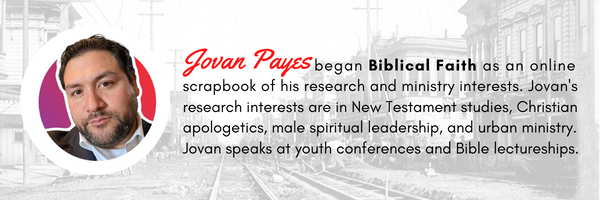






 biblicalfaith.online