Working Through Church Problems

Are you looking for a perfect congregation? Take a number and stand in line. The perfect congregation is elusive because they are composed of imperfect people.

Yes, problems happen. If anything should tip our hand to this fact it ought to be the apostolic letters to the churches found in the New Testament. Even though the Spirit of God dwelt in the primitive church, the New Testament reveals those congregations were still imperfect.

Problems emerged, emerge, and will continue to emerge within the church, and within a congregation. Paul said that the heartache of “factions” can provide a lens to recognize who is “genuine” in the church (1 Cor 11:19 ESV).

We have been given biblical teaching as to how to respond to disruptions caused by Christian misconduct. The answers are found in the apostolic word. Consider three examples.

1. The Thessalonians

Certain members of the congregation in Thessalonica would not work in order to be self-sufficient (2 Thess 3:11-12), but instead, burdened the church as they received dietary support. Such was described as living in “idleness.”

Such was described as “busybodies,” which is a play on words contrasting the appropriate Christian ethic of being “busy at work.”

The point is some members of the Lord’s church in Thessalonica refrained from being productive in the workforce and had become guilty of lifestyles that were unproductive, intrusive, and disruptive to their lives about them.

The apostle Paul sets forth an apostolic injunction to prohibit those who willfully reject the divine ideal to “earn their own living” and received benevolent sustenance from the church: “if one is not willing to work, let him not eat” (2 Thess 3:10).

The church suffered at the hands of their disruptive behavior (i.e. “busybodies”). Since they were subsidized by the church, Paul aptly responds: “stop subsidizing their sinful behavior!”

Too many times, matters which affect the congregation (gossip, opinions, hypocrisy, etc.) are allowed to thrive due to a lack of solidarity to follow God’s teaching. Here Paul makes it clear that the congregation must make a stand together placing sanctions on those Christians who live contrary to the divine teaching on working to supply your own needs (2 Thess 3:6ff).

Only with a unified front, will there be sufficient godly pressure to make the defectors return to the “ranks.” The congregation is to apply the pressure of a well-intended, caring family towards “work” so that they may not be an unnecessary burden on others (3:8).

2. Paul and Barnabas

Sometimes problems develop within very successful ministry teams, particularly in matters of expediency.

In Acts 13:1-4, the setting for Paul’s ministry to evangelize the world is narrated. In fact, the Holy Spirit is quoted as saying, “Set apart for me Barnabas and Saul for the work to which I have called them” (13:2).

This Divine call to action belongs to Barnabas as much as it does Paul. Still, throughout the reports in Acts of the various evangelistic labors, it appears that Paul (Saul) begins to gain special consideration (Acts 13-14).

An interesting footnote is placed at Barnabas and Paul’s transition from the Cyprus Island to the southern Asia Minor Roman province of Pamphylia (Acts 13:13). Luke writes that “John” (= John-Mark 15:37) was with them in their evangelistic campaign functioning as an “assistant” (Acts 13:5); however, for reasons unknown he left Barnabas and Paul and returned to Jerusalem (Acts 13:13).

After some time had elapsed, Barnabas and Paul were anxious to return to the “mission field” to see the well-being of the congregations which they planted in Asia Minor. At this point, Barnabas and Paul entered a “sharp disagreement” over the inclusion of John-Mark (14:36-41).

John-Mark who had served as an “assistant” (Grk. huperetes), a term which suggests the responsibility to care, guard, and to manage the resources of another,[1] had “defected” (= ESV “had withdrawn”) from the evangelistic team. Why, is anyone else’s guess.

While Mark broke his commitment to the evangelistic team, Barnabas wanted to give John-Mark a second chance; but Paul felt him undependable – an evaluation he publically reverses over a decade later (2 Tim 4:11). Mark is enshrined in Scripture as one whom Paul came to think of as helpful, beneficial, and useful (Grk. euchrēstos, 2 Tim 2:21; Philm 11).

Still, Luke does not append any evaluation upon who made the right choice, for Barnabas and Paul part ways here never to be found together again on the pages of Scripture; and yet, never disparaged for their differences on this issue. Possibly, they were both correct, and it is one of those cases where there are two right choices for the same problem (Prov 26:4-5). Wisdom is always a contextualized answer-solution to a contextualized problem.

It is unfortunate that such a successful evangelistic team should part ways, but the most significant point is that neither party refrained from evangelism. Paul continues to fulfill his ministry, as Barnabas continues the “encouragement” he is known for (Acts 4:36; 9:27).

Here is a powerful lesson, especially for advocates of non-denominational Christianity. At various times, brethren due to opinions – even strong opinions – must part ways for the common good of sharing the gospel with the world:

There is enough room for different expedient methodologies (provided they are biblical) to thrive side by side without any sense of competition of faithfulness to intrude our works.

Paul continues his work with the prophet Silas, and along the way picks up Luke and Timothy. Barnabas takes with him John-Mark to the island of Cyprus. One dynamic team turns into two evangelistic teams with capable leaders.

Sometimes we need to step back and realize, like Abraham, that we are brethren, and as such, we should not quarrel with each other over expedients (Gen 13:8; Rom 14:13). Disagreements can be worked through if the parties involved reflect heavenly dispositions to make peace (Jas 3:13-18). Faithful children of God must strive to “agree in the Lord” (Phil 4:2-3). Might one of those agreements be in the matter of ministry methods that are different but biblical?

3. Diotrephes and Gaius (3 John)

Sometimes a church setting can be thrown off its balance by a strong vocal minority. They typically are aggressive, carnally minded, and self-absorbed. Unfortunately, good-meaning brethren can give such ones an audience -and the podium- which encourages their behavior.

Such was the case with a man by the name of Diotrephes. In brief, the apostle John sent a few preachers to the church acquainted with this man in order to be welcomed and financially supported in their evangelistic and missionary work.


Read more about Diotrephes in “Studies in 3 John: The Fellowship of the Truth”


However, pumped with his own arrogance, he rejected the apostolic request, suppressed the request, attacked those like Gaius who provided for men like these, and imposed his own will upon them by ill-treating the preachers and casting their supporters “out of the church” (9-10). In practice, he was a “missions killer.”

Such “church gangsters,” the apostle John says, must have their nefarious operations exposed (“I will bring up what he is doing”). They operate in the brotherhood “alleyways” where their true face is revealed. They are punitive. For not only do they not support a “worthy” work, but they will also subvert them at all costs.

The church must stand up against those who are intoxicated with pride, those who manipulate behind the “church” scenes, and those who “always need a villain” in order to promote their agenda and get their way.

Concluding Thoughts

Problems come, but the church has, can, does, and will overcome them if we are faithful to God and gracious to each other. Some church problems are ethical or doctrinal; consequently, as in the Thessalonian situation, the only solution is to reinforce God’s plan for Christian conduct and teaching.

Other times, church problems emerge when leaders disagree over matters of opinion. Sometimes, we must realize that not every method is the only way to carry out a biblical command or expectation. Some methods and decisions can co-exist side by side. We must learn to be flexible and gracious in such scenarios.

Finally, some problems are instigated by a divisive minority who implement their plan in the shadows rather than in a clear view of all. They are coercive and manipulative. They seek and exercise power rather than submission to God. In such cases, exposure to such conduct is warranted in order to begin the process to restore peace in the church.

These situations do not exhaust every problematic scenario, but hopefully, they provide guideposts that will be helpful. May the church learn to acknowledge and work through our problems in a peaceful and God-fearing way.

Endnote

  1. James H. Moulton and George Milligan, The Vocabulary of the Greek New Testament Illustrated from the Papyri and Other Non-Literary Sources (London: Hodder and Stoughton, 1914-1929), MM 654-55.

An Elder’s Character: A Matter of Public Record (1 Tim 3:7)

Moreover, he [the guardian/overseer (3:1)] must be well thought of by outsiders, so that he may not fall into disgrace, into a snare of the devil. (1 Timothy 3:7 ESV)

One of the qualifications for the “guardians” (overseers) in Ephesus listed above concerns the Christian man’s reputation among non-Christians. In 1 Tim 3:7, the church is called to evaluate this testimony as a preventive measure in the selection process of a “guardian.”

It has been asked, “what will happen to a leader who is not so regarded by those outside the church”?[1] The answer is clear: it becomes a trap set by the Devil to bring about disgrace in the church. The man’s public record must weigh in as to whether or not he should have the responsibility of a guardian. Let us explore this verse in some greater detail by looking at three aspects of the text.

(1) A Final Necessity

After exploring thirteen qualifications designed to add details to the broad concept of being “above reproach” (1 Tim 3:2), the final detail is the measure of his character as reflected by “outsiders.”

The nature of his public record must be “morally excellent.” The ESV has “well thought of,” but the text literally reads, “have a good testimony.” It covers the positive moral ideas of good, noble, and praiseworthy, a quality that is “favorably valued.”[2] His character and standing in the community (3:7) must be equal to the “good work” as a guardian (3:2).

The “source” of information which is supposed to help the church examine a “guardian’s” candidacy comes from non-Christians (literally, “from those on the outside”). At first glance, this may appear to be strange. Why would public opinion matter when addressing the leadership role of a church “guardian”? The short answer is his public reputation either brings glory to God or disgrace to His Kingdom. This qualification of the quality of an overseer’s reputation must not be ignored.

(2) The Reason for the Requirement

The middle of the verse reads, “so that he may not fall into disgrace, into a snare of the devil.” The emphasis is placed upon protecting the church from those who have a bad reputation in the community; such a scenario would play “into the devil’s trap.”

Are there any longstanding frictions with the community which not only are detrimental to the guardian’s service but also to the mission of the church? Is he “known” for having improper relationships, or do rumors circulate about him which would be reproachable to him?

These questions must be asked and answered. However, despite the importance of public record, the community is not the final say. It is an important part of the appraisal process designed to prevent disgraceful men from entering the eldership. It is much easier to get a man in than it is to remove an unqualified elder.

(3) The Ever-Present Danger of the Devil

There are no sinless guardians; however, pretense and hypocrisy are subject to slander and accusations. Such is the main objectives of “the Slanderer” (i.e., the Devil). The man’s public record should not be a prized trophy captured by the Devil (i.e., the implied hunter’s snare). Consequently, “Christian men who bring widespread scandal upon the church of God have a heavy burden to bear.”[3]

If one’s character is something that has been built brick by brick, then so is one’s reputation. Good character does not have to be perfect, but according to this verse, one’s reputation does need to be well thought of. This, then, is not a role where one develops a good reputation; quite to the contrary, the role is for the person who already possesses an excellent reputation. Contextually, further, they must already possess such a reputation from the community.

A Final Word

One’s public record is a general guide to anticipating the trajectory of a person’s character: where does it point? We must allow for imperfect people to have imperfect records; furthermore, not all concerns are of the same weight and worth. Nevertheless, if there is no longstanding trajectory towards godliness in non-Christian circles then it is adequately apparent such a prospect cannot serve in such an iconic and spiritual role as shepherd, elder, and overseer in the church of God, which is God’s house (1 Tim 3:15).

I was recently told of a congregation that was in the process of selecting new elders. In keeping with the tenor of this character requirement, the congregation placed a notice in a local newspaper seeking public input as to the character and public record of the proposed elders. I am unaware of the outcome, but their action is powerful as it upholds the importance placed upon an elder’s public record.

Endnotes

  1. George W. Knight, III, The Pastoral Epistles (1992; repr., Grand Rapids, MI: Eerdmans, 2013), 165.
  2. Bauer, Walter, Frederick W. Danker, W. F. Arndt, and F. W. Gingrich, eds. A Greek-English Lexicon of the New Testament and Other Early Christian Literature, 3rd ed. (Chicago, IL: University of Chicago Press, 2000), BDAG 504; Johannes P. Louw and Eugene A. Nida, Greek-English Lexicon of the New Testament Based on Semantic Domains, 2d ed. (New York, NY: United Bible Society, 1989), L&N 88.4.
  3. Wayne Jackson, Before I Die: Paul’s Letters to Timothy and Titus (Stockton, CA: Christian Courier Publications, 2007), 94.

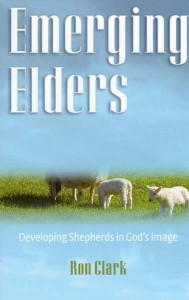
Book Review: Emerging Elders

Emerging Elders

Ron Clark, Emerging Elders: Developing Shepherds in God’s Image (Abilene, TX: Leafwood Publishers, 2008), 203 pages. Paperback.

Ron Clark is the lead church planter with the Agape church of Christ in Portland, Oregon. He holds M.Div. and D.Min. degrees from Harding School of Theology (Memphis, TN) and serves as an adjunct instructor for George Fox Evangelical Seminary. He is also a member of the Oregon Attorney General’s Sexual Assault Task Force.

Clark has contributed to various publications such as New Wineskins, The Christian Chronicle, Stone-Campbell Journal, and Restoration Quarterly; moreover, he has recently published The God of Second Chances (2012) and Setting the Captives Free (2005) along with the current volume which is the subject of this book review.

Emerging Elders: Developing Shepherds in God’s Image provides a theological platform for training current elders and potential elders. Clark explores the text and terminology of the descriptive terms for “pastor” (elder, overseer) and explores such leadership in light of an incarnation model. Clark believes that only when God’s word is actually lived out and exemplified by its the church’s leaders shepherding cannot truly be what God intended it to be.

The Book

Clark has provided the body of Christ a unique text which addresses the needs of the organizational structure of churches of Christ. This is perhaps its greatest overall strength. As Clark observes, “few books are written specifically for ministers about our style of ministry” where the pastor and the preacher are distinct ministries in the body of Christ.[1] Clark observes that most church leadership material is based upon church models which are dissimilar to churches of Christ, or based upon business models which have been given a Christian spin. Consequently, to address the lack of literature on the subject Emerging Elders is an attempt at providing a resource and a solution to the vacuum of pastoral development in light of this distinction.

In Emerging Elders, Clark provides a solid response to this lack of material to address In section one, Clark develops the need for elders who are equipped to lead the body of Christ (chapters 1-2). In section two, Clark provides a dynamic model of God as shepherd and what that means for the leaders of God’s people, he offers a situational and contextual applications of the pastoral qualifications, and then emphasizes that both God’s example and Paul’s instructions are to be applied incarnationally (chapters 3-8).

In section three, Clark provides a series of chapters which specifically address the tensions and problems within church life in particular and churches of Christ in general that emerging elders must address in an incarnational model. “These leaders are appointed to imitate God’s care and concern for people.”[2] The chapters on predators and care of the preacher were particularly exceptional and passionate, and are often not treated in the manner in which Clark has done (chapters 9-15).

Suggestions

What perhaps would have made Emerging Elders more helpful would have been in the area of conflict resolution (chapter 10) and the elder development program (chapter 15). In chapter 10, Clark explores the role elders have in the promotion and maintenance of unity. This lays heavily upon John 17 and Eph 4:1-6, and according to Clark speaks to the needs of the elders to “encourage reconciliation.” To be sure, Clark is complete in his development of the reconciliation process: “Reconciliation requires, conflict resolution, validation, and reinstatement of a relationship.”[3] However, I walked away from that section wishing that Clark had spent more time on developing these ideas, diagrams notwithstanding.

Secondly, I felt that the last chapter (ch. 15) was almost a letdown. With the idea of elder development as the core of the book, I anticipated the last chapter, “Suggested Elder Development Program,” to have more details. Maybe I am being over judgmental. The cycles are a great suggestion and using a quarter year system for elders and potential elders is very helpful. The book reading suggestions are also very appropriate. But what about the first steps it takes, the conversations needful to create the atmosphere to offer and provide these classes? I anticipated more help in creating the development program; however, even in saying this the program offered and the notes to use certain sections of the book along with corresponding cycles is very helpful.

Recommendation: High

In balance, Emerging Elders is a perfect balance of scholarship and the heart of a servant attempting to live incarnationally. Incarnational leadership is at the heart of Emerging Elders and it should be at the heart of how Christian leaders serve, and how Christians serve their church, family, and community. It does not provide easy answers to the flesh and blood problems in the church, nor does it provide answers that are so impossible to achieve. Emerging Elders calls Christians to lead God’s church biblically (incarnationally), and to address the real-life problems the people of God face with the most fundamental gift God has given his people agape love.

Emerging Elders calls every would-be elder to be living examples of faith, integrity, and loving concern for all. I highly recommend Ron Clark’s Emerging Elders to every husband and wife who serve in their church, every preaching couple, every elder and his wife, every deacon, and his wife. They are truly the focus of this book. As Clark observes,

We must help families inside and outside the church heal, but this must come from incarnational leaders who model God’s style of marriage and parenting. God has a pattern; leaders follow and call others to do the same. They follow by modeling his nature through the fruits of the Holy Spirit, becoming a father like God, and being approachable. These individuals reflect God’s character to both the church and the world.[4]

Endnotes

  1. Ron Clark, Emerging Elders: Developing Shepherds in God’s Image (Abilene, TX: Leafwood Publishers, 2008), 9.
  2. Clark, Emerging Elders, 46.
  3. Clark, Emerging Elders, 139.
  4. Clark, Emerging Elders, 101.

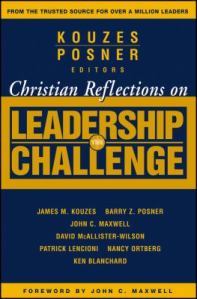
Book Review: Christian Reflections on the Leadership Challenge

Christian-Reflections-on-the-Leadership-Challenge-9780787983376

James M. Kouzes and Barry Z. Posner, Editors, Christian Reflections on the Leadership Challenge (San Francisco, CA: Jossey-Bass, 2004), hardback, 152 pages.

In Christian Reflections on the Leadership Challenge, leadership experts, James M. Kouzes and Barry Z. Posner, have assembled and edited five Christian reflection essays by exemplary leaders from various backgrounds based upon Kouzes and Posner’s highly successful original academic work, The Leadership Challenge (San Francisco, Calif.: Jossey-Bass, 1987), which is now in its fifth edition (2012). The reflections are based upon Kouzes and Posner’s “The Five Practices of Exemplary Leadership” and their application within Christian organization contexts.

Contents

The reflections are written by John C. Maxwell (“Model the Way”), David McAllister-Wilson (“Inspire a Shared Vision”), Patrick Lencioni (“Challenge the Process”), Nancy Ortberg (“Enable Others to Be”), and Ken Blanchard (“Encourage the Heart”). Moreover, Kouzes and Posner have two introductory chapters explaining and summarizing the impact and importance of their research for leadership and offer a concluding chapter in which the reflections validate their research and uphold the importance of servant leadership.

The key and central strength of Christian Reflections on the Leadership Challenge is found in its consummate anchoring to its guiding principle; namely, leadership is not about one’s position in an organization, but “about having the courage and spirit to make a significant difference” using the “The Five Practices of Exemplary Leadership.”[1] In fact, these “Practices” underscore the development of the “Servant Leader.” In the words of Ken Blanchard, “Servant leadership isn’t just an option; it’s a mandate.”[2]

The volume follows the logic of the “Five Practices” which provides the reader an opportunity to appropriate and apply each practice step by step. Examples and case studies are enlisted in the essays to vividly describe the practice discussed, and the autobiographical content from each leader-author reinforces the principle of real-life leadership decisions. This fact points also to one of the indispensable features of the book. The author of each chapter has the “flesh and blood” credibility to address the practice at hand and the wisdom gained from their leadership challenges. The insight they offer is a reservoir from which the reader gains much.

Evaluations

Christian Reflections on the Leadership Challenge has a unique strength that, if not mentioned, could be overlooked. The editors and authors are not simply writing an essay to be cataloged in an anthology. It is quite apparent that great pains of exemplary leadership were taken in order to produce the present volume. The editors, who are experts in the field, have pulled from their extensive research on leadership those that “Model the Way.” Sharing a “Vision” inspired by Maxwell, Kouzes and Posner have entered into a venture in which they have not only “Challenge the Process” to show a path to excellent leadership, but they also intended to “Enable Others” to use their model of the “Five Practices” and apply it to Christian leadership contexts.

The end user (i.e. the reader) is then to be “Encouraged” to endure the challenges and even suffer for a worthy cause. Kouzes and Posner close their volume with a chapter of gratitude to all those “hidden” names and faces involved in the production of this book. Class is not a sufficient word to describe the high level of exemplary servant leadership employed to bring this volume to fruition. This is evident on every page.

The only drawback from Kouzes and Posner is in the area of what one would expect from a multi-authored volume focused on one topic – overlap. Although the content in each chapter is solid and can stand alone as a précis on each of the “Five Practices,” at times the authors approach the “Five Practices” from a previously discussed point of view. This is to be expected. Leadership skills do not arrive in linear terms or in a vacuum. Many times leadership skills arrive from a confluence of challenges, principles, and motivations. They have a natural overlap. The challenge is to arrive at those moments and realize what is demanded from the servant leader in order to place their organization, or church, in the best possible position to accomplish its main goals. Leadership is fluid. This is not a weakness per se, yet this issue was observed at various times in the reading.

Assessment

In the final assessment, Kouzes and Posner have edited an extremely useful and hopeful resource for individuals in a field that can be extremely discouraging. Christian Reflections on the Leadership Challenge is practical and exemplary in its distillation of “The Five Practices of Exemplary Leadership” in Christian contexts. As for myself, I have found myself somewhere between groping around wondering what to do and just making a “gut” decision, from being clueless to applying conventional wisdom.

This volume helps its readers know “oneself” and understand the importance of personal integrity, developing vision, finding ways to improve, empowering others, and acknowledging the importance of others with whom we work. This book provides strategies on where to begin and to execute our service at a high level. There is a “Selected Readings on Leadership” for each chapter, and an “Index” to key terms and principles found throughout the book which contributes to further study and servant leadership development. I highly recommend this book to students, preachers, elders, deacons, Christian employers and employees. The world needs more servant leaders, whether in action or in development.

References

  1. James M. Kouzes and Barry Z. Posner, eds., Christian Reflections on the Leadership Challenge (San Francisco, Calif.: Jossey-Bass, 2004), 5.
  2. Ken Blanchard, “Reflections on Encourage the Heart,” in Christian Reflections on the Leadership Challenge (ed. James M. Kouzes and Barry Z. Posner; San Francisco: Jossey-Bass, 2004), 102.

“Is the Pastor In?”: A Brief Look at a Misnomer

The telephone rings and I answer it. The person on the other end asks the following question: “is the pastor in?” To which I reply, “No, we have no pastors, but I’m an evangelist can I help you?” The phone is silent for a few seconds, often followed by some stuttering; the refrain repeats uneasily, “is the pastor in?”

I am not purposely being difficult. I am however being biblical. I receive letter after letter, and call after call, where people (usually salespeople) are looking for or seeking “the pastor.” They are seeking the preacher but that is not the preacher’s title or description in the New Testament.

It is a rather unfortunate situation. It is also very awkward. I am often introduced (sometimes even by Christians) or greeted as a “pastor.” It really chills the occasion when I say, “no, I am not a pastor, I am an evangelist.” Somehow, that just rubs the world of Christendom the wrong way.

Maybe I should find a better time or way to correct that misunderstanding. In fact, there is a wholesale need to correct this application of the term “pastor” to the preacher.

The biblical use in the New Testament makes it clear that this is one of a few terms used with reference to a select group of congregational leaders.

Elders, Overseers, and Pastors (Shepherds)

It is just seems ingrained within the world of Christendom that the preacher must be a “pastor” of some kind. J. W. Roberts writes:

Some think of a priestly group; some think of the ministry of the Word and the preacher or ‘pastor’ of the flock; others with the metropolitan or diocesan concept think of the denominational ‘bishop.’ In truth, Paul means none of these.[1]

Roberts is correct. In Acts 20:17, the “elders” were summoned from Miletus to Ephesus; these “elders” were qualified by the Holy Spirit to be “overseers” in the church “to shepherd” the church (Acts 20:28).

Students of the New Testament are quite observant that these terms refer to the same office. In fact, one can see the interchange of these terms in 1 Peter 5:1-2, “I exhort the elders among you to pastor the flock of God that is in your charge, exercising the oversight.”[2]

Notice the three terms used in 1 Peter 5:1-2 which are exclusively for “a body of men in the primitive churches called elders.[3] The “elders” (Grk. presbuterous) are to “pastor” (Grk. poimaino) the church, employing “oversight” (Grk. episcopountes). The New Testament demonstrates that each congregation had a plurality of men so described (Phil 1:1-2, etc).

To apply the term pastor to an evangelist/preacher is to do so without New Testament precedent. “Such is a non-biblical use of the term ‘pastor,’ in spite of the popularity of such in modern society.”[4]

Does it Really Matter?

When a practice has no biblical basis, should we not simply abandon its use? This is at the heart of the problem.

Timothy and Titus represent a category of Christian workers known as “evangelist” (2 Tim 4:5) who “preach the word” (2 Tim 4:2). This is their “ministry” (2 Tim 4:5). The main obligations of the work are explained in 1 Timothy 4:13, 15 and 2 Timothy 4:2-5.

In summary, it has been observed by Earl D. Edwards that “every aspect of their work had meaning only as related to ‘the Word.’”[5] When one evaluates the basic responsibilities found in these passages a few things are evident:

The evangelist had the duty, first of all, to ‘preach’ the Word and then ‘correct’ those who did not follow that Word, and even ‘rebuke’ those who attempted to undermine the Word. He was also to ‘encourage’ with gentleness that Christians might follow the Word without becoming discouraged. In addition he was to ‘devote’ himself to the ‘public reading’ and ‘teaching’ of the Word.[6]

While the elder (pastor/overseer) must have the capacity and ability to be a teacher (1 Tim 3:2) in order to shepherd the flock, it is clear that the evangelist holds a complementary role for congregational development and a public proclamation of the gospel.

The preacher’s work is not the elder’s work. The most important qualification for the evangelist is that they are “faithful” recipients and heralds of the message (2 Tim 2:2). An elder, also, may fulfill the role of an evangelist (1 Tim 5:17; Eph 4:11); however, a preacher is not necessarily a pastor.

Not all faithful males may serve in the office of a pastor, for these men must possess specific qualifications (1 Tim 3:1-7 and Tit 1:5-9). Thus, the use of the term “pastor” to refer to the “preacher” is incorrect – a misnomer – and should be abandoned.

Concluding Thoughts

Some may be thinking, “No, I don’t buy it. A pastor is the one who leads the flock.” To which I would argue in response, “yes, pastors after a biblical pattern do lead the flock of God.” But our discussion is centered on the misuse of the term, and consequently, a blending of two distinct ministries found in the New Testament church.

There are those who are elders (overseers, pastors) who serve in a very unique office only after they met the qualifications set forth by the Holy Spirit (1 Tim 3:1ff; Acts 20:28). There are others, however, who serve as heralds of the word; that is to say, they preach the word as they labor alongside the pastors of a particular congregation (Eph 4:11).

Consider this final thought. Suppose one encounters a missionary from the Latter Day Saints, who in fact use the title “Elder”. “Elder Smith” however is a young man, single, and has no children. Yet, the inspired instruction from the Apostle Paul clearly indicates that the man must be of age (hence the term elder), must be a married man (1 Tim 3:2), and have children over which he has shown leadership (1 Tim 3:4-5).

Can we honestly say, in light of the biblical data, that these young men flashing the “Elder” badge are elders after a biblical order? Hardly, This is precisely our point. The New Testament use of the term elder (overseer, pastor) applies to a very uniquely qualified man, as he serves within a group of other men of equal caliber. Let us seek to call biblical things with Bible names, and do Bible things in biblical ways.

Sources

  1. J. W. Roberts, Letters to Timothy (Austin, TX: Sweet Publishing, 1961), 26.
  2. Everett Ferguson, The Church of Christ: A Biblical Ecclesiology for Today (Grand Rapids, MI: Eerdmans, 1996), 318-23.
  3. John W. McGarvey, The Eldership (1870; repr., Murfreesboro, TN: DeHoff Christian Bookstore, 2002), 9.
  4. Wayne Jackson, Before I Die: Paul’s Letters to Timothy and Titus (Stockton, CA: Christian Courier Publications, 2007), 82.
  5. Earl D. Edwards, “The Evangelist in the Epistles to Timothy and Titus (Book 1),” Alternative 8.3 (Summer 1982), 19.
  6. Edwards, “The Evangelist in the Epistles to Timothy and Titus,” 19-20.

Book Review: That We May Share His Holiness

that-we-may-share-his-holiness-book-cover-south

Tommy South, That We May Share His Holiness: A Fresh Approach to Church Discipline (Abilene, TX: Bible Guides, 1997), paperback, 159 pages.

With the recommendation from my friend Jeremy Marshall, I purchased a copy of Tommy South’s work, That We May Share His Holiness: A Fresh Approach to Church Discipline. I was completely unaware of South’s work, and as I was reading and researching for a paper on church discipline I took it upon myself to give South’s work a “fresh” look. To my astonishment, I nearly read through the book in one night. That We May Share His Holiness should be read by every member of the church.

Before we highlight some points from the book, let us consider a little information about the author. A minister for some thirty years, Tommy South is currently a minister at the Glen Allen church of Christ and has served in that capacity since its inception in 1995 in Glen Allen, VA. South holds a Ph.D. (University of Virginia) in the New Testament & Early Christianity. South not only serves as an Adjunct Professor of Religious Studies at Virginia Commonwealth University,[1] but also frequently contributes to publications such as the Gospel Advocate.

The Book I Enjoyed Reading

That We May Share His Holiness has been in circulation for some time. However, it is a publication that is worth describing here for study and contemplation. Because we believe there are very few negative matters to discuss, we shall only describe the work and its benefits.

The book has 15 chapters, and its outline appears to have a Bible class setting in mind. The discussion questions that follow each chapter will surely lend themselves to small group studies or congregational settings.

The content is written in a popular style —avoiding technical language— yet the author demonstrates himself to be very adept at the technical matters that arise in the discussion of church discipline.[2] Reading South’s work is a breath of fresh air as it reads so smoothly, and yet it avoids theological shallowness by providing adequate analysis and exegetical insights, and by challenging the readers to spiritually deliberate on critical issues regarding church discipline.

Furthermore, the material on holiness, individual responsibility to self-purity, and the duty we share as Christians to assist others to retain their self-purity are perennial discussions.

South’s work demonstrates how God places emphasis upon personal holiness as the basis for church discipline:

All discipline is the outgrowth of God’s desire for us to share His holiness. […] It also includes disciplining ourselves. This is where “striving after holiness” comes in. […] Congregational discipline is likewise an extension of God’s desire for our holiness. Just as God expects and requires us to discipline ourselves, he calls on us to discipline each other when necessary, not arbitrarily or angrily, or vengefully, but as an outgrowth of his love and of his demand for holiness among his people.[3]

South moves from this biblical basis (Heb. 12.10) and develops many themes in this rich survey of every significant New Testament context dealing with church discipline.

Another important discussion South develops is that fellowship is to precede discipline.

Apart from fellowship, discipline is not only meaningless, it is abusive. To discipline someone with whom we have not enjoyed real fellowship is much like spanking a stranger’s child.[4]

South advocates an attempt “to create an environment of love and fellowship” in the congregation so that church discipline can do exactly what God intends for it to accomplish—restoration.[5]

When restoration of fellowship is obtained, forgiveness is to occur by the individual specifically offended, and by the community of the church.[6] The discipline was to be “effective but not vindictive” and after restoration, steps to communal restoration are forgiveness, comfort, and confirmation of love.[7]

Discipline and restoration are connected at the proverbial hip, and to this point South cautions:

The church is never at liberty to think that we’ve “done our duty” by disciplining the erring when we are unwilling to perform the equal “duty” of forgiveness.[8]

Placing the full responsibility of reconciliation upon the disciplined is a completely untenable theological conclusion. Both have responsibilities: the disciplined is to repent and show those fruits, and the church has the responsibility to forgive and strengthen.

Recommendation

For its size and scope, it is an outstanding discussion of a critical topic. Page per page, it is rich in research which gave the book its birth, clear in the development of the central message of the Scriptures on the subject, and set forth in a spirit of genuine spirituality and Christian honesty.

This book is a must-read. It will tremendously bless all those who give it attention and a healthy judicious study, with the necessary application. It will not take long for a congregation of the Lord’s people that fails to discipline, to lose its identity as the church. It is, therefore, time to give attention to this important biblical theme.

Sources

  1. “Leadership and Staff | Glen Allen Church of Christ.” GlenAllenChurch.org. (Link). Tommy South can be contacted at gaoffice@glenallenchurch.org.
  2. South points to the technical discussions in his work, Disciplinary Practices in Pauline Texts (Lewiston, NY: Mellen, 1992).
  3. Tommy South, That We May Share His Holiness: A Fresh Approach to Church Discipline (Abilene, Tex.: Bible Guides, 1997), 16.
  4. South, That We May Share His Holiness, 31.
  5. South, That We May Share His Holiness, 34.
  6. South, That We May Share His Holiness, 102.
  7. South, That We May Share His Holiness, 103-05.
  8. South, That We May Share His Holiness, 106.

Why Balance Still Resonates Today

51WDYSYSX1L

Ira North, Balance: A Tried and Tested Formula for Church Growth (Nashville: Gospel Advocate, 1983), paperback, 156 pages.

In the academic Spring of 2004, I was enrolled in Freed-Hardeman University’s Masters in New Testament program. I took a course entitled, “The Education Program of the Church.” One of my favorite experiences was reading the book, Balance: A Tried and Tested Formula for Church Growth, written by Ira North (1922-1984).

Judging from North’s accomplishments, it is reasonable to assume why his last contribution to congregational development was selected as mandatory reading for the class. After all, North came from a strong Restoration Heritage pedigree of church leaders, was an accomplished student (Ph.D. Louisina State University), a “known” preacher throughout the Nation, editor of the Gospel Advocate (1977-1982), and educator in Speech and Bible at David Lipscomb University for 18 years.[1]

Aside from the bright red sport-jacket that has become iconic Ira North, it is his relationship with the Madison church of Christ (Madison, TN) which has memorialized him among church leaders. From 1952 until his death in 1984, North worked with the Madison congregation and the effect of his collaboration was the development of the largest church of Christ in the world in 1984 (from about 400 to well over 4,000 members).[2]

Despite the fact that in 1959 North authored, You Can March for the Master, his most celebrated work is Balance; some might say, it is his ninth symphony. Surely, then, the experiences (the good, bad, and ugly) North pulls from, and articulates in meaningful aphorisms is worth the time and energy it takes to read through the book’s 156 pages.

10 Main Points to Explore

In order to have a strong congregation, North places a high premium on common sense. It is the most general of all the points in the book, but common sense is particularly emphasized in the maintenance of the balance of organization, never overly emphasizing one program to the exclusion of all the others. Ideally, when the teaching program is strong, the congregation is mission minded, and is diligent to provide benevolence, church machinery will be in a balance homeostasis. The church symmetrically pushes forward in each biblical emphasis.

Proper usage of time is vital to the well-being of a congregation in two ways: building use and worship time. North asserts that the church building usage should reflect the business would model – everyday and with regular hours. After all, North argues, the building was designed to be an avenue to serve Christ. More functional and meaninful use of the building is good stewardship of facilities, time, and money. Time management likewise applies to the worship period. “Dead air” should not exist, but instead the worship service ought to be well organized, streamlined, and spiritual. Whenever a congregation keeps its worship and Bible class time within the specified time mentioned in the bulletin or other public notices, then it is obvious that the church is focused upon being an asset to the spiritual development of its members and visitors, without being taxing on the individual time needs of each family. In six words: worship can be timely and spiritual.

Designing a broad program for the work of the church is vital to secure a well-rounded, inclusive labor “in the vineyard.” An approach to implementing scriptural programs should not isolate a few members to do the work of the church. The local work was never designed to run on the backs of a few people (Acts 6.1-4). Thus from the beginning of design, the Bible school curriculum, benevolent programs, and other endeavors for the church, a key component should be that any member of the congregation may participate and contribute their abilities to the cause of Christ (i.e., the vineyard). In other words, make it church policy that the work of the church be inclusive so that all may “enlist.”

The delegation of responsibility to qualified members of the congregation stimulates congregational mobilization. In other words, use “in house” abilities, or to use another slogan, “keep it in the family.” When brethren in a local congregation have responsibility in their hands for specific “church-related” tasks, it alleviates the entire burden from being on a small group of people. More work can be accomplish. Add to this the use of members qualified through their own particular skill sets (accounting, management, baking, encouragement, etc.), then two things are accomlished; The maximization of quality work and specialized work. Because members are in place to accomplish tasks they are familiar with, then personal ownership of the work of the church materializes and the need to serve the Lord is satiated. A true benefit to the congregation is to have members serving in ways they already have the “know how” for Christ.

Another staple for church growth, according to North, is to remain creative and willing to try new ways to help the congregation look for creative and Scriptural ways to fulfill biblical commands. For example, the building can be used as the hub of so many programs as the church develops benevolent programs and evangelistic outreach programs which puts the church in a positive light in the community. A congregation that is busy can generate interest and appreciation from the community, which may encourages people to consider the Gospel. North’s point is not to engender a “stay busy for busy sake” disposition, but instead to break the stagnant complacency found in many congregations. Sometimes a program sounds good on paper, but not in practice. However, whether the programs “work” or not, the church should try numerous biblical ways to serve Christ in the community.

Maintain a positive and optimistic attitude, because it raises a congregation’s atmosphere to higher spiritual altitudes. Since Christianity is a positive religion, it follows that those who subscribe to its teaching out to be so infused with its goodness that it flows over into the atmosphere of a congregation.  Joy, peace, thankfulness, and love are not the hidden fruits of the Spirit, instead they are those things which have become manifest, so these are emotions and blessings that we should expose to the world. It is true that Christains are people, and consequently it is not always the easiest thing to be “happy go lucky.” North feels it is better to be proactive in encouraging and fostering a congregational atmosphere to is positive and loving. This reinforces the attractiveness of the Christian religion, as set forth in the Scriptures (1 Pet. 4.10; Rom. 13.8-14), as being a vibrant and good force in the world.

It is absolutely necessary that the work of the church is inclusive(i.e., social, economical, and age demographic). An extension of designing the congregations programs for all groups in the church, North emphasizes that attention needs to be paid to each individual person in the church. This will make them feel as if they are a part of something and not left out. Members of the Madison congregation would shake hands with each other and with their visitors before each service. North affirms that a strong church needs to implement ways for personal contact and interaction that develops the feeling of mutual dependency among its members.

Evangelistically, North advocates that in order to grow, a congregation ought to search for the one. Whether it is VBS, a “Gospel Meeting,” or a regular service the evangelistic emphasis ought to be on the one, i.e., the individual person. This is echoes the Scriptural teachings of Jesus in the parables of the lost sheep, the lost coin, the lost son (Luke 15.1-32). One more person stimulates constant growth and encourages others to be evangelistic. To be successful, evangelism does not have to be by “the thousands and ten thousands”; it can be a simple and steady stream. There is no reason a whole congregation cannot do this. In order for a congregation to thrive it must continue to search for the one.

At all cost a congregation ought to “give diligence to keep the unity of the Spirit in the bond of peace” (Eph. 4.3; emphasis added). Unity is one of the bedrocks of the Christian religion and must be established in order for true benefit to occur for the church. This affects the atmosphere and purposeful drive of the church in the work of the Lord. Attitudes needs to be set aside, personal ambition ought to be cast away, differences must be “handled with care,” and the goals of Christ must be realized. Members  must truly work together and respect the various roles they play in the congregation.

North advocates that in order to grow, a congregation ought to go all out. This seems to be an extension of the broad church program, the focus upon the individual, and keeping the unity of the church together. All ages ought to be considered for care. If any group in the church needs special attention, all must be done to secure a spiritually invigorating program to help those needs. The widows and the orphans are not the only ones who are “afflicted.” The church can help in those areas where God has desire for there to be help.

Concluding Thoughts

This brief reflection cannot emphasize sufficiently the various beneficial observations North has provided in Balance. North’s “common sense” advice is balanced, focused, and all encompassing; moreover, this common sense served him well while he ministered to the congregation in Madison, Tennessee for 32 years. It is desired that these reflections portray the power of the book in some fashion. All ten points have been thoroughly infused into each chapter and underline the point that there are many factors involved in church growth; it is not simply “a” single factor which is the key.

It is not our conviction that should these principles be employed in the life of a congregation that the church will grow by the thousands, but we believe it is better to say that a congregation that incorporates these principles will breed the right atmosphere for great things to be accomplished for the cause of Christ.

References

  1. Gospel Advocate 126 (1984), 124.
  2. Robert E. Hooper, “North, Ira Lutts (1922-1984),” Encyclopedia of the Stone-Campbell Movement, eds. Douglas A. Foster, et al. (Grand Rapids, Mich.: Eerdmans, 2005), 569-70.