The following question comes up once and a while in various forms:
Is it permissible for a baptized boy to be taught by a woman in the church’s Bible School program?
Questions like this often emerge from the heart of a concerned Christian parent whose heart wishes to honor the Lord. I pray and hope that the following guide will be helpful to those seeking an answer to this question.
The question has several elements which much be addressed. They will form the headings of this brief response in the following order: (1) what is the prohibition in 1 Timothy 2:12?, and (2) does baptism make a person an adult?
The Prohibition in 1 Timothy 2:12
Paul writes to Timothy,
I do not permit a woman to teach or to exercise authority over a man; rather, she is to remain quiet. (English Standard Version)
If left alone an argument may be made to the effect that a woman can never instruct nor be in a position of authority over a man —never. This would, however, be stripping the passage from its larger context and thereby generating a dangerously misleading analysis of these words.
Paul’s prohibition is built upon two lines of reasoning: (1) the order of creation, and (2) the profile of the fall. Observe:
For Adam was formed first, then Eve; and Adam was not deceived, but the woman was deceived and became a transgressor. (1 Tim 2:13–14 ESV).[1]
Although some apply this passage to domestic relationships (husband and wife), or to relationships in the world, such as in business (no women bosses), Paul is specifically addressing the “places” of Christian assemblies. He is not addressing all interactions between women and men, Christian or otherwise.
In verse 8, Paul uses the phrase “in every place” (en panti topō) which is a short hand for “in every place of assembly.”[2] Thus, the focus of Paul’s prohibition has quite a limited application —the Christian assembly. This is further made clear by the mention of the males —as opposed to the women— who are to pray in the assembly (v. 8), and the emphasis on godly women as doers of good works (vv. 9-10) and as active learners in the assembly (vv. 11-15).
Perhaps a point of clarification is in order. Paul does base the “headship/respect” principle for married couples on the order of creation (Eph 5:22–33), but with a different focus. It would be inappropriate to argue —based on 1 Timothy 2:11–15 alone— that women are to be silent at home before their husbands, and contradictory to passages that assume women have administrative authority in their own home (1 Tim 5:14), which also includes martial rights and due consideration from the husband (1 Cor 7:4–5).
Thus, the prohibition in this passage addresses the particular setting of the worship assembly. This must be kept in mind.
Before we move forward. I know there are many genuine believers that would cringe at the notion that there are teaching limitations along gender lines within the church assembly. Yet, while I understand some do believe this instruction to be ad hoc—unique— and therefore, not normative, Paul’s argument is built on his apostolic application of Genesis 2:18-25 and 3:1-14 which refer to the order of creation and the order of the fall.[3]
This should never be confused with an emphasis on the superiority of men and the inferiority of women, both are equal image-bearers of God (Gen 1:27; 2:18).[4]
Is Adulthood Bestowed at Baptism?
This is the heart of the question. The New Testament, in no place that I have found, marks baptism as the transitional act which bestows not only forgiveness of sins (Acts 2:38) but also adulthood upon the recipient. If adulthood is bestowed at baptism, then, what of those who are baptized in their 30s or 40s — have these people been simply children up to this point?
I have heard it said before:
If a boy is ready to make the most important decision he will ever make, then should he not be regarded as an adult? Why not?
While the argument appears to have merit, such a view can have disastrous consequences. Let me further my point. Does this also apply to young baptized girls? Are they now adults ready to marry and bear children? Should the newly baptized boy be thrust into church leadership now because he is a “man”? Why not?
This is not New Testament logic on three grounds: (1) it is nowhere mentioned in the NT, (2) baptism is about the “new creation” and forgiveness of sin (Acts 2:38; 2 Cor 5:17), and (3) baptism is about a “new birth” —a sort of spiritual infancy (John 3:3). So the logic of the gospel runs in the opposite direction of the above claim. Baptism is certainly the most important decision a person can ever make, but that by default does not make a person an adult. This is not what the NT teaches. The assertion is an opinion and we must be very careful with opinions.
Still, even in the New Testament world, there were different words used to describe age groups.[5] One key point to observe is that the ancient world held very a different view of children than modern times when it comes to concepts like merit and value, property, rights, etc. Nevertheless, we will survey these words quickly:
Bréphos means “young” and “fruit of the body” and thus refers to small children/childhood (2 Tim 3:15), newborn infants (1 Pet 2:2), and those within the womb (Luke 1:41, 44).
The words país (small, little), paidíon (little child) and paidárion (little boy, John 6:9) are bit interconnected. Paidion may refer to someone not yet 7 (Matt 2:11,13–14), which covers are large span of time; whereas, a child from the ages 7-14 would be called pais (Luke 8:51, 54). The “adolescent” (14-21) was called a meirákion but the word is not used in the NT (2 Macc 7:25).
There is téknon and teknion: These terms generally reflect “origin” (descendent), the early dependent state of children, and those who are figuratively so (téknon: Luke 11:13; Mark 7:27; Phil 2:22). And teknion was a nursery term for “little child” and is often affectionately used for Christians (John 13:33; 1 John 2:12).
Even when Paul speaks to Timothy and speaks of his “youth” (1 Tim 4:12), he is speaking in relative terms. The word (neotes) itself is relative and often associated with a “youthful spirit” and being impetuous[6] and covered a period until the approximate age of 40.[7]
In no instance is there an example from Scripture that a child becomes an adult at the point of baptism, regardless of the important choice they have made.
Finally, let me add the following. Christians are often called upon to become mature or complete (teleios 1 Cor 14:20). Even the church universal is called upon to grow into “mature manhood” (teleios aner) in the Ephesian letter (4:13; cf. Col 1:28, 4:12). What is more to the flavor of NT teaching is that baptism begins a process of spiritual maturity. It is not a commentary on biological maturity (the brain is not fully mature until the mid-twenties), on legal maturity and accountability (nations and cultures differ), nor on the wisdom the church depends on from its mature leaders.
We should never crush the embers of zeal among our youngest believers and disciples. We need to encourage them and give them an environment for their faith to be nurtured and yield its fruit. I would stress, however, that we do not artificially affirm something upon them —like adulthood— that there is no biblical nor social basis to do. Furthermore, we should not sideline our teaching sisters, many of whom are mothers and grandmothers who administer their own homes with children under their authority (Tit 2:4; 1 Tim 5:14).
So Where Do We Go From Here?
I see no scriptural evidence to remove a young baptized boy from a Bible class taught by a Christian woman simply on the merit that the boy is baptized. But, this does not settle the matter in my view.
The Scriptures do not clearly define a line that distinguishes childhood from adulthood. We often use the phrase, “age of accountability.” Again, there is no general consensus. Is age twenty, based on God’s punishment upon the unbelieving Israelites at the precipice of the Land of Promise (Exod 14:29)? If so, then no youth is accountable before that age and, therefore, baptism would be inappropriate.
Yet, there are plenty of references of young people called by the Lord and brought into His service. Samuel’s call in his early teens to service (1 Sam 3). Josiah was eight years old when he began to reign as king (2 Kings 22:1). Mary was certainly “young” (11-13 years old?) when she conceived Jesus by the power of God while betrothed to Joseph (Luke 1). In her oracle, she acknowledges her inclusion in God’s plan of salvation (Luke 1:49). So, it is not a tidy situation to say young people cannot come into God’s plan.
By and large, the conversion excerpts from the Book of Acts narrate responses from believing adults: (1) the Jews on the day of Pentecost (Acts 2), (2) the Samaritan converts (Acts 8), (3) the conversion of Simon the sorcerer (Acts 8), (4) the conversion of the Ethiopian treasurer (Acts 8), (5) the conversion of Saul of Tarsus (Acts 9, 22, 26), (6) the conversion of Cornelius and his household (Acts 10-11), (7) the conversion of Lydia (Acts 16), (8) the conversion of the Philippian jailor (Acts 16), (9) the Athenian converts (Acts 17), (10) the Corinthian converts (Acts 18), and (11) the Ephesian converts (Acts 19).
There may be some wiggle room in the reference to “household” in cases like Acts 11:14 and 16:33-34 to include younger believing members. R. C H. Lenksi, for example, viewed “household” (Grk. oikos) as a reference to Cornelius’ “family” in Acts 11:14 and 16:33-34.[8] In a study on the multi-functional social setting of the household in Luke and Acts, John Elliott notes that the term includes “family and kin,” but the term may also include “personnel and property.”[9] This may then include servants, slaves, and household managers who also responded to the gospel. At any rate, a baptized youth does not an adult member of a Greco-Roman household make.
At the heart of conversion, however, is the need for forgiveness of sin, the capacity for belief and obedience, and commitment towards discipleship. This would exclude the youthfully immature to the infantile of the house. So where do we go from here? Youths who respond to God in baptism are still youths subject to their own parents.
Concluding Thoughts
That being said, we concede that there is tremendous wisdom to maintain consistency in the church’s teaching program. Since there is no “clear-cut” age to gauge adulthood in Scripture, it would seem best for congregations and families to determine for themselves an age where the teaching program of the church exclusively selects male teachers during those transitional years from late middle school through high school. But, it should be clear that this is only a judgment call.
Endnotes
Unless otherwise stated all Scripture quotations are taken from the English Standard Version of The Holy Bible (Wheaton, IL: Crossway, 2001).
Bruce K. Waltke, “1 Timothy 2:8-15: Unique or Normative?,” Crux 28.1 (March 1992): 22-27. Repr., CBMW News/Journal of Biblical Manhood and Womanhood 1.4 (Oct 1996): 4-7.
Bruce K. Waltke and Cathi J. Fredricks, Genesis: A Commentary (Grand Rapids, MI: Zondervan, 2001), 88.
Albrecht Oepke, “pais…,”TDNT 5:636–39.
H. G. Liddell, An Intermediate Greek-English Lexicon (1888; repr., Oak Harbor, WA: Logos Research Systems, 1996), 529.
Wayne Jackson, Before I Die: Paul’s Letters to Timothy and Titus (Stockton, CA: Christian Courier Publications, 2007), 124.
“He was to tell Cornelius what would save both him and his house (family). It was a matter of saving this household.” R. C. H. Lenski, The Interpretation of the Book of the Acts of the Apostles (Minneapolis, MN: Augsburg, 1961), 443. Later, regarding the Philippian jailor and his house: “The jailor and his family were baptized in the ordinary way by an application of water in the name of the Triune God” (Lenski, Acts of the Apostles, 683).
John H. Elliott, “Temple Versus Household in Luke-Acts: A Contrast in Social Institutions,” in The Social World of Luke-Acts: Models for Interpretation, ed. Jerome H. Neyrey (1991; repr., Peabody, MA: Hendrickson, 1993), 225. See also, Jovan Payes “Organizing God’s House in 1-2 Timothy and Titus.”
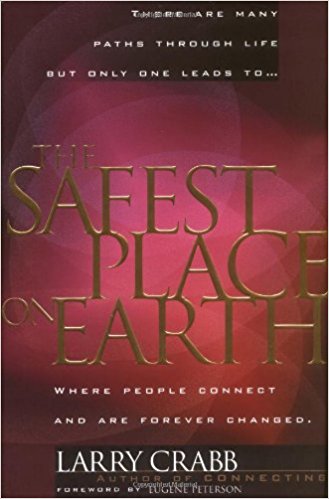
Larry Crabb, The Safest Place on Earth: Where People Connect and Are Forever Changed (Nashville, TN: W Publishing, 1999), Hardback, 240 pages.
Dr. Larry Crabb is an established licensed psychologist, a well-known Christian author on marriage and biblical counseling topics, and current Distinguished Scholar in Residence at the Colorado Christian University (Morrison, CO).[1]
Dr. Crabb earned his Ph.D in Clinical Psychology from the University of Illinois, and has been a professor of psychology since 1970. Dr. Crabb also provides workshops and weekend seminars across the United States as part of his non-profit New Way Ministries and its web presence which features interviews, video lectures, and other multimedia outlets to share resources from his School of Spiritual Direction.
Dr. Crabb has been involved in counseling and marriage, in self-help ministry, and in developing a context of “spiritual community” for over 40 years, and so has earned a place among the various “Christian voices” seeking to make the church a better place.
In 1999, Dr. Crabb released a significant but brief volume on the church as a safe spiritual community. The volume is entitled, The Safest Place on Earth: Where People Connect and Are Forever Changed (238 pages).[2]Dr. Crabb has registered his own frustration with two elements which bear upon the community of the church and its spiritual health, which he further addresses in Real Church: Does it Exist? Can I Find It? (Nashville, TN: Nelson, 2009).
In The Safest Place on Earth, however, Dr. Crabb establishes a vision for the church as a group of believers on a journey towards God, and it is within the journey that spiritual community must begin and end for spiritual healing and direction. Despite Dr. Crabb’s own training in psychology, he believes when it comes to the soul care that ought to go on within the church, such assistance must yield “to special revelation and biblically dependent thinking.”[3]Dr. Crabb is adamant,
We don’t need more churches, as we usually define the word. We need more spiritual communities where good friends and wise people turn their chairs toward each other and talk well.[4]
Structurally, The Safest Place on Earth is organized in seventeen chapters, divided into three parts, and finishes with a section of questions for each chapter. The layout follows a very clear program of development, and the content is written in a popular style. Dr. Crabb is able to articulate and shape a conceptual paradigm of what is a spiritual community and what is not a spiritual community without complex vocabulary. His illustrations, personal anecdotes, and insights from personal interactions are delivered to support his vision for a spiritual community is very clear and helpful ways.
Dr. Crabb also interacts with and depends upon the works of Dutch Catholic priest Henri Nouwen[5](1932-1996), who focused on spiritual solitude, spiritual community, and spiritual compassion, along with Swiss Catholic philosopher Jean Vanier (b. 1928) and his work connected to L’Arche communities which have overlapping concerns.[6]
A Book Summary
In part one, Dr. Crabb develops and sharpens the idea of spiritual community and how the church needs to develop sensitivity to being the spiritual community it was intended to be. Spiritual community is, according to Crabb, at the core of what the church is.
It is people facing each other in intimate, honest, and safe ways as they journey together on their way to God. Spiritual community, however, will not occur if there is no opportunity for vulnerability and a full sense of validation from these that witness the vulnerable parts of who we are.
One of the difficulties in church community life is to wrestle with the crux,
if they knew who I really was, the church would probably not like me.
To be a spiritual community, then, we must be able to love free from ego and embrace those so broken by those things which burden our souls and even cripple us.
The health metric of a spiritual community is its ability to love the unlovable, the broken, those that can only let you love them in their brokenness.
In part two, Dr. Crabb reframes the New Testament discussion of flesh and spirit elements of our soul in terms of the analogies of the Lower Room (carnal/wretchedness) and the Upper Room (spiritual/greatness).
It is in this phase of the book that Dr. Crabb focuses on the part of the church community that needs to be addressed first — our internal struggles to be spiritual. Enter Dr. Crabb’s “two rooms” analogy which he builds from the words of Jesus:
If anyone loves me, he will keep my word, and my Father will love him, and we will come to him and make our home with him. (John 14:23)
And he amplifies these words with Paul’s regarding “Christ in you” (Colossians 1:27).[7]
In essence, the two rooms represent fully furnished environments that exist within us.
Now there are two rooms inside us, the one we built where our natural self thrives, and the one the Spirit built where our natural self suffocates and our new self flourishes.[8]
Dr. Crabb does not explicitly use all the terms, but these “rooms” parallel the Freudian id, ego, and superego dynamics, the difference being they are spiritualized.[9]The lower room is self-furnished by our wretchedness and “dark forces” with its corruption and stench (id). The upper room is furnished by the Spirit of God only enjoyed once we open the doors of the lower room, acknowledge its stench, and celebrate the confidence to be a new us (an obedient us) empowered by God’s grace and teaching (superego?).
Finally, we consciously (ego?) take these “two rooms” within us and the internal struggles that go with them —because we prefer to be in the lower room— to receive outside help from “another room” which is the spiritual community, the church. This room is furnished by the Spirit with safety, vision, wisdom, and power.
In part three, Dr. Crabb continues his visioning for spiritual community with another analogy of “turning our chairs toward each other” but now by “turning our souls toward each other.”
In this process, the members of the church community must practice three needed things. First, spiritual community can only be done by the Holy Spirit. Second, personal holiness grounded in the Spirit influences the pursuit of personal holiness of others. Third, there must then be a safe place to “own and trace our desires to their source.”[10]
Spiritual community, however, will only occur when spiritual passions are “supernaturally” aroused when we are together in spiritual community experiencing acceptance, mutual faith in God’s presence in our lives, affirm the “upper room” elements in our lives, and allow God to change us without applying human pressures of forced change.
It is certainly a place of risk, but risk will always be a factor when embracing the need for vulnerability. Therefore, the real question is: will we, the church, be the safe place for those being vulnerable?
Response and Review
I chose this book principally because of the title. In fact, I had seen this title on the cover of the September/October 2001 New Wineskin magazine as part of the issue theme of “Authentic Christian Community.”[11]The concept peaked my interest because I do feel the church has not been the safest place on Earth in managing people’s sin. One example will suffice. I once heard a preacher react to the exposed sins of others with the derogatory question, “where are the normal people?” That’s not a safe place for healing. Nor is the following response to a fellow congregant’s addiction any safer, “there’s a word they need to learn – repent.”
Rebuking sin is the easy work of preaching, but creating a compassionate environment to help brothers and sisters work through repentance is the harder – and in my judgment – more fruitful work of ministry.
Crabb’s book further calls the church to be the community through which Christians experience spiritual healing for spiritual problems often mistreated —according to Dr. Crabb—as psychological disorders or problems. The gospel and the New Testament teaching that the church is the dwelling place of God, and Christians are the temple of the Holy Spirit, seem to support the overall agenda that the culture of the local congregation should be more attuned to openly working through sin, temptations, and openly celebrating grace, and spiritual empowerment by God. Even Paul declares that the church is being recreated (2 Corinthians 5:17) and repurposed for ministry (Ephesians 2:10).
Dr. Crabb’s book both intrigued me and made me uncomfortable in that he elevates the spiritual components of the church where the Holy Spirit dwells. Again, it is not that I’m troubled by the Holy Spirit, it is that in many pockets of the Churches of Christ the Holy Spirit and the use of “community” have been so tinged with so-called “liberal agendas” in the latter, and doctrinal controversial hotbeds regarding the former. His emphasis that the church is specifically designed to be a spiritual community and therefore it must be that spiritual community on a journey to God is what stands out the most to me. If we are not a spiritual community, then there will not be the Spirit.
I do not agree with all of his points on the “wretchedness” of man, but Dr. Crabb has challenged me to speak more about the Spirit and the church as the community in which God does His best work to heal us from the effects of sin.
Concluding Thoughts
What I liked overall about the book is the Dr. Crabb’s challenging call to the church to be a safe place for the sort of healing love that needs to exists between God’s people, so that the Spirit of God may work through the church to heal its members as they bear each other’s burdens with the gifts of the Spirit (Galatians 5:22-26). The church must be so, because, as Dr. Crabb reminds us, we are traveling together on a journey to God.
I recommend the challenge of this book to every Christian and church leader. The reminder that Scripture centers the body of Christ as the place where the Spirit dwells, and therefore must be the safe place where the members of the body can serve each other empowered by the same Spirit. To overcome sin, the church must be, and in some cases become, the place where no one struggles with sin void of love, compassion, support, and patience as we journey to God breaking free from the bondage of sin.
Reprinted with permission from the March 2017 issue of Gospel AdvocateMagazine.
A vital element to the worship assembly of the body of Christ in the first century was the reading aloud of the Scriptures (1 Timothy 4:13; Acts 13:15). Today, it is probably hard to imagine a time when God’s word was accessible only when assembled with God’s people; it was a communal experience. The proliferation of Bibles today has truly made reading Scripture an individualized practice; yet, this has not always been so. In fact, the meaning of “church” (ekklesia; “an assembly”) presumes a people gathered to hear, to commit to, and to act upon the Word of God (Matthew 16:18; Deuteronomy 4:10-11; 31:9-13). Thus, hearing God’s Word is part of who we are as “the church” (Acts 11:26; 14:27).
The church needs to elevate the importance of the Scripture reading assignment in our assembly (Act 13:15; 2 Corinthians 3:14). There is a tendency to be too casual about this assignment. Perhaps it is because we take literacy for granted, though the capacity to read words is not the same as understanding the words being read. In this connection, we may then take for granted that anyone can read the Scripture aloud to the church. In some societies, reading is still regarded as a technical skill, much as it was in Bible times.
If reading the Scriptures will make a child of God “complete, equipped for every good work” (2 Timothy 3:17 ESV) when read for private devotion, then the same God-breathed writings read aloud will provide the same effect for the congregation. In the Scripture reading, God is speaking to His people. For this reason, the public reading of Scripture is a crucial element of the worship assembly and should not be taken casually or lightly.
A Note on the Context
In fact, Paul anchored to this very core principle when he wrote to Timothy to provide a strategy for the faithful to protect themselves from a departure from the faith, which will consist of Christians “devoting themselves to deceitful spirits and teachings of demons” (1 Timothy 4:1). The antidote against “irreverent, silly myths” (4:6-7) and any possible competitors to divine revelation is the healthy teaching from God (4:13). Public reading of Scripture inoculates against false teaching and invites faithful discipleship and commitment to God (Exodus 23:22; 24:7). It syncs us up with God.
Paul makes similar requests in other letters to the churches of the first century. When detailing the unveiling of the mystery of Christ, Paul anticipates and expects the church to share his understanding (Ephesians 3:4-6). After he writes on the supreme role of Christ in redemptive history, he expected the Colossian congregation to letter swap with Laodicea (Colossians 4:16). And, to the Thessalonians, he was quite strong when he placed “an oath before the Lord to have this letter read to all the brothers” (1 Thessalonians 5:27), for through the reading aloud of his letters they would be taught (2 Thessalonians 2:14-15). And in the final revelation of Jesus, the apocalyptic portrayal of divine victory through the gospel is framed as one that must be read aloud and safeguarded against addition and omission (Revelation 1:3; 22:16-19).
Reading Scripture aloud can bring the church into sync with God’s word. The more exposure, the better our biblical literacy; then, ideally, the healthier our churches will become. Let us switch gears, now, to provide practical suggestions for this powerful act of reading Scriptures aloud in our worship assembly.
Six Suggestions for Reading Scripture Aloud
There must be a spiritual gravitas connected to reading Scripture before the assembly. I had a mentor, Don W. Hinds, that would stop me when I misread a passage aloud. He would use the adage, “take heed how you read,” to instill in me the importance of properly reading the biblical text aloud. I would like to use this as a refrain as we consider some practical guideposts for reading the Scriptures aloud when the church is assembled for worship — although these suggestions can be applied in various settings of church life.
Furthermore, in many congregations, those who manage or arrange the various elements of the worship assembly (deacons, elders, etc) should seriously consider the points below as they select public readers of Scripture. We are worshipping God and engaging in spiritual and divine matters, we are not merely filling a roster. God’s word must be the centerpiece of our worship.
First, the reading should be met with a respect for proper pronunciation and performance. This is the “oral” spiritual heritage of God’s people, to hear and understand God’s word (Nehemiah 8:1-8). Not only should one practice to read clearly and distinctly, but some types of Scripture (genre) require an element of performance (cf. Psalms). For example, we should not read a psalm of lament (Psalms 51) as if it were a genealogy. Take heed how you read.
Second, we should consider the verbal skill set of those who will read before the assembly. The goal is to instill an understanding of God and to invite the church to obedience. There is no verse that prohibits individuals with speech problems from publicly reading Scripture. We should both be sensitive and inclusive. Fortunately, audio technology facilitates what requires loud speaking in other settings. Still, as long as the public reading reaches its goal then it has accomplished its purpose. Take heed who will read.
Third, the reading selection should be long enough to understand the message. This is especially true when the selection is independent from the sermon. Some congregations may design their readings to go through a book (Psalms) or a large section of Scripture (Major Prophets). Other times, they are connected to the sermon. The readings must be of sufficient length to provide context and understanding and should have a natural and intended connection to the worship service. All things being equal, we may ask, “why read from the Song of Solomon when the sermon is on the ‘second death’ of Revelation?” Take heed what you read.
Fourth, the readings must be the Scriptures free from alteration. From time to time some like to add a few impromptu thoughts in connection with the reading of the Scripture. The points may be very excellent, but they run the risk to be of another variety. It is important to keep to the task at hand, which is to read the assigned portion of Scripture. There are many reasons for this. The most significant reason is to elevate the word of God over the words of men. As Revelation 22:18-19 warns, the text must be read without omission and addition. Take heed that you read.
Fifth, the reading of Scripture must be purposeful. There should be communication before hand to prepare those who will read aloud in worship. Sometimes we can displace others when we lean upon “good readers” in a pinch. With a purposeful schedule, we can give enough notice so that our readers can prepare, become familiar with the text, and develop a comfort level. Preparation and practice are the best helps to reduce “stage fright.” Take heed before you read.
Sixth, the reader should not cause a distraction by what they wear. It is true that God seeks and looks at the heart (1 Samuel 16:7; Matthew 15:8), but one should dress for the spiritual occasion (Matthew 22:11-14). While attire may sometimes be a distraction, it is more important that the reader’s lifestyle should not be a distraction. If those who pray in assembly should have “holy hands” (1 Timothy 2:8), what of those who read Scripture. Paul told Timothy that he should be an example; this would make an additional influence when he would read aloud the Scriptures to the church (1 Timothy 4:12). Take heed by whom you read.
Concluding Thoughts
The public reading of Scripture was an essential component of the first-century worship assembly. If in today’s time, the church seeks to be in conformity with the early worship practices of the New Testament church, then it will seek to incorporate this practice and develop those who will read. Moreover, the church will grow when she integrates the three-fold instruction given to Timothy: the public reading of Scripture, the exhortation, and the teaching (1 Timothy 4:13). In a day and time when so many church groups are seeking new and innovative methods to “enhance” worship, the age-tested and inspired method to read aloud God’s word must be in the forefront of our worship assemblies. Blessings to the reader, and blessings to the hearer.
Jovan Payes preaches for the Highland Church of Christ in Bakersfield, Calif.
Tommy South, That We May Share His Holiness: A Fresh Approach to Church Discipline (Abilene, TX: Bible Guides, 1997), paperback, 159 pages.
With the recommendation from my friend Jeremy Marshall, I purchased a copy of Tommy South’s work, That We May Share His Holiness: A Fresh Approach to Church Discipline.I was completely unaware of South’s work, and as I was reading and researching for a paper on church discipline I took it upon myself to give South’s work a “fresh” look. To my astonishment, I nearly read through the book in one night. That We May Share His Holiness should be read by every member of the church.
Before we highlight some points from the book, let us consider a little information about the author. A minister for some thirty years, Tommy South is currently a minister at the Glen Allen church of Christ and has served in that capacity since its inception in 1995 in Glen Allen, VA. South holds a Ph.D. (University of Virginia) in the New Testament & Early Christianity. South not only serves as an Adjunct Professor of Religious Studies at Virginia Commonwealth University,[1] but also frequently contributes to publications such as the Gospel Advocate.
The Book I Enjoyed Reading
That We May Share His Holiness has been in circulation for some time. However, it is a publication that is worth describing here for study and contemplation. Because we believe there are very few negative matters to discuss, we shall only describe the work and its benefits.
The book has 15 chapters, and its outline appears to have a Bible class setting in mind. The discussion questions that follow each chapter will surely lend themselves to small group studies or congregational settings.
The content is written in a popular style —avoiding technical language— yet the author demonstrates himself to be very adept at the technical matters that arise in the discussion of church discipline.[2] Reading South’s work is a breath of fresh air as it reads so smoothly, and yet it avoids theological shallowness by providing adequate analysis and exegetical insights, and by challenging the readers to spiritually deliberate on critical issues regarding church discipline.
Furthermore, the material on holiness, individual responsibility to self-purity, and the duty we share as Christians to assist others to retain their self-purity are perennial discussions.
South’s work demonstrates how God places emphasis upon personal holiness as the basis for church discipline:
All discipline is the outgrowth of God’s desire for us to share His holiness. […] It also includes disciplining ourselves. This is where “striving after holiness” comes in. […] Congregational discipline is likewise an extension of God’s desire for our holiness. Just as God expects and requires us to discipline ourselves, he calls on us to discipline each other when necessary, not arbitrarily or angrily, or vengefully, but as an outgrowth of his love and of his demand for holiness among his people.[3]
South moves from this biblical basis (Heb. 12.10) and develops many themes in this rich survey of every significant New Testament context dealing with church discipline.
Another important discussion South develops is that fellowship is to precede discipline.
Apart from fellowship, discipline is not only meaningless, it is abusive. To discipline someone with whom we have not enjoyed real fellowship is much like spanking a stranger’s child.[4]
South advocates an attempt “to create an environment of love and fellowship” in the congregation so that church discipline can do exactly what God intends for it to accomplish—restoration.[5]
When restoration of fellowship is obtained, forgiveness is to occur by the individual specifically offended, and by the community of the church.[6] The discipline was to be “effective but not vindictive” and after restoration, steps to communal restoration are forgiveness, comfort, and confirmation of love.[7]
Discipline and restoration are connected at the proverbial hip, and to this point South cautions:
The church is never at liberty to think that we’ve “done our duty” by disciplining the erring when we are unwilling to perform the equal “duty” of forgiveness.[8]
Placing the full responsibility of reconciliation upon the disciplined is a completely untenable theological conclusion. Both have responsibilities: the disciplined is to repent and show those fruits, and the church has the responsibility to forgive and strengthen.
Recommendation
For its size and scope, it is an outstanding discussion of a critical topic. Page per page, it is rich in research which gave the book its birth, clear in the development of the central message of the Scriptures on the subject, and set forth in a spirit of genuine spirituality and Christian honesty.
This book is a must-read. It will tremendously bless all those who give it attention and a healthy judicious study, with the necessary application. It will not take long for a congregation of the Lord’s people that fails to discipline, to lose its identity as the church. It is, therefore, time to give attention to this important biblical theme.
Sources
“Leadership and Staff | Glen Allen Church of Christ.” GlenAllenChurch.org. (Link). Tommy South can be contacted at gaoffice@glenallenchurch.org.
South points to the technical discussions in his work, Disciplinary Practices in Pauline Texts (Lewiston, NY: Mellen, 1992).
Tommy South, That We May Share His Holiness: A Fresh Approach to Church Discipline (Abilene, Tex.: Bible Guides, 1997), 16.






 biblicalfaith.online