Book Review: Exploring the New Testament World

bell-the-new-testament-world-book-cover

Albert A. Bell, Jr., Exploring the New Testament World: An Illustrated Guide to the World of Jesus and the First Christians (Nashville, TN: Nelson, 1998), paperback, 336 pages.

As a New Testament student, I have a deep interest in the social, cultural, political, and religious world from which my faith and these documents, in particular, have emerged. I always like books that help me better understand this world.

This review is focused on a popular volume from Dr. Albert A. Bell, Jr., who is current faculty and professor of history at Hope College in Holland, Michigan, which he joined in 1978. Bell is an eclectic author who has been published in academic circles (Jewish QuarterlyThe Classical WorldThe Classical Journal), as well as being an accomplished mystery novelist, and fiction and non-fiction author.

One of Bell’s passions is the New Testament and its world, and in 1998, he published an expanded and revised edition of his Guide to the New Testament World (Herald Press, 1994) with Thomas Nelson Publishing under the title, Exploring the New Testament World (abbreviated here as ENTW). It is a fairly well-known volume, and over the course of nearly 20 years, is has served as a required textbook in various colleges and university settings.

I initially purchased this volume while an undergrad. I did so because I recognized the name on the “Foreward” by-line as the venerable Bruce M. Metzger. With his endorsement that Bell’s book was the new standard,[1] I ante-ed up and added this volume to my personal library. Since then, I have read chapters and sections here and there, using them in college papers, sermons, or for insight. But recently, I read the book cover to cover, as part of my graduate coursework covering the New Testament World.

The following is a brief survey of the book and some thoughts about its strengths and weaknesses. Here we go.

Survey of Exploring the New Testament World

Bell organizes ENTW to cover nine chapters. There are ten total chapters, plus two appendices (a glossary of ancient writers, genealogies of the Julio-Claudian Caesars, and the Herods), but in terms of NT world material, there are only nine sections. In the first chapter, Bell provides a straightforward argument explaining the importance of placing the NT writings and narratives within the context of the Greco-Roman world, and the importance of the ancient sources that inform students of this first-century world in order to provide an accurate picture of the ancient realities early Christians faced.

Chapter Two develops several important contours of first-century Judaism. It surveys the issues of Hellenism and its tensions within the Jewish community, the importance of oral traditions, the various sects of the Jews (Pharisees, Sadducees, Herodians, etc.), and some of the tensions between the Jesus movement and early Judaism.

Chapters three to nine cover the Greco-Roman world and its social, political, religious, and philosophical contours, and their impact and interaction with early Christianity. The chapters provide context and provide significant high points in each of these areas. The Roman political structure is introduced, along with the emergence of the Caesars, and how a little city-state managed an empire that includes Judea. The benefits and penalties of Roman law it was applied to citizens and non-citizens, to the aristocracy and the lower class, along with the government’s concern for subversion. A concern, the Christians easily could arouse.

The interests and concerns for religions and philosophies in the Greco-Roman world are much different than modern concerns, as one could be religiously pluralistic, but such flexibility was not held among the philosophies. Religion was not about relationships nor morality, per se, but about personal success and the appeasement of the gods. Philosophy was about framing the proper worldview for justice, truth, and reality, and building a lifestyle consistent with that philosophy (Epicureanism, Stoicism, the Cynics, etc.).

In the Greco-Roman world, status was everything, and even then, the social world was immanently connected (patronage, slavery, free classes). The NT language of dichotomy –slave or free, male or female, Jew or Greek, etc.– comes alive, when one appreciates the first-century world’s penchant for status. Moreover, the Roman concern for “property” is equally of value as it plays out in the social and family life of the Romans (pater familias). Finally, the volume closes with attention to the “approximate” view of time versus the modern obsession with millisecond accuracy view of time, the way distances were measured, and the various means and methods of traveling — and yes, they did sight-seeing and had vacations, and the “they” are typically the rich.

I could not agree more with Dr. David A. deSilva’s Logos.com review on ENTW, “this is a great point of entry into the NT world. It covers a great deal of ground in a short compass.” deSilva is no slouch when it comes to studying the NT world.

Strengths and Weaknesses

First, the strengths. Bell offers a volume that is not intended for the scholar, but for a “lay readership.” In fact, he clearly says, “I don’t assume anything on the part of the reader except an interest in the New Testament and an openness to exploration.”[2] So it strikes me odd that Andreas J. Köstenberger “roughs up” Bell regarding the concern for the “general reader” as being an example of “a lack of focus.”[3] That’s why I bought the book in the first place. Mission accomplished.

This is where Bell’s a folksy, novelist, writing style serves as a major asset and strength. Bell is fun to read. He provides common sense illustrations. He is not encumbered with “scholar speak.” The material covered in ENTW can be dry and dull, but Bell’s popular writing style really makes the materials appealing and memorable. Is that not the mark of a good teacher?

Clearly, “the most outstanding feature,” as Köstenberger states,[4] is the robust bibliographies at the end of each chapter which allow the emerging NT world student ample “next step” resources and direction for further study. Even though now 20 years old, the bibliographies are still helpful because many of the articles cited are still primary resources that must be consulted today anyways. I had thought about placing the “dated” bibliographies only in the weaknesses column, but they are still valuable.

Second, the weaknesses. I still have to list that while bibliographies in ENTW are excellent, there have been 20 years of research since 1998. This research may push an understanding of a Greco-Roman or Jewish phenomenon in different, more accurate directions. So, in light of newer contributions to understanding the New Testament World, Bell’s work is dated by comparison.[5] An updated revision would certainly be welcomed.

Bell’s knowledge of the Greco-Roman world is certainly evident but it comes at a cost. Bell is disproportionate in his treatment of the Greco-Roman world compared to his treatment of the Jewish world, demonstrated by seven chapters to one chapter on the Jewish milieu.[6] ENTW would certainly be a much larger and different book if Bell provided equal space.

Finally, there is a limitation built into ENTW. The volume is an introductory volume for a readership at the very beginning of the New Testament and background study. For this reason, many of his discussions need refinement.[7] Other topics Bell brings up are irrelevant or vaguely touch on New Testament background research, such as his inclusion of the Shroud of Turin.[8] It would seem this speaks to his intended audience, but this does suggest the limits of the volume.

Recommendations

I loved reading ENTW, but by the above tally, there are several strengths and weaknesses to consider. While I have profited from the book, I would agree that it should not bear the sole burden of the main textbook without supplements. As E. P. Sanders says, “Ancient history is difficult. It requires above all common sense and a good feel for sources.”[9] Still, Bell’s achievement is a resource that is easy to read, well researched, and it serves its purpose well to be a “point of entry” (daSilva). For being nearly twenty years old, the book has stood out well. It has accomplished its task.

In this vein, then, I would recommend ENTW to the average churchgoer and those new to reading the New Testament illuminated by understanding the world its documents emerged from. It would certainly provide illustrative help for teachers and preachers of the New Testament documents. And perhaps, in this segment of New Testament students, Bell’s work will still have much life and longevity.

If, however, we are thinking in terms of college reading then, if there is no revision in sight to update the discussions or to reassess its attention to the Jewish world, then either make ENTW supplemental reading, not the core (because it reads so easily) or replace it with a more complete and scholarly work like Everett Ferguson’s Backgrounds of Early Christianity, 3rd ed. (Grand Rapids, MI: Eerdmans, 2003). Or, a blend of the two.

References

  1. Metzger’s “Foreword” begins like this, “Previous generations of students were instructed and entranced by T. R. Glover’s classic book, The World of the New Testament […] That book, now longer in print, will no be replaced for other generations of readers by the present volume written by Dr. Albert A. Bell, Jr.” (ix). That is a pretty intense opening line, and I experienced it like the opening word-crawl from Star Wars.
  2. Bell, Exploring, xii.
  3. Andreas J. Köstenberger, “Exploring the New Testament World. Albert A. Bell, Jr. Nashville; Nelson, 1998, xiv + 322 pp., $14.99,” JETS 42.4 (Dec 1999): 754.
  4. Köstenberger, “Exploring,” 754.
  5. Newer resources like Joel B. Green and Lee Martin McDonald, eds., The World of the New Testament: Social, Cultural, and Historical Contexts (Grand Rapids, MI: Baker Academic, 2013) would certainly have “fresher” insights.
  6. Köstenberger, “This may reflect more the author’s area of expertise than a conscious presupposition concerning the preeminence of a Greco-Roman over against a Jewish background for the NT. Nevertheless, it would have been helpful to acknowledge this focus at some point in the volume as well as in the title of the book” (754).
  7. Köstenberger points out a footnote comment, regarding the largely controverted discussion regarding the authorship of Paul’s letters to Timothy and Titus (754). Bell seems to keep open the option for pseudonymity (Exploring, 150, n. 7), without qualification.
  8. Bell, Exploring, 13.
  9. E. P. Sanders, The Historical Figure of Jesus (London: Penguin Books, 1995), 55.
An Elder’s Character: A Matter of Public Record (1 Tim 3:7)

Moreover, he [the guardian/overseer (3:1)] must be well thought of by outsiders, so that he may not fall into disgrace, into a snare of the devil. (1 Timothy 3:7 ESV)

One of the qualifications for the “guardians” (overseers) in Ephesus listed above concerns the Christian man’s reputation among non-Christians. In 1 Tim 3:7, the church is called to evaluate this testimony as a preventive measure in the selection process of a “guardian.”

It has been asked, “what will happen to a leader who is not so regarded by those outside the church”?[1] The answer is clear: it becomes a trap set by the Devil to bring about disgrace in the church. The man’s public record must weigh in as to whether or not he should have the responsibility of a guardian. Let us explore this verse in some greater detail by looking at three aspects of the text.

(1) A Final Necessity

After exploring thirteen qualifications designed to add details to the broad concept of being “above reproach” (1 Tim 3:2), the final detail is the measure of his character as reflected by “outsiders.”

The nature of his public record must be “morally excellent.” The ESV has “well thought of,” but the text literally reads, “have a good testimony.” It covers the positive moral ideas of good, noble, and praiseworthy, a quality that is “favorably valued.”[2] His character and standing in the community (3:7) must be equal to the “good work” as a guardian (3:2).

The “source” of information which is supposed to help the church examine a “guardian’s” candidacy comes from non-Christians (literally, “from those on the outside”). At first glance, this may appear to be strange. Why would public opinion matter when addressing the leadership role of a church “guardian”? The short answer is his public reputation either brings glory to God or disgrace to His Kingdom. This qualification of the quality of an overseer’s reputation must not be ignored.

(2) The Reason for the Requirement

The middle of the verse reads, “so that he may not fall into disgrace, into a snare of the devil.” The emphasis is placed upon protecting the church from those who have a bad reputation in the community; such a scenario would play “into the devil’s trap.”

Are there any longstanding frictions with the community which not only are detrimental to the guardian’s service but also to the mission of the church? Is he “known” for having improper relationships, or do rumors circulate about him which would be reproachable to him?

These questions must be asked and answered. However, despite the importance of public record, the community is not the final say. It is an important part of the appraisal process designed to prevent disgraceful men from entering the eldership. It is much easier to get a man in than it is to remove an unqualified elder.

(3) The Ever-Present Danger of the Devil

There are no sinless guardians; however, pretense and hypocrisy are subject to slander and accusations. Such is the main objectives of “the Slanderer” (i.e., the Devil). The man’s public record should not be a prized trophy captured by the Devil (i.e., the implied hunter’s snare). Consequently, “Christian men who bring widespread scandal upon the church of God have a heavy burden to bear.”[3]

If one’s character is something that has been built brick by brick, then so is one’s reputation. Good character does not have to be perfect, but according to this verse, one’s reputation does need to be well thought of. This, then, is not a role where one develops a good reputation; quite to the contrary, the role is for the person who already possesses an excellent reputation. Contextually, further, they must already possess such a reputation from the community.

A Final Word

One’s public record is a general guide to anticipating the trajectory of a person’s character: where does it point? We must allow for imperfect people to have imperfect records; furthermore, not all concerns are of the same weight and worth. Nevertheless, if there is no longstanding trajectory towards godliness in non-Christian circles then it is adequately apparent such a prospect cannot serve in such an iconic and spiritual role as shepherd, elder, and overseer in the church of God, which is God’s house (1 Tim 3:15).

I was recently told of a congregation that was in the process of selecting new elders. In keeping with the tenor of this character requirement, the congregation placed a notice in a local newspaper seeking public input as to the character and public record of the proposed elders. I am unaware of the outcome, but their action is powerful as it upholds the importance placed upon an elder’s public record.

Endnotes

  1. George W. Knight, III, The Pastoral Epistles (1992; repr., Grand Rapids, MI: Eerdmans, 2013), 165.
  2. Bauer, Walter, Frederick W. Danker, W. F. Arndt, and F. W. Gingrich, eds. A Greek-English Lexicon of the New Testament and Other Early Christian Literature, 3rd ed. (Chicago, IL: University of Chicago Press, 2000), BDAG 504; Johannes P. Louw and Eugene A. Nida, Greek-English Lexicon of the New Testament Based on Semantic Domains, 2d ed. (New York, NY: United Bible Society, 1989), L&N 88.4.
  3. Wayne Jackson, Before I Die: Paul’s Letters to Timothy and Titus (Stockton, CA: Christian Courier Publications, 2007), 94.

Who is Claudius Lysias?

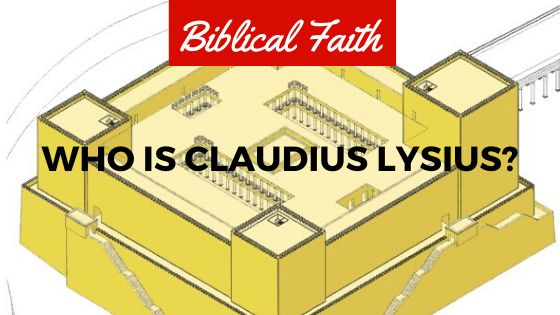
Reconstruction of Fort Antonia by Ehud Netzer in Biblical Archaeology Review 35.1 (Jan.-Feb. 2009).

Claudius Lysias, the Tribune

Claudius Lysias is called “the tribune” (χιλίαρχος, chilíarchos) 16 times within Acts 21-24 (21:31-33, 37; 22:24, 26-29; 23:10, 15, 17, 19, 22; 24:22); 17 times if Claudius Lysias is also included in among the “military tribunes” in the “audience hall” when Herod Agrippa II and Bernice come to hear Paul (Acts 25:23). However, such speculation is uncertain, especially considering a minimum of two years from when Claudius Lysias sent Paul to the Procurator Marcus Antonius Felix in c. AD 57/58 Acts 23:26-35, to within the first few months of the new Procurator Porcius Festus who rules from AD 60-62 (Acts 24:27-25:1-22).

The Greek term chilíarchos is said to be used to translate the Roman tribunus militum (following Polybius), and also for the phrase tribuni militares consulari potestate (Plutarch). The responsibilities of a chilíarchos were as a “commander of a thousand men”.[1] Essentially, Claudius Lysias is “a high ranking military officer in charge” of anywhere from 600 to 1,000 men,[2] and this appears to be the case for it is said that his command was over a “cohort” (σπειρα, speira) in Jerusalem which is “the tenth part of a Roman legion having about 600 men” (Acts 21:31).[3]

Tribune of a Jerusalem Cohort

Claudius Lysias’s complete description as found in the New Testament book of the Acts of the Apostles is “the tribune of the cohort” in Jerusalem, which resided in nearby “barracks” (Acts 21:34, 37; 22:24, 23:10, 16, 32). It takes six cohorts to make up a legion, and each legion had six tribunes with a thousand men (“soldiers and centurions” Acts 21:32) under his command if the cohort was full; consequently, Claudius Lysias was a part of a larger military force.

The exact numbers in his cohort may never be known, however, he had sufficient men to spare two centurions, two hundred soldiers, seventy horsemen, and two hundred spearmen to accompany Paul to Caesarea Acts 23:23-24. Furthermore, when the security detail arrives before Antipatris (Acts 23:31), Claudius Lysias allows for the seventy horsemen to go on with him and Paul to Caesarea, the headquarters of the Procurator Felix (Acts 23:32-35).

The “barracks” referenced in the book of Acts (21:34, 37; 22:24; 23:10, 16, 32), in connection to Claudius Lysias and his cohort are references to the Tower of Antonia, which Herod the Great rebuilt from a previous structure and named it after Marc Antony.[4] The Antonia was added on to the northwest side of the Temple facilities, “from which stairs descend into the outer court of the temple” (Acts 21:32, 35, 22:30).[5] For this reason, the Roman Tribune could hear the commotion caused by the confusing riot over Paul’s presence in the Temple and respond with speed (Acts 21:27-32).

Claudius Lysias in the New Testament

The military tribune Claudius Lysias enters the New Testament narrative when he protects Paul of Tarsus from a hostile Jewish mob on the outside of the Temple grounds in Jerusalem (Acts 21:30-32). The Acts text does not explicitly state why the tribune arrests Paul aside from asking “who he was and what he had done” (Acts 21:33); consequently, it appears Paul is detained for investigation as reflected later in Paul’s interrogation in the Antonian barracks because he was a cause of instigation among the Jews (Acts 22:23-24).

Claudius Lysias is aware of Jewish anarchistic movements, for when Paul speaking in Greek asks permission to speak to the shouting Jewish mob, the tribune appears shocked that he speaks Greek (Acts 21:37). Paul, as a controversial Greek-speaking Hebrew, evidently met some of the criteria for Lysias to conclude he was a Jewish revolutionist. Consequently, it appears that Lysias suspects him of being “the Egyptian” who “stirred up a revolt and led the four thousand men of the Assassins [σικαρίων] out into the wilderness” (Acts 21:38).

This individual operated around A.D. 53, and this revolution amounted to amassing these four thousand men, positioning themselves upon the Mount of Olives outside Jerusalem, and anticipating the walls of Jerusalem to collapse at his command. The Romans attacked this band of men, and the Egyptian lost six hundred men, and fled into the wilderness where he disappears awaiting “further revelation.” Evidently, “the Egyptian” was still on the run, wanted by the Roman military and the tribune was going to see if Paul was this anarchist.[6]

Paul was able to persuade Lysias that he was not an agitator, and provides him with his provincial citizenship as being from Tarsus, in the province of Cilicia (Acts 21:39). This was not an “obscure city” and either this suggests his citizenship could be authenticated, or Paul distinguished himself from the obscure Egyptian. In either case, Paul’s point is clear, he is not the Egyptian; the tribune accepts Paul’s case, and grants Paul an opportunity to speak to the Jews on the steps of the Temple facilities adjoined to the Antonian fortress (Acts 22:39-40).

The Jews did not respond peaceably to Paul’s speech, and Claudius Lysias decides to take Paul into the “barracks” of Antonia and “examine” him through the process of binding him to flog him (Acts 22:22-24). On receiving a report that Paul was a Roman citizen and then making a personal inquiry, Claudius is afraid of having violated the rights of a Roman by having him bound (see “Roman Citizenship” below). Claudius desires to arrive at the truth concerning the Jewish case against Paul and commands the Sanhedrin to assemble. Dissension among the Sanhedrin towards Paul arises again and causes Claudius Lysias to order his men to take Paul to the safety of the Antonian barracks (Acts 22:30-23:10).

Upon learning of a plot to kill Paul, Claudius Lysias summoned a military convoy to leave for Caesarea Maritima. In compliance with Roman law, he also sent a statement of the case to the procurator Antonius Felix. The letter reads:

Claudius Lysias, to his Excellency the governor Felix, greetings.

This man was seized by the Jews and was about to be killed by them when I came upon them with the soldiers and rescued him, having learned that he was a Roman citizen. And desiring to know the charge for which they were accusing him, I brought him down to their council. I found that he was being accused about questions of their law, but charged with nothing deserving death or imprisonment. 

And when it was disclosed to me that there would be a plot against the man, I sent him to you at once, ordering his accusers also to state before you what they have against him. (Acts 23:26-30, English Standard Version)

The letter format is consistent with the general format in the Graeco-Roman world, of “author” to “recipient” with a “greeting” with the subsequent content of the reason for the letter.[7] This letter, however, was not altogether factual. It is an interesting “specimen” of Roman military correspondence (Acts 23:26-30).

Although acknowledging Paul’s innocence, Claudius Lysias gave the impression that he had rescued Paul because of having learned that the apostle was a Roman, whereas in reality, he had violated Paul’s citizenship rights by having him bound and even ordering that he be examined under scourgings. As to the disciple Luke’s knowledge of the letter’s contents, it may be that the letter itself was read at the time Paul’s case was heard.

Roman Citizenship

In Acts 22:23-29, a discussion between Paul and Claudius emerges on the topic of Roman citizenship. Part of Claudius’ investigation procedure to find out more information was to stretch out the detained for whips and flog them.

Before his flogging begins, Paul questions the centurion given this detail, “Is it lawful for you to flog a man who is a Roman citizen and uncondemned?” (Acts 22:25). Roman citizenship had a number of privileges, as John Polhill writes:

A Roman citizen was subject to Roman law and thus was protected from such things as being beaten without a trial, from cruel punishments like crucifixion, and from unlawful imprisonment, rights which did not belong to an ordinary provincial (peregrinus). Citizens had the right of appeal. Only a Roman citizen could legally marry another Roman citizen. Citizens were exempted from certain taxes. Beyond this, there was the considerable factor of honor and deference such a status afforded.[8]

It was such a valued honor, that some people risked the death penalty given for falsely claiming citizenship.[9] Interestingly, one could hold dual citizenship, as Paul was not only a citizen of the city of Rome but was also a citizen of the city of Tarsus from the province of Cilicia (Acts 21.39; 23.34).

Roman citizenship was conferred in a number of ways. The basic ones are as follows:

(1) The most common way was being born of two Roman citizens.

This is the claim Paul makes when asked how he obtained his citizenship (“I am a citizen by birth” Acts 22:28), which implies that both of Paul’s parents were Jewish Roman citizens (cf. #4).

(2) One could obtain citizenship as a reward for military service.

Regularly, military veterans were given citizenship upon discharge. This was the surest way to get it, taking 20 to 25 years depending on the level of ranking.

(3) Imperial conference, though heard of, was not entirely common.

Nevertheless, the emperor could confer citizenship, either on individuals or on whole communities, as in the establishment of a new colony. Often the result of doing some loyal service to Rome. Also, many times through these services, one gained an audience with the Emperor through expensive gifts to members of the inner Imperial court.

This may have been how the Tribune Claudius Lysias gained his citizenship (Acts 22:27-28). In fact, the tribune’s name provides evidence to assume the plausibility that Emperor Claudius (A.D. 41 – A.D. 54) conferred upon Lysias citizenship since those granted this honor would bear the name (the nomen) of the family or patron which conferred it; hence, Lysias gained the name of his patron Claudius. It has been noted that the emperor was quite “promiscuous” in his conference of citizenship.[10]

(4) Roman citizenship was also conferred through the emancipation of a slave from the house of a Roman citizen.

Some have suggested that Paul’s ancestors may have been freedmen from among the thousands of Jews whom Pompey took as slaves in 63 B.C.[11]

Endnotes

  1. H. G. Liddell, An Intermediate Greek-English Lexicon: Abridged from Liddel and Scott’s Greek-English Lexicon (1888; repr.; Oak Harbor, Wash.: Logos Research Systems, 1996), 888.
  2. Barclay Newman, Jr., A Concise Greek-English Dictionary of the New Testament, revised ed. (Stuttgart: Deutsche Bibelgesellschaft, 2010), 200.
  3. Newman, A Concise Greek-English Dictionary, 167.
  4. Josephus, Antiquities 15.293; 15.409.
  5. George A. Smith, et al., “Jerusalem,” Encyclopaedia Biblica, eds. T. K. Cheyne and J. Southerland Black (London: A & C Black, 1901), 1:2429.
  6. Robert M. Grant, The Sword and the Cross (New York, NY: Macmillan, 1955), 49.
  7. T. C. Mitchell, Biblical Archaeology: Documents from the British Museum (New York, NY: University of Cambridge, 1988), 89.
  8. John B. Polhill, “Political Background of the New Testament,” Foundations for Biblical Interpretation, eds. David S. Dockery, et al. (Nashville, TN: Broadman & Holman, 1994), 531-32.
  9. Abraham J. Malherbe, “Life in the Graeco-Roman World,” The World of the New Testament, ed. Abraham J. Malherbe (1967; repr., Abilene, Tex.: Abilene Christian University Press, 1984), 9.
  10. Polhill, “Political Background of the New Testament,” 532.
  11. John B. Polhill, “Political Background of the New Testament,” 532; Richard R. Losch, The Uttermost Part of the Earth: A Guide to Places in the Bible (Grand Rapids, MI: Eerdmans, 2005), 176-77.

This originally appeared as a fully edited submission to Wikipedia.org. I have posted this here in case it is revised or rewritten.