Mind Your Business

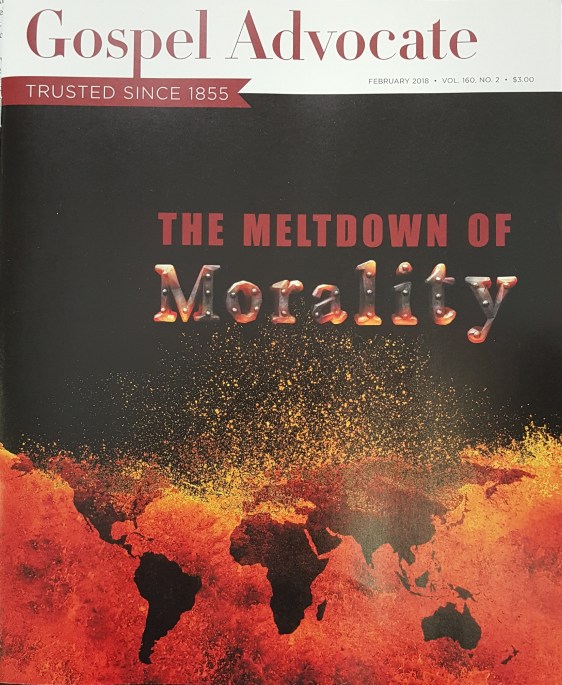
Reprinted with permission from the June 2018 issue of Gospel Advocate Magazine. Slightly revised edition.

I am not a fan of church politics, but I know they exist. Sometimes it reminds me of walking through the streets when I was a kid. You always had to have enough “friends” with you; you had to make sure you were stronger than the “other guy” and never get caught walking alone, especially in an alleyway. It saddens me to admit that “brotherhood alleyways” do exist. It appears in the form of the public shaming of preachers or schools; it appears in certain back channels where preachers or churches are undermined every step of the way due to a difference of opinions. In a word, brethren, we get consumed with the actions of others, and we seek to control them. We can’t seem to mind our own business and be about our Father’s business to love our community with the gospel.

It seems appropriate to begin this discussion with a brief look at the conjoined issue of ego. Jesus always found a way to check the egos of His disciples when they interfered with the priorities of the kingdom of God. Three examples from Mark 910 are helpful to point this out. In Mark 9:3337, the Lord had to refocus the whispers and debate among the Twelve regarding who was “great” in the kingdom of God. Greatness is measured by service, not by wielding power (cf. Luke 22:2428). In Mark 9:3841, Jesus corrected the disciples’ sense of managerial entitlement when they failed to stop a “nameless” disciple’s ministry. What matters is Jesus’ authority, not that of the disciples.

A little later, in Mark 10:13–16, the disciples impose their opinion on when Jesus was ready to provide ministry. Jesus undoes their harm by demonstrating that the kingdom of God is to be at the disposal of the vulnerable. I would argue that the actions of the disciples probably emerged from a good place, but these moments should remind us that personal ego often gets in our way of manifesting the kingdom of God. I truly believe the church is the place where our egos are supposed to die (Rom 6:1-10), but sadly they often resurrect.

We need to hear afresh the challenge from three letters: Jude, 1 Peter, and 3 John. At the heart of our church politics problems is that we have, at times, misapplied what it means to “contend for the faith” (Jude 3), become meddlers (1 Pet 4:15), and have failed to curb our egos (3 John 9).

Contending for the Faith

Many an article, sermon, blog, and petition have been published under the premise to “contend for the faith” (Jude 3). This is a very honorable goal. But at times the methods we use “to contend” lack Christian substance. The verb “to contend” (epagōnízomai) may be taken to mean, “to contend about a thing, as a combatant”[1] and give some legitimacy to a “war-time” church culture; but the metaphor should be taken in its natural direction. It may refer to “the intense effort” of an athlete to overcome the challenges of a sporting contest.[2] In this case, “to contend” is about self-discipline in the face of exertion, continuing the struggle for the sake of the faith.

Jude is the voice of reason the church needs to hear today. A careful reading of Jude does not support a “Cry ‘Havoc!,’ and let slip the [spiritual] dogs of war” agenda to demoralize and humiliate our brothers when we disagree theologically. In fact, Jesus warned that such tactics would endanger us with the fire of Gehenna (Matt 5:22). Instead, Jude writes that a proper response to the perversion of the gospel and subversion of Christ’s authority (v. 4) is to stay faithful to the content of the faith (v. 3), to trust in God’s Word, to trust the Lord will judge false teachers (vv. 59, 1416), to trust that such people will self-destruct (vv. 10–13) and to maintain a Spirit-centered culture of grace, mercy, love, and redemption within the church (vv. 17–23)all while affirming a distinction exists between the faithful and the ungodly false teachers and their corruption of the gospel itself (v. 12).

Jude does not shy away from revealing the errors of false teachers and the dangerous consequences that flow from their influence. The effort Jude speaks of is not to be spent on attacking the defectors, but instead, the exertion must be spent within our own souls, within our own congregations. We must resist the temptation to enable an ungodly inhospitable war-time church culture. With precision, Jude makes this little letter a rich description of the inhospitable environment the false teachers created in the church by their influence (vv. 12-13): they hinder love and community, they consume what others need, they withhold what is needed for life, and create a disappointing chaotic and unreliable spiritual incubator for the people of God. That is not what Jesus has called us to be.

Jude does not authorize intrusive efforts to “defend the faith.” Some among us have thought for quite some time that if they publicize an error long enough; generate enough brotherhood support; vilify the names of brethren or institutions; act like church “newscasters,” showing us the cold fronts of error among us; guide us through “connect the dots fellowship”; or act like church “J. Edgar Hoovers,” then we have contended for the faith. We have been so wrong. In truth, Jude’s brief message is bent on moving Christians to “exert effort” in embracing God’s wisdom, God’s sovereignty, and the Christian call to continue to be a fellowship of grace and mercy, love and forgiveness while affirming a distinction between ungodly false teachers and their corruption of the gospel itself (Jude 12). Those are quite different responses.

Jude concludes his letter by saying,

“But you, beloved, building yourselves up in your most holy faith and praying in the Holy Spirit, keep yourselves in the love of God, waiting for the mercy of our Lord Jesus Christ that leads to eternal life. And have mercy on those who doubt; save others by snatching them out of the fire; to others show mercy with fear, hating even the garment stained by the flesh” (vv. 20–23).

This is the work of contending. Today, we need to learn that many times the best way to deal with false teaching is to focus on the work of our local congregation, be patient with our brethren, and be gracious to those struggling rather than entering into a shouting match, in other words, staying busy with our own work and minding our own business.

Meddlers and Bullies

Meddlers. In 1 Peter, the apostle Peter addresses a number of Christian churches undergoing a forceful front of localized persecution of “shaming” in the northern provinces of Asia Minor (1:1; 2:12; 3:13; 4:4). Peter reminds them to respond to such shame-based threats by providing a kind and respectful verbal response, explaining their hope in Jesus as Lord (3:14–15). He further exhorts them to refrain from “clashes” with the community due to punishable crimes (murder, thievery, evil-doing, meddling; 4:15). Indeed, the only clash that will glorify God is when Christians are unjustly persecution for the name of Christ (4:16).

We need to give thought to Peter’s word, “meddler” (ESV, NIV). It is listed among the four offenses Christians must avoid. English translations show the difficulty of rendering this compound word (allotri + episkopos), the New Revised Standard Version has “mischief-maker”; the New King James Version, “busy-body”; and New American Standard Bible, “troublesome-meddler.” Quite possibly, Peter coined this word because it is found nowhere in Greek literature before him. At the core, the “meddler” is someone who apparently takes or seizes control of the affairs of others. Peter condemns Christians controlling others “tactlessly and without social graces.”[3] Too many times Christians think their duty is to control the choices of our neighbors. I suspect it is because we seek the right outcome of godliness. This, however, becomes a “no win” scenario. The local church is a fertile field for this temptation. Many cultish tactics have been used in the name of “discipling” our brethren. Pulpits are used not only to “persuade men” but to “meddle” in the affairs of our members. Elders cross the line separating overseeing and control. But those with more daring egos can emerge to be “the overseer” of brotherhood affairs with ungodly force and shame to establish control. Peter reminds us to “mind our own business.”

Bullies. In 3 John, the aged apostle John writes to Gaius an embattled faithful Christian leader, who is part of the collateral damage of a church bully named Diotrephes. The church setting was desperate, requiring his own personal touch (vv. 10, 13–14). The issue? False teaching? Nope. The tension was about control over mission work (vv. 5–8). Traveling preachers were part of early church culture. Over a period of time, John had commended several to this church for support, anticipating their needs would be supplied to reach the next leg of their journey. Instead, he found a polarizing church culture had matured, manifesting in Diotrephes and Gaius.

Maybe Diotrephes began this journey with a proper concern for church autonomy in matters of missions or with a desire to serve the church. The only motive explicitly given in this letter is that he “likes to put himself first” and his rejection of apostolic authority (3 John 9). The outcome, however, was wickedness, suppression, and subterfuge. He created an inhospitable and volatile church culture where suspicion reigns and alternative opinions are silenced and ousted (v. 10). It was all a bit like an Orwellian 1984 dystopia. Diotrephes was the “thought police.” He thrust his voice into areas beyond his authority, and in order to do so, he imposed his opinion by force and manipulation.

There is no question that ego became a problem, and behind that lay sin. Diotrephes became a mission-killing church bully because he chose self over the kingdom of God. He chose “preeminence” (KJV, ASV), “to be first” (NET), “to be in charge” (ISV), “to be number one” (Plain English NT), “to have first place” (FHV), “to be first in everything” (Phillips). Third John shows us the damage rendered by elders and preachers who dominate others like an “intolerant general” when something is not done their way. A church bully by any other name would still reek of wickedness. Brethren, we need to humble our pride and “mind our own business.”

Conclusion

I’ll be honest. Sometimes I feel like an outsider, even after being a part of the church for now over twenty years. But I have seen church bulletins as subtle tools for shaming congregational members and even preachers from outside of the congregation. I’ve known preacher friends receiving a copy of a brotherhood “journal” with a post-it note attached as a “friendly” reminder of how “misguided” they are for their views. Brotherhood magazines have been leveraged to do excessive numbers of exposés about this school or that preacher rather than teaching what the Bible says. For what purpose? To establish unity? None of this brings unity; instead, such actions seem designed to permanently polarize. Church, we can, and must, do better (John 13:35). Part of the solution is to be about our “local work” and to “mind our own business” (Romans 14:4).

Endnotes

  1. W. E. Vine, Merrill F. Unger, and William White, Jr., Vine’s Complete Expository Dictionary of Old and Testament Words (Nashville: Nelson, 1985), 2:125.
  2. E. Stauffer, s. v. “agōn,” Theological Dictionary of the New Testament (Grand Rapids: Eerdmans, 1964), 1:134-40. [In addition: BDAG 356, “The primary semantic component in the use of this verb in Jd 3 is the effort expended by the subject in a noble cause.” It gives “expression” to the Greco-Roman “ideal of dedication.”]
  3. Thomas R. Schreiner, 1, 2 Peter, Jude (Nashville: B&H, 2003), 224-25.

Jovan Payes preaches for the Highland Church of Christ in Bakersfield, California.

To subscribe to Gospel Advocate, click here.

The Word of God among the Denominations

Reprinted with permission from the February 2018 issue of Gospel Advocate Magazine.

20180124_150851.jpg

Hebrews affirms, “For the word of God is living and active, sharper than any two-edged sword, piercing to the division of soul and of spirit, of joints and of marrow, and discerning the thoughts and intentions of the heart” (4:12 ESV). This is part of a warning in Hebrews, which affirms that Christians who defect from God will fail to meet their rest as their Israelite counterparts did (vv. 1-11). God holds his people —and His creation— accountable by His presence (“sight”) in the word of God (Hebrews 4:13). This is a raw incontrovertible truth.

This passage makes no caveats; it makes no attempt to remedy a distinction between God’s word and God’s presence. They are both manifested at the same time. God is involved with real life (time and space) with Israel and with Christians. God makes promises and keeps his word regarding their “rest,” and God holds His people and creation accountable to His word. God is Lord of heaven and earth and everything in between, and He holds it together by the power residing in Jesus (Hebrews 1:3; Colossians 1:17). The word of God is connected not only to the authority of God but also to His nature and how He reveals Himself to the world.

Let me say the above in a differently. Our God, who is beyond time and space (God’s transcendence), enters our earthly “realm” bound by time and space (God’s immanence) with His divinity and authority (sovereignty) intact; furthermore, God enters into relationship with His creation (Abraham, Israel, Christians) by revealing Himself in creation and in His word. God is active both in creation and in His word. Creation reveals God’s existence and hints at elements of His attributes (natural theology), but it is His word that reveals God and His “will” so that humanity can enter into covenant with God. The word of God was both proclaimed orally through particular spokesmen (patriarchs, prophets, kings, apostles), but the prophetic word was not only through oracles but also in written communiqués embedded with the same divine authority (2 Peter 1:16–21). These writings reveal the mind of God (1 Corinthians 2:11–16), His purposes and mystery (Ephesians 3:1–6), His involvement in human events (Acts 17:26–27), and the righteousness by which He will bring justice to the world (Acts 17:30–31).

To say it bluntly, the Bible is the word of God set in a permanent written form. Paul declared, “all scripture is breathed out by God” (2 Timothy 3:16). The Scripture bears the character of God and is no “dead” codebook, for it transforms every “man of God” into a competent, equipped servant (2 Timothy 3:17). The profitability of all Scripture is due to its quality as “God’s breath.” There is no pecking order between the spoken or written word of God. The inspired written word is as inerrant as God’s character. There is no source outside of the Holy Spirit-given Scripture that speaks God’s transforming work since it is the depository of the gospel’s message. What the word of God promises, God will do; what God proclaims, God’s holds His creation accountable to (1 Thessalonians 2:13).

The above may seem to belabor the point, but as anticipated by the title of this piece, we will sketch how the word of God is handled among Liberal (Modern) and Neoorthodox influences. It is essential for the church to reflect on these twentieth-century influences because dialogue is healthy, truth has nothing from which to hide, and any redefinition of biblical Christianity must be given due consideration (Galatians 1:6-7).

The following historical sketches will probably not satisfy everyone, but they will be enough to see their direction and how they redefine significant elements of historic Christian beliefs and their tendency to subvert scriptural authority.

Liberalism/Modernism

The word “liberal” is a very loaded word. It is often used with contempt to show disapproval of someone else thought to be progressive (instrumental music, expanded role of women, etc.). But this is not the historic sense of the word. Liberalism emerged in the late nineteenth century through the interplay of many players, thinkers, and philosophical trends. The influence of Liberalism, or Modernism, is seen in three levels: (1) revelation is not the final answer to reality, (2) naturalism is the key to reality and religion, and (3) since the Christian documents are built on ancient myths and superstitions, the historic supernatural claims of Christianity is immaterial. To be a “Christian” is a matter of experience and the “essence” of its teaching.

Liberalism, as an intellectual revolution, is a child of the Age of Reason (the Enlightenment). The “Age” saw the elevation of human reason over the institutional “church,” which wielded divine revelation. It was “the church” that dictated to the people what to believe about reality. Divine revelation was the final answer to determining truth and what really happened in the past. This was displaced with rationalism, scientific history (criticism), and naturalism as final answers to genuine and authentic history and truth. In essence, as Stanley Grenz and Roger Olsen point out, the maxim “I believe in order that I may understand” was turned to “I believe what I can understand.”[1] Faith was overturned by a reason informed by modern findings — thus, this point of view is called “Modernism.”

Everything that was received as genuine knowledge, now, was shaped by the natural world. This was further supported by what is called “the principle of analogy,” popularized by the liberal theologian Ernst Troelsch (1865–1923), which argued that the present is the best way to understand the past. The consequence was detrimental in the extreme on the trustworthiness of Scripture. The supernatural elements interwoven in Scripture are, by definition, myths and superstitions. This meant that there are no miracles, no supernatural interventions by God, and no resurrection of Jesus Christ. Thus, many new schools of “criticism” emerged to study Scripture with mixed results.

This naturally led to an embrace of “the essence of Christianity” so long as reason and experience allowed. “Liberals” are open to the modern findings from the natural world, open to a religious humanism and science —in particularly embracing Darwinian evolution as the process by which God created. If God exists, He could only be revealed through religious “experience.” It was also immaterial if the events of Scripture happened or not because religion is a condition of the heart. Yet, the apostle Paul makes it abundantly clear that if the resurrection event has not occurred, both our preaching and faith are in vain and we are still in our sins (1 Corinthians 15:14, 17).

Another arm of Liberalism is the demythologizing of the New Testament pioneered by the “Form Critic” Rudolf Bultmann (1884–1976). Bultmann argued that historic person of Jesus is built on untrustworthy sources. The New Testament is Christian propaganda shrouded in the imagery of the Greek myths and Roman legends. As such, they are not relevant for faith nor spiritual truth claims. It is the symbolism that matters. Today, one only need to watch the latest “history” programming to find modern theological liberals interviewed. Theological liberalism has significant questions that need to be answered, but it brings Christianity to a logical dead end.

Neoorthodoxy

The Swiss theologian Karl Barth (1886–1968) ignited a movement when he published his commentary on Romans in 1919. It charted a new theological direction away from Liberalism/Modernism. Barth (pronounced “bart”) was not fond of the misnomer “neoorthodoxy,” but his strand of thinking regarding the meaning of “revelation” and “the word of God” would rival the prevailing traditional belief held historically by the church. As a consequence, many regard Barth as one of the great theologians and the father of modern theology.

Orthodoxy affirms the teaching of historic Christian truth based on Scripture. This includes, for example, the following concepts: the inerrant inspiration of scripture, the triune Godhead, the deity and virgin birth of Christ, the historic creation and fall of humanity, the bodily resurrection and ascension of Christ, the return and final judgment. Barth argued, on the other hand, that “revealed truth” was not written, but was the outcome of an encounter (an experience) with God. Thus, instead of scripture as being the objective word of God, Barth argued for a subjective experience with God initiated by reading the Bible.

Barth was offering a completely different course of thought altogether. “Revelation” does not appear in the form of propositional truths. Arguing book, chapter, verse, or appeals to the very words of scripture is insufficient to reveal God. Revelation (the word of God), it is argued, is an “event” in which God acts in history (God’s immanence). Barth even argued that revelation is not found in natural theology (Acts 17; Psalm 19; Romans 1) but, instead, in events like the call of Abraham, the exodus, and the resurrection. Millard Erickson is spot on when he classifies Neoorthodoxy as an illumination theory divorced from an objective standard.[2]

Although Neoorthodoxy is not a unified movement, there are three interconnected witnesses (modes/forms) that shape its view on revelation.[3] First, Jesus is the word of God in the truest sense, for He reveals God in the event of His incarnation, life, ministry, death and resurrection. This is true revelation, the very gospel. Second, Scripture points to Jesus but it is a flawed human (read “errant”) attempt to provide a witness to divine revelation. It is instrumentally God’s word but not properly. Third, the proclamation within the faith community —Barth preferred “community” to church— is likewise instrumentally God’s word. The Bible, then, only becomes God’s word when God uses it to reveal Jesus Christ in the encounter, contrary to 2 Timothy 3:16.

In fact, Neo-orthodoxy is quite a popular approach to handling the Word of God, even among churches of Christ. A popular theological branch of this movement is “Canonical Criticism,” popularized by the late American scholar Brevard Childs (1923–2007). It seeks to broadly bypass much of the liberal destructive criticism of the twentieth century by accepting the texts of Scripture as literary units. Nevertheless, this point of view struggles, as did Barth’s, to embrace the Bible as a very human (errant) book while appealing to its authority for theological thought as if they were inerrant. They seek, in the words of one sympathetic Abilene Christian University professor, to “articulate a doctrine of Scripture that recognizes human flaws in it.”[4] Treating the Bible as an inerrant text is simply a form of bibliolatry.

Keeping the Faith

Today, the phrase “Word of God” means different things to different believers, and that includes preachers. Liberalism ultimately rejects a supernatural Christian faith, and is at home with amputating its historic claims of a resurrected ascended Lord Jesus, in exchange for a subjective diluted Christianity. Neoorthodoxy, on the other hand, embraces a supernatural Christian faith, but it rejects the supernatural origin, inerrancy, and authority of the Scriptures which undergird its claims. The Word of God has always been a manifestation of God’s presence in our lives, in His proclamation, and in His Scripture without pecking order. Let us join Paul who declares, “Let God be true though every one were a liar” (Romans 3:4).

Notes

  1. Stanley J. Grenz and Roger E. Olsen, 20th Century Theology (Downers Grove: InterVarsity, 1992), 17.
  2. Millard J. Erickson, Christian Theology, 3rd ed. (Grand Rapids, Baker Academic, 2013), 220–21.
  3. Karl Barth, Evangelical Theology: An Introduction, trans. G. Foley (New York: Holt, 1963), 26–36.
  4. Christopher Hutson, “Scripture as the Human Word of God: Why Faith Contradicts Inerrancy,” Lexington Theological Quarterly 44.1 (2011): 210–21. Hutson serves as a professor of ministry and missions at Abilene Christian University.

To subscribe to Gospel Advocate, click here.


Book Review: The Safest Place on Earth

Safest Place on Earth - Crabb.jpg

Larry Crabb, The Safest Place on Earth: Where People Connect and Are Forever Changed (Nashville, TN: W Publishing, 1999), Hardback, 240 pages.

Dr. Larry Crabb is an established licensed psychologist, a well-known Christian author on marriage and biblical counseling topics, and current Distinguished Scholar in Residence at the Colorado Christian University (Morrison, CO).[1] 

Dr. Crabb earned his Ph.D in Clinical Psychology from the University of Illinois, and has been a professor of psychology since 1970. Dr. Crabb also provides workshops and weekend seminars across the United States as part of his non-profit New Way Ministries and its web presence which features interviews, video lectures, and other multimedia outlets to share resources from his School of Spiritual Direction.

Dr. Crabb has been involved in counseling and marriage, in self-help ministry, and in developing a context of “spiritual community” for over 40 years, and so has earned a place among the various “Christian voices” seeking to make the church a better place.

In 1999, Dr. Crabb released a significant but brief volume on the church as a safe spiritual community. The volume is entitled, The Safest Place on Earth: Where People Connect and Are Forever Changed (238 pages).[2] Dr. Crabb has registered his own frustration with two elements which bear upon the community of the church and its spiritual health, which he further addresses in Real Church: Does it Exist? Can I Find It? (Nashville, TN: Nelson, 2009).

In The Safest Place on Earth, however, Dr. Crabb establishes a vision for the church as a group of believers on a journey towards God, and it is within the journey that spiritual community must begin and end for spiritual healing and direction. Despite Dr. Crabb’s own training in psychology, he believes when it comes to the soul care that ought to go on within the church, such assistance must yield “to special revelation and biblically dependent thinking.”[3] Dr. Crabb is adamant,

We don’t need more churches, as we usually define the word. We need more spiritual communities where good friends and wise people turn their chairs toward each other and talk well.[4]

Structurally, The Safest Place on Earth is organized in seventeen chapters, divided into three parts, and finishes with a section of questions for each chapter. The layout follows a very clear program of development, and the content is written in a popular style. Dr. Crabb is able to articulate and shape a conceptual paradigm of what is a spiritual community and what is not a spiritual community without complex vocabulary. His illustrations, personal anecdotes, and insights from personal interactions are delivered to support his vision for a spiritual community is very clear and helpful ways.

Dr. Crabb also interacts with and depends upon the works of Dutch Catholic priest Henri Nouwen[5] (1932-1996), who focused on spiritual solitude, spiritual community, and spiritual compassion, along with Swiss Catholic philosopher Jean Vanier (b. 1928) and his work connected to L’Arche communities which have overlapping concerns.[6]

A Book Summary

In part one, Dr. Crabb develops and sharpens the idea of spiritual community and how the church needs to develop sensitivity to being the spiritual community it was intended to be. Spiritual community is, according to Crabb, at the core of what the church is.

It is people facing each other in intimate, honest, and safe ways as they journey together on their way to God. Spiritual community, however, will not occur if there is no opportunity for vulnerability and a full sense of validation from these that witness the vulnerable parts of who we are.

One of the difficulties in church community life is to wrestle with the crux,

if they knew who I really was, the church would probably not like me.

To be a spiritual community, then, we must be able to love free from ego and embrace those so broken by those things which burden our souls and even cripple us.

The health metric of a spiritual community is its ability to love the unlovable, the broken, those that can only let you love them in their brokenness.

In part two, Dr. Crabb reframes the New Testament discussion of flesh and spirit elements of our soul in terms of the analogies of the Lower Room (carnal/wretchedness) and the Upper Room (spiritual/greatness).

It is in this phase of the book that Dr. Crabb focuses on the part of the church community that needs to be addressed first — our internal struggles to be spiritual. Enter Dr. Crabb’s “two rooms” analogy which he builds from the words of Jesus:

If anyone loves me, he will keep my word, and my Father will love him, and we will come to him and make our home with him. (John 14:23)

And he amplifies these words with Paul’s regarding “Christ in you” (Colossians 1:27).[7]

In essence, the two rooms represent fully furnished environments that exist within us.

Now there are two rooms inside us, the one we built where our natural self thrives, and the one the Spirit built where our natural self suffocates and our new self flourishes.[8] 

Dr. Crabb does not explicitly use all the terms, but these “rooms” parallel the Freudian id, ego, and superego dynamics, the difference being they are spiritualized.[9] The lower room is self-furnished by our wretchedness and “dark forces” with its corruption and stench (id). The upper room is furnished by the Spirit of God only enjoyed once we open the doors of the lower room, acknowledge its stench, and celebrate the confidence to be a new us (an obedient us) empowered by God’s grace and teaching (superego?).

Finally, we consciously (ego?) take these “two rooms” within us and the internal struggles that go with them —because we prefer to be in the lower room— to receive outside help from “another room” which is the spiritual community, the church. This room is furnished by the Spirit with safety, vision, wisdom, and power.

In part three, Dr. Crabb continues his visioning for spiritual community with another analogy of “turning our chairs toward each other” but now by “turning our souls toward each other.”

In this process, the members of the church community must practice three needed things. First, spiritual community can only be done by the Holy Spirit. Second, personal holiness grounded in the Spirit influences the pursuit of personal holiness of others. Third, there must then be a safe place to “own and trace our desires to their source.”[10] 

Spiritual community, however, will only occur when spiritual passions are “supernaturally” aroused when we are together in spiritual community experiencing acceptance, mutual faith in God’s presence in our lives, affirm the “upper room” elements in our lives, and allow God to change us without applying human pressures of forced change.

It is certainly a place of risk, but risk will always be a factor when embracing the need for vulnerability. Therefore, the real question is: will we, the church, be the safe place for those being vulnerable?

Response and Review

I chose this book principally because of the title. In fact, I had seen this title on the cover of the September/October 2001 New Wineskin magazine as part of the issue theme of “Authentic Christian Community.”[11] The concept peaked my interest because I do feel the church has not been the safest place on Earth in managing people’s sin. One example will suffice. I once heard a preacher react to the exposed sins of others with the derogatory question, “where are the normal people?” That’s not a safe place for healing. Nor is the following response to a fellow congregant’s addiction any safer, “there’s a word they need to learn – repent.”

Rebuking sin is the easy work of preaching, but creating a compassionate environment to help brothers and sisters work through repentance is the harder – and in my judgment – more fruitful work of ministry.

Crabb’s book further calls the church to be the community through which Christians experience spiritual healing for spiritual problems often mistreated —according to Dr. Crabb—as psychological disorders or problems. The gospel and the New Testament teaching that the church is the dwelling place of God, and Christians are the temple of the Holy Spirit, seem to support the overall agenda that the culture of the local congregation should be more attuned to openly working through sin, temptations, and openly celebrating grace, and spiritual empowerment by God. Even Paul declares that the church is being recreated (2 Corinthians 5:17) and repurposed for ministry (Ephesians 2:10).

Dr. Crabb’s book both intrigued me and made me uncomfortable in that he elevates the spiritual components of the church where the Holy Spirit dwells. Again, it is not that I’m troubled by the Holy Spirit, it is that in many pockets of the Churches of Christ the Holy Spirit and the use of “community” have been so tinged with so-called “liberal agendas” in the latter, and doctrinal controversial hotbeds regarding the former. His emphasis that the church is specifically designed to be a spiritual community and therefore it must be that spiritual community on a journey to God is what stands out the most to me. If we are not a spiritual community, then there will not be the Spirit.

I do not agree with all of his points on the “wretchedness” of man, but Dr. Crabb has challenged me to speak more about the Spirit and the church as the community in which God does His best work to heal us from the effects of sin.

Concluding Thoughts

What I liked overall about the book is the Dr. Crabb’s challenging call to the church to be a safe place for the sort of healing love that needs to exists between God’s people, so that the Spirit of God may work through the church to heal its members as they bear each other’s burdens with the gifts of the Spirit (Galatians 5:22-26). The church must be so, because, as Dr. Crabb reminds us, we are traveling together on a journey to God.

I recommend the challenge of this book to every Christian and church leader. The reminder that Scripture centers the body of Christ as the place where the Spirit dwells, and therefore must be the safe place where the members of the body can serve each other empowered by the same Spirit. To overcome sin, the church must be, and in some cases become, the place where no one struggles with sin void of love, compassion, support, and patience as we journey to God breaking free from the bondage of sin.

Endnotes

  1. “About Larry Crabb,” http://www.newwayministries.org/larrycrabb.php.
  2. Full details: Larry Crabb, The Safest Place on Earth: Where People Connect and Are Forever Changed (Nashville, TN: W Publishing, 1999).
  3. Crabb, The Safest Place on Earth, 7.
  4. Crabb, The Safest Place on Earth, 10.
  5. “Henri Nouwen Society,” http://henrinouwen.org.
  6. “History of L’Arche,” https://www.larcheusa.org/who-we-are/history.
  7. Unless otherwise stated all Scripture quotations are taken from the English Standard Version of The Holy Bible (Wheaton, IL: Crossway, 2001).
  8. Crabb, The Safest Place on Earth, 62–63.
  9. Crabb, The Safest Place on Earth, 78–79.
  10. Crabb, The Safest Place on Earth, 121–30.
  11. Larry Crabb, “Is the Church the Safest Place on Earth?,” New Wineskins 5.4 (Sept/Oct 2001): 12–15.

Be the Gift (1 Peter 4:10-11)

It is a staggering thought when you think about it. Christians have gifts to share with their neighbors. Much like the old nativity hymn of the three orient kings, who came from the far east with rich gifts for the newborn king Jesus, Christians have gifts to share with the people they come in contact with every day. In a word, we have a calling. It is greater than Toys for Tots, it is greater than Secret Santa, it is greater than the presents carefully wrapped and laid under the Christmas tree. The gifts Christians have are those which come from God, they are packaged by him and must be shared.

When the apostle Peter wrote to the beleaguered Christians in the northeastern Roman provinces of Asia (1 Peter 1:1), he wrote to encourage them to embrace the slander and the social persecution with the reminder that they walk in the footsteps of Jesus (1 Peter 2:21). For example, should they suffer unjustly —as did Jesus— the suffering will bring about the opportunity to extend grace to the world. Furthermore, the Christian must not focus on the momentary suffering but instead upon God’s validation and vindication. As God vindicated the suffering servant Jesus, so will He vindicate his suffering people (4:1).

As You Have Received God’s Gift

As an extension of this moral encouragement, the apostle goes on to address very practical aspects of Christian living in chapter 4. Here is an excellent moment to pause and reflect upon the truth that doctrinal purity is important, but these Christians are called to practice godliness in the face of persecution. In one of the summarizing passages of this exhortation, Peter writes the following:

As each has received a gift, use it to serve one another, as good stewards of God’s varied grace: whoever speaks, as one who speaks oracles of God; whoever serves, as one who serves by the strength that God supplies—in order that in everything God may be glorified through Jesus Christ. To him belong glory and dominion forever and ever. Amen. (1 Peter 4:10–11 ESV)

A point that is not readily notable from the English version is the connection between gift (charisma) and grace (charitos) in verse 10. They are built on the same word root, which was interconnected at the social level. It portrays God as a benefactor —a gift giver— for his people and asks them (us) to also be gift-givers (benefactors) as well.

This makes the term “good stewards” (oikonomoi) equally enlightening. It is a word that has domestic and political usage, and this usage is seen in the New Testament documents. In the ESV, the word is translated as “manager” of domestic affairs (Luke 12:42, 16:1, 3, 8; Gal 4:2), and once as “treasurer” which would have been a political office in Rome (Rom 16:23). As here in 1 Peter 4:10, “steward” in passages that emphasizes a conservatorship over a given responsibility (1 Cor 4:1-2, Tit 1:7). It was a well known Greco-Roman phenomenon that members of a benefactor’s household were also “brokers” of the gifts of the head of their household. The imagery of Peter’s message is parallel to this type of behavior.

Christians as members of God’s house are blessed by their Father’s gifts so that they may be brokers of God’s grace. We are in a very real way representatives of God’s house and what we offer in a variety of ways is the very gift of God — Jesus Christ and the gospel message. We are to teach it, we are to proclaim it, but most importantly we are to live it. Below, we will consider the points left behind in this section by the Spirit through Peter in verse 11.

Whoever speaks…

One of the overarching themes of the film, Waiting for Superman, a 2010 documentary on the American education system, is that many within the system are waiting for someone to fix it, to do the hard work to shore up its failures. Instead, such systemic problems will only be fixed by teachers and educational leaders working together and initiating helpful and creative programs. There is no one person who can fix the educational system of America, all resources must come together. The same is true with sharing the gift of Jesus and His gospel.

Every Christian (woman and man) must remember that our gift is a gift of words. Not just words, but words of God. For this reason, when a Christian shares the gospel it truly is God’s gift of grace we are sharing. We must not speak our words. We must not speak from our own anger. We must not speak our theories of the word. We must not speak our “pet” religious opinions. We must not speak from any other basis other than from the depository of God’s word — found only in the Scriptures. Our words must be as if it were God talking. God’s word is the only true gift (1 These 2:13).

Whoever serves…

Christian activity is always dramatically presented as services rendered as one who waits on tables, doing as told by their superior (Acts 6:2; John 2:5). Every Christian (woman and man) must remember that our gift is also a gift of action — of service. Christians broker God’s grace with others with the service we render to other people. Edgar Guest was spot on with this passage when he penned the opening lines of his poem, “I’d rather see a sermon than hear one any day; I’d rather one should walk with me than merely tell the way” (“I’d Rather See a Sermon Than Hear One Any Day”). Indeed, there is no greater opportunity in life than to serve as an example of God’s grace to others.

Words can be misunderstood. Actions, however, are less so. But, serving others often comes with a tall price. Service is not convenient emotionally, or physically. It is perhaps for this reason that Peter says that Christians who serve others do so and are empowered by the strength supplied by God. We do not serve others based on our own merits. It is a hard lesson for so many of us, but we need to trust in God for Him to be God when we are serving others. Whether it is food, clothing, or shelter that we offer as expressions of God’s varied graces, we do so, trusting that God will make our service His gift and that alone should empower us to serve.

Concluding Thoughts

Whether it’s the best of times or the worst of times, Christians can make a mark in the world and in the times in which they live. My prayer for all of us is to be the Christians we are called to be. Be the best gift you can be to your family and friends in word and service. Let it be the kind that brings glory to God and not to self. Remember, to say, “it’s not about me… it’s about Him.” “To him belong glory and dominion forever and ever. Amen” (4:11).


A Brief Look at Patronage as Background for the New Testament

college papers

The present study is an inquiry into the interconnected reciprocal nature of patronage in the Greco-Roman imperial social setting, as one background component from the New Testament world. One would be wrong to think that such a social dynamic’s presence was minimal. In actuality, patronage and its vocabulary not only appears specifically in the New Testament (Luke 22:25; Acts 10:38; Rom 16:2; Philm 17-20, Phil 4:14-20, etc), but the social reciprocal dynamics in which its value and cultural powers are also assumed (shame, honor, unity, gratitude, fellowship, etc.). The reader who knows what to look for will see it in numerous contexts shaping the life of the body.[1] Unfortunately, the many elements vital to the matrix of patronage can only be pointed to. Yet, as Bruce J. Malina observes, it was “the most significant form of social interaction in the limited-good world of the first century is an informal principle of reciprocity, a sort of implicit, non-legal contractual obligation, unenforceable by any authority apart from one’s sense of honor and shame.”[2] The challenge in this paper is to briefly and accurately describe it.

In seeking to understand the New Testament accurately, scholars propose various exegetical principles and contextualizing models to accomplish this task.[3] The process here requires an approach which appreciates the cultural background of the New Testament to contextualize its vocabulary. This, Albert A. Bell reminds, is the “crucial part of understanding any written text.”[4] Greco-Roman words have a socially conditioned context that the modern reader may not readily identify. “Without a comprehension of the sociological dynamics of that world, our understanding… is terribly superficial at best and woefully mistaken at worst.”[5] The most crucial need for the reader of the New Testament, then, is to be able to bridge the cultural and time gap between the original (native) context and the reader’s contemporary context. This linguistic and cultural divide can be managed. In advancing a cultural-anthropological reading model, Jerome H. Neyrey argues that one can avoid ethnocentric and anachronistic readings of Paul (and the New Testament) by appreciating the difference between reading him as member of the same culture (an emic reading), and by reading him informed by the analytical and descriptive works of specialists and ethnographers (an etic reading).[6] As one gets closer to this “emic reading,” the modern reader comes closer to better appreciate the symbolic universe of Paul’s and Jesus’ culture.[7] The goal here is to gain a realistic perception from “native informants” which can illustrate and contextualize patronage as a Greco-Roman phenomenon.[8]

The presentation to follow will demonstrate how significant the social form of patronage was in the daily life of the Greco-Roman world, it will outline the vocabulary of patronage in Latin and Greek primary sources, it will sharpen this outline to differentiate between political and social patronage, and then offer a realistic scenarios that can illuminate reading the New Testament in its social and cultural world.

Daily Significance of Patronage

In modern analogy, patronage was like an ancient informal “welfare system.” Social services, like the modern model of the United States, would have been quite foreign. Instead, patronage was a cultural phenomenon in which there was a reciprocal relationship between the upper class and the lower class. It benefited lower classes with protection and patronage by means of reasonable support (legal, financial, medical, marital, etc.) for public support, the running of errands, odd jobs, escorting through streets, and providing social honor in exchange (a return). In exchange for the daily allowance (sportula), the client was at the patron’s call. Thus, it was a form of social investment between patron-client; interestingly, even slaves of wealthy households were known to have clients who hoped the slave could use their influence upon their master.[9] Greco-Roman and Christian scholarship is unequivocal about the daily and social significance of the patron-client network of relationships.[10]

Martial, in his colorful Epigrams, clocks what city life was like in the urbs (4.8.1-4): “The first and second hours wear out clients greeting their patrons.” The imagery evokes the crushing nature of the daily dependence of clients upon their patronus. A step further, Juvenal shows how important this allowance of money was for the everyday professional and collegia with his sarcastic words in the Satires (1.95-126):

For no deity is held in such reverence amongst us as Wealth; though as yet, O baneful money, thou hast no temple of thine own; not yet have we reared altars to Money in like manner as we worship Peace and Honour, Victory and Virtue, or that Concord that clatters when we salute her nest.[11]

This fits the common view that the patron-client phenomena were important to the daily life of every social stratum of the Greco-Roman world. To this point, Jérôme Carcopinodescribes that whether employed or unemployed, freedman or the parasite do-nothing, aristocrats or lower plebeians, clients “were no sooner out of bed than they were in the grip of the duties inseparable from being a ‘client.’ […] there was no man in Rome who did not feel himself bound to someone more powerful above him by the same obligations of respect, or, to use the technical term, the same obsequium.”[12] This honor-bound relationship allowed those in various professions and collegia to survive by means of this small daily “dole as their main source of revenue.”

Patronage in Latin and Greek Sources

Extant Greek and Latin sources (literary and epigraphic) speak of patronage, benefaction, and euergetism (good-doing) from political and social perspectives. Ideas such protection, assistance, help, advocacy, and philanthropy appear. Consider the following samples. It seems that patronage was initially borne out of political power and civic duty, but that distinction apparently broke down over time into a social network between the upper and lower classes in the Greco-Roman world among the rich, the poor, the freedman and freedwoman.[13]

The Roman historian Livy stretches back about four centuries to the early Roman Republic and recounts the story of Cincinnatus, the famed aristocratic plebeian consul, turn poor plebeian farmer, turn dictator, turn savior of Roman (History of Rome 3.26-29). According to Livy, his actions as dictator were reciprocated with honor and status. Livy frames (stylizes?) the response of the army as recognizing “the benefit [beneficii] they had received at his hands,” honored him with a golden crown, and “saluted him as their protector [patronum salutaverit]” (History of Rome 3.29.3). They had become his “clients,” and Cincinnatus would use this social bond to his advantage to “clear” the charges against his son Caeso who was on the run for charges of murder. The protector of Rome, then, returned his powers of dictator and returned to the rustic farm life. Later, when Augustus consolidates his power, Tacitus recounts his use of “gratuities” (donis) among the military and the poor (Annals 1.2). Michael Grant[14] interprets this as Augustus letting “it be understood that the old institution of patrons and clients had been recast, so that henceforward all the people were his own, personal clients, including the poorest citizens.” Thus, as principis Augustus and the emperors after him would portray (politically?) to the citizens of Rome and its subjects a bond of reciprocal loyalty.

Greek sources also illuminate various aspects of patronage. In the fifth century BCE, Sophocles frames the tragic Oedipus as gratefully exchanging protection from Thebes and “help [prostátisi] of the dread goddesses” who reigns in their districts, with obtaining “a great savior [sōtēr’] for this city, and troubles for my enemies” in him (Oedipus at Colunus 455-460). The Apocrypha[15] likewise points to the political upheavals in the Maccabean storyline connected to concepts of patronage. In 2 Maccabees, Simon slanders Onias, who is designated “a plotter against the government the man who was the benefactor [tòn euergétēn] of the city, the protector [tòn kēdemóna] of his compatriots, and a zealot for the laws” (4:2).[16]

In 3 Maccabees 3:13-29, “King Ptolemy Philopater” declares to his “generals and soldiers” that despite his goodwill (philanthrōpía), a desire to do good (eū poiēsaí), and to honor (timēsai) in the Jewish temple (3:15-17), the Jews “manifest ill-will toward us” and are “the only people among all nations who hold their heads high in defiance of kings and their own benefactors [euergétais], and are unwilling to regard any action as sincere” (3:19). The accommodative and benevolent king (philanthrópōs 3:20) declares that such rebellious Jews should be arrested, bound, and deported and that any who harbor them should be severely punished (3:25-29). Eventually, Philopator descends upon the Jews but is subdued by two angels. The king breaks down to pity and tears, and blames and threatens his “friends” (toís phílois):  “You are committing treason and surpassing tyrants in cruelty; and even me, your benefactor [euergétēn]” (6:24).

Political and Social Patronage in Rome

In the Greco-Roman world of the first century CE, there appears to be evidence distinguishing between political and social patronage. This can be confusing since sources often use terms like benefactor, euergetes, and patron in the process of discussion. The masculine form of the Greek prostát– (see verbal use above for “help”) is somewhat problematic. It is often considered synonymous with the Latin patronus. Interestingly, the New Testament the feminine form προστάτις is used in Romans 16:2 and translated as patron and benefactor (ESV; NIV, NRSV, HCSB). Erlend D. MacGillivray[17] takes exception to the view that these two forms are completely synonymous. The masculine appears in both Attic Greek and in the Roman Empire and carries both legal and a variety of leadership benefaction roles, but not the feminine form. MacGillivray argues that applying the masculine meaning upon prostátis is exegetically problematic for this reason. Benefaction is in view, but one must distinguish between political patronage from some interpersonal social networking.

MacGillivray argues that understanding prostátis depends, then, upon understanding the fluid nature of ancient Mediterranean reciprocal dynamics, recognizing the patron-client model is far too limiting and misleading. There is a difference between the narrow and nuanced meaning of classical patronage and the broad euergetistic/altruistic benefaction. While epigraphical gratitude evidence shows that prostátis and prostátes imply civic prestige, the nature of the evidence is, however, often weak to force synonymity. Part of the problem stems from the near normative templates in honorary Greco-Roman epigraphs that do not always neatly distinguish between the various kinds of patronage. Thus, the presence of these terms do not prove exclusively a classical patronage/patronus; consequently, MacGillivray’s work argues that prostátis and prostátes are not demonstrably synonymous.

R. A. Kearsley[18] extends this trajectory and explores several first century CE gratitude (honorarium) inscriptions shedding light on the first-century distinction between political and social patronage. These aristocratic women are named, Iunia Theodora and Claudia Metrodora, and are celebrated as female benefactors/patrons who operated in mid-first century CE Asia Minor. The cities of Lycia (Myra, Patara, Tel-messos) recount the influence of Theodora. Theodora apparently had multiple-citizenships, she freely shared her wealth, applied influenced for political and commercial purposes, and is described consistently in benefactor terms (sōphronōs, philolúkios) in Lycia. Such amounts to Theodora functioning as a social benefactor. On the other hand, Metrodora of Chiot Island likewise held multiple-citizenships, did hold political office as magistrate (stephanephoros), which required benefaction toward the people although she surpassed such requirements. She functioned in banquets, directed imperial games, gymnasiarch, public bathhouse donation, basileia in Ionia, and was praised for her public virtue. She was a benefactor as part of holding office.

Realistic Patronage Scenarios for Reading the New Testament

The above illustrations provide insight into the deep and ancient tradition of patronage and how such played out in various settings. There are two passages where patronage vocabulary is explicitly found in the New Testament.

First, in Luke, the political aspect of patronage is evident in Jesus’ counter-intuitive teaching on greatness. Jesus corrects the “greatness debate” among the disciples by saying,

“The kings of the Gentiles exercise lordship over them, and those in authority over them are called benefactors [euergétai]. But not so with you. Rather, let the greatest among you become as the youngest, and the leader as one who serves” (22:25-26).

Frederick W. Danker observes, euergétai “served as a title for rulers in Syria and Egypt… In many cases the title would conceal tyranny under extravagant expenditure” (cf. Greek Esther 16:2-3, 13-14).[19] One might argue that Jesus is taking for granted a political euergétai known to abuse such roles, and parts from the fundamental principle of the patron-client relationship: “a service performed or a favor done shall not be transformed into status and honor.”[20] Jesus’ leadership principle, then, is that one serves detached from the demands of reciprocity and the honor and status it brings (cf. Acts 10:38).[21]

Second, in Romans 16:1-2 patronage appears to have a social component. Paul commends Phoebe to the church as “a servant of the church at Cenchreae” and as one who should be helped —reciprocally— “for she has been a patron [prostátis] of many and of myself as well.” Caroline F. Whelan[22] relates this passage to the context of Roman reciprocal social conventions within associations (collegia). Whelan maintains that women not only had the Roman legal standing to operate their wealth independently of guardians, they also functioned as civic patrons for collegia. Secondly, comparable “recommendation” letters reveal two types of reciprocal relationships. There is the superior-inferior recommendation rhetoric, and two, the social-equals recommendation rhetoric; each reflecting in some sense the inherent nature of reciprocity in Rome’s social structure, the matrix of which fuses together the economic and social. Romans 16:1-2, then, points to one of these realistic scenarios. Whelan argues that the patronage between social equals (amica, friends) is probably in view. Phoebe needs Paul’s influence among those addressed in Romans 16 (thus the recommendation), but as “equals” such rhetoric is not for his own social benefit. Instead, it is a gesture of gratitude for her own social activity as a social patron (euergetistic) to the collegia of the church in Cenchrea.

Conclusion

Robert Wilken asserts: “We have a distorted view of the history of early Christianity… The historian of Christianity has given the impression that the rest of the canvas is simply background for the closeup —relegating the general history of the times to an introductory chapter of vague generalities.”[23] Hopefully, this paper provides a closer, native (emic) reading. The smaller the cultural and linguistic gap is, the more accurate the reading. May this paper accomplish its task, to gain realistic perceptions from primary sources which can illustrate and contextualize patronage as an important Greco-Roman imperial phenomenon.

Endnotes

  1. David A. deSilva, “Honor and Shame,” “Patronage,” DNTB 518-22, 766-71; Donald Walker, “Benefactor,” DNTB 157-59; Halvor Moxnes, “Patron-Client Relations and the New Community in Luke-Acts,” in The Social World of Luke-Acts, ed. J. H. Neyrey (1991; repr., Peabody: Hendrickson, 1993), 241-68; Everett Ferguson, Backgrounds of Early Christianity, 3rd ed. (Grand Rapids: Eerdmans, 2003), 66-69.
  2. Bruce J. Malina, The New Testament World (Louisville: John Knox, 1981), 80.
  3. Ralph P. Martin, “Approaches to New Testament Exegesis,” in New Testament Interpretation, ed. I. Howard Marshall (Grand Rapids: Eerdmans, 1977), 220-51.
  4. Albert A. Bell, Jr., Exploring the New Testament World (Nashville: Nelson, 1998), 2.
  5. M. Robert Mulholland, Jr., “Sociological Criticism,” in Interpreting the New Testament, eds. David A. Black and David S. Dockery (Nashville: B&H, 2001), 171.
  6. Jerome H. Neyrey, Paul, In Other Words (Louisville: Westminster John Knox, 1990), 13.
  7. Neyrey, Paul, 14-17. Neyrey’s distinctions and concerns have value, but he makes a hardline dichotomy between Paul as one who receives supra-cultural insight (i.e., from God) and Paul as a fully incarnated product of his times (18). This distinction ignores Paul’s stated role from God. This is one of Mulholland’s four critiques of this model, it tends to be human-centered, often grounded in dynamic models foreign to the Roman world, imposes the model on the evidence, and lends itself to sociological reductionism (“Sociological Criticism,” 178-80).
  8. David A. deSilva, The Hope of Glory: Honor Discourse and New Testament Interpretation (Collegeville: Liturgical, 1999). The “native informants” are “our best instructors” (xi).
  9. Bell, Exploring the New Testament World, 191-92.
  10. Ferguson, Backgrounds, 67; Florence DuPont, Daily Life in Ancient Rome, trans. C. Woodall (Oxford: Blackwell, 1993); Micahel Grant, A Social History of Greece and Rome (New York: Scribner’s Sons, 1992).
  11. Juvenal, Satire 1.95-126, http://sourcebooks.fordham.edu/halsall/ancient/juv-sat1eng.asp.
  12. Jérôme Carcopino, Daily Life in Ancient Rome, ed. Henry T. Rowell, trans. E. O. Lorimer (1940; repr., New Haven: Yale University, 1968), 171.
  13. Grant, Social History of Greece and Rome, 30, 54, 70-76, 114-119.
  14. Grant, Social History of Greece and Rome, 75-76.
  15. See also the verbal, and substantival, usages in Wisdom 3:5, 11:5, 13, 16:2, 19:13-14; 2 Macc 8:6; 4 Macc 8:6; Greek Esther 16:2-3 = 8:12c (tōn euergetoúntōn), 13 = 8:12n (euergétēn). Of these sources, Mordecai is framed as sōtēra and euergétēn (cf. God in LXX Psa 12:6, 56:3, 114:7).
  16. Quotations for the Old Testament Apocrypha are taken from New Revised Standard Version of the Holy Bible (Nashville: Nelson, 1989). The Greek text is from Septuaginta (Stuttgart: Deutsche Bibelgesellschaft, 1996).
  17. Erlend D. MacGillivray, “Romans 16:2, prostátis/prostátes, and the Application of Reciprocal Relationships to New Testament Texts,” NovT 53 (2011): 183-99.
  18. R. A. Kearsley, “Women in Public Life in the Roman East: Iunia Theodora, Claudia Metrodora and Phoebe, Benefactress of Paul,” TynB 50.2 (1999): 189-211.
  19. Frederick W. Danker, Jesus and the New Age According to St. Luke (St. Louis: Clayton Publishing, 1979), 222.
  20. Moxnes, “Patron-Client Relations,” 261.
  21. Halvor Moxnes, The Economy of the Kingdom (1988; repr., Eugene: Wipf & Stock, 2004), 158.
  22. Caroline F. Whelan, “Amica Pauli: The Role of Phoebe in the Early Church,” JSNT 49 (1993): 67-85.
  23. Robert L. Wilken, The Christians as the Romans Saw Them (New Haven: Yale University, 1984), xiv.

Bibliography

Bell, Albert A., Jr. Exploring the New Testament World: An Illustrated Guide to the World of Jesus and the First Christians. Nashville, TN: Nelson, 1998.

Carcopino, Jérôme. Daily Life in Ancient Rome: The People and the City at the Height of the Empire. Edited by Henry T. Rowell. Translated by E. O. Lorimer. 1940. Repr., New Haven, CT: Yale University, 1968.

Danker, Frederick W. Jesus and the New Age According to St. Luke: A Commentary on the Third Gospel. 1972. Repr., St. Louis, MO: Clayton Publishing, 1979.

deSilva, David A. “Honor and Shame.” DNTB. 518-22.

deSilva, David A. The Hope of Glory: Honor Discourse and New Testament Interpretation. Collegeville, MN: Liturgical Press, 1999.

deSilva, David A. “Patronage” DNTB. 766-71.

DuPont, Florence. Daily Life in Ancient Rome. Translated by Christopher Woodall. Oxford: Blackwell, 1993.

Ferguson, Everett. Backgrounds of Early Christianity. 3rd edition. Grand Rapids, MI: Eerdmans, 2003.

Grant, Michael. A Social History of Greece and Rome. New York, NY: Scribner’s Sons, 1992.

Kearsley, R. A. “Women in Public Life in the Roman East: Iunia Theodora, Claudia Metrodora and Phoebe, Benefactress of Paul.” TynB 50.2 (1999): 189-211.

MacGillivray, Erlend D. “Romans 16:2, prostátis/prostátes, and the Application of Reciprocal Relationships to New Testament Texts.” NovT 53 (2011): 183-99.

Malina, Bruce J. The New Testament World: Insight from Cultural Anthropology. Atlanta, GA: Knox, 1981.

Moxnes, Halvor. The Economy of the Kingdom: Social Conflict and Economic Relations in Luke’s Gospel. Minneapolis, MN: Augsburg Fortress, 1988. Repr., Eugene, OR: Wipf & Stock, 2004.

——-. “Patron-Client Relations and the New Community in Luke-Acts.” Pages 241-68 in The Social World of Luke-Acts: Models for Interpretation. Edited by Jerome H. Neyrey. 1991. Repr., Peabody, MA: Hendrickson, 1993.

Mulholland, M. Robert, Jr. “Sociological Criticism.” Pages 170-86 in Interpreting the New Testament: Essays on Methods and Issues. Edited by David Alan Black and David S. Dockery. Nashville, TN: B&H, 2001.

Neyrey, Jerome H. Paul, In Other Words: A Cultural Reading of His Letters. Louisville, KY: Westminster John Knox, 1990.

Walker, Donald D. “Benefactor.” DNTB. 157-59.

Whelan, Caroline F. “Amica Pauli: The Role of Phoebe in the Early Church.” JSNT 49 (1993): 67-85.

Wilken, Robert L. The Christians as the Romans Saw Them. New Haven, CT: Yale University, 1984.

An Exegetical Walkthrough of John 16:12-15

4.png

The seventeenth-century “non-conformist” English pastor, Ralph Venning, is famous for immortalizing the following line regarding Scripture:

it is deep enough for an elephant to swim in, and yet shallow enough for a lamb to wade through.

No truer does this speak to both the complex richness and visual clarity of the Gospel of John. John is traditionally regarded as one of the last written books of the New Testament canon at the tail-end of the first-century CE. When compared to Matthew, Mark, and Luke, John is written in a style all its own — comparable only to the letters of John.

Of the significant unique features of John is the tightly bound chapters, known by many as Jesus’ Farewell Discourse (John 14-16). It is prudent to consider a few preliminary matters to appreciate the way John 16:12-15 delivers on the themes of John and the coming of the Holy Spirit with a view to some application for the modern church.

Genre and Interpretation

John, as the so-called Fourth Gospel, has presented itself with challenges of every kind. As Gary M. Burge observes, the study of what is a gospel genre and its interpretation has been an intense one, especially as it relates to the Gospel of John.[1] The nature of the genre of the gospel as a narrative is still in somewhat of a debate, and in particular how John’s structural stability or instability is appreciated and explained.[2]

The question about gospel genre speaks to what is its purpose and goal(s). This has troubled the academic community for some time. For example, a gospel is a biography but it is not what a modern person thinks of as a biography since so many anticipated features are missing. An examination of the early chapters of each Gospel reveals a thumbsketch history of Jesus’ “early years.” As Craig Blomberg demonstrates, modern perceptions of biography are misleading and resulted in earlier scholars questioning the historical value of the Gospels on false assumptions.[3] However, Blomberg continues, “when they are set side by side with various ancient sources, the Gospels compare quite favorably”:

Ancient historical standards of precision in narration and in selection and arrangement of material were much less rigid than modern ones. Few, if any, ancient works were written merely for the sake of preserving the facts; almost all were trying to put forward and defend certain ideologies or morals. But propaganda need not distort the facts, though it sometimes does. Of course, any genre may be modified, and there are uniquely Christian features in the Gospels.[4]

Craig Blomberg, “The Diversity of Literary Genres in the New Testament,” Interpreting the New Testament

Consequently, while scholars acknowledge the formal critical parallels between the Gospel accounts and other ancient historical and biographical documents, there are unique features in matters of content and emphasis.[5] Some students have even cautioned that there are significant variations even between the four Gospels based on their own internal agendas, sufficient enough to make Larry Hurtado caution, “it wise to treat them individually.”[6]

John on His Own

The Gospel of John bears features that stand uniquely against the Synoptics. This, however, does not suggest a contradiction. This proclivity of John to emphasize unique material does not disassociate itself with the themes of the Synoptics. For example, instead of a nativity narrative, there is an emphasis on the pre-incarnate narrative (John 1:1-14ff) serving as a prequel to their nativity storyline (Matt 2:1-23; Luke 1:26-52). Moreover, an emphasis upon miracle narratives and extensive dialogs and discourses, take precedence over parabolic instructions and pronouncements.[7] 

Despite the material that is unique to John, C. K. Barrett calls attention to the fact that events in John and Mark “occur in the same order.”[8] And while Barrett stresses that John most likely borrowed from Mark, Leon Morris responds that such features found to be common with John and the Synoptics “is precisely the kind that one would anticipate finding in oral tradition.”[9] In short, John is certainly unique in many significant ways, but it follows the same structure of Matthew, Mark, and Luke.

A Broad Layout for John

John may be divided broadly into two thematically arranged halves (1:19-12:50; 13:1-21:25), despite some disagreement regarding the structural integrity of the fourth Gospel, due to certain aporia (i.e. any perplexing difficulty).[10] Jeffrey Staley suggests these tendencies are set forth in the prologue (John 1:1-18) and bolsters the viability of the approach taken here.[11] John 1:19-12:50 (“book of signs”) and John 13:1-21:25 (“book of glory”) are consequently the main divisions taken in this study.

The last nine chapters focus great attention upon the last few days of Jesus’ life,[12] where the focus is on the “Upper Room” and his “Farewell Discourse” (13-17), the crucifixion and resurrection narratives (18-21). Even more specifically, the text under consideration (John 16:12-15) finds its niche as the last of five discourses that speak of the Spirit as the Paraclete (John 14:15-17, 25-26; 15:26-27; 16:7-11, 12-15):[13]

Book of Glory 13:1-21:25

Upper Room/Farewell (13-16)

Prayer (17)

Crucifixion and Resurrection (18-21)

A Brief Exegetical Walkthrough

This paper sets out to examine John 16:12-15 as the last of five segments that place emphasis upon the Paraclete’s role in the ministry of the apostles; furthermore, to examine the nature of the Paraclete’s role in the early church, as set forth by Jesus, as an apostolic “Aid,” guiding them in the ways that pertain to truth.

Verse 12: I have many things left to say to all of you, but you are not able to endure it at the present time. (Author's Translation)[14]

Following George Beasley-Murray’s lead, the final Paraclete passage brings the discourse to a “climax” emphasizing the role the Spirit’s ministry.[15] The adverbial eti here takes the sense of “what is left or remaining”[16] and in concert with all’, which contextually appears to function as a transition marker placing emphasis on “the other side of a matter or issue,”[17] suggests that verse 12 begins to further demonstrate the importance of the Spirit’s coming presence. Eti and all’ are pivotal phrases for they describe the tension of the situation in which the disciples are to be found. Consequently, this climactic Paraclete discussion may be viewed in terms of two perspectives: the disciples’ and the Lord’s.

First, from the disciple’s perspective, one wonders how much more Jesus withheld from them during his personal ministry. However, earlier in this context Jesus clearly told them, “I did not speak about these matters to you, because I was among you” (John 16:4b). As a result of disclosing the impending future events, Jesus observes their plight and says, “pain has filled your hearts” (16:6b). The thought of loss and loneliness, without access to the presence of Jesus, made the disciples at that moment (arti) incapable (ou dúnasthe) to carry the burden (bastádzein) of what appears to be doctrinal and prophetic significance (14:26; 16:14). The anarthrous adverbial infinitival construction ou dúnasthe bastádzein stresses purpose; namely, the disciples do not have adequate capacity in order to “sustain the burden” of what Jesus has left to teach them.[18] Thus, in essence, because the disciples are currently unable to carry more weight (upon the sorrow?) in their hearts, there remains future spiritual growth.

Second, from the Lord’s perspective, he looks forward to a future event. This observation is made on the basis of the present lack of capacity of the disciples to carry the burden of what Jesus has to further instruct them in. If ou dúnasthe bastádzein arti is to be taken as a present reality, then Jesus looks forward to a future reality-event when they will have the capacity to bear his teaching. This is one of the blessings already referred to previously that flow from the arrival of the Paraclete (14:25-27; 15:26-16:11).

The Paraclete[19] is viewed as an “Aid” in John 14:25-27 as one who will “teach” the disciples and “remind” them of the teaching of Jesus eventuating in “peace”; in contrast to the “sorrow” that they are now experiencing (16:6). And with the arrival of the Paraclete, the disciples will have an “Advocate” for their defense from the world (15:26-27), and a “Counselor” to give guidance in accusing the world (16:8-11).[20] In each circumstance, Jesus says, “the Father will give you another Paraclete” (14:16), “the Father will send” (14:26), “but when the Paraclete comes” (15:26), “when he comes” (16:8), “when the Spirit of truth comes” (16:12). Hence, Jesus already anticipates a time when the disciples overcome both their sorrow and the corresponding incapacity to bear more of his teaching.

Verse 13: However, when that one has come – the Spirit of Truth – he will guide you in all the truth; for he will not speak from himself, on the contrary, to the extent of what he will hear, he will speak. And he will announce to you the things that are to come.

Preliminary to discussing the continued flow of thought from verse 12, there is a text-critical matter that needs some attention. Verse 13 bears two significant variants. The first is the dative construction en te aletheía páse (dative of sphere) following hodegései humas, which according to other textual traditions has an accusative construction eis pasan tèn alétheian (spatial accusative). The committee of the UBS4 textual apparatus has given en te aletheía páse a B rating; meaning, that they view the dative construction as is almost certain,[21] being witnessed by notable uncials Aleph1 (4th century), W (4/5 centuries). Meanwhile, the accusative construction is witnessed by notable uncials A (5) and B (4th century) with variation, and 068 (5th century). Along with early translations and early patristic witnesses, the evidence appears somewhat fairly divided. Bruce Metzger suggests, however, “the construction of eis and the accusative seems to have been introduced by copyists who regarded it as more idiomatic after hodegései[22] than en with the dative.[23]

Despite the pain that filled each disciple’s heart, the disciples were directed to a future event – the work of the Spirit of Truth (16:13ff.). “However” () marks that Jesus is developing a new topic ( of “switch subject”).[24] Moreover, this contrast is temporal as demonstrated by hótan élthe (“when that one has arrived”). Furthermore, following Buth’s discussion on δὲ as a mark of switching subjects, it is proposed that the new subject is ekeínos, which refers to ho parákletos. Daniel Wallace proposes that this is a more solid linguistic connection between this pronoun and its antecedent (ekeínos = ho parákletos).[25] Consequently, tò Pneùma tès aletheías serves as an appositional phrase expanding and further defining ekeínos; hence the translation, “when that one has come – the Spirit of Truth […]” (John 16:13a). Instead of the present reality of pain that the disciples feel, Jesus focuses on the guidance that ho parákletos[26] will bring to the disciples.

Ancient sources point to a Jewish background the Spirit of Truth motif. This vocabulary was typical when admonishing obedient and moral lives by using concepts that are dualistic. For example, we find a proverbial discussion of “the spirit of truth and the spirit of error” with “the spirit of discernment” standing between them urging there to be a selection of truth (T. Jud 20). Observe the full quote:

Learn therefore, my children, that two spirits wait upon man—the spirit of truth and the spirit of error; and in the midst is the spirit of the understanding of the mind, to which it belongeth to turn whithersoever it will.  And the works of truth and the works of error are written upon the breast of men, and each one of them the Lord knoweth.  And there is no time at which the works of men can be hid from Him; for on the bones of his breast hath he been written down before the Lord.  And the spirit of truth testifieth all things, and accuseth all; and he who sinneth is burnt up by his own heart, and cannot raise his face unto the Judge. (italics added)[27]

Moreover, in the Qumran cache there is a discussion of God allotting two spirits to humanity, “the spirits of truth and perversity” in between which humanity must walk, again choosing between the two. As a result, walking with the truth is to “walk in the ways of light,” and the converse is true of walking with perversity – to walk in darkness (1QS 3:18-21). Again, observe:

[God] allotted unto humanity two spirits that he should walk in them until the time of His visitation; they are the spirits of truth and perversity. The origin of truth is in a fountain of light, and the origin of perversity is from a fountain of darkness. Dominion over all the sons of righteousness is in the hand of the Prince of light; they walk in the ways of light. All dominion over the sons of perversity is in the hand of the Angel of darkness; they walk in the ways of darkness. (italics added)[28] 

These resonate strongly with the positive guidance the disciples will receive from the Paraclete.

The source of the Paraclete’s teaching is external to him, “for he will not speak from himself, “on the contrary” (all’), to the extent of what he will hear, he will speak.” Since earlier the Paraclete is said to be like Jesus (14:16-17), and Jesus also said that his teaching was not his own (3:32-35; 7:16-18; 8:26-29, etc.), it would make sense that the teaching of the Paraclete would originate from the Father. As F. Moloney observes, “neither Jesus nor the Paraclete is the ultimate source of the revelation they communicate.”[29] And his work is, in part, to remind the disciples of the teaching of Jesus (14:26).

In addition to this call to remembrance, “he will announce” (lalései) to them “things that are to come” (tà erchómena anangeleì), which presumably are the things that he will also “hear” (hósa akoúsei). Some view this last phrase (tà erchómena anangeleì) as eschatologically prophetic.[30] Others view it as instructional content yet to be expanded upon.[31] D. A. Carson proposes that this phrase has to do with “all that transpires in consequence of the pivotal revelation bound up with Jesus’ person, ministry, death, resurrection and exaltation.”[32] These matters, Carson views, are the subject of what we now call the New Testament Canon; consequently, this anticipates further canonical development by the new prophetic office – the apostleship.[33]

Verse 14: That one will glorify me, because he will take from what is mine and he will report it to you.

Still looking to the arrival of the Paraclete (e.g. ekeínos), Jesus expands further upon his ministry – he will glorify Jesus. The word doxásei was often used in LXX to glorify God (2 Sam 6:20; 1 Chron 17:18), so also is used to describe one of the roles the Paraclete will have.[34] The term hóti has been ignored somewhat here among commentaries, where it could potentially be employed epexegetically; saying, “the Paraclete will glorify (honor) Jesus; namely, by taking the teaching that goes back to the Lord’s ministry and announcing it afresh to the disciples.” Such is not an unlikely view of the grammar; however, viewing hóti as causal (i.e. “because”) the sense changes slightly. Overall, the idea that the Paraclete’s glorifying of Jesus directly relates to him taking the teaching that was Jesus’ remains the same.[35]

This is borne out by Carson in three related ways. First, the Paraclete’s work is Christ-centric. Second, based upon the implication drawing from ek tou emou lépsetai “from what is mine,” Carson draws the conclusion that “the Spirit takes from this infinite sum and gives that truth to the disciples.” Third, Christ is the center of his teaching ministry, and it is through the Spirit’s work that Jesus is glorified.[36]

There is a rather important emphasis that should be laid upon the phrase ananggelei humìn. The term has to do with providing information; hence, may be translated “disclose,” “announce,” “proclaim,” or even “teach.”[37] What is contextually significant is that ananggéllōα carries an implicit understanding that it is a report of what one has heard.[38] Incidentally, the Paraclete will speak whatever he has heard (hósa akoúsei lalései 16:13), and here Jesus says that the Paraclete will take from what is his (Jesus), from where he will provide information to the disciples. Again, this highlights two matters: first, that the Paraclete will not speak independently; and second, the content of his teaching is all truth and Jesus. As Barrett observes, in John, ananggéllō (4:25, 5:15, 16:13-15) “is applied to the revelation of divine truth, and it is apparent that it is so used here.”[39]

Furthermore, Lawrence Lutkemeyer observes, that ananggéllō is “never” used in a predictive sense; instead, it is employed to report the way things were, are, or as they come into realization.[40] Therefore, what is under consideration is a reporting of the teaching and implications that flow from Christ and the Gospel message. This reporting is deposited within the pages of what is now the New Testament canon and serves as demonstrative proof that they have understood the Lord’s teaching.[41]

Verse 15: All things whatsoever the Father has are mine; for this reason I said, [hóti] he takes from what is mine and will report it to you.

When Jesus says, “All things whatsoever the Father has are mine,” it is in a sense logical to deduce that the content of what the Spirit is to announce or report to the disciples is under consideration. Carson again observes:

Therefore if the Spirit takes what is mine and makes it known to the disciples, the content of what is mine is nothing less than the revelation of the Father himself, for Jesus declares, All that belongs to the Father is mine (v. 15). That is why Jesus has cast the Spirit’s ministry in terms of the unfolding of what belongs to the Son: this is not a lighting of God, or undue elevation of the Son, since what belongs to the Father belongs to the Son. It is therefore entirely appropriate that the Spirit’s ministry be designed to bring glory to the Son (v. 14).[42]

D. A. Carson, The Gospel According to John, Piller New Testament Commentaries

It is precisely because they share this content and revelation (dià toùto) that the Paraclete will draw out from what belongs to Jesus (16:14), and that he will only speak what he has heard (16:13). There is a very similar statement in Luke, but here it speaks in reference to Jesus as he was sent from the Father (Luke 10:16).[43] The parallel is striking to this context regarding the Paraclete, of which Jesus by implication is the first and the Spirit is the second (14:16).

Precisely because of this shared content and revelation (dià toùto), Jesus retrospectively points out that he had spoken certain words to them (eìpon).[44] And here, John employs the recitativum hóti, meaning that the use of this conjunction is designed to introduce a direct quotation and is usually left untranslated.[45] Often hóti functions as an indicator of direct discourse.”[46] It serves only “to call attention to the quotation,” thus it functions in the same fashion as do quotation marks;[47] hence, in the translation above, hóti is emboldened and bracketed to demonstrate the origin of the quotation marks. What Jesus points to then, is the role of the Paraclete, he takes from what is mine and will report it to you.”

It is interesting to note that the first quotation, he takes from what is mine” (ek toù emoù lambánei) is a present indicative as opposed to the future indicative in 16:14 (lémpsetai). The shift in the tense of activity to the present as Christ views the Spirit’s work retrospectively may point back to 14:17, where Christ apparently speaks in both present and future tenses. Jesus says, “You know (present) him, for he dwells (present) with you and will be (future) in you” (14:17b). However, to be fair, the UBS4 committee had difficulty deciphering between a variant here (giving it a C rating) that relates specifically to the tense of both verbs ménei and éstai. If the wording of 14:17 stands as the majority of the UBS4 committee suggests,[48] then the Spirit was already in some sense active in the apostolic circle, and will in the future be in them.

This reflects what is happening here. Jesus notes that the Spirit is, in some sense, already taking (lambánei) from the reservoir of revelation and that he will when the time is ready, report this information to them (ananggeleì humìn). There is little by way of academic support for this approach to provide a resolution for the tense change from lémpsetai to lambánei (except Moloney).[49] Barrett’s terse statement, “the change of tense (cf. lémpsetai, v. 14) does not seem to be significant,”[50] needs revision on the grounds that 14:17, assuming its textual basis is the weightiest available, transitions from present to future with reference to the Paraclete’s work as does the tense shift in 16:15.[51]

Endnotes

  1. Gary M. Burge, “Interpreting the Gospel of John,” Interpreting the New Testament: Essays on Methods and Issues, eds. David Alan Black and David S. Dockery (Nashville, TN: B&H, 2001), 357-70.
  2. Burge, “Interpreting,” 376-78.
  3. Craig Blomberg, “The Diversity of Literary Genres in the New Testament,” Interpreting the New Testament: Essays on Methods and Issues, eds. David Alan Black and David S. Dockery (Nashville, TN: B&H, 2001), 274.
  4. Blomberg, “The Diversity of Literary Genres,” 274.
  5. Blomberg, “The Diversity of Literary Genres,” 275.
  6. Larry W. Hurtado, “Gospel (Genre),” DJG 278.
  7. Hurtado, “Gospel (Genre),” 281.
  8. C. K. Barrett, The Gospel According to St. John: An Introduction with Commentary and Notes on the Greek Text, 2d ed. (Philadelphia, PA: Westminster, 1978), 43.
  9. Leon Morris, The Gospel According to John, rev. ed., NICNT (Grand Rapids, MI: Eerdmans, 1995), 45.
  10. Burge, “Interpreting,” 376-78.
  11. Jeff Staley, “The Structure of John’s Prologue: Its Implications for the Gospel’s Narrative Structure,” CBQ 48.2 (April 1986): 241-49.
  12. Burge, “Interpreting,” 382.
  13. C. H. Dodd takes note of the significant fact, that John 15.1 to 16.15 is a pure monologue, and is in fact, the longest monologue in the entire Johannine Gospel (The Interpretation of the Fourth Gospel [New York, NY: Cambridge at the University Press, 1965], 410).
  14. The translations are the author’s unless otherwise noted.
  15. George R. Beasley-Murray, Gospel of Life: Theology in the Fourth Gospel (1991; repr., Peabody, MA: Hendrickson, 1995), 78.
  16. BDAG 400.
  17. BDAG 45.
  18. BDAG 171; Daniel B. Wallace, Greek Grammar Beyond the Basics: An Exegetical Syntax of the New Testament (Grand Rapids, MI: Zondervan, 1996), 590.
  19. “The principal difficulty encountered in rendering parákletos is the fact that this term covers potentially such a wide area of meaning. The traditional rendering of ‘Comforter’ is especially misleading because it suggests only one very limited aspect of what the Holy Spirit does” (L&N 12.19). There are three semantic domains in which it overlaps: (1) psychological factors of encouragement, (2) definite communication aspects, and (3) intercessory aspects leading toward certain legal implications and procedures (L&N 35:16, fn. 4).
  20. Beasley-Murray, Gospel of Life, 71-72.
  21. Bruce M. Metzger, A Textual Commentary on the Greek New Testament, 2d ed. (1994; repr., Stuttgart, Germany: German Bible Society, 2001), 14*.
  22. Metzger, A Textual Commentary, 210; cf., Stanley E. Porter, Idioms of the Greek New Testament, 2d ed. (London: Sheffield Academic Press, 2005), 151-52.
  23. Interestingly, Stanley E. Porter discusses the morphological connection between eis and en, noting that eis “may have been formally derived from the preposition ἐν, through the process of adding a final sigma (ens), the nu dropping out, and compensatory lengthening of the vowel from e to ei” (Idioms, 151) As a result, there is evidence of a connection, observing that “eis in its basic meaning is concerned with the movement of the sphere toward and into” a location, “as if this were the action that resulted in the condition of en” (Idioms, 151). There is much, therefore, to agree with Barrett’s observation that: “The difference in meaning between the two readings is slight, but whereas eis t. al. suggests that, under the Spirit’s guidance, the disciples will come to know all truth, en t. al. suggests guidance in the whole sphere of truth; they will be kept in the truth of God […] which is guaranteed by the mission of Jesus” (Gospel According to St. John, 489).
  24. Randall Buth, “Oun, De, Kai, and Asyndeton in John’s Gospel,” Linguistics and New Testament Interpretation: Essays on Discourse Analysis, eds. David Alan Black, et al. (Nashville, TN: Broadman, 1992), 145, 151.
  25. Wallace, Greek Grammar Beyond the Basics, 331-32.
  26. That one who is ho parákletos will come as a guide in all truth, and it is only fitting then that ho parákletos is called “the Spirit of Truth” (tò pneùma tés aletheías). The two titles are complex conceptions; however, they appeal to certain Hebrew motifs that need some attention here. Without developing too deeply some of the backgrounds of each of these phrases, John employs the phrases ho parákletos (5 times) and tò pneùma tés aletheía (4 times) exclusively among New Testament authors. However, cognates are used by other authors.
  27. T. Judas 20, ANF 8:20.
  28. 1QS 3:18–21 as quoted in Craig A. Evans, Word and Glory: On the Exegetical and Theological Background of John’s Prologue, JSNT Supplement 89 (England: Sheffield Academic Press, 1993), 147.
  29. Francis J. Moloney, The Gospel of John, SP 4 (Collegeville, MN: Liturgical Press, 1998), 441.
  30. Barrett, The Gospel According to St. John, 490.
  31. George R. Beasley-Murray, John, 2d ed., WBC 36 (Nashville, TN: Nelson, 1999), 283; Rodney A. Whitacre, John, IVPNTC, eds. Grant Osborne, et al. (Downers Grove, IL: InterVarsity, 1999), 392-93.
  32. D. A. Carson, The Gospel According to John, PNTC (Grand Rapids, MI: Eerdmans, 1991), 540.
  33. D. A. Carson, The Farewell Discourse and Final Prayer of Jesus: An Exposition of John 14:-17 (1980; repr., Grand Rapids, MI: Baker Books, 1988), 149-51.
  34. Ceslas Spicq, “dóxa, doxádzō, sundoxádzō,” Theological Lexicon of the New Testament, trans. James D. Ernest (1994; repr., Peabody, MA: Hendrickson, 1996), 1:376-78.
  35. Wallace, Greek Grammar Beyond the Basics, 459-60.
  36. Carson, The Farewell Discourse150.
  37. BDAG 59.
  38. BDAG 59.
  39. Barrett, The Gospel According to St. John, 490; Carson, According to John, 540.
  40. Lawrence J. Lutkemeyer, “The Role of the Paraclete (John 16:7-15),” CBQ 8.2 (April 1946): 228.
  41. Andreas J. Köstenberger, The Missions of Jesus and the Disciples According to the Fourth Gospel: With Implications for the Fourth Gospel’s Purpose and the Mission of the Contemporary Church (Grand Rapids, MI: Eerdmans, 1998), 173-74; Lutkemeyer, “The Role of the Paraclete,” 228; Barrett, The Gospel According to St. John, 490-91.
  42. Carson, According to John, 541.
  43. “The one who hears you hears me, and the one who rejects you rejects me, and the one who rejects me rejects him who sent me” (Luke 16.10 ESV).
  44. Wallace, Greek Grammar Beyond the Basics, 333.
  45. Matthew S. DeMoss, Pocket Dictionary for the Study of New Testament Greek (Downers Grove, IL: InterVarsity, 2001), 107.
  46. James Allen Hewitt, New Testament Greek: A Beginning and Intermediate Grammar (1986; repr., Peabody, MA: Hendrickson, 2004), 52.
  47. A. T. Robertson and W. Hersey Davis, A New Short Grammar of the Greek Testament, 10th ed. (1958; repr., Grand Rapids, MI: Baker Books, 1979), 364.
  48. Metzger, A Textual Commentary, 208.
  49. Moloney, The Gospel of John, 447.
  50. Barrett, The Gospel According to St. John, 491.
  51. Moloney, The Gospel of John, 447.

Bibliography

Barrett, Charles K. The Gospel According to St. John: An Introduction with Commentary and Notes on the Greek Text. 2d edition. Philadelphia, PA: Westminster, 1978.

(BDAG) Bauer, Walter, F.W. Danker, William F. Arndt, and F. Wilbur Gingrich. A Greek-English Lexicon of the New Testament and other Early Christian Literature. 3rd edition. Chicago: University of Chicago Press, 2000.

Beasley-Murray, George R. Gospel of Life: Theology in the Fourth Gospel. 1991. Repr., Peabody, MA: Hendrickson, 1995.

Blomberg, Craig. “The Diversity of Literary Genres in the New Testament.” Interpreting the New Testament: Essays on Methods and Issues. Edited by David Alan Black and David S. Dockery. Nashville, TN: B&H, 2001.

Burge, Gary M. “Interpreting the Gospel of John.” Interpreting the New Testament: Essays on Methods and Issues. Edited by David Alan Black and David S. Dockery. Nashville, TN: B&H, 2001.

Buth, Randall. “Oun, De, Kai, and Asyndeton in John’s Gospel.” Linguistics and New Testament Interpretation: Essays on Discourse Analysis. Edited by David Alan Black, et al. Nashville, TN: Broadman, 1992.

Carson, Donald A. The Farewell Discourse and Final Prayer of Jesus: An Exposition of John 14:-17. 1980. Repr., Grand Rapids, MI: Baker Books, 1988.

—-. The Gospel According to John. PNTC. Grand Rapids, MI: Eerdmans, 1991.

DeMoss, Matthew S. Pocket Dictionary for the Study of New Testament Greek.Downers Grove, IL: InterVarsity, 2001.

Dodd, C. H. The Interpretation of the Fourth Gospel. New York, NY: Cambridge at the University Press, 1965.

Evans, Craig A. Word and Glory: On the Exegetical and Theological Background of John’s Prologue. JSNT Supplement 89. Library of New Testament Studies. England: Sheffield Academic Press, 1993.

Hewitt, James Allen. New Testament Greek: A Beginning and Intermediate Grammar. 1986. Repr., Peabody, MA: Hendrickson, 2004.

Hurtado, Larry W. “Gospel (Genre).” Dictionary of Jesus and the Gospels. Edited by Joel B. Green, et al. Downers Grove, IL: InterVarsity, 1992.

Köstenberger, Andreas J. The Missions of Jesus and the Disciples According to the Fourth Gospel: With Implications for the Fourth Gospel’s Purpose and the Mission of the Contemporary Church. Grand Rapids, MI: Eerdmans, 1998.

(L&N) Louw, Johannes P., and Eugene Albert Nida. Greek-English Lexicon of the New Testament: Based on Semantic Domains. 2d edition. New York: United Bible Societies, 1996.

Lutkemeyer, Lawrence J. “The Role of the Paraclete (John 16:7-15).” CBQ 8.2 (April 1946): 220-29.

Metzger, Bruce M. A Textual Commentary on the Greek New Testament, 2d edition. 1994. Repr., Stuttgart, Germany: German Bible Society, 2001.

Moloney, Francis J. The Gospel of John. SP 4. Collegeville, MN: Liturgical Press, 1998.

Morris, Leon. The Gospel According to John. Revised edition. NICNT. Grand Rapids, MI: Eerdmans, 1995.

Porter, Stanley E. Idioms of the Greek New Testament. 2d edition. London: Sheffield Academic Press, 2005.

Robertson, Archibald T., and W. Hersey Davis. A New Short Grammar of the Greek Testament. 10th ed. 1958. Repr., Grand Rapids, MI: Baker Books, 1979.

Spicq, Ceslas. “dóxa, doxádzō, sundoxádzō.” Theological Lexicon of the New Testament, Translated by James D. Ernest. 1994. Repr., Peabody, MA: Hendrickson, 1996.

Staley, Jeff. “The Structure of John’s Prologue: Its Implications for the Gospel’s Narrative Structure.” CBQ 48.2 (April 1986): 241-63.

Testimony of the Twelve Patriarchs.” Ante-Nicene Fathers. Vol. 8. American Edition. Edited by Alexander Roberts and James Donaldson. 1886. Repr., New York, NY: Scribner’s, 1903.

Wallace, Daniel B. Greek Grammar Beyond the Basics: An Exegetical Syntax of the New Testament. Grand Rapids, MI: Zondervan, 1996.

Whitacre, Rodney A. John. IVPNTC. Edited by Grant Osborne, et al. Downers Grove, IL: InterVarsity, 1999.


The Gospel of Luke

Reprinted with permission from the July 2017 issue of Gospel Advocate Magazine.

20170626_144252.jpgThe Gospel of Luke, like Matthew, Mark, and John, provides a narrative of Jesus that dramatically emphasizes the story and significance of His life and ministry, His rejection and crucifixion, and His resurrection and exaltation. Yet, despite bearing strong similarities with the other inspired accounts, Luke’s approach expands our understanding of Jesus and the working out of God’s plan to bring salvation into the Jewish and Gentile world.

In fact, Luke is the first book of a two-volume set. Luke and Acts are joined at the proverbial hip by their prologues styled in the manner of ancient historical accounts (Luke 1:1-4; Acts 1:1-3). If one is to truly appreciate Luke, one must understand that the ministry of Jesus is but a beginning —a prelude— to the establishment and expansion of the church. Luke is the only Gospel Account that has a sequel (i.e., Acts). Said another way, in relation to Acts, Luke is a prequel. From this broad perspective, then, we can see that Luke purposefully expanded the stories of Jesus’ ministry to include more genuine details, to provide unique emphases, and to show that the ascension was not the end of the redemption story but that it was to be continued by the church.

The Prologue and Purpose

When one pauses to appreciate how each gospel accounts begins, Luke’s prologue to “book one” is set with a series of unique features. In Luke 1:1-4, the inspired text reads in such a way that the reader should see early on that this account is framed along different lines than previous accounts:

Inasmuch as many have undertaken to compile a narrative of the things that have been accomplished among us, just as those who from the beginning were eyewitnesses and ministers of the word have delivered them to us, it seemed good to me also, having followed all things closely for some time past, to write an orderly account for you, most excellent Theophilus, that you may have certainty concerning the things you have been taught. (ESV)

This one sentence in the Greek outlines very clearly the overarching concern of Luke’s gospel account, and it does so in a formal way consistent with ancient Greek historians and medical writers according to Graham N. Stanton in his classic work, The Gospels and Jesus.[1]

Here, Luke acknowledged the presence of other narratives preexisting his own account (Gk. diégesin). Despite their existence, it appeared to be the right time to provide his own inspired account. Luke told us explicitly that his gospel is in keeping with three aspects of early Christian testimony: (1) these preexisting accounts, (2) earliest eyewitness testimony, and (3) those who served to deliver the Word to the world. To be clear, Matthew, Mark, and John demonstrate to have the same concerns, but regarding emphasis, Luke’s account is the clearest. And this feature is most likely due to the sort of audience he seeks to reach that is, people like Theophilus who are interested in the certainty of the events of Jesus’ life and ministry, death and resurrection, and the progress of those who followed Him afterward.

Luke’s Author and Audience

Two more unique feature of Luke is seen in both its author and its recipient, and this speaks to Luke’s heavy emphasis on providing a closely followed and orderly account. Luke, a physician by profession (Col 4:14), is the only known gentile author in Scripture period. That alone is a spectacular fulfillment of the end goal of the gospel to reach the Jews first, and then to the Gentiles (Rom 1:16; Acts 1:8, 13:46-48). Accordingly, Luke became a participant in the work of the Apostle Paul at some point before entering the province of Macedonia (Acts 16:10). Luke includes himself in many of the journeys of Paul, marking them with the terms “we” and “our” or “us” (Acts 16:10-17, 20:5-15, 21:1-18, 27:1-37, 28:1-16).

These “we” sections tell us something very rich about Luke. He is not just an author. Luke was a collaborator and eyewitness of the continuing story of the redemption in the church, who then investigated the origins and narratives regarding Jesus by interacting with eyewitnesses and early teaching of the Word. Luke was a Gentile convert who joined Paul’s missionary fellow workers, and now offered an inspired history of the full gospel story. For this reason, Luke bears many similarities with Matthew and Mark, gospel accounts based upon eyewitness testimony. And, the book of Luke shows that his missionary itinerary screeches to a halt in Jerusalem when Paul is arrested in the Temple and after meeting with James the brother of Jesus (Acts 21:17). It is within reason to point out that Luke had over two years in the Judean region to collect eyewitness accounts while Paul is detained in Caesarea, Philippi, until Paul appealed to Caesar (Acts 21:1-26:32). 

Moreover, unlike Matthew, Mark, and John, Luke names the immediate recipient of his two-volume work, Theophilus (Acts 1:1; Luke 1:1). Many theories and speculations abound regarding the nature of the relationship Theophilus had with Christianity in general and Luke in particular. While his name means “lover of God” or “friend of God,” this was not uncommon in the ancient world, nor in the New Testament (cf. Diotrephes, “nourished by Zeus,” 3 John 9). So, it is not as reasonable as one might think to suggest it is a “code name” for a believer.

What helps our understanding of Theophilus’s connection to Luke is the way he was honored with the term “most excellent” (Gk. kratiste). The word is used four times in the New Testament and all by Luke (Luke 1:3; Acts 23:26, 24:2, 26:25). In Acts, it used when addressing the governors Felix and Festus respectively. In Luke 1:3, there is not enough evidence to suggest such a political status, but it points to, at minimum, the upper-class status of Theophilus and his social circle. This would not be the first time Christianity intersected this social sphere (Romans 16:1-2; Acts 13:1; Philippians 4:22). Thus, Luke’s audience is probably of the intellectual kind, and this fits with his stated purpose and the “better” Greek he used.

It is not surprising then, given Luke’s research and experience, his relationship to Theophilus, and his social circles, that Luke would “write an orderly account for you… that you may have certainty concerning the things you have been taught” (Luke 1:3-4). Luke promises that he is framing his account with an attention to detail —that is, with a strong historical emphasis.

Luke’s Unique Framework

Not a lot of disagreement exists concerning the general outline of Luke. The narrative is relatively straightforward. The following outline of Luke not only provides a survey of the book, but also points out the unique features of this gospel. The Gospel of Luke cannot be understood a part from an emphasis upon the intertwining of history and faith.

Book One: Prologue (1:1-4). As emphasized thus far, Luke begins with a prologue all its own. Like John 20:31, Luke 1:1-4 states the purpose of his Gospel. This is reinforced by Acts 1:1-3, which summarizes that Luke is but the beginning story of “all that Jesus began to do and teach.” There is more to the story of Jesus, and Luke provides a detailed account of it.

Birth Narratives of John and Jesus (1:5-2:52). It is not without significance that Luke provides interwoven birth and youth narratives of John the Baptist and Jesus of Nazareth. Matthew recounts elements of the nativity story during the period of Herod the Great as does Luke. Luke intertwines divine events surrounding John and his family, and Jesus and Mary, anchoring them to real life with the historical lead in “in the days of Herod, king of Judea” (Luke 1:5) and “in those days a decree went out from Caesar Augustus” (2:1). Such passages like Mary’s magnificat (1:46-55) and the two stories of Jesus in the temple (2:22-52) are recorded only here.

Anticipating the Ministry of Jesus (3:1-4:13). Among the “time stamps” Luke employs, 3:1-2 is layered with seven political figures that suggest a window from 27 to 29 for the beginning of the ministries of John the Baptist and the Lord. The intertwining of their stories continue, as John is set up as the voice to anticipate the coming of the “salvation of God” —Jesus (v. 6). Jesus is again anchored to not just history but biblical history and creation itself, as His genealogy begins with his adoptive father’s lineage down to Adam, “the son of God” (3:38), the phrase Jesus would identify with (1:35, 4:3, 9, 41, 20:36, 22:70; Acts 9:20). These are significant unique elements of Luke.

Jesus Ministers in Galilee (4:14-9:50). If one were to read Mark, this section would have many similar events recorded, but Luke expands on them or gives them a fresh twist. One event that is of particular importance for its uniqueness is Jesus reading the Isaiah scroll (Luke 4:17-21; Isaiah 61) in the synagogue, during which He not only declared its fulfillment in Himself, but also revealed what His ministry would look like. It will be a series of reversals (blind see, captives free, etc.). Jesus’ concern for the disenfranchised is witnessed in all the Gospel Accounts, but Luke strongly emphasizes it.

Jesus Travels to Jerusalem (9:51-19:44). This section is often called the “central section” of Luke as it roughly covers ten of its twenty-four chapters. Jesus has “set his face to go to Jerusalem” in anticipation of being “taken up” (9:51). It is unique in that Luke is the only gospel account to record Jesus’ travel route on the eastern side of the Jordan River. It contains some of the most memorable events (rejection in Samaria, the seventy-two sent), parables (Good Samaritan, the Rich Fool, Prodigal Son, Rich Man and Lazarus), encounters (Mary and Martha), and sayings of our Lord (return of the unclean spirit, sign of Jonah). This section is bursting with teaching and events unique among the gospel accounts.

The Passion Week in Jerusalem (19:45-21:38). Here, Luke recounts a series of controversial events leading up to his betrayal and rejection. One immediately sees the unity between the way Matthew, Mark, and Luke chronicle the “passion week.” This includes the challenge of Jesus’ authority, paying taxes to Caesar, the resurrection, the question regarding the lordship of Christ, and the prediction of the destruction of the temple in AD 70. The section concludes with a summary statement.

From Shame to Exaltation (22:1-24:53). One of the unique elements in this section is the portrayal of the institution of the Lord’s Supper and the cup-bread-cup scenario. It is not that Luke makes a mistake here, but that it perhaps reflects the practice of having four cups employed during the Passover. Another unique feature of this section is in the resurrection appearances —in particular, on the road to Emmaus where two disciples find a Jesus “in hiding.” They recount this event along with their sense of a loss of hope until they connect the dots that this was Jesus. These are the details that provide a sense of uniqueness of Luke’s gospel.

Conclusion

Luke, along with Acts, were probably published and sent to Theophilus around AD 70. Acts ends with Paul under house arrest for two years in Rome, awaiting his case to be heard by Caesar (Acts 28:30-31). This is a few years before his death, which is traditionally dated to the time of Nero (AD 54-68; Eusebius, Ecclesiastical History 2.25.5). At the time of publication, we should picture Luke as a veteran evangelist, an experienced missionary who has researched the ancient origins of the faith. He was addressing those engaged by the story of Jesus who wish more details and certainty. His inspired record, then, is offered as a powerful demonstration of the historical basis of the claims of Christianity.

Endnotes

  1. Graham N. Stanton, The Gospel and Jesus, eds. Peter R. Ackroyd and Graham N. Stanton (Oxford: Oxford University Press, 1989), 83.

Jovan Payes preaches for the Highland Church of Christ in Bakersfield, California.

To subscribe to Gospel Advocate, click here.