Are Miracles Possible?

The question of whether miracles are impossible strikes at the heart of the Christian faith. Its viability hangs on one significant miracle: the resurrection of Jesus. Paul argued,

 if Christ has not been raised, then our preaching is in vain and your faith is in vain. (1 Cor 15:14 ESV)

If the bodily resurrection never happened, because it is impossible, then the traditional Christian faith is catastrophically and irreparably compromised. In response, I will first argue there is evidence for a creator-God necessary for miracles to occur, then demonstrate that anomalies (like miracles) require intelligent causation. Finally, I will look at the resurrection as a case study.

The Creator-God

The evidence for the existence of God is cumulative in nature. This means there is a body of positive evidence combined to support the case that the universe is created by a personal Creator-God. Furthermore, God as creator is separate, or outside, of this creation. This Creator-creation relationship would allow, then, for the possibility of miracles:

if God exists then miracles are possible.[1]

Norman L. Geisler and Ronald M. Brooks
When Skeptics Ask, rev. ed. (Baker, 2013)

Natural theology affirms that the created world is host to evidence positively supporting God’s existence and justifying belief in him. There are four broad categories of arguments from natural theology:[2]

  • Cosmological (argument from causality, from effect to cause),
  • Teleological (argument from fine-tuned and intelligence-laden design),
  • Moral (argument from the objective value of morality and ethics), and
  • Ontological arguments (argument of a necessary uncaused Being).

These arguments represent a preponderance of the evidence that justifies belief in a personal ethical Creator-God.

A strong case can be made for the existence of God with the Kalam cosmological argument.[3] The first premise may be stated as “the universe had a beginning.” The evidence from the second law of thermodynamics affirms that the universe is experiencing entropy, a running out of useable energy. This points to the finite nature of the cosmos and points to a beginning when the universe was “fully charged.” The second premise affirms, “the universe was caused to exist.” What caused it to exist? Or had it come into being out of nothing? The evidence from nature (natural theology) points to a powerful (creation), ethical (morality), and intelligent designer (DNA) which brought these phenomena into existence. The reasonable conclusion is that a supernatural being created the universe into existence, this is God.

Not all Causes are Naturally Recurring

In response to the above supernatural claim, proponents of a naturalistic worldview argue that the existence of miracles would render the scientific method impossible to practice. This is only an assumption because there are different kinds of scientific ways of understanding causation, for not all causes are natural. A difference must be made between “operational science” which studies “regular patterns in the present from which predictions can be made,” and “forensic science” which studies “past singularities.”[4] The study of photosynthesis which takes into account how sunlight, carbon dioxide, and water, are converted into food by plants (operational science) would be conducted differently than a study of a singularity like the creation of the Mt. Rushmore monument (forensic science).

Miracles would no more disrupt operational science than would the reshaping of a naturally formed mountainside into a monument bust relief at Mt. Rushmore, or the carved-out ruins of Petra Pella. The use of intelligence and power offers a different source for causation than the naturally regular patterns in the world. The question remains how to decipher in what way miracles interact with the regular patterns of nature (disrupt, break, suspend). This difficulty of understanding anomalies like miracles or “the Big Bang” is not proof that such anomalies are incompatible with known scientific theory. It suggests we still have much to learn.

The Resurrection

A religion that is consistent with the picture of God derived from natural theology should have evidence of supernatural activity (historical reliability, fulfilled prophecy, etc.).[5] As noted already, the central figure of the New Testament, Jesus Christ, is presented in the historical setting of first-century Palestine, in which his teaching ministry is substantially interwoven with supernatural activity (healings, exorcisms, telepathic and empathic actions). The most significant miracle is his post-mortem bodily resurrection from the dead following his execution by means of crucifixion. Is this just legendary material that has been added, or are these ancient documents reliable eyewitness testimony to the most important miraculous event of human history?

The study of the historical reliability of the New Testament demonstrates that it has the strongest transmission history of any work from antiquity. It has preserved the eyewitness testimony of its authors who acknowledge the supernatural resurrection of Jesus Christ. For example, Paul’s words in 1 Corinthians:

Now I would remind you, brothers, of the gospel I preached to you, which you received, in which you stand, and by which you are being saved, if you hold fast to the word I preached to you—unless you believed in vain. For I delivered to you as of first importance what I also received: that Christ died for our sins in accordance with the Scriptures, that he was buried, that he was raised on the third day in accordance with the Scriptures, and that he appeared to Cephas, then to the twelve. Then he appeared to more than five hundred brothers at one time, most of whom are still alive, though some have fallen asleep. Then he appeared to James, then to all the apostles. Last of all, as to one untimely born, he appeared also to me. For I am the least of the apostles, unworthy to be called an apostle, because I persecuted the church of God. 10 But by the grace of God I am what I am, and his grace toward me was not in vain. On the contrary, I worked harder than any of them, though it was not I, but the grace of God that is with me. 11 Whether then it was I or they, so we preach and so you believed. (1 Cor 15:1–11 ESV)

Their ancient words have been preserved in over 5,000 Greek manuscripts.[6] These documents contain doctrinal traditions which include the Divine Lordship of Jesus, his bodily resurrection, and his miracles, so early (within less than a decade of the actual events) that there is no room for legends to displace Christianity’s core historical truths.[7]

The question “did Jesus rise from the dead?” must then be taken seriously. The death of Jesus is one of the surest known historical facts of Christianity.[8] Despite many attempts to theorize that he successfully survived the crucifixion, the medical evaluation[9] of the historical descriptions of his wounds points out that he was a “dead man” before the spear was thrust through his side (John 19:34). The belief that Jesus appeared bodily to his disciples after his execution is another known fact of Christianity, which transformed his disciples and converted unbelievers (e.g., James). The early disciples shared their witness that Jesus was raised from the dead by the power of God, many of them dying for their claim that they saw Jesus bodily raised.

Conclusion

The short version of this brief essay’s argument is, “if God exists, then the supernatural anomaly of the miraculous bodily resurrection of Jesus, as historically reported in the New Testament, is possible.” The possibility of the miraculous is, therefore, quite reasonable.

Endnotes

  1. Norman L. Geisler and Ronald M. Brooks, When Skeptics Ask: A Handbook on Christian Evidences, rev. ed. (Grand Rapids, MI: Baker, 2013), 71.
  2. Geisler and Brooks, When Skeptics Ask, 9–19.
  3. James P. Moreland, “Transcript: Arguments for the Existence of God” (Class lecture, Defending the Faith course of Talbot School of Theology, La Mirada, CA, n.d.); Geisler and Brooks, When Skeptics Ask, 10.
  4. Geisler and Brooks, When Skeptics Ask, 74–77.
  5. James P. Moreland, “Transcript.”
  6. Geisler and Brooks, 101–05; Joe Hellerman, “Handout: Defending the Gospel Accounts of Jesus” (Class lecture, Defending the Faith course of Talbot School of Theology, La Mirada, CA, n.d).
  7. Lee Strobel, “Handout: The Case for Faith” (Class lecture, Defending the Faith course of Talbot School of Theology, La Mirada, CA, n.d.).
  8. Known historical facts of Christianity are taken from Craig Hazen, “Handout: Evidence for the Resurrection” (Class lecture, Defending the Faith course of Talbot School of Theology, La Mirada, CA, n.d.).
  9. William D. Edwards, Wesley J. Gabel, and Floyd E. Hosmer, “On the Physical Death of Jesus Christ,” Journal of the American Medical Association 255.11 (March 1986): 1462.

Book Review: Love Must Be Tough

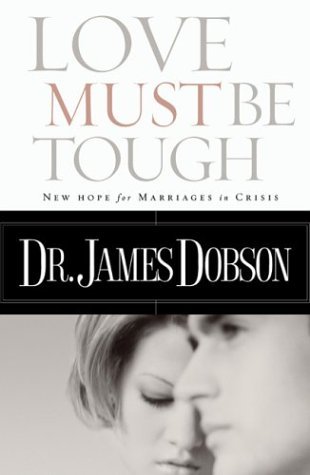
Love must be tough

James C. Dobson, Love Must Be Tough: New Hope for Families in Crisis (1983; repr., Tyndale Momentum, 2007), hardback, 238 pages.

Dr. James Dobson (1936-) is a well known and established licensed psychologist (Ph.D., University of Southern California), who has addressed social and family issues from an evangelical perspective for about 40 years. He held a teaching post at USC’s School of Medicine as Associate Clinical Professor of Pediatrics and was on staff at the Children’s Hospital in Los Angeles for many years. And he served on a number government advisory panels and testified at several government hearings.[1]

Dr. Dobson is perhaps known more for the ministry network Focus on the Family he founded in 1977 through which he has provided a steady evangelical voice with regards to social issues on radio, television, print, and online. Since 2010, however, Dr. Dobson formally transitioned away from Focus on the Family and established another multi-media ministry venture, Dr. James Dobson’s Family Talk.

Love Must Be Tough to Save Families

The book under review, Love Must be Tough, is not a new contribution. Dr. Dobson wrote it in 1983 and because of its popularity, it is often reprinted. I read this book as part of a family ministry class. I found it to be an insightful and highly useful volume designed to provide a strategic proposal to help restore marriages struggling under the burden and crisis of marital infidelity. Dr. Dobson argues that his strategy strikes at the heart of the recovery from marital infidelity better than those provided by the then-current advice by counselors and literature.

What appears to be at the heart of the problem lies at a spouse’s passivity and allowance for the other spouse to have all the control in the relationship. This imbalance is subversive to the marriage. Dr. Nancy M. Rockstroh, M.D., who often recommends Love Must be Tough agrees:

when the balance of power switches so that one person has undue control, the potential for abuse of that power becomes imminent. Once individuals have the opportunity to do anything with the tacit acceptance of their partner, they have carte blanche to engage in destructive patterns of behavior without fear of losing the benefits of the relationship.[2]

Nancy Moultrie Rockstroh, “Love Must Be Tough: Proven Hope for Families in Crisis,” Primary Care Companion to the Journal of Clinical Psychiatry (2000)

It is not just theories or bad counseling which Dobson believes to be destructive and subversive to marital restoration. Marriage culture also is to blame, in particular, those which are so co-dependent that there is a loss of self-respect and the mutual respect which should exist within a marriage. Or, as Dobson argues, what marriages in crisis really need is the application of a simple principle: love must be tough.

Book Overview

Dr. Dobson develops his thesis by first showcasing the destructive nature of common approaches advised for reclaiming an unfaithful spouse. But, perhaps most instructive is the fact that he shares real experiences of infidelity and how the wounded spouse attempts to restore the marriage. According to Dobson, counselors tend to advise self-loathing, fault assuming, affair indulgent, and spiritually careless strategies. But even still further, wounded spouses often attempt to regain their unfaithful spouse through strategies (planned or not) that can be summed in the phrase: a complete lack of self-respect and identity (Panic, appeasement, etc).

This behavior must be stopped. Dobson argues strongly that this lack of self-respect and identity is a leading contributor for both the circumstances for a spouse to become unfaithful and for the pushing away of a cheating spouse. Dobson explains this character “defect” can be permissive as it “allows” flirtation with a potential lover, or it passively “allows” the spouse to continue dangerous relationships with a would-be lover. And once suspicion (or infidelity) occurs, the concerned spouse begins to tighten their grasp upon their beloved in order to keep them, but this often times pushes them farther away. The distrusted spouse feels caged and develops a need to escape. The spouse needs freedom. To further aggravate the situation, the worried partner who cannot feel complete without their spouse loses their individual identity and panics only to try to appease their unfaithful spouse. This behavior feels more like constrictions around the unfaithful spouse’s neck, and continue to fuel the desire for freedom (extramarital freedom).

Case upon actual case is rehearsed as testimonial evidence to support Dobson’s thesis that love must be tough. Consequently, if Dobson is right that popular counseling has it wrong in its strategic opinions, and that a consistent lack of self-respect and identity provide the stimulus for infidelity, then a new approach must be considered. Dobson argues therefore that the marriage relationship must include a number of applied principles. Despite the concept of “union” in marriage, each partner must exist with their sense of individuality intact, and each partner must be able to respect themselves. This sets forth the building blocks for a healthy sense of mutual accountability needed in a marriage that will allow it to thrive.

Thus, should signs of a potential extramarital affair begin to loom in the distance, a perceptive spouse can be grounded in their self-respect and identity, provide strong warnings set forth in love, self-respect, freedom, and independence (example: “I love you, but if you continue this course, then I will leave”). Spouses must be able to hold their ground, despite loving their spouse and not wishing them to depart. This “willingness to end a relationship,” says Dr. Rockstroh, “is the very essence of freedom and independence.”[3] Yet, this principle must be, according to Dobson, practiced with caution (see below).

Chapter 12 provides a timeline of eleven benchmarks showing how good marriages end in abandonment, adultery, divorce, and guilt. Side-by-side, the storyline of a husband and wife is unfolded. It shows how emotional starvation experienced by a loving spouse can lead to frustration and depression, only to work the heart into fertile soil for an extramarital affair. Preoccupations, such as work, only blind them of their beloved’s pain and that they too have contributed to this isolation. Eventually, an affair does ensue and is discovered. At this point, Dobson argues, the marriage can still be saved if both partners want to use “tough love” to regain themselves and restore their marriage. In this scenario that Dobson narrates, the cheating spouse leaves and a divorce is finalized. As in many cases which Dobson is aware of, at the end, the love affair turns mundane, the enabling but wounded spouse lives in ignorance of their contribution and the guilt for the children’s situation overshadows their heart.

Here Dobson makes one more appeal to confront misunderstandings that affect marital happiness. He appeals to the fact that culture essentially lies to our young ladies and young men in the aspect of who provides the happiness in the home. For the women, the lie is simple but devastating: “that marriage is a lifelong romantic experience.”[4] Moreover, the husband is entirely responsible for making this a reality; hence, women enter marriage with unrealistic expectations. And when these expectations are not met, it is her husband’s fault. For the men, the lie is relatively clear: “his only responsibility is to provide materially for his family.”[5] The love must be tough principle affirms individual responsibility for one’s happiness, and each spouse must play a role in creating marital happiness.

Of many of the valuable aspects of the book, is Dobson’s honesty that as much as the love must be tough principle is valuable and helpful, it can also be dangerously misapplied. The development of self-respect, individual identity, of creating a culture of freedom, of forgiveness, and many other traits can be so developed to the point where the wounded spouse uses them to destroy the marriage. For example, a person may become so independent that they want nothing to do with their spouse. Another spouse might defend their self-respect to the point where they become so outspoken that there is no mutual accountability. Dobson, therefore, warns against running wild with this strategy.

A Critique on Dobson’s Divorce and Remarriage View

There is no debate that Dr. Dobson’s book is valuable; however, his discussion on divorce and remarriage is perhaps the most egregious section in an otherwise well-developed book.[6] To Dobson’s credit, he inserts a disclaimer that he knows some Bible students will disagree with him. I register here as one who finds Dobson’s discussion of what constitutes a scriptural divorce and remarriage completely lacking biblical support.

Dobson affirms three matters to keep in mind in the discussion of divorce and remarriage. We agree with his discussion on what constitutes adultery in Matthew 19:9 so we will focus on the second passage discussed.

First, Dobson alleges that 2 Corinthians 5:17 sanctions the notion that it “includes divorce prior to salvation,” leading him to conclude:

when the marriage and divorce occurred prior to salvation, I believe God grants His “new creation” the freedom to remarry.[7]

James Dobson, Love Must Be Tough: New Hope for Families in Crisis (1983)

Dobson’s view hinges upon a phrase in this passage, namely “old things.” “Old things” as part of the “new creature” is typological imagery that supports the real emphasis of the verse, namely, that of a new creation. The personnot his/her marital situation– is made “new.” Paul had said previously to the Corinthian church that some of them had been adulterers (1 Cor 6:9-10) but not anymore because of their conversion (1 Cor 6:11). They changed their behavior. Conversion requires a change in behavior (Acts 2:38), it is not a simply a status change.

The third discussion Dobson enters is based upon a misrepresentation of 1 Corinthian 7:25-40. Dobson alleges that if a Christian is abandoned the believer has a right to remarry. Maybe there are other circumstances involved in the abandonment (i.e., adultery), but that is not discussed in this passage. Paul, however, argues that the abandoned spouse is not under an obligation -enslaved- to follow the departing spouse. The emphasis here is about fidelity to God’s sexual and marital laws (cf. 7:1ff). In fact, earlier in the passage Paul addresses “the married” and the potential of a legal separation,[8] to which he clearly gives two options: remain separated or be reconciled (1 Cor 7:10-11).

These are significant drawbacks from an otherwise really helpful book. I further understand that many would disagree with my critique of Dobson’s view. Still, neither conversion nor mere abandonment is biblical grounds for divorce and a subsequent remarriage.

Concluding Thoughts

In the final analysis, the book is generally sound and very helpful. But, because of the material on divorce and remarriage, I would recommend an alternative to sharing its articulation Dobson’s love must be tough strategy. Perhaps create a series of handouts (with due credit) with the strategies listed and illustrated. Or, recommendations to people well versed in the scriptural teachings on marriage, divorce, and remarriage. The material on self-worth and boundaries is the relevant and helpful element of Dobson’s work.

Dobson tackles a hard issue but the counsel he offers is advantageous. It is dated somewhat. For that reason, I would use Love Must Be Tough as a supplemental work to the more current volume by Henry Cloud and John Townsend, Boundaries in Marriage.[9] “Boundaries,” as Cloud and Townsend articulate, help to develop the issues Dobson is concerned with: a healthy sense of identity, personal responsibility, and mutual accountability. So, in the end, I offer a limited recommendation of Dobson’s book for the counselor and minister.

Endnotes

  1. James Dobson,” Wikipedia.org.
  2. Nancy Moultrie Rockstroh, “Love Must Be Tough: Proven Hope for Families in Crisis,” Primary Care Companion to the Journal of Clinical Psychiatry 2.6 (Dec. 2000): 229.
  3. Rockstroh, “Love Must Be Tough.”
  4. James Dobson, Love Must Be Tough: New Hope for Families in Crisis (1983; repr., Waco, TX: Word, 1996), 176.
  5. Dobson, Love Must Be Tough, 176.
  6. Dobson, Love Must Be Tough, 129-33.
  7. Dobson, Love Must Be Tough, 130.
  8. It is documented by R. L. Roberts, Jr., very clearly that the passive phrase “to be separated” (Grk. choristhenai) in these verses is a “technical expression for divorce” as it exists in ancient legal documents before and during the apostolic era (“The Meaning of Chorizo and Douloo in 1 Corinthians 7:10-17,″ Restoration Quarterly 8.3 [1965]: 179-80). Consequently, those that only see a “separation” as we commonly conceive of it as temporary “space” between spouses are unreasonably limiting the meaning of this word here.
  9. Henry Cloud and John Townsend, Boundaries in Marriage (Grand Rapids, MI: Zondervan, 1999).

Purge the Evil Person: A Brief Analysis of 1 Corinthians 5:1-13

One of the most difficult public displays of Christian obedience to God is the withdrawal of fellowship from a recalcitrant Christian. It is perhaps one of the most dynamic of commands to follow in the New Testament. Before reaching such a public excision, the Lord Jesus addressed the problem of confronting a wayward brother with the view to “gain” him (Matt 18:15-17).

Preliminary Thoughts

The Lord sets forth a four-pronged redemptive procedure that begins under the most private of circumstances – “you and him alone” (18:15); in this setting, then, a private appeal to repent is offered. If the rebellious child of God maintains their posture, then the circle of brotherly concern widens to “one or two others” that come to witness the call to repentance (18:16).

Unfortunately, even at this point, some are so entrenched in sin, that they will not hear the admonitions; consequently, the Lord says, “if he refuses to listen to them, tell it to the church” (18:17). The publication of the situation allows the church as a whole to make an appeal to their fellow saint. All the “ties that bind” are summoned to invite this wayward soul to repent.

The Lord acknowledges that some will not be gained back to the fold by these loving and redemptive attempts, and sets forth the final process – consider the rebellious Christian as both an outsider of the blessings of the Christian covenant and a traitor who has chosen to serve Satan instead of Christ. In other words, the congregation must “disassociate the offender from the church fellowship.”[1] The saved has now become the lost – how ironically tragic.

A Flagrant Issue

The New Testament has several examples of discipline; most usually they are of a very flagrant issue. For example, in 3 John 9-10 the apostle of love forewarns his audience that he will bring discipline upon Diotrephes the “missions” killer. Or, when Paul abbreviates his role in the discipline of Hymenaeus and Alexander (“delivered them to Satan”), who made shipwreck of their faith (1 Tim 1:19-20).

However, in 1 Corinthians 5:1-13, Paul deals with an outlandish mode of porneia that is not even “tolerated” among the pagans (5:1 ESV). Porneia is the Greek word that is commonly translated “fornication” in older translations, and in newer translations as “sexual immorality.”

The truth of the matter is, porneia is a generic term for “illicit sexual intercourse.”[2] It is an umbrella term, and context must determine the type of sexual act that is under consideration. The flagrant form of porneia Paul addresses in 1 Corinthians 5:1 is this, “a [Christian] man has his father’s wife” (i.e. his stepmother). The severity of this behavior is evident by the fact that Paul appeals to the fact that Gentiles – or pagans – do not even permit such behavior.

This context provides the most insightful New Testament example of withdrawing Christian fellowship from recalcitrant saints. And as careful Bible students, we must definitely rehearse the valuable instruction of these verses.

The Duel Rebuke

Paul moves from the case of the man with his stepmother and draws attention to the congregation’s part in this flagrant relationship. The church had been “arrogant” and not “mournful” about the sinful relationship (5:2) and argues immediately that removal of the Christian was the appropriate reaction. The church at Corinth was laden with arrogance (4:6, 18-19), and here Paul rebukes them for this dispositional flaw that was affecting their decision-making process on this matter.

Paul demonstrates that not only is the rebellious person accountable to God, but that the church too cannot subscribe to a lax posture about known – public – sin in the church. The church is responsible and accountable to respond to a situation where a saint’s sin has become public knowledge. The apostle prescribes that the congregation should respond with a period of “mourning” and move into “disciplinarian action.” This is the divine reaction to sins of a public and flagrant nature (1 Cor 14:37).

The Judgment

With the next flip of his pen, Paul moves into position to make the judgment Corinth should have – he places judgment upon the Christian and the sexually immoral relationship with his un-Christian stepmother (5:3-5). There is no clear statement regarding the woman in view, aside from the fact that she is the wife of his father.[3]

However, since the judgment is upon the Christian man, “it seems safe to assume that she is not a Christian.”[4] Paul writes:

When you are assembled in the name of the Lord Jesus and my spirit is present, with the power of our Lord Jesus, you are to deliver this man to Satan for the destruction of the flesh, so that his spirit may be saved in the day of the Lord. (1 Cor 5:4-5 ESV)

The context for such a procedure is the public assembly of the church. This recalls the instruction of Jesus regarding the procedures to discipline another for sin (Matt 18:15-17), the last two of which are set in a public context. Paul assesses that this situation is a public matter; and consequently, the licentious Christian must be disciplined immediately by the church in the public eye. The goal of this withdrawal is redemptive – “that his spirit may be saved.”[5]

The judgment is upon his sin and behavior, but the goal of the discipline is to restore him – i.e. to regain him (Matt 18:15). In Hebrews 12:12-13, the author demonstrates that discipline is a privilege of sonship (12:5-8) and that the purpose is so “that the lame may not be put out of joint but rather be healed” (12:13).

Discipline is not designed to “disable permanently those who have experienced the crippling effects of sin. Rather, His purpose is to heal and restore the repentant to spiritual usefulness”;[6] in other words, “that we may share his holiness” (Heb 12:10).

The Imagery of Influence and Purity

Corinth was crippling the unfaithful man’s ability to be restored by failing to address his immoral relationship. Paul makes very clear that both the church and the man were in a spiritually precarious position. Paul appeals to the imagery of the Passover, where preparing unleavened bread demanded the need to remove the leaven (yeast) from the lump of dough (5:6-7).

The bread is the congregation, and the leaven (yeast) is the culprit sinner (and his influence) in the church, and Paul speaks very clearly that the bread must be prepared for the Passover feast which is the Christian faith. From this, the apostle suggests that the Christian who is in a sexually immoral relationship with his stepmother must be removed from the congregation. Otherwise, the church would be affected by the “leaven” (influence) of this morally and spiritually rebellious relationship.

But the truth is, they were already being afflicted by his influence, making it necessary for a public withdrawal to maintain the purity of the loaf (i.e. the church). David Williams, in his profitable work, Paul’s Metaphors: Their Context and Character, writes:

Paul had been speaking of the leaven (yeast), every trace of which had to be cleaned out of the house before the Passover was celebrated. On this analogy, he demanded that the Corinthians put their “house” in order by removing from among themselves what he called the “old leaven,” a particularly appalling instance of sexual immorality that the church had condoned (vv. 1-5).[7]

The apostle, then, was addressing what should have been quite obvious; but, because of the Corinthian’s arrogance the real issue (i.e. the issue of purity) was not seen as relevant – how shameful. May we strive to learn then the lesson of Corinth.

The Place of Christian Judgment

Paul later recalls a previous letter, where he instructed them “not to associate with sexually immoral people” (5:9 ESV). But it does not seem that they were even practicing such instruction, evident by the fact that they had allowed this immoral situation a harbor of protection in the bay of misguided church fellowship. Yet, Paul did not even suggest merely sexually immoral people in general. He meant defiant immoral Christians are not to be associated with (5:9-11).

It is very interesting to observe that Paul moves from a specific case of porneia, and ends with formulating a generic principle against Christians practicing immorality in general – poneroi (i.e. evil doers).[8] Verse 11 is very clear that purity focused Christians are not to be involved with Christians who practice evil, and it is transparent where Paul stands on the matter by saying that eating a meal with them is forbidden. Such a withdrawal of Christian fellowship reflects the disfellowshipped Christian’s heavenly reality – estrangement from God (Matt 18:18-20).

Christians have a responsibility to each other before the Lord (Matt 18:15-17). This responsibility is to “judge” each other regarding sin when necessary (1 Cor 5:12). To support his case, Paul appeals back to a formula common in Deuteronomy that highlights the need to judge insiders rather than outsiders of the covenant (17:7, 19:19, 21:21, 22:21, 24, 24:7),[9] and affirms: “God judges those outside. ‘Purge the evil person from among you’” (5:13).[10]

The Aftermath: Mission Accomplished

What ever became of this gentleman and his situation after being withdrawn from? The answer depends upon the view taken as to how many letters Paul wrote to the Corinthians. It is true that Paul mentions a previous letter written to them prior to 1 Corinthians (1 Cor 5:9), but did he write a third letter that would chronologically fit between 1 and 2 Corinthians (2 Cor 2:3-4; 7:8)?[11]

Without delving into this academic discussion, we set forth our assessment of the discussion. Essentially, we assume for the time being that Paul wrote three letters: (1) A lost letter prior to 1 Corinthians (5:9); (2) 1 Corinthians known as the “sorrowful letter” or “severe letter” (2 Cor 2:3-4; 7:8); and (3) 2 Corinthians.

Chronologically placing 1 and 2 Corinthians together contributes greatly in answering our question. In 2 Corinthians 2:6-11, Paul speaks of the reward of making the Corinthians sorrowful, and a certain punishment rendered by the majority of the congregation upon a certain individual. The connection is drawn that the man in 1 Corinthians 5 is the same as the gentleman made sorrowful in 2 Corinthians 2.

This man was sufficiently disciplined (2:6), and now the congregation’s responsibility was three-fold (2:7-8):

(1) “forgive him”

(2) “comfort him”

(3) “reaffirm brotherly love.”

There will a great deal of Divine judgment upon those that do not respond in this fashion to a penitent brother or sister, for this is a great test of Christian obedience (2 Cor 2:9-10; Matt 6:14-16).

To the apostle, it appears that the matter of restoration of fellowship is just as important as the withdrawal of fellowship; the reason being, Satan is prepared to take advantage of our shortcomings at these pivotal moments (2:11). Would it not be appropriate to make the restoration announcement just as public as the withdrawal process was? It would definitely seem so (Philem 10-21).[12]

Conclusion

It seems important to stress, therefore, that the same amount of effort it took in the discipline process should follow in the restoration process. There is to be no more invisible line of fellowship between the restored and the brethren, for that is over and the saint has returned. Neither should a “we’ll see” attitude embody the brotherhood, but a loving reception – a mirror of heaven – is expected by Paul.

This is the victory of faith, the power of the blood of Christ, and the faithfulness of God. This is a great test of Christian faithfulness. May we be ever minded to discipline when needed and repair the splintered connections of fellowship after restoration. May we likewise be faithful to receive those who have been restored.

Sources

  1. J. Carl Laney, “The Biblical Practice of Church Discipline,” BSac 143 (1986): 361.
  2. William E. Vine, et al, Vine’s Complete Expository Dictionary of Old and New Testament Words (Nashville, TN: Nelson, 1984), 2:252; Joseph H. Thayer, Thayer’s Greek-English Lexicon of the New Testament (1896; repr., Peabody, MA: Hendrickson, 1999), 532.
  3. The phrase reads: hoste gunaika tina tou patros echein. Simon J. Kistemaker observes that “in Jewish circles, the wording wife of his father meant ‘stepmother,'” and observes that God repeatedly told the Israelites to refrain from sexual relationships with their father’s wife (Lev 18:8, 20:11; Deut 22:30, 27:20). “‘Deliver This Man to Satan’ (1 Cor 5:5): A Case Study in Church Discipline,” Master’s Seminary Journal 3.1 (1992): 35.
  4. Tommy South, That We May Share His Holiness: A Fresh Approach to Church Discipline (Abilene, TX: Bible Guides, 1997), 87. Read my book review regarding South’s excellent but brief volume.
  5. Some view the expulsion here as permanent, and redemption only to be found at the end of time (Harris 146-48); however, such a conclusion runs counter to the instruction of Jesus on discipline (Matt 18:15-17), to Paul’s use of similar language in disciplining and restoring false teachers (1 Tim 1:20), and the general tenor of the New Testament regarding cleansing of sin in the Christian’s life (1 John 1:6-2:3). Gerald Harris, “The Beginnings of Church Discipline: 1 Corinthians 5,” Understanding Paul’s Ethics: Twentieth-Century Approaches, ed. Brian S. Rosner (Grand Rapids: Eerdmans, 1995), 129-51. Cf. Wayne Jackson’s article on the forgiveness available to Christians in sinful lifestyles is quite compelling: repentance, confession, prayer, and the cleansing blood of the faithful Christ. “God’s Plan of Salvation for His Lost Children,” ChristianCourier.com (Accessed: 7 July 2004).
  6. Laney, “Biblical Practice of Church Discipline,” 355-56.
  7. David J. Williams, Paul’s Metaphors: Their Context and Character (1999; repr., Peabody, MA: Hendrickson, 2004), 248.
  8. Peter S. Zaas, “‘Cast out the Evil Man from You Midst'” (1 Cor 5:13b),” JBL 103.2 (1984): 259.
  9. Zaas points out that aside from a minor adjustment by Paul, the Greek phrase is parallel with the LXX (i.e. Septuagint) formulations in Deuteronomy (“‘Cast out the Evil Man from You Midst,'” 259).
  10. Richard B. Hays has a brief discussion on this passage in his work, Echoes of Scripture in the Letters of Paul (New Haven, CT: Yale University Press, 1989). For Hays, Paul showed, if not in retrospect, that the Corinthians are part of the same covenant tradition as Ancient Israel. As such, the use of this formulae to expel the fornicator would have implicitly emphasized this relationship and demanded the logical obedience the congregation is to display in the removal of the sexually immoral brother from the congregation. In this action, they show themselves to be Israel – not figurative, but real Israel. Whether or not the Corinthians completely understood Paul’s use of this excommunication formulae Hays cannot prove, but he does respond to this point: “In this instance, [the] direct quotation becomes an allusive trope: only the reader who recognizes the source of the words will grasp the bold theological proposal implied by Paul’s metaphorical act of addressing Corinthian Gentiles as children of the covenant” (97).
  11. Daniel B. Wallace, “2 Corinthians: Introduction, Argument, and Outline,” Bible.org. For those interested in this issue, Wallace’s discussion will be of help on some of the complexities of this issue.
  12. James Pilgrim, Withdrawing from the Disorderly (West Monroe, LA: Central Printers, n.d.). I agree with Pilgrim’s observation that, “To fail to forgive and receive the returning brother is as wicked as not marking him in the beginning (2 Cor 2:11)” (17).

Bibliography

Harris, Gerald Harris. “The Beginnings of Church Discipline: 1 Corinthians 5.” Pages 129-51 in Understanding Paul’s Ethics: Twentieth-Century Approaches. Edited by Brian S. Rosner. Grand Rapids: Eerdmans, 1995.

Hays, Richard B. Echoes of Scripture in the Letters of Paul. New Haven, CT: Yale University, 1989.

Jackson, Wayne. “Church Discipline – A Tragic Neglect,.” ChristianCourier.com(Accessed: 8 June 2000).

Jackson, Wayne. “God’s Plan of Salvation for His Lost Children.” ChristianCourier.com.

Kistemaker, Simon J. “‘Deliver This Man to Satan’ (1 Cor 5:5): A Case Study in Church Discipline.” Master’s Seminary Journal 3.1 (1992): 32-46.

Laney, J. Carl. “The Biblical Practice of Church Discipline.” BSac 143.572 (Oct.-Dec. 1986): 353-63.

Pilgrim, James. Withdrawing from the Disorderly. West Monroe, LA: Central Printers, n.d.

South, Tommy. That We May Share His Holiness: A Fresh Approach to Church Discipline. Abilene, TX: Bible Guides, 1997.Joseph H. Thayer,

Thayer, Joseph H. Thayer’s Greek-English Lexicon of the New Testament1896. Repr. Peabody, MA: Hendrickson, 1999.

Vine, William E. Vine, Merrill F. Unger, and William White, Jr. Vine’s Complete Expository Dictionary of Old and New Testament Words. Nashville, TN: Nelson, 1984.

Wallace, Daniel B. “2 Corinthians: Introduction, Argument, and Outline.” Bible.org.

Williams, David J. Paul’s Metaphors: Their Context and Character. 1999. Repr. Peabody, MA: Hendrickson, 2004.

Zaas, Peter S. “‘Cast out the Evil Man from You Midst'” (1 Cor 5:13b).” JBL 103.2 (1984): 259.