
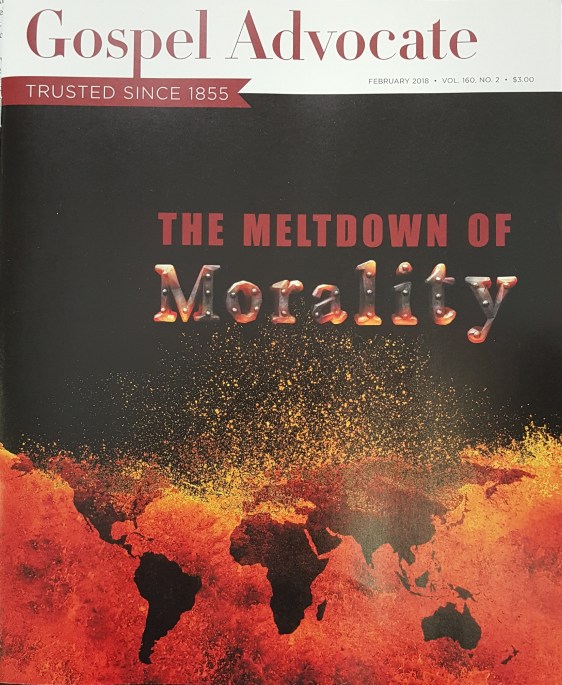
Reprinted with permission from the February 2018 issue of Gospel Advocate Magazine.
Hebrews affirms, “For the word of God is living and active, sharper than any two-edged sword, piercing to the division of soul and of spirit, of joints and of marrow, and discerning the thoughts and intentions of the heart” (4:12 ESV). This is part of a warning in Hebrews, which affirms that Christians who defect from God will fail to meet their rest as their Israelite counterparts did (vv. 1-11). God holds his people —and His creation— accountable by His presence (“sight”) in the word of God (Hebrews 4:13). This is a raw incontrovertible truth.
This passage makes no caveats; it makes no attempt to remedy a distinction between God’s word and God’s presence. They are both manifested at the same time. God is involved with real life (time and space) with Israel and with Christians. God makes promises and keeps his word regarding their “rest,” and God holds His people and creation accountable to His word. God is Lord of heaven and earth and everything in between, and He holds it together by the power residing in Jesus (Hebrews 1:3; Colossians 1:17). The word of God is connected not only to the authority of God but also to His nature and how He reveals Himself to the world.
Let me say the above in a differently. Our God, who is beyond time and space (God’s transcendence), enters our earthly “realm” bound by time and space (God’s immanence) with His divinity and authority (sovereignty) intact; furthermore, God enters into relationship with His creation (Abraham, Israel, Christians) by revealing Himself in creation and in His word. God is active both in creation and in His word. Creation reveals God’s existence and hints at elements of His attributes (natural theology), but it is His word that reveals God and His “will” so that humanity can enter into covenant with God. The word of God was both proclaimed orally through particular spokesmen (patriarchs, prophets, kings, apostles), but the prophetic word was not only through oracles but also in written communiqués embedded with the same divine authority (2 Peter 1:16–21). These writings reveal the mind of God (1 Corinthians 2:11–16), His purposes and mystery (Ephesians 3:1–6), His involvement in human events (Acts 17:26–27), and the righteousness by which He will bring justice to the world (Acts 17:30–31).
To say it bluntly, the Bible is the word of God set in a permanent written form. Paul declared, “all scripture is breathed out by God” (2 Timothy 3:16). The Scripture bears the character of God and is no “dead” codebook, for it transforms every “man of God” into a competent, equipped servant (2 Timothy 3:17). The profitability of all Scripture is due to its quality as “God’s breath.” There is no pecking order between the spoken or written word of God. The inspired written word is as inerrant as God’s character. There is no source outside of the Holy Spirit-given Scripture that speaks God’s transforming work since it is the depository of the gospel’s message. What the word of God promises, God will do; what God proclaims, God’s holds His creation accountable to (1 Thessalonians 2:13).
The above may seem to belabor the point, but as anticipated by the title of this piece, we will sketch how the word of God is handled among Liberal (Modern) and Neoorthodox influences. It is essential for the church to reflect on these twentieth-century influences because dialogue is healthy, truth has nothing from which to hide, and any redefinition of biblical Christianity must be given due consideration (Galatians 1:6-7).
The following historical sketches will probably not satisfy everyone, but they will be enough to see their direction and how they redefine significant elements of historic Christian beliefs and their tendency to subvert scriptural authority.
Liberalism/Modernism
The word “liberal” is a very loaded word. It is often used with contempt to show disapproval of someone else thought to be progressive (instrumental music, expanded role of women, etc.). But this is not the historic sense of the word. Liberalism emerged in the late nineteenth century through the interplay of many players, thinkers, and philosophical trends. The influence of Liberalism, or Modernism, is seen in three levels: (1) revelation is not the final answer to reality, (2) naturalism is the key to reality and religion, and (3) since the Christian documents are built on ancient myths and superstitions, the historic supernatural claims of Christianity is immaterial. To be a “Christian” is a matter of experience and the “essence” of its teaching.
Liberalism, as an intellectual revolution, is a child of the Age of Reason (the Enlightenment). The “Age” saw the elevation of human reason over the institutional “church,” which wielded divine revelation. It was “the church” that dictated to the people what to believe about reality. Divine revelation was the final answer to determining truth and what really happened in the past. This was displaced with rationalism, scientific history (criticism), and naturalism as final answers to genuine and authentic history and truth. In essence, as Stanley Grenz and Roger Olsen point out, the maxim “I believe in order that I may understand” was turned to “I believe what I can understand.”[1] Faith was overturned by a reason informed by modern findings — thus, this point of view is called “Modernism.”
Everything that was received as genuine knowledge, now, was shaped by the natural world. This was further supported by what is called “the principle of analogy,” popularized by the liberal theologian Ernst Troelsch (1865–1923), which argued that the present is the best way to understand the past. The consequence was detrimental in the extreme on the trustworthiness of Scripture. The supernatural elements interwoven in Scripture are, by definition, myths and superstitions. This meant that there are no miracles, no supernatural interventions by God, and no resurrection of Jesus Christ. Thus, many new schools of “criticism” emerged to study Scripture with mixed results.
This naturally led to an embrace of “the essence of Christianity” so long as reason and experience allowed. “Liberals” are open to the modern findings from the natural world, open to a religious humanism and science —in particularly embracing Darwinian evolution as the process by which God created. If God exists, He could only be revealed through religious “experience.” It was also immaterial if the events of Scripture happened or not because religion is a condition of the heart. Yet, the apostle Paul makes it abundantly clear that if the resurrection event has not occurred, both our preaching and faith are in vain and we are still in our sins (1 Corinthians 15:14, 17).
Another arm of Liberalism is the demythologizing of the New Testament pioneered by the “Form Critic” Rudolf Bultmann (1884–1976). Bultmann argued that historic person of Jesus is built on untrustworthy sources. The New Testament is Christian propaganda shrouded in the imagery of the Greek myths and Roman legends. As such, they are not relevant for faith nor spiritual truth claims. It is the symbolism that matters. Today, one only need to watch the latest “history” programming to find modern theological liberals interviewed. Theological liberalism has significant questions that need to be answered, but it brings Christianity to a logical dead end.
Neoorthodoxy
The Swiss theologian Karl Barth (1886–1968) ignited a movement when he published his commentary on Romans in 1919. It charted a new theological direction away from Liberalism/Modernism. Barth (pronounced “bart”) was not fond of the misnomer “neoorthodoxy,” but his strand of thinking regarding the meaning of “revelation” and “the word of God” would rival the prevailing traditional belief held historically by the church. As a consequence, many regard Barth as one of the great theologians and the father of modern theology.
Orthodoxy affirms the teaching of historic Christian truth based on Scripture. This includes, for example, the following concepts: the inerrant inspiration of scripture, the triune Godhead, the deity and virgin birth of Christ, the historic creation and fall of humanity, the bodily resurrection and ascension of Christ, the return and final judgment. Barth argued, on the other hand, that “revealed truth” was not written, but was the outcome of an encounter (an experience) with God. Thus, instead of scripture as being the objective word of God, Barth argued for a subjective experience with God initiated by reading the Bible.
Barth was offering a completely different course of thought altogether. “Revelation” does not appear in the form of propositional truths. Arguing book, chapter, verse, or appeals to the very words of scripture is insufficient to reveal God. Revelation (the word of God), it is argued, is an “event” in which God acts in history (God’s immanence). Barth even argued that revelation is not found in natural theology (Acts 17; Psalm 19; Romans 1) but, instead, in events like the call of Abraham, the exodus, and the resurrection. Millard Erickson is spot on when he classifies Neoorthodoxy as an illumination theory divorced from an objective standard.[2]
Although Neoorthodoxy is not a unified movement, there are three interconnected witnesses (modes/forms) that shape its view on revelation.[3] First, Jesus is the word of God in the truest sense, for He reveals God in the event of His incarnation, life, ministry, death and resurrection. This is true revelation, the very gospel. Second, Scripture points to Jesus but it is a flawed human (read “errant”) attempt to provide a witness to divine revelation. It is instrumentally God’s word but not properly. Third, the proclamation within the faith community —Barth preferred “community” to church— is likewise instrumentally God’s word. The Bible, then, only becomes God’s word when God uses it to reveal Jesus Christ in the encounter, contrary to 2 Timothy 3:16.
In fact, Neo-orthodoxy is quite a popular approach to handling the Word of God, even among churches of Christ. A popular theological branch of this movement is “Canonical Criticism,” popularized by the late American scholar Brevard Childs (1923–2007). It seeks to broadly bypass much of the liberal destructive criticism of the twentieth century by accepting the texts of Scripture as literary units. Nevertheless, this point of view struggles, as did Barth’s, to embrace the Bible as a very human (errant) book while appealing to its authority for theological thought as if they were inerrant. They seek, in the words of one sympathetic Abilene Christian University professor, to “articulate a doctrine of Scripture that recognizes human flaws in it.”[4] Treating the Bible as an inerrant text is simply a form of bibliolatry.
Keeping the Faith
Today, the phrase “Word of God” means different things to different believers, and that includes preachers. Liberalism ultimately rejects a supernatural Christian faith, and is at home with amputating its historic claims of a resurrected ascended Lord Jesus, in exchange for a subjective diluted Christianity. Neoorthodoxy, on the other hand, embraces a supernatural Christian faith, but it rejects the supernatural origin, inerrancy, and authority of the Scriptures which undergird its claims. The Word of God has always been a manifestation of God’s presence in our lives, in His proclamation, and in His Scripture without pecking order. Let us join Paul who declares, “Let God be true though every one were a liar” (Romans 3:4).
Notes
- Stanley J. Grenz and Roger E. Olsen, 20th Century Theology (Downers Grove: InterVarsity, 1992), 17.
- Millard J. Erickson, Christian Theology, 3rd ed. (Grand Rapids, Baker Academic, 2013), 220–21.
- Karl Barth, Evangelical Theology: An Introduction, trans. G. Foley (New York: Holt, 1963), 26–36.
- Christopher Hutson, “Scripture as the Human Word of God: Why Faith Contradicts Inerrancy,” Lexington Theological Quarterly 44.1 (2011): 210–21. Hutson serves as a professor of ministry and missions at Abilene Christian University.
To subscribe to Gospel Advocate, click here.

 biblicalfaith.online