The Code of Hammurabi and the Law of Moses: A Selected Comparative Look

[Note: This was a comparative historical paper for a history course exploring ancient societies. It forced me to examine ancient literature–even the Bible–as a historical source. ]

If one were to think of the most significant influences in lawmaking one who be hard-pressed to consider two greater and oldest than that the Code of Hammurabi and the Law of Moses. Even today, hanging above the gallery doors of the House Chamber in Washington, D.C., are twenty-three marble relief portraits of all those whose works have influenced the establishment of the principles of American law.

Among them are King Hammurabi and the prophet Moses (“About Relief Portrait” in SNT 36). Hammurabi’s Law ( or “Code”) is available today due to a monument relief and extant manuscript evidence (Roth 336). The Law of Moses has been preserved in the biblical manuscripts used for both the Hebrew and Christian Bibles.

In this paper, I focus on four touching points between the “Code of Hammurabi” (Roth) and the Law of Moses (Exod 19:3–24:8) by examining their similarities and suggesting some differences. These touching points are their sources of authority and their significance, the relationship between Moses and his people with the relationship between Hammurabi and his people, the position(s) of women in both societies as revealed by the laws, and what both sources of the law reveal about their two societies.

While this is not an exhaustive evaluation, it is an attempt to understand from these literary sources insights helpful toward a historical understanding of ancient Mesopotamia and ancient Israel. The most fundamental conclusion from this comparison and contrast may be that despite the similar concerns for establishing order in their respective societies, the differences demonstrate the unique trajectories of each society’s beliefs, expectations, and social concerns.

Sources of Authority

The first touching point is their source(s) of authority and their significance. There are points of comparison between the Code of Hammurabi and the Law of Moses when it comes to their sources of authority; however, there are significant contrasts that highlight the unique trajectory of each set of laws.

On the one hand, the preamble of the Code of Hammurabi and the beginning chapters leading to the specific Laws of Moses share a similar concern with establishing the view that each law has a divine source. Lockard points to a black basalt stone in the temple of Marduk (Babylon’s patron god) which pictures Hammurabi “receiving” kingship from Shamash (sun-god and lawgiver), and this provides the divine authority for the king to enforce his code of 282 laws upon his people (SNT 37). The preamble of the Code of Hammurabi likewise enlists this motif of the kings being “called” by name to bring justice and protection for the weak a reality. The laws of Moses, very similarly, presume the call of Moses for the Hebrews to be a “treasured possession” of the “Lord God” as a “kingdom of priests and a holy nation” (Exod 19:5–6).

The very connection between man and the divine realm supports the shared worldview of theism and the order and accountability that follows from that view. Accordingly, then, such a relationship would make Hammurabi and Moses mediators of such divinely given laws rather than their chief architects.

On the other hand, the divine sources of authority are significantly distinct in their presumption of polytheism and monotheism. The first words in the “Code of Hammurabi” are, “When the exalted Anum king of the Annunaki.” Anum is the “sky god of the old Babylonian pantheon” of which the Annunaki were the “lesser Babylonian gods of heaven who served Enlil.” This demonstrates the full placement of the polytheistic belief system of Hammurabi and the Babylonian world (Roth 335). For example, Roth’s translation reads,

“When the august god Anu, king of the Anunnaku deities” (335). 

The preamble affirms that both gods Anum and Enlil gave all power to the god Marduk (son of Ea) and elevated him above the “Igigu deities.” It is this pantheon, as it were, of Babylonian and Mesopotamian gods that form the authoritative source for the call of Hammurabi as mediator of his law. The inclusion of these unifying acts in the heavens would create a significant plea for unity under this law on earth.

Yet, Moses and the laws in the Exodus record are based on a monotheistic view and this is significant since it ties in with their heritage. The Hebrews are believed to be descendants of a man named Abraham who departed from the Mesopotamian city of Ur (Gen. 12–13) and abandoned polytheism and idolatry. The Laws of Moses reaffirm this belief system, for example, in Exodus:

“You shall have no other gods besides me” (20:3 NJPS)

“With Me, therefore, you shall not make any gods of silver, nor shall you make for yourselves any gods of gold” (20:23 NJPS).

The monotheistic tone set at the beginning and throughout connects the Hebrews to their heritage, the sense that the God of Abraham has overthrown the gods of Egypt, and will be their only “LORD God” even in the future in polytheistic lands (Exod 23:23–24 ESV). This law will be their guide and source of unity in such conflicting environments.

Relationship with the Governed

The second touching point is the relationship between Moses and his people with the relationship between Hammurabi and his people. On the one hand, Moses is described as a servant rather than a prince. Moses dialogues with the “LORD God,” and then is said to communicate the conclusion of that dialogue to the people. As briefly noted above, Moses was called by the Lord God; however, the Exodus narrative describes Moses as one who does not always have the trust of the people. Nevertheless, it is the exodus (mass migration) out of Egypt and the procession toward the mountain of the “LORD God” that establishes the relationship for which he is known most, the servant of the “Lord God,” mediator, and law-giver (Exod. 19; 20:19-21). It is through Moses that the Hebrews agree in the community to the Laws of the Lord (Exod. 24:3). Moses does not appear as an architect or prince, but as the mediator chosen by the people and by the Lord God.

On the other hand, Hammurabi’s relationship with his empire is distinct. He comes to the throne, according to Roth, as a descendant of Sumu-abum (c. 1894-1881 B.C.E.) and consequently has an established relationship with the Mesopotamian empire (Roth 335). It is clear from the Code of Hammurabi that the king was involved in the development of the laws:

When the god Marduk commanded me to provide just ways for the people of the land (in order to attain) appropriate behavior, I established truth and justice as the declaration of the land, I enhanced the well-being of the people. (Roth 337)

Lockard describes the significant career of the king as one who stabilized, maintained, and expanded his kingdom. Consequently, Hammurabi’s relationship was far more formal than that of Moses with the Hebrews.

The Status of Women

The third touching point is the position(s) of women in both societies as revealed by the laws. On the one hand, information in the “Code of Hammurabi” demonstrates a considerable need to regulate the treatment and care of women facing a variety of injustices. Lockard holds a similar view (SNT 36). Following Roth’s and Harper’s sectioning of the Laws, sections §131-136 demonstrate considerable regulations on how to treat an accusation of adultery.

§131 If her husband accuses his own wife (of adultery), although she has not been seized lying with another male, she shall swear (to her innocence by) an oath by the god, and return to her house.
§132 If a man’s wife should have a finger pointed against her in accusation involving another male, although she has not been seized lying with another male, she shall submit to the divine River Ordeal for her husband.
§133a If a man should be captured and there are sufficient provisions in his house, his wife […, she will not] enter [another’s house].
§133b If that woman does not keep herself chaste but enters another’s house, they shall charge and convict that woman and cast her into the water.
§134 If a man should be captured and there are not sufficient provisions in his house, his wife may enter another’s house; that woman will not be subject to any penalty.
§135 If a man should be captured and there are not sufficient provisions in his house, before his return his wife enters another’s house and bears children, and afterwards her husband returns and gets back to his city, that woman shall return to her first husband; the children shall inherit from their father.
§136 If a man deserts his city and flees, and after his departure his wife enters another’s house — if that man then should return and seize his wife, because he repudiated his city and fled, the wife of the deserter will not return to her husband. (Roth COS 343)

Apparently, there was such considerable mistreatment that legislation was provided to give the local judges the necessary guidelines to protect mistreated women and children.

Some of the more intriguing laws that deal with the protection of women are in the cases of abandonment and mistreatment (section 138-141).

§138 If a man intends to divorce his first-ranking wife who did not bear him children, he shall give her silver as much as was her bridewealth and restore to her the dowry that she brought from her father’s house, and he shall divorce her. 
§139 If there is no bridewealth, he shall give her 60 shekels of silver as a divorce settlement.
§140 If he is a commoner, he shall give her 20 shekels of silver.
§141 If the wife of a man who is residing in the man’s house should decide to leave, and she appropriates goods, squanders her household possessions, or disparages her husband, they shall charge and convict her; and if her husband should declare his intention to divorce her, then he shall divorce her; neither her travel expenses, nor her divorce settlement, nor anything else shall be given to her. If her husband should declare his intention to not divorce her, then her husband may marry another woman and that (first) woman shall reside in her husband’s house as a slave woman. (Roth COS 343)

It is not that every law was written in the women’s favor because there appears evidence that a woman’s marital conduct can be actionable if abusive to her husband, but they implicitly suggest that these laws were needed in Hammurabi’s empire. Yet, this is only based on literary evidence. Nevertheless, it implies there was a negative treatment of women, so much so that it required legislation.

On the other hand, in Exodus 21:1–23:33 there are several sections addressing varying roles women were found in. Apparently, some fathers sold their daughters as slaves (21:7) but her potential manumission was legislated, as was legitimate marriage to the family’s son (21:7–11).

“When a man sells his daughter as a slave, she shall not go out as the male slaves do. 

If she does not please her master, who has designated her for himself, then he shall let her be redeemed. He shall have no right to sell her to a foreign people, since he has broken faith with her. If he designates her for his son, he shall deal with her as with a daughter. 10 If he takes another wife to himself, he shall not diminish her food, her clothing, or her marital rights. 11 And if he does not do these three things for her, she shall go out for nothing, without payment of money. (ESV)

There were also retributive laws of justice if a pregnant woman was hurt or killed (21:22–32).

22 “When men strive together and hit a pregnant woman, so that her children come out, but there is no harm, the one who hit her shall surely be fined, as the woman’s husband shall impose on him, and he shall pay as the judges determine. 23 But if there is harm, then you shall pay life for life, 24 eye for eye, tooth for tooth, hand for hand, foot for foot, 25 burn for burn, wound for wound, stripe for stripe.26 “When a man strikes the eye of his slave, male or female, and destroys it, he shall let the slave go free because of his eye. 27 If he knocks out the tooth of his slave, male or female, he shall let the slave go free because of his tooth. 28 “When an ox gores a man or a woman to death, the ox shall be stoned, and its flesh shall not be eaten, but the owner of the ox shall not be liable. 29 But if the ox has been accustomed to gore in the past, and its owner has been warned but has not kept it in, and it kills a man or a woman, the ox shall be stoned, and its owner also shall be put to death. 30 If a ransom is imposed on him, then he shall give for the redemption of his life whatever is imposed on him. 31 If it gores a man’s son or daughter, he shall be dealt with according to this same rule. 32 If the ox gores a slave, male or female, the owner shall give to their master thirty shekels of silver, and the ox shall be stoned. (ESV)

Even in the case of consensual premarital sex, the Law legislated that the male “give the bride-price” for her to legitimize the marriage (22:16–17; NJPS 22:15–16). Sociological morés of promiscuity would have rendered the woman vulnerable to social scandal and familial shame.

16 “If a man seduces [or, entices] a virgin who is not betrothed and lies with her, he shall give the bride-price for her and make her his wife. 17 If her father utterly refuses to give her to him, he shall pay money equal to the bride-price for virgins. (ESV)

Widows were to be cared for and never mistreated, and if so the perpetrators would receive the sword so their wives would become widows (22:22–24; NJPS 22:21–23). The language carries a passionate emphasis:

22 You shall not mistreat any widow or fatherless child. 23 If you do mistreat them, and they cry out to me, I will surely hear their cry, 24 and my wrath will burn, and I will kill you with the sword, and your wives shall become widows and your children fatherless. (ESV)

Related to the issue of adultery, there was a clear prohibition against such practices in the Law: “You shall not commit adultery” (Exod 20:14). In contrast to the wide practice of polygamy (but not polyandry) in ancient societies of the Near East, the LORD God established monogamy as the mandated ideal of marriage (Gen 2:24). Consequently, adultery was viewed as a social wrong and a violation against God’s order. There was a concession for divorce and remarriage found in the teachings of Moses (Deut 24:1–4), but it is very restrictive.

Overall, such legislation in Israel was required because there were problems with the mistreatment of widows and slave girls, and also the abuse of rejection or abandonment of women after premarital sex.

If one is careful to read between the lines, Hammurabi and the Exodus Laws seek correctives on matters of injustice and oppression. These may not meet the modern social expectations regarding what are protective laws for women, but it should be noted different social norms and morés are being addressed in the ancient world than those of today.

Impact on the Society

The fourth observation focuses on what both sources of law reveal about these two societies. The earlier society of Hammurabi appears to have considerable social unrest and a sense of injustice in the air. The sorts of laws are of such a micromanagement level that they reflect a tremendous amount of abuse in society at large. The laws do cover more than just social matters, but it cannot be ignored that Hammurabi’s Code was, as he affirms, to:

“make justice to appear in the land, to destroy evil and the wicked that the strong might not oppress the weak.” 

This law reveals that retribution towards evil, the wicked, and oppression was not only viewed as a social necessity but was also a divine ruling. The gods will hold the mortals accountable for their mistreatment of others.

Likewise, in the emerging society of the Hebrews, it was expected that all previous and current expectations of justice and injustice must now be reevaluated from the perspective of the moral and religious expectation of the “LORD God.” One of the premises of the Exodus Law is their liberation from Egyptian slavery and its moral application to how a neighbor treats their neighbor. The case law nature of the Mosaic Law demonstrates this transition, especially in the Ten Commandments proper (Exod 20:1–17). The good standing in the Hebrew community was based upon how one interacted with their neighbor; consequently, it may be inferred from the law section of Exodus that Hebrew society needed much legislation to correct their conduct toward their neighbor: “…you shall love your neighbor as yourself: I am the Lord (Leviticus 19:18 ESV).

Observations

Initially, it may be said that despite the similar concerns for establishing order in their respective societies, the Code of Hammurabi and the Law of Moses demonstrate the unique trajectories of each society’s beliefs, expectations, and social concerns.

This is seen in the following four areas as evaluated above. First, despite sharing a concern with connecting their source(s) of authority with the divine realm (i.e., the gods/God), and thus, making Moses and Hammurabi mediators of a law that centers on moral accountability and justice, they are markedly distinct in their theism.

Second, despite there being a common motif of mediation between the gods/God and the people they led, Moses and Hammurabi held distinct relationships with their people. Moses rose to leadership and was summoned to lead by the people; whereas, Hammurabi ascended to the thorn and had an established and formal regnal relationship with his empire.

Third, although the Hammurabi handout had selected sections on what is available shows that when compared to Exodus Laws, both were concerned with correcting and abolishing, through retributive legislation, the abuse of women in their communities in areas of sexuality, honor, abandonment, and humiliation.

Finally, both sources of law reveal that human societies always deal with matters of injustice and oppression, and these tend to be focused on the mistreatment of vulnerable women and widows. The consequences of such laws demonstrate the rough and violent nature of society and its expectations.

Bibliography

(ESV) English Standard Version of The Holy Bible. Wheaton, IL: Crossway, 2001.

Harper, Robert Francis. The Code of Hammurabi King of Babylon About 2250. 2nd edition. Chicago, IL: University of Chicago, 1904.

(NJPS) TANAKH: The Holy Scriptures, A New Translation of the Holy Scriptures According to the Traditional Hebrew Text. Philadelphia, PA: Jerusalem Publication Society, 1985.

(SNT) Lockard, Craig A. Societies, Networks, and Transitions: A Global History. Volume I: To 1500. 3rd edition. Stamford, CT: Cengage Learning, 2015.

(COS) Roth, Martha. “The Laws of Hammurabi.” In volume 3 of The Context of Scripture: Archival Documents from the Biblical World. Edited by William W. Hallo and K. Lawson Younger, Jr. New York: Brill, 2002.

Of Sheep and Shepherds

Background Bible study is fascinating and is perhaps one of the most important parts of biblical research. Obtaining a “behind-the-scenes” look into the biblical documents will “contribute to a more precise comprehension of the Word of God.”[1] This observation can be said about the shepherd motif found in Scripture. Since it is dangerous to paint half a picture of anyone or anything – especially biblical topics; we stress, then, that this is but a footnote to the beautiful motif of the pastoral profession (i.e. the shepherd) often employed by the biblical authors.

Shepherds in Israel

Shepherding was a great profession in the culture of the Ancient Near East, and so far as it relates to Israel’s history, pastoral work was a constant aspect of nomadic life (cf. Abraham, Isaac, Jacob, etc.). Even when they conquered and settled into Palestine, the end of the nomadic life did not stop pastoral work (e.g. David in 1 Sam 16:19; Amos 1:1, 7:14).[2] The widespread awareness of this profession “made motifs of sheep and shepherding apt descriptions of human and divine roles and relationships.”[3]

Notice one Old Testament example. God through Jeremiah pronounces a “woe” upon the leadership of Judah using the pastoral motif:

“Woe to the shepherds who destroy and scatter the sheep of my pasture!” declares the LORD. Therefore thus says the LORD, the God of Israel, concerning the shepherds who care for my people: ‘You have scattered my flock and have driven them away, and you have not attended to them. Behold, I will attend to you for your evil deeds, declares the LORD.’” (Jer 23:1-2 ESV)

The “shepherds” failed to maintain the pastoral relationship with God’s flock; consequently, the sheep were scattered. Jeremiah, looking to post-exilic times, promises that God will restore the proper care to his flock with faithful shepherds (Jer 23:3-4).

Shepherds in the New Testament

There are several related New Testament words used to the work of shepherding. The noun form is poimein, and refers to a shepherd, herdsmen, or pastor,[4] and hence it is a metaphor describing a guardian-leader. The third translation option probably receives the most attention from among the three, and this is due to its connection with the eldership of the New Testament (Eph 4:11, here teaching-pastors), and its erroneous, but popular, usage in denominational circles.[5]

However, the New Testament uses the term significantly in its normal sense. Jesus refers to himself as “the good shepherd” in John 10:1-18 to distinguish himself from the leaders who had oppressed or neglected the house of Israel. Luke narrates the story of the shepherds, in the field with their flock, who were told of the arrival of the Messiah (2:1-20). Jesus warned his disciples that when he is handed over to the Jews, that they would be scattered like sheep when their shepherd is harmed (Matt 9:36 = Mark 6:34).

But perhaps the most vivid pastoral scenes are of those moments that relate to our relationship with Jesus. The Lord is described as “the Shepherd and Overseer” of our souls (1 Pet 2:25; cf. Heb 13:20), who receives straying sheep as any good shepherd does. Another vivid scene using the shepherd motif is the Day of Judgment when Jesus “will separate people one from another as a shepherd separates the sheep from the goats” (Matt 25:32). This is taken from an understanding that sheep and goats were “pastured together” in Palestine, but at certain appropriate times they “require separation.”[6] The figure is given Christian meaning as a metaphor of the judgment upon faithful and non-faithful Christians.

Learning from the Sheep and the Shepherds

There are so many relationship lessons that God has taken from pastoral care, we would do well to reflect upon it more. For example: at the birthing of a new lamb, the shepherd “guards the mother during her helpless moments and picks up the lamb and carries it to the field. For the few days, until it is able to walk, he may carry it in his arms or in the loose folds of his coat.”[7] Could we not make an application from this? The shepherd and the lamb have a wonderfully tender relationship, and we would strengthen our fellowship in taking a lesson from this behavioral motif.

Truly, we can see that a pastoral care for Christians will encourage us to help in the development and care of new converts. It will stimulate us to help heal wounded sheep, and protect them as they are nourished to good health. And more personally, perhaps we would be more receptive to the prodding and care by our shepherds in the church. The “pastoral” mentality is not only for the elders, we would all do well to lead on, or be led, ever so gently (Gen 33:14).

Conclusion

In the Christian age, it is quite common for New Testament students to think of shepherd-pastors as only in terms of the office of a bishop/elder as mentioned in 1 Timothy 3. However, the imagery of a shepherd has a wide application to both describe religious leaders and the effects of their ministries upon their religious constituents, and it also describes how the Lord Jesus and the Father are both presented as providers and keepers of our souls.

May we  take from these lessons, practical ways, to reflect a pastoral concern for ourselves, our fellow believers, family, and our friends.

Sources

  1. Wayne Jackson, Background Bible Study, revised ed. (Stockton, CA: Christian Courier Publications, 1999), 1.
  2. Madeleine S. Miller, et al., Harper’s Encyclopedia of Bible Life, 3rd ed. (San Francisco, CA: Harper & Row, 1978), 142.
  3. D. Johnson, Dictionary of Jesus and the Gospels, eds. Joel B. Green, et al. (Downer’s Grove, IL: InterVarsity, 1992), DJG 751.
  4. William E. Vine, Merrill F. Unger, and William White, Vine’s Complete Expository Dictionary of Old and New Testament Words (Nashville, TN: Nelson, 1986), 2:462, 569.
  5. Despite popular usage among denominations as a term for “minister,” a usage which J.P. Louw and Eugene Nida’s lexicon continues to perpetuate (L&N 53.72), typical passages used to support this idea are misapplied. Specifically, Ephesians 4:11 where there are four groups of leadership types (not five) set forth as recipients of the temporary “gifts” which enable the Christians to obtain maturity (Eph 4:12; 1 Cor 13:10). See J. Jeremias in TDNT 6:485-502.
  6. Jack P. Lewis, Matthew (Abilene, TX: Abilene Christian University Press, 1984), 2:137.
  7. J. Patch, International Standard Bible Encyclopedia, ed. James Orr (Grand Rapids, MI: Eerdmans, 1943), ISBE 4:2764.

This is a reformatted version of the article which originally published in The Words of Truth (Montgomery, AL: 6th Ave church of Christ).

Joshua and the Land of Promise

The book of Joshua finds itself in a unique position in the Holy Writ. Few books express such a pivotal moment in Redemptive History as does the book of Joshua. Within its twenty-four chapters is found how, with Divine oversight, Joshua and the Israelites conquered and settled the land of Canaan. This was not, however, a haphazard situation but rather one of a destiny realized.

The materializing of God’s promise to Abraham was before their very eyes and in their very hands. A brief exploration of this promise and the physical features of the land will aid in understanding and appreciating the historical accounts in Joshua. Likewise, attention will be given the limitation of occupation God incorporated into the “deed” of the Land of Promise.

The Abrahamic Covenant of Faith

A major theme that runs through the book of Genesis is that God has called Abraham to dwell in a land which would eventually be given to him as a possession (i.e., Palestine; Gen 12:1-3, 13:14-15; Acts 7:2-4):[1]

Now the LORD said to Abram, “Go from your country and your kindred and your father’s house to the land that I will show you. And I will make of you a great nation, and I will bless you and make your name great, so that you will be a blessing. I will bless those who bless you, and him who dishonors you I will curse, and in you all the families of the earth shall be blessed.” (Gen 12:1-3)

Furthermore, he would be the father of the Hebrew nation, Israel, through whom the Messiah would come to redeem a fallen humanity (Gen 22:17-18; Gal 3:16). The whole world was offered redemption (John 3:16) so that it would be the beneficiary of this promise – not just the Hebrews (1 John 2:2).

However despite this promise, and despite the panoramic view God gave Abraham (Gen 13:14-18), the great patriarch of the Hebrews never obtained the land as a possession. He had to obtain it through his descendants. The writer of Hebrews recalls the fact Abraham and his offspring did not literally possess the land while they dwelt on its soil.

By faith Abraham obeyed when he was called to go out to a place that he was to receive as an inheritance. And he went out, not knowing where he was going. By faith he went to live in the land of promise, as in a foreign land, living in tents with Isaac and Jacob, heirs with him of the same promise. For he was looking forward to the city that has foundations, whose designer and builder is God. (Heb 11:8-10)

Beginning from chapter 12 of Genesis, the great patriarchs of the Israelites (Abraham, Isaac, and Jacob) dwell in a nomadic sense in the land promised to them by God – though never really possessing it. Possession of the land does not occur until after the period of Egyptian bondage, the wilderness wanderings, and then finally after the conquest of most of the Promised Land under Joshua and Caleb (Josh 11:23, 13:1).

Finally, before moving past this brief introduction to the promises of God to Abraham in Genesis 12, it is highly important to observe Paul’s insight on these passages related to the redemptive role Abraham’s “seed” would play. In Galatians 3, Paul argues how those who have Abrahamic faith will be justified in Jesus Christ.

  • And the Scripture, foreseeing that God would justify the Gentiles by faith, preached the gospel beforehand to Abraham, saying, “In you shall all the nations be blessed.” So then, those who are of faith are blessed along with Abraham, the man of faith (3:8-9).
  • Now the promises were made to Abraham and to his offspring. It does not say, “And to offsprings,” referring to many, but referring to one, “And to your offspring,” who is Christ (3:16).

The point Paul makes is that despite Abraham having many descendants, there is one particular offspring in mind that would bless all nations – Jesus the Christ. And it is through a faithful and obedient response to Jesus and his teaching that makes us children of Abraham (Gal 3:24-29). This is a vital aspect of the Abrahamic covenant, for it anticipated the Christian religion in its culminating redemptive work among all nations (Matt 28:19-20, Mark 16:15-16, Luke 24:44-49, John 1:1-14, Acts 1:8, 11:18).

Joshua and the Israelites Divide and Conquer

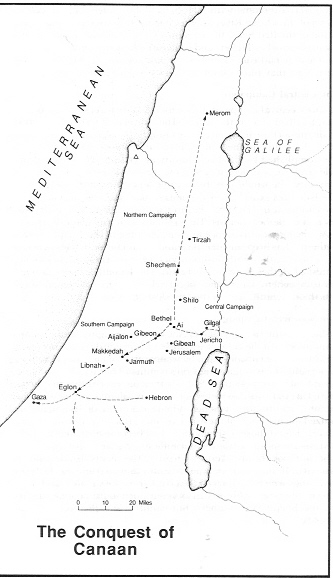
The book of Joshua is demonstrative proof that God fulfilled his land promise to Abraham. Israel must depend upon the Lord to conquer the land. The conquest is normally described as a three-pronged method of attack.[2] But the text does not describe the unfolding of these events in a strategic way. Initially, it was conceived to be an all-out conquest of the cities in the land much like Jericho and Ai; however, later conquests demonstrate to be more the result of preemptive strikes from other kingdoms upon Israel due to its successful military campaigns in the region.

First, the Israelites penetrated into the center of the Canaanite land (Joshua 6-9). The cities of Jericho (6:1-27) and Ai (7:1-8:29) were the first to experience the Israelite forces, as the Israelites initially took the land. And, the Gibeonite people were subjugated into servants, “cutters of wood and drawers of water for the congregation and for the altar of the Lord” due to their attempt at political deception (9:1-27). They claimed to come from a distant land, though they were an established group of inhabitants in the land with several cities all their own such as Gibeon, Chephirah, Beeroth, and Kiriath-jearim (9:16-17, 22).

Second, the Israelites respond to a strike upon the newly acquired inhabitants (the Gibeonites) by a band of five aggressive Amorite Kings of southern Canaan (Joshua 10). These five kings are listed in 10:5: Adoni-zedek, the king of Jerusalem, Hoham king of Hebron, the king of Jarmuth, the king of Lachish, and the king of Eglon. Since, Gibeon was a renowned city with many valiant warriors, and it had now become a part of the Israelites who conquered Jericho and Ai, these kings embraced the “strike first” strategy. Little did they know that “the Lord fought for Israel” (10:14), and that their fate would end with their cities being conquered (10:16-21, 29-38) and by suffering execution under the hand of Joshua in Makkedah (10:22-28).

The Conquest of Canaan - Concise Bible Atlas (Laney)
The Conquest of Canaan (Laney, Concise Bible Atlas)

At the end of this campaign, the chronicler[3] of these events concludes this aspect of the conquest with following words:

So Joshua struck the whole land, the hill country and the Negeb and the lowland and the slopes, and all their kings. He left none remaining, but devoted to destruction all that breathed, just as the Lord God of Israel commanded. And Joshua struck them from Kadesh-barnea as far as Gaza, and all the country of Goshen, as far as Gibeon. And Joshua captured all these kings and their land at one time, because the Lord God of Israel fought for Israel. Then Joshua returned, and all Israel with him, to the camp at Gilgal. (10:40-43)

It was during this campaign that the famous “sun stood still” miracle occurred (10:12-13). Some dispute that the event was miraculous, but “conservative scholars are in agreement that this circumstance involved a genuine miracle, and that the account is not a mere poetic or mythological description of an ancient victory.”[4]

Finally, Joshua and company have a military victory over a northern Canaanite confederacy (Joshua 11). The land was conquered (Josh 11:16). It must be observed though, that the conquest was aided supernaturally by Divine intervention (Josh 5:13-15). Therefore, “the Lord gave to Israel all the land of which He had sworn to give to their fathers, and they took possession of it and dwelt in it” (Josh 21:43, 44-45 NKJV). After some 500 years after the initial promise, the promise is fulfilled.

The Dimensions of the Land

The land awaiting the Hebrew nation was extremely remarkable.  Both Abraham and Moses had been privileged to see its beauty (Gen 13:14-18; Deut 32:49).  In his guide book, Guy Duffield writes that from Mt. Nebo “on a clear day, the entire land of Canaan can be seen inasmuch as it is so small – 150 miles from the Jordan River to the Mediterranean.”[5] This is a “parallelogram about 150 miles from north to south and varying in width from 45 to 70 miles”,[6] and was highly diverse botanically, zoologically, meteorologically, and geographically.[7] One writer has said, “Within such small compass the country must have been unequalled for charm and variety.”[8] Even with a brief geographical overview of Palestine a value for the lands diversity can be ascertained.

Beginning from the land east of the Jordan River and venturing across the river into northern and southern extents of Palestine, the children of Israel found themselves in a very geographically dynamic territory. Carl Laney writes that the “land can be divided longitudinally into four distinct geographical regions: the coastal plain, the hill country, the Great Rift Valley, and the Transjordan highlands.”[9] While others have developed the subdivisions of these regions more exhaustively,[10] space here allows for only brief remarks as they relate to the conquest and settlement of Canaan.

The land on either side of the Jordan River is home to the historical narrative of the conquest implemented by the Israelites. The book of Joshua opens with the Israelites on the east side of the Jordan River.  In fact, the books of Numbers and Deuteronomy catalog their conquest of this region, known as the Transjordan highlands (Num 31; Deut 2:26-3:11). The land spreads 150 miles from Mt. Hermon in the north to the southern tip of the Dead Sea.[11] The territory was subdivided and given to the tribes of Reuben and Gad, and to half of the tribe of Manasseh (Deut 3:12-22). This high plateau stands nearly at 4,000 feet, which “becomes higher as it extends southward, rising from two to five thousand feet in elevation.”[12] From the western side of this highland, it descends “steeply” down to the Jordan valley.[13] A key monument in the land would be Mt. Nebo, where Moses viewed the Promised Land before his death (Deut 3:23-29).

After crossing the Jordan River, the Israelites transverse a challenging topography throughout their conquests.  In it they encountered the deep chasm of the Rift Valley and the mountainous geography of the western Hill Country.  As the Israelites crossed the Jordan River, they where trekking through a great “fissure in the earth’s crust.”[14] The Rift Valley is “some 1,700 feet above sea level at the source of the Jordan River (near Caesarea-Philippi) and almost 1,300 feet below sea level at the Dead Sea in the south.”[15] This becomes a major border between the tribes one each side so that the “Rift made it virtually impossible for Transjordan to become integrally united with Samaria and Judah on a permanent basis.”[16]

After walking across the Jordan River, the Israelites encounter the Hill Country.  This land is home to a roller coaster of valleys and mountain ranges.  This is the backdrop of the central, southern and northern campaigns.  This is the home of the rest of the Hebrew nation.  North to south, the land consists of:

Upper Galilee, Lower Galilee, the hill country of Samaria and Judea, the “Shefelah” (a natural terrace on the western side of the mountains), and the Negeb (rendered ‘South Country’ in the Scriptures), which extends south of Hebron into the Arabian Desert.[17]

This land division stretches from the Upper Galilean region, where the elevations reach their zenith at nearly 4,000 feet, down through the Samaritan and Judean regions (where lower elevations exist) to the dry Negev plain.[18] One can appreciate then the notion that the Israelites were of a rugged deportment – this is probably accredited to their sojourn in the wilderness.

As the Israelites divided the land, many of their territories would include a portion of the coastal plain (Joshua 14-21).  This beach front is “a band of sandy and alluvial soil bordering the Mediterranean Sea.”[19] North to South, it extends some 165 miles from the “Ladder of Tyre (Rosh Ha-Niqra)” to the “Wadi el-‘Arish”, all the while broadening the width of its land from 3 miles in the North to approximately “twenty-five miles” in the south.[20] “The whole coastal region readily lends itself to a threefold division: the Plain of Philistia, the Plain of Sharon, and the Plain of Acre.”[21]

The Divine Transplantation

Jehovah God fulfilled His promise to the Hebrew patriarchs and gave the Israelites the land of promise.  The description of the land itself yields a very rugged picture, yet God gave these nomads victory over the established societies encountered therein.

Henry H. Halley captures the magnitude of such a feat. He declares that such a monumental liberation and migration of a nation could not be explained sufficiently with naturalistic conclusions. For Halley, it can be spoken of in no other terms aside from the miraculous:

Aside from various accompanying miracles, the Transplanting of a Whole Great Nation, bodily, from one land to another, meanwhile maintaining it 40 years in a Desert, was in itself one of the most Stupendous Miracles of the ages.[22]

What other explanation would there be for Pharoah to relinquish his profitable workforce – the slave labor of Israel? What other explanation would there be for the survival of millions of Israelites in the desert? Moreover, how can there be a reasonable naturalistic explanation for a nomadic force overtaking fortified cities?

No doubt, the naturalist – or skeptic – can raise criticisms; however, for the theist, the best and simplest explanation is found in Divine intervention. If God created the universe and has provided for every creature, then surely God can lead and provide a nation with liberation from slavery, and then set them on the center stage of the geopolitical tensions of the Mediterranean coastline.

Indeed, the greatest problem for the skeptic and atheist resides in Genesis 1:1 –“In the beginning God.” Such a tremendous experience should have yielded a sense of unwavering dedication to the God of their salvation (Exod 14:28-31), but, unfortunately, Israel’s history retells the cyclical problem of rebellion and idolatry.

It was this problem to which God addressed himself and anticipated in the Law of Moses. The Old Testament is transparent in God’s conditional relationship with Israel.[23] The relationship was dependent upon their faithfulness. Notice a sample of a few verses:

  • “And if you faithfully obey the voice of the Lord your God, being careful to do all his commandments that I command you today, the Lord your God will set you high above all the nations of the earth” (Deut 28:1).
  • And the Lord said to Moses, “How long will this people despise me? And how long will they not believe in me, in spite of all the signs that I have done among them? I will strike them with the pestilence and disinherit them, and I will make of you a nation greater and mightier than they” (Num 14:12).
  • “Be very careful, therefore, to love the Lord your God. For if you turn back and cling to the remnant of these nations remaining among you and make marriages with them, so that you associate with them and they with you, know for certain that the Lord your God will no longer drive out these nations before you, but they shall be a snare and a trap for you, a whip on your sides and thorns in your eyes, until you perish from off this good ground that the Lord your God has given you” (Josh 23:11-13).
  • But just as all the good things that the Lord your God promised concerning you have been fulfilled for you, so the Lord will bring upon you all the evil things, until he has destroyed you from off this good land that the Lord your God has given you, if you transgress the covenant of the Lord your God, which he commanded you, and go and serve other gods and bow down to them. Then the anger of the Lord will be kindled against you, and you shall perish quickly from off the good land that he has given to you” (Josh 23:15-16).

The majority of the Hebrew Bible is the retells the story of the consistent Israelite rebellion against their God, God’s warning a recalcitrant nation of wrath, and then the culminating judgment brought upon them. One biblical student summarizes the situation in the following way:

Because of the accelerating rebellion of the nation, consummated by the murder of Jesus Christ, God rejected the Hebrew people. Inexcusably, the Jews rejected their own Messiah; accordingly, Jehovah repudiated that nation and determined to scatter them as dust (Matthew 21:44). Thus, in the providence of God, the Roman armies came against Palestine in A.D. 70, and Judaism was destroyed (cf. Matthew 22:7; 24:1-34); the Jewish “vessel” was smashed, and it cannot be put back together (cf. Jeremiah 19:11). According to Josephus, some 1.1 million Hebrews were slaughtered, and thousands were taken into slavery. All Jewish records were lost in that holocaust. Today, there is not a single Jew who knows his tribal ancestry (McClintock and Strong, 1969, 771). The physical nation of Israel is dead. The “Jews” that make up the State of Israel today (less than twenty-five percent of the world Jewish population) cannot legitimately be called a “nation.”[24]

Conclusion

The biblical record is clear that God had promised to Abraham and his children His covenant to bless them and to give them a land for their descendants (Acts 13:16-25). This land, as demonstrated by ample biblical references was a possession for as long as they remained faithful to God. Sadly, they showed a consistent spirit of rebellion, and as a consequence, a new covenant was to replace the Mosaic Covenant and fulfill the Abrahamic covenant.

Aside from physical blessings, this covenant had spiritual emphases as well – it anticipated the coming offspring that would bless all nations with salvation (Gen 22:17-18; Gal 3:16). Indeed, as the Hebrew writer observes, Joshua may have provided the Jews with a Sabbath rest after the conquest of Palestine, but Jesus provides a rest yet to be experienced – redemption in Heaven (Heb 4:1-10).

Works Cited

  1. Unless otherwise stated, all Scripture quotations are taken from the English Standard Version of the Holy Bible (Wheaton, IL: Crossway, 2001).
  2. Norman L. Geisler, A Popular Survey of the Old Testament (Grand Rapids, MI: Baker, 2000), 97.
  3. I use the name “chronicler” due to the fact that Joshua is, like many Old Testament books, anonymous. Raymond B. Dillard and Tremper Longman, III, stress that ascertaining authorship and date for Joshua’s composition is “bound up with larger historical and theological questions” than mere internal and external argumentation (An Introduction to the Old Testament [Grand Rapids, MI: Zondervan, 1994], 108). David Malick lists a number of features within Joshua (i.e. internal evidence) pointing to various authors; among them, Joshua (“eyewitness quality”) and others who finished the book later – “but not much later” (“An Introduction to the Book of Joshua“). Malick concludes his discussion of authorship by observing that since critical scholarship results rejecting Joshua authorship lacks unanimity, the traditional view that Joshua wrote the majority of the book that bears his name is therefore a good assumption. The book should be viewed as “true to form” written in the days of Joshua and the elders that outlived him (Josh 24:31).
  4. Wayne Jackson, “How Do You Explain Joshua’s Long Day?,” ChristianCourier.com (Accessed: 22 Mar. 2002). This is a brief introduction to the subject, it would be worth consulting.
  5. Guy P. Duffield, Handbook of Bible Lands (Glendale, CA: Regal, 1969), 140.
  6. “Palestine of the Holy Land,” New Standard Reference Bible (Chicago, IL: Hertel, 1955), 756.
  7. Wayne Jackson, Background Bible Study (1986; repr., Stockton, CA: Christian Courier Publications, 2000), 1-18, 67-74.
  8. Alfred Edersheim, Sketches of Jewish Social Life, updated ed. (Peabody, MA: Hendrickson, 1994), 2.
  9. J. Carl Laney, Concise Bible Atlas: A Geographical Survey of Bible History (Peabody, MA: Hendrickson, 1998), 41.
  10. J. McKee Adams, Biblical Backgrounds, revised ed., rev. Joseph A. Callaway (Nashville, TN: Broadman, 1965), 52-85.
  11. Laney, Concise Bible Atlas, 79.
  12. Laney, Concise Bible Atlas, 79.
  13. Laney, Concise Bible Atlas, 42.
  14. Laney, Concise Bible Atlas, 42.
  15. Jackson, Background Bible Study, 3.
  16. Laney, Concise Bible Atlas, 83.
  17. Jackson, Background Bible Study, 3.
  18. Laney, Concise Bible Atlas, 41.
  19. Laney, Concise Bible Atlas, 41.
  20. Laney, Concise Bible Atlas, 131.
  21. Adams, Biblical Backgrounds, 56.
  22. Henry H. Halley, Halley’s Bible Handbook, 24th ed. (Grand Rapids, MI: Zondervan, 1965), 22.
  23. Wayne Jackson, “God and the Nation of Israel,” ChristianCourier.com (Accessed: 14 Dec. 1998 ); pars. 13-14.
  24. Jackson, “God and the Nation of Israel,” par. 8.