Your Mission Matters

It is not unusual for businesses and enterprises to have “mission statements” to outline their objectives, goals, philosophy, and proposed impact their products or services are intended to have.

When you think about it, the “statement” is a great way to bring focus to an image about an outcome, or the goal of an organization. It is also a way for there to be creative control over how we would like people to envision us, our message, and our ethics and values as we seek our mission. In short, our mission statement holds us accountable for what we seek to accomplish and it includes the culture we seek to generate in the process of reaching this mission.

What’s Your Mission?

Do you have a mission statement? Are you involved in something where you have “bought-in” to its image, message, and mentality? If you are employed then to a degree you share something of the company’s “mission” whether it be in baby care, athletic activewear, intellectual property law, or even that entrepreneurial zest.

Being on Mission at Work

When I worked at NikeTown, San Francisco in the Union Square of San Francisco, CA, as a sales floor associate, I was all in. Everything was Nike. Socks, shoes, T-shirts, jackets, watches, even my gifts were Nike. I was all in on the apparel, the knowledge of our products, and its work culture. What was my mission? To find out what our customer’s athletic needs were and match them with the proper activewear so they can achieve their goals. So when I had track and field athletes, we went over to running wear, and when I worked with the head coach of a major league soccer club we went over soccer wear. I was all in on our mission and committed to it. I loved my time there.

Then there were those jobs I had no investment in its mission. It was just a job, just a paycheck, and I did as little as possible. I came in late. I

It is not even about personal aspirations.

So the question posed here again is: Do you have a “mission statement”? Yes, this is a spiritual double entendre – I have another meaning in mind.

A Line of Thought on the Mission

First, let us begin with a few ideas. Everything around us that we see on Earth and in the universe is the result of a Creator. It is unfortunate that some do not acknowledge this truth but suppress it (Rom 1:18).

To this point, the apostle Paul writes:

For what can be known about God is plain to them, because God has shown it to them. For his invisible attributes, namely, his eternal power and divine nature, have been clearly perceived, ever since the creation of the world, in the things that have been made. So they are without excuse. (Romans 1:19–20 ESV)

The world is evidence within itself that there is a creator of limitless power and intelligence, and he is to be acknowledged by us – the product of his creation (Psa 8:3–8) – in the way we live.

The quote ends with the strong indictment that if we do not acknowledge His existence we are “without excuse” (Rom 1:20). The word has a litigious background, and essentially means that in the cosmic courtroom such are “without defense” (Gk. anapologetos).

No words, no smooth arguments, no loopholes, nothing will be grounds for a mistrial; there is simply no excusable rationale for rejecting the existence of a Creator as revealed in nature which bears the marks of intelligent design and infinite power.

Moreover, such a Creator by virtue of His very nature has the right to demand faithful service from His creative progeny – humanity (Gen 1:26–30, Rom 1:18, 21–23; 9:19–21). If we mortal parents may expect by virtue of our position to hold authority over our children, how can we expect the Father of all to hold any less authority?

Second, every expectation to obey God’s will (= Law/commandment) is a reflection of His holiness and the expectation that humanity will take upon themselves the freedom to make a choice to obey or to disobey.

This freedom of choice is reflected very clearly in the historical narrative of Adam and Eve as they are given everything in the Garden of Eden save the right to eat from the tree of the knowledge of good and evil. The stated consequence should such an infraction occur, the Lord said, is “death.”

It is not told to us how long or short the first family lived in compliance with this expectation of behavior in the garden; however, it is revealed to us that unfortunately Eve gave in to temptation as did Adam. As the initial consequence, the first couple was expelled from the Garden and lost access to the Tree of Life (Gen. 3).

Sin it is said by John, the apostle, is the rejection of God’s law (1 John 3:4). In fact, it is an expression of a lack of love and a lack of fidelity to God (1 John 5:2). Hence, what we have been given in this freedom of choice is an ability to decide our relationship with God – will we show love and fidelity, or will we show a lack thereof?

Freedom of choice is a powerful instrument of human behavior. With it, we fall from grace and the stature of one made in the image of God (Rom 3:9–18, 23), and by it we return to God and submit our powers of decision into the hands of a forgiving and holy God (Rom 2:4; 3:26).

At every instance, then, we have a choice. Will we make those choices that inherently become less as we expend more earthly time on His service or our own selfish ambitions? Surely, our plans can only be enhanced by submitting to the Mind of God (Prov 16:25; Isa 55:8–9).

Third, while we may enjoy the blessing of freedom of choice it is a privilege that swings two ways. Much like the tongue, by our choices, we may praise God or reject him (Jas 3:45). As a consequence of our decisions, sin is a common problem to all accountable individuals (Ezek 18:20). And yet, in Jesus we are given the saving message of rebirth (John 3:4), of salvation (1 Thess 1:10), and a new creation (2 Cor 5:17).

If in our sinful choices, we have lost our identity as the image of God, then surely our choices which reflect our recreation in Christ amount to a new plan of action in our lives. Paul, the apostle, writes that when we are saved we are remade to walk in certain works He has assigned us to accomplish (Eph 2:10).

Back to Our Question

What’s your mission statement? While we have freedom of choice, when a person chooses to become a Christian that person has committed to live as God directs, as Christ reflects, so that our living connects His mission with our mission in this world.

The Lord’s mission was to reconcile the world back to Himself:

[I]n Christ God was reconciling the world to himself, not counting their trespasses against them, and entrusting to us the message of reconciliation. Therefore, we are ambassadors for Christ, God making his appeal through us. We implore you on behalf of Christ, be reconciled to God. (2 Corinthians 8:19–20 ESV)

Notice how Paul acknowledges that his mission is the same as God’s mission: to appeal to others through the message of the Gospel to announce how God is reconciling the world to himself.

Christians are those recreated in Christ, and our “mission” is to help other people see God’s abundant love found in the Gospel. Our mission matters because our mission is supposed to be His mission. So how does your “mission” add up?

Changed to Serve, Living in Hope (1 Thess 1:9–10)

Christians must always be reminded of their responsibility to live out lives reflective of the high calling of God (Eph 4:1; Phil 3:14). There is a tremendous passage in 1 Thessalonians 1:9–10, which provides the Christian with the basic aspects of Christian living. Here is the passage:

For they themselves report concerning us the kind of reception we had among you, and how you turned to God from idols to serve the living and true God, and to wait for his Son from heaven, whom he raised from the dead, Jesus who delivers us from the wrath to come. (1 Thessalonians 1:9–10 English Standard Version)

Let us examine this passage, and reflect on the four aspects of this passage: (1) reception of the word, (2) conversion, (3) consecrated service and (4) hope of deliverance.

I hope to invite modern Christians to reflect on the importance of turning to God in conversion, to living a sanctified life in anticipation of the final day when Jesus comes again.

The Background

First, let us consider some background information.

After leaving the city of Philippi, Paul and Silas traveled probably on horseback some 100 miles on the Egnatian Way through Amphipolis and Apollonia only to pause their trip in Thessalonica.[1] It is highly likely this was a three-staged trek to Thessalonica: Philippi to Amphipolis (30 mi.), Amphipolis to Apollonia (27 mi.), and Apollonia to Thessalonica (35 mi.).[2] Situated on the Egnatian Way, ancient Thessalonica was at the heart of Roman travel, communication, and culture in Macedonia. So much so, that William Barclay succinctly said, “East and West converged on Thessalonica.”[3]

The Book of Acts chronicles Paul’s initial evangelistic efforts in that great city (Acts 17:1–9), as he enters the synagogue and presents various elements of the gospel message as found in the prophetic writing of the Old Testament. In fact, in Acts 17:2, Luke says Paul spent three weeks “reasoning” with the Jews on the Sabbath, the word suggesting a rigorous discussion or possibly hints at a debate style of presentation (Grk. dialegomai).

Unfortunately, in this case, Luke does not inform us which scriptures Paul uses to build his case (cf. 1 Thess 1:10; 1 Cor 15:3–5; Isa 53:2–8; Psa 22:1, 16:10; Acts 2:31). He only affirms that the suffering, death, and resurrection of Jesus of Nazareth is the embodiment of these prophetic utterings which adherents of the synagogue would have been familiar.

Luke observes the response of those that believed:

some of them were persuaded and joined Paul and Silas, as did a great many of the devout Greeks and not a few of the leading women. (Acts 17:4)

Unfortunately, a number of Jews responded to the missionaries with political manipulation and leveraging. These Jews, operating out of jealousy, enlisted the worst of society and orchestrated a riot, and attacked and arrested Jason who was hosting Paul and his company (Acts 17:5–6).

When presenting their case against Jason and the Christians, this mob describes them with politically subversive language. They are those “who have turned the world upside down” (Acts 17:6), “they are all acting against the decrees of Caesar” (Acts 17:7a), and “they are all… saying that there is another king, Jesus” (Acts 17:7b). Due to this charge, Jason is released to Paul and Silas on the conditions of payment of bail (“security”) and their departure (Acts 17:8–9). Paul later describes this as being “torn away” from them (1 Thess 2:17).

Reception of the Word

Sometime after leaving Thessalonica, Paul was restless and sent Timothy to Thessalonica for a report. Timothy returns with an encouraging report of their faithfulness (1 Thess 3:6). This faithfulness began when they believed Paul’s preaching in the synagogue (Acts 17:4). Luke notes that some Jews, and many devout Greeks (likely God-fearers) and leading women were “persuaded and joined Paul and Silas.” These are passive verbs, suggesting the work of the Spirit’s word compelled those with honest hearts to identify with the gospel proclaimers.

When Paul wrote to this young church, he recalls this moment. In fact, he frames their conversion as an example of the success of the gospel message received as God’s word:

And we also thank God constantly for this, that when you received the word of God, which you heard from us, you accepted it not as the word of men but as what it really is, the word of God, which is at work in you believers. (1 Thessalonians 2:13)

The “makings” of a Christian begin when the gospel is heard not as just another philosophy, or religious message. Instead, as Paul recalls, before one becomes a Christian it is imperative that the preaching is regarded as the very word of God. This is the foundation; if this is not believed spiritual failure is surely looming in the distance.

Conversion: Turned from Idols

The actual verb “turned” in 1 Thessalonians 1:9 (Grk. epistrépho) carries the idea of turning around and directing this move towards a new object or a person. In Acts, the noun is used for conversion to God (Grk. epistrephe). Together with its more common verb “to turn” they appear a total of twelve times in the Book of Acts (3:19; 9:35, 40; 11:21; 14:15; 15:3 [noun], 19, 36; 16:18; 26:18, 20; 28:27). Except for three instances (9:40, 15:36, and 16:18), the terms are exclusively used with reference to people turning to God in response to the Gospel.

Paul celebrates that as a result of accepting the word of God as authoritative and believing the gospel message, the Thessalonians turned to God after a life of serving “idols” (1 Thess 1:9). While Luke plants the conversion of the Thessalonians to those connected to the synagogue, in his letter Paul emphasizes a defection from the pagan background of the Greco-Roman converts.

This likely points to their lack of participation in the cults of their clans and tribes, temple, city, and “states” gods, which would have created a wedge between them and their neighbors. Albert Bell, Jr., notes that “the more gods a city worshiped, the better its chances of divine favor.”[4] It is known, for example, the people of Thessalonica worshipped Zeus, Asclepius, Aphrodite, and Demeter, and even the Egyptian gods Serapis and Isis. They were also given to the Samothrace cult of Cabrius.[5]

According to the Greco-Roman cultic mindset, Christians turning from the gods was not only difficult to understand but also came off as unpatriotic to the state. In their mind, it would not only have been subversive to the Spirit of Roma (Rome worshipped) and even the deified Caesar but also this behavior would have been seen as inviting divine disfavor (1 Thess 2:14). Paul celebrated their choice in doing this.

Children of God must remember their conversion was a choice. W. E. Vine insightfully comments on this conversion:

[It was] an immediate and decisive change, consequent upon a deliberate choice; a conversion is a voluntary act in response to the presentation of truth.[6] 

They chose to leave their sins behind; they did not take them along in their new life as God’s people.

Consecrated Service

Again, the Thessalonians did not bring their old life with them. Instead, they were changed “to serve the living and true God.” In fact, Paul later writes to them that “God has not called us for impurity, but in holiness” (1 Thess 4:7). Service to God is expressed in the rejection of “the passions” of the past which reflects a rejection and of God (1 Thess 4:5).

Christian service is a demonstration that the things which were important and governed the fundamentals of our pre-Christian lives no longer function in this way. Christians are not to lean upon their past; instead, they are called to “stand fast in the Lord” (1 Thess 3:8).

In other words, Christians are to live lives devoted to serving God over our own ambitions. This is the “how to” of our service to God, to accept God sanctifying his people. Notice this emphasis on a consecrated and holy life:

For you know how, like a father with his children, we exhorted each one of you and encouraged you and charged you to walk in a manner worthy of God, who calls you into his own kingdom and glory. (1 Thessalonians 2:11–12)

Now may our God and Father himself, and our Lord Jesus, direct our way to you, and may the Lord make you increase and abound in love for one another and for all, as we do for you, so that he may establish your hearts blameless in holiness before our God and Father, at the coming of our Lord Jesus with all his saints. (1Thessalonians 3:11–13)

For you know what instructions we gave you through the Lord Jesus. For this is the will of God, your sanctification: that you abstain from sexual immorality...  For God has not called us for impurity, but in holiness. (1 Thessalonians 4:2–3, 7)

Now may the God of peace himself sanctify you completely, and may your whole spirit and soul and body be kept blameless at the coming of our Lord Jesus Christ. (1 Thessalonians 5:23)

As a result of being converted, Christians are washed, consecrated, and remade for righteous service (1 Cor 6:9–11; Eph 2:10). Contemporary Christians need to take this message of consecration to heart.

Hope of Deliverance

Christians live in the present with a living hope which anticipates the second coming of Jesus. Paul is very clear when he affirms that there is a future point of hope and deliverance for which Christians wait for (1 Thess 1:10).

For they themselves report concerning us the kind of reception we had among you, and how you turned to God from idols to serve the living and true God, and to wait for his Son from heaven, whom he raised from the dead, Jesus who delivers us from the wrath to come. (1 Thessalonians 1:9–10)

Christians anticipate the Son to come “from heaven.” This last line is heavily loaded with theological truth. The Son is further described as the one God “raised from the dead, Jesus who delivers us from the wrath to come.” This is a statement of hope. The hope of the advent of Jesus (i.e., the second coming) is directly linked to God’s power demonstrated in the resurrection of Jesus. That God raised Jesus from the dead makes the claim that Jesus is returning from heaven a firm expectation.

With the certainty of the second coming of the Son “out from the heavens” (literal rendering of the Greek) established in the Christian mind, it affirmed that the Son, Jesus, will come with judgment for the unbelieving world (i.e., “the wrath to come”) but deliverance for the believer. Paul calls this “the day of the Lord,” a period of judgment and final consummation of God’s plan (1 Thess 4:13–5:11; 2 Thess 1:5–12).

Final Words

The gospel found fertile soils in the heart of early Thessalonian Christians. The congregation had a culturally and religiously diverse background, but they accepted the gospel as the word of God. Their faith in the God who raised Jesus from the dead was also at work as they followed their call to holy living as they anticipate Jesus coming to judge the living and the dead, and delivering those who are his.

Sources

  1. J. Carl Laney, Concise Bible Atlas (Peabody, MA: Hendrickson, 1998), 229.
  2. Colin J. Hemer, The Book of Acts in the Setting of Hellenistic History, ed. Conrad H. Gempf (Winona Lake, IN: Eisenbrauns, 1990), “The mention of Amphipolis and of Apollonia should probably be taken to imply that these were the places where the travellers [sic] spent successive nights, dividing the journey to Thessalonica into three stages of about 30, 27 and 35 miles” (115).
  3. William Barclay, The Letters to the Philippians, Colossians and Thessalonians, revised edition (Louisville, KY: Westminster, 1975), 180.
  4. Albert A. Bell, Jr., Exploring the New Testament World (Nashville, TN: Nelson, 1998), 126.
  5. Nijay K. Gupta, 1-2 Thessalonians: A New Covenant Commentary, New Covenant Commentary Series, eds. Michael F. Bird and Craig Keener (Eugene, OR: Cascade Books, 2016), 4. Russell Morton, “Samothrace” in Lexham Bible Dictionary, Logos electronic edition, ed. John D. Berry, et al. (Bellingham, WA: Lexham, 2016).
  6. W. E. Vine, Merrill F. Unger, and William White, Jr., Vine’s Complete Expository Dictionary of Old and New Testament Words (Nashville, TN: Nelson, 1984), 2:647.

Book Review: The Safest Place on Earth

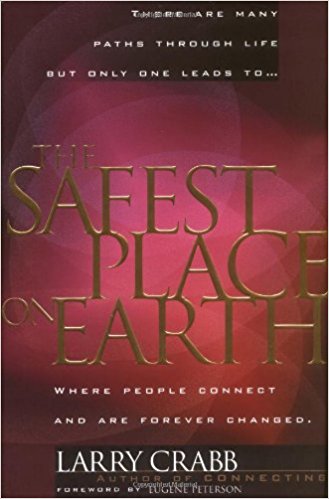
Safest Place on Earth - Crabb.jpg

Larry Crabb, The Safest Place on Earth: Where People Connect and Are Forever Changed (Nashville, TN: W Publishing, 1999), Hardback, 240 pages.

Dr. Larry Crabb is an established licensed psychologist, a well-known Christian author on marriage and biblical counseling topics, and current Distinguished Scholar in Residence at the Colorado Christian University (Morrison, CO).[1] 

Dr. Crabb earned his Ph.D in Clinical Psychology from the University of Illinois, and has been a professor of psychology since 1970. Dr. Crabb also provides workshops and weekend seminars across the United States as part of his non-profit New Way Ministries and its web presence which features interviews, video lectures, and other multimedia outlets to share resources from his School of Spiritual Direction.

Dr. Crabb has been involved in counseling and marriage, in self-help ministry, and in developing a context of “spiritual community” for over 40 years, and so has earned a place among the various “Christian voices” seeking to make the church a better place.

In 1999, Dr. Crabb released a significant but brief volume on the church as a safe spiritual community. The volume is entitled, The Safest Place on Earth: Where People Connect and Are Forever Changed (238 pages).[2] Dr. Crabb has registered his own frustration with two elements which bear upon the community of the church and its spiritual health, which he further addresses in Real Church: Does it Exist? Can I Find It? (Nashville, TN: Nelson, 2009).

In The Safest Place on Earth, however, Dr. Crabb establishes a vision for the church as a group of believers on a journey towards God, and it is within the journey that spiritual community must begin and end for spiritual healing and direction. Despite Dr. Crabb’s own training in psychology, he believes when it comes to the soul care that ought to go on within the church, such assistance must yield “to special revelation and biblically dependent thinking.”[3] Dr. Crabb is adamant,

We don’t need more churches, as we usually define the word. We need more spiritual communities where good friends and wise people turn their chairs toward each other and talk well.[4]

Structurally, The Safest Place on Earth is organized in seventeen chapters, divided into three parts, and finishes with a section of questions for each chapter. The layout follows a very clear program of development, and the content is written in a popular style. Dr. Crabb is able to articulate and shape a conceptual paradigm of what is a spiritual community and what is not a spiritual community without complex vocabulary. His illustrations, personal anecdotes, and insights from personal interactions are delivered to support his vision for a spiritual community is very clear and helpful ways.

Dr. Crabb also interacts with and depends upon the works of Dutch Catholic priest Henri Nouwen[5] (1932-1996), who focused on spiritual solitude, spiritual community, and spiritual compassion, along with Swiss Catholic philosopher Jean Vanier (b. 1928) and his work connected to L’Arche communities which have overlapping concerns.[6]

A Book Summary

In part one, Dr. Crabb develops and sharpens the idea of spiritual community and how the church needs to develop sensitivity to being the spiritual community it was intended to be. Spiritual community is, according to Crabb, at the core of what the church is.

It is people facing each other in intimate, honest, and safe ways as they journey together on their way to God. Spiritual community, however, will not occur if there is no opportunity for vulnerability and a full sense of validation from these that witness the vulnerable parts of who we are.

One of the difficulties in church community life is to wrestle with the crux,

if they knew who I really was, the church would probably not like me.

To be a spiritual community, then, we must be able to love free from ego and embrace those so broken by those things which burden our souls and even cripple us.

The health metric of a spiritual community is its ability to love the unlovable, the broken, those that can only let you love them in their brokenness.

In part two, Dr. Crabb reframes the New Testament discussion of flesh and spirit elements of our soul in terms of the analogies of the Lower Room (carnal/wretchedness) and the Upper Room (spiritual/greatness).

It is in this phase of the book that Dr. Crabb focuses on the part of the church community that needs to be addressed first — our internal struggles to be spiritual. Enter Dr. Crabb’s “two rooms” analogy which he builds from the words of Jesus:

If anyone loves me, he will keep my word, and my Father will love him, and we will come to him and make our home with him. (John 14:23)

And he amplifies these words with Paul’s regarding “Christ in you” (Colossians 1:27).[7]

In essence, the two rooms represent fully furnished environments that exist within us.

Now there are two rooms inside us, the one we built where our natural self thrives, and the one the Spirit built where our natural self suffocates and our new self flourishes.[8] 

Dr. Crabb does not explicitly use all the terms, but these “rooms” parallel the Freudian id, ego, and superego dynamics, the difference being they are spiritualized.[9] The lower room is self-furnished by our wretchedness and “dark forces” with its corruption and stench (id). The upper room is furnished by the Spirit of God only enjoyed once we open the doors of the lower room, acknowledge its stench, and celebrate the confidence to be a new us (an obedient us) empowered by God’s grace and teaching (superego?).

Finally, we consciously (ego?) take these “two rooms” within us and the internal struggles that go with them —because we prefer to be in the lower room— to receive outside help from “another room” which is the spiritual community, the church. This room is furnished by the Spirit with safety, vision, wisdom, and power.

In part three, Dr. Crabb continues his visioning for spiritual community with another analogy of “turning our chairs toward each other” but now by “turning our souls toward each other.”

In this process, the members of the church community must practice three needed things. First, spiritual community can only be done by the Holy Spirit. Second, personal holiness grounded in the Spirit influences the pursuit of personal holiness of others. Third, there must then be a safe place to “own and trace our desires to their source.”[10] 

Spiritual community, however, will only occur when spiritual passions are “supernaturally” aroused when we are together in spiritual community experiencing acceptance, mutual faith in God’s presence in our lives, affirm the “upper room” elements in our lives, and allow God to change us without applying human pressures of forced change.

It is certainly a place of risk, but risk will always be a factor when embracing the need for vulnerability. Therefore, the real question is: will we, the church, be the safe place for those being vulnerable?

Response and Review

I chose this book principally because of the title. In fact, I had seen this title on the cover of the September/October 2001 New Wineskin magazine as part of the issue theme of “Authentic Christian Community.”[11] The concept peaked my interest because I do feel the church has not been the safest place on Earth in managing people’s sin. One example will suffice. I once heard a preacher react to the exposed sins of others with the derogatory question, “where are the normal people?” That’s not a safe place for healing. Nor is the following response to a fellow congregant’s addiction any safer, “there’s a word they need to learn – repent.”

Rebuking sin is the easy work of preaching, but creating a compassionate environment to help brothers and sisters work through repentance is the harder – and in my judgment – more fruitful work of ministry.

Crabb’s book further calls the church to be the community through which Christians experience spiritual healing for spiritual problems often mistreated —according to Dr. Crabb—as psychological disorders or problems. The gospel and the New Testament teaching that the church is the dwelling place of God, and Christians are the temple of the Holy Spirit, seem to support the overall agenda that the culture of the local congregation should be more attuned to openly working through sin, temptations, and openly celebrating grace, and spiritual empowerment by God. Even Paul declares that the church is being recreated (2 Corinthians 5:17) and repurposed for ministry (Ephesians 2:10).

Dr. Crabb’s book both intrigued me and made me uncomfortable in that he elevates the spiritual components of the church where the Holy Spirit dwells. Again, it is not that I’m troubled by the Holy Spirit, it is that in many pockets of the Churches of Christ the Holy Spirit and the use of “community” have been so tinged with so-called “liberal agendas” in the latter, and doctrinal controversial hotbeds regarding the former. His emphasis that the church is specifically designed to be a spiritual community and therefore it must be that spiritual community on a journey to God is what stands out the most to me. If we are not a spiritual community, then there will not be the Spirit.

I do not agree with all of his points on the “wretchedness” of man, but Dr. Crabb has challenged me to speak more about the Spirit and the church as the community in which God does His best work to heal us from the effects of sin.

Concluding Thoughts

What I liked overall about the book is the Dr. Crabb’s challenging call to the church to be a safe place for the sort of healing love that needs to exists between God’s people, so that the Spirit of God may work through the church to heal its members as they bear each other’s burdens with the gifts of the Spirit (Galatians 5:22-26). The church must be so, because, as Dr. Crabb reminds us, we are traveling together on a journey to God.

I recommend the challenge of this book to every Christian and church leader. The reminder that Scripture centers the body of Christ as the place where the Spirit dwells, and therefore must be the safe place where the members of the body can serve each other empowered by the same Spirit. To overcome sin, the church must be, and in some cases become, the place where no one struggles with sin void of love, compassion, support, and patience as we journey to God breaking free from the bondage of sin.

Endnotes

  1. “About Larry Crabb,” http://www.newwayministries.org/larrycrabb.php.
  2. Full details: Larry Crabb, The Safest Place on Earth: Where People Connect and Are Forever Changed (Nashville, TN: W Publishing, 1999).
  3. Crabb, The Safest Place on Earth, 7.
  4. Crabb, The Safest Place on Earth, 10.
  5. “Henri Nouwen Society,” http://henrinouwen.org.
  6. “History of L’Arche,” https://www.larcheusa.org/who-we-are/history.
  7. Unless otherwise stated all Scripture quotations are taken from the English Standard Version of The Holy Bible (Wheaton, IL: Crossway, 2001).
  8. Crabb, The Safest Place on Earth, 62–63.
  9. Crabb, The Safest Place on Earth, 78–79.
  10. Crabb, The Safest Place on Earth, 121–30.
  11. Larry Crabb, “Is the Church the Safest Place on Earth?,” New Wineskins 5.4 (Sept/Oct 2001): 12–15.