The Code of Hammurabi and the Law of Moses: A Selected Comparative Look

[Note: This was a comparative historical paper for a history course exploring ancient societies. It forced me to examine ancient literature–even the Bible–as a historical source. ]

If one were to think of the most significant influences in lawmaking one who be hard-pressed to consider two greater and oldest than that the Code of Hammurabi and the Law of Moses. Even today, hanging above the gallery doors of the House Chamber in Washington, D.C., are twenty-three marble relief portraits of all those whose works have influenced the establishment of the principles of American law.

Among them are King Hammurabi and the prophet Moses (“About Relief Portrait” in SNT 36). Hammurabi’s Law ( or “Code”) is available today due to a monument relief and extant manuscript evidence (Roth 336). The Law of Moses has been preserved in the biblical manuscripts used for both the Hebrew and Christian Bibles.

In this paper, I focus on four touching points between the “Code of Hammurabi” (Roth) and the Law of Moses (Exod 19:3–24:8) by examining their similarities and suggesting some differences. These touching points are their sources of authority and their significance, the relationship between Moses and his people with the relationship between Hammurabi and his people, the position(s) of women in both societies as revealed by the laws, and what both sources of the law reveal about their two societies.

While this is not an exhaustive evaluation, it is an attempt to understand from these literary sources insights helpful toward a historical understanding of ancient Mesopotamia and ancient Israel. The most fundamental conclusion from this comparison and contrast may be that despite the similar concerns for establishing order in their respective societies, the differences demonstrate the unique trajectories of each society’s beliefs, expectations, and social concerns.

Sources of Authority

The first touching point is their source(s) of authority and their significance. There are points of comparison between the Code of Hammurabi and the Law of Moses when it comes to their sources of authority; however, there are significant contrasts that highlight the unique trajectory of each set of laws.

On the one hand, the preamble of the Code of Hammurabi and the beginning chapters leading to the specific Laws of Moses share a similar concern with establishing the view that each law has a divine source. Lockard points to a black basalt stone in the temple of Marduk (Babylon’s patron god) which pictures Hammurabi “receiving” kingship from Shamash (sun-god and lawgiver), and this provides the divine authority for the king to enforce his code of 282 laws upon his people (SNT 37). The preamble of the Code of Hammurabi likewise enlists this motif of the kings being “called” by name to bring justice and protection for the weak a reality. The laws of Moses, very similarly, presume the call of Moses for the Hebrews to be a “treasured possession” of the “Lord God” as a “kingdom of priests and a holy nation” (Exod 19:5–6).

The very connection between man and the divine realm supports the shared worldview of theism and the order and accountability that follows from that view. Accordingly, then, such a relationship would make Hammurabi and Moses mediators of such divinely given laws rather than their chief architects.

On the other hand, the divine sources of authority are significantly distinct in their presumption of polytheism and monotheism. The first words in the “Code of Hammurabi” are, “When the exalted Anum king of the Annunaki.” Anum is the “sky god of the old Babylonian pantheon” of which the Annunaki were the “lesser Babylonian gods of heaven who served Enlil.” This demonstrates the full placement of the polytheistic belief system of Hammurabi and the Babylonian world (Roth 335). For example, Roth’s translation reads,

“When the august god Anu, king of the Anunnaku deities” (335). 

The preamble affirms that both gods Anum and Enlil gave all power to the god Marduk (son of Ea) and elevated him above the “Igigu deities.” It is this pantheon, as it were, of Babylonian and Mesopotamian gods that form the authoritative source for the call of Hammurabi as mediator of his law. The inclusion of these unifying acts in the heavens would create a significant plea for unity under this law on earth.

Yet, Moses and the laws in the Exodus record are based on a monotheistic view and this is significant since it ties in with their heritage. The Hebrews are believed to be descendants of a man named Abraham who departed from the Mesopotamian city of Ur (Gen. 12–13) and abandoned polytheism and idolatry. The Laws of Moses reaffirm this belief system, for example, in Exodus:

“You shall have no other gods besides me” (20:3 NJPS)

“With Me, therefore, you shall not make any gods of silver, nor shall you make for yourselves any gods of gold” (20:23 NJPS).

The monotheistic tone set at the beginning and throughout connects the Hebrews to their heritage, the sense that the God of Abraham has overthrown the gods of Egypt, and will be their only “LORD God” even in the future in polytheistic lands (Exod 23:23–24 ESV). This law will be their guide and source of unity in such conflicting environments.

Relationship with the Governed

The second touching point is the relationship between Moses and his people with the relationship between Hammurabi and his people. On the one hand, Moses is described as a servant rather than a prince. Moses dialogues with the “LORD God,” and then is said to communicate the conclusion of that dialogue to the people. As briefly noted above, Moses was called by the Lord God; however, the Exodus narrative describes Moses as one who does not always have the trust of the people. Nevertheless, it is the exodus (mass migration) out of Egypt and the procession toward the mountain of the “LORD God” that establishes the relationship for which he is known most, the servant of the “Lord God,” mediator, and law-giver (Exod. 19; 20:19-21). It is through Moses that the Hebrews agree in the community to the Laws of the Lord (Exod. 24:3). Moses does not appear as an architect or prince, but as the mediator chosen by the people and by the Lord God.

On the other hand, Hammurabi’s relationship with his empire is distinct. He comes to the throne, according to Roth, as a descendant of Sumu-abum (c. 1894-1881 B.C.E.) and consequently has an established relationship with the Mesopotamian empire (Roth 335). It is clear from the Code of Hammurabi that the king was involved in the development of the laws:

When the god Marduk commanded me to provide just ways for the people of the land (in order to attain) appropriate behavior, I established truth and justice as the declaration of the land, I enhanced the well-being of the people. (Roth 337)

Lockard describes the significant career of the king as one who stabilized, maintained, and expanded his kingdom. Consequently, Hammurabi’s relationship was far more formal than that of Moses with the Hebrews.

The Status of Women

The third touching point is the position(s) of women in both societies as revealed by the laws. On the one hand, information in the “Code of Hammurabi” demonstrates a considerable need to regulate the treatment and care of women facing a variety of injustices. Lockard holds a similar view (SNT 36). Following Roth’s and Harper’s sectioning of the Laws, sections §131-136 demonstrate considerable regulations on how to treat an accusation of adultery.

§131 If her husband accuses his own wife (of adultery), although she has not been seized lying with another male, she shall swear (to her innocence by) an oath by the god, and return to her house.
§132 If a man’s wife should have a finger pointed against her in accusation involving another male, although she has not been seized lying with another male, she shall submit to the divine River Ordeal for her husband.
§133a If a man should be captured and there are sufficient provisions in his house, his wife […, she will not] enter [another’s house].
§133b If that woman does not keep herself chaste but enters another’s house, they shall charge and convict that woman and cast her into the water.
§134 If a man should be captured and there are not sufficient provisions in his house, his wife may enter another’s house; that woman will not be subject to any penalty.
§135 If a man should be captured and there are not sufficient provisions in his house, before his return his wife enters another’s house and bears children, and afterwards her husband returns and gets back to his city, that woman shall return to her first husband; the children shall inherit from their father.
§136 If a man deserts his city and flees, and after his departure his wife enters another’s house — if that man then should return and seize his wife, because he repudiated his city and fled, the wife of the deserter will not return to her husband. (Roth COS 343)

Apparently, there was such considerable mistreatment that legislation was provided to give the local judges the necessary guidelines to protect mistreated women and children.

Some of the more intriguing laws that deal with the protection of women are in the cases of abandonment and mistreatment (section 138-141).

§138 If a man intends to divorce his first-ranking wife who did not bear him children, he shall give her silver as much as was her bridewealth and restore to her the dowry that she brought from her father’s house, and he shall divorce her. 
§139 If there is no bridewealth, he shall give her 60 shekels of silver as a divorce settlement.
§140 If he is a commoner, he shall give her 20 shekels of silver.
§141 If the wife of a man who is residing in the man’s house should decide to leave, and she appropriates goods, squanders her household possessions, or disparages her husband, they shall charge and convict her; and if her husband should declare his intention to divorce her, then he shall divorce her; neither her travel expenses, nor her divorce settlement, nor anything else shall be given to her. If her husband should declare his intention to not divorce her, then her husband may marry another woman and that (first) woman shall reside in her husband’s house as a slave woman. (Roth COS 343)

It is not that every law was written in the women’s favor because there appears evidence that a woman’s marital conduct can be actionable if abusive to her husband, but they implicitly suggest that these laws were needed in Hammurabi’s empire. Yet, this is only based on literary evidence. Nevertheless, it implies there was a negative treatment of women, so much so that it required legislation.

On the other hand, in Exodus 21:1–23:33 there are several sections addressing varying roles women were found in. Apparently, some fathers sold their daughters as slaves (21:7) but her potential manumission was legislated, as was legitimate marriage to the family’s son (21:7–11).

“When a man sells his daughter as a slave, she shall not go out as the male slaves do. 

If she does not please her master, who has designated her for himself, then he shall let her be redeemed. He shall have no right to sell her to a foreign people, since he has broken faith with her. If he designates her for his son, he shall deal with her as with a daughter. 10 If he takes another wife to himself, he shall not diminish her food, her clothing, or her marital rights. 11 And if he does not do these three things for her, she shall go out for nothing, without payment of money. (ESV)

There were also retributive laws of justice if a pregnant woman was hurt or killed (21:22–32).

22 “When men strive together and hit a pregnant woman, so that her children come out, but there is no harm, the one who hit her shall surely be fined, as the woman’s husband shall impose on him, and he shall pay as the judges determine. 23 But if there is harm, then you shall pay life for life, 24 eye for eye, tooth for tooth, hand for hand, foot for foot, 25 burn for burn, wound for wound, stripe for stripe.26 “When a man strikes the eye of his slave, male or female, and destroys it, he shall let the slave go free because of his eye. 27 If he knocks out the tooth of his slave, male or female, he shall let the slave go free because of his tooth. 28 “When an ox gores a man or a woman to death, the ox shall be stoned, and its flesh shall not be eaten, but the owner of the ox shall not be liable. 29 But if the ox has been accustomed to gore in the past, and its owner has been warned but has not kept it in, and it kills a man or a woman, the ox shall be stoned, and its owner also shall be put to death. 30 If a ransom is imposed on him, then he shall give for the redemption of his life whatever is imposed on him. 31 If it gores a man’s son or daughter, he shall be dealt with according to this same rule. 32 If the ox gores a slave, male or female, the owner shall give to their master thirty shekels of silver, and the ox shall be stoned. (ESV)

Even in the case of consensual premarital sex, the Law legislated that the male “give the bride-price” for her to legitimize the marriage (22:16–17; NJPS 22:15–16). Sociological morés of promiscuity would have rendered the woman vulnerable to social scandal and familial shame.

16 “If a man seduces [or, entices] a virgin who is not betrothed and lies with her, he shall give the bride-price for her and make her his wife. 17 If her father utterly refuses to give her to him, he shall pay money equal to the bride-price for virgins. (ESV)

Widows were to be cared for and never mistreated, and if so the perpetrators would receive the sword so their wives would become widows (22:22–24; NJPS 22:21–23). The language carries a passionate emphasis:

22 You shall not mistreat any widow or fatherless child. 23 If you do mistreat them, and they cry out to me, I will surely hear their cry, 24 and my wrath will burn, and I will kill you with the sword, and your wives shall become widows and your children fatherless. (ESV)

Related to the issue of adultery, there was a clear prohibition against such practices in the Law: “You shall not commit adultery” (Exod 20:14). In contrast to the wide practice of polygamy (but not polyandry) in ancient societies of the Near East, the LORD God established monogamy as the mandated ideal of marriage (Gen 2:24). Consequently, adultery was viewed as a social wrong and a violation against God’s order. There was a concession for divorce and remarriage found in the teachings of Moses (Deut 24:1–4), but it is very restrictive.

Overall, such legislation in Israel was required because there were problems with the mistreatment of widows and slave girls, and also the abuse of rejection or abandonment of women after premarital sex.

If one is careful to read between the lines, Hammurabi and the Exodus Laws seek correctives on matters of injustice and oppression. These may not meet the modern social expectations regarding what are protective laws for women, but it should be noted different social norms and morés are being addressed in the ancient world than those of today.

Impact on the Society

The fourth observation focuses on what both sources of law reveal about these two societies. The earlier society of Hammurabi appears to have considerable social unrest and a sense of injustice in the air. The sorts of laws are of such a micromanagement level that they reflect a tremendous amount of abuse in society at large. The laws do cover more than just social matters, but it cannot be ignored that Hammurabi’s Code was, as he affirms, to:

“make justice to appear in the land, to destroy evil and the wicked that the strong might not oppress the weak.” 

This law reveals that retribution towards evil, the wicked, and oppression was not only viewed as a social necessity but was also a divine ruling. The gods will hold the mortals accountable for their mistreatment of others.

Likewise, in the emerging society of the Hebrews, it was expected that all previous and current expectations of justice and injustice must now be reevaluated from the perspective of the moral and religious expectation of the “LORD God.” One of the premises of the Exodus Law is their liberation from Egyptian slavery and its moral application to how a neighbor treats their neighbor. The case law nature of the Mosaic Law demonstrates this transition, especially in the Ten Commandments proper (Exod 20:1–17). The good standing in the Hebrew community was based upon how one interacted with their neighbor; consequently, it may be inferred from the law section of Exodus that Hebrew society needed much legislation to correct their conduct toward their neighbor: “…you shall love your neighbor as yourself: I am the Lord (Leviticus 19:18 ESV).

Observations

Initially, it may be said that despite the similar concerns for establishing order in their respective societies, the Code of Hammurabi and the Law of Moses demonstrate the unique trajectories of each society’s beliefs, expectations, and social concerns.

This is seen in the following four areas as evaluated above. First, despite sharing a concern with connecting their source(s) of authority with the divine realm (i.e., the gods/God), and thus, making Moses and Hammurabi mediators of a law that centers on moral accountability and justice, they are markedly distinct in their theism.

Second, despite there being a common motif of mediation between the gods/God and the people they led, Moses and Hammurabi held distinct relationships with their people. Moses rose to leadership and was summoned to lead by the people; whereas, Hammurabi ascended to the thorn and had an established and formal regnal relationship with his empire.

Third, although the Hammurabi handout had selected sections on what is available shows that when compared to Exodus Laws, both were concerned with correcting and abolishing, through retributive legislation, the abuse of women in their communities in areas of sexuality, honor, abandonment, and humiliation.

Finally, both sources of law reveal that human societies always deal with matters of injustice and oppression, and these tend to be focused on the mistreatment of vulnerable women and widows. The consequences of such laws demonstrate the rough and violent nature of society and its expectations.

Bibliography

(ESV) English Standard Version of The Holy Bible. Wheaton, IL: Crossway, 2001.

Harper, Robert Francis. The Code of Hammurabi King of Babylon About 2250. 2nd edition. Chicago, IL: University of Chicago, 1904.

(NJPS) TANAKH: The Holy Scriptures, A New Translation of the Holy Scriptures According to the Traditional Hebrew Text. Philadelphia, PA: Jerusalem Publication Society, 1985.

(SNT) Lockard, Craig A. Societies, Networks, and Transitions: A Global History. Volume I: To 1500. 3rd edition. Stamford, CT: Cengage Learning, 2015.

(COS) Roth, Martha. “The Laws of Hammurabi.” In volume 3 of The Context of Scripture: Archival Documents from the Biblical World. Edited by William W. Hallo and K. Lawson Younger, Jr. New York: Brill, 2002.
The Word of God among the Denominations

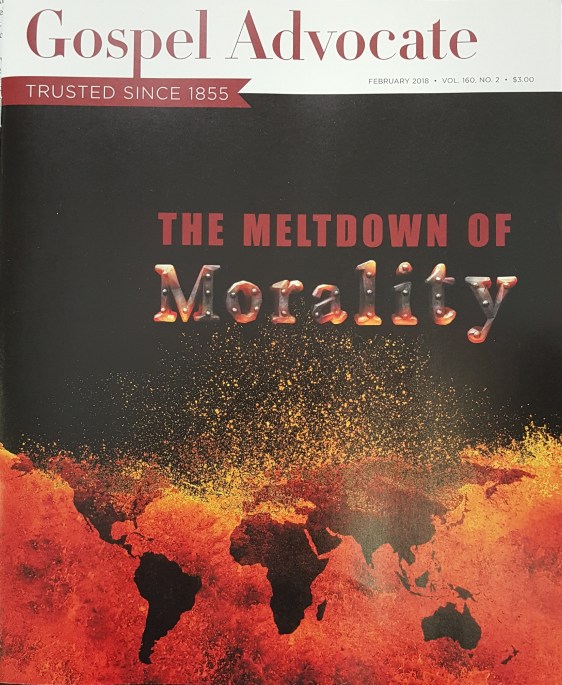
Reprinted with permission from the February 2018 issue of Gospel Advocate Magazine.

20180124_150851.jpg

Hebrews affirms, “For the word of God is living and active, sharper than any two-edged sword, piercing to the division of soul and of spirit, of joints and of marrow, and discerning the thoughts and intentions of the heart” (4:12 ESV). This is part of a warning in Hebrews, which affirms that Christians who defect from God will fail to meet their rest as their Israelite counterparts did (vv. 1-11). God holds his people —and His creation— accountable by His presence (“sight”) in the word of God (Hebrews 4:13). This is a raw incontrovertible truth.

This passage makes no caveats; it makes no attempt to remedy a distinction between God’s word and God’s presence. They are both manifested at the same time. God is involved with real life (time and space) with Israel and with Christians. God makes promises and keeps his word regarding their “rest,” and God holds His people and creation accountable to His word. God is Lord of heaven and earth and everything in between, and He holds it together by the power residing in Jesus (Hebrews 1:3; Colossians 1:17). The word of God is connected not only to the authority of God but also to His nature and how He reveals Himself to the world.

Let me say the above in a differently. Our God, who is beyond time and space (God’s transcendence), enters our earthly “realm” bound by time and space (God’s immanence) with His divinity and authority (sovereignty) intact; furthermore, God enters into relationship with His creation (Abraham, Israel, Christians) by revealing Himself in creation and in His word. God is active both in creation and in His word. Creation reveals God’s existence and hints at elements of His attributes (natural theology), but it is His word that reveals God and His “will” so that humanity can enter into covenant with God. The word of God was both proclaimed orally through particular spokesmen (patriarchs, prophets, kings, apostles), but the prophetic word was not only through oracles but also in written communiqués embedded with the same divine authority (2 Peter 1:16–21). These writings reveal the mind of God (1 Corinthians 2:11–16), His purposes and mystery (Ephesians 3:1–6), His involvement in human events (Acts 17:26–27), and the righteousness by which He will bring justice to the world (Acts 17:30–31).

To say it bluntly, the Bible is the word of God set in a permanent written form. Paul declared, “all scripture is breathed out by God” (2 Timothy 3:16). The Scripture bears the character of God and is no “dead” codebook, for it transforms every “man of God” into a competent, equipped servant (2 Timothy 3:17). The profitability of all Scripture is due to its quality as “God’s breath.” There is no pecking order between the spoken or written word of God. The inspired written word is as inerrant as God’s character. There is no source outside of the Holy Spirit-given Scripture that speaks God’s transforming work since it is the depository of the gospel’s message. What the word of God promises, God will do; what God proclaims, God’s holds His creation accountable to (1 Thessalonians 2:13).

The above may seem to belabor the point, but as anticipated by the title of this piece, we will sketch how the word of God is handled among Liberal (Modern) and Neoorthodox influences. It is essential for the church to reflect on these twentieth-century influences because dialogue is healthy, truth has nothing from which to hide, and any redefinition of biblical Christianity must be given due consideration (Galatians 1:6-7).

The following historical sketches will probably not satisfy everyone, but they will be enough to see their direction and how they redefine significant elements of historic Christian beliefs and their tendency to subvert scriptural authority.

Liberalism/Modernism

The word “liberal” is a very loaded word. It is often used with contempt to show disapproval of someone else thought to be progressive (instrumental music, expanded role of women, etc.). But this is not the historic sense of the word. Liberalism emerged in the late nineteenth century through the interplay of many players, thinkers, and philosophical trends. The influence of Liberalism, or Modernism, is seen in three levels: (1) revelation is not the final answer to reality, (2) naturalism is the key to reality and religion, and (3) since the Christian documents are built on ancient myths and superstitions, the historic supernatural claims of Christianity is immaterial. To be a “Christian” is a matter of experience and the “essence” of its teaching.

Liberalism, as an intellectual revolution, is a child of the Age of Reason (the Enlightenment). The “Age” saw the elevation of human reason over the institutional “church,” which wielded divine revelation. It was “the church” that dictated to the people what to believe about reality. Divine revelation was the final answer to determining truth and what really happened in the past. This was displaced with rationalism, scientific history (criticism), and naturalism as final answers to genuine and authentic history and truth. In essence, as Stanley Grenz and Roger Olsen point out, the maxim “I believe in order that I may understand” was turned to “I believe what I can understand.”[1] Faith was overturned by a reason informed by modern findings — thus, this point of view is called “Modernism.”

Everything that was received as genuine knowledge, now, was shaped by the natural world. This was further supported by what is called “the principle of analogy,” popularized by the liberal theologian Ernst Troelsch (1865–1923), which argued that the present is the best way to understand the past. The consequence was detrimental in the extreme on the trustworthiness of Scripture. The supernatural elements interwoven in Scripture are, by definition, myths and superstitions. This meant that there are no miracles, no supernatural interventions by God, and no resurrection of Jesus Christ. Thus, many new schools of “criticism” emerged to study Scripture with mixed results.

This naturally led to an embrace of “the essence of Christianity” so long as reason and experience allowed. “Liberals” are open to the modern findings from the natural world, open to a religious humanism and science —in particularly embracing Darwinian evolution as the process by which God created. If God exists, He could only be revealed through religious “experience.” It was also immaterial if the events of Scripture happened or not because religion is a condition of the heart. Yet, the apostle Paul makes it abundantly clear that if the resurrection event has not occurred, both our preaching and faith are in vain and we are still in our sins (1 Corinthians 15:14, 17).

Another arm of Liberalism is the demythologizing of the New Testament pioneered by the “Form Critic” Rudolf Bultmann (1884–1976). Bultmann argued that historic person of Jesus is built on untrustworthy sources. The New Testament is Christian propaganda shrouded in the imagery of the Greek myths and Roman legends. As such, they are not relevant for faith nor spiritual truth claims. It is the symbolism that matters. Today, one only need to watch the latest “history” programming to find modern theological liberals interviewed. Theological liberalism has significant questions that need to be answered, but it brings Christianity to a logical dead end.

Neoorthodoxy

The Swiss theologian Karl Barth (1886–1968) ignited a movement when he published his commentary on Romans in 1919. It charted a new theological direction away from Liberalism/Modernism. Barth (pronounced “bart”) was not fond of the misnomer “neoorthodoxy,” but his strand of thinking regarding the meaning of “revelation” and “the word of God” would rival the prevailing traditional belief held historically by the church. As a consequence, many regard Barth as one of the great theologians and the father of modern theology.

Orthodoxy affirms the teaching of historic Christian truth based on Scripture. This includes, for example, the following concepts: the inerrant inspiration of scripture, the triune Godhead, the deity and virgin birth of Christ, the historic creation and fall of humanity, the bodily resurrection and ascension of Christ, the return and final judgment. Barth argued, on the other hand, that “revealed truth” was not written, but was the outcome of an encounter (an experience) with God. Thus, instead of scripture as being the objective word of God, Barth argued for a subjective experience with God initiated by reading the Bible.

Barth was offering a completely different course of thought altogether. “Revelation” does not appear in the form of propositional truths. Arguing book, chapter, verse, or appeals to the very words of scripture is insufficient to reveal God. Revelation (the word of God), it is argued, is an “event” in which God acts in history (God’s immanence). Barth even argued that revelation is not found in natural theology (Acts 17; Psalm 19; Romans 1) but, instead, in events like the call of Abraham, the exodus, and the resurrection. Millard Erickson is spot on when he classifies Neoorthodoxy as an illumination theory divorced from an objective standard.[2]

Although Neoorthodoxy is not a unified movement, there are three interconnected witnesses (modes/forms) that shape its view on revelation.[3] First, Jesus is the word of God in the truest sense, for He reveals God in the event of His incarnation, life, ministry, death and resurrection. This is true revelation, the very gospel. Second, Scripture points to Jesus but it is a flawed human (read “errant”) attempt to provide a witness to divine revelation. It is instrumentally God’s word but not properly. Third, the proclamation within the faith community —Barth preferred “community” to church— is likewise instrumentally God’s word. The Bible, then, only becomes God’s word when God uses it to reveal Jesus Christ in the encounter, contrary to 2 Timothy 3:16.

In fact, Neo-orthodoxy is quite a popular approach to handling the Word of God, even among churches of Christ. A popular theological branch of this movement is “Canonical Criticism,” popularized by the late American scholar Brevard Childs (1923–2007). It seeks to broadly bypass much of the liberal destructive criticism of the twentieth century by accepting the texts of Scripture as literary units. Nevertheless, this point of view struggles, as did Barth’s, to embrace the Bible as a very human (errant) book while appealing to its authority for theological thought as if they were inerrant. They seek, in the words of one sympathetic Abilene Christian University professor, to “articulate a doctrine of Scripture that recognizes human flaws in it.”[4] Treating the Bible as an inerrant text is simply a form of bibliolatry.

Keeping the Faith

Today, the phrase “Word of God” means different things to different believers, and that includes preachers. Liberalism ultimately rejects a supernatural Christian faith, and is at home with amputating its historic claims of a resurrected ascended Lord Jesus, in exchange for a subjective diluted Christianity. Neoorthodoxy, on the other hand, embraces a supernatural Christian faith, but it rejects the supernatural origin, inerrancy, and authority of the Scriptures which undergird its claims. The Word of God has always been a manifestation of God’s presence in our lives, in His proclamation, and in His Scripture without pecking order. Let us join Paul who declares, “Let God be true though every one were a liar” (Romans 3:4).

Notes

  1. Stanley J. Grenz and Roger E. Olsen, 20th Century Theology (Downers Grove: InterVarsity, 1992), 17.
  2. Millard J. Erickson, Christian Theology, 3rd ed. (Grand Rapids, Baker Academic, 2013), 220–21.
  3. Karl Barth, Evangelical Theology: An Introduction, trans. G. Foley (New York: Holt, 1963), 26–36.
  4. Christopher Hutson, “Scripture as the Human Word of God: Why Faith Contradicts Inerrancy,” Lexington Theological Quarterly 44.1 (2011): 210–21. Hutson serves as a professor of ministry and missions at Abilene Christian University.

To subscribe to Gospel Advocate, click here.


Christian Character During Tough Times (2 Pet 1:1-11)

Introduction

Someone has coined the phrase, “tough times never last, but tough people do.” As the years pass and the hurdles of life with them, this axiom becomes profoundly evident. Life is relentless, however, in its daily dosage of aches and pains – on all fronts.

Sometimes people flail their arms up and give up, feeling helpless. But, for those who are disciples of the Christ, a renewable source of strength and comfort is available: the apostle Peter says that we have been granted “all things that pertain to life and godliness” (2 Pet 1:3). This is the power of incorporating the word of God into a person’s life.

At some time near the end of his life, the apostle Peter dispatched a letter to a church suffering internally because of a number of false teachers were spreading immorality, anti-authoritarianism, and skepticism (2 Pet 2-3). It was, therefore, essential to stay grounded in the true knowledge. These Christians must carry the truth of the gospel in the one hand, and maintain a well rounded Christian lifestyle on the other hand.

In articulating these important instructions, we have been bequeathed a treatise that provides guidelines for developing Christian character during tough times. Tough times manifest themselves politically, socially, familially, spiritually, and emotionally. As in the first century, the contemporary climate of immorality, anti-authoritarianism, and skepticism is prevalent; and likewise, the inspired apostolic instruction is as relevant as when it was first composed nearly two thousand years ago!

To be sure more could be said; however, reflect on these quick notes on a section of Scripture that is often labeled “Christian Graces,” and in so doing perhaps this study will achieve its goal. The goal is to be more mindful of growing as a Christain (2 Pet 1:3-7), and to realize that being active in this process underscores our awareness of the redemption we have received in Christ (2 Pet 1:8-9). May the Lord bless you, as you strive to make your calling and election sure (2 Pet 1:10-11).

Greeting (2 Peter 1:1-2)

Simeon Peter, a servant and apostle of Jesus Christ, To those who have obtained a faith of equal standing with ours by the righteousness of our God and Savior Jesus Christ: May grace and peace be multiplied to you in the knowledge of God and of Jesus our Lord.

Unlike modern letter writing standards, ancient letter writers put the author’s name first, followed by some reference that connects the author and the readers. Peter calls himself a servant and apostle, two terms that are quite descriptive. As a servant (the word used for slave), Peter stresses his submission to God and his disposition regarding his ministry to others. The word apostle stresses his spiritual commission to represent God as His ambassador to the world, delivering His message exactly as God empowered him.

The readers are those who share the same faith as he does, they are on “the same level as the author.”[1] Here we find the principle of equality of a faith to be shared. This faith is personal, as developed with their relationship with God and Jesus. Then consistent with ancient letter writing, Peter sends them a greeting. Grace is usually seen as the Greek salutation while peace is typically considered to be the Hebrew way of saying hello. Consistent with the themes of his letter Peter sends this greeting in the knowledge of God and of Jesus our Lord.

3-4: The Basis for Godly Living

His divine power has granted to us all things that pertain to life and godliness, through the knowledge of him who called us to his own glory and excellence, by which he has granted to us his precious and very great promises, so that through them you may become partakers of the divine nature, having escaped from the corruption that is in the world because of sinful desire.

Peter continues the theme of knowledge and says that it is through Christ’s divine power (God-based ability), that Christians have been given access to all things that pertain to life and godliness. Christians cannot have the latter without the former. In agreement is Frederic Howe, we conclude that Christians must learn that “the ultimate condition, prerequisite, or essential foundation for holiness in the believer’s life is God’s divine power.”[2]

The Christian has this access through knowledge, but this is not simple knowledge, it is the knowledge of him who called us to his own glory and excellence. The reference to his glory and excellence is a “pointer” to which our calling finds completion -to abide with God. Yet this final reality can only be obtained in a life governed by knowledge of the Savior and his teaching.

Knowledge has given us his precious and very great promises, which are the means by which God allows us to become partakers of the divine nature (i.e. to share the holy nature of God). Modern man -even the modern Christian- may feel skeptical about this promise,[3] but it is a promise that in some way those who are faithful will “like him” in the immortal state (1 John 3:2). This holy nature is obtained as one learns how to escape from the corruption that is in the world because of sinful desire. Christians are expected to employ God’s knowledge to do this, holiness will not happen by accident.

5: Faith, Virtue, and knowledge

For this very reason, make every effort to supplement your faith with virtue, and virtue with knowledge,

Naturally, since the Christian aim is to escape the corruption of this world and partake of the divine nature through knowledge, Peter provides a list of “virtues” that must be added to one’s lifestyle in order reach these goals.

The virtues described in the chain in 1:5-7 not only are holy actions, but the very chain indicates the fullness of holiness that they must strive for. Thus those who seek them will be completely holy.[4]

In fact, the word supplement implies that “the believer contributes lavishly to the work of his salvation.”[5] Christians must contribute faith with virtue; moreover, this faith is probably the same referred to earlier -a personally developed reliance upon God- that must be contributed to with virtue (moral excellence).[6]

Furthermore, Christians are to supplement their moral excellence with knowledge, meaning that they are to have knowledge in the “how to’s” of a godly life. Contextually, this knowledge is what allows Christians to become partakers of the divine nature, after escaping the corruption that is in the world because of sinful desire.

6: Self-Control, Steadfastness, and Godliness

and knowledge with self-control, and self-control with steadfastness, and steadfastness with godliness,

In addition to moral excellence and knowledge, to become completely holy and capable of partaking of the divine nature, the Christian is to assume the development of self-control, steadfastness, and godliness. Instead of self-control, some translations have the word temperance (KJV), but this is inaccurate since “temperance” usually implies a self-imposed censorship against alcohol. The Greek word in the text means, “to exercise complete control over one’s desires and actions – ‘to control oneself, to exercise self-control.’”[7] The overarching theme of self-control is one’s ability at self-mastery – i.e. self-government.

Next, is the idea of bearing up courageously under suffering, here translated steadfastness.[8] Perhaps this word provides a better hint of the local situation of Peter’s audience:

The need to persevere is particularly important in the situation Peter addressed, for the opponents were threatening the church, attracting others to follow them (2:2), so that some who began in the way of the gospel had since abandoned it (2:20-22).[9]

And then, disciples of Jesus are to supplement their behavior with godliness. One would think that this exhortation is unnecessary since the whole list of virtues revolves around the idea of devotion towards God in such a way where one “does that which is well-pleasing to Him.”[10] But this list of virtues would be incomplete without such an important inclusion of a vital virtue.

7: Brotherly Affection and Love

and godliness with brotherly affection, and brotherly affection with love.

The last two virtues of Christian godliness are brotherly affection and love, elements which are of special consideration because there is a distinction being made here between the two. Brotherly affection (philadelphia) is mutual love, while purposeful love (agape) is more encompassing because it requires self-generated love directed consistently upon another with their best in view.

Fred Craddock discusses these words in the following way:

Mutual affection is literally ‘love of one’s brothers and sisters’ (philadelphia) and is an essential component of church life. But that is just the point: mutual affection, reciprocal love, pertains to life in the church, to the fellowship. Beyond that, however is love, agape. Love does not require reciprocity; it includes the stranger, and even the enemy. It behaves favorably and helpfully toward the other regardless of who the other is or what the other had done.[11]

Sometimes the differences between these words are overstated, but these words of filial and “purposeful” love simply accentuate important capacities a person must engender in order to be a well-rounded Christian. We must be able to embrace the love (philadelphia) that comes easiest to us (usually familial love), and likewise be able to love on a deeper spiritual level – a beneficent love (agape).[12]

8-9: The Importance of these Characteristics

For if these qualities are yours and are increasing, they keep you from being ineffective or unfruitful in the knowledge of our Lord Jesus Christ. For whoever lacks these qualities is so nearsighted that he is blind, having forgotten that he was cleansed from his former sins.

Peter does not hold back here, where people are prone to; instead, he affirms clearly that these things -qualities- must be in the Christians possessions and in the process of development. In so doing, he affirms, they will keep you from being ineffective or unfruitful in the knowledge of our Lord Jesus Christ. Peter does not let loose of two concepts -godly living and knowledge- for the two are joined at the proverbial “hip.”

This stands more clearly in stark contrast to the false teachers in chapter 2. Rigorous training and development in godly behaviors assure one that they will not become “useless and unproductive” in the joys that exist in the knowledge of our Lord Jesus Christ.

A strong warning is made against those who would lack these qualities, stressing that to lack these qualities are the result of forgetting that a person’s sinfulness was forgiven and that these sins represent one’s imperfection and need to develop morally. Failure to do this will be detrimental to one’s calling and election.

10-11: Making Your Calling and Election Sure

Therefore, brothers, be all the more diligent to make your calling and election sure, for if you practice these qualities you will never fall. For in this way there will be richly provided for you an entrance into the eternal kingdom of our Lord and Savior Jesus Christ.

Because of the dangers that inhere should a Christian not develop these qualities of godly living, Peter warns with a logical conclusion, be all the more diligent to make your calling and election sure.[13] The answer to the question “why?” is provided, for if you practice these qualities you will never fall. It is crystal clear that Peter is demonstrating that one’s salvation can be a fragile thing should one neglect personal development.

Neglect will give way to falling, and contextually, this fall refers to one’s failure to enter into the eternal kingdom of our Lord and Savior Jesus Christ. Peter even affirms, by supplementing one’s life with godly characteristics, one will be richly provided an entrance into this kingdom; however, failure to do this makes this entrance void – it is not just the richness of the heavenly entrance being considered, it’s the entrance into heaven itself.[14] And here we see another major crack in the veneer of the Calvinistic error “Once Saved, Always Saved”.

Conclusion

2 Peter places a high premium on knowledge, especially as it pertains to knowledge and morality, and knowledge and truth. True knowledge appropriately originates from God and of Jesus our Lord and provides the proper framework for the development of godly living. This knowledge is now collected in the 27 documents of the New Testament, as the final revelation of Jesus Christ (John 16:13; Heb 1:1-2).

Guy N. Woods once observed that in this passage a godly character is developed and revealed in the person of deep Christian virtue: (1) those which are necessary to form the Christian character, and (2) those traits which reveal a follower of Christ to be a genuine servant of God.[15]

One of the most striking things about this section of Scripture is the methodical response of the Christians against the false teachers. It was not a brutal attack by physical force – a literal blow by blow as they stand toe to toe. The Christians were to respond with godly character, with love and truth. Viewing this life as concluding with the final judgment, only godly conduct will withstand the type of final exam the Divine Tribunal will release (2 Pet 3:9-13).

Finally, recalling the problem facing the group of Christians of 2 Peter was internal church problems of false teaching manifested in immorality, anti-authoritarianism, and skepticism (2 Pet 2-3). The best way, it seems, to outlast troublesome times, is to endure and become spiritually tough. This is precisely Peter’s point. False teachers with their troubles will come and go, but spiritually tough churches will last and last because they are grounded in godly knowledge and have kept their calling and election sure. And for that matter, so will spiritually tough Christians!

Sources

  1. Pheme Perkins, First and Second Peter, James, and Jude (Louisville, KY: Knox, 1995), 167.
  2. Frederic R. Howe, “The Christian’s Life in Peter’s Theology,” BSac 157 (2000): 307.
  3. Perkins, First and Second Peter, James, and Jude, 169; Guy N. Woods, A Commentary on the New Testament Epistles of Peter, John, and Jude (Nashville, TN: Gospel Advocate, 1991), 149.
  4. Jerome H. Neyrey, 2 Peter, Jude: A New Translation with Introduction and Commentary (New York, NY: Doubleday, 1993), 154. Michael Green’s observation of the use of the Stoic practice of making similar virtue lists, and comments, that the “practice of making lists of virtues was already well established among the Stoics, who called it a prokope, ‘moral advance.'” This is not an attempt to make the church thinking like the world (i.e. the Greek world), but to use a familiar practice and leverage its familiarity to equip these Christians to embody Christian character (The Second Epistle of Peter and the Epistle of Jude [Grand Rapids, MI: Eerdmans, 2002], 75-76).
  5. Simon J. Kistemaker, Exposition of the Epistles of Peter and the Epistle of Jude (Grand Rapids, MI: Baker, 1987), 251.
  6. Barclay M. Newman, Jr., A Concise Greek-English Dictionary of the New Testament (Stuttgart: Deutsche Bibelgesellschaft, 1993), 24.
  7. (L&N) Johannes P. Louw and Eugene A. Nida, Greek-English Lexicon of the New Testament Based on Semantic Domains, 2d ed. (New York, NY: United Bible Societies, 1989), 1:751.
  8. William E. Vine, Merrill F. Unger, and William White, Jr., Vine’s Complete Expository Dictionary of Old and New Testament Words (Nashville, TN: Nelson, 1984), 2:200.
  9. Thomas R. Schreiner, 1, 2 Peter, Jude (Nashville, TN: Broadman & Holman, 2003), 300.
  10. Vine, Vine’s Complete Expository Dictionary, 2:273.
  11. Fred B. Craddock, 1 and 2 Peter and Jude (Louisville, KY: WJK, 1995), 101.
  12. Michael Green has a worthy quote on agape and philadelphia: “This word agape is one which Christians to all intents and purposes coined, to denote the attitude which God has shown himself to have to us, and requires from us towards himself. In friendship (philia) the partners seek mutual solace; in sexual love (eros) mutual satisfaction. In both cases, these feelings are aroused because of what the loved one is. With agape, it is the reverse. God’s agape is evoked not by what we are, but by what he is. It has its origin in the agent, not in the object. It is not that we are lovable, but that he is love. This agape might be defined as a deliberate desire for the highest good of the one loved, which shows itself in sacrificial action for that person’s good” (80).
  13. Perhaps no one word is so misunderstood as the term “called” in the New Testament. Essentially, the church is a group of individuals called out to assemble into a congregation (ek, out of, plus kaleo, to call = ekklesia). A person is called by the Gospel (2 Thess 2:14) and becomes a member of the church (a called out group) through immersion for the forgiveness of sins (Acts 2:38-47; Gal 3:26-29 – notice the transitional tenses – “you are” because “you were”).
  14. Kistemaker, Exposition, 257-58.
  15. Woods, Peter, John, and Jude, 152. Woods hand selects which virtues form character and which other virtues reveal genuine discipleship, and here we must disagree because such a segregation is artificial, and not natural with the flow of the passage. In fact, there is the reason to believe that the list of eight virtues is consistent with a literary form called sarites, “in which we have a step-by-step chain that culminates in a climax” (cf. Schreiner, 1, 2 Peter, Jude, 297). At any rate, we agree with Woods’ observation – albeit modified to be descriptive of all the virtues enlisted by the apostle.