The Gospels: Reading Them Like a Gorilla

Matthew, Mark, Luke, and John are four stories about Jesus that offer four broad perspectives from which they tell specific stories with a “powerful realism” about his ministry, teaching, healings, rejection, crucifixion, and resurrection.[1] This much is very clear. Questions emerge about the genre, historicity, chronology, stages of oral transmission, and history of literary dependence (e.g., “did Matthew and Luke rely on Mark?”), but at the heart of what the gospels are is Jesus and the stories told about him.

I have been reading and studying the four gospels for about a quarter-century, first, as a young Christian, then in my on and off again academic pursuits, and as a local preacher. During this time I’ve arrived at some important conclusions about them:

  1. The genre of “gospel” is historical narratives comparable to the Greco-Roman bios.
  2. The gospels are a blend of theology and history.
  3. This blend of theology and history does not undermine their historical reliability.
  4. The gospels provide a holistic view of Jesus, we cannot pick and chose what is the “authentic” Jesus.

But there was a time I was unaware of Rudolf Bultmann’s (1884–1976) demythologizing existential approach to redefining the meaning of the supernatural elements from the Gospels, and other approaches birthed by liberalism and modernism to reading them. It was a time when I was oblivious of the historical/grammatical-critical approach to studying them with the tools of form criticism, oral-tradition criticism, literary criticism, and so on. I’ve benefited deeply from the types of questions they raise and the kinds of answers they seek to provide.

This essay is not about this process, however. Instead, I am sharing what I can recall from my experience of reading the Gospels as “a knucklehead from the streets” searching for God. I want to share this personal journey while I can still remember how reading the gospel lead me to find God in Jesus Christ and how Jesus’ life and teachings made me want to follow him.

My Background

Here are my “credentials” for the spring of 1996 when I was seventeen: A high school dropout, a three-year freshman, most days starting with cutting school, drinking, smoking weed, and roaming the parks or streets (in that order). In the columns for attendance and absences on my report cards, my poor mom thought they made an error because the numbers looked swapped.

Then there was my street life in a gang. Street fights and violence, jumping over backyard fences running from the police (and dogs), plotting to hurt “heads” from other gangs, all-nighters, drug use, sex, and on and on it went. I am not proud of it, but I ran with my homies and we were “tighter than a glove,” I had my “street-cred,” I earned my stripes, and many can vouch for that.[2] They called me, “Gorilla.”

I grew up in Roman Catholicism. I was christened as a baby at St. Charles on South Van Ness in the Mission District of San Francisco, CA. Although my family is from the Mission, my Abuela brokered a deal so I could attend an Irish Catholic parochial K-8 school in Noe Valley. I wish I could tell you anything I learned in religion class to help me read scripture but I can’t. I can say, the rituals really stuck. I was an altar boy. I know the “Our Father,” the “doxology,” the two “Hail Marys,” parts of the Catholic Apostle’s Creed, and I can genuflect with the best of them. I did my confirmation. I prayed my penance prayers after confession.

I do not however recall ever being taught how to read Scripture, that was the priest’s job. So when I started reading the Bible years after leaving the Roman Catholic Church following 8th grade and diving right into drug use that summer with acid, I had no strategies to work with except my basic education and common sense. I was seventeen years old, getting sober, and walking away from vice and violence. I cried out to God in prayer on the corner of 24th and Mission Streets: “I don’t know how to do this, but I’m going to look for you…. Can you meet me halfway?”

Things did not immediately change for me outside of me stepping away from the streets until one night I went out with my boys. While I was scrambling to get my outfit right, I looked under my bed to find my shoes: Air Griffey Max 1. Behind my shoes, under my bed, was a small Gideon New Testament I had no idea was sitting there amidst the dust and trash. I took the discovery as God prodding me, in effect saying, “I just did my part, now you do your part and start reading it.” I grabbed it. Looked at it with a smirk. Looked upwards and said, “Okay, God, I’ll start reading it.”

I started reading the Gospels and after a few months of reading the stories about Jesus, in December 1996, just after Christmas, I gave my life to Jesus and submitted to baptism in an outdoor hot tub (to learn more read: “Leaving a Street Gang for Jesus“). Up to this point, I had not entered a church, I had not participated in any evangelistic study material outside of some creepy Jack T. Chick (1924–2016) “Gospel” Tracts. I simply read the Gospels and they were sufficient to guide me to obey God.

So here are some things I recall from this several-month journey as a street gang knucklehead,[3] with an eighth-grade education, working through a period of “getting clean.”

Reading the Gospels at Face Value

Let me be clear, I have always been a believer even when I left God and did my thing. If I ever was going to return to religion it was either going to be Christianity (starting point) or Islam (due to some of my closest Egyptian, Palestinian, and Persian friendships at the time). If God exists, then the miraculous is possible. When I read Matthew, Mark, Luke, and John, then, I believed the miracles contained in them were possible. I read them at face value.

Today, naturalism may be how many more approach a book like the Bible. For them, the door is closed to anything miraculous in the literal sense (i.e., the blind will never see, the cripple will never walk, demons are not exorcized, water is not turned to wine, the resurrection of a corpse does not happen). I did not approach the Gospels with this assumption. How could I, I called on God to find me!

Today, I recognize such an approach may be called a supernatural naivete (superstitious), but after studying worldview, the logical consequences of naturalism/materialism on ethics and morality, and dealing with the dismal outlook of living in an indifferent universe, keeping the door open to the possibility of the miraculous continues to make the most sense of the evidence in this world.[4]

Today, having worked through issues surrounding the critical study of the Scriptures, along with its anti-supernatural biases, its “mythology” and de-historicizing its narratives, it is clear that such a folklore Jesus would be a dead end. If the Jesus of the gospels does not exist then there are plenty of other historical fictional, or sci-fi, figures of virtue on their own “hero’s journey” I can enjoy instead. A fictional gospel reveals a powerless Jesus.

I believed God was working through Jesus in reality, and it led me to believe that his power could be applied to my own life in some healing way.

Jesus was Compassionate and Morally Firm

I had never read the gospels. I grew up on liturgy and tradition. Liturgy and tradition can be helpful as a tool for theological reinforcement, but it has significant limitations. For the most part, I just “knew”–as best I could know–Jesus loved me and died for me. But why, and why the cross? And is this what Christianity is all about, the story of an executed man? What about this has to do with me? And what would I learn about Jesus?

Again, I was, in the words of Ben Witherington, III, living a “Jesus haunted and biblically illiterate” life.[5] At the time, Jesus was the guy that died for me. I grew up reciting the “Stations of the Cross” every year in Mass. These 14 liturgical meditations commemorate the condemnation, death, and burial of Jesus (though I distinctly remember meditations of his resurrection).

So, I opened up that little New Testament with the small print to see where it would lead me.

I wasn’t sure what to expect. I was however truly surprised by the Jesus I was reading about. He drew me in. I was slightly expecting Jesus to be like the street preachers on my block. Those “bullhorn guys” yelling at the top of their lungs, telling us all that we are sinners, that we are all under the judgment of God, that regardless if you were eating donuts, McDonald’s, a burrito, going to the market, or selling weed, it didn’t matter because God hated us until we repented.

That is not at all what I found!

The Jesus of the gospels did not shy away from pointing to sin in people’s lives, but when he did so you knew he cared about you, you knew he had spent days with the sick to heal them, with the crippled making them walk, with the demon-oppressed liberating them of these evil spirits. He spent time with the kind of people the “really religious” types pushed aside, like the prostitutes and tax-collectors who wanted God.

In one instance, a woman from the city, known as a “sinner” (she likely had a bad reputation as a violator of the law of Moses), came to Jesus to show gratitude because he had forgiven her of her sins (Luke 7:47–48). The Pharisee who hosted Jesus in his home for dinner when this happened, reacted: “If this man were a prophet, he would have known who and what sort of woman this is who is touching him, for she is a sinner” (Luke 7:39). She was undesirable, not to be engaged. Jesus however acknowledged her morally troubled past, accepted her, and forgave her of her sins.

Like a protector walking among his people, Jesus offered those that would listen to him a better way of life.

Again, Jesus healed a man who could not walk and had been that way for thirty-eight years (John 5:1–9). Later He ran into him when the man was under scrutiny by some Jews because it happened on the Sabbath. “Afterward Jesus found him in the temple and said to him, ‘See, you are well! Sin no more, that nothing worse may happen to you’ ” (John 5:14 ESV). Jesus heals the man, helps the man, forgives the man (implied), but is morally firm: sin no more.

I really needed and wanted a guide out of all the darkness and evil I was in. I knew I had dug a deeply immoral hole. I said to myself, “Jesus has gotta know my situation… and he knows what it’s going to take to get out of it.”

Meeting Jesus in the Gospels was a real turning point for me. I was moved. Reading that Jesus was the type of person that got to know you, your life, your darkness, and was not afraid to touch it as he embraced you, and then led you out of the sin in your life so you can live a liberated life before God. He was compassionate and morally firm.

Jesus’ Inspiring Inner Strength

The 1990s rap scene was flooded with “gangsta rap.” It was not the only form of rap, but like the “consciousness” of hip hop, this movement provided a peek into the mind and mental of street life. It spoke to what many of us were living through to different degrees. In 1995, the Westcoast hip-hop artist Coolio released the massively successful commercial single, “Gangsta’s Paradise” the theme song for the film, Dangerous Minds (Buena Vista Pictures). I recall me and my homies could not get enough of it. In fact, I called the hip hop station 106.1 KMEL on the request line just to hear it again. It was “the jam.”

It was more than just music, it was a mirror of our experiences. I say that because Coolio says what we all understood about respect in the street. Respect and honor were set on a hairpin trigger. When Coolio dropped this line, it was “gospel”:

But I ain’t never crossed a man that didn’t deserve it
Me be treated like a punk, you know that’s unheard of
You better watch how you talkin’ and where you walkin’
Or you and your homies might be lined in chalk

Coolio, “Gangsta’s Paradise”

This was not mere poetry this was street truth. Outside of joking around, you don’t cross your boys or disrespect people. Did it happen? Sure, but there were consequences.

So when I read the gospels, I brought this attitude with me. Call it machismo, call it pride, call it hubris. Somebody hurts your kin, the next time you see that person you confront them, punk them (embarrass them), and flex your muscle.

I was impressed with Jesus. When he interacted with the religious leaders of his day–the Pharisees, scribes, and Sadducees–who constantly poked at his school, his teaching, his methods, and his compassion, I stood amazed at how he handled these tests with an inner strength of truth and grace.

I definitely rallied behind him when Jesus flipped over the moneychangers’ tables at the temple, they had turned the place into a “den of robbers.” That language made sense to me. But Jesus was mild compared to what power he clearly had.

And he entered the temple and began to drive out those who sold access to God, saying to them, “It is written, ‘My house shall be a house of prayer,’ but you have made it a den of robbers.” (Luke 19:45–46)

He made a statement. He didn’t end them. That’s the difference.

But for every other challenge, every criticism, every rejection, every attempt on his life, every time Jesus was made out to be crazy, a fraud, a violator of the Scripture, or liable as an ally of Satan, Jesus responded with words to clarify, words to unite, words bluntly stating the obvious, and words that demonstrate the faulty logic, scriptural inconsistency, or the like.

Basically, Jesus was full of zeal but kept his cool nonetheless (John 2:17).

Consider the fact that the gospels report that Jesus could walk on water, make water into wine, give people their sight back, restore the skin of leprosy, and revive the dead.

A man with that kind of power could be tempted to abuse it, but as the temptation in the desert points out, Jesus’ power did not outpace his character (Matt 4:1–11; Mark 1:12–13; Luke 4:1–12). When Jesus was rejected by the Samaritans, he rebuked his disciples for suggesting he retaliate with fire from the sky.

And when his disciples James and John saw it, they said, “Lord, do you want us to tell fire to come down from heaven and consume them?” But he turned and rebuked them. And they went on to another village. (Luke 9:54–56)

Jesus showed strength in order to protect people, in order to speak truth to error, and authenticity to hypocrisy. I was captivated by his ability to hold it together when he was betrayed by Judas, when he was lied about in his Jewish “trial” before Caiaphas, when he was publically humiliated by the Romans, publically rejected by the Jewish mob with their frenzied chant, “crucify him, crucify him.” Jesus clearly stated he had the power and authority to be delivered by an overwhelming show of heavenly force (John 18:1–19:16a), but he did not.

I stood in awe at Jesus’ character. Jesus was dismissed by those who knew the Scriptures until the only way they thought they could silence him was to kill him. Here’s the part that really put this strength in context: Jesus predicted his betrayal, his rejection, and his death. John foreshadowed this in his prologue: “He [Jesus] came to his own, and his own people did not receive him” (1:12). He walked right into the fire.

I never heard of anyone who lived like that. Jesus was street-level “hard” (tough) in a way I had never seen. Jesus’ inner strength told me I could trust him. That’s the point.

In describing Abraham Lincoln, Robert G. Ingersol (1833–1899), was recorded in Wisconsin State Journal (16 January 1883) saying,

If you want to find out what a man is to the bottom, give him power. Any man can stand adversity — only a great man can stand prosperity. It is the glory of Abraham Lincoln that he never abused power only on the side of mercy. [Applause]. He was a perfectly honest man. When he had power, he used it in mercy.[6]

Robert Ingersol, Wisconsin State Journal (1883)

Whether that was always true of Abraham Lincoln, I’ll never know. But I trusted what I saw in Jesus’ use of power and in the realism of the stories of the gospels. I needed to trust him. I grew to trust him. I trust him still. And in the quarter-century of serving him, he has done no wrong.

Spending Time with Nobodies

In the 1991 urban drama, Boyz n the Hood (Columbia Pictures), director and writer John Singleton (1968–2019) presented a raw depiction of urban violence, racism, and gang culture as the backdrop for the coming of age stories of a group of childhood friends, notably two brothers (“Doughboy” and Ricky) and their close friend Tre. The impact of drugs and violence on the black community of South Central Los Angeles is seen as we follow these friends who grow up fast to survive–only to become victims of their own turbulent world.

After a confrontation between Ricky–a high school football star on track to receive a college scholarship– and a local gangster, the matter escalates into Ricky being gunned down in an alley while coming home from the liquor store. Doughboy and his own crew retaliate that night by killing the gunmen and his posse for killing his brother. In the next scene, the next morning, Doughboy comes out of his home, sells some crack as he crosses the street, and sits with his friend Tre.

In one of the most memorable moments in the film Doughboy says:

Turned on the TV this morning. Had this s— on about how we’re living in a violent world. Showed all these foreign places. How foreigners live and all. I started thinking, man. Either they don’t know… don’t show… or don’t care about what’s going on in the ‘hood. They had all this foreign s—. They didn’t have s— on my brother, man.

“Doughboy” in Boyz n the Hood

Although I was twelve when the movie came out, the movie has the proven realism of its era. What Singleton is voicing through Doughboy is that even though there is violence in the street of our communities, nobody cares about it. It is happening over there, not in our backyard. We put a spotlight on global violence but not in our own communities. We know it happens and the police are doing “something” about it. But it is not worth talking about or getting involved with.

Here’s my point: street life is a very different world. No matter what your starting point is, once you commit to it you live a life on the fringe. The police are not your friends. You can easily lose trust with your own people. You’re the boogeyman parents warn their kids about, “come home soon so nothing happens to you.” You are the reason they need to be careful.

For example, one day I was detained with a group of “us” by the San Francisco Police Department on 24th Street. Officer Callejas who put the twist on me was the father of a childhood friend. A bunch of us were thrown into a “patty wagon,” taken to the Mission station on Valencia Street. You really get a sense of how you are thought of in situations like this. Any mistreatment was seemingly justifiable because we were thugs who likely assaulted a little boy for his shoes. No one really cares when you are a thug. I get why, but it is still the truth.[7] We were probably guilty of something and the pain was just part of the business of the street: we felt like nobodies cause we were treated like nobodies.

Liberal New Testament scholar John Dominic Crossan (1934–) once described the “kingdom of God” Jesus focuses on as “a kingdom of nuisances and nobodies.”[8] That description really gets the point across. Crossan points to the fact Jesus spends a lot of time with the kinds of people the “clean” religious people would not associate with. The tax-collectors, the prostitutes, the sinners, the Gentile-tainted, the Samaritan, the lepers, the poor, etc., are all the kinds of people Jesus spend time with at the expense of criticism. This really spoke to me.

German theologian, Helmut Thielicke (1908–1986), really puts into words what I saw in Jesus:

[A]n ineffable love radiated from him, a love that quite obviously attracted from their usual haunts the very people whom nobody else cared for: people with loathsome, repulsive diseases, sinners who cowered before the contempt of society, the dejected and dismayed who normally concealed their misery from the eyes of others.[9]

Helmut Thielicke, The Waiting Father (1959)

Reading how Jesus ate with sinners just made me think that there was hope that he would share a seat with me at the dinner table. That he would come to my house and eat with me and my friends. Jesus put to those that criticized him for eating with sinners. He said,

Those who are well have no need of a physician, but those who are sick. I have not come to call the righteous but sinners to repentance. (Luke 5:31–32)

Would Jesus visit with me so he could heal me? I believed he would. He did. He continues to do so.

I am always amazed at the power of grace that allows us to be “other than we are.” God’s grace and forgiveness have empowered me to live a different life. No story Jesus told tells it better than the parable of the two sons:

“What do you think? A man had two sons. And he went to the first and said, ‘Son, go and work in the vineyard today.’ And he answered, ‘I will not,’ but afterward he changed his mind and went. And he went to the other son and said the same. And he answered, ‘I go, sir,’ but did not go. Which of the two did the will of his father?” They said, “The first.” Jesus said to them, “Truly, I say to you, the tax collectors and the prostitutes go into the kingdom of God before you. For John came to you in the way of righteousness, and you did not believe him, but the tax collectors and the prostitutes believed him. And even when you saw it, you did not afterward change your minds and believe him. (Matt 21:28–32)

Fringe people have an opportunity to be at the heart of what Jesus does. I wanted that.

Jesus Taught about Loving People

Sometimes I would leave the Mission and go with some of my fellas to the Tenderloin District of San Francisco at night. We had a friend with a car and we had a friend with a shop out there. The “TL” is a neighborhood district right in the heart of downtown. It’s the part of the city no one wants to get lost in, but so many people do. Legend has it that the name goes back to the largest bribes and police corruption, big cuts. In reality, it’s the home of “outcasts and outlaws, but it has also served as a welcoming home to the downtrodden and out of luck.”[10] It has been that way for a long time.

You always had to be on your guard in the streets but it felt that way even more so in the TL. I got into plenty of fights over misunderstandings. Sometimes you had to “knuckle up” to prove your point. Every now and then, something would happen that would disarm you. One time a parade of prostitutes hurried single-file by me into the back of the pizzeria I was eating at because the police were cracking down outside. That stuff makes you want to lose your appetite. Sadly, I eventually saw a few girls I went to high school with, out there in the TL “walking” the streets.

One situation really struck me. One night I watched a young girl call home to tell her folks that she was not coming back. A pimp had flipped her, she was gonna become of his girls. I can see her standing in a MUNI bust stop phone booth, surrounded by a bunch of guys as she said the following words:

Momma, don’t worry, I’m fine and I’m gonna make a lot of money…. No, tell dad I’m gonna be fine… he’s gonna take care of me, I’m going to be just fine… No, I’m not telling you where I am… he’s gonna take care of me…

Jane Doe calling home

“No, girl,” I said to myself, “No, he’s not.” You learn to get cold to things like this. I didn’t want to get played but if someone else did, that was on them. This moment, though, would eventually make me really question what it is I was becoming. One thing was certain, I was losing my humanity piece by piece I just did not know it yet.

So when I asked God to find me, and I started reading the Gospels, I learned that Jesus was all about loving his neighbor. What surprised me the most, and continues to be the challenge, is how Jesus applies the “love your neighbor” ethic. In the Sermon on the Mount Jesus said:

“You have heard that it was said, ‘You shall love your neighbor and hate your enemy.’ But I say to you, Love your enemies and pray for those who persecute you, so that you may be sons of your Father who is in heaven. For he makes his sun rise on the evil and on the good, and sends rain on the just and on the unjust. For if you love those who love you, what reward do you have? Do not even the tax collectors do the same? And if you greet only your brothers, what more are you doing than others? Do not even the Gentiles do the same? You therefore must be perfect, as your heavenly Father is perfect." (Matt 5:43–48)

When Jesus applies Leviticus 19:18 (“you shall love your neighbor as yourself”) to life, he said my neighbor was not just people I know but even people I hate, and people that hate me. That was a bitter pill to swallow. Looking back, even now, I have learned that this love even protects the vulnerable people in society (the poor, the blind, the deaf; cf. Lev 19:13–14). In a world where hate and anger were the fuel that drove my choices, I thought about how different my choices were going to have to be. I realized that I could not follow Jesus and stay in the gang, that I could not be in a “me vs. them” world. Most of the time I did not even know who the people I hated were.

I was starting to see that the world could be different. That I could be different. God was good to me despite all the things I had done. He gave me the sun, the rain, the wind and rain, different escapes from certain death, and my close trusted cholos over Frisco. I did not know it then, but I had just opened my heart to a very different way of living. Of all the things that changed my life nothing so drastically changed it as learning to love my enemies, people who hurt me, people I had come to hate, and learning to have grief and shame for the joy I got out of hurting people.

Here’s another significant point, Jesus was not teaching some kind of fluffy love. It is a rugged love. It is a love that is independent of what others do. We wait for people to love us and never hurt us, in order for us to love them back. That’s not the kind of love Jesus talks about. We treat people with love even when it might cause hatred, persecution, or attempts on your life. Jesus went through all of that when he lived out God’s love by dying on the cross for all humanity.

That type of love motivated me to learn to forgive those who hurt me, molested me, abandoned me, fought me, or betrayed me; positively, I learned to feed hungry people, give money to needy people, to care for those that struggle, treat people with kindness and patience. Most importantly, I learned to forgive and love myself. Remember, Jesus said the second great commandment is to “love your neighbor as yourself” (Matt 22:39)–as yourself, as myself. It was a new day in my life when I received Jesus’ words to love my neighbor.

Jesus inspired me to look at loving others in such a way that challenged what it means to love, who are the others and even to love myself.

Ready for the Next Step

Reading the Gospels lead me to take the next step to follow Jesus. While I no longer remember how each Gospel spoke to me, I remember the example of Jesus already making a big impression on me. I also began to see how it affected other people when I quoted Jesus or imitated Jesus, often without even telling them I was. A homeless lady on the BART even asked me, “are you a Christian?”[11] I didn’t even know what that meant. She had to tell me: someone who follows Jesus. I was that “unchurched.”

Still, I was still wrestling with drinking, smoking cigarettes and weed, and I was building my fortitude against sleeping with anyone. Over the months of reading the Gospels, I desired but I didn’t exactly know what the next step was. After all, I had not entered a church during this time. There was no preacher or evangelistic crusade that was guiding my journey. It was quite literally, me and the Gospels, and me and my demons.

I remember talking to Mormon missionaries at this time and they said, “Cry out to God for an audible answer that the Book of Mormon was true, and you will hear him.” I spent many nights crying out to God in tears, scared that I was so close but so far. Never heard a voice. I remember receiving a bunch of creepy Chick tracts that told me to give my heart to the Lordship of Jesus or I would be roasted by Satan in Hell. I wandered into books and advice from outsiders.

My big brother, however, brought me back to the Gospels. “Have you read the Gospels?,” he asked. “Yes,” I responded. “What does Jesus tell his disciples when he sends them out at the end of Matthew?” I opened the text and it was right there:

Now the eleven disciples went to Galilee, to the mountain to which Jesus had directed them. And when they saw him they worshiped him, but some doubted. And Jesus came and said to them, “All authority in heaven and on earth has been given to me. Go therefore and make disciples of all nations, baptizing them in the name of the Father and of the Son and of the Holy Spirit, teaching them to observe all that I have commanded you. And behold, I am with you always, to the end of the age.” (Matthew 28: 16–20)

That told me everything I needed to know and do next. I knew I wanted to be a disciple, this text told me how. I knew I wanted to submit to the Lordship of Jesus, this text told me how. I knew I wanted to keep having a relationship with Jesus even though he was not “here” anymore, this text showed me he was still with us. And I wanted to still study under Jesus, and he showed me that it was in the teaching of the disciples. So, I knew I would have to change my life and I made that commitment in a personal hot tub a few days after Christmas in December 1996. The “Gorilla” was “gone” and Jovan was reborn.

Endnotes

  1. See Leland Ryken, How to Read the Bible as Literature (Grand Rapids, MI: Academic Books, 1984), 132. I highly recommend Craig Blomberg, The Historical Reliability of the Gospels, 2nd ed. (Downers Grove, IL: InterVarsity, 2007).
  2. As you may see in this essay, rap lyrics speak for me at times and so it is here. In Eazy-E’s comeback response album, It’s On (Dr. Dre) 187um Killa (Woodland Hills, CA: Ruthless, 1993), to Dr. Dre’s The Chronic album (Beverly Hills, CA: Death Row Records, 1991), the song “Real Muthaphukkin G’s” features Dresta who says, “I did dirt, put in work, and many n—- can vouch that; So since I got stripes, I got the right to rap about [gangsta life].” I wasn’t the worst thug out there, and I can only speak for myself, but I did my thing.
  3. I use the “knucklehead” phrase because that’s what Mr. Cee from the RBL Posse said in his rap rhyme: “I’m just a knucklehead from the streets, All I want is a mic and some of that funky a– beat” (“A Part of Survival,” A Lesson to be Learned [Oakland, CA: In a Minute Records, 1992]).
  4. One should read the opening chapter of William Lane Craig’s The Son Rises: The Historical Evidence for the Resurrection of Jesus (1981; repr., Eugene, OR: Wipf and Stock, 2000). Consistently, atheist Richard Dawkins wrote, “…if the universe were just electrons and selfish genes, meaningless tragedies like the crashing of this bus are exactly what we should expect, along with equally meaningless good fortune. Such a universe would be neither evil nor good in intention. It would manifest no intentions of any kind. In a universe of blind physical forces and genetic replication, some people are going to get hurt, other people are going to get lucky, and you won’t find any rhyme or reason in it, nor any justice. The universe we observe has precisely the properties we should expect if there is, at bottom, no design, no purpose, no evil and no good, nothing but blind, pitiless indifferenceDNA neither knows nor cares. DNA just is. And we dance to its music” (River Out of Eden: A Darwinian View of Life [New York: Basic Books, 1995], 132–33; bold added).
  5. The actual quote is, “In America we live in a Jesus-haunted culture that is biblically illiterate. Jesus is a household name, and yet only a distinct minority of Americans have studied an English translation of the original documents that tell us about Jesus, much less read them in the original Greek. In this sort of environment, almost any wild theory about Jesus or his earliest followers can pass for knowledge with some audiences, because so few people actually know the primary sources, the relevant texts, or the historical context with which we should be concerned” (What Have They Done With Jesus? Beyond Strange Theories and Bad History–Why We Can Trust the Bible [New York: HarperSanFrancisco, 2006]).
  6. Dan MacGuill, “Did Lincoln Say, “If You want to Test a Man’s Character, Give Him Power?Snopes.com. Accessed: 18 May 2022.
  7. I can only think of one organization that was brash enough to try to disrupt our comfort with street life, and that was RAP. Unfortunately, there were not a lot of encounters.
  8. John Dominic Crossan, Jesus: A Revolutionary Biography (New York: HarperCollins, 1994), 61–84. While I am critical of many of Crossan’s proposals about the historical Jesus and his trance and mythic theory of the resurrection appearances of Jesus, he rings true here. See my, “Did Paul Hallucinate the Resurrection?
  9. Helmut Thielicke, The Waiting Father: Sermons on the Parables of Jesus, trans. John W. Doberstein (New York: Harper, 1959), 159.
  10. Tshego Letsoalo, “The History of San Francisco’s Tenderloin Neighborhood.”
  11. BART stands for the Bay Area Rapid Transit system. It was a subway/train system that connects various cities in the San Francisco/Oakland/East Bay/North Bay areas.

Lecture: Jude and Creating Unity in the Midst of Chaos

This was a keynote lecture based on the short letter of Jude delivered at the 2021 annual Faithbuilders of the Northwest conference held in Tacoma, Washington, at the Lakeview church of Christ as a collective work of many congregations of the Pacific Northwest. The theme of the conference: “That They May All be One” (John 17:21).

As one of the smallest documents of the whole Bible, Jude’s communique seems more known for its opening statement of contending for the faith (Jude 3). It is often been the source text for a battle cry of spiritual warfare. However, Jude provides his own exegetical application of this exhortation in verses 17–23. It has a quite different tone than how it is often applied.

17 But you must remember, beloved, the predictions of the apostles of our Lord Jesus Christ. 18 They said to you, “In the last time there will be scoffers, following their own ungodly passions.” 19 It is these who cause divisions, worldly people, devoid of the Spirit. 20 But you, beloved, building yourselves up in your most holy faith and praying in the Holy Spirit, 21 keep yourselves in the love of God, waiting for the mercy of our Lord Jesus Christ that leads to eternal life. 22 And have mercy on those who doubt; 23 save others by snatching them out of the fire; to others show mercy with fear, hating even the garment stained by the flesh. 

Jude 17–23 (English Standard Version)

In this keynote lecture, I call on all Christian believers to apply this passage.


Lectures: Ephesians 4:1–3 and Christian Unity

These lectures form a series on the basis of Christian unity based on Ephesians 4:1–3 delivered at the annual Faithbuilders of the Northwest conference held in Tacoma, Washington, at the Lakeview church of Christ as a collective work of many congregations of the Pacific Northwest. The theme of the conference: “That They May All Be One” (John 17:21).

I believe that Paul’s instruction beginning in Ephesians 4 lays the responsibility of maintaining the unity Jesus died for, the Holy Spirit secures, and the Father purposed on the redeemed, on us Christians. It takes people redeemed and led by the Spirit of God in order to accomplish a unity that cannot be achieved in no other way. I pray these talks will provide you with the same hope they have given me when I was preparing them.

I therefore, a prisoner for the Lord, urge you to walk in a manner worthy of the calling to which you have been called, with all humility and gentleness, with patience, bearing with one another in love, eager to maintain the unity of the Spirit in the bond of peace. 
Ephesians 4:1–3 (English Standard Version)

1 – Unity Requires a Worthy Lifestyle (Ephesians 4:1)

Watch the lecture on YouTube.com

Description: Paul places a high priority on a Christian’s lifestyle and how it must be anchored to what God is doing in Christ as a community. Christians are not to think in terms of individuality, but about what God is doing by uniting the body of Christ. We must live worthy of this work in Christ.

2 – Unity Requires Three Attitudes (Ephesians 4:2)

Watch the lecture on YouTube.com

Description: We must develop the attitudes of humility, gentleness, and patience if we are going to contribute to the greater fullness of the unity found in Christ. We must (1) realize that in Christ, our egos have gone to die, (2) learn to embrace our shared need for acceptance, and (3) learn to take the long view of God’s grace applied to all members of the body of Christ.

3 – Unity Requires Two Behaviors (Ephesians 4:3)

Watch the lecture on YouTube.com

Description: Actions manifest our attitudes. We speak with actions. Unity is spoken clearly felt and communicated when Christians learn to endure the challenges of life in the body. We are all prickly in our own way, we must demonstrate love for each other with our endurance. This feeds into another behavior which is to trust God’s Spirit to bind us rather than our perfection. God’s organic work of unity is our goal to bring all nations together into the family of God.

Rise of Empires: Persia and Rome in Profile

[Note: In light of the fact that both Persia and Rome are significant empires integral to the biblical narrative in both the Old Testament (Persia) and New Testament (Rome), sharing this historical background paper may be helpful to gain a broad appreciation of these empires. Obviously, this is only a rough sketch of these two global ancient empires.]

There are many areas to evaluate and examine ancient empires. In this paper, the Persian and Roman Empires will be evaluated based on their similarities and differences. This will be done by considering four lines of comparisons and contrasts.

First, I look at the rise of the Persian and Roman Empires, then, the political and economic bases that sustained each empire. Third, I consider the impact of environmental factors upon Persia and Rome and conclude with the major internal and external challenges that Persia and Rome confronted and how they were resolved.

These areas of discussion will be considered in light of class lecture notes[1] on the Persian and the Roman Empires respectively, and the related sections of Craig A. Lockard’s book, Societies, Networks, and Transitions: A Global History, 3rd edition (abbreviated SNT).[2]

The Rise to Empire

Persia. The rise of the Persian Empire is connected to its expansion through conquest. In the seventh century B.C.E., the Persian kingdom competed against the Medes until Persian dominance displaced them. The Persian kingdom begins significant expansion during the reign of Cyrus II (Cyrus the Great) in the sixth century B.C.E. (r. 550-530) and Cambyses II (r. 530-522 B.C.E.). These kings were members of the “ruling family” known as the Achaemenid and they reigned during the “peak” of the classical Persian Empire (SNT 140). Then, King Darius I (r. 521-486 B.C.E.) who usurped the throne continued Persian expansion on to the time of Xerxes I (r. 486-465 B.C.E.). 

In a period of fewer than one hundred years, the small coastal Persian kingdom expanded through conquest to include Afghanistan, western India along the Indus River, and Central Asia in the east; in the west, their geographic control included Mesopotamia, Syria, Palestine, Egypt, and all of Anatolia including the most western Anatolian kingdom of Lydia.

Rome. Concerning the rise of the Roman Empire, the expansion through conquest does not occur during the imperial period (31 B.C.E.-476 C.E.), but instead during the period of the Republic (509-31 B.C.E.).

As Map 8.2 in SNT (169) demonstrates, there was still unrest in certain areas of the Empire despite the Pax Romana (13 B.C.E.-180 C.E.); moreover, territories were still being added to the Roman Empire by the death of Emperor Hadrian (138 C.E.). The vast geographic territory touching the Mediterranean Sea (southern Europe, Greece, Anatolia, northern Africa, Egypt, etc.), however, is not technically the product of the Roman Empire (SNT 165).

The rise of the Roman Empire is more the result of political maneuvering away from a representative government towards a government of concentrated power in one man. This maneuvering begins with Julius Caesar.

Caesar is a victorious general who desires to become a member of the Republic Senate and was named Dictator upon arrival in the city of Rome. He violated the traditions of disarming at the city limits and the military one-day celebration to show the spoils of war; instead, Caesar crosses the Rubicon river armed, and celebrated for three days. Consequently, the senate responds to his actions by assassinating him. This ushered in a political civil war, where Caesar’s adopted son (nephew) Octavian and the allies of Julius Caesar take revenge upon all the assassins and their families, confiscate lands, and even kill slaves.

Octavian ultimately would become the first Roman Emperor, renamed himself Augustus, and reigned for approximately forty-one years (r. 27 B.C.E.–14 C.E.). The consequence was the loss of democracy, the rise of consolidated power, and as Juvenal notes distractions (“bread and circuses” SNT 168).

Thus, the rise of these two empires is seen from two different arcs. With Persia, the kingdom becomes an empire through traditional means – conquest and domination. The Roman Empire emerged due to political maneuvering rather than conquest. Yet, the rise of these empires emerges from a similar source: a small region or city that becomes a dominant world power.

Politics and Economics

Persia. Lockard describes the Persian rule during the imperial expansion as an “autocratic but culturally tolerant government” (SNT 141). In general, then, the diplomacy strategies of the Persian kings provided codified and humanitarian laws, kind economic policies, provincial governments, and expressed religious and social-cultural tolerance toward the peoples they conquered by force. Cyrus II (the Great) issued what is often called the first charter of human rights, and Darius I provided a codified law similar to that of Hammurabi.

The provinces were governed by a satrap (“protector of the kingdom”) who enforced established laws and paid taxes yearly to the king (SNT 143). Also, the religious and social-cultural tolerance shown to the diversity (language, religion, territories) of the growing empire is thought of as “most crucial” to its political success since it allowed Persia stability and flexibility not only in governing but also in battle and in commerce. Xerxes, however, was a less tolerant and more burdensome king (SNT 145).

Economically, other elements complimented Persia’s political success such as Darius completing the first Suez canal which temporarily unifies the Mediterranean Sea to the Red Sea, thus expanding the land-based commerce of Persia (e.g. the “royal road”) to also include maritime trade from the west to the east. The trade routes not only reinforce the economic forces of the Persian Empire but also extends the political power of its aristocracy.

Rome. The Roman Empire, on the other hand, saw unquestioned control of the Mediterranean for nearly a century and a half (27 B.C.E.-180 C.E.) following the emergence of Caesar Augustus. This is known as the Pax Romana (Roman Peace). By the first century C.E., Rome was a multinational, diversely populated empire. Despite this diversity, there was equality under Roman law and emphasized personal responsibility before the law. It is believed that Stoicism, a Greek philosophy, influenced Roman law in its policies of tolerance, moderation, and acceptance of life (SNT 168).

Meanwhile, the economic bases of the Roman Empire came from its growing trade routes and industries which took advantage of its maritime technologies and routes, and its vast networks of Roman roads across land extending over 150,000 miles (SNT 171). The trade routes on land not only connected Europe, Greece, Anatolia, and Egypt, but Rome made contact with India on the Silk Road, and even with China. Unfortunately, overconsumption and lack of productivity from the western part of the Empire would overburden the economic system, inflation would be a problem, and expensive conquests would deplete the mines and the farmlands (SNT 172).

Thus, the political and economic bases of Persia and Rome faced similar challenges of managing a multinational population and a vast expanding trading network. They both extended a measure of political toleration and equality, and both took advantage of land-based and maritime trading and commerce. Yet, in Persia it would appear that the policies of intolerance would hurt the empire; meanwhile, in Rome, it would be the overconsumption of its scarce resources, and a lack of fiscal responsibility that would hurt its political and economic future.

Environmental Factors

Considering the environmental factors of both the Persian and Roman Empires, respectively, geography is crucial. Map 7.1 in SNT (142) demonstrates some topographical elements of the geographic environment of the Persian kingdom and the breadth of the Persian Empire at its height (cir. 500 B.C.E.).

The Persian homeland was on the northwestern shore of the Persian Gulf and would suggest the potential to have some maritime trade and quite possibly some naval strength needed to control those waters. Persia would then have some connection to India, China, and Egypt. It would also probably have rich fisheries. However, on its northern borders, the Persian kingdom faces the Zagros Mountains and other mountain ranges. It is therefore landlocked on this side. The Persian kingdom also would then have depended upon land-based trade.

When the imperial expansion occurred, trade opportunities were strengthened along newly controlled waterways (Indus River Valley, Suez, the Mediterranean Sea, etc). It may be observed that many of the environmental factors that shaped Persia were overcome through expansion as a result of conquest.

Based on Map 8.2 in SNT (168), there would be a tremendous impact of environmental factors upon the Roman Empire.

First, the fact that the Mediterranean Sea is the center of the Roman Empire suggests its importance in shaping the environment of Rome. There would be fishing, and fisheries, maritime travel and trade, maritime technologies, and naval capacities. There would also imply that the world would be more connected due to maritime travel.

Second, the mountainous European lands like Greece and Italy would also imply that it would be possible to be landlocked in various places, so on land, there would be difficulty in travel and communication. The valleys and small communities would also be a natural place for the growing of grapes and shepherding. This would suggest then wool, fabrics, textiles, and dairy products. The environmental factors of the Roman Empire would also imply the sharing of many ideas from the farthest parts of their world.

Thus, both the Persians and the Romans had experienced due to their environments maritime travel, trade, and diet. Rome however appears to have had more diversity in land-based production in dairy, wool, olive trees, and vineyards.

The Challenges of Empire

Every political system and government has pressures working on it from within and from outside. For all their success, the Persian and Roman Empires are no different.

Persia. Persia faces significant challenges, particularly during the reign of Xerxes (486-465 B.C.E.), son of Darius I, which will ultimately weaken the empire. Xerxes inherits a larger kingdom after his father’s conquests, but it comes with growing unrest among the Greek-speaking communities in the west which do not like Persian rule. The Scythians and several Ionic coastal cities become increasingly rebellious and Xerxes is forced to deal with the expensive task of shutting down their rebellion. Xerxes does so and desires to completely conquer the divided and weak Grecian peninsula; but, what should have been a “cakewalk” ends in an epic failure.

Moreover, Xerxes’ reign represents a significant shift towards intolerance, internal Achaemenid strife, and financial instability. Xerxes and his successors “unwisely reversed” the policies which had brought about the Persian Empire’s greatest strengths and flexibilities (SNT 145). The weight of these policy shifts weakened and exacerbated the empire internally and externally, and as a consequence, concluded with Alexander the Great’s conquest of the Persian Empire in 330 B.C.E.

Rome. Rome, as well, faced major internal and external challenges. As mentioned above, later in the Roman Empire there were significant political and economic problems that undermined it. As a result of an over-reliance upon soldiers, the emperor would eventually come from soldier-backed emperors and this transition did not come without consequences.

For example, “none died peacefully in old age” (SNT 172). Yet, also, conquests would end due to the overconsumption of natural and agricultural resources. Externally, Rome would face in its declining years the rise of the Celtic and German societies in Europe. These societies exhausted Roman military resources, especially since Romans could not raise enough taxes to pay for soldiers to fight them off, especially the Germans (SNT 172-173).

Thus, the internal and external conflicts seem more focused on the Empire during the days of Xerxes when there was a reversal of policies away from tolerance and goodwill towards its subjects. Instead, there was internal unrest and military embarrassment in his failure to conquer the Grecian peninsula. Meanwhile, Rome struggled with political shifts as well, but it suffered tremendously due to mismanagement of natural and financial resources, and the unrest generated by the Celtics and the Germans.

Observations

In conclusion, there are few observations that can be made regarding the similarities and differences between the Persian and Roman Empires.

First, while the Persian Empire rose to world power through traditional means of expansion through conquest, the Roman Empire emerges due to political maneuvering and the transition from a representative government to one of consolidated power in Caesar.

Second, the political and economic bases that sustained the Persian and Roman Empires demonstrate similar demands for managing multinational populations under their rule and the economic capacity to trade and connect to other nations, but each empire succumbed to undermining what made it strong. For the Persians, it was their political tolerance and for the Romans, it was their lack of restraint with their resources.

Third, both the Persians and the Romans had experienced due to their environment: maritime travel, trade, and diet. Rome however appears to have had more diversity it land-based production in dairy, wool, olive trees, and vineyards.

Fourth, the internal and external challenges which confronted Persia and Rome are similar in that are rooted in policy changes and military interaction with outsiders. In the case of Persia, it was a drastic change in policy, while in Rome’s case it was a lack of management.

Endnotes

  1. The class lectures referenced here are from Professor Ann Wiederrecht, Bakersfield College. The citation format/style for the paper will remain as submitted (cf. SNT, page).
  2. Craig A. Lockard, Societies, Networks, and Transitions: A Global History Volume 1: To 1500, 3rd ed. (Stamford, CT: Cengage Learning, 2015).

Did Paul Hallucinate the Resurrection?

[Note: This paper has been published. Go to the end of the article to download the published version.]

The historical bodily resurrection of Jesus Christ from the dead is the foundation of orthodox Christianity. The apostle Paul asserts, “if Christ has not been raised, then our preaching is in vain and your faith is in vain” (1 Cor 15:14).[1] One argument skeptics, like former Catholic Priest and Jesus Seminar scholar John Dominic Crossan, use to counter the force of the historical claim of a bodily resurrection of Jesus is to say that the early Christians experienced hallucinations.

I intend to demonstrate the early Christian claim of Jesus appearing bodily after his resurrection­, as reflected in Paul, is the best explanation for the resurrection appearances of the New Testament over Crossan’s hallucination theory.

I first critique the hallucination theory of Crossan for contradicting the bodily resurrection language of the New Testament. Second, I demonstrate how Crossan’s trance mechanism for a hallucination imposes an anachronistic understanding on Paul’s words. Finally, I dispute Crossan’s denial of the falsifiable of the bodily resurrection of Jesus.

Early Christians Believed in a Bodily Resurrection

The language of the miracle claim asserts that Jesus resurrected and appeared bodily to his disciples (John 20:27; Luke 24:39). However, a secular worldview primed by naturalism demands an alternative explanation of “what really happened” to Jesus other than a bodily resurrection.[2] The horns of the dilemma were posed by David F. Strauss (1808–1874), “either Jesus was not really dead, or he did not really rise again.”[3] However, all the details of passion-week Friday, such as, scourging, dehydration, crucifixion, etc., make any interpretation Jesus did not die to be “at odds with modern medical knowledge.”[4] The category of hallucination, as an explanation theory, is a popular attempt to claim the disciples hallucinated the bodily appearances of Jesus, and mass hysteria then spread their claim. As Dale C. Allison, Jr., frames it,

it was not the empty tomb that begot the hallucinations but hallucinations that begot the empty tomb.[5]

Dale C. Allison, Jr., Resurrecting Jesus (T&T Clark, 2005)

The charge is ancient. In the third-century AD, Origen of Alexandria (d. 254) combatted Celsus’ second-century claim that the disciples suffered a “delusion.”[6]

Another pushback against the orthodox view of a bodily resurrection is that it is just a fictional myth that developed over time as a result of a personal hallucination of Paul. To establish this claim, liberal Bible critic Crossan introduces the writings of two early non-Christian historians (Josephus and Tacitus) which he believes limit “what happened both before and after Jesus’s execution.” [7] Crossan argues their religious profiles of the Christian movement lack mention of the resurrection. Additionally, the Gospel of Thomas speaks of the “living Jesus” and the Epistle of Barnabas is void of resurrection talk. Crossan believes this evidence affirms that early Christian faith did not need to believe in a post-mortem appearance of Jesus. He further claims that Paul uses his experience of Jesus appearing to him (1 Cor 15:8) to give him the gravitas to be the equal of all the apostles in a political powerplay.[8]

Crossan’s novel hallucination theory also requires that the present passive indicative verb ōphthē, translated “appeared” in most translations, actually means “revealed.” This would be a culturally conditioned “trance” where Paul experienced an “altered state of consciousness” and used this personal experience to stabilize the infighting in the Corinthian church.[9] Crossan’s theory requires the church to have completely misread Paul’s testimony by taking his personal experience for apostolic orthodoxy. Crossan’s theory offers a “growth-politics” twist to the category of the hallucination theory.

The words of Paul in 1 Corinthians 15:3–11, however, do not support Crossan’s theory. In fact, this passage is a test-case of the united shape of the earliest Christian tradition concerning the resurrection appearances of Jesus.[10] The minimal facts theory of apologist Gary R. Habermas provides a firm critical foundation to respond to Crossan. The minimal facts theory is a critical approach that uses “the minimal, best-established facts surrounding the appearances” of Jesus that even Bible critics grant “to determine what really happened after Jesus’ death.”[11] Habermas has established four historical facts.

First, there is very little controversy that Paul wrote 1 Corinthians, as even Crossan dates the letter to AD 53–54.[12] Second, Paul’s articulation of the gospel predates him, “I delivered to you… what I also received” (1 Cor 15:3). Here Paul affirms the normative nature of what he is preaching. Third, Paul received this “tradition” anywhere between AD 32–38, less than a decade after the crucifixion.[13] Fourth, this reception of the creed occurred during Paul’s Jerusalem information gathering “visit” (cf. historéō) with Peter and James (Gal 1:18–20) and anchors his tradition to the early Jerusalem church.[14]

Bible critical scholar, A. M. Hunter (1906–1991), argues that Paul claims in this passage “a very early Christian summary” of what the united apostolic voice affirms about the gospel and Jesus resurrection appearances (15:11);[15] namely, “that Christ died for our sins… that he was buried, that he was raised on the third day… and that he appeared” (15:3–5). The bodily death and resurrection appearances of Jesus legitimizes the existence of the Christian faith, for “in fact Christ has been raised from the dead, the firstfruits of those who have fallen asleep” (15:20; cf. 15:6, 14). There is no powerplay. Paul is in fact arguing from within the earliest Christian tradition and meaning of resurrection appearance. This is a substantial point since Crossan’s theory offers a reinterpretation of the early Christian tradition which cannot be sustained internally.

Ultimately, a naturalistic argument forces Crossan’s hand to redefine what is a resurrection and how one experiences it. Resurrection was not, according to N. T. Wright, a generic term for “life after death” but instead “the second stage in a two-stage process of what happens after death: the first stage being nonbodily and the second being a renewed bodily existence… Paul really did believe in the bodily resurrection” (cf. 1 Cor 9:1).[16] It is precisely this firm belief in the bodily resurrection that invalidates Crosson’s theory for Paul, and is in conformity with other the New Testament descriptions of the bodily resurrection appearances of Jesus.[17]

Beyond the evidence of Paul’s words in 1 Corinthians 15:3–11 of multiple eyewitnesses there are the public resurrection expectations and appearances in the Gospels; moreover, there are the resurrection creedal statements in the sermons of Acts.[18] It points to a clear unified belief among the earliest Christians that Jesus rose bodily from the dead and appeared in a renewed bodily existence. Bodily existence is the expected concept non-believers were to understand as the Christian view of the resurrection, as Judean Procurator Festus explains to Herod Agrippa II, “a certain Jesus, who was dead, but whom Paul asserted to be alive” (Acts 25:19; Acts 17:32). The New Testament evidence affirms, then, the early Christian claim that Jesus was a live again.

No Mechanism for Hallucination

As we shall argue, there are no cause for Paul to need a hallucination. Such a theory redefines the unified Christian claim of the bodily resurrection of Jesus. Crossan, keenly aware that Paul provides the earliest creedal statement, posits that Paul is the key for all the New Testament internal evidence. For Crossan what really happened is Paul was desperate to have a trance experience of the resurrection. He theorizes the Easter tradition developed over the years into its current boundaries of the canonical New Testament. Crossan offers “apparition–which involves trance” as the alternative dissociated state in which he believes Paul experienced resurrection.[19]

Based on the work by Erika Bourguignon on “dissociational” states, Crossan affirms trance to be “a human universal” that may be a culturally trained and controlled experience by one’s social and religious expectations.[20] Crossan’s reading of Paul’s words is an eisegetical fallacy importing a modern socio-religious model of an “altered state of consciousness” into Paul’s experiences to establish his political equality with the other apostles.[21] Again Crossan claims, “Paul needs… to equate his own experience” with the apostles to establish “its validity and legitimacy but not necessarily its mode or manner.”[22] Crossan’s methodology is problematic on this point.

However, there are three major problems with Crossan’s hallucination theory. First, Crossan imports an anachronistic definition into the use ōphthē in Paul’s words. It should be noted with significance that in the Greek Old Testament ōphthē is used in appearances of God (i.e., theophanies) to Abraham, and clearly to Abraham in bodily form where he ate with the Lord (Gen 18:1).[23] Paul was quite familiar with Genesis as he makes substantial arguments about justification by faith with the stories of Abraham in Galatians and Romans. To posit a modern theory while ignoring this Old Testament tradition of the verb, “he appeared,” ignores the textual evidence. Furthermore, it calls into question the validity of Crossan’s exegetical methodology.

Second, he exchanges his own meaning for Paul’s intended meaning of the verb ōphthē.[24] Crossan’s claim puts the power of the trance in Paul’s hands, but Paul’s verbal word choice indicates the appearance was out of his hands. Greek scholar, Daniel B. Wallace, reminds in grammatical instances like this, “volition rests wholly with the subject [Jesus], while the dative noun is merely recipient [Paul].”[25] It is Jesus who “appeared.” Paul did not conjure a “revelation” of Jesus.

Third, Crossan’s portrayal of Paul as desperate for apostolic power does not agree with Paul’s own success in Judaism prior to his conversion and call. He writes,

I was advancing in Judaism beyond many of my own age among my people, so extremely jealous was I for the traditions of my fathers. (Gal 1:13b–14)

Paul had the pedigree of a rising Jewish leader (Phil 3:4–8). There is no explainable mechanism which accounts for exchanging this advancement in Judaism for the trials of following Christ outside of an actual appearance of the resurrected Jesus which he did not initiate in a trance. Paul joins the pre-existing united voice of the apostolic witnesses, other earlier skeptical witnesses (non-believing siblings of Jesus), and the large groups seeing Jesus post-burial. Crossan’s theory do not adequately take these elements into account. Furthermore, Habermas’s minimal facts theory renders his mechanism historically implausible since its critical timetable places Paul as recipient, not creator, of the bodily resurrection confession.

Paul’s Claim was Falsifiable

This conclusion then leads to question of falsifiability. The early Christians claimed a dead man lived again. Writing about twenty years after the resurrection Paul asserts there were many eyewitnesses who could verify or falsify his claim that Jesus rose bodily. Paul wrote, “I delivered to you…what I also received” (1 Cor 15:2) and proceeds to outline six lines of eyewitness testimony evidence: Cephas, the twelve, over five hundred, James, all the apostles, and Paul. The most audacious claim is that Jesus appeared “to more than five hundred brothers at one time, most of whom are still alive, though some have fallen asleep” (1 Cor 15:6). Paul’s submission invites investigation into the genuineness of the resurrection of Jesus and is essential to Paul’s argument for the validity of the gospel. Paul’s claim to have “seen the Lord” is falsifiable (1 Cor 9:1). Even Crossan understands the surface argument of this passage, and observes, “no Jesus resurrection, no general resurrection; or, no general resurrection, no Jesus resurrection.”[26] He does not however believe it.

Crossan believes that it would be impossible to falsify the traditional empty tomb and resurrection stories. When asked whether “the empty tomb” was historical, Crossan emphatically responds, “No.” Crossan expands,

“I doubt there was any tomb for Jesus in the first place. I don’t think any of Jesus’ followers even knew where he was buried–if he was buried at all.”[27]

John Dominic Crossan in Who is Jesus? Answers to Your Question About the Historical Jesus (Westminster John Knox, 1996)

From Roman sources Crossan argues the Roman expectation for the crucified was the denial of both body and burial.[28] To the point, Crossan says, the “final penalty was to lie unburied as food for carrion birds and beasts [i.e., animals that eat decaying flesh].”[29] Crucifixion meant, then, “death-without-burial” and “body-as-carrion”; consequently, there was little likelihood of Jesus’ body making it off the cross let alone into the tomb of Joseph of Arimathea (Mark 15:42; Matt 27:1–61).[30] It would likely take “bribery, mercy, or indifference” to get the Romans to release the body over to a Jew seeking to avoid violating Jewish protocols of burying the hung (Deut 21:22–23).

Such a “hope” would be the exception, for only one contemporary crucified body remains have been found where thousands have been so executed; as such, it “is not history.”[31] This clearly undermines the Gospel tradition of the empty tomb where Jesus had been buried.

Crossan’s historical reconstruction of customary expectations and practices is a strong counterargument against falsification by the presentation of the cadaver of Jesus. If there is no body which survives the cross, there is no body to be buried, and therefore the Christian claim cannot be falsified. However, Crossan cannot historically rule out that Jesus was buried as Mark affirms. He can only suggest burial would be highly unlikely. Crossan’s alternative depends on advancing a legendary basis for the burial of Jesus. Yet, William Lane Craig responds this “would ignore the specific evidence” in Jesus’ case.[32] As established by the “minimal facts” critical theory, the creedal statement in 1 Corinthians 15:3–5 is very early. Furthermore, this four-line creedal formula affirms crucifixion, burial, resurrection, and then appearance.

The burial of Jesus was essential to the creed and Mark’s reference to it is substantial corroboration. First, the “assured results” of critical scholarship considers Mark the earliest gospel as it is the most “bare bones” narrative of Jesus.[33] Second, the Passion week narrative includes Jesus’ rejection and crucifixion. Third, Mark introduces Jesus’ burial in Joseph of Arimathea’s tomb from which he resurrects. Mark retains the burial tradition.[34] Crossan’s methodology is prejudicial because it rules out, beforehand (a priori), the established testimony of the earliest claim of the Christians: Christ was buried, was raised, and he appeared.

Conclusion

This paper affirms the bodily resurrection of Jesus over the challenge raised by the hallucination theory developed by Crossan. The language of the New Testament asserts that Jesus resurrected and appeared bodily to his disciples, to unbelievers, and to many others. Crossan claimed that the resurrection from the dead was not a main element of the Christian faith. However, a critical examination of the words of Paul in 1 Corinthians 15:3–11 verifies that the primary and earlier Christian creedal tradition which teaches that Jesus arose bodily and appeared. There is no other normative belief in the New Testament than Jesus resurrected from the dead.  

Second, Crossan’s trance mechanism for a hallucination imposes an anachronistic understanding on Paul’s words. The alternative theory offered by Crossan that Paul had a dissociative hallucination-trance experience to gain religious political power is based on seriously flawed exegetical methodology. There is ultimately no proper mechanism for Paul’s conversion to Christianity and his claim of seeing the resurrected Jesus, when he was living a successful Jewish life as a persecutor of the church. Paul’s claim that he saw the Lord resurrected must be taken seriously.

Finally, I asserted the early Christian claim of a bodily resurrection would have been falsifiable by the cadaver of Jesus. Crossan’s claim that Jesus’ body would likely never have survived nor made it to a burial actually is self-defeating because he cannot rule out known exceptions. In Jesus’ case, there were elements to his story that made it possible for Jesus to be taken off the cross and buried in the tomb of Joseph of Arimathea. This is in keeping with the earliest Christian claim regarding his burial.


Endnotes

  1. Unless otherwise noted, all Scripture quotations are from the English Standard Version of The Holy Bible (Wheaton, IL: Crossway Bibles, 2016).
  2. Gary R. Habermas explains that a naturalist theory for the resurrection draws “from a host of philosophical backgrounds, the basic idea is to suggest an alternative explanation in place of divine causation… ‘Jesus didn’t rise from the dead. What really happened is (fill in the blank).’” Habermas, “The Late Twentieth-Century Resurgence of Naturalistic Responses to Jesus’ Resurrection,” Trinity Journal 22 (2001): 180.
  3. David F. Strauss, The Life of Jesus Critically Examined, 4th edition, translated by George Eliot (London: Sonnenschein, 1902), 736. The longer form: “a dead man has returned to life, is composed of two such contradictory elements, that whenever it is attempted to maintain the one, the other threatens to disappear. If he has really returned to life, it is natural to conclude that he was not wholly dead; if he was really dead, it is difficult to believe that he has really become living” (735–36).
  4. William Edwards, Wesley J. Gabel, and Floyd E. Hosmer, “On the Physical Death of Jesus Christ,” Journal of the American Medical Association 255.11 (1986): 1436.
  5. Dale C. Allison, Jr., Resurrecting Jesus: The Earliest Christian Tradition and Its Interpreters (New York: T&T Clark, 2005), 204. Allison offers seven categories and sub-categories of resurrection appearance hypotheses each with different psychological catalysts (199–213).
  6. Origen Contra Celsum 2.60: “But Celsus, unwilling to admit any such view, will have it that some dreamed a waking dream, and, under the influence of a perverted imagination, formed to themselves such an image as they desired. Now it is not irrational to believe that a dream may take place while one is asleep; but to suppose a waking vision in the case of those who are not altogether out of their senses, and under the influence of delirium or hypochondria, is incredible. And Celsus, seeing this, called the woman half-mad,— a statement which is not made by the history recording the fact, but from which he took occasion to charge the occurrences with being untrue.”
  7. Josephus Antiquities 18.63; Tacitus Annals 15.44. cf. Crossan, Jesus: A Revolutionary Biography (New York: HarperCollins, 1994), 161–62. Italics added.
  8. Crossan, Jesus, 166.
  9. Ibid., 167; 87–88.
  10. The following four arguments presume the work of Gary R. Habermas, “The Resurrection Appearances of Jesus,” In Defense of Miracles, ed. R. Douglas Geivett and Gary R. Habermas (Downers Grove, IL: InterVarsity, 1997), 264.
  11. Habermas, “Resurrection Appearances,” 262.
  12. Possibly later, like 64. Stephen Neill and Tom Wright, The Interpretation of the New Testament: 1861–1986, 2nd edition (New York: Oxford University, 1988), 308; Crossan, Jesus, 163.
  13. C. H. Dodd argues that Paul’s first visit to Jerusalem was “not more than seven years after the Crucifixion,” The Apostolic Preaching and Its Developments (reprint, New York: Harper & Brothers, n.d.), 16.
  14. William R. Farmer, “Peter and Paul and the Tradition Concerning ‘The Lord Supper’ in 1 Cor 11:23–26,” Criswell Theological Review 2.1 (1987): 122–28; Habermas, “Resurrection Appearances,” 265–67.
  15. A. M. Hunter, Jesus: Lord and Saviour (reprint, Grand Rapids, MI: Eerdmans, 1978), 99. John Dominic Crossan argues that Paul went to great pains to validate his own apostleship, yet, it was not the voice but a competing voice among many regarding the importance of the resurrection, Jesus, 159–92.
  16. N. T. Wright and John Dominic Crossan, “The Resurrection: Historical Event or Theological Explanation? A Dialogue,” The Resurrection of Jesus: John Dominic Crossan and N. T. Wright in Dialogue, ed. Robert B. Stewart (Minneapolis, MN: Fortress, 2006), 17.
  17. 1 John 1:1–4; John 20:1–21:24; Acts 1:1–3, 2:29–32.
  18. Expectations: Matt 28:8–20; Luke 24:13–52; John 20:10–23, 26–30, 21:1–14; Mark 16:6–7; statements: 1:1–3; 2:23–24, 32; 3:15; 4:10; 10:41; 13:30–34; 17:31; 23:6; 24:21; 26:8, 23.
  19. Crossan, Jesus, 160–61. Italics are original.
  20. Ibid., 87–89.
  21. Ibid., 166–67; Acts 9:3–4, 22:6–7, 26:13–14.
  22. Ibid., 169.
  23. Genesis 12:7; 17:1; 18:1; 26:2, 24.
  24. The following argument is based on Daniel B. Wallace’s discussion of the dative + the present passive indicative form of ōphthē in the New Testament in his Greek Grammar Beyond the Basics: An Exegetical Syntax of the New Testament (Grand Rapids, MI: Zondervan, 1996), 165, footnote 72; “horáo,” Walter Bauer, Frederick W. Danker, William F. Ardnt, and F. Wilbur Gingrich A Greek-English Lexicon of the New Testament and Other Christian Literature, 3rd ed. (Chicago, IL: University of Chicago Press, 2000), 719.
  25. Wallace, Greek Grammar, 165. What Wallace says for Paul applies equally to all listed in 1 Corinthians 15:5–8: Cephas and the twelve, the “more than five-hundred,” and James and the apostles. Crossan, Jesus, 164.
  26. John Dominic Crossan and Richard G. Watts, Who is Jesus? Answers to Your Question About the Historical Jesus (Louisville, KY: Westminster John Knox, 1996), 122.
  27. Suetonius, Defied Augustus 13.1–2, Tacitus, Annals 6.29.
  28. John Dominic Crossan, Who Killed Jesus? Exposing the Roots of Antisemitism in the Gospel Story of the Death of Jesus (New York: HarperCollins, 1995), 160.
  29. Crossan, Who Killed Jesus, 163. In Crossan’s perspective, Joseph of Arimathea is purely a construct of Mark’s imagination; see his discussion on Luke 23:50–54 and John 19:35–42.
  30. Crossan, Who Killed Jesus, 163–68.
  31. Lee Strobel, The Case for Christ (Grand Rapids, MI: Zondervan, 1998), 208.
  32. Donald Guthrie, New Testament Introduction, 4th ed. (Downers Grove, IL: InterVarsity, 1990), 150.
  33. Strobel, Case for Christ, 209.

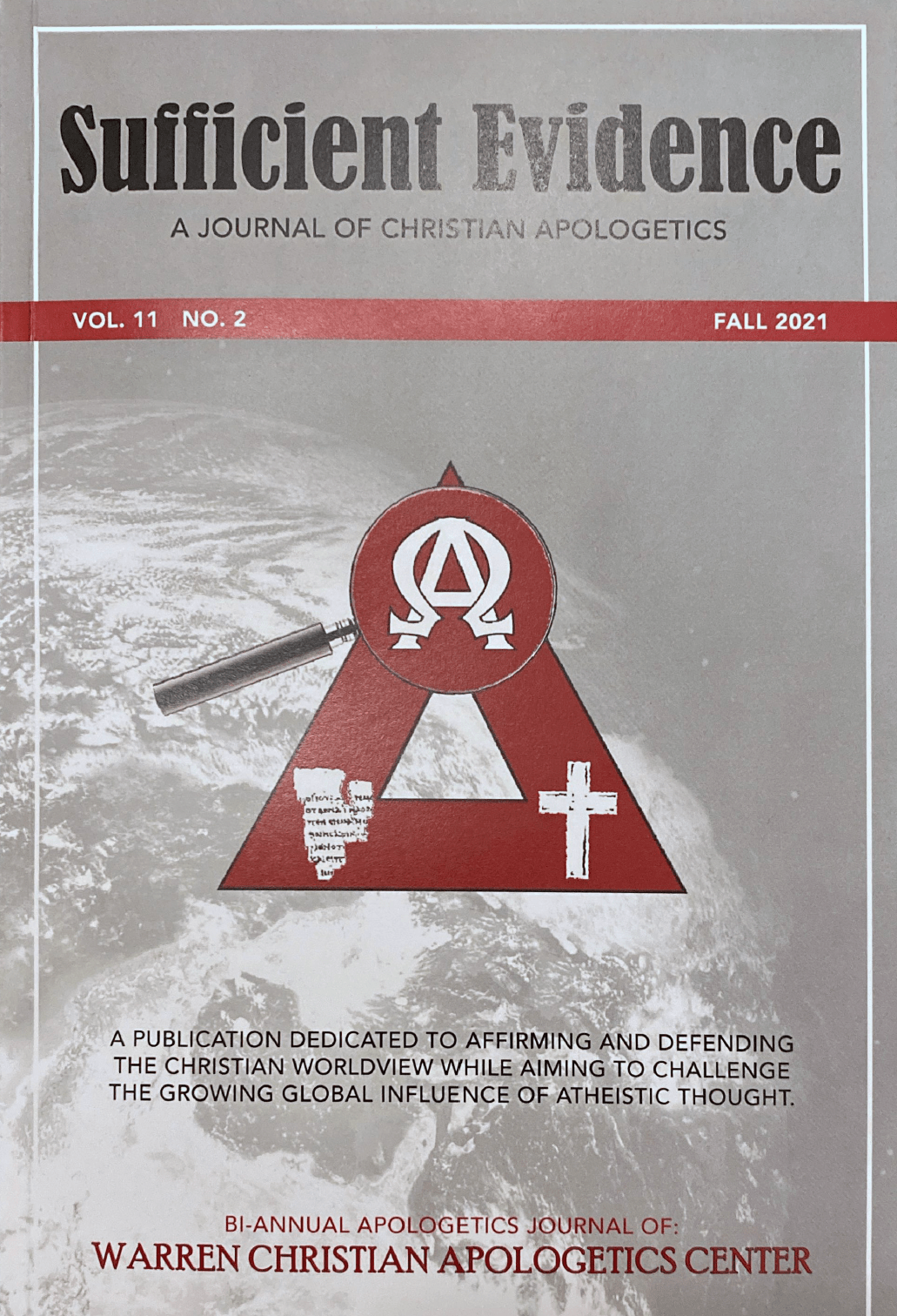
Click here to download the published version of this research paper. To subscribe to Sufficient Evidence click here.


Are Miracles Possible?

The question of whether miracles are impossible strikes at the heart of the Christian faith. Its viability hangs on one significant miracle: the resurrection of Jesus. Paul argued,

 if Christ has not been raised, then our preaching is in vain and your faith is in vain. (1 Cor 15:14 ESV)

If the bodily resurrection never happened, because it is impossible, then the traditional Christian faith is catastrophically and irreparably compromised. In response, I will first argue there is evidence for a creator-God necessary for miracles to occur, then demonstrate that anomalies (like miracles) require intelligent causation. Finally, I will look at the resurrection as a case study.

The Creator-God

The evidence for the existence of God is cumulative in nature. This means there is a body of positive evidence combined to support the case that the universe is created by a personal Creator-God. Furthermore, God as creator is separate, or outside, of this creation. This Creator-creation relationship would allow, then, for the possibility of miracles:

if God exists then miracles are possible.[1]

Norman L. Geisler and Ronald M. Brooks
When Skeptics Ask, rev. ed. (Baker, 2013)

Natural theology affirms that the created world is host to evidence positively supporting God’s existence and justifying belief in him. There are four broad categories of arguments from natural theology:[2]

  • Cosmological (argument from causality, from effect to cause),
  • Teleological (argument from fine-tuned and intelligence-laden design),
  • Moral (argument from the objective value of morality and ethics), and
  • Ontological arguments (argument of a necessary uncaused Being).

These arguments represent a preponderance of the evidence that justifies belief in a personal ethical Creator-God.

A strong case can be made for the existence of God with the Kalam cosmological argument.[3] The first premise may be stated as “the universe had a beginning.” The evidence from the second law of thermodynamics affirms that the universe is experiencing entropy, a running out of useable energy. This points to the finite nature of the cosmos and points to a beginning when the universe was “fully charged.” The second premise affirms, “the universe was caused to exist.” What caused it to exist? Or had it come into being out of nothing? The evidence from nature (natural theology) points to a powerful (creation), ethical (morality), and intelligent designer (DNA) which brought these phenomena into existence. The reasonable conclusion is that a supernatural being created the universe into existence, this is God.

Not all Causes are Naturally Recurring

In response to the above supernatural claim, proponents of a naturalistic worldview argue that the existence of miracles would render the scientific method impossible to practice. This is only an assumption because there are different kinds of scientific ways of understanding causation, for not all causes are natural. A difference must be made between “operational science” which studies “regular patterns in the present from which predictions can be made,” and “forensic science” which studies “past singularities.”[4] The study of photosynthesis which takes into account how sunlight, carbon dioxide, and water, are converted into food by plants (operational science) would be conducted differently than a study of a singularity like the creation of the Mt. Rushmore monument (forensic science).

Miracles would no more disrupt operational science than would the reshaping of a naturally formed mountainside into a monument bust relief at Mt. Rushmore, or the carved-out ruins of Petra Pella. The use of intelligence and power offers a different source for causation than the naturally regular patterns in the world. The question remains how to decipher in what way miracles interact with the regular patterns of nature (disrupt, break, suspend). This difficulty of understanding anomalies like miracles or “the Big Bang” is not proof that such anomalies are incompatible with known scientific theory. It suggests we still have much to learn.

The Resurrection

A religion that is consistent with the picture of God derived from natural theology should have evidence of supernatural activity (historical reliability, fulfilled prophecy, etc.).[5] As noted already, the central figure of the New Testament, Jesus Christ, is presented in the historical setting of first-century Palestine, in which his teaching ministry is substantially interwoven with supernatural activity (healings, exorcisms, telepathic and empathic actions). The most significant miracle is his post-mortem bodily resurrection from the dead following his execution by means of crucifixion. Is this just legendary material that has been added, or are these ancient documents reliable eyewitness testimony to the most important miraculous event of human history?

The study of the historical reliability of the New Testament demonstrates that it has the strongest transmission history of any work from antiquity. It has preserved the eyewitness testimony of its authors who acknowledge the supernatural resurrection of Jesus Christ. For example, Paul’s words in 1 Corinthians:

Now I would remind you, brothers, of the gospel I preached to you, which you received, in which you stand, and by which you are being saved, if you hold fast to the word I preached to you—unless you believed in vain. For I delivered to you as of first importance what I also received: that Christ died for our sins in accordance with the Scriptures, that he was buried, that he was raised on the third day in accordance with the Scriptures, and that he appeared to Cephas, then to the twelve. Then he appeared to more than five hundred brothers at one time, most of whom are still alive, though some have fallen asleep. Then he appeared to James, then to all the apostles. Last of all, as to one untimely born, he appeared also to me. For I am the least of the apostles, unworthy to be called an apostle, because I persecuted the church of God. 10 But by the grace of God I am what I am, and his grace toward me was not in vain. On the contrary, I worked harder than any of them, though it was not I, but the grace of God that is with me. 11 Whether then it was I or they, so we preach and so you believed. (1 Cor 15:1–11 ESV)

Their ancient words have been preserved in over 5,000 Greek manuscripts.[6] These documents contain doctrinal traditions which include the Divine Lordship of Jesus, his bodily resurrection, and his miracles, so early (within less than a decade of the actual events) that there is no room for legends to displace Christianity’s core historical truths.[7]

The question “did Jesus rise from the dead?” must then be taken seriously. The death of Jesus is one of the surest known historical facts of Christianity.[8] Despite many attempts to theorize that he successfully survived the crucifixion, the medical evaluation[9] of the historical descriptions of his wounds points out that he was a “dead man” before the spear was thrust through his side (John 19:34). The belief that Jesus appeared bodily to his disciples after his execution is another known fact of Christianity, which transformed his disciples and converted unbelievers (e.g., James). The early disciples shared their witness that Jesus was raised from the dead by the power of God, many of them dying for their claim that they saw Jesus bodily raised.

Conclusion

The short version of this brief essay’s argument is, “if God exists, then the supernatural anomaly of the miraculous bodily resurrection of Jesus, as historically reported in the New Testament, is possible.” The possibility of the miraculous is, therefore, quite reasonable.

Endnotes

  1. Norman L. Geisler and Ronald M. Brooks, When Skeptics Ask: A Handbook on Christian Evidences, rev. ed. (Grand Rapids, MI: Baker, 2013), 71.
  2. Geisler and Brooks, When Skeptics Ask, 9–19.
  3. James P. Moreland, “Transcript: Arguments for the Existence of God” (Class lecture, Defending the Faith course of Talbot School of Theology, La Mirada, CA, n.d.); Geisler and Brooks, When Skeptics Ask, 10.
  4. Geisler and Brooks, When Skeptics Ask, 74–77.
  5. James P. Moreland, “Transcript.”
  6. Geisler and Brooks, 101–05; Joe Hellerman, “Handout: Defending the Gospel Accounts of Jesus” (Class lecture, Defending the Faith course of Talbot School of Theology, La Mirada, CA, n.d).
  7. Lee Strobel, “Handout: The Case for Faith” (Class lecture, Defending the Faith course of Talbot School of Theology, La Mirada, CA, n.d.).
  8. Known historical facts of Christianity are taken from Craig Hazen, “Handout: Evidence for the Resurrection” (Class lecture, Defending the Faith course of Talbot School of Theology, La Mirada, CA, n.d.).
  9. William D. Edwards, Wesley J. Gabel, and Floyd E. Hosmer, “On the Physical Death of Jesus Christ,” Journal of the American Medical Association 255.11 (March 1986): 1462.

Must I “Hate” my Family for Jesus (Luke 14:26)?

There are always those who jump at any opportunity to disparage the character of the Son of God. They pursue any apparent inconsistency and press it beyond anything resembling its biblical and original intent.

Such is the case with Jesus’s words in Luke 14:26. The passage reads:

If anyone comes to me and does not hate his own father and mother and wife and children and brothers and sisters, yes, and even his own life, he cannot be my disciple. (Luke 14:26 ESV; emph. added)

An antagonistic critic of Jesus declared that these words makes Jesus a “cult leader” bent of intimidating his followers.

At first glance, the words are troublesome and it would be disingenuous to deny that the passage is disturbing. Nevertheless, the problem is skin deep, and is part of a larger flow of thought in which the Lord emphasizes the principle of focused commitment (Luke 14:28–32).

I will unpack this in two basic steps. First, I look at the context of the passage in the Gospel of Luke to see its big picture theme. Second, I show the term translated “hate” (miséō) has a broad spectrum of meaning and reflects a cultural hyperbolic expression of preference.

A Look at Context

In order to appreciate any passage of Scripture its context must be understood. No single verse reveals everything the Bible has to say on a given subject. It is easy to misunderstand a verse when read without getting a handle of the big picture of the passage.

The “big picture” gives us a proper perspective. This saying is found in the context of a dinner party that Jesus attended at the house of “a ruler of the Pharisees” (Luke 14:1). It is part of Jesus’ pilgrimage to Jerusalem (Luke 9:51) where he anticipates his rejection and crucifixion (Luke 9:21–22, 43b–45; 18:31–34).

It would be expected for the traveling rabbi to offer wisdom and instruction. The teaching done at dinner takes up a major part of this journey narrative (14:1–17:10) and provides some of Jesus’ strongest teaching on proper use of one’s life and material blessings for the good of others as members of God’s kingdom (search for the lost sheep, the lost coin; receive the wasteful son; live prudently; live generously, etc.).

Earlier in the dinner scene, inspired by a man with dropsy, Jesus initiated a discussion about the legality of healing on the Sabbath (14:2). Since the Bible experts (i.e., lawyers) and Pharisees “remained silent” Jesus went forward and healed the man (14:4). Jesus then pressed them with a question on compassion:

Which of you, having a son or an ox that has fallen into a well on a Sabbath day, will not immediately pull him out? (Luke 14:5) 

Since there was continued silence (“they could not reply to these things”, 14:6), Jesus posed a series of parables to them.

The Parables. Jesus told the parable of honorable seats to the guests that searched for prominent seats at the dinner party to rebuke their sense of self-importance (Luke 14:7–11). He then pressed his host to welcome those who could not repay him, trusting in repayment “at the resurrection of the just” (Luke 14:12–14). This led to the parable of “a great banquet” to which many were “invited,” but these made excuses for why they could not attend. So, “the poor and crippled and blind and lame” were invited to enjoy this banquet instead (Luke 14:15–24).

Clearly, Jesus challenged the hypocrisy of his host and fellow guests as they “dined” while surrounded by the crippled and the poor without so much of a concern for their needs. The rhetorical tool of the parable provided an image-rich narrative designed to teach a spiritual truth in an understandable and comparative way. In this way, he shows that grace of the kingdom of God is not for some future age (Luke 14:15) but an ethic to be practiced in the now.

The host’s table was supposed to be the theater of God’s kingdom. In the end, all they could do was grumble because Jesus ate with sinners (Luke 15:1–2).

The Kingdom of Commitment. The themes of the parables Jesus teaches are initially focused on a disparity between the high society of the Pharisees and scribes with those disenfranchised Jews seeking and needing the grace found in the kingdom of God. The main problem was misplaced loyalties manifested in a dereliction of responsibility.

God seeks those who will hear his invitation to relationship. This parable anticipates the rejection of God on the part of the Jews who delivered Jesus to Pilate, and the global outreach to the gentile world with the Gospel invitation. In connection with this parable, Jesus lays out four “loyalty arguments” (14:26–32):

  1. One must “bear his own cross” and follow him. This phrase foreshadows Jesus’ commitment to God’s redemptive plan to the point of his own execution on a cross. His followers are called to the same level of commitment in the choices they make (14:27).
  2. To build a structure one must first “count the cost” to complete the construction. This statement is parabolic, if not proverbial, illustrating thoughtfulness in commitment. What will following Jesus demand of me? What will be the tradeoffs to commit to the kingdom of God (14:28–30)?
  3. Before entering war one must “sit down first and deliberate.” What are my strength or weakness? Should I act towards war or peace? Jesus illustrates that decisive decisions are based on the awareness of things as they are (14:31–32).
  4. Jesus bookends his sayings with strong words of full total commitment. Jesus speaks of “hating” the closest of human connections (14:26), and “renouncing all” for him (14:33).

Jesus was rebuking the conduct of the Pharisees and scribes at the dinner. They showed no loyalty, commitment, or deliberate reflection to follow through in their service to God, only excuses and self-righteous pretensions. Jesus calls this failure out through hyperbole, an obvious and intentional exaggeration.

Hyperbolic Exaggeration

Jesus, in this setting, is speaking hyperbolically. He was using a common feature that overlaps with our own: exaggeration. Today might say to a long lost friend, “I haven’t seen you in a thousand years!” Or, we may even claim, “I’m so hungry I can eat a horse.” They are not literal statements. Hyperbole is, according to Elena Pasarello, a “grasping beyond what is necessary in order to describe a certain feeling, an experience, or response.”[1] We often forget Jesus speaks with similar conventions and this failure affects how we read Jesus’ words.

Clearly “to hate” is a verb with strong overtones. But whose overtones should we be concerned about? Ours, or that of the ancient setting in which Jesus spoke?

First, the hostile environment provides the right background for the use of hyperbole. Our expectations of hate includes with it ideas of “intense hostility and aversion usually deriving from fear, anger, or sense of injury” or “to feel extreme enmity towardto regard with active hostility” affect our reading of this text (Merriam-Webster Dictionary). This is not what Jesus had in mind.

In Luke 14:26, the verb miséō is translated “hate” in nearly every major English Bible translation. Greek dictionaries also agree that it corresponds to a spectrum of meaning such as hate, despise, disregard and “be indifferent to” (Matt 6:24; Luke 16:13).[2] Context, however, determines how the term should be translated. In the hostile dinner setting Jesus seeking to awaken the dinner party to their hypocrisy, their indifference to the poor and the outsider. God’s people must be woken up.

Second, Jesus is on record elsewhere in Luke that God’s people should treat their enemies with love. Earlier in Luke 6 Jesus teaches the following:

I say to you who hear, Love your enemies, do good to those who hate you, 28 bless those who curse you, pray for those who abuse you... 32 If you love those who love you, what benefit is that to you? For even sinners love those who love them... 35 But love your enemies, and do good, and lend, expecting nothing in return, and your reward will be great, and you will be sons of the Most High, for he is kind to the ungrateful and the evil. 36 Be merciful, even as your Father is merciful. (Luke 6:27–28, 32, 35–36)

Jesus teaches that God’s people should show a love that is kind toward those who hate them. Whatever miséō means in Luke 14:26 it must be read consistently with Jesus’ other teachings.

Third, Jesus knew, observed and defended the command to “honor your mother and father.” In one of his final encounters on his journey to Jerusalem (Luke 9:51–19:44), Jesus reminds the rich young ruler of this command (Luke 18:20; cf. Matt 19:19: Mark 7:10, 10:19). In Matthew 15:1–20, Jesus defends this command against the subversive traditions and tactics of the Pharisees and scribes:

“And why do you break the commandment of God for the sake of your tradition? For God commanded, ‘Honor your father and your mother,’ and, ‘Whoever reviles father or mother must surely die.’ But you say, ‘If anyone tells his father or his mother, “What you would have gained from me is given to God,” he need not honor his father.’ So for the sake of your tradition you have made void the word of God. (Matt 15:3–6)

Jesus is calling out the hypocrisy of the traditions of Pharisees and scribes, the very same guild of biblical scholars he is addressing in Luke 14. The non-exaggerated teaching of Jesus legitimately forces us to read Luke 14:26 in a different way. Jesus honored the commandments.

Fourth, parallel sayings of Jesus provide additional clarification evidence. In Matthew 10:37 Jesus provides another lens to understand “hate” in terms of “preference” or deep loyalty:

Whoever loves father or mother more than me is not worthy of me, and whoever loves son or daughter more than me is not worthy of me. (Matthew 10:37)

To the Jew this was a very common way to express that one’s loyalty to God was to surpass any human bonds of loyalty.

Another example is found in Matthew 6:24, which highlights a cultural way of expressing ideas of “preference” or “indifference”:

No one can serve two masters, for either he will hate the one and love the other, or he will be devoted to the one and despite the other. You cannot serve God and money. (Matthew 6:24 ESV)

This probably explains why the Good News Translation (1992) renders Luke 14:26:

Those who come to me cannot be my disciples unless they love me more than they love father and mother, wife and children, brothers and sisters, and themselves as well. (emph. added) 

While this is certainly the meaning of Jesus words, the softening of the language robs us of a significant fact. Jesus found value in targeted exaggerations to make a point.

Fifth, the ides of love and preference, or hatred and indifference are also seen in the Old Testament. For example, Jacob loved Rachel more than Leah (Gen 29:30), yet this preference is also stated as “Leah was hated” (Gen. 29.31).

Paul illustrates his affirmation of the justness of God to elect whom he wishes by his election of Jacob over Esau. Jacob elected/preferred over Esau based upon God’s sovereignty (Mal 1:2–3; Rom 9:10–13).

10 And not only so, but also when Rebekah had conceived children by one man, our forefather Isaac, 11 though they were not yet born and had done nothing either good or bad—in order that God’s purpose of election might continue, not because of works but because of him who calls— 12 she was told, “The older will serve the younger.” 13 As it is written, “Jacob I loved, but Esau I hated.” 

Finally, in the culture of Jesus notions such as interest, disregard, and indifference are often expressed in terms of “love” and “hate” which do have very limited translations.[3]

On this point, consider the following observation:

[T]he Orientals [Eastern culture], in accordance with their greater excitability, are wont both to feel and to profess love and hate where we Occidentals [Westerners], with our cooler temperament, feel and express nothing more than interest in, or disregard and indifference to a thing.

Joseph H. Thayer, A Greek-English Lexicon of the New Testament (1896)[4]

Scholar G. B. Caird observed similarly:

To hate father and mother did not mean on the lips of Jesus what it conveys to the Western reader (cf. Mark 7:9–13). The semitic mind is comfortable only with extremes –light and darkness, truth and falsehood, love and hate– primary colours [sic] with no half-shades of compromise in between.

G. B. Caird, The Gospel of Saint Luke (1963)[5]

Jesus is speaking in an exaggerated hyperbolic fashion to give some shock value to illustrate the kind of deep preferential conviction God’s people must have.

Conclusion

The big picture context of Luke 14:26 demonstrates that Jesus is in the middle of a series of instructive parables focused on proper discipleship in the kingdom of God. They are directed to the host, the guests, and the crowds that joined them. When Jesus speaks to the crowds he outlines the deliberative nature of would-be disciples and should be disciples. These are non-negotiable matters.

The idea of “hate” (miséō) as a cultural hyperbolic expression provides a proper understanding to Jesus’ meaning. Jesus did not violate the mosaic law to honor one’s parents, but he lived it and defended against any corruption by false piety. Instead, Jesus spoke in his own cultural semitic vernacular.

In the final analysis, misguided assaults on the character of Jesus backfire. This should also remind God’s people to take the time to examine the passage adequately.

Endnotes

  1. Elena Pasarello, “What is Hyperbole?Oregon State University.
  2. Barclay M. Newman, A Concise Greek-English Dictionary of the New Testament, rev. ed. (2010; Stuttgart: Deutsche Bibelgesellschaft, 2014), 119.
  3. BDAG 652.
  4. Joseph H. Thayer, A Greek-English Lexicon of the New Testament (1896; repr., Peabody, MA: Hendrickson, 1999), 415.
  5. G. B. Caird, The Gospel of Saint Luke, Pelican New Testament Commentaries, ed. D. E. Nineham (1963; repr., Baltimore, MD: Penguin Books, 1974),178.