Book Review: Relaunch

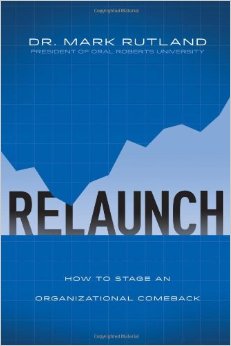
Relaunch - Rutland - Cover

Mark Rutland, Relaunch: How to Stage an Organizational Comeback (Colorado Springs, CO: Cook, 2013), hardback, 206 pages.

A walk in the clearance section (because I hate paying full price) of my local Lifeway Christian bookstore led me to the present volume on leadership. The price, packaging, and presentation of this David C. Cook book persuaded me to purchase it. I am very thankful I did and now I feel I’m playing catch-up on leadership insights from Dr. Mark Rutland.

Dr. Mark Rutland has 13 books under his belt that can be obtained in many formats, and he also maintains an active teaching, humanitarian and blogging presence through his National Institute of Christian Leadership and Global Servants organization. In Relaunch, Rutland provides insights into his ministerial roles as Associate Pastor (Mt. Paran Church of God) and Senior Pastor (Calvary Assembly of God), and his presidential posts (Southeastern University, Oral Roberts University). These experiences serve as a springboard to show his credibility to speak to leaders about the core issues of turnaround leadership in a variety of settings.

ReLaunch: A Survey

ReLaunch is about turnaround leadership. It is comprised of 14 chapters, arranged in three parts followed by an epilogue all wrapped within 206 pages. In Part 1 (chapters 1-4), Rutland casts a common-sense vision for understanding the intangible nature of leadership. Leadership is, in a nutshell, the art and skill to understand an organization’s goal and dream and to connect all its actions into realizing the dream, so that when the leader’s work is “done” the organization is in a better position for the next person to lead. Leadership then is to make the dream a reality by being the everyday “driving force” behind this achievement.[1] Here, Rutland spends some time surveying key experiences within three organizations’ turnarounds (Calvary Assembly of God, Southeastern University, and Oral Roberts University).

In Part 2 (5-11), Rutland articulates and sets forth seven steps that are critical to turnaround leadership within a failing organization. Turnaround leadership, according to Rutland, cannot be accomplished without facing institutional reality and communicating the organization’s vision relentlessly from top to bottom (Steps 1-2). Turnaround leadership must focus on alignment for the organization within the correct niche market, by its message, and through the most effective medium (Step 3). This requires creating an executable strategy by finding which system within your organization that can make the most impact (Step 4). Rutland demonstrates that in a turnaround you must either restore or create the organization’s dream and this is done by shifting its internal culture so that its members can support the organization’s promise to the world (Step 5); moreover, this fuels the need to keep an eye on quality, which is to say it that the organization clearly delivers what it publically promises (Step 6). Finally, Rutland underscores the psychological importance of measuring and celebrating success within a turnaround because these actions promote meaning and value, and generate higher levels of positive energy within the members of the organization as they drive towards turnaround (Step 7).

In Part 3 (12-14), Rutland closes ReLaunch with a section on how to build a turnaround team. I believe these chapters alone would be worth the purchase of the book. The premise of building a turnaround team is to have the proper alignment within the organization. In such a case, adding new members (“hiring”) who fit the goals, vision, and culture of the turnaround is critical because, otherwise, you are starting “the old cycle over again.”[2]  This boils down to finding the right person, at the right time, for the right reason (“job”). Rutland spends time developing a system he uses to put the right people in the right roles (his helpful Finder-Binder-Minder-Grinder system). Unfortunately, the changes which take place during a turnaround are hard for the established members (employees, board members, volunteers, etc.) of the organization. Rutland discusses, then, the last resort a turnaround leader must face when preexisting employees can not adjust – he talks about the troubling art of firing. Rutland shows compassionate insight. It is important to clearly promote your new vision and continue to hold everyone accountable to this turnaround goal to recapture the old dream (or create a new one). He counsels, “Some can make the change. Some can be retrained. But not everyone can make the turn.”[3] Finally, Rutland addresses the importance of forming a board and sketches the difference between an emotional (undependable) board, a legalistic (robotic; holds to if-then thinking) board, and a holistic (balances the tensions found in emotional/legalistic thinking) board. Rutland praises those boards which respect their limits, support their leader’s role in the organization, and “empowers” their leader to do their best.

ReLaunch ends with the Epilogue where Rutland speaks to the inner life of the turnaround leader. It is honest, frank, and interwoven with experience of a leader who has “nosedived” and had his own inner turnaround within his life and family. Rutland warns that a leader must keep pushing forward and never fall into the trap that defeat or victory are final experiences. Also, leadership is costly because it is all-consuming: “There is always a cost.”[4] I found a sense of great depth when Rutland discusses “the most important truth” he has learned: to be a healthy leader, “stay free in God’s hand.” In other words, be willing to take the roles you are “called” into, execute its duties faithfully, but understand that you do not need to have it; moreover, learn that you can be “good” (acceptance) if you have to leave that role. Your identity should not be tied to your role, but instead, tied to your God.

Strengths and Weaknesses

ReLaunch is about turnaround leadership and Rutland succeeds in providing the key principles and steps which can deliver what he himself has accomplished and promises – turnaround. Rutland clearly articulates, with a narrator’s voice, addressing the philosophical terrain of turnaround realities. There is no fluff in this book, it is direct honesty, based on real-life examples and personal illustrations. If anything, ReLaunch provides excellent insights on how to point out the turnaround benchmarks when discussing the future of your congregation, school, and organization. This is not a book on theory alone, but practice, and framed by someone who has lived on the front lines. The seven steps are “shovel ready” and await a bold leader to employ them when faced with the need to stage an organizational comeback. ReLaunch is a real book for real leaders.

I found the leadership insight focused as Rutland epitomizes his definition of leadership as tethering all of an organization’s parts to its dream and goals. This is particularly displayed in this compassion and awareness when discussing hiring and firing team members during the turnaround. Also, Rutland’s experience with working with a board demonstrates the common problems felt not only in the business world but also in the church. It illuminates that even within churches elderships (“boards”) may not always embrace a healthy culture (emotional, legalistic). Too many times, we tie such roles with a right to be right, but Rutland shows that boards and elderships may be vulnerable to being imbalanced. Rutland is spot on.

If I had to make a critique regarding ReLaunch it would be in terms of its top-down leadership approach (as assumed in the book) and its application to the leadership model of the church as revealed in the New Testament. Dr. Rutland assumes the equivalent role of pastor and preacher which is common in many circles of Christendom.[5] The New Testament does not make these equivalent roles, instead, a pastor (= elder, overseer) is a distinct responsibility that applies to a very uniquely qualified man, as he serves within a group of other men of equal caliber. This does not apply to the role of preacher or evangelist.[6] This is not to say that mentors cannot shepherd their fellow believers, but in terms of a distinct church role, the terms are not equivalent. Still, this does not undermine the richness and essence of the book, but it does begin the leadership discussion from a different point than the New Testament. Rutland would probably disagree with that assessment.

Of course, Rutland addresses a readership from a broad spectrum. ReLaunch is not specifically a church leadership book, it is a book that may apply to a ministerial context like mine among churches of Christ. Nevertheless, the preacher often finds the need to be the Chief Culture Officer (CCO) of the congregation; consequently, a preacher can within their role help lead an organizational comeback with the cooperative efforts of their overseeing eldership. But, as Ron Clark observes, “few books are written specifically for ministers about our style of ministry” where the pastor and the preacher are distinct ministries in the body of Christ. Clark observes that most church leadership material is based upon church models which are dissimilar to churches of Christ, or based upon business models which have been given a Christian spin.[7] Again, this is not to say the principles are not applicable, nor does this speak to the quality of ReLaunch. The quality of the content of the book exceeded my expectations.

Recommendations

Aside from the exception and critique provided above, Dr. Mark Rutland provides a leadership model that is exceptional. An administrator, board member, president, father and mother, elder, preacher, deacon, and if there is anyone in between can yield a great deal of practical wisdom for a turnaround in their public and professional lives but also in their private lives. The principles in ReLaunch and their capacity to effect meaningful change have broad applications.

I would recommend this book to every leader in any context. I would also recommend ReLaunch to every incoming preacher entering an established church, and to every incoming administrator entering a new organization. I would also recommend this book to every elder and leader who believe their church, ministry, or organization is in decline. The truth is, every organization needs to ReLaunch at times. We must at times create a new dream, but most of the time we must recapture the dream and relaunch it to do so. Jesus even told the church in Ephesus to relaunch, “But I have this against you, that you have abandoned the love you had at first. Remember therefore from where you have fallen; repent, and do the works you did at first” (Rev 2:4-5 ESV).[8]

Endnotes

  1. Rutland says, “Some dream well. Some define well. Others may tether well or excel at organizing. The art, though -the great craft of leading others- is the connection between the dream, its proclamation, and making the dream the driving force of everything that is done” (23).
  2. Rutland warns, “You can’t let the people who are devoted to the old ways do the hiring, or else you’ll just start the old cycle over again. You’re cultivating the soil in which your new vision and culture can grow” (161).
  3. Rutland counsels, “when you are honest about your expectations, and your team members are honest about their ability and their commitment, parting ways doesn’t have to be a crisis or a drama. In the end, you have to articulate exactly what you expect from your employees. You have to hold people accountable. If you’re going to turn a ship, there are going to be people who did things a certain way to get them into this mess. Some can make the change. Some can be retrained. But not everybody can make the turn. You need to communicate this to your staff long before it becomes an issue” (174).
  4. Rutland frankly says, “There is always a cost. If we don’t consider it before we begin to lead, then the cost may catch us by surprise midcourse. Emotional and mental exhaustion can lead to a dangerous level of toxicity” (198).
  5. By Christendom I mean to describe all religious groups (denominations, non-denominations, etc.) which historically follow Jesus of Nazareth as God’s Messiah (Christ), and accept the Bible as the revealed word of God. I make a distinction between Christendom and Christianity revealed in the New Testament and supported by the Hebrew Scriptures.
  6. I have written several essays in connection to elders, overseers (“guardians”), and pastors. They are available on my blog: “‘Is the Pastor In?’: A Brief Look at a Misnomer,” “Guardians of the Church: A Reading of 1 Timothy 3:1-7,” and “Organizing God’s House in 1-2 Timothy and Titus.”
  7. Ron Clark, Emerging Elders: Developing Shepherds in God’s Image (Abilene, TX: Leafwood Publishers, 2008), 9; Jovan Payes, “Book Review: Emerging Elders,” BiblicalFaith.wordpress.com.
  8. English Standard Version of the Holy Bible (Wheaton, IL: Crossway, 2001).
“Is the Pastor In?”: A Brief Look at a Misnomer

The telephone rings and I answer it. The person on the other end asks the following question: “is the pastor in?” To which I reply, “No, we have no pastors, but I’m an evangelist can I help you?” The phone is silent for a few seconds, often followed by some stuttering; the refrain repeats uneasily, “is the pastor in?”

I am not purposely being difficult. I am however being biblical. I receive letter after letter, and call after call, where people (usually salespeople) are looking for or seeking “the pastor.” They are seeking the preacher but that is not the preacher’s title or description in the New Testament.

It is a rather unfortunate situation. It is also very awkward. I am often introduced (sometimes even by Christians) or greeted as a “pastor.” It really chills the occasion when I say, “no, I am not a pastor, I am an evangelist.” Somehow, that just rubs the world of Christendom the wrong way.

Maybe I should find a better time or way to correct that misunderstanding. In fact, there is a wholesale need to correct this application of the term “pastor” to the preacher.

The biblical use in the New Testament makes it clear that this is one of a few terms used with reference to a select group of congregational leaders.

Elders, Overseers, and Pastors (Shepherds)

It is just seems ingrained within the world of Christendom that the preacher must be a “pastor” of some kind. J. W. Roberts writes:

Some think of a priestly group; some think of the ministry of the Word and the preacher or ‘pastor’ of the flock; others with the metropolitan or diocesan concept think of the denominational ‘bishop.’ In truth, Paul means none of these.[1]

Roberts is correct. In Acts 20:17, the “elders” were summoned from Miletus to Ephesus; these “elders” were qualified by the Holy Spirit to be “overseers” in the church “to shepherd” the church (Acts 20:28).

Students of the New Testament are quite observant that these terms refer to the same office. In fact, one can see the interchange of these terms in 1 Peter 5:1-2, “I exhort the elders among you to pastor the flock of God that is in your charge, exercising the oversight.”[2]

Notice the three terms used in 1 Peter 5:1-2 which are exclusively for “a body of men in the primitive churches called elders.[3] The “elders” (Grk. presbuterous) are to “pastor” (Grk. poimaino) the church, employing “oversight” (Grk. episcopountes). The New Testament demonstrates that each congregation had a plurality of men so described (Phil 1:1-2, etc).

To apply the term pastor to an evangelist/preacher is to do so without New Testament precedent. “Such is a non-biblical use of the term ‘pastor,’ in spite of the popularity of such in modern society.”[4]

Does it Really Matter?

When a practice has no biblical basis, should we not simply abandon its use? This is at the heart of the problem.

Timothy and Titus represent a category of Christian workers known as “evangelist” (2 Tim 4:5) who “preach the word” (2 Tim 4:2). This is their “ministry” (2 Tim 4:5). The main obligations of the work are explained in 1 Timothy 4:13, 15 and 2 Timothy 4:2-5.

In summary, it has been observed by Earl D. Edwards that “every aspect of their work had meaning only as related to ‘the Word.’”[5] When one evaluates the basic responsibilities found in these passages a few things are evident:

The evangelist had the duty, first of all, to ‘preach’ the Word and then ‘correct’ those who did not follow that Word, and even ‘rebuke’ those who attempted to undermine the Word. He was also to ‘encourage’ with gentleness that Christians might follow the Word without becoming discouraged. In addition he was to ‘devote’ himself to the ‘public reading’ and ‘teaching’ of the Word.[6]

While the elder (pastor/overseer) must have the capacity and ability to be a teacher (1 Tim 3:2) in order to shepherd the flock, it is clear that the evangelist holds a complementary role for congregational development and a public proclamation of the gospel.

The preacher’s work is not the elder’s work. The most important qualification for the evangelist is that they are “faithful” recipients and heralds of the message (2 Tim 2:2). An elder, also, may fulfill the role of an evangelist (1 Tim 5:17; Eph 4:11); however, a preacher is not necessarily a pastor.

Not all faithful males may serve in the office of a pastor, for these men must possess specific qualifications (1 Tim 3:1-7 and Tit 1:5-9). Thus, the use of the term “pastor” to refer to the “preacher” is incorrect – a misnomer – and should be abandoned.

Concluding Thoughts

Some may be thinking, “No, I don’t buy it. A pastor is the one who leads the flock.” To which I would argue in response, “yes, pastors after a biblical pattern do lead the flock of God.” But our discussion is centered on the misuse of the term, and consequently, a blending of two distinct ministries found in the New Testament church.

There are those who are elders (overseers, pastors) who serve in a very unique office only after they met the qualifications set forth by the Holy Spirit (1 Tim 3:1ff; Acts 20:28). There are others, however, who serve as heralds of the word; that is to say, they preach the word as they labor alongside the pastors of a particular congregation (Eph 4:11).

Consider this final thought. Suppose one encounters a missionary from the Latter Day Saints, who in fact use the title “Elder”. “Elder Smith” however is a young man, single, and has no children. Yet, the inspired instruction from the Apostle Paul clearly indicates that the man must be of age (hence the term elder), must be a married man (1 Tim 3:2), and have children over which he has shown leadership (1 Tim 3:4-5).

Can we honestly say, in light of the biblical data, that these young men flashing the “Elder” badge are elders after a biblical order? Hardly, This is precisely our point. The New Testament use of the term elder (overseer, pastor) applies to a very uniquely qualified man, as he serves within a group of other men of equal caliber. Let us seek to call biblical things with Bible names, and do Bible things in biblical ways.

Sources

  1. J. W. Roberts, Letters to Timothy (Austin, TX: Sweet Publishing, 1961), 26.
  2. Everett Ferguson, The Church of Christ: A Biblical Ecclesiology for Today (Grand Rapids, MI: Eerdmans, 1996), 318-23.
  3. John W. McGarvey, The Eldership (1870; repr., Murfreesboro, TN: DeHoff Christian Bookstore, 2002), 9.
  4. Wayne Jackson, Before I Die: Paul’s Letters to Timothy and Titus (Stockton, CA: Christian Courier Publications, 2007), 82.
  5. Earl D. Edwards, “The Evangelist in the Epistles to Timothy and Titus (Book 1),” Alternative 8.3 (Summer 1982), 19.
  6. Edwards, “The Evangelist in the Epistles to Timothy and Titus,” 19-20.

Of Sheep and Shepherds

Background Bible study is fascinating and is perhaps one of the most important parts of biblical research. Obtaining a “behind-the-scenes” look into the biblical documents will “contribute to a more precise comprehension of the Word of God.”[1] This observation can be said about the shepherd motif found in Scripture. Since it is dangerous to paint half a picture of anyone or anything – especially biblical topics; we stress, then, that this is but a footnote to the beautiful motif of the pastoral profession (i.e. the shepherd) often employed by the biblical authors.

Shepherds in Israel

Shepherding was a great profession in the culture of the Ancient Near East, and so far as it relates to Israel’s history, pastoral work was a constant aspect of nomadic life (cf. Abraham, Isaac, Jacob, etc.). Even when they conquered and settled into Palestine, the end of the nomadic life did not stop pastoral work (e.g. David in 1 Sam 16:19; Amos 1:1, 7:14).[2] The widespread awareness of this profession “made motifs of sheep and shepherding apt descriptions of human and divine roles and relationships.”[3]

Notice one Old Testament example. God through Jeremiah pronounces a “woe” upon the leadership of Judah using the pastoral motif:

“Woe to the shepherds who destroy and scatter the sheep of my pasture!” declares the LORD. Therefore thus says the LORD, the God of Israel, concerning the shepherds who care for my people: ‘You have scattered my flock and have driven them away, and you have not attended to them. Behold, I will attend to you for your evil deeds, declares the LORD.’” (Jer 23:1-2 ESV)

The “shepherds” failed to maintain the pastoral relationship with God’s flock; consequently, the sheep were scattered. Jeremiah, looking to post-exilic times, promises that God will restore the proper care to his flock with faithful shepherds (Jer 23:3-4).

Shepherds in the New Testament

There are several related New Testament words used to the work of shepherding. The noun form is poimein, and refers to a shepherd, herdsmen, or pastor,[4] and hence it is a metaphor describing a guardian-leader. The third translation option probably receives the most attention from among the three, and this is due to its connection with the eldership of the New Testament (Eph 4:11, here teaching-pastors), and its erroneous, but popular, usage in denominational circles.[5]

However, the New Testament uses the term significantly in its normal sense. Jesus refers to himself as “the good shepherd” in John 10:1-18 to distinguish himself from the leaders who had oppressed or neglected the house of Israel. Luke narrates the story of the shepherds, in the field with their flock, who were told of the arrival of the Messiah (2:1-20). Jesus warned his disciples that when he is handed over to the Jews, that they would be scattered like sheep when their shepherd is harmed (Matt 9:36 = Mark 6:34).

But perhaps the most vivid pastoral scenes are of those moments that relate to our relationship with Jesus. The Lord is described as “the Shepherd and Overseer” of our souls (1 Pet 2:25; cf. Heb 13:20), who receives straying sheep as any good shepherd does. Another vivid scene using the shepherd motif is the Day of Judgment when Jesus “will separate people one from another as a shepherd separates the sheep from the goats” (Matt 25:32). This is taken from an understanding that sheep and goats were “pastured together” in Palestine, but at certain appropriate times they “require separation.”[6] The figure is given Christian meaning as a metaphor of the judgment upon faithful and non-faithful Christians.

Learning from the Sheep and the Shepherds

There are so many relationship lessons that God has taken from pastoral care, we would do well to reflect upon it more. For example: at the birthing of a new lamb, the shepherd “guards the mother during her helpless moments and picks up the lamb and carries it to the field. For the few days, until it is able to walk, he may carry it in his arms or in the loose folds of his coat.”[7] Could we not make an application from this? The shepherd and the lamb have a wonderfully tender relationship, and we would strengthen our fellowship in taking a lesson from this behavioral motif.

Truly, we can see that a pastoral care for Christians will encourage us to help in the development and care of new converts. It will stimulate us to help heal wounded sheep, and protect them as they are nourished to good health. And more personally, perhaps we would be more receptive to the prodding and care by our shepherds in the church. The “pastoral” mentality is not only for the elders, we would all do well to lead on, or be led, ever so gently (Gen 33:14).

Conclusion

In the Christian age, it is quite common for New Testament students to think of shepherd-pastors as only in terms of the office of a bishop/elder as mentioned in 1 Timothy 3. However, the imagery of a shepherd has a wide application to both describe religious leaders and the effects of their ministries upon their religious constituents, and it also describes how the Lord Jesus and the Father are both presented as providers and keepers of our souls.

May we  take from these lessons, practical ways, to reflect a pastoral concern for ourselves, our fellow believers, family, and our friends.

Sources

  1. Wayne Jackson, Background Bible Study, revised ed. (Stockton, CA: Christian Courier Publications, 1999), 1.
  2. Madeleine S. Miller, et al., Harper’s Encyclopedia of Bible Life, 3rd ed. (San Francisco, CA: Harper & Row, 1978), 142.
  3. D. Johnson, Dictionary of Jesus and the Gospels, eds. Joel B. Green, et al. (Downer’s Grove, IL: InterVarsity, 1992), DJG 751.
  4. William E. Vine, Merrill F. Unger, and William White, Vine’s Complete Expository Dictionary of Old and New Testament Words (Nashville, TN: Nelson, 1986), 2:462, 569.
  5. Despite popular usage among denominations as a term for “minister,” a usage which J.P. Louw and Eugene Nida’s lexicon continues to perpetuate (L&N 53.72), typical passages used to support this idea are misapplied. Specifically, Ephesians 4:11 where there are four groups of leadership types (not five) set forth as recipients of the temporary “gifts” which enable the Christians to obtain maturity (Eph 4:12; 1 Cor 13:10). See J. Jeremias in TDNT 6:485-502.
  6. Jack P. Lewis, Matthew (Abilene, TX: Abilene Christian University Press, 1984), 2:137.
  7. J. Patch, International Standard Bible Encyclopedia, ed. James Orr (Grand Rapids, MI: Eerdmans, 1943), ISBE 4:2764.

This is a reformatted version of the article which originally published in The Words of Truth (Montgomery, AL: 6th Ave church of Christ).