Church, Let’s be Gentle (Gal 5:22–23)

Hardships come in all shapes and sizes. They often harden the people that survive them. Sometimes we are surrounded by so many troubles, their downpour is palpable. Our political climate resides on a hairpin trigger; any response to the “pandemic” seemly places you at odds with various camps at once.

There is remote education, remote working, adjusted schedules, reduced workforce and its accompanying reduced income and on we may go. Never have we had to adjust so quickly in so many fields, and rethink all of our social/cultural connections at once. It has not been done without incurring major trauma and frustration. The medical sector has gone to such protective measures that people have died alone, void of human touch; people are fighting diseases without the side by side support of their loved ones and communities. Yet, we somehow find the strength to cheer, “we’re all in this together.”

Many of our churches have likewise had to adjust and adopt methods that have been viewed, for the most part, as luxuries, out of reach and impractical. Among the many churches, broadcasting sermons and worship is for the bigger, tele-evangelist type churches. Embracing a new way to gather together, embracing additional formats allowable in the scriptures for assembling and spiritual communion. This has not happened without various forms of turmoil, infighting, the testing of fellowship, and in some cases suspicion.

It makes me think that the church needs to be reminded to be gentle.

The Fruit of the Spirit

A study on “the fruit of the Spirit” is badly needed right now. It is the outflow of our relationship with God. These fruits provide us the resources for enduring and succeeding as God’s people during stormy weather.

What was Paul getting at in the “fruit” of the Spirit”? The word “fruit” (karpós) has a wide range of meaning: it may be translated as “fruit, grain; harvest; result, outcome; deed, action; return, gain, advantage; tribute, praise (of the lips); offspring (Lk 1:42) descendant (Ac 2:30).”[1] The word ranges from the literal to the metaphoric and context helps to limit how fruit should be understood.

Fruit is the natural outcome from a plant, a living being, or a process. Fruit bears the distinguishing characteristics of its source. A banana is the fruit of the banana tree, an apple is the fruit of an apple tree, etc. A child is the offspring (fruit) of her/his parents. An error is the outcome of misinformation or a distortion.

For example, Jesus speaks of the spiritual caliber of a person based upon the fruit of their actions and teaching:

Beware of false prophets, who come to you in sheep’s clothing but inwardly are ravenous wolves. You will recognize them by their fruits. Are grapes gathered from thornbushes, or figs from thistles? So, every healthy tree bears good fruit, but the diseased tree bears bad fruit. A healthy tree cannot bear bad fruit, nor can a diseased tree bear good fruit. Every tree that does not bear good fruit is cut down and thrown into the fire. Thus you will recognize them by their fruits. (Matthew 7:15–20; English Standard Version)[2]

The Psalms, likewise, speak of one’s spiritual outgrowth based on a connection to the Word of God:

He is like a tree planted by streams of water that yields its fruit in its season, and its leaf does not wither. In all that he does, he prospers. The wicked are not so, but are like chaff that the wind drives away. (Psalm 1:3–4)

These examples are samples of a greater body of biblical examples for the spiritual character of the fruit metaphor.

This metaphor directs our attention to a spiritual harvest procured from the child of God’s relationship with the Spirit. It certainly points to the important spiritual realm of our activity. Paul does not point to a spirituality detached from the world. No, God’s people must embrace that the spiritual realm bleeds over into our natural (flesh/human) world because our faith is grounded in both realms of activity.[3]

This means that Christians derive the wellspring for their actions from God’s leading, and this then frees us from any obligations to act like the customary fallen fleshly/human world. We are freed to live a life anchored to our relationship with God.

This is part of the big picture drama of Paul’s letter to the Galatians. Throughout Galatians, he displays how freedom and obligation work together in tension as Christians live freed by Christ to be obligated by the ethic of love.

For freedom Christ has set us free [theology of freedom]; stand firm therefore [ethic of obligation], and do not submit again to a yoke of slavery. (Galatians 5:1)
For you were called to freedom, brothers. Only do not use your freedom as an opportunity for the flesh, but through love serve one another. For the whole law is fulfilled in one word: “You shall love your neighbor as yourself.” But if you bite and devour one another, watch out that you are not consumed by one another. (Galatians 5:13–15)

These are not competing themes. I like how Charles K. Barrett (1917–2011) puts it,

There is no conflict but rather an indissoluble union between the theology of freedom and the ethics of obligation. Nor is there any equation of a compromise between the two in which each is watered down so as to accommodate the other. Freedom is real freedom, and any attempt to restrict it must be firmly refuted. But obligation is real obligation too, and there must be no attempt to evade it.[4]

Freedom and Obligation (1985)

In other words, the regenerated child of God is freed by the gospel and a life that is lived in light of God’s redemption will their obligation anchored in loving others. God’s people must certainly live with this tension: (1) a theology of freedom to live out in the natural world the love of God bred by the gospel message, and (2) the ethic of obligation that a Christian and the church is bound by to embrace the grace of God and the purpose of Christ’s death.

Making Sense of Gentleness

The most important way to understand how a word is to be understood is its context, otherwise, we may import misleading ideas into a text. Word studies are additional way to appreciate the limits of a word’s meaning. I like to look at how the ancients used the words of the New Testament, as it often provides a better sense of what Paul is saying and means.

Secular Sense. New Testament Scottish scholar, William Barclay (1907–1978), was one of the best wordsmiths of his era. His knowledge of the classics and Greek literature was astounding. In his little book, Flesh and Spirit (1962), he illustrates six ways the concept of “gentleness” (praútēs) was used in ancient secular Greek.[5]

  1. Gentleness as a soothing quality in the face of difficulty, hardship, or bitterness.
  2. Gentleness of conduct breeds a spirit of cooperation, especially when those with the power to act behaved differently.
  3. In the midsts of any argument, gentleness is the attitude and culture created where “cooler heads” prevail without losing one’s temper.
  4. The ability to take things lightly, whether going through an unpleasant experience, or, to not overreact to important things.
  5. It is used to speak of animals which have become obedient and have learned control and discipline.
  6. The most common use: Gentleness is seen in the portrayal of a person’s character in which strength and gentleness go together, where passion and gentleness find a balance in high degree.

The modern sense of “gentleness” carries more of the qualitative sense of “mildness of manners and disposition” (Merriam-Webster), or being “kind, calm, or soft…” (Cambridge Dictionary). There is some similarity to the ancient sense, but as Barclay points out the ancients held a more robust sense of the power and impact of “gentleness.”

New Testament Usage. I want to use Barclay’s spectrum to illustrate how the New Testament uses “gentleness” (praútēs), a term that appears eleven times (1 Cor 4:21; 2 Cor 10:1; Gal 5:23, 6:1; Eph 4:2; Col 3:12; 2 Tim 2:25; Tit 3:2; Jas 1:21, 3:13; 1 Pet 3:15). We are illustrating here how to best understand the word in the context of four New Testament case studies, and then we will look at our passage in Galatians 5:23 (and 6:1).

1 Corinthians 4:21: What do you wish? Shall I come to you with a rod, or with love in a spirit of gentleness? 

In a context of correction and restoration, Paul offers this rhetorical question. The phrase “spirit of gentleness” may be translated as “a gentle spirit” (cf. Gal 6:1). In other words, this is a question about the kind of “frame of mind” the Corinthians wish Paul to arrive in.[6] The emphasis is on either whether the Corinthians want Paul to arrive with a soothing attitude (1), or with a culture of love generated by a cool temper (3). These seem to be the better options of the sense here.

2 Corinthians 10:1: I, Paul, myself entreat you, by the meekness and gentleness of Christ—I who am humble when face to face with you, but bold toward you when I am away! 

When Paul addressed a slanderous charge against him that in person he was timid and in letter he is aggressive,[7] the apostle appeals to the Corinthians by “the meekness of Christ” or “Christ’s meekness.” This is clearly a reference to the balanced character of Jesus Christ who is both meek (praútēs) and gentle/forbearing (epieíkeia). In the face of conflict, Paul will appeal to the disciplined character of Jesus to be his guide (6).

Colossians 3:12: Put on then, as God’s chosen ones, holy and beloved compassionate hearts kindness humility, meekness, and patience...

As in Galatians 5:22–23 and Ephesians 4:2, our word appears in a list of virtues of proper conduct. In fact, much has been said about the parallels between Colossians and Ephesians, where in the latter walking in a manner worthing of the Christian calling includes walking “with all humility and gentleness, with patience bearing with one another in love” (4:2). As part of a virtue list, these contexts provide a “big picture” character portrayal to which the child of God must endeavor to pursue. It is vital to breed unity and cooperation in the body of Christ by being actively gentle (2).[8]

2 Timothy 2:25: correcting his opponents with gentleness. God may perhaps grant them repentance leading to a knowledge of the truth...

Paul outlines a program for Timothy on how to engage his opponents. It should not be done through bitter quarreling (2:24) but through “correction… with gentleness” (2:25). Quarreling and correcting are opposites in this context, all quarreling is inconsistent with a servant’s method of engagement, but not all correcting is quarreling. Gentleness must shape the quality of the correction. The emphasis is perhaps on the cool headed attitude (3) or a lack of overreaction to these confrontations (4).

The key takeaway from these examples is that we must make an attempt to understand how the original readers of the text would have understood praútēs, the word often translated “gentleness” or “meekness.” It is not a passive “Clark Kent” unassuming mildness, instead it is a proactive personal virtue necessary to create a culture of community.

The Fruit of Gentleness (Gal 5:23; 6:1)

When Paul lays the vice list of the “works of the flesh” side by side with the virtue list of the “fruit of the Spirit,” he is outlining what freedom in Christ looks like. The realm of the flesh enslaves whether it be the Law of Moses or it be living exclusively by our natural conventions.

The realm controlled by the Spirit, provides freedom from such constraints. We are no longer bound by the Law (for the Jews) or our vice-filled conventions (for gentiles), but are lead by the Spirit to produce a new character (the fruit/outcome).

the fruit of the Spirit is love, joy, peace, patience, kindness, goodness, faithfulness, gentleness, self-control; against such things there is no law. And those who belong to Christ Jesus have crucified the flesh with its passions and desires.

Galatians 5:22–24

The character portrayed here gives us the content of the ethic of obligation. We are free in Christ to create a new creation, an Israel of God (Gal 6:15–16). This obligation has communal implications. God’s people are must look out for each other and hold each other accountable.

Paul moves quickly from “the fruit of the Spirit” to one example of application in Galatians 6:1 which has to do with restoration:

Brothers if anyone is caught in any transgression you who are spiritual should restore him in a spirit of gentleness. Keep watch on yourself, lest you too be tempted.

Galatians 6:1

I repeat what I said earlier, gentleness is part of a “big picture” character development necessary for the child of God. It must be pursued. When Christians are actively gentle its breeds unity, cooperation, and healing in the body of Christ. This fruit of the Spirit “enables the Christian to correct the erring brother without arrogance, impatience, or anger.”[9]

This fruit of the Spirit provides the gentleness and tolerance in the face of difficulties to do the better–often harder–thing.[10] Sometimes church discipline is practiced in such a punitive way that that permanent expulsion is the only outcome. We should meditate, however, on the following words,

Do not amputate [them], as a piece of gangrene flesh, from the church body, but so handle [them] as to restore [them]. Also do not do this in a proud, Pharisaical spirit.[11]

J. W. McGarvey and Philip Pendleton,
Thessalonians, Corinthians, Galatians and Romans (1916)

The process of restoration requires the connective tissue of a Spirit-led gentle community and a humble self-evaluation. J. Louis Martyn rounds out my thinking here:[12]

The restoration, then, is to be completely devoid of lasting stigma. It is to be carried out with the gentleness that is one of the marks of the Spirit-led community […] and also with circumspection. For, as the next clause indicates, all are subject to missteps. Indeed, because every member of the community […] is on the battlefront pictured in 5:17a, everyone is subject to the tempting power of the Flesh.

Galatians (2008)

Freedom and Obligation

Gentleness provides us with one virtue where the theology of freedom and the ethic of obligation are found in Christ is clearly illustrated. Here we conclude with a few examples.

  • When church controversies occur that leave us upset, heart broken, or disheveled, God’s people are free in Christ to break from the destructive behaviors we were once bound to. Our obligation is to be gentle in the face of conflict with those that have hurt us and that we disagree with.
  • When our society is embroiled in controversy and unrest, remember we have been liberated from any cultural tests of loyalty (political party, hashtag movements, etc.), because our obligation is to love our neighbor with cool-headedness and Christlike character.
  • When we are tempted to act out in self-righteous anger, we are freed to acknowledge our own sins that God has forgiven, and can then look in the mirror to see that our commitment to the gospel obligates us to treat others with Spirit-led community.

Love is the obligated ethic of the Christian (Lev 19:18) and it is the proving ground of true discipleship (John 13:35):

You shall not take vengeance or bear a grudge against the sons of your own people, but you shall love your neighbor as yourself: I am the Lord. (Leviticus 19:18)
By this all people will know that you are my disciples, if you have love for one another. (John 13:35)

Gentleness is the method and shape of how we administer love during the various difficulties the Christian faces.

This means I must learn to do things differently. I must learn to be cool headed and kind when dealing with fallen Christians. I must learn to face the prospect of things out of my control with the balance of calmness and patience.

All of God’s people must learn to reflect the character of Jesus described by Isaiah in the following way:

a bruised reed he will not break, and a faintly burning wick he will not quench; he will faithfully bring forth justice. (Isaiah 42:3; Matthew 12:20)

Endnotes

  1. Barclay M. Newman, Jr., A Concise Greek-English Dictionary of the New Testament (Stuttgart, Germany: United Bible Societies, 1993), 92.
  2. Unless otherwise noted all Scripture quotations are taken from the English Standard Version (ESV) of The Holy Bible (Wheaton, IL: Crossway, 2016).
  3. Walter Russell, “Does the Christian Have ‘Flesh’ in Gal 5:13–26,” JETS 36.2 (1993): 179–87.
  4. C. K. Barrett, Freedom and Obligation (Philadelphia: Westminster, 1985), 70.
  5. William Barclay, Flesh and Spirit (Nashville: Abingdon, 1962), 112–14.
  6. Anthony C. Thiselton, The First Epistle to the Corinthians: A Commentary on the Greek Text (Grand Rapids, MI: W.B. Eerdmans, 2000), 378.
  7. Wayne Jackson, A New Testament Commentary (Stockton, CA: Christian Courier Publication, 2011), 359.
  8. F. F. Bruce, The Epistles to the Colossians, to Philemon, and to the Ephesians (Grand Rapids: Eerdmans, 1984), 152, 334.
  9. Friedrich Hauck and Seigfried Schulz, “πραΰς, πραΰτης,” TDNT 6:650.
  10. Herman N. Ridderbos, The Epistle of Paul to the Churches of Galatia (1953; repr., Grand Rapids, MI: Eerdmans, 1976), 208.
  11. John W. McGarvey and Philip Y. Pendleton, Thessalonians, Corinthians, Galatians and Romans (1916; repr., Cincinnati, OH: Standard Publishing, 1950), 284.
  12.  J. Louis Martyn, Galatians: A New Translation with Introduction and Commentary (New Haven, CT: Yale University Press, 2008), 547.

Bibliography

Barclay, William. Flesh and Spirit: An Examination of Galatians 5:19–23. Nashville, TN: Abingdon, 1962.

Barrett, Charles K. Freedom and Obligation: A Study of the Epistle to the Galatians. Philadelphia, PA: Westminster, 1985.

Bruce, F. F. The Epistles to the Colossians, to Philemon, and to the Ephesians. NICNT. Grand Rapids: Eerdmans, 1984.

Hauck, Friedrich, and Seigfried Schulz. “πραΰς, πραΰτης.” TDNT 6:645–51.

Martyn, J. Louis. Galatians: A New Translation with Introduction and Commentary. AYB. Vol. 33A. New Haven, CT: Yale University Press, 2008.

McGarvey, John W., and Philip Y. Pendleton. Thessalonians, Corinthians, Galatians and Romans. 1916. Repr., Cincinnati, OH: Standard Publishing, 1950.

Newman, Barclay M., Jr. A Concise Greek-English Dictionary of the New Testament. Stuttgart, Germany: United Bible Societies, 1993.

Ridderbos, Herman N. The Epistle of Paul to he Churches of Galatia. NICNT. 1953. Repr., Grand Rapids, MI: Eerdmans, 1976.

Russell, Walter. “Does the Christian Have ‘Flesh’ in Gal 5:13–26.” JETS 36.2 (1993): 179–87.

Thiselton, Anthony C. The First Epistle to the Corinthians: A Commentary on the Greek Text. NIGTC. Grand Rapids, MI: W.B. Eerdmans, 2000.

The Value of Learning Biblical Hebrew

college papers

In 2 Timothy, Paul encourages the evangelist Timothy to trust in “[a]ll scripture” as the “useful” source for transformative instruction which empowers God’s people to accomplish “every good work” (3:16–17 NRSV).[1] There is a reason to believe this reference to “scripture” is primarily an allusion to the Hebrew Bible.[2] Study of the Hebrew language, then, would be a necessary acquisition for the minister. The benefits of studying biblical Hebrew are vast and significant, ranging from practical to technical. The insights gained from the study of Hebrew allow the minister to provide biblical clarity for the benefit of their audience.

The Benefits of Studying Biblical Hebrew

There are several benefits of studying Hebrew but only a selected few will be set forward for consideration. The ultimate benefit and goal for any minister of the Hebrew Bible are “to learn to exegete the Hebrew text accurately in order to preach authoritative, relevant sermons.”[3] Studying biblical Hebrew improves the proficiency to preach and teach what amounts to two-thirds of the biblical canon, a literary world that is often a difficult foreign terrain for most people.[4]

Further, a knowledge of biblical Hebrew also liberates ministers from being dependent on commentaries, and other secondary literature, and helps avoid making arguments exclusively from scholarly consensus.[5] Instead, proficient knowledge of Hebrew will allow the minister to provide fresh and original messages that guide the church based on deep personal wrestling with the original languages.[6]

For the minister, there are several benefits from a technical (professional) vantage point. The minister ought to know their subject matter in deeper ways than the average Bible reader.[7] Silzer and Finley point out that much of the exegetical task is to understand how language works to convey meaning, in other words, semantics.[8] A steady daily program of working through biblical Hebrew, along with the right tools (lexicons, grammar, and other aids) will increase exposure and proficiency in how the language functions.[9]

Ideally, such would help mitigate against linguistic fallacies such as root, the figure of speech confusion, and totality transfer which reflect ignorance of how languages work.[10] Furthermore, the exegetical process helps the minister sort through technical questions which have no homiletic value but are required by the exegetical task. “The meaning of a sentence is not always obvious from the meaning of the individual words.”[11] This process to let context determine the meaning of words and phrases whether literal or figurative, ambiguous or clear ought to encourage humility (Jas 4:10), a much-needed “benefit” to the craft of preaching and teaching.[12]

The Task of Ministers to Clarify the Biblical Text

The insights gained from the study of Hebrew allow the minister to be in a better position to clarify the biblical text using languages and images their audience understands. This task emerges from various needs.

First, ministers are often asked to answer questions about translations and teachings.[13] The question “which translation is correct?” may seem a daunting one but it is actually an opportunity to help the person take their first steps into a larger world of Bible study. The minister must help to provide guidance and clarity in this sensitive but crucial area of Bible knowledge that all translations are interpretive aids to understand the original language of the text.[14] Finally, a minister who has adequate proficiency in biblical Hebrew will have the ability to address questions concerning the accuracy of certain proposed teachings or the need to correct inaccurate teachings.

Second, ministers must know when to bring out relevant insights from the text that English translations do not highlight but are quite helpful to see another level of depth to the pericope.[15] Wegner, for example, points to the phrase tōhu wābōhu which appears in the Hebrew Bible twice (Jer 4:23 and Gen 1:2).[16] It seems the prophet Jeremiah is using this unique phrase from Genesis (“a formless void” NRSV) to affirm that due to the sins of Israel, the earth is once again “waste and void” (NRSV). This intertextual insight would most likely have gone unnoticed without work in the Hebrew text.

Finally, and perhaps most significantly is the clarity that comes from a fresh and relevant application of the Hebrew text to the contemporary life of the congregation. Exegesis always has the singular aim “to produce a deeper understanding of biblical truth,”[17] the sermon for the contemporary setting must be shaped by these “freshly pressed” insights.

Conclusion

A knowledge of biblical Hebrew certainly provides practical and technical benefits for the minister who maintains a steady program to improve their proficiency in the language. Likewise, the insights gained from the study of Hebrew allow the minister to provide clarity when preaching and teaching.

This will often include addressing questions regarding translations, and teachings, or providing fresh insight from the Hebrew text hidden by an English text; and finally, by aligning the message to the contours of the exegetical work in the original language.

Endnotes

  1. All Scripture references are taken from the New Revised Standard Version unless otherwise noted.
  2. Paul D. Wegner, Using Old Testament Hebrew in Preaching: A Guide for Students and Pastors (Grand Rapids, MI: Kregel Publications, 2009), 17.
  3. Wegner, Using Old Testament Hebrew, 13.
  4. Wegner, Using Old Testament Hebrew, 13–14; Peter James Silzer and Thomas John Finley, How Biblical Languages Work: A Student’s Guide to Learning Hebrew and Greek (Grand Rapids, MI: Kregel Publications, 2004), 161.
  5. Wegner, Using Old Testament Hebrew, 15–16; David Ford, “Keeping up Biblical Languages while in the Ministry,” Foundations 14 (1985), 42; Douglas Stuart, Old Testament Exegesis: A Handbook for Students and Pastors, 4th ed. (Louisville, KY: Westminster John Knox, 2009), 181.
  6. Ford, “Keeping up Biblical Languages,” 42, 44; Wegner, Using Old Testament Hebrew, 15–17.
  7. Wegner, Using Old Testament Hebrew, 17.
  8. Silzer and Finley, How Biblical Languages Work, 160.
  9. Wegner, Using Old Testament Hebrew, 20–22.
  10. Silzer and Finley, How Biblical Languages Work, 162, 165; Stuart, Old Testament Exegesis, 182–83.
  11. Silzer and Finley, How Biblical Languages Work, 176.
  12. Silzer and Finley, How Biblical Languages Work, 180.
  13. Wegner, Using Old Testament Hebrew, 16.
  14. Wegner, Using Old Testament Hebrew, 15.
  15. Ford, “Keeping up Biblical Languages,” 42.
  16. Wegner, Using Old Testament Hebrew, 15.
  17. Ford, “Keeping up Biblical Languages,” 43.

Bibliography

Ford, David. “Keeping up Biblical Languages while in the Ministry.” Foundations 14 (1985): 41–44.

Silzer, Peter James, and Thomas John Finley. How Biblical Languages Work: A Student’s Guide to Learning Hebrew and Greek. Grand Rapids, Mich: Kregel Publications, 2004.

Stuart, Douglas. Old Testament Exegesis: A Handbook for Students and Pastors. 4th edition. Louisville, Kent: Westminster John Knox, 2009.

Wegner, Paul D. Using Old Testament Hebrew in Preaching: A Guide for Students and Pastors. Grand Rapids, Mich: Kregel Publications, 2009.


Mind Your Business

Reprinted with permission from the June 2018 issue of Gospel Advocate Magazine. Slightly revised edition.

I am not a fan of church politics, but I know they exist. Sometimes it reminds me of walking through the streets when I was a kid. You always had to have enough “friends” with you; you had to make sure you were stronger than the “other guy” and never get caught walking alone, especially in an alleyway. It saddens me to admit that “brotherhood alleyways” do exist. It appears in the form of the public shaming of preachers or schools; it appears in certain back channels where preachers or churches are undermined every step of the way due to a difference of opinions. In a word, brethren, we get consumed with the actions of others, and we seek to control them. We can’t seem to mind our own business and be about our Father’s business to love our community with the gospel.

It seems appropriate to begin this discussion with a brief look at the conjoined issue of ego. Jesus always found a way to check the egos of His disciples when they interfered with the priorities of the kingdom of God. Three examples from Mark 910 are helpful to point this out. In Mark 9:3337, the Lord had to refocus the whispers and debate among the Twelve regarding who was “great” in the kingdom of God. Greatness is measured by service, not by wielding power (cf. Luke 22:2428). In Mark 9:3841, Jesus corrected the disciples’ sense of managerial entitlement when they failed to stop a “nameless” disciple’s ministry. What matters is Jesus’ authority, not that of the disciples.

A little later, in Mark 10:13–16, the disciples impose their opinion on when Jesus was ready to provide ministry. Jesus undoes their harm by demonstrating that the kingdom of God is to be at the disposal of the vulnerable. I would argue that the actions of the disciples probably emerged from a good place, but these moments should remind us that personal ego often gets in our way of manifesting the kingdom of God. I truly believe the church is the place where our egos are supposed to die (Rom 6:1-10), but sadly they often resurrect.

We need to hear afresh the challenge from three letters: Jude, 1 Peter, and 3 John. At the heart of our church politics problems is that we have, at times, misapplied what it means to “contend for the faith” (Jude 3), become meddlers (1 Pet 4:15), and have failed to curb our egos (3 John 9).

Contending for the Faith

Many an article, sermon, blog, and petition have been published under the premise to “contend for the faith” (Jude 3). This is a very honorable goal. But at times the methods we use “to contend” lack Christian substance. The verb “to contend” (epagōnízomai) may be taken to mean, “to contend about a thing, as a combatant”[1] and give some legitimacy to a “war-time” church culture; but the metaphor should be taken in its natural direction. It may refer to “the intense effort” of an athlete to overcome the challenges of a sporting contest.[2] In this case, “to contend” is about self-discipline in the face of exertion, continuing the struggle for the sake of the faith.

Jude is the voice of reason the church needs to hear today. A careful reading of Jude does not support a “Cry ‘Havoc!,’ and let slip the [spiritual] dogs of war” agenda to demoralize and humiliate our brothers when we disagree theologically. In fact, Jesus warned that such tactics would endanger us with the fire of Gehenna (Matt 5:22). Instead, Jude writes that a proper response to the perversion of the gospel and subversion of Christ’s authority (v. 4) is to stay faithful to the content of the faith (v. 3), to trust in God’s Word, to trust the Lord will judge false teachers (vv. 59, 1416), to trust that such people will self-destruct (vv. 10–13) and to maintain a Spirit-centered culture of grace, mercy, love, and redemption within the church (vv. 17–23)all while affirming a distinction exists between the faithful and the ungodly false teachers and their corruption of the gospel itself (v. 12).

Jude does not shy away from revealing the errors of false teachers and the dangerous consequences that flow from their influence. The effort Jude speaks of is not to be spent on attacking the defectors, but instead, the exertion must be spent within our own souls, within our own congregations. We must resist the temptation to enable an ungodly inhospitable war-time church culture. With precision, Jude makes this little letter a rich description of the inhospitable environment the false teachers created in the church by their influence (vv. 12-13): they hinder love and community, they consume what others need, they withhold what is needed for life, and create a disappointing chaotic and unreliable spiritual incubator for the people of God. That is not what Jesus has called us to be.

Jude does not authorize intrusive efforts to “defend the faith.” Some among us have thought for quite some time that if they publicize an error long enough; generate enough brotherhood support; vilify the names of brethren or institutions; act like church “newscasters,” showing us the cold fronts of error among us; guide us through “connect the dots fellowship”; or act like church “J. Edgar Hoovers,” then we have contended for the faith. We have been so wrong. In truth, Jude’s brief message is bent on moving Christians to “exert effort” in embracing God’s wisdom, God’s sovereignty, and the Christian call to continue to be a fellowship of grace and mercy, love and forgiveness while affirming a distinction between ungodly false teachers and their corruption of the gospel itself (Jude 12). Those are quite different responses.

Jude concludes his letter by saying,

“But you, beloved, building yourselves up in your most holy faith and praying in the Holy Spirit, keep yourselves in the love of God, waiting for the mercy of our Lord Jesus Christ that leads to eternal life. And have mercy on those who doubt; save others by snatching them out of the fire; to others show mercy with fear, hating even the garment stained by the flesh” (vv. 20–23).

This is the work of contending. Today, we need to learn that many times the best way to deal with false teaching is to focus on the work of our local congregation, be patient with our brethren, and be gracious to those struggling rather than entering into a shouting match, in other words, staying busy with our own work and minding our own business.

Meddlers and Bullies

Meddlers. In 1 Peter, the apostle Peter addresses a number of Christian churches undergoing a forceful front of localized persecution of “shaming” in the northern provinces of Asia Minor (1:1; 2:12; 3:13; 4:4). Peter reminds them to respond to such shame-based threats by providing a kind and respectful verbal response, explaining their hope in Jesus as Lord (3:14–15). He further exhorts them to refrain from “clashes” with the community due to punishable crimes (murder, thievery, evil-doing, meddling; 4:15). Indeed, the only clash that will glorify God is when Christians are unjustly persecution for the name of Christ (4:16).

We need to give thought to Peter’s word, “meddler” (ESV, NIV). It is listed among the four offenses Christians must avoid. English translations show the difficulty of rendering this compound word (allotri + episkopos), the New Revised Standard Version has “mischief-maker”; the New King James Version, “busy-body”; and New American Standard Bible, “troublesome-meddler.” Quite possibly, Peter coined this word because it is found nowhere in Greek literature before him. At the core, the “meddler” is someone who apparently takes or seizes control of the affairs of others. Peter condemns Christians controlling others “tactlessly and without social graces.”[3] Too many times Christians think their duty is to control the choices of our neighbors. I suspect it is because we seek the right outcome of godliness. This, however, becomes a “no win” scenario. The local church is a fertile field for this temptation. Many cultish tactics have been used in the name of “discipling” our brethren. Pulpits are used not only to “persuade men” but to “meddle” in the affairs of our members. Elders cross the line separating overseeing and control. But those with more daring egos can emerge to be “the overseer” of brotherhood affairs with ungodly force and shame to establish control. Peter reminds us to “mind our own business.”

Bullies. In 3 John, the aged apostle John writes to Gaius an embattled faithful Christian leader, who is part of the collateral damage of a church bully named Diotrephes. The church setting was desperate, requiring his own personal touch (vv. 10, 13–14). The issue? False teaching? Nope. The tension was about control over mission work (vv. 5–8). Traveling preachers were part of early church culture. Over a period of time, John had commended several to this church for support, anticipating their needs would be supplied to reach the next leg of their journey. Instead, he found a polarizing church culture had matured, manifesting in Diotrephes and Gaius.

Maybe Diotrephes began this journey with a proper concern for church autonomy in matters of missions or with a desire to serve the church. The only motive explicitly given in this letter is that he “likes to put himself first” and his rejection of apostolic authority (3 John 9). The outcome, however, was wickedness, suppression, and subterfuge. He created an inhospitable and volatile church culture where suspicion reigns and alternative opinions are silenced and ousted (v. 10). It was all a bit like an Orwellian 1984 dystopia. Diotrephes was the “thought police.” He thrust his voice into areas beyond his authority, and in order to do so, he imposed his opinion by force and manipulation.

There is no question that ego became a problem, and behind that lay sin. Diotrephes became a mission-killing church bully because he chose self over the kingdom of God. He chose “preeminence” (KJV, ASV), “to be first” (NET), “to be in charge” (ISV), “to be number one” (Plain English NT), “to have first place” (FHV), “to be first in everything” (Phillips). Third John shows us the damage rendered by elders and preachers who dominate others like an “intolerant general” when something is not done their way. A church bully by any other name would still reek of wickedness. Brethren, we need to humble our pride and “mind our own business.”

Conclusion

I’ll be honest. Sometimes I feel like an outsider, even after being a part of the church for now over twenty years. But I have seen church bulletins as subtle tools for shaming congregational members and even preachers from outside of the congregation. I’ve known preacher friends receiving a copy of a brotherhood “journal” with a post-it note attached as a “friendly” reminder of how “misguided” they are for their views. Brotherhood magazines have been leveraged to do excessive numbers of exposés about this school or that preacher rather than teaching what the Bible says. For what purpose? To establish unity? None of this brings unity; instead, such actions seem designed to permanently polarize. Church, we can, and must, do better (John 13:35). Part of the solution is to be about our “local work” and to “mind our own business” (Romans 14:4).

Endnotes

  1. W. E. Vine, Merrill F. Unger, and William White, Jr., Vine’s Complete Expository Dictionary of Old and Testament Words (Nashville: Nelson, 1985), 2:125.
  2. E. Stauffer, s. v. “agōn,” Theological Dictionary of the New Testament (Grand Rapids: Eerdmans, 1964), 1:134-40. [In addition: BDAG 356, “The primary semantic component in the use of this verb in Jd 3 is the effort expended by the subject in a noble cause.” It gives “expression” to the Greco-Roman “ideal of dedication.”]
  3. Thomas R. Schreiner, 1, 2 Peter, Jude (Nashville: B&H, 2003), 224-25.

Jovan Payes preaches for the Highland Church of Christ in Bakersfield, California.

To subscribe to Gospel Advocate, click here.

Lecture: Conversion of a Gang Member

1

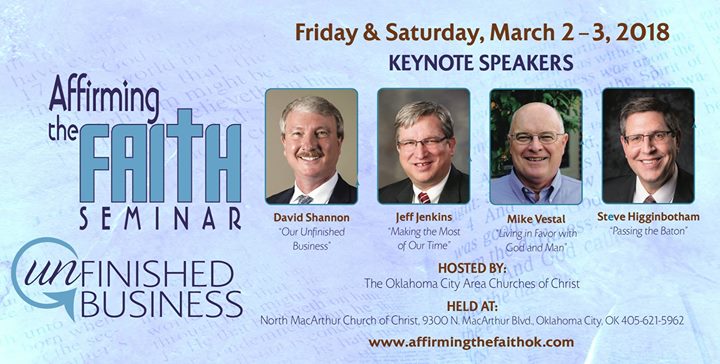
“Conversion of a Gang Member” was a part of the Conversion Series for the 11th annual Affirming the Faith Seminar held at the North MacArthur church of Christ (Oklahoma City, OK). The 2018 theme was Unfinished Business.

ATF 2018.jpg

Lecture Audio

Lesson Summary

The conversion to Christ by a gang member comes with its own challenges culturally, spiritually, socially, and developmentally. The stark contrast between the evils and perils of the world from the lives of long-time church-goers is often hard to quantify and hard to appreciate. We need a cooperative learning model that gives the church insight to enter and help their communities and provides a “training in righteousness” mentorship for the new covert.

The Lecture Presentation Slides

Notes

  • Related reading: Jovan Payes, “Leaving a Street Gang for Christ,” Gospel Advocate (April 2015).
  • “Lessons and Suggestions…”
    • I was able, for the most part, to blend and weave “lessons and suggestions” throughout the lecture.
    • Let me add a few Lessons
      • Even when we do not understand “where” our new converts are coming from socially and culturally, we can love them and plug them into the culture of the church. What we do not understand about them should not hinder us from incorporating them.
      • Shaming converts because they are urban, ethnic, or from a broken home will never do. The world no longer has the old “normal” standards or expectations. We need to be flexible with our expectations of what people know, how they think and relate, and where their pains exist – for not all scars are skin deep, some go to the soul. We do not need to add to their trauma. There are no “normal” people, there are only people.
      • In our excitement to celebrate people’s conversions to Christ, we need to be careful not to tell their story without permission. Some people are not ready emotionally to talk about where they come from, or what they’ve done in their life. Learn to embrace their new life in Christ, without forcing them to dig out their skeletons and trauma. They will do that when it is right for them to glorify God in Jesus.
    • Let me add a few Suggestions
      • We -the church- need to stop taking ourselves so seriously. We are all in need of grace and forgiveness… that includes our elderly members as well. So, we need to take Paul’s words to heart: “welcome one another as Christ has welcomed you, for the glory of God” (Romans 15:7 ESV).
      • Develop a “adopt a new Convert” program, or adopt a new convert on your own. Sometimes we wait for churches to create programs that need to happen now. Don’t wait for approval to serve… just serve. If you need permission… I permit you to serve. :) : “For whoever does the will of God, he is my brother and sister and mother” (Mark 3:35).
      • Remember the goal is to make disciples, but everyone starts at a different start line. Jesus’ words are clear, we are to not leave them to figure things out, but to develop them – give them moral and spiritual goals: “Go therefore and make disciples of all nations, baptizing them in the name of the Father and of the Son and of the Holy Spirit, teaching them to observe all that I have commanded you…” (Matthew 28:19-20).

Book Review: The Safest Place on Earth

Safest Place on Earth - Crabb.jpg

Larry Crabb, The Safest Place on Earth: Where People Connect and Are Forever Changed (Nashville, TN: W Publishing, 1999), Hardback, 240 pages.

Dr. Larry Crabb is an established licensed psychologist, a well-known Christian author on marriage and biblical counseling topics, and current Distinguished Scholar in Residence at the Colorado Christian University (Morrison, CO).[1] 

Dr. Crabb earned his Ph.D in Clinical Psychology from the University of Illinois, and has been a professor of psychology since 1970. Dr. Crabb also provides workshops and weekend seminars across the United States as part of his non-profit New Way Ministries and its web presence which features interviews, video lectures, and other multimedia outlets to share resources from his School of Spiritual Direction.

Dr. Crabb has been involved in counseling and marriage, in self-help ministry, and in developing a context of “spiritual community” for over 40 years, and so has earned a place among the various “Christian voices” seeking to make the church a better place.

In 1999, Dr. Crabb released a significant but brief volume on the church as a safe spiritual community. The volume is entitled, The Safest Place on Earth: Where People Connect and Are Forever Changed (238 pages).[2] Dr. Crabb has registered his own frustration with two elements which bear upon the community of the church and its spiritual health, which he further addresses in Real Church: Does it Exist? Can I Find It? (Nashville, TN: Nelson, 2009).

In The Safest Place on Earth, however, Dr. Crabb establishes a vision for the church as a group of believers on a journey towards God, and it is within the journey that spiritual community must begin and end for spiritual healing and direction. Despite Dr. Crabb’s own training in psychology, he believes when it comes to the soul care that ought to go on within the church, such assistance must yield “to special revelation and biblically dependent thinking.”[3] Dr. Crabb is adamant,

We don’t need more churches, as we usually define the word. We need more spiritual communities where good friends and wise people turn their chairs toward each other and talk well.[4]

Structurally, The Safest Place on Earth is organized in seventeen chapters, divided into three parts, and finishes with a section of questions for each chapter. The layout follows a very clear program of development, and the content is written in a popular style. Dr. Crabb is able to articulate and shape a conceptual paradigm of what is a spiritual community and what is not a spiritual community without complex vocabulary. His illustrations, personal anecdotes, and insights from personal interactions are delivered to support his vision for a spiritual community is very clear and helpful ways.

Dr. Crabb also interacts with and depends upon the works of Dutch Catholic priest Henri Nouwen[5] (1932-1996), who focused on spiritual solitude, spiritual community, and spiritual compassion, along with Swiss Catholic philosopher Jean Vanier (b. 1928) and his work connected to L’Arche communities which have overlapping concerns.[6]

A Book Summary

In part one, Dr. Crabb develops and sharpens the idea of spiritual community and how the church needs to develop sensitivity to being the spiritual community it was intended to be. Spiritual community is, according to Crabb, at the core of what the church is.

It is people facing each other in intimate, honest, and safe ways as they journey together on their way to God. Spiritual community, however, will not occur if there is no opportunity for vulnerability and a full sense of validation from these that witness the vulnerable parts of who we are.

One of the difficulties in church community life is to wrestle with the crux,

if they knew who I really was, the church would probably not like me.

To be a spiritual community, then, we must be able to love free from ego and embrace those so broken by those things which burden our souls and even cripple us.

The health metric of a spiritual community is its ability to love the unlovable, the broken, those that can only let you love them in their brokenness.

In part two, Dr. Crabb reframes the New Testament discussion of flesh and spirit elements of our soul in terms of the analogies of the Lower Room (carnal/wretchedness) and the Upper Room (spiritual/greatness).

It is in this phase of the book that Dr. Crabb focuses on the part of the church community that needs to be addressed first — our internal struggles to be spiritual. Enter Dr. Crabb’s “two rooms” analogy which he builds from the words of Jesus:

If anyone loves me, he will keep my word, and my Father will love him, and we will come to him and make our home with him. (John 14:23)

And he amplifies these words with Paul’s regarding “Christ in you” (Colossians 1:27).[7]

In essence, the two rooms represent fully furnished environments that exist within us.

Now there are two rooms inside us, the one we built where our natural self thrives, and the one the Spirit built where our natural self suffocates and our new self flourishes.[8] 

Dr. Crabb does not explicitly use all the terms, but these “rooms” parallel the Freudian id, ego, and superego dynamics, the difference being they are spiritualized.[9] The lower room is self-furnished by our wretchedness and “dark forces” with its corruption and stench (id). The upper room is furnished by the Spirit of God only enjoyed once we open the doors of the lower room, acknowledge its stench, and celebrate the confidence to be a new us (an obedient us) empowered by God’s grace and teaching (superego?).

Finally, we consciously (ego?) take these “two rooms” within us and the internal struggles that go with them —because we prefer to be in the lower room— to receive outside help from “another room” which is the spiritual community, the church. This room is furnished by the Spirit with safety, vision, wisdom, and power.

In part three, Dr. Crabb continues his visioning for spiritual community with another analogy of “turning our chairs toward each other” but now by “turning our souls toward each other.”

In this process, the members of the church community must practice three needed things. First, spiritual community can only be done by the Holy Spirit. Second, personal holiness grounded in the Spirit influences the pursuit of personal holiness of others. Third, there must then be a safe place to “own and trace our desires to their source.”[10] 

Spiritual community, however, will only occur when spiritual passions are “supernaturally” aroused when we are together in spiritual community experiencing acceptance, mutual faith in God’s presence in our lives, affirm the “upper room” elements in our lives, and allow God to change us without applying human pressures of forced change.

It is certainly a place of risk, but risk will always be a factor when embracing the need for vulnerability. Therefore, the real question is: will we, the church, be the safe place for those being vulnerable?

Response and Review

I chose this book principally because of the title. In fact, I had seen this title on the cover of the September/October 2001 New Wineskin magazine as part of the issue theme of “Authentic Christian Community.”[11] The concept peaked my interest because I do feel the church has not been the safest place on Earth in managing people’s sin. One example will suffice. I once heard a preacher react to the exposed sins of others with the derogatory question, “where are the normal people?” That’s not a safe place for healing. Nor is the following response to a fellow congregant’s addiction any safer, “there’s a word they need to learn – repent.”

Rebuking sin is the easy work of preaching, but creating a compassionate environment to help brothers and sisters work through repentance is the harder – and in my judgment – more fruitful work of ministry.

Crabb’s book further calls the church to be the community through which Christians experience spiritual healing for spiritual problems often mistreated —according to Dr. Crabb—as psychological disorders or problems. The gospel and the New Testament teaching that the church is the dwelling place of God, and Christians are the temple of the Holy Spirit, seem to support the overall agenda that the culture of the local congregation should be more attuned to openly working through sin, temptations, and openly celebrating grace, and spiritual empowerment by God. Even Paul declares that the church is being recreated (2 Corinthians 5:17) and repurposed for ministry (Ephesians 2:10).

Dr. Crabb’s book both intrigued me and made me uncomfortable in that he elevates the spiritual components of the church where the Holy Spirit dwells. Again, it is not that I’m troubled by the Holy Spirit, it is that in many pockets of the Churches of Christ the Holy Spirit and the use of “community” have been so tinged with so-called “liberal agendas” in the latter, and doctrinal controversial hotbeds regarding the former. His emphasis that the church is specifically designed to be a spiritual community and therefore it must be that spiritual community on a journey to God is what stands out the most to me. If we are not a spiritual community, then there will not be the Spirit.

I do not agree with all of his points on the “wretchedness” of man, but Dr. Crabb has challenged me to speak more about the Spirit and the church as the community in which God does His best work to heal us from the effects of sin.

Concluding Thoughts

What I liked overall about the book is the Dr. Crabb’s challenging call to the church to be a safe place for the sort of healing love that needs to exists between God’s people, so that the Spirit of God may work through the church to heal its members as they bear each other’s burdens with the gifts of the Spirit (Galatians 5:22-26). The church must be so, because, as Dr. Crabb reminds us, we are traveling together on a journey to God.

I recommend the challenge of this book to every Christian and church leader. The reminder that Scripture centers the body of Christ as the place where the Spirit dwells, and therefore must be the safe place where the members of the body can serve each other empowered by the same Spirit. To overcome sin, the church must be, and in some cases become, the place where no one struggles with sin void of love, compassion, support, and patience as we journey to God breaking free from the bondage of sin.

Endnotes

  1. “About Larry Crabb,” http://www.newwayministries.org/larrycrabb.php.
  2. Full details: Larry Crabb, The Safest Place on Earth: Where People Connect and Are Forever Changed (Nashville, TN: W Publishing, 1999).
  3. Crabb, The Safest Place on Earth, 7.
  4. Crabb, The Safest Place on Earth, 10.
  5. “Henri Nouwen Society,” http://henrinouwen.org.
  6. “History of L’Arche,” https://www.larcheusa.org/who-we-are/history.
  7. Unless otherwise stated all Scripture quotations are taken from the English Standard Version of The Holy Bible (Wheaton, IL: Crossway, 2001).
  8. Crabb, The Safest Place on Earth, 62–63.
  9. Crabb, The Safest Place on Earth, 78–79.
  10. Crabb, The Safest Place on Earth, 121–30.
  11. Larry Crabb, “Is the Church the Safest Place on Earth?,” New Wineskins 5.4 (Sept/Oct 2001): 12–15.

Oh Be Careful Little Ears…

Who would we be –and where– without those individuals who gave us the guidance and benefits of their wisdom accrued over the years of their experience. The powerful influences of those who have been our benefactors have left an indelible mark upon our lives in more ways than we often can be thankful for.

Of course, not all influences are of the same caliber. The Scriptures remind us of those powerful influences which may tug at our hearts and emotional fixations. Let us look at a few examples of counsel poorly chosen; then reflect upon choosing those wonderful influences which will improve our lives.

Counsel Poorly Chosen

Enabling Wrong-Doing to Satisfy an Obsession

Emotional fixations are very dangerous if left to fester and grow into obsessions. There are some who would do anything to help you gratify your desires.

No one knows this tragic lesson better than Amnon who had an obsession for his beautiful half-sister Tamar (2 Sam 13). Apparently, Amnon’s vexation was so apparent that his cousin Jonadab counsels him to pretend an illness, so that he may request the nursing care of his unsuspecting victim Tamar in his isolated chambers.

The results were a horrific incestuous rape, Amnon’s assassination at the hands of Tamar’s brother Absolam, and in turn an attack upon the throne of David as a further expression of his vengeful defiance. Absalom would lose his life in the insurrection.

Leaning on the Ambitions of the Power Hungry

In the transitional moments following King Solomon’s death and the rise of his successor Rehoboam, the young king had a choice to make: should he be a heavy-handed king like his father, or relieve the people of their plight (1 Kings 12:1-5)?

Rehoboam seeks the counsel of two groups of men, “the old men” (12:6-7) and “the young men” (12:8-11). The “old men” who had seen the oppression of his father were moved with compassion and propose that the new king’s reign should be based upon the welfare of his people, not upon an “iron fist.” [All Scripture references are from the English Standard Version unless otherwise noted.]

Unfortunately, Rehoboam listened to “the young men” with whom he had grown up. They propose an intensified cruel reign (12:9-11). The new king must be vindictive and cruel; his subjects ought to live in fear.

Little wonder that the majority of the Israelite tribes (10 of 12) seceded to follow a new claimant king – Jeroboam. The results were disastrous, for his idolatrous influence plagued the Northern Kingdom of Israel until its demise in 722 BC (2 Kings 17-18). This too was predicated upon Jeroboam’s fear of losing power over his subjects only that instead of listening to the counsel of others “he had devised [this] from his own heart” (1 Kings 12:25-33).

Accepting False Teaching Affects Moral Purity

False teachers are tremendous influences of evil upon our lives. In order to shake up the Corinthian congregation to reject false teaching regarding the resurrection (i.e. that it had already occurred, 1 Cor 15:12-32), Paul quotes the playwright Menander’s comedy Thais (ca.300 BC):

Bad company ruins good morals. (1 Cor 15:33)

By this quote, Paul argues against making associations with false teachers (false mentors); the influence would be, he argues, disastrous upon their morals (v. 34).[1]

Why?

“What could have been” enters the mind when considering the tragedy of Tamar, if only Jonadab had counseled his cousin in another direction.

One ponders, “if only Rehoboam had listened to the wise counsel of the ‘old men’” instead of submitting to the influence of his power grabbing childhood “friends”?

Too, why did Jeroboam reject the religion of the Lord after all that the Lord had promised to make a covenant with him as king (1 Kings 11:29-39)?

When the foundation of the Christian message is founded upon the resurrection from the dead according to the Scriptures (1 Cor 15:1-11), what could be so tempting in the notion that the dead do not rise (15:12)? There is nothing to gain if there is no resurrection. Why move from hope to hopelessness?

Influence and Personal Responsibility

As they say, “hind-sight is 100%.” The Monday morning quarterback is always a pro-bowler, and the “back seat” driver should be authorized to distribute driver licenses. I bring out these clichés because they are pertinent to this discussion.

The matter is not that we are “back seat” drivers telling another how they should have done better. We learn from the mistakes of the past in order to inform our own decisions so that we may not repeat their failures.

This is a matter regarding personal responsibility in light of those moments we allow others into our decision-making process.

Let the wise hear and increase in learning, and the one who understands obtain guidance, to understand a proverb and a saying, the words of the wise and their riddles. (Prov 1:5-6)

God calls us to seek His Word, warning us of the consequences of “ignoring” His counsel and reproof (Prov 1:25).

Like Amnon, Rehoboam and Jeroboam, and the Corinthians there may be temptations which vex us and those enticing us to embrace it by conspiring (via advice or false teaching) a way to experience it; however, like Joseph we need to keep our principles realizing that to satiate a sinful desire betrays God and those who would be destroyed by such an action (Gen 39:6-10).

When we are lost in the possibility that “we could” do something and never stop to think about whether we should,[2] we have left the hallmarks of responsibility behind. Proverbs 7:1-27 reminds of this truth, as Solomon speaks to the dangers of irresponsibility. Seeking counsel does not absolve us from the importance of making the right decision (Prov 11:14), nor from taking responsibility should our “counseled” decisions return to us as a mistake (Matt 5:23-24).

The Scriptures are very clear that we cannot “pass the buck” when it comes to our responsibilities. Every action – public or private – will be evaluated by a Holy God (Eccl 12:14).

The Blame Game

“Passing the buck” is such a common saying that we tend to be ignorant of its origin. President Truman has been associated with this saying, but actually, it is a term from the game of poker as played in the frontier days of the American story.

During these days, a marker or counter was a knife with a buckhorn handle – the “buck.” It “was used to indicate the person whose turn it was to deal”; moreover:

If the player did not wish to deal he could pass the responsibility by passing the ‘buck,’ as the counter came to be called, to the next player.

TrumanLibrary.org

Hence, “pass the buck” means to pass the responsibility on to someone else.

In Truman’s “farewell address” he affirms “the President – whoever he is – has to decide. He can’t pass the buck to anybody. No one else can do the deciding for him. That’s his job” (TrumanLibrary.org).

The saying applies to us all; no one can make our decisions for us. No excuses. This is “ground zero” of personal responsibility.

The First Blame Game

In the early days of the human family, Adam and Eve succumbed to the subtlety of the serpent’s questions regarding the forbidden fruit. When the Lord asked them concerning their actions, Adam and Eve attempt to distance themselves from the responsibility of their actions by placing upon either their spouse or the creature (Gen 3:8-13).

Giving in to Others is Not an Excuse

In early years of the Kingdom of Israel, King Saul was called upon to wage war upon the Amalekites. In fact, Saul was charged specifically to “go and strike Amalek and devote to destruction all that they have” (1 Sam 15:3; Lev 27:28).

Upon return from their victory over Amalek, Saul returns with the choice items of the plunders of war – with which he was not supposed to return. Moreover, he returns with the King (15:9). As a consequence, the prophet Samuel questions the king regarding the bleating of the sheep and lowing of the oxen (15:14).

The king places the burden of the decision to disobey God’s command upon the people, attempting to absolve himself from moral responsibility (15:9, 15, 20-21); yet, the king was completely complicit (15:9). Nevertheless, despite the action of others, the Lord was displeased with Saul and it cost him his throne (15:17-19, 26).

Personal Ownership

Accepting the Burden of our Decisions without Excuses

When David is presented with a parable, he unwittingly condemns himself for the adultery with Bathsheba (2 Sam 11:1-5), a failed cover-up (11:6-13), and the murder of Uriah (11:14-27).

Instead of passing the buck, David accepts accountability and the consequences of his sin. Unlike the many cases of Saul’s incessant impudence, denying his sins – David quickly moves to being convicted of heart. One only needs to read Psalm 51 in order to see his contrition for his sins before God.

Our Future is Based upon Decisions Made Today

When the Kingdom of Judah was exiled into captivity in the 7th–6th century BC, one of the concerns raised is the following: “Our fathers sinned, and are no more; and we bear their iniquities” (Lam 5:7). The exile was a time where the question of sin and responsibility and accountability before the Lord was pondered.

In Ezekiel 14:12-23, the prophet makes it clear that even if many Old Testament faithful were alive during the days of the exile, men like Noah, Daniel and Job would be saved and delivered from the exile because they are righteous. Unlike the rebellious character of the generation of the exile, righteous people could experience deliverance.

This is heavily answered in chapter 18; in particular verses 19–20:

Yet you say, ‘Why should not the son suffer for the iniquity of the father?’ When the son has done what is just and right, and has been careful to observe all my statutes, he shall surely live. (Ezek 18:19)

The son can escape the consequences of his father’s sin by living faithfully to the Lord. We must realize that our futures are partly shaped by our decisions.

One of the most important aspects to receiving the guidance offered by another is taking ownership of the decision to act on it or not.

Some attempt to fabricate a scenario in order to get the advice they desired in the first place but what they wanted was the “green light” from “another” to relieve them of responsibility. Some else made their choice for them.

Others simply run with the first piece of advice thrown at them. In either case, whether it is poor advice or good advice, one cannot escape personal responsibility for the course taken. Here we conclude our discussion.

Good Counsel Taken

Naomi and Ruth

One of the tenderest moments in Old Testament history is the relationship between Naomi and Ruth. After being widowed in the land of Moab, she gave her sons into marriage only to lose them over the course of a decade (Ruth 1:1-5). The only daughter-in-law to remain with Naomi is Ruth, and she joins Naomi on her return to Israelite land (1:6-22).

Being a stranger in another culture is difficult, but thankfully for Ruth she was blessed by a kind man (Boaz) who knew her story. Boaz cautioned her to stay on his land and among his servants and the young women.

When she returns to Naomi’s abode, Naomi reinforces Boaz’s counsel so that she is not assaulted by men in another field (2.22).

Naomi then counsels her to remarry with Boaz – a “redeemer” (2:20; 3:1-17). A redeemer is “one who frees or delivers another from difficulty, danger, or bondage.”[3] And Naomi provides the love, direction, and mentorship to give Ruth a chance at a good life with Boaz after enduring all the hardship of being a widow.

While Boaz works out the details with the extended family of Naomi’s husband, Ruth returns home and explains the situation to her. In a moment of wisdom, Naomi tells Ruth:

Wait, my daughter, until you learn how the matter turns out, for the man will not rest but will settle the matter today. (Ruth 3:18)

The outcome was a marriage that would be central to the lineage of King David (Ruth 4:13-22), and ultimately the ancestral beginnings of Jesus (Matt 1:5-6, 16).

Mordecai and Esther

When Esther replaces Vashti as queen of Persia, in the days of King Ahasuerus her relationship with her cousin Mordecai results in the protection of the Jewish population in exile.

A plot had emerged to genocide the Jewish population of the Persian Empire orchestrated by Haman. When Mordecai becomes aware of the plot, he impresses upon Esther with counsel to go to the king to stop it:

And who knows whether you have not come to the kingdom for such a time as this? (Esth 4:14b)

The results where an intercession so dramatic that Haman’s plot is foiled, he is punished by death, the Jews are delivered, and the Feast of Purim is inaugurated to honor this great event (Esth 5:1-9:32).

Samuel and Eli

In those transitional years when Israel settled into the land of Canaan, the Lord raised “judges” to deliver the people from oppression and led them to faithfulness. The last of the judges is the prophet Samuel. His beginnings are miraculous (1 Sam 1-2).

When he was a very young boy, Samuel’s mother Hannah lends him over to the Lord’s service for the entirety of his life (2:21-28). Samuel is placed into the care of the high priest Eli.

When Samuel grows to be “young man” he is found serving under Eli. On one occasion, when Samuel was sleeping “the Lord called Samuel” (3:4); it was during a unique time when “the word of the Lord was rare” and there “was no frequent vision” (3:1b). Consequently, Samuel – and Eli – did not understand what was happening when the Lord began to call Samuel for service.

Samuel initially arose from bed and presented himself before Eli, “Here I am”. Three times it occurred, twice Eli responded, “I did not call; lie down” (3:4-7). On the third time, Eli “perceived” that Samuel was being called by the Lord (3:8).

Eli counsels Samuel on how to respond to the Lord’s call (3:9): “Speak, Lord, for your servant hears.” That one moment of guidance set the groundwork for one of the greatest prophets of biblical history. Samuel led Israel faithfully, he set up kings (Saul and David) and deposed another (Saul).

Concluding Thoughts

Where would we be without mothers who guided our futures by their powerful faith? How would we make those important life-changing decisions without the passionate pleas from our friends? Or, how would we see the Lord calling us to do great things for Him if not by trusting in the wisdom of a good friend?

“No man is an island”; neither are our decisions. “What would ‘_’ have done” has helped us on many occasions. Let us apply wisdom prayerfully, knowing that in the end, the responsibility of our actions is all on us. Let there be mercy.

Endnotes

  1. Marion L. Soards, 1 Corinthians (Peabody, MA: Hendrickson, 1999), 339.
  2. This is a play on a scene from the sci-fi film Jurassic Park (Universal, 1993) where Dr. Ian Malcolm reacts to the reckless behavior of geneticists in the film who were cloning dinosaurs for an amusement park. Here is the dialogue courtesy of IMDB.comDr. Ian Malcom: If I may… Um, I’ll tell you the problem with the scientific power that you’re using here, it didn’t require any discipline to attain it. You read what others had done and you took the next step. You didn’t earn the knowledge for yourselves, so you don’t take any responsibility for it. You stood on the shoulders of geniuses to accomplish something as fast as you could, and before you even knew what you had, you patented it, and packaged it, and slapped it on a plastic lunchbox, and now [bangs on the table] Dr. Ian Malcolm: you’re selling it, you wanna sell it. Well… John Hammond: I don’t think you’re giving us our due credit. Our scientists have done things which nobody’s ever done before… Dr. Ian Malcolm: Yeah, yeah, but your scientists were so preoccupied with whether or not they could that they didn’t stop to think if they should.
  3. “Redeemer,” Nelson’s New Illustrated Bible Dictionary, ed. Ronald F. Youngblood (Nashville, TN: Nelson, 1995), 1073.