[Chapter submission for the 84th Annual Freed-Hardeman University Lectureship (2020), Henderson, Tennessee. This is part of the “Anticipating the Future: My Story is His Story” Series. Our Place in His Story: Remembering the Past, Anticipating the Future (Link to book). Listen to the audio lecture as delivered clicking here.]
Everyone has a past. Every conversion to Christ has a past from which it starts and a future to which it clings. Early in Paul’s letter to the Thessalonians he wrote of their decisive change from paganism to the faith and hope that is found in Christ, noting, “how you turned to God from idols to serve the living and true God, and to wait for his Son from heaven, whom he raised from the dead, Jesus who delivers us from the wrath to come” (1 Thess 1:9–10). [All Scripture references are from the English Standard Version unless otherwise stated.] This is the basic grammar of the Christian life: a conversion to serve God awaiting future deliverance at the return of Jesus. Between these two bookends (the past and future) the Christian experiences grace which is greater than our all past associations.
The Past is Worthless
In his autobiographical moments, Paul affirmed that the grace he experienced as a Christian—and apostle—surpassed any value attached to his past Jewish heritage. For example, in Philippians 3, Paul weighs the value of his life outside of Christ against what he finds “in Christ.” His past and present reads much like a “pros” (present) and “cons” (past) list. His past was filled with Israelite hubris and Jewish accolades (3:5–6). Richard Peace well observes,
not only was he blessed by birth with impeccable religious credentials, but as the result of his own accomplishments he had risen to the pinnacle of first-century Jewish spirituality. (31).
Richard Peace, Conversion in the New Testament (1999)
On paper, he was truly a “Hebrew of Hebrews” and it showed. Paul had been a blameless Benjamite Pharisee who zealously persecuted the church. Yet, at the time, his “zeal for God” was “not according to knowledge” (Rom 10:2). On the other side of the ledger, the “gain” (kérdos) this activity afforded him —Jewish “street cred”—amounted to being “loss” (Phil 3:7, 8) and “rubbish”[1] (3:8). Real “gain” is found in Paul’s slogan, “to live is Christ, and to die is gain [kérdos]” (Phil 1:21). Why? Paul had attained a full and realized relationship with Jesus Christ (3:8–16) manifested in the Lord’s “grace” (1:2, 7; 4:23). This is what every Christian shares in, grace that is greater than one’s past associations.
1 Timothy 1:12–14
Lost in Speculation (1 Tim 1:3–7)
Another important autobiographical statement by Paul is found in 1 Timothy 1:12–14.[2] Contextually, it comes off the heals of his reminder to Timothy that he was charged to address the dangers of “certain ones” (tís) bringing into the church religious “speculations” (ekzétesis) which emerge from teaching other doctrine(s) (hetero + didaskaleín) and indulging in myths and genealogies (1:3–4). Paul’s stress for doctrinal purity is well established. In Galatians 1:6, for example, Paul is opposed to any desertion to a “different gospel” (héteron euangélion). In Ephesus, the “end game” of those teaching other doctrines was simply “the inquiry” into the theoretical which subverts the actual carrying out of the plan of God (oikonomía; Knight 75) empowered by faith. The economy of God’s plan is not empowered by theory but by a Christian whose love is saturated by their pure heart, good conscience, and sincere personal faith (1:5). A Christian, distracted by “overthinking,” untouched by the work of God in their life will never be able to truly carry out their call to share the gospel of Jesus (1:6–7).
Healthy Teaching Restrains Evil (1 Tim 1:8–11)
There is no sin in exploring the contours of the faith nor engaging in deep religious and theological conversations, but this must never hinder teaching the law of God with its concrete condemnation of sin in all of its forms. Paul mentions thirteen types of “lawless” ones (1:9–10) for whom the law properly applies (nomímōs, 1:8). Paul affirms it is the primary purpose of the law “to restrain evil doing” (Guthrie 74) and this is why those that teach other doctrine(s) (1:3) fail in their endeavor to be “teachers of the law” (nomodidáskaloi, 1:7). Their speculations only offer that which is “contrary” (antíkeimai), and different (héteros),[3] to what is “healthy teaching” as concretely found and expressed in the law (1:10). This is the source of the convicting component of the gospel message, for through it God convicts humanity of sin but he does not leave sinners in their judgment. He incorporates them into the economy of his plan. This may be restated as, “no matter who you are, no matter where you have been, no matter what you have done, there is a place for you in the kingdom of God” (Payes). This key principle is the foundation for Paul’s own autobiographical thanksgiving in the next verses (1:12–14).
Thankful for the Grace of Jesus (1 Tim 1:12–14)
Paul frequently uses the Greek word chárin (grace, thanks, gift, favor, etc.) in his letters (100 times). In fact, he opens and closes all of his letters with chárin. This segment of 1 Timothy likewise opens (1:12) and closes (1:14) with this word, but with two different emphases—gratitude and favor (MM 684). Paul’s gratitude to his Lord Christ Jesus recognizes not only the enabling power (endunamóō) he receives from the Lord, but also the confidence placed on Paul to serve in his ministry (diakonía). Participating in the economy of God’s saving plan gave the apostle the experience of an overflowing “grace” (chárin). Paul never forgot his past, grace does not delete the past. It is clear that Paul’s past as “a blasphemer, persecutor, and insolent opponent” served as a motivation for his gratitude and zeal (Petrillo 18). His example demonstrates that God’s grace and mercy provides the means to cross the bridge from condemnation (1:8–10) to arrive at the healing place which creates the pure heart, good conscience, and a sincere faith (1:5) within the “foremost” sinner (1:15).
Paul’s “unbelief” (apistía) was met with the Lord’s compassion (eleéō), his “sins” and lawless behavior was met with the embrace of “the faith and love that are in Christ Jesus” (1:14). When Paul was brought into the “in Christ” relationship mercy was shown to him, he did not have to earn it. In his case, however, his rebellion was in ignorance while zealous for God (cf. Rom 10:2); nevertheless, he was in sin, and he acknowledged that God initiated a relationship with him out of compassion. Luke records this divine extension of mercy and Paul’s response (Acts 9:1–19; 22:16). On paper, Paul should stand condemned, but God does the overflowing abundant thing by empowering him to be an example to every believer after him (1 Tim 1:16).
Grace Greater than the Past
If one is not careful there is no greater enemy than the past. The powerful functions of the brain to store and to recall memories, decisions, mistakes, sins, and to imprint on them feelings anew can leave a person in an emotionally dangerous depressive cycle. If ever there was a divine commentary to how the human conscience lives in agony face to face with the evil done in the body it is David and his penitential prayer in Psalm 51. It is felt in the imperatives of the first two verses: have mercy, blot out, wash me, cleanse me. David makes these petitions trusting in God’s “steadfast love” (chesed) and “abundant mercy” (rōb + rahamim). Grief over moral failure is real, it hurts, and it lingers; however, the Lord provides the healing presence of his Spirit to find “a clean heart” and a renewed “right spirit” (10–11). It will require working through grief and regret, and to take these weaknesses that will always be there, and allow God to supply the power of his overflowing grace to take such weaknesses and turn them into strengths (2 Cor 12:9–10). There are some Christians who will never let go, they will hold grudges, but God’s grace is greater than past moral failures and greater than the self-righteous critics.
The reason grace is so powerful is that God turns human expectations on their heads and forces his people to reorient themselves to accommodate how the grace of God is rolled out. The Scottish wordsmith theologian, William Barclay (1907–1978), wrote about “the essential grace” in his volume The Mind of Paul. There are a few points to appreciate. First, “grace always moves in the realm of winsomeness, of loveliness, of attractiveness, of beauty and of charm” (154). Second, “grace has always in it the idea of a gift which is completely free and entirely undeserved” (155). For Barclay, grace always has an esthetic value, it can be appreciated for its beauty and attractiveness, and it also can be exchanged without quid pro quo. Third, God’s grace is inexhaustible as well as “undeserved generosity” (161–62). Indeed, Barclay affirms:
Grace is not a thing of narrow limitations, it is not a thing measured out in painstakingly accurate quantities with just enough and no more, as an ingredient might be in a recipe for some concoction; in grace there is a certain infinity; a certain complete adequacy; a certain inexhaustibility and illimitableness. No demand that can ever be made on it can exhaust it or strain its capacity and its power. (Barclay 163)
William Barclay, The Mind of Paul (1958)
It enabled Paul to embrace and celebrate the Christian experience of grace in all of its surpassing capacity (2 Cor 9:8, 14; Rom 5:20; Eph 1:7, 2:7).
Grace empowers the child of God to move forward, it is not a crutch to revert back into lawlessness. There is no cheap grace with God. Grace is rich and deep, but it is not an excuse to continue in sin (Rom 6:1–2). The connection between immersion and grace is firmly established with the Christian’s identification with Jesus’ resurrection, for the risen Christian emerges to serve God in grace (6:3–14). The past is not ignored, but the legal metaphor[4] based on the Roman slave trade is employed to paint the transition in ownership explains how Christians went from servants of sin to become “servants of righteousness” and experiencing the grace of God (Rom 6:15–23). Grace enables the Christian to serve God unimpeded.
A Personal Aside
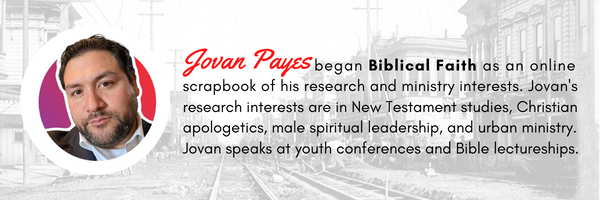
It is easy to get lost in the academic side of this study, but grace is not a sterile observable entity. Grace is an environment of generosity designed to rehabilitate those made in the image of God through the gospel (2 Cor 5:17). Over twenty years ago, I was on a street corner in the Mission District of San Francisco. I was a drug dealer and user. I abused alcohol. I was sexually immoral. I was in a gang. I was violent. I was a criminal. I contributed to the urban system of violence and fear. I was a sinner. But by the grace of God, I had the opportunity to read about Jesus in a Bible I found under my bed. The beauty of his grace was attractive. I desired it and wanted to share it with others. I traded in my old life for a life in Christ and was immersed for the forgiveness of my sins (Acts 2:38).
I never expected to be a preacher—I never expected to live past 18 years old. Today I am more than twice that age, and by the grace of God I preach the gospel and share it with my community in Bakersfield, CA. I’ve had some serious growing pains in the course of my Christian life. Some will only see me for my mistakes. Others have spurred me along because they too know that the grace of God is greater than our past associations and failures. Let us all ever be so minded.
Endnotes
- The word skúbalon is translated variously as “dung” (KJV, NET, CSB), “rubbish” (ESV, NABRE, NASB95, NKJV, NRSV), “refuse” (ASV, RSV), or “garbage” (CEV, NIV2011). Some think this word is either a swear/crude word (i.e, the s-word) or the closest thing to it. It certainly is a word that may literally mean “dung” (Sir 27:4) so in this sense it is construed as a vulgar word (TDNT 7:446; Wallace); however, the available lexical data does not support its use as an invective curse word (Manning). According to Friedrich Lang’s research, skúbalon is found to be an apt religious and philosophical analog for human “corruptibility” and “worthlessness” (TDNT 7:445). This appears to be clearly Paul’s point as he intensifies from “loss” to skúbalon; as in, his past is “all worthless trash” (ERV). It would have provided some shock value but not because it was a curse word.
- While some scholars argue that certain internal and contextual factors surrounding 1 Timothy—along with 2 Timothy and Titus—are not in keeping with the traditional view that Paul is its author (Dibelius and Conzelmann 1–5), they are however far from definitive (Knight 21–52) and do not make Pauline authorship impossible (Guthrie 58). The present study presupposes Pauline authorship for the thirteen letters traditionally associated to him.
- The ASV reads, “if there be any other thing [héteros] contrary to the sound doctrine” (1:10), which more clearly keeps at the forefront Paul’s use of héteros than the rendering of the ESV, “whatever else [héteros].”
- For further reading on the legal metaphor in Romans 6 see, Francis Lyall, “Legal Metaphors in the Epistles,” TynB 32 (1981):81–95.
Works Cited
Barclay, William. The Mind of Paul. 1958. Repr., New York: Harper & Row, 1975.
Dibelius, Martin, and Hans Conzelmann. The Pastoral Epistles. Translated by Philip Buttolph and Adela Yarbro. Herm. Edited by Helmut Koester, et al. Philadelphia: Fortress, 1972.
Guthrie, Donald. The Pastoral Epistles: An Introduction and Commentary. 2d edition. TNTC. Vol. 14. Edited by Leon Morris. 1990. Repr., Downers Grove: IVP Academic, 2009.
Knight, George W., III. The Pastoral Epistles. NIGTC. Edited by I. Howard Marshall and W. Ward Gasque. 1992. Repr., Grand Rapids: Eerdmans, 2013.
Lang, Friedrich. “skúbalon.” Theological Dictionary of the New Testament. Vol. 7. Edited by Gerhard Kittel and Gerhard Friedrich. Translated by Geoffrey W. Bromiley. Grand Rapids: Eerdmans, 1964.
Lyall, Francis. “Legal Metaphors in the Epistles.” TynB 32 (1981): 81–95.
Manning, Gary, Jr. “Did the Apostle Paul Use Profanity?” Biola University Good Book Blog. 2015. Accessed 30 Sept. 2019.
(MM) Moulton, James Hope, and George Milligan. The Vocabulary of the Greek Testament. 1930. Repr., Peabody: Hendrickson, 1997.
Payes, Jovan. “Leaving a Street Gang for Christ.” Gospel Advocate Blog. 2015. Accessed 30 Sept. 2019.
Peace, Richard V. Conversion in the New Testament: Paul and the Twelve. Grand Rapids: Eerdmans, 1999.
Petrillo, Denny. Commentary on 1, 2 Timothy and Titus. Abilene: Quality Publications, 1998.
Wallace, Daniel B. “A Brief Word Study on Skúbalon.” Bible.org. 2007. Accessed 30 Sept. 2019.




 biblicalfaith.online