Understanding That I Cannot Live at Peace with Everyone: Living with Not Being Able to Do the Impossible

[Note: This is a pre-pub version of my article submission for The Jenkins Institute’s August 2023 issue of The Preaching & Ministry Journal.]

God created human beings to be social, and to live within community. When “God created man in his image, in the image of God he created him,” notice that the text then equates this action with, “male and female he created them” (Gen 1:27).[1] The word “man” (’adam) here is not exclusive to the male but is generic for mankind as a created order. Mankind is the only creation made in God’s image and likeness, which is to say, that elements of the human species allow us to approximate what God is like. Humans are not God, but they share a “family resemblance.” A few of these resemblances include being free social, moral, spiritual, and relational creatures.

Christian ministry among God’s people and in the world speaks to these fundamental human issues and experiences. God has always communicated his will to humanity to shape our social, moral, spiritual, and relational toward godliness through Divine action, word, or prophetic revelation (Heb 1:1–2; 4:12–13). Unfortunately, our ungodliness gets in the way. Not only is the human response to the exposing power of God’s word often filled with resistance, but often the people who pursue godly living are resisted, rejected, and in extreme cases have been persecuted (1 Pet 4:1–19). Christian ministry, then, is grounded in the understanding of God’s word, its proclamation of the gospel by which sin is condemned, and the power of God’s gracious sanctification is heralded.

The work of Christian ministry is seated right in the heart of the human experience. It challenges free will choices, condemns certain actions, and commends others, and does so with love and righteousness serving as tandem virtues. Jesus in his farewell words to his disciples, reminded them that the word of God makes enemies. For this reason, he quoted Psalm 35:19, “They hated me without a cause” (John 15:26). This raises the issue of this short essay: while ministry is often filled with wonderful experiences and we witness meaningful spiritual triumphs, it is inevitable that the ministry of the word will create conflict among those we share it. We cannot always live in peace with everyone. How do we as ministers navigate this hard bitter truth? I suggest the following spiritual and emotional tools.

Spiritual Tools

Sitting with the Rejected Jesus

When we find ourselves at the barrel end of the anger and rejection of those we minister to, we need to sit with Jesus. God’s work comes with rejection. Jesus said, “If the world hates you, know that it has hated me before it hated you” (John 15:18). The prophet Isaiah foresaw the coming of Jesus and depicted him as the rejected servant who will suffer for the healing of Israel (52:13–53:12; Acts 8:35). On the surface, he was “stricken, smitten by God, and afflicted” (Isa 53:4), but in fact, he was punished by God for Israel’s rebellion against God (Isa 53:5).

Robert Chisholm notes that Isaiah affirms that “this apparent alienation was not final” for God’s servant will be vindicated (53:10–11).[2] The Gospels recount in detail how in his ministry Jesus was rejected for the hard truths against hypocrisy, traditionalism, and lack of love and grace for the downtrodden. I have learned to sit with Jesus when I feel rejected by those to whom I minister the word of God.

The Light Must Shine in the Darkness

The light of God’s word often creates tensions with those whose sins, consciences, or beliefs are cloaked in the darkness of worldliness. There is a great temptation to preach what is agreeable to the majority. When we push beyond what is traditionally expected or on controversial topics, biblical conclusions about sin may be met with hostility. These hostilities may be warranted if the presentation lacked love or adequate biblical foundation. Other times, hostilities arise because a social norm that has become acceptable is called sin. The preaching of repentance is to trade in resistance.

Additionally, preaching God’s word trades in light and darkness, righteousness and sin, morality and immorality, and personal sins and relational sins. If we refrain to proclaim the “whole counsel of God” then we will have abdicated our role as servants of God (Acts 20:26–27; Gal 1:10). It is hard to speak God’s word to people you love when you know that you are shining God’s light into their darkness (John 1:5, 11–12), but this is the task we have accepted. Trust the light to do its work.

Compassionate without Compromise

Every preacher brings a culture to their pulpit. Our desire to be faithful to God’s word can sometimes lack compassion. We should take time to evaluate if some of our uneasy relationship with others is because we preach as if there is only one type of preaching: harsh. The oracles of Moses, the prophets, and the sermons and discourses of Jesus and the apostles provide us with diverse examples of proclamation. Jesus certainly condemns sin. Remarkably, he lovingly invites the sinner to the innermost part of his heart (Matt 11:28–30).

On one occasion, Matthew cites Isaiah 42:1–3 to describe Jesus’ healing love for the sick. His compassion is framed as “a bruised reed he will not break, and a smoldering wick he will not quench” (Matt 12:18–21). William Barclay (1907–1978) reflects on this well, “A man’s witness may be shaky and weak; the light of his life may be but a flicker and not a flame; but Jesus did not come to discourage but encourage.”[3] We should always do some soul-searching when reflecting on the friction created by our attempts to proclaim God’s word.

Emotional Tools

Disappointment is a Normal Reaction

Isaiah declared, “who has believed what he has heard from us?” (53:1). Paul himself cited this in Romans 10:16 as he discusses the problem that not everyone will believe, yet the gospel must go out. Ministry is people work. We work with people. People disappoint us, especially those that know us and our love for them. It is hard not to personally take the rejection of what we teach and preach. Jesus reminds us that when our teaching aligns with his, any rejection of the doctrine goes back to our God.

The disappointment in “ministry outcomes” can tap into our identity issues and send us down a shame and depression spiral. Not everyone will like our preaching style. Not everyone will like our personality. Not everyone will accept us either. Sadly, we will be misunderstood as well. We will be judged by word gaffes in the pulpit. Our hard stand on sin will sometimes be confused for bigotry and outdated morality. People we love may be inadvertently hurt by ministering the word of God. We always want clear skies, but we must endure cloudy days. Disappointment is a normal reaction when our good-faith intentions in ministry create personal problems with others. Love them through your disappointments.

Frustration is No Excuse for Bad Behavior

As a young man, I thought I would become an auto mechanic for Mercedes-Benz. One day in auto school, two Russian students were heard banging on a car. The teacher yelled out into the shop, “What are you doing?” In response one of the men said in a thick Russian accent, “Don’t worry, sledgehammer and screwdriver fix everything.” My teacher was not impressed. When our message offends, and it will then remember we are stewards of God’s word. When we are frustrated by how people respond to us, we need to remember it is not an excuse for short-sighted responses that satisfy our emotional fixations of retribution.

“Sledgehammer and screwdriver” will not fix everything. When reading the Gospels, Jesus certainly had his fair share of direct controversies, but he always tempered them based on the kind of person that stood before him. Frustration often seeks a release because we have been let down. It is hard to remember that the person in front of you needs the grace of Jesus, not a petty unkind word that took a second to say but may take a lifetime to overcome. Yet, we are called to be peacemakers between God and man, and with each other (Matt 5:9; Jas 3:17–18). The work of peace-making applies the transforming “heart of Jesus” to times of conflict.[4]

Pray and Meditate through the Psalms

If there ever was a biblical figure that understood conflict in his life with those who oppose God’s will, few rival David. To say David was not perfect is an understatement. He is a multi-dimensional figure. Warrior and worshiper, sinner and a man after God’s own heart, condemned and vindicated, a political rival and a Divinely appointed king. The books of Samuel also reveal him to be musically inclined. He eventually received the moniker, “the sweet psalmist of Israel” (2 Sam 23:1). 73 psalms in the Psalter explicitly are “of David.” They are prayer-songs David wrote to praise God, declare faith and trust in God, plea for divine retribution, and recount God’s deliverance. Philip Yancey says that these “150 psalms are as difficult, disordered, and messy as life itself, a fact that can bring unexpected comfort.”[5] These psalms are a powerful tool for emotionally wrestling with ministry conflicts.

A significant form of the psalm is the lament. The lament is essentially a broad category of urgent prayer for God’s redeeming and saving intervention. Despite the sense of being God’s anointed and chosen, it seems rejection follows God’s servant. Sometimes the rejection is fatal and communal (Psa 22), or betrayal (Psa 41). These laments reveal that conflict in the life of God’s servant can cause confusion despite a deep faith. They can help structure our prayer life when wrestling with conflict. Psalm 13, for example, illustrates this process: call to God with our complaint (1–2), petition God to intervene (3a), give God reasons for his intervention (3b–4), and an expression of faith or sense of vindication that God has helped us through our conflicts with others (5–6). It is an interactive type of prayer.[6] As ministers, we need a prayer life to help us cope with conflicts in ministry when we are unable to live peaceably with others.

Conclusion

The spiritual and emotional tools I have surveyed are essential tools for the minister in times of conflict. I have not listed intellectual tools because our instincts to respond to conflict and rejection are often emotional responses. As Jack Cottrell (1933–2022) reflects,

What should a Christian do when harmed by another person…? The almost-universal tendency is to personally strike back, to retaliate, to try to get even, to make the evildoer pay for the harm he has done, i.e., to seek personal revenge.”[7]

Cottrell, Romans (1998)

Paul calls all Christians to resist this tendency for vengeance, “repay no one evil for evil… if possible, so far as it depends on you, live peaceably with all” (Rom 12:17–18). My prayer for those in ministry is to develop the emotional and spiritual disciplines above so they can endure the temptations which emerge from ministerial conflict.

Endnotes

[1] All Scripture references are from the English Standard Version unless otherwise stated.

[2] Robert B. Chisholm, Jr., Handbook on the Prophets: Isaiah, Jeremiah, Lamentations, Ezekiel, Daniel, Minor Prophets (2002; reprint, Grand Rapids, MI: Baker Academic, 2009), 120–21.

[3] William Barclay, The Gospel of Matthew, rev. ed. (Philadelphia, PA: Westminster, 1975), 2:34.

[4] Ken Sande, The Peace Maker: A Biblical Guide to Resolving Personal Conflict, 3rd ed. (Grand Rapids, MI: Baker Books, 2004), 134–35.

[5] Philip Yancey, The Bible Jesus Read (Grand Rapids, MI: Zondervan, 1999), 119.

[6] Walter Brueggemann, An Introduction to the Old Testament: The Canon and Christian Imagination (Louisville, KY: Westminster John Knox, 2003), 281–84.

[7] Jack Cottrell, Romans (Joplin, MO: College Press, 1998), 2:343.

Bibliography

Barclay, William. The Gospel of Matthew. 2 vols. Revised edition. Louisville, KY: Westminster John Knox, 1975.

Brueggemann, Walter. An Introduction to the Old Testament: The Canon and Christian Imagination. Louisville, KY: Westminster John Knox, 2003.

Chisholm, Robert B., Jr. Handbook on the Prophets: Isaiah, Jeremiah, Lamentations, Ezekiel, Daniel, Minor Prophets. 2002. Reprint, Grand Rapids, MI: Baker Academic, 2009.

Cottrell, Jack. Romans. 2 vols. College Press NIV Commentary. Edited by Anthony Ash. Joplin, MO: College Press, 1998.

Sande, Ken. The Peace Maker: A Biblical Guide to Resolving Personal Conflict. 3rd edition. Grand Rapids, MI: Baker Books, 2004.

Yancey, Philip. The Bible Jesus Read. Grand Rapids, MI: Zondervan, 1999.

Spiritual Growth: The Ezra Principle (Ezra 7:10)

In pursuit of my own spiritual growth (such as it is) as a man of faith, it took me a long time to figure out where my journey was supposed to find not just the goal, but the starting point and the road map for the pilgrimage. Spiritual growth is not the result of knowing where our faith calls us to, but from the arduous journey to get there.

My journey has been massively blessed. I have had mentors, mothers, fathers – at times, even grandparent – figures. They have all given me something for my journey (perhaps, sometime, I’ll write about that), but I was only walking with them on their journey. Still, I would not be where I am, spiritually, without them.

I tried education. I figured “if I could be smarter” then I could discover all of the secrets that others are keeping to themselves behind the walls of academia – the proverbial mountain top. I found the tools and methods instead to help me navigate “the strange and yet immanent” world of Scriptures. They helped me raise questions and look at God’s word from various new angles that have indeed helped me in my journey to God. Despite its benefits of making me feel closer to the text, however, it was not the “end all” solution to my spiritual needs.

My personal life experiences, training, and those mentors in my life, all pointed me back to one thing: my journey to God only makes sense when I invest in a lifestyle of discipleship that has a consequential impact on my life. This required me to take seriously the words of the Psalmists.

I needed my desire for wisdom to mirror the Psalmist’s outcry to the Lord:

Open my eyes, that I may behold wondrous things out of your law. (Psalm 119:18)[1]

In this great Psalm, David recounts the wonders of the Law of God and exalts its beauty, richness, guidance, and its loftiness as it is grounded in God’s righteousness. It begins with the words,

Blessed are those whose way is blameless, who walk in the law of the Lord! (Psalm 119:1)

One of the empowering aspects of this Psalm is not actually found in what is written, but in the very process by which we see the Psalmist’s love for living out the Word of God, the Law of the Lord. The entire Psalm flows with a powerful example of losing oneself in the world of God’s Law.

I am not at all surprised that Psalm 119 found a communal niche at the Feast of Pentecost, as Nancy deClaissé-Walford recounts:

It is recited at the Feast of Pentecost, the spring festival observed fifty days after Passover, which celebrates the giving of the torah to Moses at Sinai during the wilderness wanderings.[2]

Nancy deClaissé-Walford in The Book of Psalms (2014)

Psalm 119 called my attention to the only true path to spiritual growth: the transformative power of the world of the scriptures. Knowing God through the scriptures, however, must lead toward discipleship, toward obedience.

The Ezra Principle

The “Ezra Principle” sounds catchy and new doesn’t it. I guarantee you it is not. I have not discovered anything hidden in plain sight. In fact, the “principle” is not just one thing, but a commitment to five values of discipleship that Ezra pursued himself.

In the fifth century B.C. (c. 458 B.C.), Ezra is commissioned by the Persian King Artaxerxes I (465–424 B.C.) in his return to Jerusalem (7:1–28). It is a time of fresh opportunity to “get things right” following the seventy years of captivity in the Babylonian due to the corruptive influence of pagan idolatry.[3] In this context, Ezra had begun a process of preparation for the task before him:

Ezra had set his heart to study the Law of the LORD, and to do it and to teach his statutes and rules in Israel. (Ezra 7:10)

The grammarian in me is interested in the verbal phrases of Ezra’s commitment: (1) “set his heart,” (2) “to study the Law,” (3) “to do it,” and (4) “to teach… in Israel.” That’s powerful. You may find other ways to divide this passage, but we will separate “study” and its object, “the Law of the Lord,” into two values themselves.

This is one of those passages that made clear to me the connection between knowing God’s word and being an authentic follower of God: the connection between personal commitment to know and to do God’s word.

Knowledge and Discipleship

This observation shifted my thinking away from just being absorbed in the Word of God. Spiritual growth must embrace knowledge but that is not the entire picture. James warns us that a people of knowledge alone is useless if not insulting because knowledge (i.e., faith) is to demonstrate itself by good works (1:22-27).[4]

James weaves together the two themes of favoritism and faith in order to illustrate just how practical saving faith must be. He illustrates this by examining the relationship between the poor and the rich in the church:

If a brother or sister is poorly clothed and lacking in daily food, and one of you says to them, "Go in peace, be warmed and filled," without giving them the things needed for the body, what good is that? (Jas 2:15–16)

What good is knowing that we are all saved in Christ, so goes the argument, if we do not care for each other in this life? How does God’s communal redemption of all impact our daily interactions? James argues that knowledge (faith) should be lived out in the community of the body of Christ in consequential ways.

For that matter, think about the community where the church meets. What good are we doing if we are strong on truth, but our community has never heard or seen us live out what the gospel is all about? The good we do should move people that thank God:

In the same way, let your light shine before others, so that they may see your good works and give glory to your Father who is in heaven. (Matt 5:16)

In other words, spiritual knowledge and discipleship are inseparable.

To return to our point, knowing is only the beginning, the end is discipleship. The process from point A to point B is our journey of applying the narrative of Scripture (how God redeems humanity through Jesus Christ) to our lives so that we may be transformed by it (Rom 12:1-2). This makes the Word of God the essential guiding force behind all of our actions.

This brings us to the “main event” of this discussion: something I call the “Ezra Principle.”

(1) We Must Set Our Hearts

is one of the clearest descriptions of a targeted mindset in the OT. If the heart is not “into it” the body and life will not follow. Paul, speaking of the Macedonian’s benevolent efforts despite their deep poverty, describes the basis of their commitment: “they gave themselves first to the Lord, and then by the will of God to us” (2 Cor 8:5). Great advancements always stem from great commitments.

In the study and application of God’s Word, the commitment which begins at our spiritual core – the heart – will continue to be the driving force throughout our life of service to God (Deut 6:5, Lev 19:18).

(2) We Must Spend Time in Study.

Near the end of the apostle Paul’s life, he requested that Timothy come to be with him and bring his cloak, his books, and the parchments (2 Tim 4:13).  There are many speculations about the nature of these last two items, but at the very least the books and parchments would include copies of his letters to other churches. Paul would spend the last days of his life with those volumes he penned through inspiration to those in need of strength and faith.

The point we draw from here is that Paul was a studying man. In fact, he would encourage Timothy to be well equipped in the word of God and aptly able to “divide” the Scripture clearly and carefully (2 Tim 2:15). Ezra likewise spent renewed focus on studying the Law as he found himself and Israel back in the Land of their faith. Ezra knew, as we ought to today, that in order to rebuild our lives it must be based upon God’s word.

(3) We Must Select Only God’s Word as the Object of our Study.

There are many philosophical writings and even religious “scriptures” in the world. They often have maxims, sayings, or verses with which we would agree and commend. When building a biblical worldview as for the foundation of our spiritual growth, however, the Bible is the only set of “Sacred Writings” which are able to make a person wise to obtain salvation (2 Tim 3:14-15).

One may argue that this is an arrogant statement; however, despite the fact that such “writings” may provide insight into our lives, they pale in comparison with the never surpassed guidance given in the divine books of the Bible.

When one analyzes the Bible from the vantage point of predictive prophecy, historical accuracy, scientific foreknowledge, and literary harmony of this great anthology of 66 books in contrast to such other works, the Bible stands alone.

(4) We Must Steadfastly Practice God’s Word.

It is only by the conviction that the words inscribed on the paper we read are not mere words of human beings, but are instead the very words that God himself would breathe out (1 Thess 2:13; 2 Tim 3:16–17). Jesus teaches quite clearly that our lives are to reflect this type of respect, for in our prayers we are to express the sentiment, “your will be done, on earth as it is in heaven” (Matt 6:10). The Lord declares: “to obey is better than sacrifice” (1 Sam 15:22)

(5) We Must Share both our Learning and Experiences.

In many ways, teaching is not only the sharing of facts and principles. In various instances, anecdotal interactions with God’s word can be very revealing and helpful in understanding and teaching God’s word. For example, consider all those who continue to leave the denominational world for the practice of pure New Testament Christianity.

The process of filtering out unbiblical accretions while adding to their learning and practicing the biblical faith can be a very helpful experience to teach others going through the same process. The bottom line is that God’s word was never designed to be a mental exercise to the exclusion of action and sharing; indeed, we must make “disciples” (Matt 28:19-20).

Steven Lawson, in his own words, calls attention to the advice of Walter Kaiser:

When a man preaches, he should never remove his finger from the Scriptures, Kaiser affirmed. If he is gesturing with his right hand, he should keep his left hand’s finger on the text. If he reverses hands for gesturing, then he should also reverse hands for holding his spot in the text. He should always be pointing to the Scriptures.[5]

S. J. Lawson, “The Pattern of Biblical Preaching,” Bibliotheca Sacra 158 (2001)

The advice is striking for those that proclaim the Word of God, but it is an excellent reminder to those would-be disciples interested in taking their discipleship to the next level, namely, to be teachers.

Studying is Complicated

This may seem like an aside, but it is not. I promise. We need to be very careful how we use scripture. Sometimes there are narratives regarding God’s people which seem contrary to the high moral calling which is expected of God’s leaders or people. Historical narratives need to be read with caution, as they often make their points indirectly (with no commentary). They are not always telling us something God wants us to imitate, but what God’s people have done.[6] It teaches me to be careful when seeking to “do” and “teach” God’s word.

I have often wrestled with some of the deeds of Ezra as recorded in the sacred record, particularly the covenant he seems to have initiated among the returning exiled Jews to “put away” all their foreign wives and children (cf. Ezra 10). Was this divorce en-masse commissioned by God? If one takes the view that whatever is written is positive teaching, as an authoritative command, then the text seemingly gives justification to divorce and remarriage on the count of practicing a different faith. This seems counter to the teaching of Jesus who affirms that there is only one justifiable cause for divorce and remarriage: adultery (Matt 19:1–9).

Yet, if one takes the view that each action must be taken into consideration on its own merits, then it is possible that Ezra was convicted by the significant teaching against inter-marriage with foreigners due to their influence on their spiritual corruption (Exod 34:12–16; Deut 7:1–6; Josh 23:19–23) that he overstepped its application and persuaded the men of Israel to do something not commanded of those who were already “married with children.” This would align with the fact that there is no explicit commentary nor “word from the Lord” to demand these families to be severed.

Providing an answer to this riddle is beyond the purpose of this essay. My point is in our commitment to setting the heart, studying the word, and living out the word in our individual lives, the weight of teaching is likewise an important discipline that should be taken with the heavy responsibility that comes with it.

The Lord’s brother James wrote:

Not many of you should become teachers, my brothers, for you know that we who teach will be judged with greater strictness. For we all stumble in many ways. And if anyone does not stumble in what he says, he is a perfect man, able also to bridle his whole body. (James 3:1–2)

Humility must always accompany study and teaching (Rom 2:1–11).

Final Thoughts

I am forever grateful for those who took the time to encourage me, prod me, and guide me to appreciate the special place Bible study is in the spiritual life and growth of God’s people. I would like to give a quick hat tip to them at the close of this essay.

Donald W. Hinds (1922–2008) taught me and encouraged me to read daily and widely, to be challenged by what I read, and to meditate carefully on it. His son David Hinds taught me the importance of finding the right book and the right teacher (author), in that some have so prepared themselves that if I should listen to other voices beyond the Bible, I should find such authors. I am thankful to Wayne Jackson (1961–2017), a true preacher’s preacher, who probably shaped my passion for the study of the Scriptures more so than anyone else in my early formative years through his writings in biblical studies (The Christian Courier), biblical apologetics (Apologetics Press, Inc.), and while a member of the church where he richly and profoundly proclaimed the scriptures.

Others have guided me along the way as well. Earl D. Edwards was one of my instructors in college, an elder in the church while I attended college, and a personal mentor during my early academic development. In him, I saw how the power of God’s word can so shape a man’s life with dignity, scholarship, and humility.

I wish I could say more about others, but I’ll save that for another time. These are but a few personal encounters with those who have lived out and assisted me to see that the “Ezra Principle” is not a “cute” title, but essential for the spiritual formation that comes from following God and his word. I pray that you take its challenge.

Endnotes

  1. Unless cited otherwise, all Scripture quotations are from the English Standard Version of The Holy Bible (Wheaton, Ill: Crossway, 2016).
  2. Nancy deClaissé-Walford, “Book Five of the Psalter: Psalms 107–150,” in The Book of Psalms, NICOT, eds. E. J. Young, R. K. Harrison, and Robert L. Hubbard Jr. (Grand Rapids, MI: Eerdmans, 2014), 870.
  3. M. J. Boda, “Ezra,” Dictionary of the Old Testament: Historical Books (Downers Grove, IL: InterVarsity Press, 2005), 278.
  4. Craig L. Blomberg and Mariam J. Kamell, James, ZECNT, ed. Clinton E. Arnold (Grand Rapids, MI: Zondervan, 2008), 101.
  5. Steven J. Lawson, “The Pattern of Biblical Preaching: An Expository Study of Ezra 7:10 and Nehemiah 8:1–18,” BSac 158 (2001): 451.
  6. I am reminded of an “authorized” campus flyer I came across advertising a community college course on “The Bible as Literature” at the City College of San Francisco. It had a picture of the Bible with a sticker label on it that read:

    —-
    WARNING: This is a work of fiction. Do not interpret literally.

    CONTENT ADVISORY: Contains verses descriptive of or advocating suicide, incest, bestiality, sadomasochism, rape, murder, morbid violence, use of drugs or alcohol, homosexuality, criminal activity, human rights violations, and crimes against humanity.

    EXPOSURE WARNING: Exposure to contents for extended periods or during formative years in children has been known to cause delusions, hallucinations, decreased cognitive and objective reasoning abilities, and in extreme cases, pathological disorders, hatred, bigotry, and violence including, but not limited to torture, murder, and genocide.
    —-

    Are there stories in Scripture that record horrific events? Yes. Are they documented to promote such behavior? No. They are recorded to document the fallen nature of the world we live in.

Grace Greater Than Past Associations (1 Tim 1:12–14)

[Chapter submission for the 84th Annual Freed-Hardeman University Lectureship (2020), Henderson, Tennessee. This is part of the “Anticipating the Future: My Story is His Story” Series. Our Place in His Story: Remembering the Past, Anticipating the Future (Link to book). Listen to the audio lecture as delivered clicking here.]


Everyone has a past. Every conversion to Christ has a past from which it starts and a future to which it clings. Early in Paul’s letter to the Thessalonians he wrote of their decisive change from paganism to the faith and hope that is found in Christ, noting, “how you turned to God from idols to serve the living and true God, and to wait for his Son from heaven, whom he raised from the dead, Jesus who delivers us from the wrath to come” (1 Thess 1:9–10). [All Scripture references are from the English Standard Version unless otherwise stated.] This is the basic grammar of the Christian life: a conversion to serve God awaiting future deliverance at the return of Jesus. Between these two bookends (the past and future) the Christian experiences grace which is greater than our all past associations.

The Past is Worthless

In his autobiographical moments, Paul affirmed that the grace he experienced as a Christian—and apostle—surpassed any value attached to his past Jewish heritage. For example, in Philippians 3, Paul weighs the value of his life outside of Christ against what he finds “in Christ.” His past and present reads much like a “pros” (present) and “cons” (past) list. His past was filled with Israelite hubris and Jewish accolades (3:5–6). Richard Peace well observes,

not only was he blessed by birth with impeccable religious credentials, but as the result of his own accomplishments he had risen to the pinnacle of first-century Jewish spirituality. (31).

Richard Peace, Conversion in the New Testament (1999)

On paper, he was truly a “Hebrew of Hebrews” and it showed. Paul had been a blameless Benjamite Pharisee who zealously persecuted the church. Yet, at the time, his “zeal for God” was “not according to knowledge” (Rom 10:2). On the other side of the ledger, the “gain” (kérdos) this activity afforded him —Jewish “street cred”—amounted to being “loss” (Phil 3:7, 8) and “rubbish”[1] (3:8). Real “gain” is found in Paul’s slogan, “to live is Christ, and to die is gain [kérdos]” (Phil 1:21). Why? Paul had attained a full and realized relationship with Jesus Christ (3:8–16) manifested in the Lord’s “grace” (1:2, 7; 4:23). This is what every Christian shares in, grace that is greater than one’s past associations.

1 Timothy 1:12–14

Lost in Speculation (1 Tim 1:3–7)

Another important autobiographical statement by Paul is found in 1 Timothy 1:12–14.[2] Contextually, it comes off the heals of his reminder to Timothy that he was charged to address the dangers of “certain ones” (tís) bringing into the church religious “speculations” (ekzétesis) which emerge from teaching other doctrine(s) (hetero + didaskaleín) and indulging in myths and genealogies (1:3–4). Paul’s stress for doctrinal purity is well established. In Galatians 1:6, for example, Paul is opposed to any desertion to a “different gospel” (héteron euangélion). In Ephesus, the “end game” of those teaching other doctrines was simply “the inquiry” into the theoretical which subverts the actual carrying out of the plan of God (oikonomía; Knight 75) empowered by faith. The economy of God’s plan is not empowered by theory but by a Christian whose love is saturated by their pure heart, good conscience, and sincere personal faith (1:5). A Christian, distracted by “overthinking,” untouched by the work of God in their life will never be able to truly carry out their call to share the gospel of Jesus (1:6–7).

Healthy Teaching Restrains Evil (1 Tim 1:8–11)

There is no sin in exploring the contours of the faith nor engaging in deep religious and theological conversations, but this must never hinder teaching the law of God with its concrete condemnation of sin in all of its forms. Paul mentions thirteen types of “lawless” ones (1:9–10) for whom the law properly applies (nomímōs, 1:8). Paul affirms it is the primary purpose of the law “to restrain evil doing” (Guthrie 74) and this is why those that teach other doctrine(s) (1:3) fail in their endeavor to be “teachers of the law” (nomodidáskaloi, 1:7). Their speculations only offer that which is “contrary” (antíkeimai), and different (héteros),[3] to what is “healthy teaching” as concretely found and expressed in the law (1:10). This is the source of the convicting component of the gospel message, for through it God convicts humanity of sin but he does not leave sinners in their judgment. He incorporates them into the economy of his plan. This may be restated as, “no matter who you are, no matter where you have been, no matter what you have done, there is a place for you in the kingdom of God” (Payes). This key principle is the foundation for Paul’s own autobiographical thanksgiving in the next verses (1:12–14).

Thankful for the Grace of Jesus (1 Tim 1:12–14)

Paul frequently uses the Greek word chárin (grace, thanks, gift, favor, etc.) in his letters (100 times). In fact, he opens and closes all of his letters with chárin. This segment of 1 Timothy likewise opens (1:12) and closes (1:14) with this word, but with two different emphases—gratitude and favor (MM 684). Paul’s gratitude to his Lord Christ Jesus recognizes not only the enabling power (endunamóō) he receives from the Lord, but also the confidence placed on Paul to serve in his ministry (diakonía). Participating in the economy of God’s saving plan gave the apostle the experience of an overflowing “grace” (chárin). Paul never forgot his past, grace does not delete the past. It is clear that Paul’s past as “a blasphemer, persecutor, and insolent opponent” served as a motivation for his gratitude and zeal (Petrillo 18). His example demonstrates that God’s grace and mercy provides the means to cross the bridge from condemnation (1:8–10) to arrive at the healing place which creates the pure heart, good conscience, and a sincere faith (1:5) within the “foremost” sinner (1:15).

Paul’s “unbelief” (apistía) was met with the Lord’s compassion (eleéō), his “sins” and lawless behavior was met with the embrace of “the faith and love that are in Christ Jesus” (1:14). When Paul was brought into the “in Christ” relationship mercy was shown to him, he did not have to earn it. In his case, however, his rebellion was in ignorance while zealous for God (cf. Rom 10:2); nevertheless, he was in sin, and he acknowledged that God initiated a relationship with him out of compassion. Luke records this divine extension of mercy and Paul’s response (Acts 9:1–19; 22:16). On paper, Paul should stand condemned, but God does the overflowing abundant thing by empowering him to be an example to every believer after him (1 Tim 1:16).

Grace Greater than the Past

If one is not careful there is no greater enemy than the past. The powerful functions of the brain to store and to recall memories, decisions, mistakes, sins, and to imprint on them feelings anew can leave a person in an emotionally dangerous depressive cycle. If ever there was a divine commentary to how the human conscience lives in agony face to face with the evil done in the body it is David and his penitential prayer in Psalm 51. It is felt in the imperatives of the first two verses: have mercy, blot out, wash me, cleanse me. David makes these petitions trusting in God’s “steadfast love” (chesed) and “abundant mercy” (rōb + rahamim). Grief over moral failure is real, it hurts, and it lingers; however, the Lord provides the healing presence of his Spirit to find “a clean heart” and a renewed “right spirit” (10–11). It will require working through grief and regret, and to take these weaknesses that will always be there, and allow God to supply the power of his overflowing grace to take such weaknesses and turn them into strengths (2 Cor 12:9–10). There are some Christians who will never let go, they will hold grudges, but God’s grace is greater than past moral failures and greater than the self-righteous critics.

The reason grace is so powerful is that God turns human expectations on their heads and forces his people to reorient themselves to accommodate how the grace of God is rolled out. The Scottish wordsmith theologian, William Barclay (1907–1978), wrote about “the essential grace” in his volume The Mind of Paul. There are a few points to appreciate. First, “grace always moves in the realm of winsomeness, of loveliness, of attractiveness, of beauty and of charm” (154). Second, “grace has always in it the idea of a gift which is completely free and entirely undeserved” (155). For Barclay, grace always has an esthetic value, it can be appreciated for its beauty and attractiveness, and it also can be exchanged without quid pro quo. Third, God’s grace is inexhaustible as well as “undeserved generosity” (161–62). Indeed, Barclay affirms:

Grace is not a thing of narrow limitations, it is not a thing measured out in painstakingly accurate quantities with just enough and no more, as an ingredient might be in a recipe for some concoction; in grace there is a certain infinity; a certain complete adequacy; a certain inexhaustibility and illimitableness. No demand that can ever be made on it can exhaust it or strain its capacity and its power. (Barclay 163)

William Barclay, The Mind of Paul (1958)

It enabled Paul to embrace and celebrate the Christian experience of grace in all of its surpassing capacity (2 Cor 9:8, 14; Rom 5:20; Eph 1:7, 2:7).

Grace empowers the child of God to move forward, it is not a crutch to revert back into lawlessness. There is no cheap grace with God. Grace is rich and deep, but it is not an excuse to continue in sin (Rom 6:1–2). The connection between immersion and grace is firmly established with the Christian’s identification with Jesus’ resurrection, for the risen Christian emerges to serve God in grace (6:3–14). The past is not ignored, but the legal metaphor[4] based on the Roman slave trade is employed to paint the transition in ownership explains how Christians went from servants of sin to become “servants of righteousness” and experiencing the grace of God (Rom 6:15–23). Grace enables the Christian to serve God unimpeded.

A Personal Aside

It is easy to get lost in the academic side of this study, but grace is not a sterile observable entity. Grace is an environment of generosity designed to rehabilitate those made in the image of God through the gospel (2 Cor 5:17). Over twenty years ago, I was on a street corner in the Mission District of San Francisco. I was a drug dealer and user. I abused alcohol. I was sexually immoral. I was in a gang. I was violent. I was a criminal. I contributed to the urban system of violence and fear. I was a sinner. But by the grace of God, I had the opportunity to read about Jesus in a Bible I found under my bed. The beauty of his grace was attractive. I desired it and wanted to share it with others. I traded in my old life for a life in Christ and was immersed for the forgiveness of my sins (Acts 2:38).

I never expected to be a preacher—I never expected to live past 18 years old. Today I am more than twice that age, and by the grace of God I preach the gospel and share it with my community in Bakersfield, CA. I’ve had some serious growing pains in the course of my Christian life. Some will only see me for my mistakes. Others have spurred me along because they too know that the grace of God is greater than our past associations and failures. Let us all ever be so minded.

Endnotes

  1. The word skúbalon is translated variously as “dung” (KJV, NET, CSB), “rubbish” (ESV, NABRE, NASB95, NKJV, NRSV), “refuse” (ASV, RSV), or “garbage” (CEV, NIV2011). Some think this word is either a swear/crude word (i.e, the s-word) or the closest thing to it. It certainly is a word that may literally mean “dung” (Sir 27:4) so in this sense it is construed as a vulgar word (TDNT 7:446; Wallace); however, the available lexical data does not support its use as an invective curse word (Manning). According to Friedrich Lang’s research, skúbalon is found to be an apt religious and philosophical analog for human “corruptibility” and “worthlessness” (TDNT 7:445). This appears to be clearly Paul’s point as he intensifies from “loss” to skúbalon; as in, his past is “all worthless trash” (ERV). It would have provided some shock value but not because it was a curse word.
  2. While some scholars argue that certain internal and contextual factors surrounding 1 Timothy—along with 2 Timothy and Titus—are not in keeping with the traditional view that Paul is its author (Dibelius and Conzelmann 1–5), they are however far from definitive (Knight 21–52) and do not make Pauline authorship impossible (Guthrie 58). The present study presupposes Pauline authorship for the thirteen letters traditionally associated to him.
  3. The ASV reads, “if there be any other thing [héteros] contrary to the sound doctrine” (1:10), which more clearly keeps at the forefront Paul’s use of héteros than the rendering of the ESV, “whatever else [héteros].”
  4. For further reading on the legal metaphor in Romans 6 see, Francis Lyall, “Legal Metaphors in the Epistles,” TynB 32 (1981):81–95. 

Works Cited

Barclay, William. The Mind of Paul. 1958. Repr., New York: Harper & Row, 1975.

Dibelius, Martin, and Hans Conzelmann. The Pastoral Epistles. Translated by Philip Buttolph and Adela Yarbro. Herm. Edited by Helmut Koester, et al. Philadelphia: Fortress, 1972.

Guthrie, Donald. The Pastoral Epistles: An Introduction and Commentary. 2d edition. TNTC. Vol. 14. Edited by Leon Morris. 1990. Repr., Downers Grove: IVP Academic, 2009.

Knight, George W., III. The Pastoral Epistles. NIGTC. Edited by I. Howard Marshall and W. Ward Gasque. 1992. Repr., Grand Rapids: Eerdmans, 2013.

Lang, Friedrich. “skúbalon.” Theological Dictionary of the New Testament. Vol. 7. Edited by Gerhard Kittel and Gerhard Friedrich. Translated by Geoffrey W. Bromiley. Grand Rapids: Eerdmans, 1964.

Lyall, Francis. “Legal Metaphors in the Epistles.” TynB 32 (1981): 81–95.

Manning, Gary, Jr. “Did the Apostle Paul Use Profanity?Biola University Good Book Blog. 2015. Accessed 30 Sept. 2019.

(MM) Moulton, James Hope, and George Milligan. The Vocabulary of the Greek Testament. 1930. Repr., Peabody: Hendrickson, 1997.

Payes, Jovan. “Leaving a Street Gang for Christ.” Gospel Advocate Blog. 2015. Accessed 30 Sept. 2019.

Peace, Richard V. Conversion in the New Testament: Paul and the Twelve. Grand Rapids: Eerdmans, 1999.

Petrillo, Denny. Commentary on 1, 2 Timothy and Titus. Abilene: Quality Publications, 1998.

Wallace, Daniel B. “A Brief Word Study on Skúbalon.” Bible.org. 2007. Accessed 30 Sept. 2019.


Book Review: The Safest Place on Earth

Safest Place on Earth - Crabb.jpg

Larry Crabb, The Safest Place on Earth: Where People Connect and Are Forever Changed (Nashville, TN: W Publishing, 1999), Hardback, 240 pages.

Dr. Larry Crabb is an established licensed psychologist, a well-known Christian author on marriage and biblical counseling topics, and current Distinguished Scholar in Residence at the Colorado Christian University (Morrison, CO).[1] 

Dr. Crabb earned his Ph.D in Clinical Psychology from the University of Illinois, and has been a professor of psychology since 1970. Dr. Crabb also provides workshops and weekend seminars across the United States as part of his non-profit New Way Ministries and its web presence which features interviews, video lectures, and other multimedia outlets to share resources from his School of Spiritual Direction.

Dr. Crabb has been involved in counseling and marriage, in self-help ministry, and in developing a context of “spiritual community” for over 40 years, and so has earned a place among the various “Christian voices” seeking to make the church a better place.

In 1999, Dr. Crabb released a significant but brief volume on the church as a safe spiritual community. The volume is entitled, The Safest Place on Earth: Where People Connect and Are Forever Changed (238 pages).[2] Dr. Crabb has registered his own frustration with two elements which bear upon the community of the church and its spiritual health, which he further addresses in Real Church: Does it Exist? Can I Find It? (Nashville, TN: Nelson, 2009).

In The Safest Place on Earth, however, Dr. Crabb establishes a vision for the church as a group of believers on a journey towards God, and it is within the journey that spiritual community must begin and end for spiritual healing and direction. Despite Dr. Crabb’s own training in psychology, he believes when it comes to the soul care that ought to go on within the church, such assistance must yield “to special revelation and biblically dependent thinking.”[3] Dr. Crabb is adamant,

We don’t need more churches, as we usually define the word. We need more spiritual communities where good friends and wise people turn their chairs toward each other and talk well.[4]

Structurally, The Safest Place on Earth is organized in seventeen chapters, divided into three parts, and finishes with a section of questions for each chapter. The layout follows a very clear program of development, and the content is written in a popular style. Dr. Crabb is able to articulate and shape a conceptual paradigm of what is a spiritual community and what is not a spiritual community without complex vocabulary. His illustrations, personal anecdotes, and insights from personal interactions are delivered to support his vision for a spiritual community is very clear and helpful ways.

Dr. Crabb also interacts with and depends upon the works of Dutch Catholic priest Henri Nouwen[5] (1932-1996), who focused on spiritual solitude, spiritual community, and spiritual compassion, along with Swiss Catholic philosopher Jean Vanier (b. 1928) and his work connected to L’Arche communities which have overlapping concerns.[6]

A Book Summary

In part one, Dr. Crabb develops and sharpens the idea of spiritual community and how the church needs to develop sensitivity to being the spiritual community it was intended to be. Spiritual community is, according to Crabb, at the core of what the church is.

It is people facing each other in intimate, honest, and safe ways as they journey together on their way to God. Spiritual community, however, will not occur if there is no opportunity for vulnerability and a full sense of validation from these that witness the vulnerable parts of who we are.

One of the difficulties in church community life is to wrestle with the crux,

if they knew who I really was, the church would probably not like me.

To be a spiritual community, then, we must be able to love free from ego and embrace those so broken by those things which burden our souls and even cripple us.

The health metric of a spiritual community is its ability to love the unlovable, the broken, those that can only let you love them in their brokenness.

In part two, Dr. Crabb reframes the New Testament discussion of flesh and spirit elements of our soul in terms of the analogies of the Lower Room (carnal/wretchedness) and the Upper Room (spiritual/greatness).

It is in this phase of the book that Dr. Crabb focuses on the part of the church community that needs to be addressed first — our internal struggles to be spiritual. Enter Dr. Crabb’s “two rooms” analogy which he builds from the words of Jesus:

If anyone loves me, he will keep my word, and my Father will love him, and we will come to him and make our home with him. (John 14:23)

And he amplifies these words with Paul’s regarding “Christ in you” (Colossians 1:27).[7]

In essence, the two rooms represent fully furnished environments that exist within us.

Now there are two rooms inside us, the one we built where our natural self thrives, and the one the Spirit built where our natural self suffocates and our new self flourishes.[8] 

Dr. Crabb does not explicitly use all the terms, but these “rooms” parallel the Freudian id, ego, and superego dynamics, the difference being they are spiritualized.[9] The lower room is self-furnished by our wretchedness and “dark forces” with its corruption and stench (id). The upper room is furnished by the Spirit of God only enjoyed once we open the doors of the lower room, acknowledge its stench, and celebrate the confidence to be a new us (an obedient us) empowered by God’s grace and teaching (superego?).

Finally, we consciously (ego?) take these “two rooms” within us and the internal struggles that go with them —because we prefer to be in the lower room— to receive outside help from “another room” which is the spiritual community, the church. This room is furnished by the Spirit with safety, vision, wisdom, and power.

In part three, Dr. Crabb continues his visioning for spiritual community with another analogy of “turning our chairs toward each other” but now by “turning our souls toward each other.”

In this process, the members of the church community must practice three needed things. First, spiritual community can only be done by the Holy Spirit. Second, personal holiness grounded in the Spirit influences the pursuit of personal holiness of others. Third, there must then be a safe place to “own and trace our desires to their source.”[10] 

Spiritual community, however, will only occur when spiritual passions are “supernaturally” aroused when we are together in spiritual community experiencing acceptance, mutual faith in God’s presence in our lives, affirm the “upper room” elements in our lives, and allow God to change us without applying human pressures of forced change.

It is certainly a place of risk, but risk will always be a factor when embracing the need for vulnerability. Therefore, the real question is: will we, the church, be the safe place for those being vulnerable?

Response and Review

I chose this book principally because of the title. In fact, I had seen this title on the cover of the September/October 2001 New Wineskin magazine as part of the issue theme of “Authentic Christian Community.”[11] The concept peaked my interest because I do feel the church has not been the safest place on Earth in managing people’s sin. One example will suffice. I once heard a preacher react to the exposed sins of others with the derogatory question, “where are the normal people?” That’s not a safe place for healing. Nor is the following response to a fellow congregant’s addiction any safer, “there’s a word they need to learn – repent.”

Rebuking sin is the easy work of preaching, but creating a compassionate environment to help brothers and sisters work through repentance is the harder – and in my judgment – more fruitful work of ministry.

Crabb’s book further calls the church to be the community through which Christians experience spiritual healing for spiritual problems often mistreated —according to Dr. Crabb—as psychological disorders or problems. The gospel and the New Testament teaching that the church is the dwelling place of God, and Christians are the temple of the Holy Spirit, seem to support the overall agenda that the culture of the local congregation should be more attuned to openly working through sin, temptations, and openly celebrating grace, and spiritual empowerment by God. Even Paul declares that the church is being recreated (2 Corinthians 5:17) and repurposed for ministry (Ephesians 2:10).

Dr. Crabb’s book both intrigued me and made me uncomfortable in that he elevates the spiritual components of the church where the Holy Spirit dwells. Again, it is not that I’m troubled by the Holy Spirit, it is that in many pockets of the Churches of Christ the Holy Spirit and the use of “community” have been so tinged with so-called “liberal agendas” in the latter, and doctrinal controversial hotbeds regarding the former. His emphasis that the church is specifically designed to be a spiritual community and therefore it must be that spiritual community on a journey to God is what stands out the most to me. If we are not a spiritual community, then there will not be the Spirit.

I do not agree with all of his points on the “wretchedness” of man, but Dr. Crabb has challenged me to speak more about the Spirit and the church as the community in which God does His best work to heal us from the effects of sin.

Concluding Thoughts

What I liked overall about the book is the Dr. Crabb’s challenging call to the church to be a safe place for the sort of healing love that needs to exists between God’s people, so that the Spirit of God may work through the church to heal its members as they bear each other’s burdens with the gifts of the Spirit (Galatians 5:22-26). The church must be so, because, as Dr. Crabb reminds us, we are traveling together on a journey to God.

I recommend the challenge of this book to every Christian and church leader. The reminder that Scripture centers the body of Christ as the place where the Spirit dwells, and therefore must be the safe place where the members of the body can serve each other empowered by the same Spirit. To overcome sin, the church must be, and in some cases become, the place where no one struggles with sin void of love, compassion, support, and patience as we journey to God breaking free from the bondage of sin.

Endnotes

  1. “About Larry Crabb,” http://www.newwayministries.org/larrycrabb.php.
  2. Full details: Larry Crabb, The Safest Place on Earth: Where People Connect and Are Forever Changed (Nashville, TN: W Publishing, 1999).
  3. Crabb, The Safest Place on Earth, 7.
  4. Crabb, The Safest Place on Earth, 10.
  5. “Henri Nouwen Society,” http://henrinouwen.org.
  6. “History of L’Arche,” https://www.larcheusa.org/who-we-are/history.
  7. Unless otherwise stated all Scripture quotations are taken from the English Standard Version of The Holy Bible (Wheaton, IL: Crossway, 2001).
  8. Crabb, The Safest Place on Earth, 62–63.
  9. Crabb, The Safest Place on Earth, 78–79.
  10. Crabb, The Safest Place on Earth, 121–30.
  11. Larry Crabb, “Is the Church the Safest Place on Earth?,” New Wineskins 5.4 (Sept/Oct 2001): 12–15.

Book Review: Relaunch

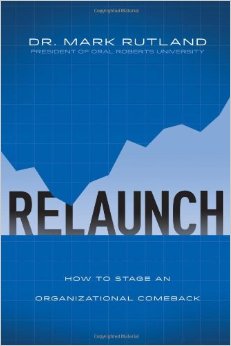
Relaunch - Rutland - Cover

Mark Rutland, Relaunch: How to Stage an Organizational Comeback (Colorado Springs, CO: Cook, 2013), hardback, 206 pages.

A walk in the clearance section (because I hate paying full price) of my local Lifeway Christian bookstore led me to the present volume on leadership. The price, packaging, and presentation of this David C. Cook book persuaded me to purchase it. I am very thankful I did and now I feel I’m playing catch-up on leadership insights from Dr. Mark Rutland.

Dr. Mark Rutland has 13 books under his belt that can be obtained in many formats, and he also maintains an active teaching, humanitarian and blogging presence through his National Institute of Christian Leadership and Global Servants organization. In Relaunch, Rutland provides insights into his ministerial roles as Associate Pastor (Mt. Paran Church of God) and Senior Pastor (Calvary Assembly of God), and his presidential posts (Southeastern University, Oral Roberts University). These experiences serve as a springboard to show his credibility to speak to leaders about the core issues of turnaround leadership in a variety of settings.

ReLaunch: A Survey

ReLaunch is about turnaround leadership. It is comprised of 14 chapters, arranged in three parts followed by an epilogue all wrapped within 206 pages. In Part 1 (chapters 1-4), Rutland casts a common-sense vision for understanding the intangible nature of leadership. Leadership is, in a nutshell, the art and skill to understand an organization’s goal and dream and to connect all its actions into realizing the dream, so that when the leader’s work is “done” the organization is in a better position for the next person to lead. Leadership then is to make the dream a reality by being the everyday “driving force” behind this achievement.[1] Here, Rutland spends some time surveying key experiences within three organizations’ turnarounds (Calvary Assembly of God, Southeastern University, and Oral Roberts University).

In Part 2 (5-11), Rutland articulates and sets forth seven steps that are critical to turnaround leadership within a failing organization. Turnaround leadership, according to Rutland, cannot be accomplished without facing institutional reality and communicating the organization’s vision relentlessly from top to bottom (Steps 1-2). Turnaround leadership must focus on alignment for the organization within the correct niche market, by its message, and through the most effective medium (Step 3). This requires creating an executable strategy by finding which system within your organization that can make the most impact (Step 4). Rutland demonstrates that in a turnaround you must either restore or create the organization’s dream and this is done by shifting its internal culture so that its members can support the organization’s promise to the world (Step 5); moreover, this fuels the need to keep an eye on quality, which is to say it that the organization clearly delivers what it publically promises (Step 6). Finally, Rutland underscores the psychological importance of measuring and celebrating success within a turnaround because these actions promote meaning and value, and generate higher levels of positive energy within the members of the organization as they drive towards turnaround (Step 7).

In Part 3 (12-14), Rutland closes ReLaunch with a section on how to build a turnaround team. I believe these chapters alone would be worth the purchase of the book. The premise of building a turnaround team is to have the proper alignment within the organization. In such a case, adding new members (“hiring”) who fit the goals, vision, and culture of the turnaround is critical because, otherwise, you are starting “the old cycle over again.”[2]  This boils down to finding the right person, at the right time, for the right reason (“job”). Rutland spends time developing a system he uses to put the right people in the right roles (his helpful Finder-Binder-Minder-Grinder system). Unfortunately, the changes which take place during a turnaround are hard for the established members (employees, board members, volunteers, etc.) of the organization. Rutland discusses, then, the last resort a turnaround leader must face when preexisting employees can not adjust – he talks about the troubling art of firing. Rutland shows compassionate insight. It is important to clearly promote your new vision and continue to hold everyone accountable to this turnaround goal to recapture the old dream (or create a new one). He counsels, “Some can make the change. Some can be retrained. But not everyone can make the turn.”[3] Finally, Rutland addresses the importance of forming a board and sketches the difference between an emotional (undependable) board, a legalistic (robotic; holds to if-then thinking) board, and a holistic (balances the tensions found in emotional/legalistic thinking) board. Rutland praises those boards which respect their limits, support their leader’s role in the organization, and “empowers” their leader to do their best.

ReLaunch ends with the Epilogue where Rutland speaks to the inner life of the turnaround leader. It is honest, frank, and interwoven with experience of a leader who has “nosedived” and had his own inner turnaround within his life and family. Rutland warns that a leader must keep pushing forward and never fall into the trap that defeat or victory are final experiences. Also, leadership is costly because it is all-consuming: “There is always a cost.”[4] I found a sense of great depth when Rutland discusses “the most important truth” he has learned: to be a healthy leader, “stay free in God’s hand.” In other words, be willing to take the roles you are “called” into, execute its duties faithfully, but understand that you do not need to have it; moreover, learn that you can be “good” (acceptance) if you have to leave that role. Your identity should not be tied to your role, but instead, tied to your God.

Strengths and Weaknesses

ReLaunch is about turnaround leadership and Rutland succeeds in providing the key principles and steps which can deliver what he himself has accomplished and promises – turnaround. Rutland clearly articulates, with a narrator’s voice, addressing the philosophical terrain of turnaround realities. There is no fluff in this book, it is direct honesty, based on real-life examples and personal illustrations. If anything, ReLaunch provides excellent insights on how to point out the turnaround benchmarks when discussing the future of your congregation, school, and organization. This is not a book on theory alone, but practice, and framed by someone who has lived on the front lines. The seven steps are “shovel ready” and await a bold leader to employ them when faced with the need to stage an organizational comeback. ReLaunch is a real book for real leaders.

I found the leadership insight focused as Rutland epitomizes his definition of leadership as tethering all of an organization’s parts to its dream and goals. This is particularly displayed in this compassion and awareness when discussing hiring and firing team members during the turnaround. Also, Rutland’s experience with working with a board demonstrates the common problems felt not only in the business world but also in the church. It illuminates that even within churches elderships (“boards”) may not always embrace a healthy culture (emotional, legalistic). Too many times, we tie such roles with a right to be right, but Rutland shows that boards and elderships may be vulnerable to being imbalanced. Rutland is spot on.

If I had to make a critique regarding ReLaunch it would be in terms of its top-down leadership approach (as assumed in the book) and its application to the leadership model of the church as revealed in the New Testament. Dr. Rutland assumes the equivalent role of pastor and preacher which is common in many circles of Christendom.[5] The New Testament does not make these equivalent roles, instead, a pastor (= elder, overseer) is a distinct responsibility that applies to a very uniquely qualified man, as he serves within a group of other men of equal caliber. This does not apply to the role of preacher or evangelist.[6] This is not to say that mentors cannot shepherd their fellow believers, but in terms of a distinct church role, the terms are not equivalent. Still, this does not undermine the richness and essence of the book, but it does begin the leadership discussion from a different point than the New Testament. Rutland would probably disagree with that assessment.

Of course, Rutland addresses a readership from a broad spectrum. ReLaunch is not specifically a church leadership book, it is a book that may apply to a ministerial context like mine among churches of Christ. Nevertheless, the preacher often finds the need to be the Chief Culture Officer (CCO) of the congregation; consequently, a preacher can within their role help lead an organizational comeback with the cooperative efforts of their overseeing eldership. But, as Ron Clark observes, “few books are written specifically for ministers about our style of ministry” where the pastor and the preacher are distinct ministries in the body of Christ. Clark observes that most church leadership material is based upon church models which are dissimilar to churches of Christ, or based upon business models which have been given a Christian spin.[7] Again, this is not to say the principles are not applicable, nor does this speak to the quality of ReLaunch. The quality of the content of the book exceeded my expectations.

Recommendations

Aside from the exception and critique provided above, Dr. Mark Rutland provides a leadership model that is exceptional. An administrator, board member, president, father and mother, elder, preacher, deacon, and if there is anyone in between can yield a great deal of practical wisdom for a turnaround in their public and professional lives but also in their private lives. The principles in ReLaunch and their capacity to effect meaningful change have broad applications.

I would recommend this book to every leader in any context. I would also recommend ReLaunch to every incoming preacher entering an established church, and to every incoming administrator entering a new organization. I would also recommend this book to every elder and leader who believe their church, ministry, or organization is in decline. The truth is, every organization needs to ReLaunch at times. We must at times create a new dream, but most of the time we must recapture the dream and relaunch it to do so. Jesus even told the church in Ephesus to relaunch, “But I have this against you, that you have abandoned the love you had at first. Remember therefore from where you have fallen; repent, and do the works you did at first” (Rev 2:4-5 ESV).[8]

Endnotes

  1. Rutland says, “Some dream well. Some define well. Others may tether well or excel at organizing. The art, though -the great craft of leading others- is the connection between the dream, its proclamation, and making the dream the driving force of everything that is done” (23).
  2. Rutland warns, “You can’t let the people who are devoted to the old ways do the hiring, or else you’ll just start the old cycle over again. You’re cultivating the soil in which your new vision and culture can grow” (161).
  3. Rutland counsels, “when you are honest about your expectations, and your team members are honest about their ability and their commitment, parting ways doesn’t have to be a crisis or a drama. In the end, you have to articulate exactly what you expect from your employees. You have to hold people accountable. If you’re going to turn a ship, there are going to be people who did things a certain way to get them into this mess. Some can make the change. Some can be retrained. But not everybody can make the turn. You need to communicate this to your staff long before it becomes an issue” (174).
  4. Rutland frankly says, “There is always a cost. If we don’t consider it before we begin to lead, then the cost may catch us by surprise midcourse. Emotional and mental exhaustion can lead to a dangerous level of toxicity” (198).
  5. By Christendom I mean to describe all religious groups (denominations, non-denominations, etc.) which historically follow Jesus of Nazareth as God’s Messiah (Christ), and accept the Bible as the revealed word of God. I make a distinction between Christendom and Christianity revealed in the New Testament and supported by the Hebrew Scriptures.
  6. I have written several essays in connection to elders, overseers (“guardians”), and pastors. They are available on my blog: “‘Is the Pastor In?’: A Brief Look at a Misnomer,” “Guardians of the Church: A Reading of 1 Timothy 3:1-7,” and “Organizing God’s House in 1-2 Timothy and Titus.”
  7. Ron Clark, Emerging Elders: Developing Shepherds in God’s Image (Abilene, TX: Leafwood Publishers, 2008), 9; Jovan Payes, “Book Review: Emerging Elders,” BiblicalFaith.wordpress.com.
  8. English Standard Version of the Holy Bible (Wheaton, IL: Crossway, 2001).

Guardians of the Church: A Reading of 1 Timothy 3:1-7

college papers

In Philippians 1:1, Paul addresses himself “to all the holy ones in Christ Jesus who are in Philippi with the guardians and servants.” In Acts 20, Paul addresses “the elders of the church” from Ephesus and calls them to a commitment to their pastoral ministry. In this admonition, he reaffirms that it was the Holy Spirit that “set them forth as guardians” (Acts 20:28). These few references point to the organization structure of the early Christian congregations in apostolic times but provide little by way of an exposition of qualifications needed to assume such a role.

Moreover, there are approximately four terms that are used in concert when touching the topic of church leadership; their common glosses are elder, overseer (“guardian”), shepherd (“pastor”), and steward. While this connection demonstrates their interdependence upon each other to explain the function of such leaders, only two pericopes develop the qualifications with specific details.[1] These are 1 Timothy 3:1-7 and Titus 1:5-9 which show some variation in terminology, though “the same ideas are often expressed.”[2] The former is the focus of this reading.

Understanding the qualifications for those aspiring to the episkope in 1 Timothy 3:1-7 is a pressing need for the body of Christ, in general, and local congregations in particular which seek to establish their organizational model upon the pattern of the primitive church reflected in the New Testament. A reading of this passage will be accomplished in three progressions. First, 1 Timothy 3:1-7 must be understood in its connection to the previous chapters. Second, the passage must be taken as a whole along with its subdivisions. Finally, translation and reading of the passage will provide a proper understanding of the qualification of the guardians.

Evaluating the Internal Context

The context of the previous chapters must be considered. In the assumption that 1 Timothy is a genuine Pauline document, Paul is writing to Timothy at the beginning to the sixth decade of the first century A.D., to excel in his ministry of the word in Ephesus against various false teachers and threats to church life (1 Tim 4:11-16).[3]

Contextually, in the first two chapters Paul leads his letter with a reminder of his warning against false teachers and immorality (1:3-11), then balances the rebuke against false teachers with another reminder of God’s “mercy” (1:12-17), ending with a call to wage war against false teacher and detractors (1:18-20). In the second chapter, Paul shifts into another call for action and this time in reference to prayer that it may result in, among many things, lives framed in “dignity” in matters of authority, gender roles, and domestic roles (2:2; 2:1-15; cf. 3:4, 8; Tit 2:7).

From here, Paul transitions quickly into the qualifications of the “guardians” (3:1-7) and “servants” (3:8-13) which are framed in a virtue list. As such, then, Paul uses a common literary tool to “communicate his own theological intent.”[4] “Guardians” are part of the solution to protect and lead the church.

Breaking Down 1 Timothy 3:1-7

The pericope can be subdivided into reasonable progressions beyond the broader paragraph.[5] Gordon D. Fee organizes his analysis of this passage into five progressions (3:1, 2-3, 4-5, 6, 7).[6] Others focus on the two main aspects of this section: the faithful saying (3:1) and the qualifications (3:1-7).[7] This reading will follow a three-movement progression: the faithful saying (3:1), the things which must be (3:2-5), and the dangers of the Devil (3:6-7).

The first progression is based upon the introductory statement of 3:1, which is used elsewhere in the letter (1:15, 4:9). The second progression is established by the leading statement regarding the things which are “fitting” (or “necessary”) “to be” (i.e. the qualifications) in 3:2, introducing the virtue list which technically concludes in verse 7.

However, 3:6-7 are unique in the section because they set up two warnings in connection with two qualifications (“not a new convert” and “a good testimony from non-Christians”). For this reason, these last verses are seen as a final progression.

An outline of 1 Timothy 3:1-7 is as follows:

  1. The Faithful Saying (3:1)
  2. What the Guardian Must Be (3:2-5)
  3. Two Warnings for the Guardians (3:6-7)

A Reading of 1 Timothy 3:1-7

A reading and translation of 1 Timothy 3:1-7 a proper appreciation of the flow and meaning can be gained with the intention of having true “guardians” of church based upon the fifteen virtues in the apostle Paul’s list.

The First Progression. The first section of the pericope begins with no particle of transition or connective conjunction;[8] instead, 3:1 begins with the introductory slogan, “The statement is true” (pistos ho logos).

The nominatives stand grammatically separate, and the adjective πιστὸς stands in the predicate position to ho logos. Robertson disagrees with this slogan beginning the section; instead, he affirms this “phrase points to the preceding words (not like 1:15) and should close the preceding paragraph.”[9] In brief response, the “faithful saying” better introduces the protasis, “if someone aspires…,” in the present simple conditional clause in 3:1b.[10] In the end, the phrase is used to emphasize the following truth:[11] “If someone aspires to the responsibility of a guardian, he desires to secure a good work” (3:1b).

The second half of the verse contains the trustworthy maxim. First, consider the logic of 3:1b. As previously mention, it is a present simple conditional statement. The present middle indicative protasis, ei tis and oregetai, includes within it the personal emotional interest (lit. “I stretch myself to reach”)[12] of the one “aspiring to the responsibility of a guardian.” The verb oregetai takes the genitive episkopes as its direct object which suggests that episkopes defines what is the aspiration.[13] It is the episkopes and “no other” which serves as the root idea of the verb.[14]

The present active indicative apodosis, kalou ergou epithumei, portrays the simple consequence, “he desires to secure a good work.”  Another verb of emotion, epithumei likewise has a genitive as its direct object.[15] This verb is often associated with an inordinate emotion (i.e. sexual lust, covet, etc.), but in this instance the connotation of a positive desire as colored by its object “a good work.”

Second, there is a need to briefly explain why the term “guardian” (episkopos) and the phrase “responsibility of a guardian” (episkope) has been selected over its contemporary gloss “overseer” and “office of an overseer.” In brief, the New Testament use of these terms does not inherently suggest an “office” (status) as they do stress a responsibility (function). There is evidence in the papyri showing the use as a title and an office;[16] however, its contextual use in the New Testament emphasizes function over office.[17] Categories of use in the New Testament such as “one being present watching over” to care or to punish (Luke 19:44; 1 Pet 2:12), or “a position of responsibility” due to an assignment (Acts 1:20), and the act of “supervision.”[18]

In 1 Peter 2:25, God is both shepherd and “guardian” of our souls; moreover, in 1 Peter 5:2 “being guardians” displays the function of “overseeing.”[19] Agreeably, it does seem “important to try to combine the concepts of both service and leadership […] the responsibility of caring for the needs of a congregation as well as directing the activities of the membership.”[20] This is not an appeal for an exclusive gloss, but an attempt to emphasize the function of “guardian.”

Second Progression. In the second progression of 1 Timothy 3:1-7, Paul begins his virtue list regarding the “guardian” of the church of God (3:2-5). After the “faithful saying” of 3:1a, the impersonal present active indicative verb of obligation dei (lit. “it is necessary”) and oun transitions Paul’s readers to the virtue list with, “It is, then, fitting” (3:2). There is also the difficulty due to the wide “colloquial” use of dei, because it complicates how to view the nature of the obligation. Generally, it refers to “something that happens because” it is “fitting” (due to internal or external reasons) and is often followed by an infinitive verb as here (einai).[21]

In such a case, the infinitive may function as “the subject of a finite verb”[22] as it has been rendered here: “It is, then, fitting to be.” However, due to English grammar, the subject of the infinitive (ton episkopon) is translated along with the leading verb dei;[23] hence, “It is, then, fitting for the guardian to be.” The semantic force here displayed is what Wallace calls the “potential indicative” for it places an emphasis on the desire, not upon the doing.[24] This is a blanket declarative statement for each adjectival qualification.[25]

In keeping with what is fitting, the “guardian” (ton episkopon) stands as a representative of this class of church leadership.[26] In other words, in keeping with a virtue list which will be compared or contrasted against “deacons” or false teachers, the category of the “guardian” is in focus.  From 3:2b-5, Paul develops thirteen different qualifications, all adjectival words or participles in the accusative case. With a few exceptions, the terms are straightforward. Paul writes:

It is, then, fitting for the guardian to be: irreproachable, a-man-of-one-woman, clear-headed (i.e. wineless), self-controlled, respectable, hospitable, skilled in teaching, not quarrelsome, not combative, but forbearing, peaceable, not a lover of money, one who is engaged in the care of his own household, having children in submission with all dignity (but if he does not know how to care for his own household, how will he take care of God’s church?). (1 Tim 3:2-5 AT)

Of the thirteen terms enlisted above, three phrases were of interest in this reading. The most controversial phrase is “a-man-of-one-woman” (mias yunaikos andra, cf. 3:12, 5:12).[27] The anarthrous accusative andra is modified by the genitive mias gunaikos. Before any theological meaning can be derived from the phrase, the syntactical limits of the phrase must be established. It seems a qualitative[28] or descriptive genitive,[29] or a possessive genitive[30] are three of the best options. Of these three, a qualitative or descriptive genitive is probably under consideration as each of these uses underscores character over mere possession of a woman or wife.[31]

The second term, emphasizes the type of character which has as its primary meaning to be free of the influence of wine (i.e. wineless);[32] consequently, as a secondary meaning portrays a person who is “level-headed”[33] and “clear-headed.”[34] This is in contrast to the negative “not quarrelsome” (me paroinon) which has a primary meaning of being “given to drinking too much wine” as in being “addicted to wine;”[35] consequently, this refers to a person who would is abusive or brash, everything a guardian is not supposed to be.

The third phrase, is a present middle participle meaning “one who is engaged in the care of his own household” it describes “involvement or leadership” which must first be demonstrated “in house;” hence, the potential “guardian” must show himself to be an “active” family man who plays an important role in training and developing his children.[36] This last phrase is the subject of a parenthetical statement (3:5). In this statement, the apostle Paul forms a question in a present simple conditional sentence setting a portrayal of the sort of “guardianship” God intends to occur. “If he does not know how to care for his own household, how will he take care of God’s church?” In other words, if one has not been involved at home to personally mature and develop those in their care, the portrayal goes, the “guardian” of the church will not have the “how to” of experience.

The Third Progression. Finally, the last two verses (3:6-7) reflect the final progression with two strong warnings of how well-intended leadership can go bad. This last progression is built upon dei and einai from 3:2. It is, then, fitting for the guardian to not be “a new convert, so that he may not —having become conceited— fall into the judgment of the Devil” (3:6). The warning against a newly planted Christian becoming a “guardian” is seen in the hina and subjunctive clause, reflecting the potential result of such a fall into judgment. The same sort of warning closes the pericope: “But, it is also fitting to have a good testimony from non-Christians, so that he may not fall into the disgrace and snare of the Devil” (3:7).[37]

The section closes with a few similarities from within the pericope (3:1-7), in that a combination of an impersonal present active verb dei (lit. “it is necessary”) and the present active infinitive echein (lit. “to have”): “it is fitting to have.” The subject of the infinitive is the accusative “a good testimony” modified with the genitive of source “from non-Christians.” The point is, there is a certain fall out which results if these qualifications are not met.

The genitive of source is in contrast to the failures or work of the Devil, which depends upon how one reads tou diabolou in 3:6 and 7. In connection with 3:6-7, the genitive of tou diabolou shows there is a connection between the two “he may fall” statements and the Devil. What that connection may be is debated. The Devil may be the subject of the condemnation received from God or condemnation one endures at the hands of Satan (3:6).[38] It is read here with the former in mind; namely, in 3:6 the warning is against judgment as a result of arrogance. This is genitive of possession (“the Devil’s guilty verdict”) and it fits with the overall biblical context of the Devil’s standing before God (John 16:11).

In 3:7, there is a good reason to consider the genitive of agency or source. The context is of having a good testimony, which has its hindrances; namely, those which are done by or have their origin from tou diabolou (lit. “the adversary”). The Devil is ready to bring a shameful charge or a snare upon a would-be “guardian” to entrap him so that he falls. In both cases, the Devil stands as a warning to a prospective guardian. The Devil is the “poster child” for falling prey to arrogance, and in 3:7 stands as an ever-present enemy to those seeking to establish marturian kalen.

Concluding Thoughts

Jack P. Lewis once wrote, “Words create the patterns in which men think.”[39] It then follows that a reading and translation of this passage should help in this endeavor to think in the patterns Paul deems fitting regarding “guardians.” This reading of 1 Timothy 3:1-7 originates from a pressing need to explore the inner workings one of the two “complete” virtue lists in the New Testament for the “guardians of the church.”

The immediate context demonstrates Paul making a theological assertion about the leadership qualities of the “guardians” which reflect one who has restraint and conviction, steady relationships in the home and in the community, and is compassionate and genuine, a leader in the things which matter most in life and faith.

Endnotes

  1. Donald A. Carson and Douglas J. Moo, An Introduction to the New Testament, 2d ed. (Grand Rapids, MI: Zondervan, 2005). As Carson and Moo observe, “It comes as something of a surprise to realize that, apart from the Pastoral Epistles, the New Testament has very little to say about it (and with it does, it speaks of forms like the apostle or the prophet, which, at least in their narrowest definitions, have ceased to exist). It is accordingly important that 1 Timothy has so much to say about ministers —more, indeed, than has any other New Testament writing” (575). The same can be said for the episkopos.
  2. Everett Ferguson, The Church of Christ: A Biblical Ecclesiology for Today (Grand Rapids, MI: Eerdmans, 1996), 323.
  3. Carson and Moo, An Introduction, 571.
  4. David A. Mappes, “Moral Virtues Associated with Eldership,” BSac 160 (April-June 2003): 211.
  5. There are many popular commentaries that outline 1 Timothy broadly then focus verse by verse. David Lipscomb and J. W. Shepherd, 1-2 Thessalonians, 1-2 Timothy, Titus, and Philemon, ed. J.W. Shepherd (Nashville, TN: Gospel Advocate, 1942), Wayne Jackson, Before I Die: Paul’s Letters to Timothy and Titus (Stockton, CA: Christian Courier Publications, 2007), Denny Petrillo, Commentary on 1, 2 Timothy (Abilene, TX: Quality Publications, 1998), Carl Spain, The Letters of Paul to Timothy and Titus (Austin, TX: Sweet Publishing, 1970), William E. Vine, “1 Timothy,” volume 3 of The Collected Writings of W.E. Vine (Nashville, Tenn.: Nelson, 1996).
  6. Gordon D. Fee, 1 and 2 Timothy, Titus (1988; repr., Peabody, MA: Hendrickson, 2000), 79-83.
  7. J. W. Roberts, Letters to Timothy (Austin, TX: Sweet Publishing, 1961), Walter Lock, A Critical and Exegetical Commentary on the Pastoral Epistles (1924; repr., Edinburgh: T & T Clark, 1959), Walter L. Liefeld, 1 and 2 Timothy, Titus (Grand Rapids, MI: Zondervan, 1999).
  8. R. C. H. Lenski, The Interpretation of St. Paul’s Epistles to the Colossians, to the Thessalonians, to Timothy, to Titus, and to Philemon (1937; repr., Peabody, MA: Hendrickson, 2001), 576.
  9. Archibald T. Robertson, Word Pictures in the New Testament (1931; repr., Nashville, TN: Broadman, n.d.), 4:572. This is also how the editorial committee of the NA28 have rendered the paragraph.
  10. Fee, 1 and 2 Timothy, Titus, 79. Herbert W. Smyth, A Greek Grammar for Colleges (New York, NY: American Book Company, 1920), par. 2297. Lock, Pastoral Epistles, 35.
  11. Spain, The Letters of Paul, 34-35.
  12. BDAG 721; Archibald T. Robertson, A Grammar of the Greek New Testament in the Light of Historical Research (1923; repr., Nashville, TN: Broadman, 1934), 508.
  13. James A. Brooks and Carlton L. Winbery, Syntax of New Testament Greek (Lanham, MD: University Press of America, 1979). “Some verbs have a root idea (i.e. meaning) which is so closely related to the root idea of the genitive (i.e. description, definition) that they take their direct object in the genitive rather than the accusative case” (20).
  14. Archibald T. Robertson and W. Hersey Davis, A New Short Grammar of the Greek Testament, 10th ed. (1958; repr., Grand Rapids, MI: Baker, 1979), 230; cf. Robertson, Grammar, 506.
  15. Daniel B. Wallace, Greek Grammar Beyond the Basics: An Exegetical Syntax of the New Testament (Grand Rapids, MI: Zondervan, 1996), 132. Wallace advises not to make much out of this construction because it generally takes a genitive direct object.
  16. G. Adolf Deissmann, Bible Studies, trans. Alexander Grieve (Edinburgh: T & T Clark, 1901; repr., Peabody, MA: Hendrickson, 1988), 230-31.
  17. James H. Moulton and George Milligan, Vocabulary of the Greek Testament Illustrated from the Papyri and Other Non-Literary Sources (London: Hodder and Stoughton, 1914-1929; repr., Peabody, MA: Hendrickson, 1997), MM 244-45.
  18. BDAG 379.
  19. L&N 35.43.
  20. L&N 53.71. Barclay M. Newman, Jr., A Concise Greek-English Dictionary of the New Testament, revised ed. (Stuttgart: German Bible Society, 1993). Newman provides the following glosses: “overseer, guardian, supervisor” (72).
  21. BDAG 214.
  22. Ernest De witt Burton, Syntax of the Moods and Tenses in New Testament Greek, 3rd ed. (1900; repr., Grand Rapids, Mich.: Kregel Publications, 1994), 153.
  23. Burton, Syntax, 153.
  24. Wallace, Greek Grammar, 451-52. Wallace goes on to say that it “is important to understand that normal force of the indicative mood is not thereby denied; rather, the assertion is simply in the desire, not the doing. Thus, this usage is really a subcategory of the declarative indicative” (451). This seems to be the force here and in 3:6 (dei de and echein).
  25. Robertson, Grammar, 1168-72.
  26. Harvey E. Dana and Julius R. Mantey. A Manuel Grammar of the Greek New Testament (1927; repr., New York, NY: Macmillan, 1957), 144. Stanley E. Porter, Idioms of the Greek New Testament, 2d ed. (1994; repr., London: Sheffield Academic Press, 2005). Porter calls this the “categorical” use of the article, whereby, the article makes a substantive represent a category of items (104-105).
  27. Ed Glasscock, “‘The Husband of one Wife’ Requirement in 1 Timothy 3:2.” BSac 140 (July-Sept. 1983): 244-58, Robert L. Saucy, “The Husband of One Wife.” BSac 131 (July-Sept. 1974): 229-40.
  28. Wallace, Greek Grammar, 86-88.
  29. Wallace, Greek Grammar, 79-81.
  30. Wallace, Greek Grammar, 81-83.
  31. J. W. Roberts, “Exegetical Helps,” ResQ 2.3 (1958): 128-131. Andreas J. Köstenberger, “Hermeneutical and Exegetical Challenges in Interpreting the Pastoral Epistles,” Entrusted with the Gospel: Paul’s Theology in the Pastoral Epistles, eds. Andreas J. Köstenberger and Terry L. Wilder (Nashville, TN: B&H, 2010), 1-27.
  32. MM 426.
  33. BDAG 672.
  34. Richard J. Goodrich and Albert L. Lukaszewski, A Reader’s Greek New Testament (Grand Rapids, MI: Zondervan, 2003), 459.
  35. BDAG 780.
  36. Ron Clark, “Family Management or Involvement? Paul’s Use of Proistemi in 1 Timothy 3 as a Requirement for Church Leadership,” Stone-Campbell Journal 9 (Fall 2006): 251.
  37. Newport J. D. White, EGT 4:114. There “is something blameworthy in a man’s character if the consensus of outside opinion be unfavorable to him; no matter how much he may be admired and respected by his own party.”
  38. White, EGT 4:114.
  39. Jack P. Lewis, Leadership Questions Confronting the Church (Nashville, TN: Gospel Advocate, 1985), 11-12.

Organizing God’s House in 1-2 Timothy and Titus

college papers

The ekklesia of the Pastoral Epistles (PE) is a challenging study.[1] Part of its challenge is that the study is can be very quickly clouded by the assertions against Pauline authorship from interpreters which make large assumptions based upon a perceived problems with the way the organization of the church is detailed in the PE; and, although a majority of New Testament interpreters categorize the PE as pseudonymous, and deutero-Pauline, there are salient and thoughtful responses to such criticisms[2] against Pauline authorship.[3]

This particular investigation looks into the use of ekklesia in the 1-2 Timothy and Titus (PE) and seeks an understanding of how these letters articulate the organization of the church, and to present a preliminary conclusion of whether or not this reflects a post-Pauline setting.

Ekklesia in Perspective

To begin with, of the 114 instances of ekklesia in the New Testament Paul’s use of the term accounts for 62 (54.39%) of these, three of which are only in the PE (2.63%).[4] The word is used in both non-biblical and biblical contexts.[5] In its ordinary sense, it refers to “the popular assembly of the full citizens of the polis, or Greek city state” (Acts 19:32, 41).[6]

It is incorporated into Jewish theology through the Septuagint (LXX) frequently to translate the Hebrew term qahal.[7] It is found in references to the assembly of Israel during  “their desert wanderings.”[8] It also would describe “Israel when it assembled to hear the Word of God on Mt. Sinai, or later on Mt. Zion where all Israel was required to assemble three times a year.”[9] There was the assembly “of the Lord” (Deut 23:2), or “of the people of God” (Judges 20:2; Acts 7:38).[10] It seems proper to understand ekklesia, then, as a word which in many cases depicts an assembly of God’s people prepared to hear God’s Word (Matt 16:18).

Ekklesia in 1-2 Timothy and Titus

The first matter to discuss is the usage of ekklesia in the PE. The limits of the use of ekklesia in the PE perhaps underscore Luke T. Johnson’s concerns regarding certain tendencies in how “the three letters are invariably treated together as a group.” This tendency results in the “characterization” of the PE by “coalescing” their contents and in effect “dulls the perception of the individual letters.”[11] There must be an internal reason for this limited use of ekklesia in the PE. Despite the data and Johnson’s concern, the concepts associated with church life are interwoven throughout the PE, demonstrated by the fact that ministerial concerns are ultimately church concerns: “Keep a close watch on yourself and to the teaching. Remain in them, for by doing these things you will save both yourself and your hearers” (1 Tim 4:16).[12]

The three uses of ekklesia in 1 Timothy are found in 3:5, 15, and 5:16. These will be considered in the order of their appearance. 1 Timothy 3:5 is a parenthetical maxim: “but if someone does not know how to care for his own household [tou idiou tou idiou oikou], how will he take care of God’s church [ekklesias theou]?” Not much later, Paul writes, “but if I delay, that you might know how one ought to behave in the household of God [en oiko theou], which is the church of the living God [ekklesia theou zontos], the pillar and the foundation of truth” (3:15). At the end of the discussion regarding the ministry toward widows, Paul writes, “If any believing woman has widows, let her provide them help and do not let the church [he ekklesia] be burdened, in order that She (i.e. the church) may provide for the ones who are truly widows” (5:16).

1 Timothy 3:5 and 15 are the most closely linked together not only in proximity but also the way they are integrated into Paul’s argument for the expected conduct in the ekklesia (3:15). In 3:5, the care given in the guardian’s[13] “own home” reflects his capacity to care for the “household of God”; moreover, this very “household of God” bears the “characteristic quality” (hetis)[14] as “the church of the living God” (3:15). The syntax may be understood in a few a ways. These institutions may find their origin in God (ablative of source); or, the genitive reflects them as God’s possession, if not they are defined by their relationship with God.[15] In either case, what God creates He possesses and has a relationship with what is His (John 1:12).

While these three are legitimate grammatical options, contextually the contrast between the household of the guardian and the household of God lays the emphasis upon possession: “God’s household” and “the Living God’s church.” Hence, as George W. Knight, writes, the Christian life is to be lived out in “the home built and owned by God and indwelt by him as the living one.”[16]

In 5:16, the closing statement requires the care for widows and presents a prohibition against burdening “the church” unnecessarily (he ekklesia). This is the anaphoric use of the article, pointing back to 3:15, which implicitly suggests this is a reference to the local congregation.[17] “The church” is the same as “the church of the living God” for as K. L. Schmidt observes, “the words tou theou are implied even when they are not specifically added, just as basileia in the NT always means the basileia tou theou unless some earthly kingdom is expressly mentioned.”[18] This fits well with the context, where there is a strong distinction made between one’s responsibility to “one’s own household” (5:4) and “member of the family” (5:8) with the responsibility he ekklesia has to care for its members who are “genuine widows.”

Taking a wider view, the phrase ekklesia theou is found in connection of the work of guardians who function as shepherds in Acts 20:28; moreover, the phrase ekklesia theou is found in the so-called “genuine” Pauline letters (1 Cor 1:2, 10:32, 11:16, 22, 15:9; 2 Cor 1:1; Gal 1:13; 1 Thess 2:14) and “deutero-Pauline” references such as 2 Thessalonians 1:4.[19]

The exclusive use of ekklesia in 1 Timothy demonstrates a few things. Firstekklesia must be understood in its connection to the genitival theou, which here emphasizes God’s ownership of the church. Secondekklesia theou is explanatory revealing the “characteristic quality” (hetis) of the household of God (oiko theou 3:15). Third, the genitival construction ekklesias theou is consistent with the so-called “genuine” letters of Paul. This is significant since it is a consistent Pauline phrase to describe the saints in Christ (2 Cor 1:1). Fourth, as the “household of God” the church is distinct from the household of the “guardians” (3:1b, 5) and of the “servants” (3:12), and of the Christian families who must care for their own households (5:1-16).

1 Timothy’s use of ekklesia then is bound within what this writer would describe as a concentric responsibility. Guardians, servants, and Christian families must take care of their own households as part requisite to serve in greater echelons of the household of God, the church of the living God. The household metaphor will be explored next since it is pervasive in the PE.

The “Household” in 1-2 Timothy and Titus

The second matter to consider is the church organizational structure found in the PE. Despite the limited use of the ekklesia various church leaders are discussed within the PE. In 1 Timothy and Titus there those who would take on “the responsibility of a guardian” (episkope; 1 Tim 3:1-7; Tit 1:5-9). Only 1 Timothy provides a virtue list for those who would be “servants” (deacons) in the church (3:8-13). There is an “enrollment of the widows” which may refer to an “order” of godly women who are supported by the church (1 Tim 5:1-16). Again, Johnson’s caution is reiterated that the PE are individual letters in spite of many overlapping features, and these distinctions must be respected. Nevertheless, the familiar Greco-Roman metaphor of “household” is evident throughout the PE and provides the organizing principle for churches in Ephesus and Crete.[20]

The “household” metaphor is significantly used throughout the PE. It is not without precedent that Paul uses metaphors (the body, the bride, the temple, etc.) to describe the interworking relationships of the church. David J. Williams introduces his research on metaphors in Pauline literature by calling attention to the literary fact that

metaphor is a way of presenting a truth that is wholly or partly unknown by likening it to something that is known to the person or persons under instruction. A metaphor is an aid to the perception of a truth (its intuitive recognition). It helps us to “get a handle” on a truth, but it does not necessarily furnish an explanation, certainly not a complete explanation, of the truth in question.[21]

In the Greco-Roman backdrop, the household metaphor lent itself to the political realm. According to P. H. Towner, the Roman emperor “came to be viewed as a father and the state as his household. And many functions or positions in relation to the state were derived from the ‘household’ root.”[22] As such, the metaphor of “household” would include derivative analogies such as immediate family members, slaves, freedmen, servants and laborers, and many other household personnel.

It is clear that “household” is an overarching metaphor Paul draws from in the PE. This is seen in the PE’s phrase, “how one ought to behave in God’s house” (1 Tim 3:15b). Paul does use the term “house” in his correspondences in the sense of one’s own home (1 Cor 11:22) and in the sense of where Christians meet (Rom 16:5; Phlm 2). Yet, it is in the metaphor of household that the PE develop the analogy of the church as “a social unit, made up of various members, each responsible to one another and ultimately to the householder.”[23]

This emphasis on household imagery could explain the omission of spiritual gifts as the connective tissues of church organization and leadership, which is a critical concern that some interpreters find to be evidence pointing against Pauline authorship. Therefore, if it is granted to Paul that the household metaphor better pointed out “truth” to his recipients then at the very least the viability of Pauline authorship cannot be dismissed lightly. Such criticisms, which centers on the PE’s use of non-Pauline metaphor for ekklesia, appears forced and arbitrary.

The household metaphor for the church organization, then, is developed in the PE in the following ways. In 2 Timothy 2:20-21 there is a brief comparison of the church to “a great house” (en megale oikia). Such a comparison suggests that the house must have various elements of worth. 1 Timothy 2:1-3:13 more emphatically develops that there are expectations in the household of God (3:15).[24]

Let us summarize a few points regarding expectations. First, 1 Timothy 2:1-15 develops the roles of the church as a whole (2:1-7), and gender role expectations in the assembly (2:8-15). Second, 1 Timothy 3:1-7 and Titus 1:5-9 addresses the qualifications for the managerial and senior members of the household of God (guardians and elders). Moreover, Titus 1:7 calls the elder and guardian a “steward of God” (theou oikonomon), which refers to a member of the household who is entrusted with a task by the master of the household.[25] Third, 1 Timothy 3:8-13 provides a virtue list for servants (diakonous) who function in various roles in a household. In this connection, Timothy himself is described as a diakonos Christou Iesou who later on is called to fulfill his work as an evangelist (2 Tim 4:5).[26] Fourth, there is the familial treatment between Christian “siblings” and the care of widows as members of the household of God (1 Tim 5:1-16). Timothy and Titus are both regarded as a “true child” (1 Tim 1:2; Tit 1:4), and Timothy is also described as “beloved child” (2 Tim 1:2).

Does this Fit with Paul’s Authorship?

With the evaluation of much of the internal evidence of the PE, it must be considered whether the picture of the church is of such a state that it weighs against Pauline authorship. The use of the household metaphor for organizing “the church of the living God” in the PE is pervasive, providing analogies for every ministry of ekklesia; moreover, it is all inclusive with specific guidelines for the various ministries considered.

Gerd Theissen, however, argues that “the notions of the community are not very Pauline. The image of the body of Christ in which all members have equal rights is absent.”[27] Quite to the contrary, the “notions of community” in the PE are every bit as comparable to so-called “authentic” Pauline teaching of the body of Christ. In Romans 12:3-8 the body of Christ is filled with many members with differing gifts. Paul writes the gifts are given “each according to the measure of faith that God has assigned” (3 ESV), and “so we, though many, are one body in Christ, and individually members one of another” (5 ESV).

Furthermore, in 1 Corinthians 12 Paul makes a similar argument. All the spiritual gifts are from a single source, but every Christian has a different ministry: “there are varieties of gifts, but the same Spirit” (4 ESV).  In this context, Paul raises the issue of church leadership: “Are all apostles? Are all prophets? Are all teachers? Do all work miracles?” (29 ESV).

There appeared to be equal opportunities to serve but different areas of ministry based upon the will of God. This is precisely how the household metaphor presents ministry in the PE. Such evidence ought to reduce the weight of observations like those of Theissen who reject Paul’s authorship on the belief that the community in the PE is inconsistent with the so-called “authentic” letters of the apostle.

Some Conclusions

The conclusions drawn here are preliminary, but they lean toward a realization that each letter in the PE must be respected for their individual contribution and voice. Yet, for the focus given to individual church leaders (Timothy and Titus) and their concerns for conduct in the household of God, there is a commonality between them which can be evaluated in unison. There are three preliminary conclusion which can be made at this time.

First, the limited data of the use of ekklesia in the PE demonstrates that 1 Tim has particular expectations for its members to understand the difference between one’s own household and God’s household. This clearly suggests a rebuke and an attempt to recalibrate the Christian behavior. Titus and 2 Timothy apparently had different church concerns.

Second, the church organization revealed in the PE is quite clearly patterned after the metaphor of “household” with God as the master. In employing this metaphor, the PE reveals that leadership roles are subject to God’s prerogative to entrust a task for His household servants. Timothy and Titus along with the other leaders and servants appear cooperative; there does not appear to be a portrayal of a second century monarchical type of hierarchy as in Clement of Rome and Ignatius.[28]

Finally, the criticism that the PE “office holders” have replaced a “charismatic-functional church structure”[29] overlooks the pervasive and organic nature of the “household” organizing principle, and upon closer look reflects similar levels of diversity of ministries and personnel.

Endnotes

  1. Pastoral Epistles (PE) will be used throughout this essay. There is some objection raised as to the use of this nomenclature due to the correct view that neither Timothy nor Titus are pastors in the modern sense. However, Paul does address the qualifications for the episkopos, the overseers, or the guardians of the church; so, in this sense as documents which speak to this office these letters are viewed as pastoral, if not episcopal, in the New Testament sense.
  2. The internal areas of discussion are fourfold: the historical problem of fitting the PE into the historical scheme of Acts and the Pauline corpus, the connection between church organization in the PE and second century church organization, the distinct style of the PE and its unfamiliar robust vocabulary, and the dissimilar use of Pauline theological terms and lack of common doctrinal concerns.
  3. Donald A. Carson and Douglas J. Moo, An Introduction to the New Testament, 2d ed. (Grand Rapids, MI: Zondervan, 2005), 554-68; Donald Guthrie, New Testament Introduction, 4th ed. (Downers Grove, IL: InterVarsity Press, 1990), 612-36; a centrist, Luke Timothy Johnson and Todd C. Penner, The Writings of the New Testament: An Interpretation, rev. ed. (Minneapolis, MN: Fortress Press, 1999), 424-28.
  4. Peter T. O’Brien, “Church,” DPL 124. Cognates of ekklesia are used throughout in 1 Timothy (6:12) and 2 Timothy (1:9; 2:20, 22), but they are not used in Titus.
  5. ekklesia,” BDAG 303-04.
  6. O’Brien, “Church,” 123.
  7. O’Brien, “Church,” 124; Karl Ludwig Schmidt, “ekklesia,” TDNT 3:527; BDAG 303.
  8. Joseph A. Fitzmyer, Pauline Theology: A Brief Sketch (Englewood Cliffs, NJ: Prentice-Hall, 1967), 76.
  9. O’Brien, “Church,” 124.
  10. See also the assemblies in 1 Kgs 8:55 and 1 Chr 29:10; interestingly, the Hebrew writer speaks of the redeemed in a similar way (Heb 12:22-24).
  11. Johnson and Penner, The Writings of the New Testament, 424.
  12. Unless otherwise noted all translations are those of the author.
  13. episkopos,” L&N 35:43.
  14. hostis, hetis, hoti,” BDAG 729.
  15. Boyce W. Blackwelder, Light from the Greek New Testament (1958; repr., Grand Rapids, MI: Baker Hook House, 1976), 131; James A. Brooks and Carlton L. Winbery, Syntax of New Testament Greek (Lanham, MD: University Press of America, 1979), 8-9, 23
  16. George W. Knight, III, The Pastoral Epistles (Grand Rapids, MI: Eerdmans, 1992; repr., Grand Rapids, MI: Eerdmans, 2013), 181-82.
  17. Daniel B. Wallace, Greek Grammar Beyond the Basics: An Exegetical Syntax of the New Testament (Grand Rapids, MI: Zondervan, 1996), 217-20.
  18. Schmidt, “episkopos,” TDNT 3:507.
  19. Blackwelder, Light from the Greek New Testament, 131; Charles B. Cousar, The Letters of Paul (Nashville, TN: Abingdon, 1996), 89-90, 163-80.
  20. Cousar, Letters of Paul, 178, 202.
  21. David J. Williams, Paul’s Metaphors: Their Context and Character (Peabody, MA: Hendrickson, 1999; repr., Peabody, MA: Hendrickson, 2004), 1. Williams sees the use of “household of God” (oiko theou) as a probable metaphor for the church in 1 Tim 3:5 and 15, and he compares this with the “household of faith” in Galatians 6:10 (30).
  22. Philip H. Towner, “Households and Household Codes,” DPL 417.
  23. Towner, “Households and Household Codes,” 418.
  24. Cousar, Letters of Paul, 202; Towner, “Households and Household Codes,” 418.
  25. oikonomos,” BDAG 698.
  26. This is of particular importance since Timothy is thought of as a type of monarchial bishop from the second century. Neither Timothy nor Titus are so named.
  27. Gerd Theissen, Fortress Introduction to the New Testament, trans. John Bowden (Minneapolis, MN: Fortress Press, 2003), 136.
  28. Howard Lee Kee, Understanding the New Testament, 4th ed. (Englewood, NJ: Prentice-Hall, 1983), 315. Although Kee rejects Pauline authorship, he does concede that there is “no hint” of a single bishop in a city or territory with central authority over the Church in the PE.
  29. Udo Schnelle, The History and Theology of the New Testament Writings, trans. M. Eugene Boring (Minneapolis, MN: Fortress Press, 1998), 330; trans. of Einleitung in das Neue Testament (Göttingen: Vandenhoeck & Ruprecht, 1994).