Many phrases summarize Paul’s letter to Rome such as justification, righteousness, gospel, or God’s sovereignty. Another important phrase found in Romans is “obedience of faith” and bookends the letter at its beginning (1:5) and at its close (16:26). This is the desired result (“to bring about”) of the Father’s work of salvation in Jesus Christ.
Those seeking to enjoy the redemptive blessings of God’s righteousness and salvation are called to respond with a faith in God that is obedient to his call and his word (Rom 1:16–17). Paul’s quotation of Habakkuk 2:4, “The righteous shall live by faith” (1:17), further establishes his point. This is the nature of biblical faith and when sharing the gospel it is imperative to remember that faith is not biblical if it is not obedient. This has significant implications to the Christian’s efforts to share the victory message of the gospel with their neighbors.
The Shape of Faith
Words are the patterns by which people think. It is key, therefore, to clear the air on a common misconception. For some, faith resembles a blind leap into the dark. It is a gut feeling devoid of reason. Taken in this way, the only relationship between faith and reason is that they are on opposite poles that never touch. Furthermore, faith in God, the Bible as the word of God, or in the death, burial, resurrection, and ascension are purely a feeling. It is pure fideism. Biblical faith is a response to evidence (Heb 11:1).
Biblical faith is both relational and responsive. Paul explains that the gospel of God is supported by a series of lines of evidence. The gospel was promised prophetically in the Old Testament (1:2) and centered on the Davidic lineage of Jesus (1:3) whose claim to being the Son of God is established by the resurrection from the dead (1:4). On this basis, the apostles are commissioned to share the gospel designed to induce an obedient faith from the world and the church (1:5–6). Faith relates to the worthiness of the evidence of the gospel message that God acted in the world through Jesus and his cross (2 Cor 5:18), and responds with actions that reflect that trust in God and the gospel.
Living by Faith
In Romans 1:16-17, Paul explains that faith is not only a first response to the gospel but also frames the lifestyle of the Christian. It is not an exaggeration to say that the Roman letter hangs on his quotation of Habakkuk 2:4, “The righteous shall live by faith.” Paul evokes the contrast God makes in his response to a frustrated Habakkuk. The wicked live faithless and so digress into immorality (Hab 1:12–2:5). By contrast, the righteous organize their life by what faith in God requires (2:4). Two things are affirmed here: (1) faith is anchored in God’s actions and word, and (2) faith reshapes one’s priorities and actions. Let us explore these two points a bit further.
First, when sharing the gospel it is imperative to anchor a person’s faith in God and his word. Biblical faith in God does not emerge without believing God exists and acts in history (Acts 14:15–17, 17:24–31), the Bible provides divine truth (Eph 3:4–5), and has sent his son as demonstration of his love (Rom 5:6–8). Indeed, this “obedience of faith” is reflected in the Genesis story of Abraham. Paul, by the Spirit, picks up on this in Romans 3–4, when he parallels the justifying faith of Abraham with the faith of the person who comes to obey God and walks before him in faith (3:21–26).
Indeed, “Abraham believed God” (Rom 4:3; Gen 15:6). Abraham was “fully convinced” that God was “able to do what he promised” (Rom 4:21). Until a person has a conviction in God and his word, saving faith has no fertile soil to blossom from (Rom 10:6–13; Mark 16:15–16).
Second, faith reshapes one’s priorities and actions. The words of Habakkuk are quoted two other times in the New Testament (Gal 3:11; Heb 10:37–38). In each passage, there is an emphasis that biblical faith — saving faith — reshapes the Christian’s priorities. In Galatians, Paul argues that faith provides access to the gift of the Spirit. In Hebrews, the writer affirms that because of faith the converted believer can endure hardships because their priorities have changed. It is written,
“And without faith it is impossible to please him, for whoever would draw near to God must believe that he exists and that he rewards those who seek him” (Heb 11:6).
Personal faith is nurtured through the study of the scriptures and leads gospel obedience (Rom 6:17–18; 1 Thess 2:13). As Jesus affirmed,
“It is written in the Prophets, ‘And they will all be taught by God.’ Everyone who has heard and learned from the Father comes to me” (John 6:45).
Concluding Thoughts
In order to show the difference between “agreement” and “faith,” evangelist Windell Fikes learned to asked: (1) “Do you believe what the Bible says?,” (2) “Do you want to do what the Bible says?,” and (3) “Do you want to do what the Bible says right now?” In other words, biblical faith is expressed in obedience to God’s word.
Jesus would say,
“Why do you call me ‘Lord, Lord,’ and not do what I tell you?” (Luke 6:46).
Jovan preaches for the Highland congregation in Bakersfield, CA.
This article originally appeared in The Carolina Messenger. To subscribe for FREE click here.
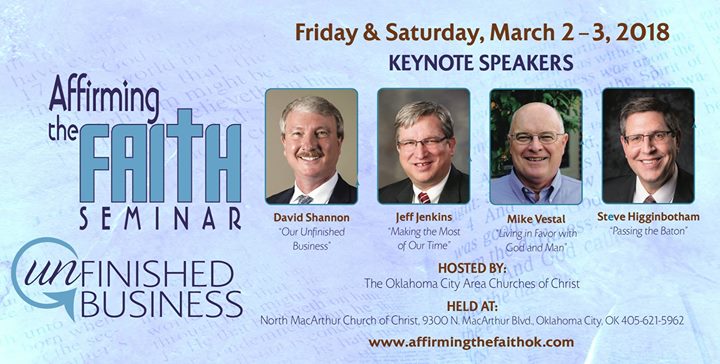
“Conversion of a Gang Member” was a part of the Conversion Series for the 11th annual Affirming the Faith Seminar held at the North MacArthur church of Christ (Oklahoma City, OK). The 2018 theme was Unfinished Business.
Lecture Audio
Lesson Summary
The conversion to Christ by a gang member comes with its own challenges culturally, spiritually, socially, and developmentally. The stark contrast between the evils and perils of the world from the lives of long-time church-goers is often hard to quantify and hard to appreciate. We need a cooperative learning model that gives the church insight to enter and help their communities and provides a “training in righteousness” mentorship for the new covert.
I was able, for the most part, to blend and weave “lessons and suggestions” throughout the lecture.
Let me add a few Lessons
Even when we do not understand “where” our new converts are coming from socially and culturally, we can love them and plug them into the culture of the church. What we do not understand about them should not hinder us from incorporating them.
Shaming converts because they are urban, ethnic, or from a broken home will never do. The world no longer has the old “normal” standards or expectations. We need to be flexible with our expectations of what people know, how they think and relate, and where their pains exist – for not all scars are skin deep, some go to the soul. We do not need to add to their trauma. There are no “normal” people, there are only people.
In our excitement to celebrate people’s conversions to Christ, we need to be careful not to tell their story without permission. Some people are not ready emotionally to talk about where they come from, or what they’ve done in their life. Learn to embrace their new life in Christ, without forcing them to dig out their skeletons and trauma. They will do that when it is right for them to glorify God in Jesus.
Let me add a few Suggestions
We -the church- need to stop taking ourselves so seriously. We are all in need of grace and forgiveness… that includes our elderly members as well. So, we need to take Paul’s words to heart: “welcome one another as Christ has welcomed you, for the glory of God” (Romans 15:7 ESV).
Develop a “adopt a new Convert” program, or adopt a new convert on your own. Sometimes we wait for churches to create programs that need to happen now. Don’t wait for approval to serve… just serve. If you need permission… I permit you to serve. :) : “For whoever does the will of God, he is my brother and sister and mother” (Mark 3:35).
Remember the goal is to make disciples, but everyone starts at a different start line. Jesus’ words are clear, we are to not leave them to figure things out, but to develop them – give them moral and spiritual goals: “Go therefore and make disciples of all nations, baptizing them in the name of the Father and of the Son and of the Holy Spirit, teaching them to observe all that I have commanded you…” (Matthew 28:19-20).
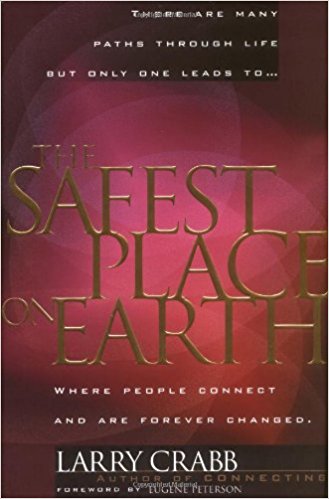
Larry Crabb, The Safest Place on Earth: Where People Connect and Are Forever Changed (Nashville, TN: W Publishing, 1999), Hardback, 240 pages.
Dr. Larry Crabb is an established licensed psychologist, a well-known Christian author on marriage and biblical counseling topics, and current Distinguished Scholar in Residence at the Colorado Christian University (Morrison, CO).[1]
Dr. Crabb earned his Ph.D in Clinical Psychology from the University of Illinois, and has been a professor of psychology since 1970. Dr. Crabb also provides workshops and weekend seminars across the United States as part of his non-profit New Way Ministries and its web presence which features interviews, video lectures, and other multimedia outlets to share resources from his School of Spiritual Direction.
Dr. Crabb has been involved in counseling and marriage, in self-help ministry, and in developing a context of “spiritual community” for over 40 years, and so has earned a place among the various “Christian voices” seeking to make the church a better place.
In 1999, Dr. Crabb released a significant but brief volume on the church as a safe spiritual community. The volume is entitled, The Safest Place on Earth: Where People Connect and Are Forever Changed (238 pages).[2]Dr. Crabb has registered his own frustration with two elements which bear upon the community of the church and its spiritual health, which he further addresses in Real Church: Does it Exist? Can I Find It? (Nashville, TN: Nelson, 2009).
In The Safest Place on Earth, however, Dr. Crabb establishes a vision for the church as a group of believers on a journey towards God, and it is within the journey that spiritual community must begin and end for spiritual healing and direction. Despite Dr. Crabb’s own training in psychology, he believes when it comes to the soul care that ought to go on within the church, such assistance must yield “to special revelation and biblically dependent thinking.”[3]Dr. Crabb is adamant,
We don’t need more churches, as we usually define the word. We need more spiritual communities where good friends and wise people turn their chairs toward each other and talk well.[4]
Structurally, The Safest Place on Earth is organized in seventeen chapters, divided into three parts, and finishes with a section of questions for each chapter. The layout follows a very clear program of development, and the content is written in a popular style. Dr. Crabb is able to articulate and shape a conceptual paradigm of what is a spiritual community and what is not a spiritual community without complex vocabulary. His illustrations, personal anecdotes, and insights from personal interactions are delivered to support his vision for a spiritual community is very clear and helpful ways.
Dr. Crabb also interacts with and depends upon the works of Dutch Catholic priest Henri Nouwen[5](1932-1996), who focused on spiritual solitude, spiritual community, and spiritual compassion, along with Swiss Catholic philosopher Jean Vanier (b. 1928) and his work connected to L’Arche communities which have overlapping concerns.[6]
A Book Summary
In part one, Dr. Crabb develops and sharpens the idea of spiritual community and how the church needs to develop sensitivity to being the spiritual community it was intended to be. Spiritual community is, according to Crabb, at the core of what the church is.
It is people facing each other in intimate, honest, and safe ways as they journey together on their way to God. Spiritual community, however, will not occur if there is no opportunity for vulnerability and a full sense of validation from these that witness the vulnerable parts of who we are.
One of the difficulties in church community life is to wrestle with the crux,
if they knew who I really was, the church would probably not like me.
To be a spiritual community, then, we must be able to love free from ego and embrace those so broken by those things which burden our souls and even cripple us.
The health metric of a spiritual community is its ability to love the unlovable, the broken, those that can only let you love them in their brokenness.
In part two, Dr. Crabb reframes the New Testament discussion of flesh and spirit elements of our soul in terms of the analogies of the Lower Room (carnal/wretchedness) and the Upper Room (spiritual/greatness).
It is in this phase of the book that Dr. Crabb focuses on the part of the church community that needs to be addressed first — our internal struggles to be spiritual. Enter Dr. Crabb’s “two rooms” analogy which he builds from the words of Jesus:
If anyone loves me, he will keep my word, and my Father will love him, and we will come to him and make our home with him. (John 14:23)
And he amplifies these words with Paul’s regarding “Christ in you” (Colossians 1:27).[7]
In essence, the two rooms represent fully furnished environments that exist within us.
Now there are two rooms inside us, the one we built where our natural self thrives, and the one the Spirit built where our natural self suffocates and our new self flourishes.[8]
Dr. Crabb does not explicitly use all the terms, but these “rooms” parallel the Freudian id, ego, and superego dynamics, the difference being they are spiritualized.[9]The lower room is self-furnished by our wretchedness and “dark forces” with its corruption and stench (id). The upper room is furnished by the Spirit of God only enjoyed once we open the doors of the lower room, acknowledge its stench, and celebrate the confidence to be a new us (an obedient us) empowered by God’s grace and teaching (superego?).
Finally, we consciously (ego?) take these “two rooms” within us and the internal struggles that go with them —because we prefer to be in the lower room— to receive outside help from “another room” which is the spiritual community, the church. This room is furnished by the Spirit with safety, vision, wisdom, and power.
In part three, Dr. Crabb continues his visioning for spiritual community with another analogy of “turning our chairs toward each other” but now by “turning our souls toward each other.”
In this process, the members of the church community must practice three needed things. First, spiritual community can only be done by the Holy Spirit. Second, personal holiness grounded in the Spirit influences the pursuit of personal holiness of others. Third, there must then be a safe place to “own and trace our desires to their source.”[10]
Spiritual community, however, will only occur when spiritual passions are “supernaturally” aroused when we are together in spiritual community experiencing acceptance, mutual faith in God’s presence in our lives, affirm the “upper room” elements in our lives, and allow God to change us without applying human pressures of forced change.
It is certainly a place of risk, but risk will always be a factor when embracing the need for vulnerability. Therefore, the real question is: will we, the church, be the safe place for those being vulnerable?
Response and Review
I chose this book principally because of the title. In fact, I had seen this title on the cover of the September/October 2001 New Wineskin magazine as part of the issue theme of “Authentic Christian Community.”[11]The concept peaked my interest because I do feel the church has not been the safest place on Earth in managing people’s sin. One example will suffice. I once heard a preacher react to the exposed sins of others with the derogatory question, “where are the normal people?” That’s not a safe place for healing. Nor is the following response to a fellow congregant’s addiction any safer, “there’s a word they need to learn – repent.”
Rebuking sin is the easy work of preaching, but creating a compassionate environment to help brothers and sisters work through repentance is the harder – and in my judgment – more fruitful work of ministry.
Crabb’s book further calls the church to be the community through which Christians experience spiritual healing for spiritual problems often mistreated —according to Dr. Crabb—as psychological disorders or problems. The gospel and the New Testament teaching that the church is the dwelling place of God, and Christians are the temple of the Holy Spirit, seem to support the overall agenda that the culture of the local congregation should be more attuned to openly working through sin, temptations, and openly celebrating grace, and spiritual empowerment by God. Even Paul declares that the church is being recreated (2 Corinthians 5:17) and repurposed for ministry (Ephesians 2:10).
Dr. Crabb’s book both intrigued me and made me uncomfortable in that he elevates the spiritual components of the church where the Holy Spirit dwells. Again, it is not that I’m troubled by the Holy Spirit, it is that in many pockets of the Churches of Christ the Holy Spirit and the use of “community” have been so tinged with so-called “liberal agendas” in the latter, and doctrinal controversial hotbeds regarding the former. His emphasis that the church is specifically designed to be a spiritual community and therefore it must be that spiritual community on a journey to God is what stands out the most to me. If we are not a spiritual community, then there will not be the Spirit.
I do not agree with all of his points on the “wretchedness” of man, but Dr. Crabb has challenged me to speak more about the Spirit and the church as the community in which God does His best work to heal us from the effects of sin.
Concluding Thoughts
What I liked overall about the book is the Dr. Crabb’s challenging call to the church to be a safe place for the sort of healing love that needs to exists between God’s people, so that the Spirit of God may work through the church to heal its members as they bear each other’s burdens with the gifts of the Spirit (Galatians 5:22-26). The church must be so, because, as Dr. Crabb reminds us, we are traveling together on a journey to God.
I recommend the challenge of this book to every Christian and church leader. The reminder that Scripture centers the body of Christ as the place where the Spirit dwells, and therefore must be the safe place where the members of the body can serve each other empowered by the same Spirit. To overcome sin, the church must be, and in some cases become, the place where no one struggles with sin void of love, compassion, support, and patience as we journey to God breaking free from the bondage of sin.
Reprinted with permission from the March 2017 issue of Gospel AdvocateMagazine.
A vital element to the worship assembly of the body of Christ in the first century was the reading aloud of the Scriptures (1 Timothy 4:13; Acts 13:15). Today, it is probably hard to imagine a time when God’s word was accessible only when assembled with God’s people; it was a communal experience. The proliferation of Bibles today has truly made reading Scripture an individualized practice; yet, this has not always been so. In fact, the meaning of “church” (ekklesia; “an assembly”) presumes a people gathered to hear, to commit to, and to act upon the Word of God (Matthew 16:18; Deuteronomy 4:10-11; 31:9-13). Thus, hearing God’s Word is part of who we are as “the church” (Acts 11:26; 14:27).
The church needs to elevate the importance of the Scripture reading assignment in our assembly (Act 13:15; 2 Corinthians 3:14). There is a tendency to be too casual about this assignment. Perhaps it is because we take literacy for granted, though the capacity to read words is not the same as understanding the words being read. In this connection, we may then take for granted that anyone can read the Scripture aloud to the church. In some societies, reading is still regarded as a technical skill, much as it was in Bible times.
If reading the Scriptures will make a child of God “complete, equipped for every good work” (2 Timothy 3:17 ESV) when read for private devotion, then the same God-breathed writings read aloud will provide the same effect for the congregation. In the Scripture reading, God is speaking to His people. For this reason, the public reading of Scripture is a crucial element of the worship assembly and should not be taken casually or lightly.
A Note on the Context
In fact, Paul anchored to this very core principle when he wrote to Timothy to provide a strategy for the faithful to protect themselves from a departure from the faith, which will consist of Christians “devoting themselves to deceitful spirits and teachings of demons” (1 Timothy 4:1). The antidote against “irreverent, silly myths” (4:6-7) and any possible competitors to divine revelation is the healthy teaching from God (4:13). Public reading of Scripture inoculates against false teaching and invites faithful discipleship and commitment to God (Exodus 23:22; 24:7). It syncs us up with God.
Paul makes similar requests in other letters to the churches of the first century. When detailing the unveiling of the mystery of Christ, Paul anticipates and expects the church to share his understanding (Ephesians 3:4-6). After he writes on the supreme role of Christ in redemptive history, he expected the Colossian congregation to letter swap with Laodicea (Colossians 4:16). And, to the Thessalonians, he was quite strong when he placed “an oath before the Lord to have this letter read to all the brothers” (1 Thessalonians 5:27), for through the reading aloud of his letters they would be taught (2 Thessalonians 2:14-15). And in the final revelation of Jesus, the apocalyptic portrayal of divine victory through the gospel is framed as one that must be read aloud and safeguarded against addition and omission (Revelation 1:3; 22:16-19).
Reading Scripture aloud can bring the church into sync with God’s word. The more exposure, the better our biblical literacy; then, ideally, the healthier our churches will become. Let us switch gears, now, to provide practical suggestions for this powerful act of reading Scriptures aloud in our worship assembly.
Six Suggestions for Reading Scripture Aloud
There must be a spiritual gravitas connected to reading Scripture before the assembly. I had a mentor, Don W. Hinds, that would stop me when I misread a passage aloud. He would use the adage, “take heed how you read,” to instill in me the importance of properly reading the biblical text aloud. I would like to use this as a refrain as we consider some practical guideposts for reading the Scriptures aloud when the church is assembled for worship — although these suggestions can be applied in various settings of church life.
Furthermore, in many congregations, those who manage or arrange the various elements of the worship assembly (deacons, elders, etc) should seriously consider the points below as they select public readers of Scripture. We are worshipping God and engaging in spiritual and divine matters, we are not merely filling a roster. God’s word must be the centerpiece of our worship.
First, the reading should be met with a respect for proper pronunciation and performance. This is the “oral” spiritual heritage of God’s people, to hear and understand God’s word (Nehemiah 8:1-8). Not only should one practice to read clearly and distinctly, but some types of Scripture (genre) require an element of performance (cf. Psalms). For example, we should not read a psalm of lament (Psalms 51) as if it were a genealogy. Take heed how you read.
Second, we should consider the verbal skill set of those who will read before the assembly. The goal is to instill an understanding of God and to invite the church to obedience. There is no verse that prohibits individuals with speech problems from publicly reading Scripture. We should both be sensitive and inclusive. Fortunately, audio technology facilitates what requires loud speaking in other settings. Still, as long as the public reading reaches its goal then it has accomplished its purpose. Take heed who will read.
Third, the reading selection should be long enough to understand the message. This is especially true when the selection is independent from the sermon. Some congregations may design their readings to go through a book (Psalms) or a large section of Scripture (Major Prophets). Other times, they are connected to the sermon. The readings must be of sufficient length to provide context and understanding and should have a natural and intended connection to the worship service. All things being equal, we may ask, “why read from the Song of Solomon when the sermon is on the ‘second death’ of Revelation?” Take heed what you read.
Fourth, the readings must be the Scriptures free from alteration. From time to time some like to add a few impromptu thoughts in connection with the reading of the Scripture. The points may be very excellent, but they run the risk to be of another variety. It is important to keep to the task at hand, which is to read the assigned portion of Scripture. There are many reasons for this. The most significant reason is to elevate the word of God over the words of men. As Revelation 22:18-19 warns, the text must be read without omission and addition. Take heed that you read.
Fifth, the reading of Scripture must be purposeful. There should be communication before hand to prepare those who will read aloud in worship. Sometimes we can displace others when we lean upon “good readers” in a pinch. With a purposeful schedule, we can give enough notice so that our readers can prepare, become familiar with the text, and develop a comfort level. Preparation and practice are the best helps to reduce “stage fright.” Take heed before you read.
Sixth, the reader should not cause a distraction by what they wear. It is true that God seeks and looks at the heart (1 Samuel 16:7; Matthew 15:8), but one should dress for the spiritual occasion (Matthew 22:11-14). While attire may sometimes be a distraction, it is more important that the reader’s lifestyle should not be a distraction. If those who pray in assembly should have “holy hands” (1 Timothy 2:8), what of those who read Scripture. Paul told Timothy that he should be an example; this would make an additional influence when he would read aloud the Scriptures to the church (1 Timothy 4:12). Take heed by whom you read.
Concluding Thoughts
The public reading of Scripture was an essential component of the first-century worship assembly. If in today’s time, the church seeks to be in conformity with the early worship practices of the New Testament church, then it will seek to incorporate this practice and develop those who will read. Moreover, the church will grow when she integrates the three-fold instruction given to Timothy: the public reading of Scripture, the exhortation, and the teaching (1 Timothy 4:13). In a day and time when so many church groups are seeking new and innovative methods to “enhance” worship, the age-tested and inspired method to read aloud God’s word must be in the forefront of our worship assemblies. Blessings to the reader, and blessings to the hearer.
Jovan Payes preaches for the Highland Church of Christ in Bakersfield, Calif.





 biblicalfaith.online