Changed to Serve, Living in Hope (1 Thess 1:9–10)

Christians must always be reminded of their responsibility to live out lives reflective of the high calling of God (Eph 4:1; Phil 3:14). There is a tremendous passage in 1 Thessalonians 1:9–10, which provides the Christian with the basic aspects of Christian living. Here is the passage:

For they themselves report concerning us the kind of reception we had among you, and how you turned to God from idols to serve the living and true God, and to wait for his Son from heaven, whom he raised from the dead, Jesus who delivers us from the wrath to come. (1 Thessalonians 1:9–10 English Standard Version)

Let us examine this passage, and reflect on the four aspects of this passage: (1) reception of the word, (2) conversion, (3) consecrated service and (4) hope of deliverance.

I hope to invite modern Christians to reflect on the importance of turning to God in conversion, to living a sanctified life in anticipation of the final day when Jesus comes again.

The Background

First, let us consider some background information.

After leaving the city of Philippi, Paul and Silas traveled probably on horseback some 100 miles on the Egnatian Way through Amphipolis and Apollonia only to pause their trip in Thessalonica.[1] It is highly likely this was a three-staged trek to Thessalonica: Philippi to Amphipolis (30 mi.), Amphipolis to Apollonia (27 mi.), and Apollonia to Thessalonica (35 mi.).[2] Situated on the Egnatian Way, ancient Thessalonica was at the heart of Roman travel, communication, and culture in Macedonia. So much so, that William Barclay succinctly said, “East and West converged on Thessalonica.”[3]

The Book of Acts chronicles Paul’s initial evangelistic efforts in that great city (Acts 17:1–9), as he enters the synagogue and presents various elements of the gospel message as found in the prophetic writing of the Old Testament. In fact, in Acts 17:2, Luke says Paul spent three weeks “reasoning” with the Jews on the Sabbath, the word suggesting a rigorous discussion or possibly hints at a debate style of presentation (Grk. dialegomai).

Unfortunately, in this case, Luke does not inform us which scriptures Paul uses to build his case (cf. 1 Thess 1:10; 1 Cor 15:3–5; Isa 53:2–8; Psa 22:1, 16:10; Acts 2:31). He only affirms that the suffering, death, and resurrection of Jesus of Nazareth is the embodiment of these prophetic utterings which adherents of the synagogue would have been familiar.

Luke observes the response of those that believed:

some of them were persuaded and joined Paul and Silas, as did a great many of the devout Greeks and not a few of the leading women. (Acts 17:4)

Unfortunately, a number of Jews responded to the missionaries with political manipulation and leveraging. These Jews, operating out of jealousy, enlisted the worst of society and orchestrated a riot, and attacked and arrested Jason who was hosting Paul and his company (Acts 17:5–6).

When presenting their case against Jason and the Christians, this mob describes them with politically subversive language. They are those “who have turned the world upside down” (Acts 17:6), “they are all acting against the decrees of Caesar” (Acts 17:7a), and “they are all… saying that there is another king, Jesus” (Acts 17:7b). Due to this charge, Jason is released to Paul and Silas on the conditions of payment of bail (“security”) and their departure (Acts 17:8–9). Paul later describes this as being “torn away” from them (1 Thess 2:17).

Reception of the Word

Sometime after leaving Thessalonica, Paul was restless and sent Timothy to Thessalonica for a report. Timothy returns with an encouraging report of their faithfulness (1 Thess 3:6). This faithfulness began when they believed Paul’s preaching in the synagogue (Acts 17:4). Luke notes that some Jews, and many devout Greeks (likely God-fearers) and leading women were “persuaded and joined Paul and Silas.” These are passive verbs, suggesting the work of the Spirit’s word compelled those with honest hearts to identify with the gospel proclaimers.

When Paul wrote to this young church, he recalls this moment. In fact, he frames their conversion as an example of the success of the gospel message received as God’s word:

And we also thank God constantly for this, that when you received the word of God, which you heard from us, you accepted it not as the word of men but as what it really is, the word of God, which is at work in you believers. (1 Thessalonians 2:13)

The “makings” of a Christian begin when the gospel is heard not as just another philosophy, or religious message. Instead, as Paul recalls, before one becomes a Christian it is imperative that the preaching is regarded as the very word of God. This is the foundation; if this is not believed spiritual failure is surely looming in the distance.

Conversion: Turned from Idols

The actual verb “turned” in 1 Thessalonians 1:9 (Grk. epistrépho) carries the idea of turning around and directing this move towards a new object or a person. In Acts, the noun is used for conversion to God (Grk. epistrephe). Together with its more common verb “to turn” they appear a total of twelve times in the Book of Acts (3:19; 9:35, 40; 11:21; 14:15; 15:3 [noun], 19, 36; 16:18; 26:18, 20; 28:27). Except for three instances (9:40, 15:36, and 16:18), the terms are exclusively used with reference to people turning to God in response to the Gospel.

Paul celebrates that as a result of accepting the word of God as authoritative and believing the gospel message, the Thessalonians turned to God after a life of serving “idols” (1 Thess 1:9). While Luke plants the conversion of the Thessalonians to those connected to the synagogue, in his letter Paul emphasizes a defection from the pagan background of the Greco-Roman converts.

This likely points to their lack of participation in the cults of their clans and tribes, temple, city, and “states” gods, which would have created a wedge between them and their neighbors. Albert Bell, Jr., notes that “the more gods a city worshiped, the better its chances of divine favor.”[4] It is known, for example, the people of Thessalonica worshipped Zeus, Asclepius, Aphrodite, and Demeter, and even the Egyptian gods Serapis and Isis. They were also given to the Samothrace cult of Cabrius.[5]

According to the Greco-Roman cultic mindset, Christians turning from the gods was not only difficult to understand but also came off as unpatriotic to the state. In their mind, it would not only have been subversive to the Spirit of Roma (Rome worshipped) and even the deified Caesar but also this behavior would have been seen as inviting divine disfavor (1 Thess 2:14). Paul celebrated their choice in doing this.

Children of God must remember their conversion was a choice. W. E. Vine insightfully comments on this conversion:

[It was] an immediate and decisive change, consequent upon a deliberate choice; a conversion is a voluntary act in response to the presentation of truth.[6] 

They chose to leave their sins behind; they did not take them along in their new life as God’s people.

Consecrated Service

Again, the Thessalonians did not bring their old life with them. Instead, they were changed “to serve the living and true God.” In fact, Paul later writes to them that “God has not called us for impurity, but in holiness” (1 Thess 4:7). Service to God is expressed in the rejection of “the passions” of the past which reflects a rejection and of God (1 Thess 4:5).

Christian service is a demonstration that the things which were important and governed the fundamentals of our pre-Christian lives no longer function in this way. Christians are not to lean upon their past; instead, they are called to “stand fast in the Lord” (1 Thess 3:8).

In other words, Christians are to live lives devoted to serving God over our own ambitions. This is the “how to” of our service to God, to accept God sanctifying his people. Notice this emphasis on a consecrated and holy life:

For you know how, like a father with his children, we exhorted each one of you and encouraged you and charged you to walk in a manner worthy of God, who calls you into his own kingdom and glory. (1 Thessalonians 2:11–12)

Now may our God and Father himself, and our Lord Jesus, direct our way to you, and may the Lord make you increase and abound in love for one another and for all, as we do for you, so that he may establish your hearts blameless in holiness before our God and Father, at the coming of our Lord Jesus with all his saints. (1Thessalonians 3:11–13)

For you know what instructions we gave you through the Lord Jesus. For this is the will of God, your sanctification: that you abstain from sexual immorality...  For God has not called us for impurity, but in holiness. (1 Thessalonians 4:2–3, 7)

Now may the God of peace himself sanctify you completely, and may your whole spirit and soul and body be kept blameless at the coming of our Lord Jesus Christ. (1 Thessalonians 5:23)

As a result of being converted, Christians are washed, consecrated, and remade for righteous service (1 Cor 6:9–11; Eph 2:10). Contemporary Christians need to take this message of consecration to heart.

Hope of Deliverance

Christians live in the present with a living hope which anticipates the second coming of Jesus. Paul is very clear when he affirms that there is a future point of hope and deliverance for which Christians wait for (1 Thess 1:10).

For they themselves report concerning us the kind of reception we had among you, and how you turned to God from idols to serve the living and true God, and to wait for his Son from heaven, whom he raised from the dead, Jesus who delivers us from the wrath to come. (1 Thessalonians 1:9–10)

Christians anticipate the Son to come “from heaven.” This last line is heavily loaded with theological truth. The Son is further described as the one God “raised from the dead, Jesus who delivers us from the wrath to come.” This is a statement of hope. The hope of the advent of Jesus (i.e., the second coming) is directly linked to God’s power demonstrated in the resurrection of Jesus. That God raised Jesus from the dead makes the claim that Jesus is returning from heaven a firm expectation.

With the certainty of the second coming of the Son “out from the heavens” (literal rendering of the Greek) established in the Christian mind, it affirmed that the Son, Jesus, will come with judgment for the unbelieving world (i.e., “the wrath to come”) but deliverance for the believer. Paul calls this “the day of the Lord,” a period of judgment and final consummation of God’s plan (1 Thess 4:13–5:11; 2 Thess 1:5–12).

Final Words

The gospel found fertile soils in the heart of early Thessalonian Christians. The congregation had a culturally and religiously diverse background, but they accepted the gospel as the word of God. Their faith in the God who raised Jesus from the dead was also at work as they followed their call to holy living as they anticipate Jesus coming to judge the living and the dead, and delivering those who are his.

Sources

  1. J. Carl Laney, Concise Bible Atlas (Peabody, MA: Hendrickson, 1998), 229.
  2. Colin J. Hemer, The Book of Acts in the Setting of Hellenistic History, ed. Conrad H. Gempf (Winona Lake, IN: Eisenbrauns, 1990), “The mention of Amphipolis and of Apollonia should probably be taken to imply that these were the places where the travellers [sic] spent successive nights, dividing the journey to Thessalonica into three stages of about 30, 27 and 35 miles” (115).
  3. William Barclay, The Letters to the Philippians, Colossians and Thessalonians, revised edition (Louisville, KY: Westminster, 1975), 180.
  4. Albert A. Bell, Jr., Exploring the New Testament World (Nashville, TN: Nelson, 1998), 126.
  5. Nijay K. Gupta, 1-2 Thessalonians: A New Covenant Commentary, New Covenant Commentary Series, eds. Michael F. Bird and Craig Keener (Eugene, OR: Cascade Books, 2016), 4. Russell Morton, “Samothrace” in Lexham Bible Dictionary, Logos electronic edition, ed. John D. Berry, et al. (Bellingham, WA: Lexham, 2016).
  6. W. E. Vine, Merrill F. Unger, and William White, Jr., Vine’s Complete Expository Dictionary of Old and New Testament Words (Nashville, TN: Nelson, 1984), 2:647.

Spiritual Growth: The Ezra Principle (Ezra 7:10)

In pursuit of my own spiritual growth (such as it is) as a man of faith, it took me a long time to figure out where my journey was supposed to find not just the goal, but the starting point and the road map for the pilgrimage. Spiritual growth is not the result of knowing where our faith calls us to, but from the arduous journey to get there.

My journey has been massively blessed. I have had mentors, mothers, fathers – at times, even grandparent – figures. They have all given me something for my journey (perhaps, sometime, I’ll write about that), but I was only walking with them on their journey. Still, I would not be where I am, spiritually, without them.

I tried education. I figured “if I could be smarter” then I could discover all of the secrets that others are keeping to themselves behind the walls of academia – the proverbial mountain top. I found the tools and methods instead to help me navigate “the strange and yet immanent” world of Scriptures. They helped me raise questions and look at God’s word from various new angles that have indeed helped me in my journey to God. Despite its benefits of making me feel closer to the text, however, it was not the “end all” solution to my spiritual needs.

My personal life experiences, training, and those mentors in my life, all pointed me back to one thing: my journey to God only makes sense when I invest in a lifestyle of discipleship that has a consequential impact on my life. This required me to take seriously the words of the Psalmists.

I needed my desire for wisdom to mirror the Psalmist’s outcry to the Lord:

Open my eyes, that I may behold wondrous things out of your law. (Psalm 119:18)[1]

In this great Psalm, David recounts the wonders of the Law of God and exalts its beauty, richness, guidance, and its loftiness as it is grounded in God’s righteousness. It begins with the words,

Blessed are those whose way is blameless, who walk in the law of the Lord! (Psalm 119:1)

One of the empowering aspects of this Psalm is not actually found in what is written, but in the very process by which we see the Psalmist’s love for living out the Word of God, the Law of the Lord. The entire Psalm flows with a powerful example of losing oneself in the world of God’s Law.

I am not at all surprised that Psalm 119 found a communal niche at the Feast of Pentecost, as Nancy deClaissé-Walford recounts:

It is recited at the Feast of Pentecost, the spring festival observed fifty days after Passover, which celebrates the giving of the torah to Moses at Sinai during the wilderness wanderings.[2]

Nancy deClaissé-Walford in The Book of Psalms (2014)

Psalm 119 called my attention to the only true path to spiritual growth: the transformative power of the world of the scriptures. Knowing God through the scriptures, however, must lead toward discipleship, toward obedience.

The Ezra Principle

The “Ezra Principle” sounds catchy and new doesn’t it. I guarantee you it is not. I have not discovered anything hidden in plain sight. In fact, the “principle” is not just one thing, but a commitment to five values of discipleship that Ezra pursued himself.

In the fifth century B.C. (c. 458 B.C.), Ezra is commissioned by the Persian King Artaxerxes I (465–424 B.C.) in his return to Jerusalem (7:1–28). It is a time of fresh opportunity to “get things right” following the seventy years of captivity in the Babylonian due to the corruptive influence of pagan idolatry.[3] In this context, Ezra had begun a process of preparation for the task before him:

Ezra had set his heart to study the Law of the LORD, and to do it and to teach his statutes and rules in Israel. (Ezra 7:10)

The grammarian in me is interested in the verbal phrases of Ezra’s commitment: (1) “set his heart,” (2) “to study the Law,” (3) “to do it,” and (4) “to teach… in Israel.” That’s powerful. You may find other ways to divide this passage, but we will separate “study” and its object, “the Law of the Lord,” into two values themselves.

This is one of those passages that made clear to me the connection between knowing God’s word and being an authentic follower of God: the connection between personal commitment to know and to do God’s word.

Knowledge and Discipleship

This observation shifted my thinking away from just being absorbed in the Word of God. Spiritual growth must embrace knowledge but that is not the entire picture. James warns us that a people of knowledge alone is useless if not insulting because knowledge (i.e., faith) is to demonstrate itself by good works (1:22-27).[4]

James weaves together the two themes of favoritism and faith in order to illustrate just how practical saving faith must be. He illustrates this by examining the relationship between the poor and the rich in the church:

If a brother or sister is poorly clothed and lacking in daily food, and one of you says to them, "Go in peace, be warmed and filled," without giving them the things needed for the body, what good is that? (Jas 2:15–16)

What good is knowing that we are all saved in Christ, so goes the argument, if we do not care for each other in this life? How does God’s communal redemption of all impact our daily interactions? James argues that knowledge (faith) should be lived out in the community of the body of Christ in consequential ways.

For that matter, think about the community where the church meets. What good are we doing if we are strong on truth, but our community has never heard or seen us live out what the gospel is all about? The good we do should move people that thank God:

In the same way, let your light shine before others, so that they may see your good works and give glory to your Father who is in heaven. (Matt 5:16)

In other words, spiritual knowledge and discipleship are inseparable.

To return to our point, knowing is only the beginning, the end is discipleship. The process from point A to point B is our journey of applying the narrative of Scripture (how God redeems humanity through Jesus Christ) to our lives so that we may be transformed by it (Rom 12:1-2). This makes the Word of God the essential guiding force behind all of our actions.

This brings us to the “main event” of this discussion: something I call the “Ezra Principle.”

(1) We Must Set Our Hearts

is one of the clearest descriptions of a targeted mindset in the OT. If the heart is not “into it” the body and life will not follow. Paul, speaking of the Macedonian’s benevolent efforts despite their deep poverty, describes the basis of their commitment: “they gave themselves first to the Lord, and then by the will of God to us” (2 Cor 8:5). Great advancements always stem from great commitments.

In the study and application of God’s Word, the commitment which begins at our spiritual core – the heart – will continue to be the driving force throughout our life of service to God (Deut 6:5, Lev 19:18).

(2) We Must Spend Time in Study.

Near the end of the apostle Paul’s life, he requested that Timothy come to be with him and bring his cloak, his books, and the parchments (2 Tim 4:13).  There are many speculations about the nature of these last two items, but at the very least the books and parchments would include copies of his letters to other churches. Paul would spend the last days of his life with those volumes he penned through inspiration to those in need of strength and faith.

The point we draw from here is that Paul was a studying man. In fact, he would encourage Timothy to be well equipped in the word of God and aptly able to “divide” the Scripture clearly and carefully (2 Tim 2:15). Ezra likewise spent renewed focus on studying the Law as he found himself and Israel back in the Land of their faith. Ezra knew, as we ought to today, that in order to rebuild our lives it must be based upon God’s word.

(3) We Must Select Only God’s Word as the Object of our Study.

There are many philosophical writings and even religious “scriptures” in the world. They often have maxims, sayings, or verses with which we would agree and commend. When building a biblical worldview as for the foundation of our spiritual growth, however, the Bible is the only set of “Sacred Writings” which are able to make a person wise to obtain salvation (2 Tim 3:14-15).

One may argue that this is an arrogant statement; however, despite the fact that such “writings” may provide insight into our lives, they pale in comparison with the never surpassed guidance given in the divine books of the Bible.

When one analyzes the Bible from the vantage point of predictive prophecy, historical accuracy, scientific foreknowledge, and literary harmony of this great anthology of 66 books in contrast to such other works, the Bible stands alone.

(4) We Must Steadfastly Practice God’s Word.

It is only by the conviction that the words inscribed on the paper we read are not mere words of human beings, but are instead the very words that God himself would breathe out (1 Thess 2:13; 2 Tim 3:16–17). Jesus teaches quite clearly that our lives are to reflect this type of respect, for in our prayers we are to express the sentiment, “your will be done, on earth as it is in heaven” (Matt 6:10). The Lord declares: “to obey is better than sacrifice” (1 Sam 15:22)

(5) We Must Share both our Learning and Experiences.

In many ways, teaching is not only the sharing of facts and principles. In various instances, anecdotal interactions with God’s word can be very revealing and helpful in understanding and teaching God’s word. For example, consider all those who continue to leave the denominational world for the practice of pure New Testament Christianity.

The process of filtering out unbiblical accretions while adding to their learning and practicing the biblical faith can be a very helpful experience to teach others going through the same process. The bottom line is that God’s word was never designed to be a mental exercise to the exclusion of action and sharing; indeed, we must make “disciples” (Matt 28:19-20).

Steven Lawson, in his own words, calls attention to the advice of Walter Kaiser:

When a man preaches, he should never remove his finger from the Scriptures, Kaiser affirmed. If he is gesturing with his right hand, he should keep his left hand’s finger on the text. If he reverses hands for gesturing, then he should also reverse hands for holding his spot in the text. He should always be pointing to the Scriptures.[5]

S. J. Lawson, “The Pattern of Biblical Preaching,” Bibliotheca Sacra 158 (2001)

The advice is striking for those that proclaim the Word of God, but it is an excellent reminder to those would-be disciples interested in taking their discipleship to the next level, namely, to be teachers.

Studying is Complicated

This may seem like an aside, but it is not. I promise. We need to be very careful how we use scripture. Sometimes there are narratives regarding God’s people which seem contrary to the high moral calling which is expected of God’s leaders or people. Historical narratives need to be read with caution, as they often make their points indirectly (with no commentary). They are not always telling us something God wants us to imitate, but what God’s people have done.[6] It teaches me to be careful when seeking to “do” and “teach” God’s word.

I have often wrestled with some of the deeds of Ezra as recorded in the sacred record, particularly the covenant he seems to have initiated among the returning exiled Jews to “put away” all their foreign wives and children (cf. Ezra 10). Was this divorce en-masse commissioned by God? If one takes the view that whatever is written is positive teaching, as an authoritative command, then the text seemingly gives justification to divorce and remarriage on the count of practicing a different faith. This seems counter to the teaching of Jesus who affirms that there is only one justifiable cause for divorce and remarriage: adultery (Matt 19:1–9).

Yet, if one takes the view that each action must be taken into consideration on its own merits, then it is possible that Ezra was convicted by the significant teaching against inter-marriage with foreigners due to their influence on their spiritual corruption (Exod 34:12–16; Deut 7:1–6; Josh 23:19–23) that he overstepped its application and persuaded the men of Israel to do something not commanded of those who were already “married with children.” This would align with the fact that there is no explicit commentary nor “word from the Lord” to demand these families to be severed.

Providing an answer to this riddle is beyond the purpose of this essay. My point is in our commitment to setting the heart, studying the word, and living out the word in our individual lives, the weight of teaching is likewise an important discipline that should be taken with the heavy responsibility that comes with it.

The Lord’s brother James wrote:

Not many of you should become teachers, my brothers, for you know that we who teach will be judged with greater strictness. For we all stumble in many ways. And if anyone does not stumble in what he says, he is a perfect man, able also to bridle his whole body. (James 3:1–2)

Humility must always accompany study and teaching (Rom 2:1–11).

Final Thoughts

I am forever grateful for those who took the time to encourage me, prod me, and guide me to appreciate the special place Bible study is in the spiritual life and growth of God’s people. I would like to give a quick hat tip to them at the close of this essay.

Donald W. Hinds (1922–2008) taught me and encouraged me to read daily and widely, to be challenged by what I read, and to meditate carefully on it. His son David Hinds taught me the importance of finding the right book and the right teacher (author), in that some have so prepared themselves that if I should listen to other voices beyond the Bible, I should find such authors. I am thankful to Wayne Jackson (1961–2017), a true preacher’s preacher, who probably shaped my passion for the study of the Scriptures more so than anyone else in my early formative years through his writings in biblical studies (The Christian Courier), biblical apologetics (Apologetics Press, Inc.), and while a member of the church where he richly and profoundly proclaimed the scriptures.

Others have guided me along the way as well. Earl D. Edwards was one of my instructors in college, an elder in the church while I attended college, and a personal mentor during my early academic development. In him, I saw how the power of God’s word can so shape a man’s life with dignity, scholarship, and humility.

I wish I could say more about others, but I’ll save that for another time. These are but a few personal encounters with those who have lived out and assisted me to see that the “Ezra Principle” is not a “cute” title, but essential for the spiritual formation that comes from following God and his word. I pray that you take its challenge.

Endnotes

  1. Unless cited otherwise, all Scripture quotations are from the English Standard Version of The Holy Bible (Wheaton, Ill: Crossway, 2016).
  2. Nancy deClaissé-Walford, “Book Five of the Psalter: Psalms 107–150,” in The Book of Psalms, NICOT, eds. E. J. Young, R. K. Harrison, and Robert L. Hubbard Jr. (Grand Rapids, MI: Eerdmans, 2014), 870.
  3. M. J. Boda, “Ezra,” Dictionary of the Old Testament: Historical Books (Downers Grove, IL: InterVarsity Press, 2005), 278.
  4. Craig L. Blomberg and Mariam J. Kamell, James, ZECNT, ed. Clinton E. Arnold (Grand Rapids, MI: Zondervan, 2008), 101.
  5. Steven J. Lawson, “The Pattern of Biblical Preaching: An Expository Study of Ezra 7:10 and Nehemiah 8:1–18,” BSac 158 (2001): 451.
  6. I am reminded of an “authorized” campus flyer I came across advertising a community college course on “The Bible as Literature” at the City College of San Francisco. It had a picture of the Bible with a sticker label on it that read:

    —-
    WARNING: This is a work of fiction. Do not interpret literally.

    CONTENT ADVISORY: Contains verses descriptive of or advocating suicide, incest, bestiality, sadomasochism, rape, murder, morbid violence, use of drugs or alcohol, homosexuality, criminal activity, human rights violations, and crimes against humanity.

    EXPOSURE WARNING: Exposure to contents for extended periods or during formative years in children has been known to cause delusions, hallucinations, decreased cognitive and objective reasoning abilities, and in extreme cases, pathological disorders, hatred, bigotry, and violence including, but not limited to torture, murder, and genocide.
    —-

    Are there stories in Scripture that record horrific events? Yes. Are they documented to promote such behavior? No. They are recorded to document the fallen nature of the world we live in.

Soul-Winning for Jesus: Obedience of Faith

Many phrases summarize Paul’s letter to Rome such as justification, righteousness, gospel, or God’s sovereignty. Another important phrase found in Romans is “obedience of faith” and bookends the letter at its beginning (1:5) and at its close (16:26). This is the desired result (“to bring about”) of the Father’s work of salvation in Jesus Christ.

Those seeking to enjoy the redemptive blessings of God’s righteousness and salvation are called to respond with a faith in God that is obedient to his call and his word (Rom 1:16–17). Paul’s quotation of Habakkuk 2:4, “The righteous shall live by faith” (1:17), further establishes his point. This is the nature of biblical faith and when sharing the gospel it is imperative to remember that faith is not biblical if it is not obedient. This has significant implications to the Christian’s efforts to share the victory message of the gospel with their neighbors.

The Shape of Faith

Words are the patterns by which people think. It is key, therefore, to clear the air on a common misconception. For some, faith resembles a blind leap into the dark. It is a gut feeling devoid of reason. Taken in this way, the only relationship between faith and reason is that they are on opposite poles that never touch. Furthermore, faith in God, the Bible as the word of God, or in the death, burial, resurrection, and ascension are purely a feeling. It is pure fideism. Biblical faith is a response to evidence (Heb 11:1).

Biblical faith is both relational and responsive. Paul explains that the gospel of God is supported by a series of lines of evidence. The gospel was promised prophetically in the Old Testament (1:2) and centered on the Davidic lineage of Jesus (1:3) whose claim to being the Son of God is established by the resurrection from the dead (1:4). On this basis, the apostles are commissioned to share the gospel designed to induce an obedient faith from the world and the church (1:5–6). Faith relates to the worthiness of the evidence of the gospel message that God acted in the world through Jesus and his cross (2 Cor 5:18), and responds with actions that reflect that trust in God and the gospel.

Living by Faith

In Romans 1:16-17, Paul explains that faith is not only a first response to the gospel but also frames the lifestyle of the Christian. It is not an exaggeration to say that the Roman letter hangs on his quotation of Habakkuk 2:4, “The righteous shall live by faith.” Paul evokes the contrast God makes in his response to a frustrated Habakkuk. The wicked live faithless and so digress into immorality (Hab 1:12–2:5). By contrast, the righteous organize their life by what faith in God requires (2:4). Two things are affirmed here: (1) faith is anchored in God’s actions and word, and (2) faith reshapes one’s priorities and actions. Let us explore these two points a bit further.

First, when sharing the gospel it is imperative to anchor a person’s faith in God and his word. Biblical faith in God does not emerge without believing God exists and acts in history (Acts 14:15–17, 17:24–31), the Bible provides divine truth (Eph 3:4–5), and has sent his son as demonstration of his love (Rom 5:6–8). Indeed, this “obedience of faith” is reflected in the Genesis story of Abraham. Paul, by the Spirit, picks up on this in Romans 3–4, when he parallels the justifying faith of Abraham with the faith of the person who comes to obey God and walks before him in faith (3:21–26).

Indeed, “Abraham believed God” (Rom 4:3; Gen 15:6). Abraham was “fully convinced” that God was “able to do what he promised” (Rom 4:21). Until a person has a conviction in God and his word, saving faith has no fertile soil to blossom from (Rom 10:6–13; Mark 16:15–16).

Second, faith reshapes one’s priorities and actions. The words of Habakkuk are quoted two other times in the New Testament (Gal 3:11; Heb 10:37–38). In each passage, there is an emphasis that biblical faith — saving faith — reshapes the Christian’s priorities. In Galatians, Paul argues that faith provides access to the gift of the Spirit. In Hebrews, the writer affirms that because of faith the converted believer can endure hardships because their priorities have changed. It is written, 

“And without faith it is impossible to please him, for whoever would draw near to God must believe that he exists and that he rewards those who seek him” (Heb 11:6).

Personal faith is nurtured through the study of the scriptures and leads gospel obedience (Rom 6:17–18; 1 Thess 2:13). As Jesus affirmed,

 “It is written in the Prophets, ‘And they will all be taught by God.’ Everyone who has heard and learned from the Father comes to me” (John 6:45).

Concluding Thoughts

In order to show the difference between “agreement” and “faith,” evangelist Windell Fikes learned to asked: (1) “Do you believe what the Bible says?,” (2) “Do you want to do what the Bible says?,” and (3) “Do you want to do what the Bible says right now?” In other words, biblical faith is expressed in obedience to God’s word.

Jesus would say, 

“Why do you call me ‘Lord, Lord,’ and not do what I tell you?” (Luke 6:46).

Jovan preaches for the Highland congregation in Bakersfield, CA.

This article originally appeared in The Carolina Messenger. To subscribe for FREE click here.


The Word of God among the Denominations

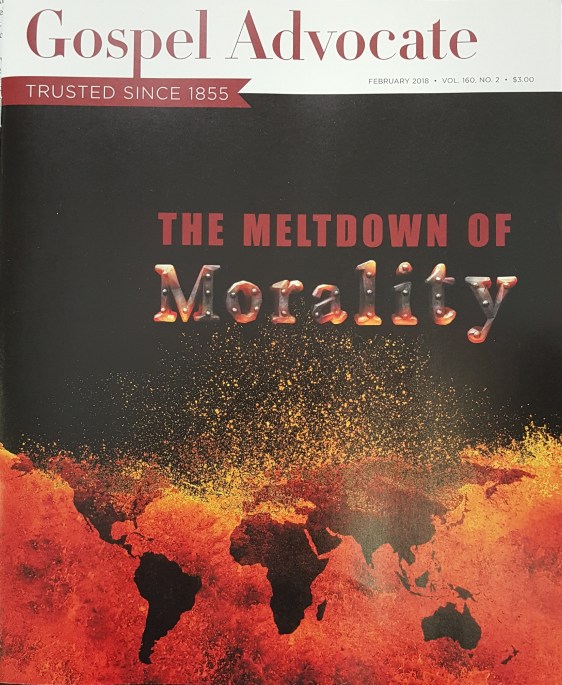
Reprinted with permission from the February 2018 issue of Gospel Advocate Magazine.

20180124_150851.jpg

Hebrews affirms, “For the word of God is living and active, sharper than any two-edged sword, piercing to the division of soul and of spirit, of joints and of marrow, and discerning the thoughts and intentions of the heart” (4:12 ESV). This is part of a warning in Hebrews, which affirms that Christians who defect from God will fail to meet their rest as their Israelite counterparts did (vv. 1-11). God holds his people —and His creation— accountable by His presence (“sight”) in the word of God (Hebrews 4:13). This is a raw incontrovertible truth.

This passage makes no caveats; it makes no attempt to remedy a distinction between God’s word and God’s presence. They are both manifested at the same time. God is involved with real life (time and space) with Israel and with Christians. God makes promises and keeps his word regarding their “rest,” and God holds His people and creation accountable to His word. God is Lord of heaven and earth and everything in between, and He holds it together by the power residing in Jesus (Hebrews 1:3; Colossians 1:17). The word of God is connected not only to the authority of God but also to His nature and how He reveals Himself to the world.

Let me say the above in a differently. Our God, who is beyond time and space (God’s transcendence), enters our earthly “realm” bound by time and space (God’s immanence) with His divinity and authority (sovereignty) intact; furthermore, God enters into relationship with His creation (Abraham, Israel, Christians) by revealing Himself in creation and in His word. God is active both in creation and in His word. Creation reveals God’s existence and hints at elements of His attributes (natural theology), but it is His word that reveals God and His “will” so that humanity can enter into covenant with God. The word of God was both proclaimed orally through particular spokesmen (patriarchs, prophets, kings, apostles), but the prophetic word was not only through oracles but also in written communiqués embedded with the same divine authority (2 Peter 1:16–21). These writings reveal the mind of God (1 Corinthians 2:11–16), His purposes and mystery (Ephesians 3:1–6), His involvement in human events (Acts 17:26–27), and the righteousness by which He will bring justice to the world (Acts 17:30–31).

To say it bluntly, the Bible is the word of God set in a permanent written form. Paul declared, “all scripture is breathed out by God” (2 Timothy 3:16). The Scripture bears the character of God and is no “dead” codebook, for it transforms every “man of God” into a competent, equipped servant (2 Timothy 3:17). The profitability of all Scripture is due to its quality as “God’s breath.” There is no pecking order between the spoken or written word of God. The inspired written word is as inerrant as God’s character. There is no source outside of the Holy Spirit-given Scripture that speaks God’s transforming work since it is the depository of the gospel’s message. What the word of God promises, God will do; what God proclaims, God’s holds His creation accountable to (1 Thessalonians 2:13).

The above may seem to belabor the point, but as anticipated by the title of this piece, we will sketch how the word of God is handled among Liberal (Modern) and Neoorthodox influences. It is essential for the church to reflect on these twentieth-century influences because dialogue is healthy, truth has nothing from which to hide, and any redefinition of biblical Christianity must be given due consideration (Galatians 1:6-7).

The following historical sketches will probably not satisfy everyone, but they will be enough to see their direction and how they redefine significant elements of historic Christian beliefs and their tendency to subvert scriptural authority.

Liberalism/Modernism

The word “liberal” is a very loaded word. It is often used with contempt to show disapproval of someone else thought to be progressive (instrumental music, expanded role of women, etc.). But this is not the historic sense of the word. Liberalism emerged in the late nineteenth century through the interplay of many players, thinkers, and philosophical trends. The influence of Liberalism, or Modernism, is seen in three levels: (1) revelation is not the final answer to reality, (2) naturalism is the key to reality and religion, and (3) since the Christian documents are built on ancient myths and superstitions, the historic supernatural claims of Christianity is immaterial. To be a “Christian” is a matter of experience and the “essence” of its teaching.

Liberalism, as an intellectual revolution, is a child of the Age of Reason (the Enlightenment). The “Age” saw the elevation of human reason over the institutional “church,” which wielded divine revelation. It was “the church” that dictated to the people what to believe about reality. Divine revelation was the final answer to determining truth and what really happened in the past. This was displaced with rationalism, scientific history (criticism), and naturalism as final answers to genuine and authentic history and truth. In essence, as Stanley Grenz and Roger Olsen point out, the maxim “I believe in order that I may understand” was turned to “I believe what I can understand.”[1] Faith was overturned by a reason informed by modern findings — thus, this point of view is called “Modernism.”

Everything that was received as genuine knowledge, now, was shaped by the natural world. This was further supported by what is called “the principle of analogy,” popularized by the liberal theologian Ernst Troelsch (1865–1923), which argued that the present is the best way to understand the past. The consequence was detrimental in the extreme on the trustworthiness of Scripture. The supernatural elements interwoven in Scripture are, by definition, myths and superstitions. This meant that there are no miracles, no supernatural interventions by God, and no resurrection of Jesus Christ. Thus, many new schools of “criticism” emerged to study Scripture with mixed results.

This naturally led to an embrace of “the essence of Christianity” so long as reason and experience allowed. “Liberals” are open to the modern findings from the natural world, open to a religious humanism and science —in particularly embracing Darwinian evolution as the process by which God created. If God exists, He could only be revealed through religious “experience.” It was also immaterial if the events of Scripture happened or not because religion is a condition of the heart. Yet, the apostle Paul makes it abundantly clear that if the resurrection event has not occurred, both our preaching and faith are in vain and we are still in our sins (1 Corinthians 15:14, 17).

Another arm of Liberalism is the demythologizing of the New Testament pioneered by the “Form Critic” Rudolf Bultmann (1884–1976). Bultmann argued that historic person of Jesus is built on untrustworthy sources. The New Testament is Christian propaganda shrouded in the imagery of the Greek myths and Roman legends. As such, they are not relevant for faith nor spiritual truth claims. It is the symbolism that matters. Today, one only need to watch the latest “history” programming to find modern theological liberals interviewed. Theological liberalism has significant questions that need to be answered, but it brings Christianity to a logical dead end.

Neoorthodoxy

The Swiss theologian Karl Barth (1886–1968) ignited a movement when he published his commentary on Romans in 1919. It charted a new theological direction away from Liberalism/Modernism. Barth (pronounced “bart”) was not fond of the misnomer “neoorthodoxy,” but his strand of thinking regarding the meaning of “revelation” and “the word of God” would rival the prevailing traditional belief held historically by the church. As a consequence, many regard Barth as one of the great theologians and the father of modern theology.

Orthodoxy affirms the teaching of historic Christian truth based on Scripture. This includes, for example, the following concepts: the inerrant inspiration of scripture, the triune Godhead, the deity and virgin birth of Christ, the historic creation and fall of humanity, the bodily resurrection and ascension of Christ, the return and final judgment. Barth argued, on the other hand, that “revealed truth” was not written, but was the outcome of an encounter (an experience) with God. Thus, instead of scripture as being the objective word of God, Barth argued for a subjective experience with God initiated by reading the Bible.

Barth was offering a completely different course of thought altogether. “Revelation” does not appear in the form of propositional truths. Arguing book, chapter, verse, or appeals to the very words of scripture is insufficient to reveal God. Revelation (the word of God), it is argued, is an “event” in which God acts in history (God’s immanence). Barth even argued that revelation is not found in natural theology (Acts 17; Psalm 19; Romans 1) but, instead, in events like the call of Abraham, the exodus, and the resurrection. Millard Erickson is spot on when he classifies Neoorthodoxy as an illumination theory divorced from an objective standard.[2]

Although Neoorthodoxy is not a unified movement, there are three interconnected witnesses (modes/forms) that shape its view on revelation.[3] First, Jesus is the word of God in the truest sense, for He reveals God in the event of His incarnation, life, ministry, death and resurrection. This is true revelation, the very gospel. Second, Scripture points to Jesus but it is a flawed human (read “errant”) attempt to provide a witness to divine revelation. It is instrumentally God’s word but not properly. Third, the proclamation within the faith community —Barth preferred “community” to church— is likewise instrumentally God’s word. The Bible, then, only becomes God’s word when God uses it to reveal Jesus Christ in the encounter, contrary to 2 Timothy 3:16.

In fact, Neo-orthodoxy is quite a popular approach to handling the Word of God, even among churches of Christ. A popular theological branch of this movement is “Canonical Criticism,” popularized by the late American scholar Brevard Childs (1923–2007). It seeks to broadly bypass much of the liberal destructive criticism of the twentieth century by accepting the texts of Scripture as literary units. Nevertheless, this point of view struggles, as did Barth’s, to embrace the Bible as a very human (errant) book while appealing to its authority for theological thought as if they were inerrant. They seek, in the words of one sympathetic Abilene Christian University professor, to “articulate a doctrine of Scripture that recognizes human flaws in it.”[4] Treating the Bible as an inerrant text is simply a form of bibliolatry.

Keeping the Faith

Today, the phrase “Word of God” means different things to different believers, and that includes preachers. Liberalism ultimately rejects a supernatural Christian faith, and is at home with amputating its historic claims of a resurrected ascended Lord Jesus, in exchange for a subjective diluted Christianity. Neoorthodoxy, on the other hand, embraces a supernatural Christian faith, but it rejects the supernatural origin, inerrancy, and authority of the Scriptures which undergird its claims. The Word of God has always been a manifestation of God’s presence in our lives, in His proclamation, and in His Scripture without pecking order. Let us join Paul who declares, “Let God be true though every one were a liar” (Romans 3:4).

Notes

  1. Stanley J. Grenz and Roger E. Olsen, 20th Century Theology (Downers Grove: InterVarsity, 1992), 17.
  2. Millard J. Erickson, Christian Theology, 3rd ed. (Grand Rapids, Baker Academic, 2013), 220–21.
  3. Karl Barth, Evangelical Theology: An Introduction, trans. G. Foley (New York: Holt, 1963), 26–36.
  4. Christopher Hutson, “Scripture as the Human Word of God: Why Faith Contradicts Inerrancy,” Lexington Theological Quarterly 44.1 (2011): 210–21. Hutson serves as a professor of ministry and missions at Abilene Christian University.

To subscribe to Gospel Advocate, click here.


Be the Gift (1 Peter 4:10-11)

It is a staggering thought when you think about it. Christians have gifts to share with their neighbors. Much like the old nativity hymn of the three orient kings, who came from the far east with rich gifts for the newborn king Jesus, Christians have gifts to share with the people they come in contact with every day. In a word, we have a calling. It is greater than Toys for Tots, it is greater than Secret Santa, it is greater than the presents carefully wrapped and laid under the Christmas tree. The gifts Christians have are those which come from God, they are packaged by him and must be shared.

When the apostle Peter wrote to the beleaguered Christians in the northeastern Roman provinces of Asia (1 Peter 1:1), he wrote to encourage them to embrace the slander and the social persecution with the reminder that they walk in the footsteps of Jesus (1 Peter 2:21). For example, should they suffer unjustly —as did Jesus— the suffering will bring about the opportunity to extend grace to the world. Furthermore, the Christian must not focus on the momentary suffering but instead upon God’s validation and vindication. As God vindicated the suffering servant Jesus, so will He vindicate his suffering people (4:1).

As You Have Received God’s Gift

As an extension of this moral encouragement, the apostle goes on to address very practical aspects of Christian living in chapter 4. Here is an excellent moment to pause and reflect upon the truth that doctrinal purity is important, but these Christians are called to practice godliness in the face of persecution. In one of the summarizing passages of this exhortation, Peter writes the following:

As each has received a gift, use it to serve one another, as good stewards of God’s varied grace: whoever speaks, as one who speaks oracles of God; whoever serves, as one who serves by the strength that God supplies—in order that in everything God may be glorified through Jesus Christ. To him belong glory and dominion forever and ever. Amen. (1 Peter 4:10–11 ESV)

A point that is not readily notable from the English version is the connection between gift (charisma) and grace (charitos) in verse 10. They are built on the same word root, which was interconnected at the social level. It portrays God as a benefactor —a gift giver— for his people and asks them (us) to also be gift-givers (benefactors) as well.

This makes the term “good stewards” (oikonomoi) equally enlightening. It is a word that has domestic and political usage, and this usage is seen in the New Testament documents. In the ESV, the word is translated as “manager” of domestic affairs (Luke 12:42, 16:1, 3, 8; Gal 4:2), and once as “treasurer” which would have been a political office in Rome (Rom 16:23). As here in 1 Peter 4:10, “steward” in passages that emphasizes a conservatorship over a given responsibility (1 Cor 4:1-2, Tit 1:7). It was a well known Greco-Roman phenomenon that members of a benefactor’s household were also “brokers” of the gifts of the head of their household. The imagery of Peter’s message is parallel to this type of behavior.

Christians as members of God’s house are blessed by their Father’s gifts so that they may be brokers of God’s grace. We are in a very real way representatives of God’s house and what we offer in a variety of ways is the very gift of God — Jesus Christ and the gospel message. We are to teach it, we are to proclaim it, but most importantly we are to live it. Below, we will consider the points left behind in this section by the Spirit through Peter in verse 11.

Whoever speaks…

One of the overarching themes of the film, Waiting for Superman, a 2010 documentary on the American education system, is that many within the system are waiting for someone to fix it, to do the hard work to shore up its failures. Instead, such systemic problems will only be fixed by teachers and educational leaders working together and initiating helpful and creative programs. There is no one person who can fix the educational system of America, all resources must come together. The same is true with sharing the gift of Jesus and His gospel.

Every Christian (woman and man) must remember that our gift is a gift of words. Not just words, but words of God. For this reason, when a Christian shares the gospel it truly is God’s gift of grace we are sharing. We must not speak our words. We must not speak from our own anger. We must not speak our theories of the word. We must not speak our “pet” religious opinions. We must not speak from any other basis other than from the depository of God’s word — found only in the Scriptures. Our words must be as if it were God talking. God’s word is the only true gift (1 These 2:13).

Whoever serves…

Christian activity is always dramatically presented as services rendered as one who waits on tables, doing as told by their superior (Acts 6:2; John 2:5). Every Christian (woman and man) must remember that our gift is also a gift of action — of service. Christians broker God’s grace with others with the service we render to other people. Edgar Guest was spot on with this passage when he penned the opening lines of his poem, “I’d rather see a sermon than hear one any day; I’d rather one should walk with me than merely tell the way” (“I’d Rather See a Sermon Than Hear One Any Day”). Indeed, there is no greater opportunity in life than to serve as an example of God’s grace to others.

Words can be misunderstood. Actions, however, are less so. But, serving others often comes with a tall price. Service is not convenient emotionally, or physically. It is perhaps for this reason that Peter says that Christians who serve others do so and are empowered by the strength supplied by God. We do not serve others based on our own merits. It is a hard lesson for so many of us, but we need to trust in God for Him to be God when we are serving others. Whether it is food, clothing, or shelter that we offer as expressions of God’s varied graces, we do so, trusting that God will make our service His gift and that alone should empower us to serve.

Concluding Thoughts

Whether it’s the best of times or the worst of times, Christians can make a mark in the world and in the times in which they live. My prayer for all of us is to be the Christians we are called to be. Be the best gift you can be to your family and friends in word and service. Let it be the kind that brings glory to God and not to self. Remember, to say, “it’s not about me… it’s about Him.” “To him belong glory and dominion forever and ever. Amen” (4:11).