Organizing God’s House in 1-2 Timothy and Titus

college papers

The ekklesia of the Pastoral Epistles (PE) is a challenging study.[1] Part of its challenge is that the study is can be very quickly clouded by the assertions against Pauline authorship from interpreters which make large assumptions based upon a perceived problems with the way the organization of the church is detailed in the PE; and, although a majority of New Testament interpreters categorize the PE as pseudonymous, and deutero-Pauline, there are salient and thoughtful responses to such criticisms[2] against Pauline authorship.[3]

This particular investigation looks into the use of ekklesia in the 1-2 Timothy and Titus (PE) and seeks an understanding of how these letters articulate the organization of the church, and to present a preliminary conclusion of whether or not this reflects a post-Pauline setting.

Ekklesia in Perspective

To begin with, of the 114 instances of ekklesia in the New Testament Paul’s use of the term accounts for 62 (54.39%) of these, three of which are only in the PE (2.63%).[4] The word is used in both non-biblical and biblical contexts.[5] In its ordinary sense, it refers to “the popular assembly of the full citizens of the polis, or Greek city state” (Acts 19:32, 41).[6]

It is incorporated into Jewish theology through the Septuagint (LXX) frequently to translate the Hebrew term qahal.[7] It is found in references to the assembly of Israel during  “their desert wanderings.”[8] It also would describe “Israel when it assembled to hear the Word of God on Mt. Sinai, or later on Mt. Zion where all Israel was required to assemble three times a year.”[9] There was the assembly “of the Lord” (Deut 23:2), or “of the people of God” (Judges 20:2; Acts 7:38).[10] It seems proper to understand ekklesia, then, as a word which in many cases depicts an assembly of God’s people prepared to hear God’s Word (Matt 16:18).

Ekklesia in 1-2 Timothy and Titus

The first matter to discuss is the usage of ekklesia in the PE. The limits of the use of ekklesia in the PE perhaps underscore Luke T. Johnson’s concerns regarding certain tendencies in how “the three letters are invariably treated together as a group.” This tendency results in the “characterization” of the PE by “coalescing” their contents and in effect “dulls the perception of the individual letters.”[11] There must be an internal reason for this limited use of ekklesia in the PE. Despite the data and Johnson’s concern, the concepts associated with church life are interwoven throughout the PE, demonstrated by the fact that ministerial concerns are ultimately church concerns: “Keep a close watch on yourself and to the teaching. Remain in them, for by doing these things you will save both yourself and your hearers” (1 Tim 4:16).[12]

The three uses of ekklesia in 1 Timothy are found in 3:5, 15, and 5:16. These will be considered in the order of their appearance. 1 Timothy 3:5 is a parenthetical maxim: “but if someone does not know how to care for his own household [tou idiou tou idiou oikou], how will he take care of God’s church [ekklesias theou]?” Not much later, Paul writes, “but if I delay, that you might know how one ought to behave in the household of God [en oiko theou], which is the church of the living God [ekklesia theou zontos], the pillar and the foundation of truth” (3:15). At the end of the discussion regarding the ministry toward widows, Paul writes, “If any believing woman has widows, let her provide them help and do not let the church [he ekklesia] be burdened, in order that She (i.e. the church) may provide for the ones who are truly widows” (5:16).

1 Timothy 3:5 and 15 are the most closely linked together not only in proximity but also the way they are integrated into Paul’s argument for the expected conduct in the ekklesia (3:15). In 3:5, the care given in the guardian’s[13] “own home” reflects his capacity to care for the “household of God”; moreover, this very “household of God” bears the “characteristic quality” (hetis)[14] as “the church of the living God” (3:15). The syntax may be understood in a few a ways. These institutions may find their origin in God (ablative of source); or, the genitive reflects them as God’s possession, if not they are defined by their relationship with God.[15] In either case, what God creates He possesses and has a relationship with what is His (John 1:12).

While these three are legitimate grammatical options, contextually the contrast between the household of the guardian and the household of God lays the emphasis upon possession: “God’s household” and “the Living God’s church.” Hence, as George W. Knight, writes, the Christian life is to be lived out in “the home built and owned by God and indwelt by him as the living one.”[16]

In 5:16, the closing statement requires the care for widows and presents a prohibition against burdening “the church” unnecessarily (he ekklesia). This is the anaphoric use of the article, pointing back to 3:15, which implicitly suggests this is a reference to the local congregation.[17] “The church” is the same as “the church of the living God” for as K. L. Schmidt observes, “the words tou theou are implied even when they are not specifically added, just as basileia in the NT always means the basileia tou theou unless some earthly kingdom is expressly mentioned.”[18] This fits well with the context, where there is a strong distinction made between one’s responsibility to “one’s own household” (5:4) and “member of the family” (5:8) with the responsibility he ekklesia has to care for its members who are “genuine widows.”

Taking a wider view, the phrase ekklesia theou is found in connection of the work of guardians who function as shepherds in Acts 20:28; moreover, the phrase ekklesia theou is found in the so-called “genuine” Pauline letters (1 Cor 1:2, 10:32, 11:16, 22, 15:9; 2 Cor 1:1; Gal 1:13; 1 Thess 2:14) and “deutero-Pauline” references such as 2 Thessalonians 1:4.[19]

The exclusive use of ekklesia in 1 Timothy demonstrates a few things. Firstekklesia must be understood in its connection to the genitival theou, which here emphasizes God’s ownership of the church. Secondekklesia theou is explanatory revealing the “characteristic quality” (hetis) of the household of God (oiko theou 3:15). Third, the genitival construction ekklesias theou is consistent with the so-called “genuine” letters of Paul. This is significant since it is a consistent Pauline phrase to describe the saints in Christ (2 Cor 1:1). Fourth, as the “household of God” the church is distinct from the household of the “guardians” (3:1b, 5) and of the “servants” (3:12), and of the Christian families who must care for their own households (5:1-16).

1 Timothy’s use of ekklesia then is bound within what this writer would describe as a concentric responsibility. Guardians, servants, and Christian families must take care of their own households as part requisite to serve in greater echelons of the household of God, the church of the living God. The household metaphor will be explored next since it is pervasive in the PE.

The “Household” in 1-2 Timothy and Titus

The second matter to consider is the church organizational structure found in the PE. Despite the limited use of the ekklesia various church leaders are discussed within the PE. In 1 Timothy and Titus there those who would take on “the responsibility of a guardian” (episkope; 1 Tim 3:1-7; Tit 1:5-9). Only 1 Timothy provides a virtue list for those who would be “servants” (deacons) in the church (3:8-13). There is an “enrollment of the widows” which may refer to an “order” of godly women who are supported by the church (1 Tim 5:1-16). Again, Johnson’s caution is reiterated that the PE are individual letters in spite of many overlapping features, and these distinctions must be respected. Nevertheless, the familiar Greco-Roman metaphor of “household” is evident throughout the PE and provides the organizing principle for churches in Ephesus and Crete.[20]

The “household” metaphor is significantly used throughout the PE. It is not without precedent that Paul uses metaphors (the body, the bride, the temple, etc.) to describe the interworking relationships of the church. David J. Williams introduces his research on metaphors in Pauline literature by calling attention to the literary fact that

metaphor is a way of presenting a truth that is wholly or partly unknown by likening it to something that is known to the person or persons under instruction. A metaphor is an aid to the perception of a truth (its intuitive recognition). It helps us to “get a handle” on a truth, but it does not necessarily furnish an explanation, certainly not a complete explanation, of the truth in question.[21]

In the Greco-Roman backdrop, the household metaphor lent itself to the political realm. According to P. H. Towner, the Roman emperor “came to be viewed as a father and the state as his household. And many functions or positions in relation to the state were derived from the ‘household’ root.”[22] As such, the metaphor of “household” would include derivative analogies such as immediate family members, slaves, freedmen, servants and laborers, and many other household personnel.

It is clear that “household” is an overarching metaphor Paul draws from in the PE. This is seen in the PE’s phrase, “how one ought to behave in God’s house” (1 Tim 3:15b). Paul does use the term “house” in his correspondences in the sense of one’s own home (1 Cor 11:22) and in the sense of where Christians meet (Rom 16:5; Phlm 2). Yet, it is in the metaphor of household that the PE develop the analogy of the church as “a social unit, made up of various members, each responsible to one another and ultimately to the householder.”[23]

This emphasis on household imagery could explain the omission of spiritual gifts as the connective tissues of church organization and leadership, which is a critical concern that some interpreters find to be evidence pointing against Pauline authorship. Therefore, if it is granted to Paul that the household metaphor better pointed out “truth” to his recipients then at the very least the viability of Pauline authorship cannot be dismissed lightly. Such criticisms, which centers on the PE’s use of non-Pauline metaphor for ekklesia, appears forced and arbitrary.

The household metaphor for the church organization, then, is developed in the PE in the following ways. In 2 Timothy 2:20-21 there is a brief comparison of the church to “a great house” (en megale oikia). Such a comparison suggests that the house must have various elements of worth. 1 Timothy 2:1-3:13 more emphatically develops that there are expectations in the household of God (3:15).[24]

Let us summarize a few points regarding expectations. First, 1 Timothy 2:1-15 develops the roles of the church as a whole (2:1-7), and gender role expectations in the assembly (2:8-15). Second, 1 Timothy 3:1-7 and Titus 1:5-9 addresses the qualifications for the managerial and senior members of the household of God (guardians and elders). Moreover, Titus 1:7 calls the elder and guardian a “steward of God” (theou oikonomon), which refers to a member of the household who is entrusted with a task by the master of the household.[25] Third, 1 Timothy 3:8-13 provides a virtue list for servants (diakonous) who function in various roles in a household. In this connection, Timothy himself is described as a diakonos Christou Iesou who later on is called to fulfill his work as an evangelist (2 Tim 4:5).[26] Fourth, there is the familial treatment between Christian “siblings” and the care of widows as members of the household of God (1 Tim 5:1-16). Timothy and Titus are both regarded as a “true child” (1 Tim 1:2; Tit 1:4), and Timothy is also described as “beloved child” (2 Tim 1:2).

Does this Fit with Paul’s Authorship?

With the evaluation of much of the internal evidence of the PE, it must be considered whether the picture of the church is of such a state that it weighs against Pauline authorship. The use of the household metaphor for organizing “the church of the living God” in the PE is pervasive, providing analogies for every ministry of ekklesia; moreover, it is all inclusive with specific guidelines for the various ministries considered.

Gerd Theissen, however, argues that “the notions of the community are not very Pauline. The image of the body of Christ in which all members have equal rights is absent.”[27] Quite to the contrary, the “notions of community” in the PE are every bit as comparable to so-called “authentic” Pauline teaching of the body of Christ. In Romans 12:3-8 the body of Christ is filled with many members with differing gifts. Paul writes the gifts are given “each according to the measure of faith that God has assigned” (3 ESV), and “so we, though many, are one body in Christ, and individually members one of another” (5 ESV).

Furthermore, in 1 Corinthians 12 Paul makes a similar argument. All the spiritual gifts are from a single source, but every Christian has a different ministry: “there are varieties of gifts, but the same Spirit” (4 ESV).  In this context, Paul raises the issue of church leadership: “Are all apostles? Are all prophets? Are all teachers? Do all work miracles?” (29 ESV).

There appeared to be equal opportunities to serve but different areas of ministry based upon the will of God. This is precisely how the household metaphor presents ministry in the PE. Such evidence ought to reduce the weight of observations like those of Theissen who reject Paul’s authorship on the belief that the community in the PE is inconsistent with the so-called “authentic” letters of the apostle.

Some Conclusions

The conclusions drawn here are preliminary, but they lean toward a realization that each letter in the PE must be respected for their individual contribution and voice. Yet, for the focus given to individual church leaders (Timothy and Titus) and their concerns for conduct in the household of God, there is a commonality between them which can be evaluated in unison. There are three preliminary conclusion which can be made at this time.

First, the limited data of the use of ekklesia in the PE demonstrates that 1 Tim has particular expectations for its members to understand the difference between one’s own household and God’s household. This clearly suggests a rebuke and an attempt to recalibrate the Christian behavior. Titus and 2 Timothy apparently had different church concerns.

Second, the church organization revealed in the PE is quite clearly patterned after the metaphor of “household” with God as the master. In employing this metaphor, the PE reveals that leadership roles are subject to God’s prerogative to entrust a task for His household servants. Timothy and Titus along with the other leaders and servants appear cooperative; there does not appear to be a portrayal of a second century monarchical type of hierarchy as in Clement of Rome and Ignatius.[28]

Finally, the criticism that the PE “office holders” have replaced a “charismatic-functional church structure”[29] overlooks the pervasive and organic nature of the “household” organizing principle, and upon closer look reflects similar levels of diversity of ministries and personnel.

Endnotes

  1. Pastoral Epistles (PE) will be used throughout this essay. There is some objection raised as to the use of this nomenclature due to the correct view that neither Timothy nor Titus are pastors in the modern sense. However, Paul does address the qualifications for the episkopos, the overseers, or the guardians of the church; so, in this sense as documents which speak to this office these letters are viewed as pastoral, if not episcopal, in the New Testament sense.
  2. The internal areas of discussion are fourfold: the historical problem of fitting the PE into the historical scheme of Acts and the Pauline corpus, the connection between church organization in the PE and second century church organization, the distinct style of the PE and its unfamiliar robust vocabulary, and the dissimilar use of Pauline theological terms and lack of common doctrinal concerns.
  3. Donald A. Carson and Douglas J. Moo, An Introduction to the New Testament, 2d ed. (Grand Rapids, MI: Zondervan, 2005), 554-68; Donald Guthrie, New Testament Introduction, 4th ed. (Downers Grove, IL: InterVarsity Press, 1990), 612-36; a centrist, Luke Timothy Johnson and Todd C. Penner, The Writings of the New Testament: An Interpretation, rev. ed. (Minneapolis, MN: Fortress Press, 1999), 424-28.
  4. Peter T. O’Brien, “Church,” DPL 124. Cognates of ekklesia are used throughout in 1 Timothy (6:12) and 2 Timothy (1:9; 2:20, 22), but they are not used in Titus.
  5. ekklesia,” BDAG 303-04.
  6. O’Brien, “Church,” 123.
  7. O’Brien, “Church,” 124; Karl Ludwig Schmidt, “ekklesia,” TDNT 3:527; BDAG 303.
  8. Joseph A. Fitzmyer, Pauline Theology: A Brief Sketch (Englewood Cliffs, NJ: Prentice-Hall, 1967), 76.
  9. O’Brien, “Church,” 124.
  10. See also the assemblies in 1 Kgs 8:55 and 1 Chr 29:10; interestingly, the Hebrew writer speaks of the redeemed in a similar way (Heb 12:22-24).
  11. Johnson and Penner, The Writings of the New Testament, 424.
  12. Unless otherwise noted all translations are those of the author.
  13. episkopos,” L&N 35:43.
  14. hostis, hetis, hoti,” BDAG 729.
  15. Boyce W. Blackwelder, Light from the Greek New Testament (1958; repr., Grand Rapids, MI: Baker Hook House, 1976), 131; James A. Brooks and Carlton L. Winbery, Syntax of New Testament Greek (Lanham, MD: University Press of America, 1979), 8-9, 23
  16. George W. Knight, III, The Pastoral Epistles (Grand Rapids, MI: Eerdmans, 1992; repr., Grand Rapids, MI: Eerdmans, 2013), 181-82.
  17. Daniel B. Wallace, Greek Grammar Beyond the Basics: An Exegetical Syntax of the New Testament (Grand Rapids, MI: Zondervan, 1996), 217-20.
  18. Schmidt, “episkopos,” TDNT 3:507.
  19. Blackwelder, Light from the Greek New Testament, 131; Charles B. Cousar, The Letters of Paul (Nashville, TN: Abingdon, 1996), 89-90, 163-80.
  20. Cousar, Letters of Paul, 178, 202.
  21. David J. Williams, Paul’s Metaphors: Their Context and Character (Peabody, MA: Hendrickson, 1999; repr., Peabody, MA: Hendrickson, 2004), 1. Williams sees the use of “household of God” (oiko theou) as a probable metaphor for the church in 1 Tim 3:5 and 15, and he compares this with the “household of faith” in Galatians 6:10 (30).
  22. Philip H. Towner, “Households and Household Codes,” DPL 417.
  23. Towner, “Households and Household Codes,” 418.
  24. Cousar, Letters of Paul, 202; Towner, “Households and Household Codes,” 418.
  25. oikonomos,” BDAG 698.
  26. This is of particular importance since Timothy is thought of as a type of monarchial bishop from the second century. Neither Timothy nor Titus are so named.
  27. Gerd Theissen, Fortress Introduction to the New Testament, trans. John Bowden (Minneapolis, MN: Fortress Press, 2003), 136.
  28. Howard Lee Kee, Understanding the New Testament, 4th ed. (Englewood, NJ: Prentice-Hall, 1983), 315. Although Kee rejects Pauline authorship, he does concede that there is “no hint” of a single bishop in a city or territory with central authority over the Church in the PE.
  29. Udo Schnelle, The History and Theology of the New Testament Writings, trans. M. Eugene Boring (Minneapolis, MN: Fortress Press, 1998), 330; trans. of Einleitung in das Neue Testament (Göttingen: Vandenhoeck & Ruprecht, 1994).

An Elder’s Character: A Matter of Public Record (1 Tim 3:7)

Moreover, he [the guardian/overseer (3:1)] must be well thought of by outsiders, so that he may not fall into disgrace, into a snare of the devil. (1 Timothy 3:7 ESV)

One of the qualifications for the “guardians” (overseers) in Ephesus listed above concerns the Christian man’s reputation among non-Christians. In 1 Tim 3:7, the church is called to evaluate this testimony as a preventive measure in the selection process of a “guardian.”

It has been asked, “what will happen to a leader who is not so regarded by those outside the church”?[1] The answer is clear: it becomes a trap set by the Devil to bring about disgrace in the church. The man’s public record must weigh in as to whether or not he should have the responsibility of a guardian. Let us explore this verse in some greater detail by looking at three aspects of the text.

(1) A Final Necessity

After exploring thirteen qualifications designed to add details to the broad concept of being “above reproach” (1 Tim 3:2), the final detail is the measure of his character as reflected by “outsiders.”

The nature of his public record must be “morally excellent.” The ESV has “well thought of,” but the text literally reads, “have a good testimony.” It covers the positive moral ideas of good, noble, and praiseworthy, a quality that is “favorably valued.”[2] His character and standing in the community (3:7) must be equal to the “good work” as a guardian (3:2).

The “source” of information which is supposed to help the church examine a “guardian’s” candidacy comes from non-Christians (literally, “from those on the outside”). At first glance, this may appear to be strange. Why would public opinion matter when addressing the leadership role of a church “guardian”? The short answer is his public reputation either brings glory to God or disgrace to His Kingdom. This qualification of the quality of an overseer’s reputation must not be ignored.

(2) The Reason for the Requirement

The middle of the verse reads, “so that he may not fall into disgrace, into a snare of the devil.” The emphasis is placed upon protecting the church from those who have a bad reputation in the community; such a scenario would play “into the devil’s trap.”

Are there any longstanding frictions with the community which not only are detrimental to the guardian’s service but also to the mission of the church? Is he “known” for having improper relationships, or do rumors circulate about him which would be reproachable to him?

These questions must be asked and answered. However, despite the importance of public record, the community is not the final say. It is an important part of the appraisal process designed to prevent disgraceful men from entering the eldership. It is much easier to get a man in than it is to remove an unqualified elder.

(3) The Ever-Present Danger of the Devil

There are no sinless guardians; however, pretense and hypocrisy are subject to slander and accusations. Such is the main objectives of “the Slanderer” (i.e., the Devil). The man’s public record should not be a prized trophy captured by the Devil (i.e., the implied hunter’s snare). Consequently, “Christian men who bring widespread scandal upon the church of God have a heavy burden to bear.”[3]

If one’s character is something that has been built brick by brick, then so is one’s reputation. Good character does not have to be perfect, but according to this verse, one’s reputation does need to be well thought of. This, then, is not a role where one develops a good reputation; quite to the contrary, the role is for the person who already possesses an excellent reputation. Contextually, further, they must already possess such a reputation from the community.

A Final Word

One’s public record is a general guide to anticipating the trajectory of a person’s character: where does it point? We must allow for imperfect people to have imperfect records; furthermore, not all concerns are of the same weight and worth. Nevertheless, if there is no longstanding trajectory towards godliness in non-Christian circles then it is adequately apparent such a prospect cannot serve in such an iconic and spiritual role as shepherd, elder, and overseer in the church of God, which is God’s house (1 Tim 3:15).

I was recently told of a congregation that was in the process of selecting new elders. In keeping with the tenor of this character requirement, the congregation placed a notice in a local newspaper seeking public input as to the character and public record of the proposed elders. I am unaware of the outcome, but their action is powerful as it upholds the importance placed upon an elder’s public record.

Endnotes

  1. George W. Knight, III, The Pastoral Epistles (1992; repr., Grand Rapids, MI: Eerdmans, 2013), 165.
  2. Bauer, Walter, Frederick W. Danker, W. F. Arndt, and F. W. Gingrich, eds. A Greek-English Lexicon of the New Testament and Other Early Christian Literature, 3rd ed. (Chicago, IL: University of Chicago Press, 2000), BDAG 504; Johannes P. Louw and Eugene A. Nida, Greek-English Lexicon of the New Testament Based on Semantic Domains, 2d ed. (New York, NY: United Bible Society, 1989), L&N 88.4.
  3. Wayne Jackson, Before I Die: Paul’s Letters to Timothy and Titus (Stockton, CA: Christian Courier Publications, 2007), 94.

Book Review: Emerging Elders

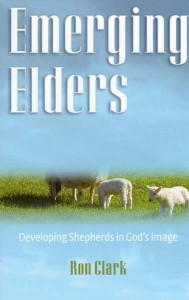
Emerging Elders

Ron Clark, Emerging Elders: Developing Shepherds in God’s Image (Abilene, TX: Leafwood Publishers, 2008), 203 pages. Paperback.

Ron Clark is the lead church planter with the Agape church of Christ in Portland, Oregon. He holds M.Div. and D.Min. degrees from Harding School of Theology (Memphis, TN) and serves as an adjunct instructor for George Fox Evangelical Seminary. He is also a member of the Oregon Attorney General’s Sexual Assault Task Force.

Clark has contributed to various publications such as New Wineskins, The Christian Chronicle, Stone-Campbell Journal, and Restoration Quarterly; moreover, he has recently published The God of Second Chances (2012) and Setting the Captives Free (2005) along with the current volume which is the subject of this book review.

Emerging Elders: Developing Shepherds in God’s Image provides a theological platform for training current elders and potential elders. Clark explores the text and terminology of the descriptive terms for “pastor” (elder, overseer) and explores such leadership in light of an incarnation model. Clark believes that only when God’s word is actually lived out and exemplified by its the church’s leaders shepherding cannot truly be what God intended it to be.

The Book

Clark has provided the body of Christ a unique text which addresses the needs of the organizational structure of churches of Christ. This is perhaps its greatest overall strength. As Clark observes, “few books are written specifically for ministers about our style of ministry” where the pastor and the preacher are distinct ministries in the body of Christ.[1] Clark observes that most church leadership material is based upon church models which are dissimilar to churches of Christ, or based upon business models which have been given a Christian spin. Consequently, to address the lack of literature on the subject Emerging Elders is an attempt at providing a resource and a solution to the vacuum of pastoral development in light of this distinction.

In Emerging Elders, Clark provides a solid response to this lack of material to address In section one, Clark develops the need for elders who are equipped to lead the body of Christ (chapters 1-2). In section two, Clark provides a dynamic model of God as shepherd and what that means for the leaders of God’s people, he offers a situational and contextual applications of the pastoral qualifications, and then emphasizes that both God’s example and Paul’s instructions are to be applied incarnationally (chapters 3-8).

In section three, Clark provides a series of chapters which specifically address the tensions and problems within church life in particular and churches of Christ in general that emerging elders must address in an incarnational model. “These leaders are appointed to imitate God’s care and concern for people.”[2] The chapters on predators and care of the preacher were particularly exceptional and passionate, and are often not treated in the manner in which Clark has done (chapters 9-15).

Suggestions

What perhaps would have made Emerging Elders more helpful would have been in the area of conflict resolution (chapter 10) and the elder development program (chapter 15). In chapter 10, Clark explores the role elders have in the promotion and maintenance of unity. This lays heavily upon John 17 and Eph 4:1-6, and according to Clark speaks to the needs of the elders to “encourage reconciliation.” To be sure, Clark is complete in his development of the reconciliation process: “Reconciliation requires, conflict resolution, validation, and reinstatement of a relationship.”[3] However, I walked away from that section wishing that Clark had spent more time on developing these ideas, diagrams notwithstanding.

Secondly, I felt that the last chapter (ch. 15) was almost a letdown. With the idea of elder development as the core of the book, I anticipated the last chapter, “Suggested Elder Development Program,” to have more details. Maybe I am being over judgmental. The cycles are a great suggestion and using a quarter year system for elders and potential elders is very helpful. The book reading suggestions are also very appropriate. But what about the first steps it takes, the conversations needful to create the atmosphere to offer and provide these classes? I anticipated more help in creating the development program; however, even in saying this the program offered and the notes to use certain sections of the book along with corresponding cycles is very helpful.

Recommendation: High

In balance, Emerging Elders is a perfect balance of scholarship and the heart of a servant attempting to live incarnationally. Incarnational leadership is at the heart of Emerging Elders and it should be at the heart of how Christian leaders serve, and how Christians serve their church, family, and community. It does not provide easy answers to the flesh and blood problems in the church, nor does it provide answers that are so impossible to achieve. Emerging Elders calls Christians to lead God’s church biblically (incarnationally), and to address the real-life problems the people of God face with the most fundamental gift God has given his people agape love.

Emerging Elders calls every would-be elder to be living examples of faith, integrity, and loving concern for all. I highly recommend Ron Clark’s Emerging Elders to every husband and wife who serve in their church, every preaching couple, every elder and his wife, every deacon, and his wife. They are truly the focus of this book. As Clark observes,

We must help families inside and outside the church heal, but this must come from incarnational leaders who model God’s style of marriage and parenting. God has a pattern; leaders follow and call others to do the same. They follow by modeling his nature through the fruits of the Holy Spirit, becoming a father like God, and being approachable. These individuals reflect God’s character to both the church and the world.[4]

Endnotes

  1. Ron Clark, Emerging Elders: Developing Shepherds in God’s Image (Abilene, TX: Leafwood Publishers, 2008), 9.
  2. Clark, Emerging Elders, 46.
  3. Clark, Emerging Elders, 139.
  4. Clark, Emerging Elders, 101.

Modesty in Speech: Reflecting God’s Image in What We Say

Introduction

Do words matter? Framed in another way, is there a fundamental connection between speaking and God? Again, is there a spiritual component to communication? Consider the following. The Bible asserts that the universe came into existence at the command of God, “God said” (Gen 1:3, 6, 9, 11, 14, 20, 24, 26, 29). The Hebrew writer asserts,

By faith we understand that the worlds have been framed by the word of God, so that what is seen hath not been made out of things which appear.

Hebrews 11:3 (All Scripture references are from the American Standard Version unless otherwise noted)

In fact, both the origin and the dissolution of the universe is subject to the declaration –“word”– of God (2 Pet 3:5-7). Communicating is, then, a core activity of God; in other words, God speaks His Mind.

There are people in this world who seek for a chance to hear God speak to them. God has spoken, in his wisdom, through two monumental venues. The first is creation; the second, are the Scriptures. In Romans 1:20, Paul affirms,

For the invisible things of him since the creation of the world are clearly seen, being perceived through the things that are made, even his everlasting power and divinity; that they may be without excuse.

Romans 1:20

The world essentially speaks of a powerful supernatural eternal being Who is the origin of all that is seen; in a nutshell, the “heavens declare the glory of God; and the firmament showeth his handiwork” (Psa 19:1).

Second, God has spoken his mind and has preserved it in the Scriptures. It is written,

For who among men knoweth the things of a man, save the spirit of the man, which is in him? even so the things of God none knoweth, save the Spirit of God. But we received, not the spirit of the world, but the spirit which is from God; that we might know the things that were freely given to us of God.

1 Corinthians 2:11-12

In fact, the unveiling of God’s mind is the cause which brought about the Scriptures. It is written, “Every scripture inspired of God” (2 Tim 3:16). God has spoken his unique message through his prophets, who have committed those oracles to print (Eph 3:1-6; 2 Pet 1:19). King David once said of himself, “The Spirit of Jehovah spake by me, And his word was upon my tongue” (2 Sam 23:2).

What this discussion points to is a fundamental truth about God. Inasmuch as God is the source of love, it is equally true that God is the source of disclosure. In other words, communicating and disclosing the eternal mind is fundamental to the nature of God. This is important for a proper understanding of human communication because humanity is made in the image of God (Gen 1:26-27). God’s people are expected to reflect their Creator’s nature. In fact, Peter writes,

but like as he who called you is holy, be ye yourselves also holy in all manner of living; because it is written, Ye shall be holy; for I am holy.

1 Peter 1:15-16

Little wonder that Peter would further admonish, “if any man speaketh, speaking as it were oracles of God” (1 Pet 4:11). Every aspect of godly living is to be set apart for God’s purposes (Rom 6:17-18), and this includes how a person speaks.

Speaking is a process which discloses the thoughts and movements within a person’s heart; it reveals what is in the heart (Matt 6:22-23; Mark 7:20-23). All things being equal, regardless of the truths or lies a person speaks, it derives from the inner workings of the heart. Since communication is a spiritual matter and reflects one’s heart, it is not surprising that Jesus would state the following: “And I say unto you, that every idle word that men shall speak, they shall give account thereof in the day of judgment. For by thy words thou shalt be justified, and by thy words thou shalt be condemned” (Matt 12:36-37; cf. Rev 21:8; Rom 14:12, 10-12; 2 Cor 5:10; Eccl 12:14; Acts 17:30-31).

What a person “says” matters because it reflects a spiritual truth about a person’s heart. The heart is the touchstone upon which Jesus makes his case for a higher level of spirituality as addressed in the “Sermon on the Mount” (Matt 5:21-22, 27-28, 33-37, 43-48). When someone tells the truth, or lies, or uses a swear word, there is a corresponding spiritual truth which points to how one reflects the image of God. If one wishes to be a faithful child of God, one must “adorn” God’s teaching on modest speech (Tit 2:10). Our speech must reflect that we are made in the image of God, and it must exemplify the gracious and righteous nature of the gospel message.

Our Speech is to Reflect the Image of God

In writing to the Christians in Colossae, Paul walks through the conversion process (Col 2:10-3.4). They went through “the circumcision of Christ; having been buried with him in baptism” (2:11-12). In this “working of God” they were “raised with him” (2:12), and made “alive together with him” for forgiveness (2:13). To reinforce their commitment, Paul urges them to “put to death” their past vices:

now do ye also put them all away: anger, wrath, malice, railing, shameful speaking out of your mouth: lie not on to another; seeing that ye have put off the old man with his doings and have put on the new man, that is being renewed unto knowledge after the image of him that created him.

Colossians 3:8-10

A child of God should so speak from the heart that it reflects God’s image rebranded upon them. There is a deep truth here to unpack. The Lord Jesus warns and instructs how Christians are to treat others. One should not insult his brother (“Raca” Matt 5:22); instead, Christians are to be “the salt of the earth” and “the light of the world” (Matt 5:13).

Unfortunately, some are so good at the craft of sarcasm and caustic acidity that though they have not transgressed moral boundaries with their vocabulary, they are quite adept at verbally abusing their brethren. Instead, Christians should “receive one another, even as Christ also received you, to the glory of God” (Rom 15:7).

Our Speech is to be Exemplary

In writing to his protégé, Paul extends to Timothy an encouraging word for his ministry in Ephesus. He admonishes, “Let no man despise thy youth; but be thou an ensample to them that believe, in word, in manner of life, in love, in faith, in purity” (1 Tim 4:12). The nature of Timothy’s “youth” (neotatos) is a matter of speculation, but based on inscriptional evidence he may have been in his twenties if not early thirties.

He needed this instruction to dissuade those that would be critical of Timothy’s ministry due to his age; namely, Timothy’s moral and spiritual reputation would be established by the moral pattern of his “word” (i.e. “speech”). Timothy’s speech is to be exemplary, a template. In these words to Timothy, when it comes to their speech Christians are enjoined upon to be a “model citizen.”

Does this mean that one is required to always speak as if they were a graduate from a charm or etiquette school? Hardly, but it does mean that God’s people should be proactive in speaking appropriately. There is room to be culturally flexible provided it is moral. Paul writes,

Let your speech be always with grace, seasoned with salt, that ye may know how ye ought to answer each one.

Colossians 4:6

Ultimately, a Christian’s speech and vocabulary ought to create an attractive environment to their neighbors so that all may feel welcomed in their presence. The obvious illusion is to create an atmosphere where evangelism may occur (1 Thess 2:13; 2 Thess 2:14). Since it is God’s goodness that leads people to repentance (Rom 2:4), then it is also true that a Christian’s goodness can point others to their good God (Matt 5:16).

Concluding Thoughts

The biblical evidence shows that speaking and communicating the thoughts of one’s heart is an important spiritual component to being created in the image of God. Communication comes with a great challenge,

If any stumbleth not in word, the same is a perfect man, able to bridle the whole body also.

James 3:2

The entire course of one’s future can be directed by the outpouring of the thoughts and intentions of the heart when spoken (Jas 3:3-12). The most important aspect of what a person can do is to use one’s words to praise God and his son Jesus the Christ. As it is written,

Wherefore also God highly exalted him, and gave unto him the name which is above every name; that in the name of Jesus every knee should bow, of things in heaven and things on earth, and that every tongue should confess that Jesus Christ is Lord, to the glory of God the Father.

Philippians 2:9-11

This is a slightly reformatted version of the article which originally published in The Glendale Gleaner (Newbern, TN: Glendale church of Christ).